• About

Sacred Cow Chips

Sacred Cow Chips

Tag Archives: Cost-Benefit Analysis

COVID Externalities: the Costs and Benefits of Intervention

13 Sunday Dec 2020

Posted by Nuetzel in Coronavirus, Public Health, Social Costs

≈ 1 Comment

Tags

Cost-Benefit Analysis, Covid-19, Externalities, Friedrich Hayek, Intervention, Knowledge Problem, Mutual Risks, Non-Pharmaceutical interventions, Public Health, Stringency Index, University of Oxford

This post offers a simple representation of the argument against public non-pharmaceutical interventions (NPIs) to subdue the COVID-19 pandemic. The chart below features two lines, one representing the presumed life-saving benefits of lockdown measures or NPI stringency, and another representing the costs inflicted by those measures. The values on the axes here are not critical, though measures of stringency exist (e.g., the University of Oxford Stringency Index) and take values from zero to 100.

The benefits of lives saved due to NPI stringency are assigned a value on the vertical axis, as are the costs of lives lost due to deferred health care, isolation, and other stressors caused by stringency. In addition, there are the more straightforward losses caused by suspending economic activity, which should be included in costs.
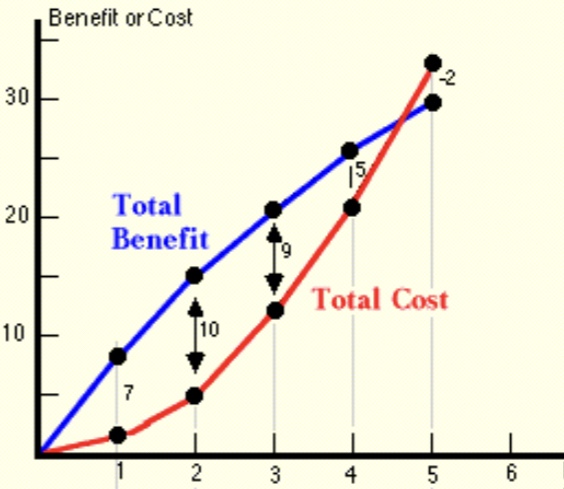
One can think of the benefits curve as representing gains from forcing individuals, via lockdown measures, to internalize the external costs of risk inflicted on others. However, this curve captures only benefits incremental to those achieved through voluntary action. Thus, NPI benefits include only extra gains from coercing individuals to internalize risks, while losses from NPI stringency are captured by the cost curve.

My contention is that the benefits of stringency diminish and may in fact turn down at some point, and that costs always increase in the level of stringency. In the chart, for what it’s worth, the “optimal” level of stringency would be at a value of 2, where the difference between total benefits and total costs is maximized (and where the benefits of incremental stringency are equal to the marginal costs or losses). However, I am not convinced that the benefits of lockdown measures ever exceed costs, as they do in the chart above. That is, voluntary action may be sufficient. But if the benefits of NPIs do exceed costs, it’s likely to be only at low levels of stringency.

To the extent that people are aware of the pandemic and recognize risk, the external costs of possible infectiousness are already internalized to some degree. Moreover, there is mutual risk in most interactions, and all individuals face risks that are proportional to those to which they expose others: if your contacts are more varied and your interactions are more frequent and intimate, you face correspondingly higher risks yourself. After all, in a pandemic, an individual’s failure to exercise caution may lead to a very hard internalization of costs if an infection strikes them. This mutuality is an element absent from most situations involving externalities. And to the extent that you take voluntary precautions, you and your contacts both benefit. Nevertheless, I concede that there are individuals who face less risk themselves (the young or healthy) but who might behave recklessly, and they might not internalize all risk for which they are responsible. Yes, stringency may have benefits, but that does not mean it has net benefits.

Even if there is some meaningful point at which NPIs are “optimized”, government does not possess the knowledge required to find that point. It lacks detailed knowledge of both costs and benefits of NPIs. This is a manifestation of the “knowledge problem” articulated by Friedrich Hayek, which hampers all efforts at central planning. In contrast, individual actors know their own tolerance for risk, and they surely have some sense of the risks they create in their normal course of affairs. And again, there is a strong degree of proportionality and voluntary internalization of mutual risks.

While relying on voluntary action is economically inefficient relative to an ideal, full-information and perfectly altruistic solution, it is at least based on information that individuals possess: their own risk profile and risk preferences. In contrast, government does not possess information necessary to impose rules in an optimal way, and those rules are rife with unintended consequences and costs inflicted on individuals.

My next post will present empirical evidence of the weakness of lockdown measures in curbing the coronavirus as well as the high costs of those measures. The coronavirus is a serious infection, but it is not terribly deadly or damaging to the longer-term health of the vast majority of people. This, in and of itself, should be sufficient to demonstrate that the array of non-pharmaceutical interventions imposed in the U.S. and abroad were and are not worthwhile. People are capable of assessing risks for themselves. The externality argument, that NPIs are necessary because people do not adequately assess the risk they pose to others, relies on an authority’s ability to assess that risk, and they invariably go overboard on interventions for which they underestimate costs. COVID is not serious enough to justify a surrender of our constitutional rights, and like every concession to government authority, those rights will be difficult to recover.

Cuomo Denies Tradeoffs, Cries Scarcity

12 Tuesday May 2020

Posted by Nuetzel in Pandemic, statism, Virtue Signaling

≈ 1 Comment

Tags

Andrew Cuomo, BMI, Coronavirus, Cost-Benefit Analysis, Covid-19, Economic Value of Life, European Virus, Javits Center, Lockdown, New York Virus, Shadow Price, statism, The Nation, Ventilators, Who Shall Live?, Wuhan Virus

Here’s an all-time dumbass bromide: “If it saves only one life, it’s worth it.” New York Governor Andrew Cuomo said it last week in a bit of sanctimonious posturing intended for consumption by the unthinking. A variant on this is, “You can’t put a value on a human life,” and Cuomo said that too. But of course we do that every day. Yes, we weigh lives against costs, and we must. Each and every decision involving any personal or public health risk entails an implicit and sometimes explicit valuation of human life. There are few costless decisions in a world of scarce resources, and lives are often one of those costs. These might be matters of probability in an ex ante sense, which might make it more palatable. Ex post, they add up to real lives.

Imagine a world in which we spared no expense to save lives. We’d shift massive resources into health care to the detriment of all production and consumption that does not save lives. No precaution would be too conservative. No driving or biking, because those prohibitions would save many lives. Many risky construction and maintenance jobs would be off limits. No smoking, of course, and no drinking! No chips! Every BMI greater than 25 and you’re off to mandatory fat camp. Sadly, the effort to save a life is sometimes fruitless, but as long as there’s a chance, we’d try and try, providing mechanical life support to every patient hanging on by a tattered thread. No, we don’t do these things because it’s too damn costly.

We face an infinite number of tradeoffs in medical care and in public health more generally. The question “Who Shall Live?” must be answered every day when deciding how health care resources are to be allocated. No matter how you answer that question, certain lives will be lost as the cost of meeting your preferred medical objectives. You can’t meet them all. Resources are scarce — or in more everyday language, budgets are tight.

So human life is often assigned an implicit or shadow value in decision making. But even explicit assignment of economic value to human life is not uncommon. Valuing lives is a standard practice in cost-benefit analysis. It’s also quite common for life values to be estimated as part of forensic analyses in support of legal proceedings.

Andrew Cuomo surely knows all this. That makes his statements all the more disingenuous. This article in The Nation from the end of March implies that Cuomo has valued life all too cheaply in light of his past budget proposals for health care programs. Along the same lines, see this eye-opening critique of the policies Cuomo has pursued that left NY poorly prepared for a pandemic. And now, he’d like to keep his costly lockdown order in place even if it saves “just one life”.

Beyond all that, Cuomo is a stupendous hypocrite, asserting that life is too precious to spare any expense after signing an order in March requiring nursing homes to accept individuals with active Covid infections. Nursing homes have been the very hottest of spots for Covid infections and deaths, so the order was glaringly dismissive in valuing the lives of vulnerable nursing home residents. The rationale for the order was to save hospital beds, but there was no shortage. 

In fairness, Cuomo was also clamoring for assistance to add hospital capacity. Millions were spent to convert the Javits Center to a temporary field hospital and to bring a U.S. Navy hospital ship up the Hudson, but they went almost completely unused. Why not send the elderly patients there, instead of back to the nursing homes?

Finally, he pouted for weeks about his state’s shortage of ventilators, only to quickly reverse course as it became apparent that the state had a surplus of ventilators.

Recently, Cuomo felt it necessary to demonstrate his anti-Western bona fides by labeling the coronavirus the “European Virus“. He must think that’s a clever poke in the eye to those who prefer “Wuhan Virus”, though it is quite correct (and not the least bit “racist”) to note that the virus originated in Wuhan, China. For what it’s worth, the genome of the European strain, like the others that hit New York, differs by less than 12 out of 30,000 base-pairs of DNA from the original Wuhan strain. And of course the New York metropolitan area has made a massive contribution to the U.S. case load and death toll from the virus. Travelers from New York did much to spread Covid-19 to the rest of the country. So, as some have suggested, perhaps a better name might be “New York Virus”.

Andrew Cuomo is nothing if not a politician, and I suppose he’s just behaving like one. I probably wouldn’t gripe were it not for the minions who fall for Cuomo’s sham virtue. But it’s worse than that: the claim that public intervention at any cost is worthwhile if it saves “just one life” is a deeply statist sentiment.

Follow Sacred Cow Chips on WordPress.com

Recent Posts

  • Immigration and Merit As Fiscal Propositions
  • Tariff “Dividend” From An Indigent State
  • Almost Looks Like the Fed Has a 3% Inflation Target
  • Government Malpractice Breeds Health Care Havoc
  • A Tax On Imports Takes a Toll on Exports

Archives

  • December 2025
  • November 2025
  • October 2025
  • September 2025
  • August 2025
  • July 2025
  • June 2025
  • May 2025
  • April 2025
  • March 2025
  • February 2025
  • January 2025
  • December 2024
  • November 2024
  • October 2024
  • September 2024
  • August 2024
  • July 2024
  • June 2024
  • May 2024
  • April 2024
  • March 2024
  • February 2024
  • January 2024
  • December 2023
  • November 2023
  • August 2023
  • July 2023
  • June 2023
  • May 2023
  • April 2023
  • March 2023
  • February 2023
  • January 2023
  • December 2022
  • November 2022
  • October 2022
  • September 2022
  • August 2022
  • July 2022
  • June 2022
  • May 2022
  • April 2022
  • March 2022
  • February 2022
  • January 2022
  • December 2021
  • November 2021
  • October 2021
  • September 2021
  • August 2021
  • July 2021
  • June 2021
  • May 2021
  • April 2021
  • March 2021
  • February 2021
  • January 2021
  • December 2020
  • November 2020
  • October 2020
  • September 2020
  • August 2020
  • July 2020
  • June 2020
  • May 2020
  • April 2020
  • March 2020
  • February 2020
  • January 2020
  • December 2019
  • November 2019
  • October 2019
  • September 2019
  • August 2019
  • July 2019
  • June 2019
  • May 2019
  • April 2019
  • March 2019
  • February 2019
  • January 2019
  • December 2018
  • November 2018
  • October 2018
  • September 2018
  • August 2018
  • July 2018
  • June 2018
  • May 2018
  • April 2018
  • March 2018
  • February 2018
  • January 2018
  • December 2017
  • November 2017
  • October 2017
  • September 2017
  • August 2017
  • July 2017
  • June 2017
  • May 2017
  • April 2017
  • March 2017
  • February 2017
  • January 2017
  • December 2016
  • November 2016
  • October 2016
  • September 2016
  • August 2016
  • July 2016
  • June 2016
  • May 2016
  • April 2016
  • March 2016
  • February 2016
  • January 2016
  • December 2015
  • November 2015
  • October 2015
  • September 2015
  • August 2015
  • July 2015
  • June 2015
  • May 2015
  • April 2015
  • March 2015
  • February 2015
  • January 2015
  • December 2014
  • November 2014
  • October 2014
  • September 2014
  • August 2014
  • July 2014
  • June 2014
  • May 2014
  • April 2014
  • March 2014

Blogs I Follow

  • Passive Income Kickstart
  • OnlyFinance.net
  • TLC Cholesterol
  • Nintil
  • kendunning.net
  • DCWhispers.com
  • Hoong-Wai in the UK
  • Marginal REVOLUTION
  • Stlouis
  • Watts Up With That?
  • Aussie Nationalist Blog
  • American Elephants
  • The View from Alexandria
  • The Gymnasium
  • A Force for Good
  • Notes On Liberty
  • troymo
  • SUNDAY BLOG Stephanie Sievers
  • Miss Lou Acquiring Lore
  • Your Well Wisher Program
  • Objectivism In Depth
  • RobotEnomics
  • Orderstatistic
  • Paradigm Library
  • Scattered Showers and Quicksand

Blog at WordPress.com.

Passive Income Kickstart

OnlyFinance.net

TLC Cholesterol

Nintil

To estimate, compare, distinguish, discuss, and trace to its principal sources everything

kendunning.net

The Future is Ours to Create

DCWhispers.com

Hoong-Wai in the UK

A Commonwealth immigrant's perspective on the UK's public arena.

Marginal REVOLUTION

Small Steps Toward A Much Better World

Stlouis

Watts Up With That?

The world's most viewed site on global warming and climate change

Aussie Nationalist Blog

Commentary from a Paleoconservative and Nationalist perspective

American Elephants

Defending Life, Liberty and the Pursuit of Happiness

The View from Alexandria

In advanced civilizations the period loosely called Alexandrian is usually associated with flexible morals, perfunctory religion, populist standards and cosmopolitan tastes, feminism, exotic cults, and the rapid turnover of high and low fads---in short, a falling away (which is all that decadence means) from the strictness of traditional rules, embodied in character and inforced from within. -- Jacques Barzun

The Gymnasium

A place for reason, politics, economics, and faith steeped in the classical liberal tradition

A Force for Good

How economics, morality, and markets combine

Notes On Liberty

Spontaneous thoughts on a humble creed

troymo

SUNDAY BLOG Stephanie Sievers

Escaping the everyday life with photographs from my travels

Miss Lou Acquiring Lore

Gallery of Life...

Your Well Wisher Program

Attempt to solve commonly known problems…

Objectivism In Depth

Exploring Ayn Rand's revolutionary philosophy.

RobotEnomics

(A)n (I)ntelligent Future

Orderstatistic

Economics, chess and anything else on my mind.

Paradigm Library

OODA Looping

Scattered Showers and Quicksand

Musings on science, investing, finance, economics, politics, and probably fly fishing.

  • Subscribe Subscribed
    • Sacred Cow Chips
    • Join 128 other subscribers
    • Already have a WordPress.com account? Log in now.
    • Sacred Cow Chips
    • Subscribe Subscribed
    • Sign up
    • Log in
    • Report this content
    • View site in Reader
    • Manage subscriptions
    • Collapse this bar
 

Loading Comments...