• About

Sacred Cow Chips

Sacred Cow Chips

Tag Archives: Debt Monetization

The Case Against Interest On Reserves

05 Monday Jan 2026

Posted by Nuetzel in Interest Rates, Monetary Policy

≈ Leave a comment

Tags

Ample Reserves, Basel III, Brian Wesbury, Capital Requirementd, Debt Monetization, Dodd-Frank, Fed Independence, Federal Reserve, Interbank Borrowing, Interest on Reserves, John Cochrane, Modern Monetary Theory, Nationalization, Nominal GDP Targeting, Operation Twist, Quantitative Easing, Reserve Requirements, Scarce Reserves, Scott Sumner, Socialized Risk
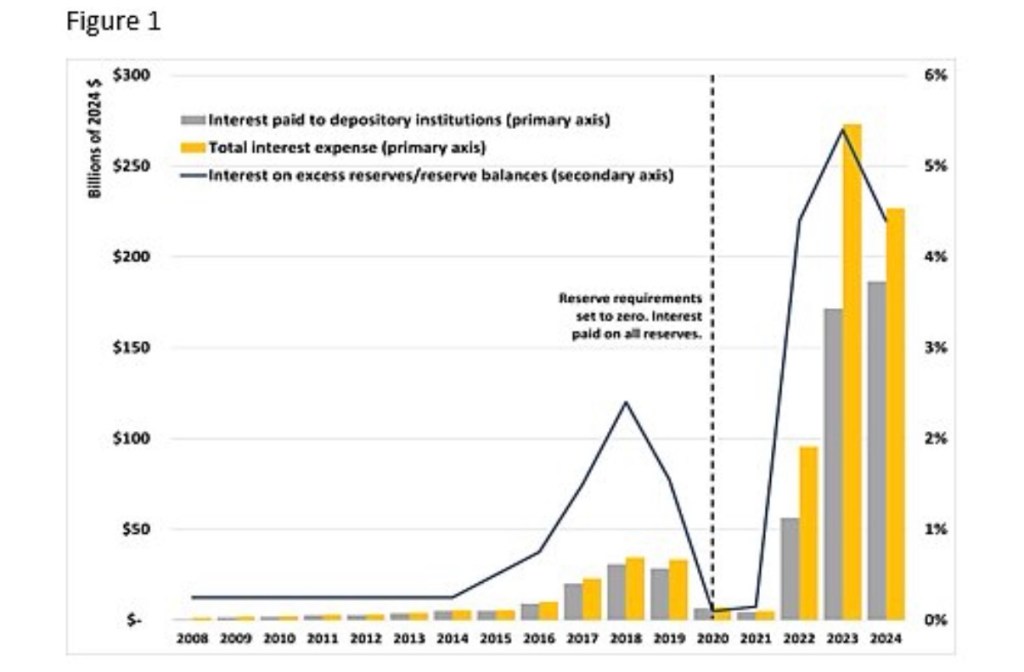
This topic flared up in 2025, with legislation proposing to end the Federal Reserve’s payment of interest on bank reserves (IOR). The bills have not yet advanced in Congress, however. As a preliminary on IOR and its broader implications, consider two hypotheticals:

First, imagine banks that take deposits, make loans, and invest in assets like government securities (i.e., Treasury debt). Banks are required to hold some percentage of reserves against their deposits at the central bank (the Fed), but the reserves earn nothing.

Now consider a world in which the Fed pays banks a risk-free interest rate on reserves. Banks will opt to hold plentiful reserves and relatively less in Treasuries. But in this scenario, the Fed itself holds large amounts of Treasuries and other securities, earns interest, and in turn pays interest to banks on their reserves.

The first scenario held sway in the U.S. until 2008, when Congress authorized the Fed to pay IOR. Since that time, we’ve had the second scenario: the IOR monetary order.

Socialized Risk

The central bank can basically print money, so there is no danger that banks won’t be paid IOR, despite some risk inherent in assets held by the Fed in its portfolio. While the rate paid on reserves can change, and banks are paid IOR every 14 days, they do not face the rate risk (and a modicum of default risk) inherent in holding Treasuries and mortgage securities, which have varying maturities. Instead, the Fed and ultimately taxpayers shoulder that risk, despite the Fed’s assurances that any portfolio losses and negative net interest income are economically irrelevant. These risks have been socialized, so we now share them.

This means that an essential function of the banking system, assessing and rationally pricing risks associated with certain assets, has been nationalized. It is a suspension of the market mechanism and an invitation to misallocated capital. Why bother to critically assess the risks inherent in assets if the Fed is happy to take them off your hands, possibly at a small premium, and then pay you a risk-free return on your cash to boot.

Bank Subsidies

IOR is a subsidy to banks. They get a return with zero risk, while taxpayers provide a funding bridge for any losses on the Fed’s holdings of securities on its balance sheet or any shortfall in the Fed’s net interest income. Banks, however, can’t lose money on their ample reserves.

The subsidy may come at a greater cost to some banks than others. This regime has been accompanied by significantly more regulation of bank balance sheets, such as capital and liquidity requirements (Basel III and Dodd-Frank). Not only is IOR a significant step toward nationalizing banks, but the attendant regulatory regime tends to favor large banks.

On the other hand, zero IOR with a positive reserve requirement amounts to a tax on banks, which is ultimately paid by bank customers. Allowing banks to hold zero reserves is out of the question, so we could view the implicit reserve-requirement tax as a cost of achieving some monetary stability and promoting safer depository institutions.

Quantitative Easing

Again, the advent of IOR created an incentive for banks to hold more reserves and relatively less in Treasuries and other assets (even some loans). Rather than “scarce reserves”, banks were encouraged by IOR to hold “ample reserves”. Of course, this is thought to promote stability and a safer banking system, but as Scott Sumner notes, it represents a contractionary policy owing to the increase in the demand for base money (reserves) by banks.

The Fed took up the slack in the debt markets, buying mortgage-backed securities and Treasuries for its own portfolio in large amounts. That kind of expansion in the Fed’s balance sheet is called quantitative easing (QE). which adds to the money supply as the Fed pays for the assets.

QE helped to neutralize the contractionary effect of IOR. And QE itself can be neutralized by other measures, including regulations governing bank capital and liquidity levels.

Fed Balance Sheet Policies

QE can’t go on forever… or can it? Perhaps no more than expanding federal deficits can go on forever! The Fed’s balance sheet topped out in 2022 at about $9 trillion. It stood at just over $6.5 trillion in November 2025.

Quantitative tightening (QT) occurs when the Fed sells assets or allows run-off in its portfolio as securities mature. Nevertheless, the Fed’s mere act of holding large amounts of debt securities (whether accompanied by QE, QT, or stasis) is essentially part of the ample reserves/IOR monetary regime: without it, the demand for debt securities would be undercut (because banks get a sweeter deal from the Fed, and so disintermediation occurs).

In terms of monetary stimulus, QE was more or less offset during the financial crisis leading into the Great Recession via higher demand for bank reserves (IOR) and stricter banking regulation. Higher capital requirements were justified as necessary to stabilize the financial system, but critics like Brian Wesbury stress that the real destabilizing culprit was mark-to-market valuation requirements.

During the Covid pandemic, however, aggressive QE was intended to stabilize the economy and was not neutralized, so the Fed’s balance sheet and the money supply expanded dramatically. A surge in inflation followed.

Rates and Monetary Policy

The IOR regime severs the connection between overnight rates and monetary policy, while artificially fixing the price of reserves. There is little interbank borrowing of reserves under this “ample reserves” policy. But if there is little or no volume, what’s the true level of the Fed funds rate? Some critics (like Wesbury) claim it’s basically made up by the Fed! In any case, there is no longer any real connection between the fed funds rate and the tenor of monetary policy.

Instead, the rate paid to banks on reserves essentially sets a floor on short-term interest rates. And whenever the Fed seeks to tighten policy via IOR rate actions, it faces a potential loss on its interest spread. That represents a conflict of interest for Fed policymaking.

Sumner dislikes the IOR arrangement because, he say, it reinforces the false notion that interest rates are key to understanding monetary policy. For example, higher short-term rates are not always consistent with lower inflation. Sumner prefers controlling the monetary base as a means of targeting the level of nominal GDP, allowing interest rates to signal reserve scarcity. All of that is out of the question as long as the Fed is manipulating the IOR rate.

The Fed As Treasury Lapdog

With IOR and ample reserves, the Fed’s management of a huge portfolio of securities puts it right in the middle of the debt market across a range of maturities. As implied above, that distorts pricing and creates tension between fiscal policy and “independent” monetary policy. Such tension is especially troubling given ongoing, massive federal deficits and increasing Administration pressure on the Fed to reduce rates.

Of course, when the Fed engages in QE, or actively turns over and replaces its holdings of maturing Treasuries with new ones, it is monetizing deficits and creating inflationary pressure. It’s one kind of money printing, the mechanism by which an inflation tax is traditionally understood to reduce the real value of federal debt.

The IOR monetary regime is not the first time the Fed has intervened in the debt markets at longer maturities. In 1961, the Fed ran “Operation Twist”, selling short-term Treasuries and buying long-term Treasuries in an effort to reduce long-term rates and stimulate economic activity. However, the operation did not result in an increase in the Fed’s balance sheet holdings and cannot be interpreted as debt monetization.

Fed Adventurism

The Fed earned positive net interest income from 2008-2023, enabling it to turn over profits to the Treasury. This had a negative effect on federal deficits. However, some contend that the Fed’s net interest income over those years fostered mission creep. Wesbury notes that the Fed dabbled in “… research on climate change, lead water pipes and all kinds of other issues like ‘inequality’ and ‘racism.’” These topics are far afield of the essential functions of a central bank, monetary authority, or bank regulator. One can hope that keeping the Fed on a tight budgetary leash by ending the IOR monetary regime would limit this kind of adventurism.

A Contrary View

John Cochrane insists that IOR is a “lovely innovation”. In fact, he wonders whether the opposition to IOR is grounded in nostalgic, Trumpian hankering for zero interest rates. Cochrane also asserts that IOR is “usually” costless because longer-term rates on the Fed’s portfolio tend to exceed the short-term rate earned on reserves. That’s not true at the moment, of course, and the value of securities in the Fed’s portfolio tanked when interest rates rose. The Fed treats the shortfall in net interest as an increment to a “deferred asset”, but the negative profit, in the interim, must be met by taxpayers (who would normally benefit from the Fed’s profit) or printing money. The Fed shoulders ongoing interest-rate risk, freeing banks of the same to the extent that they hold reserves. Again, this subsidy has a real cost.

I’m surprised that Cochrane doesn’t see the strong potential for monetary lapdoggery under the IOR regime. Sure, the Fed can always print money and load up on new issues of Treasury debt. But IOR and an ongoing “quantitative” portfolio create an institutional bias toward supporting fiscal incontinence.

I’m also surprised that Cochrane would characterize an attempt to end IOR as easier monetary policy. Such a change would be accompanied by an unwinding of the Fed’s mammoth portfolio (QT). That might or might not mean tighter policy, on balance. Such an unwinding would be neutralized by lower demand for bank reserves and a lighter regulatory touch, and it should probably be phased in over several years.

Conclusion

Norbert Michel summarizes the problems created by IOR (the chart at the top of this post is from Michel). Here is a series of bullet points from his December testimony before the Senate Homeland Security and Governmental Affairs Committee (no quote marks below, as I paraphrase his elaborations):

  • The economic cost of the Fed’s losses is high. Periodic or even systemic failures to turn profits over to the Treasury means more debt, taxes, or inflation.
  • The IOR framework creates a conflict of interest with the Fed’s mandate to stabilize prices. The IOR rate set by the Fed has an impact on its profitability, which can be inconsistent with sound monetary policy actions.
  • The IOR system facilitates government support for the private financial sector. Banks get a risk-free return and the Fed acquiesces to bearing rate risk.
  • More accessible money spigot. The Fed can buy and hold Treasury debt, helping to fund burgeoning deficits, while paying banks to hold the extra cash that creates.

The money spigot enables wasteful expansion of government. Unfortunately, far too many partisans are under the delusion that more government is the solution to every problem, rather than the root cause of so much dysfunction. And of course advocates of so-called Modern Monetary Theory are all for printing the money needed to bring about the “warmth of collectivism”.
It’s a Big Government Mess

22 Tuesday Nov 2022

Posted by Nuetzel in Big Government, Uncategorized

≈ 1 Comment

Tags

Campaign Spending, Carbon Footprint, central planning, Climate Risk, Compliance Costs, Cronyism, Debt Monetization, dependency, Diversity, Do-Somethingism, External Costs, Fiscal Illusion, Limited government, Malinvestment, monopoly, Price Controls, Public goods, Redistribution, Regulatory Capture, rent seeking, Wetlands, Willingness To Pay

I’m really grateful to have the midterm elections behind us. Well, except for the runoff Senate race in Georgia, the cockeyed ranked-choice Senate race in Alaska, and a few stray House races that remain unsettled after almost two weeks. I’m tired of campaign ads, including the junk mail and pestering “unknown” callers — undoubtedly campaign reps or polling organizations.

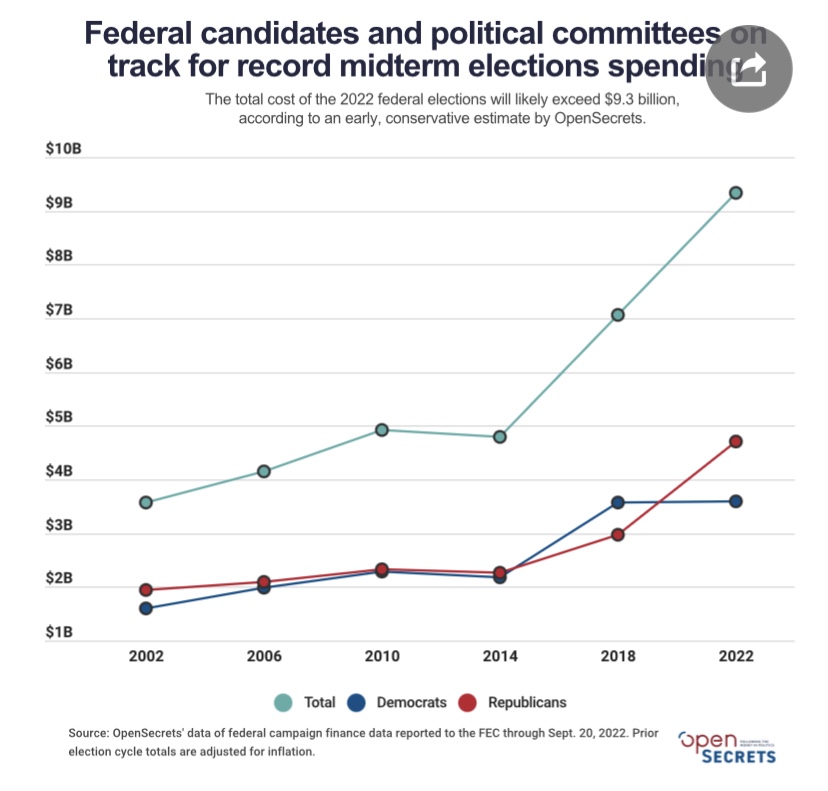
It’s astonishing how much money is donated and spent by political campaigns. This year’s elections saw total campaign spending (all levels) hit $16.7 billion, a record for a mid-term. The recent growth in campaign spending for federal offices has been dramatic, as the chart below shows:

Do you think spending of a few hundred million dollars on a Senate campaign is crazy? Me too, though I don’t advocate for legal limits on campaign spending because, for better or worse, that issue is entangled with free speech rights. Campaigns are zero-sum events, but presumably a big donor thinks a success carries some asymmetric reward…. A success rate of better than 50% across several campaigns probably buys much more…. And donors can throw money at sure political bets that are probably worth a great deal…. Many donors spread their largess across both parties, perhaps as a form of “protection”. But it all seems so distasteful, and it’s surely a source of waste in the aggregate.

My reservations about profligate campaign spending include the fact that it is a symptom of big government. Donors obviously believe they are buying something that government, in one way or another, makes possible for them. The greater the scope of government activity, the more numerous are opportunities for rent seeking — private gains through manipulation of public actors. This is the playground of fascists!

There are people who believe that placing things in the hands of government is an obvious solution to the excesses of “greed”. However, politicians and government employees are every bit as self-interested and “greedy” as actors in the private sector. And they can do much more damage: government actors legally exercise coercive power, they are not subject in any way to external market discipline, and they often lack any form of accountability. They are not compelled to respect consumer sovereignty, and they make correspondingly little contribution to the nation’s productivity and welfare.

Actors in the private sector, on the other hand, face strong incentives to engage in optimizing behavior: they must please customers and strive to improve performance to stay ahead of their competition. That is, unless they are seduced by what power they might have to seek rents through public sector activism.

A people who grant a wide scope of government will always suffer consequences they should expect, but they often proceed in abject ignorance. So here is my rant, a brief rundown on some of the things naive statists should expect to get for their votes. Of course, this is a short list — it could be much longer:

  • Opportunities for graft as bureaucrats administer the spending of others’ money and manipulate economic activity via central planning.
  • A ballooning and increasingly complex tax code seemingly designed to benefit attorneys, the accounting profession, and certainly some taxpayers, but at the expense of most taxpayers.
  • Subsidies granted to producers and technologies that are often either unnecessary or uneconomic (and see here), leading to malinvestment of capital. This is often a consequence of the rent seeking and cronyism that goes hand-in-hand with government dominance and ham-handed central planning.
  • Redistribution of existing wealth, a zero- or even negative-sum activity from an economic perspective, is prioritized over growth.
  • Redistribution beyond a reasonable safety net for those unable to work and without resources is a prescription for unnecessary dependency, and it very often constitutes a surreptitious political buy-off.
  • Budgetary language under which “budget cuts” mean reductions in the growth of spending.
  • Large categories of spending, known in the U.S. as non-discretionary entitlements, that are essentially off limits to lawmakers within the normal budget appropriations process.
  • “Fiscal illusion” is exploited by politicians and statists to hide the cost of government expansion.
  • The strained refrain that too many private activities impose external costs is stretched to the point at which government authorities externalize internalities via coercive taxes, regulation, or legal actions.
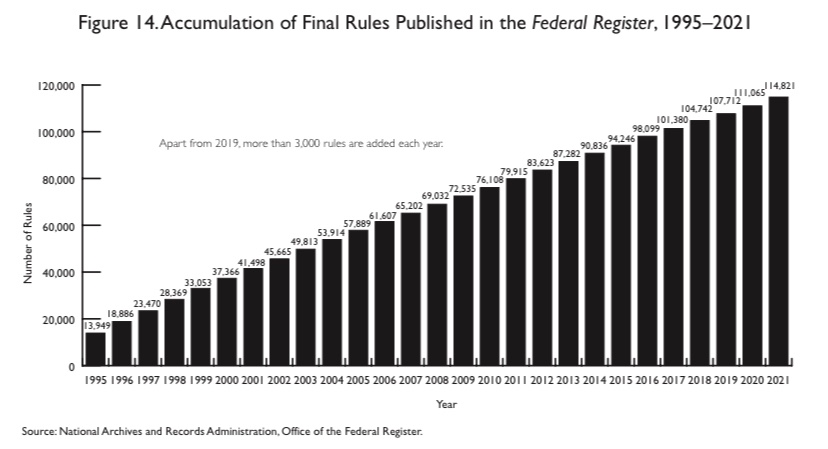
  • Massive growth in regulation (see chart at top) extending to puddles classified as wetlands (EPA), the ”disparate impacts” of private hiring practices (EEOC), carbon footprints of your company and its suppliers (EPA, Fed, SEC), outrageous energy efficiency standards (DOE), and a multiplicity of other intrusions.
  • Growth in the costs of regulatory compliance.
  • A nearly complete lack of responsiveness to market prices, leading to misallocation of resources — waste.
  • Lack of value metrics for government activities to gauge the public’s “willingness to pay”.
  • Monopoly encouraged by regulatory capture and legal / compliance cost barriers to competition. Again, cronyism.
  • Monopoly granted by other mechanisms such as import restrictions and licensure requirements. Again, cronyism.
  • Ruination of key industries as government control takes it’s grip.
  • Shortages induced by price controls.
  • Inflation and diminished buying power stoked by monetized deficits, which is a long tradition in financing excessive government.
  • Malinvestment of private capital created by monetary excess and surplus liquidity.
  • That malinvestment of private capital creates macroeconomic instability. The poorly deployed capital must be written off and/or reallocated to productive uses at great cost.
  • Funding for bizarre activities folded into larger budget appropriations, like holograms of dead comedians, hamster fighting experiments, and an IHOP for a DC neighborhood.
  • A gigantic public sector workforce in whose interest is a large and growing government sector, and who believe that government shutdowns are the end of the world.
  • Attempts to achieve central control of information available to the public, and the quashing of dissent, even in a world with advanced private information technology. See the story of Hunter Biden’s laptop. This extends to control of scientific narratives to ensure support for certain government programs.
  • Central funding brings central pursestrings and control. This phenomenon is evident today in local governance, education, and science. This is another way in which big government fosters dependency.
  • Mission creep as increasing areas of economic activity are redefined as “public” in nature.
  • Law and tax enforcement, security, and investigative agencies pressed into service to defend established government interests and to compromise opposition.

I’ve barely scratched the surface! Many of the items above occur under big government precisely because various factions of the public demand responses to perceived problems or “injustices”, despite the broader harms interventions may bring. The press is partly responsible for this tendency, being largely ignorant and lacking the patience for private solutions and market processes. And obviously, those kinds of demands are a reason government gets big to begin with. In the past, I’ve referred to these knee-jerk demands as “do somethingism”, and politicians are usually too eager to play along. The squeaky wheel gets the oil.

I mentioned cronyism several times in the list. The very existence of broad public administration and spending invites the clamoring of obsequious cronies. They come forward to offer their services, do large and small “favors”, make policy suggestions, contribute to lawmakers, and to offer handsomely remunerative post-government employment opportunities. Of course, certaIn private parties also recognize the potential opportunities for market dominance when regulators come calling. We have here a perversion of the healthy economic incentives normally faced by private actors, and these are dynamics that gives rise to a fascist state.

It’s true, of course, that there are areas in which government action is justified, if not necessary. These include pure public goods such as national defense, as well as public safety, law enforcement, and a legal system for prosecuting crimes and adjudicating disputes. So a certain level of state capacity is a good thing. Nevertheless, as the list suggests, even these traditional roles for government are ripe for unhealthy mission creep and ultimately abuse by cronies.

The overriding issue motivating my voting patterns is the belief in limited government. Both major political parties in the U.S. violate this criterion, or at least carve out exceptions when it suits them. I usually identify the Democrat Party with statism, and there is no question that democrats rely far too heavily on government solutions and intervention in private markets. The GOP, on the other hand, often fails to recognize the statism inherent in it’s own public boondoggles, cronyism, and legislated morality. In the end, the best guide for voting would be a political candidate’s adherence to the constitutional principles of limited government and individual liberty, and whether they seem to understand those principles. Unfortunately, that is often too difficult to discern.

The Fed’s Balance Sheet: What’s the Big Deal?

08 Sunday May 2022

Posted by Nuetzel in Government Failure, Inflation, Monetary Policy

≈ Leave a comment

Tags

Allocation of Capital, Bank Reserves, crowding out, Debt Monetization, Fed Balance Sheet, Federal Funds, Federal Reserve, Fiscal Inflation, Inflation tax, Interest Rate Targeting, MBS, Monetary policy, Mortgage Backed Securities, QE, Quantitative Easing, Scarcity, Tapering

The Federal Reserve just announced tighter monetary policy in an attempt to reduce inflationary pressures. First, it raised its target range for the federal funds rate (on overnight loans between banks) by 0.5%. The new range is 0.75% – 1%. Second, on June 1, the Fed will begin taking steps to reduce the size of its $9 trillion portfolio of securities. These holdings were acquired during periods of so-called quantitative easing (QE) beginning in 2008, including dramatic expansions in 2020-21. A shorthand reference for this portfolio is simply the Fed’s “balance sheet”. It includes government debt the Fed has purchased as well as privately-issued mortgage-backed securities (MBS).

What Is This Balance Sheet You Speak Of?

Talk of the Fed’s balance sheet seems to mystify lots of people. During the 2008 financial crisis, the Fed began to inject liquidity into the economy by purchasing large amounts of assets to be held on its balance sheet. This was QE. It’s scope was unprecedented and a departure from the Fed’s pre-crisis reliance on interest rate targeting. QE had the effect of increasing bank reserves, which raised the possibility of excessive money supply growth. That’s when the Fed began to pay interest to banks on reserves, so they might be content to simply hold some of the reserves over and above what they are required to hold, rather than using all of that excess to support new loans and deposits (and thus money growth). However, that interest won’t stop banks from lending excess reserves if better opportunities present themselves.

The Fed has talked about reducing, “normalizing”, or “tapering” its balance sheet for some time, but it only recently stopped adding to it. With inflation raging and monetary policy widely viewed as too “dovish”, analysts expected the Fed to stop reinvesting proceeds from maturing securities, which amounts to about $95 billion per month. That would shrink or “taper” the balance sheet at a rate of about $1.1 trillion per year. Last week the Fed decided to cap the “runoff” at $47.5 billion per month for the first three months, deferring the $95 billion pace until September. Monetary policy “hawks” were disappointed by this announcement.

Monetizing Government

So, one might ask, what’s the big deal? Why must the Fed taper its securities holdings? Well, first, the rate of inflation is far above the Fed’s target range, and it’s far above the “average Joe’s” comfort range. Inflation imposes significant costs on the economy and acts as a regressive form of taxation, harming the poor disproportionately. To the extent that the Fed’s huge balance sheet (and the corresponding bank reserves) are supporting incremental money growth and fueling inflation, the balance sheet must be reduced.

In that connection, the Fed’s investment in government debt represents monetized federal debt. That means the Fed is essentially printing money to meet the Treasury’s financing needs. Together with profligate spending by the federal government, nothing could do more to convince investors that government debt will never be repaid via future budget surpluses. This dereliction of the government’s “full faith and credit”, and the open-armed acceptance of the inflation tax as a financing mechanism (à la Modern Monetary Theory), is the key driver of fiscal inflation. Reducing the balance sheet would represent de-monetization, which might help to restore faith in the Fed’s ability to push back against fiscal recklessness.

Buyer of First Resort

Perhaps just as critically, the Fed’s heavy investment in government debt and MBS represents an ongoing distortion to the pricing of financial assets and the allocation of capital. Some call this interference in the “price discovery process”. That’s because the Fed has represented a market-altering presence, a willing and inelastic buyer of government debt and MBS. Given that presence, it’s difficult for buyers and sellers to discern the true values of alternative uses of capital, or to care.

QE was, among other things, a welcome institutional development for the U.S. Treasury and for those who fancy that fresh money printing is an ever-valid form of government payment for scarce resources. The Fed’s involvement also means that other potential buyers of Treasury debt need not worry about interest rate risk, making public debt relatively more attractive than private debt. This is a dimension of the “crowding out” phenomenon, whereby the allocation of capital and flows of real resources between public and private uses are distorted.

The Fed’s presence as a buyer of MBS depresses mortgage rates and makes mortgage lending less risky for lenders and investors. As a result, it encourages an over-investment in housing and escalating home prices. This too distorts the allocation of capital and real resources, at the margin, toward housing and away from uses with greater underlying value.

Conclusion

The magnitude of the Fed’s balance sheet is an ongoing testament to an increasingly dominant role of central authorities in the economy. In this case, the Fed has served as a conduit for the inflation tax. In addition, it has unwittingly facilitated crowding out of private capital investment. The Fed’s purchases of MBS have distorted the incentives (and demand) for residential investment. These are subtle effects that the average citizen might not notice, just as one might not notice the early symptoms of a debilitating disease. The long-term consequences of the Fed’s QE activities, including the inflation tax and distorted allocations of capital, are all too typical of failures of government intervention and attempts at central planning. But don’t expect anyone at the Fed to admit it.

Fiat Money, Government and Culture

24 Wednesday Aug 2016

Posted by Nuetzel in Monetary Policy

≈ Leave a comment

Tags

Asset Price Inflation, Commercial Culture, Crony Culturalism, Debt Monetization, Distribution of Wealth, Federal Reserve Act, Fiat Money, Full Faith and Credit, Gresham's Law, Inflation, Jörg Guido Hülsmann, Mises Wire, Redeemability, Tyler Cowan

Partytime

The money we use every day has roughly zero intrinsic value. That includes paper, coins made from base metals, and electronic bookkeeping entries that can be drawn on via plastic cards and communication devices. We take it for granted that all of these forms of payment will be accepted in transactions. The dollars we use in the U.S. are backed only by the “full faith and credit” of the U.S. government, which is quite a bit of nothing when it comes right down to it. This form of money is called “fiat money” because it derives value essentially by decree, including the government’s willingness to accept your dollars in payment of taxes. It’s a fine thing that such a level of trust exists in society, and most important is trust that the next seller will accept your dollars in trade.

An old maxim in economics known as Gresham’s Law holds that “bad money drives out good”, particularly when the “good money” and the “bad money” are assigned the same legal value in exchange. The good money, having greater intrinsic value than the bad money, will quickly disappear from use as a medium of exchange. Like any asset, the good money will be held as a store of value, but not used in routine transactions.

In the past, our “good money” consisted mainly of claims on precious metals. However, the U.S. government stopped redeeming dollars in gold in the 1930s, silver in the 1960s, and silver coins stopped circulating at about the same time.

What’s so “bad” about fiat money, given that we trust its usefulness in the next transaction? The lack of intrinsic value places its issuing authority, the Federal Reserve in our case, in a position of tremendous power and responsibility as the keeper of the “full faith” of the U.S. government. However, the Fed is privately owned (by banks), and no one at the Fed is elected. The members of its Board of Governors are appointed by the President to 14-year terms. The lengthy terms are hoped to keep the Fed independent and immune to political manipulation. Ostensibly, the Fed conducts policy in the objective pursuit of price stability and full employment. (Never mind that the two goals may be incompatible.)

The Fed, as the authority responsible for the nation’s fiat money, has traditionally allowed the money supply to grow by issuing “new money” in exchange for federal debt obligations, like Treasury bonds. The Fed buys the bonds, and the payment becomes a seed for new money growth. For the Treasury, which raises funds to finance government activities by collecting taxes and borrowing, this mechanism is quite convenient. The Fed can act to “accommodate” the government’s needs, essentially printing money to fund deficits.

Does it happen? Absolutely, although in the past few years, the Fed has demonstrated a more subtle variation on this theme, and one that is cheaper for the government. That will be the subject of a future post. The key point here is that with the cooperation of the monetary authority, the government avails itself of the so-called printing press. Thus, it is not answerable to taxpayers for any expansion in its spending. The government can commandeer resources as it sees fit, with no restraint from the governed.

That’s the key point made by Jörg Guido Hülsmann in a post on the Mises Wire blog, “How Fiat Money Destroys Culture“. On that note, I’d say first that enabling the displacement of private commerce for government-directed activity is a sure-fire prescription for degrading the culture. Government is not and never will be a font of creativity. Capitalism and markets, on the other hand, deliver an astonishing degree of cultural wealth to every segment of society. The freedom to create and share art, cuisine, customs and technology, without interference by government, is the very essence of culture. Some might object that government often serves as a conduit for bringing cultural works to the public, and that government can and does direct resources to the arts. There is an extent to which that’s true, of course, but it may be a deal with the devil: public sector support for new art is often subject to strings, politicization, and favoritism. That’s crony culturalism, to coin a phrase.

Hülsmann discusses other cultural repercussions of fiat money. By enabling the government to compete for resources with the private sector, and by swelling the quantity of money relative to goods and assets, fiat money puts upward pressure on prices. This might manifest in the prices of goods, the prices of assets, or both, and it might be very uneven. This changes the distribution of rewards in society in fundamental ways.

Price inflation penalizes those who hold currency. Hülsmann says:

“In a free economy with a natural monetary system, there is a strong incentive to save money in the form of cash held under one’s immediate control. Investments in savings accounts or other relatively safe investments also play a certain role, but cash hoarding is paramount, especially among low-income families. … By contrast, when there is constant price inflation, as in a fiat-money system, cash hoarding becomes suicidal.“

Price inflation also rewards those in debt. Strictly speaking, this is true only when inflation accelerates unexpectedly, since lenders tend to demand sufficient interest to offset expected inflation. Hülsmann blames the widespread growth of debt financing in modern society on fiat currency. There is an element of truth to this assertion, but it strikes me as an exaggeration, given the advances in financial markets and technologies over the past century or so. We are much better at allocating resources inter-temporally than in 1900, for example, so the growth of consumer and business debt over the years should be viewed in the context of future earning power and enabling technology. Still, there are those for whom these markets and technologies are out of reach, and the destructive effect of inflation on their ability to save should not be minimized. This contributes to greater dependency at the lowest levels of the socioeconomic spectrum, a very regrettable kind of cultural change.

Growth of the money stock tends to reward many at the top of the socioeconomic spectrum, partly because it is associated with stock market appreciation. Again, when the Fed buys government bonds, or mortgage bonds, or any other asset, it always finds willing sellers, usually brokers/dealers and banks. Successful bidding by the Fed for assets is the first step in lifting asset prices (and reducing yields). But market participants tend to know all this in advance. Therefore, private traders will bid up asset prices in advance, assuming that the Fed has indicated its intentions. Other assets, being substitute vehicles for wealth accumulation, will also be bid upward, as a given amount of income produced by an asset is valued more highly when competing yields are low. After the Fed completes a round of asset purchases, the process can repeat itself.

Goods inflation and higher asset prices generated by continuing debt monetization and distorted interest rates tend to skew the distribution of wealth toward the top and away from the bottom. Moreover, if cost and pricing pressure build up in goods markets, those with the greatest market power always fare best. Thus, debt monetization has the potential to be a very inegalitarian process, and one not based on fundamental economic criteria such a productivity. This too represents a damaging form of cultural change.

A more accurate form of Gresham’s law might be the following: government ambition drives out “good money”. The existence of fiat money creates an avenue through which the expansion of government can be funded without approval by current or future taxpayers. This ultimately leads to a stagnant economic environment and a stagnant culture: government displaces private activity, the economy’s growth potential and vibrancy deteriorates, and society’s ability to support all forms of culture declines. To add insult to injury, the process of monetizing government debt punishes small savers and rewards the privileged. The distribution of cultural rewards will follow suit.

Follow Sacred Cow Chips on WordPress.com

Recent Posts

  • The Case Against Interest On Reserves
  • Immigration and Merit As Fiscal Propositions
  • Tariff “Dividend” From An Indigent State
  • Almost Looks Like the Fed Has a 3% Inflation Target
  • Government Malpractice Breeds Health Care Havoc

Archives

  • January 2026
  • December 2025
  • November 2025
  • October 2025
  • September 2025
  • August 2025
  • July 2025
  • June 2025
  • May 2025
  • April 2025
  • March 2025
  • February 2025
  • January 2025
  • December 2024
  • November 2024
  • October 2024
  • September 2024
  • August 2024
  • July 2024
  • June 2024
  • May 2024
  • April 2024
  • March 2024
  • February 2024
  • January 2024
  • December 2023
  • November 2023
  • August 2023
  • July 2023
  • June 2023
  • May 2023
  • April 2023
  • March 2023
  • February 2023
  • January 2023
  • December 2022
  • November 2022
  • October 2022
  • September 2022
  • August 2022
  • July 2022
  • June 2022
  • May 2022
  • April 2022
  • March 2022
  • February 2022
  • January 2022
  • December 2021
  • November 2021
  • October 2021
  • September 2021
  • August 2021
  • July 2021
  • June 2021
  • May 2021
  • April 2021
  • March 2021
  • February 2021
  • January 2021
  • December 2020
  • November 2020
  • October 2020
  • September 2020
  • August 2020
  • July 2020
  • June 2020
  • May 2020
  • April 2020
  • March 2020
  • February 2020
  • January 2020
  • December 2019
  • November 2019
  • October 2019
  • September 2019
  • August 2019
  • July 2019
  • June 2019
  • May 2019
  • April 2019
  • March 2019
  • February 2019
  • January 2019
  • December 2018
  • November 2018
  • October 2018
  • September 2018
  • August 2018
  • July 2018
  • June 2018
  • May 2018
  • April 2018
  • March 2018
  • February 2018
  • January 2018
  • December 2017
  • November 2017
  • October 2017
  • September 2017
  • August 2017
  • July 2017
  • June 2017
  • May 2017
  • April 2017
  • March 2017
  • February 2017
  • January 2017
  • December 2016
  • November 2016
  • October 2016
  • September 2016
  • August 2016
  • July 2016
  • June 2016
  • May 2016
  • April 2016
  • March 2016
  • February 2016
  • January 2016
  • December 2015
  • November 2015
  • October 2015
  • September 2015
  • August 2015
  • July 2015
  • June 2015
  • May 2015
  • April 2015
  • March 2015
  • February 2015
  • January 2015
  • December 2014
  • November 2014
  • October 2014
  • September 2014
  • August 2014
  • July 2014
  • June 2014
  • May 2014
  • April 2014
  • March 2014

Blogs I Follow

  • Passive Income Kickstart
  • OnlyFinance.net
  • TLC Cholesterol
  • Nintil
  • kendunning.net
  • DCWhispers.com
  • Hoong-Wai in the UK
  • Marginal REVOLUTION
  • Stlouis
  • Watts Up With That?
  • Aussie Nationalist Blog
  • American Elephants
  • The View from Alexandria
  • The Gymnasium
  • A Force for Good
  • Notes On Liberty
  • troymo
  • SUNDAY BLOG Stephanie Sievers
  • Miss Lou Acquiring Lore
  • Your Well Wisher Program
  • Objectivism In Depth
  • RobotEnomics
  • Orderstatistic
  • Paradigm Library
  • Scattered Showers and Quicksand

Blog at WordPress.com.

Passive Income Kickstart

OnlyFinance.net

TLC Cholesterol

Nintil

To estimate, compare, distinguish, discuss, and trace to its principal sources everything

kendunning.net

The Future is Ours to Create

DCWhispers.com

Hoong-Wai in the UK

A Commonwealth immigrant's perspective on the UK's public arena.

Marginal REVOLUTION

Small Steps Toward A Much Better World

Stlouis

Watts Up With That?

The world's most viewed site on global warming and climate change

Aussie Nationalist Blog

Commentary from a Paleoconservative and Nationalist perspective

American Elephants

Defending Life, Liberty and the Pursuit of Happiness

The View from Alexandria

In advanced civilizations the period loosely called Alexandrian is usually associated with flexible morals, perfunctory religion, populist standards and cosmopolitan tastes, feminism, exotic cults, and the rapid turnover of high and low fads---in short, a falling away (which is all that decadence means) from the strictness of traditional rules, embodied in character and inforced from within. -- Jacques Barzun

The Gymnasium

A place for reason, politics, economics, and faith steeped in the classical liberal tradition

A Force for Good

How economics, morality, and markets combine

Notes On Liberty

Spontaneous thoughts on a humble creed

troymo

SUNDAY BLOG Stephanie Sievers

Escaping the everyday life with photographs from my travels

Miss Lou Acquiring Lore

Gallery of Life...

Your Well Wisher Program

Attempt to solve commonly known problems…

Objectivism In Depth

Exploring Ayn Rand's revolutionary philosophy.

RobotEnomics

(A)n (I)ntelligent Future

Orderstatistic

Economics, chess and anything else on my mind.

Paradigm Library

OODA Looping

Scattered Showers and Quicksand

Musings on science, investing, finance, economics, politics, and probably fly fishing.

  • Subscribe Subscribed
    • Sacred Cow Chips
    • Join 128 other subscribers
    • Already have a WordPress.com account? Log in now.
    • Sacred Cow Chips
    • Subscribe Subscribed
    • Sign up
    • Log in
    • Report this content
    • View site in Reader
    • Manage subscriptions
    • Collapse this bar
 

Loading Comments...