• About

Sacred Cow Chips

Sacred Cow Chips

Tag Archives: EEOC

Stealth Hiring Quotas Via AI

24 Monday Oct 2022

Posted by Nuetzel in Discrimination, Diversity, Quotas, Uncategorized

≈ Leave a comment

Tags

AI, AI Bill of Rights, Algorithmic Bias, Algorithms, American Data Privacy and Protection Act, Artificial Intelligence, DEI, Disparate impact, Diversity Equity Inclusion, EEOC, Hiring Quotas, Machine Learning, Neural Networks, Protected Classes, Stealth Quotas, Stewart Baker, Volokh Conspiracy

Hiring quotas are of questionable legal status, but for several years, some large companies have been adopting quota-like “targets” under the banner of Diversity, Equity and Inclusion (DEI) initiatives. Many of these so-called targets apply to the placement of minority candidates into “leadership positions”, and some targets may apply more broadly. Explicit quotas have long been viewed negatively by the public. Quotas have also been proscribed under most circumstances by the Supreme Court, and the EEOC’s Compliance Manual still includes rigid limits on when the setting of minority hiring “goals” is permissible.

Yet large employers seem to prefer the legal risks posed by aggressive DEI policies to the risk of lawsuits by minority interests, unrest among minority employees and “woke” activists, and “disparate impact” inquiries by the EEOC. Now, as Stewart Baker writes in a post over at the Volokh Conspiracy, employers have a new way of improving — or even eliminating — the tradeoff they face between these risks: “stealth quotas” delivered via artificial intelligence (AI) decisioning tools.

Skynet Smiles

A few years ago I discussed the extensive use of algorithms to guide a range of decisions in “Behold Our Algorithmic Overlords“. There, I wrote:

“Imagine a world in which all the information you see is selected by algorithm. In addition, your success in the labor market is determined by algorithm. Your college admission and financial aid decisions are determined by algorithm. Credit applications are decisioned by algorithm. The prioritization you are assigned for various health care treatments is determined by algorithm. The list could go on and on, but many of these ‘use-cases’ are already happening to one extent or another.”

That post dealt primarily with the use of algorithms by large tech companies to suppress information and censor certain viewpoints, a danger still of great concern. However, the use of AI to impose de facto quotas in hiring is a phenomenon that will unequivocally reduce the efficiency of the labor market. But exactly how does this mechanism work to the satisfaction of employers?

Machine Learning

As Baker explains, AI algorithms are “trained” to find optimal solutions to problems via machine learning techniques, such as neural networks, applied to large data sets. These techniques are are not as straightforward as more traditional modeling approaches such as linear regression, which more readily lend themselves to intuitive interpretation of model results. Baker uses the example of lung x-rays showing varying degrees of abnormalities, which range from the appearance of obvious masses in the lungs to apparently clear lungs. Machine learning algorithms sometimes accurately predict the development of lung cancer in individuals based on clues that are completely non-obvious to expert evaluators. This, I believe, is a great application of the technology. It’s too bad that the intuition behind many such algorithmic decisions are often impossible to discern. And the application of AI decisioning to social problems is troubling, not least because it necessarily reduces the richness of individual qualities to a set of data points, and in many cases, defines individuals based on group membership.

When it comes to hiring decisions, an AI algorithm can be trained to select the “best” candidate for a position based on all encodable information available to the employer, but the selection might not align with a hiring manager’s expectations, and it might be impossible to explain the reasons for the choice to the manager. Still, giving the AI algorithm the benefit of the doubt, it would tend to make optimal candidate selections across reasonably large sets of similar, open positions.

Algorithmic Bias

A major issue with respect to these algorithms has been called “algorithmic bias”. Here, I limit the discussion to hiring decisions. Ironically, “bias” in this context is a rather slanted description, but what’s meant is that the algorithms tend to select fewer candidates from “protected classes” than their proportionate shares of the general population. This is more along the lines of so-called “disparate impact”, as opposed to “bias” in the statistical sense. Baker discusses the attacks this has provoked against algorithmic decision techniques. In fact, a privacy bill is pending before Congress containing provisions to address “AI bias” called the American Data Privacy and Protection Act (ADPPA). Baker is highly skeptical of claims regarding AI bias both because he believes they have little substance and because “bias” probably means that AIs sometimes make decisions that don’t please DEI activists. Baker elaborates on these developments:

“The ADPPA was embraced almost unanimously by Republicans as well as Democrats on the House energy and commerce committee; it has stalled a bit, but still stands the best chance of enactment of any privacy bill in a decade (its supporters hope to push it through in a lame-duck session). The second is part of the AI Bill of Rights released last week by the Biden White House.”

What the hell are the Republicans thinking? Whether or not it becomes a matter of law, misplaced concern about AI bias can be addressed in a practical sense by introducing the “right” constraints to the algorithm, such as a set of aggregate targets for hiring across pools of minority and non-minority job candidates. Then, the algorithm still optimizes, but the constraints impinge on the selections. The results are still “optimal”, but in a more restricted sense.

Stealth Quotas

As Baker says, these constrains on algorithmic tools would constitute a way of imposing quotas on hiring that employers won’t really have to explain to anyone. That’s because: 1) the decisioning rationale is so obtuse that it can’t readily be explained; and 2) the decisions are perceived as “fair” in the aggregate due to the absence of disparate impacts. As to #1, however, the vendors who create hiring algorithms, and specific details regarding algorithm development, might well be subject to regulatory scrutiny. In the end, the chief concern of these regulators is the absence of disparate impacts, which is cinched by #2.

About a month ago I posted about the EEOC’s outrageous and illegal enforcement of disparate impact liability. Should I welcome AI interventions because they’ll probably limit the number of enforcement actions against employers by the EEOC? After all, there is great benefit in avoiding as much of the rigamarole of regulatory challenges as possible. Nonetheless, as a constraint on hiring, quotas necessarily reduce productivity. By adopting quotas, either explicitly or via AI, the employer foregoes the opportunity to select the best candidate from the full population for a certain share of open positions, and instead limits the pool to narrow demographics.

Demographics are dynamic, and therefore stealth quotas must be dynamic to continue to meet the demands of zero disparate impact. But what happens as an increasing share of the population is of mixed race? Do all mixed race individuals receive protected status indefinitely, gaining preferences via algorithm? Does one’s protected status depend solely upon self-identification of racial, ethnic, or gender identity?

For that matter, do Asians receive hiring preferences? Sometimes they are excluded from so-called protected status because, as a minority, they have been “too successful”. Then, for example, there are issues such as the classification of Hispanics of European origin, who are likely to help fill quotas that are really intended for Hispanics of non-European descent.

Because self-identity has become so critical, quotas present massive opportunities for fraud. Furthermore, quotas often put minority candidates into positions at which they are less likely to be successful, with damaging long-term consequences to both the employer and the minority candidate. And of course there should remain deep concern about the way quotas violate the constitutional guarantee of equal protection to many job applicants.

The acceptance of AI hiring algorithms in the business community is likely to depend on the nature of the positions to be filled, especially when they require highly technical skills and/or the pool of candidates is limited. Of course, there can be tensions between hiring managers and human resources staff over issues like screening job candidates, but HR organizations are typically charged with spearheading DEI initiatives. They will be only too eager to adopt algorithmic selection and stealth quotas for many positions and will probably succeed, whether hiring departments like it or not.

The Death of Merit

Unfortunately, quotas are socially counter-productive, and they are not a good way around the dilemma posed by the EEOC’s aggressive enforcement of disparate impact liability. The latter can only be solved only when Congress acts to more precisely define the bounds of illegal discrimination in hiring. Meanwhile, stealth quotas cede control over important business decisions to external vendors selling algorithms that are often unfathomable. Quotas discard judgements as to relevant skills in favor of awarding jobs based on essentially superficial characteristics. This creates an unnecessary burden on producers, even if it goes unrecognized by those very firms and is self-inflicted. Even worse, once these algorithms and stealth quotas are in place, they are likely to become heavily regulated and manipulated in order to achieve political goals.

Baker sums up a most fundamental objection to quotas thusly:

“Most Americans recognize that there are large demographic disparities in our society, and they are willing to believe that discrimination has played a role in causing the differences. But addressing disparities with group remedies like quotas runs counter to a deep-seated belief that people are, and should be, judged as individuals. Put another way, given a choice between fairness to individuals and fairness on a group basis, Americans choose individual fairness. They condemn racism precisely for its refusal to treat people as individuals, and they resist remedies grounded in race or gender for the same reason.”

Quotas, and stealth quotas, substitute overt discrimination against individuals in non-protected classes, and sometimes against individuals in protected classes as well, for the imagined sin of a disparate impact that might occur when the best candidate is hired for a job. AI algorithms with protection against “algorithmic bias” don’t satisfy this objection. In fact, the lack of accountability inherent in this kind of hiring solution makes it far worse than the status quo.

Ubiquitous Guilt: EEOC Disparate Impact Liability

22 Thursday Sep 2022

Posted by Nuetzel in Discrimination, Regulation

≈ 3 Comments

Tags

Antonin Scalia, Automation, Bias, Business Necessity, Chevron Deference, Christopher Rufo, Civil Rights Act, Credit Checks, Criminal Background Checks, DEI, discrimination, Disparate impact, Due Process, EEOC, Employment Practices, Equal Protection, Four-Fifths Rule, Gail Heriot, Griggs v. Duke Power Co., Major Questions Doctrine, Non-Delegation Doctrine, Protected Groups, Separation of Powers, Stakeholder Capitalism, Strength Tests, Title VII, Warren Burger, Written Job Tests

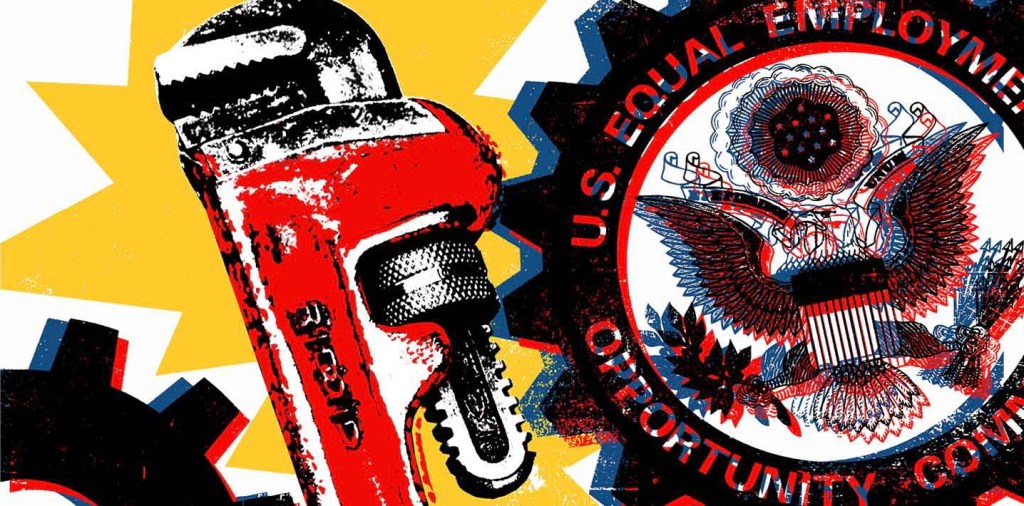
A key part of the Civil Rights Act of 1964 was Title VII, which dealt with employment discrimination. Title VII applied only to intentional discrimination, but it didn’t take long for the Equal Employment Opportunity Commission (EEOC), the agency charged with administering Title VII, to find ways to expand the scope of its enforcement mandate under the law. The EEOC eventually managed to convince virtually all parties, including employers, employees, job applicants, attorneys, and even the courts, that the law prohibited employment practices having disparate impacts on groups protected from actual discrimination under the law. Predictably, this warped reinterpretation created severe distortions to the efficiency and fairness of labor market outcomes .

Another Rogue Agency

On the EEOC’s complete and erroneous reimagining of Title VII, Gail Heriot’s “Title VII Disparate Impact Liability Makes Almost Everything Presumptively Illegal” is a must read. Heriot is a Professor at the University of San Diego School of Law and is a member of the U.S. Commission on Civil Rights. This post attempts to summarize most of the important points in Heriot’s paper, so if you don’t have time for Heriot’s paper, read on. All errors are mine, of course!

Heriot provides an incredible case study on the dangers of regulatory overreach. She first discusses the EEOC’s blatant usurpation of Congressional power:

“It is hardly surprising that EEOC officials would undertake to publish answers to the questions they were hearing repeatedly…. But publishing such ‘guidances’ also had the potential to spin out of control. The temptation would always be to use them to establish what the EEOC staff wanted the law to be rather than what it was. Instead of interpreting Title VII in good faith, guidances would soon become quasi-legislation—disguised as interpretation, but in reality imposing new duties on employers not found in Title VII itself.

None of this should be surprising. It is in the nature of bureaucracy. It naturally seeks to expand its powers, often beginning by occupying niches that are otherwise unoccupied. Over time, a little power often becomes a lot of power. What is surprising is how upfront EEOC officials were about their tactics in accumulating that power.”

Having gone this far, one might be tempted to ask the EEOC what limiting principle they actually apply to determine whether various employment and hiring practices are permissible. Are level of education, industry experience, and tests of physical and cognitive faculties verboten? The answer that is there is no consistent, limiting principle. Instead, Heriot says the EEOC “picks its battles” (see below). She also describes the EEOC’s adoption of a so-called “four-fifths rule”, which is about as arbitrary as it gets. It means the EEOC will challenge an employment practice only if it leads to a selection of any protected group at a rate less than 80% of the most-selected group. That is, the “disparate impact” must be less than 20% to rule out a challenge. This rule appears nowhere in Title VII.

Job Qualifications? You’re Guilty!

Unfortunately, as Heriot takes pains to demonstrate, it’s virtually impossible to identify a hiring guideline or method of employee assessment that does not have a disparate impact. The examples she provides on pp. 34 – 37 of her paper, and on p. 40, are convincing. Furthermore, the EEOC’s “four-fifths” rule hardly narrows the potential for challenge at all.

“Selection rates of less than four-fifths relative to the group with the highest rate are extremely common. Just as everything or nearly everything has a disparate impact, everything or nearly everything has a selection rate that fails the ‘four fifths rule’ for some race, color, religion, sex, or national origin group.”

So the EEOC is allowed to operate with tremendous discretion. Again, Heriot says the agency “picks its battles”, focusing on challenges to screening tools like “written tests, physical strength and endurance tests, criminal background tests [sic], high school diploma requirements, personal credit histories, residency requirements, and a few others.”

This regulatory environment encourages employers to keep job requirements vague, sometimes to the point at which potential applicants might not be sure what the job qualifications really are, or exactly what the job function entails. One upshot is that this makes it harder to detect and prove actual discrimination, and it often leads to more arbitrary decisions by hiring managers, which may, in fact, involve real discrimination, including nepotism and/or cronyism.

Unbiased Intent Doesn’t Matter

Heriot points to a disastrous decision by the Supreme Court that, perhaps unintentionally, helped legitimize the concept of disparate impact as legal doctrine, and as a valid cause of action by plaintiffs against employers. In Griggs v. Duke Power Co. (1971), the Court rejected the premise that an employer’s innocence with respect to their intent to discriminate was an inadequate defense of an employment practice that had adverse consequences to a protected group. Heriot quotes the opinion of Chief Justice Warren Burger:

“… good intent or absence of discriminatory intent does not redeem…. Congress directed the thrust of the Act to the consequences of employment practices, not simply the motivation.”

It’s as if the Court convinced itself that adverse consequences prove actual discrimination, even when there is no intent to discriminate. The Court also emphasized that it’s decision was based on “general deference” to the EEOC! And this was years before the unfortunate Chevron Doctrine (judicial deference to administrative agencies on interpretation of law) was formally established by the Court. Heriot and others assert that the decision in Griggs would have astonished the authors of Title VII.

Heriot also discusses changes in the treatment of “business necessity” as a defense against complaints of disparate impact. It is generally the employer’s burden to show the “necessity” of a challenged hiring practice. “Necessity” was the subject of several Supreme Court decisions in the 1970s and 1980s, but the Court stopped short of requiring an employer to show that a practice was “essential”. In one case, the court shifted some of the burden back onto the plaintiff to show that a practiced lacked necessity. In 1990, there was concern in the Bush Administration and Congress that the difficulty of proving business necessity would eventually lead to the adoption of racial quotas by employers in order to prevent EEOC challenges, though the authors of Title VII had staunchly opposed quotas. While the original hope was that the Civil Rights Act of 1991 would resolve questions about “business necessity” and the burden of proof, it did not. Instead, it can be said that it legitimized disparate impact liability, with conditions. The standard for proving necessity, based on Court decisions, evolved to become more strict with time. There are cases in which courts seem to have left the EEOC to define “business necessity”, as if the EEOC would be in a better position to do that than the business itself!

Inviting Discrimination

Heriot devotes part of her paper to the perverse effects of disparate impact. When employers are faced with prohibitions or the threat of action against a certain practice, whether it be tests of aptitude, strength, or screening on criminal or credit records, they may abandon those devices and opt instead for “informal” proxies. The use of proxies, however, often leads to instances of actual discrimination, whether born of conscious or unconscious bias on the part of hiring managers.

Heriot provides a number of examples of the proxy phenomenon, some of which have been confirmed by empirical research. For example, an employer interviewing candidates for a job that requires math proficiency might reasonably use a test of math skill as a key criterion. If such a test is prohibited, the hiring manager might be tempted to hire an Asian candidate, since Asians have a reputation for good math skills. Similarly, an applicant of West European ancestry might be favored for a position requiring excellent grammar skills, absent the ability to explicitly test grammatical skill. Candidates for a job requiring a certain level of physical strength could be evaluated by various tests of strength, but barring that, a hiring manager might be inclined to hire based on gender.

When criminal background checks are prohibited, employers might be tempted to use proxies such as gender and race as a substitute. Likewise, if it’s forbidden to check a candidate’s credit record to gauge reliability, other proxies might lead to discrimination against members of protected classes. Needless to say, these kinds of outcomes are precisely the opposite of what the EEOC hopes to achieve.

As Heriot further notes, the outcomes can be much systematic and destructive than a bit of one-off discrimination in hiring, promotion, pay raises, or task assignment. These may inflict damage reaching well beyond having the wrong people gaining favorable labor market outcomes. For example, an employer might choose to relocate operations to a “safer” or more affluent community, barring an ability to perform criminal background or credit checks. Or businesses might decide to substitute capital for labor, given the interference in their attempts to identify the best job candidates. The difficulty in screening also creates an incentive to automate, just as premature automation is becoming more common with rising wage floors imposed by government.

Killing Jobs and Competition

Like many forms of regulation, however, large firms in less competitive industries are usually better positioned to survive EEOC scrutiny than smaller firms in competitive markets. Indeed, we often see large market players embrace regulation because it gives them a competitive advantage over smaller rivals. In this case, we see large firms adopting their own diversity, equity, and inclusion (DEI) goals. This is not solely related to the threat of EEOC challenges, however. Private lawsuits alleging discrimination or disparate impact are also a concern, as is pleasing activists inside and outside the company. Nevertheless, as Christopher Rufo reveals, there is growing push-back against the corporate DEI regime. Let’s hope it continues to gain traction.

Unconstitutional Executive Discretion

Heriot also dedicates part of her paper to constitutional issues related to the EEOC’s broad discretion in the application of disparate impact to employment practices. For one thing, disparate impact is a direct source of discrimination: when members of “protected groups” are awarded opportunities based on the possibility of disparate statistical outcomes, it means the majority candidates are denied those opportunities, no matter their qualifications. This is outright discrimination, and it’s instigation by a federal agency constitutes an explicit denial of equal protection under the law.

It should be no surprise that many consider disparate impact actions against employers to be denials of due process. Furthermore, when a federal agency like the EEOC exercises broad discretion, the so-called non-delegation doctrine should come into play. That is, the EEOC makes judgements on matters that are not necessarily authorized Congress. Thus, there are legitimate questions as to whether the EEOC’s discretion is a violation of the separation of powers. Granted, the courts have long deferred to administrative agencies in the interpretation of enabling statutes, but the Supreme Court has taken a new tack under Chief Justice Roberts. In some recent decisions, the Court has relied on a new “major questions” doctrine to place certain limits on executive discretion.

Conclusion

Hiring? Creating jobs? Better not get picky about checking your applicants’ skills and backgrounds or you risk liability for contributing to the statistical malaise of one, or of many, protected groups. That’s how it is under “disparate impact” rules imposed by the EEOC. The success of your business be damned!

Gail Heriot’s excellent paper details the way in which the EEOC transformed the meaning of its enabling legislation, expanding its reign over employment practices across the nation. She demonstrates the breadth of disparate impact rules with examples showing that virtually any attempt at systematic screening of job applicants can be held to be illegal. Your intent to hire the most qualified candidate without bias doesn’t matter, under an insane Supreme Court decision that buttressed the EEOC’s authority. As Heriot says, “… everything is presumptively illegal”. She also describes how disparate impact liability leads to employment decisions based on proxy criteria, which often lead to actual (even if unintended) discrimination. Further unintended consequences are the possibility of larger job losses in minority communities and less competition in product and labor markets. Finally, Heriot delineates several constitutional violations inherent in broad EEOC discretion and the enforcement of disparate impact.

One day a court challenge to the EEOC and disparate impact liability might rise to the level of the Supreme Court. Justice Antonin Scalia expected it, but it still hasn’t come before the Court. It should! Another way to do battle against the EEOC’s scourge is to challenge corporations who cow-tow to activists and to the EEOC with their own DEI initiatives. This manifestation of stakeholder capitalism is a cancer on the wealth and productivity of the U.S. economy, resting side-by-side with disparate impact liability.

It’s Time to Make Woke Corporations Hurt!

12 Wednesday May 2021

Posted by Nuetzel in Corporatism, Social Justice, Virtue Signaling

≈ Leave a comment

Tags

Amazon, Apple, Bank of America, Black Lives Matter, Coca Cola, Delta Airlines, Disney, Disney Plus, Disparate impact, Diversity, EEOC, ESG Scores, Fuzzy Logic Blog, Joe Biden, Price Discrimination, Race-Based Discounts, Stakeholder Capitalism, Whole Foods, Wokeness

It’s a BLM discount! You need only shout the magic words! Ah, but if “woke” corporations are sincere in their avowals to help end racial injustice, there is so much more they can do! In fact, let me describe an idea so good and rich that we really must partner with Black Lives Matter and Antifa to bring it on!

Yes, we know how much the social justice warriors of corporate America care about diversity, inclusion, and eliminating unconscious bias. Also, in their business practices, they are eager to avoid “disparate impacts” on “protected classes” of individuals. However, if they want to get serious, they need to put real money where their mouths are. The Fuzzy Logic blog (FLB) suggests that we dare corporations celebrating “wokeness” to offer free products and services to people of color (POC)!

There is a strong rationale under current law for a slightly less drastic version of this proposal. For example, in 2019, the median household income of African Americans was about 60% that of whites, but Disney charges blacks and whites the same admission price to their theme parks. That means it costs a black family proportionately more of their income than a white family to spend a day at the park in Orlando. That, my friends, is a disparate impact!

I’m not aware of any legal challenges along these lines, but it’s not as if “one price” is a business necessity, which would otherwise offer Disney a defense against such a claim. Disney already offers discounts to seniors and other groups. But why wait for the EEOC to take action when Disney can demonstrate its high-mindedness and good faith by offering race-based discounts right now?

It would be fun to see how the company reacts to pressure for that kind of action. Based on income disparities, the company could discount tickets by 40% to African Americans and by about 26% for Hispanics. Discounting should be extended to Disney Plus subscriptions as well. Those discounts can be revisited each year with appropriate adjustments until such time as income parity is achieved.

In reality, differential pricing is practiced broadly by American businesses. It’s called price discrimination, and it is generally legal. Higher prices tend to be charged to market segments with less elastic (price-sensitive) demand, and lower prices are offered to segments with more elastic demand. It is a rational and often profit-maximizing approach to pricing, but its practice tends to be more subtle than discriminating on price with respect to race or ethnicity. It’s safe to say that pressure to do so would be disruptive and unwelcome to these firms. So I still like the idea!

But again, FLB’s post goes much farther: given past injustices, why limit the reparations to a correction for the disparate impact of pricing? Something more radical is needed as this is a matter of conscience, not merely a legal hurdle to neutralize income disparities:

“These companies (and the many thousands more engaged in this woke crap) must put their own profits where their big, fat lying mouths are. There will be no government bailouts for them; they must pay for their part in condoning and pushing white supremacy for the past bazillion years, and they must pay with their own wealth, wealth they say they accumulated on the backs of black and brown people.”

Therefore, FLB insists that Disney should offer free admission and streaming on Disney Plus to certain racial and ethnic minorities for a period of several years…and free accommodations at Disney Hotels! What a tremendous show of good faith in wokeness that would be!

We’re picking on Disney, and it’s not alone in its professed racial consciousness and pursuit of equal outcomes. There are so many others! Coca-Cola could issue coupons redeemable at full price through a program of outreach in minority communities. Delta Airlines could institute a program of “Black Life Passports” to bona fide African Americans (meaning one must identify as such!) for discounted or free fares. Bank of America will probably want to exceed the minimum requirements under community banking law by offering free banking services and heavily discounted account management fees to African Americans. Amazon will no doubt want to offer free Prime memberships to certain minorities and perhaps throw in some freebies at Whole Foods as well. And Apple has plenty of merchandise to give away. Why wait for Joe Biden to offer free phones in the run-up to the 2024 election like his old boss did?

You probably won’t be happy about this proposal if you’re a corporate shareholder, but then you should not be happy to have witnessed increasing management preoccupation with social justice, and you should not have been happy as your “agents” lost sight of their fundamental missions as business organizations: to produce something well and thereby do well for customers and shareholders. The sad consequence of “stakeholder capitalism” is that everything a business is supposed to do gets done worse.

I recently discussed the assignment of “scores” to public companies for their focus and performance on environmental, social, and governance (ESG) factors. These ESG scores are used by “woke” fund managers and advisors to select or rate stocks. I personally have no wish to invest in companies seeking to boost their ESGs, but you can read all about that at the link. For our purposes here, ESGs might serve well as a tool for identifying entities most in need of pressure to offer discounts and freebies to POC.

It would be great to see agitation against the woke-most corporations for race-based discounts and free products. Perhaps a broad discussion of the idea would prompt social justice warriors to get on board. It might provide some laughs, but the real hope is to shake the corporate wokesters from their virtue-signaling stupor. Most shareholders wouldn’t like race-based discounts, of course, and that’s part of the idea. A conceivable defensive maneuver for our “target” entities would be a lobbying effort for government action such as tax-financed reparations. That won’t necessarily be cheap for them or their shareholders, however. Get woke, go broke!

Follow Sacred Cow Chips on WordPress.com

Recent Posts

  • The Case Against Interest On Reserves
  • Immigration and Merit As Fiscal Propositions
  • Tariff “Dividend” From An Indigent State
  • Almost Looks Like the Fed Has a 3% Inflation Target
  • Government Malpractice Breeds Health Care Havoc

Archives

  • January 2026
  • December 2025
  • November 2025
  • October 2025
  • September 2025
  • August 2025
  • July 2025
  • June 2025
  • May 2025
  • April 2025
  • March 2025
  • February 2025
  • January 2025
  • December 2024
  • November 2024
  • October 2024
  • September 2024
  • August 2024
  • July 2024
  • June 2024
  • May 2024
  • April 2024
  • March 2024
  • February 2024
  • January 2024
  • December 2023
  • November 2023
  • August 2023
  • July 2023
  • June 2023
  • May 2023
  • April 2023
  • March 2023
  • February 2023
  • January 2023
  • December 2022
  • November 2022
  • October 2022
  • September 2022
  • August 2022
  • July 2022
  • June 2022
  • May 2022
  • April 2022
  • March 2022
  • February 2022
  • January 2022
  • December 2021
  • November 2021
  • October 2021
  • September 2021
  • August 2021
  • July 2021
  • June 2021
  • May 2021
  • April 2021
  • March 2021
  • February 2021
  • January 2021
  • December 2020
  • November 2020
  • October 2020
  • September 2020
  • August 2020
  • July 2020
  • June 2020
  • May 2020
  • April 2020
  • March 2020
  • February 2020
  • January 2020
  • December 2019
  • November 2019
  • October 2019
  • September 2019
  • August 2019
  • July 2019
  • June 2019
  • May 2019
  • April 2019
  • March 2019
  • February 2019
  • January 2019
  • December 2018
  • November 2018
  • October 2018
  • September 2018
  • August 2018
  • July 2018
  • June 2018
  • May 2018
  • April 2018
  • March 2018
  • February 2018
  • January 2018
  • December 2017
  • November 2017
  • October 2017
  • September 2017
  • August 2017
  • July 2017
  • June 2017
  • May 2017
  • April 2017
  • March 2017
  • February 2017
  • January 2017
  • December 2016
  • November 2016
  • October 2016
  • September 2016
  • August 2016
  • July 2016
  • June 2016
  • May 2016
  • April 2016
  • March 2016
  • February 2016
  • January 2016
  • December 2015
  • November 2015
  • October 2015
  • September 2015
  • August 2015
  • July 2015
  • June 2015
  • May 2015
  • April 2015
  • March 2015
  • February 2015
  • January 2015
  • December 2014
  • November 2014
  • October 2014
  • September 2014
  • August 2014
  • July 2014
  • June 2014
  • May 2014
  • April 2014
  • March 2014

Blogs I Follow

  • Passive Income Kickstart
  • OnlyFinance.net
  • TLC Cholesterol
  • Nintil
  • kendunning.net
  • DCWhispers.com
  • Hoong-Wai in the UK
  • Marginal REVOLUTION
  • Stlouis
  • Watts Up With That?
  • Aussie Nationalist Blog
  • American Elephants
  • The View from Alexandria
  • The Gymnasium
  • A Force for Good
  • Notes On Liberty
  • troymo
  • SUNDAY BLOG Stephanie Sievers
  • Miss Lou Acquiring Lore
  • Your Well Wisher Program
  • Objectivism In Depth
  • RobotEnomics
  • Orderstatistic
  • Paradigm Library
  • Scattered Showers and Quicksand

Blog at WordPress.com.

Passive Income Kickstart

OnlyFinance.net

TLC Cholesterol

Nintil

To estimate, compare, distinguish, discuss, and trace to its principal sources everything

kendunning.net

The Future is Ours to Create

DCWhispers.com

Hoong-Wai in the UK

A Commonwealth immigrant's perspective on the UK's public arena.

Marginal REVOLUTION

Small Steps Toward A Much Better World

Stlouis

Watts Up With That?

The world's most viewed site on global warming and climate change

Aussie Nationalist Blog

Commentary from a Paleoconservative and Nationalist perspective

American Elephants

Defending Life, Liberty and the Pursuit of Happiness

The View from Alexandria

In advanced civilizations the period loosely called Alexandrian is usually associated with flexible morals, perfunctory religion, populist standards and cosmopolitan tastes, feminism, exotic cults, and the rapid turnover of high and low fads---in short, a falling away (which is all that decadence means) from the strictness of traditional rules, embodied in character and inforced from within. -- Jacques Barzun

The Gymnasium

A place for reason, politics, economics, and faith steeped in the classical liberal tradition

A Force for Good

How economics, morality, and markets combine

Notes On Liberty

Spontaneous thoughts on a humble creed

troymo

SUNDAY BLOG Stephanie Sievers

Escaping the everyday life with photographs from my travels

Miss Lou Acquiring Lore

Gallery of Life...

Your Well Wisher Program

Attempt to solve commonly known problems…

Objectivism In Depth

Exploring Ayn Rand's revolutionary philosophy.

RobotEnomics

(A)n (I)ntelligent Future

Orderstatistic

Economics, chess and anything else on my mind.

Paradigm Library

OODA Looping

Scattered Showers and Quicksand

Musings on science, investing, finance, economics, politics, and probably fly fishing.

  • Subscribe Subscribed
    • Sacred Cow Chips
    • Join 128 other subscribers
    • Already have a WordPress.com account? Log in now.
    • Sacred Cow Chips
    • Subscribe Subscribed
    • Sign up
    • Log in
    • Report this content
    • View site in Reader
    • Manage subscriptions
    • Collapse this bar
 

Loading Comments...