• About

Sacred Cow Chips

Sacred Cow Chips

Tag Archives: Keystone Pipeline

Markets Deal With Scarcity, Left Screams “Price Gouging”

11 Monday Apr 2022

Posted by Nuetzel in Antitrust, Environmental Fascism, Oil Prices

≈ Leave a comment

Tags

Antitrust, Barack Obama, central planning, ESG Scores, FDR, Fossil fuels, Gas Prices, Green New Deal, Intermittancy, Joe Biden, Keystone Pipeline, Lawrence Summers, Oil Prices, Oil Profits, OPEC, Power Grid, Price Gouging, Profit Margins, Profiteering, Renewable energy, Strategic Petroleum Reserve, Ukraine Invasion, Vladimir Putin, West Texas Intermediate

Democrats claim profiteering by oil companies is responsible for the sustained rise in oil prices since Joe Biden’s inauguration (really, his election). That’s among the more laughable attempts at gaslighting in recent memory, right up there with blaming market concentration for the sustained increase in inflation since Biden’s inauguration. At a hearing this week, congressional Democrats, frightened by the prospect of a beat-down just ahead in the mid-term elections, couldn’t resist making “price-gouging” accusations against oil producers. These pols stumble over their own contradictory talking points, insisting on more oil production only when they aren’t hastily sabotaging oil and gas output. Their dishonestly is galling, but so is the foolishness of voters who blindly accept the economic illiteracy issuing from that side of the aisle.

Break It Then Blame It

Those who level “price gouging” charges at oil companies are often the same people seeking to eliminate fossil fuel consumption by making those energy choices unaffordable. The latter is a bad look this close to mid-term elections, so they follow the playbook I described recently in “Break the Market, Blame It, Then Break It Some More“. And this post is instructive: “House Dem: Big Oil is profiteering by, er … doing what we demanded”.

Not only have the Democrats’ policies caused oil prices to soar; for many years they’ve been undermining the stability of the power grid via forced conversion into intermittent renewable energy sources like wind and solar, all while preventing the expansion of safe and carbon-free nuclear power generation. It’s ironic that these would-be industrial planners seem so eager to botch the job, though failure is all too typical of central planning. Just ask the Germans about their own hapless efforts at energy planning.

As economist Lawrence Summers, former Treasury Secretary under Barack Obama, said recently:

“Look, the net effect of the things the administration talks about in terms of micro policies to reduce inflation, this gouging talk is frivolous, nonserious, and utterly ineffectual. A gas price holiday would, ultimately, push up prices by raising demand. … The student loan relief … is injecting resources into the economy at a hundred billion dollar a year annual rate when the economy needs to be cooled off, not heated up. … The administration could be much more constructive than it has been with respect to energy supply.”

The market functions to allocate scarce resources. When conditions of scarcity become more acute, the market mechanism responds by pricing available supplies to both curtail use and incentivize delivery of additional quantities. That involves the processing of vast amounts of information, and it is a balancing at which the market performs extremely well relative to bumbling politicians and central planners, whose actions are too often at the root of acute scarcities.

Antitrust Nonsense

Of course, the Democrats have seized upon the inescapable fact that soaring oil prices cause profits to soar for anyone producing oil or holding stocks of oil. But oil company profits are notoriously volatile. Margins were negative for most of 2020, when demand weakened in the initial stages of the pandemic. And now, some companies are bracing for massive write-downs on abandoned drilling projects in Russia. The oil and gas business is certainly not known for high profit margins. Short-term profits, while they last, must be used to meet the physical or financial needs of the business.

The threats of antitrust action by the Biden Administration are an extension of the price-gouging narrative, even if the threat reflects an injudicious grasp of what it takes to prove collusion. It takes a fertile imagination to think western oil companies could successfully collude on pricing in a market dominated by the following players:

Fat chance. In any case, it’s a global market, and it’s impossible for western oil producers to dictate pricing. Even the OPEC cartel has been unable to dictate prices, not to mention keeping it’s members from violating production quotas. But if a successful conspiracy among oil companies to raise prices was possible, one would guess they’d have done it a lot sooner!

Nor is it possible for the oil majors to dictate prices at the pump, because retail prices are set independently. While the cost of crude oil is only about 54% of the cost of refined gas at retail, fluctuations in prices at the pump correlate strongly with crude oil prices. Here is a ten-year chart of daily price data, where the blue line is the price of West Texas Intermediate crude oil and the orange line is the average price of regular gas in the U.S.:

Here are the same two series for 2022 year-to-date:

Coerced Scarcity

Again, oil prices have been under upward pressure for over a year until a break in early March, following the steep run-up in the immediate wake of the Ukraine invasion. First there was Biden’s stultifying rhetoric, before and after the 2020 election, assisted by radical members of Congress. Then there were executive orders halting drilling on federal lands, killing the Keystone pipeline, efforts to shut down several other existing pipelines, and the imposition of regulatory penalties on drillers. In addition, unrest in certain parts of the Middle East curtailed production, compounded this year by the boycott on Russian oil (which, as a foreign policy matter, was far too late in coming).

However, existing facilities have been capable of squeezing out more oil and gas. Lo and behold, supply curves slope upward, even in the short-run! Despite all of Biden’s efforts to cripple domestic oil production, higher crude prices have brought forth some additional supplies. Biden’s raid on the Strategic Petroleum Reserve has also boosted supply for now, but its magnitude won’t help much, and it must be replaced for use during real U.S. national emergencies, which the war in Ukraine is not, as awful as it is.

That said, investing in new drilling capacity is not wise given the political climate created by Biden and the Democrats: they have been quite clear that they mean to crush the fossil fuel industry. For some time, the oil companies have been busy investing cash flows in “green” initiatives in an effort to bolster their ESG scores, a dubious exercise to say the least. Arguably, in this policy environment, the most responsible thing to do is to return some of the capital over which these firms are stewards to its rightful owners, many of whom are middle-class savers who hold oil stocks in their 401(k) funds. That approach is manifest in the recent stock buybacks and dividend payments oil companies have announced and defended before Congress.

Conclusion

A forced shutdown of fossil fuel energy was much ballyhooed by the Left as a part of Joe Biden’s agenda. Biden himself bought into the “Green New Deal”, imagining it might win him a vaunted place alongside FDR’s legacy in American history. The effort was unwise, but Biden is trying to hang onto the narrative and maintain his punitive measures against American oil companies. All the while, he begs OPEC producers to step up production, bending a knee to despots in countries such as Iran and Venezuela. Why, it’s as if their fossil fuels are somehow cleaner than those extracted in the U.S! The feeble Biden and congressional Democrats are proving just how mendacious they are. They can rightfully blame Vladimir Putin for the recent escalation in oil prices, but they bear much responsibility themselves for the burden of high gas prices, energy bills, and the unnecessary, ongoing scarcity victimizing the American public.

Now, What About Trump?

25 Wednesday Jan 2017

Posted by Nuetzel in Trump Administration

≈ Leave a comment

Tags

Ajit Pai, Barack Obama, Bill Weld, Donald Trump, Drug War, eminent domain, Entitlement Reform, Executive Authority, FCC, FDA, Fourth Amendment, Gary Johnson, Hillary Clinton, Industrial Policy, Jim O'Neil, Keystone Pipeline, Legal Immigration, Limited government, Paris Climate Accord, Protectionism, Scott Alexander, Slate Star Codex, Standing Rock Sioux, State's Rights, Trade Partnerships, Trans-Pacific Partnership, Trump's Great Wall, USA Freedom Act, Wilbur Ross

donald-trump-hair-force-1

This guy I voted for… Hoo boy! I’m tellin’ ya’, this guy’s a real beaut! But now, it’s time for me to make an accounting of the good and the bad I see in a Donald Trump presidency. I’ll cover a number of policy areas and how well I think, at this point, the Trump Administration will match my preferences, which are generally libertarian. In posting this list, I’m reminded of a wonderful quote of the late guitarist Jerry Garcia on his ideas for a new project: “I’m shopping around for something to do that no one will like.” I certainly don’t expect many to agree with the entirety of my “scorecard”, but here it is. But before getting to it, a few preliminaries:

First, I’ve had mixed feelings about Trump since he first announced that he’d seek the republican nomination. A basic concern was the difficulty of knowing his real philosophy about the role of government and fundamental constitutional rights. Trump has a history of contradictory positions on big issues like taxes, health care, and gun rights. It was a gamble to count on him to follow any particular idealogical course, and some of it remains unclear even now. My misgivings about Trump’s inclinations as a whirligig were discussed on Sacred Cow Chips in “Trump Flaunts Shape-Shifting Powers” in 2015. Uncertainty still colors my views, though his cabinet picks and other alliances have served to clarify the direction of policy. My discussion below reflects this uncertainty. Also, Trump shows every intention of moving fast on a number of fronts, so I hope the relevance of this post isn’t too perishable.

Second, it’s worth noting that Trump’s policy statements and predilection to “keep-’em-guessing” are probably a by-product of his instincts as a negotiator. His bellicosity may be something of a ploy to negotiate more favorable compromises in international affairs, trade and domestic issues. Still, I can’t know that. Should I evaluate all those statements at face value as policy positions? I have to make some allowance for the reasonability of a bargaining position, but I’ll try to be consistent in my approach.

Third, revelations during the campaign of Trump’s past remarks about women, and some in-campaign remarks like his attack on Megyn Kelly, were highly offensive. I’ve heard plenty of “locker-room talk” over my years, but some of Trump’s statements were made well outside the locker room and well beyond the age at which “youthful indiscretion” could be taken as a mitigating factor. Trump has plenty of female defenders, however, and he has a record of placing women in key roles within the Trump organization and for paying them well. While I do not condone the remarks, and I doubt that complete reform is possible, he cannot change his history and he is now the president. Evaluating his policy positions is now an entirely separate matter. I only hope the exposure has taught him to be more respectful.

Finally, I do not buy the narrative that Trump is a racist. This “Crying Wolf” essay on Scott Alexander’s Slate Star Codex blog demonstrates that Trump’s rhetoric and behavior during his campaign was not racist when viewed in the broader context of his record of denigrating anyone who opposes him. He seems to be an equal opportunity offender! In fact, Trump made strong attempts to appeal to minority voters and succeeded to some extent. His positions on border security and immigration were boisterous, but they were not truly about race or ethnicity. Instead, they were rooted in concerns about illegal immigration and public safety. Efforts by the left to characterize those points as de facto evidence of racism are simply not credible. Nor are claims that he practiced racial discrimination at his apartment buildings early in his career. Today, I would call those cases garden-variety disparate impact actions, as when a business is challenged on the use of screening criteria that might be correlated with race, such as credit rating. A legitimate business purpose is generally a valid defense, though Trump did agree to settle out of court.

So what about Trump from a policy perspective? Here is what I expect of his administration thus far:

I’m Pretty Sure of the Following, Which I Rate As Bad

Trump is a protectionist. He is extremely ignorant of trade principles and favors import duties to punish those who wish to purchase goods from abroad. This would raise both domestic and import prices and directly harm employment in import-dependent industries. It would also discourage innovation by domestic producers, who would face less competition. I cover these protectionist tendencies here as an unqualified negative, but I have a more mixed view on his opposition to certain government-negotiated trade agreements (e.g., the Trans-Pacific Partnership ), which are covered below.

Trump is likely to be a drug warrior. He could do much to restore order in inner cities by ending the drug war, but he will not. He will thereby encourage activity in the black market for drugs, which produces both violence and more dangerous varieties of drugs. He might well interfere with the rights of states to determine their own policies toward relatively benign substances like marijuana, including medical marijuana, by choosing to enforce destructive federal drug laws. The possible appointment of marijuana legalization advocate Jim O’Neil to head the FDA looks decreasingly likely. That might be a game changer, but I doubt it will happen.

Big public infrastructure outlays. This is distinct from private infrastructure, to be discussed below. The latter is motivated by private willingness-to-pay. Rushing into a large public construction program with questionable economic justification will bring waste, and it will probably be sold as an economic stimulus package, which is unnecessary and dangerous at a time when the economy is finally operating near capacity. The decrepitude of American infrastructure is greatly exaggerated by those with a private interest in such projects, and the media eats it up. The breathless promotion of massive but noneconomic projects like high-speed rail is also greeted with enthusiasm by the media. And politicians love to boast to constituents of their efforts to secure federal funds for big local projects. We also know that Trump wants to build a massive border wall, but I’m convinced that border security could be achieved at lower cost by leveraging surveillance technology and other, less costly barriers.

Deficits: Increased defense outlays, a big infrastructure package, a “great” wall, tax credits and lower tax rates will almost certainly add up to ballooning federal deficits in the years ahead. That fiscal combination will be unsustainable if accompanied by higher interest rates and could very well have inflationary consequences.

Trump favors public and private eminent domain and believes it should be treated as a hallowed institution. He truly thinks that a “higher-valued use” is a superior claim to existing ownership of property. This is perverse. I have trouble accepting eminent domain action even for a public purpose, let alone a private purpose; it should only be motivated by the most compelling public interest, as a last resort, and with handsome compensation to the existing property owner. We can only hope that Trump’s public and private infrastructure programs do not lead to many takings of this kind.

Industrial policy. This is the essence of government central planning, picking winners and losers by granting tax and loan subsidies, lenient reviews, and other advantages. The most obvious example of Trump’s amenability to industrial policy is his penchant for trade protectionism, but I fear it will go much deeper. For some reason, Trump believes that manufacturing activity creates private and public benefits far beyond its market value. Moreover, manufacturers require far fewer workers now than they did in his youth, so the sector is not the job engine it once was. His appointee for Commerce Secretary is Wilbur Ross, an investor with a history of trading on prospects for government assistance. This article provides disturbing background on Ross, along with this quote: “We ought, as a country, to decide which industries are we going to really promote — the so-called industries of the future.” Trump’s plan to meet regularly with leaders of giant corporations is a sure sign that corporatism will be alive and well for at least the next four years… as long as they tow The Donald’s line.

Restricting Legal Immigration. I’m all for securing the border, but legal immigration is a major driver of economic growth. Many industries rely on a flow of skilled and unskilled workers from abroad, a need that will be more intense given Trump’s plan to tax outsourcing. Moreover, the country will face a low ratio of workers to retirees over the next few decades; short of massive entitlement reform, immigration is perhaps the only real chance of meeting public obligations to retirees.

Endangered Privacy Rights: As a “law and order” guy, Donald Trump might not be a reliable defender of the privacy protections enshrined in the Fourth Amendment. He has expressed a willingness to repeal the USA Freedom Act, which restricts the bulk collection of metadata and provides other privacy protections. Trump also has expressed an interest in forcing technology companies to enable “back doors” into the devices and programs they sell to the public. I’m concerned that we’ll see the creation of security databases with an excessively broad scope. As a likely drug warrior, Trump will support the sort of privacy violations in law enforcement that have become all too common.

I’m Pretty Sure of the Following, Which I Rate As Good

He’s not Hillary Clinton, and he is not a statist in the mold of Clinton and Barack Obama, though he does embody some statist tendencies as described above.  I thought I would vote for Gary Johnson, but he made crucial mistakes, such as choosing Bill Weld as his running mate and fumbling at attempts to explain libertarian philosophy. At some point, my distaste for Clinton’s criminality and her advocacy of big government in so many aspects of life convinced me she had to be defeated, and that Trump was the only real possibility. But whether he can actually reduce the resources that the federal government absorbs is hard to say, as he has his own spending priorities.

Trump favors deregulation generally, as it places an enormous burden on society’s ability to improve well being. This covers aspects of the Affordable Care Act and reducing the role of the federal government in education. He opposes the costly Paris Climate Accord and other intrusive federal environmental measures, such as wetlands regulation.

Obamacare repeal and replacement with market-oriented delivery of health care, insurance with broad choices, and equalized tax treatment across the employer and individual market segments via refundable tax credits. There is a chance that Trump’s preferred alternative will assign excessive responsibility to the federal government rather than markets, but I’m optimistic on this point.

Entitlement reform is a possibility. Social Security and Medicare are insolvent. Ideas about how future retirees might take advantage of market opportunities should be explored. This includes private retirement accounts with choices of investment direction and greater emphasis on alternatives like Medicare Advantage.

Tax reform of some kind is on Trump’s agenda. This is likely to involve lower corporate and individual tax rates and some tax simplification. It is likely to stimulate economic growth from both the demand and the supply sides. In the short-run, traditional demand-side macroeconomic analysis would suggest that upward price pressures could arise. However, by encouraging saving and investment, the economy’s production capacity would increase, mitigating price pressure in the longer run.

Trump favors border security. No mystery here. My enthusiasm for this is not based on a physical wall at the border. That might come and it might be very costly. I favor a liberalized but controlled flow of immigration and vetting of all immigrants. The recent order of a temporary hold on refugees from a short list of countries will be of concern if it is not short-lived, and it remains to be seen what “extreme vetting” will entail. Nevertheless, I support enhanced integrity of our borders and our right as a nation to be cautious about who enters.

Education reform and school choice. Increased spending on public education, especially at the federal level, has made no contribution to educational productivity, and the country is burdened with too many failing schools.

Encouraging private infrastructure. This relies on private incentives to build and finance  infrastructure based on users’ willingness to pay, thereby avoiding stress on public funding capacity.

Deregulating energy: This includes encouraging zero-carbon nuclear power, deregulation of fossil fuels, and lower energy costs.

Deregulating financial institutions. Repeal of the burdensome Dodd-Frank Act, which has imposed costs on both banks and consumers with little promise of a benefit in terms of financial stability.

Unabashed support for Israel. I strongly favor repairing our damaged ties with Israel and the proposed move of our embassy to West Jerusalem, which has been a part of Israel proper since its founding. Israel is the only real democracy in the middle east and a strong ally in an extremely dangerous part of the globe.

Trump supports Second Amendment rights. This is fundamental. Private gun ownership is the single-best line of self-defense, especially for those with the misfortune to live in areas rife with black market drug activity.

States’ rights and federalism. On a range of issues, Trump seems amenable to transferring more responsibility to states, rather than asserting federal supremacy on issues that are unsettled from region-to-region.

Ending federal funding for abortion. Tax dollars should not be used for a purpose that is morally abhorrent to a large segment of the population. This is not the same as the “right” to abort a child, as settled by Roe vs. Wade.

Putting the screws to the UN. This organization is not aligned with U.S. interests, yet the U.S. foots a large part of the bill for its activities. Sharp reductions in funding would be a powerful message.

Reduced federal funding for the arts. I’ve never been comfortable with allowing the federal government to disburse funds in support of the arts. Lower levels of government are less objectionable, where there is greater accountability to local voters. Dependence on federal purse strings creates a powerful line of influence that usurps authority and may conflict with the desires of local taxpayers. Individuals pay for art voluntarily if they find it of value, and people give privately to support the arts for the same reason. Federal taxpayers certainly have other valued uses for the funds. Art is not a “public good” in a strict sense, and its external benefits, to the extent they exist, do not justify a federal role.

Reversing the FCC’s net neutrality rules. Trump has appointed Ajit Pai as the new chairman of the FCC. Pai is no fan of net neutrality, a policy that rewards heavy users of network capacity and is likely to discourage the growth of network infrastructure.

I’m Not Sure How To Rate the Following

Foreign policy reset. I welcome several likely foreign policy initiatives from the Trump Administration, such as deemphasizing our role in the UN, restoring our relationship with Israel, and taking a harder line on nuclear development by Iran. I also favor greater scrutiny of outlays for foreign aid, much of which is subject to graft by recipient governments. However, I would not welcome a continuation of foreign policy designed around U.S. strategic interests that are, in fact, private investments.

Defense build-up. Our armed forces have suffered a decline in their ability to defend the country during the Obama years. I favor some restoration of the defense budget, but I am concerned that Trump will go on a defense binge. I’m also concerned about how aggressively he’ll wish to project American power overseas. Let’s not go to war!

Upending Trade Partnerships. I am a free-trader, and I abhor Trump’s belligerent talk about erecting trade barriers. So how could I be “unsure” about anything that promotes trade? Formal trade partnerships between nations are an aggravation to me because governments don’t trade… people do! And they do because they reap unambiguous benefits from trade. I’d much rather the U.S. simply eliminated all trade barriers unilaterally than get entangled in complicated trade agreements. These agreements are rats nests. They stipulate all sorts of conditions that are not trade related, such as environmental rules and labor policy. I therefore view them as a compromise to sovereignty and a potential impediment to economic growth. To the extent that trade agreements can be renegotiated in our favor, I should not complain. And to the extent that we’ll never see a government allow completely free and open trade, I should probably hope for agreements that at least reduce trade barriers.

The Keystone pipeline. I am happy with Trump’s decision to approve completion of the pipeline on its merits for energy delivery, and also because it is environmentally less risky than rail, barge and container ships. And yes, it is private infrastructure. But I am unhappy about the heavy application of eminent domain against landowners in the path of the pipeline. The Standing Rock Sioux tribe’s opposition is suspect because the path does not cross its tribal land, and the tribe originally gave its consent to the project. The tribe’s recent position could be an effort to extract rents from the process.

Executive authority. I am somewhat wary of Trump’s aggressiveness thus far. He seems eager to take actions that are questionable under existing law, such as seizing wire-transfer remittances by undocumented immigrants. Granted, he is busy “undoing” some of Obama’s actions, but let’s hope he doesn’t get carried away.

Summary

What we have here is a very mixed bag of policies. On the whole, I’m still pleased that Trump was elected. I believe he favors a smaller role for government in most affairs. But while the balance of considerations listed above seems to be in Trump’s favor, the negatives have the potential to be disastrous. He certainly wants to spend. My biggest fears, however, are that Trump will not respect the Constitution, that he will govern as a cronyist, and that he will succumb to the notion that he can actively manage the economy like a casino build.

Politicians and Infra-Hucksters

05 Thursday Jan 2017

Posted by Nuetzel in Government, infrastructure, Technology

≈ 2 Comments

Tags

Border Wall, Congestion, Donald Trump, Dynamic Message Boards, economic stimulus, Efficient Pricing, Elon Musk, eminent domain, Heritage Foundation, High speed rail, Hyperloop, infrastructure, Jerry L. Jordan, Job Creation, Keystone Pipeline, Michael Sargent, Private Infrastructure, Reason Foundation, Solar Roads, St. Louis MO, Steven Horowitz, T. Norman Van Cott, Trolleys, Tunnel Boring, User Fees

img_3863

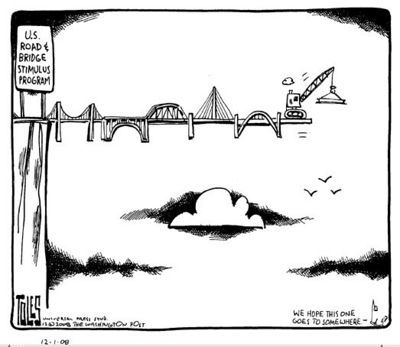
We’ll soon have a new president and already we’ve heard new promises of infrastructure investment. Once again, a chorus of politicians and pundits decries the woeful state of America’s road, bridges, sewers and airport terminals. Then, there are hosannas in adoration of the economic stimulus and job creation promised by large public works projects. And of course there are proposals to integrate politically-favored technologies with new infrastructure. All three rationales for a publicly-financed infrastructure program are flawed. Our infrastructure is not as inadequate as many believe; it is bad public policy to justify infrastructure decisions on the basis of the construction jobs required; and new infrastructure should not be treated as a vehicle for large-scale deployment of unproven technologies.

Ownership

Much of our nation’s infrastructure is privately owned. This includes, but is not limited to, power generation and the power grid, communication networks, many water systems and sewer systems, most rail lines, some toll roads and bridges, and some river, sea and space ports. Maintenance and upgrades to private facilities, and to some public facilities, depend on the adequacy of the rates or fees charged to users. On the other hand, the quantity and quality of publicly-owned and operated infrastructure is often left up to taxpayers rather than users. Proposals for federal infrastructure investment are largely about these public facilities, but they might also involve subsidies for the development of private infrastructure.

Crisis or Crock?

In a Heritage Foundation research report, Michael Sargent notes that the poor state of the country’s public infrastructure is wildly exaggerated:

“The notion that America’s infrastructure is ‘crumbling’ and in uniquely poor condition is not supported by data. The percentage of the nation’s bridges deemed ‘structurally deficient (not necessarily unsafe, but requiring extensive maintenance) has declined annually since 1990 and now sits at under 10 percent, well under half of what it was 25 years ago. Similarly, analyses of highway pavement quality conclude that the nation’s major roads have been steadily improving in quality and are likely in their best shape ever. Our airports and airways safely move more people and goods than those of any other nation. Overall, the U.S. ranks near the top of G-7 nations for infrastructure quality.“

The usual poster child of the infrastructure “crisis” is the nation’s transportation system, but this report from the Reason Foundation shows that those troubles are something of a myth.

Nevertheless, there are always repairs, maintenance and replacement projects to be considered, as well as possible expansion and new facilities. Infrastructural shortfalls and expansion must be prioritized, but as Sargent emphasizes, an even larger number of projects should and probably would be handled privately if not for burdensome federal regulations. In addition, an irrational mistrust of privately-operated facilities among some segments of the public creates pressure to burden taxpayers with costs, rather than users. Complaints about congestion on roads offer a case in point: the best solutions involve efficient (and positive) pricing of existing capacity, rather than continued expansion of a “free” good. The avoidance of rational solutions like efficient pricing underscores the extent to which demands for increased public investment in infrastructure are driven by hyperbole, rather than sound analysis.

It’s About the Infrastructure, Not the Jobs 

Public infrastructure projects are also pitched as effective engines of economic stimulus and job creation. Both of those claims are questionable. Most importantly, the real rationale for infrastructure investment is the value of the infrastructure itself and the needs it serves going forward. The public expense and the jobs required to produce it are cost items! This point was made recently by economist T. Norman Van Cott, who rightfully asserts that a given output is of greater benefit when its costs are low and when it requires less labor input. (Van Cott’s piece uses the Keystone pipeline as an example, a controversial private project that I find objectionable for its dependence on eminent domain actions.) The sharp distinction between creating value and creating jobs is also made here by Jerry L. Jordon and here by Steven Horowitz. Here is Horowitz:

“Creating jobs is easy; it’s creating value that’s hard. We could create millions of jobs quite easily by destroying every piece of machinery on U.S. farms. The question is whether we are actually better off by creating those jobs—and the answer is a definite no.“

Yet this is how so many infrastructure projects are pitched at the national, state and local levels. It’s also puzzling that economic stimulus is used as a rationale even when the economy is operating near its potential output. Even by the standards of traditional Keynesian economic analysis, that is the wrong time for stimulus. Infrastructure projects should be evaluated on their own merits, not on how many construction workers must be hired, or on how much of their paychecks those workers will spend. Many of them must be bid away from competing projects anyway.

The Public Investment Trough

Here’s a brief anecdote from my own experience with an “advanced” public infrastructure project. Some years ago in the region around my city, St. Louis, Missouri, transportation agencies began to install a network of electronic highway message boards to convey real-time information to drivers on road conditions, congestion, and various public service announcements. The 100+ signs in the area today are connected to operators in a central office via fiber optic cable. This type of system is used elsewhere, and it is partly funded by the federal government.

I seriously question the benefits of this system relative to cost. The signs themselves cost well in excess of $100,000 each. The fiber network is undoubtedly costly, and there are other fixed and variable system costs. The signs have an anachronistic look, vaguely the quality of old high school scoreboards. The information they provide generally adds little to what I already know (“12 minutes to I-270”). The signs are in fixed positions, so the occasional report of an accident or congestion usually comes too late to give motorists decent alternatives. The information the signs provide on road conditions is obvious. Missives such as “buckle up” are of questionable value. Before I depart on a commute, or if I have a passenger, we can consult maps and other apps on cell phones to avail ourselves of far better information. Other, more flexible technologies were outpacing the message boards even before they could be fully deployed, and the boards are still being deployed. This is a project that might have sounded brilliant to highway engineers 20 years ago, but it represented something of a luxury relative to other needs, and it still got funded. Today, it looks like waste.

The politics of infrastructure often means that the enabling legislation gets loaded with poorly-planned projects and shiny jewels to dangle before home constituencies. Legislators are so eager to demonstrate their sophistication that they fall over themselves to approve taxpayer funds for unproven but politically-favored technologies. For example, a recent post by Warren Meyer notes the technical folly of solar roads. These are unlikely to attract much private money because they represent such a monumentally stupid idea. Proponents will go after tax money instead. The same is true of ideas like Elon Musk’s tunnel boring project, for which he hopes to collect massive taxpayer subsidies. Musk claims that tunnels will eliminate road congestion, but efficient pricing would do much to eliminate this problem without tunnels, and other technologies like automated vehicles are likely to reduce congestion by the time Musk over-invests tax money in tunnel-boring equipment, roads and hyper-loops inside tunnels.

In general, taxpayers should be wary of “green infrastructure” proposals. A large number of bike lanes, pedestrian bridges and greenways sound wonderful, but they are serious cost inflators. Federal dollars are regularly squandered on charming but wasteful projects such as trolleys. Even worse are ongoing efforts to subsidize the construction of high-speed rail systems. All of these bright ideas should be resisted.

Let’s Be Rational

The country certainly has infrastructural needs, but claims that we face a crisis are greatly exaggerated. With a new administration and what are likely to be supporting majorities in both houses of Congress, the danger of rushing into big funding commitments is heightened. The sponsors of this kind of legislation will herald massive job creation, but that is incidental to the cost side of the ledger. The benefits of individual projects should be evaluated carefully in comparison to costs. Then they can be prioritized if deemed of sufficient value. Finally, large scale deployment of unproven technologies should be avoided on the public dime.

I haven’t even mentioned one very large infrastructure project that has been proposed by President-Elect Donald Trump: the border wall. I suspect that it would be easier and less expensive to solve the problem of border security using more advanced and flexible technologies, but the permanence and symbolism of a wall appeals to many of Mr. Trump’s supporters. The benefits of a wall in terms of border security and control of immigration flows are difficult if not impossible to evaluate, as are the costs to taxpayers, with Trump promising to extract some form of payment from Mexico. The wall, however, is being “sold” to the American public in emotional terms. Come to think of it, that’s how too many other infrastructure proposals are sold by politicians!

There are promising opportunities to improve the nation’s infrastructure through the private sector, where the value of projects is subject to evaluation by parties who must put “skin in the game”. This will be addressed in my next post.

Follow Sacred Cow Chips on WordPress.com

Recent Posts

  • Immigration and Merit As Fiscal Propositions
  • Tariff “Dividend” From An Indigent State
  • Almost Looks Like the Fed Has a 3% Inflation Target
  • Government Malpractice Breeds Health Care Havoc
  • A Tax On Imports Takes a Toll on Exports

Archives

  • December 2025
  • November 2025
  • October 2025
  • September 2025
  • August 2025
  • July 2025
  • June 2025
  • May 2025
  • April 2025
  • March 2025
  • February 2025
  • January 2025
  • December 2024
  • November 2024
  • October 2024
  • September 2024
  • August 2024
  • July 2024
  • June 2024
  • May 2024
  • April 2024
  • March 2024
  • February 2024
  • January 2024
  • December 2023
  • November 2023
  • August 2023
  • July 2023
  • June 2023
  • May 2023
  • April 2023
  • March 2023
  • February 2023
  • January 2023
  • December 2022
  • November 2022
  • October 2022
  • September 2022
  • August 2022
  • July 2022
  • June 2022
  • May 2022
  • April 2022
  • March 2022
  • February 2022
  • January 2022
  • December 2021
  • November 2021
  • October 2021
  • September 2021
  • August 2021
  • July 2021
  • June 2021
  • May 2021
  • April 2021
  • March 2021
  • February 2021
  • January 2021
  • December 2020
  • November 2020
  • October 2020
  • September 2020
  • August 2020
  • July 2020
  • June 2020
  • May 2020
  • April 2020
  • March 2020
  • February 2020
  • January 2020
  • December 2019
  • November 2019
  • October 2019
  • September 2019
  • August 2019
  • July 2019
  • June 2019
  • May 2019
  • April 2019
  • March 2019
  • February 2019
  • January 2019
  • December 2018
  • November 2018
  • October 2018
  • September 2018
  • August 2018
  • July 2018
  • June 2018
  • May 2018
  • April 2018
  • March 2018
  • February 2018
  • January 2018
  • December 2017
  • November 2017
  • October 2017
  • September 2017
  • August 2017
  • July 2017
  • June 2017
  • May 2017
  • April 2017
  • March 2017
  • February 2017
  • January 2017
  • December 2016
  • November 2016
  • October 2016
  • September 2016
  • August 2016
  • July 2016
  • June 2016
  • May 2016
  • April 2016
  • March 2016
  • February 2016
  • January 2016
  • December 2015
  • November 2015
  • October 2015
  • September 2015
  • August 2015
  • July 2015
  • June 2015
  • May 2015
  • April 2015
  • March 2015
  • February 2015
  • January 2015
  • December 2014
  • November 2014
  • October 2014
  • September 2014
  • August 2014
  • July 2014
  • June 2014
  • May 2014
  • April 2014
  • March 2014

Blogs I Follow

  • Passive Income Kickstart
  • OnlyFinance.net
  • TLC Cholesterol
  • Nintil
  • kendunning.net
  • DCWhispers.com
  • Hoong-Wai in the UK
  • Marginal REVOLUTION
  • Stlouis
  • Watts Up With That?
  • Aussie Nationalist Blog
  • American Elephants
  • The View from Alexandria
  • The Gymnasium
  • A Force for Good
  • Notes On Liberty
  • troymo
  • SUNDAY BLOG Stephanie Sievers
  • Miss Lou Acquiring Lore
  • Your Well Wisher Program
  • Objectivism In Depth
  • RobotEnomics
  • Orderstatistic
  • Paradigm Library
  • Scattered Showers and Quicksand

Blog at WordPress.com.

Passive Income Kickstart

OnlyFinance.net

TLC Cholesterol

Nintil

To estimate, compare, distinguish, discuss, and trace to its principal sources everything

kendunning.net

The Future is Ours to Create

DCWhispers.com

Hoong-Wai in the UK

A Commonwealth immigrant's perspective on the UK's public arena.

Marginal REVOLUTION

Small Steps Toward A Much Better World

Stlouis

Watts Up With That?

The world's most viewed site on global warming and climate change

Aussie Nationalist Blog

Commentary from a Paleoconservative and Nationalist perspective

American Elephants

Defending Life, Liberty and the Pursuit of Happiness

The View from Alexandria

In advanced civilizations the period loosely called Alexandrian is usually associated with flexible morals, perfunctory religion, populist standards and cosmopolitan tastes, feminism, exotic cults, and the rapid turnover of high and low fads---in short, a falling away (which is all that decadence means) from the strictness of traditional rules, embodied in character and inforced from within. -- Jacques Barzun

The Gymnasium

A place for reason, politics, economics, and faith steeped in the classical liberal tradition

A Force for Good

How economics, morality, and markets combine

Notes On Liberty

Spontaneous thoughts on a humble creed

troymo

SUNDAY BLOG Stephanie Sievers

Escaping the everyday life with photographs from my travels

Miss Lou Acquiring Lore

Gallery of Life...

Your Well Wisher Program

Attempt to solve commonly known problems…

Objectivism In Depth

Exploring Ayn Rand's revolutionary philosophy.

RobotEnomics

(A)n (I)ntelligent Future

Orderstatistic

Economics, chess and anything else on my mind.

Paradigm Library

OODA Looping

Scattered Showers and Quicksand

Musings on science, investing, finance, economics, politics, and probably fly fishing.

  • Subscribe Subscribed
    • Sacred Cow Chips
    • Join 128 other subscribers
    • Already have a WordPress.com account? Log in now.
    • Sacred Cow Chips
    • Subscribe Subscribed
    • Sign up
    • Log in
    • Report this content
    • View site in Reader
    • Manage subscriptions
    • Collapse this bar
 

Loading Comments...