• About

Sacred Cow Chips

Sacred Cow Chips

Tag Archives: Martin Feldstein

Behold Our Riches! Quality, Prices, Income, and the Purchasing Power of Labor

12 Tuesday Sep 2017

Posted by Nuetzel in Human Welfare, Markets

≈ 1 Comment

Tags

Affordability, Consumer Surplus, Don Boudreaux, Human Progress, Income Statistics, John D. Rockefeller, Marian Tupy, Martin Feldstein, Measures of Economic Welfare, Middle Class Stagnation, Non-Wage Benefits, Quality Adjustment, Wage Stagnation
coffeemaker

A steady refrain among pundits is that the American middle class can’t get ahead. The standard of living of average Americans has stagnated over the past 30 years, according to this view. It’s bolstered by government measures of average wage growth relative to consumer prices. But Martin Feldstein describes the flaws in constructing these measures; he says they may have led to an understatement of real income growth of more than 2% per year! Here is a link to Feldstein’s piece in the Wall Street Journal: “We’re Richer Than We Realize“. (If the link doesn’t work, an ungated link can be found on the WSJ Facebook page, posted at 10:30 a.m. on Saturday, Sept. 9th.)

Here are some of Feldstein’s observations:

“If there is no increase in the cost of production, the government concludes that there has been no increase in quality. And if the manufacturer reports an increase in the cost of production, the government assumes that the value of the product to consumers has increased in the same proportion.

That’s a very narrow—and incorrect—way to measure quality change. In reality companies improve products in ways that don’t cost more to produce and may even cost less. That’s been true over the years for familiar products like television sets and audio speakers. The government therefore doesn’t really measure the value to consumers of the improved product, only the cost of the increased inputs. The same approach, based on measuring the cost of inputs rather than the value of output, is also used for services.

The official estimates of quality change are therefore mislabeled and misinterpreted. When it comes to quality change, what is called the growth of real output is really the growth of real inputs. The result is a major underestimation of the increase in real output and in the growth of real incomes that occurs through quality improvements.

The other source of underestimation of growth is the failure to capture the benefit of new goods and services. Here’s how the current procedure works: When a new product is developed and sold to the public, its market value enters into nominal gross domestic product. But there is no attempt to take into account the full value to consumers created by the new product per se.“

It goes well beyond that, however, as great swaths of consumer value are completely ignored by government statistics:

“A basic government rule of GDP measurement is to count only goods and services that are sold in the market. Services like Google and Facebook are therefore excluded from GDP even though they are of substantial value to households. The increasing importance of such free services implies a further understatement of real income growth.“

Some of these criticisms are unfair to the extent that income statistics correspond to what consumers can purchase in terms of market value. That is a fundamentally different concept than the total value consumers assign to goods and services (market value plus consumer surplus). Nevertheless, there are efforts to adjust for quality in these statistics, but they fall far short of their objective. Also, GDP and income statistics purport to be measures of economic welfare, though it’s well known that they fall short of that ideal. It might be more fair to say that that official income statistics are reliable in tracking short-term changes in well being, but not so much over long periods of time.

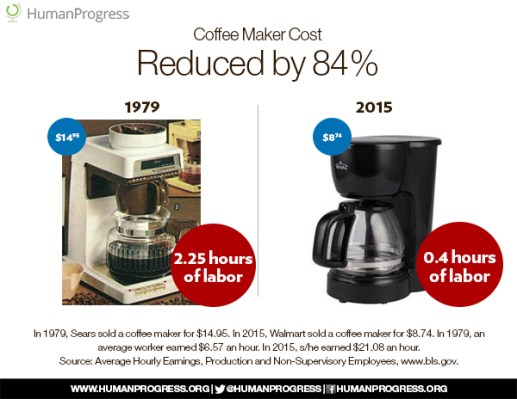
The graphic at the top of this post is taken from Marian L. Tupy’s “Cost of Living and Wage Stagnation in the United States, 1979-2015“, on the CATO Institute‘s web site:

“… many, perhaps most, big-ticket items used by a typical American family on a daily basis have decreased in price. Over at Human Progress, we have been comparing the prices of common household items as advertised in the 1979 Sears catalog and prices of common household items as sold by Walmart in 2015.

We have divided the 1979 nominal prices by 1979 average nominal hourly wages and 2015 nominal prices by 2015 average nominal hourly wages, to calculate the “time cost” of common household items in each year (i.e., the number of hours the average American would have to work to earn enough money to purchase various household items at the nominal prices). Thus, the ‘time cost’ of a 13 Cu. Ft. refrigerator fell by 52 percent in terms of the hours of work required at the average hourly nominal wage, etc.“

Tupy’s post also covers the huge increases in non-wage benefits enjoyed by many workers over the past several decades, which are not captured in average wage statistics.

It’s clear that standard measures of income growth are distorted by the failure to properly account for changes in the quality of goods and services at our disposal. The narrative of middle class stagnation is flawed in that respect. As Don Boudreaux has said, most ordinary Americans are richer today than John D. Rockefeller was a century ago. The availability and quality of goods and many services today, affordable to ordinary Americans, are vastly superior to what Rockefeller had then or could even imagine. And many of those advancements occurred since the 1970s.

The Taxing Logic of Carbon Cost Guesswork

11 Saturday Mar 2017

Posted by Nuetzel in Environment, Taxes, Uncategorized

≈ 1 Comment

Tags

Anthopomorphic, Carbon Dividend, Carbon Tax, Climate Leadership Council, Corrective Taxation, External costs and benefits, Fossil fuels, Greg Mankiw, Martin Feldstein, Paul Driessen, Roger Besdek, Ronald Bailey, Ted Halstead, Universal Basic Inome, Watt's Up With That?

An article by three prominent economists* in the New York Times this week summarized the Climate Leadership Council’s Conservative Case for Climate Action“. The “four pillars” of this climate plan include (1) a revenue-neutral tax on carbon emissions, which are used to fund… (2) quarterly “carbon dividend” payments to all Americans; (3) border tax adjustments to account for carbon emissions and carbon taxes abroad; (4) eliminating all other regulations on emissions of carbon. The “Case” is thus a shift from traditional environmental regulation to a policy based on tax incentives, then wrapped around a redistributive universal income mechanism.

I’ll dispense with the latter “feature” by referencing my recent post on the universal basic income: bad idea! The economists advocate for the carbon dividend sincerely, but also perhaps as a political inducement to the left and confused centrists.

The Limits of Our Knowledge

The most interesting aspect of the “Case” is how it demonstrates uncertainty around the wisdom of carbon restrictions of any kind: traditional regulations, market-oriented trading, or tax incentives. Those all involve assumptions about the extent to which carbon emissions should be restricted, and it’s not clear that any one form of restriction is more ham-handed than another. Traditional regulation may restrict output in various ways. For example, standards on fuel efficiency are an indirect way of restricting output. A carbon market, with private trading in assigned “rights” to emit carbon, is more economically efficient in the sense that a tradeoff is involved for any decision having carbon implications at the margin. However, the establishment of a carbon market ultimately means that a limit must be imposed on the total quantity of rights available for trading.

A carbon tax imputes a cost of carbon emissions to society. It also imposes tradeoffs, so it is similar to carbon trading in being more economically efficient than traditional regulation. A producer can attempt to adjust a production process such that it emits less carbon, and the incidence of the tax falls partly on final consumers, who adjust the carbon intensity of their behavior accordingly. For our purposes here, a tax is more illuminating in the sense that we can assess inputs to the cost imputation. Even a cursory examination shows that the cost estimate can vary widely given reasonable differences in the inputs. So, in a sense, a tax helps to reveal the weakness of the case against carbon and the carbon-based rationale for allowing a coercive environmental authority to sclerose the arteries of the market system.

The three economists propose an initial tax of $40 per metric ton of emitted carbon. The basis for that figure is the so-called “social cost of carbon” (SCC), a theoretical construct that is not readily measured. Economists have long subscribed to the theory of social costs, or negative externalities, and to the legitimacy of government action to force cost causers to internalize social costs via corrective taxation. However, the wisdom of allowing the state to intrude upon markets in this way depends on our ability to actually measure specific external costs.

Fatuous Forecasts

The SCC is based on the presumed long-run costs of an incremental ton of carbon in the environment. I do not use the word “presumed” lightly. The $40 estimate subsumes a variety of speculative assumptions about the climate’s response to carbon emissions, the future economic impact of that response, and the rate at which society should be willing to trade those future costs against present costs. The figure only counts costs, without considering the huge potential benefits of warming, should it actually occur.

Ronald Bailey at Reason illustrates the many controversies surrounding the calculation of the SCC. He notes the tremendous uncertainty surrounding an Obama Administration estimate of $36 a ton in 2007 dollars. It used an outdated climate sensitivity figure much higher than more recent estimates, which would bring the calculated SCC down to just $16.

A discount rate of 3% was applied to projected future carbon costs to produce an SCC in present value terms. The idea is that today’s “collective” would be indifferent between paying this cost today and suffering the burden of future costs inflicted by carbon emissions. This presumes that 3% is the expected return society can earn for the future by investing resources today. Unfortunately, the SCC is tremendously sensitive to the discount rate. Together with the more realistic estimate of climate sensitivity, a discount rate of 7% (the Office of Management and Budget’s regulatory guidance) would actually make the SCC negative!

Another U.S. regulatory standard, according to Bailey, is that calculations of social cost are confined to costs borne domestically. However, the SCC attempts to encompass global costs, inflating the estimate by a factor of 4 to 14 times. The justification for the global calculation is apparent righteousness in owning up to the costs we cause as a nation, and also for the example it sets for other countries in crafting their own carbon policies. Unfortunately, it also magnifies the great uncertainties inherent in this messy calculation.

Lack of Evidence

This guest essay on the Watts Up With That? web site by Paul Driessen and Roger Bezdek takes a less gracious view of the SCC than Bailey, if that is possible. As they note, in addition to climate sensitivity, the SCC must come to grips with the challenge of measuring the economic damage caused by each degree of warming. This includes factors far into the future that simply cannot be projected with any confidence. We are expected to place faith in distant cost estimates of heat-related deaths, widespread crop failures, severe storm damage, coastal flooding, and many other calamities that are little more than scare stories. For example, the widely reported connection between atmospheric carbon concentration and severe weather is demonstrably false, as are reports that Pacific islands have been swallowed by the sea due to global warming.

Ignoring the Benefits

The SCC makes no allowance for the real benefits of burning fossil fuels, which have been a powerful engine of economic growth and still hold the potential to lift the underdeveloped world out of poverty and environmental  distress. The benefits of carbon also include fewer cold-related deaths, higher agricultural output, and a greener environment. It isn’t surprising that these benefits are ignored in the SCC calculation, as any recognition of that promise would undermine the narrative that fossil fuels are unambiguously evil. Indeed, an effort to calculate only the net costs of carbon emissions would likely expose the entire exercise as a sham.

The “four pillars” of the Climate Leadership Council‘s case for climate action rest upon an incredibly flimsy foundation. Like anthropomorphic climate change itself, appropriate measurement of a social cost of carbon is an unsettled issue. Its magnitude is far too uncertain to use as a tool of public policy: as either a tax or a rationale for carbon regulation of any kind. And let’s face it, taxation and regulation are coercive acts that better be undertaken with respect for the distortions they create. In this case, it’s not even clear that carbon emissions should be treated as an external cost in many applications, as opposed to an external benefit. So much for the corrective wisdom of authorities. The government is not well-equipped to centrally plan the economy, let alone the environment.

  • The three economists are Martin Feldstein, Ted Halstead and Greg Mankiw.

Central Bank Bubbles Pop On Our Heads

09 Wednesday Sep 2015

Posted by Nuetzel in Big Government, Macroeconomics, Monetary Policy

≈ Leave a comment

Tags

Asset Bubble, Asset Price Distortion, Boom and bust, capital costs, Capital investment, Easy Money, Jim Grant, Market Manipulation, Martin Feldstein, Quantitative Easing, Ryan McMaken, Seigniorage, Supportive Earnings, Zero Interest Rate Policy, ZIRP

boom_and_bust

Printing money is a temptation that central banks can’t resist. And they distort prices when they do it. The new “liquidity” finds its way into higher asset values: stocks, bonds, real estate, even art. But as Jim Grant points out (as quoted by Ryan McMaken), the inflated prices are artificial, decoupled from the actual value those assets are capable of generating. The high asset prices are unsustainable:

“The idea is that you put the cart of asset values before the horse of enterprise. By raising up asset values, you mobilize spending by people who have assets… It was otherwise known as trickle-down economics before the enlightenment, then it became something much fancier in economic lingo. But that’s essentially the idea. So what you have seen is an artificial structure of prices worldwide.”

This comports with the general drift one gets from chatting with financial market professionals about the Federal Reserve and other central banks. These advisors usually add a reflexive assurance that corporate earnings are adequate to support stock prices. So which is it? Those very earnings might reflect trading gains on assets held by financial institutions and others, so the “supportive earnings” argument is circular to some degree. That aside, it’s suggestive that the recent market selloff has been centered on tighter monetary conditions:

“‘The risk of global liquidity conditions swinging is real for the markets, justifying a significant reduction in exposure for all asset classes,’ said Didier Saint-Georges, managing director at Carmignac, in a note to clients.“

Likewise, significant rebounds have been attributed, at least in part, to softening expectations that the Fed will move to increase short-term interest rates next week. If asset values are so heavily dependent on a continuation of a zero-interest rate, easy-money policy at this stage of an economic expansion, then it looks like a bubble is waiting to pop. More liquidity might delay the inevitable.

How did we get here? Martin Feldstein describes the policy of “quantitative easing” (QE) in “The Fed’s Stock Price Correction“:

“When the Obama administration’s poorly designed 2009 stimulus legislation failed to produce a strong economic turnaround, then-Fed Chairman Ben Bernanke announced that the central bank would pursue an ‘unconventional monetary policy’ by purchasing immense amounts of long-term bonds and promising to hold short-term interest rates near zero for an extended period.

Mr. Bernanke explained that the Fed’s policy was designed to drive down long-term interest rates, inducing portfolio investors to shift from bonds to stocks. This ‘portfolio substitution’ strategy, as he labeled it, would increase share prices, raising household wealth and therefore consumer spending.“

Feldstein does not buy the contention that “earnings are supportive”. Despite his conventional demand-side approach to macroeconomics, he too emphasizes that loose monetary policy has distorted asset prices.

The process is exacerbated by the bloated federal government’s appetite for funds. The Treasury is able to float debt at very low interest rates, thanks to the Fed’s willingness to provide liquidity to the banking system. By that, I mean the Fed’s willingness to buy Treasury bonds and monetize federal deficit spending.

Jim Grant’s argument regarding price distortion goes further. Increases in the prices of financial assets artificially deflate the cost of raising new capital, translating into over-investment in physical assets such as office buildings and machinery. Here’s Grant:

The prices themselves are the cosmetic evidence of underlying difficulty. So if you misprice something, it’s not just the price that’s wrong. It’s the thing itself that has been financed by the price. So you have perhaps too many oil derricks, too many semi-conductor fabs. We have too much of something, which is financed by an excess of credit or debt.“

Thus, the boom feeds the inevitable bust. That is certainly a danger. I’m sympathetic to Grant’s reasoning, but we have not experienced much of a boom in physical capital investment in the U.S., except perhaps for commercial real estate and in capital-intensive oil and gas extraction, and the latter is now on the skids. China, however, has been aggressively over-investing, and that is coming to an end.

While asset values have likely been inflated, it is fair to ask why the Fed’s accommodative policy has not led to a more general inflation in the prices of goods and services. For one thing, the strong dollar has held import prices down. (The international value of the dollar has been buttressed by the view that dollar-denominated assets are relatively safe, despite the risks created by the Fed.) More importantly, aging baby boomers have contributed to relatively strong saving activity (and less spending). Paradoxically, it’s possible that saving has been reinforced by the zero-rate policy of the Fed, as noted before on Sacred Cow Chips. Buying extra comfort in retirement requires greater set-asides if rates are low.

I am not optimistic about the direction of asset values, but I am not adjusting my own investment profile. Market timing is generally a bad strategy, and I will do my best to ride out the market’s ups and downs, even if they are manipulated by the Fed. However, we should all demand more discipline from the federal government and more restraint from the Fed. Better yet, limit the Fed’s discretion in the conduct of monetary policy by relying on a monetary standard that is less prone to manipulation and seigniorage.

Follow Sacred Cow Chips on WordPress.com

Recent Posts

  • Immigration and Merit As Fiscal Propositions
  • Tariff “Dividend” From An Indigent State
  • Almost Looks Like the Fed Has a 3% Inflation Target
  • Government Malpractice Breeds Health Care Havoc
  • A Tax On Imports Takes a Toll on Exports

Archives

  • December 2025
  • November 2025
  • October 2025
  • September 2025
  • August 2025
  • July 2025
  • June 2025
  • May 2025
  • April 2025
  • March 2025
  • February 2025
  • January 2025
  • December 2024
  • November 2024
  • October 2024
  • September 2024
  • August 2024
  • July 2024
  • June 2024
  • May 2024
  • April 2024
  • March 2024
  • February 2024
  • January 2024
  • December 2023
  • November 2023
  • August 2023
  • July 2023
  • June 2023
  • May 2023
  • April 2023
  • March 2023
  • February 2023
  • January 2023
  • December 2022
  • November 2022
  • October 2022
  • September 2022
  • August 2022
  • July 2022
  • June 2022
  • May 2022
  • April 2022
  • March 2022
  • February 2022
  • January 2022
  • December 2021
  • November 2021
  • October 2021
  • September 2021
  • August 2021
  • July 2021
  • June 2021
  • May 2021
  • April 2021
  • March 2021
  • February 2021
  • January 2021
  • December 2020
  • November 2020
  • October 2020
  • September 2020
  • August 2020
  • July 2020
  • June 2020
  • May 2020
  • April 2020
  • March 2020
  • February 2020
  • January 2020
  • December 2019
  • November 2019
  • October 2019
  • September 2019
  • August 2019
  • July 2019
  • June 2019
  • May 2019
  • April 2019
  • March 2019
  • February 2019
  • January 2019
  • December 2018
  • November 2018
  • October 2018
  • September 2018
  • August 2018
  • July 2018
  • June 2018
  • May 2018
  • April 2018
  • March 2018
  • February 2018
  • January 2018
  • December 2017
  • November 2017
  • October 2017
  • September 2017
  • August 2017
  • July 2017
  • June 2017
  • May 2017
  • April 2017
  • March 2017
  • February 2017
  • January 2017
  • December 2016
  • November 2016
  • October 2016
  • September 2016
  • August 2016
  • July 2016
  • June 2016
  • May 2016
  • April 2016
  • March 2016
  • February 2016
  • January 2016
  • December 2015
  • November 2015
  • October 2015
  • September 2015
  • August 2015
  • July 2015
  • June 2015
  • May 2015
  • April 2015
  • March 2015
  • February 2015
  • January 2015
  • December 2014
  • November 2014
  • October 2014
  • September 2014
  • August 2014
  • July 2014
  • June 2014
  • May 2014
  • April 2014
  • March 2014

Blogs I Follow

  • Passive Income Kickstart
  • OnlyFinance.net
  • TLC Cholesterol
  • Nintil
  • kendunning.net
  • DCWhispers.com
  • Hoong-Wai in the UK
  • Marginal REVOLUTION
  • Stlouis
  • Watts Up With That?
  • Aussie Nationalist Blog
  • American Elephants
  • The View from Alexandria
  • The Gymnasium
  • A Force for Good
  • Notes On Liberty
  • troymo
  • SUNDAY BLOG Stephanie Sievers
  • Miss Lou Acquiring Lore
  • Your Well Wisher Program
  • Objectivism In Depth
  • RobotEnomics
  • Orderstatistic
  • Paradigm Library
  • Scattered Showers and Quicksand

Blog at WordPress.com.

Passive Income Kickstart

OnlyFinance.net

TLC Cholesterol

Nintil

To estimate, compare, distinguish, discuss, and trace to its principal sources everything

kendunning.net

The Future is Ours to Create

DCWhispers.com

Hoong-Wai in the UK

A Commonwealth immigrant's perspective on the UK's public arena.

Marginal REVOLUTION

Small Steps Toward A Much Better World

Stlouis

Watts Up With That?

The world's most viewed site on global warming and climate change

Aussie Nationalist Blog

Commentary from a Paleoconservative and Nationalist perspective

American Elephants

Defending Life, Liberty and the Pursuit of Happiness

The View from Alexandria

In advanced civilizations the period loosely called Alexandrian is usually associated with flexible morals, perfunctory religion, populist standards and cosmopolitan tastes, feminism, exotic cults, and the rapid turnover of high and low fads---in short, a falling away (which is all that decadence means) from the strictness of traditional rules, embodied in character and inforced from within. -- Jacques Barzun

The Gymnasium

A place for reason, politics, economics, and faith steeped in the classical liberal tradition

A Force for Good

How economics, morality, and markets combine

Notes On Liberty

Spontaneous thoughts on a humble creed

troymo

SUNDAY BLOG Stephanie Sievers

Escaping the everyday life with photographs from my travels

Miss Lou Acquiring Lore

Gallery of Life...

Your Well Wisher Program

Attempt to solve commonly known problems…

Objectivism In Depth

Exploring Ayn Rand's revolutionary philosophy.

RobotEnomics

(A)n (I)ntelligent Future

Orderstatistic

Economics, chess and anything else on my mind.

Paradigm Library

OODA Looping

Scattered Showers and Quicksand

Musings on science, investing, finance, economics, politics, and probably fly fishing.

  • Subscribe Subscribed
    • Sacred Cow Chips
    • Join 128 other subscribers
    • Already have a WordPress.com account? Log in now.
    • Sacred Cow Chips
    • Subscribe Subscribed
    • Sign up
    • Log in
    • Report this content
    • View site in Reader
    • Manage subscriptions
    • Collapse this bar
 

Loading Comments...