• About

Sacred Cow Chips

Sacred Cow Chips

Tag Archives: Medicare

Choice, Federal Exchange Failure, and a Path to Health Insurance Reform

25 Wednesday Oct 2017

Posted by Nuetzel in Health Insurance, Markets, Obamacare

≈ Leave a comment

Tags

Association Health Plans, Avik Roy, Barack Obama, Bill Cassidy, Cost-Sharing Subsidies, Donald Trump, Exchange Markets, Health Status Insurance, Insurer subsidies, Jeffrey Tucker, John C. Goodman, John Cochrane, John McCain, Medicaid, Medicare, Obamacare, Patient Freedom Act, Pete Sessions, Pre-Existing Conditions, Short-Term Policies, Tax-Credit Subsidies, Universal Health Allowance

“… a government program that is ruined by permitting more choice is not sustainable.“

That’s Jeffrey Tucker on Obamacare. Conversely, coercive force is incompatible with a free society. Tucker, no fan of President Donald Trump, writes that the two recent executive orders on health coverage are properly framed as liberalization. The orders in question: 1a) eliminate federal restrictions on the sale of so-called association health insurance plans, including their availability across state lines; 1b) remove the three-month limitation on coverage offered under temporary policies; and 2) end insurer cost-sharing subsidies for policies sold to low-income (non-Medicaid) segments of the individual market.

The most immediately impactful of the three points above might be 1b. These temporary policies became quite popular after Obamacare took effect, at least until the Obama Administration placed severe restrictions on their duration and renewal in 2016 (see Avik Roy’s post in Forbes on this point). Trump’s first order rescinds that late-term Obama order. The short-term policies are likely to become popular once again, as things stand. Small employers can avoid many of the Obamacare rules and save significantly on premiums using temporary policies.

Association plans are already sold to small businesses having a “commonality of interest”, but Trump’s order would expand the allowable common interests and permit association plans to be sold across state lines. Avik Roy doubts that this will have a large impact, but to the extent that association plans avoid both state and federal benefit mandates, they could prove to be another important source of more affordable coverage for employees than the Obamacare exchanges. In any case, as Tucker says:

“In the words of USA Today: the executive order permits a greater range of choice ‘by allowing more consumers to buy health insurance through association health plans across state lines.’  … The key word here is ‘allowing’– not forcing, not compelling, not coercing. Allowing.

Why would this be a problem? Because allowing choice defeats the core feature of Obamacare, which is about forcing risk pools to exist that the market would otherwise never have chosen. … The tenor of the critics’ comments on this move is that it is some sort of despotic act. But let’s be clear: no one is coerced by this executive order. It is exactly the reverse: it removes one source of coercion. It liberalizes, just slightly, the market for insurance carriers.“

The elimination of insurer cost-sharing subsidies might sound like the most draconian aspect of the orders. Those subsidies were designed to keep the cost of coverage low for consumers with low incomes, but the subsidies are illegal because the allocation of funds was never authorized by Congress. And contrary to what has been alleged, eliminating the insurer subsidies will have virtually no impact on low-income consumers. First, a large percentage of them are on Medicaid to begin with, not the exchanges. Second, tax-credit subsidies for low-income consumers are still in place for exchange plans, and they will scale based on the premium charged for the “silver” plan (also see Avik Roy’s link above). Taxpayers will be on the hook for those increased subsidies, as they were for the insurer cost-sharing payments.

The exchange market will be weakened by the executive orders, but it has been in a prolonged decline since its inception. Relatively healthy consumers will have opportunities to buy more competitive coverage through short-term policies or association plans, so they are now more likely to exit the risk pool. Higher-income, unsubsidized consumers are likely to pay more for coverage on the exchanges, particularly those with pre-existing conditions. As premiums rise, some of the healthy will simply forego coverage, paying the penalty instead (if it is enforced). Of course, the exchange risk pool was already risky, coverage options have thinned, and premiums have been rising, but the deterioration of conditions on the exchanges will likely be hastened under Trump’s executive orders.

Dismantling some of the restrictions on health insurance choice, which were imposed by executive order under President Obama, could prove to have been a stroke of genius on Trump’s part. As a negotiating ploy, Trump just might have maneuvered Republicans and Democrats into a position from which they can agree … on something. The new orders certainly give emphasis to the deterioration of the exchange markets. The insurers probably viewed the cost-sharing subsidies as a better deal for themselves than having to recoup costs via risky and controversial rate increases, so they are likely to pressure Congress for relief. And higher-income consumers with pre-existing conditions will face higher premiums but won’t have new choices. They will be a vocal constituency.

Democrats just don’t have any ideas with legs, however: single-payer and Medicare-for-all are increasingly viewed as politically unacceptable alternatives by most observers. As John C. Goodman notes at the last link, Medicare is already an actuarial and financial nightmare. Another program of the like to replace existing coverage that most voters would like to keep is not a position likely to win elections. Here is Goodman:

“So, the Democrats’ dilemma is: (1) they are not getting any electoral advantage from Obamacare, (2) they can’t afford to criticize it for fear of upsetting their base and (3) they don’t have an acceptable solution in any event.“

So perhaps we have conditions that might foster a compromise, at least one that could win enough votes to fix the insurance markets. Goodman contends that a plan originally attributable to John McCain, and now in the form of the Pete Sessions/Bill Cassidy-sponsored Patient Freedom Act, could be the answer. It would create something like a Universal Basic Health Allowance, in the form of a tax credit, funded by eliminating all current federal spending on health care (excluding Medicare and Medicaid). Those with pre-existing conditions would purchase coverage the same way as others, but the plan would give insurers a strong incentive to retain them. According to Goodman, a “health status risk adjustment” would assure actuarially-fair pricing by forcing an existing insurer to pay the adjustment to a new insurer when sick individuals change their insurance plans.

The Sessions/Cassidy plan (and Goodman) describes a particular implementation of a more general concept called health status insurance, a good explanation of which is offered by John Cochrane:

“Market-based lifetime health insurance has two components: medical insurance and health-status insurance. Medical insurance covers your medical expenses in the current year, minus deductibles and copayments. Health-status insurance covers the risk that your medical insurance premiums will rise. If you get a long-term condition that moves you into a more expensive medical insurance premium category, health-status insurance pays you a lump sum large enough to cover your higher medical insurance premiums, with no change in out-of-pocket expenses.“

It would be a miracle if Congress can successfully grapple with the complexities of health care reform in the current legislative session. However, Trump’s executive orders have improved the odds that some kind of agreement can be negotiated to address the dilemma of the failing exchanges and coverage for pre-existing conditions. Let’s hope whatever they negotiate will leverage consumer choice and free markets. Trump’s orders are a step, but only one step, in reestablishing the patient/insured as a key decision maker in the allocation of health care resources.

Gains From Medicare Trade

08 Thursday Dec 2016

Posted by Nuetzel in Medicare, Privatization, Profit Motive

≈ 2 Comments

Tags

ACA, American Enterprise Institute, CMS, Donald Trump, Health Savings Accounts, HHS, IPAB, John C. Goodman, MACRA, Medicare, Medicare Advantage, Medicare Part C, Medigap, Obamacare, Original Medicare, Premium Support Plan, Privatization, Tom Price

Boomers and Medicare

Here’s a bit of zero-sum ignorance: private profits are robbed from consumers; only non-profits or government can deliver full value, or so this logic goes. Those who subscribe to this notion dismiss the function of private incentives in creating value, yet those incentives are responsible for nearly all of the material blessings of modern life. What the government seems to do best, on the other hand, is writing checks. It’s not really clear it does that very well, of course, but it does have the coercive power of taxation required to do so. Capital employed by government is not a “free” input. It bears opportunity costs and incentive costs that are seldom considered by critics of the private sector.

The role of private profit and the zero-sum fallacy come up in the context of proposals to privatize government services. In what follows, I discuss a case in point: privatization of Medicare. Rep. Tom Price, the Chairman of the House Budget Committee, is Donald Trump’s nominee to head HHS. In November, Price said Congress would attempt to pass legislation overhauling Medicare in the first year of the Trump Administration. James Capretta of the American Enterprise Institute (AEI) explains some of the features of the possible reforms. Price has supported the concept of a premium support plan whereby seniors would purchase their own coverage from private insurers, paid at least in part by the government (also see here).

Medicare and Its Ills

The Medicare program is beset with problems: it has huge unfunded liabilities; it’s cash flows are being undermined by demographic trends; fraud and bureaucratic waste run rampant; it’s unpopular with doctors; and the regulations imposed on healthcare providers are often misguided.

Writing checks to health care providers is really the primary “good” created by the federal government in the administration of Medicare. The Centers for Medicare & Medicaid Services (CMS), a branch of the Department of Health and Human Services (HHS), also performs regulatory functions mandated by legislation, such as the Affordable Care Act (ACA).

More recently, CMS has been implementing the Medicare Access and Chip Reauthorization Act of 2015 (MACRA), which will introduce changes to the payment formulas for physician compensation under the plan. Economist John C. Goodman offers a cogent explanation of the ill-conceived economic planning at the heart of Medicare regulation and its implementation of MACRA in particular:

“…the government’s current payment formulas create perverse economic incentives — to maximize income against the formulas instead of putting patient welfare first. The goal is to change those incentives, so that providers will get paid more if they lower costs and raise quality.

But after the new formulas replace the old ones, provider incentives in a very real sense will be unchanged. They will still have an economic incentive to maximize income by exploiting the formulas, even if that is at the expense of their patients.“

After describing several ways in which Medicare regulation, now and prospectively, leads to perverse results, Goodman advances the powerful argument that the market can regulate health care delivery to seniors more effectively than CMS.

“If the government’s metrics are sound, why not allow health plans to advertise their metrics to potential enrollees and compete on these quality measures. Right now, they cannot. Every communication from health plans to Medicare enrollees must be approved by CMS. … Under MACRA, health plans profit by satisfying the government, not their customers. … Better yet, why not let the market (rather than government) decide on the quality metrics?“

Private Medicare Exists

Wait a minute: profit? But isn’t Medicare a government program, free from the presumed evils of profit-seekers? Well, here’s the thing: almost all of the tasks of managing the provision of Medicare coverage are handled by the private sector under contract with CMS, subject to CMS regulation, of course. That is true even for Part A and Part B benefits, or “original Medicare”, as it’s sometimes called.

Under “original” Medicare, private insurers process “fee-for-service” claims and payments, provide call center services, manage clinician enrollment, and perform fraud investigations. Yes, these companies can earn a profit on these services. Unfortunately, CMS regulation probably serves to insulate them from real competition, subverting efficiency goals. Goodman’s suggestion would refocus incentives on providing value to the consumers these insurers must ultimately serve.

Then there are “Medigap” or Medicare Supplement policies that cover out-of-pocket costs not covered under Parts A and B. These policies are designed by CMS, but they are sold and managed by private insurers.

And I haven’t even mentioned Medicare Parts C and D, which are much more significantly privatized than original Medicare or Medigap. The Part C program, also known as Medicare Advantage, allows retirees to choose from a variety of privately-offered plans as an alternative to traditional Medicare. At a minimum, these plans must cover benefits that are the equivalent to Parts A and B, as judged by CMS, though apparently “equivalency” still allows some of those benefits to be declined in exchange for a rebate on the premium. More optional benefits are available for an additional premium under these plans, including a reduced out-of-pocket maximum, a lower deductible, and reduced copays. Part C has grown dramatically since its introduction in 1996 and now covers 32% of Medicare enrollees. Apparently these choices are quite popular with seniors. So why, then, is privatization such a bogeyman with the left, and with seniors who are cowed by the anti-choice narrative?

What’s To Privatize?

Not privatized are the following Medicare functions: the collection of payroll-tax contributions of current workers; accounting and reporting functions pertaining to the Trust Fund; decisions surrounding eligibility criteria; the benefit designs and pricing of Part A (hospitalization) and Part B (optional out-patient medical coverage, including drugs administered by a physician); approval of provider plan designs and pricing under Parts C; regulation and oversight of all other aspects of Medicare, including processes managed by private administrative contractors and providers of optional coverage; and regulation of health care providers. 

The Independent Payment Advisory Board (IPAB) was created under the Affordable Care Act (ACA), aka Obamacare, to achieve Medicare costs savings under certain conditions, beginning in 2015. Its mandate is rather confusing, however, as IPAB is ostensibly restricted by the ACA from meddling with health care coverage and quality. Proposals from IPAB are expected to cover such areas as government negotiation of drug prices under Part D, a Part B formulary, restrictions on the “protected status” of certain drugs, and increasing incentives for diagnostic coding for Part C plans. Note that these steps are confined to optional or already-private parts of Medicare. They are extensions of the administrative and regulatory functions described above. Despite the restrictions on IPAB’s activities under the ACA, these steps would have an impact on coverage and quality, and they mostly involve functions for which market solutions are better-suited than one-size-fits-all regulatory actions.

The opportunities for privatization are in 1) creating more choice and flexibility in Parts A and B, or simply migrating them to Parts C and D, along with premium support; 2) eliminating regulatory burdens, including the elimination of IPAB.

Impacts On Seniors Now and Later

Privatization is unlikely to have any mandatory impact on current or near-future Medicare beneficiaries. That it might is a scare story circulating on social media (i.e., fake news), but I’m not aware of any privatization proposal that would make mandatory changes affecting anyone older than their mid-50s. Voluntary benefit choices, such as Part C and D plans, would be given more emphasis.

There should be an intensive review of the regulatory costs imposed on providers and, in turn, patients. Many providers simply refuse to accept patients with Medicare coverage, and regulation encourages health care delivery to become increasingly concentrated into large organizations, reducing choices and often increasing costs. Lightening the regulatory burden is likely to bring immediate benefits to seniors by improving access to care and allowing providers to be more patient-focused, rather than compliance-focused.

Again, the most heavily privatized parts of Medicare are obviously quite popular with seniors. The benefits are also provided at lower cost, although the government pays the providers of those plans extra subsidies, which may increase their cost to taxpayers. Enrollees should be granted more flexibility through the private market, including choices to limit coverage, even down to catastrophic health events. Consumers should be given at least limited control over the funds used to pay their premia. That would include choice over whether to choose lower premia and put the excess premium support into consumer-controlled Health Saving Account (HSA) contributions.

Other Reforms

Pricing is a controversial area, but that’s where the terms of mutually beneficial trades are made, and it’s what markets do best. Pricing flexibility for private plans would be beneficial from the standpoint of matching consumer needs with the appropriate level of coverage, especially with fewer regulatory restrictions. Such flexibility need not address risk rating in order to have beneficial effects.

Regulations imposed on physicians and other providers should be limited to those demanded by private plans and the networks to which they belong, as well as clear-cut legislative rules and standards of practice imposed by professional licensing boards. The better part of future contributions to the Trust Fund by younger workers (i.e., those not grandfathered into the existing program) should be redirected toward the purchase today of future benefits in retirement, based on actuarial principles.

Perhaps the best cost-control reform would be repeal of the tax deductibility of insurance premia on employer-paid insurance plans. This provision of the tax code has already inflated health care costs for all consumers, including seniors, via demand-side pressure, and it has inflated their insurance premia as well. If extended to all consumers, tax deductibility would be less discriminatory toward consumers in the individual market and most seniors, but it would inflate costs all the more, with unevenly distributed effects. Unfortunately, rather than eliminating it entirely, qualification for the tax deduction is very likely to be broadened.

Conclusions

The Medicare program is truly in need of an overhaul, but reform proposals, and especially proposals that would put decision-making power into the hands of consumers, are always greeted with reflexive shrieks from sanctimonious worshippers of the state. The most prominent reform under consideration now would offer more of what’s working best in the Medicare program: private choices in coverage and costs. Solving the long-term funding issues will be much easier without a centralized regime that encourages escalating costs.

Earning a profit is usually the mark of a job well done. It is compensation for the use of capital and the assumption of risk (i.e., no bailouts). Physicians, nurses, chiropractors, insurance agents and customer service reps all earn compensation for their contributions. Providers of capital should too, including the owners of health insurance companies who do well by their customers. And if you think the absence of profit in the public sector creates value, remember the damage inflicted by taxes. Capital isn’t “free” to society just because it can be confiscated by the government.

Bernie, Breadlines and Bumpkins

05 Tuesday Apr 2016

Posted by Nuetzel in Capitalism, Socialism

≈ Leave a comment

Tags

Bernie Sanders, Breadlines, Chronic Shortages, First Amendment, Food Rationing, Free College Tuition, Free Markets, Gains From Trade, Living Wage, Matt Welch, Medicare, Press Crackdown, Reason.com, Sandanistas, Scandinavia, Totalitarian Regimes, Universal Pre-K

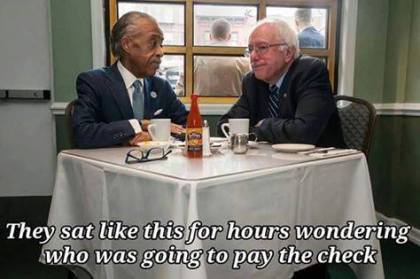
12923208_223278574701995_2096558007828525663_n

For sheer stupidity, you can’t top the remarks made in this video by Bernie Sanders, uttered as an adult, praising the fact that consumers in socialist countries must stand in line to receive food rations! Here is his distorted logic:

“It’s funny, sometimes American journalists talk about how bad a country is, that people are lining up for food. That is a good thing! In other countries people don’t line up for food: the rich get the food and the poor starve to death.“

I try to avoid derogation of individuals in favor of demonstrating the weakness of their words or ideas. I must admit that it’s hard to maintain both ends of that policy in Mr. Sanders’ case. He’s never availed himself of the well-known laws of economics that invalidate his primitive views. For example, he doesn’t grasp that the price system in a market economy provides incentives for conservation and for extra production when supplies are short. In Sanders’ mind, that mechanism is unacceptable because it means someone will profit. Of course, the cooperative nature of markets and voluntary exchange is lost on Sanders. Part of that cooperation is the willingness of buyers to reward able sellers, giving them the incentive to meet future demands. And they do!

Sanders doesn’t understand the universal tendency of government to waste resources. The state’s command over resources derives from coercive power, and it lacks the discipline and incentives for efficiency that are always present in markets. Sanders has not reflected on the shackles the regulatory state places on the productive, private sector. He imagines that government can be trusted because good-hearted people, like him, will always be in charge under a socialist state, and they will design the way forward. Yes, with the aid of their coercive power.

As for breadlines, Sanders has never assimilated the fact that the widespread, plentiful food supplies available in capitalist societies are unprecedented historically. Or that socialist systems have always been typified by chronic shortages of food and other consumer goods. Those are simply empirical facts, on one hand, but they are not accidents. Sanders hasn’t noticed these “details”, remaining immersed in a wild fantasy that prosperity is possible under socialism. Don’t point to Scandinavia as a counterargument, as Sanders supporters are wont to do. There, democratic socialism has wrongly been credited for prosperity that owes more to wealth created under capitalism, before those countries began to feed on themselves.

Bread lines are awful, but they aren’t the worst of it. Mr. Sanders has also praised certain tyrannical regimes, as well as the crackdown on the press under the communist Sandinista regime in Nicaragua. Here is a quote in Reason from Michael Moynihan, a former Reason editor who has uncovered a treasure trove of material on Sanders’ past pronouncements:

“When challenged on the Sandinistas’ incessant censorship, Sanders had a disturbing stock answer: Nicaragua was at war with counterrevolutionary forces, funded by the United States, and wartime occasionally necessitated undemocratic measures.“

Well, the First Amendment may be passe, and the revolution is at hand, eh?

Another Reason article by Matt Welch covers ten of “Bernie’s Bad Ideas“, most of which are grounded in an understanding of economics that can only be described as child-like: the “living” wage, free college tuition, universal pre-K education, opposition to international trade, and Medicare for all are just a few of Sanders’ nitwitted plans. I’ve written about many of these topics on Sacred Cow Chips in the past (a few of those posts are linked in the last sentence). Sanders’ supporters are seduced by the falsehood that government can reward the “deserving” justly for something, in some way, by some miracle, without destroying the incredible font of (under-appreciated) prosperity that is the market economy.

To end on a high note, as it were, here’s a fun Facebook page called “Bernie Sanders Bread Line” with some interesting takes on the lunatic ravings of the socialist candidate. All of those memes ring true, including the one at the top of this post.


Busted Big Government

01 Monday Jun 2015

Posted by Nuetzel in National Debt

≈ Leave a comment

Tags

Alan Greenspan, bailouts, Contingent liabilities, Default, Disability Insurance Fund, entitlements, Inflation, Lawrence Lindsey, Medicare, Nicholas Ballasy, Social Security Trust Fund, Taxes

accounting or accountability

Alan Greenspan says we are “way underestimating” the U.S. national debt. His statements on this point make a great follow-up to last night’s post on bailouts. Here are a couple of recent Greeenspan quotes from an article by Nicholas Ballasy:

“Largely because we are not including what I would call contingent liabilities, that is the issue of, which is answered by a question: what is the probability that in today’s environment JP Morgan would be allowed to default? The answer is zero or less.”

Now, that means that whole balance sheet is a contingent liability. Now to be sure, while it’s contingent, there’s no interest payments but ultimately that overhangs the structure because we have committed in so many different ways to guarantee this, that and the other thing. It’s not only Fannie and Freddie but it’s a whole series of financial institutions and, regrettably, it is also non-financial institutions.”

The bailout barometer I mentioned last night is an eye-opener, but it reflects a very incomplete view of the contingent liabilities faced by the government. Ballasy discusses some massive unfunded liabilities associated with programs like Social Security, which has a trust fund that Greenspan calls “meaningless”:

“The Social Security and Medicare Trustees 2014 annual report said while legislation is needed to address all of Social Security’s financial imbalances, ‘the need has become most urgent with respect to the program’s disability insurance component. Lawmakers need to act soon to avoid automatic reductions in payments to DI beneficiaries in late 2016.’”

Lawrence Lindsey, an economic official in the Bush Administration, says the real national debt is closer to 300 percent of GDP when unfunded obligations for Social Security and Medicare are added. The fast-dissipating disability insurance fund was the subject of another post here two days ago. It is a case study in irresponsible governance. Here is Ballasy with another Greenspan quote:

“According to Greenspan, entitlement spending in the U.S. was 4.7 percent of GDP in 1967 compared to more than 14 percent today. ‘Had we kept it at that level, our productivity would be far higher today. The average wage would be very significantly higher, the standard of living would be higher and what we have to do is think about how we are going to shrink that pie back and, to me, that is the single most important problem that confronts this country,’ he said.“

Shrinking the ongoing flow of entitlements is a tall political order. Avoiding the contingencies that would add to existing obligations calls for economic policies that promote stability, rather than boom and bust cycles that follow misguided efforts to stimulate the economy. Still another matter is to deal with the obligations that already exist. Higher taxes, inflation and default do not represent attractive policy options, but our activist government has placed us squarely in that corner.

More Obamacare Follies

31 Thursday Jul 2014

Posted by Nuetzel in Uncategorized

≈ Leave a comment

Tags

ACA, adverse selection, crony capitalism, Don Boudreaux, Medicare, Megan McArdle, Obamacare, rent seeking

follies
Disconcerting news regarding the administration of the ACA just keeps on coming. The so-called “risk corridors” represent a bailout for health insurers for whom Obamacare premium revenue proves inadequate. Sure enough, but more interesting is how the Obama administration attempted to manipulate several provisions of the law on reimbursement in order to keep insurers happy after other changes with negative implications for their risk pools. In addition, when insurers expressed alarm about the “budget neutrality” of the corridors, the administration backtracked on that position. “… the administration had a choice: provide a bailout, or face the unpleasant prospect of having insurers price their products honestly.” The unfolding of these events is detailed in Emails Show Cozy Government- Insurer Alliance….

Don’t get too excited about the improvement in Medicare’s finances under the ACA. The chief actuary for the Centers for Medicaid and Medicare Services says that the ACA’s Medicare changes aren’t sustainable. Reimbursement rates under the ACA are inadequate barring “an unprecedented change in health care delivery systems and payment mechanisms.” In other words, an unlikely advance in productivity will be necessary in order to make Medicare’s finances work.

A few days ago, I posted about the Halbig vs. Sebelius District Court decision here, highlighting Jonathan Gruber’s one-time defense of the ACA’s rules that premium subsidies could be paid only on policies purchased on state exchanges. More recently, he claimed that the rule was not the intent of the legislation. Here are some further thoughts from Don Boudreaux on Gruber’s memory lapse, in which he links to a piece by Megan McArdle. Boudreaux:

The very claim that such a simple “mistake” infects the ACA calls into question the competence (or the incentives, or both) of elites, both political and intellectual, who seek ever more power for government.

Newer posts →
Follow Sacred Cow Chips on WordPress.com

Recent Posts

  • The Case Against Interest On Reserves
  • Immigration and Merit As Fiscal Propositions
  • Tariff “Dividend” From An Indigent State
  • Almost Looks Like the Fed Has a 3% Inflation Target
  • Government Malpractice Breeds Health Care Havoc

Archives

  • January 2026
  • December 2025
  • November 2025
  • October 2025
  • September 2025
  • August 2025
  • July 2025
  • June 2025
  • May 2025
  • April 2025
  • March 2025
  • February 2025
  • January 2025
  • December 2024
  • November 2024
  • October 2024
  • September 2024
  • August 2024
  • July 2024
  • June 2024
  • May 2024
  • April 2024
  • March 2024
  • February 2024
  • January 2024
  • December 2023
  • November 2023
  • August 2023
  • July 2023
  • June 2023
  • May 2023
  • April 2023
  • March 2023
  • February 2023
  • January 2023
  • December 2022
  • November 2022
  • October 2022
  • September 2022
  • August 2022
  • July 2022
  • June 2022
  • May 2022
  • April 2022
  • March 2022
  • February 2022
  • January 2022
  • December 2021
  • November 2021
  • October 2021
  • September 2021
  • August 2021
  • July 2021
  • June 2021
  • May 2021
  • April 2021
  • March 2021
  • February 2021
  • January 2021
  • December 2020
  • November 2020
  • October 2020
  • September 2020
  • August 2020
  • July 2020
  • June 2020
  • May 2020
  • April 2020
  • March 2020
  • February 2020
  • January 2020
  • December 2019
  • November 2019
  • October 2019
  • September 2019
  • August 2019
  • July 2019
  • June 2019
  • May 2019
  • April 2019
  • March 2019
  • February 2019
  • January 2019
  • December 2018
  • November 2018
  • October 2018
  • September 2018
  • August 2018
  • July 2018
  • June 2018
  • May 2018
  • April 2018
  • March 2018
  • February 2018
  • January 2018
  • December 2017
  • November 2017
  • October 2017
  • September 2017
  • August 2017
  • July 2017
  • June 2017
  • May 2017
  • April 2017
  • March 2017
  • February 2017
  • January 2017
  • December 2016
  • November 2016
  • October 2016
  • September 2016
  • August 2016
  • July 2016
  • June 2016
  • May 2016
  • April 2016
  • March 2016
  • February 2016
  • January 2016
  • December 2015
  • November 2015
  • October 2015
  • September 2015
  • August 2015
  • July 2015
  • June 2015
  • May 2015
  • April 2015
  • March 2015
  • February 2015
  • January 2015
  • December 2014
  • November 2014
  • October 2014
  • September 2014
  • August 2014
  • July 2014
  • June 2014
  • May 2014
  • April 2014
  • March 2014

Blogs I Follow

  • Passive Income Kickstart
  • OnlyFinance.net
  • TLC Cholesterol
  • Nintil
  • kendunning.net
  • DCWhispers.com
  • Hoong-Wai in the UK
  • Marginal REVOLUTION
  • Stlouis
  • Watts Up With That?
  • Aussie Nationalist Blog
  • American Elephants
  • The View from Alexandria
  • The Gymnasium
  • A Force for Good
  • Notes On Liberty
  • troymo
  • SUNDAY BLOG Stephanie Sievers
  • Miss Lou Acquiring Lore
  • Your Well Wisher Program
  • Objectivism In Depth
  • RobotEnomics
  • Orderstatistic
  • Paradigm Library
  • Scattered Showers and Quicksand

Blog at WordPress.com.

Passive Income Kickstart

OnlyFinance.net

TLC Cholesterol

Nintil

To estimate, compare, distinguish, discuss, and trace to its principal sources everything

kendunning.net

The Future is Ours to Create

DCWhispers.com

Hoong-Wai in the UK

A Commonwealth immigrant's perspective on the UK's public arena.

Marginal REVOLUTION

Small Steps Toward A Much Better World

Stlouis

Watts Up With That?

The world's most viewed site on global warming and climate change

Aussie Nationalist Blog

Commentary from a Paleoconservative and Nationalist perspective

American Elephants

Defending Life, Liberty and the Pursuit of Happiness

The View from Alexandria

In advanced civilizations the period loosely called Alexandrian is usually associated with flexible morals, perfunctory religion, populist standards and cosmopolitan tastes, feminism, exotic cults, and the rapid turnover of high and low fads---in short, a falling away (which is all that decadence means) from the strictness of traditional rules, embodied in character and inforced from within. -- Jacques Barzun

The Gymnasium

A place for reason, politics, economics, and faith steeped in the classical liberal tradition

A Force for Good

How economics, morality, and markets combine

Notes On Liberty

Spontaneous thoughts on a humble creed

troymo

SUNDAY BLOG Stephanie Sievers

Escaping the everyday life with photographs from my travels

Miss Lou Acquiring Lore

Gallery of Life...

Your Well Wisher Program

Attempt to solve commonly known problems…

Objectivism In Depth

Exploring Ayn Rand's revolutionary philosophy.

RobotEnomics

(A)n (I)ntelligent Future

Orderstatistic

Economics, chess and anything else on my mind.

Paradigm Library

OODA Looping

Scattered Showers and Quicksand

Musings on science, investing, finance, economics, politics, and probably fly fishing.

  • Subscribe Subscribed
    • Sacred Cow Chips
    • Join 128 other subscribers
    • Already have a WordPress.com account? Log in now.
    • Sacred Cow Chips
    • Subscribe Subscribed
    • Sign up
    • Log in
    • Report this content
    • View site in Reader
    • Manage subscriptions
    • Collapse this bar
 

Loading Comments...