• About

Sacred Cow Chips

Sacred Cow Chips

Tag Archives: Obesity

CDC Makes a Bum Lead Steer: Alternate Reality vs. The Herd

16 Sunday May 2021

Posted by Nuetzel in Herd Immunity, Pandemic

≈ 2 Comments

Tags

Adam Kucharski, Andy Slovitt, Anthony Fauci, CDC, Degrees of Separation, Herd Immunity, Herd Immunity Threshold, Joe Biden, Jordan Schachtel, Nathan D. Grawe, Obesity, Phil Kerpen, Pre-existing Immunity, Precautionary Principle, Reproduction Rate, Seroprevalence, Sub-Herds, Super-Spreader Events, Vaccinations, Vitamin D, Zero COVID
Jordan Schachtel enjoyed some schadenfreude last week when he tweeted:

“I am thoroughly enjoying the White House declaring COVID over and seeing the confused cultists having a nervous breakdown and demanding the continuation of COVID Mania.”

It’s quite an exaggeration to say the Biden Administration is “declaring COVID over”, however. They’re backpedaling, and while last week’s CDC announcement on masking is somewhat welcome, it reveals more idiotic thinking about almost everything COVID: the grotesquely excessive application of the precautionary principle (typical of the regulatory mindset) and the mentality of “zero COVID”. And just listen to Joe Biden’s tyrannical bluster following the CDC announcement:

“The rule is now simple: get vaccinated or wear a mask until you do.

The choice is yours.”

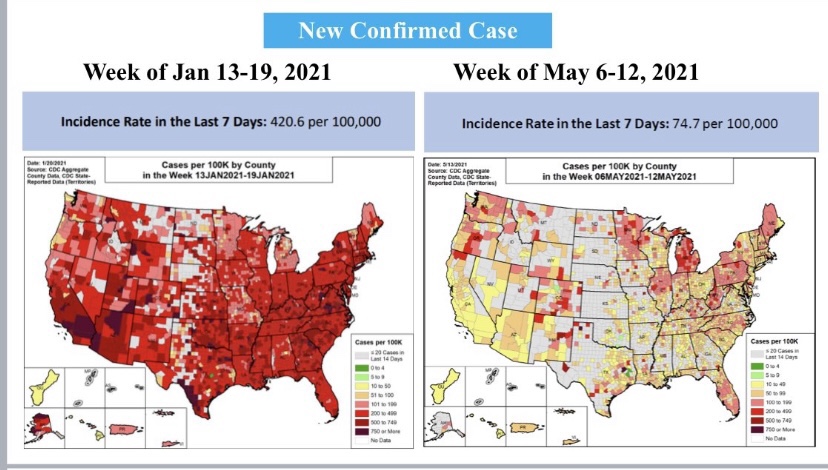
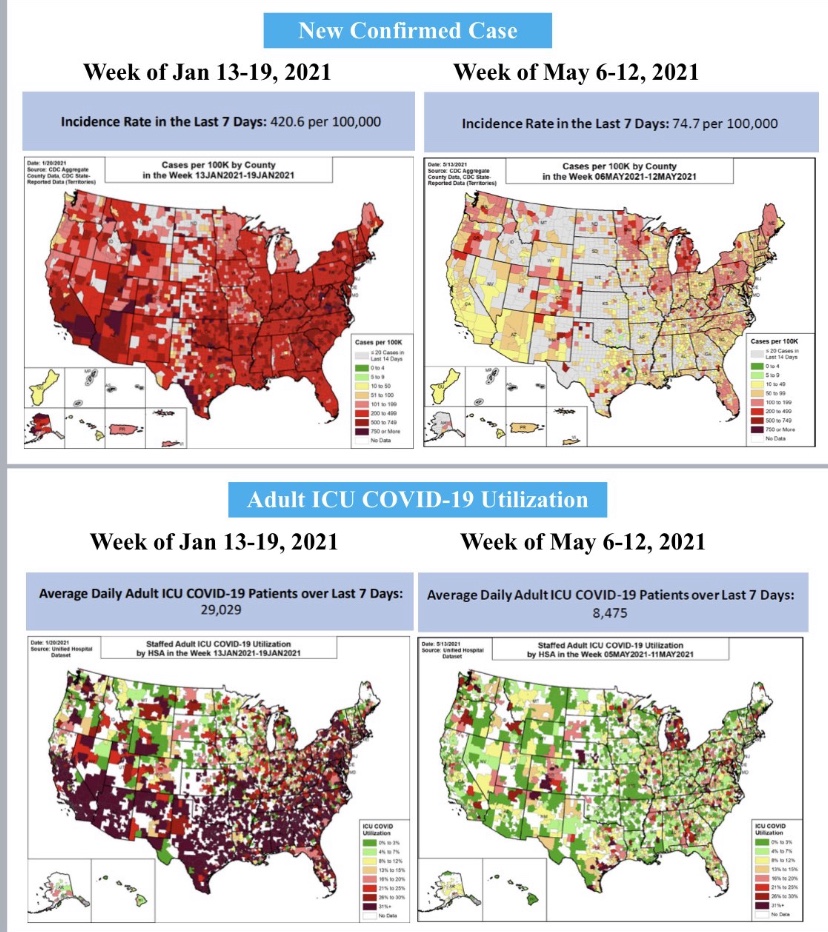
Is anyone really listening to this buffoon?Unfortunately, yes. But there’s no federal “rule”, unless your on federal property; it constitutes “guidance” everywhere else. I’m thankful our federalist system still receives a modicum of respect in the whole matter, and some states have chosen their own approaches (“Hooray for Florida”). Meanwhile, the state of the pandemic looks like this, courtesy of Andy Slavitt:
False Assertions

The CDC still operates under the misapprehension that kids need to wear masks, despite mountains of evidence showing children are at negligible risk and tend not to be spreaders. Here’s some evidence shared by Phil Kerpen on the risk to children:

The chart shows the fatality risk by age (deaths per 100,000), and then under the assumption of a 97% reduction in that risk due to vaccination, which is quite conservative. Given that kind of improvement, an unvaccinated 9 year-old child has about the same risk as a fully vaccinated 30 year-old!

The CDC still believes the unvaccinated must wear masks outdoors, but unless you’re packed in a tight crowd, catching the virus outdoors has about the same odds as a piano falling on your head. And the CDC insists that two shots of mRNA vaccine (Pfizer or Moderna) are necessary before going maskless, but only one shot of the Johnson and Johnson vaccine, even though J&J’s is less effective than a single mRNA jab!

Other details in the CDC announcement are worthy of ridicule, but for me the most aggravating are the agency’s implicit position that herd immunity can only be achieved through vaccination, and its “guidance” that the unvaccinated should be dealt with coercively, even if they have naturally-acquired immunity from an infection!

Tallying Immunity

Vaccination is only one of several routes to herd immunity, as I’ve noted in the past. For starters, consider that a significant share of the population has a degree of pre-existing immunity brought on by previous exposure to coronaviruses, including the common cold. That doesn’t mean they won’t catch the virus, but it does mean they’re unlikely to suffer severe symptoms or transmit a high viral load to anyone else. Others, while not strictly immune, are nevertheless unlikely to be sickened due to protections afforded by healthy vitamin D levels or because they are not obese. Children, of course, tend to be fairly impervious. Anyone who’s had a bout with the virus and survived is likely to have gained strong and long-lasting immunity, even if they were asymptomatic. And finally, there are those who’ve been vaccinated. All of these groups have little or no susceptibility to the virus for some time to come.

It’s not necessary to vaccinate everyone to achieve herd immunity, nor is it necessary to reach something like an 85% vax rate, as the fumbling Dr. Fauci has claimed. Today, almost 47% of the U.S. population has received at least one dose, or about 155 million adults. Here’s Kerpen’s vax update for May 14.
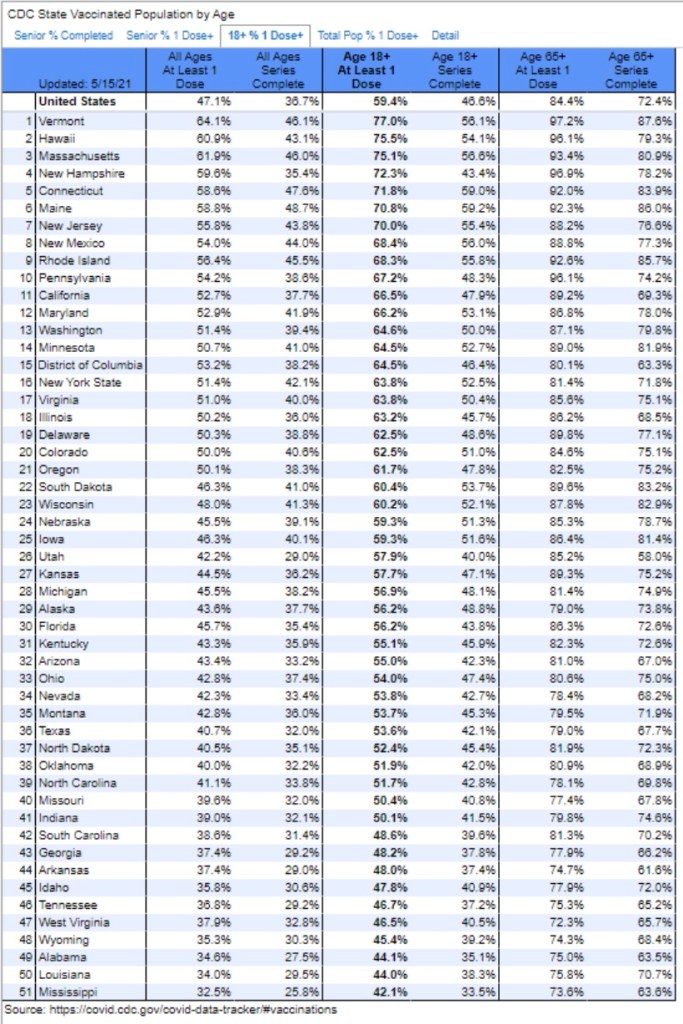
Another 33 million people have had positive diagnoses and survived, and estimates of seroprevalence would add perhaps another 30 million survivors. Some of those individuals have been vaccinated unnecessarily, however, and to avoid double counting, let’s say a total of 50 million people have survived the virus. Some 35 million children in the U.S. are under age 12. Therefore, even if we ignore pre-existing immunity, there are probably about 240 million effectively immune individuals without counting the remaining non-susceptibles. At the low end, based on a population of 330 million, U.S. immunity is now greater than 70%, and probably closer to 80%. That is more than sufficient for herd immunity, as traditionally understood.

The Herd Immunity Threshold

Here and in the following section I take a slightly deeper dive into herd immunity concepts.

Herd immunity was one of my favorite topics last year. I’m still drawn to it because it’s so misunderstood, even by public health officials with pretensions of expertise in the matter. My claim, about which I’m not alone, is that it’s unnecessary for a large majority of the population to be infected (or vaccinated) to limit the spread of a virus. That’s primarily because there is great variety in individuals’ degree of susceptibility, social connections, aerosol production, and viral load if exposed: call it heterogeneity or diversity if you like. Variation across individuals naturally limits a contagion relative to a homogeneous population.

Less than 1% of those who caught the virus died, while the others recovered and acquired immunity. The remaining subset of individuals most vulnerable to severe illness was thus reduced over time via acquired immunity or death. This is the natural dynamic that causes contagions to slow and ultimately peter out. In technical jargon, the virus reproduction rate “R” falls below a value of one. The point at which that happens is called the “herd immunity threshold” (HIT).

A population with lots of variation in susceptibility will have a lower HIT. Some have estimated a HIT in the U.S. as low as 15% -25%. Ultimately, total exposure will go much higher than the HIT, perhaps well more than doubling exposure, but the contagion recedes once the HIT is reached. So again, it’s unnecessary for anywhere near the full population to be immune to achieve herd immunity.

One wrinkle is that CIVID is now likely to have become endemic. Increased numbers of cases will re-emerge seasonally in still-susceptible individuals. That doesn’t contradict the discussion above regarding the HIT rate: subsequent waves will be quite mild by comparison with the past 14 months. But if the effectiveness of vaccines or acquired immunity wanes over time, or as healthy people age and become unhealthy, re-emergence becomes a greater risk.

Sub-Herd Immunity

A further qualification relates to so-called sub-herds. People are clustered by geographical, social, and cultural circles, so we should think of society not as a singular “herd”, but as a collection of sub-herds having limited cross-connectivity. The following charts are representations of different kinds of human networks, from Nathan D. Grawe’s review of “The Rules of Contagion, by Adam Kucharski:

Sub-herd members tend to have more degrees of separation from individuals in other sub-herds than within their own sub-herd. The most extreme example is the “broken network” (where contagions could not spread across sub-herds), but there are identifiable sub-herds in all of the examples shown above. Less average connectedness across sub-herds implies barriers to transmission and more isolated sub-herd contagions.

We’ve seen isolated spikes in cases in different geographies, and there have been spikes within geographies among sub-herds of individuals sharing commonalities such as race, religious affiliation, industry affiliation, school, or other cultural affiliation. Furthermore, transmission of COVID has been dominated by “super-spreader” events, which tend to occur within sub-herds. In fact, sub-herds are likely to be more homogeneous than the whole of society, and that means their HIT will be higher than we might naively calculate based on higher levels of aggregation.

We have seen local, state, or regional contagions peak and turn down when estimates of total incidence of infections reach the range of 15 – 25%. That appears to have been enough to reach the HIT in those geographically isolated cases. However, if those geographical contagions were also concentrated within social sub-herds, those sub-herds might have experienced much higher than 25% incidence by the time new infections peaked. Again, the HIT for sub-herds is likely to be greater than the aggregate population estimates implied, The upshot is that some sub-herds might have achieved herd immunity last year but others did not, which explains the spikes in new geographic areas and even the recurrence of spikes within geographic areas.

Conclusion

It’s unnecessary for 100% of the population to be vaccinated or to have pre-existing immunity. Likewise, herd immunity does not imply that no one catches the virus or that no one dies from the virus. There will be seasonal waves, though muted by the large immune share of the population. This is not something that government should try to stanch, as that would require the kind of coercion and scare tactics we’ve already seen overplayed during the pandemic. People face risks in almost everything they do, and they usually feel competent to evaluate those risks themselves. That is, until a large segment of the population allows themselves to be infantalized by public health authorities.

Perspective on U.S. Health Care Spending & Outcomes

05 Sunday Aug 2018

Posted by Nuetzel in Health Care, Health Insurance

≈ Leave a comment

Tags

Bernie Sanders, Charles Blahous, John Cochrane, Joseph Walker, Life Expectancy, Mahdi Barakat, Medicare For All, Mercatus Center, Obesity, Random Critical Analysis, SwedenCare

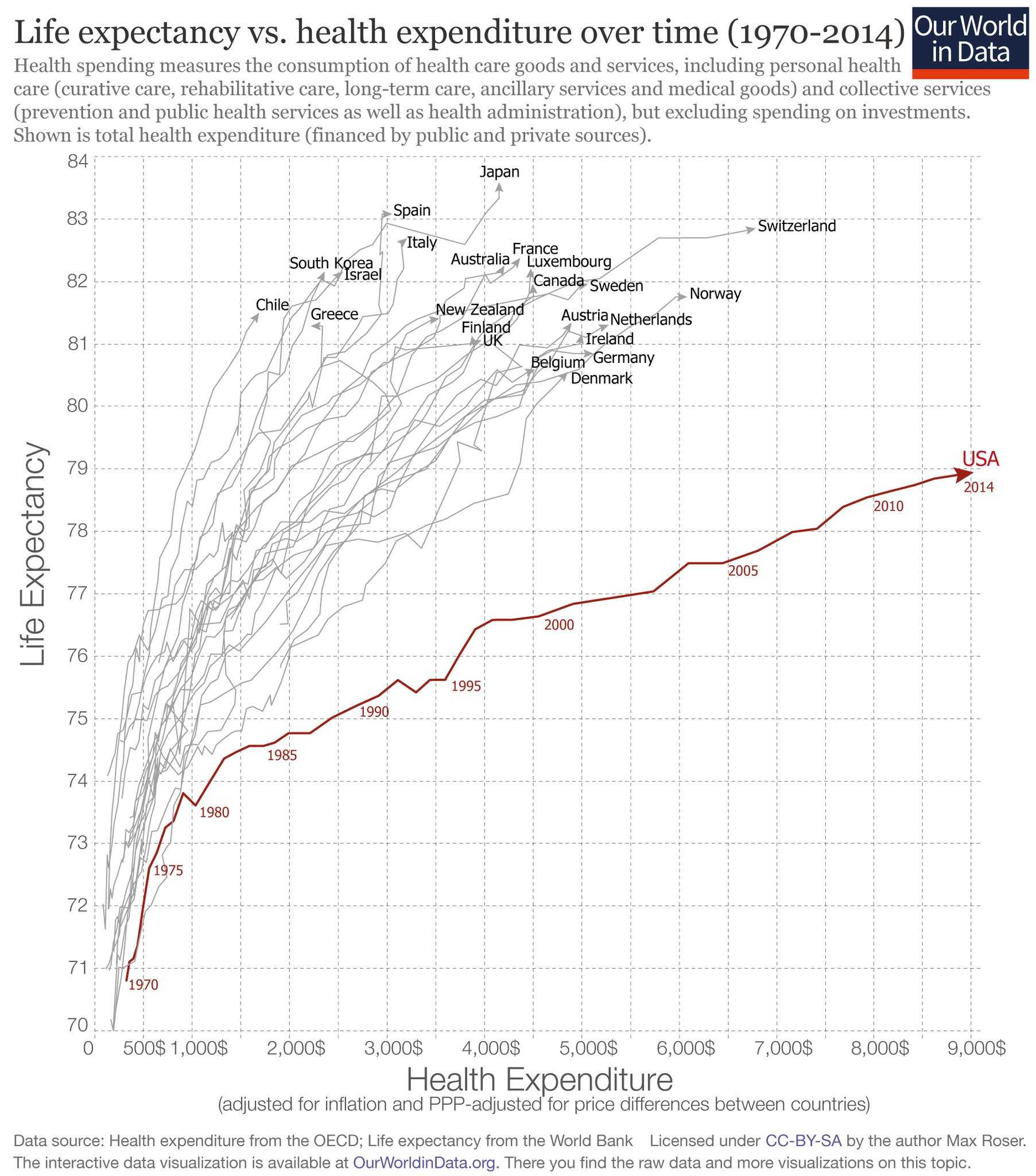
The U.S. spends a lot on health care, and our health care system is frequently criticized for poor health outcomes. The chart below is an example of evidence used to buttress this argument. It shows combinations of health care spending and life expectancy over time for the OECD countries. The U.S. appears to be a severe outlier and inferior to the other countries. A variation on this chart appeared on the home page of The Wall Street Journal this week. It accompanied (but was not part of) a good article by Joseph Walker in which he used 12 other charts in an effort to explain why the U.S. spends so much on health care. (Sorry, this link is probably gated.) Walker discusses several important cost factors, including third-party payments, tax treatment, and the deployment of expensive technology in the U.S. However, the claim that the U.S. is really an outlier is worth examining on other grounds.

The chart’s construction suggests that a reliable link should exist between health care spending and life expectancy, but there are several reasons to question whether that is the case. U.S. life expectancy has been held down historically by high rates of smoking, but reduced smoking rates should help moderate the U.S. life expectancy gap in coming years. Obesity in the U.S. is a more persistent problem, especially for the poor, and an even bigger contributor to low U.S. life expectancy than smoking at present. (See this report for evidence on the contributions of smoking and obesity to shorter life expectancy for older adults.) Other contributors to low life expectancy in the U.S. include high motor-vehicle deaths and homicides, the latter attributable in large part to the war on drugs. All of these factors contribute to higher health care spending and directly reduce life expectancy.

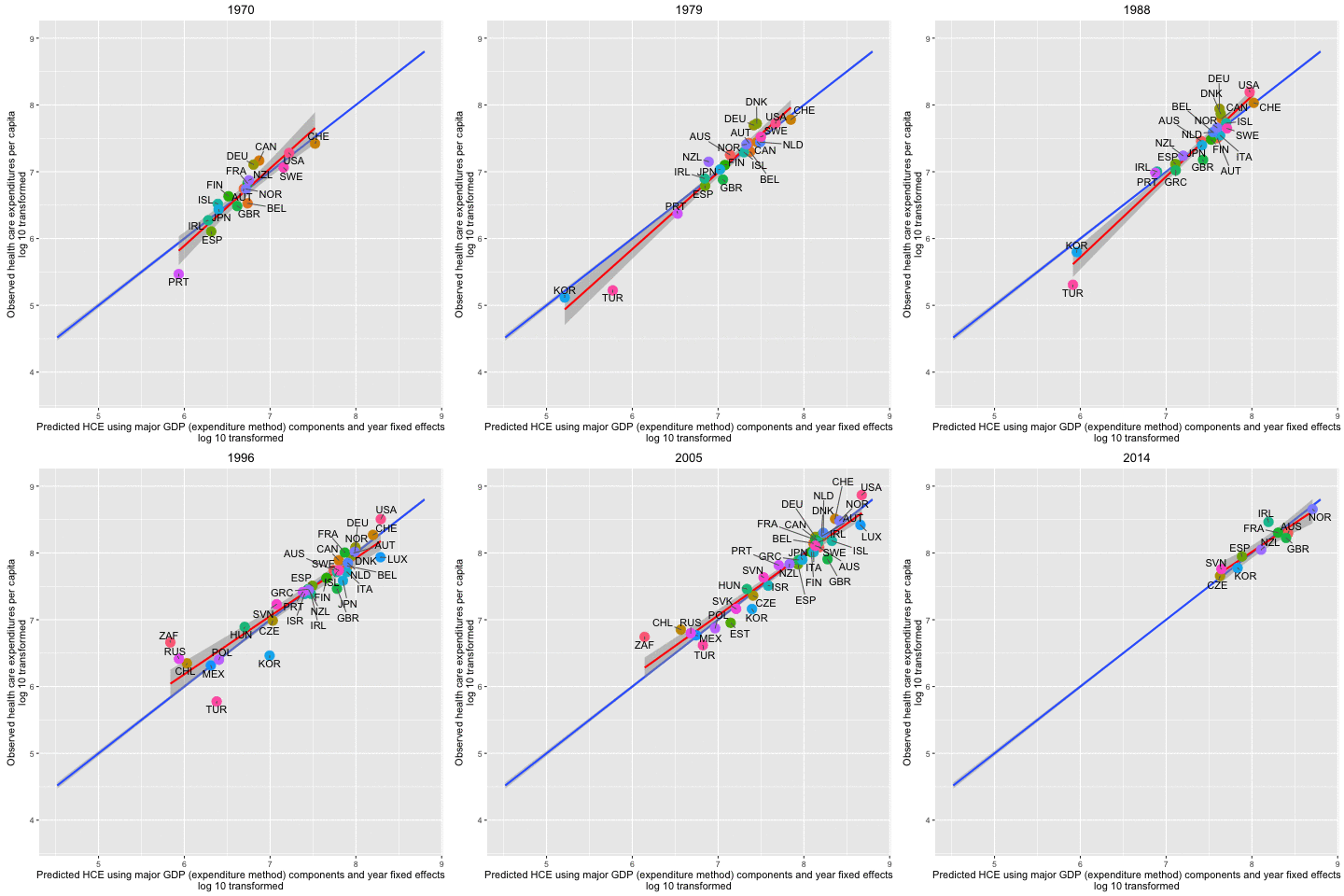
The status of the U.S. as an outlier in terms of health care spending is questioned on the Random Critical Analysis blog (RCA). The author’s detailed analysis includes the following points among many others of interest:

  • Health care is a superior good: as income rises, spending on health care rises faster;
  • The U.S. has a much higher standard of living than any of its peer nations;
  • U.S. consumption spending relative to GDP is an “outlier”, like health care spending relative to GDP;
  • Consumption is a stronger predictor of health care spending than income;
  • Relative to consumption, health care spending in the U.S. is not an outlier, nor is spending on pharmaceuticals, physician/nursing compensation, and the levels of health price indices.

Take a look at the following sequence from the RCA blog linked above (the animation might not be visible on a phone):

So the argument that the U.S. health care system is inferior to peer countries based on cross-county spending comparisons and life expectancy, to the extent that it holds up at all, is subject to strong qualifications. Inferior lifestyle choices, diets, and lack of exercise might be problematic in the U.S., but the healthcare system cannot be faulted based on spending levels relative to other OECD countries.

In fact, the superiority of the U.S. health care system in many areas is not even in dispute. As Mahdi Barakat points out, wait times for care, cancer survival rates, and stroke mortality are all clearly better in the U.S. than in many peer countries:

“Lives are indeed saved by the many types of superior medical outcomes that are often unique to the US. This is not to mention the innumerable lives saved each year around the world due to medical innovations that are made possible through vibrant US markets.”

Barakat compares dubious progressive claims that up to 45,000 American lives are lost each year due to a lack of insurance with the likely incremental lives lost if various performance measures in the U.S. were equivalent to those in other countries:

  • 25,000 additional female deaths per year with Canada’a wait times for care (no estimate for additional male deaths is given by Mahdi’s source);
  • 64,000 additional stroke deaths each year with the UK’s overall stroke mortality;
  • 72,000 additional cancer deaths each year with the UKs survival rates.

Theoretically, the national spending figures could be adjusted for the cost of queuing, i.e. wait times. While Obamacare certainly increased wait times in the U.S., the adjustment would likely reduce or eliminate the spending advantages that several OECD countries appear to have over the U.S.

The performance of health care systems in many countries with single-payer systems or universal care is subject to challenge, as some of the statistics offered by Barakat demonstrate. In “The Truth About SwedenCare“, Klaus Bernpaintner expresses his dismay at the romanticized view of health care in Sweden among so many Americans. His effort to convey the truth about Sweden’s stultifying health care bureaucracy is illuminating. There are few private physician practices in Sweden. Care is generally rationed and waits are lengthy, and it is delivered by disinterested, centrally-assigned providers.

“For non-emergency cases in Sweden, you must go to the public ‘Healthcare Central.’ This is always the starting point for anything from the common flu to brain tumors. You must go to your assigned Central, according to your healthcare district. Admission is by appointment only. Usually they have a 30-minute window every morning, when you call to claim one of the budgeted slots. Make sure to call early or they run out. Rarely will you get an appointment for the same day. You will be assigned a general practitioner, probably one you have never met before; likely one who does not speak fluent Swedish; and very likely one who hates his job. If you have a serious condition, you will be started on a path of referrals to experts. This process can take months.”

Bernpaintner calls this Sweden’s health care “bread line”, where people go to die. He mentions several other nightmarish features of health care in Sweden that Americans should hope to avoid. In particular, we should resist calls for a single-payer system, like Bernie Sanders’ Medicare-For-All proposal. An analysis by Charles Blahous of the Mercatus Center at George Mason University has shown that it would increase federal spending by $32.6 trillion over ten years. This estimate is basically in-line with others mentioned by Blahous. Much of the additional federal spending would represent a transition away from private spending, a process that would be massively disruptive. However, the study gives the plan the benefit of several doubts by accepting the assumptions made by Sanders: 1) a huge saving in prescription drug costs; 2) a huge saving in administrative costs; 3) providers will happily accept Medicare reimbursement levels; and 4) new immigrants will not be attracted by an essentially free health care program. Fat chance. But given all of these questionable assumptions, total health care spending would fall even as the government takes on the massive new outlays. Take away just fantasy #3 and total national health care spending would rise, a swing of $700 billion by 2031.

John Cochrane makes a useful distinction between two conceptions of universally-accessible coverage: one that all must use vs. one that all can use. (He calls them both forms of single-payer systems, though that usage sounds a bit awkward to me.) The voluntary form is preferable for several reasons: it can preserve choice in terms of coverage and providers; while the public-payer’s share must be funded, it demands little or nothing in the way of cross-subsidized pricing; and it does not imply that government must act as a single “price setter”. Cochrane warns of the possible consequences of a universally-mandated single payer:

“Not only is there some sort of single easy to access health care and insurance scheme for poor or unfortunate people, but you and I are forbidden to escape it, to have private doctors, private hospitals, or private insurance outside the scheme. Doctors are forbidden to have private cash paying customers. That truly is a nightmare, and it will mean the allocation of good medical care by connections and bribes.”

The presumption that universal health care will improve quality and save lives is unsupported by any real evidence. Its proponents incorrectly assume that the uninsured do not get care at all. Providers might go uncompensated, but the uninsured can often get needed care with more immediacy than they could with the lengthy wait times typical of many single-payer systems. The quality of care is likely to deteriorate under a single-payer system given the stresses placed on providers, the highly regulated conditions under which they would be forced to operate, and restricted treatment options. And of course a single-payer system would suspend the price mechanism and any semblance of competition in the health care marketplace.

The health care system in the U.S. has massive problems, but they were created and exacerbated by a series of governmental intrusions on the marketplace over many years. A flourishing market requires choice for consumers and competition between providers—in both health care delivery and insurance coverage. It also requires a roll-back of regulation on providers and insurers. But as Cochrane emphasizes, such a marketplace can exist apart from a voluntary, tax-funded payer-of-last-resort.

Follow Sacred Cow Chips on WordPress.com

Recent Posts

  • Immigration and Merit As Fiscal Propositions
  • Tariff “Dividend” From An Indigent State
  • Almost Looks Like the Fed Has a 3% Inflation Target
  • Government Malpractice Breeds Health Care Havoc
  • A Tax On Imports Takes a Toll on Exports

Archives

  • December 2025
  • November 2025
  • October 2025
  • September 2025
  • August 2025
  • July 2025
  • June 2025
  • May 2025
  • April 2025
  • March 2025
  • February 2025
  • January 2025
  • December 2024
  • November 2024
  • October 2024
  • September 2024
  • August 2024
  • July 2024
  • June 2024
  • May 2024
  • April 2024
  • March 2024
  • February 2024
  • January 2024
  • December 2023
  • November 2023
  • August 2023
  • July 2023
  • June 2023
  • May 2023
  • April 2023
  • March 2023
  • February 2023
  • January 2023
  • December 2022
  • November 2022
  • October 2022
  • September 2022
  • August 2022
  • July 2022
  • June 2022
  • May 2022
  • April 2022
  • March 2022
  • February 2022
  • January 2022
  • December 2021
  • November 2021
  • October 2021
  • September 2021
  • August 2021
  • July 2021
  • June 2021
  • May 2021
  • April 2021
  • March 2021
  • February 2021
  • January 2021
  • December 2020
  • November 2020
  • October 2020
  • September 2020
  • August 2020
  • July 2020
  • June 2020
  • May 2020
  • April 2020
  • March 2020
  • February 2020
  • January 2020
  • December 2019
  • November 2019
  • October 2019
  • September 2019
  • August 2019
  • July 2019
  • June 2019
  • May 2019
  • April 2019
  • March 2019
  • February 2019
  • January 2019
  • December 2018
  • November 2018
  • October 2018
  • September 2018
  • August 2018
  • July 2018
  • June 2018
  • May 2018
  • April 2018
  • March 2018
  • February 2018
  • January 2018
  • December 2017
  • November 2017
  • October 2017
  • September 2017
  • August 2017
  • July 2017
  • June 2017
  • May 2017
  • April 2017
  • March 2017
  • February 2017
  • January 2017
  • December 2016
  • November 2016
  • October 2016
  • September 2016
  • August 2016
  • July 2016
  • June 2016
  • May 2016
  • April 2016
  • March 2016
  • February 2016
  • January 2016
  • December 2015
  • November 2015
  • October 2015
  • September 2015
  • August 2015
  • July 2015
  • June 2015
  • May 2015
  • April 2015
  • March 2015
  • February 2015
  • January 2015
  • December 2014
  • November 2014
  • October 2014
  • September 2014
  • August 2014
  • July 2014
  • June 2014
  • May 2014
  • April 2014
  • March 2014

Blogs I Follow

  • Passive Income Kickstart
  • OnlyFinance.net
  • TLC Cholesterol
  • Nintil
  • kendunning.net
  • DCWhispers.com
  • Hoong-Wai in the UK
  • Marginal REVOLUTION
  • Stlouis
  • Watts Up With That?
  • Aussie Nationalist Blog
  • American Elephants
  • The View from Alexandria
  • The Gymnasium
  • A Force for Good
  • Notes On Liberty
  • troymo
  • SUNDAY BLOG Stephanie Sievers
  • Miss Lou Acquiring Lore
  • Your Well Wisher Program
  • Objectivism In Depth
  • RobotEnomics
  • Orderstatistic
  • Paradigm Library
  • Scattered Showers and Quicksand

Blog at WordPress.com.

Passive Income Kickstart

OnlyFinance.net

TLC Cholesterol

Nintil

To estimate, compare, distinguish, discuss, and trace to its principal sources everything

kendunning.net

The Future is Ours to Create

DCWhispers.com

Hoong-Wai in the UK

A Commonwealth immigrant's perspective on the UK's public arena.

Marginal REVOLUTION

Small Steps Toward A Much Better World

Stlouis

Watts Up With That?

The world's most viewed site on global warming and climate change

Aussie Nationalist Blog

Commentary from a Paleoconservative and Nationalist perspective

American Elephants

Defending Life, Liberty and the Pursuit of Happiness

The View from Alexandria

In advanced civilizations the period loosely called Alexandrian is usually associated with flexible morals, perfunctory religion, populist standards and cosmopolitan tastes, feminism, exotic cults, and the rapid turnover of high and low fads---in short, a falling away (which is all that decadence means) from the strictness of traditional rules, embodied in character and inforced from within. -- Jacques Barzun

The Gymnasium

A place for reason, politics, economics, and faith steeped in the classical liberal tradition

A Force for Good

How economics, morality, and markets combine

Notes On Liberty

Spontaneous thoughts on a humble creed

troymo

SUNDAY BLOG Stephanie Sievers

Escaping the everyday life with photographs from my travels

Miss Lou Acquiring Lore

Gallery of Life...

Your Well Wisher Program

Attempt to solve commonly known problems…

Objectivism In Depth

Exploring Ayn Rand's revolutionary philosophy.

RobotEnomics

(A)n (I)ntelligent Future

Orderstatistic

Economics, chess and anything else on my mind.

Paradigm Library

OODA Looping

Scattered Showers and Quicksand

Musings on science, investing, finance, economics, politics, and probably fly fishing.

  • Subscribe Subscribed
    • Sacred Cow Chips
    • Join 128 other subscribers
    • Already have a WordPress.com account? Log in now.
    • Sacred Cow Chips
    • Subscribe Subscribed
    • Sign up
    • Log in
    • Report this content
    • View site in Reader
    • Manage subscriptions
    • Collapse this bar
 

Loading Comments...