• About

Sacred Cow Chips

Sacred Cow Chips

Tag Archives: Roy Spencer

Feckless Greens Burn Aussie Bush

09 Thursday Jan 2020

Posted by Nuetzel in Forest Fires, Global Warming, Wildfires

≈ 1 Comment

Tags

Arson, Arson Raptors, Australia, Black Kite, CO2 Forcings, David Packham, David Ward, Dead Vegetation, Eucalyptus, Gasoline Trees, Human Ignitions, Invasive Grasses, James Morrow, Jennifer Marohasy, Leslie Eastman, Marc Lallanilla, Massachusetts, Mike Shedlock, Mishtalk, Myron Ebell, New South Wales, Patrick Michaels, Prescribed Burns, Queensland, Roy Spencer, Victoria, Whistling Kite, Willis Eschenbach
The raging Australian bush fires have been expansive and deadly. Country-wide, over 12 million acres have burned over the past few months, an area approaching twice the size of Massachusetts. The burnt areas in some regions rival or exceed individual fires of the past, such as the Black Friday fire of 1939, which burned about 5 million acres. As bad as the recent fires have been, note that various outlets in the U.S. have felt it necessary to exaggerate the size of the burnt area (also see here). And the season’s burnt area has not even approached the total for 1974-1975, when over 250 million acres burned.

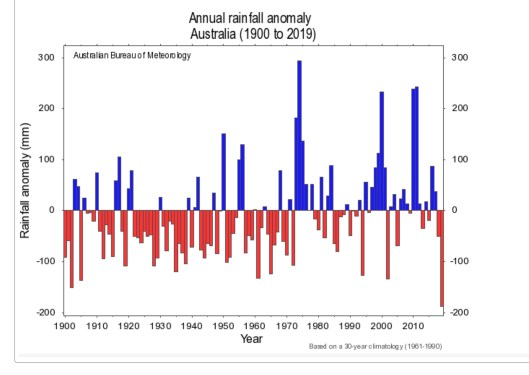
So what causes these bush fires? Dry weather and plenty of fuel from dead vegetation create the hazard, of course. A spark is needed, as from lightning, an accident, an arsonist, or perhaps even a blistering sun, but warm temperatures are unnecessary. Nevertheless, the narrative we hear year-in and year-out is that global warming is to blame for wildfires. My commentary on the climate-change hubbub over the 2018 California fires is here. As for Australia’s fires, there is similarly ample evidence that climate change or warming has nothing to do with it. Rather, as in California, there is a pattern of mismanagement of forests and brush combined with population growth, accidents, and arson, and of course a dry spell. This dry spell has been severe, but the trend in Australia over the past 120 years has been toward more precipitation, not less, and the past 25 years have been relatively rainy. The rain comes with a downside, however: it encourages growth in vegetation, much of which dies every dry season, leaving plenty of fuel for fires. And the fuel has been accumulating.

Mike Shedlock at Mishtalk offers some pertinent observations. First, he quotes James Morrow in the Wall Street Journal:

“Byzantine environmental restrictions prevent landholders from clearing scrub, brush and trees. State governments don’t do their part to reduce the fuel load in parks. Last November a former fire chief in Victoria slammed that state’s ‘minimalist approach’ to hazard-reduction burning in the off-season. That complaint is heard across the country.“

Prescribed burns have been in decline and focused on areas adjacent to suburbs, leaving vast areas of accumulating fuel. This is a product of wrongheaded conservation efforts and resistance to CO2 emissions. These policymakers haven’t done favors for Australia or the world on either count. Shedlock reinforces this point with the following statement from Patrick Michaels and Myron Ebell:

“Australia has been ready to explode for years. David Packham, former head of Australia’s National Rural Fire Research Centre, warned in a 2015 article in the Age that fire fuel levels had climbed to their most dangerous levels in thousands of years. He noted this was the result of ‘misguided green ideology.'”

Eucalyptus trees grow thickly in many fire-prone areas of Australia, and Shedlock says these trees act as a multiplier on the fire hazard. Yet these trees remain a favorite landscape feature for suburbians even in fire-prone areas. He quotes Marc Lallanilla in LiveScience:

“Fallen eucalyptus leaves create dense carpets of flammable material, and the trees’ bark peels off in long streamers that drop to the ground, providing additional fuel that draws ground fires up into the leaves, creating massive, fast-spreading ‘crown fires’ in the upper story of eucalyptus forests. … Additionally, the eucalyptus oil that gives the trees their characteristic spicy fragrance is a flammable oil: This oil, combined with leaf litter and peeling bark during periods of dry, windy weather, can turn a small ground fire into a terrifying, explosive firestorm in a matter of minutes. That’s why eucalyptus trees — especially the blue gums (Eucalyptus globulus) that are common throughout New South Wales — are sometimes referred to wryly as ‘gasoline trees.’“

The introduction of non-native invasive grasses has also been blamed for increasing the fuel load in the bush. And as incredible as it may seem, certain birds native to Australia are spreading bushfires by carrying and dropping burning sticks in grasslands to flush out prey. Birds are indeed tool users! The Whistling Kite and the Black Kite are sometimes called “arson raptors”, according to Leslie Eastman at this link.

The hypothesis that climate warming from CO2 emissions is the cause of the bushfires is undermined by all of the above. Then, of course, there are the arsonists and accidental fires. Over 180 people have been arrested for setting recent brushfires intentionally in New South Wales alone, and 103 others in Queensland. (Also see here.) Jim Steele reports that human ignitions account for 66% of bush fires, while just 11% are caused by lightning. Population growth has brought more people into close proximity with the bush, which increases the exposure of humans to fire danger and might well add to the number of accidents and potential arsonists. Obviously, human and avian arson, and accidents, are not within the line of causation that climate alarmists have in mind.

Roy Spencer addresses some of the inconsistencies in the claimed link between climate warming and the Australian bushfires. First, of course, is the trend in rainfall. Climate models based on CO2 forcings predict no long-term trend in Australia’s rainfall, but again, rainfall has increased in Australia during the era of accelerated forcings. Interestingly, the fires of 1974-75 occurred during a period that was quite rainy, but that rain might have added so much to the annual vegetation cycle that it exacerbated the effect of dry season. Temperatures in Australia were quite warm in 2019, but the climate models cannot account for that variation, especially as Australian temperatures are subject to high variability from year-to-year. It’s been hotter before, though the temperature records in Australia have been subject to some controversial “editing”. Finally, Spencer notes that global wildfire activity has been in decline for many years, despite the mild warming we’ve experienced over the past 50 years (also see here).

Australia has bush fires every year, and this year has been particularly bad, but it might not reach the proportions of the fires in 1974-75. The causes are: poor burn management practices, or sometimes neglect and no burn management at all, allowing dead vegetation to accumulate to dangerous levels; arson, which has been implicated in a large number of fires this year; and 2019 was a very dry year. The contention that global warming or climate change is responsible for these bush fires is a dangerous distraction from reforms that can minimize fire hazards in the future.

For additional reading of interest, see “Australia Fires … and Misfires” by Willis Eschenbach and “The Mathematics of Connectivity and Bush Fires: A Note From David Ward” a post from Jennifer Marohasy’s blog.

Warming Bias and Hot-Town Thermometers

27 Monday May 2019

Posted by Nuetzel in Global Warming

≈ Leave a comment

Tags

AIRS, Albedo, Axial Tilt, Diurnal Temperature Range, Eccentricity, global warming, Insolation, Interglacial, Javier, Jim Steele, NASA, Obliquity, Paleoclimatolog, Roy Spencer, Satellite Temperatures, Urban Heat Islands


A few little-recognized facts about global warming are summarized nicely by climate researcher Javier in a comment on this post by Dr. Roy Spencer:

“It is mainly over land and not over sea. It is mainly in the Northern Hemisphere and not in the Southern Hemisphere. It is mainly during winter and not during summer. And it affects mainly minimal (night) temperature and not maximal (day) temperature.”

I added the hyperlinks to Javier’s comment. The last two items on his list emphasize a benign aspect of the warming we’ve experienced since the late 1970s. After all, cold temperatures are far deadlier than warm temperatures.

Here is a disclaimer: my use of the term “global warming” refers to the fact that averages of measured temperatures have risen in a few fits and starts over the past four decades. I do not use the term to mean a permanent trend induced by human activity, since that time span is very short in climatological terms, and the observed increase is well within the historical range of natural variation.

Few seem aware that the surface temperature record is plagued by an obvious issue: the siting of most weather stations in urban environments. In fact, urban weather stations account for 82% of total stations in the U.S., as Jim Steele writes of “Our Urban ‘Climate Crisis’“. Temperatures run hot in cities due to the heat-absorbing characteristics of building materials and the high proportion of impervious ground cover. And some stations well outside of metropolitan areas are also situated near concrete and pavement. There is little doubt that urbanization and thoughtless siting decisions for weather stations have corrupted temperature measurements and exaggerated surface warming trends.

Hot summer days always arouse expressions of climate alarm. However, increases in summer temperatures, and daytime temperatures, have been relatively modest compared to increases in winter and nighttime temperatures. In Roy Spencer’s post, (also linked above), he reports that 80% of the U.S. warming observed by a NASA satellite system (AIRS) from September 2002 to March 2019 occurred at night.

Of course, climate alarmists also claim that global warming makes temperatures more volatile. So, they argue, there are now more very hot days even if the change in the average summer temperature is modest. The facts do not support that claim, however. Indeed, the world has experienced less temperature volatility as global temperatures have risen. And less extreme weather, as it happens, is contrary to another theme in the warmest narrative.

There is some reason to believe that the relative increase in nighttime temperature is connected to the urban heat island effect. Pavement, concrete, and other materials retain heat overnight. Thus, increasing urbanization leads to nighttime temperatures that do not fall from their daily highs as much as they did a few decades back. The magnification of daytime heating is not as pronounced as the effect of retained heat overnight, which causes the diurnal temperature range to decrease. But I should note that some rural farmers insist that nighttime lows have increased relative to daytime highs there as well, and Roy Spencer himself is not confident that the satellite temperature data on which his finding was based reflects a strong urban heat island effect.

For perspective, it’s good to remember that we live in the midst of an interglacial period. These are relatively brief, temperate intervals between lengthier glacial periods (see here, and more from Javier here). The current interglacial is well advanced, having begun about 11,700 years ago, but Javier estimates that it could last for another 1,500 years. That would be longer than the historical average. At the peak of the last interglacial period, temperatures were about 2C higher than today and sea levels were 5 meters higher. The last interglacial ended about 120,000 years ago, but the historical average time between interglacials is only about 41,000 years. These low frequency changes in the global climate are generally driven by the Earth’s axial tilt (obliquity), recurring cycles in the shape of our eliptical orbit around the Sun (eccentricity), and the Earth’s solar exposure (insolation) and albedo.

Biased surface temperature records have both inspired and reinforced the sense of panic surrounding global warming. Few observers seem to understand the existence of a strong bias, let alone its source: the urban heat island effect. And few seem to realize that most of the warming we’ve experienced since the 1970s has occurred at night, not during the day, and that these changes are well within the range of natural variation. Dramatic climate change happens at both long and short time scales for reasons that are largely astronomical. The lengthy historical record accumulated by paleoclimatologists shows that current concerns over global warming are exaggerated. I’m quite confident that mankind will find ways to adapt to climate change in either direction, but some global warming might be beneficial once the next glacial period begins.


The Non-Trend In Hurricane Activity

18 Thursday Oct 2018

Posted by Nuetzel in Global Warming, Hurricanes

≈ 1 Comment

Tags

David Middleton, El Nino, global warming, Hurricane Michael, Media Bias, Natural Disasters, Roy Spencer, Ryan Maue, Selection Bias, Tropical Cyclone Energy, Warren Meyer

People are unaccountably convinced that there is an upward trend in severe weather events due to global warming. But there is no upward trend in the data on either the frequency or severity of those events. Forget, for the moment, the ongoing debate about the true extent of climate warming. In fact, I’ll stipulate that warming has occurred over the past 40 years, though most of it was confined to the jump roughly coincident with two El Ninos in the 1990s; there’s been little if any discernible trend since. But what about the trend in severe weather? I’ve heard people insist that it is true, but a few strong hurricanes do not constitute a trend.

The two charts at the top of this post were created by hurricane expert Ryan N. Maue. I took them from an article by David Middleton., but visit Maue’s web site on tropical cyclone activity for more. The last month plotted is September 2018, so the charts do not account for Hurricane Michael and the 2018 totals are for a partial year. The first nine months of each year typically accounts for about 3/4 of annual tropical cyclones, so 2018 will be a fairly strong year. Nevertheless, the charts refute the contention that there has been an upward trend in tropical cyclone activity. In fact, in the lower chart, the years following the 1990s increase in global temperatures is shown to have been a time a lower cyclone energy. Roy Spencer weighs in on the negative trend in major landfalling hurricanes in the U.S. and Florida stretching over many decades.

Warren Meyer blames ‘”media selection bias” for the mistaken impression of dangerous trends that do not exist. That is, the news media are very likely to report extreme events, as they should, but they are very unlikely to report a paucity of extreme events, no matter how lengthy or unusual the dearth:

“Does anyone doubt that if we were having a record-heavy tornado season, this would be leading every newscast?  [But] if a record-heavy year is newsworthy, shouldn’t a record-light year be newsworthy as well?  Apparently not.” 

It so happens that 2018, thus far, has seen very close to a record low number of tornadoes in the U.S.

Meyer also highlights the frequent use of misleading statistics on the real value of damage from natural disasters. That aggregate value has almost certainly grown over the years, but it had nothing to do with the number or severity of natural disasters. Meyer explains:

“Think about places where there are large natural disasters in the US — two places that come to mind are California fires and coastal hurricanes. Do you really think that the total property value in California or on the US coastline has grown only at inflation? You not only have real estate price increases, but you have the value of new construction. The combination of these two is WAY over the 2-3% inflation rate.”

Recent experiences are always the most vivid in our minds. The same is true of broad impressions drawn from reports on the most recent natural disasters. The drama and tragedy of these events should never be minimized, and the fact that there is no upward trend in cyclone activity is no consolation to victims of those disasters. Still, the media can’t seem to resist the narrative that the threat of such events is increasing, even if it can’t be proven. Indeed, even if it’s not remotely correct. Reporters are human and generally not good at science, and they are not immune to the tendency to exaggerate the significance of events upon which they report. A dangerous, prospective trend is at once scary, exciting, and possibly career-enhancing. As for the public, sheer repetition is enough to convince most people that such a threat is undeniable… that everybody knows it… that the trend is already underway. The fact is that the upward trend in hurricane activity (and other kinds of severe weather) is speculative, not real.

Climate Change, Hurricanes and Noisy Statistics

22 Friday Sep 2017

Posted by Nuetzel in Global Warming

≈ Leave a comment

Tags

AGW, Atlantic Multi-Decadal Oscillation, Climate Change, Cool the Past, East Anglia University, El Nino, Fabius Maximus, global warming, Hurricane Harvey, Hurricane Irma, Hurricane Maria, Michael Mann, NOAA, Roger Pielke Sr, Roy Spencer, Ryan Maue, Sea Surface Temperatures, Signal-to-Noise, Statistical Noise, Storm Intensity, Watt's Up With That?

IMG_4919

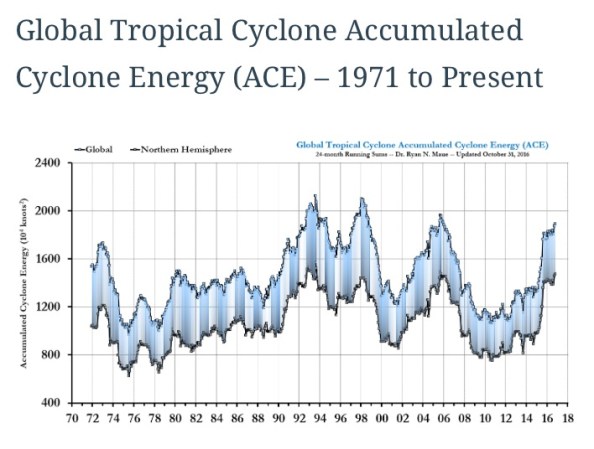
The nasty spate of hurricanes this year has been a catch-up of sorts following a decade of subdued activity. In fact, global hurricane activity has been flat to declining in frequency since 1970. Until the recent increase, hurricane activity had been trending down in terms of 24-month cumulative energy since the 1990s, as the chart above shows. The historical data on the number of U.S. landfalls extends back to 1900, and it has had a negative trend as well. Nevertheless, we hear from climate alarmists that Hurricanes Harvey and Irma, which ended a drought of record length in U.S hurricane landfalls, and now presumably Maria, were a consequence of anthropomorphic global warming (AGW), er… climate change.

The implication is that increases in the atmospheric concentration of CO2 led to these hurricanes or their high intensity. Apparently, the paucity of hurricane activity over the previous ten years can be waved off as a fluke. A further implication of the alarmist view is that the longer negative trends in hurricane frequency and energy can be ignored in the context of any relation to CO2 concentration. But how so? One confounding factor I’ve seen mentioned blames El Nino warming in the Pacific, and a consequent increase in Atlantic wind shear, for the long lull in activity after 2005. That has a ring of plausibility, but a closer look reveals that actual El Nino activity during those years was hardly impressive, with the exception of 2015-16.

More historical data can be seen in the charts on the tropical cyclone page on the Watts Up With That? blog. (The charts in question start about two-thirds of the way down the page.) Hurricane expert Ryan Maue compiled a number of these charts, including the one above. He authored an editorial in the Wall Street Journal this week bemoaning the climate-change hype surrounding Harvey and Irma (if the link doesn’t work, it is available at the WSJ’s Opinion page on Facebook, posted on 9/17). Maue believes that both the climate science community and the media share in the blame for that hype. But he also says the following:

“Although a clear scientific consensus has emerged over the past decade that climate change influences hurricanes in the long run, its effect upon any individual storm is unclear.“

Maue provides a link to this NOAA web site offering cautious support for the proposition that there is a link between global warming and hurricane intensity, though the data it cites ends about ten years ago, so it does not capture the recent lull. Also, some of the information it provides is based on modeled global temperatures and hurricane activity through 2100. As is well-known by now, or should be, long-term climate forecasts based on carbon forcings are notoriously inaccurate, and NOAA admits that the association between those predicted temperatures and future hurricanes is tenuous:

“It is premature to conclude that human activities–and particularly greenhouse gas emissions that cause global warming–have already had a detectable impact on Atlantic hurricane or global tropical cyclone activity.“

Perhaps the idea that there is consensus regarding the relationship between climate change and hurricanes is more of a stretch than Maue and NOAA let on. Here is a summary of 30 peer-reviewed studies showing no connection to either hurricane frequency or intensity. Most of these studies are more recent than the end of the data record cited by NOAA. And in fact, many of these studies find support for a negative link between global temperatures and hurricane activity.

One of the prominent alarmists in the climate research community is Penn State’s Michael Mann, who has famously claimed that hurricanes are more frequent now than at any time in the past 1,000 years. He based his conclusions on highly speculative hurricane “proxies” identified in layers of sediment. Mann’s claims and research technique have been called into questioned by other climate scientists, who have arrived at contrary results in their own research. Lest anyone forget, Mann was implicated in a  data manipulation fraud related to the East Anglia climate scandal. Though cleared by a group of tenured professors at his own university, there are a number of climate scientists who believe Mann violated scientific standards.

The claim that global warming will cause hurricanes to become increasingly intense relies on elevated sea surface temperatures. This year, temperatures in the Gulf of Mexico are elevated and are said to have had a role in strengthening Harvey as it approached the Gulf Coast. Texas, however, has experienced as many landfalls of major hurricanes with cooler Gulf waters as with warmer waters. And Irma strengthened in a part of the Atlantic without such warm temperatures. Instead, minimal wind shear was implicated as a factor contributing to Irma’s strength.

In general, Atlantic temperatures have been relatively warm since the late 1990s, a fact that most scientists would at least partially attribute to the “Atlantic multi-decadal oscillation“, a regular cycle in water temperatures that repeats with a period of multiple decades. Potentially adding to that temperature increase is a controversial change in NOAA’s calibration of sea surface temperatures, as an increasing share of those readings are taken from buoys rather than ship-board measurement. There is some suspicion that NOAA’s adjustments “cool the past” more than is justified, a suspicion that was heightened by allegations from one whistle-blowing NOAA scientist early this year. Then, there is the contention that the sea surface temperature makes little difference if it is matched by an increase in air temperature.

Overall, NOAA says the combination of frequency and intensity of tropical cyclones will increase by 2%-11% over the rest of this century. As Roy Spencer notes, that is not a terribly alarming figure given the risks people have always willingly accepted by living in coastal areas. In any case, the range is based on models of climate behavior that are of questionable reliability. And like past temperature predictions produced by carbon-forcing climate models, it is likely to be a gross overestimate. Here is Roger Pielke, Sr., who is quoted in this wide-ranging post on hurricanes and climate at the Fabius Maximus web site:

“Model projections of hurricane frequency and intensity are based on climate models. However, none have shown skill at predicting past (as hindcasts) variations in hurricane activity (or long term change in their behavior) over years, decades, and longer periods. Thus, their claim of how they will change in the future remains, at most, a hypothesis (i.e. speculation). When NOAA, IPCC and others communicate to the media and public, to be scientifically honest, they should mention this.”

Despite the spike in activity this year, strong hurricanes are intermittent and fairly rare. Establishing reliable statistical connections with other forces is difficult with emergent events like hurricanes. Moreover, the degree of error in measuring global or regional temperature itself is much larger than is generally acknowledged, and the global warming “signal” is very weak. As we say in the statistical analysis business, noisy data are compatible with diverse hypotheses. The relationship between hurricanes and climate change is a prime example.

Tragic Harvey Flooding Was a Known Risk

31 Thursday Aug 2017

Posted by Nuetzel in Flood Insurance, Global Warming, Subsidies, Uncategorized

≈ Leave a comment

Tags

Climate Change, David Conrad, Federal Flood Insurance, Houston, Hurricane Frequency, Hurricane Harvey, Landfalling Hurricanes, Michael Grunwald, National Wildlife Federation, Roger Pielke Jr., Roy Spencer

Houston-flood-1935

The photo above is downtown Houston during the flood of 1935, which I lifted from a post on Roy Spencer’s blog. The rate of rainfall from Hurricane Harvey in Houston is not unprecedented, according to Spencer. The geographic breadth and duration of the heavy rainfall might be, but ready comparisons are difficult on that basis, even for the 100 years of recorded rainfall in East Texas. The tragic severity of the flood damage is probably unprecedented as well, though the full tally won’t be in for some time. The severity is a consequence of four factors: the breadth of the rainfall, its duration, the growth of the Houston metro area, and the unnecessary development of low-lying areas that can no longer provide effective drainage and absorption of rainfall due to impervious cover.

Harvey was (and is) a big storm, but an unusual aspect of Harvey was the way it stalled after making landfall:

“The exact same tropical system moving at, say, 15 mph might have produced the same total amount of rain, but it would have been spread over a wide area, maybe many states, with no flooding disaster. This is usually what happens with landfalling hurricanes. … Instead, Harvey stalled after it came ashore and so all of the rain has been concentrated in a relatively small portion of Texas around the Houston area. In both cases, the atmosphere produced the same amount of rain, but where the rain lands is very different.“

Spencer also notes that Harvey is in no way evidence of global warming, as many in the media have implied:

“Roger Pielke Jr. has pointed out that the U.S. has had only four Category 4 (or stronger) hurricane strikes since 1970, but in about the same number of years preceding 1970 there were 14 strikes. So we can’t say that we are experiencing more intense hurricanes in recent decades. … Going back even earlier, a Category 4 hurricane struck Galveston in 1900, killing between 6,000 and 12,000 people. That was the greatest natural disaster in U.S. history. … And don’t forget, we just went through an unprecedented length of time – almost 12 years – without a major hurricane (Cat 3 or stronger) making landfall in the U.S.“

As for the role of development in the severity of the flooding, Spencer says:

“Major floods are difficult to compare throughout history because the ways in which we alter the landscape. For example, as cities like Houston expand over the years, soil is covered up by roads, parking lots, and buildings, with water rapidly draining off rather than soaking into the soil. The population of Houston is now ten times what it was in the 1920s. The Houston metroplex area has expanded greatly and the water drainage is basically in the direction of downtown Houston.”

Short memories and inaccurate assessments of flood potential might have encouraged excessive building in low-lying areas in and around Houston. However, the profligate extension of federal flood insurance to properties in those areas played a large role. Here is Michael Grunwald:

“Nearly two decades before the storm’s historic assault on homes and businesses along the Gulf Coast of Texas this week, the National Wildlife Federation released a groundbreaking report about the United States government’s dysfunctional flood insurance program, demonstrating how it was making catastrophes worse by encouraging Americans to build and rebuild in flood-prone areas.“

Houston played a noteworthy role in the report quoted by Grunwald:

“‘Houston, we have a problem,’ declared the report’s author, David Conrad. The repetitive losses from even modest floods, he warned, were a harbinger of a costly and potentially deadly future. ‘We haven’t seen the worst of this yet,’ Conrad said.

Climate alarmists would be well-advised to read Spencer’s piece on Harvey. It offers  excellent historical and climatological context. It’s also interesting to read some of the venomous ad hominem sprayed in Spencer’s direction by alarmist trolls in the comments section. Spencer knows too well, however, that “floods aren’t just due to the weather“. Let’s hope that the Houston area won’t be encouraged to rebuild in low-lying areas by prospective subsidies from a federal flood insurance program in need of drastic reform.

Playing Pretend Science Over Cocktails

13 Thursday Apr 2017

Posted by Nuetzel in Global Warming

≈ 2 Comments

Tags

97% Consensus, AGW, Carbon Forcing Models, Climate Feedbacks, CO2 and Greening, East Anglia University, Hurricane Frequency, Judith Curry, Matt Ridley, NOAA, Paleoclimate, Peer Review Corruption, Ross McKitrick, Roy Spencer, Sea Levels, Steve McIntyre, Temperature Proxies, Urbanization Bias

It’s a great irony that our educated and affluent classes have been largely zombified on the subject of climate change. Their brainwashing by the mainstream media has been so effective that these individuals are unwilling to consider more nuanced discussions of the consequences of higher atmospheric carbon concentrations, or any scientific evidence to suggest contrary views. I recently attended a party at which I witnessed several exchanges on the topic. It was apparent that these individuals are conditioned to accept a set of premises while lacking real familiarity with supporting evidence. Except in one brief instance, I avoided engaging on the topic, despite my bemusement. After all, I was there to party, and I did!

The zombie alarmists express their views within a self-reinforcing echo chamber, reacting to each others’ virtue signals with knowing sarcasm. They also seem eager to avoid any “denialist” stigma associated with a contrary view, so there is a sinister undercurrent to the whole dynamic. These individuals are incapable of citing real sources and evidence; they cite anecdotes or general “news-say” at best. They confuse local weather with climate change. Most of them haven’t the faintest idea how to find real research support for their position, even with powerful search engines at their disposal. Of course, the search engines themselves are programmed to prioritize the very media outlets that profit from climate scare-mongering. Catastrophe sells! Those media outlets, in turn, are eager to quote the views of researchers in government who profit from alarmism in the form of expanding programs and regulatory authority, as well as researchers outside of government who profit from government grant-making authority.

The Con in the “Consensus”

Climate alarmists take assurance in their position by repeating the false claim that  97% of climate scientists believe that human activity is the primary cause of warming global temperatures. The basis for this strong assertion comes from an academic paper that reviewed other papers, the selection of which was subject to bias. The 97% figure was not a share of “scientists”. It was the share of the selected papers stating agreement with the anthropomorphic global warming (AGW) hypothesis. And that figure is subject to other doubts, in addition to the selection bias noted above: the categorization into agree/disagree groups was made by “researchers” who were, in fact, environmental activists, who counted several papers written by so-called “skeptics” among the set that agreed with the strong AGW hypothesis. So the “97% of scientists” claim is a distortion of the actual findings, and the findings themselves are subject to severe methodological shortcomings. On the other hand, there are a number of widely-recognized, natural reasons for climate change, as documented in this note on 240 papers published over just the first six months of 2016.

Data Integrity

It’s rare to meet a climate alarmist with any knowledge of how temperature data is actually collected. What exactly is the “global temperature”, and how can it be measured? It is a difficult undertaking, and it wasn’t until 1979 that it could be done with any reliability. According to Roy Spencer, that’s when satellite equipment began measuring:

“… the natural microwave thermal emissions from oxygen in the atmosphere. The intensity of the signals these microwave radiometers measure at different microwave frequencies is directly proportional to the temperature of different, deep layers of the atmosphere.“

Prior to the deployment of weather satellites, and starting around 1850, temperature records came only from surface temperature readings. These are taken at weather stations on land and collected at sea, and they are subject to quality issues that are generally unappreciated. Weather stations are unevenly distributed and they come and go over time; many of them produce readings that are increasingly biased upward by urbanization. Sea surface temperatures are collected in different ways with varying implications for temperature trends. Aggregating these records over time and geography is a hazardous undertaking, and these records are, unfortunately, the most vulnerable to manipulation.

The urbanization bias in surface temperatures is significant. According to this paper by Ross McKitrick, the number of weather stations counted in the three major global temperature series declined by more than 4,500 since the 1970s (over 75%), and most of those losses were rural stations. From McKitrick’s abstract:

“The collapse of the sample size has increased the relative fraction of data coming from airports to about 50% (up from about 30% in the late 1970s). It has also reduced the average latitude of source data and removed relatively more high altitude monitoring sites. Oceanic data are based on sea surface temperature (SST) instead of marine air temperature (MAT)…. Ship-based readings changed over the 20th century from bucket-and-thermometer to engine-intake methods, leading to a warm bias as the new readings displaced the old.“

Think about that the next time you hear about temperature records, especially NOAA reports on a “new warmest month on record”.

Data Manipulation

It’s rare to find alarmists having any awareness of the scandal at East Anglia University, which involved data falsification by prominent members of the climate change “establishment”. That scandal also shed light on corruption of the peer-review process in climate research, including a bias against publishing work skeptical of the accepted AGW narrative. Few are aware now of a very recent scandal involving manipulation of temperature data at NOAA in which retroactive adjustments were applied in an effort to make the past look cooler and more recent temperatures warmer. There is currently an FOIA outstanding for communications between the Obama White House and a key scientist involved in the scandal. Here are Judith Curry’s thoughts on the NOAA temperature manipulation.

Think about all that the next time you hear about temperature records, especially NOAA reports on a “new warmest month on record”.

Other Warming Whoppers

Last week on social media, I noticed a woman emoting about the way hurricanes used to frighten her late mother. This woman was sharing an article about the presumed negative psychological effects that climate change was having on the general public. The bogus premises: we are experiencing an increase in the frequency and severity of storms, that climate change is causing the storms, and that people are scared to death about it! Just to be clear, I don’t think I’ve heard much in the way of real panic, and real estate prices and investment flows don’t seem to be under any real pressure. In fact, the frequency and severity of severe weather has been in decline even as atmospheric carbon concentrations have increased over the past 50 years.

I heard another laughable claim at the party: that maps are showing great areas of the globe becoming increasingly dry, mostly at low latitudes. I believe the phrase “frying” was used. That is patently false, but I believe it’s another case in which climate alarmists have confused model forecasts with fact.

The prospect of rising sea levels is another matter that concerns alarmists, who always fail to note that sea levels have been increasing for a very long time, well before carbon concentrations could have had any impact. In fact, the sea level increases in the past few centuries are a rebound from lows during the Little Ice Age, and levels are now back to where the seas were during the Medieval Warm Period. But even those fluctuations look minor by comparison to the increases in sea levels that occurred over 8,000 years ago. Sea levels are rising at a very slow rate today, so slowly that coastal construction is proceeding as if there is little if any threat to new investments. While some of this activity may be subsidized by governments through cheap flood insurance, real money is on the line, and that probably represents a better forecast of future coastal flooding than any academic study can provide.

Old Ideas Die Hard

Two enduring features of the climate debate are 1) the extent to which so-called “carbon forcing” models of climate change have erred in over-predicting global temperatures, and 2) the extent to which those errors have gone unnoticed by the media and the public. The models have been plagued by a number of issues: the climate is not a simple system. However, one basic shortcoming has to do with the existence of strong feedback effects: the alarmist community has asserted that feedbacks are positive, on balance, magnifying the warming impact of a given carbon forcing. In fact, the opposite seems to be true: second-order responses due to cloud cover, water vapor, and circulation effects are negative, on balance, at least partially offsetting the initial forcing.

Fifty Years Ain’t History

One other amazing thing about the alarmist position is an insistence that the past 50 years should be taken as a permanent trend. On a global scale, our surface temperature records are sketchy enough today, but recorded history is limited to the very recent past. There are recognized methods for estimating temperatures in the more distant past by using various temperature proxies. These are based on measurements of other natural phenomenon that are temperature-sensitive, such as ice cores, tree rings, and matter within successive sediment layers such as pollen and other organic compounds.

The proxy data has been used to create temperature estimates into the distant past. A basic finding is that the world has been this warm before, and even warmer, as recently as 1,000 years ago. This demonstrates the wide range of natural variation in the climate, and today’s global temperatures are well within that range. At the party I mentioned earlier, I was amused to hear a friend say, “Ya’ know, Greenland isn’t supposed to be green”, and he meant it! He is apparently unaware that Greenland was given that name by Viking settlers around 1000 AD, who inhabited the island during a warm spell lasting several hundred years… until it got too cold!

Carbon Is Not Poison

The alarmists take the position that carbon emissions are unequivocally bad for people and the planet. They treat carbon as if it is the equivalent of poisonous air pollution. The popular press often illustrates carbon emissions as black smoke pouring from industrial smokestacks, but like oxygen, carbon dioxide is a colorless gas and a gas upon which life itself depends.

Our planet’s vegetation thrives on carbon dioxide, and increasing carbon concentrations are promoting a “greening” of the earth. Crop yields are increasing as a result; reforestation is proceeding as well. The enhanced vegetation provides an element of climate feedback against carbon “forcings” by serving as a carbon sink, absorbing increasing amounts of carbon and converting it to oxygen.

Matt Ridley has noted one of the worst consequences of the alarmists’ carbon panic and its influence on public policy: the vast misallocation of resources toward carbon reduction, much of it dedicated to subsidies for technologies that cannot pass economic muster. Consider that those resources could be devoted to many other worthwhile purposes, like bringing electric power to third-world families who otherwise must burn dung inside their huts for heat; for that matter, perhaps the resources could be left under the control of taxpayers who can put it to the uses they value most highly. The regulatory burdens imposed by these policies on carbon-intensive industries represent lost output that can’t ever be recouped, and all in the service of goals that are of questionable value. And of course, the anti-carbon efforts almost certainly reflect a diversion of resources to the detriment of more immediate environmental concerns, such as mitigating truly toxic industrial pollutants.

The priorities underlying the alarm over climate change are severely misguided. The public should demand better evidence than consistently erroneous model predictions and manipulated climate data. Unfortunately, a media eager for drama and statism is complicit in the misleading narrative.

FYI: The cartoon at the top of this post refers to the climate blog climateaudit.org. The site’s blogger Steve McIntyre did much to debunk the “hockey stick” depiction of global temperature history, though it seems to live on in the minds of climate alarmists. McIntyre appears to be on an extended hiatus from the blog.

The Greening-Carbon Nexus

17 Saturday Dec 2016

Posted by Nuetzel in Environment, Global Warming

≈ 2 Comments

Tags

Atmospheric Carbon Concentration, Climate Change, Climate Consensus, David Henderson, Global Greening, global warming, Harrison H. Schmitt, Matt Ridley, Pollution, Rand Paul, Rodney W. Nichols, Roy Spencer, Thomas Malthus

carbon_sequestration

Satellite records show that our world is experiencing a remarkable “greening” in the 21st century, to the seeming chagrin of the environmental left. There is now more vegetation than two decades ago, and greener vegetation, across as much as 50% of the Earth’s vegetated surface area. That area is expanding as well, and the creeping greenery has improved soil moisture levels in some drylands. This bodes well for agricultural productivity, putting another nail in Malthus’ coffin. The satellite studies have concluded that most of the enhanced vegetation is attributable to greater concentration of CO2 in the atmosphere, as opposed to warming or other possible causes. An interesting feedback is that the enhanced vegetation increases natural absorption of CO2, providing an enhanced carbon sink. This, in turn, has caused a pause in the growth of atmospheric carbon cencentration.

The environmental left knows these developments tend to undermine their preferred narrative that human emissions of CO2 must be reduced — at any cost. In fact, already there are warnings that global greening will “outgrow its benefit” as the greater volume of plants begins to decay, releasing carbon. You just can’t make some people happy! But not all of the carbon release from plant decay adds to atmospheric carbon — some is soil-bound — so the greening should provide a fairly durable carbon sink.

Global greening was one of the major motifs in Matt Ridley’s 2016 Global Warming Policy Foundation Lecture. Ridley covered various evidence of greening, but he also discussed the failure of a large contingent of climate researchers to follow a legitimate scientific approach to the study of climate change. Instead, they have politicized their field of study, committing a few noteworthy frauds along the way:

“It is irresponsible not to challenge the evidence properly, especially if the policies pursued in its name are causing suffering. Increasingly, many people would like to outlaw, suppress, prosecute and censor all discussion of what they call ‘the science’ rather than engage in debate. …

No wonder that I talk frequently to scientists who are skeptical, but dare not say so openly. That is a ridiculous state of affairs. We’re told that it’s impertinent to question “the science” and that we must think as we are told. But arguments from authority are the refuge of priests. Thomas Henry Huxley put it this way: ‘The improver of natural knowledge absolutely refuses to acknowledge authority, as such. For him, scepticism is the highest of duties; blind faith the one unpardonable sin’. 

What keeps science honest, what stops it from succumbing entirely to confirmation bias, is that it is decentralized, allowing one lab to challenge another.“

It is all too true that policies advanced in the interests of curbing a slight warming trend cause real suffering, and the pain is heavily concentrated on the most impoverished. The presumed benefits of activist climate-change policies are speculative, at best. They have little chance of reversing atmospheric carbon concentration on their own.

Ridley makes note of the substantial evidence that sensitivity of the climate to airborne carbon concentration is low. This has become increasingly evident with the unfolding of a consistent record of over-forecasts of global temperatures by climate forcing models. Roy Spencer provides insights about these models in a recent discussion of global warming and “dodgy science” on his blog.

There is a widespread myth that 97 percent of climate scientists believe human activity is the main cause of global warming. In fact, that claim was based on a paper counting citations, not scientists; the methods used in the study and the citations themselves were also questionable. I have reviewed that evidence here on Sacred Cow Chips. David Henderson reviewed it here. A large number of studies find fault with so-called “consensus” pronouncements. They should always be viewed with suspicion.

There is also a lively debate underway over whether CO2 should be considered a pollutant! I exhale, therefore I pollute? To the extent that fecal matter is considered a pollutant, is it fair that to say that CO2 is, too? After all, both are anthropogenic. No, they are not even close in terms of an immediate threat to human health. As a philosophical matter, the idea that anything done by man is “unnatural” denies the fact that we are a very part of nature. Obviously, CO2 is not in the same class as pollutants like sulfur dioxide, ammonia, carbon monoxide or toxic metals. Today, these pollutants are very common in many parts of the world, and they are very threatening to human life. Effective mitigation technologies are available, but instead, in the developed West, we fixate on an increase in CO2 concentration of 100 parts per million over many decades, the climate implications of which are de minimis.

Rand Paul’s Facebook page has an ungated link to a WSJ.com commentary by Rodney W. Nichols and Harrison H. Schmitt on “The Phony War Against CO2”. Their commentary provokes questions as to the motives of the environmental left, and certain members of the research community, in shilling for the cause. That we would fight the greening of the globe, and the potential agricultural benefit it could bring, is bizarre. To devote enormous resources to an endeavor that is largely futile is a waste and a tragedy.


Occupying a Meaningless Climate Summit

24 Wednesday Sep 2014

Posted by Nuetzel in Uncategorized

≈ Leave a comment

Tags

Climate fraud, Glen Reynolds, Occupy Wall Street, OWS, People's Climate March, Roger Simon, Ron Bailey, Roy Spencer, Steven Koonin, UN Climate Summit

al-gore-hypnosis

Today’s UN Climate Summit was, by all reports thus far, pretty much a waste of energy, that pun very much intended. It was an event for solemn repetition of good and misplaced intentions. Last week, Roger Simon challenged readers to “Suppose They Gave a Climate Conference and Nobody Came.” Well, a few people came, but Simon quotes Newsweek’s apprehension regarding “the failure of leaders from the U.N.’s three largest member nations—China, Russia and India—to attend.” Ron Bailey at Reason notes that neither the U.S. or China were ready to make any pledges regarding future emissions at the Summit. The entire affair was simply a political show, but there are parties to global climate negotiations with serious goals. More on the scam from Simon:

“I went to Copenhagen in 2009 for this website to cover another UN climate conference (COP 15), then considered to be extremely crucial. Several islands — Micronesia, I think — were supposedly about to go under from the rising tides. I ran into the representative from one of those islands and asked him if he was worried. He started to laugh and shook his head. So I asked him what he was doing at the conference. I want the money, he said.”

Nevertheless, there is a political constituency for politicians who wish to play the climate card. It has been forged by certain grant-hungry climate scientists, spotlight-hungry advocates, and an always crisis-hungry media  playing to the back row of the science class. As former Obama science advisor Steven E. Koonin writes, the science is not settled. Anything but.

The editorial The People’s Climate Demarche in the Wall Street Journal describes some of the “free-lunch” nonsense from the climate lobby that passes for good economics, as well as the politics of why momentum on climate negotiations is stalling.

Perhaps a bigger spectacle leading up to the UN Summit was the “People’s Climate March” in New York City on Sunday. Basically, if you think everything about a modern, market-driven society sucks, then the climate change bandwagon is for you. It’s an all-inclusive excuse to bash … almost anything, but especially anything conceivably subject to confiscation! The participants apparently have no inkling that without the fruits of modern capitalism, they would be without the material comforts to which they are accustomed (such as electricity) and have life expectancies of about 40 years from birth.

Roy Spencer minces no words when describing the march:

“The marchers are trying to teach us how we should live our lives, when they have no clue what life would be like if they got their way. Someday we will have a realistic, affordable, abundant energy alternative to fossil fuels. But that day is not here yet. And its arrival cannot be legislated or negotiated with a treaty.”

In another interesting sidelight, Anthony Watts posts a copy of a Craigslist ad soliciting paid volunteers for the climate march.

Finally, the climate march and the subsequent “Flood Wall Street” march (which was described in Reason as more of a trickle) are obviously close cousins to the Occupy Wall Street protests of 2012. Glen Reynolds’ syllabus for OWS is simply a gem.

Green With Irony

08 Sunday Jun 2014

Posted by Nuetzel in Uncategorized

≈ Leave a comment

Tags

Carbon Emission Rules, Climate Change, Greening, Roy Spencer, Vegetative Cover

Image

The relatively brief increase in global temperatures during the late 20th century took a pause over the past 15 years or so, but worldwide carbon emissions have continued to grow (now at the “alarming” level of 4 parts per 10,000 in the atmosphere, despite significant decreases in the U.S. over the past few years, and even bigger decreases in U.S. carbon emissions relative to real output). This disconnect is a major reason why climate models have failed so miserably in recent years. Ironically, the warming that did occur last century, and the continuing increases in carbon concentrations, have increased the earth’s vegetative cover and “greened” the planet, as described by climatologist Roy Spencer. This appears to have occurred in certain desert regions as well as areas of more moderate conditions. Coincidentally, this greening is a source of increased carbon uptake as well.

In the meantime, President Obama has announced new carbon emission rules for U.S. power plants. Here’s another Roy Spencer post on that topic. The new rules will raise energy costs, damage the economy, and contribute climate benefits of approximately zero.

Follow Sacred Cow Chips on WordPress.com

Recent Posts

  • Immigration and Merit As Fiscal Propositions
  • Tariff “Dividend” From An Indigent State
  • Almost Looks Like the Fed Has a 3% Inflation Target
  • Government Malpractice Breeds Health Care Havoc
  • A Tax On Imports Takes a Toll on Exports

Archives

  • December 2025
  • November 2025
  • October 2025
  • September 2025
  • August 2025
  • July 2025
  • June 2025
  • May 2025
  • April 2025
  • March 2025
  • February 2025
  • January 2025
  • December 2024
  • November 2024
  • October 2024
  • September 2024
  • August 2024
  • July 2024
  • June 2024
  • May 2024
  • April 2024
  • March 2024
  • February 2024
  • January 2024
  • December 2023
  • November 2023
  • August 2023
  • July 2023
  • June 2023
  • May 2023
  • April 2023
  • March 2023
  • February 2023
  • January 2023
  • December 2022
  • November 2022
  • October 2022
  • September 2022
  • August 2022
  • July 2022
  • June 2022
  • May 2022
  • April 2022
  • March 2022
  • February 2022
  • January 2022
  • December 2021
  • November 2021
  • October 2021
  • September 2021
  • August 2021
  • July 2021
  • June 2021
  • May 2021
  • April 2021
  • March 2021
  • February 2021
  • January 2021
  • December 2020
  • November 2020
  • October 2020
  • September 2020
  • August 2020
  • July 2020
  • June 2020
  • May 2020
  • April 2020
  • March 2020
  • February 2020
  • January 2020
  • December 2019
  • November 2019
  • October 2019
  • September 2019
  • August 2019
  • July 2019
  • June 2019
  • May 2019
  • April 2019
  • March 2019
  • February 2019
  • January 2019
  • December 2018
  • November 2018
  • October 2018
  • September 2018
  • August 2018
  • July 2018
  • June 2018
  • May 2018
  • April 2018
  • March 2018
  • February 2018
  • January 2018
  • December 2017
  • November 2017
  • October 2017
  • September 2017
  • August 2017
  • July 2017
  • June 2017
  • May 2017
  • April 2017
  • March 2017
  • February 2017
  • January 2017
  • December 2016
  • November 2016
  • October 2016
  • September 2016
  • August 2016
  • July 2016
  • June 2016
  • May 2016
  • April 2016
  • March 2016
  • February 2016
  • January 2016
  • December 2015
  • November 2015
  • October 2015
  • September 2015
  • August 2015
  • July 2015
  • June 2015
  • May 2015
  • April 2015
  • March 2015
  • February 2015
  • January 2015
  • December 2014
  • November 2014
  • October 2014
  • September 2014
  • August 2014
  • July 2014
  • June 2014
  • May 2014
  • April 2014
  • March 2014

Blogs I Follow

  • Passive Income Kickstart
  • OnlyFinance.net
  • TLC Cholesterol
  • Nintil
  • kendunning.net
  • DCWhispers.com
  • Hoong-Wai in the UK
  • Marginal REVOLUTION
  • Stlouis
  • Watts Up With That?
  • Aussie Nationalist Blog
  • American Elephants
  • The View from Alexandria
  • The Gymnasium
  • A Force for Good
  • Notes On Liberty
  • troymo
  • SUNDAY BLOG Stephanie Sievers
  • Miss Lou Acquiring Lore
  • Your Well Wisher Program
  • Objectivism In Depth
  • RobotEnomics
  • Orderstatistic
  • Paradigm Library
  • Scattered Showers and Quicksand

Blog at WordPress.com.

Passive Income Kickstart

OnlyFinance.net

TLC Cholesterol

Nintil

To estimate, compare, distinguish, discuss, and trace to its principal sources everything

kendunning.net

The Future is Ours to Create

DCWhispers.com

Hoong-Wai in the UK

A Commonwealth immigrant's perspective on the UK's public arena.

Marginal REVOLUTION

Small Steps Toward A Much Better World

Stlouis

Watts Up With That?

The world's most viewed site on global warming and climate change

Aussie Nationalist Blog

Commentary from a Paleoconservative and Nationalist perspective

American Elephants

Defending Life, Liberty and the Pursuit of Happiness

The View from Alexandria

In advanced civilizations the period loosely called Alexandrian is usually associated with flexible morals, perfunctory religion, populist standards and cosmopolitan tastes, feminism, exotic cults, and the rapid turnover of high and low fads---in short, a falling away (which is all that decadence means) from the strictness of traditional rules, embodied in character and inforced from within. -- Jacques Barzun

The Gymnasium

A place for reason, politics, economics, and faith steeped in the classical liberal tradition

A Force for Good

How economics, morality, and markets combine

Notes On Liberty

Spontaneous thoughts on a humble creed

troymo

SUNDAY BLOG Stephanie Sievers

Escaping the everyday life with photographs from my travels

Miss Lou Acquiring Lore

Gallery of Life...

Your Well Wisher Program

Attempt to solve commonly known problems…

Objectivism In Depth

Exploring Ayn Rand's revolutionary philosophy.

RobotEnomics

(A)n (I)ntelligent Future

Orderstatistic

Economics, chess and anything else on my mind.

Paradigm Library

OODA Looping

Scattered Showers and Quicksand

Musings on science, investing, finance, economics, politics, and probably fly fishing.

  • Subscribe Subscribed
    • Sacred Cow Chips
    • Join 128 other subscribers
    • Already have a WordPress.com account? Log in now.
    • Sacred Cow Chips
    • Subscribe Subscribed
    • Sign up
    • Log in
    • Report this content
    • View site in Reader
    • Manage subscriptions
    • Collapse this bar
 

Loading Comments...