• About

Sacred Cow Chips

Sacred Cow Chips

Tag Archives: Slavery

Juneteenth Marred By An Economic Fallacy

28 Saturday Jun 2025

Posted by Nuetzel in Economic Development, Slavery

≈ Leave a comment

Tags

1619 Project, Abolition, Antebellum South, Capital Deepening, Civil War, Coercion, Emancipation, Juneteenth, Nathan Nunn, Phil Magness, Redistribution, Reparatiins, Rod D. Martin, Slavery, Welfare Loss
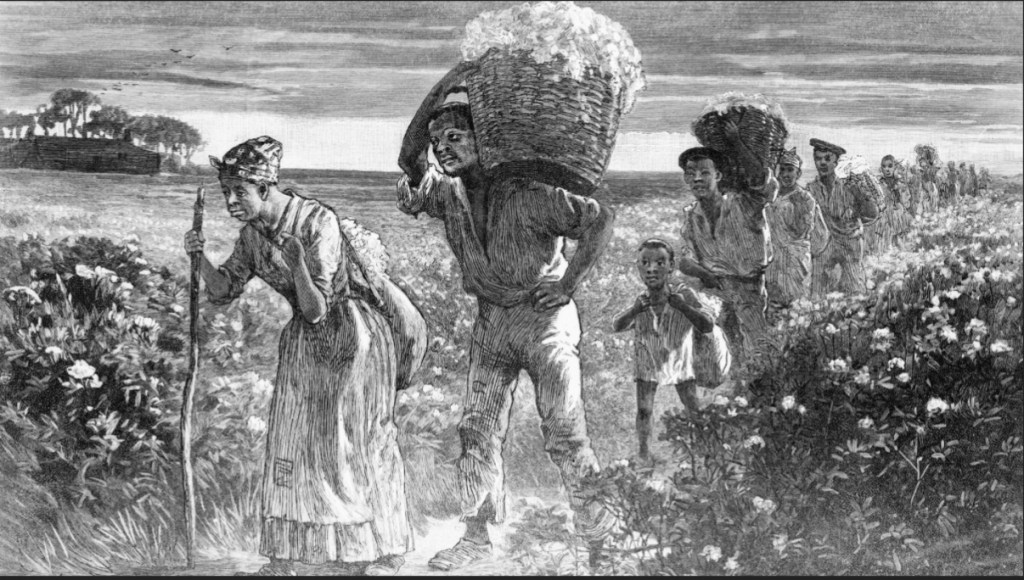
The Juneteenth holiday (June 19th) marks the anniversary of the abolition of slavery in the U.S. It should be viewed as a celebration of basic human rights. However, in purely economic terms, slavery was (and still is in many parts of the world) a complete revocation of property rights (self-ownership). But not only was slave-holding the worst sort of theft, it represented a total suspension of the labor market mechanism and had dire consequences for long-term economic development, especially in the south.

Government sanction of slaveholding in the southern U.S. and an extremely low effective wage for slaves promoted an excessive and inefficient dependence on, and utilization of, the low-cost input: slave labor. As a result, slavery created an obstacle to economic development, innovation, and capital deepening. The overall impact on the U.S. was to reduce economic welfare and development, and the dysfunction was obviously concentrated in the south.

That hasn’t stopped some activists from making the claim that slavery enabled the success of American capitalism. For example, this book contends that:

“… the expansion of slavery in the first eight decades after American independence drove the evolution and modernization of the United States.“

The so-called 1619 Project has promoted this narrative as well. Interestingly, this is similar to claims made prior to emancipation by defenders of slavery.

Of course, one can’t overemphasize the injustices suffered by American slaves, like those of other enslaved peoples throughout history. But it is foolhardy to attribute the long-term economic success of the American economy to slavery. Even today, 160 years after emancipation, it’s a safe bet that most Americans would be better off without its legacy.

To be clear I’ll outline several assertions I’m making here. First, if slaves had been free workers, they would have enjoyed freedoms and captured the value of their labors from the start. (Though it is not clear how many Africans would have come to America voluntarily as free workers, had they been given the opportunity. Some, however, were already enslaved.)

Under this counterfactual, more efficient pricing of labor would have led to deeper capital. At the same time, while many black non-slaves would still have worked in agriculture, blacks would have been more dispersed occupationally, working at tasks that best suited individual skills. The resulting efficiency gains would have been magnified by virtue of working in combination with more capital assets, enhancing productivity. And these workers would have been free to build their own human capital through education and work experience. Meanwhile, government would not have wasted resources enforcing slave ownership, and plantation owners (and other slave holders) would have made more rational resource allocation decisions. All these factors would have produced a net gain in welfare and improved economic development from at least the time of the nation’s founding.

There is no question that enslavement and the welfare losses suffered by slaves (and many of their descendants) far outweighed the gains captured by those who employed slave labor, as well as those who consumed or otherwise made use of the product of slave labor. A proper economic accounting of these losses acknowledges that slaves were denied their worker surplus and their ability to earn an opportunity cost, and they were often punished or tortured as a means of coercing greater effort. This serves to emphasize the implausibility of the argument that the America reaped net economic benefits from slavery.

Slavery was so powerful an institution that it permeated southern culture and perceptions of status. Wealth was tied-up in slave-chattel, and the free labor made for a handsome return on investment. Thus, both economic and cultural factors acted to lock producers into an unending series of short-run input decisions.

Furthermore, as Phil Magness explains in a letter to the Editor in the Wall Street Journal:

“… slavery’s economics … largely depended on government support. Fugitive slave patrols, military expenditures to fend off the threat of slave revolts and censorship of abolitionist materials by the post office were necessary to secure the institution’s economic position. These policies transferred the burden of enforcing the slave system from the plantation masters on to the taxpaying public.“

Meanwhile, the distortions to the cost of labor slowed the adoption of a variety of production techniques, including horse-drawn cultivators and harrows, steel plows, and steam-powered machinery. In other words, planters had little incentive to modernize production. Other technologies commonly used in the north during that era could have been applied in the south, but only to its much smaller share of acreage dedicated to grain crops.

Southern agricultural practices were “frozen in place”, as Rod D. Martin puts it. Ultimately, had southern planters adopted labor-saving technologies, and had southern governments shifted resources away from protecting slavery as an institution toward more diversified economic development, the antebellum economy would have experienced more rapid growth.

Growth in demand for cotton exports was certainly a boon to the south during the years preceding the Civil War, but the reliance on cotton was such that the southern economy was heavily exposed to risks of draught and other shocks. Furthermore, the lack of industrialization meant that southern states captured little of the final value of the textiles produced with cotton. The inadequacy of transportation infrastructure in the south was another serious detriment to long-term growth.

The work of Nathan Nunn, which is cited by Martin, generally supports the hypothesis that slavery retards economic growth. Nunn found a strong negative correlation between slave use and later economic development across different “New World” economies, as well as U.S. states and counties.

Martin goes so far as to say that the Union’s victory over the Confederacy was due in large part to economic under-development attributable to slavery in the south. That narrative has been challenged by a few scholars who claimed that the south was actually wealthier than the north. The owners of large southern plantations were quite well off, of course, but estimates of their wealth are unreliable, and in any case slaves themselves were highly illiquid “assets”. That meant planters would have been hard pressed to raise the capital needed for investment in labor-saving technologies, even if they’d had proper incentives to do so.

On the whole, there is no question the north was far more industrialized, diversified, and prosperous than the south. It was also much larger in terms of population and total output. Thus, Martin’s assertion that slavery explains why the south lost the Civil War is probably a bit too sweeping.

Nevertheless, the slavery “ecosystem” helps explain the south’s historic under-development. It was characterized by artificially cheap labor, illiquidity, a lack of diversification, a rigid social hierarchy based on the aberrant ownership of human chattel, and state subsidization of slave owners. These conditions restricted the supply of investment capital in the south. This was a drag on economic development before the Civil War. Those characteristics, along with the direct costs of the war itself, go a long way toward explaining the south’s lengthy period of depressed conditions after the Civil War as well.

It’s certainly not a knock on the slave population prior to emancipation to say that they were not responsible for the success of American capitalism. It’s a knock on the institution of slavery itself. Our wealth and the bounties produced by today’s economy are not supercharged by the efforts of slave labor in the distant past. If anything, our prosperity would be far greater had slavery never been practiced on U.S. soil.

I oppose reparations as a form of redistribution partly because most prospective payers today have absolutely no connection to slave-holding in antebellum America. It’s ironic that certain activists now argue for reparations based on imagined economic benefits once used to defend slavery itself.

White Racialism, Identity Politics, and Crippling DEI

09 Thursday Nov 2023

Posted by Nuetzel in DEI, Identity Politics

≈ 1 Comment

Tags

Anti-discrimination law, Christopher Rufo, Colorblind Society, Comparative advantage, DEI, Diversity, Equity, George Floyd, Hobbesian, Identity Politics, Inclusion, Jim Crow Laws, Protected Classes, Racial Preferences, Racialism, racism, rent seeking, Segregation, Slavery, Social Constructs, Structural Racism, Tribalism, Tyler Cowen, Victimhood, Victor Davis Hanson, White Racialism, Zero-Sum Thinking

I’ve taken an extended hiatus from blogging while moving to a different part of the country. I haven’t posted here in over 10 weeks, but a new post appears below. I’m still tying-up loose ends from the move, but I’ll be trying to get back to posting more regularly … trying!

~~~~~~~~~~~~~~~~~~~~~~~~~~~~~~~~~~~~~~~

Absurd ideas about race and identity politics come from extreme elements on both the Left and the Right. Some leftists insist that race has no natural basis — that it’s simply a “social construct”. On the Right, a “racialist” contingent is promoting the “celebration of whiteness” and embracing racial preferences for whites. Treated as alternative pathways, I’d take “social construct”. It’s nonsense, of course, but the beautiful irony is that it provides a basis for stripping away from our institutions the entire diversity, equity, and inclusion (DEI) straightjacket. It’s almost as if those promoting race as a social construct wish to build a “colorblind” society. On the other hand, I suppose some think they can have their DEI cake along with a side of free choice to identify as anything they want: black, white, or furry.

Who Are the Racists?

People of good faith don’t harbor or act on racist tendencies. The mere recognition of racial/ethnic/cultural differences is not evidence of racism and does not preclude the treatment of all with fairness and due respect. It’s possible to respect, value, or fall in love with someone outside one’s own racial, ethnic, or cultural group of origin, even while holding a general affinity for one’s own group, as nearly everyone does.

But a few real racists are sprinkled across all races, ethnicities, cultures, and the full political spectrum. The “popular” racist stereotype as white male has been kept alive by the lingering echos of slavery in America, which ended nearly 16 decades ago, and the long hangover that included Jim Crow laws and segregation. Today, however, “white society” or “whiteness” is hardly the sole domain of prejudice.

Is Racialism Different?

Now, a few whites are promoting the celebration of “white identity” as a counterbalance to identity politics among non-whites. Ostensibly, this “white racialism” might be similar to celebrations of identity often practiced by minorities, which are also forms of racialism. Should white racialism be viewed as less savory than racialism practiced by racial minorities?

For most Caucasians, “being white” does not have much salience relative to other affiliations defining identity. That’s why white racialism seems odd to me. Sure, when forced to check a box, whites will check “Caucasian”, but “white identity” seems overly broad. There are too many distinct cultures and subcultures that dominate self-identity, such as national ancestry, religion, and cultural membership.

The same could be said for many other racial categories, but minority status and historical events (e.g., American slavery) help explain why broad categories often form cohesive identity groups. And, as Christopher Rufo notes in his great discussion of the racialist viewpoint, broad categories tend to be the most closely associated with racialism:

“Yes, left-wing racialism is indeed now deeply embedded in America’s institutions, and the demographic balance of the country has shifted in recent decades. And yes, the basic racial classification system in the United States broadly delineates continental origin—Europe, Africa, Latin America, Asia—in a way that is not arbitrary or meaningless. Terms such as ‘white,’ ‘black,’ ‘Latino,’ and ‘Asian,’ while often obscuring important variations within such groupings, have become the lingua franca and are useful shorthand descriptors for many purposes.”

There are individuals from all groups or “classes”, including whites, who react critically to aggressive expressions of identity by members of other classes. Perhaps that’s excusable, depending on the degree of zealotry on either part. The line between pride in race/ancestry/culture and fractious racialism might be hard to discern in some cases, but the chief distinction is rooted in explicit, demeaning and/or envious comparisons to “out-groups”. This might be damaging enough, but from there it can be a very short step into outright racism.

A preoccupation with the historic disadvantages of one’s race can be disempowering to an individual and destructive in a social sense. I believe the white racialist phenomenon belongs in that category. The presumed “disadvantages” of whiteness are very contemporary, however, rooted in policies dating back only to the widespread adoption of racial preferences for non-white “protected classes” and DEI.

Preferences For All

Imagine the racialist policies now practiced widely in government, industry, and academia — particularly racial preferences on behalf of protected classes — but now applied on behalf of heretofore unprotected classes as well. For example, what if some proportion of jobs, admissions, or other coveted placements were set aside for whites? If whites represent 50% of the population, then 50% of hires or admissions would be reserved for whites.

Some might assume that this treatment is already implied by existing racial preferences, but that’s not the case. In the wake of George Floyd’s death, just 6% of new hires among S&P companies were white, according to Bloomberg News.

Nevertheless, such a white racialist turnabout would be a colossal mistake. Adding strict limits to the application of existing preferences might be a good thing, but white racial preferences would buttress the entire system of racial preferences as an institution and add more rigidity to the operation of labor markets. From an economic viewpoint, it would be just as pernicious as racial preferences generally.

Racial preferences of any kind freeze labor markets and impair the allocation of human resources to their most-valued uses. In fact, placing one individual into a position on any basis other than their qualifications implies that two individuals must be placed into positions in which they lack comparative advantage relative to each other. Little by little, that means lost output and upward price pressure. It is a mechanism that short circuits gains from trade, shriveling the benefits that the most and least talented confer on society at large. Extending preferences to whites would only serve to further institutionalize this damaging practice.

Adherence to numerical preferences is to pretend that people can be treated less as individuals and more like interchangeable parts… except with respect to their value as “class members”. Racial preferences are presumed to be a remedy for so-called structural racism, as opposed to racism by individuals. But they involve classification and favor the so-called “oppressed” at the expense of designated “oppressors”. The latter, almost without exception, had no role oppressive regimes of the past. Favoritism of this kind necessarily means reverse discrimination and fails to match individuals to roles in an optimal fashion.

Whether publicly or privately imposed, racial preferences often undermine those they are purported to help by placing individuals into positions for which they may not be competitive. This can sabotage an individual’s long-term success. It goes without saying that preferences build resentment among the “unprotected”, which goes to the impetus for “white racialism”. Indeed, preferences are not always popular with protected classes either. That’s because they interfere with merit-based decision-making and are perceived to stigmatize those presumed to benefit.

The Fixed Pie Is a Lie

Racialism reflects zero-sum thinking, a hallmark of DEI initiatives. Tyler Cowen quoted the abstract of a recent NBER working paper that found:

“… a more zero-sum mindset is strongly associated with more support for government redistribution, race- and gender-based affirmative action, and more restrictive immigration policies.”

Zero-sum thinking is fundamental to rent-seeking behavior, which is motivated by either malevolent greed or perceptions of victimhood. Victimhood and rent seeking is at the heart of calls for DEI, to say nothing of more radical proposals like reparation payments. White racialism attempts to get in on the action by positing that whites are oppressed under the current institutional dominance of DEI. But the misguided presumption that every identity group should have their own preferences or quotas broadens the emphasis on redressing perceived harms and redistributing rewards — zero-sum activities.

These zero-sum efforts waste energy and resources, harming our ability to produce things that enhance well being. Ultimately, they are actually negative-sum activities, and they also breed hatred.

Race is obviously determined by genetics, but I’d be happy to pretend it’s a mere social construct if that would help get us to a “colorblind” society.

Conclusion

There’s a huge irony in the racialism exercised by both traditional and “white racialist” DEI advocates: it neglects the most fundamental and just application of diversity: equality of opportunity. This principle incorporates the concept of diversity without sacrificing economic efficiency. We’ve largely abandoned it in favor of equality of outcomes via racial preferences, even at a time when society has become enlightened with respect to racial differences. In doing so, we’ve unintentionally chosen another form of explicit racial victimization.

To close, here’s a good summary of the dangers of racialism and identity politics offered by Victor Davis Hanson:

“Anytime one ethnic, racial, or religious group refuses to surrender its prime identity in exchange for a shared sense of self, other tribes for their own survival will do the same.

All then rebrand their superficial appearance as essential not incidental to whom they are.

And like nuclear proliferation that sees other nations go nuclear once a neighboring power gains the bomb, so too the tribalism of one group inevitably leads only to more tribalism of others. The result is endless Hobbesian strife.”

And that’s how white racialism fits right in with the pernicious politics of identity. When you can, vote for the elimination, or at least reform, of DEI policies and practices, not for a reinforcement of identity politics.

Hiring Discrimination In the U.S., Canada, and Western Europe

10 Monday Oct 2022

Posted by Nuetzel in Discrimination

≈ Leave a comment

Tags

Alex Tabarrok, Anti-Discrimination Laws, Ban the Box, Disparate impact, European Union, Hiring Discrimination, Protected Groups, Racial Proxies, Segregation, Slavery

Some people have the impression that the U.S. is uniquely bad in terms of racial, ethnic, gender, and other forms of discrimination. This misapprehension is almost as grossly in error as the belief held in some circles that the history of slavery is uniquely American, when in fact the practice has been so common historically, and throughout the world, as to be the rule rather than the exception.

This week, Alex Tabarrok shared some research I’d never seen on one kind of discriminatory behavior. In his post, “The US has Relatively Low Rates of Hiring Discrimination”, he cites the findings of a 2019 meta-study of “… 97 Field Experiments of Racial Discrimination in Hiring”. The research focused on several Western European countries, Canada, and the U.S. The experiments involved the use of “faux applicants” for actual job openings. Some studies used applications only and were randomized across different racial or ethnic cues for otherwise similar applicants. Other studies paired similar individuals of different racial or ethnic background for separate in-person interviews.

The authors found that hiring discrimination is fairly ubiquitous against non-white groups across employers in these countries. The authors were careful to note that the study did not address levels of hiring discrimination in countries outside the area of the study. They also disclaimed any implication about other forms of discrimination within the covered countries, such as bias in lending or housing.

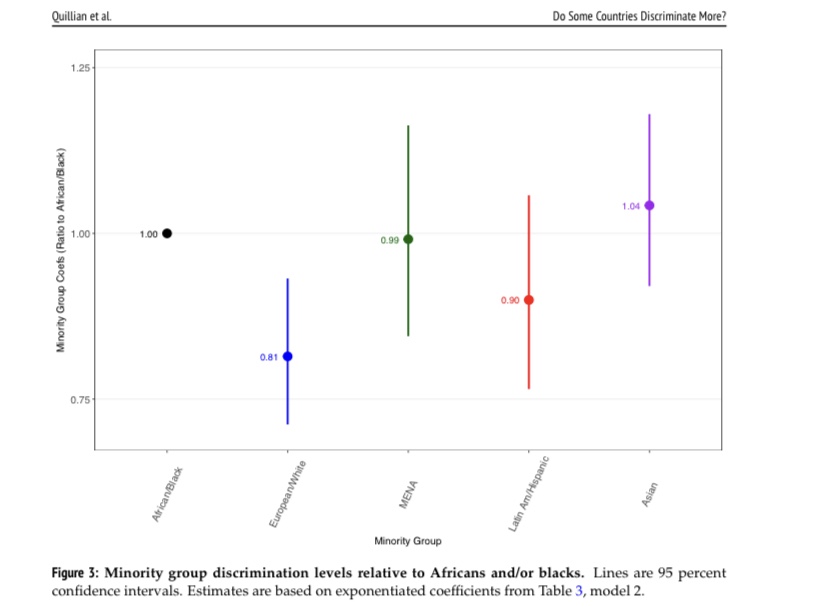
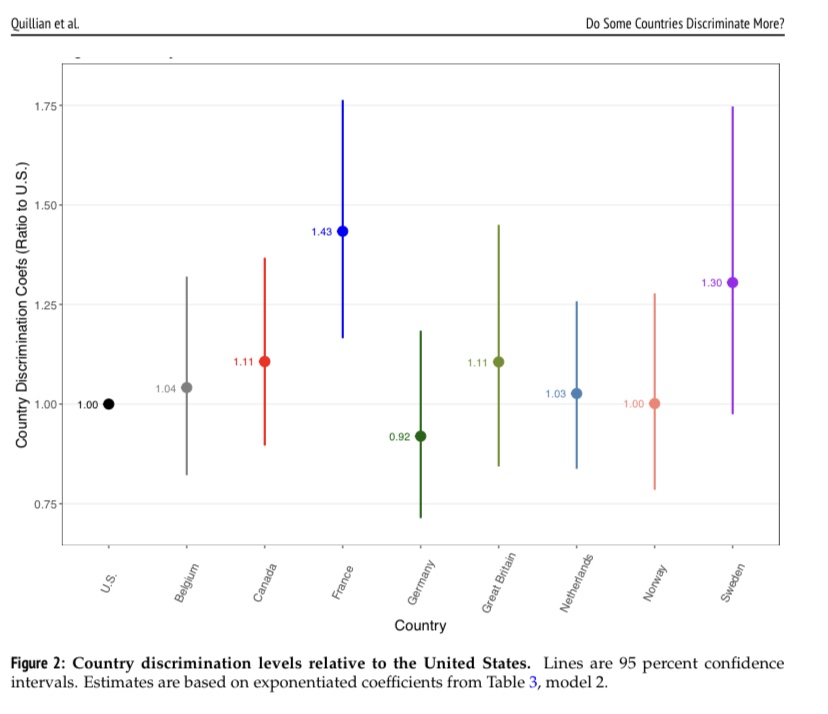
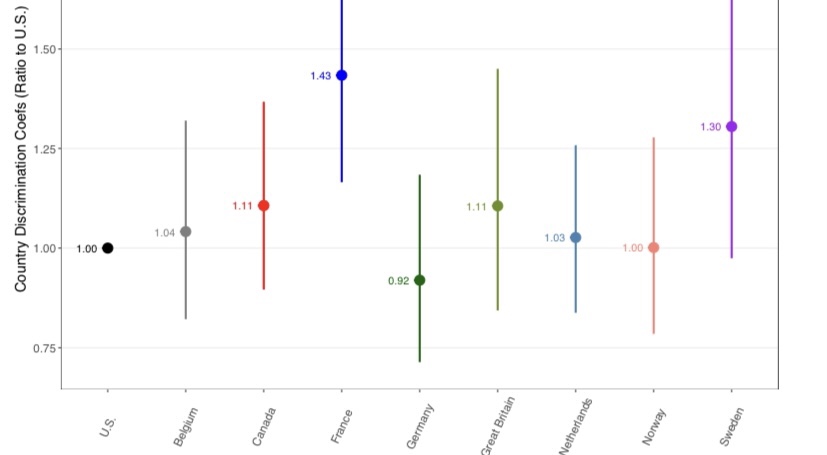
The study’s point estimates indicated “ubiquitous hiring discrimination”, though not all the estimates were statistically significant. My apologies if the chart below is difficult to read. If so, try zooming in, clicking on it, or following the link to the study above.

Some of the largest point estimates were highly imprecise due to less coverage by individual studies. The impacted groups and severity varied across countries. Blacks suffered significant discrimination in the U.S., Canada, France, and Great Britain. For Hispanics, the only coverage was in the U. S. and sparsely in Canada. The point estimates showed discrimination in both counties, but it was (barely) significant only in the U.S. For Middle Eastern and North African (MENA) applicants, discrimination was severe in France, the Netherlands, Belgium, and Sweden. Asian applicants faced discrimination in France, Norway, Canada, and Great Britain.

Across all countries, the group suffering the least hiring discrimination was white immigrants, followed by Latin Americans / Hispanics (but only two countries were covered). Asians seemed to suffer the most discrimination, though not significantly more than Blacks (and less in the U.S. than in France, Norway, Canada, and Great Britain). Blacks and MENA applicants suffered a bit less than Asians from hiring discrimination, but again, not significantly less.

Comparing countries, the authors used U.S. hiring discrimination as a baseline, assigning a value of one. France had the most severe hiring discrimination and at a high level of significance. Sweden was next highest, but it was not significantly higher than in the U.S. Belgium, Canada, the Netherlands and Great Britain had higher point estimates of overall discrimination than the U. S., though none of those differences were significant. Employers in Norway were about as discriminatory as the U.S., and German employers were less discriminatory, though not significantly.

The upshot is that as a group, U.S. employers are generally at the low end of the spectrum in terms of discriminatory hiring. Again, the intent of this research was not to single out the selected countries. Rather, these countries were chosen because relevant studies were available. In fact, Tabarrok makes the following comment, which the authors probably wouldn’t endorse and is admittedly speculative, but I suspect it’s right:

“I would bet that discrimination rates would be much higher in Japan, China and Korea not to mention Indonesia, Iraq, Nigeria or the Congo. Understanding why discrimination is lower in Western capitalist democracies would reorient the literature in a very useful way.”

So the U.S. is not on the high-side of this set of Western countries in terms of discriminatory hiring practices. While discrimination against blacks and Hispanics in the U.S. appears to be a continuing phenomenon, overall hiring discrimination in the U.S. is, at worst, comparable to many European countries.

To anticipate one kind of response to this emphasis, the U.S. is not alone in its institutional efforts to reduce discrimination. In fact, the study’s authors say:

“A fairly similar set of antidiscrimination laws were adopted in North America and many Western European countries from the 1960s to the 1990s. In 2000, the European Union passed a series of race directives that mandated a range of antidiscrimination measures to be adopted by all member states, putting their legislative frameworks on racial discrimination on highly similar footing.”

Despite these similarities, there are a few institutional details that might have some bearing on the results. For example, France bans the recording and “formal discussion” of race and ethnicity during the hiring process. (However, photos are often included in job applications in European countries.) Does this indicate that reporting mandates and prohibiting certain questions reduce hiring discrimination? That might be suggestive, but the evidence is not as clear cut as the authors seem to believe. They cite one piece of conflicting literature on that point. Moreover, it does not explain why Great Britain had a greater (and highly significant) point estimate of discrimination against Asians, or why Canada and Norway were roughly equivalent to France on this basis. Nor does it explain why Sweden and Belgium did not differ from France significantly in terms of discrimination against MENA applicants. Or why Canada was not significantly different from France in terms of hiring discrimination against Blacks. Overall, discrimination in Sweden was not significantly less than in France. Still, at least based on the three applicant groups covered by studies of France, that country had the highest overall level of discrimination. France also had the most significant departure from the U.S., where recording the race and ethnicity of job applicants is institutionalized.

Germany had the lowest overall point estimates of hiring discrimination in the study. According to the authors, employers in German-speaking countries tend to collect a fairly thorough set of background information on job applications. This detail can actually work against discrimination in hiring. Tabarrok notes that so-called “ban the box” policies, or laws that prohibit employers from asking about an applicant’s criminal record, are known to result in greater racial disparities in hiring. The same is true of policies that threaten sanctions against the use of objective job qualifications which might have disparate impacts on “protected” groups. That’s because generalized proxies based on race are often adopted by hiring managers, consciously or subconsciously.

Discrimination in hiring based on race and ethnicity might actually be reasonable when a job entails sensitive interactions requiring high levels of trust with members of a minority community. This statement acknowledges that we do not live in a perfect world in which racial and ethnic differences are irrelevant. Still, aside from exceptions of that kind, overt hiring discrimination based on race or ethnicity is a negative social outcome. The conundrum we face is whether it is more or less negative than efforts to coerce nondiscrimination on those bases across a broad range of behaviors, most of which are nondiscriminatory to begin with, and when interventions often have perverse discriminatory effects. Policymakers and observers in the U.S. should maintain perspective. Discriminatory behavior persists in the U.S., especially against Blacks, but some of this discrimination is likely caused by prohibitions on objective tests of relevant job skills. And as the research discussed above shows, employers here appear to be a bit less discriminatory than those in most other Western democracies.

Equal *Mattering* Under Ethics, Law and Community

04 Saturday Jul 2020

Posted by Nuetzel in Identity Politics, racism, Uncategorized

≈ 1 Comment

Tags

Black Lives Matter, Civil Rights, Conflict Theory, Equal Protection, Family Unit, Great Society, Identity Politics, Jim Crow, Lyndon Johnson, Marxism, Moral Dilemma, Original Sin, racism, Self-Driving Cars, Slavery, Systemic Racism, Thomas Sowell, Tribalism, Walter Williams, Welfare State

How many white lives is a single black life worth? It seems so easy to pin that down, but if you think it’s okay to say “black lives matter”, but not to say “all lives matter”, the implication is that one black life is worth more than one white life. Anyone who insists on that should take the following litmus test. 

A classic dilemma discussed by ethicists involves situations of mortal danger in which a life or lives might be sacrificed in order to save other lives. Variants of it come up again and again in the effort to tune software for autonomous vehicles. It’s also a simple tool for challenging assertions about the values of different lives, or whether different lives “matter”.

Suppose that two pedestrians step into the path of your vehicle. You can save them only by swerving, killing a single pedestrian standing at the curb. Most would agree the car should swerve, but the answer might change under certain circumstances. Forget about the argument that the two in your path weren’t careful, so they “deserve” die. We just don’t know what caused them to proceed, or what might have distracted them.

What if the two in your path are elderly, using walkers and dragging oxygen tanks, while the pedestrian at the curb is a healthy child. Does that matter? Do we weigh the sacrifice of many potential life-years as well as a higher quality of life? People might feel less certain about that choice.

Now let’s suppose that all three pedestrians are healthy, young adults. Does it matter that any of the pedestrians are black? The one on the the curb, or the two in your path? Of course not! The truly “colorblind” answer is to swerve regardless of race. You are an obvious racist if you think otherwise. The sacrifice of one white life is certainly worth saving two black lives; the sacrifice of one black life is certainly worth saving two white lives. Black lives and white lives matter equally. 

Our Constitution and ethical standards dictate that lives are equal, that we are equal before the law, that we that we have equal rights to speak, worship, and enjoy the fruits of our labors, including the unchallenged right to property we might acquire. Under the law, and in all of our social interactions, we must be accorded equal consideration regardless of extraneous characteristics such as race. All of us have the same promise of life and opportunities to pursue happiness, and to make of our lives what we can or will. However, none of this entitles us to equal happiness, romance, and material well being.

Now, detractors will say all that misses the point. The value of black lives has been discounted for centuries, they say, as evidenced in disparate treatment by police, prosecutors, juries, employers, neighbors, social clubs, and places of business. Of course it’s true that racism has a long history throughout the world, and at one time or other it has been turned against virtually every race or religion in existence. If you think in this day and age that racism doesn’t exist elsewhere, think again.

Slavery was a tragic reality in the U.S. until 155 years ago, but it was certainly not unique to the U.S. Jim Crow laws that prevented blacks from participating equally in many aspects of life were finally ended more than 50 years ago through a series of legislative actions and Supreme Court decisions. Slavery and Jim Crowism were the acts of long-dead ancestors of almost anyone living today. The presumption that all whites should assume guilt for some kind original sin against blacks is sheer nonsense, and one many of us will simply never accept.

Nevertheless, the legacy of degraded personhood under those long-defunct laws created a heavy burden for blacks in terms of upward mobility, and certainly vestiges of racism survive even today. However, we have adopted many standards and programs intended to rectify this unfortunate legacy, including the civil rights legislation of the 1960s and beyond, the Great Society programs of Lyndon Johnson, and many other enlargements of the social safety net since then. These programs have represented a massive redistribution of resources to the impoverished via education, housing, and direct transfers. One estimate put cumulative federal spending on anti-poverty programs alone at $13 trillion between 1963 and 2010. In addition, a variety of programs have been a source of preferential treatment for various minorities in an effort to ensure equal opportunities across many aspects of life.

The success of these programs is subject to great doubt (more on that below), and in fact the motives of Johnson and other proponents of this expansion in the role of government were perhaps less than pure. Nevertheless, the entirety of the package of civil rights and welfare state programs over the years was supported by most of the black community. In fact, one could say that these measures were hardly the actions of a racist society, at least in ostensible intent.

And yet we are told today that we do not sufficiently appreciate that black lives matter! There is no question that racism lives in the hearts and minds of certain individuals, but those individuals aren’t all white. More importantly, the blanket condemnation of whites as racist lacks any basis in reality.

When Black Lives Matter activists talk of “systemic racism”, you can translate as follows: blacks have not met with the ex post economic and social success to which these activists believe blacks are entitled. As it pertains to law enforcement, they mean that blacks are met with more violent police actions than blacks should suffer.

As to law enforcement, it is an awful thing that crime perpetrated by blacks, and particularly crime by blacks against blacks, is disproportionally heavy. As I argued recently, it is difficult to accept the hypothesis of systemic racism in law enforcement in the presence of rampant “systemic crime” in the black community. But crime, in turn, is tied closely to economic success, or the lack thereof.

Median black income has grown relative to median white income since 1970 (also see here). Unfortunately, many blacks have not shared in that growth and remain mired in poverty and on public aid. Sadly, many aid programs have pernicious effects because they impose extremely high marginal tax rates on earned income. The solution lays the groundwork for continued dependency. That qualifies as systemic racism, or at least classism.

Two well-known black economists, Thomas Sowell and Walter Williams, have both decried the welfare state’s destructive impact on the black family unit. That’s one reason why Williams calls white liberals the “worst enemy of black people“. (Also see what Williams has to say about expectations for black students, and about black crime.)

Ultimately, the uproar over racism alleged to be so widespread and “systemic” is divisive. It is an application of Marxist “conflict theory” lying at the very heart of identity politics. Such tribal philosophies creat huge obstacles to peaceful and productive coexistence among diverse peoples. Meanwhile, there’s a simple truth: a widespread consensus exists that all lives are of equal value, that all lives deserve respect and equal treatment under the law, that the goodwill of one’s fellows is a birthright, and that racism is fundamentally evil. If society is to provide fertile ground for the equal cultivation of all lives, it must reject the strictures and resentment bred by identity politics in favor of individual liberty, personal responsibility, and compassion for those unable to care for themselves.

I’m Conjuring Some Damages For You To Pay

27 Friday Jun 2014

Posted by Nuetzel in Uncategorized

≈ Leave a comment

Tags

AGW, Climate Change, Cotton Mather, Reparations, Slavery

Image

Demands for climate change reparations are nothing new on an international level, but the essay at the link notes a fascinating comparison of these demands to calls for slavery reparations. Of course, given the weak evidence that climate warming is actually underway, and if so, that it is indeed man-made, and given the extremely poor track-record of models predicting global warming, the assertion of “moral equivalence of slavery and climate change” is ridiculous on its face.

Slavery and its damages are historical facts. Anthropomorphic global warming (AGW) remains speculative, let alone any presumed damages. The author amusingly notes:

It is as provocative today to express doubt in AGW as it would have been to argue with Cotton Mather about relying on spectral evidence. As Mather said, “Never use but one grain of patience with any man that shall go to impose upon me a Denial of Devils, or of Witches.”

Beyond measurement issues, the two demands for reparations share another practical weakness: the difficulty of apportioning the cost. If real, can or should such damages be generalized at the national level? Furthermore, actual payments for past damages are a political non-starter, whether for slavery reparations in the U.S. or climate reparations to the third world promulgated in Copenhagen. In both cases, there is some recognition that it is better politics to adopt forward-looking remedies. That is not to say these remedies are constitutionally legitimate or economically sound, however.

Follow Sacred Cow Chips on WordPress.com

Recent Posts

  • Immigration and Merit As Fiscal Propositions
  • Tariff “Dividend” From An Indigent State
  • Almost Looks Like the Fed Has a 3% Inflation Target
  • Government Malpractice Breeds Health Care Havoc
  • A Tax On Imports Takes a Toll on Exports

Archives

  • December 2025
  • November 2025
  • October 2025
  • September 2025
  • August 2025
  • July 2025
  • June 2025
  • May 2025
  • April 2025
  • March 2025
  • February 2025
  • January 2025
  • December 2024
  • November 2024
  • October 2024
  • September 2024
  • August 2024
  • July 2024
  • June 2024
  • May 2024
  • April 2024
  • March 2024
  • February 2024
  • January 2024
  • December 2023
  • November 2023
  • August 2023
  • July 2023
  • June 2023
  • May 2023
  • April 2023
  • March 2023
  • February 2023
  • January 2023
  • December 2022
  • November 2022
  • October 2022
  • September 2022
  • August 2022
  • July 2022
  • June 2022
  • May 2022
  • April 2022
  • March 2022
  • February 2022
  • January 2022
  • December 2021
  • November 2021
  • October 2021
  • September 2021
  • August 2021
  • July 2021
  • June 2021
  • May 2021
  • April 2021
  • March 2021
  • February 2021
  • January 2021
  • December 2020
  • November 2020
  • October 2020
  • September 2020
  • August 2020
  • July 2020
  • June 2020
  • May 2020
  • April 2020
  • March 2020
  • February 2020
  • January 2020
  • December 2019
  • November 2019
  • October 2019
  • September 2019
  • August 2019
  • July 2019
  • June 2019
  • May 2019
  • April 2019
  • March 2019
  • February 2019
  • January 2019
  • December 2018
  • November 2018
  • October 2018
  • September 2018
  • August 2018
  • July 2018
  • June 2018
  • May 2018
  • April 2018
  • March 2018
  • February 2018
  • January 2018
  • December 2017
  • November 2017
  • October 2017
  • September 2017
  • August 2017
  • July 2017
  • June 2017
  • May 2017
  • April 2017
  • March 2017
  • February 2017
  • January 2017
  • December 2016
  • November 2016
  • October 2016
  • September 2016
  • August 2016
  • July 2016
  • June 2016
  • May 2016
  • April 2016
  • March 2016
  • February 2016
  • January 2016
  • December 2015
  • November 2015
  • October 2015
  • September 2015
  • August 2015
  • July 2015
  • June 2015
  • May 2015
  • April 2015
  • March 2015
  • February 2015
  • January 2015
  • December 2014
  • November 2014
  • October 2014
  • September 2014
  • August 2014
  • July 2014
  • June 2014
  • May 2014
  • April 2014
  • March 2014

Blogs I Follow

  • Passive Income Kickstart
  • OnlyFinance.net
  • TLC Cholesterol
  • Nintil
  • kendunning.net
  • DCWhispers.com
  • Hoong-Wai in the UK
  • Marginal REVOLUTION
  • Stlouis
  • Watts Up With That?
  • Aussie Nationalist Blog
  • American Elephants
  • The View from Alexandria
  • The Gymnasium
  • A Force for Good
  • Notes On Liberty
  • troymo
  • SUNDAY BLOG Stephanie Sievers
  • Miss Lou Acquiring Lore
  • Your Well Wisher Program
  • Objectivism In Depth
  • RobotEnomics
  • Orderstatistic
  • Paradigm Library
  • Scattered Showers and Quicksand

Blog at WordPress.com.

Passive Income Kickstart

OnlyFinance.net

TLC Cholesterol

Nintil

To estimate, compare, distinguish, discuss, and trace to its principal sources everything

kendunning.net

The Future is Ours to Create

DCWhispers.com

Hoong-Wai in the UK

A Commonwealth immigrant's perspective on the UK's public arena.

Marginal REVOLUTION

Small Steps Toward A Much Better World

Stlouis

Watts Up With That?

The world's most viewed site on global warming and climate change

Aussie Nationalist Blog

Commentary from a Paleoconservative and Nationalist perspective

American Elephants

Defending Life, Liberty and the Pursuit of Happiness

The View from Alexandria

In advanced civilizations the period loosely called Alexandrian is usually associated with flexible morals, perfunctory religion, populist standards and cosmopolitan tastes, feminism, exotic cults, and the rapid turnover of high and low fads---in short, a falling away (which is all that decadence means) from the strictness of traditional rules, embodied in character and inforced from within. -- Jacques Barzun

The Gymnasium

A place for reason, politics, economics, and faith steeped in the classical liberal tradition

A Force for Good

How economics, morality, and markets combine

Notes On Liberty

Spontaneous thoughts on a humble creed

troymo

SUNDAY BLOG Stephanie Sievers

Escaping the everyday life with photographs from my travels

Miss Lou Acquiring Lore

Gallery of Life...

Your Well Wisher Program

Attempt to solve commonly known problems…

Objectivism In Depth

Exploring Ayn Rand's revolutionary philosophy.

RobotEnomics

(A)n (I)ntelligent Future

Orderstatistic

Economics, chess and anything else on my mind.

Paradigm Library

OODA Looping

Scattered Showers and Quicksand

Musings on science, investing, finance, economics, politics, and probably fly fishing.

  • Subscribe Subscribed
    • Sacred Cow Chips
    • Join 128 other subscribers
    • Already have a WordPress.com account? Log in now.
    • Sacred Cow Chips
    • Subscribe Subscribed
    • Sign up
    • Log in
    • Report this content
    • View site in Reader
    • Manage subscriptions
    • Collapse this bar
 

Loading Comments...