• About

Sacred Cow Chips

Sacred Cow Chips

Tag Archives: Sovereign Wealth Fund

Public Debt and AI: Ain’t But One Way Crowding Out

17 Sunday Aug 2025

Posted by Nuetzel in Artificial Intelligence, Deficits

≈ Leave a comment

Tags

AI Capital Expenditures, Artificially Intelligence, Bradford S. Cohen, Carlyle, central planning, Cronyism, crowding out, Daren Acemoglu, Digital Assets, Federal Deficits, Goldman Sachs, Jason Thomas, Megan Jones, Productivity Growth, Public debt, Scarcity, Seth Benzell, Sovereign Wealth Fund, Stanford Digital Economy Lab, Tyler Cowen
There’s a hopeful narrative making the rounds that artificial intelligence will prove to be such a boon to the economy that we need not worry about high levels of government debt. AI investment is already having a substantial economic impact. Jason Thomas of Carlyle says that AI capital expenditures on such things as data centers, hardware, and supporting infrastructure account for about a third of second quarter GDP growth (preliminarily a 3% annual rate). Furthermore, he says relevant orders are growing at an annual rate of about 40%. The capex boom may continue for a number of years before leveling off. In the meantime, we’ll begin to see whether AI is capable of boosting productivity more broadly.

Unfortunately, even with this kind of investment stimulus, there’s no assurance that AI will create adequate economic growth and tax revenue to end federal deficits, let alone pay down the $37 trillion public debt. That thinking puts too much faith in a technology that is unproven as a long-term economic engine. It would also be a naive attitude toward managing debt that now carries an annual interest cost of almost $1 trillion, accounting for about half of the federal budget deficit.

Boom Times?

Predictions of AI’s long-term macro impact are all over the map. Goldman Sachs estimates a boost in global GDP of 7% over 10 years, which is not exactly aggressive. Daren Acemoglu has been even more conservative, estimating a gain of 0.7% in total factor productivity over 10 years. Tyler Cowen has been skeptical about the impact of AI on economic growth. For an even more pessimistic take see these comments.

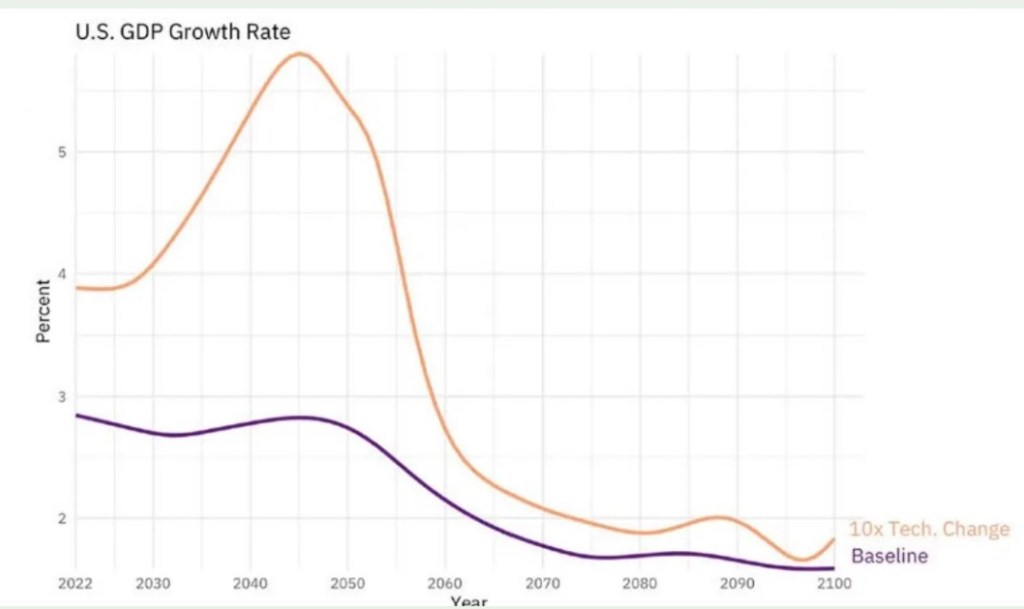
In July, however, Seth Benzell of the Stanford Digital Economy Lab discussed some simulations showing impressive AI-induced growth (see chart at top). The simulations project additional U.S. GDP growth of between 1% – 3% annually over the next 75 years! The largest boost in growth occurs now through the 2050s. This would produce a major advance in living standards. It would also eliminate the federal deficit and cure our massive entitlement insolvency, but the result comes with heavy qualifications. In fact, Benzell ultimately throws cold water on the notion that AI growth will be strong enough to reduce or even stabilize the public debt to GDP ratio.

The Scarcity Spoiler

The big hitch has to do with the scarcity of capital, which I’ve described as an impediment to widespread AI application. Competition for capital will drive interest rates up (3% – 4%, according to Benzell’s model). Ongoing needs for federal financing intensify that effect. But it might not be so bad, according to Benzell, if climbing rates are accompanied by heightened productivity powered by AI. Then, tax receipts just might keep-up with or exceed the explosion in the government’s interest obligations.

A further complication cited by Benzell lurks in insatiable demands for public spending, and politicians who simply can’t resist the temptation to buy votes via public largesse. Indeed, as we’ve already seen, government will try to get in on the AI action, channeling taxpayer funds into projects deemed to be in the public interest. And if there are segments of the work force whose jobs are eliminated by AI, there will be pressure for public support. So even if AI succeeds in generating large gains in productivity and tax revenue, there’s very little chance we’ll see a contagion of fiscal discipline in Washington DC. This will put more upward pressure on interest rates, giving rise to the typical crowding out phenomenon, curtailing private investment in AI.

Playing Catch-Up

The capex boom must precede much of the hoped-for growth in productivity from AI. Financing comes first, which means that rates are likely to rise sooner than productivity gains can be expected. And again, competition from government borrowing will crowd out some private AI investment, slowing potential AI-induced increases in tax revenue.

There’s no chance of the converse: that AI investment will crowd out government borrowing! That kind of responsiveness is not what we typically see from politicians. It’s more likely that ballooning interest costs and deficits generally will provoke even more undesirable policy moves, such as money printing or rate ceilings.

The upshot is that higher interest rates will cause deficits to balloon before tax receipts can catch up. And as for tax receipts, the intangibility of AI will create opportunities for tax flight to more favorable jurisdictions, a point well understood by Benzell. As attorneys Bradford S. Cohen and Megan Jones put it:

“Digital assets can be harder to find and more easily shifted offshore, limiting the tax reach of the U.S. government.”

AI Growth Realism

Benzell’s trepidation about our future fiscal imbalances is well founded. However, I also think Benzell’s modeled results, which represent a starting point in his analysis of AI and the public debt, are too optimistic an assessment of AI’s potential to boost growth. As he says himself,

“… many of the benefits from AI may come in the form of intangible improvements in digital consumption goods. … This might be real growth, that really raises welfare, but will be hard to tax or even measure.”

This is unlikely to register as an enhancement to productivity. Yet Benzell somehow buys into the argument that AI will lead to high levels of unemployment. That’s one of his reasons for expecting higher deficits.

My view is that AI will displace workers in some occupations, but it is unlikely to put large numbers of humans permanently out of work and into state support. That’s because the opportunity cost of many AI applications is and will remain quite high. It will have to compete for financing not only with government and more traditional capex projects, but with various forms of itself. This will limit both the growth we are likely to reap from AI and losses of human jobs.

Sovereign Wealth Fund

I have one other bone to pick with Benzell’s post. That’s in regard to his eagerness to see the government create a sovereign wealth fund. Here is his concluding paragraph:

“Instead of contemplating a larger debt, we should instead be talking about a national sovereign wealth fund, that could ‘own the robots on behalf of the people’. This would both boost output and welfare, and put the welfare system on an indefinitely sustainable path.”

Whether the government sells federal assets or collects booty from other kinds of “deals”, the very idea of accumulating risk assets in a sovereign wealth fund undermines the objective to reduce debt. It will be a struggle for a sovereign wealth fund to consistently earn cash returns to compensate for interest costs and pay down the debt. This is especially unwise given the risk of rising rates. Furthermore, government interests in otherwise private concerns will bring cronyism, displacement of market forces by central planning, and a politicization of economic affairs. Just pay off the debt with whatever receipts become available. This will free up savings for investment in AI capital and hasten the hoped-for boom in productivity.

Summary

AI’s contribution to economic growth probably will be inadequate and come too late to end government budget deficits and reduce our burgeoning public debt. To think otherwise seems far fetched in light of our historical inability to restrain the growth of federal spending. Interest on the federal debt already accounts for about half of the annual budget deficit. Refinancing the existing public debt will entail much higher costs if AI capex continues to grow aggressively, pushing interest rates higher. These dynamics make it pretty clear that AI won’t provide an easy fix for federal deficits and debt. In fact, ongoing federal borrowing needs will sop up savings needed for AI development and diffusion, even as the capital needed for AI drives up the cost of funds to the government. It’s a shame that AI won’t be able to crowd out government.
Will DOGE Hunt? Bond Market Naturally Defers

21 Friday Feb 2025

Posted by Nuetzel in DOGE, Public debt

≈ 1 Comment

Tags

Bond Market, Deficit Reduction, DOGE, DOGE Dividend, Donald Trump, Elon Musk, Federal Reserve, Fiscal policy, Gaza, Greenland, Jerome Powell, Marginal Revolution, Matt Yglesias, Mineral Rights, Prodding Diplomacy, Sovereign Wealth Fund, Treasury Debt, Tyler Cowen, Ukraine

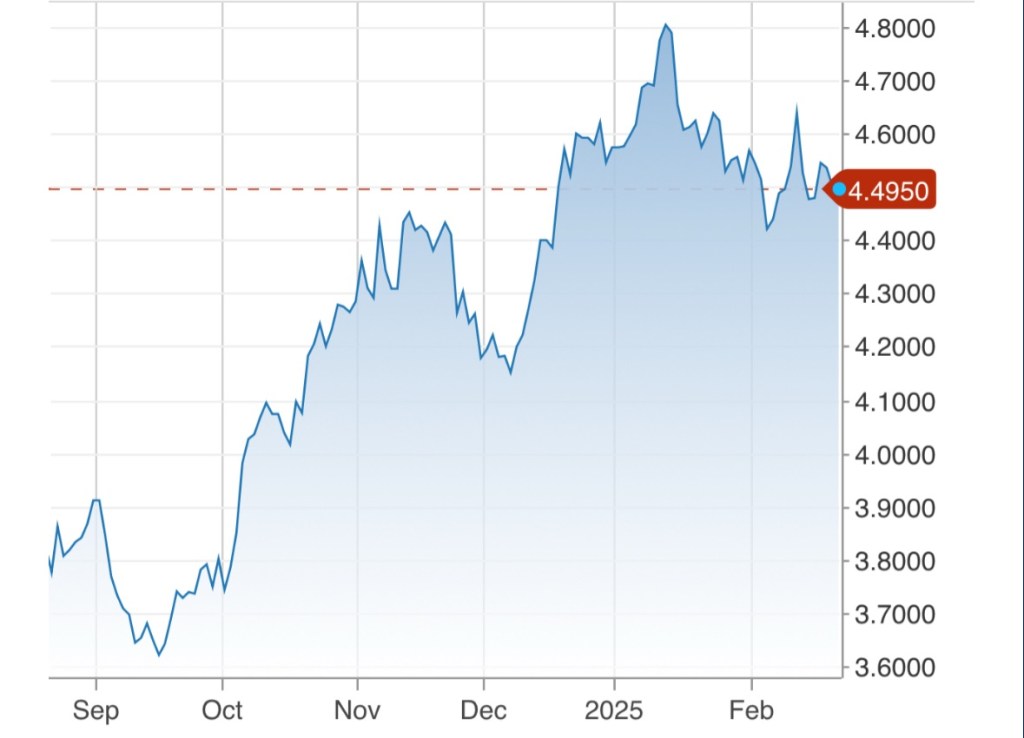
Matt Yglesias tweeted on X that “the bond market does not appear to believe in DOGE”. He included a chart much like the updated one above to “prove” his point. Tyler Cowen posted a link to the tweet on Marginal Revolution, without comment … Cowen surely must know that any such conclusion is premature, especially based on the movement of Treasury yields over the past month (or more, since the market’s evaluation of the DOGE agenda preceded Trump’s inauguration).

Of course, there is a difference between “believing” in DOGE and being convinced that its efforts should have succeeded in reducing interest rates immediately amidst waves of background noise from budget and tax legislation, court challenges, Federal Reserve missteps (this time cutting rates too soon), and the direction of the economy in general.

In this case, perhaps a better way to define success for DOGE is a meaningfully negative impact on the future supply of Treasury debt. Even that would not guarantee a decline in Treasury rates, so the premise of Yglesias’ tweet is somewhat shaky to begin with. Still, all else equal, we’d expect to see some downward pressure on yields if DOGE succeeds in this sense. But we must go further by recognizing that DOGE savings could well be reallocated to other spending initiatives. Then, the savings would not translate into lower supplies of Treasury debt after all.

Certainly, the DOGE team has made progress in identifying wasteful expenditures, inefficiencies, and poor controls on spending. But even if the $55 billion of estimated savings to date is reliable, DOGE has a long way to go to reach Musk’s stated objective of $2 trillion. There are some juicy targets, but it will be tough to get there in 17 more months, when DOGE is to stand down. Still, it’s not unreasonable to think DOGE might succeed in accomplishing meaningful deficit reduction.

But if bond traders have doubts about DOGE, it’s partly because Donald Trump and Elon Musk themselves keep giving them reasons. In my view, Musk and Trump have made a major misstep in toying with the idea of using prospective DOGE savings to fund “dividend checks” of $5,000 for all Americans. These would be paid by taking 20% of the guesstimated $2 trillion of DOGE savings. Musk’s expression of interest in the idea was followed by a bit of clusterfuckery, as Musk walked back his proposal the next day even as Trump jumped on board. PLEASE Elon, don’t give the Donald any crowd-pleasing ideas! And don’t lose sight of the underlying objective to reduce the burden of government and the public debt.

Now, Trump proposes that 60% of the savings accomplished by DOGE be put toward paying for outlays in future years. Sure, that’s deficit reduction, but it may serve to dull the sense that shrinking the federal government is an imperative. The mechanics of this are unclear, but as a first pass, I’d say the gain from investing DOGE savings for a year in low-risk instruments is unlikely to outweigh the foregone savings in interest costs from paying off debt today! Of course, that also depends on the future direction of interest rates, but it’s not a good bet to make with public funds.

Nor can the bond market be comforted by uncertainty surrounding legislation that would not only extend the Trump tax cuts, but will probably include various spending provisions, both cuts and increases. As of now, the mix of provisions that might accompany a deal among GOP factions is very much up in the air.

There is also trepidation about Trump’s aggressive stance toward the Federal Reserve. He promises to replace Jerome Powell as Fed Chairman, but with God knows whom? And Trump jawbones aggressively for lower rates. The Fed’s ill-advised rate cuts in the fall might have been motivated in part by an attempt to capitulate to the then-President Elect.

Trump’s Executive Order to create a sovereign wealth fund (SWF), which I recently discussed here, is probably not the most welcome news to bond investors. All else equal, placing tax or tariff revenue into such a fund would reduce the potential for deficit reduction, to say nothing of the idiocy of additional borrowing to purchase assets.

Finally, Trump has proposed what might later prove to be massive foreign policy trial balloons. Some of these are bound up with the creation of the SWF. They might generate revenue for the government without borrowing (mineral rights in Ukraine? Or Greenland?), but at this point there’s also a chance they’ll create massive funding needs (Gaza development?). Again, Trump seems to be prodding or testing counterparties to various negotiations… prodding diplomacy. It’s unlikely that anything too drastic will come of it from a fiscal perspective, but it probably doesn’t leave bond traders feeling easy.

At this stage, it’s pretty rash to conclude that the bond market “doesn’t believe in DOGE”. In fact, there is no doubt that DOGE is making some progress in identifying potential fraud and inefficiencies. However, bond traders must weigh a wide range of considerations, and Donald Trump has a tendency to kick up dust. Indeed, the so-called DOGE dividend will undermine confidence in debt reduction and bond prices.

Only a Statist Could Love a Sovereign Wealth Fund

12 Wednesday Feb 2025

Posted by Nuetzel in Central Planning, Public debt

≈ 7 Comments

Tags

Bitcoin, Blockchain, Capital Reserve, Carnegie Endowment for International Peace, Crypto Reserve, Donald Trump, Federal Asset Sales, Fiscal Sustainability, Government Corruption, Interest Expense, Joe Biden, Knowledge Problem, Pension Reserves, Peter Earle, Public debt, Sovereign Wealth Fund, Strategic Petroleum Reserve, Tariffs, Taxes, TikTok

I want a federal government with a less pervasive presence in the private sphere. That’s why I oppose a U.S. sovereign wealth fund (SWF), but President Trump issued an executive order (EO) on February 3 setting in motion the creation of an SWF. It would hold various assets with the ostensible intent to earn a return benefiting American taxpayers.

Here are a few comments on the form an SWF might take:

1) How would the SWF be funded?

—Sales of federal assets like federal land, buildings, and the sale of extraction rights? These are probably the least offensive possibilities for funding an SWF, but the proceeds, if and when they materialize, should be used to pay off our massive federal debt, not to fund a governmental piggy bank.

—Taxes/Tariffs? Funding an SWF via taxes or tariffs would be contrary to the EO’s stated objective to “lessen the burden of taxes on American families and small businesses”. Moreover, it would be contrary to a pro-growth agenda, undermining any gains an SWF might produce.

—Borrowing? Another contradiction of a basic rationale for the SWF, which is “to promote fiscal sustainability”. It would mean more debt on top of a mountain of debt that is already growing at an unsustainable rate.

—“Deals” that might place assets under government ownership? Already, potential buyers of TikTok are singing the praises of a partnership with the SWF. Trump seems to think the government can acquire interests in certain enterprises in exchange for allowing them to operate in the U.S. He also believes that federal dollars can be used for development in order to acquire ownership capital. The federal government should not engage in the development of private resources. Business enterprises should remain private or be privatized, to the extent that their ownership has nothing to do with the provision of public goods.

2) What kinds of investments would be held in the SWF? Stocks and bonds? TikTok shares? Private equity? Crypto? The Gaza Riviera REIT?

These are all terrible ideas. Government ownership of the means of production, or socialism, virtually guarantees underperformance and subservience to political objectives. Federal acquisition of private businesses is not a legitimate function of the state.

There is no point in having the government hold a Bitcoin or crypto reserve. First, giving the U.S. government an interest in the private blockchain undermines the very purpose that most users feel gives the blockchain value. Second, the return on crypto depends only on price changes, and most forms of crypto are volatile. It is a stretch to believe that crypto assets have value in promoting “fiscal sustainability” or national security.

3) How would the SWF’s assets and earnings ultimately be used?

The EO plainly states that earnings in the SWF are to be used to promote fiscal sustainability and benefit taxpayers. In the presence of a large and growing national debt, the best path toward those objectives would be to use any and all spare funds to pay off debt and limit the explosive interest burden it imposes. This puts the funds back into hands of private investors, who will respond to market incentives by deploying the capital as they see fit. Does anyone truly think government planners know better how to put those funds to use?

SWF and Future Debt Service

Just to clarify matters, let’s quantify two alternatives: 1) pay off debt immediately; 2) create an SWF to invest funds and pay off debt later. Suppose the government stumbles upon a spare $100. It can immediately pay off $100 of debt and avoid a certain $3.50 in interest expense in year one. If instead an SWF invests the funds at an expected (but uncertain) return of 7%, then perhaps a greater reduction in the debt can be made a year later. How much? Not $107, but only $103.50 (assuming the 7% return is realized) because the $3.50 interest expense on the debt was not avoided in year one. The SWF must earn twice the interest cost on debt to break even on the proposition. That might be possible for an average return over many years, but the returns will vary and the government is likely to botch the job in any case.

An Itch For Intervention

The SWF is subject to dangers inherent in many government activities. One is that the funds held in reserve might be used as a tool of market intervention and/or political mischief, much as Joe Biden attempted to tamp down oil prices by releasing millions of barrels from the Strategic Petroleum Reserve. An administration having available a large pool of financial assets might be tempted to use it to intervene in various markets to manipulate asset prices. And even if you happen to like the interventions of one administration, you might hate the interventions of another.

The Scratch That Corrupts

In testament to the inefficacy and corruption inherent in government intervention in private markets, Peter Earle offers a number of examples of government planning gone awry. It’s not difficult to understand the dysfunction:

“A sovereign wealth fund would not, whatever the intentions of its government administrators, be guided purely by market signals but rather by political interests. That virtually ensures poor investment choices, investments in politically favored industries, and/or wasteful subsidies tending to yield subpar returns. 

“Government officials will not have the same rigorous concern for opportunity costs that drives private investors and for-profit managers, as bureaucratic decision-making is often guided by political priorities and budget cycles rather than the disciplined allocation of capital to its most productive use. The Knowledge Problem is real — and ignoring it is expensive.“

Big money in government is an invitation to corruption, and an SWF is no exception. According to the Carnegie Endowment for International Peace:

“…there are systemic governance issues and regulatory gaps that can enable SWFs to act as conduits of corruption, money laundering, and other illicit activities.“

Therefore, the management and operations of an SWF require great transparency as well as strong governance and oversight. This obviously adds a layer of cost as well.

Sound Planning

There is an economic rationale for holding funds in reserve for certain, earmarked purposes. For example, private businesses usually maintain reserves for the upkeep or replacement of physical capital. Shouldn’t the government do the same for public infrastructure such as highways or harbors? Public investments in physical capital should be planned such that the flow of tax revenue is adequate to replenish infrastructure from wear and tear. To the extent that the necessary expenditures are “lumpy”, however, a maintenance reserve fund is sound practice, as long as its management is transparent and accountable, and its holdings represent prudent risks.

Another example is the maintenance of a reserve fund for pension payments. This is a reasonable and even necessary practice under traditional defined benefit plans, but those plans have often fallen short of their obligations in practice. The private sector stayed ahead of this risk by shifting overwhelmingly to defined contribution plans. As part of this shift, the existing pension obligations of many private entities were converted to vested “cash value” balances. The public sector should do the same, putting employees in charge of their own retirement savings.

Countries with SWFs tend to be small and also tend to run budget surpluses. Very often, they are funded with revenue earned from abundant natural resources. But even those governments short-change their citizens by failing to reduce tax rates, which would promote growth.

Nonsensical Appeal to Nationalism

Why does the creation of an SWF sound so good to people who should know better? I think it has something to do with the nationalist urge to embrace symbols of patriotic strength. An SWF might evoke the emotive impact of phrases like “sound money” or “a strong dollar”. But in the presence of a large public debt and large, continuing budget deficits, the kind of SWF envisioned by Trump would be counterproductive. Future obligations to pay down the public debt are better addressed in the present, to the extent possible. The government has no business hoarding private financial assets as a means of outrunning debt. Sure, the return on equity usually exceeds the interest rate on public debt, but private investors are better at allocating capital than government, so government should not attempt to take on that role.

Follow Sacred Cow Chips on WordPress.com

Recent Posts

  • Immigration and Merit As Fiscal Propositions
  • Tariff “Dividend” From An Indigent State
  • Almost Looks Like the Fed Has a 3% Inflation Target
  • Government Malpractice Breeds Health Care Havoc
  • A Tax On Imports Takes a Toll on Exports

Archives

  • December 2025
  • November 2025
  • October 2025
  • September 2025
  • August 2025
  • July 2025
  • June 2025
  • May 2025
  • April 2025
  • March 2025
  • February 2025
  • January 2025
  • December 2024
  • November 2024
  • October 2024
  • September 2024
  • August 2024
  • July 2024
  • June 2024
  • May 2024
  • April 2024
  • March 2024
  • February 2024
  • January 2024
  • December 2023
  • November 2023
  • August 2023
  • July 2023
  • June 2023
  • May 2023
  • April 2023
  • March 2023
  • February 2023
  • January 2023
  • December 2022
  • November 2022
  • October 2022
  • September 2022
  • August 2022
  • July 2022
  • June 2022
  • May 2022
  • April 2022
  • March 2022
  • February 2022
  • January 2022
  • December 2021
  • November 2021
  • October 2021
  • September 2021
  • August 2021
  • July 2021
  • June 2021
  • May 2021
  • April 2021
  • March 2021
  • February 2021
  • January 2021
  • December 2020
  • November 2020
  • October 2020
  • September 2020
  • August 2020
  • July 2020
  • June 2020
  • May 2020
  • April 2020
  • March 2020
  • February 2020
  • January 2020
  • December 2019
  • November 2019
  • October 2019
  • September 2019
  • August 2019
  • July 2019
  • June 2019
  • May 2019
  • April 2019
  • March 2019
  • February 2019
  • January 2019
  • December 2018
  • November 2018
  • October 2018
  • September 2018
  • August 2018
  • July 2018
  • June 2018
  • May 2018
  • April 2018
  • March 2018
  • February 2018
  • January 2018
  • December 2017
  • November 2017
  • October 2017
  • September 2017
  • August 2017
  • July 2017
  • June 2017
  • May 2017
  • April 2017
  • March 2017
  • February 2017
  • January 2017
  • December 2016
  • November 2016
  • October 2016
  • September 2016
  • August 2016
  • July 2016
  • June 2016
  • May 2016
  • April 2016
  • March 2016
  • February 2016
  • January 2016
  • December 2015
  • November 2015
  • October 2015
  • September 2015
  • August 2015
  • July 2015
  • June 2015
  • May 2015
  • April 2015
  • March 2015
  • February 2015
  • January 2015
  • December 2014
  • November 2014
  • October 2014
  • September 2014
  • August 2014
  • July 2014
  • June 2014
  • May 2014
  • April 2014
  • March 2014

Blogs I Follow

  • Passive Income Kickstart
  • OnlyFinance.net
  • TLC Cholesterol
  • Nintil
  • kendunning.net
  • DCWhispers.com
  • Hoong-Wai in the UK
  • Marginal REVOLUTION
  • Stlouis
  • Watts Up With That?
  • Aussie Nationalist Blog
  • American Elephants
  • The View from Alexandria
  • The Gymnasium
  • A Force for Good
  • Notes On Liberty
  • troymo
  • SUNDAY BLOG Stephanie Sievers
  • Miss Lou Acquiring Lore
  • Your Well Wisher Program
  • Objectivism In Depth
  • RobotEnomics
  • Orderstatistic
  • Paradigm Library
  • Scattered Showers and Quicksand

Blog at WordPress.com.

Passive Income Kickstart

OnlyFinance.net

TLC Cholesterol

Nintil

To estimate, compare, distinguish, discuss, and trace to its principal sources everything

kendunning.net

The Future is Ours to Create

DCWhispers.com

Hoong-Wai in the UK

A Commonwealth immigrant's perspective on the UK's public arena.

Marginal REVOLUTION

Small Steps Toward A Much Better World

Stlouis

Watts Up With That?

The world's most viewed site on global warming and climate change

Aussie Nationalist Blog

Commentary from a Paleoconservative and Nationalist perspective

American Elephants

Defending Life, Liberty and the Pursuit of Happiness

The View from Alexandria

In advanced civilizations the period loosely called Alexandrian is usually associated with flexible morals, perfunctory religion, populist standards and cosmopolitan tastes, feminism, exotic cults, and the rapid turnover of high and low fads---in short, a falling away (which is all that decadence means) from the strictness of traditional rules, embodied in character and inforced from within. -- Jacques Barzun

The Gymnasium

A place for reason, politics, economics, and faith steeped in the classical liberal tradition

A Force for Good

How economics, morality, and markets combine

Notes On Liberty

Spontaneous thoughts on a humble creed

troymo

SUNDAY BLOG Stephanie Sievers

Escaping the everyday life with photographs from my travels

Miss Lou Acquiring Lore

Gallery of Life...

Your Well Wisher Program

Attempt to solve commonly known problems…

Objectivism In Depth

Exploring Ayn Rand's revolutionary philosophy.

RobotEnomics

(A)n (I)ntelligent Future

Orderstatistic

Economics, chess and anything else on my mind.

Paradigm Library

OODA Looping

Scattered Showers and Quicksand

Musings on science, investing, finance, economics, politics, and probably fly fishing.

  • Subscribe Subscribed
    • Sacred Cow Chips
    • Join 128 other subscribers
    • Already have a WordPress.com account? Log in now.
    • Sacred Cow Chips
    • Subscribe Subscribed
    • Sign up
    • Log in
    • Report this content
    • View site in Reader
    • Manage subscriptions
    • Collapse this bar
 

Loading Comments...