• About

Sacred Cow Chips

Sacred Cow Chips

Tag Archives: Syria

To End War and Poverty in the Middle East

09 Friday Aug 2024

Posted by Nuetzel in Middle East, Terrorism

≈ Leave a comment

Tags

Abraham Accords, anti-Semitism, Ashkenazi, David Post, Egypt, Gaza Blockade, Gaza Strip, Genocide, Golan Heights, Hamas, Hezbollah, Houthis, Human Shields, Iran, Israel, Israeli Defence Forces, Jacob Sullum, Jerusalem, Jordan, League of Nations, Levant, Mizrahim, October 7th Massacre, Palestine, Palestinian Authority, Separation Wall, Six-Day War, Syria, Two-State Solution, UN Partition Plan, Volokh Conspiracy, West Bank
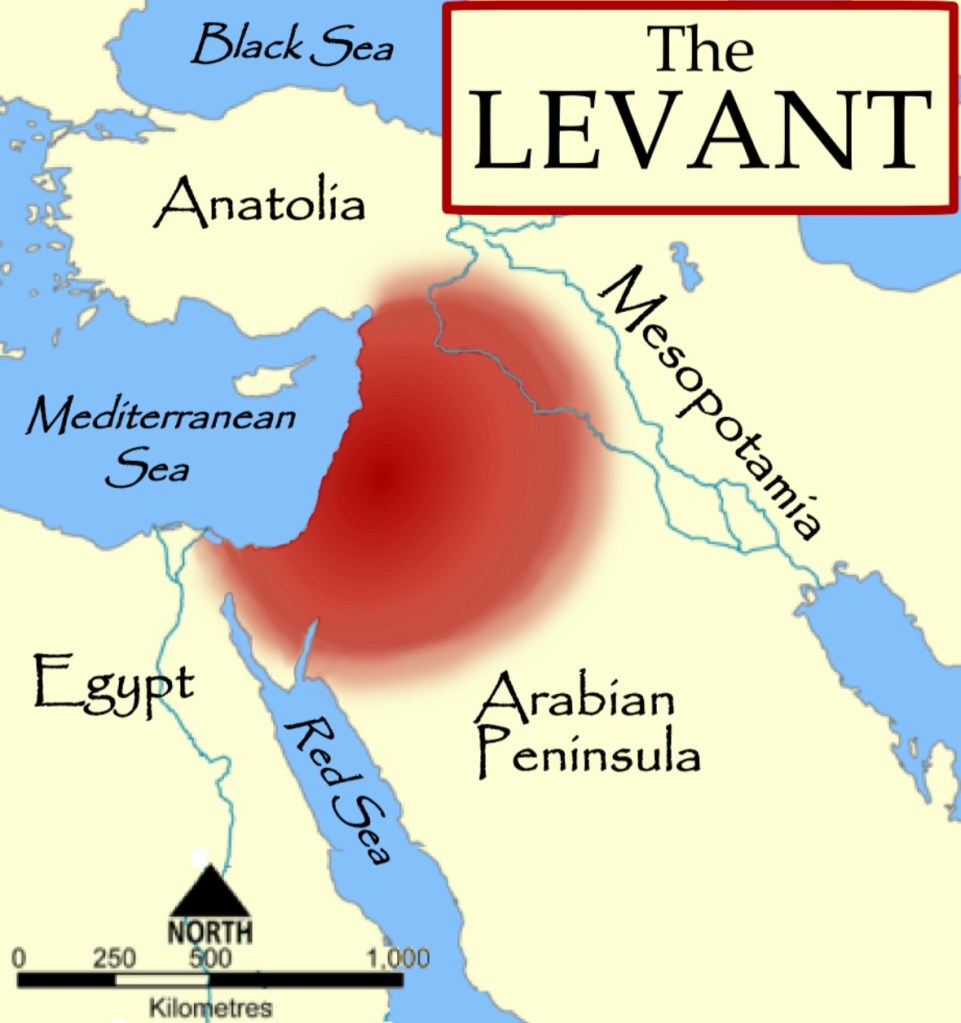
The timing of this post might be awkward given the escalation of threats by Iran and its client militia groups toward Israel. But I’m posting it anyway because this blog is a way for me to get things off my chest. Read on…

In the West there is fairly broad agreement that the Palestinian people should have a sovereign state of their own. There is much less agreement over the geographic boundaries of such a state and the sequence of events that must take place in order for it to be established. Among Palestinians there is some support for a two-state solution, but it is far from a majority.

The UN Partition Plan

The following map might be helpful in what follows. It shows the proposed boundaries of an Israeli state and an Arab state under the Partition Plan adopted by UN Resolution in 1947. The Resolution called for replacing a League of Nations mandate for British administration of the region requiring the establishment of a Jewish homeland. Likewise, the Arab state was intended to accommodate Palestinian nationalists. Together the two states were expected to comprise an economic union.
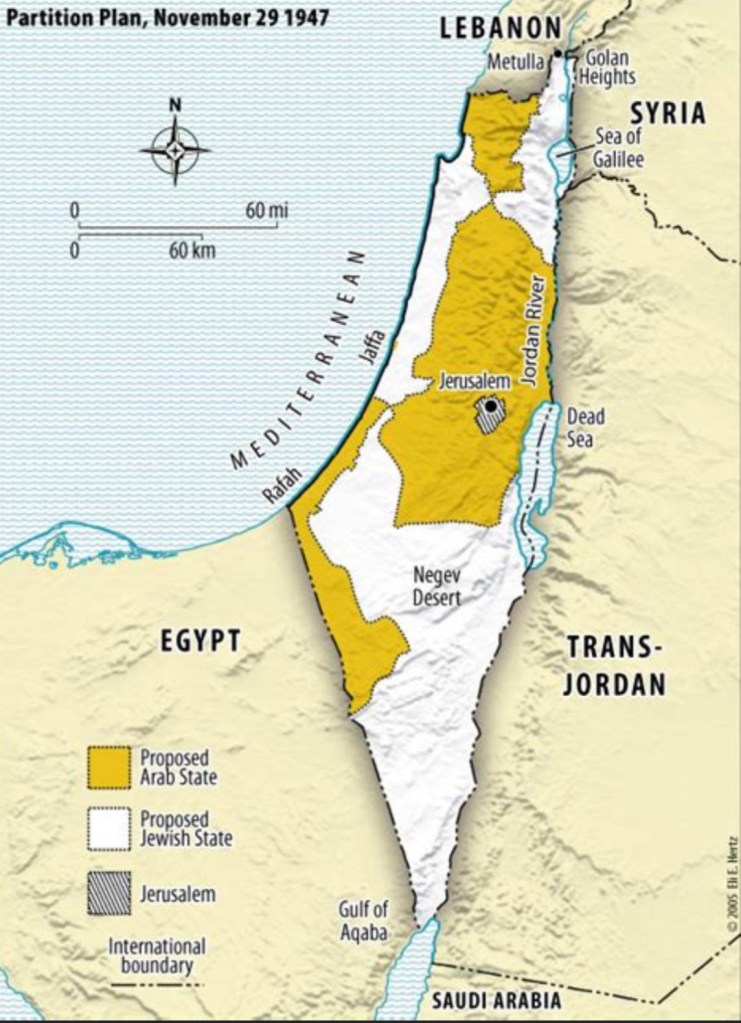
What is striking is the discontinuity of the lands assigned to each state, and this surely contributed to almost immediate border challenges. More on that below.

The Gaza Strip is the region along the shore of the Mediterranean on the lower left, which was designated as Palestinian. The Golan Heights is the Israeli region on the upper right. The West Bank is the Palestinian region in the middle. Jerusalem and its vicinity was designated as an international zone to be administered by the UN.

Border Battles

Today, the geography of a prospective Palestinian state would certainly include the Gaza Strip. There doesn’t seem to be any great dispute there, but the West Bank is another story. In this context, it’s important to remember some key details about the history of this region since 1947. David Post writes at the Volokh Conspiracy that the Palestinian state was obliterated by other Arab states in 1948:

“The State of Palestine was strangled in its infancy, not by the Israelis, who accepted the U.N. partition plan, but by the neighboring Arab States—Egypt, Syria, and Jordan—who did not. The day after the British pulled their forces out, the Arab armies marched in, and the first Arab-Israeli War began.“

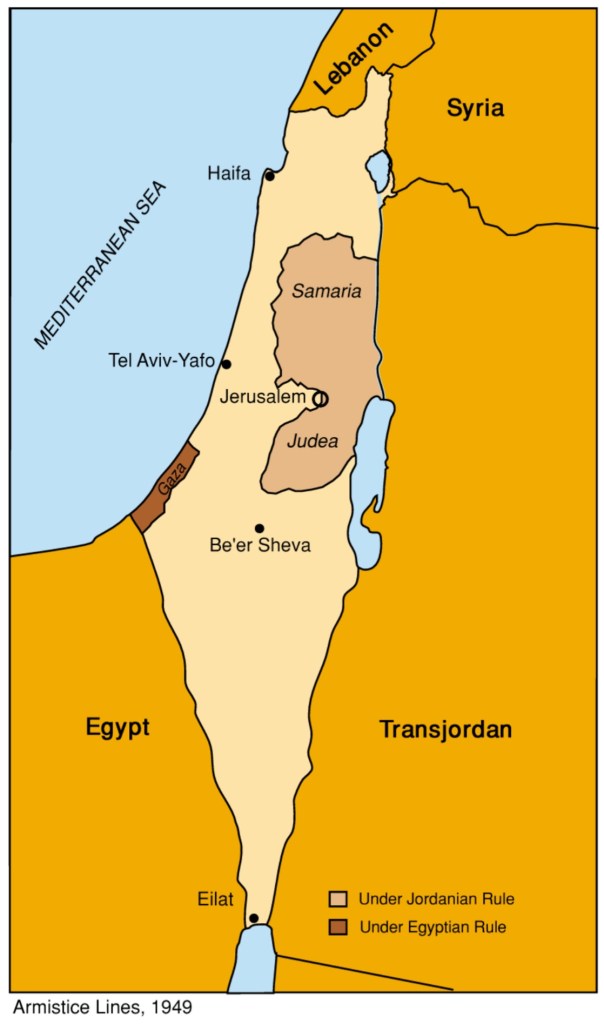
The hostilities were formally ended with the signing of three different Armistices in 1949:

“The boundaries fixed in those agreements gave to each of the four countries involved more-or-less the territory that their armies had managed to control as of the date that ceasefires had been declared. The West Bank became part of Jordan; Gaza became part of Egypt; the Golan Heights became part of Syria. Israel got—or kept—the rest. The Palestinians, who had no army of their own, got nothing.“

Here are the boundaries under the 1949 Armistices:
The three Arab states, which refused to recognize Israel’s right to exist, attacked again in 1967. In a matter of six days and on three fronts, the Israelis drove them back and took Gaza, the West Bank, and retook the Golan Heights. Post asks:

“Why is it that only starting then, now that Israel was in control of these areas, did the world rouse itself to Palestinian grievances, and demand that ‘Palestinian lands’ be given back to the Palestinians?“

It’s worth noting that these conflicts led to the displacement of a great many Palestinians, but Israel did not provoke the attacks.

Indigenous Populations

Enemies of Israel, including those in the West, go so far as to say the Israelis are not entitled to a homeland in the Levant. Even worse, they chant “from the river to the sea”, often ignorant that it is a thinly veiled call for genocide. But Jews have as great a claim to a homeland in the Levant as the Palestinians. Jacob Sullum wrote of this truth last October, in the wake of the Hamas butchery on October 7, 2023. Israeli Jews are characterized by enemies as “colonizers”. This, as Sullum says:

“… is a ‘simplistic morality tale’, that pits white European oppressors against ‘indigenous’ people, eliding Israel’s demographic roots and the ancient Jewish connection to the land. “

Sullum goes on to discuss research on the genetic origins of modern Jewish populations. For example, one paper found that the ancestors of Ashkenazi Jews, who account for almost a third of Jews in Israel, likely descended from a “diverse population in the Middle East.” And Sullum points out that Mizrahim Jews of Middle Eastern and North African origin represent almost 45% of Israeli Jews. Furthermore, another study found that Jews and Arabs in the Middle East both share high percentages of Y chromosomes with a single gene pool, which suggests a common origin. Therefore, both Palestinians and Israeli Jews have legitimate claims to a homeland in the Levant.

Israel and Gaza

Contrary to claims by Hamas supporters, there was no occupation of Gaza by Israel at the time of the October 7th massacre. Israel’s prior occupation of Gaza ended almost 20 years ago, in 2005. However, Israel has restricted the movement of goods in and out of the Gaza Strip since the 1990s. Israel and Egypt tightened the blockade on Gaza in 2007 after Hamas took control there, though it was eased in steps from 2010 – 2013. Given the uncompromising belligerence of Hamas and its proclivity for diverting resources to support aggression against Israel, it’s fair to say the blockade is, and has been, a legitimate instrument of defense, as long as Gaza is “governed” by Hamas.

Last year, less than a week after the October 7th massacre and hostage taking, the Israeli Defense Forces (IDF) began ground operations in Gaza in an effort to root out Hamas fighters, destroy their war-making infrastructure, and rescue hostages held by Hamas in Gaza. Of course, that fight goes on.

Hamas has fought against Israel’s retaliatory action in ways that have propaganda value, especially given the naïveté of much of the Western press. Its fighters are often embedded among civilians within residential areas and facilities like schools and hospitals. The use of human shields is a war crime for which Hamas bears full responsibility, and Hamas has made it clear that their aim is to kill Israelis, civilian and military alike. Hamas has made a practice of exaggerating Palestinian death counts, a distortion that has been more obvious to statisticians than journalists.

The Israeli blockade of the Gaza Strip will be tough to end without a complete surrender by Hamas and release of the hastages. Even then, the current IDF occupation is unlikely to end until efforts are well underway to flesh out the details of a new Palestinian government, if not statehood.

The West Bank

Perhaps even more thorny for an eventual two-state solution is that Israel occupies the West Bank and has established settlements that Palestinians strongly oppose. Jordan might also have designs on retaking West Bank territory, which would once again leave Palestinians as the odd people out. Israel took the land in its own defense during the Six-Day War in 1967 and kept it as a security buffer:

“… Israel insisted that it should not, and would not, simply return to the pre-war situation — the dangerous combination of precarious armistice lines and aggressive neighbors that had prevailed for 19 years. …

The idea that Israeli security depended on continued control over parts of the West Bank was held not only by Israeli officials, but also by the American Joint Chiefs of Staff. … Referring to the West Bank, they argued that Israel required a new boundary that would ‘widen the narrow portion of Israel’ and help protect Tel Aviv.“

Israel splits aspects of governance with the Palestinian Authority in parts of the West Bank, but most of the security apparatus is run by Israel.

The continued West Bank occupation is as fraught with controversy as ever. Today there is bitter resentment over new Israeli settlements and the construction of the “Separation Wall” just inside the western border of the West Bank. The situation is made all the more intractable by Hamas’ presence there amid ongoing attacks against Israeli interests.

Withdrawing from the West Bank would create a huge vulnerability for Israel, so one can hardly expect it to cede control of the entire territory. Yet it is hard to imagine an economically viable Palestinian state confined to the Gaza Strip. In fact, some feel that more than the West Bank should be in play for creating a contiguous corridor to Gaza, which would help promote a new Palestinian state’s economic viability.

Iran

Obviously Hamas is not the only threat to Israel’s security. To the north in Lebanon, Hezbollah is a well-armed adversary. And like Hamas, it receives considerable support from Iran. It’s difficult to imagine that Iran could maintain this support, not to mention its nuclear ambitions, without the flow of oil revenue made possible by U.S. acquiescence. Reaching a peaceful resolution to the conflicts between Israel and its neighbors will be very difficult without somehow neutralizing the Iranian threat. Regime change there would be key to this effort.

What Must Happen

The obstacles to establishing a peaceful, two-state solution for Palestinians and Israelis are so steep that the prospect seems almost unimaginable. A complete defeat of both Hamas and Hezbollah would be critical, and the Palestinian Authority or any other successor regime must be counted on to negotiate in good faith and with the legitimate support of the Palestinian people. Likewise, Israel must be willing to negotiate meaningful concessions, at least in terms of its occupied territories in the West Bank.

For a successful resolution, the role of other Arab states can’t be emphasized enough. These states should apply pressure to Israel’s neighbors like Syria and Jordan to rein-in their own territorial ambitions. In a positive sign, there is now growing pressure on Iran from other Arab states to end its belligerence.

A reconstituted Abraham Accords framework could strengthen diplomatic and economic ties across the region, promoting cross-investment, trade, and cultural exchange. The framework should include a mechanism to encourage aid from the Arab states and Israel to help Palestinians build a new, peaceful, and prosperous state.

Finally, a peaceful two-state solution hinges on continued U.S. support for Israel and a new Palestinian homeland. Unfortunately, in recent years we’ve witnessed a drift toward anti-Zionism (and even anti-Semitism) among Democrats. This sort of foolishness on the far Left knows no bounds. If the anti-Zionist position comes to be accepted by the mainstream of the party, it could severely compromise Israel’s leverage in negotiations.

Summary

A resolution that would ultimately bring peace to the Middle East seems remote in the midst of the current hostilities. It would require a dramatic softening of views among nearly all parties to solve the impasse over nation-state homelands for both Jews and Palestinians. In no particular order, the following are all necessary:

  • Israel’s neighboring states must not covet territory originally intended for the Palestinians, or for that matter the state of Israel.
  • Iran must butt out one way or another (in the language of high diplomacy), which would do much to neutralize militant factions like Hamas, Hezbollah, and the Houthis.
  • Other Arab states must come to the table along with the Israelis to negotiate economic and political accords, including aid to the Palestinian people.
  • The U.S. must resist internal calls from the Left to withdraw support for Israel.
  • More immediately, Israel must do its best to root out and defeat Hamas, Hezbollah, and the Houthis.
  • The Palestinian people must decide they want peace and a prosperous civilization.
  • Israel must show a willingness to negotiate concessions to Palestinians in the West Bank, and to aid in the rebuilding of Gaza.

Taken together that’s a very tall order! The U.S. can and should do its part to support Israel and the Palestinian people, penalize Iran, and help to bring all parties to the negotiating table. A refashioning of the Abraham Accords could contribute to peace in the region, including a stable, prosperous, and well-governed Palestinian homeland.

Full Blame for Monstrous Aggression On Putin

14 Monday Mar 2022

Posted by Nuetzel in Foreign Policy, Propaganda

≈ Leave a comment

Tags

Anders Fogh Rasmussen, Barack Obama, Bashar Assad, Bio-weapons, Biolabs, Chechnya Invasion, Chemical Weapons, Claire Berlinski, De-Nazification, Dmitry Utkin, Donald Trump, George Kennan, Georgia Invasion, Hillary Clinton, Holodomer Genicide, Joe Biden, John Mearscheimer, Kyle Becker, Malaysian Airlines, Matt Vespa, Melanie Willis, NATO, Russian Federal Security Service, Russian Imperial Movement, Stephen Kotkin, Syria, Thermobaric Weapons, Ukraine, Ukraine Invasion, USSR, Vladimir Putin, Volodymyr Zelensky, Wagner Group, WMDs

One would think condemnation of Vladimir Putin’s invasion of Ukraine would be easy for anyone who cares about human rights. This action and the threats he’s made against the West are the work of a psychotic. Yet there are some who place the ultimate blame for his behavior on the West and on NATO in particular. These reactions range from “This is all our fault” to “He’s evil, but we should not have provoked him”. Other reactions are much wilder, such as “We’re hiding something in Ukraine” to “We orchestrated this whole thing.” I am a small-government classical liberal, and no one trusts government power less than I do. However, I certainly place more trust in Western governments than in Russia’s authoritarian regime. If the West deserves any blame here, it’s because we made it easy for Putin.

Authoritarian Longings

For certain Western conservatives who’ve developed a man-crush on the “strong leader” Putin, the first thing you should understand is that he is an inveterate gangster and thug. Brute force fascism has always defined his approach to governance and foreign policy. That’s how this so-called “genius” came to power: three Russian apartment buildings were bombed in 1999, an act believed to have been instigated by the Russian Federal Security Service, of which he was head. Putin blamed Chechen rebels, prompting an attack on Chechnya that led to his ascendency.

Even among more moderate voices we hear statements like this:

“Russia has an existential interest in keeping NATO away from his border.”

Existential? “His” border? NATO may have expanded to include members from Eastern Europe, but that didn’t change its basic defensive posture nor the Putin regime’s expansionist goals. Objectively, it might have been more in Russia’s existential interest to be less belligerent and avoid the kind of rogue-state trap it’s now sprung on itself.

There are a few so-called leading intellectuals in the West who have condemned NATO eastward expansion as the root cause of Russia’s vengeful mind set, such as George Kennan and John Mearsheimer. However, Russian scholar Stephan Kotkin says they have it all backwards:

“The problem with their argument is that it assumes that, had nato not expanded, Russia wouldn’t be the same or very likely close to what it is today. What we have today in Russia is not some kind of surprise. It’s not some kind of deviation from a historical pattern. Way before nato existed—in the nineteenth century—Russia looked like this: it had an autocrat. It had repression. It had militarism. It had suspicion of foreigners and the West. This is a Russia that we know, and it’s not a Russia that arrived yesterday or in the nineteen-nineties. It’s not a response to the actions of the West. There are internal processes in Russia that account for where we are today.

I would even go further. I would say that nato expansion has put us in a better place to deal with this historical pattern in Russia that we’re seeing again today.”

Former NATO Secretary-General Anders Fogh Rasmussen agrees with that assessment, noting several early attempts at outreach to Russia:

“Russia is not a victim. We have reached out to Russia several times during history…. First, we approved the NATO Russia Founding Act in 1997…. Next time, it was in 2002, we reached out once again, established something very special, namely the NATO-Russia Council. And in 2010, we decided at a NATO-Russia summit that we would develop a strategic partnership between Russia and NATO.”

Nazis At the Kremlin

Putin contends that Ukraine must be “de-Nazified”, which is bizarre given the large Jewish population of Ukraine and its representation in leadership. Putin’s claim is also complete projection, as Melanie Willis has written:

“It is in fact Putin himself who has unleashed neo-Nazism on Ukraine using the Wagner Group. This is a private army of mercenaries financed by pro-Kremlin oligarchs. It’s led by Dmitry Utkin, a former Russian military intelligence officer sporting Waffen-SS tattoos who allegedly named his outfit after Hitler’s favourite composer.

Far-right extremists comprise the core of this group, which has committed horrific atrocities across Africa, the Middle East and Ukraine as a front for Russian imperial policy. …

The Russian Imperial Movement, which has fought in Ukraine, was designated a terrorist organisation by the US in 2020 for training and funding neo-Nazi terrorists across the world in its military camps, which operate under the Russian security services’ eye.”

Love Letters To Soviet Monsters

As if to emphasize his bona fides as a vicious authoritarian, Putin lionizes the failed Soviet empire, as if to forgive the horrors perpetrated by the communists: millions of lives lost to the engineered Ukrainian famine of the Holodomer genocide in the 1930s, the widespread raping of Russian, Polish, German women by members of the Red Army at the end of World War II, the millions confined to concentration camps over the entire Soviet era, and the repression, murder, or exile of many others. And this is to say nothing of the long economic nightmare inflicted by communist central planners, including the denial of property rights to ordinary people in the USSR and its satellite states.

Also recall that Putin’s army has made a practice of bombing civilian targets in separate conflicts starting with Chechnya in 1999, Georgia in 2008, and Syria in 2015. Cluster bombs and thermobaric weapons were used against residential areas in all three of these actions, the first two of which were Russian invasions of sovereign nations, and the third was on behalf of the Bashar Assad regime. It’s no surprise that we’re now seeing atrocities committed at Putin’s behest in Ukraine, and it could get far worse.

NATO: Not All About Russia

Another thing to understand: NATO’s original and ongoing purpose goes far beyond simply defending against Soviet and now Russian aggression. Claire Berlinski has a good post on this subject. She quotes “A Short History of NATO”:

“In fact, the Alliance’s creation was part of a broader effort to serve three purposes: deterring Soviet expansionism, forbidding the revival of nationalist militarism in Europe through a strong North American presence on the continent, and encouraging European political integration.”

Much of Europe was reduced to rubble after World War II, with many millions of soldiers and civilians dead. Homelessness and hunger were everywhere. Berlinski points to outbreaks of “militant nationalism” that plagued Europe in the wake of earlier crises.

“The enormity of the destruction transferred the responsibility for preserving Western civilization to the United States. …

Americans who resent Europeans for being reluctant to militarize and for placing so much importance on political integration should remember that this is the world we created. We insisted upon this. Europe had no choice. It’s very strange for Americans suddenly to view the United States’ greatest military and foreign policy achievement as a failure. It was the United States’ plan for Europe to focus on economic growth rather than maintaining large conventional armies …”

Indeed, this point was lost on Donald Trump. There is no question that European states should pay up to their commitments to NATO, and today more balance in those commitments is probably well-advised. However, as Berlinski notes, even when the Berlin Wall fell and the USSR dissolved, NATO’s role in ensuring European stability was still paramount. One might even say it ultimately required NATO expansion to the Eastern European states. And no, Russia was never promised that NATO would not expand to the east. That is a complete myth promoted by Putin and the Russian misinformation apparatus.

The rise of Russian belligerence over the past two decades meant that all three components of NATO’s original mission remained relevant. And through all that, NATO’s posture has remained defensive, not offensive. Yet many in the West have fallen for a continuing barrage of Russian propaganda and misinformation that the U.S. should withdraw from the alliance. On that, Berlinski says,

“It’s an idea very much like unilateral nuclear disarmament.”

The West Did Not Impede Putin

As a staunch Russian nationalist, Putin has always been butt-hurt about the fall of the USSR. And let’s not fool ourselves into thinking he hasn’t been coddled to a significant degree by the West, even as he grew bolder in his provocations and bullying. I already discussed NATO’s attempts to reach out to Putin before 2010. This article recounts, from a series of tweets by Kyle Becker, the subsequent course of affairs. Becker notes the following:

  • As Secretary of State under Barack Obama, Hillary Clinton approved the Uranium One deal giving Russia 20% of U.S. reserves.
  • In early 2010, the new START treaty left Russia with huge tactical nuclear advantages, and the agreement had very weak enforcement mechanisms.
  • Obama’s incredible hot-mic moment in 2012 caught him promising “more flexibility” to the Russians on ballistic missile defense after the November election.
  • The 2014 takeover of the Crimean Parliament and the subsequent rigged referendum to leave Ukraine was met with ineffective sanctions.
  • Missiles fired by pro-Russian forces took down a Malaysian Airlines flight over the Dunbas region in 2014. Earlier, Obama had denied Ukraine access to equipment that would have defended against anti-aircraft fire, and might have prevented the tragedy.

Even more recently, Joe Biden in January practically issued a pass to Russia on action against Ukraine: “It’s one thing if it’s a minor incursion…” Well then! Townhall’s Matt Vespa says:

“Russia is invading because they’ve been getting away with using brute force for years, coupled with an eight-year administration in the United States that did all it could to weaken everyone around them. Obama did nothing when Crimea was seized. He did nothing when Russians established themselves in the Middle East… For a solid decade, the use of force has worked, and Biden being Obama’s former VP, he sees a continuation of that weakness. Putin was right in that regard, gaming out the West’s response to a senile U.S. president. What he did not expect was the tenacity of the Ukrainian resistance.”

The Biolabs Pretext

What about those biolabs in the Ukraine? Putin’s propaganda machine went into high gear to characterize the labs as threats of biological warfare on Russia’s border. Many Western populists and conservatives thought this seemed like a rational pretext for Putin’s actions, but without a shred of proof. We really don’t know what’s happening there, but biolabs are not exactly uncommon, and the vast preponderance of biological and virological research is benign. The mere existence of those facilities is certainly not synonymous with “bio-weapons” research, as many have taken for granted. And, of course, a biolab in the West is likely to be engaged in bio-defense research as well. You can be sure, however, that Putin has contemplated the use of bio-weapons against Ukraine.

Conclusion

Vladimir Putin has made ominous threats against NATO countries, but if he didn’t have a huge stockpile of nuclear weapons he’d be merely a bad actor from a low-tier industrial society, and without the clout to frighten the entire world. His belligerence is long-standing and quite out-of-hand, and it is unlikely to stop with Ukraine should he succeed in crushing it. That seems to be his intent. NATO and the West did not do anything to justify Putin’s conspiratorial fantasies. In fact, the West coddled Putin for far too long, to our detriment and to the horror of the Ukrainian people.

I’m trying to maintain some optimism that Putin’s miscalculations in this invasion will eventually lead to Russian defeat. At the very least, it may be impossible for his occupying forces to maintain control without disastrous consequences to them. That might eventually lead to a withdrawal, much as it did in Afghanistan. Meanwhile, Western leaders still hope to find an “off-ramp” for Putin allowing him to save face and perhaps settle for small gains in the separatist regions. If so, I won’t be surprised to see repeat offenses from Putin in the future, either in Ukraine or elsewhere.

3 Cheers, No Tears for Strike on Master of Iranian Terror

08 Wednesday Jan 2020

Posted by Nuetzel in Middle East, War

≈ Leave a comment

Tags

AL Monitor, Al-Quds, Anderson Cooper, Avi Melamed, Bloomberg, Charles De Gaulle, Decapitation, Deterrence, Donald Trump, Iran, Iranian Mullah Regime, Iraq, Kataeb Hezbollah, Politico, Qassim Soleimani, Regime Change, Retaliation, Reuters, Saudi Arabia, Self-Defense, Syria, Terrorism, Tyler Cowen, Victor Davis Hanson, World War III

Note: As I finish this post, Iran has fired missiles at U.S. bases in Iraq, so we know a bit more about their response to the killing of Qassim Soleimani. Tonight’s response by Iran looks to have been impotent. There are risks of other kinds of action, of course. We shall see.

Last week’s killing of Iranian General Qassim Soleimani was not prompted solely by the attack on the U.S. embassy in Iraq by Kataeb Hezbollah, the Iranian-backed militia. Iran, perhaps the largest state-sponsor of terrorism in the world, has been guilty of provocation and aggression in Iraq, Syria, Saudi Arabia and elsewhere under Soleimani’s direction for many years. And he was reviled for his ruthless treatment of protestors within Iran’s borders. In recent weeks there had been a series of rocket attacks on U.S. bases, and there was “chatter” that much more was planned. It’s been noted that the presence of so-many high-level officials in one place at the time of the attack on Soleimani indicated that something big was in the works. This Reuters article gives some insight into Soleimani’s suspicious activities in the weeks prior to his death, of which the U.S. was surely aware. While the attack on the U.S. embassy provided additional pretext (as if it was needed), all of this indicates that Soleimani’s assassination was not an impulsive decision, but deliberated, contrary to assertions by critics of President Trump’s decision to act. It was both retaliatory and preemptive. Soleimani’s travels and whereabouts were well known, and it’s highly likely that a “decapitation” had been planned as a contingency for some time. This report in Politico provides details of the decision making leading up to the strike. The attack was executed brilliantly by all accounts.

The U.S. had retaliated to earlier rocket attacks with strikes against Kataeb Hezbollah positions. That the strike on Soleimani was more than retaliation and an act of self-defense against additional threats is, I believe, the flaw in arguments against the strike like the one Tyler Cowen seemed to make in Bloomerg (though his main point was different). The value of the strike goes far beyond retaliation. This was not intended to be another volley in an ongoing series of “tits-for-tats”.

In addition to Soleimani, several other high-level Iranian military personnel were killed. This undoubtedly disrupted plans that would have threatened U.S. soldiers and assets, yet some describe the strike as an “impulsive” act on Trump’s part, and an “act of war”, as if unprovoked. And as if Iran had not been warring on the U.S. for the past 40 years. What to make of those who take this position?  Of course, most are reflexively anti-Trump, refusing to evaluate the decision on it’s own merits. They pretend that Soleimani and the Iranian overseers of the stooge government in Iraq have legitimacy. Anderson Cooper actually compared Soleimani to Charles De Gaulle. It would be more accurate to compare him to the murderous Che Guevara, but then again, many on the Left worship Che’s memory as well! These fools will tell you that Soleimani was “worshipped” in Iran. In fact, there are a great many Iranians who are quietly celebrating his death.

Middle East analyst Avi Melamed does not mince words in describing the impact Soleimani has had on the Middle East (emphasis his):

“Some argue that the assassination of Soleimani will increase tensions in the Middle East. This outlook confuses cause and effect: Tensions in the Middle East have intensified over the past decade because of the violent Iranian aggression which Soleimani spearheaded. Aggression which has led to Syria’s destruction and the disintegration of Lebanon and Iraq. Aggression that threatens maritime routes and safe passage in the Arab (Persian) Gulf and the Red Sea, a direct attack on Saudi Arabia’s oil facilities that spiked oil prices and compromised the world’s oil supply. Aggression that has fueled and intensified tensions – including direct military confrontations – between Iran and its proxies and Israel.

General Soleimani and the Al-Quds force led the escalation in the region in the service of the hegemonic vision of the Iranian Mullah regime. Their actions have so far claimed the lives of hundreds of thousands of people, led to the destruction of states, the disintegration of cities, and caused a wave of millions of refugees. Killing Soleimani is not the cause of the escalation – but the result.”

Malamed expected Iran to take retaliatory actions in Iraq, where it already has a strong military presence and good reconnaissance. Missiles have now been fired at U.S. bases from Iran (as of tonight), but with few or no casualties. It remains to be seen how effective a response the Iranians can mount. Any short-term U.S. casualties should probably not be viewed as incremental, given the high likelihood of casualties had Soleimani lived. Perhaps Iran will fire missiles at Israel from western Iraq or Syria, or at Saudi Arabian oil assets, as it did last September. Or it might make a bold military intervention in Iraq to strengthen its control there, which Iran considers crucial to its own security.

Al Monitor believes the assassination “leaves Iran with very few options to retaliate” with any strength, at least in the short-run:

“… the economic hardship in Iran — in addition to the challenges the government is facing internally — would not allow Tehran to increase the tension. Iran’s past conduct against Israel strikes on Iranian bases in Syria also shows it will not seek revenge if its national security and interests are in danger. … This all indicates that Iran and its proxies in the region most likely would not seek revenge in the near future and — in regard to Iraq, in particular — would not lead Iraq to fall into a civil war or mass destruction, because it would lose even more in Iraq if it takes such a risk.”

So despite the brash talk, Iran is weak and spread thin across commitments outside its borders, and the regime has real fear of retaliation by its enemies that can only have been reinforced by the strike against Soleimani. Of what other retaliatory actions is Iran capable, assuming the regime can survive in the longer run? And assuming the Mullah regime itself is willing to take existential risks? It has threatened actions against civilians in the West. Can it bring down planes? Can it bomb targets in the U.S.? Can it develop or buy a small nuclear device? It can try any of those things, of course, but with uncertain odds and with risks it might not want to take. Survival is of the utmost importance to the regime, and it is already on shaky ground.

Trump’s critics claim that he authorized the “decapitation” without a plan for its aftermath. Trump has made clear his intent to “punch back twice as hard”, as it were, in response to any additional force from Iran. This is, first and foremost, a game of deterrence. Beyond that, however, and despite talk of “changing the Iranian regime’s behavior”, it appears that the larger plan pursued by Trump is to continue undermining the regime with sanctions and targeted strikes, if necessary. “Maximum pressure”. But there will be no World War III. The markets seem pretty comfortable about that as well, including the oil market.

I do take issue with Trump’s mention of the possibility of striking “cultural sites” in Iran, though he seems to have retracted it. On that point, however, I fully agree with Tyler Cowan (linked above). The only plausible rationale for such a statement is to frighten Iran’s leadership, especially if it has located military and intelligence functions within cultural sites.

Trump still maintains that our ultimate goal should be withdrawal from Iraq. That assumes stabilization in the region and fair elections, which would be well-served by a weaker Iran or a regime change there. As Victor Davis Hanson explains, the Middle East is of declining importance in world energy markets and trade generally. That’s one reason we’re unlikely to ever again send a huge ground force to the region, and it’s a good reason to scale back our presence in the Middle East generally.

Toodle-oo, President Cool Fool

20 Friday Jan 2017

Posted by Nuetzel in Government

≈ Leave a comment

Tags

Barack Obama, Benghazi Attack, Black Lives Matter, Chelsea Manning, Chris Stephens, David Harsanyi, Donald Trump, Drone Attacks, Fast and Furious, Guantanamo, Hillary Clinton, Iran Nuclear Deal, Jeffrey Tucker, Joel Kotkin, Narcissism, Nobel Peace Prize, Obamacare, Oscar Lopez Rivera, Paris Climate Accord, Racial Healing, racism, Solyndra, Syria

img_3887

The durability of Barack Obama’s achievements as President of the United States will go down in history as … an oxymoron. He will likely be remembered more for his failures in social, economic, foreign policy and political leadership. Obama has himself to blame for the lack of a durable legacy. From the beginning of his administration, Obama’s mentality with respect to policymaking was always “my way or the highway” (“The election’s over, and I won”), and his consequent failure to achieve legislative victories during his last six years in office was always Congress’ fault. He would share no blame. But it was cool, ’cause Obama had “a pen and a phone” and was willing to act by executive fiat to affect changes he desired. His hope, I suppose, was that his regulatory diktats would become so ingrained in our way of life that rescinding them would be political suicide, much like some of the programs of the New Deal and the Great Society. Well, that backfired! Most of Obama’s executive actions can be undone by executive or legislative action, and while it won’t be costless, it will happen.

The fact of the matter is that Obama’s policies were not productive and not popular. Not only did they contribute to the election of Donald Trump, but they helped fuel the massive losses suffered by Democrats in state houses and governorships over the past eight years. But Obama was always right as rain.

The Planner’s Conceit: A big believer in the power and goodness of government, Obama attempted to usher in a great wave of new regulation and social planning. Here is David Harsanyi in Reason:

“The president’s central case for government’s existence rests on the notion of the state being society’s moral center, engine of prosperity and arbiter of fairness. Obama speaks of government as a theocrat might speak of church, and his fans return the favor by treating him like a pope.“

Obama is a man who lacks any understanding of the causes of prosperity: personal and economic freedoms, individual initiative, and healthy private markets. Jeffrey Tucker makes this point eloquently in “Why Obama Failed“:

“Despite his vast knowledge on seemingly everything, and endless amounts of charm to sell himself to the public, he missed the one crucial thing. He never understood wealth is not a given; it must be created through enterprise and innovation, trade and experimentation, by real people who need the freedom to try, unencumbered by a regulatory and confiscatory state. This doesn’t happen just because there is a nice and popular guy in the White House. It happens because the institutions are right.“

Obama’s results underscore his ignorance regarding the fundamental drivers of material well-being: economic growth during the post-recession years has been very sluggish, and while the unemployment rate has declined, it is not as impressive as it might appear: many workers have been forced into part-time jobs, and the decline in the jobless rate was exaggerated with declines in labor force participation to levels not seen since the late 1970s. Perhaps not coincidentally, the number of workers claiming Social Security disability benefits happened to soar as employment prospects remained grim. Slow growth in the economy and budget sequestration (an action Obama blames on republicans despite having proposed it himself as a cudgel) have reduced the annual budget deficit, but the nation’s outstanding debt under Obama has increased by $10 trillion, doubling the total outstanding over his eight years. Future annual deficits are projected to soar under his policies, according to the Congressional Budget Office.

Two factors that would contribute to ballooning deficits, if allowed to stand, are the Paris Climate Accord, signed by Obama without the Senate’s consent, and Obamacare. The climate treaty would do little to change global temperatures, but would impose heavy costs on the U.S. in terms of subsidies for foreign energy projects, regulatory burdens, and energy bills.

Failing Health Care: The future budget impact of the Paris Accord could be minor compared to Obama’s greatest source of pride: the Affordable Care Act (ACA), a.k.a. Obamacare. Recent scare stories have softened public opinion regarding the ACA, but so unpopular was this “landmark” legislation that Donald Trump was elected in part because he promised, along with congressional republicans (who played no part in its passage) to “repeal and replace” the law. The failures of the ACA were covered in my last post, “Death By Obamacare“.

Foreign FUBARs: The foreign policy foibles of the Obama Administration are legend. From Benghazi to the Syrian “red line”, from the botched deal on nuclear weapons development by Iran to the weak stand on Russian expansionism, American foreign policy has never been such an embarrassment. Obama, the recipient of a dubious Nobel Peace Prize, has been an avid drone warrior, collateral damage be damned. Our continued involvement in Afghanistan and the reentry of U.S. forces into Iraq must be sorely disappointing to the anti-war constituency Obama once courted. He has alienated our longstanding allies and cooed in the ears of avowed enemies. His grants of clemency in recent days to the likes of the treasonous Chelsea Manning and terrorists like Oscar Lopez Rivera are symbolic of the contempt in which he holds the lives lost at their hands. Our weakness abroad has led to a loss of respect for the U.S., signaled vividly by our exclusion from peace talks in Syria. Recent events have increased public awareness of our vulnerability to cyber-attack from foreign enemies, but Obama has failed to provide leadership on the issue.

Scandalous: Obama’s tenure as president has been marked by a number of scandals, contrary to what his admirers would have us believe. The Fast and Furious operation by ATF agents put guns in the hands of criminals and drug cartels, resulting in the death of a border control agent, but the Obama Justice Department sought to obstruct an investigation. The massacre at the U.S. consulate in Benghazi, Libya led to the death of four Americans, including Ambassador Chris Stephens. The White House and State Department sought to create a misleading story line, claiming an anti-Muslim video was responsible for a protest gone-wrong, when in fact they were well aware that it was a planned terrorist action. A deeper question is whether Stephens was in Benghazi attempting to arrange arms sales to “Syrian rebels”. Then there are the attempts by the IRS to target opposition to Obama, and conservative groups generally, and an apparent effort to conceal that activity, as well as cases in which it appeared that the administration was targeting members of the press whom they considered unfriendly. There were a number of other scandals and events such as the Solyndra subsidies, which suggested high corruption and cronyism. Here is an excellent discussion of a variety of dubious antics by the Obama Administration, and the shady efforts to keep them quiet.

Racial Muckraking: Ironically, Obama’s greatest failing might well have been the racial discord that boiled up during his two terms. As the first African-American president of the U.S., there was a considerable expectation that his legacy would be one of racial healing. Instead, it was as if he deliberately sought to encourage discord. Here is Joel Kotkin’s description of the president’s missteps on race relations:

“Whenever race-related issues came up — notably in the area of law enforcement — Obama and his Justice Department have tended to embrace the narrative that America remains hopelessly racist. As a result, he seemed to embrace groups like Black Lives Matter and, wherever possible, blame law enforcement, even as crime was soaring in many cities, particularly those with beleaguered African American communities.

Eight years after his election, more Americans now consider race relations to be getting worse, and we are more ethnically divided than in any time in recent history. As has been the case for several decades, African Americans’ economic equality has continued to slip, and is lower now than it was when Obama came into office in 2009, according to a 2016 Urban League study.“

The Liar: Obama is an unrepentant liar. Even the Washington Post felt it necessary to catalog some of the Obama lies that made it into their headlines (through many did not). There was the infamous Benghazi deception; the “Like Your Plan, Keep Your Plan” fib; he quoted enrollment numbers on the Obamacare exchanges that were greatly exaggerated; he publicly denied that domestic surveillance was a reality; he claimed that he was not responsible for our withdrawal from Iraq… what? There were efforts to cover and dissemble regarding details of all the scandals referenced above. By now, Obama’s insistence that his would be the “most transparent administration in history” is rather humorous. Most of Obama’s lies were motivated by ideology, and that might make it worse in my book. What’s particularly galling is the lie that Obama has any respect for the Constitution. He has attempted to subvert it with regularity.

I, Barack Obama: Another common trait among politicians is narcissism, but few are as obvious about it as Barack Obama. He has a habit of self-referencing that may be unequaled in political oratory. In fact, last July at the Democratic National Convention, he mentioned himself 119 times in a speech about Hillary Clinton. He is always eager to invoke his personal story as a possible source of inspiration for others. He is seemingly preoccupied with his legacy, going out his way to issue additional executive orders in the waning days of his term, and giving a “final” address in which he glorified his accomplishments. And then there was a final-final press conference at which he did the same. He has always encouraged the perception that Barack Obama is the “smartest guy in the room”. Of course, he is never wrong, and everything is cool. Obama seems to believe that he can make reality conform to his every assertion –oh yeah, I already talked about lies!

Did Obama’s narcissism contribute to his failed presidency? It’s plausible because he invested too much in his own ability to teach, influence others,  and control events. Collaboration with important stakeholders was unnecessary, and indeed, it was often better to demonize anyone who stood in the way of the world according to Barack. That world was a sad self-delusion.

Follow Sacred Cow Chips on WordPress.com

Recent Posts

  • Immigration and Merit As Fiscal Propositions
  • Tariff “Dividend” From An Indigent State
  • Almost Looks Like the Fed Has a 3% Inflation Target
  • Government Malpractice Breeds Health Care Havoc
  • A Tax On Imports Takes a Toll on Exports

Archives

  • December 2025
  • November 2025
  • October 2025
  • September 2025
  • August 2025
  • July 2025
  • June 2025
  • May 2025
  • April 2025
  • March 2025
  • February 2025
  • January 2025
  • December 2024
  • November 2024
  • October 2024
  • September 2024
  • August 2024
  • July 2024
  • June 2024
  • May 2024
  • April 2024
  • March 2024
  • February 2024
  • January 2024
  • December 2023
  • November 2023
  • August 2023
  • July 2023
  • June 2023
  • May 2023
  • April 2023
  • March 2023
  • February 2023
  • January 2023
  • December 2022
  • November 2022
  • October 2022
  • September 2022
  • August 2022
  • July 2022
  • June 2022
  • May 2022
  • April 2022
  • March 2022
  • February 2022
  • January 2022
  • December 2021
  • November 2021
  • October 2021
  • September 2021
  • August 2021
  • July 2021
  • June 2021
  • May 2021
  • April 2021
  • March 2021
  • February 2021
  • January 2021
  • December 2020
  • November 2020
  • October 2020
  • September 2020
  • August 2020
  • July 2020
  • June 2020
  • May 2020
  • April 2020
  • March 2020
  • February 2020
  • January 2020
  • December 2019
  • November 2019
  • October 2019
  • September 2019
  • August 2019
  • July 2019
  • June 2019
  • May 2019
  • April 2019
  • March 2019
  • February 2019
  • January 2019
  • December 2018
  • November 2018
  • October 2018
  • September 2018
  • August 2018
  • July 2018
  • June 2018
  • May 2018
  • April 2018
  • March 2018
  • February 2018
  • January 2018
  • December 2017
  • November 2017
  • October 2017
  • September 2017
  • August 2017
  • July 2017
  • June 2017
  • May 2017
  • April 2017
  • March 2017
  • February 2017
  • January 2017
  • December 2016
  • November 2016
  • October 2016
  • September 2016
  • August 2016
  • July 2016
  • June 2016
  • May 2016
  • April 2016
  • March 2016
  • February 2016
  • January 2016
  • December 2015
  • November 2015
  • October 2015
  • September 2015
  • August 2015
  • July 2015
  • June 2015
  • May 2015
  • April 2015
  • March 2015
  • February 2015
  • January 2015
  • December 2014
  • November 2014
  • October 2014
  • September 2014
  • August 2014
  • July 2014
  • June 2014
  • May 2014
  • April 2014
  • March 2014

Blogs I Follow

  • Passive Income Kickstart
  • OnlyFinance.net
  • TLC Cholesterol
  • Nintil
  • kendunning.net
  • DCWhispers.com
  • Hoong-Wai in the UK
  • Marginal REVOLUTION
  • Stlouis
  • Watts Up With That?
  • Aussie Nationalist Blog
  • American Elephants
  • The View from Alexandria
  • The Gymnasium
  • A Force for Good
  • Notes On Liberty
  • troymo
  • SUNDAY BLOG Stephanie Sievers
  • Miss Lou Acquiring Lore
  • Your Well Wisher Program
  • Objectivism In Depth
  • RobotEnomics
  • Orderstatistic
  • Paradigm Library
  • Scattered Showers and Quicksand

Blog at WordPress.com.

Passive Income Kickstart

OnlyFinance.net

TLC Cholesterol

Nintil

To estimate, compare, distinguish, discuss, and trace to its principal sources everything

kendunning.net

The Future is Ours to Create

DCWhispers.com

Hoong-Wai in the UK

A Commonwealth immigrant's perspective on the UK's public arena.

Marginal REVOLUTION

Small Steps Toward A Much Better World

Stlouis

Watts Up With That?

The world's most viewed site on global warming and climate change

Aussie Nationalist Blog

Commentary from a Paleoconservative and Nationalist perspective

American Elephants

Defending Life, Liberty and the Pursuit of Happiness

The View from Alexandria

In advanced civilizations the period loosely called Alexandrian is usually associated with flexible morals, perfunctory religion, populist standards and cosmopolitan tastes, feminism, exotic cults, and the rapid turnover of high and low fads---in short, a falling away (which is all that decadence means) from the strictness of traditional rules, embodied in character and inforced from within. -- Jacques Barzun

The Gymnasium

A place for reason, politics, economics, and faith steeped in the classical liberal tradition

A Force for Good

How economics, morality, and markets combine

Notes On Liberty

Spontaneous thoughts on a humble creed

troymo

SUNDAY BLOG Stephanie Sievers

Escaping the everyday life with photographs from my travels

Miss Lou Acquiring Lore

Gallery of Life...

Your Well Wisher Program

Attempt to solve commonly known problems…

Objectivism In Depth

Exploring Ayn Rand's revolutionary philosophy.

RobotEnomics

(A)n (I)ntelligent Future

Orderstatistic

Economics, chess and anything else on my mind.

Paradigm Library

OODA Looping

Scattered Showers and Quicksand

Musings on science, investing, finance, economics, politics, and probably fly fishing.

  • Subscribe Subscribed
    • Sacred Cow Chips
    • Join 128 other subscribers
    • Already have a WordPress.com account? Log in now.
    • Sacred Cow Chips
    • Subscribe Subscribed
    • Sign up
    • Log in
    • Report this content
    • View site in Reader
    • Manage subscriptions
    • Collapse this bar
 

Loading Comments...