• About

Sacred Cow Chips

Sacred Cow Chips

Tag Archives: Tax Incidence

Attack Private Sector With Tariffs, Then Attack Pricing

26 Saturday Jul 2025

Posted by Nuetzel in Tariffs, Tax Incidence

≈ 1 Comment

Tags

Amazon, Beige Book, Capitalism, Chad Wolf, Consumer Sovereignty, Costco, Eating Tariffs, Free Markets, Import Competing Goods, Mussolini, New Right, Price Gouging, Profit Motive, Protectiinism, Retail Margins, Target, Tariffs, Tax Incidence, WalMart

An opinion piece caught my eye written by one Chad Wolf. It’s entitled: “Retailers caught red-handed using Trump’s tariffs as cover for price gouging”. A good rule is to approach allegations of “price gouging” with a strong suspicion of economic buffoonery. You tend to hear such gripes just when prices should rise to discourage over-consumption and encourage production. The Wolf article, however, typifies the kind of attack on capitalism we hear increasingly from the “new right” (and see this).

Wolf, a former Homeland Security official in the first Trump Administration, says that large retailers like Walmart and Target are ripping off American consumers by raising prices on goods that are, in his judgement, “unaffected” by tariffs.

We’ll get into that, but first a quick disclaimer: I have no connection to Walmart or Target. Sure, I’ve shopped at those stores and I’ve filled a few prescriptions at a Walmart pharmacy. Maybe I have an ETF with an interest, but I have no idea.

Competition and Consumer Choice

Of course, no one forces consumers to shop at Walmart or Target. Those stores compete with a wide variety of outlets, including Costco and Amazon, the latter just a few clicks away. In a market, sellers price goods at what the market will bear, which ultimately serves to signal scarcity: a balancing between the cost of required resources and the value assigned by buyers. Unfortunately, in the case of tariffs, buyers and sellers of imports must deal with an artificial form of scarcity designed to extract revenue while benefitting other interests.

Wolf touts the “gift” of a free market for American businesses, as if private rights flow from government beneficence. He then decries a so-called betrayal by large retailers who would “price gouge” the American consumer in an effort to protect their profit margins. The free market is indeed a great thing! But his indignance is highly ironic as a pretext for defending tariffs and protectionism, given their destructive effect on the free operation of markets.

Broader Impacts

Wolf might be unaware that tariffs have an impact on a large number of domestically-produced goods that are not imported, but nevertheless compete with imports. When a tariff is charged to buyers of imports, producers of domestic substitutes experience greater demand for their products. That means the prices of these import-competing goods must rise. Furthermore, the effect can manifest even before tariffs go into effect, as consumers begin to seek out substitutes and as producers anticipate higher input costs.

Obviously, tariffs also impinge on producers who rely on imports as inputs to production. It’s not clear that Wolf understands how much tariffs, which represent a direct increase in costs, hurt these firms and their competitive positions.

“Expected” Does Not Mean “Unaffected”

Wolf cites the Federal Reserve’s Beige Book report (which he calls a “study”) to support his claim that businesses are gouging buyers for goods “unaffected” by tariffs. Here is one quote he employs:

“A heavy construction equipment supplier said they raised prices on goods unaffected by tariffs to enjoy the extra margin before tariffs increased their costs,” the Beige Book report said.“

Read that again carefully! Apparently Wolf, and whoever added this to the Fed’s Beige Book, thinks that being “unaffected by tariffs” includes firms whose future costs, including replacement of inventories, will be affected by tariffs! He goes on to say:

“… Walmart has already issued price hikes under the guise of tariff costs.“

The examples at his “price hikes” link were for Chinese goods in April and May, after Trump announced 145% tariffs on China in April. In mid-May, Trump said China would face a lower 30% tariff rate during a 90-day “pause” while a trade agreement was negotiated. It is now 55%, but the point is that retailers were forced to play a guessing game with respect to inventory replacement costs due to uncertainty imposed by Trump. They had a sound reason for marking up those items.

Fibbing on the Margin

Here’s an excerpt from Wolf’s diatribe that demonstrates his cluelessness even more convincingly:

“We all know many of these large retailers are sitting on comfortable, even expanded, profit margins because of the price hikes from COVID-19 that never came down. But it’s not enough for them. They want to fleece the American consumer and blame it on President Trump’s America First agenda.“

So let’s take a look at those profit margins that “never came down” after the pandemic, but in a longer historical context. Here are gross margins for Walmart since 2010:
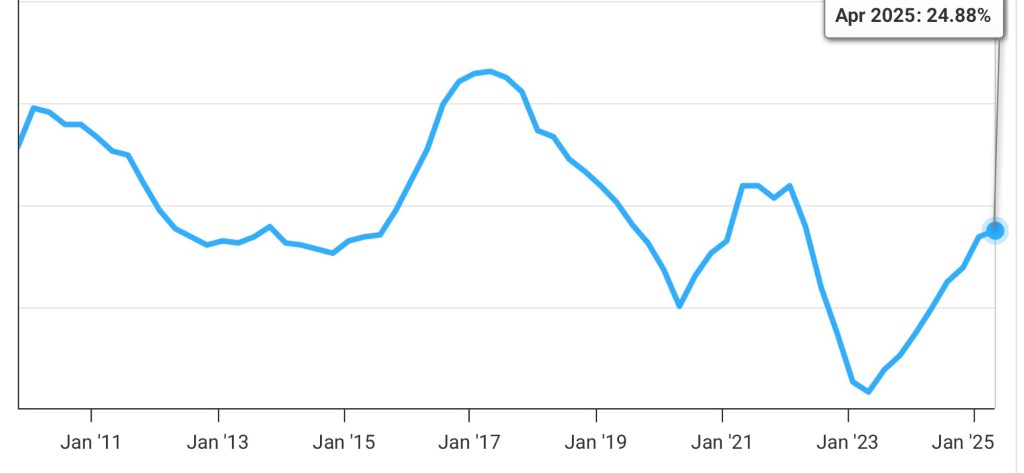
Walmart’s margin today is about the same as the average for discount stores, and it is lower than for department stores, retailers of household and personal products, groceries, and footwear. Furthermore, it is lower today than it was ten years ago. While the margin increased a little during the pandemic, it fell in its aftermath, contrary to Wolf’s assertion. That the company has rebuilt margins steadily since 2023 should be viewed not as an indictment, but perhaps as a testament to improved managerial performance.

Wolf goes on to quote a former Walmart CEO who says that the 25 basis point increase in the gross margin in the latest quarter (from ~24.7% to 24.94%) indicates that the chain can “manage” the tariff impact. Of course it can, but that would not constitute “price gouging”.

A Trump Lackey

Of course, Wolf is taking his cues from Donald Trump, who has been bullying American businesses to “eat” the cost of his tariff onslaught, rather than passing them along to the ultimate buyers of imported goods. However, private businesses should not be expected to take orders from the President. This is not Mussolini’s Italy. Moreover, anyone familiar with tax incidence will understand that sellers are likely to eat some portion of a tariff (sharing the burden with buyers) without jawboning from the executive branch. That’s because buyers demand less at higher prices and sellers wish to avoid losing profitable sales, to the extent they can. But the dynamics of this adjustment process might take time to play out.

It’s also worth noting that a retailer might attempt to hold the line on certain prices in an uncertain cost environment. This uncertainty is a real cost inflicted by Trump. Meanwhile, pointing to increased prices for domestic goods, even if they are truly unaffected by tariffs, proves nothing without knowledge of the relevant cost and market conditions for those goods. It certainly doesn’t prove an “unpatriotic” attempt to cross subsidize imported goods.

In fact, one might say it’s unpatriotic for the federal government to restrict the market choices faced by American consumers and businesses, and for the President to tell American sellers that they better “eat” the cost of tariffs (or else?). And say, what happened to the contention that tariffs aren’t taxes?

Conclusion

Attacks on sellers attempting to recoup tariff costs are unfair and anti-capitalist. They are also somewhat disdainful of the economic sovereignty of American consumers, though not as much as the tariffs themselves. In the case described above, Chad Wolf would have us believe that sellers should not act on their expectations of near-term tariff increases. He also fails to recognize the impact of tariffs on import-competing goods and the cost of tariffs borne by producers who must rely on imported goods as inputs to production. Even worse, Wolf misrepresents some of the evidence he uses to make his case.

More generally, American businesses should not be bullied into taking a hit just because they serve customers who wish to buy imported goods. There is nothing unpatriotic about the freedom to choose what to goods to buy, what goods to stock, and how to maintain profitability in the face of government interference.

Letting Protectionist Nations Tax Themselves

22 Tuesday Apr 2025

Posted by Nuetzel in Comparative advantage, Protectionism, Tariffs

≈ 3 Comments

Tags

Arthur Laffer, Benn Zycher, Currency Manipulation, Domestic Content Restrictions, Donald Trump, Export Subsidies, Inelastic Demand, Protectionism, Quotas, Stephen Moore, Tariffs, Tax Incidence, Trade Barriers

First, a few more comments re: my speculative musings that Donald Trump’s tariff rampage could ultimately result in a regime with lower trade barriers, at least with a subset of trading partners. Arthur Laffer and Stephen Moore suggested last week that the White House should propose reciprocal free trade with zero barriers and zero subsidies for exports to any country that wishes to negotiate. A more cynical Ben Zycher scoffed at the very possibility, noting that Trump and his lieutenants view any trade deficit as evidence of cheating in one form or another. Zycher is convinced that Trump lacks a basic understanding of the (mostly) benign forces that drive trade imbalances.

I’ve said much the same. Trump’s crazy notions about trade could scuttle negotiations, or he might later accuse a trading partner of cheating on the pretext of a bilateral trade deficit (he’s done so already). And all this is to say nothing of the serious constitutional questions surrounding Trump’s tariff actions.

The mistaken focus on bilateral trade deficits also manifests in certain proposals made during trade negotiations: “Okay, but you’re gonna have to purchase vast quantities of our soybeans every year.” This sort of export promotion is a further drift into industrial planning, and it’s just too much for Trump’s trade negotiators to resist.

This might well turn out as an exercise in self-harm for Trump. However, I’ve also wondered whether his trade hokum is pure posturing, especially because he expressed support for a free trade regime in 2018. Let’s hope he meant it and that he’ll pursue that objective in trade talks. Please, just negotiate lower trade barriers on both sides without the mercantilist baggage.

Which brings me to the theme of this post: it would probably be simpler and more effective for the U.S. to simply drop all of its trade barriers unilaterally. There should be limited exceptions related to national security, but in general we should “turn the other cheek” and let recalcitrant trade partners engage in economic self-harm, if they must.

Okay, Wise Guy, What’s Your Plan?

I have a few friends who bemoan the lack of “fair play” against the U.S. in foreign trade. They have a point, but they also hold an unshakable belief that the U.S. can be just as efficient at producing anything as any other country. They are pretty much in denial that comparative advantages exist in the real world. They are seemingly oblivious to the critical role of specialization in unlocking gains from trade and lifting much of the world’s population out of penury over the past few centuries.

Furthermore, these friends believe that Trump is justified in “retaliating” against countries with whom the U.S. runs trade deficits. If tariffs are so bad, they ask, what would I do instead? Again, here’s my answer:

Eliminate (almost) all barriers to trade imposed by the U.S. Let protectionist nations choke themselves with tariffs/trade barriers.

Before getting into that, I’ll address one fact that is often denied by protectionists.

Yes, a Tariff Is a Tax!

Protectionists often claim that tariffs are not really taxes on U.S. buyers. However, tariffs are charged to buyers of imported goods (often businesses who sell imported goods to consumers or other businesses). In principle, tariffs operate just like a sales tax charged to retail buyers. Both raise government revenue, and they are both excise taxes.

In both cases, the buyer pays but generally bears less than the full burden of the tax. That’s because demand curves slope downward, so sellers (foreign exporters) try to avoid losing sales by moderating their prices in response to the tariff. In both cases, sellers end up shouldering part of the tax burden. How much depends on how buyers react to price: a steep (inelastic) demand curve implies that buyers bear the greater part of the burden of a tariff or sales tax.

People sometimes buy imports due to a lack of substitutes, which implies a steep demand curve. Consumer imports are often luxury items, and well-heeled buyers may be somewhat insensitive to price. Most imports, however, are inputs purchased by businesses, either capital goods or intermediate goods. In the face of higher tariffs, those businesses find it difficult and costly to arrange new suppliers, let alone domestic suppliers, who can deliver quickly and meet their specifications.

These considerations imply that the demand for imports is fairly inelastic (steeper), especially in the short run (when alternatives can’t easily be arranged). Thus, import buyers bear a large portion of the burden in the immediate aftermath of an increased tariff. By imposing tariffs we tax our own citizens and businesses, forcing them to incur higher costs. Correspondingly, if demand is inelastic, an importing country tends to gain more than its trading partners by unilaterally eliminating its own tariffs.

Tariffs on imports also trigger price hikes by import-competing producers. Sometimes this is opportunistic, but even these producers incur higher costs in attempting to meet new demand from buyers who formerly purchased imports. (See this post for an explanation of the costly transition, including a nice exposition of the waste of resources it entails.)

Other Forms of Blood Letting

Beyond tariffs, certain barriers to trade make it more difficult or impossible to purchase goods produced abroad. This includes import quotas and domestic content restrictions. These barriers are often as bad or worse than tariffs because they increase costs and encumber freedom of choice and consumer sovereignty.

Another kind of trade intervention, export subsidies, must be funded by taxpayers. Subsidies are too easily used to protect special interests who otherwise can’t compete. Currency manipulation can both subsidize exports and discourage imports, but it is often unsustainable. The common theme of these interventions is to undermine economic efficiency by shielding the domestic economy from real price signals.

Let Them Tax Themselves

Suppose the U.S. simply turns the other cheek, eliminating all of our own trade interventions with respect to country X despite X’s tariffs and other interventions.

To start with, the existence of barriers means that both countries are unable to exploit all of the benefits of specialization and mutually beneficial trade. Both countries must produce an excess of goods in which they lack a comparative advantage, and both countries produce too few goods in which they have a comparative advantage. Both incur extra costs and produce less output than they could in the absence of trade barriers.

Unilateral elimination of U.S. tariffs and other barriers would reduce high-cost domestic production of certain goods in favor of better substitutes from country X. But Country X gains as well, because it is now able to produce more goods and services for export in which it possesses a comparative advantage. Therefore, the unilateral move by the U.S. is beneficial to both countries.

On the other hand, U.S. export industries are still constrained by country X’s import tax or other restraints. These would-be exporters are no worse off than before, but they are worse off relative to a state in which buyers in country X could freely express their preferences in the marketplace.

What exactly does country X gain from tariffs and other trade burdens on its citizens? It denies them full access to what they deem to be superior goods and services at an acceptable price. It means that resources are misallocated, forcing abstention or the use of inferior or costlier domestic alternatives. Resources must be diverted to relatively inefficient firms. In short, the tariff makes country X less prosperous.

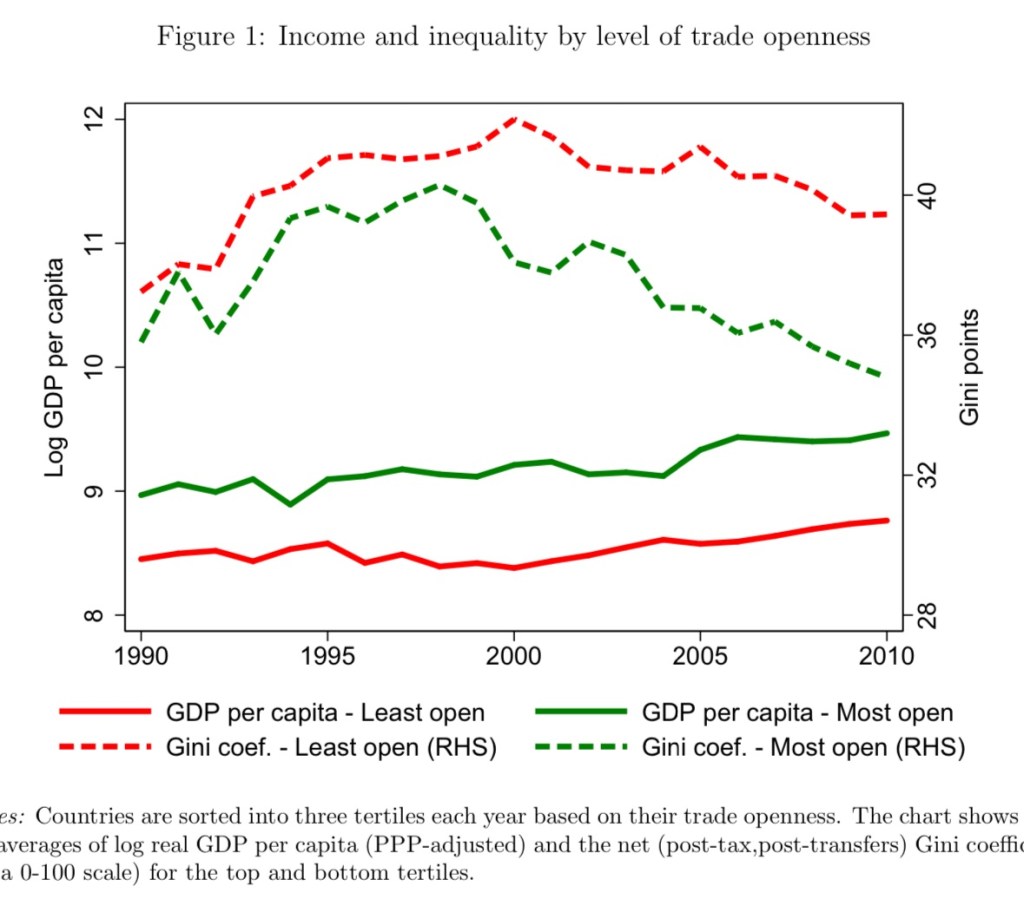
Empirical evidence shows that more open economies (with fewer trade barriers) enjoy greater income and productivity growth. This study found that “trade’s impact on real income [is] consistently positive and significant over time.” See this paper as well. Trade barriers tend to increase the income gap between rich and poor countries. The chart below (from this link) compares real GDP per capita from the top third and bottom third of the distribution of countries on a measure of trade “openness”. Converting logs to levels, the top third has more than twice the average real GDP per capita of the bottom third. And of course, the averaging process mutes differences between very open and very closed trade policies.

The chart also shows that countries more “open” to trade have more equal distributions of income, as measured by their Gini coefficients.

An important qualification is that domestic production of certain goods and services might be critical to national security. We must be willing to tolerate some inefficiencies in that case. It would be foolish to depend on a hostile nation for those supplies, despite any comparative advantage they might possess. It’s reasonable to expect such a list of critical goods and services to evolve with technological developments and changing security threats. However, merely acknowledging this justification leaves the door open for excessively broad interpretations of “critical goods”, especially in times of crisis.

Setting a Good Policy and Example

Here’s an attempt to summarize:

  • Tariffs are taxes, and non-tariff barriers inflict costs by distorting prices or diminishing choice
  • Trade barriers reduce economic efficiency and produce welfare losses
  • Trade barriers deny the citizens of a country the benefits of specialization
  • Both countries gain when one trading partner eliminates tariffs on imports from the other
  • The demand for imports is fairly inelastic, at least in the short run. Thus, the gain from eliminating a tariff will be skewed toward the domestic importers
  • Both countries gain when they agree to eliminate any and all trade barriers
  • Across countries, trade barriers are associated with lower incomes, lower income growth, and more unequal distributions of income

The U.S. has a large number of trading partners. Every liberalization we initiate means a welfare gain for us and one trading partner, who would do well to follow our example and reciprocate in full. Not doing so foregoes welfare gains and leads to incremental losses in income relative to more trade-friendly nations. Across all of our trading relationships, a unilateral end to U.S. trade barriers would almost certainly convince some countries to reciprocate. Those that refuse would suffer. Let them self-flagulate. Let them tax themselves.

Joy-Politik Weird Trick: Anti-Business, Anti-Labor

01 Tuesday Oct 2024

Posted by Nuetzel in corporate taxes, Tax Incidence

≈ Leave a comment

Tags

Capital Flight, Capital-Labor Ratio, Class Struggle, Corporate Imcome Tax, Elasticity, Greedflation, Kamala Harris, Tax Incidence, Unrealized Capital Gains

Workers nationwide are assured that great joy will prevail if Kamala Harris retains her grip on the reins of power next year. Finally, greedy employers and rich people generally will have to “pay their fair share”. While slower job growth and stagnating real wages might dampen the enthusiasm, Harris offers vague assurances that “metrics” will demonstrate how her policies pay for themselves, achieving positive returns on investment (ROI). That creates an attractive buzz and it takes a lot of chutzpah, but she probably wouldn’t know an ROI if it bit her in the ass.

Tax “Big Greed”

This installment of my “Joy-Politik” series covers another federal tax proposal put forward by Harris. In my last post, I discussed her plan to tax unrealized capital gains, which is inimical to investment incentives, a healthy capital base, and economic growth. Here I discuss her proposal: to increase the corporate income tax rate from 21 percent to 28 percent (and increase the alternative minimum tax rate for corporations from 15% to 21%).

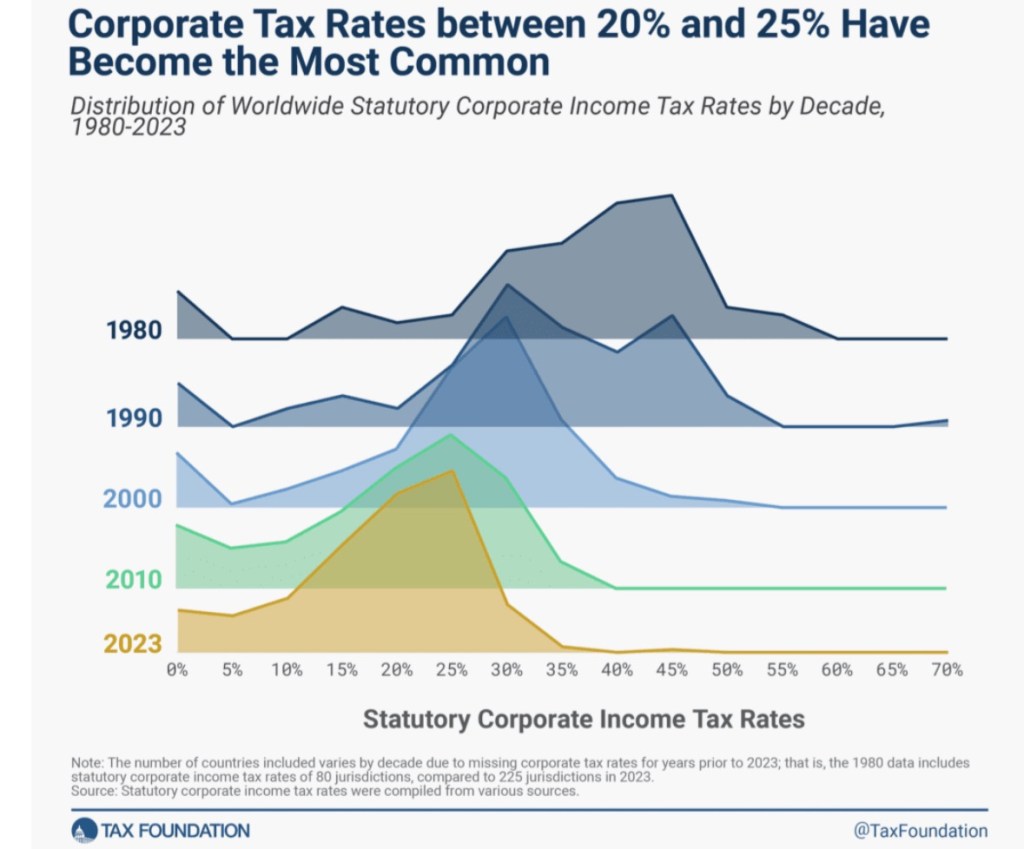
The chart at the top of this post shows that corporate statutory tax rates have trended down quite a bit over the past 40+ years. That’s a strong indicator of competition for corporate investment capital. It’s intense because governments know capital investment produces jobs, higher wages, and economic growth. U.S. corporate taxes today are competitive within the distribution, and they are below the international average. A hike to 28% would push the U.S. to a much less competitive level.

But here’s Harris’ rhetorical move: insist that the income of corporations must be taxed heavily, even punitively, for the benefit of the masses! While you’re at it, deride these greedy companies for causing inflation. The thinking is that a corporation’s shareholders will have to pay the tax. That’s who they’re after, and they can’t resist the left-populist optics!

Tax Incidence

Let’s put aside the “class struggle” premise and the political joy of bashing the rich; let’s also put aside the mistaken attribution of inflation to corporate greed. Beyond all that, Harris (and many others) makes a fundamental error in thinking that shareholders will bear the full burden of the tax. Anyone with a passing familiarity with tax incidence knows that the burden of the tax will be shared by the firm’s workers, customers, and shareholders. That’s because firms attempt to pass the tax along to consumers in higher prices and employees in lower wages.

Corporations cannot avoid tax incidence entirely. All parties (the firms, their consumers, workers, and shareholders) respond with some degree of elasticity. Ultimately, the interplay between their responses will yield a behavioral compromise whereby each of the three groups shoulders a portion of the burden.

Workers have limited mobility, but the supply of capital to a country is fairly elastic. Capital will deploy to locales where the returns net of taxes are most favorable. So capital tends to flee from jurisdictions in which it is more heavily penalized. This reduces the amount of capital available to each worker (tools, machinery, information/computing resources), ultimately leading to reduced productivity and wages.

As of 2021, even the federal government’s tax studies assumed that workers bore 20% – 25% of the burden of a corporate tax increase. However, the true labor share is likely to be higher. An abundance of research (for example, see here, here, and here) supports this conclusion. The full range of estimates runs from 15% – 100%. A number of studies suggest a range of 50% – 100%, with 70% seen as a reasonable midpoint. That means wages can be expected to decline in the wake of a corporate tax hike, and labor ultimately bears more than two-thirds of the increased corporate rate hike. With this in mind, no one should mistake Harris’ anti-corporate policy stance as labor-friendly. Quite the contrary!

Broad Economic Effects

The macroeconomic effects of the corporate tax hike are unfavorable, according to a Tax Foundation report:

“Raising the corporate income tax rate to 28 percent is the largest driver of the negative effects, reducing long-run GDP by 0.6 percent, the capital stock by 1.1 percent, wages by 0.5 percent, and full-time equivalent jobs by 125,000.“

The report’s estimates of losses for the entire Harris tax package through 2034 exclude a few provisions such as the new minimum tax on unrealized gains of high income earners. Therefore, the negative impacts are likely larger. But even without that, the losses in the report are a 2% decline in GDP, a 1.2% loss of wages, a 3% decline in the capital stock, and 786,000 fewer jobs.

Conclusion

Kamala Harris makes a great show of her desire to stick it to the rich for their “fair share.” In this case, the motives of corporations are demonized and presented as a natural vehicle through which the rich can be targeted. That effort would be worse than futile. The bulk of the incidence of the change in the corporate income tax rate would fall on workers. Even worse, the impact on jobs, the capital stock, and GDP are all likely to be negative. Rewarding workers by punishing their employers is a negative sum proposition, not a joyous thing.

A, But Not-So-I: Altman’s Plan To Tax Wealth and Redistribute Capital

09 Tuesday Jul 2024

Posted by Nuetzel in Artificial Intelligence, Wealth Distribution, Wealth Taxes

≈ 2 Comments

Tags

Absolute Advantage, AGI, Alignment, American Equity Fund, Antitrust, ChatGPT, Chris Edwards, Comparative advantage, consumption tax, David Schizer, Defense Production Act, Direct Taxes, Inequality, Maxwell Tabarrok, Michael Munger, Michael Strain, Moore v. United States, Moore’s Law, Open AI, Patrick Hedger, Sam Altman, Scarcity, Scott Sumner, Sixteenth Amendment, Steven Calabresi, Tax Incidence, ULTRA Tax, Wealth Tax

In this case, the “A” stands for Altman. Now Sam Altman is no slouch, but he’s taken a few ill-considered positions on public policy. Altman, the CEO of Open AI, wrote a blog post back in 2021 entitled “Moore’s Law For Everything” in which he predicted that AI will feed an explosion of economic growth. He also said AI will put a great many people out of work and drive down the price of certain kinds of labor. Furthermore, he fears that the accessibility of AI will be heavily skewed against the lowest socioeconomic classes. In later interviews (see here and here), Altman is somewhat demure about those predictions, but the general outline is the same: despite exceptional growth of GDP and wealth, he envisions job losses, an underclass of AI-illiterates, and a greater degree of income and wealth inequality.

Not Quite Like That

We’ve yet to see an explosion of growth, but it’s still very early in the AI revolution. The next several years will be telling. AI holds the potential to vastly increase our production possibilities over the course of the next few decades. For that and other reasons, I don’t buy the more dismal aspects of Altman’s scenario, as my last two posts make clear (here and here).

There will be plenty of jobs for people because humans will have comparative advantages in various areas of production. AI agents might have absolute advantages across most or even all jobs, but a rational deployment would have AI agents specialize only where they have a comparative advantage.

Scarcity will not be the sort of anachronism envisioned by some AI futurists, Altman included, and scarcity of AI agents (and their inputs) will necessitate their specialization in certain tasks. The demand for AI agents will be quite high, and their energy and “compute” requirements will be massive. AI agents will face extremely high opportunity costs in other tasks, leaving many occupations open for human labor, to say nothing of abundant opportunities for human-AI collaboration.

However, I don’t dismiss the likelihood of disruptions in markets for certain kinds of labor if the AI revolution proceeds as rapidly as Altman thinks it will. Many workers would be displaced, and it would take time, training, and a willingness to adapt for them to find new opportunities. But new kinds of jobs for people will emerge with time as AI is embedded throughout the economy.

Altman’s Rx

Altman’s somewhat pessimistic outlook for human employment and inequality leads him to make a couple of recommendations:

1) Ownership of capital must be more broadly distributed.

2) Capital and land must be taxed, potentially replacing income taxes, but primarily to fund equity investments for all Americans.

Here I agree with the spirit of #1. Broad ownership of capital is desirable. It allows greater participation in the capitalist system, which fosters political and economic stability. And wider access to capital, whether owned or not, allows a greater release of entrepreneurial energy. It also diversifies incomes and reduces economic dependency.

Altman proposes the creation of an American Equity Fund (AEF) to hold the proceeds of taxes on land and corporate assets for the benefit of all Americans. I’ll get to the taxes in a moment, but in discussing the importance of educating the public on the benefits of compounding, Altman seems to imply that assets in AEF would be held in individual accounts, as opposed to a single “public” account controlled by the federal government. Individual accounts would be far preferable, but it’s not clear how much control Altman would grant individuals in managing their accounts.

To Kill a Golden Goose

Taxes on capital are problematic. Capital can only be accumulated over time by saving out of income. Thus, as Michael Munger points out, as a general proposition under an income tax, all capital has already been taxed once. And we tax the income from capital at both the corporate and individual level. So corporate income is already double taxed: corporate profits are taxed along with dividend payments to shareholders.

Altman proposed in his 2021 blog post to levy a tax of 2.5% on the market value of publicly-traded corporations each year. The tax would be payable in cash or in corporate shares to be placed into the AEF. The latter would establish a kind of UnLiquidated Tax Reserve Accounts (ULTRA), which Munger discusses in the article linked above (my bracketed x% in the quote here):

“Instead of taking [x%] of the liquidated value of the wealth, the state would simply take ownership of the wealth, in place. An ULTRA is a ‘notional equity interest.’ The government literally takes a portion of the value of the asset; that value will be paid to the state when the asset is sold. Now, it is only a ‘notional’ stake, in the sense that no shared right of control or voting rights exists. But for those who advocate for ULTRAs, in any situation where tax agencies are authorized to tax an asset today, but cannot because there is no evaluation event, the taxpayer could be made to pay with an ULTRA rather than with cash.”

This solves all sorts of administrative problems associated with wealth taxes, but it is draconian nevertheless. Munger quotes an example of a successful, privately-held business subject to a 2% wealth tax every year in the form of an ULTRA. After 20 years, the government owns more than a third of the company’s value. That represents a substantial penalty for success! However, the incidence of such a tax might fall more on workers and customers and less on business owners. And Altman would tax corporations more heavily than in Munger’s example.

A tax on wealth essentially penalizes thrift, reduces capital accumulation, and diminishes productivity and real wages. But another fundamental reason that taxes on capital should be low is that the supply of capital is elastic. A tax on capital discourages saving and encourages capital flight. The use of avoidance schemes will proliferate, and there will be intense pressure to carve out special exemptions.

A Regressive Dimension

Another drawback of a wealth tax is its regressivity with respect to returns on capital. To see this, we can convert a tax on wealth to an equivalent income tax on returns. Here is Chris Edwards on that point:

“Suppose a person received a pretax return of 6 percent on corporate equities. An annual wealth tax of 2 percent would effectively reduce that return to 4 percent, which would be like a 33 percent income tax—and that would be on top of the current federal individual income tax, which has a top rate of 37 percent.”

… The effect is to impose lower effective tax rates on higher‐yielding assets, and vice versa. If equities produced returns of 8 percent, a 2 percent wealth tax would be like a 25 percent income tax. But if equities produced returns of 4 percent, the wealth tax would be like a 50 percent income tax. People with the lowest returns would get hit with the highest tax rates, and even people losing money would have to pay the wealth tax.“

Edwards notes the extreme inefficiency of wealth taxes demonstrated by the experience of a number of OECD countries. There are better ways to increase revenue and the progressivity of taxes. The best alternative is a tax on consumption, which rewards saving and capital accumulation, promoting higher wages and economic growth. Edwards dedicates a lengthy section of his paper to the superiority of a consumption tax.

Is a Wealth Tax Constitutional?

The constitutionality of a wealth tax is questionable as well. Steven Calabresi and David Schizer (C&S) contend that a federal wealth tax would qualify as a direct tax subject to the rule of apportionment, which would also apply to a federal tax on land. That is, under the U.S. Constitution, these kinds of taxes would have to be the same amount per capita in every state. Thus, higher tax rates would be necessary in less wealthy states.

C&S also note a major distinction between taxes on the value of wealth relative to income, excise, import, and consumption taxes. The latter are all triggered by transactions entered into voluntarily. They are avoidable in that sense, but not wealth taxes. Moreover, C&S believe the founders’ intent was to rely on direct taxes only as a backstop during wartime.

The recent Supreme Court decision in Moore v. United States created doubt as to whether the Court had set a precedent in favor of a potential wealth tax. According to earlier precedent, the Constitution forbade the “laying of taxes” on “unrealized” income or changes in wealth. However, in Moore, the Court ruled that undistributed profits from an ownership interest in a foreign business are taxable under the mandatory repatriation tax, signed into law by President Trump in 2017 as part of his tax overhaul package. But Justice Kavanaugh, who wrote the majority opinion, stated that the ruling was based on the foreign company’s status as a pass-through entity. The Wall Street Journal says of the decision:

“Five Justices open the door to taxing unrealized gains in assets. Democrats will walk through it.”

In a brief post, Calabrisi laments Justice Ketanji Brown Jackson’s expansive view of the federal government’s taxing authority under the Sixteenth Amendment, which might well be shared by the Biden Administration. But the Wall Street Journal piece also describes Kavanaugh’s admonition regarding any expectation of a broader application of the Moore opinion:

“Justice Kavanaugh does issue a warning that ‘the Due Process Clause proscribes arbitrary attribution’ of undistributed income to shareholders. And he writes that his opinion should not ‘be read to authorize any hypothetical congressional effort to tax both an entity and its shareholders or partners on the same undistributed income realized by the entity.’”

Growth Is the Way, Not Taxes

AI growth will lead to rapid improvements in labor productivity and real wages in many occupations, despite a painful transition for some workers requiring occupational realignment and periods of unemployment and training. However, people will retain comparative advantages over AI agents in a number of existing occupations. Other workers will find that AI allows them to shift their efforts toward higher-value or even new aspects of their jobs. Along the same lines, there will be a huge variety of new occupations made possible by AI of which we’re only now catching the slightest glimpse. Michael Strain has emphasized this aspect of technological diffusion, noting that 60% of the jobs performed in 2018 did not exist in 1940. In fact, few of those “new” jobs could have been imagined in 1940.

AI entrepreneurs and AI investors will certainly capture a disproportionate share of gains from an AI revolution. Of course, they’ll have created a disproportionate share of that wealth. It might well skew the distribution of wealth in their favor, but that does not reflect negatively on the market process driving the outcome, especially because it will also give rise to widespread gains in living standards.

Altman goes wrong in proposing tax-funded redistribution of equity shares. Those taxes would slow AI development and deployment, reduce economic growth, and produce fewer new opportunities for workers. The surest way to effect a broader distribution of equity capital, and of equity in AI assets, is to encourage innovation, economic growth, and saving. Taxing capital more heavily is a very bad way to do that, whether from heavier taxes on income from capital, new taxes on unrealized gains, or (worst of all) from taxes on the value of capital, including ULTRA taxes.

Altman is right, however, to bemoan the narrow ownership of capital. As I mentioned above, he’s also on-target in saying that most people do not fully appreciate the benefits of thrift and the miracle of compounding. That represents both a failure of education and our calamitously high rate of time preference as a society. Perhaps the former can be fixed! However, thrift is a decision best left in private hands, especially to the extent that AI stimulates rapid income growth.

Killer Regulation

Altman also supports AI regulation, and I’ll cut him some slack by noting that his motives might not be of the usual rent-seeking variety. Maybe. Anyway, he’ll get some form of his wish, as legislators are scrambling to draft a “roadmap” for regulating AI. Some are calling for billions of federal outlays to “support” AI development, with a likely and ill-advised effort to “direct” that development as well. That is hardly necessary given the level of private investment AI is already attracting. Other “roadmap” proposals call for export controls on AI and protections for the film and recording industries.

These proposals are fueled by fears about AI, which run the gamut from widespread unemployment to existential risks to humanity. Considerable attention has been devoted to the alignment of AI agents with human interests and well being, but this has emerged largely within the AI development community itself. There are many alignment optimists, however, and still others who decry any race between tech giants to bring superhuman generative AI to market.

The Biden Administration stepped in last fall with an executive order on AI under emergency powers established by the Defense Production Act. The order ranges more broadly than national defense might necessitate, and it could have damaging consequences. Much of the order is redundant with respect to practices already followed by AI developers. It requires federal oversight over all so-called “foundation models” (e.g., ChatGPT), including safety tests and other “critical information”. These requirements are to be followed by the establishment of additional federal safety standards. This will almost certainly hamstring investment and development of AI, especially by smaller competitors.

Patrick Hedger discusses the destructive consequences of attempts to level the competitive AI playing field via regulation and antitrust actions. Traditionally, regulation tends to entrench large players who can best afford heavy compliance costs and influence regulatory decisions. Antitrust actions also impose huge costs on firms and can result in diminished value for investors in AI start-ups that might otherwise thrive as takeover targets.

Conclusion

Sam Altman’s vision of funding a redistribution of equity capital via taxes on wealth suffers from serious flaws. For one thing, it seems to view AI as a sort of exogenous boon to productivity, wholly independent of investment incentives. Taxing capital would inhibit investment in new capital (and in AI), diminish growth, and thwart the very goal of broad ownership Altman wishes to promote. Any effort to tax capital at a global level (which Altman supports) is probably doomed to failure, and that’s a good thing. The burden of taxes on capital at the corporate level would largely be shifted to workers and consumers, pushing real wages down and prices up relative to market outcomes.

Low taxes on income and especially on capital, together with light regulation, promote saving, capital investment, economic growth, higher real wages, and lower prices. For AI, like all capital investment, public policy should focus on encouraging “aligned” development and deployment of AI assets. A consumption tax would be far more efficient than wealth or capital taxes in that respect, and more effective in generating revenue. Policies that promote growth are the best prescription for broadening the distribution of capital ownership.

Fiscal Foolishness a Costly Salve For Midterm Jitters

05 Friday Aug 2022

Posted by Nuetzel in Fiscal policy, Inflation

≈ 2 Comments

Tags

Alternative Minimum Corporate Tax, Brad Polumbo, Carried Interest, Chuck Schumer, CMS, Drug Price Controls, Eric Boehm, Fossil fuels, Green Energy, Inflation Reduction Act, IRS, Joe Biden, Joe Manchin, Kyrsten Sinema, Lois Lerner, Medicare Part D, Obamacare Subsidies, Private equity, Stock Buybacks, Sweat Equity, Tax Burden, Tax Enforcement, Tax Incidence, Wharton Economics, William C. Randolf

The “Inflation Reduction Act” (IRA) is about as fatuous a name for pork-barrel spending and taxes as its proponents could have dreamt up! But that’s the preposterous appellation given to the reconciliation bill congressional Democrats hope to approve. Are we to believe that Congress suddenly recognizes the inflationary effects of governments deficits? Well, the trouble is the projected revenue enhancements (taxes) and cost savings are heavily backloaded. It’s mostly spending up front, which is exactly how we got to this point. There are a number of provisions intended to increase domestic energy production in the hope of easing cost-push, supply-side price pressures. However, provisions relating to fossil fuel production are dependent on green energy projects in the same locales. So, even if we get more oil, we’ll still be pissing away resources on wind and solar technologies that will never be reliable sources of power. Even worse, the tax provisions in the bill will have burdens falling heavily on wage earners, despite the Administration’s pretensions of taxing only rich corporations and their shareholders.

The Numbers

The IRA (itself an irritating acronym) would add $433 billion of new federal outlays through 2031 (*investments*, because seemingly every federal outlay is an “investment” these days). At least that’s the deal that Chuck Schumer and Joe Manchin agreed to. As the table below shows, these outlays are mostly for climate initiatives, but the figure includes almost $70 billion of extended Obamacare subsidies. There is almost $740 billion of revenue enhancements, which are weighted toward the latter half of the ten-year budget window.

The deal reduces the federal budget deficit by about $300 billion over ten years, but that takes a while… somewhat larger deficits are projected through 2026. I should note that the Congressional Budget Office has issued a new score this week that puts the savings at a much lower $102 billion. However, that “new” score does not reflect the changes demanded by Kyrsten Sinema (R-AZ).

Spending

Budget projections are usually dependent on assumptions about the duration of various measures, among many other things like economic growth. For example, the increased Obamacare subsidies are an extension, and the scoring assumes they end in 2026. It’s hard to believe they won’t be extended again when the time comes. Over ten years, that would cut the deficit reduction roughly in half.

The bill is laden with green energy subsidies intended to reduce CO2 emissions. They will accomplish little in that respect, but what the subsidies will do is enrich well-healed cronies while reducing the stability of the electric grid. Tax credits for electric vehicles will be utilized primarily by wealthier individuals, though there are tax credits for energy-efficient appliances and the like, which might benefit a broader slice of the population. And while there are a few provisions that might address supplies of fossil fuels and investment in nuclear energy, these are but a sop to Joe Manchin and misdirection against critics of Joe Biden’s disastrous energy policies.

Revenue

Should we be impressed that the Democrats have proposed a bill that raises revenue more than spending? For their part, the Democrats insist that the bill will impose no new taxes on those with taxable incomes less than $400,000. That’s unlikely, as explained below. As a matter of macroeconomic stability, with the economy teetering on the edge of recession, it’s probably not a great time to raise taxes on anyone. However, Keynesians could say the same thing about my preferred approach to deficit reduction: cutting spending! So I won’t press that point too much. However, the tax provisions in the IRA are damaging not so much because they depress demand, but because they distort economic incentives. Let’s consider the three major tax components:

1. IRS enforcement: this would provide about $80 billion in extra IRS funding over 10 years. It is expected to result in a substantial number of additional IRS tax audits (placed as high as 1.2 million). Democrats assert that it will raise an additional $400 billion, but the CBO says it’s likely to be much lower($124 billion). This will certainly ensnare a large number of taxpayers earning less than $400,000 and impose substantial compliance costs on individuals and businesses. A simplified tax code would obviate much of this wasteful activity, but our elected representatives can’t seem to find their way to that obvious solution. In any case, pardon my suspicions that this increase in funding to enforce a Byzantine tax code might be used to weaponize the IRS against parties harboring disfavored political positions. Shades of Lois Lerner!

2. Carried Interest: Oops! Apparently the Democrat leadership just bought off Kyrsten Sinema by eliminating this provision and replacing it with another awful tax…. See #3 below. The next paragraph briefly discusses what the tax change for carried interest would have entailed:

The original bill sought to end the favorable tax treatment of “carried interest”, which is earned by private equity managers but is akin to the “sweat equity” earned by anyone making a contribution to the value of an investment without actually contributing a proportionate amount of capital. I’ve written about this before here. Carried interest income is taxed at the long-term capital gains tax rate, which is usually lower than tax rates on ordinary income. This treatment is really the same as for any partnership that allocates gains to partners, but populist rhetoric has it that it is used exclusively by nasty private equity managers. Changing this treatment for private equity firms would represent gross discrimination against firms that make a valuable contribution to the market for the ownership control of business enterprises, which helps to discipline the management of resources in the private sector.

3. Tax on Corporate Stock Buy-Backs: it’s not uncommon for firms to use cash they’ve generated from operations to repurchase shares of stock issued in past. Unaccountably, Democrats regard this as a “wasteful” activity designed to unfairly enrich shareholders. However, it is a perfectly legitimate way for firms to return capital to owners. The tax would create an incentive for managers to choose less efficient alternatives for the use of excess funds. In any case, the unrestricted freedom of owners to empower managers to repurchase shares is a fundamental property right.

A tax on corporate stock buybacks can result in the triple taxation of corporate profits. Profits are taxed at the firm level, and if the firm uses after-tax profits to repurchases shares, then the profits are taxed again, and further, any gain to shareholders would be subject to capital gains tax. This is one more violation of the old principle that income should be taxed once and only once.

The proposed excise tax on buy-backs now added to the IRA is *expected* to raise more revenue than the carried interest revision would have, but adjustments to behavior have a way of stymying expectations. Research has demonstrated that firms who buy back their shares often outperform their peers. But again, there are always politicians who wish to create more frictions in capital markets because firms and investors are easy political marks, and because these politocos do not understand the key role of capital markets in allocating resources efficiently between uses and across time.

4. Corporate taxes: Imposing a minimum tax rate of 15% on corporate book income above $1 billion is a highly controversial part of the IRA. While supporters contend that the burden would fall only on wealthy shareholders, in fact the burden would be heavily distributed across lower income ranges. First, a great many working people are corporate shareholders through their individual or employer-sponsored savings plans. Second, corporate employees shoulder a large percentage of the burden of corporate taxes via reduced wages and benefits. Here’s Brad Polumbo on the incidence of the corporate tax burden:

“William C. Randolph of the Congressional Budget Office found that for every dollar raised by the corporate tax, approximately 70 cents comes out of workers’ wages. Further confirming this finding, research from the Kansas City Federal Reserve concluded that a 10% increase in corporate taxes reduces wages by 7%.”

This again demonstrates the dishonesty of claims that no one with an income below $400,000 will be taxed under the IRA. In addition, almost 50% of the revenue from this minimum tax will come from the manufacturing sector:

As Eric Boehm states at the last link, “So much for improving American manufacturers’ competitiveness!” Incidentally, it’s estimated that the bill would cause differential increases in the effective corporate tax on investments in equipment, structures, and inventories. This is not exactly a prescription for deepening the stock of capital or for insulating the American economy from supply shocks!

5. Medicare Drug Prices: A final source of deficit reduction is the de facto imposition of price controls on certain prescription drugs under Medicare Part D. A small amount of savings to the government are claimed to begin in 2023. However, the rules under which this will be administered probably won’t be established for some time, so the savings may well be exaggerated. It’s unclear when the so-called “negotiations” with drug companies will begin, but they will take place under the threat of massive fines for failing to agree to CMS’s terms. And as with any price control, it’s likely to impinge on supply — the availability of drugs to seniors, and it is questionable whether seniors will reap any savings on drugs that will remain available.

Do Words Have No Meaning?

The IRA’s vaunted anti-inflationary effects are a pipe dream. A Wharton Study found that the reduction in inflation would be minuscule:

“We estimate that the Inflation Reduction Act will produce a very small increase in inflation for the first few years, up to 0.05 percent points in 2024. We estimate a 0.25 percentage point fall in the PCE price index by the late 2020s. These point estimates, however, are not statistically different than zero, thereby indicating a very low level of confidence that the legislation will have any impact on inflation.”

Over 230 economists have weighed in on the poor prospects that the IRA will achieve what its name suggests. And let’s face it: not even the general public has any confidence that the IRA will actually reduce inflation:

Conclusion

The Inflation Reduction Act is a destructive piece of legislation and rather galling in its many pretenses. I’m all for deficit reduction, but the key to doing so is to cut the growth in spending! Reducing the government’s coerced absorption of resources relative to the size of the economy prevents “crowding out” of private, voluntary, market-tested activity. It also prevents the need for greater tax distortions that undermine economic performance.

The federal government has played host to huge pandemic relief bills over the past two years. Then we have Joe Biden’s move to forgive student debt, a benefit flowing largely to higher income individuals having accumulated debt while in graduate programs. And then, Congress passed a bill to subsidize chip manufacturers who were already investing heavily in domestic production facilities. All the while, the Biden Administration was doing everything in its power to destroy the fossil fuel industry. So now, Democrats hope to follow-up on all that with a bill stuffed with rewards for cronies in the form of renewable energy subsidies, financed largely on the backs of the same individuals who they’ve sworn they won’t tax! The dishonesty is breathtaking! This crowd is so eager to do anything before the midterm elections that they’ll shoot for the nation’s feet!

Labor Shares the Burden of the Corporate Income Tax

03 Friday Nov 2017

Posted by Nuetzel in Taxes

≈ 4 Comments

Tags

Alex Tabarrok, corporate income tax, Greg Mankiw, John Cochrane, Lawrence Summers, monopoly, Monopsony, Pass-Through Income, Paul Krugman, Tax Burden, Tax Discounting, Tax Incidence, Tax Reform

As expected, a reduction of the corporate income tax rate from 35% to 20% is included in the GOP’s tax reform bill, a summary of which was released today. That rate cut would be a welcome development for workers, consumers, and corporate shareholders. It should be no surprise that the burden of the U.S. corporate income tax is not borne exclusively by owners of capital. In fact, it might hurt workers and consumers substantially while imposing relatively little burden on shareholders.

John Cochrane’s post on the incidence of the tax on corporate income is very interesting, though by turns it rambles and may be too technical for some tastes. He notes that the incidence of the corporate tax can fall on only three different groups: shareholders, workers and customers:

“As an accounting matter, every cent [of taxes] corporations pay comes from higher prices, lower wages, or lower payments to shareholders. The only question is which one.“

Cochrane quotes Lawrence Summers and Paul Krugman, both of whom are of the belief that the incidence of the corporate tax must fall primarily on capital and not on labor. That’s consistent with their view that a reduction in corporate taxes amounts to a gift to shareholders. But Cochrane isn’t at all convinced:

“The usual principle is that he or she bears the burden who can’t get out of the way. So, how much room do companies, as a whole, have to raise prices, lower wages, lower interest payments, or lower dividends?”

In fact, owners of capital can get out of the way. Capital is very mobile relative to labor. Here’s a counterfactual exercise Cochrane steps through in order to illustrate the implications of ownership bearing the incidence of the tax: if equity markets are efficient, share prices reflect all available information about the firm. If wages and product prices are unchanged after the imposition of the tax, then shareholders would suffer an immediate loss. Once the tax is discounted into share prices, there would be no further impact on current or future shareholders. Thus, future buyers of shares would escape the tax burden entirely. As a first approximation, the share price must fall to the point at which the ongoing return on the stock is restored to its value prior to imposition of the tax.

Cochrane notes that evidence on the reaction of stock prices to corporate tax changes is mixed at best, which implies that the incidence of corporate taxation falls more weakly on shareholders than many believe. That leaves consumers or workers to bear a significant part of the burden. Workers and consumers are mostly one and the same: economy-wide, higher prices mean lower real wages; lower wages also mean lower real wages. So I’ll continue to speak as if the incidence of the tax falls on either labor or capital, and we can leave aside consumers as a separate category. Cochrane says:

“It used to be thought that it was easy to lower payments to shareholders — ‘the supply of savings is inelastic’ — so that’s where the tax would come from. The newer consensus is that companies as a whole have very little power to pay less to investors, … so the corporate tax comes from lower wages or, equivalently, higher prices. Then, indirectly, reducing the corporate tax would increase capital, which would result in higher wages.”

Cochrane’s post and another on his blog were prompted by an earlier piece by Greg Mankiw showing that real wages, in an open economy, will have a strong negative response to a corporate tax increase. Here is the reasoning: the tax reduces the return earned from invested capital in the short run. Ideally, capital is deployed only up to the point at which its return no longer exceeds the opportunity cost needed to attract it. Given time to adjust, less capital must be deployed after the imposition of the tax in order to force the return on a marginal unit of capital back up to the given opportunity cost. That means less capital deployed per worker, and that, in turn, reduces labor productivity and wages.

Another issue addressed by Cochrane has to do with assertions that monopoly power in the corporate sector is a good rationale for a high tax on corporate income. You can easily convince me that the “average” firm in the corporate sector earns a positive margin over marginal cost. However, a microeconomic analysis of monopoly behavior by the entire corporate sector would be awkward, to say the least. Despite all that, Cochrane notes that monopolists have more power than firms in competitive sectors to raise prices, and monopsonists have more power to reduce wages. Therefore, the “tax the monopolists” line of argument does not suggest that labor will avoid a significant burden of a corporate tax. A safer bet is that firms in the U.S. corporate sector are price-takers in capital markets, but to some degree may be price-makers in product and labor markets.

Cochrane also emphasizes the inefficiency of the corporate tax as a redistributional mechanism, even if shareholders bear a significant share of its burden. It is still likely to harm workers via lost productivity, as discussed above. It is also true that many workers hold corporate equities in their retirement funds, so a corporate tax harms them directly in their dual role as owners of capital.

The cut in the corporate tax rate is but one element of many in the GOP bill, but a related provision is that so-called “pass-through” income, of the type earned via many privately-owned businesses, would be taxed at a maximum rate of 25%. These businesses generate more income than C-corporations. Currently, pass-through income is taxed as ordinary income, so capping the top rate at 25% represents a very large tax cut. As Alex Tabarrok points out at the last link, tax treatment should be neutral with respect to the form of business organization, but under the GOP bill, the effective gap between the top rate for pass-throughs versus corporate income would be even larger than it is now.

Critics of a reduction in corporate taxes should bear in mind that its incidence falls at least partly on labor, perhaps mainly on labor. The U.S. has the highest corporate tax rate in the industrialized world. That undermines U.S. competitiveness, as does the complexity of corporate tax rules. Tax planning and compliance burn up massive resources while drastically reducing the tax “take”, i.e., the revenue actually collected. The corporate income tax is something of a “show” tax that exists to appease populist and leftist elements in the electorate who consistently fail to recognize the unexpectedly nasty consequences of their own advocacy.


Follow Sacred Cow Chips on WordPress.com

Recent Posts

  • Immigration and Merit As Fiscal Propositions
  • Tariff “Dividend” From An Indigent State
  • Almost Looks Like the Fed Has a 3% Inflation Target
  • Government Malpractice Breeds Health Care Havoc
  • A Tax On Imports Takes a Toll on Exports

Archives

  • December 2025
  • November 2025
  • October 2025
  • September 2025
  • August 2025
  • July 2025
  • June 2025
  • May 2025
  • April 2025
  • March 2025
  • February 2025
  • January 2025
  • December 2024
  • November 2024
  • October 2024
  • September 2024
  • August 2024
  • July 2024
  • June 2024
  • May 2024
  • April 2024
  • March 2024
  • February 2024
  • January 2024
  • December 2023
  • November 2023
  • August 2023
  • July 2023
  • June 2023
  • May 2023
  • April 2023
  • March 2023
  • February 2023
  • January 2023
  • December 2022
  • November 2022
  • October 2022
  • September 2022
  • August 2022
  • July 2022
  • June 2022
  • May 2022
  • April 2022
  • March 2022
  • February 2022
  • January 2022
  • December 2021
  • November 2021
  • October 2021
  • September 2021
  • August 2021
  • July 2021
  • June 2021
  • May 2021
  • April 2021
  • March 2021
  • February 2021
  • January 2021
  • December 2020
  • November 2020
  • October 2020
  • September 2020
  • August 2020
  • July 2020
  • June 2020
  • May 2020
  • April 2020
  • March 2020
  • February 2020
  • January 2020
  • December 2019
  • November 2019
  • October 2019
  • September 2019
  • August 2019
  • July 2019
  • June 2019
  • May 2019
  • April 2019
  • March 2019
  • February 2019
  • January 2019
  • December 2018
  • November 2018
  • October 2018
  • September 2018
  • August 2018
  • July 2018
  • June 2018
  • May 2018
  • April 2018
  • March 2018
  • February 2018
  • January 2018
  • December 2017
  • November 2017
  • October 2017
  • September 2017
  • August 2017
  • July 2017
  • June 2017
  • May 2017
  • April 2017
  • March 2017
  • February 2017
  • January 2017
  • December 2016
  • November 2016
  • October 2016
  • September 2016
  • August 2016
  • July 2016
  • June 2016
  • May 2016
  • April 2016
  • March 2016
  • February 2016
  • January 2016
  • December 2015
  • November 2015
  • October 2015
  • September 2015
  • August 2015
  • July 2015
  • June 2015
  • May 2015
  • April 2015
  • March 2015
  • February 2015
  • January 2015
  • December 2014
  • November 2014
  • October 2014
  • September 2014
  • August 2014
  • July 2014
  • June 2014
  • May 2014
  • April 2014
  • March 2014

Blogs I Follow

  • Passive Income Kickstart
  • OnlyFinance.net
  • TLC Cholesterol
  • Nintil
  • kendunning.net
  • DCWhispers.com
  • Hoong-Wai in the UK
  • Marginal REVOLUTION
  • Stlouis
  • Watts Up With That?
  • Aussie Nationalist Blog
  • American Elephants
  • The View from Alexandria
  • The Gymnasium
  • A Force for Good
  • Notes On Liberty
  • troymo
  • SUNDAY BLOG Stephanie Sievers
  • Miss Lou Acquiring Lore
  • Your Well Wisher Program
  • Objectivism In Depth
  • RobotEnomics
  • Orderstatistic
  • Paradigm Library
  • Scattered Showers and Quicksand

Blog at WordPress.com.

Passive Income Kickstart

OnlyFinance.net

TLC Cholesterol

Nintil

To estimate, compare, distinguish, discuss, and trace to its principal sources everything

kendunning.net

The Future is Ours to Create

DCWhispers.com

Hoong-Wai in the UK

A Commonwealth immigrant's perspective on the UK's public arena.

Marginal REVOLUTION

Small Steps Toward A Much Better World

Stlouis

Watts Up With That?

The world's most viewed site on global warming and climate change

Aussie Nationalist Blog

Commentary from a Paleoconservative and Nationalist perspective

American Elephants

Defending Life, Liberty and the Pursuit of Happiness

The View from Alexandria

In advanced civilizations the period loosely called Alexandrian is usually associated with flexible morals, perfunctory religion, populist standards and cosmopolitan tastes, feminism, exotic cults, and the rapid turnover of high and low fads---in short, a falling away (which is all that decadence means) from the strictness of traditional rules, embodied in character and inforced from within. -- Jacques Barzun

The Gymnasium

A place for reason, politics, economics, and faith steeped in the classical liberal tradition

A Force for Good

How economics, morality, and markets combine

Notes On Liberty

Spontaneous thoughts on a humble creed

troymo

SUNDAY BLOG Stephanie Sievers

Escaping the everyday life with photographs from my travels

Miss Lou Acquiring Lore

Gallery of Life...

Your Well Wisher Program

Attempt to solve commonly known problems…

Objectivism In Depth

Exploring Ayn Rand's revolutionary philosophy.

RobotEnomics

(A)n (I)ntelligent Future

Orderstatistic

Economics, chess and anything else on my mind.

Paradigm Library

OODA Looping

Scattered Showers and Quicksand

Musings on science, investing, finance, economics, politics, and probably fly fishing.

  • Subscribe Subscribed
    • Sacred Cow Chips
    • Join 128 other subscribers
    • Already have a WordPress.com account? Log in now.
    • Sacred Cow Chips
    • Subscribe Subscribed
    • Sign up
    • Log in
    • Report this content
    • View site in Reader
    • Manage subscriptions
    • Collapse this bar
 

Loading Comments...