• About

Sacred Cow Chips

Sacred Cow Chips

Tag Archives: Sam Altman

Some Dimensions Of the AI/Data Center Freakout

25 Thursday Jun 2026

Posted by Nuetzel in Artificial Intelligence, Government Failure

≈ Leave a comment

Tags

AI, AI Alignment, AI Land Use, AI Power Consumption, AI Regulation, Andy Masley, Anthropic, Bernie Sanders, Brian Albrecht, Capital Deepening, Chinese Communist Party, Comparative advantage, Dario Amodei, Data Centers, Dean Ball, Donald Trump, Elon Musk, Fable, Friedrich Hayek, Google, Luddites, Mythos, National Security, NIMBY, OpenAI, Rebecca Lowe, Sam Altman, Sam Altman (OpenAI), Sovereign Wealth Fund, Sundar Pichai, Superabundance, The Fatal Conceit, Timnit Gebru, Water Cooling, xAI
Bad policy ideas are circulating that have been conceived amid hysteria over AI. These are interventionist approaches to the development and deployment of AI models, ranging from direct confiscation of AI capital, taxes on the flow of compute, various forms of regulation, and state and local efforts to forbid the construction of data centers. All of these actions would unnecessarily inhibit achievement of AI’s enormous potential benefits and present unnecessary national security challenges as well.

Land Use and Displacement

Emotionally I’m probably just as NIMBY as the next guy when it comes to developments in my vicinity that might offend my personal aesthetics or intrude on my privacy. But at a more rational level, I object to developments that will inflict external costs on me. I happen to live in a private community that provides some buffer against incursions of those kinds, but I deeply sympathize with anyone who finds their property will soon be next door to a large or obnoxious industrial, commercial or government facility, and I despise the use of eminent domain for almost any purpose.

But let’s step back and consider the case in which an owner of private property receives what they feel is just compensation on the sale of their land to a data center developer. This property might be in your close proximity, but you can’t prevent your neighbor from selling unless it’s by way of a larger political process to revoke his property rights. Of course, you can help organize or join a resistance group in an attempt to stop the development. That’s perfectly reasonable if you fear the prospect of having your property stranded in the middle of a new industrial or commercial development.

Ultimately, such efforts are likely to influence negotiations between communities and developers. In fact, developers of data centers can often be persuaded to work with communities in addressing public concerns, and some developers are eager to do so.

Water and Power Consumption

Aside from land use, potential displacement, and aesthetic issues (including plain-old NIMBYism), other underlying concerns exciting local opposition to data centers have to do with predicted strains on water and power supplies. These are no doubt critical issues in certain localities. However, on the whole these concerns are vastly overblown, as elucidated by Andy Masley at this link. In particular, water use by data centers is on the same order of magnitude as other industrial uses. Contrary to some claims, any water pollution by data centers is usually confined to the construction phase, if at all, and in that respect is very much like any other construction project. And as Masley points out, a data center can generate tax revenue for use in reducing water scarcity.

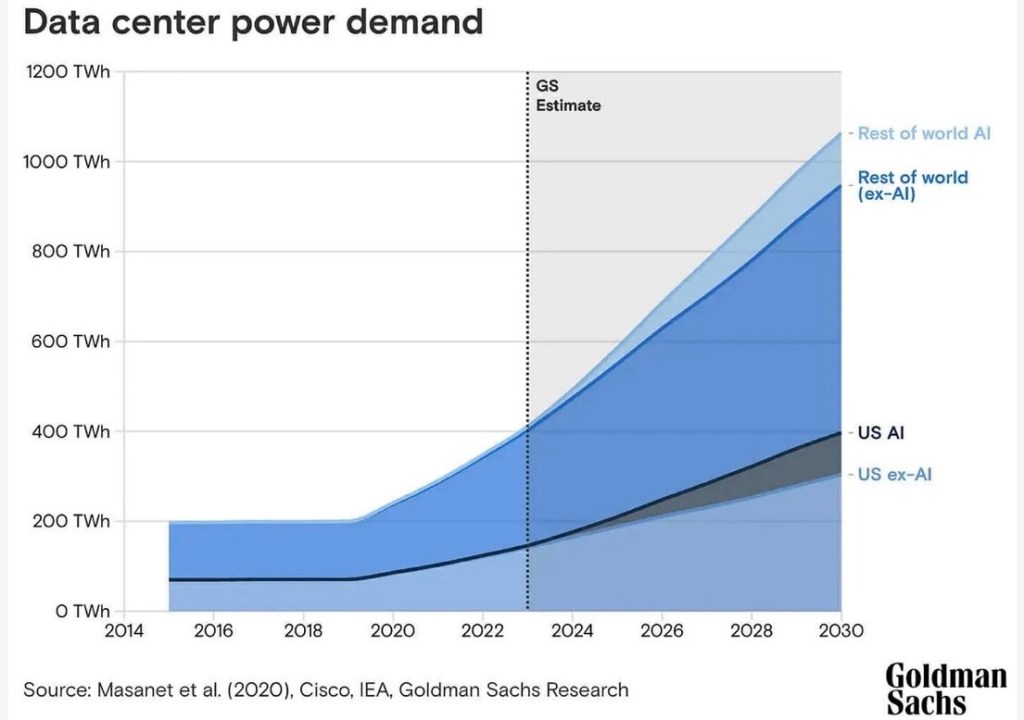
It should also be noted that data centers house the computational power of the entire internet. As the chart (from Masley) at the top of this post shows, AI represents an incremental need that is still relatively small relative to total data center power use. Incidentally, water cooling rather than air cooling reduces a data center’s power consumption.

Nevertheless, the power consumption of data centers is indeed a matter of critical importance and controversy. Referring again to the chart at the top, it’s evident that data center power usage is growing rapidly. However, developers are increasingly planning to produce their own power off-grid, often colocating with their power sources to minimize transmission costs. This includes locating alongside natural gas basins, installing wind and solar collection facilities nearby, and coming soon, incorporating modular nuclear reactors. The latter would provide base-load, dispatchable, zero-carbon power for data centers. Of course, modular reactors will be costly and might eat into returns from developing data centers, but other power sources are costly as well, and it is the one sure dispatchable, zero-carbon, off-grid solution.

Water and energy supplies for data centers are key to enabling broad contributions of AI to consumer welfare, productivity growth, and national security. Local interests should weigh other benefits that construction of data centers will bring to a community. Construction jobs and permanent data center jobs are obviously important considerations, as well as the aforementioned increases in local tax revenue.

State Regulation and Litigation

Of course, AI controversies are playing out at the national and state levels as well. First, there is the issue of AI regulation. AI legislation in all 50 states attempts to regulate various “threatening” aspects of AI. These bills address topics such as fraud prevention (e.g., deep fakes), chatbot safety, and restrictions on automated AI decisioning (e.g., hiring, insurance coverage and claims adjudication).

There is litigation and potential litigation at the state level related to alleged abuses by Open AI’s ChatGPT. These concern the use of customer data and alleged encouragement of self-harm, among other matters. And the New York legislature has passed a bill calling for a one-year moratorium on AI data center development.

These regulatory and legal efforts at the state and local level raise the prospect of fragmented treatment of AI in different jurisdictions that would be disruptive and costly for both AI companies and users. Federalist principles aside, economic efficiency argues for a more uniform approach to many concerns about AI. But whether it’s at the federal, state, or local level, tight regulatory control of AI risks compromising the healthy competitive development of AI technology and the industry. That’s because politicians and bureaucrats cannot possess the knowledge of evolving competition, scarcity, and market incentives only revealed by free market processes.

Rooting for Regulation

Unfortunately, modern-day Luddites at the national level are calling for a moratorium on AI development. In fact, in 2023, fears of AI misalignment with human interests brought even Elon Musk to call for a six-month “pause” on development. Today, a number of industry insiders call for a “slowdown”, if only other countries go along with it (fat chance!).

Yes, AI is improving… fast, but the most consequential threats have to do with security protocols. Anthropic, in particular, almost begged for government control over its Mythos product, which recently gripped the AI and cybersecurity communities with its advanced ability to identify software vulnerabilities. The Fable version is said to incorporate “guardrails”, but reportedly Fable is vulnerable to “jailbreaks”. In what should not have surprised Anthropic after its own warnings, the federal government imposed export controls, restricting access by foreign nationals. And now, Anthropic has withdrawn availability of the models worldwide..

Be Careful What You Ask For

Perhaps Anthropic got what it deserved, but sadly, the Trump Administration seems to have crossed a threshold from a “light touch” approach to regulating AI to something more severe. Let’s hope the Mythos/Fable affair doesn’t presage a permanent transition from private governance to state control. That would inhibit development and present risks likely to rattle some of AI’s most important customers, .

The last link cites Timnit Gebru’s critique that AI labs have made a huge miscalculation:

“She argues that AI labs have consistently used ‘dangerous AI’ narratives for marketing, investor appeal, and competitive advantage, only for the narrative to backfire when actual state power intervenes. (on X)”

It’s possible that Anthropic and a few of its competitors have fallen for the same mistaken notion that central planning by government bureaucrats can improve upon market processes. Statists on the right and the left have been eager to join the chorus for regulatory control.

Fatal Conceit

Dean Ball channels Friedrich Hayek in the following tweet on the mistaken impression that government must impose a “strategy” and “plan” AI.

“I think part of it, at least vis a vis US/China competition, is that US and western chattering classes find it hard to believe that the market-driven outcome of frontier AI could possibly be right. They basically believe, in their hearts, that the Chinese system, with its ‘industrial strategy,’ has eclipsed capitalism. So they harbor the same inferiority complex toward the Chinese system that many Americans once harbored toward the EU’s system. Their heuristic is that the industrial strategists of China have grasped the whole picture of the technological competition in a way that US industrialists, with their ‘profit maximizing incentives,’ could not possibly have matched. And so any outcome in the economy that is not the result of ‘strategy’ is therefore prima facie worse than what the ‘strategists’ have concocted. They also believe the Chinese strategists possess awesome powers of foresight and the ability to evade all tendencies of financial and economic gravity, due of course to ‘strategy,’ really it’s almost a kind of orientalism.”

National security is an important consideration, of course, but AI development should not be hamstrung for fear of the ever-present need for improved encryption or by the prospect of threats from autonomous weapons systems. Indeed, AI can and should be put to use defending against all such threats to national security without compromising its promise as a revolutionary technology with a wide range of applications. Again, Trump’s purported intent to encourage U.S. AI development is undercut by his fixations on controlling trade and “taking stakes”. And do foreign customers want to deal with this confusing state of affairs? Or simply go to China?

AI and Capital Redistribution

Another nest of controversies has to do with the widespread presumption that AI will be negative for labor markets. Prescriptions from the populist left and right include various kinds of AI taxation, redistribution, and even nationalization.

Bernie Sanders and Donald Trump both want a sovereign wealth fund, and Sanders wants to fund it with a one-time 50% tax on AI stock. Sanders, the High Prince of Economic Parasites, is sponsoring a bill he claims would allow the American public to take a role in determining the future of AI, whatever that means. What he hopes to create is a mechanism for wealth redistribution, since the fashionable view is that AI will be a catastrophe for labor. While the AI industry is far from profitable at the moment, many AI stocks have soared in value. And Sanders’ target “AI industry” might fairly broad, including chip manufacturers and other producers of AI infrastructure.

If the public wants to kill AI investment in the U.S., tank equity markets, and give politicians an excuse for more profligate spending, then Sander’s bill is a grand idea. It would be an outright expropriation of wealth. The impacts on economic growth, productivity, American competitiveness, and national security would be unambiguously negative. And lest you think such a redistribution is necessary to compensate for job losses caused by AI, that issue is far from settled. In fact, it’s highly likely that the job realignment certain to take place will result in growth from a variety of occupations previously unimagined, just as technological advances have in the past.

The Compute Tax

Others (including Sanders) have also broached the idea of a “compute tax”, or as Brian Albrecht explains:

“… a levy on computational resources. Think GPU hours, processing power, data center electricity, or some similar proxy for AI work.”

Albrecht believes the real intent is to tax the stock of physical AI capital, as opposed to a flow of input services rendered for AI. But consider the number of goods and services whose values are likely to be enhanced by the use of AI as an input. And also consider the innovation and discovery that will be made possible by AI. Albrecht wisely questions the logic of adding to the cost and discouraging this value added via taxation. In the context of killing the golden goose, he cites two rules of optimal taxation: don’t tax intermediate goods and don’t tax capital. When the supply of capital is elastic, he notes, taxing it is more likely to harm workers than to help them. And one can reasonably argue that the external benefits expected to flow from AI would justify a compute subsidy rather than a tax. Finally, Albrecht cautions that a compute tax, unless it is very broad and at a very high rate, won’t raise much revenue.

Trump’s Confusion

Bernie Sanders deserves plenty of condemnation for his infantile, class-warfare rhetoric and interventionist approach to economic policy, including state ownership of the means of production. But in practice Donald Trump isn’t much better. He’s been busy partially nationalizing several different industries, including steel, semiconductors, nuclear energy, rocket motors, quantum computing, and critical mineral supplies, often with direct reins on business decisions (e.g., the “Golden Share” in U.S. Steel). Now, he’s angling to acquire equity stakes in AI companies. The Senate Armed Services Committee is ready to help him out with a bill that would establish a Department of Defense Equity Investment Account at the Treasury.

These are all part of the sovereign wealth fund Trump has decided is in the fiscal and national security interests of the U.S. Again, government ownership stakes in private companies invite cronyism, political interference, and regulatory capture. In the case of AI, it is an invitation to censorship and government surveillance. Moreover, spare government funds would be better spent paying down our burgeoning public debt, reducing government obligations and interest expense at zero risk. In contrast, the value of private equity stakes and their returns are fully at risk, while leaving government debt, interest expenses, and interest rate rollover risks in place.

Trump is now inveigling the likes of Sam Altman (OpenAI), Dario Amodei (Anthropic), Sundar Pichai (Google), and even Elon Musk (xAI) to accept his vision of public ownership of AI stock. It’s effectively a trap and a prescription for competitive failure, but Trump doesn’t get it.

Superabundance?

Many AI industry leaders have indeed bought into some version of an AI wealth transfer, primarily because they accept the notion of superabundance along with heavy losses of remunerative work for humans. But in fact they don’t understand the economics of capital deepening and the contradictions implied by their position.

First, savings and funds available for capex are scarce, and any given project for AI buildout must compete with many other valued uses. The working world will not be monopolized by AI robots any time soon, even given dramatic cost reductions. AI may well increase the productivity of human workers (along with their wages) in greater proportion than other forms of physical capital. But some forms of labor are likely to be in surplus, and that will cause the wages in those occupations to become more competitive relative to the cost of potential AI-augmented substitutes. In fact, occupations in which humans are more competitive than machines will persist. Here is Albrecht on this point:

“And comparative advantage always pops up fighting against [human job losses]. When automation makes some things cheap, the things that remain expensive tend to be the things that are hard to automate. And the things that are hard to automate are, almost by definition, the things where humans still have comparative advantage. The saved dollar drifts toward where humans are still worth paying. That’s not optimism. That’s what comparative advantage means.“

A second contradiction of the superabundance job-loss narrative is, as I’ve said, that there will be many inventive new occupations available for humans. At worst, job losses will be a transitional phenomenon. Third, superabundance itself implies drastically lower prices, which would ultimately benefit wage earners and consumers, obviating the need for government intervention on their behalf.

I had to laugh when I read this quote of Rebecca Lowe, who has an amusing and sensible reaction to the “AI will take all the jobs” narrative:

“I think a large part of this is you don’t really get experts in their particular domains writing about AI. Instead, you get ‘the AI expert’, and they want to reinvent the wheel. You see this when they write about economics, or when they write about philosophy. You talk to an AI person and suddenly they’re like, ‘I’ve just discovered this thing!’ And it turns out they’re talking about, like, supply and demand. And you’re like, oh my God.”

CCP Interference

I’ll briefly touch on one other controversy: whether the anti-AI/data center furor is being instigated by the Chinese in an attempt to undermine U.S. leadership in AI. The House Energy and Commerce Committee claims to have evidence that strongly suggests the CCPs involvement in attempts to hamstring substantial U.S. leadership in AI. Apparently no details on that evidence have been made public, however. It would not be surprising or uncharacteristic of the CCP, and if true would constitute another tension in the attempt to safeguard national security while avoiding government obstruction in AI development.

Summary

Artificial intelligence is animating economic controversies at the local, state and federal levels. Like other forms of industrial development, opponents are roused by claims of strains on local resources as well as displacement of property owners. Some of these claims are exaggerated or can be resolved via negotiation or technological solutions.

There are also fears that AI can be used in a variety of nefarious ways. There may be legitimate dangers, and AI companies themselves are actively working to address so called “alignment” issues. Nevertheless, there are increasing calls for state and/or federal regulation of AI. These proposals must be approached cautiously or they could easily derail U.S. progress on perhaps the most promising technologies to ever come down the line. That would indeed represent an economic and national security failure.

Finally, fear that AI will lead to large-scale job losses and widening inequality has prompted calls for taxes on AI capital, or even partial nationalization, with redistribution of future profits to the public. This would be a colossal mistake. Nothing could stanch AI development more effectively than such a policy. Unfortunately, even Donald Trump has called for the government to take equity stakes in AI companies pursuant to “national priorities” and supposedly for the benefit of American taxpayers. In fact, this partial nationalization has already begun. This is a prescription for destructive regulation, planning failures, and corruption.

The key lesson in all this is that we’ll all be better off if government stays out of the way of AI development.

Joy-Politik: Taxing Unrealized Capital Gains

25 Wednesday Sep 2024

Posted by Nuetzel in Wealth Taxes

≈ 1 Comment

Tags

Alex Tabarrok, Billionaire Tax, Capital Flight, Jason Furman, Joe Biden, Kamala Harris, Michael Munger, Moore v. United States, Notional Equity Interest, Sam Altman, Tyler Cowen, ULTRA, Unrealized Capital Gains, Wealth Tax

Kamala Harris’ campaign platform lifts several tax provisions from Joe Biden’s ill-fated campaign. The most pernicious of these are lauded by observers on the Left for their “fairness”, but they dismiss some rather obvious economic damage these provisions would inflict. Here, I’ll cover Harris’ proposal to tax unrealized capital gains of the rich in two different ways:

  1. A minimum 25% “billionaire tax” on the “incomes” of taxpayers with net worth exceeding $100 million. This definition of income would include unrealized capital gains.
  2. A tax of 28% at the time of death on unrealized capital gains in excess of $5 million ($10 million for joint returns).

Why Bother?

To get a whiff of the complexity involved, take a look at the description on pp. 79 – 85 of this document, to which the Harris proposal seems to correspond. It’s not fully fleshed out, but it’s easy to imagine the lucrative opportunities this would create for tax attorneys and accountants, to say nothing of job openings at the IRS!

On the other hand, there’s little chance these proposals would be approved by Congress, no matter which party holds a majority. Harris knows that, or at least her advisors do. That taxation of unrealized gains is even part of the conversation in a presidential election year tells us how normalized the idea has become within the Democrat Party, which seems to have lost all regard for private property rights. These are classist proposals designed to garner the votes of the “tax-the-rich” crowd, who either aren’t aware or haven’t come to grips with the fact that the U.S. already has a very progressive income tax system. “The rich” already pay a disproportionately high share of taxes.

Taxable Income

These provisions would complicate and corrupt the income tax code by distorting the definition of income for tax purposes. The Internal Revenue Code has always been consistent in defining taxable income as realized income. One might use the expression “mark-to-market taxation” to characterize a tax on unrealized gains from tradable assets. It’s much more difficult to estimate unrealized gains on non-tradable or infrequently traded investments, for which there is no ready market value.

There is one type of income that some believe to be taxed as unrealized. A few weeks ago, in a post about Sam Altman’s infatuation with a wealth tax, I cited a recent Supreme Court decision that has been mistakenly interpreted as favoring income taxation of unrealized gains or a wealth tax. In fact, Moore v. United States involved the undistributed profits of a foreign pass-through entity (i.e., not a C corporation) for purposes of the mandatory repatriation tax. The foreign firm’s profits were realized, and its pass-through status meant that the U.S. owners had also, by definition, realized the profits. So this case did not set a precedent or create an exception to the rule that income taxation applies only to realized income.

Forced Sales

Tradable assets with easily recorded market values will often have unrealized gains in a given year. While tax payments might be spread over the current and future tax years, these taxes could necessitate asset sales to pay the taxes owed. If unrealized losses are treated symmetrically, they would require either future deductions or possibly credits for prior tax payments.

Estimates of unrealized gains on illiquid or private investments like closely-held business interests, artwork, or real estate are highly uncertain and subject to dispute. A large tax liability on such an asset could be especially burdensome. Cash must be raised, which might require a forced sale of other assets. And again, these valuations often come with great complexity and exorbitant administrative costs, not just for the IRS, but especially for taxpayers.

Economic Downsides

As I noted above, additional taxes on unrealized gains would create an obvious need for liquidity, if not immediately then at death. With or without careful planning, sales of assets by wealthy investors to pay the tax would undermine market values of equity (and other assets), producing a broader loss of wealth economy-wide.

Avoidance schemes would be heavily utilized. For example, a wealthy investor could borrow heavily against assets so as to offset unrealized gains with deductible debt-service costs.

Capital flight is likely to be intense if a Harris tax regime began to take shape in Congress. This might be the best avoidance scheme of all. The U.S. is likely to experience massive capital outflows. Furthermore, investment in new physical capital will decline, ultimately leading to lower productivity and real wages.

Entrepreneurial activity would also take a hit. In a critique of Jason Furman’s effort to justify Harris’ proposal, Tyler Cowen asks why we should be so eager to “whack” venture capital. He also quotes an email from Alex Tabarrok on the detrimental policy effects on rapidly growing start-ups:

“What’s really going on is that you are divorcing the entrepreneur from their capital at precisely the moment that the team is likely most productive. Separation of capital from entrepreneur could negatively impact the company’s growth or the entrepreneur’s ability to manage effectively. The entrepreneur could lose control, for example. If you wait until the entrepreneur realizes the gain that’s the time that the entrepreneur wants out and is ready to consume so it’s closer to taxing consumption and better timed in the entrepreneurial growth process.“

Or the entrepreneur might just decide that a startup would be more rewarding in a tax-friendly environment, perhaps somewhere overseas.

Interest Rates and Tax Receipts

Tabarrok notes in a separate post that much of the variation in stock prices is caused by changes in interest rates. Investors use market rates to determine discount rates at which a firm’s future cash flows can be valued. Thus, changes in rates engender changes in stock prices, capital gains, and capital losses.

A decline in interest rates can raise market valuations without any change in dividends. However, a long-term investor would see no change in pre-tax income or consumption, so the tax could force a series of premature sales. A change in a firm’s expected growth rate would also create an unrealized gain (or loss), but the tax would undermine U.S. equity values. Taxing an actual increase in the dividend is one thing, but taxing a change in expectations of future dividends is another. As Tabarrok puts it, “It’s taxing the chickens before the eggs have hatched.“

Dangerous Narrative, Dangerous Policy

A final objection to taxing unrealized capital gains is that it would cross the line into a form of wealth taxation. Assets come in many forms, but the only time realized values can be discerned are when they are traded. That goes for collectibles, homes, boats, and the full array of financial assets. A corollary is that a very large percentage of wealth is unrealized.

A tax on unrealized gains would be the proverbial camel’s nose under the tent and another incursion into the private realm. So often in the history of taxation we’ve seen narrow taxes expand into broad taxes. This is one more opportunity for the state to extend its dominance and control.

I’ve written in the past about the economic dangers of a wealth tax. First, every dollar of income used to purchase capital is already taxed once. In that sense, the cost basis of wealth would be double taxed under a wealth tax. Second, the supply of capital is highly elastic. This implies a high propensity for capital flight, shallowing of productive physical capital, and reduced productivity and real wages. Avoidance schemes would rapidly be put into play. Given these limitations, the revenue raising potential of a wealth tax is unlikely to live up to expectations. Finally, a wealth tax is unconstitutional, but that won’t stop the Left from pushing for one, especially if they first get a tax on unrealized gains. Even if they are unsuccessful now, the conversation tends to normalize the idea of a wealth tax among low-information voters, and that is a shame.

A, But Not-So-I: Altman’s Plan To Tax Wealth and Redistribute Capital

09 Tuesday Jul 2024

Posted by Nuetzel in Artificial Intelligence, Wealth Distribution, Wealth Taxes

≈ 3 Comments

Tags

Absolute Advantage, AGI, Alignment, American Equity Fund, Antitrust, ChatGPT, Chris Edwards, Comparative advantage, consumption tax, David Schizer, Defense Production Act, Direct Taxes, Inequality, Maxwell Tabarrok, Michael Munger, Michael Strain, Moore v. United States, Moore’s Law, Open AI, Patrick Hedger, Sam Altman, Scarcity, Scott Sumner, Sixteenth Amendment, Steven Calabresi, Tax Incidence, ULTRA Tax, Wealth Tax

As of February 2026, I’m adding this short preamble to a few older posts on the subject of AI and future prospects for human labor. In the original post below (and a few others), I overstated the case that the law of comparative advantage would assure a continued role for humans in production. I still think the case is strong, mind you, but now I’m convinced that the outcome depends on elasticities of input substitution and how those elasticities might shift given the advent of AI-augmented capital. You can read my most recent thoughts on the matter here.

____________________________________________

In this case, the “A” stands for Altman. Now Sam Altman is no slouch, but he’s taken a few ill-considered positions on public policy. Altman, the CEO of Open AI, wrote a blog post back in 2021 entitled “Moore’s Law For Everything” in which he predicted that AI will feed an explosion of economic growth. He also said AI will put a great many people out of work and drive down the price of certain kinds of labor. Furthermore, he fears that the accessibility of AI will be heavily skewed against the lowest socioeconomic classes. In later interviews (see here and here), Altman is somewhat demure about those predictions, but the general outline is the same: despite exceptional growth of GDP and wealth, he envisions job losses, an underclass of AI-illiterates, and a greater degree of income and wealth inequality.

Not Quite Like That

We’ve yet to see an explosion of growth, but it’s still very early in the AI revolution. The next several years will be telling. AI holds the potential to vastly increase our production possibilities over the course of the next few decades. For that and other reasons, I don’t buy the more dismal aspects of Altman’s scenario, as my last two posts make clear (here and here).

There will be plenty of jobs for people because humans will have comparative advantages in various areas of production. AI agents might have absolute advantages across most or even all jobs, but a rational deployment would have AI agents specialize only where they have a comparative advantage.

Scarcity will not be the sort of anachronism envisioned by some AI futurists, Altman included, and scarcity of AI agents (and their inputs) will necessitate their specialization in certain tasks. The demand for AI agents will be quite high, and their energy and “compute” requirements will be massive. AI agents will face extremely high opportunity costs in other tasks, leaving many occupations open for human labor, to say nothing of abundant opportunities for human-AI collaboration.

However, I don’t dismiss the likelihood of disruptions in markets for certain kinds of labor if the AI revolution proceeds as rapidly as Altman thinks it will. Many workers would be displaced, and it would take time, training, and a willingness to adapt for them to find new opportunities. But new kinds of jobs for people will emerge with time as AI is embedded throughout the economy.

Altman’s Rx

Altman’s somewhat pessimistic outlook for human employment and inequality leads him to make a couple of recommendations:

1) Ownership of capital must be more broadly distributed.

2) Capital and land must be taxed, potentially replacing income taxes, but primarily to fund equity investments for all Americans.

Here I agree with the spirit of #1. Broad ownership of capital is desirable. It allows greater participation in the capitalist system, which fosters political and economic stability. And wider access to capital, whether owned or not, allows a greater release of entrepreneurial energy. It also diversifies incomes and reduces economic dependency.

Altman proposes the creation of an American Equity Fund (AEF) to hold the proceeds of taxes on land and corporate assets for the benefit of all Americans. I’ll get to the taxes in a moment, but in discussing the importance of educating the public on the benefits of compounding, Altman seems to imply that assets in AEF would be held in individual accounts, as opposed to a single “public” account controlled by the federal government. Individual accounts would be far preferable, but it’s not clear how much control Altman would grant individuals in managing their accounts.

To Kill a Golden Goose

Taxes on capital are problematic. Capital can only be accumulated over time by saving out of income. Thus, as Michael Munger points out, as a general proposition under an income tax, all capital has already been taxed once. And we tax the income from capital at both the corporate and individual level. So corporate income is already double taxed: corporate profits are taxed along with dividend payments to shareholders.

Altman proposed in his 2021 blog post to levy a tax of 2.5% on the market value of publicly-traded corporations each year. The tax would be payable in cash or in corporate shares to be placed into the AEF. The latter would establish a kind of UnLiquidated Tax Reserve Accounts (ULTRA), which Munger discusses in the article linked above (my bracketed x% in the quote here):

“Instead of taking [x%] of the liquidated value of the wealth, the state would simply take ownership of the wealth, in place. An ULTRA is a ‘notional equity interest.’ The government literally takes a portion of the value of the asset; that value will be paid to the state when the asset is sold. Now, it is only a ‘notional’ stake, in the sense that no shared right of control or voting rights exists. But for those who advocate for ULTRAs, in any situation where tax agencies are authorized to tax an asset today, but cannot because there is no evaluation event, the taxpayer could be made to pay with an ULTRA rather than with cash.”

This solves all sorts of administrative problems associated with wealth taxes, but it is draconian nevertheless. Munger quotes an example of a successful, privately-held business subject to a 2% wealth tax every year in the form of an ULTRA. After 20 years, the government owns more than a third of the company’s value. That represents a substantial penalty for success! However, the incidence of such a tax might fall more on workers and customers and less on business owners. And Altman would tax corporations more heavily than in Munger’s example.

A tax on wealth essentially penalizes thrift, reduces capital accumulation, and diminishes productivity and real wages. But another fundamental reason that taxes on capital should be low is that the supply of capital is elastic. A tax on capital discourages saving and encourages capital flight. The use of avoidance schemes will proliferate, and there will be intense pressure to carve out special exemptions.

A Regressive Dimension

Another drawback of a wealth tax is its regressivity with respect to returns on capital. To see this, we can convert a tax on wealth to an equivalent income tax on returns. Here is Chris Edwards on that point:

“Suppose a person received a pretax return of 6 percent on corporate equities. An annual wealth tax of 2 percent would effectively reduce that return to 4 percent, which would be like a 33 percent income tax—and that would be on top of the current federal individual income tax, which has a top rate of 37 percent.”

… The effect is to impose lower effective tax rates on higher‐yielding assets, and vice versa. If equities produced returns of 8 percent, a 2 percent wealth tax would be like a 25 percent income tax. But if equities produced returns of 4 percent, the wealth tax would be like a 50 percent income tax. People with the lowest returns would get hit with the highest tax rates, and even people losing money would have to pay the wealth tax.“

Edwards notes the extreme inefficiency of wealth taxes demonstrated by the experience of a number of OECD countries. There are better ways to increase revenue and the progressivity of taxes. The best alternative is a tax on consumption, which rewards saving and capital accumulation, promoting higher wages and economic growth. Edwards dedicates a lengthy section of his paper to the superiority of a consumption tax.

Is a Wealth Tax Constitutional?

The constitutionality of a wealth tax is questionable as well. Steven Calabresi and David Schizer (C&S) contend that a federal wealth tax would qualify as a direct tax subject to the rule of apportionment, which would also apply to a federal tax on land. That is, under the U.S. Constitution, these kinds of taxes would have to be the same amount per capita in every state. Thus, higher tax rates would be necessary in less wealthy states.

C&S also note a major distinction between taxes on the value of wealth relative to income, excise, import, and consumption taxes. The latter are all triggered by transactions entered into voluntarily. They are avoidable in that sense, but not wealth taxes. Moreover, C&S believe the founders’ intent was to rely on direct taxes only as a backstop during wartime.

The recent Supreme Court decision in Moore v. United States created doubt as to whether the Court had set a precedent in favor of a potential wealth tax. According to earlier precedent, the Constitution forbade the “laying of taxes” on “unrealized” income or changes in wealth. However, in Moore, the Court ruled that undistributed profits from an ownership interest in a foreign business are taxable under the mandatory repatriation tax, signed into law by President Trump in 2017 as part of his tax overhaul package. But Justice Kavanaugh, who wrote the majority opinion, stated that the ruling was based on the foreign company’s status as a pass-through entity. The Wall Street Journal says of the decision:

“Five Justices open the door to taxing unrealized gains in assets. Democrats will walk through it.”

In a brief post, Calabrisi laments Justice Ketanji Brown Jackson’s expansive view of the federal government’s taxing authority under the Sixteenth Amendment, which might well be shared by the Biden Administration. But the Wall Street Journal piece also describes Kavanaugh’s admonition regarding any expectation of a broader application of the Moore opinion:

“Justice Kavanaugh does issue a warning that ‘the Due Process Clause proscribes arbitrary attribution’ of undistributed income to shareholders. And he writes that his opinion should not ‘be read to authorize any hypothetical congressional effort to tax both an entity and its shareholders or partners on the same undistributed income realized by the entity.’”

Growth Is the Way, Not Taxes

AI growth will lead to rapid improvements in labor productivity and real wages in many occupations, despite a painful transition for some workers requiring occupational realignment and periods of unemployment and training. However, people will retain comparative advantages over AI agents in a number of existing occupations. Other workers will find that AI allows them to shift their efforts toward higher-value or even new aspects of their jobs. Along the same lines, there will be a huge variety of new occupations made possible by AI of which we’re only now catching the slightest glimpse. Michael Strain has emphasized this aspect of technological diffusion, noting that 60% of the jobs performed in 2018 did not exist in 1940. In fact, few of those “new” jobs could have been imagined in 1940.

AI entrepreneurs and AI investors will certainly capture a disproportionate share of gains from an AI revolution. Of course, they’ll have created a disproportionate share of that wealth. It might well skew the distribution of wealth in their favor, but that does not reflect negatively on the market process driving the outcome, especially because it will also give rise to widespread gains in living standards.

Altman goes wrong in proposing tax-funded redistribution of equity shares. Those taxes would slow AI development and deployment, reduce economic growth, and produce fewer new opportunities for workers. The surest way to effect a broader distribution of equity capital, and of equity in AI assets, is to encourage innovation, economic growth, and saving. Taxing capital more heavily is a very bad way to do that, whether from heavier taxes on income from capital, new taxes on unrealized gains, or (worst of all) from taxes on the value of capital, including ULTRA taxes.

Altman is right, however, to bemoan the narrow ownership of capital. As I mentioned above, he’s also on-target in saying that most people do not fully appreciate the benefits of thrift and the miracle of compounding. That represents both a failure of education and our calamitously high rate of time preference as a society. Perhaps the former can be fixed! However, thrift is a decision best left in private hands, especially to the extent that AI stimulates rapid income growth.

Killer Regulation

Altman also supports AI regulation, and I’ll cut him some slack by noting that his motives might not be of the usual rent-seeking variety. Maybe. Anyway, he’ll get some form of his wish, as legislators are scrambling to draft a “roadmap” for regulating AI. Some are calling for billions of federal outlays to “support” AI development, with a likely and ill-advised effort to “direct” that development as well. That is hardly necessary given the level of private investment AI is already attracting. Other “roadmap” proposals call for export controls on AI and protections for the film and recording industries.

These proposals are fueled by fears about AI, which run the gamut from widespread unemployment to existential risks to humanity. Considerable attention has been devoted to the alignment of AI agents with human interests and well being, but this has emerged largely within the AI development community itself. There are many alignment optimists, however, and still others who decry any race between tech giants to bring superhuman generative AI to market.

The Biden Administration stepped in last fall with an executive order on AI under emergency powers established by the Defense Production Act. The order ranges more broadly than national defense might necessitate, and it could have damaging consequences. Much of the order is redundant with respect to practices already followed by AI developers. It requires federal oversight over all so-called “foundation models” (e.g., ChatGPT), including safety tests and other “critical information”. These requirements are to be followed by the establishment of additional federal safety standards. This will almost certainly hamstring investment and development of AI, especially by smaller competitors.

Patrick Hedger discusses the destructive consequences of attempts to level the competitive AI playing field via regulation and antitrust actions. Traditionally, regulation tends to entrench large players who can best afford heavy compliance costs and influence regulatory decisions. Antitrust actions also impose huge costs on firms and can result in diminished value for investors in AI start-ups that might otherwise thrive as takeover targets.

Conclusion

Sam Altman’s vision of funding a redistribution of equity capital via taxes on wealth suffers from serious flaws. For one thing, it seems to view AI as a sort of exogenous boon to productivity, wholly independent of investment incentives. Taxing capital would inhibit investment in new capital (and in AI), diminish growth, and thwart the very goal of broad ownership Altman wishes to promote. Any effort to tax capital at a global level (which Altman supports) is probably doomed to failure, and that’s a good thing. The burden of taxes on capital at the corporate level would largely be shifted to workers and consumers, pushing real wages down and prices up relative to market outcomes.

Low taxes on income and especially on capital, together with light regulation, promote saving, capital investment, economic growth, higher real wages, and lower prices. For AI, like all capital investment, public policy should focus on encouraging “aligned” development and deployment of AI assets. A consumption tax would be far more efficient than wealth or capital taxes in that respect, and more effective in generating revenue. Policies that promote growth are the best prescription for broadening the distribution of capital ownership.

Follow Sacred Cow Chips on WordPress.com

Recent Posts

  • Chinese State, CCP, Cronies Exploit Wage Earners
  • Some Dimensions Of the AI/Data Center Freakout
  • Warsh and Fed Confront a Crossroads On Policies
  • Isotopes Point To Natural CO2 Origins
  • Is “Global Temperature” a Fiction?

Archives

  • July 2026
  • June 2026
  • May 2026
  • April 2026
  • March 2026
  • February 2026
  • January 2026
  • December 2025
  • November 2025
  • October 2025
  • September 2025
  • August 2025
  • July 2025
  • June 2025
  • May 2025
  • April 2025
  • March 2025
  • February 2025
  • January 2025
  • December 2024
  • November 2024
  • October 2024
  • September 2024
  • August 2024
  • July 2024
  • June 2024
  • May 2024
  • April 2024
  • March 2024
  • February 2024
  • January 2024
  • December 2023
  • November 2023
  • August 2023
  • July 2023
  • June 2023
  • May 2023
  • April 2023
  • March 2023
  • February 2023
  • January 2023
  • December 2022
  • November 2022
  • October 2022
  • September 2022
  • August 2022
  • July 2022
  • June 2022
  • May 2022
  • April 2022
  • March 2022
  • February 2022
  • January 2022
  • December 2021
  • November 2021
  • October 2021
  • September 2021
  • August 2021
  • July 2021
  • June 2021
  • May 2021
  • April 2021
  • March 2021
  • February 2021
  • January 2021
  • December 2020
  • November 2020
  • October 2020
  • September 2020
  • August 2020
  • July 2020
  • June 2020
  • May 2020
  • April 2020
  • March 2020
  • February 2020
  • January 2020
  • December 2019
  • November 2019
  • October 2019
  • September 2019
  • August 2019
  • July 2019
  • June 2019
  • May 2019
  • April 2019
  • March 2019
  • February 2019
  • January 2019
  • December 2018
  • November 2018
  • October 2018
  • September 2018
  • August 2018
  • July 2018
  • June 2018
  • May 2018
  • April 2018
  • March 2018
  • February 2018
  • January 2018
  • December 2017
  • November 2017
  • October 2017
  • September 2017
  • August 2017
  • July 2017
  • June 2017
  • May 2017
  • April 2017
  • March 2017
  • February 2017
  • January 2017
  • December 2016
  • November 2016
  • October 2016
  • September 2016
  • August 2016
  • July 2016
  • June 2016
  • May 2016
  • April 2016
  • March 2016
  • February 2016
  • January 2016
  • December 2015
  • November 2015
  • October 2015
  • September 2015
  • August 2015
  • July 2015
  • June 2015
  • May 2015
  • April 2015
  • March 2015
  • February 2015
  • January 2015
  • December 2014
  • November 2014
  • October 2014
  • September 2014
  • August 2014
  • July 2014
  • June 2014
  • May 2014
  • April 2014
  • March 2014

Blogs I Follow

  • Passive Income Kickstart
  • OnlyFinance.net
  • TLC Cholesterol
  • Nintil
  • kendunning.net
  • DCWhispers.com
  • Hoong-Wai in the UK
  • Marginal REVOLUTION
  • Stlouis
  • Watts Up With That?
  • American Elephants
  • The View from Alexandria
  • The Gymnasium
  • A Force for Good
  • Notes On Liberty
  • troymo
  • SUNDAY BLOG Stephanie Sievers
  • Miss Lou Acquiring Lore
  • Your Well Wisher Program
  • Objectivism In Depth
  • RobotEnomics
  • Orderstatistic
  • Paradigm Library
  • Scattered Showers and Quicksand
  • Jam Review

Blog at WordPress.com.

Passive Income Kickstart

OnlyFinance.net

TLC Cholesterol

Nintil

To estimate, compare, distinguish, discuss, and trace to its principal sources everything

kendunning.net

The Future is Ours to Create

DCWhispers.com

Hoong-Wai in the UK

A Commonwealth immigrant's perspective on the UK's public arena.

Marginal REVOLUTION

Small Steps Toward A Much Better World

Stlouis

Watts Up With That?

The world's most viewed site on global warming and climate change

American Elephants

Defending Life, Liberty and the Pursuit of Happiness

The View from Alexandria

In advanced civilizations the period loosely called Alexandrian is usually associated with flexible morals, perfunctory religion, populist standards and cosmopolitan tastes, feminism, exotic cults, and the rapid turnover of high and low fads---in short, a falling away (which is all that decadence means) from the strictness of traditional rules, embodied in character and inforced from within. -- Jacques Barzun

The Gymnasium

A place for reason, politics, economics, and faith steeped in the classical liberal tradition

A Force for Good

How economics, morality, and markets combine

Notes On Liberty

Spontaneous thoughts on a humble creed

troymo

SUNDAY BLOG Stephanie Sievers

Escaping the everyday life with photographs from my travels

Miss Lou Acquiring Lore

Gallery of Life...

Your Well Wisher Program

Attempt to solve commonly known problems…

Objectivism In Depth

Exploring Ayn Rand's revolutionary philosophy.

RobotEnomics

(A)n (I)ntelligent Future

Orderstatistic

Economics, chess and anything else on my mind.

Paradigm Library

OODA Looping

Scattered Showers and Quicksand

Musings on science, investing, finance, economics, politics, and probably fly fishing.

Jam Review

"If you get confused, listen to the music play."

  • Subscribe Subscribed
    • Sacred Cow Chips
    • Join 128 other subscribers
    • Already have a WordPress.com account? Log in now.
    • Sacred Cow Chips
    • Subscribe Subscribed
    • Sign up
    • Log in
    • Report this content
    • View site in Reader
    • Manage subscriptions
    • Collapse this bar
Loading Comments...