• About

Sacred Cow Chips

Sacred Cow Chips

Tag Archives: The Brookings Institution

Slam the Damn Brakes on the Regulatory Potentate

28 Saturday Oct 2017

Posted by Nuetzel in Regulation

≈ Leave a comment

Tags

Administrative State, Barry Brownstein, Corn Ethanol, crony capitalism, DARPA, Deregulation, Donald Trump, Drug Review, EPA, FCC, FDA, Greg Ip, Industrial Policy, Mercatus Center, NASA, Net Neutrality, Paris Climate Accord, Patrick McLaughlin, Puerto Rico, Renewable Fuel Standards, Steve Bannon, The Brookings Institution, Two-For-One Regulatory Order

The stock market’s recent gains have at least three plausible explanations: corporate earnings growth, the prospect of tax reform, and deregulation. Tax reform and deregulation are stated priorities of the Trump Administration and have the potential to lift the economy and generate additional earnings. Investors obviously like that prospect, though regulation itself is a tool used subversively by crony capitalists to stifle competition in their markets. Conceivably, some of the large firms that dominate major stock indices could suffer from deregulation. And I have to wonder whether the economic threat of Trumpian trade protectionism is not taken seriously by the equity markets. Let’s hope they’re right.

It’s no mystery that high taxes and tax complexity can inhibit economic growth. Let’s face it: when it comes to productive effort, we can all think of better things to do than tax planning, crony capitalist or not. The same is true of regulation: the massive diversion of resources into non-productive compliance activities stifles innovation, growth, and even the stability of the status quo. Regulation creates obstacles to activities like new construction and the diffusion of telecommunications services. And it discourages the creation of new products and services like potentially life-saving drugs and slows their introduction to market. The sheer number of federal regulations is so spectacular that one wonders how anything productive ever gets done! Patrick McLaughlin of The Mercatus Center and several coauthors tell of “The Impossibility of Comprehending, or Even Reading, All Federal Regulations“.

Regulation is more than a mere economic burden. It is the product of an administrative apparatus that is not subject to the checks and balances that are at the very heart of our system of constitutional government. That is a threat to basic liberties. Barry Brownstein offers an instructive case study of “The Tyranny of Administrative Power” involving violations of property rights in New Hampshire. The case involves the administrative machinations surrounding an installation of high-power lines.

Governmental efforts to spur innovation ordinarily take the form of spending on research, subsidies for certain technologies or favored industries (e.g., alternative energy), and large government programs dedicated to the achievement of various technological goals (e.g., NASA, DARPA). Together with regulatory rules that influence the allocation of resources, these governmental efforts are called industrial policy. An unfortunate recent example is Trump’s decision to retain the renewable fuel standard (RFS), but on the whole, industrial policy does not seem central to Trump’s effort to stimulate innovation.

It’s clear that a deregulatory effort is well underway: the so-called “deconstruction of the administrative state” hailed by Steve Bannon not long after Trump took office. First came Trump’s 2-for 1 executive order (also see here) requiring the elimination (or modification) of two rules for every new rule. In the Wall Street Journal, Greg Ip writes about changes at the FDA and the FCC that could dramatically alter the pace of innovation in the pharmaceutical and telecom industries. (If the link is gated, you access the article on the WSJ’s Facebook page.) Speedier and less burdensome reviews of new drugs will greatly benefit consumers. An end to net neutrality rules will support greater investment in broadband infrastructure and access to innovative services. There is a new emphasis at the FCC on enabling innovative solutions to communications problems, such as Google’s effort to provide cell phone service in Puerto Rico by flying balloons over the island. The Trump Administration is also reining-in an aggressive EPA, the source of many questionable rules that weaken property rights and inhibit growth. (Again, the RFS is a disappointing exception.) Health care reform could offer much needed relief from overzealous insurance regulation and high compliance costs for physicians and other providers.

But deconstructing the administrative state is hard. Regulations just seem to metastasize, so deregulatory gains are offset by continued rule-making. This is partly from new legislation, but it is also a consequence of the incentives facing self-interested regulators. With that in mind, it’s impressive that regulation has not grown, on balance, thus far into Trump’s first year in office. According to Patrick McLaughlin, zero regulatory growth has been unusual going back at least to the Carter Administration. In quoting McLaughlin, The Weekly Standard says that Trump might well earn the mantle of “King of Deregulation“, but he has a long way to go. Brookings has this interactive tool to keep track of his deregulatory progress. One item on the Brookings list is the President’s intention to withdraw from the Paris Climate Accord. That represents a big save in terms of avoiding future regulatory burdens.

I can’t help but be wary of other avenues through which the Trump Administration might regulate activity and undermine economic growth. Chief among these is Trump’s negative attitude toward foreign trade. Government interference with our freedom to freely engage in transactions with the rest of the world is costly in terms of both foreign and domestic prices. With something of a history as a crony capitalist himself, Trump is not immune to pressure from private economic interests, as illustrated by his recent cow-tow to the ethanol lobby. Nevertheless, I’m mostly encouraged by the administration’s deregulatory efforts, and I hope they continue. The equity market apparently expects that to be the case.
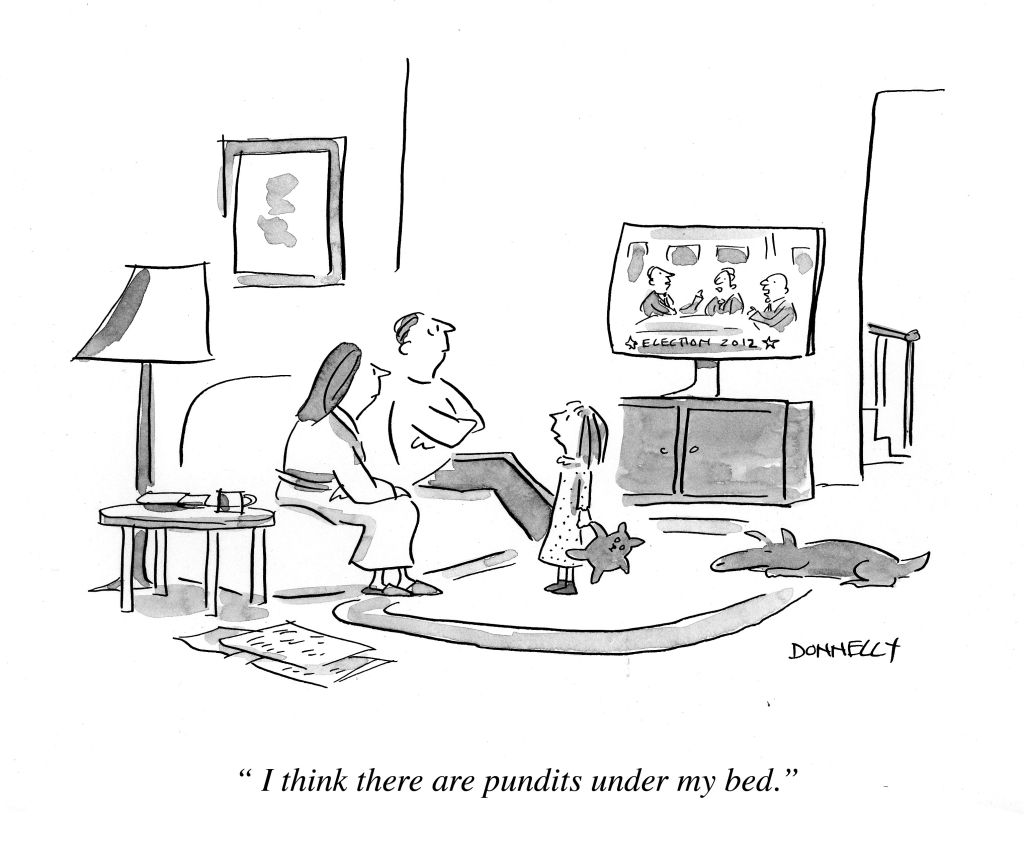

Pundits Get Played But Earn Rents From the Trade

04 Friday Dec 2015

Posted by Nuetzel in Big Government

≈ Leave a comment

Tags

Corporatism, Influence Trading, Jeremy Shapiro, Policy Validation, rent seeking, Selling Policy, The Brookings Institution, Think Tank Influence

pundits-under-my-bed

Powerful officials often seek to influence “thinkers” and pundits by flattering them with access and requesting advice that ultimately is treated as superfluous. That is the upshot of this interesting post from Jeremy Shapiro at The Brookings Institution: “Who Influences Whom? Reflections on U.S. Government Outreach to Think Tanks“.

These relationships are of a different character than the symbioses often existing between government officials (elected and unelected) and private corporations and unions. The corporatist relationships that most often come to mind are infamous for bleeding taxpayers, distorting the economy and using the power of government to advance private interests. The nexus highlighted by Shapiro between officialdom and think-tank experts, as well as influencers in the media and academia, is a different corner of the rent-seeking world, but it is rent seeking nevertheless.

Shapiro, himself a former government official, describes a sequence of events that might be experienced by an outside expert leading up to an “important” meeting with a high government official. Such experts have a strong interest in their areas of study and naturally hope to promote their own views and analyses. An opportunity to provide input to a policymaker is obviously attractive to such a person. Interactions with officials also confer status on experts, who can then trade on the impressive access they’ve been granted. Invitations to meetings like these, in and of themselves, represent successful rent-seeking by policy experts, regardless of whether their policy advice is given serious consideration by public officials.

While outside experts are often called upon for real policy advice, the government official is frequently after something else; in all likelihood, the official already has a policy position:

“The government official desperately wants the thinkers to give him the benefit of the doubt when his inevitably flawed policy comes up for critical examination, as they are an important source of its ultimate evaluation by the Congress and the public. The briefings therefore tend to take place before important diplomatic meetings or foreign trips that will predictably occasion a round of media coverage on the policy in question.“

So the official hopes to engineer mutually beneficial trades with outside experts. Trades of this kind may have no real value to anyone outside of the direct parties. Shapiro’s example relates to foreign policy, but the same dynamic takes place in almost every area of government policymaking:

“The thinkers are the validators. They will write op-eds, give pithy quotes to important newspapers, and appear on network news programs.“

As Shapiro tells it, an intriguing aspect of this process is that the experts are often well aware of the circumstances. Usually, they can be counted upon to pay for their access and the esteem it bestows by offering at least subtle forms of support for the official’s policy initiative:

“The meetings, their grandeur and secrecy, are intended to foster a sense that the thinkers have been listened to and thus are somehow complicit in the policy—the illusion of inclusion. A meeting that seems to the thinker to be an opportunity to persuade is actually an opportunity to be persuaded. It doesn’t always work, of course. Fundamental positions are rarely altered and many of the supposed validators will remain fierce critics. But the biggest secret of all is that, even if the thinker does understand the real purpose, it often works at least at the margins.“

Large numbers of tremendously talented, well-compensated people are engaged in charades like this on a regular basis. We know there are beneficiaries and there are real costs, but who pays for the largess? Obviously taxpayers, but private parties pay in other ways: Media time devoted to pundits is often paid by advertisers and, ultimately, consumers. Private think tanks are supported by private contributors who expect their own views to be validated by analyses and promoted in policy debates. The activity described by Shapiro may subvert those intentions. The real cost to society, however, is the value of resources diverted from productive, private activity to support the circle of rent-jerking. The bigger the government, the bigger the circle.

Bernie Sanders Wants To Deal… Your Property

18 Sunday Oct 2015

Posted by Nuetzel in Socialism, The Road To Serfdom

≈ Leave a comment

Tags

Angus Deaton, Bernie Sanders, Chelsea German, Dierdre McCloskey, Fixed Pie Fallacy, Free Stuff, Gary Burtless, Hillary Clinton, HumanProgress.org, Scandinavia, Socialism, Student Loans, The Brookings Institution, The Great Escape

Fall In Hole giphy

Bernie Sanders is very sincere in his beliefs, and yet he is profoundly ignorant regarding economic growth in the U.S. and the futility of socialism as form of economic organization. Chelsea German, at the HumanProgress blog, presents some simple facts that contradict a few of the Senator’s favorite assertions. In “Senator Sanders and the Fixed Pie Fallacy“, German quotes a line that Sanders has been using for at least 41 years: “The rich are getting richer and the poor are getting poorer.” Granted, his first utterance of that expression might have been in a recession, but aside from those relatively brief episodes, he’s been wrong for the duration. Apparently, Sanders cannot fathom the widespread gains made possible by capitalism and economic growth. Only a “fixed pie” (or worse) would necessarily imply that gains must come at the expense of others, as he seems to believe. (H.T. to Ken DeVaughn on the brilliant gif above.)

One chart in German’s post shows that after-tax income grew in every quintile of the U.S. income distribution from 1979 (pre-recession) to 2010 (post-recession). The chart is taken from CBO data used by Gary Burtless in a piece published by Brookings. Sanders should have a look. However, it’s also important to note that people generally don’t remain in the same strata of the distribution over time. A second chart, from Angus Deaton’s “The Great Escape“, shows that U.S. poverty rates have generally declined over time. Finally, German shows that with a few interruption, GDP has grown over time. All of these facts might be something of a surprise to Sanders. German quotes the great Deirdre McCloskey:

“The rich got richer, true. But millions more have gas heating, cars, smallpox vaccinations, indoor plumbing, cheap travel, rights for women, lower child mortality, adequate nutrition, taller bodies, doubled life expectancy, schooling for their kids, newspapers, a vote, a shot at university, and respect.“

Sanders showcases his lack of familiarity with economic principles almost every time he opens his mouth, or his Twitter account. He recently opined that rates of interest on student loans should be lower than rates on loans for autos and mortgages. Of course, both auto loans and mortgages are secured by valuable collateral and have much lower default rates. It’s a good thing for Sanders that he didn’t pursue a career in lending.

Recently, Hillary Clinton has been unable to restrain herself from chasing Sanders off the rhetorical cliff. Clinton is offering the public lots of “free stuff“, like Sanders, in a transparent attempt to buy votes with promises of future largess. Neither candidate has offered a credible plan for funding their promises. Higher taxes on “Wall Street” and other top earners are the supposed answer, but those measures would be woefully inadequate. Look out, middle class!

By the way, another recent Brookings study shows that increasing the top marginal income tax rate, a policy of which Sanders would approve, would do little to reduce the degree of income inequality.

Of course, Sanders seems just as unfamiliar with the great failures of socialism over the past century as he is with the successes of capitalism in eliminating poverty. He thinks the U.S. should adopt the socialist policies in Scandanavia, but the truth is that socialism has served to inhibit the continued success of capitalism in those countries (also see here). Perhaps that’s why Denmark is scaling back its redistributionist policies.

The Left, including Bernie Sanders, are burdened by a naive utopianism so powerful that they can rationalize the confiscation of private property to support their personal preferences and those of the political class. The aristocratic Left, like Hillary, differ only in the power they hold to influence policy. Perhaps a few suffer from a strong sense of guilt regarding their own circumstances. No, not Hillary. But both Bernie and Hillary are guilty of gross social and economic misdiagnosis. Politicians, heal thyselves!

Subsidized Waste: The Renewable Irony

12 Tuesday May 2015

Posted by Nuetzel in Renewable Energy

≈ Leave a comment

Tags

Charles Frank, Christopher Helman, Elon Musk, Energy Matters, Energy storage, Energy subsidies, Lobos Motl, Renewable energy, Tesla Powerwall battery, The Brookings Institution, The Economist, Viv Forbes, Wind and solar

wind damage

The new Tesla “Powerwall” home battery is probably most noteworthy for the breathless hype it has generated. The $3,500 cost for the 10 kWh version is not cheap, and the installed price is probably closer to $7,000. The battery has a limited number of charge cycles, though Tesla has not fully disclosed all of the specifications. People of considerable expertise in this area (not me!) do not believe that Tesla’s new battery is the least bit innovative as an energy storage technology. See this post by Lobos Motl, or this one by Christopher Helman. This is not to say that Tesla has not made contributions to battery technology, only that this variation is not new, except for the marketing.

How can it pay for itself? The promise is not so much for back-up power during outages. Instead, it is an arbitrage play allowing consumers to store power during off-peak hours and avoid usage during peak-price hours. But the application (and hope) that has excited the media and well-meaning greens is efficient storage of power generated by intermittent, renewable sources. Tesla’s marketing effort certainly fostered such hopes; those with home solar panels may have Tesla sugar plums dancing in their heads.

Advocates of renewable energy can rightly claim that the costs of energy storage (and some forms of renewable power generation) have been declining. But there is still a mismatch between expectations and reality: the Tesla battery is not new technology, and it is not really cheap in terms cost per unit of energy stored and later delivered. The economic viability of intermittent sources of power obviously depends on the combined cost of storage, transmission and the power generated by a renewable source relative to other fuels, including the initial capital outlays. This is reviewed at the Energy Matters blog in “The High Cost of Renewables“, which is largely based on this paper from The Brookings Institution by Charles Frank.

It’s relevant to compare renewables such as wind and solar to nuclear energy and natural gas as replacements for “base-load” coal plants. Nuclear and gas power are often touted as viable, reduced or no-carbon solutions to providing for the energy needs. Two issues make renewables more costly than nuclear and gas in terms of installed cost per kilowatt, despite the huge up-front installation costs of nuclear. The first is the intermittency of wind and solar power generation. According to Frank’s calculations at the link above, this factor alone causes solar to be nearly four times as costly as nuclear energy, and wind to be more than 25% more costly. The second issue is that wind and solar installations have short useful lives relative to nuclear. This adds to the wind and solar cost disadvantages, but the practice of dividing costs by the number of years of useful life probably distorts the comparisons. The shorter-lived installations can be expected to involve lower costs at replacement, which should be averaged into a comparison with a longer-lived asset. Still, there is no question that renewables are more costly than gas and nuclear power.

Critics took Frank to task over certain assumptions following the publication of his paper. He offered rebuttals here, here and here in which he revised his calculations in ways that tested his critics’ assertions. Frank’s conclusions are the same:

“Taking all changes into account, my main conclusions are strengthened. Wind continues to rank number four and, by a large margin, solar number five. Gas combined cycle continues to rank number one by a large margin, although nuclear drops from two to three [behind hydroelectric power].”

This article in The Economist also emphasizes the problem of intermittency:

“… countries which have a lot of renewable generation must still pay to maintain traditional kinds of power stations ready to fire up when demand peaks. And energy from these stations also becomes more expensive because they may not run at full-blast.“

“Firing-up” a power station repeatedly consumes fuel at a greater than proportionate rate. If fossil fuels are involved, this process eats into the presumed benefits of using renewables. Of course, there are other factors that make large-scale renewable energy  “farming” undesirable, such as massive land requirements and danger to birds and even marine life. Here is another piece offering a reality check on the true costs of wind power.

Certain forms of renewable energy and energy storage technologies will continue to advance and their costs will decline over time. However, solar and wind power are currently more costly than other alternatives. The benefits of these technologies to society are highly speculative, since models of carbon-forced climate change do a poor job of explaining the actual climate. In any case, climate change, should it occur, is not unambiguously costly. In the absence of more convincing evidence, the costs of renewable energy supplies should be fully internalized by rational actors (who may have personal preferences for renewables) in private, arms-length transactions. Unfortunately, to date, the growth in the share of renewable energy production in most countries has been abetted by government subsidies, so even the aforementioned private actors are collecting rents at the expense of the rest of society. The extra costs imposed on society represent a waste of resources.

In the absence of compelling evidence of pure public benefits, new technologies should be subject to true market tests, not forced upon the public by mandates or encouraged via artificial self-interest created by subsidies. In “Green Energy Policy: ‘Nothing That Works’“, Viv Forbes discusses the real goals of the extreme green lobby, quoting several environmental radicals. Here is the “money” quote:

“… Amory Lovins of the Rocky Mountains Institute, said: ‘It would be little short of disastrous for us to discover a source of clean, cheap, abundant energy, because of what we might do with it.’“

There are a few countries that have attempted to adopt aggressive policies of renewable energy mandates. Here is a discussion of the German “Green Energy Debacle”. Australia has had its share of problems as well. And here is a warning about the implications of green policy and the imposition of “energy poverty on poor countries“.

Follow Sacred Cow Chips on WordPress.com

Recent Posts

  • The Case Against Interest On Reserves
  • Immigration and Merit As Fiscal Propositions
  • Tariff “Dividend” From An Indigent State
  • Almost Looks Like the Fed Has a 3% Inflation Target
  • Government Malpractice Breeds Health Care Havoc

Archives

  • January 2026
  • December 2025
  • November 2025
  • October 2025
  • September 2025
  • August 2025
  • July 2025
  • June 2025
  • May 2025
  • April 2025
  • March 2025
  • February 2025
  • January 2025
  • December 2024
  • November 2024
  • October 2024
  • September 2024
  • August 2024
  • July 2024
  • June 2024
  • May 2024
  • April 2024
  • March 2024
  • February 2024
  • January 2024
  • December 2023
  • November 2023
  • August 2023
  • July 2023
  • June 2023
  • May 2023
  • April 2023
  • March 2023
  • February 2023
  • January 2023
  • December 2022
  • November 2022
  • October 2022
  • September 2022
  • August 2022
  • July 2022
  • June 2022
  • May 2022
  • April 2022
  • March 2022
  • February 2022
  • January 2022
  • December 2021
  • November 2021
  • October 2021
  • September 2021
  • August 2021
  • July 2021
  • June 2021
  • May 2021
  • April 2021
  • March 2021
  • February 2021
  • January 2021
  • December 2020
  • November 2020
  • October 2020
  • September 2020
  • August 2020
  • July 2020
  • June 2020
  • May 2020
  • April 2020
  • March 2020
  • February 2020
  • January 2020
  • December 2019
  • November 2019
  • October 2019
  • September 2019
  • August 2019
  • July 2019
  • June 2019
  • May 2019
  • April 2019
  • March 2019
  • February 2019
  • January 2019
  • December 2018
  • November 2018
  • October 2018
  • September 2018
  • August 2018
  • July 2018
  • June 2018
  • May 2018
  • April 2018
  • March 2018
  • February 2018
  • January 2018
  • December 2017
  • November 2017
  • October 2017
  • September 2017
  • August 2017
  • July 2017
  • June 2017
  • May 2017
  • April 2017
  • March 2017
  • February 2017
  • January 2017
  • December 2016
  • November 2016
  • October 2016
  • September 2016
  • August 2016
  • July 2016
  • June 2016
  • May 2016
  • April 2016
  • March 2016
  • February 2016
  • January 2016
  • December 2015
  • November 2015
  • October 2015
  • September 2015
  • August 2015
  • July 2015
  • June 2015
  • May 2015
  • April 2015
  • March 2015
  • February 2015
  • January 2015
  • December 2014
  • November 2014
  • October 2014
  • September 2014
  • August 2014
  • July 2014
  • June 2014
  • May 2014
  • April 2014
  • March 2014

Blogs I Follow

  • Passive Income Kickstart
  • OnlyFinance.net
  • TLC Cholesterol
  • Nintil
  • kendunning.net
  • DCWhispers.com
  • Hoong-Wai in the UK
  • Marginal REVOLUTION
  • Stlouis
  • Watts Up With That?
  • Aussie Nationalist Blog
  • American Elephants
  • The View from Alexandria
  • The Gymnasium
  • A Force for Good
  • Notes On Liberty
  • troymo
  • SUNDAY BLOG Stephanie Sievers
  • Miss Lou Acquiring Lore
  • Your Well Wisher Program
  • Objectivism In Depth
  • RobotEnomics
  • Orderstatistic
  • Paradigm Library
  • Scattered Showers and Quicksand

Blog at WordPress.com.

Passive Income Kickstart

OnlyFinance.net

TLC Cholesterol

Nintil

To estimate, compare, distinguish, discuss, and trace to its principal sources everything

kendunning.net

The Future is Ours to Create

DCWhispers.com

Hoong-Wai in the UK

A Commonwealth immigrant's perspective on the UK's public arena.

Marginal REVOLUTION

Small Steps Toward A Much Better World

Stlouis

Watts Up With That?

The world's most viewed site on global warming and climate change

Aussie Nationalist Blog

Commentary from a Paleoconservative and Nationalist perspective

American Elephants

Defending Life, Liberty and the Pursuit of Happiness

The View from Alexandria

In advanced civilizations the period loosely called Alexandrian is usually associated with flexible morals, perfunctory religion, populist standards and cosmopolitan tastes, feminism, exotic cults, and the rapid turnover of high and low fads---in short, a falling away (which is all that decadence means) from the strictness of traditional rules, embodied in character and inforced from within. -- Jacques Barzun

The Gymnasium

A place for reason, politics, economics, and faith steeped in the classical liberal tradition

A Force for Good

How economics, morality, and markets combine

Notes On Liberty

Spontaneous thoughts on a humble creed

troymo

SUNDAY BLOG Stephanie Sievers

Escaping the everyday life with photographs from my travels

Miss Lou Acquiring Lore

Gallery of Life...

Your Well Wisher Program

Attempt to solve commonly known problems…

Objectivism In Depth

Exploring Ayn Rand's revolutionary philosophy.

RobotEnomics

(A)n (I)ntelligent Future

Orderstatistic

Economics, chess and anything else on my mind.

Paradigm Library

OODA Looping

Scattered Showers and Quicksand

Musings on science, investing, finance, economics, politics, and probably fly fishing.

  • Subscribe Subscribed
    • Sacred Cow Chips
    • Join 128 other subscribers
    • Already have a WordPress.com account? Log in now.
    • Sacred Cow Chips
    • Subscribe Subscribed
    • Sign up
    • Log in
    • Report this content
    • View site in Reader
    • Manage subscriptions
    • Collapse this bar
 

Loading Comments...