• About

Sacred Cow Chips

Sacred Cow Chips

Monthly Archives: January 2024

They Pave Paradise Because Users Pay No Price

24 Wednesday Jan 2024

Posted by Nuetzel in Price Mechanism, Scarcity

≈ Leave a comment

Tags

Car Dependence, Cloverleaf Interchanges, Congestion pricing, Diamond Interchange, Diverging Diamond, Dynamic Pricing, Failure of the Commons, Flyover Ramps, Gas Taxes, Infrastructure Investment and Jobs Act, Interstate Highways, Jessica Trounstine, Joe Biden, Joel Kotkin, Lyft, New York City, Paved Paradise, Private Roads, Reddit, Robert P. Murphy, Sarasota, Socialized Roads, SunPass, Tolls, Uber, Urban planning, Urban Sprawl, Willian Frey
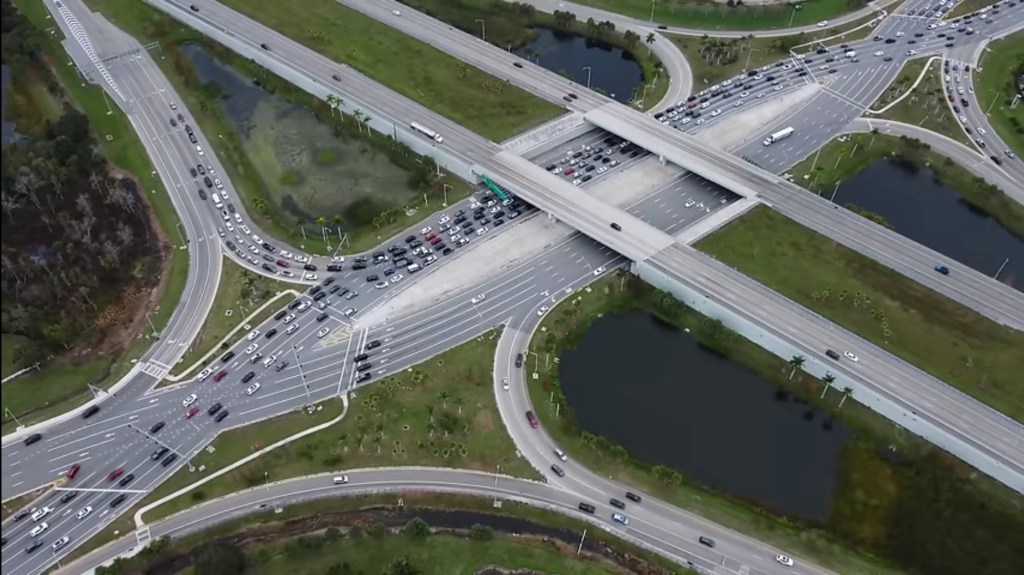
The interchange above is just a few miles from my new home. It’s the world’s largest “diverging diamond” design and it usually works quite well, so I was interested to see this video discussing both its benefits and the conditions under which it hasn’t performed well.

Unfortunately, the video maintains a dubious focus on car dependence in most urban areas. The tale it tells is daunting… and if the reaction on Reddit is any indication, it seems to excite the populist mind. The narrator blames car dependence and sprawl on poor urban planning. I agree in a sense, and I’ll even stipulate that our car dependence is often excessive, but not because anyone could have “planned” better. Top-down planning is notoriously failure-prone. Rather, the corrective is something the creators of the video never contemplate: effective pricing for the use of roads.

There is deserved emphasis near the end of the video on the cost of building and maintaining roads and interchanges. For example, the cost of the interchange above was $74.5 million when it was built about 15 years ago. That sounds exorbitant, and it’s natural for people (and especially urban planners) to question the necessity of building an interchange of that magnitude in what many feel “should be” an outlying district. Did sprawl make it necessary? Can that be avoided in a growing region? What can or should be done?

Good Interchange Design

The interchange in question is at I-75 and University Parkway in Sarasota, FL. It’s used by many drivers to access a large shopping mall, other commercial centers, and nearby residential areas. The video stresses the diverging diamond’s effectiveness and safety in handling high flows of traffic. The design reduces the number of conflict points relative to conventional diamond interchanges, especially for crossing traffic.

Both diverging diamonds and conventional diamond interchanges have advantages over cloverleaf designs. While the latter have no crossover conflict points, they require more land use. They also create additional complexities for grading and drainage, and they are often constrained in the length of space available for left-turn merges. Furthermore, a cloverleaf places more severe limits on traffic flow. Flyover ramps are another alternative that can save space but entail greater expense.

The interchange in question serves an area of rapid growth. Residents increasingly complain about traffic, especially when “snow birds” are in town during the winter months. The video shows that even the diverging diamond has problems once traffic reaches a certain volume. But new residential communities and commercial areas continue to come on-line, adding to traffic flows and requiring additional roads and infrastructure. Again, the narrator believes the resulting traffic and sprawl could have been avoided, and he’s partly correct as far as that goes.

Sprawl Reflects Preferences

The video fails to consider important qualifications to the “car dependence” critique of suburban sprawl. For example, many people like to use their cars and enjoy the freedom of mobility their cars confer. More importantly, most people prefer to live in low-density residential environments rather than dense urban neighborhoods, or even the kinds of communities depicted as ideal in the video. I’m one of those people. More space, more privacy, and more greenery (though I grant that sprawling mall parking lots are not my favorite aesthetic).

Joel Kotkin presents data along those lines, quoting research by Jessica Trounstine, who says, “preferences for single-family development are ubiquitous.” And low-density communities have broad appeal across demographics, as noted by Kotkin:

“Even in blue states, the majority of ethnic minorities live in suburbs, who have accounted for virtually all the suburban growth over the past decade. William Frey of the Brookings Institution notes that in 1990 roughly 20 percent of suburbanites were non-white. That rose to 30 percent in 2000 and 45 percent in 2020.”

Urban Planning Myopia

As to the video’s emphasis on car dependence, its most serious omission is a failure to recognize the economics of pricing. Road use comes with various costs, but the key here is the zero price at the margin for using specific routes, interchanges, bridges, and suburban parking lots. There are many exceptions to be sure, but the video makes no mention of road pricing as a development tool. Nor does it consider “socialized roads” as the chief cause of ever-expanding demands for roads, parking, and the all-too-typical failure of these ersatz “commons”.

The federal government is complicit in this. After all, the interstate highway system was a federal initiative, and interchanges (along with concomitant commercial development) are integral to its success. Interstate highways often supplemented regional efforts to facilitate commuting to cities from distant suburbs. More recently, Joe Biden’s Infrastructure Investment and Jobs Act of 2021 added $110 billion a year from the government’s general fund to subsidize highways and bridges. It should be no surprise that federal gas taxes don’t fund these subsidies. (Gas taxes are user fees only in a vague sense, as they don’t price specific routes at the margin).

More Roads, Trains, Buses?

There are two knee-jerk reactions to congested roads. The first is a tendency to double-down on invested plant, building more, bigger, and wider roads in the hope that they can handle the growing traffic load. Presumably this must be funded by taxpayers, as in the past, and seldom if ever by charging per marginal use of these facilities. This “solution” basically calls for more socialized roads.

The second knee-jerk reaction to congestion, and it is also a reaction to the real or presumed shortcomings of a “paved paradise”, is to call for more buses, streetcars, or light rail. But mass transit systems seldom pay for their operating costs let alone their capital costs. One of the reasons, of course, is that they must compete with free roads!

What else might the urban planners have us do? We can’t just tear down the sprawling developments and road infrastructure and start over. However, we can accomplish a few other things like: 1) raise revenue from users to make the upkeep of road infrastructure self-funding; 2) minimize congestion, emissions, and time-use while improving safety; and 3) stem growth in demand that eventually would require more lanes, more parking, and other measures to maximize traffic flow. Pricing the actual use of roads would do all these things in greater or lesser degree, and it would more effectively balance development preferences with costs. In turn, positive road-use prices would incentivize other development models such as the “human-centric” communities the video’s narrator finds so attractive.

Those Who Benefit Shall Pay

Tolls for the use of roads and bridges (and paid parking) are hardly new ideas. Tolls on bridges were a natural continuation of fees charged by operators of ferry boats. Tolling was instituted by large landholders to extract rents from anyone wishing to traverse their property, and only later was used as a mechanism for funding road construction and maintenance. But like any price, tolls serve to ration the availability of a resource.

Today, tolling in the U.S. is an increasingly important source of funding for highways and bridges. This importance is growing due to a less sanguine outlook for gas tax collections. In any case, tolls are often more advantageous politically than taxes. Technological advance has allowed tolling to become more cost effective as well. In Florida, for example, the SunPass system allows drivers to cruise through toll collection points at moderate speeds. It’s also used for parking at certain facilities like airports. SunPass holders are required to set up automatic “recharge” of their available balance for toll payments. Similar systems are in place in other states.

Technology has enabled dynamic congestion pricing to be implemented by commercial interests like Uber and Lyft. This means that price responds to demand and supply conditions in real time. In coming years, congestion pricing is likely to be instituted by jurisdictions experiencing heavy traffic volumes. New York City’s congestion pricing plan has stalled, but it would charge a toll on vehicles using Manhattan streets below Central Park.

Law of Demand

Tolls at interchanges like the one at I-75 and University Parkway would help to allocate resources more efficiently. First, the mechanics could be simple enough in concept, but toll booths are probably out of the question, and toll authorities would have to sort through various administrative issues.

Let’s suppose SunPass was put to use here, with the revenue distributed to several jurisdictions or agencies responsible for maintaining the interchange and a defined set of connecting streets. When a driver exits I-75 to University, enters I-75 from University, or uses the through lanes on University, the SunPass transponder in their vehicle would communicate with the toll system to record their passage, and their account would be charged the appropriate toll. The charge might differ for through lanes versus I-75 entry or exit. Over the course of a month, tolls on various roads and interchanges would accumulate and be summarized by road or interchange on a statement for the driver.

Vehicles without SunPass (or another toll system partnering with SunPass) would have to be charged via photo identification of tags with billing by mail once a month. This is already a feature of toll roads in Florida (and other states) when vehicles without a SunPass use the SunPass lanes. The volume of mail billing would increase substantially, but that is not an obstacle in principle.

One other wrinkle would allow existing residents of neighborhoods with street entrances within one or two miles of the interchange to receive discounted tolls. That seems fair, but the danger is that discounts of this kind, if extended too far, would blunt incentives that otherwise discourage overuse and underpriced road sprawl. It would also add another layer of complexity to the tolling system.

The behavior of drivers will change in response to tolls. They derive benefits from using particular interchanges which depend upon the importance of errands or appointments in each vicinity, the distance and convenience of other shopping areas, the time of day, and the time saved by using any one route instead of alternates. The toll paid for using an interchange might depend on the size of vehicle, the time of day, or some measure of average congestion at that time of day. A higher toll prompts drivers to consider other routes, other shopping areas (including on-line shopping), or different times of day for those errands. Thus, tolls will redistribute traffic across space and time and are likely to reduce overall traffic at the most congested interchanges, at least at peak hours when tolls are highest.

Smart Pricing

The advent and installation of more sophisticated tolling infrastructure will enable “smart roads”, time-of-day pricing, or even dynamic congestion pricing on some routes. Integrating dynamic pricing with information systems guiding driver decisions about route choice and timing would be another major step. Implementing sophisticated route pricing systems like this will take time, but ultimately the technology will allow tolls to be applied broadly and efficiently… if we allow it to happen.

Private Vs. Public

The private sector is likely to play a greater role in a world of more widespread tolling. To some extent this will take the form of more privately-owned roads. Short of that, many toll roads and smart roads will be privately administered and operated. Private concerns will also play a major role in provisioning infrastructure and systems for more widespread and sophisticated toll roads.

There is a long history of private roads in the U.S. Robert P. Murphy offers a brief summary:

“… many analysts simply assume, because currently the government virtually monopolizes the production and administration of roads, that it must always have done so. And yet, from the 1790s through the 1830s, the private sector was responsible for the creation and operation of many turnpikes. According to economist Daniel Klein, ‘The turnpike companies were legally organized like corporate businesses of the day. The first, connecting Philadelphia and Lancaster, was chartered in 1792, opened in 1794, and proved significant in the competition for trade.’3 ‘By 1800,’ Klein reports, ‘sixty-nine companies had been chartered’ in New England and the Middle Atlantic states. Merchants would often underwrite the expense of building a turnpike, knowing that it would bring in extra traffic to their businesses.”

In Norway and Sweden, most roads are owned and operated privately, though most of the private roads are local. The funding is generally provided by property owners along those routes. Private roads are increasingly common in the U.S., but they are mostly confined to private communities funded by residents. Broader private ownership of roads, and tolling, is likely to occur in the U.S. as governments at all levels struggle with issues of funding, maintenance, traffic control, and growth.

Pricing For Scarcity

There will be political obstacles to widespread tolling and road congestion pricing. Questions of equity and privacy will be raised, but pricing may hold the key to achieving more equitable outcomes. Greater reliance on tolls would avoid regressive tax increases, and selective tolls themselves might well have a progressive incidence, to the extent that congestion tends to be high in prosperous commercial districts. It would make alternatives like mass transit more competitive and viable as well. Furthermore, price signals will cause geographic patterns of commerce and development to shift, potentially encouraging the kinds of high-density, pedestrian communities long-favored by urban planners.

Urban sprawl and auto dependence are old targets of the urban planning community, not to mention the populist left. But those critics rely on a stylized characterization of geographic and social arrangements that happen to be preferred by masses of individuals. As an economist, I sympathize with the critics because those preferences are revealed under incentives that do not reflect the scarcity and real costs of roads and driving. However, in the absence of adequate price incentives, solutions offered by critics of sprawl and autos are at worst brutally intrusive and at best ineffectual. More efficient pricing of roads can be achieved with the installation of tolling solutions that are now technologically feasible. Optimizing tolls over specific roads, bridges, blocks, intersections, and interchanges will require more sophisticated systems, but for now, let’s at least get road-use prices going in the right direction!

Stubborn Inflation and the Fed’s Approach Trajectory

15 Monday Jan 2024

Posted by Nuetzel in Economic Outlook, Monetary Policy

≈ Leave a comment

Tags

Birth-Death Model, BLS, Core Inflation, CPI, Establishment Survey, Federal Funds Rate, Federal Open Market Committee, Federal Reserve, FOMC, Grateful Dead, Hard Landing, Household Survey, Inflation, Jerome Powell, Nonfarm Payrolls, PCE Deflator, PPI, Red Sea, Seasonal Adjustment, Soft Landing, Supply Shocks

When Federal Reserve Chairman Jerome Powell said “higher for longer” last year, it wasn’t about the Grateful Dead concerts he’s attended over the years. No, he meant the Fed might need to raise its short-term interest rate target and/or keep it elevated for an extended period to squeeze inflation out of the economy. As late as December, Powell said that additional rate hikes remain on the table. But short of that, the Fed might keep its current target rate steady until inflation is solidly in-line with its 2% objective. The obvious risk is that tight monetary policy might tip the economy into recession. The market, for its part, is pricing in several rate cuts this year.

Thus far, the release of key economic data for December 2023 has not settled the debate as to whether disinflation has truly paused short of the Fed’s goal. There were inauspicious signs from the labor market in December as well. These data releases don’t rule out a “soft landing”, but they indicate that recession risks are still with us in 2024. The Fed will face a dilemma if the economy weakens but inflation fails to abate, either due to residual stickiness or new supply shocks. The latter are unfolding even now with the shut down of Red Sea shipping.

Bad Employment Report

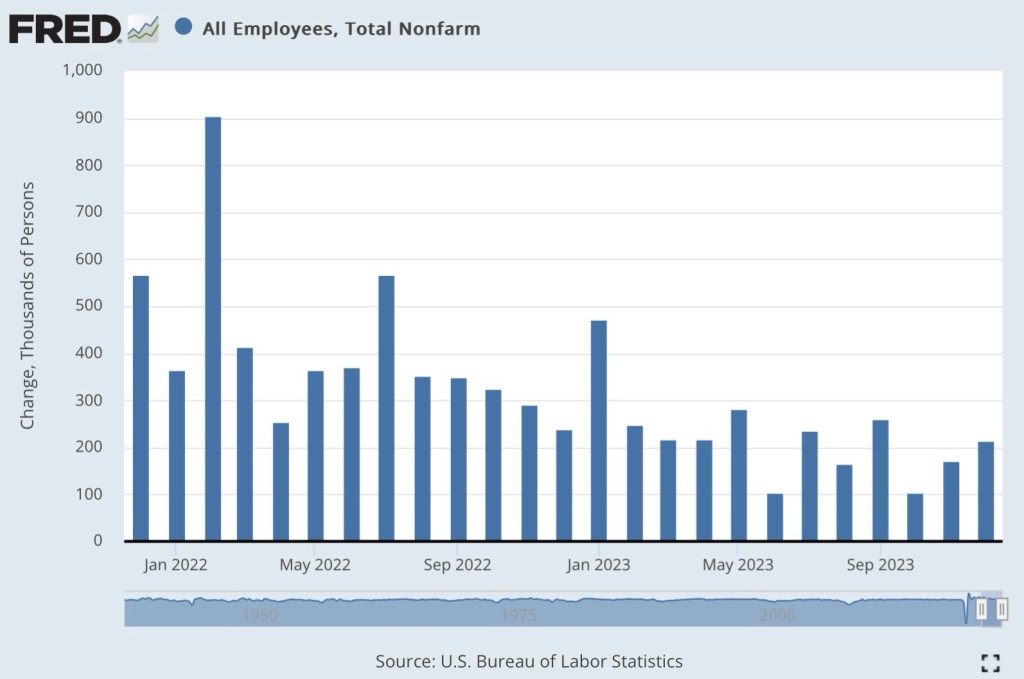
On the surface, the employment report from the Bureau of Labor Statistics (BLS) was strong relative to expectations, and the media reported it on that superficial level: nonfarm payrolls increased by 216,000 jobs, about 45,000 more than expected; unemployment was unchanged from November at 3.7%.

Unfortunately, the report contained several ominous signs:

1) Employment from the BLS Household Survey declined by 683,000 in December and is essentially flat since July. This discrepancy should be rather unsettling to anyone waving off the possibility of a recession.

2) The number of full-time workers decreased by 1.53 million in December, and the number of part-time workers increased by 762,000 as the holidays approached. Retail employment was not particularly strong however, and the big loss of full-time work stands in contrast to the “strong-report” narrative.

3) The number of multiple jobholders hit a record and increased by 556,000 over the past year. This might indicate trouble for some workers making ends meet.

5) The civilian labor force declined by 676,000. What accounts for the change in status among these former workers or job seekers?

6) From the BLS Establishment Survey, government hiring accounted for 24% of the nonfarm jobs filled in December. Social Services accounted for 10% of the new hiring and health care for 18%, both of which are heavily dependent on government.

7) Nonfarm payrolls were revised downward by a total of 71,000 for October and November. We’ve seen downward revisions for 10 of the past 11 months.

8) In total, initial monthly job reports in 2023 overstated the full-year gain in nonfarm employment after available revisions by 439,000.

Those are big qualifiers on the “stronger than expected” jobs report. Furthermore, I tend to discount new government jobs as a real engine of production possibilities, so the report didn’t offer much assurance about the economy’s momentum. In addition, there are estimates that the payroll gain was due to better weather than the seasonal adjustment factors indicate.

Fictional Payroll Gains?

Still other issues cast doubt on the BLS payroll numbers. First, they are based on a survey of employers that is not complete by the time of each month’s initial report. Second, the survey is heavily skewed toward employees of government and large corporations; the sample of small employers is light by comparison. Third, seasonal adjustments often swamp the unadjusted changes in payrolls.

Finally, the BLS uses a statistical model of business births/deaths to adjust the figures. This is intended to correct for a lag in survey coverage as new businesses are formed and others close. The net effect on the payroll estimate can be positive or negative. Unfortunately, it’s difficult for even the BLS to tell how much the birth/death model affects the headline nonfarm jobs figure in any particular month. Therefore, it’s tough to put much faith in the monthly reports, but we watch them anyway.

Stubborn Inflation

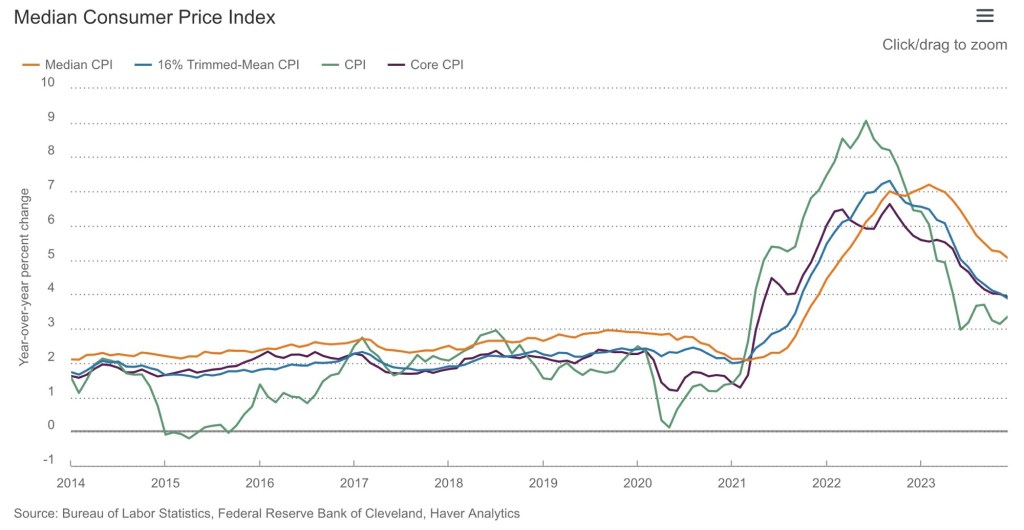
The Consumer Price Index (CPI) for December increased 0.3% over November and 3.4% year-over-year, slightly more than expectations of 0.2% and 3.2%, respectively. The “core” CPI (excluding food and energy prices) rose 3.9% year-over-year, more than the 3.8% expected. The core rate declined on a one-month and year-over-year basis, however, as did the median item in the CPI.

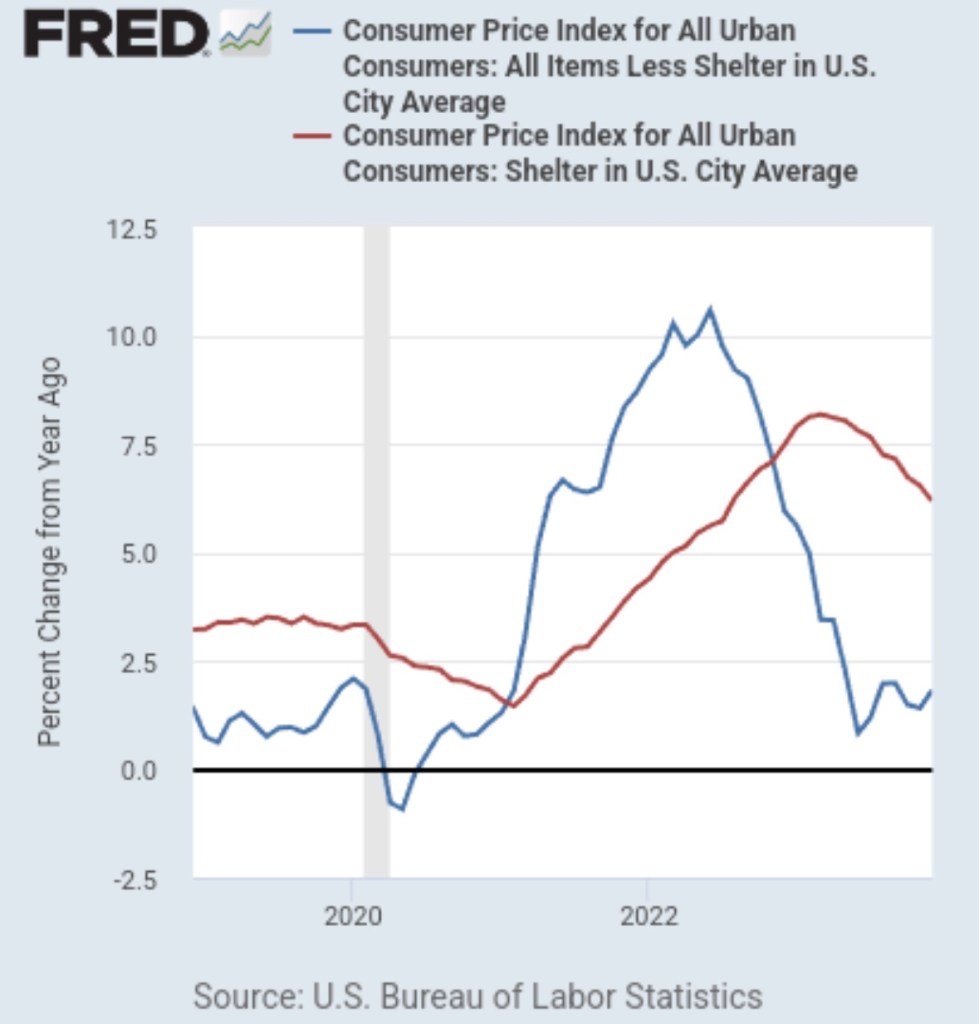
All CPI measures in the chart declined during 2023, though the core and median lagged the headline CPI (green line), which “flattened” somewhat during the last half of the year. So there appears to be some stickiness hindering disinflation in the CPI at this point, but the apparent “stickiness” has been confined to lagging declines in housing costs (also see here).

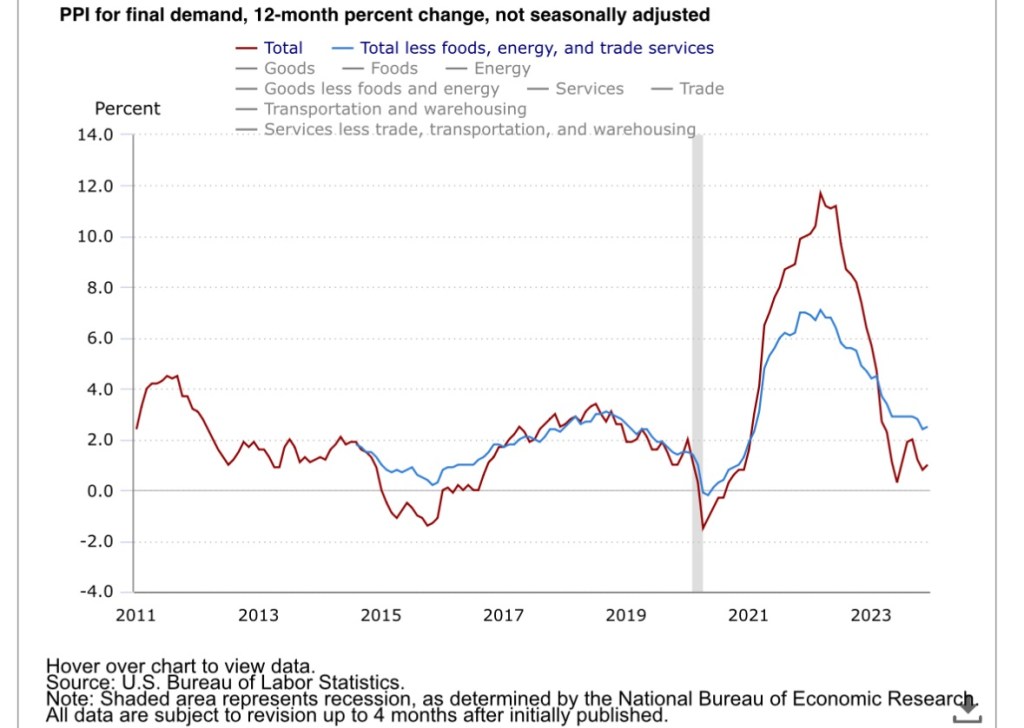
The Producer Price Index (PPI) reported a day later was thought to be benign. Like the CPI, disinflation in the core PPI has tapered:

In this context, it should be noted that declines in the Fed’s preferred inflation gauge, the PCE deflator, have also undergone something of a pause, and the PCE weights housing costs much less heavily than the CPI.

The CPI and PPI reports don’t offer any reason for the Fed to reduce its target federal funds rate over the next couple of Federal Open Market Committee (FOMC) meetings. There are two more sets of monthly inflation reports before the meeting in late March, so things could change. But again, the Fed has given ample guidance that it might have to leave its target rate at the current level for an extended period.

The Market View

Markets had priced-in six cuts in the Fed funds rate target in 2024 prior to the CPI report, but traders began to discount that possibility in its immediate aftermath. However, members of the FOMC expected an average of three cuts in 2024, with more to come in 2025, whether or not that’s consistent with “higher for longer”. Inflation is hovering somewhat above the Fed’s goal, but getting the rest of the job done might be tough, and indeed, might imply “longer” if not “higher”.

But why did the market ever hold the expectation of six cuts this year? Traders must have anticipated an economic contraction, which would kick the Fed into rapid response mode. The employment report offered no assurance that such a “hard landing” will be avoided. A few more negative signals on the real economy without further progress on prices would provide quite a test of the Fed’s inflation-fighting resolve.

That Word “Liberal” … I Don’t Think That Means What You Think It Means

03 Wednesday Jan 2024

Posted by Nuetzel in Conservatism, Liberalism, Socialism

≈ Leave a comment

Tags

Adam Smith, Capitalism, Classical Liberal, Conservatism, Consumer Sovereignty, Corporatism, Free Markets, Freedom of Speech, Friedrich Hayek, Liberalism, Libertarianism, MAGA, monopoly, Monopsony, Nate Silver, Natural Rights, Non-Aggression Principle, Perfect Competition, Progressivism, Property Rights, Public goods, Religious Freedom, Right to Life, Scott Sumner, social engineering, Socialism, State Capacity, State Religion, statism, The Wealth of Nations

Leftism has taken on new dimensions amid its preoccupation with identity politics, victimhood, and “wokeness”. Traditional socialists are still among us, of course, but “wokeists” and “identitarians” have been on the progressive vanguard of late, rooting for the deranged human butchers of Hamas and the dismantling of liberal institutions. This didn’t happen overnight, of course, and traditional socialists are mostly fine with it.

An older story is the rebranding of leftism that took place in the U.S. during the first half of the 20th century, when the word “liberal” was co-opted by leftists. Before that, a liberal orientation was understood to be antithetical to the collectivist mindset long associated with the Left. Note also that liberalism retains its original meaning even today in much of Europe. Often we hear the term “classical liberal” to denote the “original” meaning of liberalism, but the modifier should be wholly unnecessary.

Liberalism Is Not “In-Betweenism”

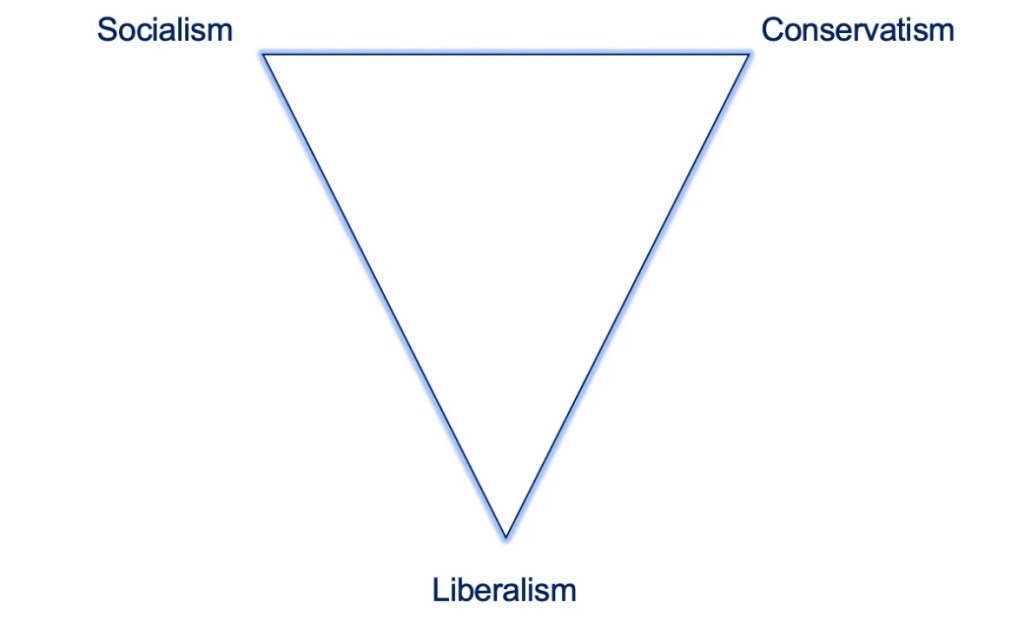
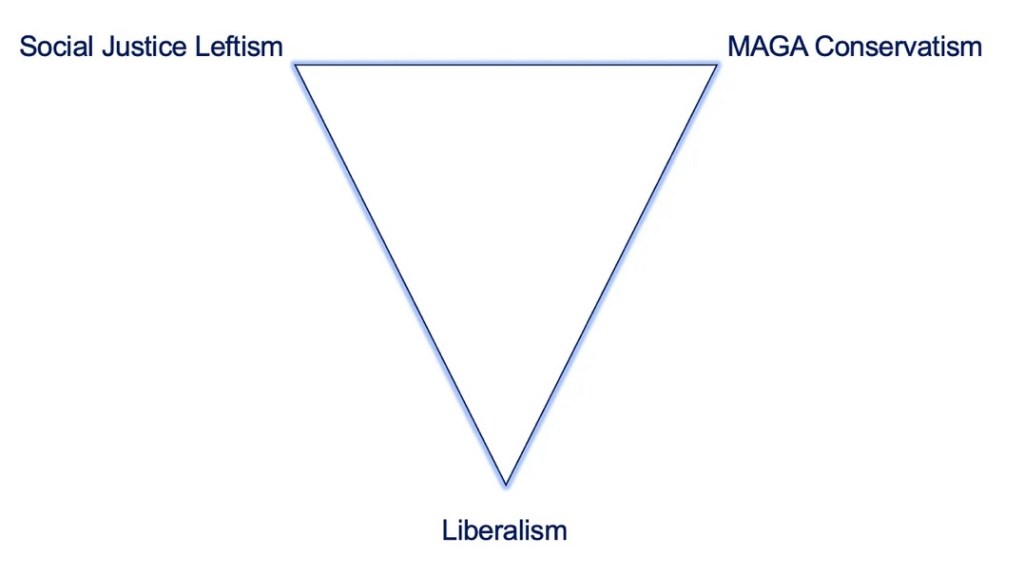
In this vein, Nate Silver presents a basic taxonomy of political orientation in a recent Substack post. It includes the diagram above, which distinguishes between socialism, conservatism, and liberalism. Silver draws on a classic essay written by Friedrich Hayek in 1945, “Why I am Not a Conservative”, in which Hayek discussed the meaning of the word “liberal” (and see here). Liberalism’s true emphasis is a tolerance for individual rights and freedoms, subject to varying articulations of the “nonaggression principle”. That is, “do as you like, but do no harm to others”.

We often see a linear representation distinguishing between so-called progressives on the left and conservatives on the right. Of course, a major hallmark of leftist thinking is extreme interventionism. Leftists or progressives are always keen to detect the slightest whiff of an externality or the slightest departure from the perfectly competitive market ideal. They seem eager to find a role for government in virtually every area of life. While it’s not a limiting case, we can substitute socialism or statism for progressivism on the far left, as Silver does, whereby the state takes primacy in economic and social affairs.

Conservatism, on the other hand, is a deep resistance to change, whether institutional, social, and sometimes economic. Conservatives too often demonstrate a willingness to use the coercive power of the state to prevent change. Hayek noted the willingness of both socialists and conservatives to invoke state power for their own ends.

Similarly, religious conservatives often demand state support beyond that afforded by the freedom to worship in the faith of one’s choice. They might strongly reject certain freedoms held to be fundamental by liberals. Meanwhile, socialists often view mere religious freedom as a threat to the power of the state, or at least they act like it (e.g. see here for an example).

Like conservatives, dedicated statists would doubtless resist change if it meant a loss of their own power. That is, they’d wish to preserve socialist institutions. On this point, witness the vitriol from the Left over what it perceives as threats to the public school monopoly. Witness also the fierce resistance among public employees to reducing the scale of the administrative state, and how advocates of entitlements fiercely resist decreases in the growth rate of those expenditures.

Silver, like Hayek, objects to the traditional, linear framework in which liberals are thought to occupy a range along a line between socialism and conservatism. He objects to that because real liberals value individual liberty as a natural human right, a viewpoint typically abhored by both socialists and conservatives. There is nothing “in between” about it! And of course, conservatives and progressives are equally guilty in their mistaken use of the word “liberal”.

Mapping Political Preferences

Liberty, statism, and conservatism are not exactly orthogonal political dimensions. Larger government almost always means less economic liberty. At a minimum, state dominance implies a social burden associated with public monopoly and monopsony power, as well as tax and welfare-state incentive problems. These features compromise or corrupt the exercise of basic rights. On the other hand, capitalism and its concomitant reliance on consumer sovereignty, individual initiative, free exchange and secure property rights is most in harmony with true liberalism.

For conservatives, resistance to change in support of a traditionally free market economy might offer something of a contradiction. In one sense, it corresponds to upholding market institutions. However, free markets allow new competitors and new technologies to undermine incumbents, who conservatives sometimes wish to defend through regulatory or protectionist measures. And conservatives are almost always too happy to join in the chorus of “price gouging” in response to the healthy operation of the free market in bringing forth supplies.

All that is to say that preferences involving liberty, statism, and traditionalism are not independent of one another. They cannot simply be mapped onto a three-dimensional space. At least the triangular representation gets liberalism out of the middle, but it’s difficult to visualize other ideological positions there. For example, “state religionism” could lie anywhere along the horizontal line at the top or even below it if certain basic liberties are preserved. Facism combines elements of socialism and a deformed version of capitalism that is properly called corporatism, but where would it fall within the triangle?

Big Government Liberalism?

Silver says he leans heavily toward a “big government” version of liberalism, but big government is hard to square with broad liberties. Granted, any well-functioning society must possess a certain level of “state capacity” to defend against private or public violations of individual rights, adjudicate disputes, and provide true public goods. It’s not clear whether Silver’s preferences lie within the bounds of those ambitions. Still, he deserves credit for his recognition that liberalism is wholly different from the progressive, socialist vision. It is the opposite.

The “New” Triangle

Silver attempts to gives the triangular framework a more contemporary spin by replacing conservatism with “MAGA Conservatism” and socialism with “Social Justice Leftism” (SJL), or “wokeism”. Here, I’m treating MAGA as a “brand”. Nothing below is intended to imply that America should not be a great nation.

The MAGA variant of conservatism emphasizes nationalism, though traditional conservatives have never been short on love of nation. For that matter, as a liberal American, it’s easier to forgive nationalist sentiments than it is the “Death to America” refrain we now hear from some SJLs.

The MAGA brand is also centered around a single individual, Donald Trump, whose rhetoric strikes many as nativistic. And Trump is a populist whose policy proposals are often nakedly political and counterproductive.

SJL shares with socialism an emphasis on various forms of redistribution and social engineering, but with a new focus on victimhood based on classes of identity. Of SJL, Silver says:

“Proponents of SJL usually dislike variations on the term ‘woke’, but the problem is that they dislike almost every other term as well. And we need some term for this ideology, because it encompasses quite a few distinctive features that differentiate it both from liberalism and from traditional, socialist-inflected leftism. In particular, SJL is much less concerned with the material condition of the working class, or with class in general. Instead, it is concerned with identity — especially identity categories involving race, gender and sexuality, but sometimes also many others as part of a sort of intersectional kaleidoscope.”

The gulf between liberals and SJLs couldn’t be wider on issues like free speech and “equity”, and equality of opportunity. MAGAns, on the other hand, have some views on individual rights and responsibility that are largely consistent with liberals, but reflexive populism often leads them to advocate policies protecting rents, corporate welfare, and protectionism.

Divided Liberalism

Liberalism emphasizes limited government, individual autonomy, and free exchange. However, there are issues upon which true liberals are of divided opinion. For example, one such area of controversy is the conflict between a woman’s right to choose and the fetal right to life. Many true liberals disagree over whether the rights of a fetus outweigh its mother’s right to choose, but most would concede that the balance shifts to the fetus at some point well short of birth (putting aside potential dangers to the mother’s life). Open borders is another area that can divide true liberals. On one side, the right to unrestricted mobility is thought to supersede any public interest in enforcing borders and limiting the flow of immigrants. On the other side, questions of national sovereignty, national security, as well as social and state capacity to absorb immigrants take primacy.

Don’t Call Lefties “Liberal”… They’re Not!

True liberalism (including most strains of libertarianism) recognizes various roles that a well-functioning state should play, but it also recognizes the primacy of the individual and individual rights as a social underpinning. As Hayek noted, true liberals are not resistant to change per se, unlike conservatives. But modern progressives demand changes of the worst kind: that the state should intervene to pursue their favored objectives, laying claim to an ever-greater share of private resources. This requires government coercion on a massive scale, the antithesis of liberalism. It’s time to recognize that “progressives” aren’t liberals in any sense of the word. For that matter, they don’t even stand for progress.

I’ll close with a quote from Adam Smith that I cribbed from Scott Sumner. Unfortunately, Sumner does not give the full reference, but I’ll take his word that Smith wrote this 20 years before the publication of The Wealth of Nations:

“Little else is requisite to carry a state to the highest degree of opulence from the lowest barbarism, but peace, easy taxes, and a tolerable administration of justice; all the rest being brought about by the natural course of things. All governments which thwart this natural course, which force things into another channel, or which endeavour to arrest the progress of society at a particular point, are unnatural, and to support themselves are obliged to be oppressive and tyrannical.”

Follow Sacred Cow Chips on WordPress.com

Recent Posts

  • Immigration and Merit As Fiscal Propositions
  • Tariff “Dividend” From An Indigent State
  • Almost Looks Like the Fed Has a 3% Inflation Target
  • Government Malpractice Breeds Health Care Havoc
  • A Tax On Imports Takes a Toll on Exports

Archives

  • December 2025
  • November 2025
  • October 2025
  • September 2025
  • August 2025
  • July 2025
  • June 2025
  • May 2025
  • April 2025
  • March 2025
  • February 2025
  • January 2025
  • December 2024
  • November 2024
  • October 2024
  • September 2024
  • August 2024
  • July 2024
  • June 2024
  • May 2024
  • April 2024
  • March 2024
  • February 2024
  • January 2024
  • December 2023
  • November 2023
  • August 2023
  • July 2023
  • June 2023
  • May 2023
  • April 2023
  • March 2023
  • February 2023
  • January 2023
  • December 2022
  • November 2022
  • October 2022
  • September 2022
  • August 2022
  • July 2022
  • June 2022
  • May 2022
  • April 2022
  • March 2022
  • February 2022
  • January 2022
  • December 2021
  • November 2021
  • October 2021
  • September 2021
  • August 2021
  • July 2021
  • June 2021
  • May 2021
  • April 2021
  • March 2021
  • February 2021
  • January 2021
  • December 2020
  • November 2020
  • October 2020
  • September 2020
  • August 2020
  • July 2020
  • June 2020
  • May 2020
  • April 2020
  • March 2020
  • February 2020
  • January 2020
  • December 2019
  • November 2019
  • October 2019
  • September 2019
  • August 2019
  • July 2019
  • June 2019
  • May 2019
  • April 2019
  • March 2019
  • February 2019
  • January 2019
  • December 2018
  • November 2018
  • October 2018
  • September 2018
  • August 2018
  • July 2018
  • June 2018
  • May 2018
  • April 2018
  • March 2018
  • February 2018
  • January 2018
  • December 2017
  • November 2017
  • October 2017
  • September 2017
  • August 2017
  • July 2017
  • June 2017
  • May 2017
  • April 2017
  • March 2017
  • February 2017
  • January 2017
  • December 2016
  • November 2016
  • October 2016
  • September 2016
  • August 2016
  • July 2016
  • June 2016
  • May 2016
  • April 2016
  • March 2016
  • February 2016
  • January 2016
  • December 2015
  • November 2015
  • October 2015
  • September 2015
  • August 2015
  • July 2015
  • June 2015
  • May 2015
  • April 2015
  • March 2015
  • February 2015
  • January 2015
  • December 2014
  • November 2014
  • October 2014
  • September 2014
  • August 2014
  • July 2014
  • June 2014
  • May 2014
  • April 2014
  • March 2014

Blogs I Follow

  • Passive Income Kickstart
  • OnlyFinance.net
  • TLC Cholesterol
  • Nintil
  • kendunning.net
  • DCWhispers.com
  • Hoong-Wai in the UK
  • Marginal REVOLUTION
  • Stlouis
  • Watts Up With That?
  • Aussie Nationalist Blog
  • American Elephants
  • The View from Alexandria
  • The Gymnasium
  • A Force for Good
  • Notes On Liberty
  • troymo
  • SUNDAY BLOG Stephanie Sievers
  • Miss Lou Acquiring Lore
  • Your Well Wisher Program
  • Objectivism In Depth
  • RobotEnomics
  • Orderstatistic
  • Paradigm Library
  • Scattered Showers and Quicksand

Blog at WordPress.com.

Passive Income Kickstart

OnlyFinance.net

TLC Cholesterol

Nintil

To estimate, compare, distinguish, discuss, and trace to its principal sources everything

kendunning.net

The Future is Ours to Create

DCWhispers.com

Hoong-Wai in the UK

A Commonwealth immigrant's perspective on the UK's public arena.

Marginal REVOLUTION

Small Steps Toward A Much Better World

Stlouis

Watts Up With That?

The world's most viewed site on global warming and climate change

Aussie Nationalist Blog

Commentary from a Paleoconservative and Nationalist perspective

American Elephants

Defending Life, Liberty and the Pursuit of Happiness

The View from Alexandria

In advanced civilizations the period loosely called Alexandrian is usually associated with flexible morals, perfunctory religion, populist standards and cosmopolitan tastes, feminism, exotic cults, and the rapid turnover of high and low fads---in short, a falling away (which is all that decadence means) from the strictness of traditional rules, embodied in character and inforced from within. -- Jacques Barzun

The Gymnasium

A place for reason, politics, economics, and faith steeped in the classical liberal tradition

A Force for Good

How economics, morality, and markets combine

Notes On Liberty

Spontaneous thoughts on a humble creed

troymo

SUNDAY BLOG Stephanie Sievers

Escaping the everyday life with photographs from my travels

Miss Lou Acquiring Lore

Gallery of Life...

Your Well Wisher Program

Attempt to solve commonly known problems…

Objectivism In Depth

Exploring Ayn Rand's revolutionary philosophy.

RobotEnomics

(A)n (I)ntelligent Future

Orderstatistic

Economics, chess and anything else on my mind.

Paradigm Library

OODA Looping

Scattered Showers and Quicksand

Musings on science, investing, finance, economics, politics, and probably fly fishing.

  • Subscribe Subscribed
    • Sacred Cow Chips
    • Join 128 other subscribers
    • Already have a WordPress.com account? Log in now.
    • Sacred Cow Chips
    • Subscribe Subscribed
    • Sign up
    • Log in
    • Report this content
    • View site in Reader
    • Manage subscriptions
    • Collapse this bar
 

Loading Comments...