• About

Sacred Cow Chips

Sacred Cow Chips

Author Archives: Nuetzel

Knocking Noxious Weeds Down on the Farm

06 Thursday Feb 2020

Posted by Nuetzel in Agriculture, Technology

≈ 1 Comment

Tags

"Natural" Herbicides, Active Ingredient, Ag Daily, CO2, Crop Yields, EPA, Exposure, Glyphosate, Hazard, Herbicides, Methane, Michelle Miller, Nitrous Oxide, Organics, Risk, Roundup, Spectrum, Tillage

Proof continues to mount that the use of glyphosate herbicide in agriculture and landscape weed control poses no danger to humans, the claims of covetous plaintiffs’ attorneys notwithstanding. Glyphosate is the compound in Roundup and Spectrum weed killers. Ag Daily summarizes the EPA’s 10-year review of the empirical evidence in “EPA reaffirms no human health risk from glyphosate has been found“. The article notes that glyphosate has been studied extensively around the globe:

“The bodies supporting these safety findings include the European Food Safety Authority, European Chemicals Agency, German BfR, and Australian, Canadian, Korean, New Zealand and Japanese regulatory authorities, as well as the Joint FAO/WHO Meeting on Pesticide Residues.“

I should make one qualification about the EPAs findings: they apply to registered uses, and not to improper application or exposure to more than the prescribed use of glyphosate. Evidence that excessive exposure is dangerous is not in doubt, yet such findings are routinely presented as if they apply generally. This article in The Scientist makes clear that there are number of pathways along which glyphosate might be harmful to humans and animals (like anything else, really), but the evidence of those effects is mixed, at best, and limited to unrealistic conditions. Glyphosate, the so-called active ingredient, is heavily diluted for application, so it is correctly used in minute quantities. It is always important to follow the manufacturer’s instructions for use, wear appropriate protective gear, and in the kitchen, rinse your produce thoroughly just to be safe.

It’s also important to note that in terms of toxicity, glyphosate is benign relative to the herbicides it replaced, a process that accelerated in the 1990s. Michelle Miller describes a basic relation that is critical to understanding the real dangers posed by any natural or manufactured substance: Risk = Hazard + Exposure. So-called “natural” herbicides used on organic farms are often applied heavily due to their relative inefficacy, so heavier exposure to those herbicides may well offset the presumed health advantages of organic foods.

Glyphosate has additional advantages: it minimizes tillage of fields, which reduces the energy-intensity of farming and avoids unnecessary microbial disturbance, thereby reducing emissions of methane, nitrous oxide, and CO2. It also improves farm yields, helping farms prosper and enhancing the world’s food supplies.


End of Snowfalls Is Greatly Exaggerated

03 Monday Feb 2020

Posted by Nuetzel in Uncategorized

≈ Leave a comment

Tags

Baby Boomers, Climate Change, Climate models, Gen X, global warming, Millenials, NOAA, Snowfalls, The Independent, Thomas Jefferson

Snowcover Anomoly

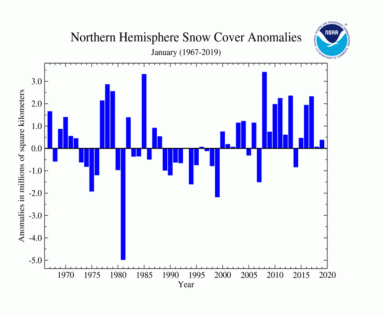
Everyone seems to think it snowed more in their youth than in recent years, but that’s generally incorrect, at least for for late-stage baby boomers, Gen Xers, and Millenials. Gregory Wrightstone thought the same thing as he reflected on his youth in Pittsburgh, but after checking snowfall records he was surprised to find an upward trend. In “Warming and the Snows of Yesteryear“, Wrightstone says his look at the records from other areas showed similar upward trends. The chart above from NOAA shows the Northern Hemisphere has experienced mostly positive snowfall anomalies over the past 20 years. So, the truth is that snowfalls have not decreased over the last 50+ years, contrary to our fond memories of big snows in childhood. Interestingly, Thomas Jefferson thought the same thing in 1801, but I’m not sure whether he was right.

We’ve been told by climate alarmists that “snowfalls are a thing of the past” due to global warming (The Independent in March, 2000). If anything, however, snowfalls have increased, and big snowfalls still happen. As with so many climate predictions over the years, this too is a bust. Most of those predictions have relied on predictive models fitted with an inadequate historical record of data, and the models are inadequately specified to capture the complexities of global climate trends. Don’t bet the house on them, and don’t presume to bet my house on them either, please!

When Government Externalizes Internalities

02 Sunday Feb 2020

Posted by Nuetzel in Government Failure

≈ 1 Comment

Tags

Corrective Taxation, Exclusivity, External Benefits, External Costs, Externalizing Internality, Government Failure, Internalizing Externality, Minimum Wage, National Defense, Public goods, Quotas, Regulatory Capture, Social Costs, Social Good, Subsidies, Takings, Wage floor

The headline describes a kind of government failure. In an ideal private transaction, costs and benefits are fully internalized by the buyer and seller. Both reap private gains, or surplus, from mutually beneficial transactions. On the other hand, there are cases in which external costs are inflicted on otherwise unrelated third parties, as when production emits pollutants. Or, there might be external benefits that inure to third parties, as when a homeowner pays to beautify their property and the whole neighborhood gains. These “externalities” are commonly citied as rationale for government interference in private markets. A good government, it is said, would seek to “internalize the externalities”, in one way or another, to prevent too much trade in a good imposing external costs, or too little trade where there are external benefits. Imposing taxes, granting subsidies, intervening with price controls, quotas, or various regulations are all ways in which corrective action might be attempted by public authorities.

The problem is that government often chooses badly, both misidentifying externalities, poorly estimating their magnitude, or in choosing how best to address them. When mistakes of this nature occur, the internal gains from trade are not just compromised or even destroyed. They are often externalized — revoked and redistributed to non-participants. The formerly private and internal gains may be extracted in the form of taxes, ultimately flowing to unconnected third parties. They are externalized internalizes, if I may coin a phrase. In other cases, in order to subsidize favored industries, individuals might be taxed on their income. Yet the favored industry is likely  unconnected or external to the taxed individual’s source of income. While the gains that might accrue in the favored industry are internalized there, their source is an externalized internality.

Putting the troubling issue of takings or confiscation aside, these mistaken interventions distort relative prices and production decisions, with false signals propagating into other markets — which again are external effects. This, in turn, distorts the allocation of resources across various uses. These cases are clear-cut examples of externalized internalities.

I will confine this discussion to economic matters. By “internalities“, I mean all things within the economic realm that are private and/or reserved to the individual by natural rights. That includes private property and the individual’s freedom to trade and contract with others.

Wrongly taxing presumed “bads” or wrongly subsidizing presumed “goods” are absolute cases of externalizing internalities. And taxing a “bad” excessively (at more than its true social cost) or subsidizing a “good” excessively (at more than its true social benefit) are cases of externalizing internalities. The political temptation to subsidize might be the greater danger, as it is all too easy for public officials and politicians to identify and sell “deserving” causes, especially if they intimate that others will pay.

For example, subsidized education, which primarily benefits private individuals, is billed to the taxpaying public. It over-allocates resources to education, including students with greater value as human resources in other pursuits. Subsidized energy pays the seller of a power source more than its value to buyers, courtesy of taxpayers, and over allocates resources to those energy sources relative to non-subsidized energy and other goods.

Even if an industry is taxed in exact accordance with its true social cost, there is still the question of how the proceeds of the tax are to be distributed. Ideally, unless the social costs are borne equally by all, the distribution should bear some proportionality to the damages borne by individuals, yet that is seldom considered outside of certain kinds of litigation. The true victims will almost certainly be shorted. Benefits will accrue to many who are free of any burden inflicted by the undesired activity. The corrective action thus fails to properly address the externality, and it bestows an incidental external benefit on wholly unconnected parties.

Likewise, subsidies paid to an industry in exact accordance with its true social benefits require taxes that may burden individuals who do not stand to benefit from the subsidized activity in any way. That is true unless the industry in question produces a pure public good. Indeed, if the taxed individuals had a choice in the matter, they would often use the funds for something they value more highly. Thus, suboptimal distribution of the tax proceeds for funding a less-than-pure “social good” involves the extraction of an internality.

Other forms of government action have similar externalization of internal costs or benefits. With the imposition of a wage floor, or minimum wage, the least-skilled workers are likely to lose their jobs. Consumers are likely to pay higher prices as well. The job losers become more dependent on public aid, which must be funded via taxes on others. The wage floor will also degrade working conditions for those lucky enough to keep their jobs. All of these effects of market intervention demonstrate the public piercing of internal gains from private, voluntary trade. Some of what is excised gets spilt, and some gets siphoned off to external parties. Thus internalities are externalized.

Regulation of private industry often results in regulatory capture, whereby regulators impose rules with compliance costs too high for small competitors and potential entrants to afford. This obviously strengthens the market power of larger incumbents, who may in turn increase prices or skimp on quality. Taxpayers pay the regulators, consumers pay the inflated prices, smaller firms shut down, and resources are under-allocated to the product or service in question. These distortions spill into other markets as well. All these effects are part of the despoilment of internal gains from trade. To the extent that trades are prevented at competitive prices, the external winners are those who capture trades at higher prices, along with the regulators themselves and anyone else standing to benefit from graft as part of the arrangement. And again, the wrongful gains to the winners can be described as externalized internalities.

There are many other examples of government failure that fit the description of externalized internalities. In fact, extracting internalities is the very essence of taxation, though we readily accept its use for expenditures on goods that are of a truly public nature, which by definition confer benefits that are non-exclusive. The classic case, of course, is national defense. The differences in the cases of government failure cited above, however, are that the internalities extracted via taxation or other forms of intervention are externalized for private gain by other parties, no matter how widely distributed and diffuse. This is an extremely pernicious kind of government failure, as it ultimately leads to a cannibalization of private activity via our role as public actors. Beware politicians bearing gifts, and beware them just as much when they demonize private trade.

EPA Concedes Puddles, Ditches to Owners

30 Thursday Jan 2020

Posted by Nuetzel in Environment, Federalism, Regulation

≈ Leave a comment

Tags

Anthony K Francois, Christian Britschgi, Clean Water Act, Environmental Protection Agency, EPA, Federalism, Interstate Waters, Jonathan Adler, Navigable Waters Protection Rule, Obama administration, Property and Environment Research Center, Reason.com, Trump Administration, Waters of the United States, WOTUS

Those who like their government served-up intrusive are reacting hysterically to the Environmental Protection Agency’s new Navigable Waters Protection Rule, which forbids the federal government from regulating waters that are not interstate waters or waters that aren’t or cannot be used in any way related to interstate commerce. The federal government will no longer have jurisdiction over normally dry, “ephemeral”  creek beds, private lakes and ponds unconnected to interstate waters, and most ground areas where rainwater pools, such as ditches on private property. This is a very good thing!

The emphasis of the new rule on interstate waters hews more closely to the constitutional limits of federal power than did the rescinded rule that had been imposed by the Obama Administration in 2015, which some called the Waters of the United States (WOTUS) rule (really an interpretation of “navigable waters”, or WOTUS as defined by the 1972 Clean Water Act). Christian Britschgi writes at Reason.com:

“The Obama-era rule was controversial from the get-go, with multiple Red states filing legal challenges claiming it exceeded the federal government’s authority to regulate water pollution. A slew of federal court rulings stayed the implementation of the rule in over half the states.”

Some of the straightforward differences between the new rule and WOTUS were mentioned above, but Anthony K. Francois of the Property and Environment Research Center gets into a bit more detail in his nice summary of these changes in federal authority.

In many cases, state and local governments already have regulatory authority over waters placed off-limits to the EPA. In fact, as Jonathan Adler wrote last summer, some of those state regulations are more stringent than the federal oversight now rescinded. That flies in the face of assertions by activists that states will be patsies in their dealings with property owners (the activists would call them “polluters”). So those who claim that the new rule will cause damage to the environment are really saying they only trust the EPA’s authority in these matters. They are also saying that no private citizen who owns property should be presumed to have rights over the industrial, commercial, or residential use of that property without review by the federal government. Under WOTUS, this represented such a severe abrogation of rights that it interfered with both productive activity and private enjoyment, not to mention the considerable confusion and costly litigation it prompted.

Weighing the costs and benefits of regulatory actions is a difficult undertaking. However, it is far too easy for regulators, with an imbalance of coercive power in their favor, to impose costly standards in locales where there may be little or no net benefit, and where individual property owners have no recourse. Regulators get no reward for protecting individual liberty and property rights, which skews their view of the tradeoff against potential environmental damage. Federal regulatory power is best kept within strict limits. The same goes for state and local regulatory power, but authority at those levels is at least more accountable to local interests on behalf of consumer, business and environmental concerns.

More Attacks On Private Charity

25 Saturday Jan 2020

Posted by Nuetzel in Charity

≈ Leave a comment

Tags

Bill Gates, Charitable Deduction, David Rubenstein, Jeff Bezos, Karl Zinsmeister, Philanthropy Magazine, Private charity

The social corrosion brought on by the growth of government, and from advocates of greater government dominance, has many symptoms, but hostility to private giving and charitable work is one of its ugliest manifestations. There is a notion among leftists that almost any charitable gift could better serve its intended purpose were it simply turned over to a government agency tasked with an “appropriate” role. The attitude is partly explained by a fallacy of central planning, that charitable efforts scale so readily that the state should always be in charge, and indeed, a fallacy that the state has better information, is more effective at guiding outcomes, and could accomplish more were it not for obstacles created by pesky private efforts.

Even worse, private gifts and charitable efforts are often characterized as buy-offs to excuse evils perpetrated elsewhere by givers. That’s one of the themes I covered in “You’re Welcome: Charitable Gifts Prompt Statist Ire“. Karl Zinsmeister of Philanthropy magazine bemoans the extent to which private good works are condemned in “No Giver Is Safe: How the Left Is Poisoning Philanthropy“:

“Names are being pried off of college buildings, museums are getting picketed, companies are facing boycotts. No giver is safe. Long-time tax protections for charitable giving, churches, and charities are being attacked and proposed for repeal. Activists demand that government be given the right to appoint board members at nonprofits. Privacy protections for donors and charities are being eroded.

The deep odium for personal wealth and private problem-solving nursed by fashionable chatterers today often surges into view when businesspeople take up philanthropy. Jeff Bezos donates a million Australian dollars to fire recovery and the plute-smashers swing their axes. David Rubenstein offers to renovate the Jefferson Memorial and other historical landmarks and gets attacked for being a private-equity villain. For crusading against malaria, Bill Gates is portrayed as a vainglorious megalomaniac.”

The income tax deduction for charitable giving is presumed by critics to benefit mainly the wealthy. But without the deduction, our system of income taxation would make it more difficult for all Americans to carve charitable donations from their household budgets. And as Zinsmeister notes, most charitable giving does not come from the wealthy. In fact, he says 36% is given by those earning less than $100,000 annually.

Antipathy for the wealthy is nothing new, and the haters never give a thought to how wealth is created: by producing things of value that otherwise would be unavailable, and that we purchase willingly. That goes for “big wealth” and “little wealth” alike. The attack on philanthropy is merely another front in the effort to delegitimize private wealth and ultimately its confiscation. That is both evil and short-sighted. Private charity is more efficient and cost effective than government aid (and see here and here), and it is an act of true virtue no matter how small, something that can’t be said for those who pretend that confiscating the wealth of others is an of caring.

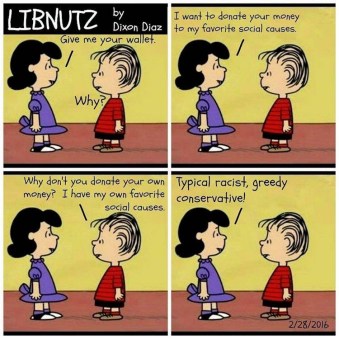
A shout out to Dixon Diaz and thefederalistpapers.org for the great cartoon!


Bernie Sanders and the Brutal Bros

24 Friday Jan 2020

Posted by Nuetzel in Collectivism, Leftism, Tyranny, Uncategorized

≈ Leave a comment

Tags

Antifa, Barack Obama, Bernie Bros, Bernie Sanders, Black Lives Matter, Che Guevara, David Burge, Fidel Castro, Gulags, Hillary Clinton, Iowahawk, James Hodgekinson, John Hinderaker, Joseph Stalin, Leftism, Mao Zedong, Pol Pot, PowerLineblog.com, Project Veritas, Re-Education, Steve Scalise

Some of Bernie Sanders’ most devoted fans have an unfortunate brutalitarian streak. The violent strain of so-called Bernie Bros aren’t as isolated as one might hope. First, of course, there was James Hodgkinson, the BB who attempted to assassinate Republican members of Congress at a congressional baseball game practice, seriously injuring Rep. Steve Scalise. Now, campaign field organizers for Sanders in Iowa and South Carolina have been captured on film proposing gulags, re-education camps, sentencing billionaires to hard labor, and shooting or beheading those opposed to Sanders’ policies. And much more. And they say this in all seriousness. What nice people have been assigned positions of responsibility within the Sanders campaign organization! Watch it for yourself at the link above.

Should we be surprised? No: these are advocates of forced collectivism, and if their favorable perspective on coercive power wasn’t enough of a tip-off, recent history suggests that many among them are truly ready and willing to do violence. The brutal and murderous history of collectivist regimes the world over demonstrates the tendency well enough. Stalin, Mao, Pol Pot, Castro and too many other leftist tyrants left bodies strewn in their wake as they sought to enforce their ideology. It’s no coincidence that the American Left holds the murderous Che Guevara in such high esteem. Black Lives Matter and Antifa have both perpetrated violent acts, and members of the Leftist media have openly advocated physical attacks on their political opponents. And then we have these Bernie Bros.

I feel compelled to review a bit of background on Bernie Sanders, the batty old communist who has managed to convince large numbers of poorly educated “intellectuals” that he knows the path to utopia. The nicer ones imagine that he’s a man of the people, though he hasn’t worked a day in his life at anything except agitation and rent seeking. He is an inveterate public mooch. His life history as a politician and as a person is rather unflattering.

I’ve used this Iowahawk (David Burge) quote about Sanders before:

“Who better to get America back to work than a guy who was actually fired from a Vermont hippie commune for being too lazy.”

Apparently, Barack Obama is not a Bernie Bro:

“Obama has told people in private that Sanders is both temperamentally and politically unfit to beat Trump in the 2020 general election, these people say. Among his concerns are Sanders’ strident form of politics and confrontational manners where he was known not to seek compromise during his long years in the US senate.”

And say what you will about Hillary Clinton, but her opinion of Sanders comports with much of what we know about The Bern:

“He was in Congress for years. He had one senator support him. Nobody likes him, nobody wants to work with him, he got nothing done.”

At least the Bernie Bros have taken their masks off before getting too far. Give Leftists power and they all will.

Single-Payer: Queue Up and Die Already

19 Sunday Jan 2020

Posted by Nuetzel in Health Care, Health Insurance

≈ 1 Comment

Tags

Australia, Bernie Sanders, Canada, Catastrophic Coverage, Chris Pope, Competitive Payer, Dual Payer, Employer-Paid Coverage, France, Germany, Individual Mandate, Manhattan Institute, Medicaid, Medicare, Netherlands, Out-of-Pocket Costs, Portability, Premium Deductibility, Segmented Payer, Single-Payer, Switzerland, third-party payments, Uncompensated care, United Kingdom, Universal Coverage

I constantly hear this sort of naive remark about health care in “other major countries”, and while Chris Pope’s rejoinder below should chasten the ignorant, they won’t listen (emphasis is mine):

“[Bernie] Sanders recently argued that ‘our idea is to do what every other major country on earth is doing,’ but this claim is … fictitious. In fact, there is not a single country in the world that offers comprehensive coverage with an unlimited choice of providers, fully paid for by taxpayers, without insurer gatekeeping, service rationing, or out-of-pocket payments. In reality, there is a direct trade-off between ease of access to providers and the cost borne by individuals in out-of-pocket expenses.”

Pope’s statement pretty much strips bare the fiction of “universal” coverage, a concept too loosely defined to be of any real use except as a rhetorical device. It also highlights the non-monetary costs inflicted on consumers by non-price rationing of care. The presumption that government must provide universal health care coverage and that all other developed countries actually have that arrangement is incorrect.

Pope has another article at the Manhattan Institute site, written late last year, on the lessons we can learn on health care from experience abroad under various payer systems. This offers a more detailed comparison of the structure of the U.S. payment system versus seven other countries, including Canada, the U.K., Australia, and Germany. Single-payer tends to be the “gold standard” for the Left, but the only systems that “approximate” single-payer are in Canada and the U.K. Here is one blurb about Canada:

“Canadians have easy access to general practitioners, but getting an appointment to see a specialist is more difficult than in all the other nations studied in this report. The Canadian medical system provides the least hospital care, delivers consistently fewer outpatient procedures, and provides much less access to modern diagnostic technology.

Canadians also have limited access to drugs, according to Pope. And out-of-pocket (OOP) spending is about the same as in the U.S. At the first link above, Pope says:

“Canadians spend less on health care than Americans mostly because they are not allowed to use as much — not because they are getting a better deal. … Waiting lists are generally seen as the single-payer budgeter’s friend, as some patients will return to health by themselves, others will be discouraged from seeking treatment, and a large proportion of the most expensive cases will die before any money is due to be spent on them.”

Pope says this about the U.K. at the second link:

“U.K. hospitals often lack cutting-edge technology, and mortality after major emergency hospitalizations compares poorly with that of other nations in this report. Access to specialists is very limited, and the system falls well short of most other nations in the delivery of outpatient surgery.” 

Waiting times in the U.K. tend to be long, but in exchange for all these shortcomings in care, at least OOP costs are low. Relative to other payment systems, single payer seems to be the worst in several respects.

The other systems described by Pope are:

  • “dual payer” in Australia and France, with public entitlements and the choice of some private or supplemental coverage;
  • “competing payer” in Switzerland, Germany, and the Netherlands, whereby subsidies can be used to purchase coverage from private plans (and in Germany some “quasi-public” plans; and
  • “segmented payer” in the U.S., with two public plans for different segments of the population (Medicare for the elderly and Medicaid for the non-elderly poor), employer-sponsored coverage primarily from larger employers, individually-purchased private coverage, and subsidies to providers for “uncompensated care” for the uninsured.

Here is what Pope says about the various “multi-payer” systems:

“Dual-payer and competitive-payer systems blend into each other, according to the extent of the public entitlement in dual-payer countries …

… limitations in access to care are closely tied to the share of the population enrolled in private insurance—with those in Britain and Canada greatly limited, Australians facing moderate restrictions, and those in the other countries studied being more able to get care when they need it. 

The competing-payer model ideally gives insurers the freedom and responsibility to procure health-care services in a way that attracts people to their plans by offering them the best benefits and the lowest medical costs. While all competing-payer systems fall short of this ideal, in practice they consistently offer good access to high-quality medical care with good insurance protection. The competing-payer model is, therefore, best understood as an objective that is sought rather than yet realized—and countries including Germany, the Netherlands, France, and the U.S., which have experienced the most significant health-care reform over recent years, are each moving toward it.”

The U.S. has very high health care costs as a percent of GDP, but OOP costs are roughly in line with the others (except the Swiss, who face very high OOP costs). The U.S. is wealthier than the other countries reviewed by Pope, so a large part of the cost gap can be attributed to demand for health care as a luxury good, especially late in life. Insured U.S. consumers certainly have access to unrivaled technology and high-quality care with minimal delays.

Several countries, including the U.S., are plagued by a lack of competition among hospitals and other providers. Government regulations, hospital subsidies, and pricing rules are at the root of this problem. Third-party payments separate consumers from the pricing consequences of their health-care decisions, which tends to drive up costs. If that weren’t enough, the tax deductibility of employer-paid insurance premiums in the U.S. is an subsidy ironically granted to those best-able to afford coverage, which ultimately heightens demand and inflates prices.

Notably, unlike other countries, there is no longer an individual mandate in the U.S. or any penalty for being uninsured, other than the potential difficulty in qualifying for coverage with pre-existing conditions. Consumers who lack employer-sponsored or individual coverage, but have incomes too high to qualify for Medicaid or premium subsidies, fall into a gap that has been the bane of would-be reformers. There are a few options for an immediate solution: 1) force them to get insured with another go at an individual mandate; 2) offer public subsidies to a broader class; 3) let them rely on emergency-room services (which cannot turn them away) or other forms of uncompensated care; 4) allow them to purchase cheap temporary and/or catastrophic coverage at their own expense; 5) allow portability of coverage for job losers. Recently, the path of least political resistance seems to have been a combination of 3, 4, and 5. But again, the deficient option preferred by many on the Left: single-payer. Again, from Pope:

“Single-payer systems share the common feature of limiting access to care according to what can be raised in taxes. Government revenues consistently lag the growth in demand for medical services resulting from increased affluence, longevity, and technological capacity. As a result, single-payer systems deliver consistently lower quality and access to high-cost specialty care or surgical procedures without reducing overall out-of-pocket costs. Across the countries in this paper, limitations in access to care are closely tied to the share of the population enrolled in private insurance—with those in Britain and Canada greatly limited…”

The Wealth of Space Colonies

17 Friday Jan 2020

Posted by Nuetzel in Space Travel

≈ Leave a comment

Tags

Mayflower, Native Americans, Plymouth Company, Rand Simberg, Terry L. Anderson

Pilgrim colonies in outer space will fare better under the liberal order of capitalism than socialism. Both forms of social organization require some form of governance: various rules regulating or prohibiting behavior and a system for adjudicating violations. Socialist pilgrims would be subject to central decision-making in all or most social affairs, as well as common property ownership and equally-shared rewards from effort of any kind. These are the classic conditions under which a tragedy of the commons can be expected, which would jeopardize the very survival of the colonists. In contrast, capitalist pilgrims would be subject to rules defining property rights; individuals would be free to make various production decisions and contract freely with one another, and perhaps only a portion of the rewards for effort would be shared equally via taxation. In other words, a great deal of the governance that takes place under capitalism would be of a private nature, just as it is on Earth in the advanced economies.

The authoritarian impulses of mission sponsors and planners might hold sway for a time, but they will ultimately clash with the long-term survival imperative. That might give way to a “discovery process” whereby authorities elect to conduct experiments to test various forms of social organization and degrees of individual autonomy. Rand Simberg has a pretty good idea about what those experiments would turn up. In “Socialists in Space“, he covers the history of the U.S. space program as a “command” model. A shift toward more private space activity is still underway, of course, but the power of competition and private enterprise to reduce costs is already evident. The subtitle to Simberg’s article extends that point: “Opening a frontier is hard. Its even harder when you’re a socialist“. He cites the cogent example of the pilgrim colony established by the passengers on the Mayflower:

“When the Plymouth Company adopted the settlement’s initial economic rules, it stated that “all profits & benefits that are got by trade, traffic, trucking, working, fishing, or any other means” were to be placed in the common stock of the colony, and that ‘all such persons as are of this colony, are to have their meat, drink, apparel, and all provisions out of the common stock.’ In other words, to use a phrase from a subsequent century: From each according to his ability, to each according to his needs.

About half the settlement died of starvation in the first winter. It was only after the colony changed its rules to allow people to keep the product of their own efforts, for their consumption or for sale, that they finally had the first bountiful harvest. This wasn’t a unique event; many of the early English settlements, including Jamestown a few years earlier, had to learn the lesson the hard way.”

Lest you object that many Native American civilizations lived for centuries under harsh conditions despite their collectivist forms of governance, it is something of a myth that those tribes always treated property as common. In fact, as Terry L. Anderson wrote in 1997:

“... while there were exceptions that led to the tragedy of the commons, generally American Indians understood the importance of incentives. Property rights, supplemented by customs and traditions where appropriate, often produced the incentives that were needed to husband resources in what was frequently a hostile environment.”

Simberg goes on to discuss the kinds of necessities, or actually opportunities, that are likely to arise in space. Entrepreneur-capitalists will exploit these more successfully than socialist workers ever could. That includes uses of extraterrestrial materials, agriculture, manufacturing, and terraforming solutions. There will be successes and failures, but the efforts will be diversified and the probability of success, and survival in an environment of extreme scarcity, will be improved by the superior structure of incentives for agents having ownership. There will be some dependency on the mission’s sponsoring organization for a considerable period of time, which might dictate certain “terms of trade”. Nonetheless, a liberal order is ultimately the surest way to make a colony prosper on any body or man-made structure in the universe.

We have seen repeatedly that the most effective means of achieving common objectives like ending privation, or indeed, survival, is individual liberty. Freedom and voluntary trade unlock growth in prosperity, thus providing the means for achieving broader social objectives (like the colony’s survival) and the provision of public goods.

For the foreseeable future, it is likely that missions into space, from launch to arrival and initial encampment, will be central planned, but the planning need not be the responsibility of any national government. Again, private space missions are a reality and are growing as a share of launches and payload. After all, the Mayflower itself was a private merchant vessel. The transit itself involves a singular overriding goal: to reach the destination safely, which is subject to high risks of catastrophe and thinly-tested technologies. Thus, it’s reasonable to expect a command structure to be more effective in transit than a crew of autonomous decision makers. Like the Mayflower, passengers will have limited freedoms while on board and during the initial stages of their settlement.

That may differ for more extended the missions. Just as there are likely to be greater benefits from personal autonomy in permanent settlements on moons and planets, the same would be true on multi-generational journeys to other star systems.

International treaties regarding activities and claims on resources in outer space are an area of controversy, according to Simberg. Some hope to use treaties to collectivize space, demanding “collective property rights” and equity in the use of extraterrestrial resources. I wrote about related topics last year in “Space, Property Rights, and Scarcity“, quoting a few uninformed comments by purported experts on space law about scarcity, capitalism, and the “global commons” theory of rights in outer space. Fortunately, there is considerable resistance to their socialist designs. Harvesting resources from outer space will be greatly encouraged by private incentives, much to the benefit of all mankind. And successful colonization of other worlds demands liberalized social arrangements that rely on private incentives. Fortunately, as Simberg says, the “current administration has repeatedly stated that space is not in fact a commons“.


Scorning the Language of the Left

12 Sunday Jan 2020

Posted by Nuetzel in Censorship, Leftism, Political Correctness

≈ Leave a comment

Tags

Abortion, Boy George, Brett Kavanaugh, Brexit, Check Your Privilege, Cisgender, Climate Change, Donald Trump, Gender, Harper's, Hate Speech, Identitarian, Israel, Lefty Lingo, LGBTQ, Lionel Shriver, Microaggession, Patriarchy, Phobic, Privilege, Progressive Speech, Pronouns, Queer, Safe Space, STFU, Sustainability

It’s hard not to ridicule some the language adopted by our lefty friends, and it can be fun! But it’s not just them. We hear it now from employers, schools, and otherwise sensible people too eager to signal their modernity and virtue. Lionel Shriver dissects some of this “Lefty Lingo” in an entertaining piece in Harper’s. It’s funny, but it aroused my contempt for the smugness of the “wokescenti” (a term Shriver attributes too Meghan Daum) and my pity for those “normals” simply desperate to project progressive sophistication.

Here are a few of Shriver’s observations:

“Privilege”: makes you incapable of understanding that which you criticize.

“Whereas a privilege can be acquired through merit—e.g., students with good grades got to go bowling with our teacher in sixth grade—privilege, sans the article, is implicitly unearned and undeserved. The designation neatly dispossesses those so stigmatized of any credit for their achievements while discounting as immaterial those hurdles an individual with a perceived leg up might still have had to overcome (an alcoholic parent, a stutter, even poverty). For privilege is a static state into which you are born, stained by original sin. Just as you can’t earn yourself into privilege, you can’t earn yourself out of it, either. … . it’s intriguing that the P-bomb is most frequently dropped by folks of European heritage, either to convey a posturing humility (“I acknowledge my privilege”) or to demonize the Bad White People, the better to distinguish themselves as the Good White People.

Meanwhile, it isn’t clear what an admission of privilege calls you to do, aside from cower. That tired injunction ‘Check your privilege’ translates simply to ‘S.T.F.U.’—and it’s telling that ‘Shut the fuck up’ is now a sufficiently commonplace imperative to have lodged in text-speak.”

“Cisgender”: “Cis-” is a linguistic shell game whereby the typical case is labelled cis-typical.

“Denoting, say, a woman born a woman who thinks she’s a woman, this freighted neologism deliberately peculiarizes being born a sex and placidly accepting your fate, and even suggests that there’s something a bit passive and conformist about complying with the arbitrary caprices of your mother’s doctor. Moreover, unless a discussion specifically regards transgenderism, in which case we might need to distinguish the rest of the population (‘non-trans’ would do nicely), we don’t really need this word, except as a banner for how gendercool we are. It’s no more necessary than words for ‘a dog that is not a cat,’ a ‘lamppost that is not a fire hydrant,’ or ‘a table that is actually a table.’ Presumably, in order to mark entities that are what they appear to be, we could append ‘cis’ to anything and everything. ‘Cisblue’ would mean blue and not yellow. ‘Cisboring’ would mean genuinely dull, and not secretly entertaining after all.”

“Microaggression“: Anything you say that bothers them, even a little.

“… a perverse concoction, implying that the offense in question is so minuscule as to be invisible to the naked eye, yet also that it’s terribly important. The word cultivates hypersensitivity.”

“_____-phobic”: the typical use of this suffix in identity politics stands “phobia” on its head. To be fair, however, it started with a presumption that people hate that which they fear. Maybe also that they fear and hate that which they don’t care for, but we’ll just focus on fear and hate. For example, there is the notion that men have deep fears about their own sexuality. Thus, the prototypical gay-basher in film is often compensating for his own repressed homosexual longings, you see. And now, the idea is that we always fear “otherness” and probably hate it too. Both assertions are tenuous. At least those narratives are rooted in “fear”, but it’s not quite the same phenomenon as hate, and yet “phobic” seems to have been redefined as odium:

“The ubiquitous ‘transphobic,’ ‘Islamophobic,’ and ‘homophobic’ are also eccentric, in that the reprobates so branded are not really being accused of fearfulness but hatred.”

“LGBTQ“: Lumping all these “types” together can be misleading, as they do not always speak in unison on public policy. But if we must, how about “Let’s Go Back To ‘Queer'”, as Shriver suggests. The LGBs I know don’t seem to mind it as a descriptor, but maybe that’s only when they say it. Not sure about the trannies. There is a great Libertarian economist who is transsexual ( Dierdre McCloskey), and somehow “queer” doesn’t seem quite right for her. Perhaps she’s just a great woman.

“The alphabet soup of ‘LGBTQ’ continues to add letters: LGBTQIAGNC, LGBTQQIP2SAA, or even LGBTIQCAPGNGFNBA. A three-year-old bashing the keyboard would produce a more functional shorthand, and we already have a simpler locution: queer.”

“Problematic”, “Troubling” and “Inappropriate”: I’m sure some of what I’ve said above is all three. I must confess I’ve used these terms myself, and they are perfectly good words. It’s just funny when the Left uses them in the following ways.

“Rare instances of left-wing understatement, ‘problematic’ and ‘troubling’ are coyly nonspecific red flags for political transgression that obviate spelling out exactly what sin has been committed (thereby eliding the argument). Similarly, the all-purpose adjectival workhorse ‘inappropriate’ presumes a shared set of social norms that in the throes of the culture wars we conspicuously lack. This euphemistic tsk-tsk projects the prim censure of a mother alarmed that her daughter’s low-cut blouse is too revealing for church. ‘Inappropriate’ is laced with disgust, while once again skipping the argument. By conceit, the appalling nature of the misbehavior at issue is glaringly obvious to everyone, so what’s wrong with it goes without saying.”

Here are a few others among my favorites:

“Patriarchy“: This serves the same function as “privilege” but is directed more specifically at the privilege enjoyed by males. Usually white, heterosexual males. It seeks to preemptively discredit any argument a male might make, and often it is used to discredit Western political and economic thought generally. That’s because so much of it was the product of the patriarchy, don’t you know! And remember, it means that males are simply incapable of understanding the plight of females … and children, let alone queers! Apparently fathers are bad, especially if they’re still straight. Mothers are good, unless they stand with the patriarchy.

“Hate Speech“: This expression contributes nothing to our understanding of speech that is not protected by the Constitution. If anything its use is intended to deny certain kinds of protected speech. Sure, originally it was targeted at such aberrations as racist or anti-gay rhetoric, assuming that always meant “hate”, but even those are protected as long as they stop short of “fighting words”. There are many kinds of opinions that now seem to qualify as “hate speech” in the eyes of the Identitarian Left, even when not truly “hateful”, such as church teachings in disapproval of homosexuality. There is also a tendency to characterize certain policy positions as “hate speech”, such as limits on immigration and opposition to “living wage” laws. Hypersensitivity, once more.

“Sustainability“: What a virtue signal! It’s now a big game to characterize whatever you do as promoting “sustainability”. But let’s get one thing straight: an activity is sustainable only if its benefits exceed its resource costs. That is the outcome sought by voluntary participants in markets, or they do not trade. Benefits and costs “estimated” by government bureaucrats without the benefit of market prices are not reliable guides to sustainability. Nor is Lefty politics a reliable guide to sustainability. Subsidies for favored activities actually undermine that goal.

There are many other Lefty catch phrases and preferred ways of speaking. We didn’t even get to “safe space”, “social justice”, and the pronoun controversy. Shriver closes with some general thoughts on the lefty lingo. I’ll close by quoting one of those points:

“The whole lexicon is of a piece. Its usage advertises that one has bought into a set menu of opinions—about race, gender, climate change, abortion, tax policy, #MeToo, Trump, Brexit, Brett Kavanaugh, probably Israel, and a great deal else. Reflexive resort to this argot therefore implies not that you think the same way as others of your political disposition but that you don’t think. You have ordered the prix fixe; you’re not in the kitchen cooking dinner for yourself.”


Feckless Greens Burn Aussie Bush

09 Thursday Jan 2020

Posted by Nuetzel in Forest Fires, Global Warming, Wildfires

≈ 1 Comment

Tags

Arson, Arson Raptors, Australia, Black Kite, CO2 Forcings, David Packham, David Ward, Dead Vegetation, Eucalyptus, Gasoline Trees, Human Ignitions, Invasive Grasses, James Morrow, Jennifer Marohasy, Leslie Eastman, Marc Lallanilla, Massachusetts, Mike Shedlock, Mishtalk, Myron Ebell, New South Wales, Patrick Michaels, Prescribed Burns, Queensland, Roy Spencer, Victoria, Whistling Kite, Willis Eschenbach

The raging Australian bush fires have been expansive and deadly. Country-wide, over 12 million acres have burned over the past few months, an area approaching twice the size of Massachusetts. The burnt areas in some regions rival or exceed individual fires of the past, such as the Black Friday fire of 1939, which burned about 5 million acres. As bad as the recent fires have been, note that various outlets in the U.S. have felt it necessary to exaggerate the size of the burnt area (also see here). And the season’s burnt area has not even approached the total for 1974-1975, when over 250 million acres burned.

So what causes these bush fires? Dry weather and plenty of fuel from dead vegetation create the hazard, of course. A spark is needed, as from lightning, an accident, an arsonist, or perhaps even a blistering sun, but warm temperatures are unnecessary. Nevertheless, the narrative we hear year-in and year-out is that global warming is to blame for wildfires. My commentary on the climate-change hubbub over the 2018 California fires is here. As for Australia’s fires, there is similarly ample evidence that climate change or warming has nothing to do with it. Rather, as in California, there is a pattern of mismanagement of forests and brush combined with population growth, accidents, and arson, and of course a dry spell. This dry spell has been severe, but the trend in Australia over the past 120 years has been toward more precipitation, not less, and the past 25 years have been relatively rainy. The rain comes with a downside, however: it encourages growth in vegetation, much of which dies every dry season, leaving plenty of fuel for fires. And the fuel has been accumulating.

Mike Shedlock at Mishtalk offers some pertinent observations. First, he quotes James Morrow in the Wall Street Journal:

“Byzantine environmental restrictions prevent landholders from clearing scrub, brush and trees. State governments don’t do their part to reduce the fuel load in parks. Last November a former fire chief in Victoria slammed that state’s ‘minimalist approach’ to hazard-reduction burning in the off-season. That complaint is heard across the country.“

Prescribed burns have been in decline and focused on areas adjacent to suburbs, leaving vast areas of accumulating fuel. This is a product of wrongheaded conservation efforts and resistance to CO2 emissions. These policymakers haven’t done favors for Australia or the world on either count. Shedlock reinforces this point with the following statement from Patrick Michaels and Myron Ebell:

“Australia has been ready to explode for years. David Packham, former head of Australia’s National Rural Fire Research Centre, warned in a 2015 article in the Age that fire fuel levels had climbed to their most dangerous levels in thousands of years. He noted this was the result of ‘misguided green ideology.'”

Eucalyptus trees grow thickly in many fire-prone areas of Australia, and Shedlock says these trees act as a multiplier on the fire hazard. Yet these trees remain a favorite landscape feature for suburbians even in fire-prone areas. He quotes Marc Lallanilla in LiveScience:

“Fallen eucalyptus leaves create dense carpets of flammable material, and the trees’ bark peels off in long streamers that drop to the ground, providing additional fuel that draws ground fires up into the leaves, creating massive, fast-spreading ‘crown fires’ in the upper story of eucalyptus forests. … Additionally, the eucalyptus oil that gives the trees their characteristic spicy fragrance is a flammable oil: This oil, combined with leaf litter and peeling bark during periods of dry, windy weather, can turn a small ground fire into a terrifying, explosive firestorm in a matter of minutes. That’s why eucalyptus trees — especially the blue gums (Eucalyptus globulus) that are common throughout New South Wales — are sometimes referred to wryly as ‘gasoline trees.’“

The introduction of non-native invasive grasses has also been blamed for increasing the fuel load in the bush. And as incredible as it may seem, certain birds native to Australia are spreading bushfires by carrying and dropping burning sticks in grasslands to flush out prey. Birds are indeed tool users! The Whistling Kite and the Black Kite are sometimes called “arson raptors”, according to Leslie Eastman at this link.

The hypothesis that climate warming from CO2 emissions is the cause of the bushfires is undermined by all of the above. Then, of course, there are the arsonists and accidental fires. Over 180 people have been arrested for setting recent brushfires intentionally in New South Wales alone, and 103 others in Queensland. (Also see here.) Jim Steele reports that human ignitions account for 66% of bush fires, while just 11% are caused by lightning. Population growth has brought more people into close proximity with the bush, which increases the exposure of humans to fire danger and might well add to the number of accidents and potential arsonists. Obviously, human and avian arson, and accidents, are not within the line of causation that climate alarmists have in mind.

Roy Spencer addresses some of the inconsistencies in the claimed link between climate warming and the Australian bushfires. First, of course, is the trend in rainfall. Climate models based on CO2 forcings predict no long-term trend in Australia’s rainfall, but again, rainfall has increased in Australia during the era of accelerated forcings. Interestingly, the fires of 1974-75 occurred during a period that was quite rainy, but that rain might have added so much to the annual vegetation cycle that it exacerbated the effect of dry season. Temperatures in Australia were quite warm in 2019, but the climate models cannot account for that variation, especially as Australian temperatures are subject to high variability from year-to-year. It’s been hotter before, though the temperature records in Australia have been subject to some controversial “editing”. Finally, Spencer notes that global wildfire activity has been in decline for many years, despite the mild warming we’ve experienced over the past 50 years (also see here).

Australia has bush fires every year, and this year has been particularly bad, but it might not reach the proportions of the fires in 1974-75. The causes are: poor burn management practices, or sometimes neglect and no burn management at all, allowing dead vegetation to accumulate to dangerous levels; arson, which has been implicated in a large number of fires this year; and 2019 was a very dry year. The contention that global warming or climate change is responsible for these bush fires is a dangerous distraction from reforms that can minimize fire hazards in the future.

For additional reading of interest, see “Australia Fires … and Misfires” by Willis Eschenbach and “The Mathematics of Connectivity and Bush Fires: A Note From David Ward” a post from Jennifer Marohasy’s blog.

← Older posts
Newer posts →
Follow Sacred Cow Chips on WordPress.com

Recent Posts

  • Some Dimensions Of the AI/Data Center Freakout
  • Warsh and Fed Confront a Crossroads On Policies
  • Isotopes Point To Natural CO2 Origins
  • Is “Global Temperature” a Fiction?
  • ESG Contortions: Virtue, Returns, and Politics

Archives

  • June 2026
  • May 2026
  • April 2026
  • March 2026
  • February 2026
  • January 2026
  • December 2025
  • November 2025
  • October 2025
  • September 2025
  • August 2025
  • July 2025
  • June 2025
  • May 2025
  • April 2025
  • March 2025
  • February 2025
  • January 2025
  • December 2024
  • November 2024
  • October 2024
  • September 2024
  • August 2024
  • July 2024
  • June 2024
  • May 2024
  • April 2024
  • March 2024
  • February 2024
  • January 2024
  • December 2023
  • November 2023
  • August 2023
  • July 2023
  • June 2023
  • May 2023
  • April 2023
  • March 2023
  • February 2023
  • January 2023
  • December 2022
  • November 2022
  • October 2022
  • September 2022
  • August 2022
  • July 2022
  • June 2022
  • May 2022
  • April 2022
  • March 2022
  • February 2022
  • January 2022
  • December 2021
  • November 2021
  • October 2021
  • September 2021
  • August 2021
  • July 2021
  • June 2021
  • May 2021
  • April 2021
  • March 2021
  • February 2021
  • January 2021
  • December 2020
  • November 2020
  • October 2020
  • September 2020
  • August 2020
  • July 2020
  • June 2020
  • May 2020
  • April 2020
  • March 2020
  • February 2020
  • January 2020
  • December 2019
  • November 2019
  • October 2019
  • September 2019
  • August 2019
  • July 2019
  • June 2019
  • May 2019
  • April 2019
  • March 2019
  • February 2019
  • January 2019
  • December 2018
  • November 2018
  • October 2018
  • September 2018
  • August 2018
  • July 2018
  • June 2018
  • May 2018
  • April 2018
  • March 2018
  • February 2018
  • January 2018
  • December 2017
  • November 2017
  • October 2017
  • September 2017
  • August 2017
  • July 2017
  • June 2017
  • May 2017
  • April 2017
  • March 2017
  • February 2017
  • January 2017
  • December 2016
  • November 2016
  • October 2016
  • September 2016
  • August 2016
  • July 2016
  • June 2016
  • May 2016
  • April 2016
  • March 2016
  • February 2016
  • January 2016
  • December 2015
  • November 2015
  • October 2015
  • September 2015
  • August 2015
  • July 2015
  • June 2015
  • May 2015
  • April 2015
  • March 2015
  • February 2015
  • January 2015
  • December 2014
  • November 2014
  • October 2014
  • September 2014
  • August 2014
  • July 2014
  • June 2014
  • May 2014
  • April 2014
  • March 2014

Blogs I Follow

  • Passive Income Kickstart
  • OnlyFinance.net
  • TLC Cholesterol
  • Nintil
  • kendunning.net
  • DCWhispers.com
  • Hoong-Wai in the UK
  • Marginal REVOLUTION
  • Stlouis
  • Watts Up With That?
  • American Elephants
  • The View from Alexandria
  • The Gymnasium
  • A Force for Good
  • Notes On Liberty
  • troymo
  • SUNDAY BLOG Stephanie Sievers
  • Miss Lou Acquiring Lore
  • Your Well Wisher Program
  • Objectivism In Depth
  • RobotEnomics
  • Orderstatistic
  • Paradigm Library
  • Scattered Showers and Quicksand
  • Jam Review

Blog at WordPress.com.

Passive Income Kickstart

OnlyFinance.net

TLC Cholesterol

Nintil

To estimate, compare, distinguish, discuss, and trace to its principal sources everything

kendunning.net

The Future is Ours to Create

DCWhispers.com

Hoong-Wai in the UK

A Commonwealth immigrant's perspective on the UK's public arena.

Marginal REVOLUTION

Small Steps Toward A Much Better World

Stlouis

Watts Up With That?

The world's most viewed site on global warming and climate change

American Elephants

Defending Life, Liberty and the Pursuit of Happiness

The View from Alexandria

In advanced civilizations the period loosely called Alexandrian is usually associated with flexible morals, perfunctory religion, populist standards and cosmopolitan tastes, feminism, exotic cults, and the rapid turnover of high and low fads---in short, a falling away (which is all that decadence means) from the strictness of traditional rules, embodied in character and inforced from within. -- Jacques Barzun

The Gymnasium

A place for reason, politics, economics, and faith steeped in the classical liberal tradition

A Force for Good

How economics, morality, and markets combine

Notes On Liberty

Spontaneous thoughts on a humble creed

troymo

SUNDAY BLOG Stephanie Sievers

Escaping the everyday life with photographs from my travels

Miss Lou Acquiring Lore

Gallery of Life...

Your Well Wisher Program

Attempt to solve commonly known problems…

Objectivism In Depth

Exploring Ayn Rand's revolutionary philosophy.

RobotEnomics

(A)n (I)ntelligent Future

Orderstatistic

Economics, chess and anything else on my mind.

Paradigm Library

OODA Looping

Scattered Showers and Quicksand

Musings on science, investing, finance, economics, politics, and probably fly fishing.

Jam Review

"If you get confused, listen to the music play."

  • Subscribe Subscribed
    • Sacred Cow Chips
    • Join 128 other subscribers
    • Already have a WordPress.com account? Log in now.
    • Sacred Cow Chips
    • Subscribe Subscribed
    • Sign up
    • Log in
    • Report this content
    • View site in Reader
    • Manage subscriptions
    • Collapse this bar

Loading Comments...