• About

Sacred Cow Chips

Sacred Cow Chips

Category Archives: Big Government

Lucky Barack: Let Me “Invest” Your Winnings

22 Friday May 2015

Posted by Nuetzel in Big Government, Taxes, Welfare State

≈ Leave a comment

Tags

Barack Obama, Curtis Dubay, Investment, Redistribution, Society's lottery winners, Thomas Sowell

lucky obama

Ask a group of teenagers how to get rich and a significant share will say to win the lottery. The truth is that NOT buying lottery tickets and instead saving the ticket money is a far better approach. That, and hard work, are much more likely to get you there. Of course, that’s how many of the rich got that way, but President Obama now refers to them as “society’s lottery winners”. No doubt this description serves his redistributionist policy agenda by appealing to the ignorance of his base. I am tempted to say that his use of the phrase is a testament to his own ignorance, as his only real experience is in the political realm, as opposed to the world of actual production and wealth creation.

Thomas Sowell offers remarks on Obama’s smug characterization of the wealthy, highlighting the President’s disingenuous assertion that redistributionists merely “‘ask from society’s lottery winners’ that they make a ‘modest investment’ in government programs to help the poor.” Sowell notes that “asking” is not what the U.S. government will do:

“Despite pious rhetoric on the left about ‘asking’ the more fortunate for more money, the government does not ‘ask’ anything. It seizes what it wants by force. If you don’t pay up, it can take not only your paycheck, it can seize your bank account, put a lien on your home and/or put you in federal prison.“

Sowell also decries Obama’s continued abuse of the term “investment”. Everything is now an “investment”, whether it pays for consumption or new physical capital. You can feel Sowell’s frustration:

“... please don’t call the government’s pouring trillions of tax dollars down a bottomless pit ‘investment.’ Remember the soaring words from Barack Obama, in his early days in the White House, about “investing in the industries of the future”? After Solyndra and other companies in which he ‘invested’ the taxpayers’ money went bankrupt, we haven’t heard those soaring words so much.“

In The World According to Barack, wealth is created by luck, the government merely requests the cooperation of those paying the vast bulk of federal taxes, and redistribution itself and the consumption it pays for is “investment”.

Conscious Design, the Collective Mind and Social Decline

20 Wednesday May 2015

Posted by Nuetzel in Big Government, Human Welfare, Spontaneous Order

≈ 1 Comment

Tags

Aggregate demand, Aggregation problem, Conscious Design, David Kreps, F.A. Hayek, Interventionism, Library of Economics and Liberty, Norman Barry, Spontaneous Social Order, The Counter-Revolution of Science

All those in favor

The great gains in human welfare over the past few hundred years are not the result of some conscious design by a central authority. They are due instead to the emergence of conditions under which a “spontaneous social order” could bear fruit. Yet most people toil under the illusion that the progress of humanity and civilization are impossible without the imposition of some conscious design and intervention by human planners. In “The Counter-Revolution of Science“, F.A. Hayek noted that conscious direction was unnecessary to the development of such fundamental institutions as language, markets, money, the legal system and morals:

“We flatter ourselves undeservedly if we represent human civilization as entirely the product of conscious reason or as the product of human design, or when we assume that it is necessarily in our power deliberately to re-create or to maintain what we have built without knowing what we were doing.“

A liberal, spontaneous social order arose against a backdrop of secure rights that encouraged voluntary exchange. Individuals, free to act on their preferences, capabilities and personal resources forged their own trade relationships and contractual arrangements. In this sort of environment, the prices established by free exchange not only direct goods and resources in the present, but also direct their availability over time by balancing the time preferences of savers and investors. Again, it was this set of unplanned but voluntary private arrangements that brought such dramatic material progress to humanity. The chief contributions of central authority were the provision of a reasonably stable legal environment and, ironically, the constitutional framework in the U.S. that imposed limits on government power.

On the other hand, there is a long history of attempts to impose “conscious” designs by edict. They have met with consistent failure, and for good reason: human authorities cannot possess the dispersed knowledge needed to balance the diverse needs and preferences of millions of economic agents with the abilities of others to produce and provide for those demands. Nor would human authorities have the correct incentives to properly direct resources to their most valued uses, even if they possessed the requisite knowledge. In fact, the imposition of a “collective” plan implies a degree of coercion. The plan, no matter how well meaning, will necessarily conflict with the objectives of some individuals. Efforts to work around the plan will lead to additional coercive steps to bring all parties into compliance.

Still, there seems to be a deeply ingrained belief that advances can only be a product of conscious design and central direction. The idea dovetails with the tendency to view policies and objectives as things that must be achieved by “society” as a collective. But the details of deliberate social policies must be promulgated by relatively few policymakers and then executed by technocrats, even if the policies themselves are the product of representative democracy.

The elites who administer central plans must rely on aggregate measures of economic activity and broad categories or class groupings, which grossly over-simplify and misrepresent the complexities of human activity. This aggregation problem afflicts a wide variety of measurements and attempts to analyze behavior. Gary Galles discusses various aggregation problems in “How Economic Aggregation Hides The Problems of Interventionism“.

By analyzing things at aggregate levels, we may deceive ourselves by thinking that the aggregates can represent meaningful outcomes, or even worse, policy levers. The aggregates become constructs to which theories of “behavior” are applied, often rationalized by so-called “micro-foundations” of “representative agent behavior”. This effectively elides the fundamental reasons for engaging in voluntary market exchanges in the first place: differences in preferences, abilities, knowledge, and endowments of resources create opportunities for gain through trade. David Kreps is quoted at a link above on a prominent example of this phenomenon, the weak foundations of “aggregate demand”:

“… total demand will shift about as a function of how individual incomes are distributed even holding total (societal) income fixed. So it makes no sense to speak of aggregate demand as a function of price and societal income ….“

In short, the theoretical relationships between aggregates do not describe real economic behavior. Hayek noted that relying on aggregates fosters the all-too common but mistaken view among policymakers, pundits and the public that the economy can be shaped and managed much as an engineer designs a machine, or as a manager runs his factory. That is an incorrect but insidious viewpoint. Hayek explains that engineers or factory managers are able to perform their functions with relative precision because they are able to take so much for granted: prices or the availability of certain materials and resource flows, and reliable, technical relationships between inputs and outputs. Again, the economy and society encompass too many complex relationships and details that are unknowable to any central authority to manage effectively from the top down.

Some kinds of differences between individuals are recognized by planners and collectivists. Policies divide the population into groups subject to disparate treatments in an effort to meet social goals deemed worthwhile by the collective conscience. As my friend John Crawford said in a recent email: “… to have public policy the individual must be subjugated to the group simply for ease of understanding.” These disparate treatments imply that:

“… the simple act of generating public policy requires racism, ageism, sexism, classism, whatever-ism. Some ‘-ism’ must be conceived of simply so individuals can be grouped into bins, measured so a public policy action can be justified.“

These sorts of policies do not encourage a productive society. Instead, they promote political competition rather than economic competition, division rather than unity, and rent seeking and cronyism instead of productive effort, saving and economic growth. Norman Barry discusses the negative consequences of this shift in orientation in his essay “The Tradition of Spontaneous Order“:

“Hayek is no doubt correct in identifying the main disruptive threat to the preservation of a spontaneous order as the inevitable formation, under present democratic rules, of coalitions of interests which divert the stream of income in a catallaxy to politically-favored groups—to the ultimate harm of all.“

High-Speed Third Rail For Taxpayers

15 Friday May 2015

Posted by Nuetzel in Big Government, infrastructure, Taxes

≈ 3 Comments

Tags

Amtrak, Bullet trains, California, capital costs, Carbon Emissions, fare revenue, Frederic Bastiat, High speed rail, infrastructure, Malinvestment, Megabus, operating costs, Privatization, profitability, Public benefits, Public boondoggles, Randall O'Toole, Sean Davis, The Federalist, Transit subsidies

bullet train

Public boondoggles come in many forms, including sports stadiums and entertainment venues, convention centers, local trolly lines, light rail, superhighways, “gold-plated” public offices, and even subsidies for politically-favored (as opposed to market-favored) industries. Anything involving “infrastructure” has an almost perverse  political appeal. The many varieties of boondoggles have much in common from a public finance perspective: ultimately, they are almost always funded by taxpayers; when they confer benefits to private parties (and they usually do), they are underpriced to those users. Taxpayers are often lucky if these projects cover their operating costs, let alone capital costs, via direct revenue generation. Taxpayers are usually on the hook for the bonds. Pure public benefits might offer some justication for this burden, but those cited by project proponents are often unconvincing on that basis. Let’s face it: projects are seldom evaluated against something approximating the true opportunity costs faced by the public or taxpayers.

A prominent example of such a project that seems to capture the political imagination is high-speed rail (HSR). My friend John Crawford emailed the following link: “Doing the math on California’s bullet train fares“. John provided this summary:

“Not surprisingly, today’s fare estimate has risen 72% over the estimate that was cited during planning. That’s telling but probably not surprising to anyone, even those that tried to change opinions by citing the $50 fare. What I think is most interesting follows.

CA-HSR price of 86 is about 20c/mile. Comparable prices are 22c for a Chinese train that everybody agrees to be subsidized, 54c for a French train that is profitable and 50c for the Amtrak corridor on the East coast, which is probably profitable; 46c in Germany. Somehow, they think they can do what nobody else in the world can do…profit at 20c/mile.“

The California authority is either spectacularly arrogant or stupid. Probably the former, because they are doing what self-interested bureaucrats and politicians always do. They want the project to get done, thus creating an empire, kicking a can-full of fare increases and taxpayer liabilities down the road, beyond the time when anyone will hold them accountable for the malinvestment. But the true extent of the malinvestment will never be obvious, because the counter-factual will remain in the unseen world of lost opportunity.

Something I find exasperating about articles like this are references to “profitability”, as in “… state officials say the system will quickly become profitable“, when the meaning is not actual profitability. My friend John did it too, but I forgive him because he knew the score, and because he’ll forgive me for being a pedant (I hope). But this is important! What the California officials mean by “profitability” (and it is a misuse of the term) is fare revenue in excess of operating costs. The latter do not include initial capital costs, so these officials are not making claims about actual profitability. Profitability means that revenue exceeds ALL costs, including capital costs. Many observers consider the California authority’s estimates of operating costs to be suspect, so it’s not even clear that revenue will cover the future costs of capital replacement, let alone the initial installation costs. Construction and planning costs are expected to be $68 billion for Phase 1 only, and you can safely bet on significant additional overruns by the projected completion of Phase 1 in 2029.

Fares calibrated to cover operating costs are not defensible in terms of long-run marginal cost pricing. While an incremental rider does not cause the capital cost of the system to increase in the short run, incremental riders absolutely do have an impact on long-run capital costs. In any case, there are many incremental riders at start-up. The long run is now. Yet, like many public projects, the burden of uncovered costs is justified in terms of other benefits of a supposedly public nature. Here is a vague description of such benefits from the CA HSR Authority:

“California high-speed rail will connect the mega-regions of the state, contribute to economic development and a cleaner environment, create jobs and preserve agricultural and protected lands.“

Let’s take these one at a time:

  • connecting “mega-regions”, if that is a real benefit of HSR relative to alternative modes of transportation, will largely accrue to riders, not the general public.
  • Economic development benefits are possible along the route or near stations, but that is hardly a pure public benefit, and it is likely to come at the expense of development elsewhere.
  • The trains will be powered, at least in part, by energy from fossil fuels. If HSR produces less carbon than equivalent airplanes, autos and other alternatives, that might represent a pure public benefit (according to the carbonphobic), but this is a costly way to achieve a minor reduction in carbon emissions. It is of value only to the extent that HSR brings real substitution away from other, higher carbon modes.
  • Construction jobs are part of the cost of the project, but this is a common ploy and very handy way to sell the project. Gains for the workers are certainly not a pure public benefit. To paraphrase Bastiat, calling construction jobs from malinvested capital a “public benefit” is like calling a broken window beneficial because it provides work for the glazier.
  • As for preserving agricultural and public lands, I do not believe that HSR will make much of a dent in future, land-gobbling highway construction (and if it did, it would offset those vaunted HSR job gains).

The public should always view large public projects like HSR with skepticism and insist that private benefits should be paid privately. There are always alternative uses of taxpayer funds, including the possibility that taxpayers should keep them. Too many public projects become funding disasters. In many cases, private parties would not be willing to buy the facilities for more than 10 cents on the dollar.of original cost.  Without access to tax revenue, only a low purchase price would allow them to operate at a profit.

At the national level, this week’s tragic Amtrak crash near Philadelphia was the context for misguided calls to provide additional funding to the rail service. Sean Davis in The Federalist has a more logical proposal, even if it is a bit radical: not only should Amtrak be privatized, its assets should be given away! And how could anyone reach such a conclusion?

“Amtrak lost nearly $1.3 billion in 2013. Since its creation, Amtrak has racked up over $31 billion in accumulated losses. And every penny of those losses has been covered by federal taxpayers.

… Hand over the entire enterprise to whichever rail company wants it. ‘But that’s crazy!’ you might say. ‘Giving it away for free makes no cents [sic]!’

Well, neither does keeping it on the taxpayers’ books. The status quo costs taxpayers at least a billion dollars each year.“

Davis makes a fair point, though a give-away might attract multiple takers. Ultimately, bidding just might be necessary! Or, perhaps it would be necessary to PAY a private rail operator to take Amtrak off the federal government’s hands. A fairly high payment would still be worthwhile to taxpayers.

Randall O’Toole provides this excellent discussion of privatizing transit in a video  of approximately 17 minutes. He discusses trends in ridership, the inefficiencies inherent in public transportation systems, and compares various market structures and types of private transportation systems, including private intercity buses (Megabus). He also addresses concerns that private transportation systems will not meet the needs of the poor by proposing the substitution of “transit stamps” for the huge subsidies currently paid into transportation bureaucracies.

Department of Homeland Skepticism

28 Saturday Feb 2015

Posted by Nuetzel in Big Government

≈ Leave a comment

Tags

Defunding, Department of Homeland Security, DHS, Executive Orders, Homeland, Illegal immigrants, jingoism, Nick Gillespie, Obama's immigration order, Propaganda value, Security

homeland_security

Almost any reference to the U.S. as the “homeland” makes me cringe. It has such a jingoistic ring to my ear that I am immediately suspicious of the speaker’s motives: “Propaganda Alert!” I suppose anyone who makes their home in this land has a right to call it their homeland, if they must. The term seems uniquely appropriate for native americans. For others residing in this “nation of immigrants”, the homeland always strikes me as a reference to the country of origin of someone’s ancestors.

It’s all the worse when a government super-agency engaged in a variety of controversial activities uses “homeland” as its middle name. That very name, the Department of Homeland Security (DHS), suggests that whatever it is they do there must be in the interests of our homeland, and therefore beyond reproach.

To me it’s creepy and Orwellian, but the name of the agency is of little import relative to its activities. Now, as the fight over DHS funding — and President Obama’s executive order on immigration — reaches a fever pitch in Congress, Nick Gillespie asks, “Why do we even have a Department of Homeland Security in the first place?”

“Created in 2002 in the mad crush of panic, paranoia, and patriotic pants-wetting after the 9/11 attacks, DHS has always been a stupid idea. Even at the time, creating a new cabinet-level department responsible for 22 different agencies and services was suspect. Exactly how was adding a new layer of bureaucracy supposed to make us safer (and that’s leaving aside the question of just what the hell “homeland security” actually means)? DHS leaders answer to no fewer than 90 congressional committees and subcommittees that oversee the department’s various functions. Good luck with all that.”

Gillespie expounds on the profligacy and mismanagement at DHS. It has a voracious appetite for resources and taxpayer funds and is notorious for waste, to say nothing of its less than full-throated enthusiasm for civil liberties:

“The Government Accountability Office (GAO) routinely lists DHS on its ‘high risk’ list of badly run outfits and surveys of federal workers have concluded ‘that DHS is the worst department to work for in the government,’ writes Chris Edwards of the Cato Institute.”

That shouldn’t make anyone feel much safer. Gillespie advocates dismantling the entire agency. A high-level org chart for DHS is shown here. Certainly its constituent sub-agencies were able to function before the DHS concept was hatched. There might have been some interagency rivalry, but there was also cooperation. Would a DHS have been better able to anticipate and prevent the 9/11 attacks? That’s doubtful. Given its track record, it’s difficult to see how the DHS bureaucratic umbrella improves security, and it is not a model of cost efficiency despite expectations of reduced duplication of overhead.

Threats by a faction of the GOP to defund DHS enforcement of Obama’s immigration order are creating another deadlock in Congress. The order would grant amnesty to over 5 million illegal immigrants, but a Federal judge has ruled in favor of 26 states that sued to stop enforcement based on the imposition of enforcement costs on the states. GOP leadership would rather approve funding and let the courts do the heavy lifting to stop the order, but the administration has asked the judge to stay his injunction pending appeal. If a stay is granted, and that is unlikely, or if an appeals court overturns the ruling, implementation of the order would go forward before the conclusion of what would likely be a protracted legal process. The de-funders are unwilling to take that chance.

Democrats claim that the effort to defund DHS enforcement of the executive order will shut down the agency, which is nonsense. GOP leadership fears that Republicans will be blamed if there is even a perception of negative consequences. I suspect Obama will do his best to create those perceptions, but the funding gap won’t have much real impact. In any case, I’m with Nick Gillespie: to hell with the DHS administrative umbrella! Releasing the individual security agencies from DHS’s grip would be more likely to reduce costs with no loss of security, and just might promote individual liberty.

Big Tax & Spend Party In Obama’s Head

04 Wednesday Feb 2015

Posted by Nuetzel in Big Government, Taxes

≈ Leave a comment

Tags

corporate income tax reform, corporate taxes, defense spending, estate taxes, government deficit, government spending, infrastructure, Investors Business Daily, Obama budget, Reason, Sequestration, stepped-up basis, tax inversion, Timothy Taylor

Obamas_budget

President Obama has thoughtfully dangled lots of freebies before the eyes of Americans in his proposed budget under the guise of “middle-class economics.” It’s not clear that the middle class will benefit over the long haul, but this certainly isn’t about forsaking present pleasure for future gain. It’s just about politics. Obama hopes his budget establishes a superior negotiating position with Republicans, and he hopes that the opposition to many of his giveaways will allow Democrats to tar the GOP as hard-hearted. In introducing his proposal, the president derided what he called the “mindless austerity” of the sequestration spending caps (which his budget would exceed by a mere $74 billion), but as Reason notes, the “sequestration process was the White House’s idea in the first place.”

Investor’s Business Daily has this to say in their editorial:

“The era of big government would be back with a vengeance. Obama wants a preposterous 7% spending hike this year for government agencies — with more nanny-state money for schools, early-childhood education, roads and bridges, child care, green energy and corporate welfare for manufacturers.”

All of these priorities are behaviorally non-neutral, heavily cross-subsidized and of questionable value, at best. Of course, everybody wants a high-speed rail line as long as the fare is heavily subsidized. Beyond that yearning, the poor state of American transportation infrastructure is something of a myth. Just as stupefying is the proposed increase in defense spending, which will end up as the most popular provision among hawks in Congress. From Reason:

“President Obama’s budget requests $561 billion for defense spending, which includes the biggest baseline Pentagon budget ever. Sequestration caps for military were already loosened from initial levels in a budget deal made in 2013. And the Pentagon has managed to keep spending freely on boondoggles like the Joint Strike Fighter—a $400 billion futuristic fighter that has serious trouble with basic functionality, like flying—and a program to build new nuclear bombers and subs expected to cost about $350 billion. This is not a picture of a fighting force that is desperately starving for cash.”

On the revenue side, the Obama budget would increase taxes by $1.6 trillion over 10 years. Some of the details are discussed here, including $200 billion in corporate tax reform. As explained by Timothy Taylor, the so-called reform is a hodge-podge of 67 different provisions. For the 2017 budget year, these would add revenue of about $19 billion, but when Taylor totals the top ten provision, those come to $49 billion. The $30 billion difference consists of various items such as “simplification and tax relief for small business,” which might represent sensible changes, and “incentives for manufacturing, research, and clean energy.” Those are tax breaks and subsidies. From Taylor: “Clearly, the temptation to redistribute the “special deductions, credits, and other tax preferences,” rather than ending them, remains strong.”

The current 35% U.S. corporate income tax rate is the highest in the industrialized world. The idea of corporate tax reform is to reduce the tax rate in exchange for eliminating various deductions, which is laudable in itself. Unfortunately, the Obama plan also proposes a tax on corporate profits earned and held abroad (not repatriated). Taylor explains the rub:

“Here, I’ll juse [sic] make the point that the U.S. is unique among the major economies in that it claims the right to tax the profits of U.S. corporations wherever in the world they are earned. Other countries only tax profits earned within their borders. Of course, this is one reason why U.S. companies sometimes seek to merge with a foreign firm and transfer their official ownership abroad. A foreign-controlled domestic company in the United States is taxed only on its U.S. profits; in contrast, if a company with the same structure is a U.S.-controlled firm, then the U.S. government claims the right to tax its foreign profits as well. This is a real issue for US corporate tax reform in a globalizing economy, and the approach in this budget document bascially just doubles down on going after revenue from abroad.”

Other tax increases proposed by Obama include an increase in the rate on dividends (already double-taxed) and capital gains (with its implicit inflation tax on wealth), capital gains taxation of assets at death (elimination of stepped-up basis), higher estate taxes, limits on itemized deductions, and several others. All of these complexities in the tax code could be eliminated entirely with real tax reform and simplification, but that would prevent the president’s beneficent “middle-class economics,” more appropriately called middle-class pandering. Higher taxes undermine economic growth: first, by reducing disposable income and spending, the traditional Keynesian explanation; second, and more fundamentally, by reducing incentives to work, invest and take risks that increase the economy’s productive potential over time. When it all plays out, a budget with a $1.6 trillion increase in taxes, no matter where the direct burden falls, will not help the middle class.

Finally, the Obama budget includes optimistic assumptions about economic growth. Even under that outlook, the budget deficit is expected to rise from  $474 billion in 2016 to $687 billion in 2025. The debt will keep expanding, absorbing private saving, leaving a smaller pool of capital available for private investment.

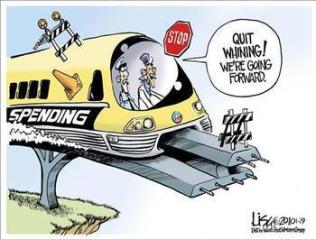
The president’s efforts to grow the state apparatus continue with this budget proposal. It might be “toast” as a package, but the political bidding war continues. Much depends on the ability of Americans to resist the goodies dangled before them by the White House candyman. That much is required to reverse the ongoing slide into dependency on the state.

Newer posts →
Follow Sacred Cow Chips on WordPress.com

Recent Posts

  • A Warsh Policy Scenario At the Federal Reserve
  • The Coexistence of Labor and AI-Augmented Capital
  • The Case Against Interest On Reserves
  • Immigration and Merit As Fiscal Propositions
  • Tariff “Dividend” From An Indigent State

Archives

  • February 2026
  • January 2026
  • December 2025
  • November 2025
  • October 2025
  • September 2025
  • August 2025
  • July 2025
  • June 2025
  • May 2025
  • April 2025
  • March 2025
  • February 2025
  • January 2025
  • December 2024
  • November 2024
  • October 2024
  • September 2024
  • August 2024
  • July 2024
  • June 2024
  • May 2024
  • April 2024
  • March 2024
  • February 2024
  • January 2024
  • December 2023
  • November 2023
  • August 2023
  • July 2023
  • June 2023
  • May 2023
  • April 2023
  • March 2023
  • February 2023
  • January 2023
  • December 2022
  • November 2022
  • October 2022
  • September 2022
  • August 2022
  • July 2022
  • June 2022
  • May 2022
  • April 2022
  • March 2022
  • February 2022
  • January 2022
  • December 2021
  • November 2021
  • October 2021
  • September 2021
  • August 2021
  • July 2021
  • June 2021
  • May 2021
  • April 2021
  • March 2021
  • February 2021
  • January 2021
  • December 2020
  • November 2020
  • October 2020
  • September 2020
  • August 2020
  • July 2020
  • June 2020
  • May 2020
  • April 2020
  • March 2020
  • February 2020
  • January 2020
  • December 2019
  • November 2019
  • October 2019
  • September 2019
  • August 2019
  • July 2019
  • June 2019
  • May 2019
  • April 2019
  • March 2019
  • February 2019
  • January 2019
  • December 2018
  • November 2018
  • October 2018
  • September 2018
  • August 2018
  • July 2018
  • June 2018
  • May 2018
  • April 2018
  • March 2018
  • February 2018
  • January 2018
  • December 2017
  • November 2017
  • October 2017
  • September 2017
  • August 2017
  • July 2017
  • June 2017
  • May 2017
  • April 2017
  • March 2017
  • February 2017
  • January 2017
  • December 2016
  • November 2016
  • October 2016
  • September 2016
  • August 2016
  • July 2016
  • June 2016
  • May 2016
  • April 2016
  • March 2016
  • February 2016
  • January 2016
  • December 2015
  • November 2015
  • October 2015
  • September 2015
  • August 2015
  • July 2015
  • June 2015
  • May 2015
  • April 2015
  • March 2015
  • February 2015
  • January 2015
  • December 2014
  • November 2014
  • October 2014
  • September 2014
  • August 2014
  • July 2014
  • June 2014
  • May 2014
  • April 2014
  • March 2014

Blogs I Follow

  • Passive Income Kickstart
  • OnlyFinance.net
  • TLC Cholesterol
  • Nintil
  • kendunning.net
  • DCWhispers.com
  • Hoong-Wai in the UK
  • Marginal REVOLUTION
  • Stlouis
  • Watts Up With That?
  • Aussie Nationalist Blog
  • American Elephants
  • The View from Alexandria
  • The Gymnasium
  • A Force for Good
  • Notes On Liberty
  • troymo
  • SUNDAY BLOG Stephanie Sievers
  • Miss Lou Acquiring Lore
  • Your Well Wisher Program
  • Objectivism In Depth
  • RobotEnomics
  • Orderstatistic
  • Paradigm Library
  • Scattered Showers and Quicksand

Blog at WordPress.com.

Passive Income Kickstart

OnlyFinance.net

TLC Cholesterol

Nintil

To estimate, compare, distinguish, discuss, and trace to its principal sources everything

kendunning.net

The Future is Ours to Create

DCWhispers.com

Hoong-Wai in the UK

A Commonwealth immigrant's perspective on the UK's public arena.

Marginal REVOLUTION

Small Steps Toward A Much Better World

Stlouis

Watts Up With That?

The world's most viewed site on global warming and climate change

Aussie Nationalist Blog

Commentary from a Paleoconservative and Nationalist perspective

American Elephants

Defending Life, Liberty and the Pursuit of Happiness

The View from Alexandria

In advanced civilizations the period loosely called Alexandrian is usually associated with flexible morals, perfunctory religion, populist standards and cosmopolitan tastes, feminism, exotic cults, and the rapid turnover of high and low fads---in short, a falling away (which is all that decadence means) from the strictness of traditional rules, embodied in character and inforced from within. -- Jacques Barzun

The Gymnasium

A place for reason, politics, economics, and faith steeped in the classical liberal tradition

A Force for Good

How economics, morality, and markets combine

Notes On Liberty

Spontaneous thoughts on a humble creed

troymo

SUNDAY BLOG Stephanie Sievers

Escaping the everyday life with photographs from my travels

Miss Lou Acquiring Lore

Gallery of Life...

Your Well Wisher Program

Attempt to solve commonly known problems…

Objectivism In Depth

Exploring Ayn Rand's revolutionary philosophy.

RobotEnomics

(A)n (I)ntelligent Future

Orderstatistic

Economics, chess and anything else on my mind.

Paradigm Library

OODA Looping

Scattered Showers and Quicksand

Musings on science, investing, finance, economics, politics, and probably fly fishing.

  • Subscribe Subscribed
    • Sacred Cow Chips
    • Join 128 other subscribers
    • Already have a WordPress.com account? Log in now.
    • Sacred Cow Chips
    • Subscribe Subscribed
    • Sign up
    • Log in
    • Report this content
    • View site in Reader
    • Manage subscriptions
    • Collapse this bar
 

Loading Comments...