• About

Sacred Cow Chips

Sacred Cow Chips

Category Archives: Climate

Carbon Credits Are Still Largely Fake

06 Wednesday Mar 2024

Posted by Nuetzel in Climate, Renewable Energy

≈ 4 Comments

Tags

Carbon Credits, Carbon Offsets, CO2, Credible CO2 Offsets, Deforestation, Double Counting of Offsets, ESG Variance, Excess Power, Global Greening, Greenhouse Gases, Inelastic Power Demand, Intermitancy, Net Zero, Paul Mueller, Renewable energy, Renewables Utilization, Taylor Swift, Water Vapor
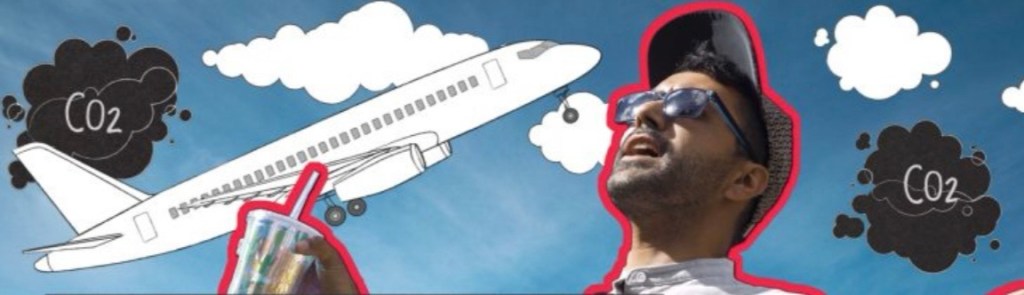
About a year ago I wrote about the sketchy nature of carbon credits (or “offsets”), which are purchased by people or entities whose actions generate CO2 emissions they’d like to offset. Those actions would include Taylor Swift’s private air travel, electric power generation, and many other activities whose participants wish to have “greenwashed”.

One short digression before I get started: see those black clouds of CO2 in the image above? Well, carbon dioxide doesn’t really look like that. In fact, CO2 is transparent. Trees breathe it! Visually, it’s less obvious than the greenhouse gas known as water vapor in those puffy white clouds, but virtually every image you’ll ever see on-line depicting CO2 emissions shows dark, roiling smoke. I just hate to spoil the scary effect, but there it is.

Back to carbon credits, which help fund projects that offset CO2 emissions (at least theoretically), such as planting new forest acreage (which would absorb CO2 … someday) or preventing deforestation. Other types of offset activities include investment in renewable energy projects and carbon capture technology. So, for example, if a utility’s power generation emits CO2, the creation or preservation of some amount of forested acreage can serve as a carbon sink adequate to offset the utility’s emissions. Net zero! Or so the utility might claim.

If only it were that simple! Paul Mueller explains that the incentive structure of these arrangements is perverse. What if credits are sold on the basis of supposed efforts to preserve forests that were never at risk to begin with? In fact, the promise of revenue from the sale of credits may be a powerful incentive to falsely present forested lands as targets for development. For that matter, cutting forestland for lumber makes more sense if it can be replanted immediately in exchange for revenue from the sale of carbon credits. And newly planted acreage won’t lead to absorption of much CO2 for many years, until the trees begin to mature. Then there are the risks of forest fires or disease that could compromise a forest’s ultimate value as a carbon sink.

Whether through fraud, calamity, or mismanagement, the sad truth is that projects serving as a basis for credits have done far less to reduce deforestation than promised. On top of that, another issue plaguing carbon markets for some time has been double counting of offsets, which can occur under several circumstances. Ultimately, CO2 emissions themselves may have done more to promote the growth of forests than purchases of carbon credits, because CO2 gives life to vegetation!

Obviously, the purchase of offsets raises the incremental cost of any project having CO2 emissions. The incidence of this added cost is borne to a large extent by consumers, especially because power demand is fairly inelastic. The craziness of offset logic may even dictate the purchase of offsets when a plant emitting more CO2 (e.g., coal) is replaced by a plant emitting less (natural gas), because the replacement would still emit carbon!

Some carbon offsets help pay for the construction of renewable power facilities like wind and solar farms. These renewable power facilities contribute to the power supply, of course, but wind turbines and solar farms typically operate at a small fraction of nameplate capacity due to the intermittency of wind and sunshine. Thus, these offsets are far less than complete. And from that low rate of renewable utilization we can deduct another fraction: periods of actual utilization often occur when no one wants the power, and while utilities can sell that excess power into the grid, it doesn’t replace other power at those times and it therefore doesn’t contribute to reductions in CO2 emissions.

Claims of achieving net zero are very much in vogue in the corporate world, and for a few related reasons. One is that they help keep activists and protesters away from the gates. There are, however, plenty of activists serving on corporate boards, in the executive suite, and among regulators.

The purchase of carbon offsets by “socially responsible corporations” might put stakeholder pressure on competitors who are “insufficiently green”. That would help to compensate for the higher costs imposed by offsets. After all, carbon credits are not cheap. In fact, smaller competitors might struggle to fund additional outlays for the credits.

Finally, claims of carbon neutrality also help with another constituency: “woke” investors. “Achieving” net zero boosts a firm’s so-called ESG score, presumed to reflect soundness in terms of environmental (E) and social (S) responsibility, as well as the quality of internal governance (G). With firms jockeying for ESG improvements, they help keep the offset charade going.

There is no common standard for calculating ESG, and there is considerable variance in ESG scores across rating firms. This should be cause for great skepticism, but too many investors are vulnerable to suggestions that screening on ESGs can enable both social responsibility and better returns. Sadly, they are sometimes paying higher fees for the privilege. The ESG fad among these investors might have helped fulfill hopes of greater returns for a while, but the imagined ESG advantage may have faded.

Carbon credits or offsets are plagued by bad incentives that often lead to wasteful outlays if not outright fraud. At present, they generally fail to reduce atmospheric CO2 as promised and they contribute to higher costs, which are passed on to consumers. They also serve as an unworthy basis for higher ESG scores, which are something of a sham in any case.

There have been efforts underway to improve the quality and legitimacy of carbon offsets. Some of this is voluntary due diligence on the part of purchasers. The effort also includes various NGOs and regulators. Ultimately, the push for quality is likely to push the price of offsets upward dramatically. Perhaps offsets will become more credible, but they won’t come cheap. The cost of achieving net zero targets will largely come out of consumers’ pockets, and those net zeros will still be nominal at best.
Climate Change Did Not Cause the Maui Fires

15 Tuesday Aug 2023

Posted by Nuetzel in Climate, Wildfires

≈ Leave a comment

Tags

Arson, Cliff Mass, Firebreaks, Hawaii Fire Risk, Hurricane Dora, Invasive Grasses, James Steele, Josh Green, Lahaina, Maui, Mick Fleetwood, Steve Parrish, Trade Winds, West Maui Wildfires

Several years ago my wife and I dined on the roof of Mick Fleetwood’s restaurant in beautiful Lahaina on Maui. Sadly, that restaurant was destroyed by this week’s wildfire, along with the famous banyan tree and most of the town. The death toll keeps climbing in what was an unimaginably tragic event.

Climate alarmists, including Hawaii Governor Josh Green and one of my favorite personalities, Steve Parrish, jumped to the immediate and wrong-headed conclusion that this fire was caused by climate change. They believe that sounds so sensible, but nothing could be further from the truth. As I noted in a post last week, this year has seen relatively little burning around the globe. It just so happens that the western side of Maui is particularly prone to grass fires, and this one happened to be huge.

Here’s a good explanation from James Steele of the circumstances which culminated in the fire that destroyed Lahaina. He first acknowledges that wildfires are quite common in Hawaii, but very few are caused by lightning strikes:

“According to Hawaii Wildfire Management Organization, 98% of all Hawaiian fires are started by people, of which 75% are due to carelessness. .. As retirees flock to Hawaii seeking the health benefits of a warmer climate, the population has tripled since 1980, which only increases the probability of a careless fire being started.”

Arson is part of the story, but I don’t know of any reports of arson that might be implicated in this conflagration. Fires from electrical lines have also been mentioned as possible triggers.

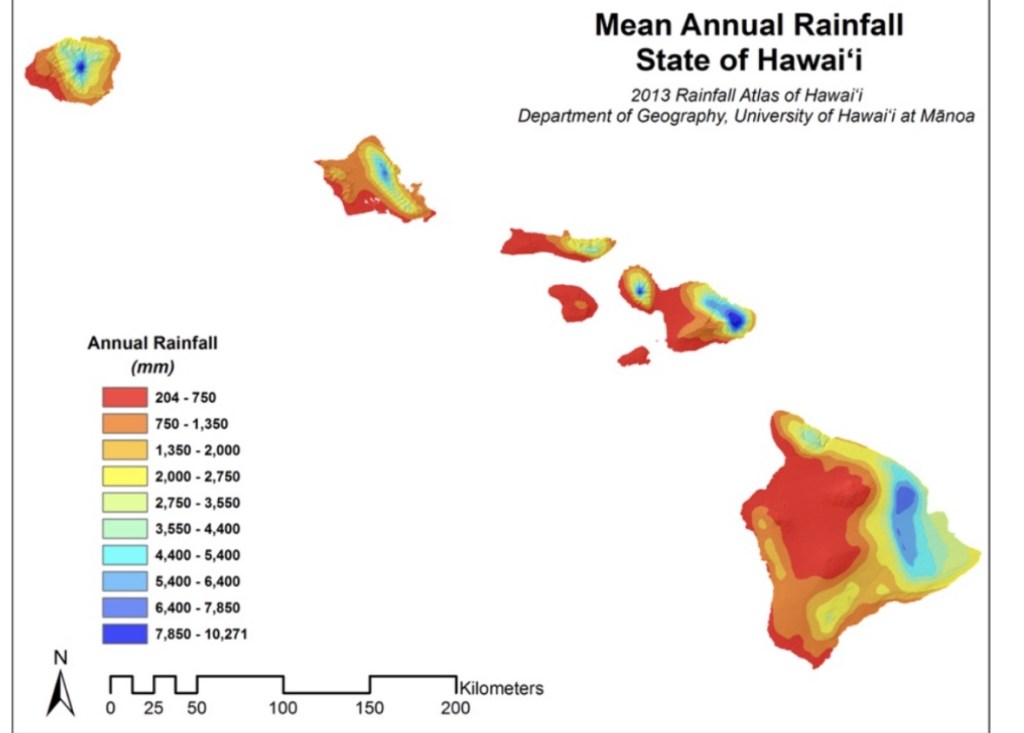
The western part of Maui tends to be much drier than more eastern parts of the island. Here’s Steele again:

“Lahaina is situated on the leeward side of Maui’s mountains. These highlands wring out the moisture carried by the trade winds, with only 15” of rain falling in Lahaina compared to 300” on the mountains to the east.”

Expanding acreage of invasive grasses has led to excessive fire risk. This has occurred with declining production of agricultural products like pineapples and sugar cane. These “small diameter” grasses dry-out very quickly and become dangerous fuel for wind-blown fires. Even worse, a very wet spring led to more growth in the grasses than normally occurs. Once dry weather set in, a tinder box was created in western Maui.

Cliff Mass makes some of the same points, and he offers some detail on strong trade winds that developed last week between a powerful high-pressure system to the north of Maui and Hurricane Dora to the south. And no, climate change is not increasing the frequency or severity of hurricanes. Maui’s position between other islands, and the mountains east of Lahaina, create a funneling effect for the winds. Mass speculates that these high winds blew down power lines, igniting the fires.

The risk of catastrophic fires in West Maui has been known for years. The link summarizes statements made by a director of a non-profit involved in planning and preparing earlier reports on fire risk:

“… significant progress in implementing the community-based work since [her] organizations inception in 2002. But the necessary ‘enormous infrastructure’ investments have not come.

‘I don’t know if I understood the urgency of those bigger investments.’ ….”

The recommended investments included 70 miles of fire breaks and 90 miles of fuel breaks. Essentially, these breaks would be bare land intended to reduce fire spread and intensity. Apparently that work was never initiated, nor was work begun on other types of infrastructure needed to minimize risk.

The tragic fire in West Maui resulted from a confluence of declining agriculture, invasive and fire-prone grasses, an especially wet spring followed by a dry summer, a few days of unusually strong trade winds, and geography that funnels and focuses the intensity of those winds. The “spark” or “sparks” might well have been from downed power lines, or possibly some other kind of accident, carelessness, or even arson. It was not caused by global warming, as much as the climate change activists might like to convince you. The assertion that fires are becoming more frequent and severe has absolutely no basis in fact.

Tis the Season of Peak Climate Propaganda

09 Wednesday Aug 2023

Posted by Nuetzel in Climate

≈ 1 Comment

Tags

Björn Lomberg, Climate Change, Cooling the Past, Dust Bowl, El Nino, EPA, global warming, Heat Wave Index, Heat Waves, Hunga Tonga, Lancet, NASA, PBS News Hour, Satellite Temperatures, Thermometer Sitings, Urban Heat Island Effect, Water Temperatures, Water Vapor, Wildfires

It happens every summer! It’s been hot, and the news media and professional grifters in the anti-carbon climate-change establishment want us to panic about it. Granted, the weather really was quite hot for several weeks in July across parts of the U.S., Europe, and elsewhere, but it’s cooled off considerably since then, especially in my neck of the woods.

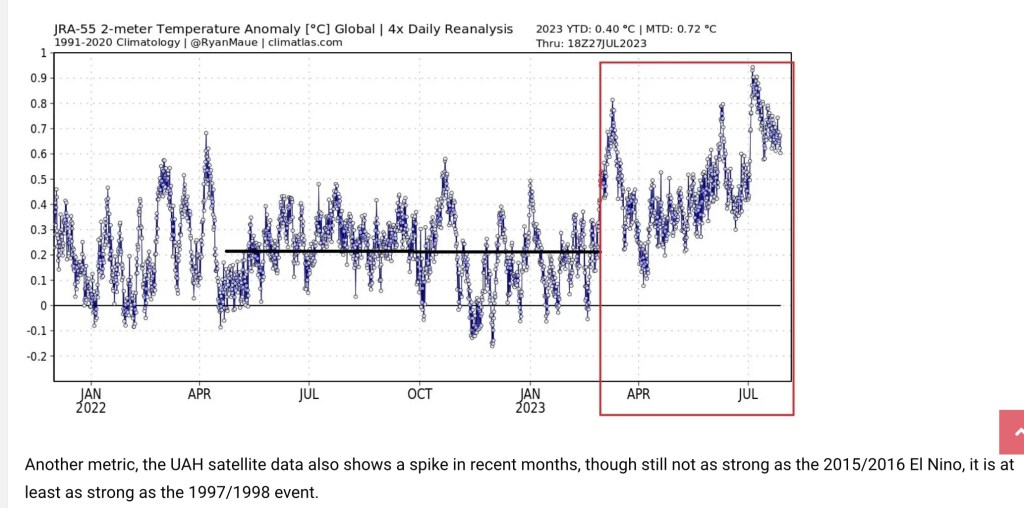
July is typically the warmest month of the year, and July 2023 was the warmest July for the troposphere on the satellite record. (The troposphere is the lowest 13 km of the atmosphere, but that’s an average — it’s thicker toward equatorial latitudes, thinner toward the poles.) However, attribution of this summer’s heat waves to carbon-induced climate change is misplaced. What follows are a few considerations in evaluating this claim, and the lengths to which climate activists go to distort weather data and reporting.

The Biggest Greenhouse Gas

One speculative explanation for the recent heat wave has gained some traction: the eruption of the Hunga Tonga-Hunga Ha’apai volcano in the South Pacific on Jan. 15, 2022 (and see here). This underwater eruption spewed massive quantities of water vapor into the stratosphere, which encircled the globe in fairly short order. Water vapor acts as a greenhouse gas, and it is by far the most important greenhouse gas. This plume of vapor may have affected the climate with a delay, and it is not expected to dissipate for at least a couple of years. However, there are theories that the eruption might have led to some offsetting effects due to the reflective properties of water and ice in the stratosphere. See here for an interesting debate on the estimated effects of this “shock” to the atmosphere.

NASA has estimated that the Hunga Tonga eruption resulted in a 10% increase in atmospheric water vapor, while the European Space Agency puts the increase at 13%. Now, in addition to this added water vapor, we have the early effects of an El Niño event in the Pacific, which may elevate temperatures over the next couple of years.

However, the temperatures in July simply don’t justify the claim that we’re experiencing “unprecedented” warmth. The satellite records go back only to 1979, which is an especially narrow window on climatological scales. The longer record of temperatures shows earlier periods of higher temperatures, For example, U.S. surface temperature records indicate that the 1930s had periods warmer than this July. Moreover, while estimates of paleo-climate data are a matter of great dispute, there is no question that the globe has experienced warmer temperatures in the past, with an ice-free Arctic.

So, was July 3 really the hottest day in history? No way, and the worst part of this warm spell wasn’t even the warmth. Rather, it was the attempts to make weather a political matter, as if public policymakers possess some kind of control knob over weather phenomena, or as if we should bestow upon them dictatorial powers to act on their fantasy.

Longer Trends

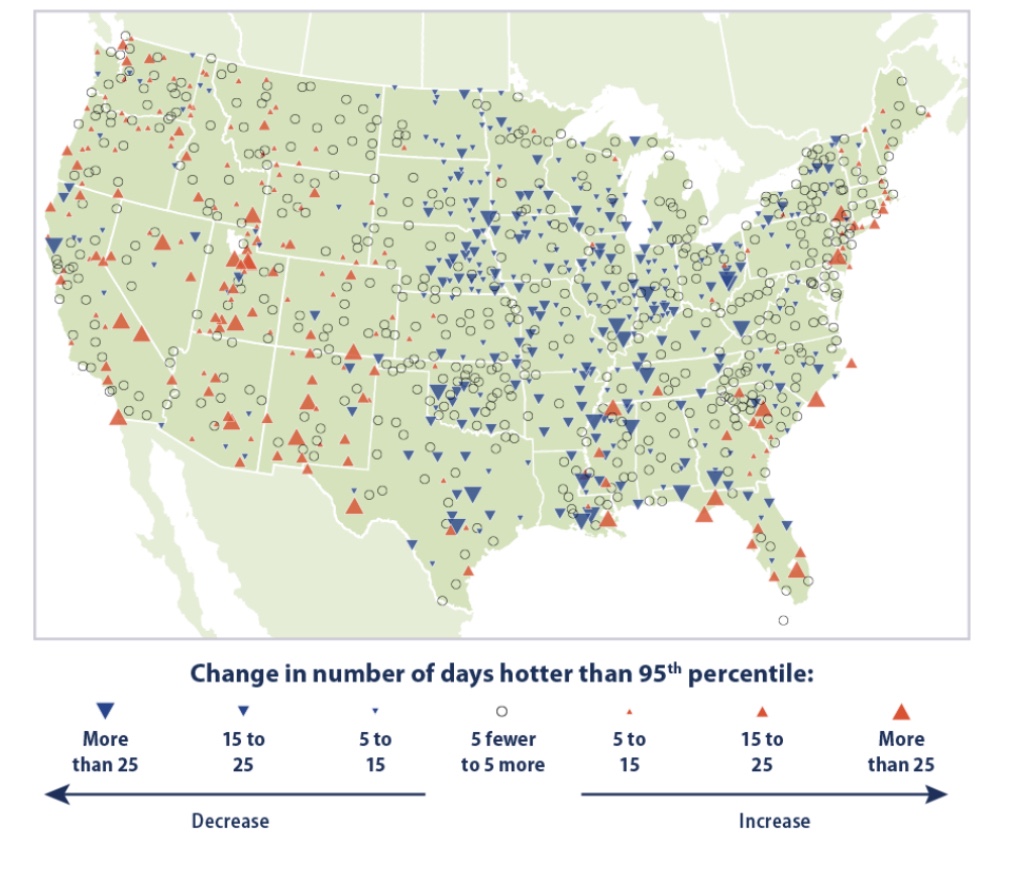
There’s plenty of other evidence running contrary to the “hotter-than-any-time in-history” foolishness. Take a look at trends in hot and cool weather from individual U.S. weather stations over a somewhat longer time span than the satellite record. The red symbols shown on the map below mark stations reporting increases in the number of unusually hot days (heat in the 95th percentile) between 1948 – 2020, with larger symbols corresponding to greater increases in extremely hot days. The blue symbols mark stations reporting increases in the number of unusually cool days (in the 5th percentile) over the same period. The data in this chart is published by the EPA, and it is definitely not alarming.

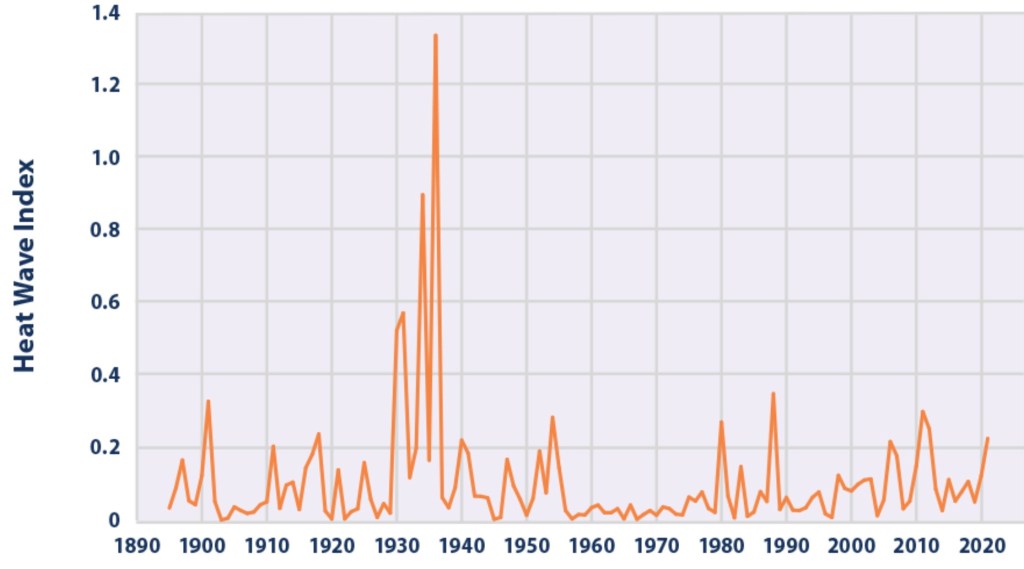
The next chart shows the so-called Heat Wave Index produced by the EPA. Recent spikes in the index are muted relative to the Dust Bowl days of the 1930s.

Journalism or Exaggeration?

Reports of hot weather in Europe have been distorted as well, often placing more emphasis on forecasts of high temperatures than on the temperatures themselves. It’s almost as if authorities, with the aid of the news media and naive weather reporters, are determined to raise an exaggerated sense of alarm among the citizenry. Almost?

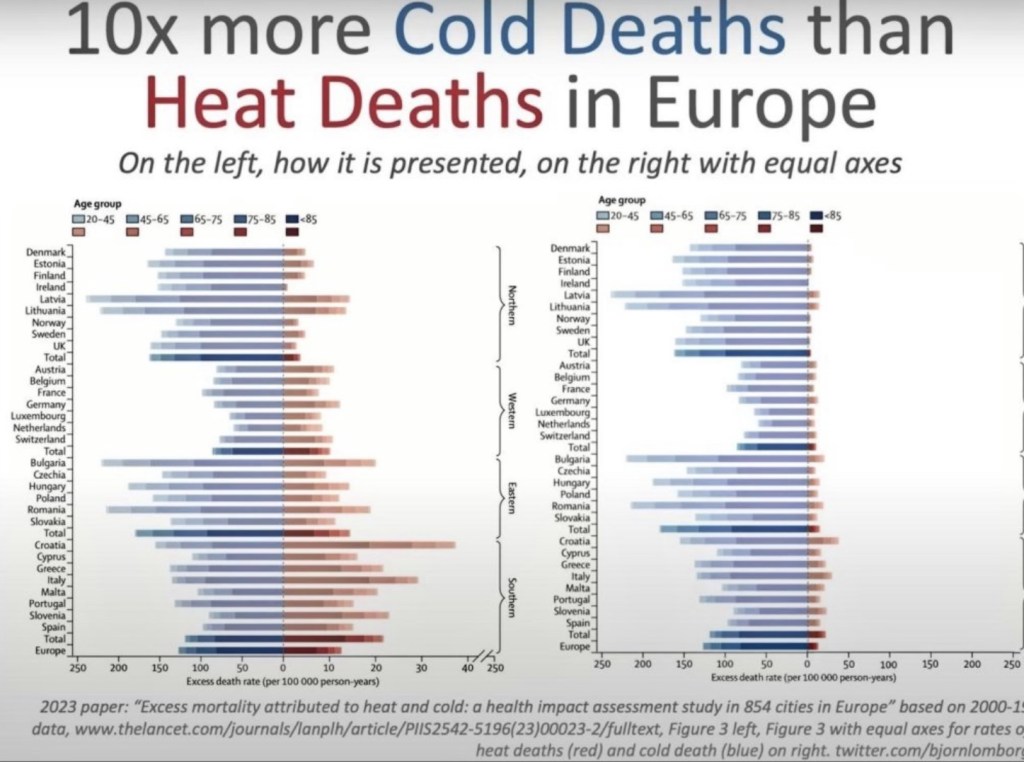
Cold 10x Deadlier Than Heat

The next chart vividly illustrates an attempt to propagandize climate misinformation. Take a look at the left side of this illustration, which appeared in the medical journal Lancet. Note the difference in the horizontal scale for heat deaths vs. cold deaths. The chart on the right side uses equivalent scales for heat vs. cold deaths. This should qualify the journal for some kind of award for mendacity, or perhaps sheer stupidity. It’s the cold that really kills, not the heat! I’m moving south!

Finding Hot Water

And here’s a take-down of some incredible water temperature propaganda. A PBS News Hour reporter has pushed claims that South Florida water temperatures reached 101 degrees this summer. The emphasis on a single reading was taken from a buoy not subject to the cooling effects of deep water circulation, and it is located where fresh water often overlays salt water, which traps heat. Data from other buoys not far away showed much lower temperatures.

Spreads Like Wildfire

Another fallacious claim we hear too often is that global warming is literally causing the world to go up in flames. The facts run contrary to these scare stories. Björn Lomborg notes the following:

“For more than two decades, satellites have recorded fires across the planet’s surface. The data are unequivocal: Since the early 2000s, when 3% of the world’s land caught fire, the area burned annually has trended downward.

“In 2022, the last year for which there are complete data, the world hit a new record-low of 2.2% burned area. Yet you’ll struggle to find that reported anywhere.”

The heavy focus by the media on this year’s wild fires in North America offers a perfect example of the media’s tendency to “cherry pick for clicks”. Africa and Europe have had little burning this year, and in North America, arson has played a conspicuous role (and see here) in the wildfires.

Distorted Measurements

Personally, I have trouble accepting claims that temperatures are any warmer now than they were in my youth, at least where I grew up. My subjective and local assessment aside, there are strong reasons to doubt the reliability and significance of trends in official temperature records. The urban heat-island effect has distorted temperatures by ever greater magnitudes, as growing metropolitan areas absorb heat readily compared to rural green space.

Furthermore, poor siting of weather stations and temperature gauges has become all too common. This includes equipment located at airports and other areas in close proximity to asphalt or concrete. This contributes to an upward bias in more recent temperature data. It’s also worth noting in this context that satellite temperature readings must be calibrated periodically to surface temperatures. If the latter are corrupted in any way, the satellite readings may be corrupted as well.

“Adjusting” the Past

Official historical records also include a variety of “adjustments” to temperature data that raise concerns. Ostensibly, these adjustments are justified by an interest in maintaining a consistent historical record. Changes in equipment or it’s exact location can create discontinuities, for example. Unfortunately, the adjustments appear to have had a systematic tendency to “cool the past” relative to more recent data. This reinforcement of the warming trend over the past few decades is suspicious, to say the least. It does very little to build confidence in the agencies responsible for these records.

Conclusion

The hot temperatures in July brought the usual deluge of propaganda, including distortions in the reporting of weather phenomena. And we hear increasing calls to force transition to EVs (which are powered mostly by fossil-fuel electric plants), subsidize intermittent renewable power sources, and to end the use of air conditioning and gas stoves. Yet these coercive measures would do nothing to prevent summer heat or climate change generally. Water vapor represents 95% of greenhouse gases, and the huge vapor shock from the Hunga Tonga eruption might well make us prone to warmer temperatures for at least some months to come, mixed with signals from the Pacific El Niño pattern. But these are not evidence of a man-made crisis, despite perverse cheers from those rooting for more draconian state intrusions and an end to growth, or indeed, a reversal in gains to human well being.

Carbon Credits and Green Bonds Are Largely Fake

06 Monday Mar 2023

Posted by Nuetzel in Climate, Environment

≈ 2 Comments

Tags

Blake Lovewall, Carbon Credits, Carbon Offsets, Caveat Emptor, Climate Change Opportunism, Deforestation, Die Zeit, Environmental Committments, ESG Scores, Fiduciary Duty, Green Bonds, Green Investing, greenfraud.blogspot.com, Greenwashing, Net Zero, Paris Climate Accords, Recycling Mandates, REDD, SourceMaterial, The Guardian

It doesn’t take much due diligence to reveal that certain green “commitments” are flimsy gestures at best. I discussed the poor economics of recycling mandates in a post a few days ago. Here I discuss two other prominent examples of fake virtue: so-called carbon offsets and green bonds. These are devices often utilized by private actors to assuage activists, gain favor with public policymakers., or simply to claim and promote themselves as “zero-footprint”. No doubt many well-intentioned people believe in the goodness of these instruments, blissfully ignorant of the underlying fakery. Of course, this is dwarfed by the broad flimsiness (and cost implications) of claims about climate catastrophe, which is what motivates carbon credits and most green bonds in the first place. The includes “commitments” made by various nations under the Paris Climate Accords, but that is a subject for another day.

Climate Credits

I mentioned Blake Lovewall’s interesting commentary on carbon credits recently. Purchasing these credits is a way of “greenwashing” activities that emit carbon dioxide. Also known as carbon offsets, this is a $2 billion market with growth fueled by a desire by businesses to appeal to environmental activists and “green” investors, and to boost their ESG scores. I’ll quote here from my own piece, which had as it’s main thrust the waste inherent in wind and solar projects (Lovewall quotes are in blue type):

“The resulting carbon emissions are, in reality, unlikely to be offset by any quantity of carbon credits these firms might purchase, which allow them to claim a ‘zero footprint’. Blake Lovewall describes the sham in play here:

‘The biggest and most common Carbon offset schemes are simply forests. Most of the offerings in Carbon marketplaces are forests, particularly in East Asian, African and South American nations. …

The only value being packaged and sold on these marketplaces is not cutting down the trees. Therefore, by not cutting down a forest, the company is maintaining a ‘Carbon sink’ …. One is paying the landowner for doing nothing. This logic has an acronym, and it is slapped all over these heralded offset projects: REDD. That is a UN scheme called “Reduce Emissions from Deforestation and Forest Degradation”. I would re-name it to, “Sell off indigenous forests to global investors”.’

Lovewall goes on to explain that these carbon offset investments do not ensure that forests remain pristine by any stretch of the imagination. For one thing, the requirements for managing these ‘preserves’ are often subject to manipulation by investors working with government; as such, the credits are often vehicles for graft. In Indonesia, for example, carbon credited forests have been converted to palm oil plantations without any loss of value to the credits! Lovewall also cites a story about carbon offset investments in Brazil, where the credits provided capital for a massive dam in the middle of the rainforest. This had severe environmental and social consequences for indigenous peoples. It’s also worth noting that planting trees, wherever that might occur under carbon credits, takes many years to become a real carbon sink.”

Lovewall makes a strong case that carbon credits are a huge fraud. This was reinforced by a recent investigation conducted by the Guardian, Die Zeit and SourceMaterial, a “non-profit investigative journalism organization”, according to the Guardian. The investigation was based on independent research studies as well as interviews with various parties. They found that at least 90% of “rainforest credits” do not represent carbon reductions. Two studies found no abatement whatsoever in deforestation under the credits. Furthermore, the deforestation threats (absent credits) had been overstated by some 400%. The investigation also noted serious human rights violations associated with the offset projects. Rainforest credits are only one kind of carbon offset, but similar problems plague other types of credits as well, such as those earned by shuttering fossil fuel plants in developing countries desperately short on power generation.

That so much of the carbon credit market is fraudulent should infuriate climate change radicals. The findings also are a disgrace to participants in these markets, revealing that much of the “net zero” propaganda trumpeted by corporate PR organizations is a charade. Regrettably, it is motivated by an unnecessary panic over carbon dioxide emissions and their presumed role in global warming. Spending on environmental initiatives should be a warning flag for investors. The resources firms dedicate to those credits deserve careful scrutiny. The fascination with ESG scores is another sign that corporate managers have lost sight of their fundamental mission: to maximize shareholder value by serving their customers well.

Green Bonds

Another suspicious form of “commitment” is embodied in the issuance of so-called “green bonds” to raise funds for environmental initiatives. This form of investing is so ostensibly “virtuous” that these bonds are demanded even with specific commitments that are quite “soft”. This just released study finds that green bonds offer little assurance of any positive environmental impact:

“… we find a concerning lack of enforceability of green promises. Moreover, these promises have been getting weaker over time. Green bonds often make vague commitments, exclude failures to live up to those commitments from default events, and disclaim an obligation to perform in other parts of the document. These shortcomings are known to market participants. Yet, demand for these instruments has been growing. We ask why green bond promises are so weak, while the same investors demand strong promises from the same issuers in other settings.”

Green bonds are “virtue ornaments” typically purchased by institutional investors with some sort of environmental or ESG objective. Apparently, earning returns is an afterthought. Unfortunately, these funds managers are usually investing on behalf of other people. While some of those clients might wholly support the environmental objectives, many others have no clue.

Fortunately, there are alternatives, and I’m tempted to say caveat emptor applies here. However, it really is a remarkable breach of fiduciary duty to manage funds based on objectives other than maximizing expected returns, or to in any way sacrifice returns in favor of “green” objectives. That is happening before our very eyes. Even clients who wish to invest funds for green objectives are being shaken down here. According to the research cited above, the green bond “commitments” are hardly worth the paper they’re written on.

Institutional investors go right along, scrambling to add green bonds to their portfolios. This helps drive down the effective cost of funds to the green bond issuers. Thus, highly speculative climate or environmental initiatives can be funded on the cheap. They do, however, produce lucrative opportunities for the climate crisis industry.

One More Time

People save to build wealth, typically for their retirement years. If that’s your objective, you probably shouldn’t invest in firms expending their resources on carbon credits. At best, the credits are a buy-off to activists. who are just as ignorant of the whole sham.

One might plausibly ask whether I should love carbon credits because they allow, at least, certain forms of beneficial economic activity to avoid challenge by crazies. Perhaps that’s true taking the world as it is, but my hope is that exposing various layers of climate hysteria and craziness is one way to change the world. The whole carbon credit enterprise enables extraction of still greater rents by climate change opportunists, to say nothing of human rights abuses taking place under the guise of these credits.

Like carbon offsets, green bonds promote fictitious virtue, They are another way in which green profiteers extract rents from well-meaning savers and investors, some of whom are unaware that ESG objectives are undermining their returns. Even if investors prefer to sacrifice returns in the pursuit of green goals, the initiatives thus funded often have no environmental merit, particularly when it comes to reducing carbon emissions. Despite the efforts of these bonds issuers to convince us of their green bona fides, their “commitments” to green results are usually flimsy.

HT: Green Fraud blog for the image above.

.

Grow Or Collapse: Stasis Is Not a Long-Term Option

18 Wednesday Jan 2023

Posted by Nuetzel in Climate, Environment, Growth

≈ 1 Comment

Tags

Asymptotic Burnout, Benjamin Friedman, Climate Change, Dead Weight Loss, Degrowth, Fermi Paradox, Lewis M. Andrews, Limits to Growth, NIMBYism, Paul Ehrlich, Population Bomb, Poverty, regulation, Robert Colvile, Stakeholder Capitalism, State Capacity, Stubborn Attachments, Subsidies, Tax Distortions, Thomas Malthus, Tyler Cowan, Veronique de Rugy, Zero Growth

Growth is a human imperative and a good thing in every sense. We’ve long heard from naysayers, however, that growth will exhaust our finite resources, ending in starvation and the collapse of human civilization. They say, furthermore, that the end is nigh! It’s an old refrain. Thomas Malthus lent it credibility over 200 years ago (perhaps unintentionally), and we can pick on poor Paul Ehrlich’s “Population Bomb” thesis as a more modern starting point for this kind of hysteria. Lewis M. Andrews puts Ehrlich’s predictions in context:

“A year after the book’s publication, Ehrlich went on to say that this ‘utter breakdown’ in Earth’s capacity to support its bulging population was just fifteen years away. … For those of us still alive today, it is clear that nothing even approaching what Ehrlich predicted ever happened. Indeed, in the fifty-four years since his dire prophesy, those suffering from starvation have gone from one in four people on the planet to just one in ten, even as the world’s population has doubled.”

False Limits

The “limits” argument comes from the environmental Left, but it creates for them an uncomfortable tradeoff between limiting growth and the redistribution of a fixed (they hope) or shrinking (more likely) pie. That’s treacherous ground on which to build popular support. It’s also foolish to stake a long-term political agenda on baldly exaggerated claims (and see here) about the climate and resource constraints. Ultimately, people will recognize those ominous forecasts as manipulative propaganda.

Last year, an academic paper argued that growing civilizations must eventually reach a point of “asymptotic burnout” due to resource constraints, and must undergo a “homeostatic awakening”: no growth. The authors rely on a “superlinear scaling” argument based on cross-sectional data on cities, and they offer their “burnout” hypothesis as an explanation for the Fermi Paradox: the puzzling quiet we observe in the universe while we otherwise expect it to be teeming with life… civilizations reach their “awakenings” before finding ways to communicate with, or even detect, their distant neighbors. I addressed this point and it’s weaknesses last year, but here I mention it only to demonstrate that the “limits to growth” argument lives on in new incarnations.

Growth-limiting arguments are tenuous on at least three fundamental grounds: 1) failure to consider the ability of markets to respond to scarcity; 2) underestimating the potential of human ingenuity not only to adapt to challenges, but to invent new solutions, exploit new resources, and use existing resources more efficiently; and 3) homeostasis is impossible because zero growth cannot be achieved without destructive coercion, suspension of cooperative market mechanisms, and losses from non-market (i.e., political and non-political) competition for the fixed levels of societal wealth and production.

The zero-growth world is one that lacks opportunities and rewards for honest creation of value, whether through invention or simple, hard work. That value is determined through the interaction of buyers and sellers in markets, the most effective form of voluntary cooperation and social organization ever devised by mankind. Those preferring to take spoils through the political sphere, or who otherwise compete on the basis of force, either have little value to offer or simply lack the mindset to create value to exchange with others at arms length.

Zero-Growth Mentality

As Robert Colvile writes in a post called “The Morality of Growth”:

“A society without growth is not just politically far more fragile. It is hugely damaging to people’s lives – and in particular to the young, who will never get to benefit from the kind of compounding, increasing prosperity their parents enjoyed.”

Expanding on this theme is commenter Slocum at the Marginal Revolution site, where Colvile’s essay was linked:

“Humans behave poorly when they perceive that the pie is fixed or shrinking, and one of the main drivers for behaving poorly is feelings of envy coming to the forefront. The way we encourage people not to feel envy (and to act badly) is not to try to change human nature, or ‘nudge’ them, but rather to maintain a state of steady improvement so that they (naturally) don’t feel envious, jealous, tribal, xenophobic etc. Don’t create zero-sum economies and you won’t bring out the zero-sum thinking and all the ills that go with it.”

And again, this dynamic leads not to zero growth (if that’s desired), but to decay. Given the political instability to which negative growth can lead, collapse is a realistic possibility.

I liked Colville’s essay, but it probably should have been titled “The Immorality of Non-Growth”. It covers several contemporary obstacles to growth, including the rise of “stakeholder capitalism”, the growth of government at the expense of the private sector, strangling regulation, tax disincentives, NIMBYism, and the ease with which politicians engage in populist demagoguery in establishing policy. All those points have merit. But if his ultimate purpose was to shed light on the virtues of growth, it seems almost as if he lost his focus in examining only the flip side of the coin. I came away feeling like he didn’t expend much effort on the moral virtues of growth as he intended, though I found this nugget well said:

“It is striking that the fastest-growing societies also tend to be by far the most optimistic about their futures – because they can visibly see their lives getting better.”

Compound Growth

A far better discourse on growth’s virtues is offered by Veronique de Rugy in “The Greatness of Growth”. It should be obvious that growth is a potent tonic, but its range as a curative receives strangely little emphasis in popular discussion. First, de Rugy provides a simple illustration of the power of long-term growth, compound growth, in raising average living standards:

This is just a mechanical exercise, but it conveys the power of growth. At 2% real growth, real GDP per capital would double in 35 years and quadruple in 70 years. At 4% growth, real GDP would double in 18 years… less than a generation! It would quadruple in 35 years. If you’re just now starting a career, imagine nearing retirement at a standard of living four times as lavish as today’s senior employees (who make a lot more than you do now). We’ll talk a little more about how such growth rates might be achieved, but first, a little more on what growth can achieve.

The Rewards of Growth

Want to relieve poverty? There is no better and more permanent solution than economic growth. Here are some illustrations of this phenomenon:

Want to rein-in the federal budget deficit? Growth reduces the burden of the existing debt and shrinks fiscal deficits, though it might interfere with what little discipline spendthrift politicians currently face. We’ll have to find other fixes for that problem, but at least growth can insulate us from their profligacy.

And who can argue with the following?

“All the stuff an advocate anywhere on the political spectrum claims to value—good health, clean environment, safety, families and quality of life—depends on higher growth. …

There are other well-documented material consequences of modern economic growth, such as lower homicide rates, better health outcomes (babies born in the U.S. today are expected to live into their upper 70s, not their upper 30s as in 1860), increased leisure, more and better clothing and shelter, less food insecurity and so on.”

De Rugy argues convincingly that growth might well entail a greater boost in living standards for lower ranges of the socioeconomic spectrum than for the well-to-do. That would benefit not just those impoverished due to a lack of skills, but also those early in their careers as well as seniors attempting to earn extra income. For those with a legitimate need of a permanent safety net, growth allows society to be much more generous.

What de Rugy doesn’t mention is how growth can facilitate greater saving. In a truly virtuous cycle, saving is transformed into productivity-enhancing additions to the stock of capital. And not just physical capital, but human capital through investment in education as well. In addition, growth makes possible additional research and development, facilitating the kind of technical innovation that can sustain growth.

Getting Out of the Way of Growth

Later in de Rugy’s piece, she evaluates various ways to stimulate growth, including deregulation, wage and price flexibility, eliminating subsidies, less emphasis on redistribution, and simplifying the tax code. All these features of public policy are stultifying and involve dead-weight losses to society. That’s not to deny the benefits of adequate state capacity for providing true public goods and a legal and judicial system to protect individual rights. The issue of state capacity is a major impediment to growth in the less developed world, whereas countries in the developed world tend to have an excess of state “capacity”, which often runs amok!

In the U.S., our regulatory state imposes huge compliance costs on the private sector and effectively prohibits or destroys incentives for a great deal of productive (and harmless) activity. Interference with market pricing stunts growth by diverting resources from their most valued uses. Instead, it directs them toward uses that are favored by political elites and cronies. Subsidies do the same by distorting tradeoffs at a direct cost to taxpayers. Our system of income taxes is rife with behavioral distortions and compliance costs, bleeding otherwise productive gains into the coffers of accountants, tax attorneys, and bureaucrats. Finally, redistribution often entails the creation of disincentives, fostering a waste of human potential and a pathology of dependence.

Growth and Morality

Given the unequivocally positive consequences of growth to humanity, could the moral case for growth be any clearer? De Rugy quotes Benjamin Friedman’s “The Moral Consequences of Economic Growth”:

“Growth is valuable not only for our material improvement but for how it affects our social attitudes and our political institutions—in other words, our society’s moral character, in the term favored by the Enlightenment thinkers from whom so many of our views on openness, tolerance and democracy have sprung.”

De Rugy also paraphrases Tyler Cowen’s position on growth from his book “Stubborn Attachments”:

“… economic growth, properly understood, should be an essential element of any ethical system that purports to care about universal human well-being. In other words, the benefits are so varied and important that nearly everyone should have a pro-growth program at or near the top of their agenda.”

Conclusion

Agitation for “degrowth” is often made in good faith by truly frightened people. Better education would help them, but our educational establishment has been corrupted by the same ignorant narrative. When it comes to rulers, the fearful are no less tyrannical than power-hungry authoritarians. In fact, fear can be instrumental in enabling that kind of transformation in the personalities of activists. A basic failing is their inability to recognize the many ways in which growth improves well-being, including the societal wealth to enable adaptation to changing conditions and the investment necessary to enhance our range of technological solutions for mitigating existential risks. Not least, however, is the failure of the zero-growth movement to understand the cruelty their position condones in exchange for their highly speculative assurances that we’ll all be better off if we just do as they say. A terrible downside will be unavoidable if and when growth is outlawed.

Climate Alarmism and Junk Science

02 Thursday Dec 2021

Posted by Nuetzel in Climate, Research Bias, Uncategorized

≈ 8 Comments

Tags

Carbon Forcing Models, Climate Alarmism, Green Subsidies, Intergovernmental Panel on Climate Change, IPCC, Kevin Trenberth, Model Bias, Model Ensembles, National Center for Atmospheric Research, Norman Rogers, Redistribution, rent seeking

The weak methodology and accuracy of climate models is the subject of an entertaining Norman Rogers post. I want to share just a few passages along with a couple of qualifiers.

Rogers quotes Kevin Trenberth, former Head of Climate Analysis at the National Center for Atmospheric Research, with apparent approval. Oddly, Rogers does not explain that Trenberth is a strong proponent of the carbon-forcing models used by the UN’s Intergovernmental Panel on Climate Change (IPCC). He should have made that clear, but Trenberth actually did say the following:

“‘[None of the] models correspond even remotely to the current observed climate [of the Earth].’“

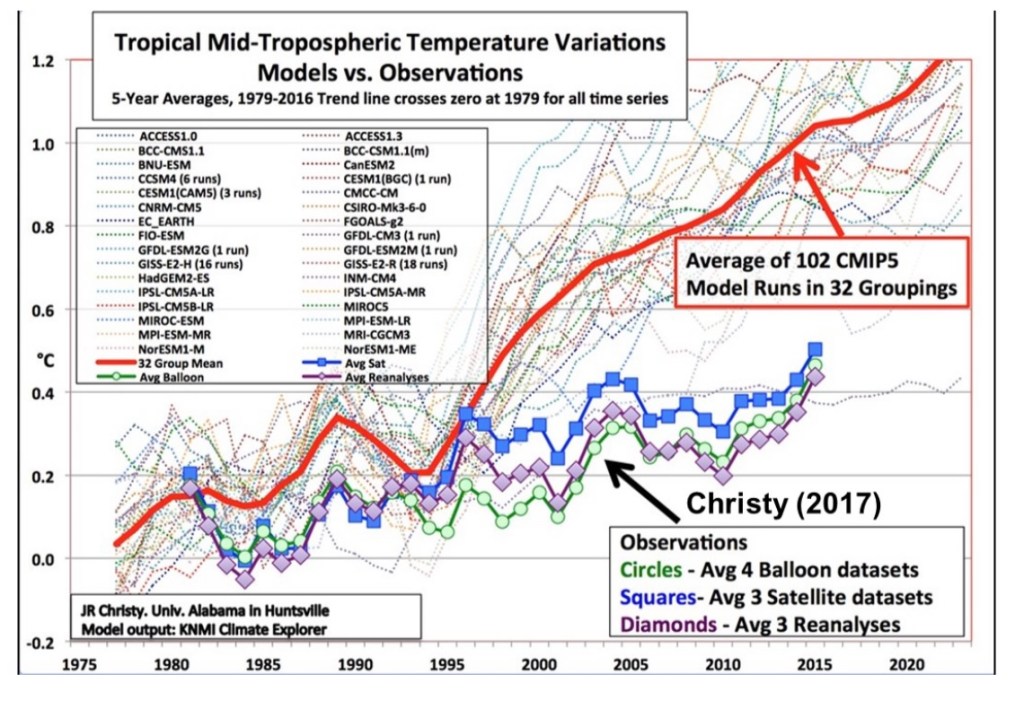
I’ll explain the context of this comment below, but it constitutes a telling admission of the poor foundations on which climate alarmism rests. The various models used by the IPCCc are all a little different and they are calibrated differently. I’ve noted elsewhere that their projections are consistently biased toward severe over-predictions of temperature trends. Rogers goes on from there:

“The models can’t properly model the Earth’s climate, but we are supposed to believe that, if carbon dioxide has a certain effect on the imaginary Earths of the many models it will have the same effect on the real earth.”

But how on earth can a modeler accept the poor track record of these models? It’s not as if the bias is difficult to detect! On this question, Rogers says:

“The climate models are an exemplary representation of confirmation bias, the psychological tendency to suspend one’s critical facilities in favor of welcoming what one expects or desires. Climate scientists can manipulate numerous adjustable parameters in the models that can be changed to tune a model to give a ‘good’ result.“

And why are calamitous projections desirable from the perspective of climate modelers? Follow the money and the status rewards of reinforcing the groupthink:

“Once money and status started flowing into climate science because of the disaster its denizens were predicting, there was no going back. Imagine that a climate scientist discovers gigantic flaws in the models and the associated science. Do not imagine that his discovery would be treated respectfully and evaluated on its merits. That would open the door to reversing everything that has been so wonderful for climate scientists. Who would continue to throw billions of dollars a year at climate scientists if there were no disasters to be prevented? “

Indeed, it has been a gravy train. Today, it is reinforced by green-preening politicians, the many billions of dollars committed by investors seeking a continuing flow of public subsidies for renewables, tempting opportunities for international redistribution (and graft), and a mainstream media addicted to peddling scare stories. The parties involved all rely on, and profit by, alarmist research findings.

Rogers’ use of the Trenberth quote above might suggest that Trenberth is a critic of the climate models used by the IPCC. However, the statement was in-line with Trenberth’s long-standing insistence that the IPCC models are exclusively for constructing “what-if” scenarios, not actual forecasting. Perhaps his meaning also reflected his admission that climate models are “low resolution” relative to weather forecasting models. Or maybe he was referencing longer-term outcomes that are scenario-dependent. Nevertheless, the quote is revealing to the extent that one would hope these models are well-calibrated to initial conditions. That is seldom the case, however.

As a modeler, I must comment on a point made by Rogers about the use of ensembles of models. That essentially means averaging the predictions of multiple models that differ in structure. Rogers denigrates the approach, and while it is agnostic with respect to theories of the underlying process generating the data, it certainly has its uses in forecasting. Averaging the predictions of two different models with statistically independent and unbiased predictions will generally produce more accurate forecasts than the individual models. Rogers may or may not be aware of this, but he has my sympathies in this case because the IPCC is averaging across a large number of models that are clearly biased in the same direction! Rogers adds this interesting tidbit on the IPCC’s use of model ensembles:

“There is a political reason for using ensembles. In order to receive the benefits flowing from predicting a climate catastrophe, climate science must present a unified front. Dissenters have to be canceled and suppressed. If the IPCC were to select the best model, dozens of other modeling groups would be left out. They would, no doubt, form a dissenting group questioning the authority of those that gave the crown to one particular model.”

Rogers discusses one more aspect of the underpinnings of climate models, one that I’ve covered several times on this blog. That is the extent to which historical climate data is either completely lacking, plagued by discontinuities or coverage, or distorted by imperfections in measurement. The data used to calibrate climate models has been manipulated, adjusted, infilled, and estimated over lengthy periods by various parties to produce “official” and unofficial temperature series. While these efforts might seem valiant as exercises in understanding the past, they are fraught with uncertainty. Rogers provides a link to the realclimatescience blog, which details many of the data shortcomings as well as shenanigans perpetrated by researchers and agencies who have massaged, imputed, or outright created these historical data sets out of whole cloth. Rogers aptly notes:

“The purported climate catastrophe ahead is 100% junk science. If the unlikely climate catastrophe actually happens, it will be coincidental that it was predicted by climate scientists. Most of the supporting evidence is fabricated.”

Bill Gates, Wayward Climate Nerd

17 Wednesday Nov 2021

Posted by Nuetzel in Climate, Energy

≈ Leave a comment

Tags

Abortion, Anti-Vaxers, Battery Technology, Bill Gates, Carbon Capture, Carbon Concentration, Carbon Efficiency, Carbon Emissions, CO2, David Solway, Fossil fuels, Gates Foundation, Green Premium, Health and Fertility, Hydrogen Power, Industrial Policy, Kaya Identity, Lockdowns, Median Voter, Natural Gas, Net Zero Carbon, Non-Pharmaceutical interventions, Nuclear power, Power Storage, Renewable energy, Reproductive Health Services, Solar Power, TED Talks, Thomas Malthus, Vaccine Passports, Wind Power, World Health Organization

Bill Gates’ considerable philanthropic efforts through the Gates Foundation are well known. Much of the foundation’s activity has focused on disease control and nutrition around the globe. Education reform has also been a priority. Many of these projects are laudable, though I’m repulsed by a few (see here and here). During the coronavirus pandemic, Gates has spoken approvingly of Non-Pharmaceutical Interventions (lockdown measures), which are both coercive and ineffective (and see here). He has earned the enmity of anti-vaxers, of course, though I’m not anti-vax as long as the jabs are voluntary. The Gates Foundation funded the World Health Organization’s effort to provide guidance on digital vaccine passports, which is a de facto endorsement of discrimination based on vaccination status. His priorities for addressing climate change also raise some troubling issues, a few of which I address below.

Squeezing Policy from a Definition

Gates put a special Malthusian twist on a TED Talk he did back in 2010 using an equation for carbon dioxide emissions, which he’s reprised over the years. It gained a lot of notice in 2016 when a few sticklers noticed that his claim to have “discovered” the equation was false. The equation is:

CO2 = P x S x E x C,

where P = People, S = Services per person, E = Energy per service, and C = CO2 per energy unit.

This equation first appeared as the so-called Kaya Identity in a scientific review in 2002. Such an equation can be helpful in organizing one’s thoughts, but it has no operational implications in and of itself. At one level it is superficial: we could write a similar identity for almost anything, like the quantity of alcohol consumed in a year, which must equal the population times the ounces of alcohol per drink times the number of drinks per person. At a deeper level, it can be tempting to build theories around such equations, and there is no question that any theory about CO2 must at least preserve the identity.

There’s an obvious temptation to treat an equation like this as something that can be manipulated by policy, despite the possibility of behavioral links across components that might lead to unintended consequences. This is where Gates gets into trouble.

Reality Checks

As David Solway writes, Gates’ jumped to the conclusion that population drives carbon emissions, reinforcing a likely perspective that the human population is unsustainable. His benevolent solution? A healthier population won’t breed as fast, so he prescribes more vaccinations (voluntary?) and improved health care. For good measure, he added a third prong: better “reproductive health services”. Let’s see… what share of the 0.9 -1.4 billion reduction in world population Gates prescribed in 2016 would have come from terminated pregnancies?

In fact, healthier people might or might not want more children, but lower child mortality in the developing world would reduce certain economic incentives for high fertility. Another reliable association is between income and child bearing: an increase in “services per person” is likely to lead to smaller families, but that wasn’t given any emphasis by Gates. Income growth is simply not part of the narrative! Yet income growth does something else: it allows us to more easily afford the research and investments required for advanced technologies, including cleaner energy. These things take time, however.

Solway points to other weaknesses in Gates’ interpretation of the Kaya Identity. For example, efforts to slow population growth are not reliably associated with “services per person”, fuel efficiency, or carbon efficiency. In other words, carbon emissions may be powerfully influenced by factors other than population. China is a case in point.

Centralized industrial and social planning is generally ill-suited to advancing human well being. It’s especially suspect if the sole objective is to reduce carbon emissions. But Gates knows that lowering emissions without a corresponding drop in real income requires continuing technological advances and/or more efficient decisions about which technologies to deploy. He is a big advocate of developing cheap hydrogen power, which is far from a reality. He is also excited about carbon capture technologies, which are still in their infancy.

Renewables like wind and solar power play a large part in Gates’ vision. Those technologies cannot deliver a reliable flow of power, however, without either adequate backup capacity or a dramatic advance in battery technology. Gates over-promotes wind and solar, but I give him credit for acknowledging their intermittency. He attempts to come to grips with it by advocating nuclear backup, but it’s just not clear that he has integrated the incremental cost of the necessary backup capacity with other direct costs of these renewables… not to mention the considerable environmental costs imposed by wind and solar (see the “back-to-nature” photo at the top for a cogent illustration). Power storage at scale is still a long way off, and its cost will be significant as well.

We could deploy existing energy technologies to greater advantage with respect to carbon efficiency. We’ve already reduced CO2 emissions in the U.S. by substituting natural gas for less carbon-efficient fuels, but the Biden Administration would rather discourage its use. Gates deserves credit for recognizing the huge role that nuclear energy can play in providing zero-carbon power. Despite that, he still can’t quite bring himself to admit the boneheadedness of heavy reliance on intermittent renewables.

Bill’s “Green Premium”

Gates seems to have deemphasized the Kaya Identity more recently. Instead, his focus has shifted to the so-called “green premium”, or the incremental cost of using zero-carbon technology relative to a traditional source. Needless to say, the premium is large for truly zero-carbon sources, but Gates emphasizes the importance of using the green premium to guide development even in the here and now.

That’s fine, but it’s not clear that he gives adequate consideration to cases in which emissions, while not eliminated, can be reduced at a negative incremental cost via appropriate substitution. That describes the transition to natural gas from other fuels. This is something that markets can do without the assistance of ham-handed interventionists. Gates prefers nuclear power and says natural gas is “not a real bridge technology” to a zero carbon future. That’s short-sighted and reflects an absolutist mindset that ignores both the economic and political environment. The thinking is that if it’s not zero emissions, it’s not worth doing.

Gates emphasizes the need to sharply reduce the range of green premia on various technologies to achieve net-zero carbon emissions by 2050. But the goal of net-zero emissions 2050 is based on the highly unlikely proposition that global catastrophe awaits failing net-zero. In fact, the predicted consequences of doing nothing are based on drastic and outdated carbon growth scenarios and rudimentary carbon-forcing models that have proven to be severely biased to the upside in terms of predicting global temperature trends.

The idea that 2050 is some kind of “deadline” is a wholly arbitrary determination. Furthermore, the absolutism with which such goals are stated belies a failure to properly assess the true costs and benefits of carbon-based energy. If we so much as accept the notion that fossil fuels have external costs, we are then expected to accept that zero carbon emissions is optimal. This is not “science”; it is doctrine propped-up by bizarre and false scare stories. It involves massive efforts to manipulate opinion and coerce behavior based upon shoddy forecasts produced by committee. Even carbon capture technology is considered “problematic” because it implies that someone, somewhere, will use a process that emits CO2. That’s a ridiculous bogeyman, of course, and even Gates supports development of carbon capture.

Conclusion

I’ve never felt any real antipathy for Bill Gates as a person. He built a fortune, and I used his company’s software for most of my career. In some ways I still prefer it to macOS. I believe Gates is sincere in his efforts to help humanity even if his efforts are misdirected. He seems to reside on the less crazy end of the spectrum of climate alarmists. He’s putting a great deal of his private resources toward development of technologies that, if successful, might actually lead to less coercion by those attempting to transform private energy decisions. Nevertheless, there is menace in some of the solutions to which Gates clings. They require concerted action on the part of central authorities that would commandeer private resources and abrogate liberty. His assertion that the world is over-populated is both dubious and dangerous. You can offer free health care, but a conviction that the population must be thinned can lead to far more radical and monstrous initiatives.

The “green premium” promoted by Gates is an indirect measure of how far we must go to achieve parity in the pricing of carbon and non-carbon energy sources, as if parity should be an objective of public policy. That proposition is based on bad economics, fraudulent analyses of trends in carbon concentrations and climate trends, and a purposely incomplete menu of technological alternatives. Yes, the green premium highlights various technological challenges, but it is also a direct measure of how much intervention via taxes or subsidies are necessary to achieve parity. Is that a temptation to policymakers? Or does it represent a daunting political barrier? It’s pretty clear that the “median voter” does not view climate change as the only priority.

Follow Sacred Cow Chips on WordPress.com

Recent Posts

  • The Case Against Interest On Reserves
  • Immigration and Merit As Fiscal Propositions
  • Tariff “Dividend” From An Indigent State
  • Almost Looks Like the Fed Has a 3% Inflation Target
  • Government Malpractice Breeds Health Care Havoc

Archives

  • January 2026
  • December 2025
  • November 2025
  • October 2025
  • September 2025
  • August 2025
  • July 2025
  • June 2025
  • May 2025
  • April 2025
  • March 2025
  • February 2025
  • January 2025
  • December 2024
  • November 2024
  • October 2024
  • September 2024
  • August 2024
  • July 2024
  • June 2024
  • May 2024
  • April 2024
  • March 2024
  • February 2024
  • January 2024
  • December 2023
  • November 2023
  • August 2023
  • July 2023
  • June 2023
  • May 2023
  • April 2023
  • March 2023
  • February 2023
  • January 2023
  • December 2022
  • November 2022
  • October 2022
  • September 2022
  • August 2022
  • July 2022
  • June 2022
  • May 2022
  • April 2022
  • March 2022
  • February 2022
  • January 2022
  • December 2021
  • November 2021
  • October 2021
  • September 2021
  • August 2021
  • July 2021
  • June 2021
  • May 2021
  • April 2021
  • March 2021
  • February 2021
  • January 2021
  • December 2020
  • November 2020
  • October 2020
  • September 2020
  • August 2020
  • July 2020
  • June 2020
  • May 2020
  • April 2020
  • March 2020
  • February 2020
  • January 2020
  • December 2019
  • November 2019
  • October 2019
  • September 2019
  • August 2019
  • July 2019
  • June 2019
  • May 2019
  • April 2019
  • March 2019
  • February 2019
  • January 2019
  • December 2018
  • November 2018
  • October 2018
  • September 2018
  • August 2018
  • July 2018
  • June 2018
  • May 2018
  • April 2018
  • March 2018
  • February 2018
  • January 2018
  • December 2017
  • November 2017
  • October 2017
  • September 2017
  • August 2017
  • July 2017
  • June 2017
  • May 2017
  • April 2017
  • March 2017
  • February 2017
  • January 2017
  • December 2016
  • November 2016
  • October 2016
  • September 2016
  • August 2016
  • July 2016
  • June 2016
  • May 2016
  • April 2016
  • March 2016
  • February 2016
  • January 2016
  • December 2015
  • November 2015
  • October 2015
  • September 2015
  • August 2015
  • July 2015
  • June 2015
  • May 2015
  • April 2015
  • March 2015
  • February 2015
  • January 2015
  • December 2014
  • November 2014
  • October 2014
  • September 2014
  • August 2014
  • July 2014
  • June 2014
  • May 2014
  • April 2014
  • March 2014

Blogs I Follow

  • Passive Income Kickstart
  • OnlyFinance.net
  • TLC Cholesterol
  • Nintil
  • kendunning.net
  • DCWhispers.com
  • Hoong-Wai in the UK
  • Marginal REVOLUTION
  • Stlouis
  • Watts Up With That?
  • Aussie Nationalist Blog
  • American Elephants
  • The View from Alexandria
  • The Gymnasium
  • A Force for Good
  • Notes On Liberty
  • troymo
  • SUNDAY BLOG Stephanie Sievers
  • Miss Lou Acquiring Lore
  • Your Well Wisher Program
  • Objectivism In Depth
  • RobotEnomics
  • Orderstatistic
  • Paradigm Library
  • Scattered Showers and Quicksand

Blog at WordPress.com.

Passive Income Kickstart

OnlyFinance.net

TLC Cholesterol

Nintil

To estimate, compare, distinguish, discuss, and trace to its principal sources everything

kendunning.net

The Future is Ours to Create

DCWhispers.com

Hoong-Wai in the UK

A Commonwealth immigrant's perspective on the UK's public arena.

Marginal REVOLUTION

Small Steps Toward A Much Better World

Stlouis

Watts Up With That?

The world's most viewed site on global warming and climate change

Aussie Nationalist Blog

Commentary from a Paleoconservative and Nationalist perspective

American Elephants

Defending Life, Liberty and the Pursuit of Happiness

The View from Alexandria

In advanced civilizations the period loosely called Alexandrian is usually associated with flexible morals, perfunctory religion, populist standards and cosmopolitan tastes, feminism, exotic cults, and the rapid turnover of high and low fads---in short, a falling away (which is all that decadence means) from the strictness of traditional rules, embodied in character and inforced from within. -- Jacques Barzun

The Gymnasium

A place for reason, politics, economics, and faith steeped in the classical liberal tradition

A Force for Good

How economics, morality, and markets combine

Notes On Liberty

Spontaneous thoughts on a humble creed

troymo

SUNDAY BLOG Stephanie Sievers

Escaping the everyday life with photographs from my travels

Miss Lou Acquiring Lore

Gallery of Life...

Your Well Wisher Program

Attempt to solve commonly known problems…

Objectivism In Depth

Exploring Ayn Rand's revolutionary philosophy.

RobotEnomics

(A)n (I)ntelligent Future

Orderstatistic

Economics, chess and anything else on my mind.

Paradigm Library

OODA Looping

Scattered Showers and Quicksand

Musings on science, investing, finance, economics, politics, and probably fly fishing.

  • Subscribe Subscribed
    • Sacred Cow Chips
    • Join 128 other subscribers
    • Already have a WordPress.com account? Log in now.
    • Sacred Cow Chips
    • Subscribe Subscribed
    • Sign up
    • Log in
    • Report this content
    • View site in Reader
    • Manage subscriptions
    • Collapse this bar
 

Loading Comments...