• About

Sacred Cow Chips

Sacred Cow Chips

Category Archives: Data Integrity

Trump’s Dreadful Sacking of BLS Commish

10 Sunday Aug 2025

Posted by Nuetzel in Data Integrity, Economic Aggregates

≈ Leave a comment

Tags

Birth/Death Model of Business Formation, Bureau of Labor Statistics, Claudia Sahm, Donald Trump, Erika McEntarfer, Establishment Survey, Household Survey, John Podhoretz, Mish Shedlock, Nonfarm Payroll Employment, Quarterly Census of Employment and Wages, Seasonal Adjustments, Veronique de Rugy
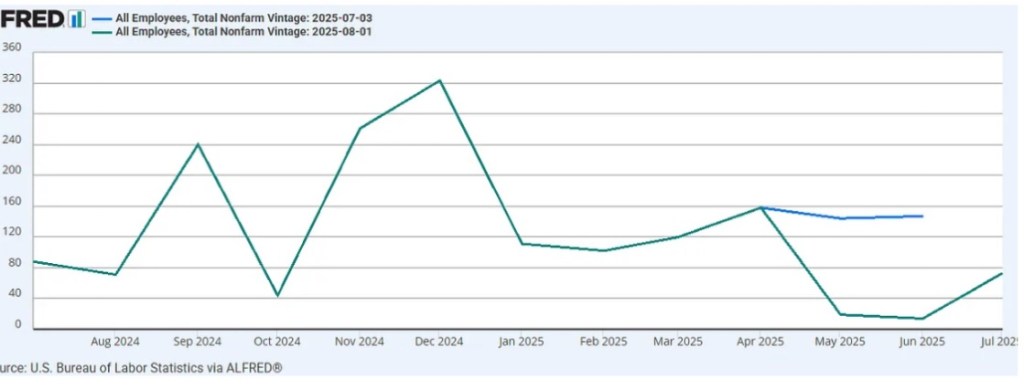
The dismissal of the Bureau of Labor Statistics (BLS) commissioner Erika McEntarfer by President Trump was regrettable and a dumb move besides. It was undeserved, and its timing made Trump look like the authoritarian buffoon of his enemies’ worst nightmares.

Trump believed the weak employment report for July made him “look bad”. He was particularly enraged by the downward revisions in nonfarm payrolls for the months of May and June (see chart above). Of course, he would not have liked the estimates to begin with, had they been in line the ultimate revisions — he just doesn’t like “bad” numbers on his watch. Trump stated his conviction that the weak report was “politically motivated”, and even “rigged” by McEntarfer, which is absurd. To anyone who knows anything about how these numbers are produced, this makes Trump look like a guy who is willing to manipulate economic data to his advantage. Only good numbers, please!

As I’ve said before, the mere availability of aggregate economic statistics seems to encourage activist policy. This is made worse by the unreliability and mis-measurement of these aggregates, which compounds policy failures. Like other parts of the federal statistical system, BLS reporting has shortcomings, some of them severe and getting worse. But that’s not McEntarfer’s doing. The numbers, for all their faults, are generated by a highly standardized process. Reforming that process will not be cheap.

One compelling take on the negative revisions is that they are really Trump’s very own fault. In an excellent post describing some of the technicalities that drive revisions, Claudia Sahm says:

“This is a policy problem, not a measurement problem. … Large, unpredictable shifts in economic policy are placing unusual strains on our measurement apparatus because they are causing large, unpredictable changes in the behavior of consumers and businesses. These changes are difficult to measure in real time. The GDP statistics this year have struggled to isolate massive swings in imported goods around the start of tariffs from its measure of domestic production. The initial estimates of payrolls didn’t capture the slowdown in employment, but that’s more a reflection of how sharp the jobs slowdown is, rather than a limitation of the surveys.“

The key lesson here is that shifts in the policy landscape can make economic activity more difficult to measure. And of course, policy uncertainty has contractionary effects on top of the stagflationary effects of higher taxes (i.e., tariffs). But I’m not holding out hope that Trump will engage in any introspection on the point.

As Sahm explains, the sharp slowing of job growth serves to highlight one of the difficulties inherent in survey-based measures of economic performance: not all responses are timely, and that is likely aggravated when underlying changes in activity are dramatic. In fact, she says, the June revision was driven largely by late reporting. Furthermore, the May and June revisions to payrolls were also partly driven by a change in seasonal adjustment factors based on new data (BLS uses a concurrent seasonal adjustment methodology).

In terms of industries, half of the June revision to payrolls came from state and local education, erasing an initial estimate showing that public education jobs had increased in June, which perplexed analysts at the time. The other half of the revision was spread broadly across the private sector.

In addition to the changeable nature of survey data and seasonal variability, BLS reports suffer because they often involve shaky assumptions made necessary by the limits of survey coverage. Perhaps the most controversial of these comes from the so-called birth/death (b/d) model of business formation/closure. This model is used by the BLS to estimate the net jobs created by new businesses that cannot be covered by the monthly Establishment Survey. Month-to-month, that can be a large gap to fill. Unfortunately, the b/d model can be extremely inaccurate, especially at turning points. In July 2025, the b/d model added about 257,000 jobs to total new jobs (prior to seasonal adjustment). Thus, the b/d assumption was 3.5 times the seasonally adjusted total gain of 73,000!

Critics of BLS methodology insist that its monthly payroll estimates should be benchmarked to quarterly data from a different survey as soon as it is available: the Quarterly Census of Employment and Wages, which has a 90% response rate. From Mish Shedlock:

“It is inexcusable for the BLS to not incorporate QCEW data as soon as possible.

“Instead, it relies on poor sampling of a small subset. On that poor sample, the response rate is pathetic.

“In addition, there is survival bias. In recognition of survival bias, the BLS concocted its absurd birth-death model.

“And on top that that, struggling businesses have no incentive to respond. In contrast, large corporations likely have someone dedicated to filling out government surveys.”

I’ve been critical of large BLS revisions in the past, as well as glaring inconsistencies between estimates of payroll jobs from the Establishment Survey and total civilian employment from the BLS Household Survey. Of course, they are different surveys designed to estimate different things with different samples, different coverage, geared toward counting jobs in one case and people employed and unemployed in the other. The two are benchmarked differently and at different frequencies. Still, it’s unsettling to see the two surveys diverge sharply in terms of monthly changes or trends, or to see consistently one-directional revisions. John Podhoretz states that the number of new nonfarm payroll jobs has been revised down in 25 of the past 30 months!

As Veronique de Rugy says, flaws are not the same as bad faith. Surely improvements can be made to both BLS surveys, their benchmarking, and to other adjustments and assumptions made for reporting. However, it’s pretty clear that BLS has not had the staffing and resources necessary to address these shortcomings. Over the ten years ending in 2024, inflation-adjusted BLS funding declined by more than 20%. At the same time, response rates on the Household survey have declined from 89% to less than 70%. The Establishment Survey of nonfarm businesses has also been plagued by deteriorating response rates, which fell from 61% to less than 43% over the past 10 years. And now, the Trump Administration has proposed an additional budget cut for the BLS of 8% in 2026.

Trump would have done better to ask the BLS commissioner what resources were needed to revamp its processes. Instead, his approach was to create a public spectacle by firing the head of the agency. One has to wonder how Trump might find a well-trained economist or statistician who will take the job if the numbers must always reflect well on the boss.

Reformed Covid Reporting Might Quell the Omicron Panic

31 Friday Dec 2021

Posted by Nuetzel in Coronavirus, Data Integrity

≈ Leave a comment

Tags

CARES Act, Covid-19, Delta Variant, Don Wolt, False Positives, Health and Human Services, HHS Protect, Jennifer Rubin, Monica Gandhi, Omicron Variant, PCR Test, Pediatric COVID, Phil Kerpen, Positivity Rate

That’s our Commander and Chief this week, posing in a mask on the beach in what is a phenomenal display of stupidity. More importantly, that kind of messaging contributes to the wholly unwarranted panic surrounding the Omicron variant of Covid-19. Panic, you say? Take a look at this admission from a New York health official. She says a recent alert on pediatric hospitalizations was driven by a desire to “motivate” parents to vaccinate their children. Yet Covid has never posed a significant risk to children. And take a look at what this insane physician posted. It’s fair to say he’s “catastrophizing”, an all too common psychological coping mechanism for alarmists.

The Omicrommon Cold

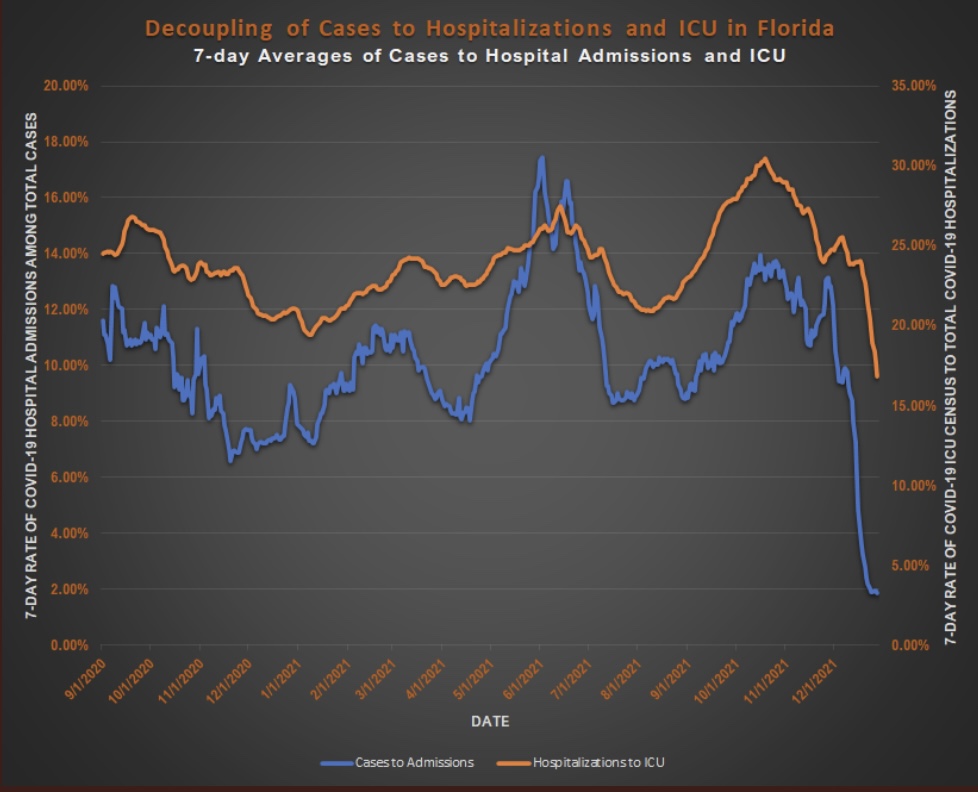
Given Omicron’s low apparent severity, it might be the variant that allows a return to normalcy. It’s perhaps the forefront of a more benign but endemic Covid, as it seems to be out-competing and displacing the far more dangerous Delta variant. In fact, Omicron infections are protective against Delta, probably for much longer than vaccines. The mild severity we’ve seen thus far is due in part to protection from vaccines and acquired immunity against breakthrough infections, but there’s more: there are plenty of non-breakthrough cases of Omicron, and most hospitalizations are among the unvaccinated. Yet we see this drastic decline in Florida’s ratio of ICU to hospital admissions (as well as a reduction in length of stay — not shown on chart). Similar patterns appear elsewhere. Omicron’s more rapid onset and course make it less likely that these patterns are caused by lags in the data.

Panic Begets Lockdowns

The frantic Omicron lunacy is driven partly by data on the number of new cases, which can be highly misleading as a guide to the real state of affairs. Testing is obviously necessary for diagnosis, but case totals as an emphasis of reporting have a way of feeding back to panic and destructive public policy: every wave brings surges in cases and the positivity rate prompting authoritarian measures with dubious benefits and significant harms (see here and here).

Flawed Case Data

In many respects, the data on Covid case totals have been flawed from the beginning, owing largely to regulators. At the outset in early 2020, there was a severe shortage in testing capacity due to the CDC’s delays in approving tests, as well as restrictions on testing by private labs. Many cases went undiagnosed, including a great many asymptomatic cases. The undercount of cases inflated the early case fatality rate (CFR). Subsequently, the FDA dithered in its reviews of low-cost, rapid, at-home tests. The latest revelation was the Administration’s decision in October to nix a large rollout of at-home tests. While the results of those tests are often unreported, they would have been helpful to individual decisions about seeking care and quarantining.

The PCR test finally distributed in March 2020 was often too sensitive, which the CDC has finally acknowledged, This is a flaw I’ve noted several times in the past. It led to false positives. Hospitals began testing all admitted patients, which was practical, and the hospitals were happy to do so given the financial rewards attendant to treating Covid patients under the CARES Act. However, it resulted in the counting of “incidental” Covid-positives: patients admitted with Covid, but not for Covid. That inflates apparent severity gleaned through measures like hospitalized cases, and it can distort counts of Covid fatalities and the CFR.

On balance, the bias caused by the test shortage at the start of the pandemic likely constrained total case counts, but the subsequent impact of testing practices is uncertain except for incidental hospitalized cases and the impact on counts of deaths.

Omicron Enlightenment

Omicron spreads rapidly, so the clamoring for tests by panicked consumers has resulted in another testing shortage, both for PCR tests and at-home tests at pharmacies. The shortage might not be relieved until the Omicron wave has crested, which could occur within a matter of a few weeks if the experience of South Africa and London are guides. In the meantime, another deleterious effect of the “case panic” is the crush of nervous individuals at emergency rooms presenting with relatively minor symptoms. Now more than ever, many of the cases identified at hospitals are incidental, particularly pediatric cases.

A thread by Monica Gandhi, and her recent article in the New York Times, makes the case that hospitalizations should be the primary focus of Covid reporting, rather than new cases. Quite apart from the inaccuracies of case counting and the mild symptoms experienced by most of those infected, Gandhi reasons that breakthrough infections so common with Omicron render case counts less relevant. That’s because high rates of vaccination (not to mention natural immunity from prior infections) reduce severity. Even Jennifer Rubin has taken this position, a complete reversal of her earlier case-count sanctimony.

Incidental Infections

Phil Kerpen’s reaction to Gandhi’s article was on point, however:

“Unless HHS Protect adds a primary [diagnosis] column, hospital census isn’t much more useful than cases.”

HHS Protect refers to the Health and Human Services public data hub. Without knowing whether Covid is the primary diagnosis at admission, we have no way of knowing whether the case is incidental. If Covid is the primary reason for admission, the infection is likely to be fairly severe. It is more useful to know both the number of patients hospitalized for Covid and tge number hospitalized for other conditions (incidentally with Covid). The distinction has been extremely important to those interpreting data from South Africa, where a high proportion of incidental admissions was a tip-off that Omicron is less severe than earlier variants.

The absence of such coding is similar to the confusion caused by the CDC’s decision early in pandemic to issue new guidance on the completion of death certificates when Covid is present or even suspected. A special exception was created at that time requiring all deaths involving primary or incidental Covid infections to be ruled as Covid deaths. This represented another terrible corruption of the data.

Summary

Earlier variants of Covid were extremely dangerous to the elderly, obese, and the immune-compromised. Yet public health authorities seemed to take every opportunity to mismanage the pandemic, including contradictory messaging and decisions that compromised the usefulness of data on the pandemic. But here we are with Omicron, which might well be the variant that spells the end of the deadly Covid waves, and the focus is still squarely on case counts, vaccine mandates, useless masking requirements, and President Brandon wearing a mask on the beach!

Case counts should certainly be available, as Gandhi goes to great lengths to emphasize. However, other metrics like hospitalizations are more reliable indicators of the current wave’s severity, especially if paired with information on primary diagnoses. Fortunately, there has been a very recent shift of interest to that kind of focus because the superior information content of reports from countries like South Africa and Denmark is too obvious. As Don Wolt marvels:

“Behold the sudden interest by the public health establishment in the “With/From” COVID distinction. While long an important & troubling issue for many who sought to understand the true impact of the virus, it was, until very recently, actively ignored by Fauci & crew.”

That change in emphasis would reduce the current sense of panic, partly by making it more difficult for the media to purvey scare stories and for authorities to justify draconian non-pharmaceutical interventions. It’s no exaggeration to say that anything that might keep the authoritarians at bay should be a public health priority.

CDC Sows Covid Case-Fatality Confusion

15 Wednesday Apr 2020

Posted by Nuetzel in Data Integrity, Pandemic

≈ Leave a comment

Tags

Case Fatality Rate, Centers for Disease Control, Co-Morbidities, Coronavirus, Covid "Hot Spots", Covid-119, Crisis Management, Data Integrity, Death Toll, Excess Deaths, Government Accounting, Influenza, New York Deaths, Probable Deaths, Respiratory Disease, Testing Guidelines

The Centers for Disease Control has formally decided to inflate statistics on coronavirus deaths by adding so-called “probable” cases to the toll. This news follows the announcement yesterday that New York decided to add, in one day, about 4,000 deaths from over the past month to its now “probable” Covid-19 death toll. So much for clean accounting! We have a confirmed death toll up to April 14th. We have a probable death toll after. The error in timing alone introduced by this abrupt adjustment impairs efforts to track patterns of change. Case fatality rates are rendered meaningless. Data integrity, which was already weak, has been thrown out the window by our public heath authorities.

It’s no longer necessary for a deceased patient to have tested positive for Covid-19:

“A probable case or death is defined as one that meets clinical criteria such as symptoms and evidence of the disease with no lab test confirming Covid-19. It can also be classified as a probable case if there are death or other vital records listing coronavirus as a cause. A third way to classify it is through presumptive laboratory evidence and either clinical criteria or evidence of the disease.”

Consider the following:

  • to date, more than 80% of patients presenting symptoms sufficient to meet testing guidelines have tested negative for Covid-19;
  • the most severe cases of Covid-19 and other respiratory diseases are coincident with significant co-morbidities;
  • “probable” cases appear to be concentrated among the elderly and infirm, whose regular mortality rate is high.

Deaths involving mere symptoms, or mere symptoms and co-morbidities, and even deaths of undetermined cause, are now more likely to be over-counted as Covid-19 deaths. This is certain to distort, and I believe overcount, Covid-19 deaths. Of course, this was already happening in some states, as I mentioned last week in “Coronavirus Controversies“.

One of the charts I’ve presented in my Continue%20reading Coronavirus “Framing” posts tracks Covid-19 deaths. The change in these cause-of-death guidelines will make continued tracking into something of a farce. I’d be tempted to deduct the one-day distortion caused by the New York decision, but then the count will still be distorted going forward by the broader definition of Covid-19 death.

The only possible rationale for these decisions by New York and the CDC is that testing is still subject to severe rationing. I have my doubts, as the number of daily tests has stabilized. On the other hand, I have heard anecdotes about hospitals with large numbers of respiratory patients who have not been tested! And they are intermingling all of these patients?? I’m not sure I can reconcile these reports. Surely the patients meet the guidelines for testing. Perhaps the CDC’s decision is associated with an effort to spread testing capacity by allowing only new patients to be tested, counting those already hospitalized as presumptively Covid-infected. And if they aren’t already, they will be! A decision to count deaths within that group as “probable” Covid deaths  would fit conveniently into that approach, but that would be wildly misguided and perverse.

I’m obviously cynical about the motives here. I don’t trust government accounting when it bears on the credit or blame for crisis management. Who stands to gain from a higher Covid death toll? The CDC? State health authorities? “Hot spots” vying for federal resources?

A consistent approach to attributing cause of death would have been more useful for gauging the direction of the pandemic, but as I’ve said, there will always be uncertainty about the true Covid-19 death toll. Ultimately, the best estimates will have to rely on calculations of “excess deaths” in 2020 compared to a “normal” level from a larger set of causes. In fact, even that comparison will be suspect because the flu season leading up to the Covid outbreak was harsh. Was it really the flu later in the season?

Follow Sacred Cow Chips on WordPress.com

Recent Posts

  • Immigration and Merit As Fiscal Propositions
  • Tariff “Dividend” From An Indigent State
  • Almost Looks Like the Fed Has a 3% Inflation Target
  • Government Malpractice Breeds Health Care Havoc
  • A Tax On Imports Takes a Toll on Exports

Archives

  • December 2025
  • November 2025
  • October 2025
  • September 2025
  • August 2025
  • July 2025
  • June 2025
  • May 2025
  • April 2025
  • March 2025
  • February 2025
  • January 2025
  • December 2024
  • November 2024
  • October 2024
  • September 2024
  • August 2024
  • July 2024
  • June 2024
  • May 2024
  • April 2024
  • March 2024
  • February 2024
  • January 2024
  • December 2023
  • November 2023
  • August 2023
  • July 2023
  • June 2023
  • May 2023
  • April 2023
  • March 2023
  • February 2023
  • January 2023
  • December 2022
  • November 2022
  • October 2022
  • September 2022
  • August 2022
  • July 2022
  • June 2022
  • May 2022
  • April 2022
  • March 2022
  • February 2022
  • January 2022
  • December 2021
  • November 2021
  • October 2021
  • September 2021
  • August 2021
  • July 2021
  • June 2021
  • May 2021
  • April 2021
  • March 2021
  • February 2021
  • January 2021
  • December 2020
  • November 2020
  • October 2020
  • September 2020
  • August 2020
  • July 2020
  • June 2020
  • May 2020
  • April 2020
  • March 2020
  • February 2020
  • January 2020
  • December 2019
  • November 2019
  • October 2019
  • September 2019
  • August 2019
  • July 2019
  • June 2019
  • May 2019
  • April 2019
  • March 2019
  • February 2019
  • January 2019
  • December 2018
  • November 2018
  • October 2018
  • September 2018
  • August 2018
  • July 2018
  • June 2018
  • May 2018
  • April 2018
  • March 2018
  • February 2018
  • January 2018
  • December 2017
  • November 2017
  • October 2017
  • September 2017
  • August 2017
  • July 2017
  • June 2017
  • May 2017
  • April 2017
  • March 2017
  • February 2017
  • January 2017
  • December 2016
  • November 2016
  • October 2016
  • September 2016
  • August 2016
  • July 2016
  • June 2016
  • May 2016
  • April 2016
  • March 2016
  • February 2016
  • January 2016
  • December 2015
  • November 2015
  • October 2015
  • September 2015
  • August 2015
  • July 2015
  • June 2015
  • May 2015
  • April 2015
  • March 2015
  • February 2015
  • January 2015
  • December 2014
  • November 2014
  • October 2014
  • September 2014
  • August 2014
  • July 2014
  • June 2014
  • May 2014
  • April 2014
  • March 2014

Blogs I Follow

  • Passive Income Kickstart
  • OnlyFinance.net
  • TLC Cholesterol
  • Nintil
  • kendunning.net
  • DCWhispers.com
  • Hoong-Wai in the UK
  • Marginal REVOLUTION
  • Stlouis
  • Watts Up With That?
  • Aussie Nationalist Blog
  • American Elephants
  • The View from Alexandria
  • The Gymnasium
  • A Force for Good
  • Notes On Liberty
  • troymo
  • SUNDAY BLOG Stephanie Sievers
  • Miss Lou Acquiring Lore
  • Your Well Wisher Program
  • Objectivism In Depth
  • RobotEnomics
  • Orderstatistic
  • Paradigm Library
  • Scattered Showers and Quicksand

Blog at WordPress.com.

Passive Income Kickstart

OnlyFinance.net

TLC Cholesterol

Nintil

To estimate, compare, distinguish, discuss, and trace to its principal sources everything

kendunning.net

The Future is Ours to Create

DCWhispers.com

Hoong-Wai in the UK

A Commonwealth immigrant's perspective on the UK's public arena.

Marginal REVOLUTION

Small Steps Toward A Much Better World

Stlouis

Watts Up With That?

The world's most viewed site on global warming and climate change

Aussie Nationalist Blog

Commentary from a Paleoconservative and Nationalist perspective

American Elephants

Defending Life, Liberty and the Pursuit of Happiness

The View from Alexandria

In advanced civilizations the period loosely called Alexandrian is usually associated with flexible morals, perfunctory religion, populist standards and cosmopolitan tastes, feminism, exotic cults, and the rapid turnover of high and low fads---in short, a falling away (which is all that decadence means) from the strictness of traditional rules, embodied in character and inforced from within. -- Jacques Barzun

The Gymnasium

A place for reason, politics, economics, and faith steeped in the classical liberal tradition

A Force for Good

How economics, morality, and markets combine

Notes On Liberty

Spontaneous thoughts on a humble creed

troymo

SUNDAY BLOG Stephanie Sievers

Escaping the everyday life with photographs from my travels

Miss Lou Acquiring Lore

Gallery of Life...

Your Well Wisher Program

Attempt to solve commonly known problems…

Objectivism In Depth

Exploring Ayn Rand's revolutionary philosophy.

RobotEnomics

(A)n (I)ntelligent Future

Orderstatistic

Economics, chess and anything else on my mind.

Paradigm Library

OODA Looping

Scattered Showers and Quicksand

Musings on science, investing, finance, economics, politics, and probably fly fishing.

  • Subscribe Subscribed
    • Sacred Cow Chips
    • Join 128 other subscribers
    • Already have a WordPress.com account? Log in now.
    • Sacred Cow Chips
    • Subscribe Subscribed
    • Sign up
    • Log in
    • Report this content
    • View site in Reader
    • Manage subscriptions
    • Collapse this bar
 

Loading Comments...