• About

Sacred Cow Chips

Sacred Cow Chips

Category Archives: Free Speech

Employee Speech and Its Consequences

18 Thursday Sep 2025

Posted by Nuetzel in Censorship, Free Speech

≈ Leave a comment

Tags

ABC, Charlie Kirk, DEI, Eugene Volokh, First Amendment, Free Speech, Hate Speech, Jimmy Kimmel, Julie Borowsky, MAGA, Pickering v. Bd. of Education, Second Amendment, Trust

I just can’t express any sympathy for those fired from their jobs for publicly endorsing or “celebrating” the assassination of Charlie Kirk. Regardless of how you felt about Charlie Kirk’s words, he was a nonviolent public figure who did everything he could to engage peacefully with those who disagreed with his views. Praising his assassination is morally repugnant.

The fairness and even the legality of these dismissals has been called into question, however. As Eugene Volokh notes, the First Amendment offers protection “against criminal punishment, civil liability” for all speech unless it “is intended to and likely to cause imminent illegal conduct”. It does not protect the speaker from other consequences, however, such as continued employment or social ostracism. It goes without saying that this applies to both sides of any debate.

But job dismissals for expressing controversial opinions should not extend beyond issues likely to threaten the mission of the employing organization, including reputation and the well being of clients and other employees. Even more importantly, prosecution under so-called “hate speech” laws (a flawed construct) should not extend outside the bounds of the First Amendment, and should not be prosecuted selectively on political grounds.

One prominent action with which I’m not comfortable is the “indefinite” cancellation of Jimmy Kimmel, who (like others on the Left) thought it would be clever to make the absurd claim, during his late-night monologue, that Kirk’s assassin was one of the MAGA tribe. Kimmel did not “celebrate” the murder per se, but his statement was enough to get his show pulled, for now. The cancellation was lauded by the Right as a response to the market. That’s plausible: Kimmel’s pronouncement might have damaged ABC’s brand, though it didn’t have far to drop. The Trump Administration seems to have employed some strong-arm tactics in this episode, however, which is awful. In any case, I’d rather keep Kimmel out there making a fool of himself.

Of course, private employers can generally employ whom they want and can often cite agreed-upon codes of conduct as justification for dismissals, if necessary. Who wants an employee announcing to the world that he or she endorses the murder of someone with whom they happen to disagree on public policy or expressions of faith? Or who wants an employee openly stating such a monstrous opinion in the workplace? It’s simply bad business to risk offense to customers, sowing discord in the workplace, or affiliating in any way with an individual willing to demonstrate such depraved values.

Things are a little different for public employees. In his post, Volokh outlined general legal conditions under which a public employee can be disciplined. These are (the full list is a quote):

  1. the speech is said by the employee as part of the employee’s job duties, Garcetti v. Ceballos (2006), or
  2. the speech is not on a matter of public concern, Connick v. Myers (1983), or
  3. the damage caused by the speech to the efficiency of the government agency’s operation outweighs the value of the speech to the employee and the public, Pickering v. Bd. of Ed. (1968).

As Volokh says, strictly speaking, these conditions do not establish categorical grounds for dismissing a public employee for praising violence. He cites case law to support that position. But the third condition listed is critical in many cases. On that point, he notes that the case in question involved a private conversation with the speaker’s co-worker/boyfriend. So that case hardly seems dispositive.

Volokh goes on to say that #3 above, or really the Pickering case, establishes a kind of heckler’s veto for public employers. That is, it:

“… often allows government to fire employees because their speech sufficiently offends coworkers or members of the public. …

“This conclusion by lower courts applying Pickering might, I think, stem from the judgment that employees are hired to do a particular job cost-effectively for the government: If their speech so offends others (especially clients or coworkers) that keeping the employees on means more cost for the government than benefit, the government needn’t continue to pay them for what has proved to be a bad bargain.“

Whether it involves someone in the public or the private sector, concerns about endorsing the murder of an ideological opponent are particularly acute when issued by those in jobs requiring a high level of trust. That covers a broad swath of workers, but especially those in health care, education, and law enforcement. Can you trust a nurse, a surgeon, or any other caregiver who would endorse murder as a proper response to political or ideological differences? Are you willing to allow your child to be instructed by such an individual at any level? For that matter, would you trust a news anchor who spouted that kind of rhetoric?

It’s certainly doesn’t present as “normal” to espouse or praise murder and other violent acts, regardless of ideological passion. In fact, most people would fairly question the stability of anyone cheerleading for murder and the risk they might present to society. Words are cheap, but it might well signal an elevated propensity for acts of violent retaliation for perceived wrongs.

The question of trust really permeates our interactions with the whole of society, so the kind of behavior we’ve witnessed from this quarter is threatening. Will my waitress, overhearing a conversation, befoul or poison the food she serves me? Will my ride share driver deliver me to a torture chamber? Will a neighborhood contact attempt to exact some kind of retribution? It’s not quite there yet, but the encroachment is real. This should be more salient to anyone with an accessible social media profile who wishes to express an honest opinion, particularly on a college campus.

A brief word about some of the Charlie Kirk quotes that have made the rounds. They are often excerpted and divorced from the full context of the argument he was attempting to make. Julie Borowsky on X provides some direct, full quotes of Kirk on several important topics. I happen to think he made valid (if not fully developed) points about the value of the Second Amendment, the divisiveness of DEI, overuse of the word “empathy”, and the downsides of Civil Rights Act. At the same time, I am certain I’d disagree with other positions Kirk held, like his support for tariffs. Still, they were all debating points on policy (or matters of faith), and they did not qualify as “hate speech”, which is a subjective notion and highly resistant to consensus. In any case, his comments could never have justified the insane reaction of Kirk’s assassin or those who cheered his murder.

AntiSemitic Left Tests Limits of Free Speech

30 Tuesday Apr 2024

Posted by Nuetzel in anti-Semitism, Free Speech

≈ Leave a comment

Tags

Agitators, Alex Tabarrok, Codes of Conduct, Eugene Volokh, Fighting Wirds, First Amendment, Foundation for Individual Rights and Expression, Free Speech, Freedom of Assembly, Hamas, Instapundit, Intifada, Israel, Michael Munger, P.J. O'Rourke, Terrorism

The current protests on college campuses across the nation bring into focus differing opinions on the limits of free speech and assembly. Particular questions seem to defy resolution. Nevertheless, there is some misunderstanding regarding the settled breadth of the First Amendment.

The protestors have acted as if they have constitutional carte blanche to gather anywhere to say anything in opposition to Israel and its war against Hamas terrorists; a subset thinks this encompasses “occupation” of any space for any duration; a still smaller subset believes this includes a right to condemn Jews, all Jews.

I strongly doubt, however, that many of the protestors truly believe their constitutional protections extend to intimidation and bullying of Jewish students attempting to go about their business on campus (scroll to a few of the articles here), destruction of property, or the use of “fighting words”, or physical attacks on Jews or other “oppressors”.

It’s well known that the Constitution does not protect “fighting words”, including threats. Furthermore, Eugene Volokh explains that there is no constitutional right to “occupy” a college campus, either public or private.

Of course, private schools are not legally bound to respect free speech or assembly rights. They can regulate activity on their private campuses in any way they see fit. Some explicitly abide the same rights as public universities, which seems reasonable for any institution dedicated to the free spirit of inquiry.

Volokh, however, cites Supreme Court precedents in which a majority held that government can prohibit camping in certain parks, for example, and that public colleges and universities can impose restrictions on campus activities:

“There is no First Amendment right to camp out in any university, public or private. Indeed, there is no First Amendment right to camp out even in public parks (see Clark v. CCNV (1984)), and the government’s power to limit the use of property used for a public university is even greater than its power as to parks (Widmar v. Vincent (1981)):

“‘A university differs in significant respects for public forums such as streets or parks or even municipal theaters. A university’s mission is education, and decisions of this Court have never denied a university’s authority to impose reasonable regulations compatible with that mission upon the use of its campus and facilities. We have not held, for example, that a campus must make all of its facilities equally available to students and nonstudents alike, or that a university must grant free access to all of its grounds or buildings.’

“Likewise, if UC Berkeley had held a law student party in the law school building rather than at Dean Chemerinsky’s house, it could have stopped students from using the party as an occasion to orate to the audience (especially with their own sound amplification devices, which the student brought to Chemerinsky’s house). See Spears v. Arizona Bd. of Regents (D. Ariz. 2019)(upholding public university’s right to stop people from speaking with sound amplification at an on-campus book fair).“

Volokh also notes, however, that public universities cannot restrict mere “offensive” expression, which would include certain antisemitic statements or even swastikas (for example), as long as the expression falls short of “fighting words” or explicit threats. Do calls for the “extermination of Jews” qualify as fighting words? That deserves a resounding yes. It’s clearly hate speech, and it’s exactly the sort of expression that might be deemed so offensive to counterprotestors (for example) as to constitute an immediate threat to public order.

Does the meaning of “fighting words” include such chants as “From the river to the sea…”? Some say that depends on the speaker, but that can’t provide a sound basis of distinction. It is clearly associated with calls to eliminate the state of Israel. Some believe it also implies the genocide of Jews in Israel, and Jews can’t be blamed for finding it threatening. Okay, how about “Intifada”? I doubt all of the students involved in the current protests understand the genocidal implications of these words. The agitators understand them well enough.

This is a grey area in our understanding of the First Amendment. The “River to the Sea” chant, and Intifada, seem like fighting words to me, but they might not qualify as direct threats to anyone on campus. By comparison, the swastika is “just” a party emblem, whatever policies it stands for, and apparently the Court did not deem it a direct threat to anyone in Skokie, Illinois. The legal distinctions here feel inadequate. Still, we say the “mere” expression of offensive ideas or symbols is protected speech, provided that it does not directly threaten harm to any party.

Many libertarians, with whom I usually agree, urge tolerance of the protests and encampments, including at least cautious tolerance of the protests. The Foundation for Individual Rights and Expression (FIRE) has strenuously objected to the actions of police in Austin, Texas in dispersing demonstrators at the University of Texas. Alex Tabarrak has reposted a tweet or two apparently critical of the government’s response to protestors in Texas and at Emory University in Atlanta, though it should be noted that the economics professor who was taken down and handcuffed on video had actually hit a police officer. Michael Munger, in a variation of his “worst enemy test” of government power, says that giving campus authorities “the power to crush us, at their discretion” is probably a bad idea. But they have that power if they choose to exercise it, for better or worse. (By “us”, I don’t think Munger intended to take sides).

I’m highly skeptical of the motives and incentives of some of the “occupiers” of campus spaces, not to mention their status as students. More importantly, there is ample evidence that “fighting words” and threats against Jews have been used by many of the protesters. This violates the codes of conduct at many schools, and should not only be censured, but any student identified as guilty of this sort of hate speech should be expelled, not merely suspended. There should be severe consequences for professors choosing to participate in these protests as well.

This behavior should have long-term consequences, and that is happening at some schools. I saw the following quote from P.J. O’Rourke on Instapundit, which seems appropriate here:

“There’s only one basic human right, the right to do as you damn well please. And with it comes the only basic human duty, the duty to take the consequences.”

The kids are wearing masks for a reason, and it ain’t Covid! Now, the protestors’ demands include “amnesty” for their participation in the protests. That shouldn’t play well if you’re provably guilty of calling for the extermination of a race of people. But here’s the thing: certain institutions like Columbia University have allowed the aberrant behavior to go on with little challenge, showing that the real limits to free speech and assembly are whatever acquiescent campus administrators are willing to put up with.

Removing these encampments is more than justified on constitutional grounds at any school, public or private. The arrest of some of the more intransigent elements among the protesters may be well justified. Insulting hate speech is one thing, but eliminationist hate speech constitutes fighting words and should not be tolerated. Of course, forcibly removing the encampments is risky in terms of public safety because some of the protestors will physically challenge the police. Comparatively innocent (though naive) students might get caught up in a conflict with law enforcement, but ignorance is no defense. They should not be there. Those risks must be taken to end the “hate encampments”, which are a direct threat to the rights of others wishing only to go about their business.

Containing An Online Viper Pit of Antisemites

05 Thursday Jan 2023

Posted by Nuetzel in Free Speech, Social Media

≈ Leave a comment

Tags

Andrew Torba, Antisemitism, Christian Nationalism, Corporatism, Dan Frankel, fascism, Fighting Words, Free Speech, Gab, GabPro, Israel, Judeo-Bolshevism, Kanye West, Kristallnach, Pittsburgh Jewish Chronicle, racism, Religious Liberty, Rothschild Family, Theocracy, Zionism

This post is about a particular social media platform and a terrible oversight on my part. I signed up for Gab at least two years ago as I tried to find social media platforms that respected free speech rights and on which I could promote my blog. I haven’t paid for a subscription to “GabPro”, but I’m embarrassed to have completely missed some of the stink emanating from within the platform until recently. It’s not as if it hadn’t been reported, but somehow, I was oblivious.

I knew pretty quickly that Gab was an odd fit for me because so many posters there are on the very religious right. That’s fine, as I’m a strong believer in religious liberty and free speech. My views sometimes conflict with the religious right, but we’re in alignment on some key issues.

I never really scrolled Gab for more than a few moments at any time, having maintained my account there primarily for cross-posting my blog. I joined a particular Gab “fan” group of a band I love, and I have an old friend who happens to be on Gab. I also joined the “Libertarians of Gab” group. Occasionally, something raised my antennae right at the top of my feed, prompting me to look more closely, but I knew this much: like many other social media platforms, Gab is a meme-fest with lots of repetition, so I seldom wasted time scrolling there.

A year or so ago, a Jewish acquaintance on Gab mentioned a few antisemitic posts he’d seen there, but he’s a staunch free-speech advocate and had other reasons to stick with it. At the time, I might have begun to notice a few posters on Gab who were clearly anti-Zionist, but there’s a real distinction between anti-Zionism and antisemitism. Antisemites are bound to be anti-Zionist; the reverse doesn’t always follow. But again, I hadn’t yet found any real fault with Gab itself at that time.

(Note: I’m not hyphenating “antisemitism”, nor am I capitalizing “semitism”, because there is no such thing as a “semite” or “semitism”. The word was concocted by political factions in 19th century Germany in an attempt to “other” German Jews as “Orientals”.)

Over the next several months, however, at the top of my feed, I began to see a few antisemitic posts. Sometimes these amounted to silly assertions, such as the Rothschild family’s supposed world domination, a claim that would be harmless enough if not for indignation that the Rothschilds happen to be Jewish. A few posts were much worse. My knee-jerk reaction to offensive content is to block the poster, as I did a few times.

More recently, in the wake of Kanye West’s crazy tweets about Jews, I was a recipient of a group email from Andrew Torba, the founder and CEO of Gab. Torba, as it happens, is a self-styled “Christian Nationalist”. His email essentially portrayed West as a messenger from God. Here are some excerpts:

“God is using Ye, formerly known as Kanye West, for a big purpose…. He talks about the need for our leaders to uphold Christian values, not Zionist ones. … Ye is using the influence and talents that God has given him to speak the Truth and glorify Jesus Christ.”

It’s interesting that Torba referred to “Zionist” values. Though he is almost certainly anti-Zionist, that’s not really what he meant here. This bit of nut-jobbery, as I learned, had been preceded by many other wild statements from Torba over the years. For instance, over a year ago he tweeted the following and then disabled his Twitter account, a stunt he’s repeated several times:

“We’re building a parallel Christian society because we are fed up and done with the Judeo-Bolshevik one.”

The author at the link above, who reviewed some of Torba’s antics, noted that Judeo-Bolshevism was a term thrown around by the Nazis in the 1930s. But even putting that aside, Torba has an unfortunate tendency to paint with an extremely broad brush in promoting his very own brand of identity politics. That point is established clearly in this “Open Letter” to Torba from a “Hebraic-oriented evangelical Christian attorney”. If anything, the letter is far too gentle with Torba. The writer concludes:

“… I do hope you will reconsider your gratuitous exclusionary rhetoric regarding our spiritual cousins in the House of Judah, treating at least the many who share our cultural values and all-important Creationist paradigm with the same basic respect and camaraderie you show to atheists in the MAGA and conservative movements.”

Torba’s perspective seems to be that all Jews are unworthy, or worse. Here’s one of his posts:

From my perspective, Torba’s recent email regarding “Ye” served as a permission slip to antisemites on Gab to engage in blatant hatred of Jews. Since then, I’ve seen truly antisemitic content appear in my feed with increasing frequency, as if it’s being promoted by the platform. I’m not sure it always sinks to the level of brown-shirts on Kristallnach, but it has that nauseating flavor. Much to my dismay, a few of these posts were from users with whom I’d established earlier connections, or it was content they reposted. Others might have appeared on my feed courtesy of an effort to “introduce” users to one another and to promote certain content.

I didn’t save screenshots of the offensive posts I’ve seen on Gab. I probably should have, but here’s a sampling of a few of the wholesome users I’ve blocked:

One recent post expressed anger with so-called “elites”, an understandable sentiment shared by many in an age of corporatist fascism with the imposition of “woke” ideology in many institutions. However, the poster’s real point was to admonish others for not identifying the target of their anger as “the Jews”.

I became aware of another piece of disturbing information about the perpetrator of a mass killing in Pittsburgh a few years ago, and I can’t believe I missed it:

“The man accused of killing 11 Jews in the Tree of Life building posted antisemitic messages on Gab before the Oct. 27, 2018, massacre. In his Gab bio, he described Jews as the ‘children of satan.’”

Related to these murders, Torba reposted this article on Gab not long ago, from the Pittsburgh Jewish Chronicle. It stated that Pennsylvania Representative Dan Frankel was the target of hateful and threatening posts on the platform. Some of the posts quoted at the link are awful.

But why did Torba repost that article? Well, it motivated a large number of Torba’s followers on Gab to subject the Chronicle to a series of antisemitic replies. This would appear to have been Torba’s intent, but he subsequently removed the repost of the article (along with the hateful replies). That’s a familiar pattern.

Torba’s original comments on the Chronicle article included the following:

“People are done caring about your eternal victimhood complex … Free speech means the right to offend…Stop conflating offensive memes with ‘threats’…Gab is what free speech looks like, the good, the bad, and the ugly are all included.”

Well, you’re right about free speech, Mr. Torba, but subject to an important qualification: “fighting words” are not protected speech under the Constitution. Maybe that’s why you took down your repost, and most importantly the replies. Did you come to your senses relative to the limits of free speech?

It’s not surprising, but the hatred on Gab is not reserved solely for Jews. Since I’ve been on the lookout, I’ve witnessed overt racism of several other varieties on Gab, and I’ve duly blocked those posters. There is also a complement of hatred for individuals falling under the LGBTQ+ banner.

Gab is not the only province of this sort of behavior on social media, but it might be a hotbed. Is it that easy to learn to hate others? Is the distinction between arguing policy versus revilement and ad hominem too subtle for them?

I have Jewish friends across the political spectrum and Jews in my extended family. Few of them are deeply religious. Likewise, many of my friends raised as Christians are not deeply religious. These individuals are entitled to the liberty to practice any or no religion at all. Their choices are no cause for hostility unless they make some effort to impose their views or will upon others. But that kind of theocratic, coercive power seems to be precisely what Andrew Torba and his Christian Nationalist followers on Gab wish to have for themselves.

I’m happy to report that I’ve seen far fewer offensive posts since blocking a number of antisemitic and racist posters. Maybe the platform is “learning” about me. However, there are many well-intentioned people on Gab, and even a few who actively call-out the bigots. I might have to join in that effort. I support Torba’s right to express his views, short of threats or incitement of violence. I have no desire to be affiliated with Torba, however, and I’ll never pay him for GabPro. I’ll remain on Gab for the time being, and we’ll see how the content evolves.

Censorship and Content Moderation in the Public Square

30 Thursday Sep 2021

Posted by Nuetzel in Censorship, Free Speech, Social Media

≈ Leave a comment

Tags

Anthony Fauci, Censorship, Clarance Thomas, Common Carrier, Communications Decency Act, Eugene Volokh, Facebook, First Amendment, Good Samaritan Provision, Hosting Function, LinkedIn, Luigi Zingales, Mark Zuckerberg, Network Externalities, Philip Hamburger, Public Accomodations, Section 230 Immunity, Sheryl Sandberg, Supreme Court, Trump Administration, Vivek Ramaswamy

I’m probably as fed up with social media as anyone, given the major platforms’ penchant for censoring on the basis of politics, scientific debate, religion, and wokeism (or I should say a lack thereof). I quit Facebook back in January and haven’t regretted it. It’s frustratingly difficult to convince others to give it up, however, and I’ve tried. Ultimately, major user defections would provide the most effective means of restraining the company’s power.

Beyond my wild fantasies of a consumer revolt, I will confess to a visceral desire to see the dominant social media platforms emasculated: broken up, regulated, or even fined for proven complaints of censorial action. That feeling is reinforced by their anti-competitive behavior, which is difficult to curb.

Are There Better Ways?

While my gut says we need drastic action by government, my head tells me … not … so … fast! These are private companies, after all. I’m an adherent of free markets and private property, so I cannot abide government intrusions to force anyone to sponsor my speech using their private facilities. At the same time, however, our free speech rights must be protected in the “public square”, and the social media companies have long claimed that their platforms offer a modern form of the public square. If they can be taken at their word, should there be some remedy available to those denied a voice based upon their point-of-view by such a business? This seems especially pertinent when access to “public accommodations” is so critical to the meaning of non-discrimination under current law (not that I personally believe businesses should be forced to accommodate the specific demands of all comers).

In a lengthy and scholarly treatment of “Treating Social Media Platforms Like Common Carriers”, Eugene Volokh states the following about U.S. Supreme Court case law (pg. 41):

“Under PruneYard and Rumsfeld, private property owners who open up their property to the public (or to some segment of the public, such as military recruiters) may be required by state or federal law to share their real estate with other speakers.”

The Common Carrier Solution

Volokh’s article is very detailed and informative. I highly recommend it to anyone hoping to gain an understanding of the complex legal issues associated with the rights of big tech firms, their users, and other interested parties. His article highlights the long-standing legal principle that so-called “common carriers” in telecommunications cannot discriminate on the basis of speech.

Volokh believes it would be reasonable and constitutional to treat the big social media platforms as common carriers. Then, the platforms would be prohibited from discriminating based on viewpoint, though free to recommend material to their users. He also puts forward a solution that would essentially permit social media firms to continue to receive protection from liability for user posts like that granted under Section 230 of the Communications Decency Act:

“… I think Congress could categorically treat platforms as common carriers, at least as to their hosting function. But Congress could also constitutionally give platforms two options as to any of their functions: (1) Claim common carrier status, which will let them be like phone companies, immune from liability but also required to host all viewpoints, or (2) be distributors like bookstores, free to pick and choose what to host but subject to liability (at least on a notice-and- takedown basis).”

Economist Luigi Zingales emphasizes the formidable network externalities that give the incumbent platforms like Facebook a dominance that is almost unshakable. Zingales essentially agrees with Volokh, but he refers to common carrier status for what he calls the “sharing function” with Section 230-like protections, while the so-called “editing function” can and should be competitive. Zingales calls recommendations of material by a platform part of the editing function which should not be granted protection from liability. In that last sense, his emphasis differs somewhat from Volokh’s. However, both seem to think an change in the law is necessary to allow protections only where they serve the “public interest”, as opposed to protecting the private interests of the platforms.

The most destructive aspect of Section 230 immunity is the so-called “Good Samaritan” clause aimed at various kinds of offensive material (“… obscene, lewd, lascivious, filthy, excessively violent, harassing, or otherwise objectionable, whether or not such material is constitutionally protected.”), which the social media platforms have used as “a license to censor”, as Philip Hamburger puts it. Here, Eugene Volokh and others, including Supreme Court Justice Clarence Thomas, assert that this provision should not receive a broad interpretation in determining immunity for content moderation decisions. In other words, the phrase “otherwise objectionable” in the provision must be interpreted within the context of the statute, which, after all, has to do with communications decency! (Here again, I question whether the government can legitimately authorize censorship in any form.)

Arm of Government?

Viewpoint discrimination and censorship by the platforms is bad enough, but in addition, by all appearances, there is a danger of allowing companies like Facebook to become unofficial speech control ministries in the service of various governments around the world, including the U.S. Here is Vivek Ramaswamy’s astute take on the matter:

“… Facebook likely serves increasingly as the censorship arm of the US government, just as it does for other governments around the world.

In countries like India, Israel, Thailand, and Vietnam, Facebook frequently removes posts at the behest of the government to deter regulatory reprisal. Here at home, we know that Mark Zuckerberg and Sheryl Sandberg regularly correspond with US officials, ranging from e-mail exchanges with Dr. Anthony Fauci on COVID-19 policy to discussing “problematic posts” that “spread disinformation” with the White House.

If Zuckerberg and Sandberg are also directly making decisions about which posts to censor versus permit, that makes it much more likely that they are responsive to the threats and inducements from government officials.”

Even LinkedIn has censored journalists in China who have produced stories the government finds unflattering. Money comes first, I guess! I’m all for the profit motive, but it should never take precedence over fundamental human rights like free speech.

There is no question of a First Amendment violation if Facebook or any other platform is censoring users on behalf of the U.S. government, and Section 230 immunity would be null and void under those circumstances.

Elections … Their Way

On the other hand, we also know that platforms repeatedly censored distribution of the Trump Administration’s viewpoints; like them or not, we’re talking about officials of the executive branch of the U.S. government! This raises the possibility that Section 230 immunity was (or should have been) vitiated by attempts to silence the government. And of course, there is no question that the social media platforms sought to influence the 2020 election via curation of posts, but it is not clear whether that is currently within their rights under Section 230’s Good Samaritan clause. Some would note the danger to fair elections inherent in any platform’s willingness to appease authoritarian governments around the world, or their willingness and ability to influence U.S. elections.

Pledge of Facebook Allegiance

Some of our domestic social media companies have become supra-national entities without a shred of loyalty to the U.S. This article in The Atlantic, of all places, is entitled “The Largest Autocracy on Earth“, and it has a sub-heading that says it all:

“Facebook is acting like a hostile foreign power; it’s time we treated it that way.”

The article reports that Facebook’s Mark Zuckerberg has promoted the mantra “company over country”. That should disabuse you of any notion that he cares one whit about the ideals embodied in the U.S. Constitution. He is a child consumed with dominance, control, and profit for his enterprise, and he might be a megalomaniac to boot. If he wants to host social media relationships in this country, let’s make Facebook a common carrier hosting platform.

Defang the Administrative State

14 Wednesday Apr 2021

Posted by Nuetzel in Administrative State, Discrimination, Free Speech

≈ Leave a comment

Tags

Administrative Law, Administrative State, discrimination, Human Subjects, Institutional Review Boards, Internal Revenue Code, Ku Klux Klan, Philip Hamburger, Religious Speech, rent seeking, Section (501)(c)(3), Tuskegee, Woodrow Wilson

The American administrative state (AS) was borne out of frustration by statist reformers with expanded voting rights. It continues to be an effective force of exclusion and discrimination today, according to Philip Hamburger of Columbia Law School. I’ve discussed Hamburger’s commentary in the past on the extra-legal power often wielded by administrative agencies, and I will quote him liberally in what follows. At the first link above, he provides some historical context on the origins of the AS and discusses the inherently discriminatory nature of administrative law and jurisprudence.

An Abrogation of Voting Rights

Hamburger quotes Woodrow Wilson from 1887 on the difficulty of appealing to a broad electorate, a view that was nothing short of elitist and bigoted:

“‘… the reformer is bewildered’ by the need to persuade ‘a voting majority of several million heads.’ He worried about the diversity of the nation, which meant that the reformer needed to influence ‘the mind, not of Americans of the older stocks only, but also of Irishmen, of Germans, of Negroes.’ Put another way, ‘the bulk of mankind is rigidly unphilosophical, and nowadays the bulk of mankind votes.’”

Wow! Far better, thought Wilson, to leave the administration of public policy to a class of educated technocrats and thinkers whose actions would be largely independent of the voting public. But Wilson spoke out of both sides of his mouth: On one hand, he said that administration “lies outside the proper sphere of politics“, but he also insisted in the same publication (“The Study of Administration“) that public administration “must be at all points sensitive to public opinion“! Unfortunately, the views of largely independent public administrators seldom align with the views of the broader public.

Administration and Prejudice

Wilson was elected President 25 years later, and his administration did much to expand the administrative powers of the federal executive. Over the years, the scope of these powers would expand to include far more than mere administrative duties. Administrative rule-making would come to form a deep body of administrative law. And while traditional legislation would nominally serve to “enable” this activity, it has expanded in ways that are not straightforwardly connected to statute, and its impact on the lives of ordinary Americans has been massive. Furthermore, a separate legal system exists for adjudicating disputes between the public and administrative agencies, with entirely separate rules and guarantees than our traditional legal system:

“It is bad enough that administrative proceedings deny defendants many of the Constitution’s guaranteed civil procedures. … In addition, all administrative proceedings that penalize or correct are criminal in nature, and they deny defendants their procedural rights, such as their right to a jury and their right to be presumed innocent until proven guilty beyond a reasonable doubt. Of course, these administrative proceedings deny procedural rights to all Americans, but they are especially burdensome on some, such as the poor.“

The AS has truly become a fourth, and in many ways dominant, branch of government. Checks and balances on its actions are woefully inadequate, and indeed, Wilson considered that a feature! It represents a usurpation of voting rights, but one that is routinely overlooked by defenders of universal suffrage. It is also highly prejudiced and discriminatory in its impact, which is routinely overlooked by those purporting to fight discrimination.

Bio-Medical Discrimination

Hamburger devotes some of his discussion to Institutional Review Boards (IRBs), which are mandated by federal law to conduct prior reviews of research in various disciplines. These boards are generally under the authority of the Department of Health and Human Services. One major objective of IRBs is to prevent research involving human subjects, but this prohibition can be very misguided, and the reviews impose costly burdens and delays of studies, often stopping them altogether on trivial grounds:

“This prior review inevitably delays and prevents a vast array of much entirely innocent bio-medical research. And because the review candidly focuses on speech in both the research and its publication, it also delays and prevents much bio-medical publication.

The consequences, particularly for minorities, are devastating. Although supposedly imposed by the federal government in response to scientific mistreatment of black individuals, such as at Tuskegee, the very solicitousness of IRBs for minorities stymies research on their distinctive medical problems. …

When government interferes with medical research and its publication—especially when it places administrative burdens on research and publication concerning minorities—the vast costs in human life are entirely predictable and, of course, discriminatory.”

Stifling Political Speach

Hamburger tells the story of Hiram Evans, a 1930s crusader against religious influence on voters and legislators. Evans also happened to be the Imperial Wizard of the Ku Klux Klan. Hamburger classifies Evans’ agitation as an important force behind nativist demands to outlaw religious speech in politics. Ultimately, Congress acquiesced, imposing limits on certain speech by non-profits. Individuals are effectively prohibited from fully participating in the political process through religious and other non-profit organizations by Section (501)(c)(3) of the Internal Revenue Code. Of course, tax-exempt status is critical to the survival and growth of many of these institutions. More traditionally religious individuals are often heavily reliant upon their faith-based organizations not just for practicing their faith, but as centers of intellectual and social life. Needless to say, politics intersects with these spheres, and to prohibit political speech by these organizations has an out-sized discriminatory impact on their members.

The insulation of the AS from the democratic process, and the effective limits on religious speech, often mean there is little leeway or tolerance within the AS for individuals whose religious beliefs run counter to policy:

“The difference between representative and administrative policymaking is painfully clear. When a legislature makes laws, the policies that bear down on religion are made by persons who feel responsive to religious constituents and who are therefore usually open to considering exemptions or generally less severe laws.”

But there are other fundamental biases against religious faith and practices within the AS:

“… when policies come from administrative agencies, they are made by persons who are chosen or fired by the executive, not the public, and so are less responsive than legislators to the distinctive needs of a diverse people. They are expected, moreover, to maintain an ethos of scientism and rationality, which—however valuable for some purposes—is indifferent and sometimes even antagonistic to relatively orthodox or traditional religion, let alone the particular needs of local religious communities.“

Sucking Life From the Republic

The administrative state imposes a variety of economic burdens on the private sector. This is not just costly to economic growth. It also creates innumerable opportunities for rent-seeking by interest groups of all kinds, including private corporations whose competitive interests often lead them to seek advantage outside of traditional participation in markets.

Hamburger’s arguments are even more fundamental to the proper functioning of a republic, but they are probably difficult for many journalists and politicians to fully grasp. He identifies some core structural defects of the administrative state, and he does so with great passion. He sums things up well in his closing:

“… was founded on racial and class prejudice, it is still supported by class prejudice. Moreover, by displacing laws made by elected lawmakers, it continues to discriminate against minorities of all sorts. Along the way, it stifles much scientific inquiry and publication with devastating costs, particularly for minorities. It is especially discriminatory against many religious Americans. And it eviscerates the Constitution’s procedural rights, not least in cases criminal in nature.

So, if you are inclined to defund oppression, defund the administrative state. If you want to tear down disgraceful monuments, demolish the prejudiced and discriminatory power that is Woodrow Wilson’s most abysmal legacy. If you are worried about stolen votes, do not merely protest retail impediments to voting, but broadly reject the wholesale removal of legislative power out of the hands of elected legislators. And if you are concerned about the injustice of the criminal justice system, speak up against the loss of juries, due process, and other rights when criminal proceedings get transmuted into administrative proceedings.

Little in America is as historically prejudiced or systematically discriminatory as administrative power. It is a disgrace, and it is time to take it down.“

Rioters Inflict Racial Injustice

02 Tuesday Jun 2020

Posted by Nuetzel in Free Speech, racism, Terrorism

≈ Leave a comment

Tags

Antifa, Black Lives Matter, Coronavirus, Covid-19, Criminal Justice Reform, Derrick Chauvin, Donald Trump, Equity Markets, George Floyd, Glenn Reynolds, Jane Coaston, National Guard, Police Unions, Qualified Immunity, racism, War on Drugs, Will Collier, Willie Delwiche

My fervent hope is that the reaction of horror to George Floyd’s murder is universal. However, my perspective on the violence that’s erupted over the week since is also one of disgust. The perpetrators are using Floyd’s death as an opportunity to unleash attacks that undermine civil society and often hurt people of color more than anyone.

The peaceful protests against police brutality and racism in cities across the country are earnest calls for reform, and they also represent fine tributes to all victims of racism. But a different dynamic takes hold when peaceful protesters are infiltrated by violent elements. Agitators use the cover of the protests and typically begin to dominate the scene as darkness falls, though sometimes it happens in broad daylight. The violence, arson, looting, and shooting are perpetrated by a combination of those whose political motivations go well beyond needed reforms to the justice system and other opportunists who are primarily interested in loot, or just a riotous a good time. There are also some otherwise non-violent protesters emboldened by the agitators to cheer on these acts of violence.

As others have said, the rioting does not serve to honor George Floyd in any way, and it does nothing to end racism or racial victimization. By cheering on these malefactors you lose any legitimate claim as an enemy of racism. The rioting, if anything, brings harm to the black community. Black lives are lost in the strife, such as the retired police captain in St. Louis who was shot Monday night defending his friend’s pawn shop. Blacks are also losing their livelihoods as a consequence of the destruction.

The left-wing, anarchist agitators are modern blackshirts masquerading as anti-fascists. Their interest, and delusion, is the violent overthrow of our government. They are largely white millennials, mostly male, and largely unemployed as a result of the ill-advised coronavirus lockdowns imposed in many states. Antifa has been prominent in these attacks, often running under Black Lives Matter flags, and the radical wing of BLM participates as well.

These pigs have been coddled by leftist state and local government officials in many cities, who send outmanned police forces to try to keep the damage in check while releasing those arrested the next day. President Trump was absolutely right on Monday to call out the national guard and raise the possibility of deploying military forces where state and local officials are incapable or unwilling to bring these situations under control.

And here’s the thing: all it takes is a few agitators, along with their enthusiastic but less ideological recruits, to destroy communities. There have been larger numbers in big cities, perhaps a few thousand hard-core shit disturbers. Slowly but surely, perhaps due to Trump’s prodding, state and local politicians are awakening and enabling law enforcement to effectively quell the unrest. The agitators, who are fairly well organized, are being infiltrated by moles who will undermine their operations and perhaps aid in prosecuting higher-level organizers and funders at the federal level. In the end, the force of anarchists is fairly small and the local support they manage to stir is fleeting.

While we recoil at the harm inflicted by the riots, another perspective is offered by the equity markets, which have been relatively unfazed through the turmoil. The values of firms in the security business have risen, but otherwise, as one investment strategist says:

“‘Right now it’s limited enough that it’s not perceived as having a meaningful economic impact,’ said Willie Delwiche, investment strategist at Baird. ‘The risk to the market right now is excessive optimism,’ and headlines from protests could simply be dampening that optimism a bit, he added.”

The riots are destructive of lives and economic value, and while we mourn those caught up in these tragedies, the situation does not portend a total social collapse. The overall impact on the U.S. economy expected by markets is not of a magnitude suggesting great instability. This too shall pass, though not easily for the small businesses and employees being ruined by the double jolt of lockdowns and riots.

Besides the outright harm to the black community by the riots, there are other disturbing elements that must be confronted. I keep hearing “White silence = violence”. No, “white silence” is neither responsible for the actions of George Floyd’s killer nor the riots in the streets. What must one say to avoid personal responsibility for the aberrant behavior of Derrick Chauvin and the rioters? What I hear are ignorant excuses and accusations: the violence is inexcusable and it is no one’s fault but the participants, whatever their circumstances.

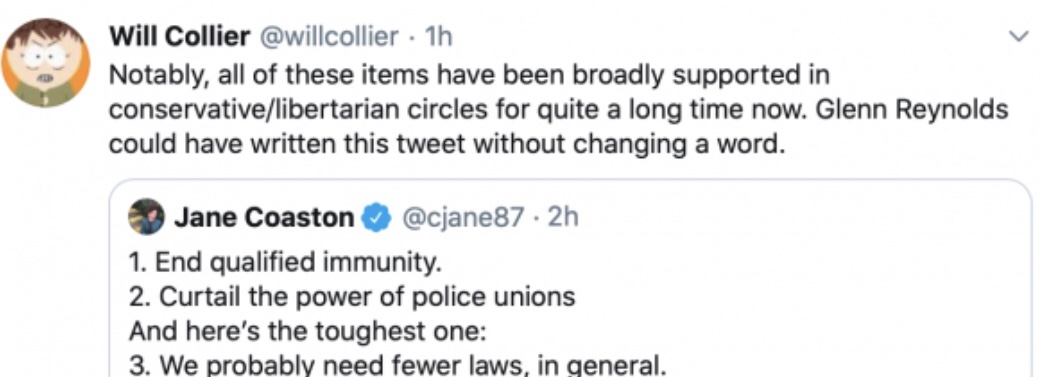
People of good faith oppose the brutality inflicted by bad cops and a system that tolerates them. It is surely time for some reforms, as the following suggests:

And there are still other promising criminal justice reforms to consider. We need to end the drug war, which is particularly harmful to minority communities.

I bemoan the poor circumstances and education that have burdened many of the disaffected protesters, and even the rioters. I advocate for policies that I believe promote improved education and family stability. I have advocated for a safety net. I have shared my distaste for the unnecessary COVID-19 lockdowns that forced so many of these individuals out of their jobs for several months. But from some quarters, the demands have no end. Not until I bow down on my hands and knees to apologize for the sins of generations past. Who cares if they weren’t my ancestors? I’m white! The next demand is reparation payments to today’s generations of blacks. Don’t complain that impoverished whites won’t share in the gains, though there are more than twice as many of them. They simply failed to capitalize on the opportunity afforded by their privilege. I’m sorry for the sarcasm….

Please mourn George Floyd’s horrible death and support the protests against the brutality that killed him, but do not pretend for a moment that the violence is in any way justified, or that it will create a healthier society. Don’t root for that shit. And don’t cast aspirations at your fellow men and women as if the color of their skin is responsible for the social ills you’ve taken up as a cause. It does nothing to further solutions.

Snopes Attacks Satire In Ominous Self-Satirization

12 Monday Aug 2019

Posted by Nuetzel in Censorship, Free Speech

≈ 1 Comment

Tags

Babylon Bee, Censorship, Chick-Fil-A, Deplatforming, Donald Trump, Facebook, Fact-Checking, Fake News, Kim Lacapria, Linda Sue Grimes, Publix, Satire, Snopes.com, Tea Party, The Onion, The Squad

Snopes.com began as an investigator of urban legends and rumors, exposing myths in an exercise that was useful and often fascinating. More recently, despite its founder’s weak argument to the contrary, Snopes has fully revealed its bias against certain political viewpoints, along with a tendency to avoid reporting some actual facts as facts when it suits itself. Lately this has reached a pathetic level, with the site drawing amused reaction to its confusion over the satiric nature of The Babylon Bee. The Bee is a truly funny site similar to The Onion, but it bills itself as “Christian Satire”. If you find that off-putting or think it means the humor must be cornpone, think again. Of course, there is no doubt that the Bee’s humor often pokes fun at the Left, which probably explains Snopes’ motives.

Snopes itself has not been above a bit of fibbing. Its “political fact-checker”, Kim Lacapria, is a former leftist blogger, known to have maligned the Tea Party as “Teahadists”, a funny mischaracterization of the unquestionably peaceful movement as violent. She’s not exactly a person you’d trust as an impartial arbiter of political “fact”. Linda Sue Grimes wrote an informative article with several prominent examples of bias by Snopes. There have also been reports of sordid personal and financial exploits  by one of Snopes’ founders, much of which stands up to scrutiny. 

In its latest misadventure in fact-weaving, Snopes’ has charged that the Bee published a story “intended to deceive” readers, and it claimed the Bee  had done so in the past. The story was entitled “Georgia Lawmaker Claims Chick-Fil-A Employee Told Her To Go Back To Her Country, Later Clarifies He Actually Said ‘My Pleasure“. It was inspired by an incident in which the same Georgia lawmaker apparently had too many items in the express checkout at a Publix grocery store. She claimed that an angry white man told her to “go back to where you came from”. However, the Publix clerk with whom she had the altercation, who happens to be Cuban, denies having said any such thing, though he did admit to calling her a bitch. The lawmaker’s allegation seems suspiciously coincidental, having come in the immediate wake of Donald Trump’s controversial tweet that the quartet of federal lawmakers known as “The Squad” should “go back to where they came from”.

Apparently, the humor in the Bee’s article was just a bit too subtle for Snopes, whose “woke” employees have particularly vivid imaginations. The Bee article was funny precisely because it ridiculed those who hear racial “dog whistles” everywhere. The idea that a Chinese employee working a drive-through at Chick-Fil-A would say such a thing is unlikely to say the least. Anyone who has ever visited a Chick-Fil-A knows it. Too many of those with whistles in their ears haven’t had the pleasure.

Has the Bee intended to deceive its readers in the past? Perhaps Snopes was referring to an article entitled “CNN Purchases Industrial-Sized Washing Machine to Spin News Before Publication“. Snopes went to the trouble of calling that story false and bringing it to Facebook’s attention. Facebook actually issued a warning to the Bee (for which FB later apologized). But here’s the thing, in Grimes’ words:

“Debunking a piece of satire renders the debunker as functionally illiterate, appearing too ignorant to understand that a piece of satire does not function to relay information as a news report would.”

It’s actually much worse than that. If Snopes wants to to assess the objective truth of claims, that’s one thing, but it has drifted into the assessment of literary and authorial intent. That’s ominous for the cause of free discourse, especially to the extent that social media sites rely on Snopes as a filter to deplatform certain voices or silence points of view. Snopes has no business attempting to draw distinctions between satire and “fake news” or any intent to deceive, because it’s bound to get it wrong and already has. They might as well fact-check stand-up comics whose routines might confuse a few dimwitted members of the public, and Snopes just might do so if the comic doesn’t support its preferred political narrative. Snopes’ role is not to protect the unsophisticated from satire, and apparently its fact-checkers feel no compulsion to debunk the satire produced by The Onion, for example. The Bee’s pointed satire often serves the purpose of exposing the Left for its congenital stupidity, but that is anything but an effort to deceive, as much as Snopes might wish it was so.


The EU Chokes the Free Flow of Information

14 Sunday Apr 2019

Posted by Nuetzel in Censorship, Free Speech

≈ Leave a comment

Tags

Brexit, Catarina Midoes, Censorship Machines, Cory Doctorow, crony capitalism, Electronic Frontier Foundation, European Copyright Directive, European Union, Facebook, Fair Use, Google, Link Tax, Mark Zuckerberg, Scott Shackford, Stan Adams, Takedown Notice, Warren Meyer

The European Union wants to force me to pay “news sites” for links with “snippets” of content I might quote on this blog, and it wants the WordPress platform to flag and censor anything that might qualify as copyright infringement. The EU also wants search engines like Google and platforms like Facebook to pay for links and “snippets” or else censor them. Most members in the EU Parliament apparently think the best way to regulate information services is to choke off the flow of information. As Warren Meyer says, if you weren’t for Brexit, this single EU action might well convert you (though British statists have their own designs on censorship, Brexit or not). And if you think government involvement won’t ruin the internet, think again.

These restrictive demands are the essence of two controversial provisions of the so-called European Copyright Directive (ECD) passed by the EU Parliament on March 26th. My summary here leaves out lots of detail, but be assured that administering the Directive will require a massive regulatory apparatus:

The Link Tax: If you link to a source and quote a “snippet” of text from that source, you will have to obtain a license from the source, or else the link you use may be blocked. Keep in mind the rule applies despite full attribution to the original source! It remains to be seen how these licenses will be negotiated, but it will almost certainly impose costs on users.

Censorship Machines: Platforms will be required to monitor and assess everything posted for possible copyright infringement. That will require the development of automated “filters” to flag and remove material that might be in violation. That’s a stark change in the treatment of speech on platforms that, heretofore, have not been required to police their users. The responsibility was on those holding copyrights to go after unauthorized use with takedown notices.

Cory Doctorow of the Electronic Frontier Foundation (EFF) wrote an informative position paper on the ECD a week before the vote. He has been an active and articulate opponent of the legislation. Here are some of his comments (his emphasis):

“… text that contains more than a ‘snippet’ from an article are covered by a new form of copyright, and must be licensed and paid by whoever quotes the text …[the ECD] has a very vague definition of ‘news site’ and leaves the definition of ‘snippet’ up to each EU country’s legislature. … no exceptions to protect small and noncommercial services, including Wikipedia but also your personal blog. The draft doesn’t just give news companies the right to charge for links to their articles—it also gives them the right to ban linking to those articles altogether, (where such a link includes a quote from the article) so sites can threaten critics writing about their articles.”

The ECD seems intended as a gift to large news organizations, but it will discourage the free exposure now given to those news sites on the internet. It’s therefore not clear that the ECD will generate much incremental cash flow for news sites or other content providers. However, collecting the new license revenue will come at some expense, so it won’t be of much help to smaller “rights holders”. Therefore, the rule is likely to benefit large platforms and news outlets disproportionately, as they are in a better position to negotiate licenses for the use of material.

As for censorship machines, perhaps rights holders prefer a shift in the burden of policing the use of copyrighted material away from themselves and to the platforms. Some might suggest that it will achieve efficiencies, but that seems unlikely. These filters are costly and are likely to suffer from an excess of false positives. Moreover, the ECD creates risks that demand conservatism on the part of the platforms, so their censorship machines will systematically side against users. There is also a reasonable possibility that filters will be used to control political speech.

All of this is contrary to the doctrine of fair use, as codified and practiced in the U.S. This involves four conditions giving fairly broad latitude to users, described at the last link by Stan Adams:

“The relevant statutory provision (17 U.S.C. § 107) describes four factors to consider when determining whether a particular use of a work is “fair”: the purpose and character of the use; the nature of the copyrighted work; the amount and substantiality of the portion used in relation to the work as a whole; and the effect of the use on the potential market for, or value of, the original work.”

Copyright protection has never been absolute nor intended to guarantee perfect exclusivity. Ever lend a book to a friend? Ever heard a cover band perform pop hits? Ever offered a quote to forward a written argument? All of this falls broadly under fair use, and much of it serves to promote the economic interests of rights holders, as opposed to infringing on the market for their original work. The EU, however, has no provisions for fair use in its copyright laws (though EU countries may have limitations and exclusions to copyright protection).

It’s bad enough that Europeans will suffer the consequences of this ill-considered piece of legislation, but can the platforms be counted upon to apply their censorship machines only to select geographies? Adams encapsulates the difficulties the ECD presents to users elsewhere:

“… the rest of the world must rely on private companies to ensure that the EU’s misguided copyright policies do not restrict freedoms enjoyed elsewhere in the world.”

Internet regulations in Europe and the U.S. seem to be following different cronyist disease vectors. The ECD favors large news organizations at the expense of social media platforms, and ultimately consumers and the cause of free speech. The large tech platforms are of course equipped to survive, but perhaps not small ones. In the U.S., we have Mark Zuckerberg begging for regulation of Facebook, including the regulation of speech. That’s a spectacularly bad idea for public policy. It too would disadvantage smaller competitors in the social media space. Ultimately, in Europe and the U.S, these steps will come at the expense of consumers, possibly in higher monetary costs, but definitely in restrained trade in online services and in the marketplace of ideas. So goes the cause of free speech when government has the power to regulate the flow of information.

For further reading on the ECF, see Catarina Midoes: “Is this blog post legal (under new EU copyright law)?” She discusses how different factions view the ECD, gives additional perspective on the controversial provisions, and discusses some potential unintended consequences. Also see Scott Shackford’s “Hide Those Meme’s Folks…”


Bad Idea: Campaign Finance Reform

25 Friday Jan 2019

Posted by Nuetzel in Campaign Finance, Free Speech

≈ Leave a comment

Tags

501(c) Organizations, Campaign Finance Reform, Citizens United, Dark Money, David Harsanyi, Disclosure Requirements, Federal Election Commission, First Amendment, Free Speech, Glenn Reynolds, Independent Expenditure Committees, Jeffrey Milyo, Nancy Pelosi, Revolving Door Tax, Ron Paul, Social Welfare Organizations, Super PACs, Term Limits

Everyone seems to hate money in politics, and nearly everyone says campaign finance reform is needed to eliminate political corruption… nearly. Money in politics is blamed for allowing powerful interests to “buy” seats in the legislature, or in executive positions, as well as “tit-for-tat” influence over pieces of legislation. But not so fast: attempts at campaign finance regulation in the past have been largely unsuccessful in achieving their goals. Furthermore, campaign finance reforms may have perverse consequences, which I’ll discuss below. More importantly, while “taking money out of politics” sounds noble to many, it starkly implies abrogation of First Amendment rights. Far from “leveling the playing field”, there is a great danger that it would lead to suppression of minority opinions. For those reasons. it’s better to consider other means of ensuring that elected officials behave even-handedly in attending to their duties.

Protected Speech

Former Congressman Ron Paul is highly skeptical that any good can come of campaign finance legislation:

“…campaign finance reform legislation does not limit the influence of powerful special interests. Instead, it violates the First Amendment and burdens those seeking real change in government.”

Here is David Harsanyi on the same point:

“Reducing the power of ‘special interests’ in Washington is always a popular issue with voters. The problem, of course, is that every voter considers another group a special interest. … specific campaign finance reform legislation is always about inhibiting someone’s speech.”

Government attempts to curb speech are bad enough, but there is also interest in subsidizing speech arising from certain quarters. Harsanyi is rightly critical of a House bill that proposes to do just that, and Nancy Pelosi has promised to bring the bill to the floor. Among other things, it would authorize a 6-to-1 federal match of small-dollar campaign donations so as to promote “grass-roots” electoral efforts. It is quite simply a bad idea to create a mechanism whereby government bureaucrats can manipulate campaign funding, potentially favoring certain kinds of speech, via the explicit use of funds from taxpayers who might well blanche at the thought of funding certain campaigns.

The bill would also impose new disclosure requirements on large contributions to 501(c)(4) organizations, which qualify as “social welfare” groups under the tax code, and whose “primary” purpose is not campaign-related. To this he says:

“… this obsession with eliminating anonymity is also a transparent attempt to chill speech and undermine minority opinions.”

Let’s face it: to complain about the use of money in promoting speech is to complain about speech itself. We can all speak out loud, but one can’t hope to spread a message broadly without bringing resources to bear on the effort. That’s true whether you are printing, broadcasting, or spreading messages on social media. It almost always takes staff, including creative talent, equipment, media buying power, and usually office space. If you don’t have the requisite resources then you must hustle, press flesh, cajole members of the media, and join with other like-minded individuals, especially those who might agree to commit resources.

Barring a monopoly on speech, choosing a particular scale at which speech becomes unacceptable is itself a denial of the right to free speech. And that right can be exercised by individuals and by associations of individuals. As to the latter, the form of association makes no difference: the union, nonprofit, and for-profit corporate forms are all valid associations through which individuals can speak as one, just as all for-profit media corporations have always exercised their First Amendment rights. That was the Supreme Court’s ruling in Citizen’s United vs. Federal Election Commission (FEC) in 2009, which remains oddly controversial. Again, if you think the ability to speak from a large platform is too much, then you are also willing to restrict speech by for-profit newspapers and television networks, and you are a tyrant.

Money and Electoral Success

In any case, virtually all campaign contributions originating in the for-profit corporate sector come from employee political action committees (PACs), not from corporations themselves. And since Citizen’s United, there’s been little uptick in campaign contributions from for-profit corporations. In fact, according to this report on campaign finance, unions have been much more aggressive than businesses in leveraging the Citizen’s United decision. The report also demonstrates the unsurprising fact that incumbents tend to spend much more on elections than their challengers. However, the authors note that across incumbents, greater spending is associated with lower vote shares, while the reverse is true across challengers. That just means, however, that incumbents must spend a lot to defeat a serious challenger.

Jeffrey Milyo made the last point more than 15 years ago:

“Most systematic studies, however, find no effect of marginal campaign spending on the electoral success of candidates … How can this be so? The best explanation to date is that competent candidates are adept at both convincing contributors to give money and convincing voters to give their vote. Consequently, the finding that campaign spending and electoral success are highly correlated exaggerates the importance of money to a candidate’s chances of winning.”

There is also a lack of evidence that politicians trade their votes for campaign contributions:

“… donors tend to give to like-minded candidates. Of course, if candidates choose their policy positions in anticipation of a subsequent payoff in campaign contributions, there would be no real distinction between accepting bribes and accepting contributions from like-minded voters. However, studies of legislative behavior indicate that the most important determinants of an incumbent’s voting record are constituent interests, party, and personal ideology.”

A tremendous disparity exists between public perceptions of the importance of money in political campaigns and the actual magnitude of campaign spending. Again, from Milyo:

“If campaign contributions do not buy favors, then why is so much money spent on politics? In fact, scholars of American politics have long noted how little is spent on politics. Consider that large firms spend ten times as much on lobbying as their employees spend on campaign contributions through PACs, as individuals, or in the form of unregulated contributions to political parties (i.e., soft money).”

Milyo’s article was written well before the Citizen’s United decision. At the time it was still illegal for corporations to make campaign contributions, but that seems to have made little difference.

In an Appeals Court decision in 2010, Independent Expenditure Committees (Super PACs) won the right to accept contributions from corporations and individuals beyond federal limits. Super PACs, however, are technically prohibited from coordinating their activities with political candidates for federal office. In fact, Super PACs have been known at times to work at cross-purposes to the political parties whose candidates they generally favor. Furthermore, there is very little evidence that corporate contributions provide more than a small share of Super PAC funds, not even via “dark money” contributions via 501(c) organizations.

Futile Reforms 

Ron Paul (linked above) notes that powerful interests will always find ways to support policies by which they stand to profit. Those interests often benefit from regulatory policies that create burdens for smaller competitors, spending programs that bring fat government contracts, and subsidies in support of favored activities or technologies. However, restricting campaign finance is a particularly troubling and ineffective approach to combating these efforts. As Milyo says:

“The consensus among academic researchers is that money is far less important in determining either election or policy outcomes than conventional wisdom holds it to be. Consequently, the benefits of campaign finance reforms have also been exaggerated.”

Beyond the lack of evidence that reform is needed, Milyo argues that restrictions on campaign contributions may have nasty unintended consequences. First, cross-sectional studies across states have shown that limits on contributions lead to less electoral competition and lower voter turnout. Second, less campaign advertising reduces interest and awareness of candidate positions among voters, also suppressing turnout. Finally, there is a real danger that incumbents can manipulate reform legislation in order to create electoral barriers to potential challengers.

Alternatives

There may be better ways to reduce the influence of moneyed interests on policy than campaign finance reforms. Term limits obviously shorten the duration of the incumbent advantage as well as corrupt actions by any office-holder who is somehow “bought and paid-for”. Most Libertarians favor term limits to reduce corruption and encourage the kinds of “citizen legislators” idealized by the nation’s founders. Others make an opposing argument that it is our electoral duty to remove legislators from office at the ballot box, and therefore term limits were left out of the Constitution for good reason. Still others say that term limits might make corrupt politicians too keen to act quickly.

Another idea is based on the “revolving door tax” often mentioned by Glenn Reynolds. Not infrequently, government bureaucrats are offered lucrative positions with firms whom they regulate, or they take on these firms as private clients once they leave government. Needless to say, this creates perverse incentives for self-interested public servants. Reynolds suggests an additional tax on subsequent income earned after accepting such an offer. Extending the idea to politicians would mean an additional tax on income earned by any former office-holder accepting work for a firm or industry specifically targeted for benefits under legislation they sponsored during their term. There is much detail to be fleshed out, but the idea is fascinating.

Conclusion

Campaign finance reform is futile: there will always be creative ways around it, so it generally doesn’t reap rewards. Campaign funding itself is rather ineffectual at the margin in generating electoral gains. Moreover, campaign finance reform is an endeavor that is almost guaranteed to run afoul of our First Amendment protections of free speech. In addition, the result may a reversion to a less-informed and less interested electorate, lower voter turnout, as well as manipulation of the reform process itself.

Gays and Bakers: Expression or Repression?

26 Monday Feb 2018

Posted by Nuetzel in Discrimination, Free Speech

≈ Leave a comment

Tags

Anti-discrimination law, CO Anti-Discrimination Act, Common Carrier, David Henderson, Eugene Volokh, Freedom of Association, Freedom of Speech, Gay Wedding Cake, Masterpiece Bakeshop, Public Accommodations, Richard Epstein, Unruh Act

A lot rides on the legal interpretation of “expression” in the gay-wedding-cake dispute. Eugene Volokh discusses a recent ruling in California in which a trial court judge ruled that the baker’s right to free expression, buttressed by her right to free exercise of religion, protected her from demands that she participate in a form of expression to which she objected. Specifically, she had no legal obligation to create a cake for the celebration of a gay couple’s wedding, according to the ruling.

The facts in the case, CA Dept. of Fair Employment and Housing v. Cathy’s Creations, are that the baker refused to bake the couple a wedding cake but expressed a willingness to sell them anything that was already available in the shop. Thus, she did not discriminate against the couple by denying them access to her “public accommodations”. She also gave the couple a referral to another baker whom she believed would be willing to produce the cake. So there were probable alternatives available to the couple, and the baker’s assistance in locating one mitigated against any harm suffered by the gay couple. That sort of mitigation is an important factor to consider in weighing the rights of conflicting parties. Courts have tended to view “dignitary harm” as less compelling than forced expression.

Volokh argues that the baker’s role in the episode did not demand expression on her part. He says the proposed cake was a pre-existing design and did not involve writing of any kind. Otherwise, Volokh would have supported the ruling. He and a coauthor discuss the distinctions between an artist (who expresses) and an artisan (who merely executes), and an expressive and a non-expressive cake, in an amicus brief, as noted in the article linked above. Here is Volokh’s summary of his view:

“While creating photographs, videos, and text would be constitutionally protected speech (so we support the right of, for instance, photographers not to photograph same-sex weddings), creating wedding cakes with no text or symbolic design on them is not.“

The Volokh article is a little confusing because the amicus brief seems to have been filed in a different but similar case, Masterpiece Bakeshop v. Colorado Civil Rights Commission, which is now before the U.S. Supreme Court. A ruling is expected this summer. Here is a transcript of the oral arguments in that case, which were heard late last year. It’s a fascinating discussion.

Volokh’s analysis is fine as far as it goes. However, a wedding cake is likely to be considered expressive to both the baker and the cake’s buyers. The baker’s effort in executing even a pre-existing design may involve meaning for her beyond mere execution, since the usual intent of a wedding cake is to celebrate a sacred union. Likewise, the baker knows that the buyers consider the cake to be expressive of their union. The baker doesn’t want any involvement in that expression, asserting that it is not for the government to intercede, forcing them to participate by producing the cake.

Does the baker’s offer to supply an existing cake (or any other bakery good) undermine their case? Does the necessity of baking a new cake for a gay wedding differ from offering a cake already on the shelf for the same purpose? That may be irrelevant to the cases at hand, because no other wedding cakes were available at the time, and freshness might demand the preparation of a new cake for such an occasion. Nevertheless, that sort of line between an acceptable sale for the baker and unacceptable expression strikes me as thin.

As for the matter of the baker’s religious beliefs and their importance to her expressive rights, Volokh derides some of the language of the ruling. Those beliefs, Volokh says, are irrelevant to the question of whether a particular kind of expression is protected or compelled:

“By the way, I take it that it’s clear that the Free Speech Clause issue can’t turn on whether Miller’s belief ‘is part of the orthodox doctrines’ of many religions, or whether it’s instead ‘trivial, arbitrary, nonsensical, or outrageous’ — the Free Speech Clause protects views regardless of whether they express views that are seen as orthodox, outrageous, or nonsensical.“

Bravo! However, when the rights of two parties are in conflict, it is appropriate to weigh any impingement upon other, secondary rights of both parties.

A disturbing aspect of these cases is that they do not turn in any way on freedom of association, a freedom that encompasses a right not to associate (since any association must be voluntary for both parties). The presumption is that the baker’s right to freely associate or not associate with whomever they please is superseded by their obligations under public accommodation laws, despite the fact that freedom of association is an enumerated right in the U.S. Constitution. While public accommodation laws have generally been found to be constitutional, those laws do not apply in all circumstances, such as when a particular product or service involves expression. But on its own, a violation of the baker’s freedom of association seems to matter less, in today’s legal environment, than abridgment of her free expression, and perhaps less than any obligation she has to provide public accommodation.

Richard Epstein gives a general treatment of the balance between freedom of association and anti-discrimination law. David Henderson has bemoaned the dilution of the freedom of association suffered in the name of non-discrimination. He does not defend discrimination on the basis of race, gender or sexual preference. Quite the contrary. However, as a matter of individual liberty, he prefers that we retain our right to associate on any basis of our choosing and pay the price imposed by the market for discrimination. For example, if you hang a sign outside your restaurant saying that you won’t serve African Americans, you are likely to suffer a loss of business from all who find your preference offensive, as many will. That solution is obviously unappealing to those who believe that participation in civil society requires public standards of equal access in private transactions. Still, there is some truth to a quote Henderson provides from an anonymous individual comparing the idea of non-discrimination in public accommodations to the “common carrier” designation:

“‘Either way, the theory boils down to “you brought forth a good or service and abracadabra you now have fewer rights”‘”.

The legal actions against the bakers in the cases discussed above rely on anti-discrimination law (in CA, the Unruh Act, and in CO, the Anti-Discrimination Act). Those laws must face limits in their application, as may be necessary in the case of compelled expression, especially expression against one’s most deeply-held convictions, religious or otherwise. The most basic question in this regard is whether the creation of the proposed wedding (or union) cakes can be described as expression. Whether the bakers are acting as mere fabricators or as artists, there is no doubt that the wedding parties desired the cakes as part of the celebration of their unions. That use of a cake constitutes expression on their part, and it is a kind of expression and an association from which the bakers would prefer to demure.

I support the right of homosexuals to enter into legal marriage, but I also support the bakers’ right to refuse the business. To invoke a phrase used by Richard Epstein in the article linked above, the world would be a better place if all agreed to simply “live and let live”.

← Older posts
Follow Sacred Cow Chips on WordPress.com

Recent Posts

  • Immigration and Merit As Fiscal Propositions
  • Tariff “Dividend” From An Indigent State
  • Almost Looks Like the Fed Has a 3% Inflation Target
  • Government Malpractice Breeds Health Care Havoc
  • A Tax On Imports Takes a Toll on Exports

Archives

  • December 2025
  • November 2025
  • October 2025
  • September 2025
  • August 2025
  • July 2025
  • June 2025
  • May 2025
  • April 2025
  • March 2025
  • February 2025
  • January 2025
  • December 2024
  • November 2024
  • October 2024
  • September 2024
  • August 2024
  • July 2024
  • June 2024
  • May 2024
  • April 2024
  • March 2024
  • February 2024
  • January 2024
  • December 2023
  • November 2023
  • August 2023
  • July 2023
  • June 2023
  • May 2023
  • April 2023
  • March 2023
  • February 2023
  • January 2023
  • December 2022
  • November 2022
  • October 2022
  • September 2022
  • August 2022
  • July 2022
  • June 2022
  • May 2022
  • April 2022
  • March 2022
  • February 2022
  • January 2022
  • December 2021
  • November 2021
  • October 2021
  • September 2021
  • August 2021
  • July 2021
  • June 2021
  • May 2021
  • April 2021
  • March 2021
  • February 2021
  • January 2021
  • December 2020
  • November 2020
  • October 2020
  • September 2020
  • August 2020
  • July 2020
  • June 2020
  • May 2020
  • April 2020
  • March 2020
  • February 2020
  • January 2020
  • December 2019
  • November 2019
  • October 2019
  • September 2019
  • August 2019
  • July 2019
  • June 2019
  • May 2019
  • April 2019
  • March 2019
  • February 2019
  • January 2019
  • December 2018
  • November 2018
  • October 2018
  • September 2018
  • August 2018
  • July 2018
  • June 2018
  • May 2018
  • April 2018
  • March 2018
  • February 2018
  • January 2018
  • December 2017
  • November 2017
  • October 2017
  • September 2017
  • August 2017
  • July 2017
  • June 2017
  • May 2017
  • April 2017
  • March 2017
  • February 2017
  • January 2017
  • December 2016
  • November 2016
  • October 2016
  • September 2016
  • August 2016
  • July 2016
  • June 2016
  • May 2016
  • April 2016
  • March 2016
  • February 2016
  • January 2016
  • December 2015
  • November 2015
  • October 2015
  • September 2015
  • August 2015
  • July 2015
  • June 2015
  • May 2015
  • April 2015
  • March 2015
  • February 2015
  • January 2015
  • December 2014
  • November 2014
  • October 2014
  • September 2014
  • August 2014
  • July 2014
  • June 2014
  • May 2014
  • April 2014
  • March 2014

Blogs I Follow

  • Passive Income Kickstart
  • OnlyFinance.net
  • TLC Cholesterol
  • Nintil
  • kendunning.net
  • DCWhispers.com
  • Hoong-Wai in the UK
  • Marginal REVOLUTION
  • Stlouis
  • Watts Up With That?
  • Aussie Nationalist Blog
  • American Elephants
  • The View from Alexandria
  • The Gymnasium
  • A Force for Good
  • Notes On Liberty
  • troymo
  • SUNDAY BLOG Stephanie Sievers
  • Miss Lou Acquiring Lore
  • Your Well Wisher Program
  • Objectivism In Depth
  • RobotEnomics
  • Orderstatistic
  • Paradigm Library
  • Scattered Showers and Quicksand

Blog at WordPress.com.

Passive Income Kickstart

OnlyFinance.net

TLC Cholesterol

Nintil

To estimate, compare, distinguish, discuss, and trace to its principal sources everything

kendunning.net

The Future is Ours to Create

DCWhispers.com

Hoong-Wai in the UK

A Commonwealth immigrant's perspective on the UK's public arena.

Marginal REVOLUTION

Small Steps Toward A Much Better World

Stlouis

Watts Up With That?

The world's most viewed site on global warming and climate change

Aussie Nationalist Blog

Commentary from a Paleoconservative and Nationalist perspective

American Elephants

Defending Life, Liberty and the Pursuit of Happiness

The View from Alexandria

In advanced civilizations the period loosely called Alexandrian is usually associated with flexible morals, perfunctory religion, populist standards and cosmopolitan tastes, feminism, exotic cults, and the rapid turnover of high and low fads---in short, a falling away (which is all that decadence means) from the strictness of traditional rules, embodied in character and inforced from within. -- Jacques Barzun

The Gymnasium

A place for reason, politics, economics, and faith steeped in the classical liberal tradition

A Force for Good

How economics, morality, and markets combine

Notes On Liberty

Spontaneous thoughts on a humble creed

troymo

SUNDAY BLOG Stephanie Sievers

Escaping the everyday life with photographs from my travels

Miss Lou Acquiring Lore

Gallery of Life...

Your Well Wisher Program

Attempt to solve commonly known problems…

Objectivism In Depth

Exploring Ayn Rand's revolutionary philosophy.

RobotEnomics

(A)n (I)ntelligent Future

Orderstatistic

Economics, chess and anything else on my mind.

Paradigm Library

OODA Looping

Scattered Showers and Quicksand

Musings on science, investing, finance, economics, politics, and probably fly fishing.

  • Subscribe Subscribed
    • Sacred Cow Chips
    • Join 128 other subscribers
    • Already have a WordPress.com account? Log in now.
    • Sacred Cow Chips
    • Subscribe Subscribed
    • Sign up
    • Log in
    • Report this content
    • View site in Reader
    • Manage subscriptions
    • Collapse this bar
 

Loading Comments...