• About

Sacred Cow Chips

Sacred Cow Chips

Category Archives: Global Warming

Tragic Harvey Flooding Was a Known Risk

31 Thursday Aug 2017

Posted by Nuetzel in Flood Insurance, Global Warming, Subsidies, Uncategorized

≈ Leave a comment

Tags

Climate Change, David Conrad, Federal Flood Insurance, Houston, Hurricane Frequency, Hurricane Harvey, Landfalling Hurricanes, Michael Grunwald, National Wildlife Federation, Roger Pielke Jr., Roy Spencer

Houston-flood-1935

The photo above is downtown Houston during the flood of 1935, which I lifted from a post on Roy Spencer’s blog. The rate of rainfall from Hurricane Harvey in Houston is not unprecedented, according to Spencer. The geographic breadth and duration of the heavy rainfall might be, but ready comparisons are difficult on that basis, even for the 100 years of recorded rainfall in East Texas. The tragic severity of the flood damage is probably unprecedented as well, though the full tally won’t be in for some time. The severity is a consequence of four factors: the breadth of the rainfall, its duration, the growth of the Houston metro area, and the unnecessary development of low-lying areas that can no longer provide effective drainage and absorption of rainfall due to impervious cover.

Harvey was (and is) a big storm, but an unusual aspect of Harvey was the way it stalled after making landfall:

“The exact same tropical system moving at, say, 15 mph might have produced the same total amount of rain, but it would have been spread over a wide area, maybe many states, with no flooding disaster. This is usually what happens with landfalling hurricanes. … Instead, Harvey stalled after it came ashore and so all of the rain has been concentrated in a relatively small portion of Texas around the Houston area. In both cases, the atmosphere produced the same amount of rain, but where the rain lands is very different.“

Spencer also notes that Harvey is in no way evidence of global warming, as many in the media have implied:

“Roger Pielke Jr. has pointed out that the U.S. has had only four Category 4 (or stronger) hurricane strikes since 1970, but in about the same number of years preceding 1970 there were 14 strikes. So we can’t say that we are experiencing more intense hurricanes in recent decades. … Going back even earlier, a Category 4 hurricane struck Galveston in 1900, killing between 6,000 and 12,000 people. That was the greatest natural disaster in U.S. history. … And don’t forget, we just went through an unprecedented length of time – almost 12 years – without a major hurricane (Cat 3 or stronger) making landfall in the U.S.“

As for the role of development in the severity of the flooding, Spencer says:

“Major floods are difficult to compare throughout history because the ways in which we alter the landscape. For example, as cities like Houston expand over the years, soil is covered up by roads, parking lots, and buildings, with water rapidly draining off rather than soaking into the soil. The population of Houston is now ten times what it was in the 1920s. The Houston metroplex area has expanded greatly and the water drainage is basically in the direction of downtown Houston.”

Short memories and inaccurate assessments of flood potential might have encouraged excessive building in low-lying areas in and around Houston. However, the profligate extension of federal flood insurance to properties in those areas played a large role. Here is Michael Grunwald:

“Nearly two decades before the storm’s historic assault on homes and businesses along the Gulf Coast of Texas this week, the National Wildlife Federation released a groundbreaking report about the United States government’s dysfunctional flood insurance program, demonstrating how it was making catastrophes worse by encouraging Americans to build and rebuild in flood-prone areas.“

Houston played a noteworthy role in the report quoted by Grunwald:

“‘Houston, we have a problem,’ declared the report’s author, David Conrad. The repetitive losses from even modest floods, he warned, were a harbinger of a costly and potentially deadly future. ‘We haven’t seen the worst of this yet,’ Conrad said.

Climate alarmists would be well-advised to read Spencer’s piece on Harvey. It offers  excellent historical and climatological context. It’s also interesting to read some of the venomous ad hominem sprayed in Spencer’s direction by alarmist trolls in the comments section. Spencer knows too well, however, that “floods aren’t just due to the weather“. Let’s hope that the Houston area won’t be encouraged to rebuild in low-lying areas by prospective subsidies from a federal flood insurance program in need of drastic reform.

Paris Climate Dance: a Concon

07 Wednesday Jun 2017

Posted by Nuetzel in Global Warming, Redistribution, Uncategorized

≈ Leave a comment

Tags

AGW, Anthropomorphic Global Warming, Axial Tilt, Barack Obama, Carbon Concentration, Carbon Forcing Models, Carbon Intensity, Climate Feedbacks, Dementors, Donald Trump, Green Climate Fund, Harry Potter, Jeffrey Tucker, Paris Climate Accord, Paris Climate Summit, Steven Allen

Ah, Paris, we bid you adieu. For both scientific and economic reasons, the Paris Climate Accord is pure numbskullery. We should all be grateful that President Trump has decided to revoke the expensive promises made by Barack Obama under the agreement in a willful effort to appease the world’s rent seekers.

From a scientific perspective, the accord’s prescriptions are premised on a partial effect: absent any feedbacks, carbon emissions would raise the atmospheric temperature slightly. But feedback effects are massively important, as anyone familiar with the climate models’ terrible track record of predictive performance might guess. Water vapor, cloud formation, wind currents, and the response of the Earth’s biomass are just some of the effects that impinge on the relationship between atmospheric carbon and temperatures. In addition, carbon forcings are relatively minor compared to the energy impulses delivered by natural sources, including solar activity and the Earth’s varying axial tilt. Paleoclimate data shows that the world has been this warm before, and warmer.

The economic case against the Paris Accord is even stronger. The very idea that authorities would impose huge material sacrifices on mankind in an effort to prevent a threat for which the evidence is so weak should give pause to any rational individual. Beyond that, however, the real function of the accord was not so much carbon mitigation as it was a shift in the distribution of wealth. This quote of Steven Allen, in a scathing assessment of the agreement, is instructive (forgive his mid-sentence switch to sarcasm):

“Mainly, it’s about taking money from taxpayers and consumers and businesspeople and electricity ratepayers and giving it to crony capitalists, and taking money from people in relatively successful countries and giving that money to rich people in poor countries, to the benefit of members of governing elites who support the Paris deal for the good of humanity and not at all because they expect to line their pockets with it.“

World carbon emissions were expected to keep rising at least through 2030 under the agreement. The subsidies it promised to crony capitalists in the renewable energy industry were to generously fund technologies that are not economically viable without government support, to the detriment of relatively clean-burning fossil fuels, not to mention nuclear power. The U.S. promised to reduce absolute carbon emissions, but the world’s greatest emitter of carbon dioxide, China, promised only to seek to limit emissions per unit of GDP, but not until sometime down the road. That means China’s level of emissions might not reverse, given the rapid growth of the Chinese economy. India’s commitment is similar. And Russia promised a reduction relative to a depressed 1990 level of emissions, which means they have plenty of room for growth.

As for the U.S., where absolute carbon emissions have been decreasing since 2007, the Paris Accord relied on so-called “voluntary” limits to be imposed by federal mandates. Financial demands were made by developing countries under the deal: $100 billion per year. And who would pay for that? Taxpayers in the developed countries, of course. One can only imagine the lust of unaccountable third-world officialdom for those funds. Thus far, the U.S. has paid only $1 billion into the so-called Green Climate Fund, and at least half of that was taken from a State Department account from which disbursal did not require Congressional approval.

Jeffrey Tucker, who is anything but a fan of Donald Trump, minced no words in his assessment of the Paris “treaty”. Here are a few selected quotes:

“The Paris Agreement is a ‘voluntary’ agreement because its architects knew it would never pass the US Senate as a treaty. Why? Because the idea of the agreement is that the US government’s regulatory agencies would impose extreme mandates on its energy sector: how it should work, what kinds of emissions it should produce, the best ways to power our lives (read: not fossil fuels), and hand over to developing world regimes billions and even trillions of dollars in aid, a direct and ongoing forcible transfer of wealth from American taxpayers to regimes all over the world, at the expense of American freedom and prosperity. …

The exuberant spokespeople talked about how ‘the United States’ had ‘agreed’ to ‘curb its emissions’ and ‘fund’ the building of fossil-free sectors all over the world. It was strange because the ‘United States’ had not in fact agreed to anything: not a single voter, worker, owner, or citizen. Not even the House or Senate were involved. This was entirely an elite undertaking to manage property they did not own and lives that were not theirs to control. …

The Paris Agreement is no different in its epistemological conceit than Obamacare, the war on drugs, nation-building, universal schooling, or socialism itself. They are all attempts to subvert the capacity of society to manage itself on behalf of the deluded dreams of a few people with power and their lust for controlling social and economic outcomes.“

The popular fascination with climate scare stories has provided a useful channel of influence for would-be central planners and redistributionists. These social dementors reject the proposition that science is a process of continuing challenge and testing, thereby subverting the very notion of scientific inquiry. They make the laughable claim that 170 years of temperature data, much of which is quite sketchy, is sufficient to draw strong conclusions about the trends and dynamics of the climate on a four billion year-old planet.

Even worse, the climate alarmists insist that they have a monopoly on scientific knowledge, despite a significant share of skeptics in the climate science community. But in pursuit of that monopoly, the alarmists have gone so far as to undermine the integrity of the peer review process in the climate literature and to manipulate temperature data to exaggerate recent records. They have promoted the false claims that cyclonic storm energy has increased with carbon concentration and that sea levels are rising at an increasing rate. (Coastal property values don’t seem to reflect those concerns.) They would have us confuse actual climate data with model predictions, and they continue to offer prescriptions based on carbon-forcing models after many years of terrible forecast performance. They claim that a small increment (one part per 10,000) to the concentration of a trace atmospheric gas will dominate other forces exerting far greater variations in energy. They ignore the benefits that an increase in nourishing carbon dioxide and warming can provide. And they make the anthropocentric claim that a costly sacrifice by mankind, in an attempt to reduce that trace gas slightly if at all, will pay off reliably by reducing global temperatures, despite the very modest claims on those grounds by the Paris Accord itself.

Here is a link to 17 earlier posts on Sacred Cow Chips having to do with the hypothesis of anthropomorphic global warming, including this one written in late 2015, at the time of the Paris Climate Summit.

Imprecision and Unsettled Science

21 Friday Apr 2017

Posted by Nuetzel in Global Warming, Propaganda

≈ 2 Comments

Tags

Abatement Cost, Carbon Abatement, Carbon Forcings, Carbon Limits, Charles Hooper, Climate models, Cloud Formation, Confidence Interval, David Henderson, Earth Day, Measurement Error, Natural Climate Variation, Solar Forcings, Statistical Precision, Surface Temperatures, Temperature Aggregation, William Nordhaus

Last week I mentioned some of the inherent upward biases in the earth’s more recent surface temperature record. Measuring a “global” air temperature at the surface is an enormously complex task, requiring the aggregation of measurements taken using different methods and instruments (land stations, buoys, water buckets, ship water intakes, different kinds of thermometers) at points that are unevenly distributed across latitudes, longitudes, altitudes, and environments (sea, forest, mountain, and urban). Those measurements must be extrapolated to surrounding areas that are usually large and environmentally diverse. The task is made all the more difficult by the changing representation of measurements taken at these points, and changes in the environments at those points over time (e.g., urbanization). The spatial distribution of reports may change systematically and unsystematically with the time of day (especially onboard ships at sea).

The precision with which anything can be measured depends on the instrument used. Beyond that, there is often natural variation in the thing being measured. Some thermometers are better than others, and the quality of these instruments has varied tremendously over the roughly 165-year history of recorded land temperatures. The temperature itself at any location is subject to variation as the air shifts, but temperature readings are like snapshots taken at points in time, and may not be representative of areas nearby. In fact, the number of land weather stations used in constructing global temperatures has declined drastically since the 1970s, which implies an increasing error in approximating temperatures within each expanding area of coverage.

The point is that a statistical range of variation exists around each temperature measurement, and there is additional error introduced by vagaries of the aggregation process. David Henderson and Charles Hooper discuss the handling of temperature measurement errors in aggregation and in discussions of climate change. The upward trend in the “global” surface temperature between 1856 and 2004 was about 0.8° C, but a 95% confidence interval around that change is ±0.98° C. (I believe that is probably small given the sketchiness of the early records.) In other words, from a statistical perspective, one cannot reject the hypothesis that the global surface temperature was unchanged for the full period.

Henderson and Hooper make some other salient points related to the negligible energy impulse from carbon forcings relative to the massive impact of variations in solar energy and the uncertainty around the behavior of cloud formation. It’s little wonder that climate models relying on a carbon-forcing impact have erred so widely and consistently.

In addition to reinforcing the difficulty of measuring surface temperatures and modeling the climate, the implication of the Henderson and Hooper article is that policy should not be guided by measurements and models subject to so much uncertainty and such minor impulses or “signals”. The sheer cost of abating carbon emissions is huge, though some alternative means of doing so are better than others. Costs increase as the degree of abatement increases (or replacement of low-carbon alternatives), and I suspect that the incremental benefit decreases. Strict limits on carbon emissions reduce economic output. On a broad scale, that would impose a sacrifice of economic development and incomes in the non-industrialized world, not to mention low-income minorities in the developed world. One well-known estimate by William Nordhaus involved a 90% reduction in world carbon emissions by 2050. He calculated a total long-run cost of between $17 trillion and $22 trillion. Annually, the cost was about 3.5% of world GDP. The climate model Nordhaus used suggested that the reduction in global temperatures would be between 1.3º and 1.6º C, but in view of the foregoing, that range is highly speculative and likely to be an extreme exaggeration. And note the small width of the “confidence interval”. That range is not at all a confidence interval in the usual sense; it is a “stab” at the uncertainty in a forecast of something many years hence.  Nordhaus could not possibly have considered all sources of uncertainty in arriving at that range of temperature change, least of all the errors in measuring global temperature to begin with.

Climate change activists would do well to spend their Earth Day educating themselves about the facts of surface temperature measurement. Their usual prescription is to extract resources and coercively deny future economic gains in exchange for steps that might or might not solve a problem they insist is severe. The realities are that the “global temperature” is itself subject to great uncertainty, and its long-term trend over the historical record cannot be distinguished statistically from zero. In terms of impacting the climate, natural forces are much more powerful than carbon forcings. And the models on which activists depend are so rudimentary, and so error prone and biased historically, that taking your money to solve the problem implied by their forecasts is utter foolishness.

Playing Pretend Science Over Cocktails

13 Thursday Apr 2017

Posted by Nuetzel in Global Warming

≈ 2 Comments

Tags

97% Consensus, AGW, Carbon Forcing Models, Climate Feedbacks, CO2 and Greening, East Anglia University, Hurricane Frequency, Judith Curry, Matt Ridley, NOAA, Paleoclimate, Peer Review Corruption, Ross McKitrick, Roy Spencer, Sea Levels, Steve McIntyre, Temperature Proxies, Urbanization Bias

It’s a great irony that our educated and affluent classes have been largely zombified on the subject of climate change. Their brainwashing by the mainstream media has been so effective that these individuals are unwilling to consider more nuanced discussions of the consequences of higher atmospheric carbon concentrations, or any scientific evidence to suggest contrary views. I recently attended a party at which I witnessed several exchanges on the topic. It was apparent that these individuals are conditioned to accept a set of premises while lacking real familiarity with supporting evidence. Except in one brief instance, I avoided engaging on the topic, despite my bemusement. After all, I was there to party, and I did!

The zombie alarmists express their views within a self-reinforcing echo chamber, reacting to each others’ virtue signals with knowing sarcasm. They also seem eager to avoid any “denialist” stigma associated with a contrary view, so there is a sinister undercurrent to the whole dynamic. These individuals are incapable of citing real sources and evidence; they cite anecdotes or general “news-say” at best. They confuse local weather with climate change. Most of them haven’t the faintest idea how to find real research support for their position, even with powerful search engines at their disposal. Of course, the search engines themselves are programmed to prioritize the very media outlets that profit from climate scare-mongering. Catastrophe sells! Those media outlets, in turn, are eager to quote the views of researchers in government who profit from alarmism in the form of expanding programs and regulatory authority, as well as researchers outside of government who profit from government grant-making authority.

The Con in the “Consensus”

Climate alarmists take assurance in their position by repeating the false claim that  97% of climate scientists believe that human activity is the primary cause of warming global temperatures. The basis for this strong assertion comes from an academic paper that reviewed other papers, the selection of which was subject to bias. The 97% figure was not a share of “scientists”. It was the share of the selected papers stating agreement with the anthropomorphic global warming (AGW) hypothesis. And that figure is subject to other doubts, in addition to the selection bias noted above: the categorization into agree/disagree groups was made by “researchers” who were, in fact, environmental activists, who counted several papers written by so-called “skeptics” among the set that agreed with the strong AGW hypothesis. So the “97% of scientists” claim is a distortion of the actual findings, and the findings themselves are subject to severe methodological shortcomings. On the other hand, there are a number of widely-recognized, natural reasons for climate change, as documented in this note on 240 papers published over just the first six months of 2016.

Data Integrity

It’s rare to meet a climate alarmist with any knowledge of how temperature data is actually collected. What exactly is the “global temperature”, and how can it be measured? It is a difficult undertaking, and it wasn’t until 1979 that it could be done with any reliability. According to Roy Spencer, that’s when satellite equipment began measuring:

“… the natural microwave thermal emissions from oxygen in the atmosphere. The intensity of the signals these microwave radiometers measure at different microwave frequencies is directly proportional to the temperature of different, deep layers of the atmosphere.“

Prior to the deployment of weather satellites, and starting around 1850, temperature records came only from surface temperature readings. These are taken at weather stations on land and collected at sea, and they are subject to quality issues that are generally unappreciated. Weather stations are unevenly distributed and they come and go over time; many of them produce readings that are increasingly biased upward by urbanization. Sea surface temperatures are collected in different ways with varying implications for temperature trends. Aggregating these records over time and geography is a hazardous undertaking, and these records are, unfortunately, the most vulnerable to manipulation.

The urbanization bias in surface temperatures is significant. According to this paper by Ross McKitrick, the number of weather stations counted in the three major global temperature series declined by more than 4,500 since the 1970s (over 75%), and most of those losses were rural stations. From McKitrick’s abstract:

“The collapse of the sample size has increased the relative fraction of data coming from airports to about 50% (up from about 30% in the late 1970s). It has also reduced the average latitude of source data and removed relatively more high altitude monitoring sites. Oceanic data are based on sea surface temperature (SST) instead of marine air temperature (MAT)…. Ship-based readings changed over the 20th century from bucket-and-thermometer to engine-intake methods, leading to a warm bias as the new readings displaced the old.“

Think about that the next time you hear about temperature records, especially NOAA reports on a “new warmest month on record”.

Data Manipulation

It’s rare to find alarmists having any awareness of the scandal at East Anglia University, which involved data falsification by prominent members of the climate change “establishment”. That scandal also shed light on corruption of the peer-review process in climate research, including a bias against publishing work skeptical of the accepted AGW narrative. Few are aware now of a very recent scandal involving manipulation of temperature data at NOAA in which retroactive adjustments were applied in an effort to make the past look cooler and more recent temperatures warmer. There is currently an FOIA outstanding for communications between the Obama White House and a key scientist involved in the scandal. Here are Judith Curry’s thoughts on the NOAA temperature manipulation.

Think about all that the next time you hear about temperature records, especially NOAA reports on a “new warmest month on record”.

Other Warming Whoppers

Last week on social media, I noticed a woman emoting about the way hurricanes used to frighten her late mother. This woman was sharing an article about the presumed negative psychological effects that climate change was having on the general public. The bogus premises: we are experiencing an increase in the frequency and severity of storms, that climate change is causing the storms, and that people are scared to death about it! Just to be clear, I don’t think I’ve heard much in the way of real panic, and real estate prices and investment flows don’t seem to be under any real pressure. In fact, the frequency and severity of severe weather has been in decline even as atmospheric carbon concentrations have increased over the past 50 years.

I heard another laughable claim at the party: that maps are showing great areas of the globe becoming increasingly dry, mostly at low latitudes. I believe the phrase “frying” was used. That is patently false, but I believe it’s another case in which climate alarmists have confused model forecasts with fact.

The prospect of rising sea levels is another matter that concerns alarmists, who always fail to note that sea levels have been increasing for a very long time, well before carbon concentrations could have had any impact. In fact, the sea level increases in the past few centuries are a rebound from lows during the Little Ice Age, and levels are now back to where the seas were during the Medieval Warm Period. But even those fluctuations look minor by comparison to the increases in sea levels that occurred over 8,000 years ago. Sea levels are rising at a very slow rate today, so slowly that coastal construction is proceeding as if there is little if any threat to new investments. While some of this activity may be subsidized by governments through cheap flood insurance, real money is on the line, and that probably represents a better forecast of future coastal flooding than any academic study can provide.

Old Ideas Die Hard

Two enduring features of the climate debate are 1) the extent to which so-called “carbon forcing” models of climate change have erred in over-predicting global temperatures, and 2) the extent to which those errors have gone unnoticed by the media and the public. The models have been plagued by a number of issues: the climate is not a simple system. However, one basic shortcoming has to do with the existence of strong feedback effects: the alarmist community has asserted that feedbacks are positive, on balance, magnifying the warming impact of a given carbon forcing. In fact, the opposite seems to be true: second-order responses due to cloud cover, water vapor, and circulation effects are negative, on balance, at least partially offsetting the initial forcing.

Fifty Years Ain’t History

One other amazing thing about the alarmist position is an insistence that the past 50 years should be taken as a permanent trend. On a global scale, our surface temperature records are sketchy enough today, but recorded history is limited to the very recent past. There are recognized methods for estimating temperatures in the more distant past by using various temperature proxies. These are based on measurements of other natural phenomenon that are temperature-sensitive, such as ice cores, tree rings, and matter within successive sediment layers such as pollen and other organic compounds.

The proxy data has been used to create temperature estimates into the distant past. A basic finding is that the world has been this warm before, and even warmer, as recently as 1,000 years ago. This demonstrates the wide range of natural variation in the climate, and today’s global temperatures are well within that range. At the party I mentioned earlier, I was amused to hear a friend say, “Ya’ know, Greenland isn’t supposed to be green”, and he meant it! He is apparently unaware that Greenland was given that name by Viking settlers around 1000 AD, who inhabited the island during a warm spell lasting several hundred years… until it got too cold!

Carbon Is Not Poison

The alarmists take the position that carbon emissions are unequivocally bad for people and the planet. They treat carbon as if it is the equivalent of poisonous air pollution. The popular press often illustrates carbon emissions as black smoke pouring from industrial smokestacks, but like oxygen, carbon dioxide is a colorless gas and a gas upon which life itself depends.

Our planet’s vegetation thrives on carbon dioxide, and increasing carbon concentrations are promoting a “greening” of the earth. Crop yields are increasing as a result; reforestation is proceeding as well. The enhanced vegetation provides an element of climate feedback against carbon “forcings” by serving as a carbon sink, absorbing increasing amounts of carbon and converting it to oxygen.

Matt Ridley has noted one of the worst consequences of the alarmists’ carbon panic and its influence on public policy: the vast misallocation of resources toward carbon reduction, much of it dedicated to subsidies for technologies that cannot pass economic muster. Consider that those resources could be devoted to many other worthwhile purposes, like bringing electric power to third-world families who otherwise must burn dung inside their huts for heat; for that matter, perhaps the resources could be left under the control of taxpayers who can put it to the uses they value most highly. The regulatory burdens imposed by these policies on carbon-intensive industries represent lost output that can’t ever be recouped, and all in the service of goals that are of questionable value. And of course, the anti-carbon efforts almost certainly reflect a diversion of resources to the detriment of more immediate environmental concerns, such as mitigating truly toxic industrial pollutants.

The priorities underlying the alarm over climate change are severely misguided. The public should demand better evidence than consistently erroneous model predictions and manipulated climate data. Unfortunately, a media eager for drama and statism is complicit in the misleading narrative.

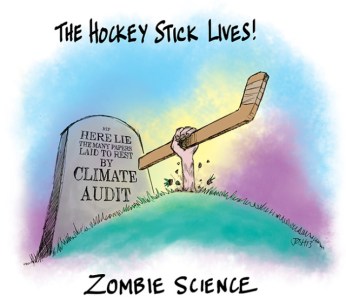
FYI: The cartoon at the top of this post refers to the climate blog climateaudit.org. The site’s blogger Steve McIntyre did much to debunk the “hockey stick” depiction of global temperature history, though it seems to live on in the minds of climate alarmists. McIntyre appears to be on an extended hiatus from the blog.

The Greening-Carbon Nexus

17 Saturday Dec 2016

Posted by Nuetzel in Environment, Global Warming

≈ 2 Comments

Tags

Atmospheric Carbon Concentration, Climate Change, Climate Consensus, David Henderson, Global Greening, global warming, Harrison H. Schmitt, Matt Ridley, Pollution, Rand Paul, Rodney W. Nichols, Roy Spencer, Thomas Malthus

carbon_sequestration

Satellite records show that our world is experiencing a remarkable “greening” in the 21st century, to the seeming chagrin of the environmental left. There is now more vegetation than two decades ago, and greener vegetation, across as much as 50% of the Earth’s vegetated surface area. That area is expanding as well, and the creeping greenery has improved soil moisture levels in some drylands. This bodes well for agricultural productivity, putting another nail in Malthus’ coffin. The satellite studies have concluded that most of the enhanced vegetation is attributable to greater concentration of CO2 in the atmosphere, as opposed to warming or other possible causes. An interesting feedback is that the enhanced vegetation increases natural absorption of CO2, providing an enhanced carbon sink. This, in turn, has caused a pause in the growth of atmospheric carbon cencentration.

The environmental left knows these developments tend to undermine their preferred narrative that human emissions of CO2 must be reduced — at any cost. In fact, already there are warnings that global greening will “outgrow its benefit” as the greater volume of plants begins to decay, releasing carbon. You just can’t make some people happy! But not all of the carbon release from plant decay adds to atmospheric carbon — some is soil-bound — so the greening should provide a fairly durable carbon sink.

Global greening was one of the major motifs in Matt Ridley’s 2016 Global Warming Policy Foundation Lecture. Ridley covered various evidence of greening, but he also discussed the failure of a large contingent of climate researchers to follow a legitimate scientific approach to the study of climate change. Instead, they have politicized their field of study, committing a few noteworthy frauds along the way:

“It is irresponsible not to challenge the evidence properly, especially if the policies pursued in its name are causing suffering. Increasingly, many people would like to outlaw, suppress, prosecute and censor all discussion of what they call ‘the science’ rather than engage in debate. …

No wonder that I talk frequently to scientists who are skeptical, but dare not say so openly. That is a ridiculous state of affairs. We’re told that it’s impertinent to question “the science” and that we must think as we are told. But arguments from authority are the refuge of priests. Thomas Henry Huxley put it this way: ‘The improver of natural knowledge absolutely refuses to acknowledge authority, as such. For him, scepticism is the highest of duties; blind faith the one unpardonable sin’. 

What keeps science honest, what stops it from succumbing entirely to confirmation bias, is that it is decentralized, allowing one lab to challenge another.“

It is all too true that policies advanced in the interests of curbing a slight warming trend cause real suffering, and the pain is heavily concentrated on the most impoverished. The presumed benefits of activist climate-change policies are speculative, at best. They have little chance of reversing atmospheric carbon concentration on their own.

Ridley makes note of the substantial evidence that sensitivity of the climate to airborne carbon concentration is low. This has become increasingly evident with the unfolding of a consistent record of over-forecasts of global temperatures by climate forcing models. Roy Spencer provides insights about these models in a recent discussion of global warming and “dodgy science” on his blog.

There is a widespread myth that 97 percent of climate scientists believe human activity is the main cause of global warming. In fact, that claim was based on a paper counting citations, not scientists; the methods used in the study and the citations themselves were also questionable. I have reviewed that evidence here on Sacred Cow Chips. David Henderson reviewed it here. A large number of studies find fault with so-called “consensus” pronouncements. They should always be viewed with suspicion.

There is also a lively debate underway over whether CO2 should be considered a pollutant! I exhale, therefore I pollute? To the extent that fecal matter is considered a pollutant, is it fair that to say that CO2 is, too? After all, both are anthropogenic. No, they are not even close in terms of an immediate threat to human health. As a philosophical matter, the idea that anything done by man is “unnatural” denies the fact that we are a very part of nature. Obviously, CO2 is not in the same class as pollutants like sulfur dioxide, ammonia, carbon monoxide or toxic metals. Today, these pollutants are very common in many parts of the world, and they are very threatening to human life. Effective mitigation technologies are available, but instead, in the developed West, we fixate on an increase in CO2 concentration of 100 parts per million over many decades, the climate implications of which are de minimis.

Rand Paul’s Facebook page has an ungated link to a WSJ.com commentary by Rodney W. Nichols and Harrison H. Schmitt on “The Phony War Against CO2”. Their commentary provokes questions as to the motives of the environmental left, and certain members of the research community, in shilling for the cause. That we would fight the greening of the globe, and the potential agricultural benefit it could bring, is bizarre. To devote enormous resources to an endeavor that is largely futile is a waste and a tragedy.


Warm, Contented Civilizations

26 Sunday Jun 2016

Posted by Nuetzel in Global Warming, Human Welfare

≈ 1 Comment

Tags

AGW, Andy May, Carbon Concentration, Human Civilization, Ice Core Data, Little Ice Age, Minoan Warm Period, Perihelion, Roman Warm Period, Temperature Proxy, Viking Civilization, Watt's Up With That?

image

Human civilizations have experienced many of their worst trials during periods of cooling and cold temperatures over the past 8,000 – 10,000 years. These were episodes associated with droughts as well. Conversely, civilizations have tended to prosper during warm, wet periods. These associations between human progress and the natural environment are discussed in a pair of articles by Andy May: “Climate and Human Civilization Over the Past 18,000 Years“, and  “Climate and Human Civilization for the Past 4,000 Years“. The articles are part climate science, part history, and part anthropology, with many fascinating details.

May presents large charts that can be downloaded, and they are especially interesting to ponder. He uses historical temperature proxies from Antarctica and Greenland to construct the charts, along with more recent data on measured surface temperatures in Greenland. According to May, the proxies are highly correlated with other proxy data from less extreme latitudes. Several important takeaways are the following:

  1. Warm periods in the historical record are associated with wet conditions, and cold periods are associated with dry conditions. This is intuitive, as warm air holds more moisture than cold air.
  2. There are estimates of temperatures going back more than 800 million years; apparent cyclical regularities in temperatures have lasted as long 150 million years. Cycles within cycles are evident: a 100,000 year cycle is prominent as well as a 25,000 year cycle (see #4 below).
  3. Today’s temperatures are not as high as those prevailing during about 200 years of the so-called Roman Warm Period, or during a span of similar length in the so-called Minoan Warm Period, about 3,300 years ago. Today’s temperatures are much lower than estimates for much of the earth’s pre-human history.
  4. The southern hemisphere has more volatile temperatures than the northern hemisphere due to the tilt of the earth’s axis at perihelion in January, when the earth is closest to the sun. That means the southern hemisphere tends to have warmer summers and colder winters. That will reverse over the next 10,000 years, and then it will reverse again. There is more land mass in the north, however, so it’s not clear that less extreme weather in the north helps explain the hugely lopsided distribution of development and population in that hemisphere.
  5. Recent increases in sea levels have been small relative to the years following the Little Ice Age. Projected increases over the next 50 years are of a magnitude that should be easily manageable for most coastal areas.
  6. Atmospheric carbon concentration seems to lag major increases in temperatures by about 800 years, raising a question of causality. Today’s carbon concentration is low relative to earlier epochs; it has been increasing for thousands of years, clearly independent of human activity, and is now near 400,000 year highs.
  7. Civilizations have blossomed with warm temperatures and they have collapsed or hit extended periods of retarded progress with declines in temperatures. Human agriculture was born as temperatures rose out of the depths of a glacial period about 10,000-12,000 years ago. Rome flourished during a warm cycle and collapsed as it waned. The Vikings settled in Greenland and Newfoundland during the Medieval Warm Period and were eliminated by the Little Ice Age. May cites a number of other examples of temperature cycles bringing on major shifts in the course of human progress. There are many possible explanations for the decline of past civilizations, but extremely low temperatures, droughts, and lengthy periods of weather inhospitable to agriculture have been important.

The fashion today is to insist that only dramatic changes in our use of energy can avert a global warming catastrophe. It is not clear that any effort by humans to manipulate global temperatures can overcome the natural forces that are always driving temperature change. For that matter, it is not clear that carbon dioxide is a bad thing, or that diverting vast quantities of resources to reduce it would be wise. CO2 is certainly not a pollutant in the normal sense of the word. Here is an excerpt from May’s conclusion in his “4,000 years” article, which speaks volumes:

“First, there is no perfect temperature. Man, even in pre-industrial times, adapted to a variety of temperatures and he has always done better in warm times and worse in cold times. Second, why would anyone want to go back to the pre-industrial climate? The Washington Post says the goal of the Paris Climate Conference was get the world to agree to limit global warming to less than two degrees above pre-industrial temperatures. Pre-industrial times? That’s the Little Ice Age, when it snowed in July, a time of endless war, famine and plague. According to the Greenland ice core proxy data, temperatures 180 years ago were nearly the coldest seen since the end of the last glacial period 10,000 years ago! Why measure our success in combating anthropogenic warming, if there is any such thing, from such an unusually cold time?“

The Broken-Climate Canard

19 Thursday May 2016

Posted by Nuetzel in Global Warming

≈ Leave a comment

Tags

AGW, Al Gore, Anthropomorphic Global Warming, Climate Alarmism, Climate Causality, Climate Change, CO2, Coyote Blog, Draught Severity, Hurricane Katrina, Little Ice Age, Measurement Technology Bias, Publication Bias, Tornadic Activity, Warren Meyer, Weather or Climate Change

MovieDisaster

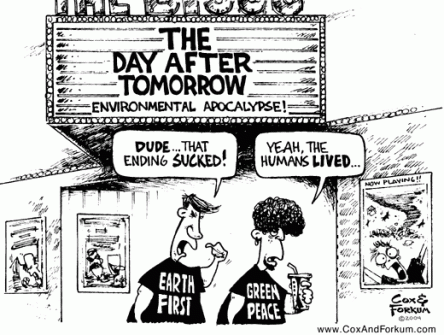
In the imagination of the climate alarmist, almost everything portends an approaching catastrophe. A hurricane? Tornado? Draught? Warm spell? Cold spell? Blizzard? Bad harvest? To their way of thinking, these are all signs that CO2 is damaging the climate. Obviously, these are weather events that imply nothing in the absence of corroborating evidence, though you wouldn’t know it from listening to the precaution pols. Warren Meyer at Coyote Blog has posted another in his series of essays on this topic, this time called “Are We Already Seeing Climate Change?” He provides links to the earlier installments — all interesting. In this installment, he covers five topics under the heading “Manufacturing A Sense that the Climate Is Broken”, which I think would have made a better title for his post. I’ll try to summarize the five points briefly, but do read the whole thing:

Publication Bias:  This quote speaks for itself: “Every single tail-of-the-distribution weather event from around the world is breathlessly reported, leaving the impression among viewers that more such events are occurring, even when there is in fact no such trend. Further, since weather events can drive media ratings, there is an incentive to make them seem scarier.”

Claiming a Trend From One Data Point: This is the kind of error to which I alluded in the first paragraph. Think of Al Gore’s reaction to Hurricane Katrina. The charts offered by Meyer in this section are very nice. There is no upward trend in any of the following: hurricane energy; severe tornadic activity; the incidence of draughts or draught severity; heat waves; extremely hot days; and there is no abatement in the upward trend in crop yields. In fact, there is no trend in high temperature records in the U.S. The upward trend in average surface temperatures in the U.S. is entirely due to warmer nighttime temperatures.

Measurement Technology Bias: We now have the technology to measure various aspects of the climate from space. We can track polar ice extent with much more precision. Doppler radar technology and weather chasers have helped to identify more small tornados than we’d have known of 50 years ago. But when events seem noteworthy to alarmists, they draw extreme conclusions. To their great chagrin, these phenomena are often products of our enhanced ability to measure things.

What Is Normal?: This is related to measurement bias. Our detailed records on surface temperatures go back about 150 years, which is an extremely short slice of history. Temperature proxies from earlier eras, such as ice cores and fossilized tree rings, tell us that the recent past is not all that unusual. Moreover, we also know that glacier melting and sea level increases have been happening for much longer than the buildup of CO2. Those trends began near the end of the “Little Age Age”, around 1800. And there is evidence that these types of developments have happened before. Alarmists, however, assume that what we’ve witnessed in the recent past is unprecedented.

Collapsing Causality in a Complex System To a Single Variable:  “With all the vast complexity of the climate, are we really to believe that every unusual weather event is caused by a 0.013 percentage point change (270 ppm to 400 ppm) in the concentration of one atmospheric gas?” Not likely! Here Meyer helps put the recent temperature trends in perspective: they are tiny relative to their annual variation, which occurs both across seasons and within days.

The public seems to regard the co-called climate catastrophe with more skepticism today than perhaps ten years ago. Not only do the facts contradict the dire predictions of carbon-forcing climate models and alarmist scare stories, but people also recognize that the costs of attempting to avoid a global warming trend are massive and, well, probably not worth it. Moreover, they rightly suspect unworthy political motives in the alarmist community. If some carbon-induced warming is an eventuality, and that’s an “if”, it might well prove to be beneficial for people and the planet. Relax!


Climate Alarmists Warm To Speech Control

02 Monday May 2016

Posted by Nuetzel in Global Warming

≈ Leave a comment

Tags

ABC/Walt Disney, AGW, Al Gore, Climate Alarmism, Climate Doomsday, Coyote Blog, David French, ExxonMobile, False Consensus, Galileo, Heliocentrism, Inquisition, IPPC, Josh Gelernter, Judith Curry, Loretta Lynch, Natural Attribution, Rick Moran, Temperature Measurement, Warren Meyer

AGW-cartoon

The reactionaries in the global warming plunderbund are revealing their philosophical bankruptcy, dishonesty, and inner fascism. Science is a continuous process of learning through empirical observation, theory and testing. Refutation is as important to the process as original research and replication. Experimental results can be confirmed, but theory can never be established as absolute fact. The term “settled science” is very nearly an oxymoron, yet we constantly hear that climate science is “settled”. Nothing could be further from the truth.

We are asked by the warmists to accept sweeping conclusions on the basis of an extremely short historical record, one that is clouded by sharp disputes over measurement issues. The long-term record based on temperature proxies shows that recent trends are well within the range of natural variability. We are asked to accept conclusions based largely on models that have proven to be extremely inaccurate and that fail to account for important climate influences such as solar variation and oceanic cycles. And with essentially no historical justification, we are asked to accept assumptions about what global temperatures “should be”, and that we should make drastic sacrifices in a quixotic effort to make temperatures stay put. To do so, we are asked to divert resources on a massive scale to mitigate a risk that is speculative at best. An alternative view is that mankind should make sacrifices in order to adapt to change when it occurs, rather than taking the arrogant view that we can, with sufficient coercion and manipulation of private decisions, dominate natural forces to assure climate stability.

Warren Meyer at Coyote Blog has an excellent series of posts on climate change. The most recent of those posts is on natural attribution of climate change. It includes links to earlier parts of his series. Meyer compares today’s alarmists to a hypothetical observer predicting future temperatures in the year 1600, roughly the minimum of the “mini ice-age”. Of course, that observer would have said it would get colder based on his experience, but that would have been wrong. Today’s alarmists rest their case on a 20-year uptrend between 1978 and 1998, tying it to man-made carbon dioxide emissions. In fact, a longer-term view shows that surface temperatures had increased in similar spurts before carbon emissions were a factor of any kind.

Scoundrels tend to twist facts when the facts don’t support their view. Rick Moran reports on an academic paper concluding that it’s acceptable to lie about the threat posed by climate change. It’s not enough to present research and the full range of uncertainty surrounding forecasts, which is very wide. No, the reporting must be wrapped in a sort of Grimm’s fairy tale in order to teach the public a lesson, unschooled children that they are. Such is the manipulative nature of the warmist community.

And the dishonesty is extensive. Remember the claim that 97% of climate scientists accept the proposition of man-made global warming? It was debunked in short order, but the media seemingly can’t get enough of a disaster scenario, so the claim lives on. Famed climatologist Judith Curry has a number of posts on her blog explaining the misleading details of this bit of disinformation. Among the problems of methodology and reporting of this “survey” result is that it was not based on an actual survey of scientists. Instead, it rated abstracts of publications as to their consistency with particular views of the anthropomorphic global warming (AGW) proposition. Not only does this method double-count the views of individual scientists; the authors were highly selective about which scientists and how many of their publications were counted. Even more interestingly, the criteria were so loose that abstracts written by certain scientists known to be skeptical of AGW were counted within the 97%! In one of Curry’s posts, entitled “The Conceits of Consensus“, she discusses the weaknesses and refutations of the claim of a strong consensus, including the participation of non-scientist evaluators of research abstracts in the sample:

“Bottom line: inflating the numbers of ‘climate scientists’ in such surveys attempts to hide that there is a serious scientific debate about the detection and attribution of recent warming, and that scientists who are skeptical of the IPCC consensus conclusion are disproportionately expert in the area of climate change detection and attribution.“

Other studies have found that a majority of surveyed meteorologists (see here and here), geoscientists and engineers are skeptical of AGW. But again, this information is essentially ignored by the media and self-interested politicos because it does not support the crisis narrative that dictates coercive action by government.

Apparently, propaganda in support of the increasingly dubious warmist position must be reinforced by more drastic measures. Prominent leftists in government are asking whether disputing climate change is punishable under the law. You read that right! Two state attorneys general have threatened to prosecute ExxonMobil for allegedly misleading investors and the public about climate change. Senator Sheldon Whitehouse (D-RI) has proposed using RICO organized crime law to go after certain energy companies for climate change “denial”. Loretta Lynch, the U.S. Attorney General, has asked the FBI to look into it. To hell with freedom of speech. To hell with the spirit of free scientific inquiry. Your authoritarian masters insist that you must fall into line with their climate change agenda or else!

Josh Gelernter opens his recent discussion of this tyrannical gambit this way:

“Four hundred years ago this week, the Inquisition met in Rome to discuss Galileo’s support for the Copernican model of the cosmos, which placed the Sun at the center of the solar system. After five days of deliberation, a commission of inquisitors ruled that heliocentrism was ‘foolish and absurd in philosophy, and formally heretical since it explicitly contradicts in many places the sense of the Holy Scripture.’ Not a good moment for the Church. Two days later, Galileo was summoned to the Vatican and ordered ‘to abstain completely from teaching or defending this doctrine and opinion or from discussing it . . . to abandon it completely . . . and henceforth not to hold, teach, or defend it in any way whatever, either orally or in writing.’“

To underscore the hypocrisy of these threats of prosecution, David French observes that there are many other instances in which the public has been misled while the presumed climate mavens profited from the hysteria. Could these opportunistic ploys also be subject to prosecution?:

  • Al Gore insisted ten years ago that by now we’d suffer a “climate doomsday” if we failed to take the measures he advocated;
  • Perhaps ABC/Walt Disney has profited from its breathless warnings that “in 2015 milk would cost almost $13 a gallon, gas would be more than $9 a gallon, ‘flames [would] cover hundreds of square miles,’ one billion people would be malnourished, and Manhattan would be flooding — all because of climate change.“
  • The Chairman of the United Nations Intergovernmental Panel on Climate Change (IPCC) said, “If there’s no action before 2012, that’s too late….” And as French says: “The IPCC has received tens of millions of dollars while hyping the threat of global warming.“

French’s suggestions are not entirely tongue-in-cheek. These suggestions are no more outlandish than threats to prosecute anyone else over a legitimate dispute in scientific debate.

The AGW community suffers from a weak understanding of the philosophy of science, a dishonest presentation of the facts, and a tyrannical streak that should can only be tamed by stripping them of power. First, however, the voting public must wise up to the danger to our economic well being and our freedom posed by these fascist activists.

El Nino Stirs Pacific Ocean and Warmists Freak Out

05 Tuesday Jan 2016

Posted by Nuetzel in Global Warming

≈ Leave a comment

173595_600

A few warm days in December precipitated a deluge of absurd remarks from climate alarmists. Paraphrasing a couple of lost intellectual sailors on Facebook, “… back when we actually used to have cold weather and snow in the wintertime…”, and “… no one can deny that the Earth is warming now!” Presidential candidate Bernie Sanders beclowned himself with similar comments. The fact that the warm temperatures were due to an El Nino pattern didn’t seem to register with these souls. Their apparent memory of weather history extends about as far as the evaporation of skin moisture on their last trip to the mailbox. Of course, there have been many wintertime warm spells in the past.

I recall a very warm December when my mother expressed amazement at the temperature as we trimmed the tree on Christmas Eve. I checked weather records for St. Louis, MO and found that it was probably 1971. The temperature hit 70 degrees on December 27th of that year. In Boston, the temperature on Christmas Day in 1889 hit 65 degrees. The early- to mid-1950s saw several warm Decembers along the eastern seaboard (see this data from 1955). And there were several other years with comparable holiday warm spells.

The point is that the over-reaction to weather is silly. The hysterics are not driven by good science or actual weather facts. As this article notes, the warm weather in December is likely to transition to a La Nina pattern later in 2016, which could bring a colder-than-normal winter next year.

Here are a few facts about climate change that should be very non-controversial:

  • Climate models based on carbon forcing have a consistent track record of predictive inaccuracy. They have over-predicted global temperature for decades. The actual surface temperatures have been at the low end and even below the lower bounds of “confidence intervals” around the predictions.
  • Climate change over the past 60 years is within the historical range of natural variation. Solar forcings, even if poorly understood, have played an important role. Active El Nino’s in the 1980s and 1990s might have contributed to the warming that occurred during those decades, before the so-called “pause”.
  • Satellite temperature records, available for only 35 years, show a smaller trend toward warming than surface temperatures, and no discernible warming since the late 1990s. Surface temperatures are subject to a number of controversial measurement issues making recent claims about “record warmth” suspect.
  • Ice melt data is ambiguous. The Arctic sea ice extent has been more stable than advertised, and the Antarctic has experienced ice accumulation.
  • Sea level increases pre-date industrial carbon forcings and have not accelerated.
  • The rate of increase in atmospheric carbon concentration has slowed dramatically in developed countries, a development that is likely to continue.
  • Poor countries cannot afford expensive measures to reduce carbon emissions and they are in desperate need of economic growth. Exploiting fossil fuels in those countries can contribute to a cleaner environment and economic growth, which would ultimately allow adoption of more expensive energy alternatives.
  • Hot temperatures kill fewer people than cold temperatures. A little warming is likely to confer benefits on mankind.
  • Carbon is the stuff of life! Higher carbon concentrations are contributing to a re-greening of the earth and will improve overall agricultural productivity.

Climate hysteria is encouraged by models that are consistently unreliable in their predictive accuracy, and by an unsupported presumption that the consequences of warming would be unambiguously negative. The first bullet above, by itself, is sufficient to show that climate science is not “settled”. There are many climatological processes, including irradiative effects and feedback mechanisms, that are not well understood. The magnitude of the warming experienced over the past 100 years is far from alarming (less than one degree Centigrade).

On any reasonable cost-benefit basis, arguments for a massive, forced reallocation of resources toward alternative energy technologies and carbon remediation are ill-founded. Absent real proof of accelerated warming AND of negative consequences, the development of alternative energy and carbon absorption technologies should proceed as the economics of the situation dictate, not by government edict.

Would You Tax Coastal Development?

14 Monday Dec 2015

Posted by Nuetzel in Central Planning, Global Warming

≈ Leave a comment

Tags

Carbon forcing, central planning, Climate Alarmism, Climate Change, Coastal development, Coastal tax, Federal Flood Insurance, FEMA, Glacier Melts, Glenn Reynolds, Pigouvian subsidies, Pigouvian Taxes, Robin Hanson, Sea Ice Extent, Strait of Gibraltar, Subsidies, Taxing development

Sea Level

If sea levels are truly rising due to climate change, then public policy should stop encouraging new development in coastal areas. Stipulating that this threat is real for the moment, serious and damaging encroachment of the seas might be 50 years away or more. By that time, many of today’s coastal buildings will be gone, or at least candidates for replacement, under realistic assumptions about the average lives of structures. A relatively low-cost approach to the threat of rising seas would be to stop building along the most vulnerable coasts right now and move new development inland. Yet no one wants to do that, least of all coastal property owners. But there is little discussion of this alternative even among the true believers of a coming global warming apocalypse. Why not?

This and related questions have been asked recently by several writers, including Glenn Reynolds and economist Robin Hanson. There are alternatives to discouraging new construction along coasts. Other expensive abatement projects can be pursued, now and later, such as sea walls or even adding land mass excavated from the sea floor or inland. In fact, the prospect of damming the Strait of Gibraltar to protect Mediterranean coastlines has been discussed. The expense of such an unprecedented public works project is what prompted Hanson’s post. To the extent that such remedial projects are not funded privately, they represent social costs arising from coastal development.

The federal government still subsidizes flood insurance on many coastal properties, though efforts to phase-out this FEMA program have been underway for a few years. However, governments seem only too willing to undertake the investment in public infrastructure and ongoing maintenance made necessary by new coastal development. And like other development projects, tax abatements and other subsidies are still granted for coastal development. Why do these policies escape notice from coastal green elites?  Public outlays with private beneficiaries along threatened coasts are an immediate drain on resources, relieving private developers and property buyers of shoreline risk.

Reynolds (perhaps tongue-in-cheek) and Hanson suggest that new development should be taxed in coastal areas. That, and ending subsidies for development along coasts, is an economically and ecologically defensible alternative to the public expense of ubiquitous sea walls. However, a coastal tax might not be in the immediate interests of elites  who claim that mankind faces an insurmountable global warming problem. Better to put off these sorts of remedial measures, especially while you can tax and regulate fossil fuels, and maybe live on the coast!

The position of the warmist community is that carbon emitters must cease and desist, in the hope that the seas will stop rising. They are willing to destroy entire industries (fossil fuels) in pursuit of their goals, but are unlikely to achieve them without inflicting drastic economic harm. If greens are so amenable to central control of economic activity and individual behavior (so long as they are at the controls), it would be prudent to take precautions now that will help to minimize the damage later. Discouraging coastal development with taxes and denial of subsidies is the sort of classic intervention that any Pigouvian planner should love. There is even evidence that sea levels have been much higher at times in the past. An earnest central planner might say that coastal development should always be discouraged to mitigate the risk of destruction.

I am skeptical of alarmist claims, including those related to rising sea levels. In fact, the connection between carbon emissions, global temperatures and sea levels is not well established, and whether sea levels are rising due to human activity is a matter of some dispute. Furthermore, global sea ice extent is not declining dramatically, if at all, and the storied glacier melts have been greatly exaggerated. Climate activists pursue their agenda despite the gross inaccuracy of past carbon-forcing forecasts, the gaping uncertainty surrounding model predictions going forward, and the crushing expense of the measures they advocate. The expense, however, is not one that activists expect to compromise their own standard of living. They either assume that it will be borne by others or that their draconian prescriptions will usher in an era of “sustainability”, powered by new, renewable energy sources. Not many of these alarmists would boast that their policies can quickly reverse the sea level rises they’ve told us to fear, but they dare not suggest taxes on coastal development until they see more convincing evidence. At least that much is sensible, if ironic!

← Older posts
Newer posts →
Follow Sacred Cow Chips on WordPress.com

Recent Posts

  • The Case Against Interest On Reserves
  • Immigration and Merit As Fiscal Propositions
  • Tariff “Dividend” From An Indigent State
  • Almost Looks Like the Fed Has a 3% Inflation Target
  • Government Malpractice Breeds Health Care Havoc

Archives

  • January 2026
  • December 2025
  • November 2025
  • October 2025
  • September 2025
  • August 2025
  • July 2025
  • June 2025
  • May 2025
  • April 2025
  • March 2025
  • February 2025
  • January 2025
  • December 2024
  • November 2024
  • October 2024
  • September 2024
  • August 2024
  • July 2024
  • June 2024
  • May 2024
  • April 2024
  • March 2024
  • February 2024
  • January 2024
  • December 2023
  • November 2023
  • August 2023
  • July 2023
  • June 2023
  • May 2023
  • April 2023
  • March 2023
  • February 2023
  • January 2023
  • December 2022
  • November 2022
  • October 2022
  • September 2022
  • August 2022
  • July 2022
  • June 2022
  • May 2022
  • April 2022
  • March 2022
  • February 2022
  • January 2022
  • December 2021
  • November 2021
  • October 2021
  • September 2021
  • August 2021
  • July 2021
  • June 2021
  • May 2021
  • April 2021
  • March 2021
  • February 2021
  • January 2021
  • December 2020
  • November 2020
  • October 2020
  • September 2020
  • August 2020
  • July 2020
  • June 2020
  • May 2020
  • April 2020
  • March 2020
  • February 2020
  • January 2020
  • December 2019
  • November 2019
  • October 2019
  • September 2019
  • August 2019
  • July 2019
  • June 2019
  • May 2019
  • April 2019
  • March 2019
  • February 2019
  • January 2019
  • December 2018
  • November 2018
  • October 2018
  • September 2018
  • August 2018
  • July 2018
  • June 2018
  • May 2018
  • April 2018
  • March 2018
  • February 2018
  • January 2018
  • December 2017
  • November 2017
  • October 2017
  • September 2017
  • August 2017
  • July 2017
  • June 2017
  • May 2017
  • April 2017
  • March 2017
  • February 2017
  • January 2017
  • December 2016
  • November 2016
  • October 2016
  • September 2016
  • August 2016
  • July 2016
  • June 2016
  • May 2016
  • April 2016
  • March 2016
  • February 2016
  • January 2016
  • December 2015
  • November 2015
  • October 2015
  • September 2015
  • August 2015
  • July 2015
  • June 2015
  • May 2015
  • April 2015
  • March 2015
  • February 2015
  • January 2015
  • December 2014
  • November 2014
  • October 2014
  • September 2014
  • August 2014
  • July 2014
  • June 2014
  • May 2014
  • April 2014
  • March 2014

Blogs I Follow

  • Passive Income Kickstart
  • OnlyFinance.net
  • TLC Cholesterol
  • Nintil
  • kendunning.net
  • DCWhispers.com
  • Hoong-Wai in the UK
  • Marginal REVOLUTION
  • Stlouis
  • Watts Up With That?
  • Aussie Nationalist Blog
  • American Elephants
  • The View from Alexandria
  • The Gymnasium
  • A Force for Good
  • Notes On Liberty
  • troymo
  • SUNDAY BLOG Stephanie Sievers
  • Miss Lou Acquiring Lore
  • Your Well Wisher Program
  • Objectivism In Depth
  • RobotEnomics
  • Orderstatistic
  • Paradigm Library
  • Scattered Showers and Quicksand

Blog at WordPress.com.

Passive Income Kickstart

OnlyFinance.net

TLC Cholesterol

Nintil

To estimate, compare, distinguish, discuss, and trace to its principal sources everything

kendunning.net

The Future is Ours to Create

DCWhispers.com

Hoong-Wai in the UK

A Commonwealth immigrant's perspective on the UK's public arena.

Marginal REVOLUTION

Small Steps Toward A Much Better World

Stlouis

Watts Up With That?

The world's most viewed site on global warming and climate change

Aussie Nationalist Blog

Commentary from a Paleoconservative and Nationalist perspective

American Elephants

Defending Life, Liberty and the Pursuit of Happiness

The View from Alexandria

In advanced civilizations the period loosely called Alexandrian is usually associated with flexible morals, perfunctory religion, populist standards and cosmopolitan tastes, feminism, exotic cults, and the rapid turnover of high and low fads---in short, a falling away (which is all that decadence means) from the strictness of traditional rules, embodied in character and inforced from within. -- Jacques Barzun

The Gymnasium

A place for reason, politics, economics, and faith steeped in the classical liberal tradition

A Force for Good

How economics, morality, and markets combine

Notes On Liberty

Spontaneous thoughts on a humble creed

troymo

SUNDAY BLOG Stephanie Sievers

Escaping the everyday life with photographs from my travels

Miss Lou Acquiring Lore

Gallery of Life...

Your Well Wisher Program

Attempt to solve commonly known problems…

Objectivism In Depth

Exploring Ayn Rand's revolutionary philosophy.

RobotEnomics

(A)n (I)ntelligent Future

Orderstatistic

Economics, chess and anything else on my mind.

Paradigm Library

OODA Looping

Scattered Showers and Quicksand

Musings on science, investing, finance, economics, politics, and probably fly fishing.

  • Subscribe Subscribed
    • Sacred Cow Chips
    • Join 128 other subscribers
    • Already have a WordPress.com account? Log in now.
    • Sacred Cow Chips
    • Subscribe Subscribed
    • Sign up
    • Log in
    • Report this content
    • View site in Reader
    • Manage subscriptions
    • Collapse this bar
 

Loading Comments...