• About

Sacred Cow Chips

Sacred Cow Chips

Category Archives: Monetary Policy

Almost Looks Like the Fed Has a 3% Inflation Target

16 Sunday Nov 2025

Posted by Nuetzel in Inflation, Monetary Policy

≈ Leave a comment

Tags

ADP Employment Report, Core PCE Deflator, Covid Restrictions, David Beckworth, Donald Trump, Dual Mandate, Employment Mandate, FAIT, Federal Funds Target, Flexible Average Inflation Targeting, Inflation Bias, Inflation Target, Jerome Powell, Mark Sobel, Monetary policy, Policy Asymmetry, Price Stability, Quantitative Tightening, Robert Brusca, Scott Sumner, Tariffs

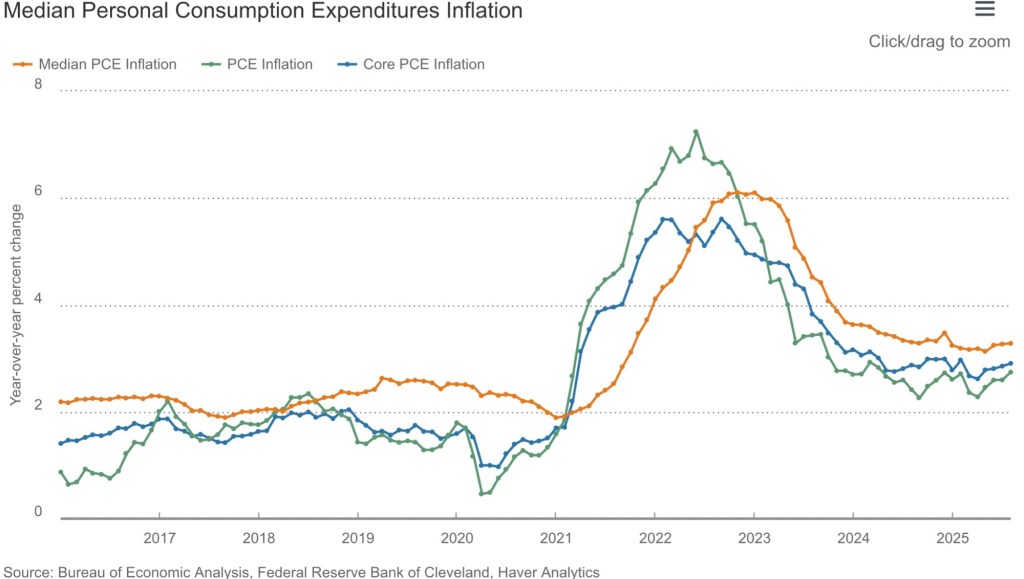
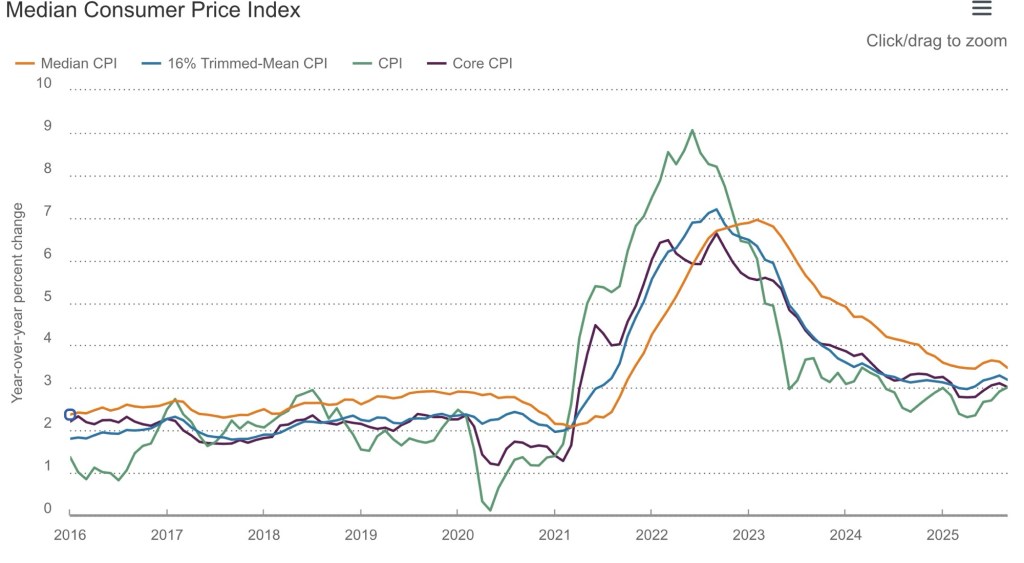
Inflation leveled off below 3% in 2024 and has drifted around the 3% level in 2025. The rate of increase in the core PCE (Personal Consumption Deflator) is the inflation measure of most interest to the Federal Reserve as a policy reference, but advances in the core CPI (Consumer Price Index) have settled at about the same level. The core inflation rates exclude food and energy prices due to the volatility of those components, but even with food and energy, inflation in the PCE and the CPI have been running near 3%.

It’s a 2% Target… Or Is It?

The Fed continues to maintain that its “official” inflation target is 2% for the core PCE. However, the central bank is now easing policy despite inflation running a full percentage point faster than the target. The rationale turns on the Fed’s dual mandate to maintain both “price stability” and full employment, goals that are not always compatible.

Currently, the labor market is showing signs of weakness, so the Fed has elected to ease policy by guiding the federal funds rate downward, and by putting a stop to run-off in its balance sheet holdings of securities. The latter ends a brief period of so-called quantitative tightening.

Just a couple of months ago, the central bank announced a new emphasis on targeting 2% inflation in the long run, with notable differences from the “flexible average inflation targeting” (FAIT) that it claimed to have adopted in 2020. In some respects, the Fed appeared to be giving more primacy to the “2%” definition of price stability than to the full employment mandate. Yet the “new approach” still allows plenty of wiggle room and might not differ much from the approach followed prior to FAIT.

No FAITful Error

Here’s how David Beckworth characterizes the way FAIT ultimately played out. He says that in practice the Fed took:

“… an asymmetric approach to the dual mandate: It would implement makeup policy on misses below the inflation target, and it would respond to shortfalls from maximum employment. These asymmetries, while well- intended, created an inflationary bias that caused FAIT to fail the ‘stress test’ of the 2021–22 inflation surge. This failure caused the Fed to effectively abandon FAIT in early 2022 and become a single-mandate central bank focused on price stability.“

Scott Sumner says the Fed never really really practiced FAIT to begin with. It should have been a symmetric policy, but it wasn’t. During 2021-22, the Fed did not attempt to correct for rising inflation. Instead, it focused on the recessionary effects of Covid and the impingements of Covid-era restrictions on employment.

Clearly, Covid was a shock that monetary policy was ill-suited to address without reinforcing inflation. Furthermore, the pandemic inflation was thought by the Fed to be transitory, but easing policy was a critical error. Stimulating demand via monetary accommodation gave inflation more permanence than the Fed apparently expected.

Lost In the Tea Leaves Again

While a strong commitment to price stability is welcome, it’s not clear that is what’s guiding the Fed’s decisions at the moment. Again, the Fed’s preferred inflation gauge has flattened out at around 3%. However, with uncertainty about tariffs and tariff pass throughs in 2026, the weak dollar, and unrelenting Treasury borrowing, easier monetary conditions could well set the stage for persistent inflation above 3%, despite the official 2% target. That might help explain the failure of longer-term interest rates to decline in the wake of the Fed’s latest quarter-point cut in the federal funds target in October.

Suspicious Minds

Speculation that the Fed is allowing its true inflation target to creep upward is hardly new. Back in June, former New York Fed economist Robert Brusca noted the following:

“A Cleveland Fed survey already has the business community thinking that the REAL target for inflation is 2.5%.”

More recently, Mark Sobel of the Official Monetary and Fiscal Institutions Forum stated that the real target, for now, is probably 3%:

“But could the Fed stealthily and unintentionally end up near 3%? Even apart from above-target inflation in recent years, short- and longer-term structural forces are at play that could usher in slightly higher inflation, notwithstanding Fed speeches on the sanctity of the 2% inflation target.“

Chewing On Data

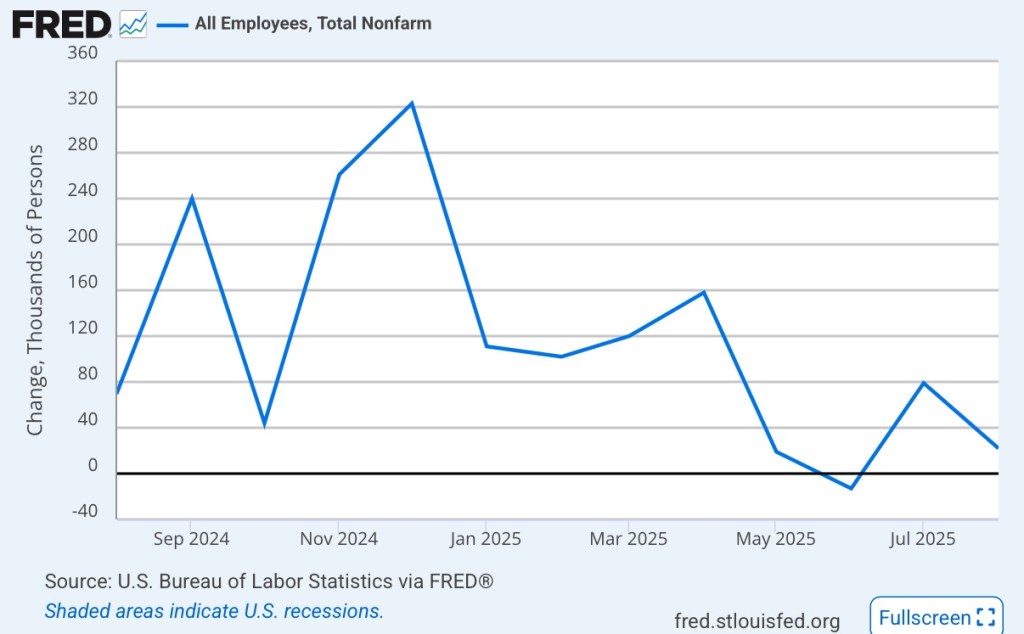
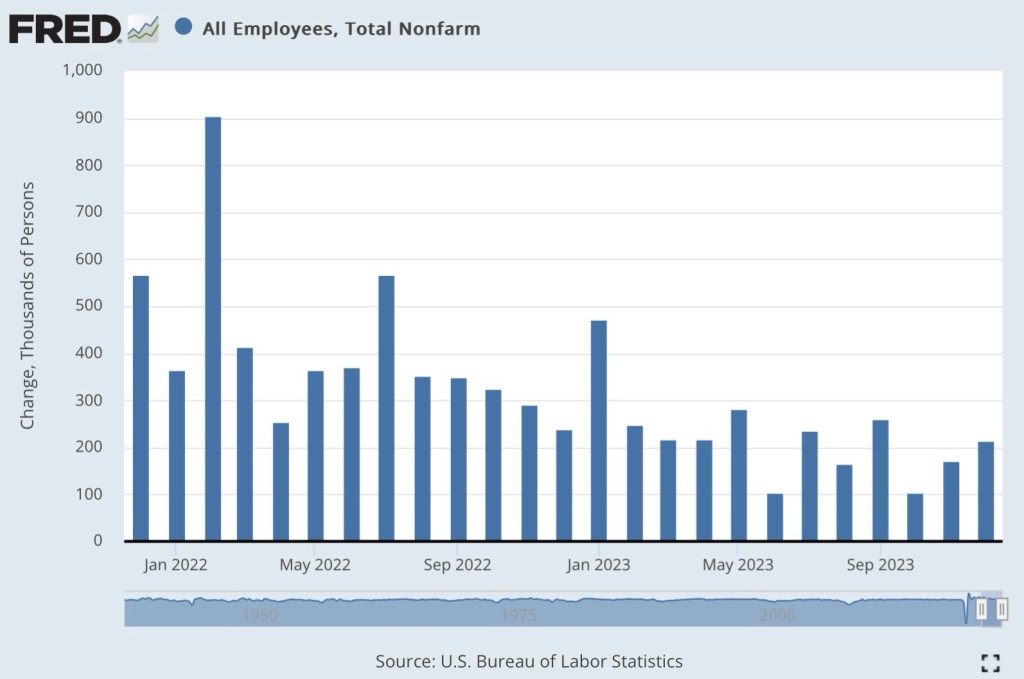
It’s pretty clear that the Fed has become a skittish about the pace of the real economy, lending more weight to the full employment part of its dual mandate. Employment growth slowed over the past year, partly due to government employee buy-outs and separations of illegal immigrants from their employers. The last official employment report was in early September, however, so the nonfarm payroll data is two months out-of-date:

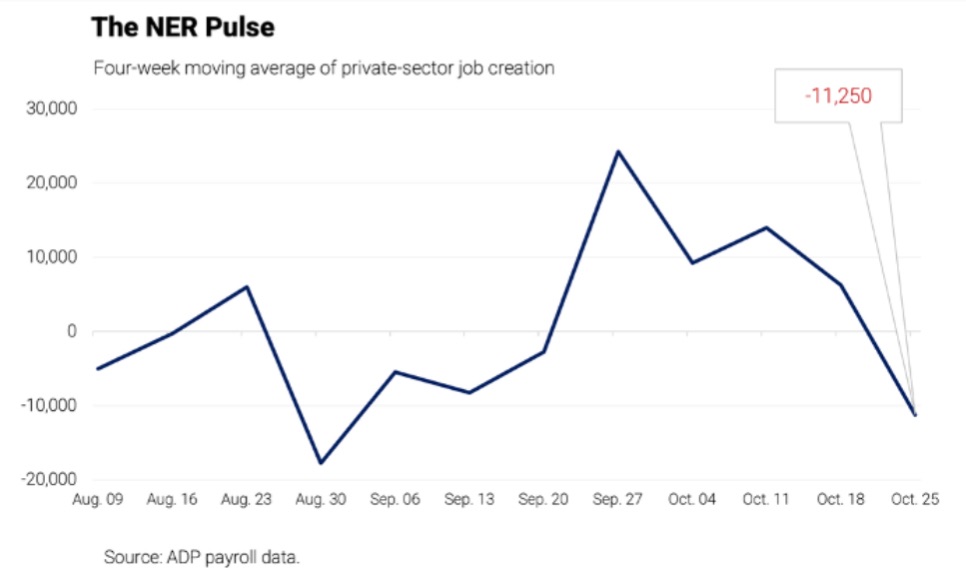
Private payroll growth from ADP over the past two months has not looked especially encouraging:

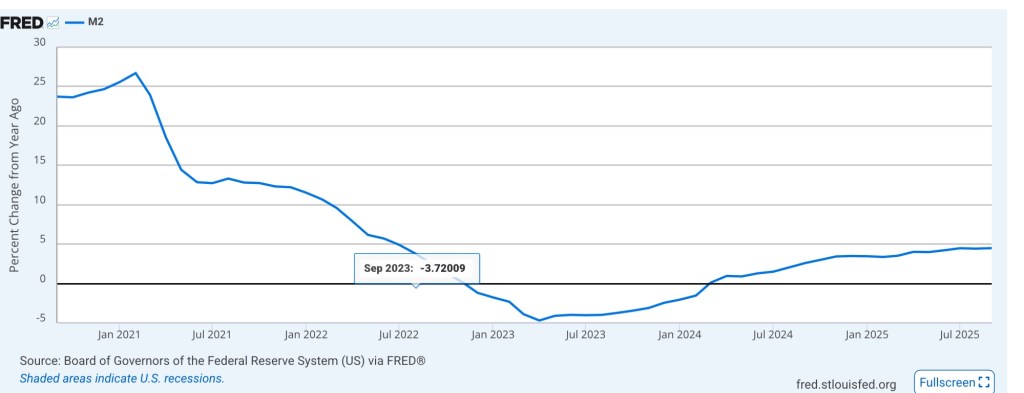
Tariffs and weakened profit margins have likely had a contractionary effect, and the six-week government shutdown just ended will shave 0.5% or more off fourth quarter GDP growth. Furthermore, while money (M2) growth has accelerated over the past year, it remains fairly restrained.

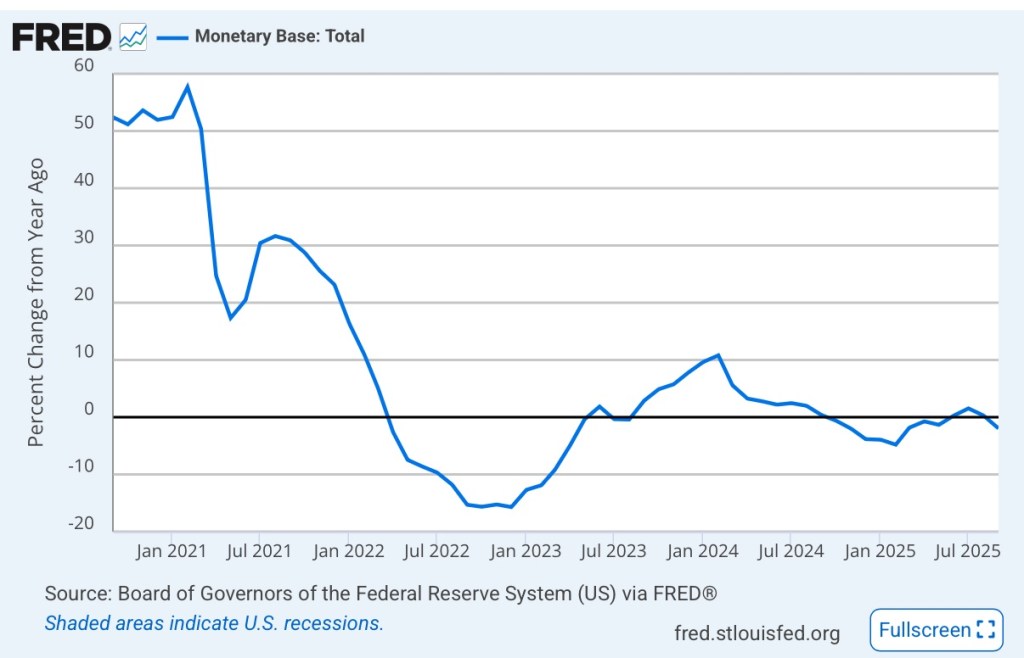
And the monetary base has been pretty flat for most of 2025:

We’ll see where these aggregates go from here. The extended “restraint” might now be of some concern to the Fed, given recent doubts about employment and economic growth. Still, in October, Fed Chairman Jerome Powell said that another quarter-point cut in the federal funds rate target in December was not a foregone conclusion. That statement seems to have worried equity investors while offering little solace to bond investors.

Aborted Landing

If (and as long as) the Fed gives primacy or greater weight in its policy deliberations to employment than inflation, it might as well have adopted an inflation target of 3% or more. The additional erosion in purchasing power wrought by that leniency is bad enough, but the effect of monetary policy on the real side of the economy is more poorly understood than its effect on nominal variables. The Fed’s shift in priorities is both unreliable on the real side and dangerous in terms of price stability. These concerns are even more salient given the upcoming appointment (in May) of a new Fed Chairman by President Trump, who seems eager for easy money.

Stablecoin Digital Dollar Substitutes

16 Wednesday Jul 2025

Posted by Nuetzel in Crypto, Monetary Policy

≈ Leave a comment

Tags

100% Reserves, Anti-CBDC Surveillance State Act, Anti-Money Laundering, Blockchain, CBDC, CLARITY Act, Crypto Week, Crypto-Currencies, Dave Friedman, Digital Assets, Disintermediation, Dollarization, GENIUS Act, Know Your Customer, Monetary Control, Payment Stablecoins, Scott Sumner, STABLE Act, Stablecoins, Taurus, Terra/Luna, Tether, Zero Knowledge Proofs

Stablecoins are a very hot topic, and not only among crypto enthusiasts. This is “Crypto Week” in Congress, but current activity in the stablecoin (SC) space ranges from an explosion of transactions and issuance by banks and other institutions, plans for issuance by other businesses like large retailers, the introduction of new embedded SC features, laws affirming the right of use in non-crypto transactions, regulatory maneuvers, and central bank scrutiny.

The Digital Money Realm

An SC is a digital asset convertible to currency at a value pegged to some other asset with a stable market value. SCs are almost all pegged to the dollar, but they can be algorythmically pegged to a basket of currencies, Treasury securities, gold, silver, or other commodities, or a combination of various kinds of assets. Still, it’s thought that the growth of SCs will reinforce the dollar’s position as the world’s dominant currency.

SCs had their genesis and are still primarily used for settlement of transaction involving crypto-currencies and cross-border transactions. They function as a store of value and provide investors exposure to the underlying asset(s), but they are increasingly seen as transactions media as well. They offer a direct channel to instant settlement without other intermediaries and with low transaction costs.

Unfortunately, the purported stability of SCs has not always held up. In 2022, the collapse of the SC Terra/Luna demonstrated that a run on an SC is a real risk. Pending legislation in the U.S. will attempt to address this risk (see below). Tether is the dominant SC on the market today, and its issuer, Tether Ltd., claims to back it with 100% fiat currency reserves. However, those claims have come under suspicion with concerns about the true liquidity of their backing. Tether has other problems, including money laundering allegations. The bills now under consideration in the Congress would require a major change in the way Tether and other SC issuers do business in the U.S.

Crypto-Week Pending Legislation

SC issuers hold levels of reserves against their outstanding value, but currently only under various state regulations. That’s likely to change soon. Bipartisan legislation is moving through Congress: the so-called GENIUS Act was approved by the Senate in June; the STABLE Act in the House has many similar provisions.

The GENIUS and STABLE bills would require public disclosure, frequent audits, and establish 100 percent reserve requirements for so-called “payment” SCs. The bills also stipulate that reserves must be held in highly liquid assets like U.S. dollars, money market fund shares, and Treasury securities maturing within 93 days. This is likely a disappointment to “hard money” partisans who’d like to see SCs backed by precious metals. Both bills would also prohibit interest-bearing SCs, obviously an impediment to risk-taking by issuers and also a nod to banks hoping to avoid new competitive pressures. Altogether, the bills would make SCs more currency-like and less vehicles for saving or speculation of any kind.

A third piece of federal legislation, the so-called CLARITY Act, would sort out the regulatory roles of different federal agencies pertaining to digital assets.

CBDC

Central banks like the Federal Reserve have taken a keen interest in SCs, which amount to an alternative monetary system. Advocates of a Central Bank Digital Currency (CBDC) maintain that it would have greater stability and public trust than privately-issued SCs. No doubt a CBDC would facilitate investigation of fraud and money laundering, and supporters say it would help preserve the sovereignty of the U.S. monetary system.

However, a CBDC is off the table in the U.S. for the foreseeable “political” future. President Trump has issued an executive order (EO) prohibiting the development or issuance of a CBDC in the U.S. The EO asserts that a CBDC would not promote stability and in fact would do the opposite.

Opposition to a CBDC revolves around several issues: 1) it would cause an atrophy in the private development of digital assets and SCs in the U.S.; 2) a CBDC would create grave concerns about surveillance and potential use of the CBDC as an input to a social credit tool; 3) the alleged risk of a CBDC to the stability of the banking system. #3 is apparently in reference to possible disintermediation when a CBDC is substituted for traditional bank deposits — but SCs have been noted for that same risk.

Neither the GENIUS Act nor the STABLE Act explicitly prohibits a CBDC, which has riled a few conservatives. However, there are provisions in the GENIUS Act that effectively rule a CBDC out at a “retail” and consumer level.

A fourth piece of legislation, the Anti-CBDC Surveillance State Act, would prohibit the Federal Reserve from “… testing, studying, developing, creating, or implementing a central bank digital currency and bar the banks from using such a currency to implement monetary policy.” The bill was passed by the House of Representatives in May, but it has yet to clear the Senate. Some House members might like to have its major provisions incorporated into the current SC legislation, but that remains to be seen, and if such a revision was passed by the House it would require another Senate vote in any case.

Not Quite Like Cash

As a “programmable” currency, a CBDC could be used to control transactions deemed impermissible by a future “regime”. This would be a manifestation of what Dave Friedman calls “The Convergence of AI and the State”. His concerns extend to privately-issued SC’s as well, inasfar as SCs and other payment systems have us “sleepwalking into a cashless society”.

Privacy has been a downside to SCs and all blockchain transactions from the start, but there are several technological extensions that could protect SC transactions and accounts from nosy governments or nefarious actors. Taurus, a crypto custodian, has launched a Stablecoin contract for businesses with privacy features using so-called zero knowledge proofs that would satisfy “Know Your Customer” requirements and anti-money laundering laws, but without revealing amounts paid or the recipient’s identity. Still, there are legitimate concerns regarding access by regulators, and law enforcement could ultimately gain access to account and transaction data given a reasonable suspicion of wrongdoing. This will almost certainly be addressed in any SC legislation that makes it to Trump’s desk.

Macro Policy Implications

Will broader adoption of SCs compromise the ability of central banks to conduct monetary policy? Scott Sumner says no:

“The Fed will still control the monetary base, and they have almost unlimited ability to adjust both the supply and the demand for base money.  This means they will be able to react to the creation of money substitutes as required to prevent any impact on macroeconomic objectives such as employment and the price level.”

When Sumner’s says the Fed controls the demand for base money, he refers to the interest rate the Fed pays on bank reserves.

As noted above, however, it’s widely feared that public substitution of SCs for bank deposits could drain bank reserves, adding variability to the broader demand for monetary assets, thus weakening the relationship between policy actions, the money stock, and other key variables.

Even if this is correct and Summer is wrong, the Federal Reserve should be treated as a special (but very important) case. That’s because the dollar is the dominant global currency, almost all SCs are backed by dollars, and essentially all SCs used in the U.S. will be backed by dollar-denominated assets should GENIUS-type legislation become law. That severely limits any potential disintermediation that SCs might otherwise cause. Control of bank reserves should be manageable, and therefore SCs will not meaningfully weaken the Fed’s control of base money or the transmission of monetary policy.
Things are not so simple for countries having home currencies that play a minor role internationally. SC’s backed by other currencies or assets are then more likely to weaken the central bank’s control of domestic monetary assets. In fact, SCs might create greater vulnerability to “dollarization” in some countries, which would weaken the efficacy of domestic monetary control. If Sumner is correct, the existence of SCs would still add a layer of variability for these central banks, making policy adjustments more complex and error-prone.

Conclusion

Stablecoins are already huge in the crypto world and they are making inroads to the broader financial sector, factor payments, and everyday consumer decisions. Naturally they have attracted a great deal of interest in policy circles, both for their benefits and the risks they present. The purported liquidity and stability of SCs, together with a few prior missteps, make the legislation now before Congress a key to broader adoption, particularly the provisions on reserves and transparency. While not strictly a part of the legislation, the incorporation of privacy features will enhance the value of SCs to all users.

Conservatives and libertarians undoubtedly will welcome the proscription on development of a digital currency by the Fed. Private SCs backed by dollar reserves should allow the Fed to maintain ample control over the monetary base and the supply of monetary assets. Moreover, the growth of dollar-backed SCs will strengthen the dollar’s dominance in international trade and finance. However, while stablecoins can and do reduce transaction costs in a variety of circumstances, dollar-backed SCs cannot be better stores of value than the dollar itself, which we know has had its shortcomings over the years.

Why We Can’t Have Nice Low Rates In the U.S.

08 Tuesday Jul 2025

Posted by Nuetzel in Interest Rates, Monetary Policy

≈ Leave a comment

Tags

Bank of Japan, Donald Trump, European Central Bank, Federal Reserve, Fiscal policy, Inflation, Interest Rates, Investor Expectations, Real Interest Rates, Swiss National Bank, Treasury Debt, Zohran Mamdani

Donald Trump’s latest volley against the Federal Reserve accuses the central bank of fixing interest rates at artificially high levels compared to rates in other developed countries. He repeatedly demands that the Fed make a large cut to its federal funds rate target, in the apparent belief that other rates will immediately fall with it. While a highly imperfect analogy, that’s a bit like saying that long-term parking in New York City would be cheaper if only hourly rates were cut to what’s charged in Omaha, and with only favorable consequences. Don’t tell Mamdani!

Trump believes the Fed’s restrictive monetary policy is preventing the economy from achieving its potential under his policies. He also argues that the Fed’s “high-rate” policy is costing the federal government and taxpayers hundreds of billions in excessive interest on federal debt. High rates can certainly impede growth and raise the cost of debt service. The question is whether there is a policy that can facilitate growth and reduce borrowing costs without risking other objectives, most notably price stability.

Delusions of Control

The financial community understands that the Fed does not directly control rates paid by the Treasury on federal debt. The Fed has its most influence on rates at the short end of the maturity spectrum. Rates on longer-term Treasury notes and bonds are subject to a variety of market forces, including expected inflation, the expected future path of federal deficits, and the perceived direction of the economy, to name a few. The Fed simply cannot dictate investor sentiments and expectations, and the ongoing flood of new Treasury debt complicates matters.

Another fundamental lesson for Trump is that cross-country comparisons of interest rates are meaningless outside the context of differing economic conditions. Market interest rates are driven by things that vary from one country to another, such as expected inflation rates, economic policies, currency values, and the strength of the home economy. Differences in rates are always the result of combinations of circumstances and expectations, which can be highly varied.

A Few Comparisons

A few examples will help reinforce this point. Below, I compare the U.S. to a few other countries in terms of recent short-term central bank rate targets and long-term market interest rates. Then we can ask what conditions explain these divergencies. For reference, the current fed funds rate target range is 4.25 – 4.5%, while 10-year Treasury bonds have traded recently at yields in the same range. Current U.S. inflation is roughly 2.5%.

It’s important to remember that markets attempt to price bonds to compensate buyers for expected future inflation. Currently, the 10-year “breakeven” inflation implied by indexed Treasury bonds is about 2.35% (but it is closer to 3% at short durations). That means unindexed Treasury bonds yielding 4.4% offer an expected real yield just above 2%. Accounting for expected inflation often narrows the gap between U.S. interest rates and foreign rates, but not always.

Switzerland: The Swiss National Bank maintains a policy rate of 0%; the rate on 10-year Swiss government bonds has been in the 0.5 – 0.7% range. Why can’t we have Swiss-like interest rates in the U.S.? Is it merely intransigence on the part of the Fed, as Trump would have us believe?

No. Inflation in Switzerland is near zero, so in terms of real yields, the gap between U.S. and Swiss rates is closer to 1.4%, rather than 3.8%. But what of the remaining difference? Swiss government debt, even more than U.S. Treasury debt, attracts investors due to the nation’s “safe-haven” status. Also, U.S. yields are elevated by our ballooning federal debt and uncertainties related to trade policy. Economic growth is also somewhat stronger in the U.S., which tends to elevate yields.

These factors give the Fed reason to be cautious about cutting its target rate. It needs evidence that inflation will continue to trend down, and that policy uncertainties can be resolved without reigniting inflation.

Euro Area: The European Central Bank’s (ECB) refinancing rate is now 2.15%. Meanwhile, the 10-year German Bund is yielding around 2.6%, so both short-term and long-term rates in the Euro area are lower than in the U.S. In this case, the difference relative to U.S. rates is not large, nor is it likely attributable to lower expected inflation. Instead, sluggish growth in the EU helps explain the gap. Federal deficits and the ongoing issuance of new Treasury debt also keep U.S. yields higher. Treasury yields may also reflect a premium for volatility due to heavier reliance on foreign investors and private funds, who tend to be price sensitive.

Japan: The Bank of Japan’s (BOJ) policy rate is currently 0.5%. Yields on Japanese 10-year government bonds have recently traded just below 1.5%. Expected inflation in Japan has been around 2.5% this year, which means that real yields are sharply negative. The BOJ has tightened policy to bring inflation down. The nearly 3% gap between U.S. and Japanese bond yields reflects very weak economic growth in Japan. In addition, despite a very high debt to GDP ratio, the depressed value of the yen discourages investment abroad, helping to sustain heavy domestic holdings of government debt.

Blame and Backfire

Trump might well understand the limits of the Fed’s control over interest rates, but if he does, then this is exclusively a case of scapegoating. Cross-country differences in interest rates represent equilibria that balance an array of complex conditions. These range from disparate rates of inflation, the strength of economic growth, currency values, fiscal imbalances, and the character of the investor base. .

Investor expectations obviously play a huge role in all this. A central bank like the Fed cannot dictate long-term yields, and it can do much more harm than good by attempting to push the market where it does not want to go. That type of aggressiveness can spark changes in expectations that undermine policy objectives. It’s childish and destructive to insist that interest rates can and should be as low in the U.S. as in countries facing much different circumstances.

Indecorously Jaw-Boning an Unhurried Fed

21 Saturday Jun 2025

Posted by Nuetzel in Inflation, Monetary Policy

≈ 1 Comment

Tags

Budget Reconciliation, Donald Trump, Fed Funds Rate, Federal Open Market Committee, FOMC, Inflation, Jerome Powell, Policy Uncertainty, Quantitative Tightening, Tariffs

President Trump engaged in one of his favorite pastimes on June 18 while the Federal Reserve Open Market Committee (FOMC) was concluding its meeting on the direction of monetary policy. He publicly called Fed Chairman Jerome Powell “stupid” for not having cut rates already, and later said the Fed’s board was “complicit”.
“”I don’t know why the Board doesn’t override this Total and Complete Moron!“

Trump also tagged Powell with one of his trademark appellations: “Too Late”. Yep, that’s how Trump says he refers to Powell.

Later that day, the Fed once again announced that it had decided to leave unchanged its target range for the interest rate on federal funds. Powell described the overall tenor of current Fed policy as mildly restrictive, but FOMC members still “expect” (loosely speaking) two quarter-point cuts in the funds rate by year end.

Of course, Powell and the FOMC really were far too late in recognizing that inflation was more than transitory in 2021-22. Now, with inflation measures tapering but still higher than the Fed’s 2% target, Trump says “Too Late” Powell and the Fed are again behind the curve. Of course, because the central bank is outside the President’s direct control, it makes a convenient scapegoat for whatever might ail the Trump economy, and Trump frets that unnecessarily high rates will cost the U.S. Treasury hundreds of billions in interest on new and refinanced federal debt.

The President has no appreciation for the value of an independent central bank, as opposed to one captive to the fiscal whims of Presidents and Congress. Despite his frequent criticism of inflationary sins of the past, Trump doesn’t understand the dangers of a central bank that could be bullied into inflating away government debt.

The day after the Fed’s meeting, Trump said rates should be cut immediately by a huge 2.5%! As the Donald might say, no one’s ever seen anything like it!

Trump, however, is delusional to think the Fed can engineer reductions in the spectrum of interest rates by aggressively slashing its fed funds target. The Fed does not control long-term interest rates, nor is that part of the Fed’s formal mandate. In fact, an aggressively large reduction in the fed funds rate is likely to backfire, feeding expectations of higher inflation and a selloff in credit markets.

Let me reiterate: the Fed does not control long-term interest rates. Short-term rates are more heavily influenced by the Fed’s rate actions, and by expectations of Fed policy, but the Fed is likewise influenced by those very expectations. In fact, the Fed often follows market rates rather than leading them. In any case, a general truth is that long-term interest rates go where market forces direct them, not where the Fed might try to push them.

Today the Fed is attempting to walk a line between precipitating divergent and potentially negative outcomes. It wants to see clear evidence that inflation is settling down at roughly the 2% target. Also, the Fed is wary that Trump’s tariffs might generate a near-term spike in prices. Under those circumstances, prematurely easing policy could rekindle more permanent inflationary pressures. It seems clear that the Fed currently judges inflation as the dominant risk.

At the same time, the real economy shows mixed signals. Clear signs of a downturn would likely prompt the Fed to cut its fed funds target sooner. After the latest meeting, the Fed announced that it had reduced its own forecast for real GDP growth in 2025 to just 1.4%. Recent employment gains have been moderate, but jobless claims are trending up. The unemployment rate is low, but the labor force has declined over the past few months, which incidentally might be putting upward pressure on wages.

Policy uncertainty was a major theme in the Fed’s June rate decision. Tariffs loom large and would be a threat to continued growth if producers, facing weak demand, were unable to pass the cost of tariffs through to customers, undermining their profit margins. Prospects for passage of the budget reconciliation bill create more uncertainty, providing another rationale to stand pat without cutting the funds rate.

Again, Jerome Powell says that Fed policy is “modestly restrictive” at present. In fact, estimates of the “policy neutral” Fed funds rate are in the vicinity of 2.75%, well below the current target range of 4.25-4.50. However, the money supply (M2) has drifted up over the past year and by May was up 4.4% from a year earlier. That would be consistent with 2% inflation and better than 2% real growth, the latter being higher than the FOMC’s expectation.

Another consideration is that the Fed has nearly ended its quantitative tightening (QT) program, having recently trimmed the passive runoff of maturing securities in its portfolio to just $5 billion per month. This leads to less downward pressure on bank reserves and less upward pressure on the fed funds rate. In other words, policy has already shifted toward greater support for money growth. But out of caution, the Fed wants to defer reductions in the funds rate to avoid undermining the central bank’s inflation-fighting credibility.

Jerome Powell and the FOMC probably could not care less about Trump’s exhortations to reduce interest rates. For one thing, it is beyond the Fed’s power to force down rates that could spur housing and other economic activity. And Trump should be grateful: such a reckless attempt would risk great harm to markets and the economy, not to mention Trump’s economic agenda. Better to wait until near-term inflation risks and policy uncertainty clear up.

Trump can jawbone as aggressively as he wants. He cannot fire Powell, though he keeps saying he “should”. However, no matter what actions the Fed takes, he will almost certainly not reappoint Powell to lead the Fed when Powell’s term expires next May. Sadly, Trump will try to appoint a replacement he can rely upon to do his bidding. Let’s hope the Senate stands in his way to preserve Fed independence.

The Fed Tiptoes Through Lags and an Endless Fiscal Thicket

04 Wednesday Sep 2024

Posted by Nuetzel in Inflation, Monetary Policy

≈ Leave a comment

Tags

Ample Reserves, CBO, Fed Balance Sheet, Federal Debt, Federal Funds Rate Target, Federal Reserve, FOMC, Inflation Target, Jackson Hole, Jerome Powell, Long and Variable Lags, Milton Friedman, Monetize Debt, Quantitative Tightening

The late, great Milton Friedman said monetary policy has “long and variable lags” in its effect on the economy. Easy money might not spark an inflation in goods prices for two years or more, though the typical lag is thought to be more like 15-20 months. Tight money seems to have similar lags in its effects. Debates surround the division and timing of these effects between inflation and real GDP, and too many remain convinced that a reliable tradeoff exists between inflation and unemployment.

With that preface, where do we stand today? The Fed executed a veritable helicopter drop of cash during the pandemic, in concert with support payments by the Treasury, with predictable inflationary results. It was also, in part, an accommodation to supply-side pressures. Then the tightening of policy began in the spring of 2022. How will the timing and strength of these shifting policies ultimately play out, as well as the impact of expectations regarding future policy moves?

Help On the Way?

Federal Reserve Chairman Jerome Powell and the Fed’s Open Market Committee (FOMC) are now poised to ease policy after three-plus years of a tighter policy stance. The FOMC is widely expected to cut its short-term interest rate target by a quarter point at the next FOMC on September 17-18. There is an outside chance that the Fed will cut the target by a half point, depending on the strength of new data to be released over the next couple of weeks. In particular, this Friday’s employment report looms large.

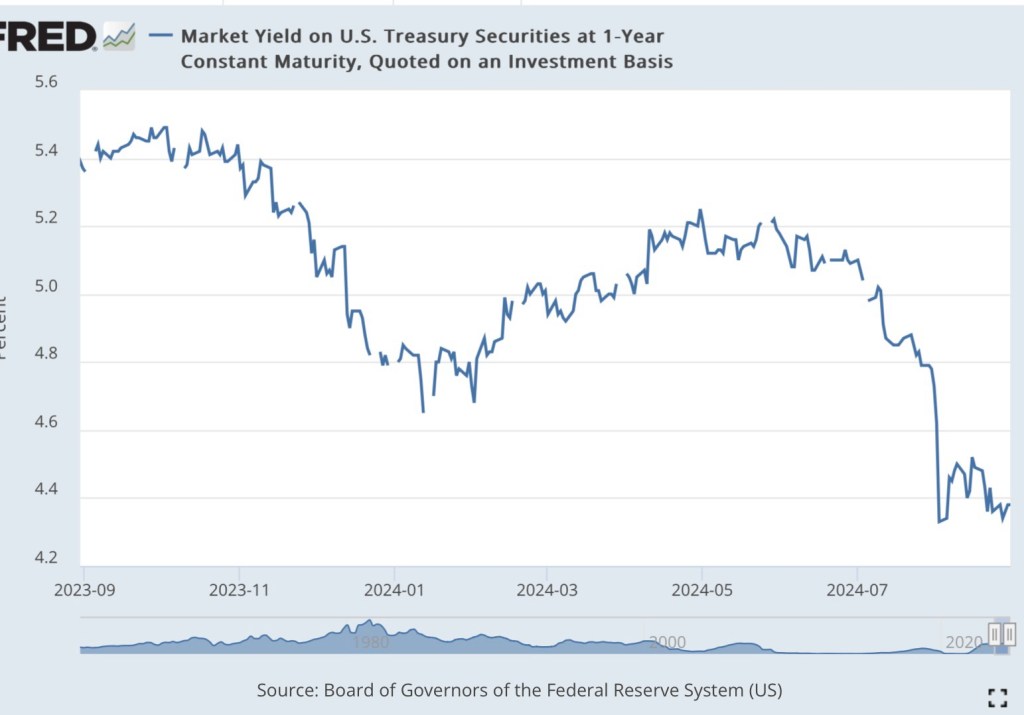
What sometimes goes unacknowledged is that the Fed will be following market rates downward, not leading them. The chart below shows the steep drop in the one-year Treasury yield over the past couple of months. Other rates have declined as well. Granted, longer rates are determined in large part by expectations of future short-term rates over which the Fed has more control.

And yet the softening of market rates may well be a signal of weaker economic activity. There is certainly concern among investors that a failure by the Fed to ease policy might jeopardize the much hoped-for “soft landing”. The lagged effects of the Fed’s tighter policy stance may drag on, with damage to the real economy and the labor market. Indeed, some assert that a recession remains a strong possibility (and see here), and the manufacturing sector has been in a state of contraction for five months.

On the other hand, the Fed has fallen short of its 2% inflation goal. The core PCE deflator, the Fed’s preferred inflation gauge, was up 2.6% for the year ending in July. Some observers fear that easing policy prematurely will lead to a new acceleration of inflation.

Powell Gives the Nod

Nevertheless, markets were relieved when Jerome Powell, in his recent speech in Jackson Hole, Wyoming, indicated his determination that a shift in policy was appropriate. From Bloomberg:

“Federal Reserve Chair Jerome Powell said ‘the time has come’ for the central bank to start cutting interest rates.

“Powell’s comments cemented expectations for a rate cut at the central bank’s next gathering in September. The Fed chief said the cooling of the labor market is ‘unmistakable,’ adding, ‘We do not seek or welcome further cooling in labor market conditions.’ Powell also said his confidence has grown that inflation is on a ‘sustainable path’ back to the Fed’s goal of 2%.“

The “sustainable path back to … 2%” might imply a view inside Fed that policy will remain somewhat restrictive even after a quarter or half-point rate cut in September. Or perhaps the “sustainable path” has to do with the aforementioned lags, which might continue to be operative regardless of any immediate change in policy. The feasibility of a “soft landing” depends on whether policy is indeed still restrictive or on how benign those lagged effects turn out to be. But if we take the lags seriously, an easing of policy wouldn’t have real economic force for perhaps 15 months. Still, the market puts great hope in the salutary effects of a move by the Fed to ease policy.

Big Balance Sheet

It can be argued that the Fed already took a step toward easing policy in May when it reduced the rate at which it was allowing runoff in its portfolio of Treasury and mortgage-backed securities. Prior to that, it had been redeeming $95 billion of maturing securities a month. The new runoff amount is $60 billion per month. Unless neutralized in other ways, the runoff has a contractionary effect on bank reserves and the money supply. It is known as “quantitative tightening” (QT). but then the May announcement was a de facto easing in the degree of QT.

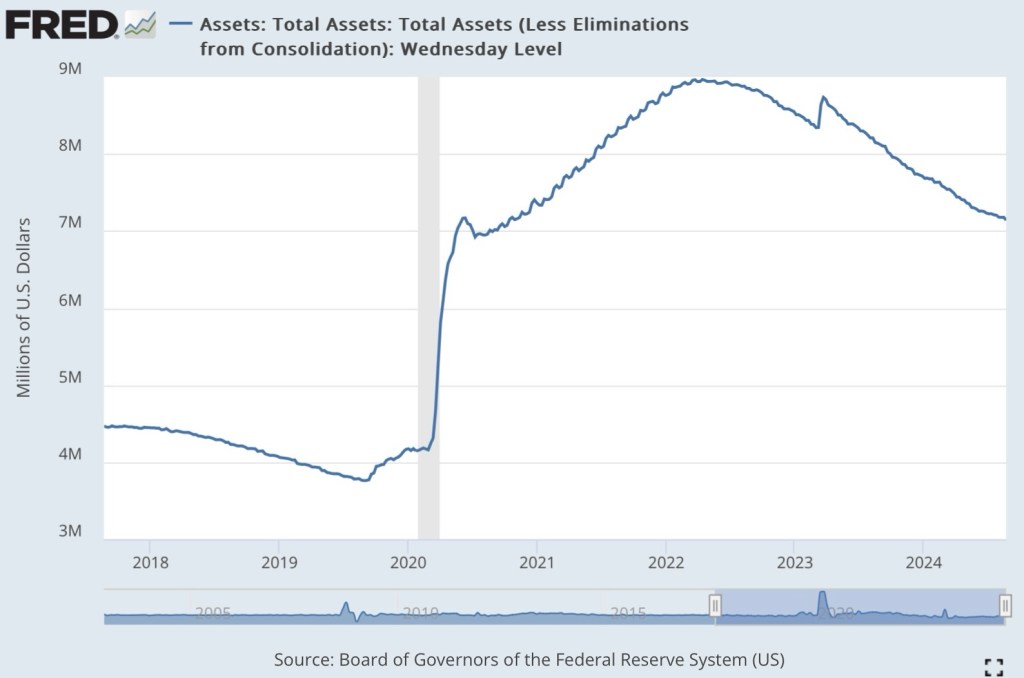
Thus far, the total reduction in the Fed’s portfolio has amounted to only $1.7 trillion from the original high-water mark of $8.9 trillion. Here is a chart showing the recent evolution in the size of the Fed’s securities holdings.

The Fed’s current balance sheet of $7.2 trillion is gigantic by historical standards. It’s reasonable to ask why the Fed considers what we have now to be a more “normalized” portfolio, and whether its size (and correspondingly, the money supply) represents potential “dry tinder” for future inflation. It remains to be seen whether the Fed will further pare the rate of portfolio runoff in the months ahead.

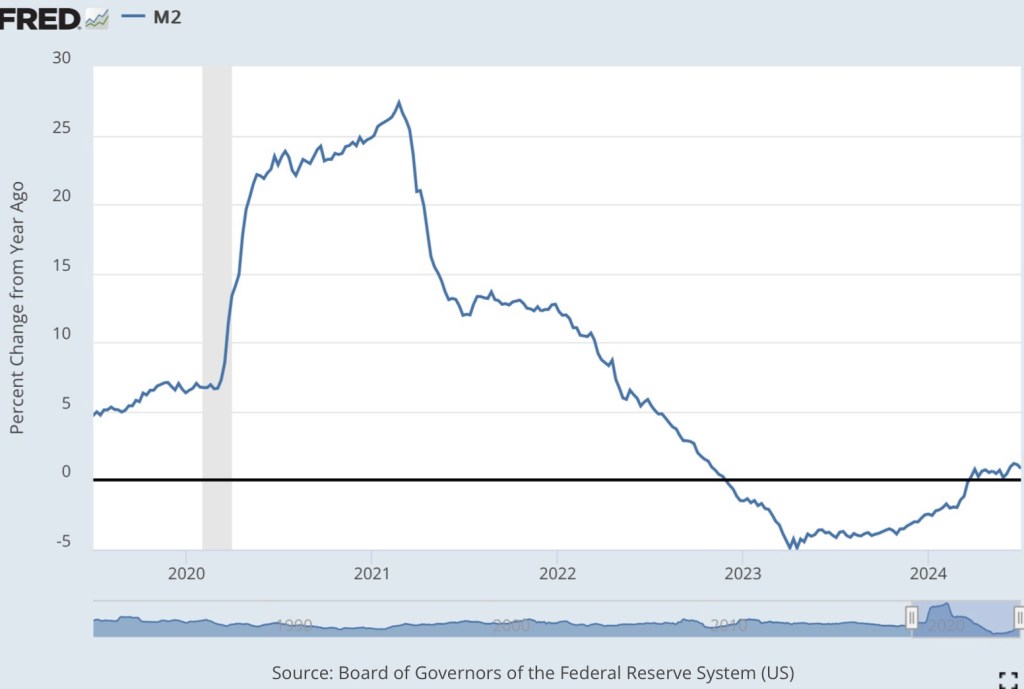
Money growth had been running negative for roughly a year and a half, but it edged closer to zero in late 2023 before accelerating to a slow, positive rate a few months into 2024. The timing didn’t exactly correspond to the Fed’s slowing of portfolio runoff. Nevertheless, the Fed’s strong preference is to supply the banking system with “ample reserves”, and reserves drive money growth. Thus, the Fed’s reaction to conditions in the market for reserves was a factor allowing money growth to accelerate.

A Cut Too Soon?

A rate cut later this month will make reserves still more ample and support additional money growth. And again, this will be an effort to mediate the negative impact of earlier policy tightness, but the effect of this move on the economy will be subject to similar lags.

A danger is that the Fed might be easing too soon, so that inflation will fail to taper to the 2% goal and possibly accelerate again. And perhaps policy was not quite as tight as it needed to be to achieve the 2% goal. Now, new supply bottlenecks are cropping up, including a near shutdown of shipping through the Suez Canal and a potential strike by east coast dockworkers.

Fiscal Incontinence

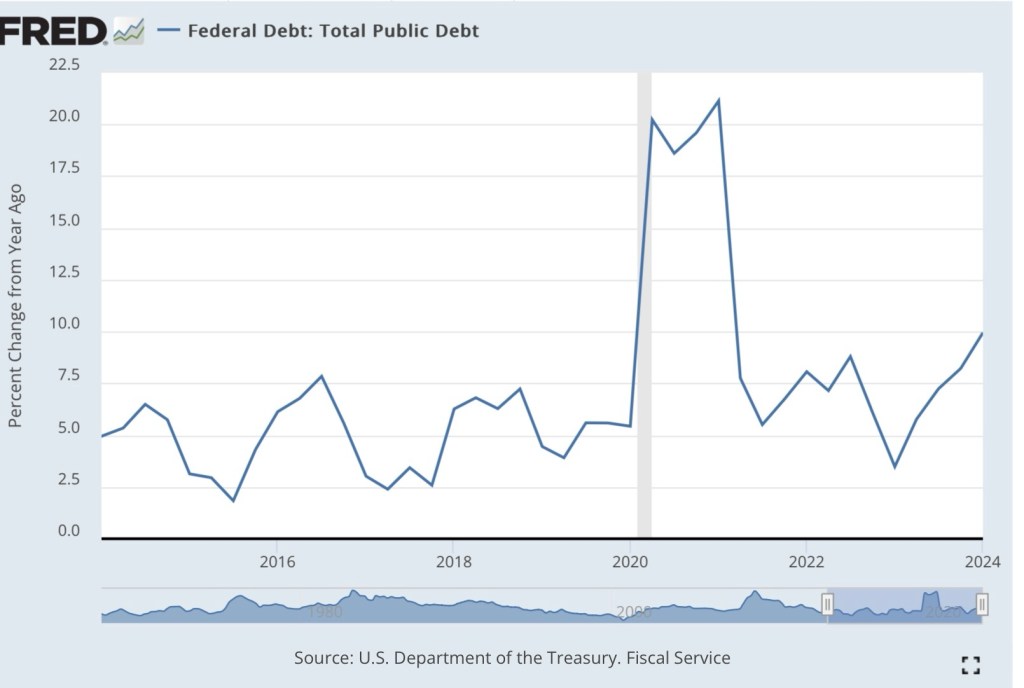
An even greater threat now, and in the years ahead, is the massive pressure placed on the economy and the Fed by excessive federal spending and Treasury borrowing. The growth of federal debt over the 12 months ending in July was almost 10%. Total federal debt stands at about $35 trillion. According to the Congressional Budget Office (CBO) projections, federal debt held by the public will be almost $28 trillion by the end of 2024 (the rest the public debt is held by the Fed or federal agencies). The CBO also projects that the federal budget deficit will average almost $1.7 trillion annually through 2027 before rising to $2.6 trillion by 2034. That would bring federal debt held by the public to more than $48 trillion.

Inflation is receding ever so slowly for now, but it’s unclear that investors will remain comfortable that growth in the public debt can be paid down by future surpluses. If not, the only way its real value can be reduced is through higher prices. Most observers believe such an inflation requires that the Fed monetize federal debt (buy it from the public with printed money). Tighter credit markets will increase pressure on the Fed to do so, but the growing debt burden is likely to exert upward pressure on the prices of goods with or without accommodation by the Fed.

Hard, Soft, Or Aborted Landing?

Some economists are convinced that the Fed has successfully engineered a “soft landing”. I might have to eat some crow…. I felt that a “hard landing” was inevitable from the start of this tightening phase. Even now I would not discount the possibility of a recession late this year or in early 2025. And perhaps we’ll get no “landing” at all. The Fed’s expected policy shift together with the fiscal outlook could presage not just a failure to get inflation down to the Fed’s 2% target, but a subsequent resurgence in price inflation.

Demand, Disinflation, and Fed Gradualism

15 Monday Apr 2024

Posted by Nuetzel in Economic Outlook, Inflation, Monetary Policy

≈ Leave a comment

Tags

Core PCE Inflation, Federal Deficit, Federal Reserve, Flexible Average Inflation Targeting, Hard Landing, Helicopter Drop, Higher for Longer, Nominal GDP Targeting, Pandemic Relief Payments, Quantitative Tightening, Scott Sumner, Soft Landing, Tight Money, Wage Inflation

The Fed’s “higher for longer” path for short-term interest rates lingers on, and so does inflation in excess of the Fed’s 2% target. No one should be surprised that rate cuts aren’t yet on the table, but the markets freaked out a little with the release of the February CPI numbers last week, which were higher than expected. For now, it only means the Fed will remain patient with the degree of monetary restraint already achieved.

Dashed Hopes

As I’ve said before, there was little reason for the market to have expected the Fed to cut rates aggressively this year. Just a couple of months ago, the market expected as many as six quarter-point cuts in the Fed’s target for the federal funds rate. The only rationale for that reaction would have been faster disinflation or the possibility of an economic “hard landing”. A downturn is not out of the question, especially if the Fed feels compelled to raise its rate target again in an effort to stem a resurgence in inflation. Maybe some traders felt the Fed would act politically, cutting rates aggressively as the presidential election approaches. Not yet anyway, and it seems highly unlikely.

There is no assurance that the Fed can succeed in engineering a “soft landing”, i.e., disinflation to its 2% goal without a recession. No one can claim any certainty on that point — it’s too early to call, though the odds have improved somewhat. As Scott Sumner succinctly puts it, a soft landing basically depends on whether the Fed can disinflate gradually enough.

It’s a Demand-Side Inflation

I’d like to focus a little more on Sumner’s perspective on Fed policy because it has important implications for the outlook. Sumner is a so-called market monetarist and a leading proponent of nominal GDP level targeting by the Fed. He takes issue with those ascribing the worst of the pandemic inflation to supply shocks. There’s no question that disruptions occurred on the supply side, but the Fed did more than accommodate those shocks in attempting to minimize their impact on real output and jobs. In fact, it can fairly be said that a Fed / Treasury collaboration managed to execute the biggest “helicopter drop” of money in the history of the world, by far!

That “helicopter drop” consisted of pandemic relief payments, a fiscal maneuver amounting to a gigantic monetary expansion and stimulus to demand. The profligacy has continued on the fiscal side since then, with annual deficits well in excess of $1 trillion and no end in sight. This reflects government demand against which the Fed can’t easily act to countervail, making the job of achieving a soft landing that much more difficult.

The Treasury, however, is finding a more limited appetite among investors for the flood of bonds it must regularly sell to fund the deficit. Recent increases in long-term Treasury rates reflect these large funding needs as well as the “higher-for-longer” outlook for short-term rates, inflation expectations, and of course better perceived investment alternatives.

The Nominal GDP Proof

There should be no controversy that inflation is a demand-side problem. As Summer says, supply shocks tend to reverse themselves over time, and that was largely the case as the pandemic wore on in 2021. Furthermore, advances in both real and nominal GDP have continued since then. The difference between the two is inflation, which again, has remained above the Fed’s target.

So let’s see… output and prices both growing? That combination of gains demonstrates that demand has been the primary driver of inflation for three-plus years. Restrictive monetary policy is the right prescription for taming excessive demand growth and inflation.

Here’s Sumner from early March (emphasis his), where he references flexible average inflation targeting (FAIT), a policy the Fed claims to be following, and nominal GDP level targeting (NGDPLT):

“Over the past 4 years, the PCE price index is up 16.7%. Under FAIT it should have risen by 8.2% (i.e., 2%/year). Thus we’ve had roughly 8.5% excess inflation (a bit less due to compounding.)

Aggregate demand (NGDP) is up by 27.6%. Under FAIT targeting (which is similar to NGDPLT) it should have been up by about 17% (i.e., 4%/year). So we’ve had a bit less than 10.6% extra demand growth.  That explains all of the extra inflation.”

Is Money “Tight”?

The Fed got around to tightening policy in the spring of 2022, but that doesn’t necessarily mean that policy ever advanced to the “tight” stage. Sumner has been vocal in asserting that the Fed’s policy hasn’t looked especially restrictive. Money growth feeds demand and ultimately translates into nominal GDP growth (aggregate demand). The latter is growing too rapidly to bring inflation into line with the 2% target. But wait! Money growth has been moderately negative since the Fed began tightening. How does that square with Sumner’s view?

In fact, the M2 money supply is still approximately 35% greater than at the start of the pandemic. There’s still a lot of M2 sloshing around out there, and the Fed’s portfolio of securities acquired during the pandemic via “quantitative easing” remains quite large ($7.5 trillion). Does this sound like tight money?

Again, Sumner would say that with nominal GDP ripping ahead at 5.7%, the Fed can’t be credibly targeting 2% inflation given an allowance for real GDP growth at trend of around 1.8% (or even somewhat greater than that). It’s an even bigger stretch if M2 velocity (V — turnover) continues to rebound with higher interest rates.

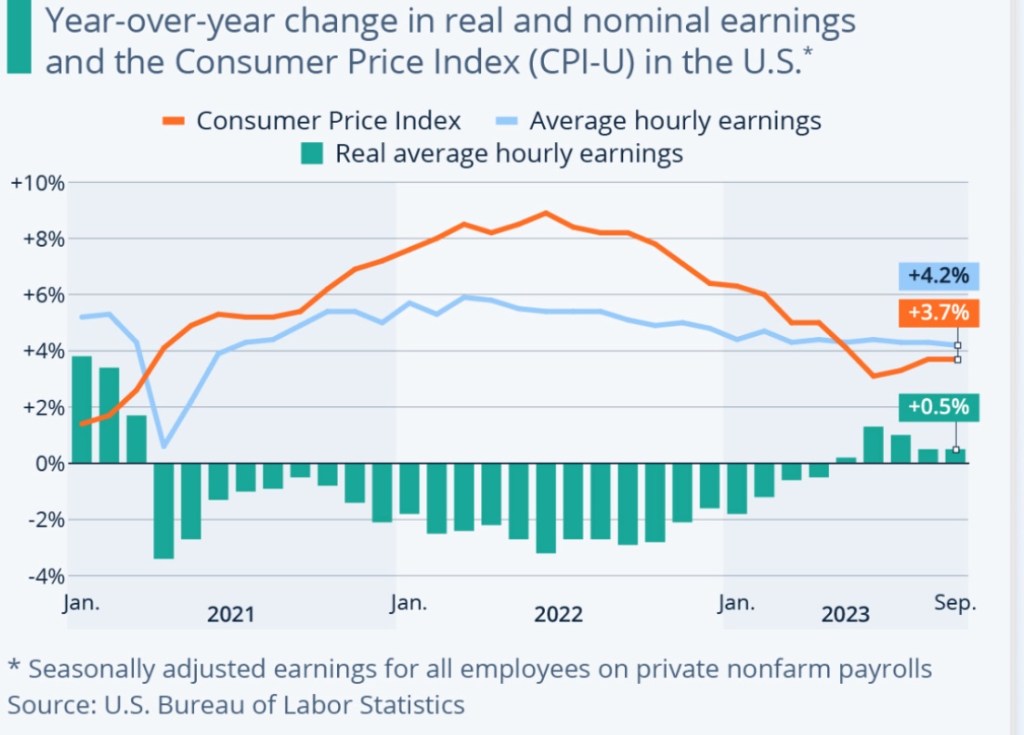
Wage growth also exceeds a level consistent with the Fed’s target. The chart below shows the gap between price inflation and wage inflation that left real wages well below pre-pandemic levels. Since early 2023, wages have made up part of that decline, but stubborn wage inflation can impede progress against price inflation.

Just Tight Enough?

Despite Sumner’s doubts, there are arguments to be made that Fed policy qualifies as restrictive. Even moderate declines in liquidity can come as a shock to markets grown accustomed to torrents from the money supply firehose. And to the extent that inflation expectations have declined, real interest rates may be higher now than they were in early November. In any case, it’s clear the market was disappointed in the higher-than-expected CPI, and traders were not greatly assuaged by the moderate report on the PPI that followed.

However, the Fed pays closest attention to another price index: the core deflator for personal consumption expenditures (PCE). Inflation by this measure is trending much closer to the Fed’s target (see the second chart below). Still, from the viewpoint of traders, many of whom, not long ago, expected six rate cuts this year, the reality of “higher for longer” is a huge disappointment.

Danger Lurks

As I noted, many believe the odds of a soft landing have improved. However, the now-apparent “stickiness” of inflation and the knowledge that the Fed will standby or possibly hike rates again has rekindled fears that the economy could turn south before the Fed elects to cut its short-term interest rate target. That might surprise Sumner in the absence of more tightening, as his arguments are partly rooted in the continuing strength of aggregate demand and nominal GDP growth.

There’s a fair degree of consensus that the labor market remains strong, which underscores Sumner’s doubts as to the actual tenor of monetary policy. The March employment numbers were deceptive, however. The gain in civilian employment was just shy of 500,000, but that gain was entirely in part-time employment. Full-time employment actually declined slightly. In fact, the same is true over the prior 12 months. And over that period, the number of multiple jobholders increased by more than total employment. Increasing reliance on part-time work and multiple jobs is a sign of stress on household budgets and that firms may be reluctant to commit to full-time hires. From the establishment survey, the gain in nonfarm employment was dominated once again by government and health care. These numbers hardly support the notion that the economy is on solid footing.
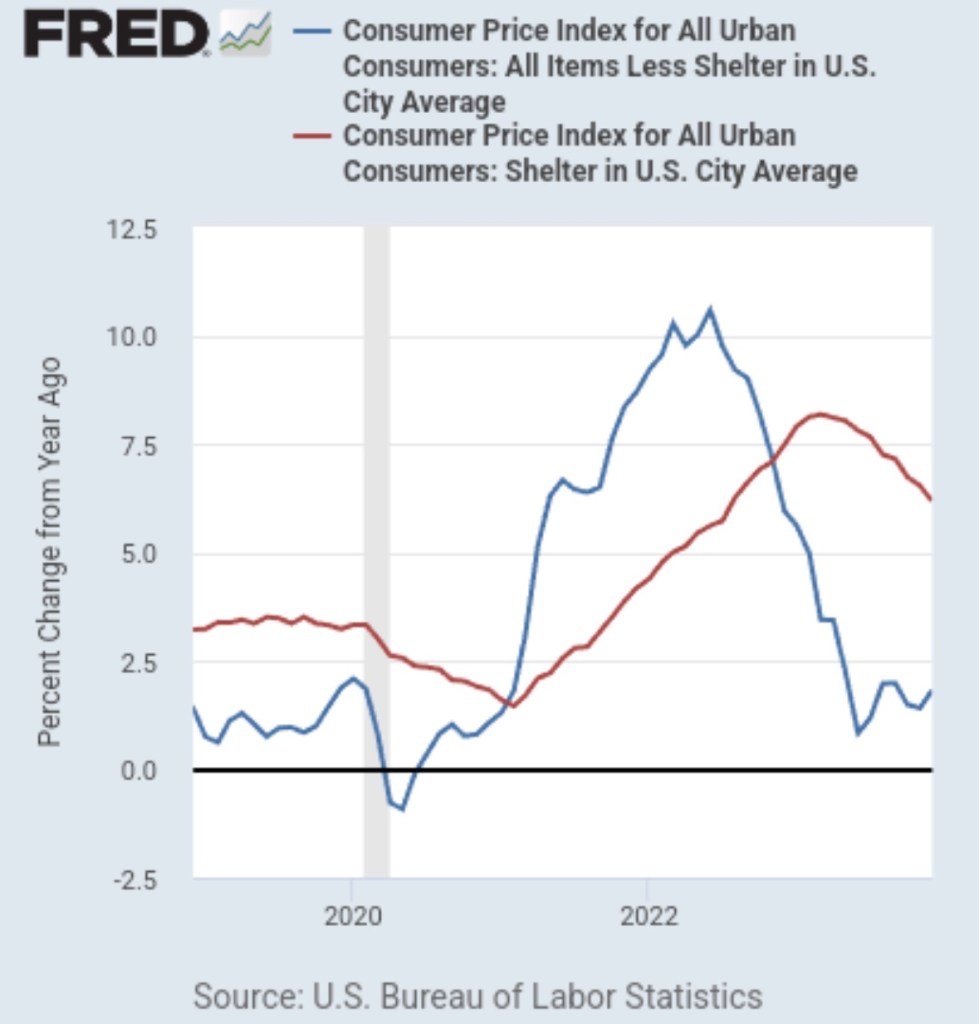
There are other signs of stress: credit card delinquencies hit an all-time high in February. High interest rates are taking a toll on households and business borrowers. Retail sales were stronger than expected in March, but excess savings accumulated during the pandemic were nearly depleted as of February, so it’s not clear how long the spending can last. And while the index of leading indicators inched up in February, it was the first gain in two years and the index has shown year/over-year declines over that entire two-year period.

Conclusion

It feels a little hollow for me to list a series of economic red flags, having done so a few times over the past year or so. The risks of a hard landing are there, to be sure. The behavior of the core PCE deflator over the next few months will have much more influence on the Fed policy, as would any dramatic changes in the real economy. The “data dependence” of policy is almost a cliche at this point. The Fed will stand pat for now, and I doubt the Fed will raise its rate target without a dramatic upside surprise on the core deflator. Likewise, any downward rate moves won’t be forthcoming without more softening in the core deflator toward 2% or definitive signs of a recession. So rate cuts aren’t likely for some months to come.

Stubborn Inflation and the Fed’s Approach Trajectory

15 Monday Jan 2024

Posted by Nuetzel in Economic Outlook, Monetary Policy

≈ Leave a comment

Tags

Birth-Death Model, BLS, Core Inflation, CPI, Establishment Survey, Federal Funds Rate, Federal Open Market Committee, Federal Reserve, FOMC, Grateful Dead, Hard Landing, Household Survey, Inflation, Jerome Powell, Nonfarm Payrolls, PCE Deflator, PPI, Red Sea, Seasonal Adjustment, Soft Landing, Supply Shocks

When Federal Reserve Chairman Jerome Powell said “higher for longer” last year, it wasn’t about the Grateful Dead concerts he’s attended over the years. No, he meant the Fed might need to raise its short-term interest rate target and/or keep it elevated for an extended period to squeeze inflation out of the economy. As late as December, Powell said that additional rate hikes remain on the table. But short of that, the Fed might keep its current target rate steady until inflation is solidly in-line with its 2% objective. The obvious risk is that tight monetary policy might tip the economy into recession. The market, for its part, is pricing in several rate cuts this year.

Thus far, the release of key economic data for December 2023 has not settled the debate as to whether disinflation has truly paused short of the Fed’s goal. There were inauspicious signs from the labor market in December as well. These data releases don’t rule out a “soft landing”, but they indicate that recession risks are still with us in 2024. The Fed will face a dilemma if the economy weakens but inflation fails to abate, either due to residual stickiness or new supply shocks. The latter are unfolding even now with the shut down of Red Sea shipping.

Bad Employment Report

On the surface, the employment report from the Bureau of Labor Statistics (BLS) was strong relative to expectations, and the media reported it on that superficial level: nonfarm payrolls increased by 216,000 jobs, about 45,000 more than expected; unemployment was unchanged from November at 3.7%.

Unfortunately, the report contained several ominous signs:

1) Employment from the BLS Household Survey declined by 683,000 in December and is essentially flat since July. This discrepancy should be rather unsettling to anyone waving off the possibility of a recession.

2) The number of full-time workers decreased by 1.53 million in December, and the number of part-time workers increased by 762,000 as the holidays approached. Retail employment was not particularly strong however, and the big loss of full-time work stands in contrast to the “strong-report” narrative.

3) The number of multiple jobholders hit a record and increased by 556,000 over the past year. This might indicate trouble for some workers making ends meet.

5) The civilian labor force declined by 676,000. What accounts for the change in status among these former workers or job seekers?

6) From the BLS Establishment Survey, government hiring accounted for 24% of the nonfarm jobs filled in December. Social Services accounted for 10% of the new hiring and health care for 18%, both of which are heavily dependent on government.

7) Nonfarm payrolls were revised downward by a total of 71,000 for October and November. We’ve seen downward revisions for 10 of the past 11 months.

8) In total, initial monthly job reports in 2023 overstated the full-year gain in nonfarm employment after available revisions by 439,000.

Those are big qualifiers on the “stronger than expected” jobs report. Furthermore, I tend to discount new government jobs as a real engine of production possibilities, so the report didn’t offer much assurance about the economy’s momentum. In addition, there are estimates that the payroll gain was due to better weather than the seasonal adjustment factors indicate.

Fictional Payroll Gains?

Still other issues cast doubt on the BLS payroll numbers. First, they are based on a survey of employers that is not complete by the time of each month’s initial report. Second, the survey is heavily skewed toward employees of government and large corporations; the sample of small employers is light by comparison. Third, seasonal adjustments often swamp the unadjusted changes in payrolls.

Finally, the BLS uses a statistical model of business births/deaths to adjust the figures. This is intended to correct for a lag in survey coverage as new businesses are formed and others close. The net effect on the payroll estimate can be positive or negative. Unfortunately, it’s difficult for even the BLS to tell how much the birth/death model affects the headline nonfarm jobs figure in any particular month. Therefore, it’s tough to put much faith in the monthly reports, but we watch them anyway.

Stubborn Inflation

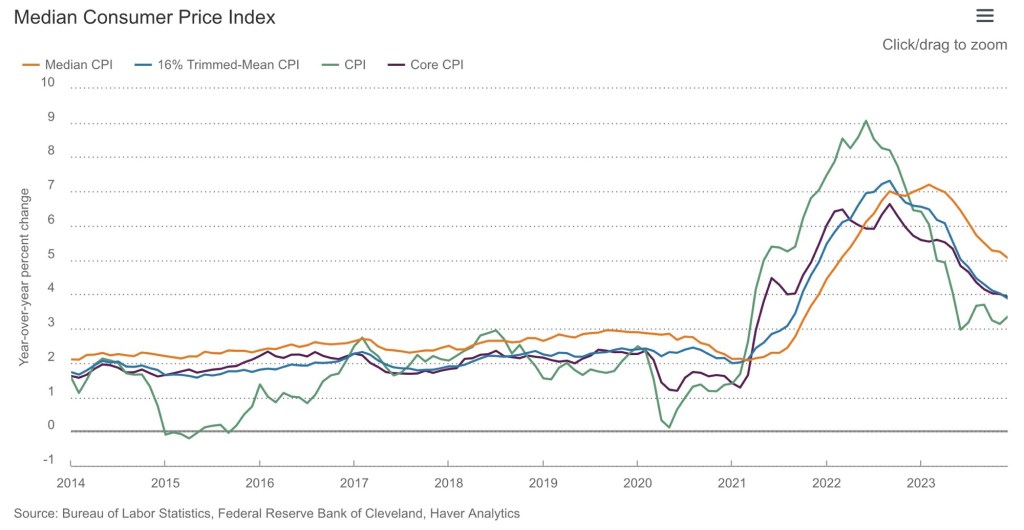
The Consumer Price Index (CPI) for December increased 0.3% over November and 3.4% year-over-year, slightly more than expectations of 0.2% and 3.2%, respectively. The “core” CPI (excluding food and energy prices) rose 3.9% year-over-year, more than the 3.8% expected. The core rate declined on a one-month and year-over-year basis, however, as did the median item in the CPI.

All CPI measures in the chart declined during 2023, though the core and median lagged the headline CPI (green line), which “flattened” somewhat during the last half of the year. So there appears to be some stickiness hindering disinflation in the CPI at this point, but the apparent “stickiness” has been confined to lagging declines in housing costs (also see here).

The Producer Price Index (PPI) reported a day later was thought to be benign. Like the CPI, disinflation in the core PPI has tapered:

In this context, it should be noted that declines in the Fed’s preferred inflation gauge, the PCE deflator, have also undergone something of a pause, and the PCE weights housing costs much less heavily than the CPI.

The CPI and PPI reports don’t offer any reason for the Fed to reduce its target federal funds rate over the next couple of Federal Open Market Committee (FOMC) meetings. There are two more sets of monthly inflation reports before the meeting in late March, so things could change. But again, the Fed has given ample guidance that it might have to leave its target rate at the current level for an extended period.

The Market View

Markets had priced-in six cuts in the Fed funds rate target in 2024 prior to the CPI report, but traders began to discount that possibility in its immediate aftermath. However, members of the FOMC expected an average of three cuts in 2024, with more to come in 2025, whether or not that’s consistent with “higher for longer”. Inflation is hovering somewhat above the Fed’s goal, but getting the rest of the job done might be tough, and indeed, might imply “longer” if not “higher”.

But why did the market ever hold the expectation of six cuts this year? Traders must have anticipated an economic contraction, which would kick the Fed into rapid response mode. The employment report offered no assurance that such a “hard landing” will be avoided. A few more negative signals on the real economy without further progress on prices would provide quite a test of the Fed’s inflation-fighting resolve.

So When Can We Expect That Hard Landing, Hmmm?

13 Wednesday Dec 2023

Posted by Nuetzel in Economic Outlook, Monetary Policy

≈ Leave a comment

Tags

Consumer Sentiment, Core PCE, Federal Funds Rate Target, Federal Open Market Committee, Hard Landing, Inflation, Jamie Diamond, Labor Market, Leading Indicators, Long and Variable Lags, Milton Friedman, Money Growth, Neutral Real Rate, Quantitative Tightening, Real Interest Rates, Real Wages, Recession, Scott Sumner, Soft Landing, Tight Money

The joke’s on me, but my “out” on the question above is “long and variable lags” in the impact of monetary policy, a description that goes back to the work of Milton Friedman. If you call me out on my earlier forebodings of a hard landing or recession, I’ll plead that I repeatedly quoted Friedman on this point as a caveat! That is, the economic impact of a monetary tightening will be lagged by anywhere from 9 to 24 months. So maybe we’re just not there yet.

Of course, maybe I’m wrong and we won’t have to get “there”: the rate of inflation has indeed tapered over the past year. A soft landing now seems like a more realistic possibility. Still, there’s a ways to go, and as Scott Sumner says, when it comes to squeezing inflation out of the system, “It’s the final percentage point that’s the toughest.” One might say the Federal Reserve is hedging its bets, avoiding further increases in its target federal funds rate absent evidence of resurging price pressures.

Strong Growth or Mirage?

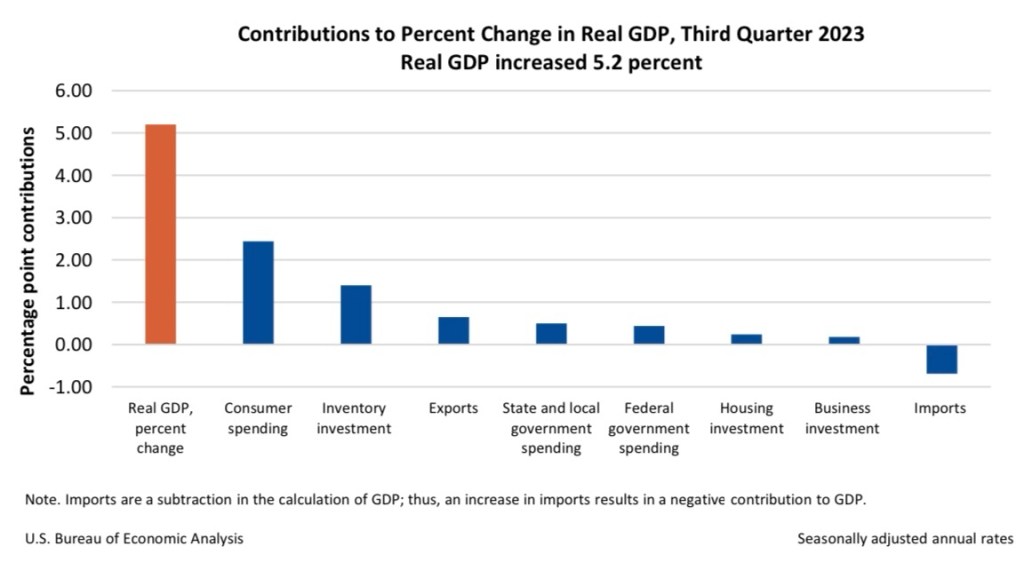
Economic growth is still strong. Real GDP in the third quarter grew at an astonishing 5.2% annual rate. A bulge in inventories accounted for about a quarter of the gain, which might lead to some retrenchment in production plans. Government spending also accounted for roughly a quarter, which corresponds to a literal liability as much as a dubious gain in real output. Unfortunately, fiscal policy is working at cross purposes to the current thrust of monetary policy. Profligate spending and burgeoning budget deficits might artificially prop up the economy for a time, but it adds to risks going forward, not to mention uncertainty surrounding the strength and timing in the effects of tight money.
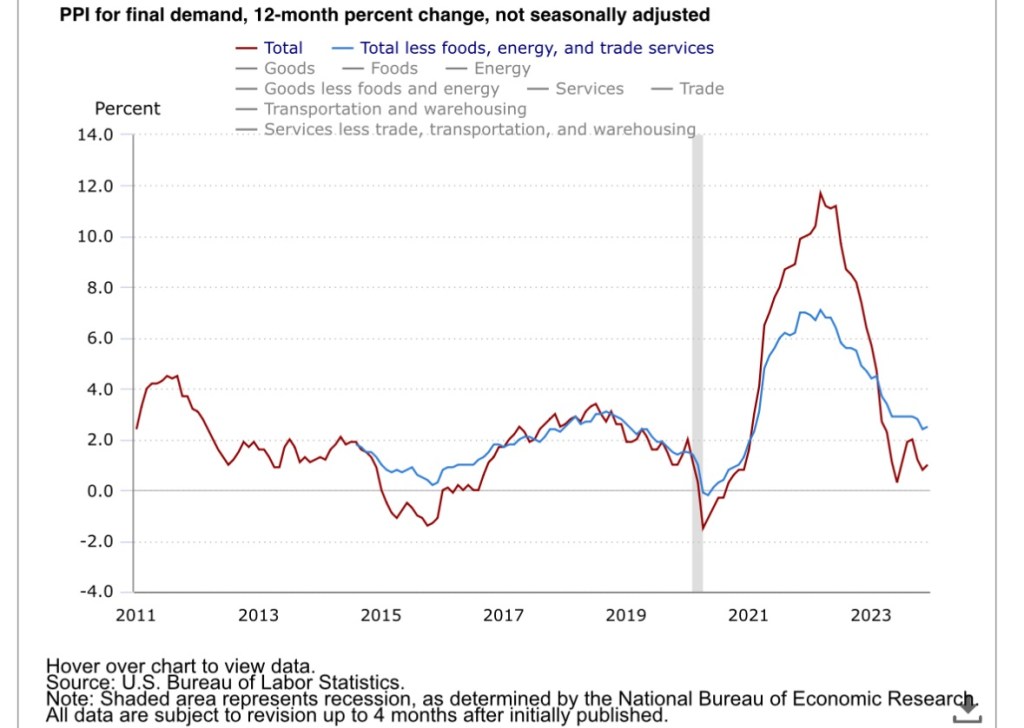
Consumers accounted for almost half of the third quarter growth despite a slim 0.1% increase in real personal disposable income. That reinforces the argument that consumers are depleting their pandemic savings and becoming more deeply indebted heading into the holidays.

The economy continues to produce jobs at a respectable pace. The November employment report was slightly better than expected, but it was buttressed by the return of striking workers, and retail and manufacturing jobs declined. Still, the unemployment rate fell slightly, so the labor market has remained stronger than expected by most economists.

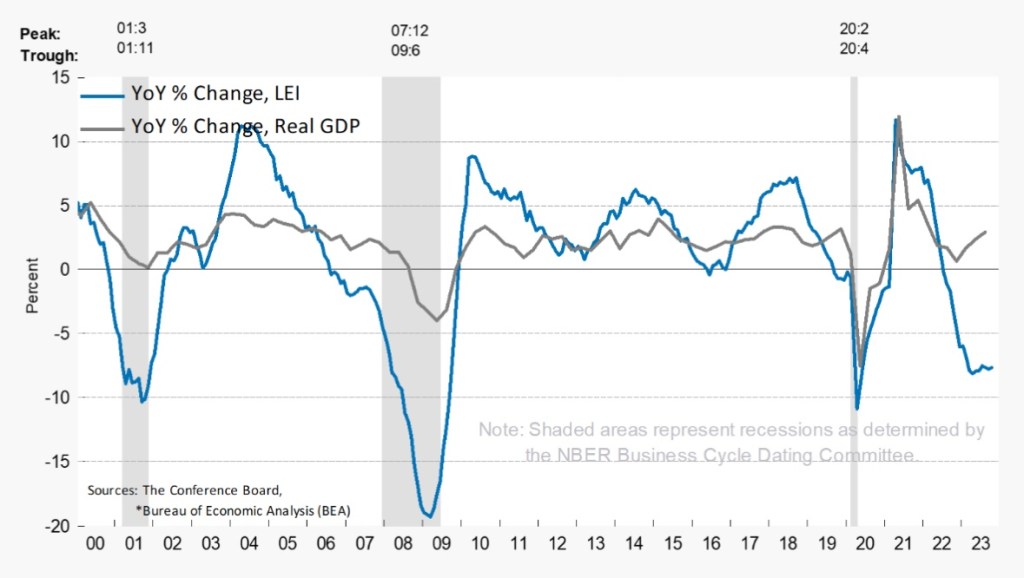
Consumer sentiment had been in the dumps until the University of Michigan report for December, which erased four months of declines. The expectations index is one component of the leading economic indicators, which has been at levels strongly suggesting a recession ahead for well over a year now. See the chart below:

But expectations improved sharply in November, and that included a decline in inflation expectations.

Another component of the LEI is the slope of the yield curve (measured by the difference between the 10-year Treasury bond yield and the federal funds rate). This spread has been a reliable predictor of recessions historically. The 10-year bond yield has declined by over 90 basis points since mid-October, a sign that bond investors think the inflation threat is subsiding. However, that drop steepened the negative slope of the yield curve, meaning that the recession signal has strengthened.

Disinflation, But Still Inflation

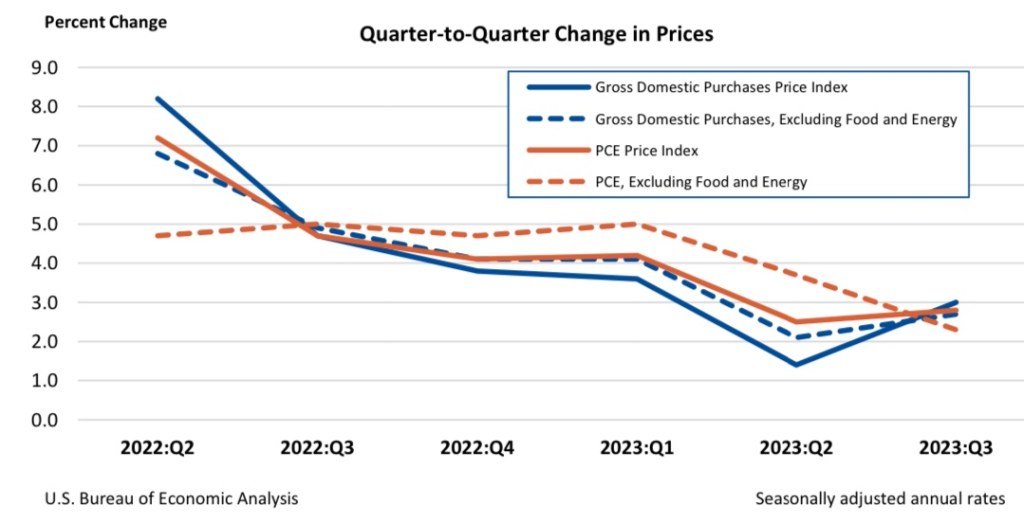
Inflation measures have been slowing, and the Fed’s “target” inflation rate of 2% appears within reach. In the Fed’s view, the most important inflation gauge is the personal consumption expenditures deflator excluding food and energy prices (the “core” PCE). The next chart shows the extent to which it has tapered over the past two quarters. While it’s encouraging that inflation has edged closer to the Fed’s target, it does not mean the inflation fight is over. Still, the decision taken at the December meeting of the Fed’s Open Market Committee (FOMC) to leave its interest rate target unchanged is probably wise.

Real wages declined during most of the past three years with the surge in price inflation (see next chart). Some small gains occurred over the past few months, but the earlier declines reinforce the view that consumers need to tighten their belts to maintain savings or avoid excessive debt.

Has Policy Really Been “Tight“?

The prospect of a hard landing presupposes that policy is “tight” and has been tight for some months, but there is disagreement over whether that is, in fact, the case. Scott Sumner, at the link above in the second paragraph, is skeptical that policy is “tight” even now. That’s despite the fact that the Fed hiked its federal funds rate target 11 times between March 2022 and July 2023 (by a total of 5.25%). The Fed waited too long to get started on its upward rate moves, which helps explain the continuing strength of the economy right now.

The real fed funds rate turned positive (arguably) as early as last winter as the rate rose and as expected inflation began to decline. There is also solid evidence that real interest rates on the short-end of the maturity spectrum are higher than “neutral” real rates and have been for well over a year (see chart below). If the Fed leaves its rate target unchanged over the next few months, assuming expected inflation continues to taper, the real rate will rise passively and the Fed’s policy stance will have tightened further.

Another view is that the Fed’s policy became “tight” when the monetary aggregates began to decrease (April 2022 for M2). A few months later the Fed began so-called “quantitative tightening” (QT—selling securities to reduce its balance sheet). Thus far, QT has reversed only a portion of the vast liquidity provided by the Fed during the pandemic. However, markets do grow accustomed to generous ongoing flows of liquidity. Cutting them off creates financial tensions that have real economic effects. No doubt the Fed’s commitment to QT established some credibility that a real policy shift was underway. So it’s probably fair to say that policy became “tight” as this realization took hold, which might place the date demarcating “tight” policy around 15 – 18 months ago.

Back to the Lags

Again, changes in monetary policy have a discernible impact only with a lag. The broad range of timing discussed among monetary experts (again, going back to Milton Friedman) is 9 – 24 months. We’re right in there now, which adds to the conviction among many forecasters that the onset of recession is likely during the first half of 2024. That’s my position, and while the tapering of inflation we’ve witnessed thus far is quite encouraging, it might take sustained monetary restraint before we’re at or below the Fed’s 2% target. That also increases the risk that we’ll ultimately suffer through a hard landing. In fact, there are prominent voices like hedge fund boss Bill Ackman who predict the Fed must begin to cut the funds rate soon to avoid a hard landing. Jamie Diamond, CEO of JP Morgan, says the U.S. is headed for a hard landing in 2024.

Looking Forward

If new data over the next few months is consistent with a “soft landing” (and it would take much more than a few months to be conclusive), or especially if the data more strongly indicate an incipient recession, the Fed certainly won’t raise its target rate again. The Fed is likely to begin to cut the funds rate sometime next year, and sooner if a recession seems imminent. Otherwise, my guess is the Fed waits at least until well into the second quarter. The average of FOMC member forecasts at the December meeting works out to three quarter-point rate cuts by year-end 2024. When the Fed does cut its target rate, I hope it won’t at the same time abandon QT, the continuing sales of securities from its currently outsized portfolio. Reducing the Fed’s holdings of securities will restrain money growth and give the central bank more flexibility over future policy actions. QT will also put pressure on Congress and the President to reduce budget deficits.

Real Short-Term Rates Have Been Positive For Months

21 Friday Jul 2023

Posted by Nuetzel in Inflation, Monetary Policy

≈ Leave a comment

Tags

Bidenomics, Cleveland Fed, Inflation Expectations, Joe Biden, Kevin Erdman, Monetary Aggregates, Neutral Fed Funds Rate, Real Interest Rates, Restrictive Policy, TIPS

Note: I’m moving for the first time in many years. We have a lot to do quickly because we’ll close on our new home in early September. It’s in a place with palm trees, but no basements! The clean-up and winnowing of our accumulated papers, possessions, and … junk — not to mention attending to all the details of the move — is taking up all of my time. Anyway, I started the post below a week ago and had to put it aside. Not sure how frequently I’ll be posting till we’re fully settled in the fall, but we’ll see how it goes.

____________________________________________

The inflation news was great last week, with both the Consumer Price Index (CPI) and the Producer Price Index (PPI) reported below expectations. Month-over-month, the increase in the overall CPI was just 0.2%. Year-over-year, CPI inflation was 3%, down from 9% a year ago. Of course, contrary to Joe Biden’s ridiculous claims, this inflation news came despite, and not because of, the pernicious effects of “Bidenomics”. But that aside, just like that, we heard proclamations that the Federal Reserve had finally succeeded in bringing real short-term interest rates into positive territory. Finally, some said, Fed policy had moved into more restrictive territory. But in fact, real rates moved above zero months ago.

The popular rate narrative is based on the fact that the effective Fed Funds rate is now 5.08% while “headline” CPI inflation fell to 2.97%. That would give us a real Fed Funds rate of 3.11%… if that sort of calculation made sense. Here’s an appropriate reaction from Kevin Erdman:

“The short term rate minus trailing 12 month inflation is not a thing. It’s an irrelevant number. Nothing about June 2022 inflation has anything to do with the real fed funds rate in July 2023.”

His statement generalizes to interest rates at any maturity less a corresponding measure of trailing inflation. They are all irrelevant. A proper real rate of interest must incorporate a measure of inflation expectations. Survey data is often used for this purpose, but a better measure can be taken from market expectations by comparing a nominal Treasury rate with a rate on an inflation-indexed Treasury (TIPS) of the same maturity. This is a fairly convenient approach.

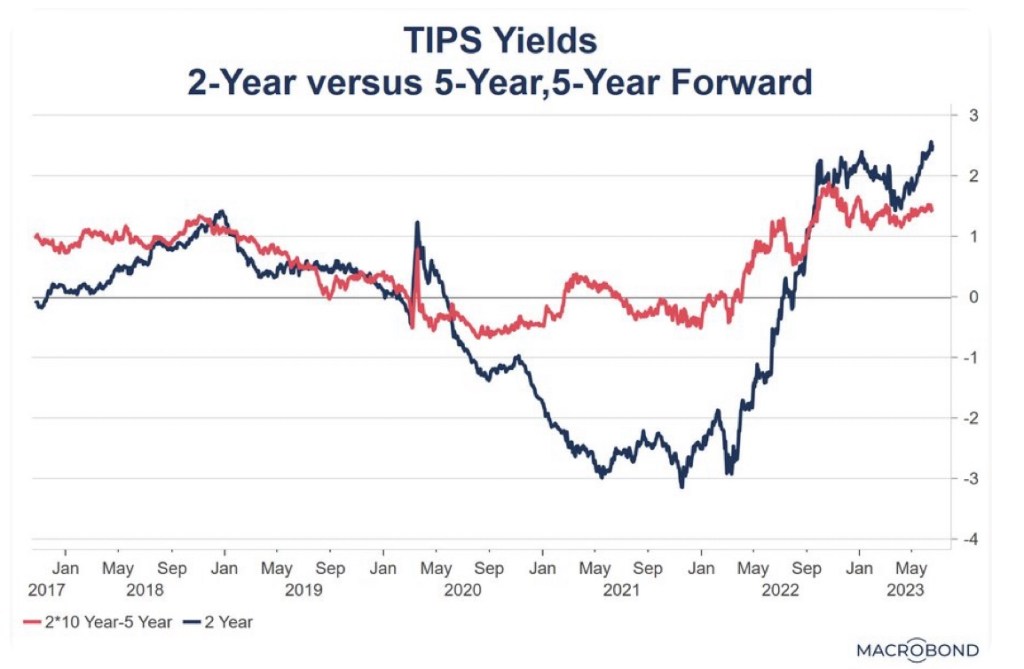
Below, we can see that the real one-year Treasury rate has been positive since last November.

And here is the real one-month Treasury rate:

Again, these charts suggest that real short-term rates have been positive much longer than some believe. Whether that represents a “restrictive policy stance” by the Federal Reserve is another matter. We know the Fed has tightened policy, but that began after the notably loose policy conducted throughout the pandemic. Have we truly crossed the threshold into “tightness”?

Here’s the effective (nominal) federal funds rate over the past year.

This rate is under fairly direct control by the Fed, and it is the primary focus of most Fed watchers. It’s an overnight lending rate on loans of reserves between banks, so to adjust it precisely for expected inflation requires an annualized, overnight inflation rate. That’s pretty tricky!

Finding a published measure of expected inflation over durations of less than a year forward is difficult. One can derive one or use a longer-term rate of expected inflation as a proxy, with the proviso that near-term expectations might be more extreme than the proxy, especially if inflation is expected to change from its current pace. Here are one-year inflation expectations over the past year from a Cleveland Fed model that utilizes TIPS returns and other data.

So inflation expectations have declined substantially. If we compare them with short-term interest rates or the effective fed funds rate over the past year, it’s likely the real fed funds rate climbed above zero before the end of the first quarter of 2023. It might even have exceeded the so called “neutral” real Fed funds rate (R*), which was estimated by the Fed to be 1.14% in the first quarter of 2023. A real Fed funds rate above that level would have been deemed restrictive in the first quarter.

My own view is that changes in the Fed funds rate are not at the heart of the transmission mechanism from monetary policy to the real economy. The monetary aggregates are more reliable guides. The broad money stock M2 has been edging lower for well over a year now. That certainly qualifies as a restrictive move, but there is still a lot of excess liquidity out there, left over from the pandemic deluge engineered by the Fed.

The good reports last week might not mark the end of the inflation problem. There are still price pressures from both the demand and supply-sides. Furthermore, to put things in context, the month-to-month increases in May and June of last year were large, which helped to hold down the 12-month increases this May and June. But the CPI was flat during the second half of last year. That means month-to-month inflation over the next six months may well translate into an escalation of year-over-year inflation. That might or might not be turn out to be meaningful, but it would provide a pretext for additional Fed tightening.

The main point of this post is that real interest rates cannot be calculated on the basis of reported inflation over prior months. Doing so at this juncture understates the degree of monetary tightening in terms of short-term rates. Real interest rates can only be determined by nominal rates relative to expectations of future inflation. This gives a more accurate picture of actual credit market conditions and the Fed’s rate policy stance.

A Monetary Cease-Fire As Inflation Retreats, For Now

20 Tuesday Jun 2023

Posted by Nuetzel in Inflation, Monetary Policy

≈ Leave a comment

Tags

Bank Reserves, Bureau of Labor Statistics, CPI, Debt Ceiling, Fed Pause, Federal Funds, Federal Open Market Committee, Hoarding Labor, Inflation, Inverted Yield Curve, Jobless Claims, Leading Economic Indicators, Liquidity, PCE Deflator, Philip Jefferson, PPI, Quantitative Tightening, Real Weekly Earnings, Soft Landing, Stock Rally

The inflation news was good last week, with both the consumer and producer price indices (CPI and PPI) for May coming in below expectations. The increase in the core CPI, which excludes food and energy prices, was the same as in April. As this series of tweets attempts to demonstrate, teasing out potential distortions from the shelter component of the CPI shows a fairly broad softening. That might be heartening to the Federal Reserve, though at 4.0%, the increase in the CPI from a year ago remains too high, as does the core rate at 5.3%. Later in the month we’ll see how much the Fed’s preferred inflation gauge, the PCE deflator, exceeds the 2% target.

Inflation has certainly tapered since last June, when the CPI had its largest monthly increase of this cycle. After that, the index leveled off to a plateau lasting through December. But the big run-up in the CPI a year ago had the effect of depressing the year-over-year increase just reported, and it will tend to depress next month’s inflation report as well. After this June’s CPI (to be reported in July), the flat base from a year earlier might have a tendency to produce rising year-over-year inflation numbers over the rest of this year. Also, the composition of inflation has shifted away from goods prices and into services, where markets aren’t as interest-rate sensitive. Therefore, the price pressure in services might have more persistence.

So it’s way too early to say that the Fed has successfully brought inflation under control, and they know it. But last week, for the first time in 10 meetings, the Fed’s chief policy-making arm (the Federal Open Market Committee, or FOMC) did not increase its target for the federal funds rate, leaving it at 5% for now. This “pause” in the Fed’s rate hikes might have more to do with internal politics than anything else, as new Vice Chairman Philip Jefferson spoke publicly about the “pause” several days before the meeting. That statement might not have been welcome to other members of the FOMC. Nevertheless, at least the pause buys some time for the “long and variable lags” of earlier monetary tightening to play out.

There are strong indications that the FOMC expects additional rate hikes to be necessary in order to squeeze inflation down to the 2% target. The “median member” of the Committee expects the target FF rate to increase by an additional 50 basis points by the end of 2023. At a minimum, it seems they felt compelled to signal that later rate hikes might be necessary after having their hand forced by Jefferson. That “expectation” might have been part of a “political bargain” struck at the meeting.

In addition, the Fed’s stated intent is to continue drawing down its massive securities portfolio, an act otherwise known as “quantitative tightening” (QT). That process was effectively interrupted by lending to banks in the wake of this spring’s bank failures. And now, a danger cited by some analysts is that a wave of Treasury borrowing following the increase in the debt ceiling, along with QT, could at some point lead to a shortage of bank reserves. That could force the Fed to “pause” QT, essentially allowing more of the new Treasury debt to be monetized. This isn’t an imminent concern, but perhaps next year it could present a test of the Fed’s inflation-fighting resolve.

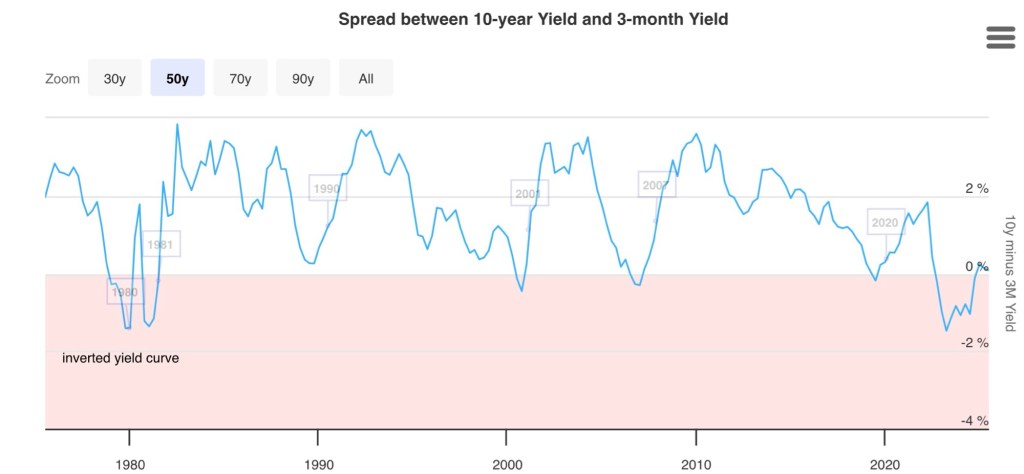
It’s certainly too early to declare that the Fed has engineered a “soft landing”, avoiding recession while successfully reigning-in inflation. The still-inverted yield curve is the classic signal that credit markets “expect” a recession. Here is the New York Federal Reserve Bank’s recession probability indicator, which is at its highest level in over 40 years:

There are other signs of weakness: the index of leading economic indicators has moved down for the last 13 months, real retail sales are down from 13 months ago, and real average weekly earnings have been trending down since January, 2021. A real threat is the weakness in commercial real estate, which could renew pressure on regional banks. Credit is increasingly tight, and that is bound to take a toll on the real economy before long.

The labor market presents its own set of puzzles. The ratio of job vacancies to job seekers has declined, but it is still rather high. Multiple job holders have increased, which might be a sign of stress. Some have speculated that employers are “hoarding” labor, hedging against the advent of an ultimate rebound in the economy, when finding new workers might be a challenge.

Despite some high-profile layoffs in tech and financial services, job gains have held up well thus far. Of course, the labor market typically lags turns in the real economy. We’ve seen declining labor productivity, consistent with changes in real earnings. This is probably a sign that while job growth remains strong, we are witnessing a shift in the composition of jobs from highly-skilled and highly-paid workers to lower-paid workers.

A further qualification is that many of the most highly-qualified job applicants are already employed, and are not part of the pool of idle workers. It’s also true that jobless claims, while not at alarming levels, have been trending higher.

It’s important to remember that the Fed’s policy stance over the past year is intended to reduce liquidity and ultimately excess demand for goods and services. In typical boom-and-bust fashion, the tightening was a reversal from the easy-money policy pursued by the Fed from 2020 – early 2022, even in the face of rising inflation. The money supply has been declining for just over a year now, but the declines have been far short of the massive expansion that took place during the pandemic. There is still quite a lot of liquidity in the system.

That liquidity helps explain the stock market’s recovery in the face of ongoing doubts about the economy. While the market is still well short of the highs reached in early 2022, recent gains have been impressive.

Some would argue that the forward view driving stock prices reflects an expectation of a mild recession and an inevitable rebound in the economy, no doubt accompanied by eventual cuts in the Fed’s interest rate target. But even stipulating that’s the case, the timing of a stock rally on those terms seems a little premature. Or maybe not! It wouldn’t be the first time incoming data revealed a recession had been underway that no one knew was happening in real time. Are we actually coming out of shallow woods?

To summarize, inflation is down but not out. The Fed might continue its pause on rate hikes through one more meeting in late July, but there will be additional rate increases if inflation remains persistent or edges up from present levels, or if the economy shows unexpected signs of strength. I’d like to be wrong about the prospects of a recession, but a downturn is likely over the next 12 months. I’ve been saying that a recession is ahead for the past eight months or so, which reminds me that even a broken clock is right twice a day. In any case, the stock market seems to expect something mild. However misplaced, hopes for a soft landing seem very much alive.

← Older posts
Follow Sacred Cow Chips on WordPress.com

Recent Posts

  • Immigration and Merit As Fiscal Propositions
  • Tariff “Dividend” From An Indigent State
  • Almost Looks Like the Fed Has a 3% Inflation Target
  • Government Malpractice Breeds Health Care Havoc
  • A Tax On Imports Takes a Toll on Exports

Archives

  • December 2025
  • November 2025
  • October 2025
  • September 2025
  • August 2025
  • July 2025
  • June 2025
  • May 2025
  • April 2025
  • March 2025
  • February 2025
  • January 2025
  • December 2024
  • November 2024
  • October 2024
  • September 2024
  • August 2024
  • July 2024
  • June 2024
  • May 2024
  • April 2024
  • March 2024
  • February 2024
  • January 2024
  • December 2023
  • November 2023
  • August 2023
  • July 2023
  • June 2023
  • May 2023
  • April 2023
  • March 2023
  • February 2023
  • January 2023
  • December 2022
  • November 2022
  • October 2022
  • September 2022
  • August 2022
  • July 2022
  • June 2022
  • May 2022
  • April 2022
  • March 2022
  • February 2022
  • January 2022
  • December 2021
  • November 2021
  • October 2021
  • September 2021
  • August 2021
  • July 2021
  • June 2021
  • May 2021
  • April 2021
  • March 2021
  • February 2021
  • January 2021
  • December 2020
  • November 2020
  • October 2020
  • September 2020
  • August 2020
  • July 2020
  • June 2020
  • May 2020
  • April 2020
  • March 2020
  • February 2020
  • January 2020
  • December 2019
  • November 2019
  • October 2019
  • September 2019
  • August 2019
  • July 2019
  • June 2019
  • May 2019
  • April 2019
  • March 2019
  • February 2019
  • January 2019
  • December 2018
  • November 2018
  • October 2018
  • September 2018
  • August 2018
  • July 2018
  • June 2018
  • May 2018
  • April 2018
  • March 2018
  • February 2018
  • January 2018
  • December 2017
  • November 2017
  • October 2017
  • September 2017
  • August 2017
  • July 2017
  • June 2017
  • May 2017
  • April 2017
  • March 2017
  • February 2017
  • January 2017
  • December 2016
  • November 2016
  • October 2016
  • September 2016
  • August 2016
  • July 2016
  • June 2016
  • May 2016
  • April 2016
  • March 2016
  • February 2016
  • January 2016
  • December 2015
  • November 2015
  • October 2015
  • September 2015
  • August 2015
  • July 2015
  • June 2015
  • May 2015
  • April 2015
  • March 2015
  • February 2015
  • January 2015
  • December 2014
  • November 2014
  • October 2014
  • September 2014
  • August 2014
  • July 2014
  • June 2014
  • May 2014
  • April 2014
  • March 2014

Blogs I Follow

  • Passive Income Kickstart
  • OnlyFinance.net
  • TLC Cholesterol
  • Nintil
  • kendunning.net
  • DCWhispers.com
  • Hoong-Wai in the UK
  • Marginal REVOLUTION
  • Stlouis
  • Watts Up With That?
  • Aussie Nationalist Blog
  • American Elephants
  • The View from Alexandria
  • The Gymnasium
  • A Force for Good
  • Notes On Liberty
  • troymo
  • SUNDAY BLOG Stephanie Sievers
  • Miss Lou Acquiring Lore
  • Your Well Wisher Program
  • Objectivism In Depth
  • RobotEnomics
  • Orderstatistic
  • Paradigm Library
  • Scattered Showers and Quicksand

Blog at WordPress.com.

Passive Income Kickstart

OnlyFinance.net

TLC Cholesterol

Nintil

To estimate, compare, distinguish, discuss, and trace to its principal sources everything

kendunning.net

The Future is Ours to Create

DCWhispers.com

Hoong-Wai in the UK

A Commonwealth immigrant's perspective on the UK's public arena.

Marginal REVOLUTION

Small Steps Toward A Much Better World

Stlouis

Watts Up With That?

The world's most viewed site on global warming and climate change

Aussie Nationalist Blog

Commentary from a Paleoconservative and Nationalist perspective

American Elephants

Defending Life, Liberty and the Pursuit of Happiness

The View from Alexandria

In advanced civilizations the period loosely called Alexandrian is usually associated with flexible morals, perfunctory religion, populist standards and cosmopolitan tastes, feminism, exotic cults, and the rapid turnover of high and low fads---in short, a falling away (which is all that decadence means) from the strictness of traditional rules, embodied in character and inforced from within. -- Jacques Barzun

The Gymnasium

A place for reason, politics, economics, and faith steeped in the classical liberal tradition

A Force for Good

How economics, morality, and markets combine

Notes On Liberty

Spontaneous thoughts on a humble creed

troymo

SUNDAY BLOG Stephanie Sievers

Escaping the everyday life with photographs from my travels

Miss Lou Acquiring Lore

Gallery of Life...

Your Well Wisher Program

Attempt to solve commonly known problems…

Objectivism In Depth

Exploring Ayn Rand's revolutionary philosophy.

RobotEnomics

(A)n (I)ntelligent Future

Orderstatistic

Economics, chess and anything else on my mind.

Paradigm Library

OODA Looping

Scattered Showers and Quicksand

Musings on science, investing, finance, economics, politics, and probably fly fishing.

  • Subscribe Subscribed
    • Sacred Cow Chips
    • Join 128 other subscribers
    • Already have a WordPress.com account? Log in now.
    • Sacred Cow Chips
    • Subscribe Subscribed
    • Sign up
    • Log in
    • Report this content
    • View site in Reader
    • Manage subscriptions
    • Collapse this bar
 

Loading Comments...