• About

Sacred Cow Chips

Sacred Cow Chips

Category Archives: Regulation

Anti-Glyphosate Goons and Gullibility

15 Sunday May 2016

Posted by Nuetzel in Agriculture, Regulation, Technology

≈ Leave a comment

Tags

Biology Fortified, Carcinogens, Christopher Portier, David Zaruk, Environmental Defense Fund, EPA, Farmer's Daughter, Glyphosate, IARC, International Agency for Research on Cancer, Julie Kelly, Kathryn Guyton, Matt Ridley, psuedoscience, Rational Optimist, Risk Monger, Roundup, Toxicity, WHO, World Health Organization

pseudociencia-a-saco

See the Postscript below.

A “roundup” of findings on the safety of glyphosate shows that the herbicide is very benign, highly unlikely to pose any real threat to humans, and far less toxic than many common household chemicals and even natural hazards in the environment. However, the debate over glyphosate is heavily politicized, as illustrated by the unsavory details surrounding a report issued last year by the International Agency for Research on Cancer (IARC), an arm of the World Health Organization (WHO). The IARC reclassified glyphosate as “probably carcinogenic to humans” based on a few cherry-picked, poorly-designed studies with weak statistical power. That finding is inconsistent with the vast preponderance research, which shows that glyphosate is not a significant threat to human health.

The Farmer’s Daughter provided a good summary of the issues shortly after the IARC’s ruling was announced last year. She offers the following quote from the U.S. Environmental Protection Agency (EPA):

“The U.S. EPA classified glyphosate as Group E, evidence of non-carcinogenicity in humans. The U.S. EPA does not consider glyphosate to be a human carcinogen based on studies of laboratory animals that did not produce compelling evidence of carcinogenicity.“

European regulators reached similar conclusions and are rather damning in their assessment of the IARC’s findings, though Brussels recently disregarded their findings and decided to ban the sale of glyphosate for gardening. In this post at Biology Fortified, Anastasia Bodnar discusses the low toxicity of glyphosate with links to several recent studies on its safety. And here is the Risk Monger blogs’s list of “ten reasons why glyphosate is the herbicide of the century“:

  1. Controlling invasive weeds leads to better agricultural yields
  2. Better yields = less land in production = more meadows and biodiversity
  3. Extremely low toxicity levels compared to (organic) alternatives
  4. Allows for no or low till farming – better for soil management
  5. Reduces CO2 emissions (compared to organic)
  6. Glyphosate saves lives
  7. It is much more affordable and effective than other options
  8. Glyphosate is off patent so no single company is profiting heavily from it
  9. Glyphosate-resistant crops allow for more ecological weed management practices
  10. There is overwhelming scientific evidence that glyphosate is safe for humans

How, then, did the IARC reach such a negative conclusion? Again from the Risk Monger, David Zaruk, the IARC hired just one external technical advisor, Christopher Portier, an activist previously employed by an NGO, the anti-pesticide Environmental Defense Fund (EDF). Portier has no technical background in toxicology, and the IARC apparently went to pains to avoid references to his affiliation with the EDF. Moreover, the IARC’s conclusion seems to have been preordained:

“The IARC study rejected thousands of documents on glyphosate that had industry involvement and based their decision on carcinogenicity on the basis of eight studies (rejecting a further six because they did not like their conclusions).“

The lead author of the report, Kathryn Guyton, gave a speech in 2014 in which she stated that herbicide studies slated for 2015 showed indications of a link to cancer. Just how did she know, so far ahead of time? And then there’s this revelation:

“According to the observer document, the glyphosate meeting started with the participants being told to rule out the possibility of classifying the substance as non-carcinogenic.“

Zaruk believes there is internal pressure for the IARC study to be retracted. The organization has suffered a great loss of credibility in the scientific community over the report. In addition, WHO has remained neutral thus far, but they are expected to address the issue this month.

Zaruk and Julie Kelly provide a more succinct summary of the issues in “The Facebook Age of Science at The World Health Organization” at National Review. The suggestion made in the title seems to be that WHO’s decision might be swayed by public pressure, measured by Facebook “likes” by the superstitious, such as unknowing David Wolfe devotees, rather than science:

“Environmentalists and organic companies tout phony studies claiming that glyphosate is found in everything from breast milk to bagels. … Meanwhile, farmers who use glyphosate to protect their crops and boost yields are caught in the crossfire. Even if glyphosate is banned, they will need to use another herbicide, probably more toxic, because the romantic notion of hand-weeding millions of acres of crops is promoted only by those who have never done it.“

I’ll keep using Monsanto’s Roundup, thanks! Or a competitive brand of glyphosate. To close, here’s a quote from Matt Ridley’s Rational Optimist blog on the embrace of pseudoscience at the IARC and elsewhere (including social media):

“Science, humanity’s greatest intellectual achievement, has always been vulnerable to infection by pseudoscience, which pretends to use the methods of science, but actually subverts them in pursuit of an obsession. Instead of evidence-based policymaking, pseudoscience specialises in policy-based evidence making. Today, this infection is spreading.“

Postscript: On May 16, WHO announced that glyphosate is “unlikely to cause cancer in people via dietary exposure.” Here is a Q&A from WHO regarding its assessment, explaining that it is based on risk as opposed to mere hazard, upon which the earlier IARC report was based. This is good news!
 

Hamburger Nation: An Administrative Nightmare

04 Friday Mar 2016

Posted by Nuetzel in Big Government, Judicial Branch, Legislative Branch, Regulation

≈ 4 Comments

Tags

Administrative Law, Administrative State, Constitutional convention, Delegated Powers, Due Process, Extralegal Powers, Fourth Branch, George Akerlof, Glenn Reynolds, Ham Sandwich Nation, Ilya Somin, IRS Targeting, Ivan Carrino, Joseph Postell, Marginal Revolution, Mia Love, Michael Ramsey, Philip Hamburger, Richard Epstein, Robert Shiller, Rule of Consent, Takings, The Originalism Blog, Volokh Conspiracy

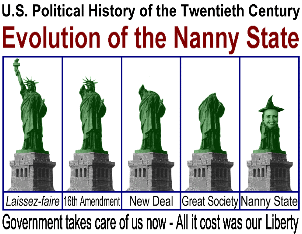
nanny-state

By what authority do unelected bureaucrats in administrative agencies increasingly make laws, enforce those laws and adjudicate violations? The fact that all of these activities take place within the executive branch of government appears to be an obvious contradiction of the separation of powers required by the first three articles of the Constitution, the principle of “Rule By Consent” of the governed, and protections of individual liberty. In a strong sense, the regulatory apparatus has grown so unwieldy that the powers routinely exercised by administrative agencies today seem beyond even the reach of elected executives. The rules promulgated by this “fourth branch” of government are essentially extralegal, a point discussed at length in Philip Hamburger’s “Is Administrative Law Unlawful“. He has also explained these issues at the Volokh Conspiracy blog in “Extralegal power, delegation, and necessity“, and “The Constitution’s repudiation of extralegal power“.

Hamburger examines the assertion that rule-making must be delegated by Congress to administrative agencies because legislation cannot reasonably be expected to address the many details and complexities encountered in the implementation of new laws. Yet this is a delegation of legislative power. Once delegated, this power has a way of metastasizing at the whim of agency apparatchiks, if not at the direction of the chief executive. If you should want to protest an administrative ruling, your first stop will not be a normal court of law, but an administrative review board or a court run by the agency itself! You’ll be well advised to hire an administrative attorney to represent you. Eventually, and at greater expense, an adverse decision can be appealed to the judicial branch proper.

This adds up to a dangerous lack of accountability and power. Marginal Revolution points out that critics of Hamburger’s book overlook the potential for harm that could be done by a “vindictive” president. But we should not lose sight of the fact that bureaucrats themselves, at any level, can be vindictive, as the IRS targeting scandal has shown. But that is only one motive for abuse of power; another motive may be more pervasive: the ability to reward those in a position to promote the self-interests of those who populate the administrative state. These are dangers that are endemic to big government. In a post entitled “Are Government Regulators More Virtuous than Everyone Else” (No!), Ivan Carrino highlights the weakness of arguments like those made by George Akerlof and Robert Shiller in “Phishing For Phools“, who call for greater government regulation on the grounds that consumers are vulnerable to manipulation by businesses. Carrino says:

“One can’t help but notice the central contradiction in this analysis. On the one hand, it is assumed that markets fail because of ‘normal human weakness.’ On the other hand, it is assumed that regulation, which must necessarily be implemented by human beings with equal or greater ‘weaknesses,’ will somehow solve the problem.

Akerlof and Shiller simultaneously demonize human beings who operate in the private sector while idealizing human beings who operate in the public sector.“

Glenn Reynolds has been a prominent critic of the administrative state. As a consequence of the vast and growing body of regulatory rules, it’s become increasingly difficult for individuals, acting on their own or as businesspeople, to know whether they are in acting in violation of administrative law. Reynolds discusses regulatory crime and over-criminalization in “You May Be Breaking The Law Right Now“, and in his great paper “Ham Sandwich Nation: Due Process When Everything is a Crime” (free download).

Hamburger’s main position is that law should be made by elected representatives, not by bureaucrats who lack direct accountability to voters. Ilya Somin believes that with time, Hamburger will have great influence on legal theorists in this regard. He compares Hamburger’s insights on administrative law to Richard Epstein’s work on takings. Epstein insisted that “almost all regulations that restrict property rights should be considered ‘takings’ that require compensation under the Fifth Amendment.” Somin notes that Epstein’s position, despite harsh criticism from certain quarters, has influenced legal thinking in a dramatic way over the years.

What’s to be done? Can a line reasonably be drawn between constitutional legislative power and delegated rule-making authority? Somin is skeptical that absolute restrictions on lawmaking by the administrative state are practical, in the sense that there will always be details that cannot be addressed in enabling legislation. Others have suggested practical paths forward: Joseph Postell attempts to give a roadmap in “From Administrative State to Constitutional Government“. A recent Glenn Reynolds op-ed, “Blow Up The Administrative State“, gives a qualified defense of Texas Governor Greg Abbot’s proposed amendments to the Constitution. Among other things, Abbot proposes to:

“–Prohibit administrative agencies … from creating federal law.
  –Prohibit administrative agencies … from preempting state law.
  –Give state officials the power to sue in federal court when … officials overstep their bounds.
  –Allow a two-thirds majority of the states to override a federal law or regulation.”

I would add that administrative review and adjudication should be independent of the agencies themselves. Also, Representative Mia Love (R-UT) has proposed legislation that would restrict Congress to bills focused on points directly related to a single issue (i.e., no omnibus bills), which would help to check the growth of the administrative state.

All of these measures seem consistent with Hamburger’s views. Reynolds is fully cognizant of the dangers of a constitutional convention. Nevertheless, he recognizes that Abbot’s proposals would impose harder limits on the size of government, and defends them in colorful fashion:

“A smaller government would mean fewer phony-baloney jobs for college graduates with few marketable skills but demonstrated political loyalty. It would mean fewer opportunities for tax dollars to be directed to people and entities with close ties to people in power. It would mean less ability to engage in social engineering and ‘nudges’ aimed at what are all-too-often seen as those dumb rubes in flyover country. The smaller the government, the fewer the opportunities for graft and self-aggrandizement — and graft and self-aggrandizement are what our political class is all about.“

For further reading, Michael Ramsey at The Originalism Blog posts links to several other essays by Hamburger at The Volokh Conspiracy, where he acted as a guest-blogger.


Horizons Lost To Coercive Intervention

27 Wednesday Jan 2016

Posted by Nuetzel in Human Welfare, Price Controls, Regulation

≈ Leave a comment

Tags

Allocation of Resources, Don Boudreaux, Foregone Alternatives, Frederic Bastiat, Luddites, Minimum Wage, Opportunity Costs, Price Ceilings, Price Controls, Price floors, Rent Control, Scientism, Unintended Consequences, What is Not Seen

ceiling prices

Every action has a cost. When you’re on the hook, major decisions are obviously worth pondering. But major societal decisions are often made by agents who are not on the hook, with little if any accountability for long-term consequences. They have every incentive to discount potential downside effects, especially in the distant future. Following Frederic Bastiat, Don Boudreaux writes of three levels of “What Is Not Seen” as a consequence of human decisions, which I summarize here:

  1. Immediate foregone alternatives: Possession, use and enjoyment of X is not seen if you buy Y.
  2. Resources not directed to foregone alternatives: The reduction in X inventory is not seen, compensating production of X is not seen, and extra worker hours, capital use and flow of raw materials needed for X production are not seen.
  3. The future implied by foregone alternatives: Future impacts can take many forms. X might have been a safer or healthier alternative, but those benefits are unseen. X might have been lower quality, so the potential frustration and repairs are unseen. X might have been less expensive, but the future benefits of the money saved are unseen. All of these “unseens” have implications for the future world experienced by the decision-maker and others.

These effects take on much more significance in multiples, but (2) and (3) constitute extended unseen implications for society at large. In multiples, the lost (unseen) X production and X labor-hours, capital and raw materials are more obvious to the losers in the X industry than the winners in the Y industry, but they matter. In the future, no vibrant X industry will not be seen; the resources diverted to meet Y demand won’t be seen at new or even old X factories. X might well vanish, leaving only nontransformable detritus as a token of its existence.

Changes in private preferences or in production technologies create waves in the course of the “seen” reality and the “unseen” world foregone. Those differences are caused by voluntary, private choice, so gains are expected to outweigh losses relative to the “road not traveled”. That’s not a given, however, when decisions are imposed by external authorities with incentives unaligned with those in their thrall. For that reason, awareness of the unseen is of great importance in policy analysis, which is really Boudreaux’s point. Here is an extreme example he offers in addressing the far-reaching implications of government intrusions:

“Suppose that Uncle Sam in the early 20th century had, with a hypothetical Ludd Act, effectively prohibited the electrification of American farms, businesses, and homes. That such a policy would have had a large not-seen element is evident even to fans of Bernie Sanders. But the details of this not-seen element would have been impossible today even to guess at with any reliability. Attempting to quantify it econometrically would be an exercise in utter futility. No one in a 2015 America that had never been electrified could guess with any sense what the Ludd Act had cost Americans (and non-Americans as well). The not-seen would, in such a case, loom so large and be so disconnected to any known reality that it would be completely mysterious.“

Price regulation provides more familiar examples. Rent controls intended to “protect” the public from landlords have enormous “unintended” consequences. Like any price regulation, rent controls stifle exchange, reducing the supply and quality of housing. Renters are given an incentive to remain in their units, and property owners have little incentive to maintain or upgrade their properties. Deterioration is inevitable, and ultimately displacement of renters. The unseen, lost world would have included more housing, better housing, more stable neighborhoods and probably less crime.

A price floor covered by Boudreaux is the minimum wage. The fully predictable but unintended consequences include immediate losses in some combination of jobs, hours, benefits, and working conditions by the least-skilled class of workers. Higher paid workers feel the impact too, as they are asked to perform more (and less complex) tasks or are victimized by more widespread substitution of capital for labor. Consumers also feel some of the pain in higher prices. The net effect is a reduction in mutually beneficial trade that continues and may compound with time:

“As the time span over which obstructions to certain economic exchanges lengthens, the exchanges that would have, but didn’t, take place accumulate. The businesses that would have been created absent a minimum wage – but which, because of the minimum wage, are never created – grow in number and variety. The instances of on-the-job worker training that would have occurred – but, because of the minimum wage, didn’t occur – stack up increasingly over time.“

Regulation and taxation of all forms have such destructive consequences, but policy makers seldom place a heavy weight on the unobserved counterfactual. Boudreaux emphasizes the futility of quantifying the “unseen” effects these policies:

“… those who insist that only that which can be measured and quantified with numerical data is real must deny, as a matter of their crabbed and blinding scientism, that such long-term effects … are not only not-seen but also, because they are not-seen, not real.“

The trade and welfare losses of coercive interventions of all types are not hypothetical. They are as real as the losses caused by destruction of property by vandals. Never again can the owners enjoy the property as they once had. Future pleasures are lost and cannot be observed or measured objectively. Even worse, when government disrupts economic activity, the cumulative losses condemn the public to a backward world that they will find difficult to recognize as such.


End The FDA’s War On Drug Development

16 Wednesday Dec 2015

Posted by Nuetzel in Health Care, Regulation

≈ Leave a comment

Tags

21st Century Cures Act, Alex Tabarrok, Biologics, Drug Approval, European Medicines Agency, FDA, Federal Drug Administration, Fred Upton, Free To Choose Medicine, Genetic Targeting, Goldwater Institute, Mike Lee, Reciprocity, Right To Try, Ted Cruz

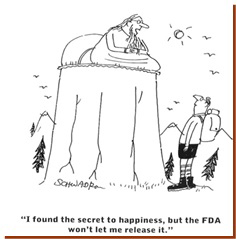
FDA Secret Happiness

For the seriously ill, the phrase “regulated to death” might hit close to home when it comes to the U.S. Food and Drug Administration. The agency is a notorious bottleneck on the availability of new, potentially life-saving drugs. Its policies seem to rely on an over-reading of the precautionary principle: that the risk of harm must be weighted heavily regardless of the opportunity cost in terms of curative, life-extending or palliative potential. The facts are as economist Alex Tabarrok describes:

“It costs well over a billion dollars to get the average new drug approved and much of that cost comes from FDA required clinical trials. Longer and larger clinical trials mean that the drugs that are eventually approved are safer. But longer trials also mean that good drugs are delayed. And the more expensive it is to produce new drugs the fewer new drugs will be produced. In short, longer and larger trials mean drug delay and drug loss.“

One billion-plus dollars of incremental cost for the average new drug! Not only are the lengthy delays unacceptable, but the added cost seriously inflates new drug prices. Furthermore, it is difficult for small, innovative competitors to engage in development in the face of costs like these. And while large pharmaceutical companies might be forced to limit investment in new drug research and might rightfully bemoan their cost structures, they are in a much better position to handle the regulatory burden than start-ups.

Tabarrok has long advocated “reciprocity”, or U.S. approval of “drugs, devices and biologics” that have been approved by authorities (such as the European Medicines Agency, or EMA) in certain other developed countries. He has also advocated “Free To Choose Medicine” principles, which would create a dual track allowing certain patients to opt into the use of drugs at a relatively early stage in the FDA’s approval process. Research studies cited by Tabarrok suggest that expedited drug approval can provide substantial benefits in terms of patient survival years without compromising safety.

A bill introduced by Senators Ted Cruz (R-TX) and Mike Lee (R-UT) would authorize reciprocity in the U.S. In October, Cruz discussed the legislation in this article:

“The FDA model is risk-averse, by its very nature obstructing promising innovations. It largely assumes that the biology of patients is the same, rather than recognizing that individuals’ genetic makeup varies widely. As a result, the only drugs the agency tends to approve are those that help a broad spectrum of patients and harm close to no one. That method may work to fight diseases that affect us all in a similar way, such as smallpox or cholera, but it does not work for diseases such as Alzheimer’s and cancer, which are highly tailored to each individual’s genetic makeup. In medicine, a one-size-fits-all approach ignores the diversity of the human person and limits the discovery of innovative cures to a small segment of those afflicted with disease.“

Tabarrok anticipates a certain objection to reciprocity:

“The argument for reciprocity, however, isn’t that the FDA is uniquely bad or always worse than the EMA or vice-versa. The argument is that it’s wasteful to duplicate the lengthy approval process and that both agencies sometimes make mistakes. As a result, it’s simple common sense to let Americans avail themselves of drugs and devices approved in other developed countries.“

There are other reform proposals in play. The Goldwater Institute has advocated “Right to Try” laws at the state level that would allow terminally-ill patients to access unapproved medicines. Representative Fred Upton (R-MI) has introduced the 21st Century Cures Act, which includes:

“... steps to streamline clinical trials; advance personalized medicine by encouraging greater use of drug development tools, such as biomarkers; and creat[es] incentives for developing drugs for uncommon but deadly diseases.”

Regulation is often an obstacle to vibrant competition and innovation, and the FDA’s antiquated drug approval process is certainly a hindrance. The process adds time and expense to drug development that carries unacceptable human costs. It is beyond comprehension that drugs can be rejected for procedural reasons when their proposed use involves circumstances that could hardly be worse, when those drugs carry little incremental downside risk. The rights of patients and the judgements of their physicians should take precedence over the sometimes picayune concerns of a regulatory bureaucracy. The reforms discussed above would be positive steps toward establishing that primacy.


Government Economy; Government Science: You Wanted Growth?

28 Wednesday Oct 2015

Posted by Nuetzel in Central Planning, Regulation, Technology

≈ Leave a comment

Tags

Basic Science, economic growth, Innovation, John Cochrane, Matt Ridley, Productivity Growth, Public Funding of Science, regulation, Technological advance

science1

Economic growth allows us to enjoy an improving material existence and the wealth to pursue other goals as a society, such as a clean environment. Yet we often pursue other goals in ways that strangle growth, when in fact those goals and growth are fundamentally compatible.

Two articles that caught my attention today approach this issue from different but complementary perspectives. One is by John Cochrane of the University of Chicago, a lengthy piece called simply “Economic Growth“. At the outset, Cochrane asserts that the one, ultimate source of economic growth in the long-run is through advancing productivity. He notes, however, that the U.S. has been falling short in that department of late. Re-establishing growth should start with a clean-up of the many harmful public policies that have cluttered the economic landscape, especially over the last few decades. Unfortunately, politics makes this easier said than done:

“The golden rule of economic policy is: Do not transfer incomes by distorting prices or slowing competition and innovation. The golden rule of political economics seems to be: Transfer incomes by distorting prices and regulating away competition. Doing so attracts a lot less attention than on-budget transfers or subsidies. It takes great political leadership to force the political process to obey the economic rule.“

Cochrane’s discussion is wide ranging, covering a number of areas of public policy that require “weeding”, as he puts it: the regulatory arena (finance, health care, energy and the environment), tax policy, debt and deficits, the design of social programs and entitlements, labor law and regulation, immigration, education, agricultural policy, trade, and the process of infrastructure investment. There may be a year’s worth of blog posts to be drawn from Cochrane’s essay, but I think “weeding” understates the difficulty of the tasks outlined by Cochrane to reignite growth.

The second article that interested me today dealt with technological advance, which is a primary driver of productivity growth. Economists and pundits often prescribe policies that they believe will lead to transformational breakthroughs in technology. This usually manifests in advocacy for increased public funding for basic scientific research. This is a mistake, according to Matt Ridley’s great article, “The Myth of Basic Science“. In fact, one might say that he’s identified another government-nourished weed for Cochrane to pull. I found Ridley’s opening paragraph intriguing:

“Innovation is a mysteriously difficult thing to dictate. Technology seems to change by a sort of inexorable, evolutionary progress, which we probably cannot stop—or speed up much either. And it’s not much the product of science. Most technological breakthroughs come from technologists tinkering, not from researchers chasing hypotheses. Heretical as it may sound, “basic science” isn’t nearly as productive of new inventions as we tend to think.“

Ridley’s thesis (actually, he credits several others for formulating this line of thinking) is that technology growth is very much an independent process, impossible to push or steer effectively. He goes so far as to say that it can’t be stopped, but he also cites ways in which it can be inhibited.

This perspective on technology has implications for patent law, a subject that Ridley explores to some extent. It also reflects badly on government efforts to direct and stimulate advances by granting subsidies to favored technologies and more aggressive funding of  “basic science”. Government, in Ridley’s view, is largely impotent in spawning technological advance. By pushing technologies that are uneconomic, government distorts price signals, diverts resources from more productive investments, and embeds inferior technologies in the economy’s productive capital base.

But Ridley’s point has more to do with the futility of basic science as a driver of technological advance, and the strong possibility that causation often runs in the other direction:

“It is no accident that astronomy blossomed in the wake of the age of exploration. The steam engine owed almost nothing to the science of thermodynamics, but the science of thermodynamics owed almost everything to the steam engine. The discovery of the structure of DNA depended heavily on X-ray crystallography of biological molecules, a technique developed in the wool industry to try to improve textiles.

Technological advances are driven by practical men who tinkered until they had better machines; abstract scientific rumination is the last thing they do. As Adam Smith, looking around the factories of 18th-century Scotland, reported in ‘The Wealth of Nations’: ‘A great part of the machines made use in manufactures…were originally the inventions of common workmen,’ and many improvements had been made ‘by the ingenuity of the makers of the machines.’

It follows that there is less need for government to fund science: Industry will do this itself. Having made innovations, it will then pay for research into the principles behind them. Having invented the steam engine, it will pay for thermodynamics. This conclusion … is so heretical as to be incomprehensible to most economists, to say nothing of scientists themselves.“

It’s good to qualify that “industry will do this itself” only if it isn’t severely hamstrung by meddling politicians and regulators.

Ridley goes on to cite a few inconvenient historical facts that run counter to the narrative that public funding of science is a necessary condition for technical advance. He also cites empirical work suggesting that the return on publicly-funded R&D is paltry. In fact, he allows that government involvement in “basic science” may inhibit more economically viable advances and their adoption. There is no question that government often chooses unwisely without the discipline of market incentives. If it gets funded, then bad science, politically-driven “science” and ultimately nonproductive science might very well crowd-out better private science and innovation.

In a time of strained government budgets, public funding for basic science should be subjected to as much scrutiny as any other spending category. Like Ridley, I have much more faith in private tinkerers to choose wisely when it comes to the development of new technologies. Intimacy with actual markets and with the production process itself improve the odds that private developers and technologists will be more effective at boosting productivity.

The Insane Substitution Of Regulation For Value

21 Monday Sep 2015

Posted by Nuetzel in Big Government, Regulation

≈ Leave a comment

Tags

Broadband Investment, Code of Federal Regulation, Compliance Costs, Coyote Blog, Dodd Frank Act, e-Verify, Great Stagnation, Jimmy Carter, L. Gordon Crovitz, Mercatus Center, Net Neutrality, Obamacare penalties, Regulatory Burdens, Regulatory State, Vestigial Regulations, Warren Meyer

Regulatory Burdens

My day-job at a financial institution has become increasingly dominated by governance and compliance issues, due largely to the Dodd-Frank Act. Much less of my time these days is dedicated to activities that are of direct value to the business or its customers. It’s not just me, but a large number of talented professionals with whom I work, many having advanced degrees. And a platoon of government regulators with advanced degrees often resides in a conference room on our floor. As I overheard one colleague say the other day, even a sneeze now requires permission from regulators. It feels very much like working for a regulated public utility, or worse yet, a government agency. This is obviously costly for shareholders, customers and taxpayers. If asked, I would be hard-pressed to explain how such massive compliance activity adds value for anyone, except perhaps the regulators themselves, or those who like the job guarantee provided by the situation. Does it offer some extra guarantee of stability for our institution, which remained stable and viable throughout the last financial crisis? Not likely, especially if actually managing the business has anything to do with it. Does it guarantee the stability of the larger financial system to impose massive compliance costs and ossify an otherwise dynamic enterprise?

The financial industry is not the only sector plagued by this phenomenon. At Coyote Blog, Warren Meyer provides a great perspective based on his own experience (and he deserves the inspirational hat-tip for this post). Meyer owns and operates a company that manages public parks. Here is his summary:

“Ten years ago, most of my company’s free capacity was used to pursue growth opportunities and refine operations. Over the last four years or so, all of our free capacity has been spent solely on compliance.“

Meyer offers details of compliance issues that have robbed his business of productive time and energy:

  • Managing hours of seasonal employees to avoid Obamacare penalties;
  • Seeking government approval of price increases to recover minimum wage hikes;
  • Implementing and running e-Verify on new hires;
  • Additional employee hiring documentation requirements;
  • Compliance with California regulation of chairs, hot-day practices, meal breaks, overtime assignments, employee sick days, and other processes;

He goes on to note some economy-wide implications of these entanglements:

“… for folks who are scratching their head over recent plateauing of productivity gains and reduced small business origination numbers, you might look in this direction.

By the way, it strikes me that regulatory compliance issues set a minimum size for business viability. You have to be large enough to cover those compliance issues and still make money. What I see happening is that as new compliance issues are layered on, that minimum size rises, like a rising tide slowly drowning companies not large enough to keep their head above water.“

There is no doubt that heavy regulation favors large firms over small firms, and it makes competing with entrenched businesses more difficult for new entrants. Here is the first of a trio of relevant posts from the Mercatus Center, a summary of research finding that regulation reduces new business start-ups and hiring activity.

A heavily regulated economy is likely to suffer from an accumulation of old, irrelevant, or often conflicting rules. A second Mercatus Center post, “‘Regulatory Appendicitis’ and the Dangers of Vestigial Regulations” focuses on an additional problem: the application of old rules to regulate new technologies:

“From a regulatory agency’s perspective, recycling old rules makes sense: Old rules have withstood legal challenges and offer a relatively safe legal route. However, the rules are unlikely to optimally fit the new context for which they are employed. The use of rules that aren’t optimized for the task at hand can significantly hamper innovation and the development of technology. Even worse, due to poor design, they may not actually accomplish the new objective.“

A case in point is the recent imposition of “net neutrality” rules, which prevent ISPs and internet backbone providers from charging incremental rates to network hogs. This involves the application of regulatory rules designed for railroads 130 years ago and applied to the phone system 80 years ago. L. Gordon Crovitz writes of the early, negative impact of this regulation on investment in broadband in a piece entitled “Obamanet Is Hurting Broadband” (if the link fails, Google “wsj Crovitz Obamanet Broadband” and choose the first link returned):

“Today bureaucrats lobbied by special interests determine what is ‘fair’ and ‘reasonable’ on the Internet, including rates, tariffs and business arrangements. The FCC got thousands of requests for new regulations within weeks of the new rules. … Before Obamanet went into effect, economist Hal Singer of the Progressive Policy Institute predicted in The Wall Street Journal that if price and other regulations were introduced, capital investments by ISPs could quickly fall … 5% and 12% a year …. Now Mr. Singer has analyzed the latest data, and his prediction has come true.“

Crovitz correctly states that consumers want more broadband, and broadband growth requires investment. Systematically punishing those who make such investments will not bring improvements in service. And this is not an isolated result. Apart from the absorption of staff time (which is often required to manage new investment), regulation discourages productive capital investment in new facilities, equipment and technology. The potential growth of the economy suffers as a result, including the potential growth of wages.

Several past posts on Sacred Cow Chips have dealt with the heavy costs imposed by regulation, including “Life’s Bleak When Your Goal Is Compliance“, “You Probably Broke The Law Today“, and “There Oughtta NOT Be a Law“.

Is there really a trend toward greater regulation? Yes, and it is not new. Has it accelerated? A third Mercatus Center post demonstrates that the Obama Administration, in terms of new regulatory restrictions, is on a pace to exceed all preceding presidents over the past 40 years. This is based on the Code of Federal Regulation (though Jimmy Carter edged Obama slightly over Obama’s first four years). Obama’s penchant for executive orders shows no sign of abating, and Congress is apparently incapable of over-riding any veto. Much of this can be reversed, in principle, but new regulations have a way of creating political constituencies, so reversals might be easier to say than do.

Ev’rybody’s Gone Serfin’, Serfdom USA

11 Tuesday Aug 2015

Posted by Nuetzel in Big Government, Regulation

≈ Leave a comment

Tags

Big government, Bureaucratic tyranny, Discovery, Due Process, Environmental regulation, Financial regulation, Friedrich Hayek, John Cochrane, Magna Carta, Regulatory fixers, Regulatory State, The Road To Serfdom, University of Chicago

image

Any new or existing enterprise can be strangled with ease when regulatory coercion is brought to bear. Whole industries can be strangled. And the strangulation of freedoms is not limited to business concerns. Individuals are impacted as well by the loss of employment choices and opportunities, choices in the marketplace, and even more basic freedoms such as speech and assembly. In an excellent paper, “The Rule of Law in the Regulatory State“, John Cochrane of The University of Chicago highlights the negative consequences of growth in the scope and complexity of regulation. It looks like a working paper with a few items in need of editorial attention. Nevertheless, it contains several interesting ideas, some noteworthy examples of regulatory overreach, and useful dimensions along which to think about regulatory power and its application.

Cochrane’s first two paragraphs give an overview of the pernicious social effects of regulation gone wild, yet they only scratch the surface:

“The United States’ regulatory bureaucracy has vast power. Regulators can ruin your life, and your business, very quickly, and you have very little recourse. That this power is damaging the economy is a commonplace complaint. Less recognized, but perhaps even more important, the burgeoning regulatory state poses a new threat to our political freedom.

What banker dares to speak out against the Fed, or trader against the SEC? What hospital or health insurer dares to speak out against HHS or Obamacare? What business needing environmental approval for a project dares to speak out against the EPA? What drug company dares to challenge the FDA? Our problems are not just national. What real estate developer needing zoning approval dares to speak out against the local zoning board?“

The centerpiece of Cochrane’s paper is his elaboration on a list of bullet points, or dimensions for assessing a regulatory process. The list is given below in italics (without quote marks), and each bullet is followed by my own brief clarification:

  • Rule vs. Discretion? – Rules are better. How much latitude shall a regulator have?
  • Simple/precise or vague/complex? – Simple is better. Vague/complex ≈ discretion.
  • Knowable rules vs. ex-post prosecutions? – Surprise! You’re busted. Vague ≈ unknowable. 
  • Permission or rule book? – Don’t make me ask. Review my plans non-arbitrarily. 
  • Plain text or fixers? – Must I hire a specialist with agency connections?
  • Enforced commonly or arbitrarily? – Objective vs. motivated enforcement.
  • Right to discovery and challenge decisions. – Transparency of evidence & standards.
  • Right to appeal. – to courts, not the agency.
  • Insulation from political process. – Limit discretion and scope of powers.
  • Speed vs. delay. – six months or approve by default.
  • Consultation, consent of the governed. – Formal representation in rule-making.

Sorry if lists make you snooze, but I think it’s a good list, even if the bullets aren’t mutually exclusive. The items highlight the always-present choice between restraining government’s exercise of coercive power versus restraining and coercing the governed.

Cochrane then takes the reader on a “tour” of regulatory areas, including several aspects of financial regulation, health care, foods & drugs, the environment, the internet, campaign finance, national security, immigration and education. These sections are brief, but in each of these areas, Cochrane highlights negative consequences of regulation that illustrate government failure based on the dimensions given in his list of bullets. Here’s an anecdote from his section on environmental regulation:

“Already, anyone opposed to a project for other reasons — like, it will block my view — can use environmental review to stop it. Delay is as good as denial in any commercial project.

The small story of Al Armendariz, head of EPA region 6 who proposed ‘crucifying’ some oil companies as an example to the others is instructive. He was caught on tape saying:

‘The Romans used to conquer little villages in the Mediterranean. They’d go into a little Turkish town somewhere, they’d find the first five guys they saw and they would crucify them. And then you know that town was really easy to manage for the next few years.

…we do have some pretty effective enforcement tools. Compliance can get very high, very, very quickly.’

According to the story, Armendariz shut down Range Resources, one of the first fracking companies. Range fought back and eventually a Federal Judge found in its favor. But an agency that operates by “crucifying” a few exemplars, explicitly to impose compliance costs, is ripe to choose just which exemplars will be crucified on political bases.“

Cochrane closes by describing his vision of a “Magna Carta for the regulatory state” in order to protect “citizens from arbitrary power“:

“It is time for a Magna Carta for the regulatory state. Regulations need to be made in a way that obeys my earlier bullet list. People need the rights to challenge regulators — to see the evidence against them, to challenge decisions, to appeal decisions. Yes, this means in court. Everyone hates lawyers, except when they need one.

People need a right to speedy decision. A “habeas corpus” for regulation would work — if any decision has not been rendered in 6 months, it is automatically in your favor.“

Accomplishing great things is difficult, both in the physical world and in creating value in any form for which other free individuals will trade. By comparison, failure is easy, and so are regulatory decisions that precipitate failure. So often, so easily, so arbitrarily, and with little accountability, those decisions destroy freedom, value and our ability to improve human welfare.

Government Wants To Gut Your Gig

24 Friday Jul 2015

Posted by Nuetzel in Big Government, Regulation

≈ Leave a comment

Tags

Bill De Blasio, Economic conservatism, Erik Sherman, Gig economy, Hillary Clinton, Megan McArdle, Overtime rules, rent seeking, Sharing economy, St. Louis Metropolitan Taxi Commission, Taskrabbit, Taxi deserts, Uber

uber-cartoonjpg

Big government is an inherently conservative enterprise when it comes to protecting  the economic status quo. It frequently acts on behalf of entrenched interests by quashing innovation and competition. This is well illustrated by resistance to the “gig economy” (or “sharing economy”) and companies like Uber and Taskrabbit. The gig economy is growing rapidly because it is often more affordable than traditional channels and it offers tremendous convenience. Enabled by the internet, customized tasks or “gigs” can be performed anywhere for anyone demanding them. My son in New York City just found a talented carpenter through an on-line app, who stopped by his apartment in the evening and mounted a big-screen TV on the wall. The service he provided was not new, but the deal was facilitated and even enhanced by technology in a way that in some cases is reordering economic relationships. The competitive pressure this can create is drawing resistance with the aid of government power.

In St. Louis, there is an ongoing conflict between the Taxicab Commission and Uber, which has not yet gained entry to the market. Three of eight members of the commission own cab companies. They have succeeded in keeping Uber and Lyft out of the market for over a year. A resolution might be possible soon, but the commission is still haggling with Uber over insurance coverage levels, fingerprints and background checks.

On the national stage, the biggest issue surrounding the gig economy is the formal relationship between workers and any company they might represent. Should those workers be treated as independent contractors or employees? Companies like Uber insist that their drivers are independent, but the government would prefer that they be treated as employees. In some cases, that would oblige employers to offer certain benefits. Erik Sherman covers this issue in “How the U.S. Just Knee-Capped the ‘Gig Economy’“. According to Uber, most of its drivers are part-time and like it that way, so it’s not clear that the government can force Uber (under current rules) to pay for extra benefits, or how many of its drivers that would affect. Still, it is instructive that the government is applying pressure in this area, potentially undermining competitive forces and voluntary relationships formed between innovative businesses and their working partners.

Big government advocates are extremely uncomfortable with the gig economy, but there are a fair number of progressives who place a high value on their ability to transact with “gigsters”. Politicians such as Hillary Clinton, who “skewered” the gig economy last week, risk fracturing their own base by advocating steps that could threaten innovative enterprises like Uber. In another statist attack on Uber, New York Mayor Bill De Blasio recently proposed to “cap” the company’s growth while the city studied its impact on traffic. Fortunately, he has backed down.

Progressives should love the value that the gig economy brings to segments of society whose members otherwise can’t afford or can’t access traditional services. For example, residents of low-income neighborhoods often find themselves living in “taxi deserts” when forced to rely on the entrenched cab companies. Megan McArdle makes this point in “Uber Serves the Poor by Going Where Taxis Don’t“. Aside from the technology angle, this is basic capitalism in action. When government steps in to restrict the conditions under which services may be offered, and raises the cost, it lends a degree of monopoly power to the entrenched providers and blocks the diffusion of services to all segments of the market. This should be seen as antithetical to the progressive agenda, but politicians and cronies don’t always see it that way.

The advantages of the gig economy have been made possible by technology, but another key element is that it has unleashed a flood of voluntary activity to fill gaps that were heretofore inadequately addressed. There have been some principled objections to the business practices of Uber and other gig sponsors, which often involve details regarding the splitting of revenue. Despite these concerns, there are benefits to workers who choose to participate, including a great deal of flexibility in choosing working hours and conditions. Second guessing their motives and the opportunity costs they face is a purely speculative and presumptuous exercise. Furthermore, on other fronts, government has been engaged in a seemingly intentional effort to make only part-time work available, as with recent changes in overtime rules and Obamacare regulations; at least the gig economy fits into that framework.

Traditional service providers, some of whom enjoyed government-enforced monopolies, have reacted to new competition by calling for protection. This rent-seeking behavior is typical in the history of regulation, which has often taken root under strong pressure for protection by entrenched interests. Progressives should reject this perverse form of economic conservatism.

Federally-Mandated Regionalism

25 Thursday Jun 2015

Posted by Nuetzel in Big Government, Regulation

≈ 1 Comment

Tags

Affirmatively Furthering Fair Housing, Disparate impact, Housing and Urban Development, HUD, Katherine Kersten, Marc A. Thiessen, New Geography, Plan Bay Area, Regionalism, Stanley Kurtz, Sustainable Communities Grants, Thrive MSP 2040, Transit-oriented development, Wendell Cox

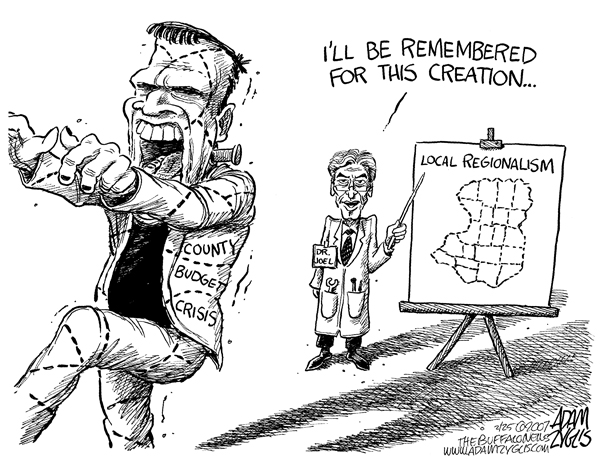
Adam Zyglis Cartoon

Quietly creeping into our lives is a regulatory framework from the Obama Administration dubbed “regionalism”. That might sound innocuous enough. On one level, we can think of regionalism as a pooling of resources in order to accomplish things that would be difficult at more fragmented levels, such as small municipalities. That could take various forms, such as annexation of an adjacent municipality or the formation of regional districts tasked with providing services such as special schools, transportation, utilities, or certain law enforcement functions. Obviously, any of these  steps involves a loss of local control — for someone.

Regionalism as redefined by the Obama regime is more radical and involves not just other regional jurisdictions, but the federal government. The key elements of one proposed rule are federal data collection, federal diversity objectives and federal purse strings. The new rule, to be issued by the Department of Housing and Urban Development (HUD), is described in a WaPo opinion piece by Marc A. Thiessen, “Obama wants to reengineer your neighborhood“:

“Under Obama’s proposed rule, the federal government will collect massive amounts of data on the racial, ethnic and socioeconomic makeup of thousands of local communities, looking for signs of ‘disparities by race, color, religion, sex, familial status, national origin, or disability in access to community assets.’ Then the government will target communities with results it doesn’t like and use billions of dollars in federal grant money to bribe or blackmail them into changing their zoning and housing policies.“

The clause “...in access to community assets” is subject to broad interpretation. As Thiessen notes later, housing and lending discrimination are already prohibited on all of the bases listed above. However, this rule has socioeconomic implications apart from the protected classes. The rule may well hold a community responsible for the aggregate disparate impact of what HUD calls “… the operation of housing markets, [and] investment choices by holders of capital.” The upshot is that a community could be penalized if HUD determines that private builders, developers and investors offer insufficient units of affordable housing within its borders.

By what standard will any such disparate impact be judged? A group’s non-representation within the borders of a subject community would frequently obviate the rule. Clearly, the reference area for any single community would have to encompass a larger regional geography, but that is likely to be decided by federal regulators. The scheme will become very arbitrary if regulators have much flexibility on a case-by-case basis.

I have been a critic of zoning laws and other local building restrictions that artificially restrict the supply of housing and inflate housing costs. It is possible that the HUD rule would weaken such restrictions, but it is more likely that local communities would leave those rules largely intact and instead carve out affordable housing “districts”. They might even find it convenient to do so via eminent domain. In any case, I do not support the kind of federal oversight and control of local communities envisioned by the Obama Administration.

Obama regionalism is much broader than the new HUD rule. Stanley Kurtz warned of this encroachment two years ago in “Regionalism: Obama’s Quiet Anti-Suburban Revolution“, and in an earlier book on the threat of Obama regionalism to American suburbs. The new HUD rule:

“… is part of a broader suite of initiatives designed to block suburban development, press Americans into hyper-dense cities, and force us out of our cars. Government-mandated ethnic and racial diversification plays a role in this scheme, yet the broader goal is forced ‘economic integration.’ The ultimate vision is to make all neighborhoods more or less alike, turning traditional cities into ultra-dense Manhattans, while making suburbs look more like cities do now. In this centrally-planned utopia, steadily increasing numbers will live cheek-by-jowl in ‘stack and pack’ high-rises close to public transportation, while automobiles fall into relative disuse.“

Much of Kurtz’s focus is on the San Francisco region’s “Plan Bay Area”. Under the guise of “sustainable development”, this initiative limits new development in the Bay Area, restricts new single-family home construction, and shoe-horns new housing and business expansion into districts near transportation hubs. Kurtz also discusses a 2012 award to Plan Bay Area of a “Sustainable Communities Grant” by the Obama Administration. The rules surrounding the use of such grants contribute to the further politicization of local development.

Wendell Cox elaborates on Kurtz’s book and the threat of regionalism to suburban life in a New Geography article entitled “Spreading the Fiscal Irresponsibility“. Obama’s regionalism entails greater local dependence on federal funds and an extreme loss of local control. Cox emphasizes the negative implications of that loss for fiscal restraint at local levels.

A more recent example of regionalism in action is in Minneapolis and St. Paul, MN, where a 30-year master plan called “Thrive MSP 2040” has been promulgated by a regional planning council. Katherine Kersten weighs in on the plan in the Wall Street Journal in “Turning the Twin Cities Into Sim City” (or you may need to use this Google search to get past the pay wall):

“While minority residents have been streaming into the Twin Cities’ suburbs for the past 15 years, the Met Council wants to make sure there is a proper race-and-income mix in each. Thus it recently mapped every census tract in the 2,800 square-mile, seven-county region by race, ethnicity and income. The purpose was to identify ‘racially concentrated areas of poverty’ and ‘high opportunity clusters.’ The next step is for the council to lay out what the region’s 186 municipalities must do to disperse poverty throughout the metro area.“

HUD and HUD grant money is assisting in this effort. To quote Kersten, HUD

“… says that mapping is intended, in part, to identify suburban land-use and zoning practices that allegedly deny opportunity and create ‘barriers’ for low-income and minority people.“

The Thrive plan also calls for “Transit-oriented development” and evaluation of “all future development policies through the ‘lens’ of climate change.” From Kersten’s closing paragraph:

“… Twin Cities residents will likely realize that Thrive MSP 2040’s centralized decision-making and Orwellian appeals to ‘equity’ and ‘sustainability’ are a serious threat to their democratic traditions of individual liberty and self-government. Let’s hope that realization comes sooner rather than later.“

Obamanomics and Opportunity Knocked Off

10 Wednesday Jun 2015

Posted by Nuetzel in Regulation

≈ 1 Comment

Tags

Coyote Blog, Department of Labor, Effective wage, Exempt employees, Non-exempt employees, Obama administration, Overtime rules, Politico, the administrative state, Warren Meyer

find-govt-worker

Another Obama fallacy and a new, binding constraint on voluntary private arrangements: in the latest example of administrative rule-making gone berserk, the Obama Administration (via The Department of Labor) is proposing a drastic change in the definition of an exempt employee, increasing the salary threshold for the exemption from $23,660 to as much as $52,000. This is likely to change the status of a large number of workers, but as Warren Meyer explains, not in the way the administration hopes.

Obama and his advisors imagine that this change will actually increase the incomes of a large number of workers — that employers will begin paying overtime to hard-working supervisory and administrative employees. Meyer quotes Politico‘s headline: “Barack Obama poised to hike wages for millions.” But employers are not indifferent to the cost of a given labor input.

As Meyer asserts, currently exempt employees who now earn a salary between the current and the new thresholds may well be converted to hourly, non-exempt employees. And those now working extra hours are likely to be working fewer hours under the new rules. In fact, they may well see their hours and incomes reduced. Some employers will be able to automate certain tasks to compensate for the reduction in labor input, as Meyer suggests. Or perhaps more part-time workers will be hired.

There is another issue at stake, however, in addition to the mere calculation of workers X hours X the wage rate. Meyer expresses disgust at the way the new threshold could change relationships between employers and certain employees. As he tells it, the change will convert ambitious young managers into clock-punchers. In case that sounds too much like a negative personality change, a more sympathetic view is that many workers do not mind putting in extra hours, even as it reduces their effective wage. They have their reasons, ranging from the non-pecuniary, such as simple work ethic, enjoyment and pride in their contribution to reward-driven competitiveness and ambition. Hours worked gives exempt employees an additional margin along which to prove their value to the enterprise. Obama’s proposal takes that away, which may penalize employees with less talent but strong ambition. Opportunity’s knock is getting softer.

← Older posts
Newer posts →
Follow Sacred Cow Chips on WordPress.com

Recent Posts

  • The Case Against Interest On Reserves
  • Immigration and Merit As Fiscal Propositions
  • Tariff “Dividend” From An Indigent State
  • Almost Looks Like the Fed Has a 3% Inflation Target
  • Government Malpractice Breeds Health Care Havoc

Archives

  • January 2026
  • December 2025
  • November 2025
  • October 2025
  • September 2025
  • August 2025
  • July 2025
  • June 2025
  • May 2025
  • April 2025
  • March 2025
  • February 2025
  • January 2025
  • December 2024
  • November 2024
  • October 2024
  • September 2024
  • August 2024
  • July 2024
  • June 2024
  • May 2024
  • April 2024
  • March 2024
  • February 2024
  • January 2024
  • December 2023
  • November 2023
  • August 2023
  • July 2023
  • June 2023
  • May 2023
  • April 2023
  • March 2023
  • February 2023
  • January 2023
  • December 2022
  • November 2022
  • October 2022
  • September 2022
  • August 2022
  • July 2022
  • June 2022
  • May 2022
  • April 2022
  • March 2022
  • February 2022
  • January 2022
  • December 2021
  • November 2021
  • October 2021
  • September 2021
  • August 2021
  • July 2021
  • June 2021
  • May 2021
  • April 2021
  • March 2021
  • February 2021
  • January 2021
  • December 2020
  • November 2020
  • October 2020
  • September 2020
  • August 2020
  • July 2020
  • June 2020
  • May 2020
  • April 2020
  • March 2020
  • February 2020
  • January 2020
  • December 2019
  • November 2019
  • October 2019
  • September 2019
  • August 2019
  • July 2019
  • June 2019
  • May 2019
  • April 2019
  • March 2019
  • February 2019
  • January 2019
  • December 2018
  • November 2018
  • October 2018
  • September 2018
  • August 2018
  • July 2018
  • June 2018
  • May 2018
  • April 2018
  • March 2018
  • February 2018
  • January 2018
  • December 2017
  • November 2017
  • October 2017
  • September 2017
  • August 2017
  • July 2017
  • June 2017
  • May 2017
  • April 2017
  • March 2017
  • February 2017
  • January 2017
  • December 2016
  • November 2016
  • October 2016
  • September 2016
  • August 2016
  • July 2016
  • June 2016
  • May 2016
  • April 2016
  • March 2016
  • February 2016
  • January 2016
  • December 2015
  • November 2015
  • October 2015
  • September 2015
  • August 2015
  • July 2015
  • June 2015
  • May 2015
  • April 2015
  • March 2015
  • February 2015
  • January 2015
  • December 2014
  • November 2014
  • October 2014
  • September 2014
  • August 2014
  • July 2014
  • June 2014
  • May 2014
  • April 2014
  • March 2014

Blogs I Follow

  • Passive Income Kickstart
  • OnlyFinance.net
  • TLC Cholesterol
  • Nintil
  • kendunning.net
  • DCWhispers.com
  • Hoong-Wai in the UK
  • Marginal REVOLUTION
  • Stlouis
  • Watts Up With That?
  • Aussie Nationalist Blog
  • American Elephants
  • The View from Alexandria
  • The Gymnasium
  • A Force for Good
  • Notes On Liberty
  • troymo
  • SUNDAY BLOG Stephanie Sievers
  • Miss Lou Acquiring Lore
  • Your Well Wisher Program
  • Objectivism In Depth
  • RobotEnomics
  • Orderstatistic
  • Paradigm Library
  • Scattered Showers and Quicksand

Blog at WordPress.com.

Passive Income Kickstart

OnlyFinance.net

TLC Cholesterol

Nintil

To estimate, compare, distinguish, discuss, and trace to its principal sources everything

kendunning.net

The Future is Ours to Create

DCWhispers.com

Hoong-Wai in the UK

A Commonwealth immigrant's perspective on the UK's public arena.

Marginal REVOLUTION

Small Steps Toward A Much Better World

Stlouis

Watts Up With That?

The world's most viewed site on global warming and climate change

Aussie Nationalist Blog

Commentary from a Paleoconservative and Nationalist perspective

American Elephants

Defending Life, Liberty and the Pursuit of Happiness

The View from Alexandria

In advanced civilizations the period loosely called Alexandrian is usually associated with flexible morals, perfunctory religion, populist standards and cosmopolitan tastes, feminism, exotic cults, and the rapid turnover of high and low fads---in short, a falling away (which is all that decadence means) from the strictness of traditional rules, embodied in character and inforced from within. -- Jacques Barzun

The Gymnasium

A place for reason, politics, economics, and faith steeped in the classical liberal tradition

A Force for Good

How economics, morality, and markets combine

Notes On Liberty

Spontaneous thoughts on a humble creed

troymo

SUNDAY BLOG Stephanie Sievers

Escaping the everyday life with photographs from my travels

Miss Lou Acquiring Lore

Gallery of Life...

Your Well Wisher Program

Attempt to solve commonly known problems…

Objectivism In Depth

Exploring Ayn Rand's revolutionary philosophy.

RobotEnomics

(A)n (I)ntelligent Future

Orderstatistic

Economics, chess and anything else on my mind.

Paradigm Library

OODA Looping

Scattered Showers and Quicksand

Musings on science, investing, finance, economics, politics, and probably fly fishing.

  • Subscribe Subscribed
    • Sacred Cow Chips
    • Join 128 other subscribers
    • Already have a WordPress.com account? Log in now.
    • Sacred Cow Chips
    • Subscribe Subscribed
    • Sign up
    • Log in
    • Report this content
    • View site in Reader
    • Manage subscriptions
    • Collapse this bar
 

Loading Comments...