• About

Sacred Cow Chips

Sacred Cow Chips

Category Archives: Technology

The Tyranny of the Job Saviors

17 Monday Jul 2017

Posted by Nuetzel in Automation, Free markets, Technology

≈ Leave a comment

Tags

Artificial Intelligence, Automation, Capital-Labor Substitution, Creative Destruction, Dierdre McCloskey, Don Boudreaux, Frederic Bastiat, James Pethokoukas, Opportunity Costs, Robert Samuelson, Robot Tax, Seen and Unseen, Technological Displacement, Universal Basic Income

Many jobs have been lost to technology over the last few centuries, yet more people are employed today than ever before. Despite this favorable experience, politicians can’t help the temptation to cast aspersions at certain production technologies, constantly advocating intervention in markets to “save jobs”. Today, some serious anti-tech policy proposals and legislative efforts are underway: regional bans on autonomous vehicles, “robot taxes” (advocated by Bill Gates!!), and even continuing legal resistance to technology-enabled services such as ride sharing and home sharing. At the link above, James Pethokoukas expresses trepidation about one legislative proposal taking shape, sponsored by Senator Maria Cantwell (D-WA), to create a federal review board with the potential to throttle innovation and the deployment of technology, particularly artificial intelligence.

Last week I mentioned the popular anxiety regarding automation and artificial intelligence in my post on the Universal Basic Income. This anxiety is based on an incomplete accounting of the “seen” and “unseen” effects of technological advance, to borrow the words of Frederic Bastiat, and of course it is unsupported by historical precedent. Dierdre McCloskey reviews the history of technological innovations and its positive impact on dynamic labor markets:

“In 1910, one out of 20 of the American workforce was on the railways. In the late 1940s, 350,000 manual telephone operators worked for AT&T alone. In the 1950s, elevator operators by the hundreds of thousands lost their jobs to passengers pushing buttons. Typists have vanished from offices. But if blacksmiths unemployed by cars or TV repairmen unemployed by printed circuits never got another job, unemployment would not be 5 percent, or 10 percent in a bad year. It would be 50 percent and climbing.

Each month in the United States—a place with about 160 million civilian jobs—1.7 million of them vanish. Every 30 days, in a perfectly normal manifestation of creative destruction, over 1 percent of the jobs go the way of the parlor maids of 1910. Not because people quit. The positions are no longer available. The companies go out of business, or get merged or downsized, or just decide the extra salesperson on the floor of the big-box store isn’t worth the costs of employment.“

Robert Samuelson discusses a recent study that found that technological advance consistently improves opportunities for labor income. This is caused by cost reductions in the innovating industries, which are subsequently passed through to consumers, business profits, and higher pay to retained workers whose productivity is enhanced by the improved technology inputs. These gains consistently outweigh losses to those who are displaced by the new capital. Ultimately, the gains diffuse throughout society, manifesting in an improved standard of living.

In a brief, favorable review of Samuelson’s piece, Don Boudreaux adds some interesting thoughts on the dynamics of technological advance and capital-labor substitution:

“… innovations release real resources, including labor, to be used in other productive activities – activities that become profitable only because of this increased availability of resources.  Entrepreneurs, ever intent on seizing profitable opportunities, hire and buy these newly available resources to expand existing businesses and to create new ones.  Think of all the new industries made possible when motorized tractors, chemical fertilizers and insecticides, improved food-packaging, and other labor-saving innovations released all but a tiny fraction of the workforce from agriculture.

Labor-saving techniques promote economic growth not so much because they increase monetary profits that are then spent but, instead, because they release real resources that are then used to create and expand productive activities that would otherwise be too costly.”

Those released resources, having lower opportunity costs than in their former, now obsolete uses, can find new and profitable uses provided they are priced competitively. Some displaced resources might only justify use after undergoing dramatic transformations, such as recycling of raw components or, for workers, education in new fields or vocations. Indeed, some of  those transformations are unforeeeable prior to the innovations, and might well add more value than was lost via displacement. But that is how the process of creative destruction often unfolds.

A government that seeks to intervene in this process can do only harm to the long-run interests of its citizens. “Saving a job” from technological displacement surely appeals to the mental and emotive mindset of the populist, and it has obvious value as a progressive virtue-signalling tool. These reactions, however, demonstrate a perspective limited to first-order, “seen” changes. What is less obvious to these observers is the impact of politically-induced tech inertia on consumers’ standard of living. This is accompanied by a stultifying impact on market competition, long-run penalization of the most productive workers, and a degradation of freedom from restraints on private decision-makers. As each “visible” advance is impeded, the negative impact compounds with the loss of future, unseen, but path-dependent advances that cannot ever occur.

Embracing the Robots

03 Friday Mar 2017

Posted by Nuetzel in Automation, Labor Markets, Technology

≈ 1 Comment

Tags

3-D Printing, Artificial Intelligence, Automation, David Henderson, Don Boudreaux, Great Stagnation, Herbert Simon, Human Augmentation, Industrial Revolution, Marginal Revolution, Mass Unemployment, Matt Ridley, Russ Roberts, Scarcity, Skills Gap, Transition Costs, Tyler Cowan, Wireless Internet

automation84s

Machines have always been regarded with suspicion as a potential threat to the livelihood of workers. That is still the case, despite the demonstrated power of machines make life easier and goods cheaper. Today, the automation of jobs in manufacturing and even service jobs has raised new alarm about the future of human labor, and the prospect of a broad deployment of artificial intelligence (AI) has made the situation seem much scarier. Even the technologists of Silicon Valley have taken a keen interest in promoting policies like the Universal Basic Income (UBI) to cushion the loss of jobs they expect their inventions to precipitate. The UBI is an idea discussed in last Sunday’s post on Sacred Cow Chips. In addition to the reasons for rejecting that policy cited in that post, however, we should question the premise that automation and AI are unambiguously job killing.

The same stories of future joblessness have been told for over two centuries, and they have been wrong every time. The vulnerability in our popular psyche with respect to automation is four-fold: 1) the belief that we compete with machines, rather than collaborate with them; 2) our perpetual inability to anticipate the new and unforeseeable opportunities that arise as technology is deployed; 3) our tendency to undervalue new technologies for the freedoms they create for higher-order pursuits; and 4) the heavy discount we apply to the ability of workers and markets to anticipate and adjust to changes in market conditions.

Despite the technological upheavals of the past, employment has not only risen over time, but real wages have as well. Matt Ridley writes of just how wrong the dire predictions of machine-for-human substitution have been. He also disputes the notion that “this time it’s different”:

“The argument that artificial intelligence will cause mass unemployment is as unpersuasive as the argument that threshing machines, machine tools, dishwashers or computers would cause mass unemployment. These technologies simply free people to do other things and fulfill other needs. And they make people more productive, which increases their ability to buy other forms of labour. ‘The bogeyman of automation consumes worrying capacity that should be saved for real problems,’ scoffed the economist Herbert Simon in the 1960s.“

As Ridley notes, the process of substituting capital for labor has been more or less continuous over the past 250 years, and there are now more jobs, and at far higher wages, than ever. Automation has generally involved replacement of strictly manual labor, but it has always required collaboration with human labor to one degree or another.

The tools and machines we use in performing all kinds of manual tasks become ever-more sophisticated, and while they change the human role in performing those tasks, the tasks themselves largely remain or are replaced by new, higher-order tasks. Will the combination of automation and AI change that? Will it make human labor obsolete? Call me an AI skeptic, but I do not believe it will have broad enough applicability to obviate a human role in the production of goods and services. We will perform tasks much better and faster, and AI will create new and more rewarding forms of human-machine collaboration.

Tyler Cowen believes that AI and  automation will bring powerful benefits in the long run, but he raises the specter of a transition to widespread automation involving a lengthy period of high unemployment and depressed wages. Cowen points to a 70-year period for England, beginning in 1760, covering the start of the industrial revolution. He reports one estimate that real wages rose just 22% during this transition, and that gains in real wages were not sustained until the 1830s. Evidently, Cowen views more recent automation of factories as another stage of the “great stagnation” phenomenon he has emphasized. Some commenters on Cowen’s blog, Marginal Revolution, insist that estimates of real wages from the early stages of the industrial revolution are basically junk. Others note that the population of England doubled during that period, which likely depressed wages.

David Henderson does not buy into Cowans’ pessimism about transition costs. For one thing, a longer perspective on the industrial revolution would undoubtedly show that average growth in the income of workers was dismal or nonexistent prior to 1760. Henderson also notes that Cowen hedges his description of the evidence of wage stagnation during that era. It should also be mentioned the share of the U.S. work force engaged in agricultural production was 40% in 1900, but is only 2% today, and the rapid transition away from farm jobs in the first half of the 20th century did not itself lead to mass unemployment nor declining wages (HT: Russ Roberts). Cowen cites more recent data on stagnant median income, but Henderson warns that even recent inflation adjustments are fraught with difficulties, that average household size has changed, and that immigration, by adding households and bringing labor market competition, has had at least some depressing effect on the U.S. median wage.

Even positive long-run effects and a smooth transition in the aggregate won’t matter much to any individual whose job is easily automated. There is no doubt that some individuals will fall on hard times, and finding new work might require a lengthy search, accepting lower pay, or retraining. Can something be done to ease the transition? This point is addressed by Don Boudreaux in another context in “Transition Problems and Costs“. Specifically, Boudreaux’s post is about transitions made necessary by changing patterns of international trade, but his points are relevant to this discussion. Most fundamentally, we should not assume that the state must have a role in easing those transitions. We don’t reflexively call for aid when workers of a particular firm lose their jobs because a competitor captures a greater share of the market, nor when consumers decide they don’t like their product. In the end, these are private problems that can and should be solved privately. However, the state certainly should take a role in improving the function of markets such that unemployed resources are absorbed more readily:

“Getting rid of, or at least reducing, occupational licensing will certainly help laid-off workers transition to new jobs. Ditto for reducing taxes, regulations, and zoning restrictions – many of which discourage entrepreneurs from starting new firms and from expanding existing ones. While much ‘worker transitioning’ involves workers moving to where jobs are, much of it also involves – and could involve even more – businesses and jobs moving to where available workers are.“

Boudreaux also notes that workers should never be treated as passive victims. They are quite capable of acting on their own behalf. They often act out of risk avoidance to save their funds against the advent of a job loss, invest in retraining, and seek out new opportunities. There is no question, however, that many workers will need new skills in an economy shaped by increasing automation and AI. This article discusses some private initiatives that can help close the so-called “skills gap”.

Crucially, government should not accelerate the process of automation beyond its natural pace. That means markets and prices must be allowed to play their natural role in directing resources to their highest-valued uses. Unfortunately, government often interferes with that process by imposing employment regulations and wage controls — i.e., the minimum wage. Increasingly, we are seeing that many jobs performed by low-skilled workers can be automated, and the expense of automation becomes more worthwhile as the cost of labor is inflated to artificial levels by government mandate. That point was emphasized in a 2015 post on Sacred Cow Chips entitled “Automate No Job Before Its Time“.

Another past post on Sacred Cow Chips called “Robots and Tradeoffs” covered several ways in which we will adjust to a more automated economy, none of which will require the intrusive hand of government. One certainty is that humans will always value human service, even when a robot is more efficient, so there will be always be opportunities for work. There will also be ways in which humans can compete with machines (or collaborate more effectively) via human augmentation. Moreover, we should not discount the potential for the ownership of machines to become more widely dispersed over time, mitigating the feared impact of automation on the distribution of income. The diffusion of specific technologies become more widespread as their costs decline. That phenomenon has unfolded rapidly with wireless technology, particularly the hardware and software necessary to make productive use of the wireless internet. The same is likely to occur with 3-D printing and other advances. For example, robots are increasingly entering consumer markets, and there is no reason to believe that the same downward cost pressures won’t allow them to be used in home production or small-scale business applications. The ability to leverage technology will require learning, but web-enabled instruction is becoming increasingly accessible as well.

Can the ownership of productive technologies become sufficiently widespread to assure a broad distribution of rewards? It’s possible that cost reductions will allow that to happen, but broadening the ownership of capital might require new saving constructs as well. That might involve cooperative ownership of capital by associations of private parties engaged in diverse lines of business. Stable family structures can also play a role in promoting saving.

It is often said that automation and AI will mean an end to scarcity. If that were the case, the implications for labor would be beside the point. Why would anyone care about jobs in a world without want? Of course, work might be done purely for pleasure, but that would make “labor” economically indistinguishable from leisure. Reaching that point would mean a prolonged process of falling prices, lifting real wages on a pace matching increases in productivity. But in a world without scarcity, prices must be zero, and that will never happen. Human wants are unlimited and resources are finite. We’ll use resources more productively, but we will always find new wants. And if prices are positive, including the cost of capital, it is certain that demands for labor will remain.

Politicians and Infra-Hucksters

05 Thursday Jan 2017

Posted by Nuetzel in Government, infrastructure, Technology

≈ 2 Comments

Tags

Border Wall, Congestion, Donald Trump, Dynamic Message Boards, economic stimulus, Efficient Pricing, Elon Musk, eminent domain, Heritage Foundation, High speed rail, Hyperloop, infrastructure, Jerry L. Jordan, Job Creation, Keystone Pipeline, Michael Sargent, Private Infrastructure, Reason Foundation, Solar Roads, St. Louis MO, Steven Horowitz, T. Norman Van Cott, Trolleys, Tunnel Boring, User Fees

img_3863

We’ll soon have a new president and already we’ve heard new promises of infrastructure investment. Once again, a chorus of politicians and pundits decries the woeful state of America’s road, bridges, sewers and airport terminals. Then, there are hosannas in adoration of the economic stimulus and job creation promised by large public works projects. And of course there are proposals to integrate politically-favored technologies with new infrastructure. All three rationales for a publicly-financed infrastructure program are flawed. Our infrastructure is not as inadequate as many believe; it is bad public policy to justify infrastructure decisions on the basis of the construction jobs required; and new infrastructure should not be treated as a vehicle for large-scale deployment of unproven technologies.

Ownership

Much of our nation’s infrastructure is privately owned. This includes, but is not limited to, power generation and the power grid, communication networks, many water systems and sewer systems, most rail lines, some toll roads and bridges, and some river, sea and space ports. Maintenance and upgrades to private facilities, and to some public facilities, depend on the adequacy of the rates or fees charged to users. On the other hand, the quantity and quality of publicly-owned and operated infrastructure is often left up to taxpayers rather than users. Proposals for federal infrastructure investment are largely about these public facilities, but they might also involve subsidies for the development of private infrastructure.

Crisis or Crock?

In a Heritage Foundation research report, Michael Sargent notes that the poor state of the country’s public infrastructure is wildly exaggerated:

“The notion that America’s infrastructure is ‘crumbling’ and in uniquely poor condition is not supported by data. The percentage of the nation’s bridges deemed ‘structurally deficient (not necessarily unsafe, but requiring extensive maintenance) has declined annually since 1990 and now sits at under 10 percent, well under half of what it was 25 years ago. Similarly, analyses of highway pavement quality conclude that the nation’s major roads have been steadily improving in quality and are likely in their best shape ever. Our airports and airways safely move more people and goods than those of any other nation. Overall, the U.S. ranks near the top of G-7 nations for infrastructure quality.“

The usual poster child of the infrastructure “crisis” is the nation’s transportation system, but this report from the Reason Foundation shows that those troubles are something of a myth.

Nevertheless, there are always repairs, maintenance and replacement projects to be considered, as well as possible expansion and new facilities. Infrastructural shortfalls and expansion must be prioritized, but as Sargent emphasizes, an even larger number of projects should and probably would be handled privately if not for burdensome federal regulations. In addition, an irrational mistrust of privately-operated facilities among some segments of the public creates pressure to burden taxpayers with costs, rather than users. Complaints about congestion on roads offer a case in point: the best solutions involve efficient (and positive) pricing of existing capacity, rather than continued expansion of a “free” good. The avoidance of rational solutions like efficient pricing underscores the extent to which demands for increased public investment in infrastructure are driven by hyperbole, rather than sound analysis.

It’s About the Infrastructure, Not the Jobs 

Public infrastructure projects are also pitched as effective engines of economic stimulus and job creation. Both of those claims are questionable. Most importantly, the real rationale for infrastructure investment is the value of the infrastructure itself and the needs it serves going forward. The public expense and the jobs required to produce it are cost items! This point was made recently by economist T. Norman Van Cott, who rightfully asserts that a given output is of greater benefit when its costs are low and when it requires less labor input. (Van Cott’s piece uses the Keystone pipeline as an example, a controversial private project that I find objectionable for its dependence on eminent domain actions.) The sharp distinction between creating value and creating jobs is also made here by Jerry L. Jordon and here by Steven Horowitz. Here is Horowitz:

“Creating jobs is easy; it’s creating value that’s hard. We could create millions of jobs quite easily by destroying every piece of machinery on U.S. farms. The question is whether we are actually better off by creating those jobs—and the answer is a definite no.“

Yet this is how so many infrastructure projects are pitched at the national, state and local levels. It’s also puzzling that economic stimulus is used as a rationale even when the economy is operating near its potential output. Even by the standards of traditional Keynesian economic analysis, that is the wrong time for stimulus. Infrastructure projects should be evaluated on their own merits, not on how many construction workers must be hired, or on how much of their paychecks those workers will spend. Many of them must be bid away from competing projects anyway.

The Public Investment Trough

Here’s a brief anecdote from my own experience with an “advanced” public infrastructure project. Some years ago in the region around my city, St. Louis, Missouri, transportation agencies began to install a network of electronic highway message boards to convey real-time information to drivers on road conditions, congestion, and various public service announcements. The 100+ signs in the area today are connected to operators in a central office via fiber optic cable. This type of system is used elsewhere, and it is partly funded by the federal government.

I seriously question the benefits of this system relative to cost. The signs themselves cost well in excess of $100,000 each. The fiber network is undoubtedly costly, and there are other fixed and variable system costs. The signs have an anachronistic look, vaguely the quality of old high school scoreboards. The information they provide generally adds little to what I already know (“12 minutes to I-270”). The signs are in fixed positions, so the occasional report of an accident or congestion usually comes too late to give motorists decent alternatives. The information the signs provide on road conditions is obvious. Missives such as “buckle up” are of questionable value. Before I depart on a commute, or if I have a passenger, we can consult maps and other apps on cell phones to avail ourselves of far better information. Other, more flexible technologies were outpacing the message boards even before they could be fully deployed, and the boards are still being deployed. This is a project that might have sounded brilliant to highway engineers 20 years ago, but it represented something of a luxury relative to other needs, and it still got funded. Today, it looks like waste.

The politics of infrastructure often means that the enabling legislation gets loaded with poorly-planned projects and shiny jewels to dangle before home constituencies. Legislators are so eager to demonstrate their sophistication that they fall over themselves to approve taxpayer funds for unproven but politically-favored technologies. For example, a recent post by Warren Meyer notes the technical folly of solar roads. These are unlikely to attract much private money because they represent such a monumentally stupid idea. Proponents will go after tax money instead. The same is true of ideas like Elon Musk’s tunnel boring project, for which he hopes to collect massive taxpayer subsidies. Musk claims that tunnels will eliminate road congestion, but efficient pricing would do much to eliminate this problem without tunnels, and other technologies like automated vehicles are likely to reduce congestion by the time Musk over-invests tax money in tunnel-boring equipment, roads and hyper-loops inside tunnels.

In general, taxpayers should be wary of “green infrastructure” proposals. A large number of bike lanes, pedestrian bridges and greenways sound wonderful, but they are serious cost inflators. Federal dollars are regularly squandered on charming but wasteful projects such as trolleys. Even worse are ongoing efforts to subsidize the construction of high-speed rail systems. All of these bright ideas should be resisted.

Let’s Be Rational

The country certainly has infrastructural needs, but claims that we face a crisis are greatly exaggerated. With a new administration and what are likely to be supporting majorities in both houses of Congress, the danger of rushing into big funding commitments is heightened. The sponsors of this kind of legislation will herald massive job creation, but that is incidental to the cost side of the ledger. The benefits of individual projects should be evaluated carefully in comparison to costs. Then they can be prioritized if deemed of sufficient value. Finally, large scale deployment of unproven technologies should be avoided on the public dime.

I haven’t even mentioned one very large infrastructure project that has been proposed by President-Elect Donald Trump: the border wall. I suspect that it would be easier and less expensive to solve the problem of border security using more advanced and flexible technologies, but the permanence and symbolism of a wall appeals to many of Mr. Trump’s supporters. The benefits of a wall in terms of border security and control of immigration flows are difficult if not impossible to evaluate, as are the costs to taxpayers, with Trump promising to extract some form of payment from Mexico. The wall, however, is being “sold” to the American public in emotional terms. Come to think of it, that’s how too many other infrastructure proposals are sold by politicians!

There are promising opportunities to improve the nation’s infrastructure through the private sector, where the value of projects is subject to evaluation by parties who must put “skin in the game”. This will be addressed in my next post.

Robots and Tradeoffs

31 Wednesday Aug 2016

Posted by Nuetzel in Living Wage, Markets, Technology

≈ 1 Comment

Tags

AI, Artificial Intelligence, Biohacking, Capital Intensity, Collaborative Automation, Cyborgization, David Autor, Don Boudreaux, Exoskeletons, Factor Substitution, Farmbots, George Selgin, gier.org, Hal Varian, Human Augmentation, Labor Productivity, Minimum Wage, Owning Machines, Pew Research Center, Resource Allocation, Robert Samuelson, Robotics, Scarcity, Singularity Hub, Superabundance, Work-Leisure Tradeoff

image

The other day, a few colleagues were lamenting the incipient robot domination of the workplace. It is true that advances in automation and robotics are likely to displace workers in a variety of fields over the next few decades. However, the substitution of capital for labor is not a new phenomenon. It’s been happening since the start of the industrial age. At the same time, capital has been augmenting labor, making it more productive and freeing it up for higher-valued uses, many of which were previously unimagined. The large-scale addition of capital to the production process has succeeded in raising labor productivity dramatically, and labor income has soared as a consequence. That is likely to continue as increasingly sophisticated robots assume certain tasks entirely and collaborate with workers on others, even in the service sector.

Advanced forms of automation are another step in the progression of technology. The process itself, however, and the adoption of robotics, might well be hastened by public policy that pushes labor costs to levels not commensurate with productivity. I wrote about this process in “Automate No Job Before Its Time” on Sacred Cow Chips late last year. The point of that essay was that government-imposed wage floors create an incentive for automation. Because a wage floor has its impact at the bottom of the wage scale, at which workers are the least-skilled, this form of government intervention creates a regrettable and unnatural acceleration in the automation process. Other mandated benefits and workplace regulations can have similar effects.

Robert Samuelson makes the same points in “Our Robot Panic Is Overblown“. He notes the effectiveness of the U.S. economy in creating jobs over time in the presence of increasing capital-intensity. But he also warns of potential missteps, including the dangers of government activism:

“There are two dangers for the future. One is that the new jobs created by new technologies will require knowledge and skills that are in short supply, leaving unskilled workers without income and the economy with skill scarcities. … The second danger is that government will damage or destroy the job creation process. We live in a profit-making economic system. Government’s main role is to maintain the conditions that make hiring profitable. … If we make it too costly for private firms to hire (through high minimum wages, mandated costs and expensive regulations) — or too difficult to fire — guess what? They won’t hire. That’s what ought to worry us, not the specter of more robots.“

Historically, automation has actually created more jobs than it has destroyed. In general, however, the new jobs have required higher levels of skills than the jobs lost. In “Why Are There Still So Many Jobs? The History and Future of Workplace Automation“, David Autor of MIT says it this way:

“Automation does indeed substitute for labor—as it is typically intended to do. However, automation also complements labor, raises output in ways that lead to higher demand for labor, and interacts with adjustments in labor supply. … journalists and even expert commentators tend to overstate the extent of machine substitution for human labor and ignore the strong complementarities between automation and labor that increase productivity, raise earnings, and augment demand for labor.“

As with almost all automation, robots will replace workers in the most routine tasks. Tasks involving less routine will not be as readily assumed by robots. To a large degree, people misunderstand the nature of automation in the workplace. The introduction of robots often requires collaboration with humans, but again, these humans must have more highly-developed skills than a typical line worker.

Hal Varian, who is the chief economist at Google, describes the positive implications of the ongoing trend to automate (see the link in the last paragraph of this post), namely, less drudgery and more leisure:

“If ‘displace more jobs’ means ‘eliminate dull, repetitive, and unpleasant work,’ the answer would be yes. How unhappy are you that your dishwasher has replaced washing dishes by hand, or your vacuum cleaner has replaced hand cleaning? My guess is this ‘job displacement’ has been very welcome, as will the ‘job displacement’ that will occur over the next 10 years. The work week has fallen from 70 hours a week to about 37 hours now, and I expect that it will continue to fall. This is a good thing. Everyone wants more jobs and less work. Robots of various forms will result in less work, but the conventional work week will decrease, so there will be the same number of jobs (adjusted for demographics, of course).“

An extreme version of the “robot domination” narrative is that one day in the not-too-distant future, human labor will be obsolete. Automation is not limited to repetitive or menial tasks by any means. A wide variety of jobs requiring advanced skills have the potential to be automated. Already, robots are performing certain tasks formerly done only by the likes of attorneys, surgeons, and computer programmers. Robots have the potential to repair each other, to self-replicate, to solve high-order analytical problems and to engage in self-improvement. With advances in artificial intelligence (AI), might humans one day become wholly obsolete for productive tasks? What does that portend for the future of so many human beings and their dependents who, heretofore, have relied only on their labor to earn a living?

There are any number of paths along which the evolution of technology, and its relationship to workers and consumers, might play out. The following paragraphs examine some of the details:

The Human Touch: There will probably always be consumers who prefer to transact with humans, as opposed machines. This might be limited to a subsegment of the population, and it might be limited to the manufacture of certain artisan goods, such as hand-rolled cigars, or certain services. Some of these services might require qualities that are more uniquely human, such as empathy, and the knowledge that one is dealing with a human would be paramount. This niche market might be willing to pay premium prices, much as consumers of organic foods are willing to pay an extra margin. However, it will be necessary to retain the perceived quality of the human touch and to remain reasonably competitive with automated alternatives on price.

Human Augmentation: Another path for the development of technology is the cyborgization of labor. This might seem rather distasteful to current sensibilities, but it’s a change that is probably inevitable. At least some will choose it. Here is an interesting definition offered by geir.org:

“Cyborgization is the enhancement of a biological being with mechanical or non-genetically delivered biological devices or capabilities. It includes organ or limb replacements, internal electronics, advanced nanomachines, and enhanced or additional capabilities, limbs, or senses.“

These types of modifications can make “enhanced” humans competitive with machines in all kinds of tasks. The development of these kinds of technologies is taking place within the context of rehabilitative medical care and even military technology, such as powerful exoskeletons, but the advances will make their way into normal civilian life. There is also development activity taking place among extreme hobbyists underground, such as “biohackers” who perform self-experimentation, embedding magnets or electronic chips in their bodies in attempts to develop a “sixth sense” or enhanced physical abilities. Even these informal efforts, while potentially risky to the biohackers themselves, might lead to changes that will benefit mankind, much like the many great garage tinkerers who have been important to innovation in the past.

Owning Machines: Ownership of capital will take on a greater role in providing for lifetime earnings. Can the distribution of capital ever be broadened to the extent needed to replace lost labor income? There are ways in which this can occur. The first thing to note is that the transition to a labor-free economy, were that to transpire, would play out over many years. Second, we have witnessed an impressive diffusion of advanced technologies in recent decades. Today, consumers across the income spectrum hold computers in their pockets that are more than the equivalent of the supercomputers that existed 50 years ago. Today’s little computers are far more useful in many ways, given wireless internet connectivity. There are many individuals for whom these devices are integral to earning an income. Thus, the rate of return on these machines can be quite impressive. The same is true of computers, software (sometimes viewed as capital) and printers, not to mention other “modern” contrivances with income-earning potential such as cars, trucks and a vast array of other tools and hardware. Machines with productive potential will continue to make their way into our lives, both as consumers and as individual producers. This also will include value-added production of goods at home, even for use or consumption within the household (think 3D printers, or backyard “farmbots”).

Saving Constructs: Most of the examples above involve machines that require some degree of human collaboration. Of course, even the act of consuming involves labor: I must lift the fork to my mouth for every bite! But in terms of earning income from machines, are there other ways in which ownership of capital can be broadened? The first answer is an old one: saving! But there is no way most individuals at the start of their “careers” can garner a significant share of income from capital. Other social arrangements are probably necessary. One of great importance is the family and family continuity. Many who have contemplated a zero-labor future imagine a world in which there are only two kinds of actors: individuals and the state. Stable families, however, hold the potential for accumulating capital over time to provide a flow of income for their members. Other forms of social organization can fill this role, but they must be able to accumulate capital endowments across generations. Of course, in an imagined world with minimal opportunities for labor, some have concluded that society must collectively provide a guaranteed income. To indulge that view for just a moment, a world of complete automation would almost certainly be a world of superabundance, so goods would be extremely cheap. That means a safety net could be provided at a very low cost. Nonetheless, it would be far preferable to do so by distributing a minimal number of shares of ownership in machines. These shares would have some value, and to improve resource allocation, it should be the individual’s responsibility to manage those shares.

Economic Transition: The dynamics of the transition to robot-dominated production raise some interesting economic questions. Should the advancement of robotics and artificial intelligence create a massive substitution away from labor, it will be spurred by 1) massive upward shifts in the productivity of capital relative to its cost; and 2) real wages that exceed labor’s marginal productivity. There will be stages of surging demand for the kinds of advanced labor skills that are complementary to robots. The demand for less advanced labor services does not have to fall to zero, however. There will be new opportunities that cannot be predicted today. Bidding for scarce capital resources and the flow of available saving will drive up capital costs, slowing the transition. And as long as materials, energy and replacement parts have a cost, and as long as savers demand a positive real return, there will be a margin along which it will be profitable to employ various forms of labor. But downward adjustment of real wages will be required. Government wage-floor policies must be abandoned. That will not be as difficult as it might sound: the kind of automation envisioned here would have profound effects on overall costs and the supply of goods, leading to deflation in the prices of consumables. As long as real factor prices can adjust, there will almost certainly remain a balance between the amounts of capital and labor employed.

In “Robots Are Nothing New“, Don Boudreaux passes along this comment from George Selgin:

“I’ve always been aghast at finding many otherwise intelligent economists arguing as if technology had a mind of its own, developing willy-nilly, or even perversely, in relation to the relative scarcity of available factors, including labor. Only thus can it happen that labor-saving technology develops to a point where labor, instead of being relatively scarce, becomes superabundant!

The fundamental problem, I believe, is confusion of the role of technological change with that of government interference with the pricing of labor services that is among the things to which technology in turn responds. Labor-saving technology becomes associated with unemployment, not because the last is a consequence of the former, but because both are contemporaneous consequences of a common cause, to wit: minimum wage laws and other such interference that sets wage rates above their market-clearing levels.“

There is much disagreement on the implications of automation. This excellent survey of experts by the Pew Research Center contains a number of insights. Also, visit Singularity Hub for a number of great articles on automation and AI, some of which are surprising. I believe that these technologies hold a great deal of promise for humanity. The process will not take place as suddenly as some fear, but ill-conceived policies such as a mandated “living wage” would put us on an unnaturally speedy trajectory. Opportunities for the least-skilled workers will be foreclosed too soon, before those individuals can develop skills and improve their odds of establishing a life free of dependency. Too rapid an adoption of advanced automation and AI would increase the likelihood of choosing suboptimal production methods that might be difficult to change later, and it would leave little time for education and training for workers who might otherwise leverage new technologies. The benefits of automation and their diffusion can be maximized by allowing advances to take a natural course, guided by market forces, with as little interference from government as possible.

Anti-Glyphosate Goons and Gullibility

15 Sunday May 2016

Posted by Nuetzel in Agriculture, Regulation, Technology

≈ Leave a comment

Tags

Biology Fortified, Carcinogens, Christopher Portier, David Zaruk, Environmental Defense Fund, EPA, Farmer's Daughter, Glyphosate, IARC, International Agency for Research on Cancer, Julie Kelly, Kathryn Guyton, Matt Ridley, psuedoscience, Rational Optimist, Risk Monger, Roundup, Toxicity, WHO, World Health Organization

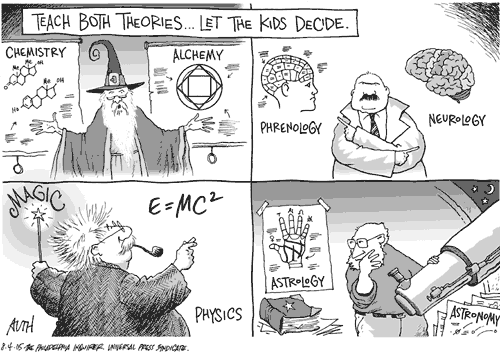
pseudociencia-a-saco

See the Postscript below.

A “roundup” of findings on the safety of glyphosate shows that the herbicide is very benign, highly unlikely to pose any real threat to humans, and far less toxic than many common household chemicals and even natural hazards in the environment. However, the debate over glyphosate is heavily politicized, as illustrated by the unsavory details surrounding a report issued last year by the International Agency for Research on Cancer (IARC), an arm of the World Health Organization (WHO). The IARC reclassified glyphosate as “probably carcinogenic to humans” based on a few cherry-picked, poorly-designed studies with weak statistical power. That finding is inconsistent with the vast preponderance research, which shows that glyphosate is not a significant threat to human health.

The Farmer’s Daughter provided a good summary of the issues shortly after the IARC’s ruling was announced last year. She offers the following quote from the U.S. Environmental Protection Agency (EPA):

“The U.S. EPA classified glyphosate as Group E, evidence of non-carcinogenicity in humans. The U.S. EPA does not consider glyphosate to be a human carcinogen based on studies of laboratory animals that did not produce compelling evidence of carcinogenicity.“

European regulators reached similar conclusions and are rather damning in their assessment of the IARC’s findings, though Brussels recently disregarded their findings and decided to ban the sale of glyphosate for gardening. In this post at Biology Fortified, Anastasia Bodnar discusses the low toxicity of glyphosate with links to several recent studies on its safety. And here is the Risk Monger blogs’s list of “ten reasons why glyphosate is the herbicide of the century“:

  1. Controlling invasive weeds leads to better agricultural yields
  2. Better yields = less land in production = more meadows and biodiversity
  3. Extremely low toxicity levels compared to (organic) alternatives
  4. Allows for no or low till farming – better for soil management
  5. Reduces CO2 emissions (compared to organic)
  6. Glyphosate saves lives
  7. It is much more affordable and effective than other options
  8. Glyphosate is off patent so no single company is profiting heavily from it
  9. Glyphosate-resistant crops allow for more ecological weed management practices
  10. There is overwhelming scientific evidence that glyphosate is safe for humans

How, then, did the IARC reach such a negative conclusion? Again from the Risk Monger, David Zaruk, the IARC hired just one external technical advisor, Christopher Portier, an activist previously employed by an NGO, the anti-pesticide Environmental Defense Fund (EDF). Portier has no technical background in toxicology, and the IARC apparently went to pains to avoid references to his affiliation with the EDF. Moreover, the IARC’s conclusion seems to have been preordained:

“The IARC study rejected thousands of documents on glyphosate that had industry involvement and based their decision on carcinogenicity on the basis of eight studies (rejecting a further six because they did not like their conclusions).“

The lead author of the report, Kathryn Guyton, gave a speech in 2014 in which she stated that herbicide studies slated for 2015 showed indications of a link to cancer. Just how did she know, so far ahead of time? And then there’s this revelation:

“According to the observer document, the glyphosate meeting started with the participants being told to rule out the possibility of classifying the substance as non-carcinogenic.“

Zaruk believes there is internal pressure for the IARC study to be retracted. The organization has suffered a great loss of credibility in the scientific community over the report. In addition, WHO has remained neutral thus far, but they are expected to address the issue this month.

Zaruk and Julie Kelly provide a more succinct summary of the issues in “The Facebook Age of Science at The World Health Organization” at National Review. The suggestion made in the title seems to be that WHO’s decision might be swayed by public pressure, measured by Facebook “likes” by the superstitious, such as unknowing David Wolfe devotees, rather than science:

“Environmentalists and organic companies tout phony studies claiming that glyphosate is found in everything from breast milk to bagels. … Meanwhile, farmers who use glyphosate to protect their crops and boost yields are caught in the crossfire. Even if glyphosate is banned, they will need to use another herbicide, probably more toxic, because the romantic notion of hand-weeding millions of acres of crops is promoted only by those who have never done it.“

I’ll keep using Monsanto’s Roundup, thanks! Or a competitive brand of glyphosate. To close, here’s a quote from Matt Ridley’s Rational Optimist blog on the embrace of pseudoscience at the IARC and elsewhere (including social media):

“Science, humanity’s greatest intellectual achievement, has always been vulnerable to infection by pseudoscience, which pretends to use the methods of science, but actually subverts them in pursuit of an obsession. Instead of evidence-based policymaking, pseudoscience specialises in policy-based evidence making. Today, this infection is spreading.“

Postscript: On May 16, WHO announced that glyphosate is “unlikely to cause cancer in people via dietary exposure.” Here is a Q&A from WHO regarding its assessment, explaining that it is based on risk as opposed to mere hazard, upon which the earlier IARC report was based. This is good news!


Junk Science Malignancy

07 Thursday Apr 2016

Posted by Nuetzel in genetic engineering, Technology

≈ Leave a comment

Tags

Andrew Porterfield, Animal Feeding Studies, Donald Danforth Plant Science Center, genetic engineering, Genetic Literacy Project, genetic modification, Gilles-Eric Séralini, Glyphosate Resistance, GMOs, Junk Science, Kevin Folta, Peer Review, Plant Science, Roundup Pesticide, Séralini Affair

A retracted 2012 study purporting to show that genetically modified (GMO) corn causes cancer was not recently vindicated by French courts. A few publications lacking minimal journalistic standards have made that false claim. There was a favorable ruling in a libel suit brought by Gilles-Eric Séralini, author of the study, but it did not vindicate his sloppy research in any way. The court simply agreed that the defendant could not prove that Séralini had committed fraud. In the U.S., proof of malice by the defendant would have been required for a libel verdict, but not in France. In any case, the ruling did not address the scientific validity of  Séralini’s research, only that it was not willfully fraudulent. Courts do not serve as arbiters of scientific validity.

The study itself was awful. Details can be found here. Séralini used rats that were bred to develop cancer with an extremely high incidence (70% – 80% lifetime); he tested different groups of these rats with varying amounts of GMO corn and Roundup pesticide. The small samples he used meant that the tests had very low statistical power. There were suspicious aspects of the study that might or might not have been cleared up with sufficient disclosure, and there was even contradictory evidence within the study itself, as would be expected with so much statistical noise. Séralini’s efforts to publicize the paper didn’t help his reputation in the scientific community. He made some exaggerated claims, and though he might have believed them, he was clearly interested in making a big splash.

The paper received overwhelming criticism in the scientific community. It was retracted by the journal that originally published it, but later it was republished in a low-quality journal without peer review. This study was not the first piece of Séralini research to be harshly criticized by his peers. Here are comments from the blog of respected horticulturist Kevin Folta, who does not mince words:

“It boils down to this– if these data were significant, if the experiments were good, and the interpretations sound, this would not be buried in the depths of a crappy journal. If there was hard evidence that our food supply truly caused tumors, it would be on the New England Journal of Medicine, Science, Nature, or maybe Cell if he wanted to go slumming. But it’s not there. It is in a tiny, obscure journal that has quite a visible agenda, and that’s the only thing visible about it.

And that’s where it belongs. Let him have his day in the sun. History will not remember him for his science. It will remember him as a disgraceful hack that let personal agenda affect adoption of safe scientific technology. He’ll be the guy that fooled millions with low-quality data.

It is very sad, because I’d rather be writing blogs about exciting science and new findings. Instead we’re back to this nonsense. Luckily, it will slowly disappear into time, like Puzstai’s lectins, Huber’s mystery organism, and the rest of the alarmist junk never published or never reproduced.“

An issue that has been thorny for GMO advocates is the erroneous conflation of GMOs with glyphosate (Roundup is one brand). Séralini’s work focused on glyphosate-resistant GMOs, and his treatments involved the administration of glyphosate to rats in varying quantities, but publicity surrounding the study gave the impression that his “findings” applied more generally to GMOs. Glyphosate resistant plants were an early product of the GMO technology, but most GMO plants have nothing to do with glyphosate. Instead, they confer benefits such as nutritional superiority, drought resistance, pest resistance, disease resistance, and improved environmental consequences of agriculture. The variety of problems that can be addressed with GMOs is staggering.

The safety of GMOs is well established in the plant science literature. Use the box above to search Sacred Cow Chips for “GMO” or “genetic” to find earlier posts in which I have addressed GMO safety at greater length. A recent article from Andrew Porterfield of the Genetic Literacy Project addresses some aspects of this literature and on long-term animal feeding studies, which have demonstrated the safety of GMOs.

A petition in support of GMO technology signed by over 1,400 plant science experts is linked in this article in Science Daily. Three of the authors of the petition are affiliated with The Donald Danforth Plant Science Center in Creve Coeur, Missouri, not far from my home.  The petition vouches for the safety of GMOs and their promise in meeting the world’s demand for food.

Note: the infographic at the top of this post is from the Biology Fortified blog.


Automate No Job Before Its Time

28 Monday Dec 2015

Posted by Nuetzel in Price Controls, Technology

≈ 6 Comments

Tags

Automation, Capital-Labor Sucstiturion, David Neumark, Don Boudreaux, Innovation, Living Wage, McKinsey Global Institute, Minimum Wage, Risk of Automation, Technological Diffusion

This interactive chart from the McKinsey Global Institute (not the one above, as good as it is…) shows occupations at risk of automation, and it should give warning to those asserting that a substantial increase in the minimum wage is in the interests of low-wage workers. It shows the extent to which various jobs can be automated under existing technology. The salient facts here are that a large number of workers earn less than $15 per hour, that most of those workers perform jobs that can be automated, and that further advances in technology will increase the potential for automation beyond what’s shown in the chart.

A simple truth that must be understood is that wage rates are strongly associated with the skills and productivity required for particular jobs. Denial of that fundamental rule cannot help anyone, and will almost certainly harm many. Low skill requirements are less highly-compensated because they add little value and are easily satisfied.

As Don Boudreaux points out, innovation is often spurred by economic forces. A mandated wage minimum, which is a price floor creating artificial surplus conditions, magnifies incentives for greater innovation. In addition to the substitution away from low-skilled labor (or domestic labor) that can be expected, there are many other margins along which employers can economize in the face of such government edicts: higher expectations for productivity, fewer benefits, fewer breaks, fewer niceties in the workplace, and less flexibility over hours and days off. These things matter greatly to employees and employers. A wage law can make for an unpleasant work environment.

Those who suffer most from minimum wage decrees are the least skilled, whose jobs are the most vulnerable. Economist David Neumark notes that “The Evidence Is Piling Up That Higher Minimum Wages Kill Jobs“, despite claims to the contrary (gated… Google “wsj NeumarK”, select the December 15, 2015 link).

Lest anyone decry the technologies that could replace these workers, recall that the substitution of capital for labor over time has led to the great gains in productivity that have elevated wages and income over time. Many jobs that are commonplace today (and were not even imagined in earlier times) would not exist if not for advances in technology. Likewise, there will be jobs that are commonplace in the future that do not exist today, and we won’t have the power (nor will the government) to anticipate those jobs until the enabling technologies come to fruition and early adoption. These kinds of changes are never without difficulty, as workers bear significant costs of adjustment in the short run, including the acquisition of new skills. However, wage floors force an even earlier and contrived adoption of technologies, which harms low-wage workers most severely. Far better to allow an unfettered and natural process of free choice, technological diffusion, price adjustment, and growth to take place.

Government Economy; Government Science: You Wanted Growth?

28 Wednesday Oct 2015

Posted by Nuetzel in Central Planning, Regulation, Technology

≈ Leave a comment

Tags

Basic Science, economic growth, Innovation, John Cochrane, Matt Ridley, Productivity Growth, Public Funding of Science, regulation, Technological advance

science1

Economic growth allows us to enjoy an improving material existence and the wealth to pursue other goals as a society, such as a clean environment. Yet we often pursue other goals in ways that strangle growth, when in fact those goals and growth are fundamentally compatible.

Two articles that caught my attention today approach this issue from different but complementary perspectives. One is by John Cochrane of the University of Chicago, a lengthy piece called simply “Economic Growth“. At the outset, Cochrane asserts that the one, ultimate source of economic growth in the long-run is through advancing productivity. He notes, however, that the U.S. has been falling short in that department of late. Re-establishing growth should start with a clean-up of the many harmful public policies that have cluttered the economic landscape, especially over the last few decades. Unfortunately, politics makes this easier said than done:

“The golden rule of economic policy is: Do not transfer incomes by distorting prices or slowing competition and innovation. The golden rule of political economics seems to be: Transfer incomes by distorting prices and regulating away competition. Doing so attracts a lot less attention than on-budget transfers or subsidies. It takes great political leadership to force the political process to obey the economic rule.“

Cochrane’s discussion is wide ranging, covering a number of areas of public policy that require “weeding”, as he puts it: the regulatory arena (finance, health care, energy and the environment), tax policy, debt and deficits, the design of social programs and entitlements, labor law and regulation, immigration, education, agricultural policy, trade, and the process of infrastructure investment. There may be a year’s worth of blog posts to be drawn from Cochrane’s essay, but I think “weeding” understates the difficulty of the tasks outlined by Cochrane to reignite growth.

The second article that interested me today dealt with technological advance, which is a primary driver of productivity growth. Economists and pundits often prescribe policies that they believe will lead to transformational breakthroughs in technology. This usually manifests in advocacy for increased public funding for basic scientific research. This is a mistake, according to Matt Ridley’s great article, “The Myth of Basic Science“. In fact, one might say that he’s identified another government-nourished weed for Cochrane to pull. I found Ridley’s opening paragraph intriguing:

“Innovation is a mysteriously difficult thing to dictate. Technology seems to change by a sort of inexorable, evolutionary progress, which we probably cannot stop—or speed up much either. And it’s not much the product of science. Most technological breakthroughs come from technologists tinkering, not from researchers chasing hypotheses. Heretical as it may sound, “basic science” isn’t nearly as productive of new inventions as we tend to think.“

Ridley’s thesis (actually, he credits several others for formulating this line of thinking) is that technology growth is very much an independent process, impossible to push or steer effectively. He goes so far as to say that it can’t be stopped, but he also cites ways in which it can be inhibited.

This perspective on technology has implications for patent law, a subject that Ridley explores to some extent. It also reflects badly on government efforts to direct and stimulate advances by granting subsidies to favored technologies and more aggressive funding of  “basic science”. Government, in Ridley’s view, is largely impotent in spawning technological advance. By pushing technologies that are uneconomic, government distorts price signals, diverts resources from more productive investments, and embeds inferior technologies in the economy’s productive capital base.

But Ridley’s point has more to do with the futility of basic science as a driver of technological advance, and the strong possibility that causation often runs in the other direction:

“It is no accident that astronomy blossomed in the wake of the age of exploration. The steam engine owed almost nothing to the science of thermodynamics, but the science of thermodynamics owed almost everything to the steam engine. The discovery of the structure of DNA depended heavily on X-ray crystallography of biological molecules, a technique developed in the wool industry to try to improve textiles.

Technological advances are driven by practical men who tinkered until they had better machines; abstract scientific rumination is the last thing they do. As Adam Smith, looking around the factories of 18th-century Scotland, reported in ‘The Wealth of Nations’: ‘A great part of the machines made use in manufactures…were originally the inventions of common workmen,’ and many improvements had been made ‘by the ingenuity of the makers of the machines.’

It follows that there is less need for government to fund science: Industry will do this itself. Having made innovations, it will then pay for research into the principles behind them. Having invented the steam engine, it will pay for thermodynamics. This conclusion … is so heretical as to be incomprehensible to most economists, to say nothing of scientists themselves.“

It’s good to qualify that “industry will do this itself” only if it isn’t severely hamstrung by meddling politicians and regulators.

Ridley goes on to cite a few inconvenient historical facts that run counter to the narrative that public funding of science is a necessary condition for technical advance. He also cites empirical work suggesting that the return on publicly-funded R&D is paltry. In fact, he allows that government involvement in “basic science” may inhibit more economically viable advances and their adoption. There is no question that government often chooses unwisely without the discipline of market incentives. If it gets funded, then bad science, politically-driven “science” and ultimately nonproductive science might very well crowd-out better private science and innovation.

In a time of strained government budgets, public funding for basic science should be subjected to as much scrutiny as any other spending category. Like Ridley, I have much more faith in private tinkerers to choose wisely when it comes to the development of new technologies. Intimacy with actual markets and with the production process itself improve the odds that private developers and technologists will be more effective at boosting productivity.

Capitalism Is The Bounce In Nature’s Rebound

04 Friday Sep 2015

Posted by Nuetzel in Free markets, Human Welfare, Technology

≈ 1 Comment

Tags

Agricultural productivity, CropMobster, Dematerialization, Elon Musk, External costs and benefits, Fish Farms, Food Cowboy, Forest plantations, Global Greening, Hydrogen production, Hyperloop, Jesse H. Ausubel, Luxury public goods, Peak use, Property Rights, Reforestation, Rewilding

image

What forces account for the great shift toward “rewilding” now taking place in our world? Is it green activism and government action? Not from the looks of the photo above, which shows a giant field of solar panels powering an airport in India. Hailed as a great accomplishment by greens, the view from above provides a clue to the absurdity of absorbing vast resources to replace cheap, traditional power sources with politically-favored solar for just a few buildings. Fry the birds, burn the taxpayers! That’s certainly not rewilding, nor will it get us there. Neither will a cluttered landscape of giant, noisy windmills that slice up avian life, provide only intermittent power, and are left to decay once taxpayer subsidies go away.

Rather, the world is returning to nature via many forms of technology, resource productivity and capitalism. How is that possible? Here is a monograph by Jesse H. Ausubel on “rewilding”, the rebound of nature taking place around the globe. It might make you feel more optimistic about prospects for human prosperity and the joint survival of mankind and planet Earth. There is no question that the changes he describes are primarily driven by powerful private incentives. However, Ausubel’s positions are largely technical, not oriented toward a particular social or economic philosophy. He presents compelling graphical evidence and references to support his technical claims. In what follows, I’ll try to summarize some of the most salient points he makes in the report. Some [bracketed comments] in the bullet points are my own thoughts:

  • Land once used in agriculture is being returned to nature as “acreage and yield [have] decoupled. Since about 1940 American farmers have quintupled corn while using the same or even less land.” The same is true in other parts of the world. “The great reversal of land use that I am describing is not only a forecast, it is a present reality in Russia and Poland as well as Pennsylvania and Michigan.” Moreover, there is no cap in sight for farm yields. He credits “precision agriculture, in which we use more bits, not more kilowatts or gallons.“
  • Even more impressive is the fact that “rising yields have not required more tons of fertilizer or other inputs. The inputs to agriculture have plateaued and then fallen, not just cropland but nitrogen, phosphates, potash, and even water.“
  • A tremendous quantity of food is wasted, but Ausubel cites new web-enabled initiatives such as Food Cowboy and CropMobster that hold great promise in rerouting wasted surplus to areas of need. “The 800 million or so hungry humans worldwide are not hungry because of inadequate production.” [Well, production might be inadequate in their vicinity. And “waste” is relative, so to speak. It is typically uneconomic to avoid all wastage, and social pockets of hunger exist for many reasons unrelated to the operation of markets in food. But improvements in technology can make it feasible to reduce wastage at little cost.]
  • “If we keep lifting average yields toward the demonstrated levels …, stop feeding corn to cars [corn ethanol – another activity subsidized by government], restrain our diets lightly, and reduce waste, then an area the size of India or the USA east of the Mississippi could be released globally from agriculture over the next 50 years or so.“
  • Land released from agriculture contributes to reforestation, a process that is underway in a number of countries. “In the USA, the forest transition began around 1900, when states such as Connecticut had almost no forest, and now encompasses dozens of states. The thick green cover of New England, Pennsylvania, and New York today would be unrecognizable to Teddy Roosevelt, who knew them as wheat fields, pastures mown by sheep, and hillsides denuded by logging.“
  • Our demand for forest products is in decline, which also contributes to reforestation. Forest plantations (accounting for about 1/3 of wood production) are much more productive than harvesting wood from natural forests. Land devoted to wood plantations can displace the harvesting of a much larger area of natural forest. 
  • Carbon dioxide (as well as nitrogen) is adding to “global greening“, which according to Ausubel is “the most important ecological trend on Earth today. The biosphere on land is getting bigger, year by year, by 2 billion tons or even more.” [Importantly, this greening provides an important offset to any tendency for human greenhouse gas emissions to warm the environment.]
  • “Dematerialization”: After the 1970s “…a surprising thing happened, even as our population kept growing. The intensity of use of the resources began to fall. For each new dollar in the economy, we used less copper and steel than we had used before.” Ausubel and some colleagues studied the use of 100 commodities in the U.S. over time. “… we found that 36 have peaked in absolute use; … Good riddance to asbestos and cadmium. … 53 commodities we consider poised to fall. These include not only cropland and nitrogen, … but even electricity and water…. Only 11 of the 100 commodities are still growing in both relative and absolute use in America.“
  • Ausubel shows that certain emissions in the U.S. have decreased in relative terms, and sometimes in absolute terms. [The latter were mostly induced by public demands for pollution control regulation, but relative declines also reflect the ability of the private economy to generate growth. However, the value of certain regulations is questionable from both a public finance and a public health perspective.]
  • He is very high on maglev technology and especially the “hyperloop”, Elon Musk’s proposed tube for high-speed maglev travel between LA and San Francisco. [I do not share his enthusiasm for some of the reasons discussed in “High-Speed Third Rail For Taxpayers“. Large-scale, publicly-subsidized infrastructure projects often fail in terms of costs vs. benefits. However, the economics of the hyperloop might prove more compelling.]
  • Fertility has been in decline throughout the world for decades. Slower population growth obviously complements technological advance in providing for material human welfare.
  • Oceans and aquatic life are an area of real concern, in Ausubel’s view. “Fish biomass in intensively exploited fisheries appears to be about one-tenth the level of the fish in those seas a few decades or hundred [of] years ago.” [This is a classic tragedy of the commons in which no property rights are defined until the catch is in.] Fish farming is a promising alternative that can reduce the strain on wild fish populations. 
  • A final section on potential changes in the human diet is provocative. Ausubel discusses the promise of hydrogen supplies in creating proteins for our diet. “A single spherical fermenter of 100 yards diameter could produce the primary food for the 30 million inhabitants of Mexico City. The foods would, of course, be formatted before arriving at the consumer. Grimacing gourmets should observe that our most sophisticated foods, such as cheese and wine, are the product of sophisticated elaboration by microorganisms of simple feedstocks such as milk and grape juice. … Globally, such a food system would allow humanity to release 90 percent of the land and sea now exploited for food.“

In concluding his monograph, Ausubel addresses whether his optimism is misplaced, having focused so much on positive trends in the developed world and relatively little on less developed countries. Here is his response:

“My view is that the patterns described are not exceptional to the US and that within a few decades, the same patterns, already evident in Europe and Japan, will be evident in many more places.“

None of this is to deny the existence of external costs and benefits to the natural environment, which private parties might ignore in cases of ill-defined property rights or difficulties in litigating damages. Regulation may be a reasonable alternative for internalizing obvious external costs and benefits, but even then, markets can play a valuable role in fashioning the most efficient regulatory approach. In fact, with advances in environmental consciousness, private parties often find it in their best interest to internalize obvious external costs.

Having achieved a sufficient level of prosperity, a society may decide to convert some of the gains into public benefits through various forms of regulation or other public initiatives. In essence, these may be characterized as “luxury public goods”. The danger lies in the mistakes government often makes in the imposition of costly measures, and in allowing excessive taxes and regulation to subvert the very market processes giving rise to prosperity. This is particularly dangerous to welfare and growth in the underdeveloped world, as illustrated by opposition from environmentalists to efficient fossil fuels. That leaves the poor no alternative but to continue to burn wood indoors for heating and cooking.

It’s worth emphasizing that the nature rebound already taking place in the developed world is largely a product of free market capitalism and the growth in wealth and technology they have made possible. A great benefit of secure property rights for society, and for the environment, is that owners have powerful incentives to husband their resources. Likewise, the profit motive gives producers strong incentives to reduce waste and improve productivity. As economic development becomes more widespread, these incentives are promoting a healthier balance between man and nature. Greenies: capitalism can be your friend!

Carbon Farce Meets Negative Forcings

22 Saturday Aug 2015

Posted by Nuetzel in Global Warming, Technology

≈ 2 Comments

Tags

Carbon Capture, Carbon Forcing Models, Carbon Nanotubes, Climate Change, crony capitalism, Fossil fuels, Green Cronies, MIT Technology Review, Nanotechnology, Negative Forcing, Peter Yeadon, Shape Shifting, Variable Transparency

NanoMan copy

A new technology is being refined that could reverse years of carbon forcings, given sufficiently wide application, and do so at a profit. That profit should not require the kind of costly subsidies that are now routinely paid to green crony capitalists. Instead, the profit should derive from real market demand for a valuable material. The MIT Technology Review covers the technology under “… How To Suck Carbon From The Air, Make Stuff From It“. It makes possible a form of carbon capture that produces carbon nanotubes, a promising material already in use but having much wider potential. From the second link above:

“Carbon nanotubes are a great example of how useful materials are being developed. This material is said to be one hundred times stronger than steel because of its ‘molecular perfection’ as explained in the paper ‘Year 2050: Cities in the Age of Nanotechnology’ by Peter Yeadon. In addition, because carbon atoms can bond with other matter; such material can be an ‘insulator, semi-conductor or conductor of electricity’”.

Carbon nanotubes have remarkable properties that will revolutionize fabrics and allow buildings to have incredible strength, “transient features” such as variable transparency, and shape shifting. The new technology is said to be more efficient than existing methods of producing carbon nanotubes, and probably much cheaper.

The first link above quotes the developers on the technology’s massive potential for carbon capture:

“They calculate that given an area less than 10 percent of the size of the Sahara Desert, the method could remove enough carbon dioxide to make global atmospheric levels return to preindustrial levels within 10 years, even if we keep emitting the greenhouse gas at a high rate during that period.“

That area is twice the size of California, but a much more modest deployment would certainly reduce the political pressure to decrease carbon emissions. The extent would depend upon the demand for nanotubes, which is expected to grow dramatically in the presence of declining costs. Perhaps we’ll want more carbon emissions if nanotube materials come into widespread use. That would be a welcome development in the developing world, where fossil fuels hold the potential to lift millions out of poverty, as they have for advanced countries in the past. However, such a change would require elites to acknowledge and yield to the supremacy of markets over politics.

A technology capable of such significant carbon capture obviously constitutes a negative carbon “forcer”. Therefore, another implication is that climate models with a heavy emphasis on carbon forcings may be rendered moot. Those models have persistently generated over-predictions of global temperatures, so a deemphasis is already long overdue.

Another hat tip to my buddy John Crawford, who recently has fed me some great information. John should accept my invitation to guest-blog on SCC sometime soon, or start his own blog!

Newer posts →
Follow Sacred Cow Chips on WordPress.com

Recent Posts

  • A Warsh Policy Scenario At the Federal Reserve
  • The Coexistence of Labor and AI-Augmented Capital
  • The Case Against Interest On Reserves
  • Immigration and Merit As Fiscal Propositions
  • Tariff “Dividend” From An Indigent State

Archives

  • February 2026
  • January 2026
  • December 2025
  • November 2025
  • October 2025
  • September 2025
  • August 2025
  • July 2025
  • June 2025
  • May 2025
  • April 2025
  • March 2025
  • February 2025
  • January 2025
  • December 2024
  • November 2024
  • October 2024
  • September 2024
  • August 2024
  • July 2024
  • June 2024
  • May 2024
  • April 2024
  • March 2024
  • February 2024
  • January 2024
  • December 2023
  • November 2023
  • August 2023
  • July 2023
  • June 2023
  • May 2023
  • April 2023
  • March 2023
  • February 2023
  • January 2023
  • December 2022
  • November 2022
  • October 2022
  • September 2022
  • August 2022
  • July 2022
  • June 2022
  • May 2022
  • April 2022
  • March 2022
  • February 2022
  • January 2022
  • December 2021
  • November 2021
  • October 2021
  • September 2021
  • August 2021
  • July 2021
  • June 2021
  • May 2021
  • April 2021
  • March 2021
  • February 2021
  • January 2021
  • December 2020
  • November 2020
  • October 2020
  • September 2020
  • August 2020
  • July 2020
  • June 2020
  • May 2020
  • April 2020
  • March 2020
  • February 2020
  • January 2020
  • December 2019
  • November 2019
  • October 2019
  • September 2019
  • August 2019
  • July 2019
  • June 2019
  • May 2019
  • April 2019
  • March 2019
  • February 2019
  • January 2019
  • December 2018
  • November 2018
  • October 2018
  • September 2018
  • August 2018
  • July 2018
  • June 2018
  • May 2018
  • April 2018
  • March 2018
  • February 2018
  • January 2018
  • December 2017
  • November 2017
  • October 2017
  • September 2017
  • August 2017
  • July 2017
  • June 2017
  • May 2017
  • April 2017
  • March 2017
  • February 2017
  • January 2017
  • December 2016
  • November 2016
  • October 2016
  • September 2016
  • August 2016
  • July 2016
  • June 2016
  • May 2016
  • April 2016
  • March 2016
  • February 2016
  • January 2016
  • December 2015
  • November 2015
  • October 2015
  • September 2015
  • August 2015
  • July 2015
  • June 2015
  • May 2015
  • April 2015
  • March 2015
  • February 2015
  • January 2015
  • December 2014
  • November 2014
  • October 2014
  • September 2014
  • August 2014
  • July 2014
  • June 2014
  • May 2014
  • April 2014
  • March 2014

Blogs I Follow

  • Passive Income Kickstart
  • OnlyFinance.net
  • TLC Cholesterol
  • Nintil
  • kendunning.net
  • DCWhispers.com
  • Hoong-Wai in the UK
  • Marginal REVOLUTION
  • Stlouis
  • Watts Up With That?
  • Aussie Nationalist Blog
  • American Elephants
  • The View from Alexandria
  • The Gymnasium
  • A Force for Good
  • Notes On Liberty
  • troymo
  • SUNDAY BLOG Stephanie Sievers
  • Miss Lou Acquiring Lore
  • Your Well Wisher Program
  • Objectivism In Depth
  • RobotEnomics
  • Orderstatistic
  • Paradigm Library
  • Scattered Showers and Quicksand

Blog at WordPress.com.

Passive Income Kickstart

OnlyFinance.net

TLC Cholesterol

Nintil

To estimate, compare, distinguish, discuss, and trace to its principal sources everything

kendunning.net

The Future is Ours to Create

DCWhispers.com

Hoong-Wai in the UK

A Commonwealth immigrant's perspective on the UK's public arena.

Marginal REVOLUTION

Small Steps Toward A Much Better World

Stlouis

Watts Up With That?

The world's most viewed site on global warming and climate change

Aussie Nationalist Blog

Commentary from a Paleoconservative and Nationalist perspective

American Elephants

Defending Life, Liberty and the Pursuit of Happiness

The View from Alexandria

In advanced civilizations the period loosely called Alexandrian is usually associated with flexible morals, perfunctory religion, populist standards and cosmopolitan tastes, feminism, exotic cults, and the rapid turnover of high and low fads---in short, a falling away (which is all that decadence means) from the strictness of traditional rules, embodied in character and inforced from within. -- Jacques Barzun

The Gymnasium

A place for reason, politics, economics, and faith steeped in the classical liberal tradition

A Force for Good

How economics, morality, and markets combine

Notes On Liberty

Spontaneous thoughts on a humble creed

troymo

SUNDAY BLOG Stephanie Sievers

Escaping the everyday life with photographs from my travels

Miss Lou Acquiring Lore

Gallery of Life...

Your Well Wisher Program

Attempt to solve commonly known problems…

Objectivism In Depth

Exploring Ayn Rand's revolutionary philosophy.

RobotEnomics

(A)n (I)ntelligent Future

Orderstatistic

Economics, chess and anything else on my mind.

Paradigm Library

OODA Looping

Scattered Showers and Quicksand

Musings on science, investing, finance, economics, politics, and probably fly fishing.

  • Subscribe Subscribed
    • Sacred Cow Chips
    • Join 128 other subscribers
    • Already have a WordPress.com account? Log in now.
    • Sacred Cow Chips
    • Subscribe Subscribed
    • Sign up
    • Log in
    • Report this content
    • View site in Reader
    • Manage subscriptions
    • Collapse this bar
 

Loading Comments...