Social Media Content Control

Tags

, , , , , , , , , ,

censorship

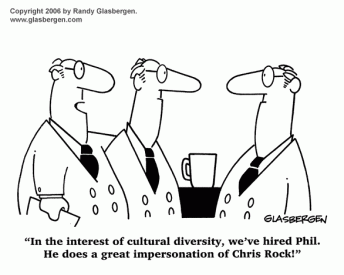
Do social media and networking platforms unfairly restrict speech and content by users expressing certain political views? Is the “marketplace of ideas” subject to entry barriers imposed by the platforms themselves? Twitter has been in the news recently for a “Block & Report Spam” feature whereby complaints can trigger a suspension. Some claim that leftists are gaming the system to take down certain posters. Twitter claims to never filter or moderate content proactively, but the system seems to invite abuse by activists at either end of the political spectrum.

Facebook admits that it attempts to enforce a set of “community standards” that cover the general areas of safety, respect (covering hate speech and nudity), security, and intellectual property. There is ample evidence, however, that enforcement of these standards is “arbitrary and capricious“. Examples range from inconsistent treatment of “Death to Israel” posts, images of buttocks, sculptures or drawings of body parts vs. actual body parts, and a variety of gay-themed images. These cases and many others are likely a consequence of different moderators responding to complaints differently in attempts to interpret and enforce rules that are vague by necessity. In addition, decisions to censor or suspend users are sometimes reversed by committee at higher levels, only to be made again later. And there have been allegations that content from advertisers is treated with a “lighter touch” than from non-advertisers. Perhaps the organization is simply trying to find a fair way to moderate the complicated social thicket, but the effort seems largely misplaced. A broader policy of content neutrality and allowing users to censor their feeds for themselves, as they are empowered to do, would avoid many of the inconsistencies.

Facebook also admits to employing contractors as “news curators”. This, and the mysterious disappearance of certain “trending topics” having a conservative bent, have led to strong complaints of blacklisting and censorship. The curators’ instructions from Facebook are described by Gizmodo:

They were also told to select articles from a list of preferred media outlets that included sites like the New York Times, Time, Variety, and other traditional outlets. They would regularly avoid sites like World Star Hip Hop, The Blaze, and Breitbart, but were never explicitly told to suppress those outlets….  News curators also have the power to “deactivate” (or blacklist) a trending topic—a power that those we spoke to exercised on a daily basis. A topic was often blacklisted if it didn’t have at least three traditional news sources covering it, but otherwise the protocol was murky—meaning a curator could ostensibly blacklist a topic without a particularly good reason for doing so.

This has the potential to create a bias in favor of certain viewpoints. If a trending topic comes from a source or involves a viewpoint that is not in favor, “news curation” amounts to a distasteful cover for outright political censorship. The Facebook system is also vulnerable to the sort of “mobbing” by activists that has been problematic for Twitter. Some of the complaints against unfair treatment by Facebook undoubtedly have merit. Such bias could have an influence sufficiently great to alter election outcomes.

Some forms of censorship on these platforms may be justified, such as preventing threats, abuse or harassment. As well, the platforms are required to comply with laws that are more restrictive in certain countries. Nevertheless, whatever the content standards, and whatever political bias might be created, the platforms are operated by private entities. They can do whatever they want, as much as anyone might hate it. The accusers are entitled to complain, of course, but they should bear in mind that these platforms are not exactly an open marketplace or a public square, however tempting it is to think of them that way. They could be open and free, given a more enlightened approach by the organizations that run them, but as things stand they are not. Positive action remains an option for those who object: agitate, package your content more carefully, or get off the platform and find an on-line community to your liking.

Climate Alarmists Warm To Speech Control

Tags

, , , , , , , , , , , , , , , , , , ,

AGW-cartoon

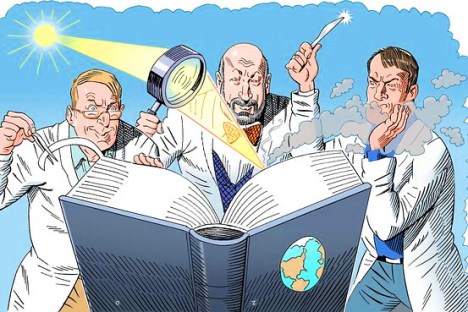
The reactionaries in the global warming plunderbund are revealing their philosophical bankruptcy, dishonesty, and inner fascism. Science is a continuous process of learning through empirical observation, theory and testing. Refutation is as important to the process as original research and replication. Experimental results can be confirmed, but theory can never be established as absolute fact. The term “settled science” is very nearly an oxymoron, yet we constantly hear that climate science is “settled”. Nothing could be further from the truth.

We are asked by the warmists to accept sweeping conclusions on the basis of an extremely short historical record, one that is clouded by sharp disputes over measurement issues. The long-term record based on temperature proxies shows that recent trends are well within the range of natural variability. We are asked to accept conclusions based largely on models that have proven to be extremely inaccurate and that fail to account for important climate influences such as solar variation and oceanic cycles. And with essentially no historical justification, we are asked to accept assumptions about what global temperatures “should be”, and that we should make drastic sacrifices in a quixotic effort to make temperatures stay put. To do so, we are asked to divert resources on a massive scale to mitigate a risk that is speculative at best. An alternative view is that mankind should make sacrifices in order to adapt to change when it occurs, rather than taking the arrogant view that we can, with sufficient coercion and manipulation of private decisions, dominate natural forces to assure climate stability.

Warren Meyer at Coyote Blog has an excellent series of posts on climate change. The most recent of those posts is on natural attribution of climate change. It includes links to earlier parts of his series. Meyer compares today’s alarmists to a hypothetical observer predicting future temperatures in the year 1600, roughly the minimum of the “mini ice-age”. Of course, that observer would have said it would get colder based on his experience, but that would have been wrong. Today’s alarmists rest their case on a 20-year uptrend between 1978 and 1998, tying it to man-made carbon dioxide emissions. In fact, a longer-term view shows that surface temperatures had increased in similar spurts before carbon emissions were a factor of any kind.

Scoundrels tend to twist facts when the facts don’t support their view. Rick Moran reports on an academic paper concluding that it’s acceptable to lie about the threat posed by climate change. It’s not enough to present research and the full range of uncertainty surrounding forecasts, which is very wide. No, the reporting must be wrapped in a sort of Grimm’s fairy tale in order to teach the public a lesson, unschooled children that they are. Such is the manipulative nature of the warmist community.

And the dishonesty is extensive. Remember the claim that 97% of climate scientists accept the proposition of man-made global warming? It was debunked in short order, but the media seemingly can’t get enough of a disaster scenario, so the claim lives on. Famed climatologist Judith Curry has a number of posts on her blog explaining the misleading details of this bit of disinformation. Among the problems of methodology and reporting of this “survey” result is that it was not based on an actual survey of scientists. Instead, it rated abstracts of publications as to their consistency with particular views of the anthropomorphic global warming (AGW) proposition. Not only does this method double-count the views of individual scientists; the authors were highly selective about which scientists and how many of their publications were counted. Even more interestingly, the criteria were so loose that abstracts written by certain scientists known to be skeptical of AGW were counted within the 97%! In one of Curry’s posts, entitled “The Conceits of Consensus“, she discusses the weaknesses and refutations of the claim of a strong consensus, including the participation of non-scientist evaluators of research abstracts in the sample:

Bottom line: inflating the numbers of ‘climate scientists’ in such surveys attempts to hide that there is a serious scientific debate about the detection and attribution of recent warming, and that scientists who are skeptical of the IPCC consensus conclusion are disproportionately expert in the area of climate change detection and attribution.

Other studies have found that a majority of surveyed meteorologists (see here and here), geoscientists and engineers are skeptical of AGW. But again, this information is essentially ignored by the media and self-interested politicos because it does not support the crisis narrative that dictates coercive action by government.

Apparently, propaganda in support of the increasingly dubious warmist position must be reinforced by more drastic measures. Prominent leftists in government are asking whether disputing climate change is punishable under the law. You read that right! Two state attorneys general have threatened to prosecute ExxonMobil for allegedly misleading investors and the public about climate change. Senator Sheldon Whitehouse (D-RI) has proposed using RICO organized crime law to go after certain energy companies for climate change “denial”. Loretta Lynch, the U.S. Attorney General, has asked the FBI to look into it. To hell with freedom of speech. To hell with the spirit of free scientific inquiry. Your authoritarian masters insist that you must fall into line with their climate change agenda or else!

Josh Gelernter opens his recent discussion of this tyrannical gambit this way:

Four hundred years ago this week, the Inquisition met in Rome to discuss Galileo’s support for the Copernican model of the cosmos, which placed the Sun at the center of the solar system. After five days of deliberation, a commission of inquisitors ruled that heliocentrism was ‘foolish and absurd in philosophy, and formally heretical since it explicitly contradicts in many places the sense of the Holy Scripture.’ Not a good moment for the Church. Two days later, Galileo was summoned to the Vatican and ordered ‘to abstain completely from teaching or defending this doctrine and opinion or from discussing it . . . to abandon it completely . . . and henceforth not to hold, teach, or defend it in any way whatever, either orally or in writing.’

To underscore the hypocrisy of these threats of prosecution, David French observes that there are many other instances in which the public has been misled while the presumed climate mavens profited from the hysteria. Could these opportunistic ploys also be subject to prosecution?:

  • Al Gore insisted ten years ago that by now we’d suffer a “climate doomsday” if we failed to take the measures he advocated;
  • Perhaps ABC/Walt Disney has profited from its breathless warnings that “in 2015 milk would cost almost $13 a gallon, gas would be more than $9 a gallon, ‘flames [would] cover hundreds of square miles,’ one billion people would be malnourished, and Manhattan would be flooding — all because of climate change.
  • The Chairman of the United Nations Intergovernmental Panel on Climate Change (IPCC) said, “If there’s no action before 2012, that’s too late….” And as French says: “The IPCC has received tens of millions of dollars while hyping the threat of global warming.

French’s suggestions are not entirely tongue-in-cheek. These suggestions are no more outlandish than threats to prosecute anyone else over a legitimate dispute in scientific debate.

The AGW community suffers from a weak understanding of the philosophy of science, a dishonest presentation of the facts, and a tyrannical streak that should can only be tamed by stripping them of power. First, however, the voting public must wise up to the danger to our economic well being and our freedom posed by these fascist activists.

Back To The Restroom

Tags

, , , , , , , , , , , , , , , ,

image

I’m following-up on “I’m a Restroom Federalist” by sharing “We Need Separation of Bathroom and State” by Roy Cordato at the Mises Institute. He makes a clean defense of the libertarian view that restrooms choices on private property must not be controlled by government. Any attempt to do so is a violation of private property rights, according to this view. I did not adequately treat the question of property rights in my first “restroom” post. Strong property rights in this context mean that you, a private businessperson, can set the rules for restroom use on your premises, or no rules at all. If you or your customers prefer gender-neutral restrooms in your place of business, so be it. If you believe your customers prefer separate restrooms based on a definition of gender, you can post appropriate signs and face any complaints privately without interference from government.

Many sincere observers hope for a way to fairly accommodate transgender individuals without unduly compromising the rights of others. In my mind, discrimination (or differences in accommodations) should not be tolerated in society if based on arbitrary distinctions. By that I mean the victim differs from the discriminator only in nonessential ways for the purposes at hand. For example, discriminating on the basis of race is wholly arbitrary in almost context. (A director casting the part of an individual of a specific race is a possible exception.) No real harm comes from tolerance and equal treatment in these contexts. I have argued that the market is self-regulating in punishing discrimination. And one can argue that certain freedoms may be violated (association, religion, expression and even property) when even arbitrary forms of discrimination are outlawed, as they are. In these situations, however, laws can work because there is little ambiguity in defining victims of discrimination and the legitimacy of their victimhood.

Is discrimination against transgenders in their restroom options just as arbitrary as it would be against other minorities? That depends upon whether “transgender” can be defined objectively. If it cannot, then denying the bearded lady’s transgender claim in the restroom is not so arbitrary, given the privacy rights of others.

Tyler Cowen discusses some of the complexities of determining whether there should be a legal definition of transgender, or a more “nuanced” definition of gender with three or more categories. That would eliminate any legitimate objections to gender-specific  restrooms. However, a legal standard cannot be based solely on “inner feelings”. Aside from genitalia, are there objective facts that can be brought to bear in defining gender? A personal physician’s assessment of “gender intent” is one possibility. An active regimen of hormone replacement therapy is another. However, transgenders themselves might object to any specific definition of gender imposed by government. Many transgenders would prefer to have it remain a matter of self-identity, but it is impossible to clearly define rights on that basis. As Cowen notes, the “most libertarian view is to refuse to offer a legal definition of transgender.” He also adds:

If we stick with no legal definition of transgender, let’s tackle the remaining problems directly. For instance we could significantly increase the penalties for men who abuse women or young girls in or near women’s rooms, if indeed that is an ongoing problem.

As I intimated in my earlier post, I am unconvinced that gender-neutral restrooms won’t encourage voyeurism by posers. That implies a conflict between the rights of transgenders and the fundamental right to privacy. Given that fact, Cowen’s suggestion is sensible under any restroom regime. He also cites the existence of voluntary gender registration systems in other countries. Given a clear definition, transgenders choosing to register could use the restroom consistent with their gender identity and would have documented proof if any question arose as to their right to use a particular facility.

Cordato provides a good explanation of the Charlotte anti-discrimination ordinance and North Carolina’s new law striking it down. The Charlotte ordinance stripped owners of business property of their right to set rules for their own restrooms. The state law does several things: It restores the rights of business owners to provide separate restrooms for males and females, which is fine as far as it goes. It also mandates gender separation of multi-occupancy restrooms and locker rooms in government facilities. Truly, it is hard to imagine any good coming of mixing middle-school girls and boys in the same restrooms and locker rooms. However, the state law also prohibits the promulgation of any anti-discrimination law by lower jurisdictions. That seems a bit too sweeping.

Cowan says the North Carolina law is a solution in search of a problem, or worse:

North Carolina made a mistake in signing the new law. Not just a practical mistake, because of the backlash, but a mistake outright. I’m not aware there was a problem needing to be solved, and yet new problems have been created.

Maybe so, but the city of Charlotte clearly took a step in violation of private property rights, and one that threatened privacy rights. I stated in my first restroom post that alternative arrangements will be tested socially, at the ballot box, and by the courts. Some object to the strong privacy ethic that exists in the U.S. as prudish, but it is a cultural given, and privacy rights are protected by the Constitution. Given a conflict over rights between two parties, the courts must decide how to balance those interests.That’s as it should be. And so we’re back to the beauty of federalism!


Words of Weasels

Tags

, , , , , , , , , , , , ,

1984 instruction-manual

Take a moment to consider some examples of the horrible misuse of words in political debates. David Harsanyi at Reason provides a few choice examples of the corrupted and misleading language used by Democrats:

  • the absence of a tax that “should” exist but doesn’t is a “loophole”;
  • failure to pay that tax is a “fraud”;
  • denial of “access” occurs when the state doesn’t give something to you for free;
  • “disenfranchisement” means you have to show an ID or wait in line;
  • “full rights” means the entire world must be a “safe space” for your actions or views, even if the rights of others are denied in the process.

These are all recent examples of mangled language from the two candidates for the Democrat Party nomination. But here’s a big one that Harsanyi overlooked: the misuse of the term “liberalism” to describe statism. In fact, he misuses the word “liberals” himself! In “Don’t Call Leftists Liberal; They’re Not!” on Sacred Cow Chips, I offered some thoughts on this bit of Newspeak practiced by so-called progressives. I can’t resist reposting the following quote of Daniel Klein quoting Kevin Williamson, which says it all (links are in the original post):

Williamson [quotes] two leftist authors writing in The Nation, one decrying ‘unbridled individualism,’ the other ‘unfettered capitalism.’ Williamson concludes: ‘A ‘liberalism’ that is chiefly concerned with the many clever uses of bridles and fetters does not deserve the name. It never has.’”

The following quote from Harsanyi gives emphasis to the wrongful appropriation of “liberalism” by the left, though it relates more specifically to the misuse of the term “loophole”:

Basically, all of life is a giant loophole until Democrats come up with a way to regulate or tax it. In its economic usage, “loophole” … creates the false impression that people are getting away with breaking the law. It’s a way to skip the entire debate portion of the conversation and get right to the accusation.

Another behavioral characteristic of leftists is a certain self-righteous satisfaction that they hold the moral high ground on any number of issues. “The Smug Style in American Liberalism“by Emmitt Rensin in Vox takes a poke at this presumption. Of course, Rensin misuses “liberalism”. I find this review of the article by Kyle Smith an effective summary, and it’s even better because it skips what comes off as a long catalog of excuses by Rensin as to why leftists might be forgiven for patting themselves on the back. I give Rensin credit, however, for a good analysis of the origins of leftist “smug”, which he attributes to a backlash against defections from the Democrat coalition by working-class voters in the second half of the twentieth century. And I credit Rensin for his ultimate condemnation of undeserved leftist attitudes of superiority. Here are some difficult realities for the left cited by Rensin:

Nothing is more confounding to the smug style than the fact that the average Republican is better educated and has a higher IQ than the average Democrat. That for every overpowered study finding superior liberal open-mindedness and intellect and knowledge, there is one to suggest that Republicans have the better of these qualities.

Perhaps inventing new definitions for words in the service of rhetoric comes easy with pomposity. In the end, assertions that the left is more “caring”, “tolerant” or “peaceful” are balderdash. There are honest policy debates to be had about the best way to solve social problems and respect for the rights of others, but having experienced angry reactions in debate with befuddled leftists for myself, I wholly concur with this Kyle Smith observation:

Ridiculing opponents is easier than arguing with them. Liberals don’t want debate, they want affirmation.


Seeding the Grapes of Graft

Tags

, , , , , , , , , , , , ,

Government-Bounty-Hunter

Are you investing in graft and rent-seeking activity without knowing it? Is a significant share of your saving channeled into sectors that profit from political influence over politicians, regulators and government planners? Maybe it’s no surprise, and you knew all along that your capital backs firms who manipulate the political system to extract resources beyond what they can earn through honest production. You have an interest in the success of the rent seekers, and you might well get a tax benefit to go along with it!

All this is almost certainly true if your savings are in a 401k, an IRA, a public or private pension fund, or in publicly-traded stocks. These sources of investor funding are dominated by firms that rent seek…. an indication of just how far the cancer of corporatism has gone toward completely subverting free market capitalism. It can be turned back only by ending the symbiosis between industry and government and encouraging real competition in markets.

This question of investing in rent seekers is raised by Guy Rolnik at Pro-Market (the blog of the Stigler Center at the University of Chicago Booth School of Business):

Put another way, are we facing an economic model in which tens of millions of Americans’ pensions are relying on the ability of companies to extract rents from consumers and taxpayers?

Rolnik’s emphasis is primarily on mergers and acquisitions, industrial concentration, diminished competition, and monopoly profits extracted by the surviving entities. As Alex Tabarrok at Marginal Revolution notes, “The Number of Publicy Traded Firms Has Halved” in the past 20 years. At the same time, the trend in business startups has been decidedly negative. While I strongly believe in the benefits of a healthy market for corporate control, these trends are a sign that the rent seekers and their enablers in government are gaining an upper hand.

Monopoly must be condoned if there are natural barriers to entry in a market, but such monopolists are generally subject to regulation of price and service levels (complex issues in their own right). If there are other legitimate economic barriers to entry such as differentiated products and strong brand reputations, there is no reason for concern, as those are signs of value creation. And given the private freedom to innovate and compete, there is little reason to suspect that above-normal profits can persist in the long run, as new risk-takers are ultimately drawn into the mix. That is how a healthy economy works and how prices direct resources to the highest-valued uses.

Rent seekers, on the other hand, always have one of the following objectives:

Government Protection: Increased concentration in an industry is a concern if there are artificial barriers to entry. One sure way to protect a market is to enlist the government’s help in locking it down. This happens in a variety of ways: tariffs and other restrictions on foreign goods, patent protection, restrictions on entry into geographic markets, implicit government guarantees against risk (too big to fail), union labor laws, and complex regulatory rules and compliance costs that small competitors can’t afford. The upshot is that if we want more competition in markets, we must reduce the size of the administrative state.

Subsidies: Another aspect of rent seeking is the quest for taxpayer subsidies. These are often channeled into politically-favored activities that can’t be sustained otherwise, and the recipients are always politically-favored firms with friends in high places. This is privilege! Look no further than the renewable energy industry to see that politically-favored, subsidized, and uneconomic activities tend to be dominated by firms with political connections. Naturally, good rent-seekers have an affinity for central planning and its plentiful opportunities for graft. With big-government control of resources you get big-time rent seeking.

Contracts: Government largess also means that big contracts are there to be won across a range of industries: construction, defense, transportation equipment, office supplies, computing, accounting and legal services and almost anything else. Because these purchases are made by an entity that uses other people’s money, incentives for efficiency are weak. And while private firms may compete for these contracts, there is no question that political connections play an important role. As government assumes control of more resources, more favorable rent-seeking opportunities always appear.

Influencing public policy is a game that is much easier for large firms to play. Moreover, the revolving door between government and industry is most active among strong players. This is not to say that large corporations don’t engage in many productive activities. They often excel in their areas of specialization and therefore earn profits that are economically legitimate. However, when government is involved as a buyer, subsidizer or regulator, the rewards are not as strongly related to productive effort. These rewards include above-normal profits, a more dominant market position, a long-term pipeline of taxpayer funding, the prestige of running a large operation with armies of highly-skilled employees engaged in compliance activities, and prestigious appointments for officers. Some of these gains from graft are shared by investors… and that’s probably you.

For society, the implications of channeling saving into rent-seeking activities are unambiguously negative. To say it differently, the private return to rent seeking exceeds the social return, and the latter is negative. Successful rent seekers artificially boost their equity returns and may simultaneously undermine returns to smaller competitors. The outcomes entail restraint of trade and misallocation of resources on a massive scale. The public-sector largess that makes it all possible gives us high rates of taxation, which retard incentives to work, save and invest. If taxes aren’t enough to cover the bloat, our central bank (the Fed) is not shy about monetizing government debt, which distorts interest rates, inflates asset prices and  inflates the prices of goods. In the aggregate, these things warp the usual tradeoff between risk and return and worsen society’s provision for the future.

How should you feel about all this? And your portfolio? As an investor, you might not have much choice. It’s not your fault, so take your private returns where you can find them. Some firms swear off rent seeking of any kind, like Koch Industries, but it is not publicly traded. You could invest in a business of your own, but know that you might compete at a disadvantage to rent seekers in the same industry. Most of all, you should vote for lower subsidies, less regulation and less government!

Dynamism and Punishment

Tags

, , , , , , , , , ,


econ

The “squeeze” on the U.S. middle class is a fiction. If you don’t believe it, take a look at the “gif” above. It first appeared in The Financial Times (FT) with a misleading description about how “…technological change and globalization drive a wedge between the winners and losers in a splintering US society.” It’s obvious that the middle class, as statically defined by the FT, is shrinking only because it is moving up to higher real income levels (i.e., adjusted for inflation). Mark Perry uses this and other supporting charts in noting that “…so many middle-income households have become better off“. Some of these gains are related to an aging population, but the gains are not remotely consistent with FT’s dramatization. One point of emphasis that the chart should make obvious, but doesn’t quite, is that groups appearing to remain within a particular income range over time are never comprised of the same individuals. There is always movement up and down across all of these groups from year-to-year.

There is a stagnation story here, but it’s more limited than suggested by FT’s narrative. It is twofold: first, the financial crisis in 2007-2009 put a temporary stop to the upward income migration, and its resumption during the Obama presidency has been less robust; second, the very lowest-income segment, $0 – $10,000 of annual income, has expanded in each time interval shown since 1991, from just above 1% of adults to roughly 2.5%. A primary reason for the tepid growth of the U.S. economy since the recession’s trough in 2009, and the weaker migration, has been weak physical investment in the productive economy from its recession lows. That form of spending usually takes a lead role in economic recoveries. A number of observers have attributed the poor performance this time around to “regime uncertainty“, or the risk that regulatory and tax regimes could take an even more destructive toll in the future, essentially devouring returns to capital. As for the increases in the lowest-income sliver of the chart, Scott Sumner says:

It could be due to expansion of the welfare state, the break-up of the traditional family, or perhaps growth in the underground economy. Nonetheless, it is cause for concern. But it has nothing to do with the mythical decline in the ‘middle class.’

A related fiction is that the U.S. tax system is unfair to the middle class, and that higher income groups do not pay their “fair share”. This is put to rest in an “Issue Brief” from the Peter G. Peterson Foundation (PPF), using data from the Tax Policy Center and the Congressional Budget Office. The analysis shows that while high-income taxpayers benefit from tax breaks, those breaks offset high marginal tax rates and do not diminish the fact that the tax system is highly progressive:

The Tax Policy Center estimates that 69 percent of taxes collected in 2015 will come from those in the top quintile, or those earning an income above $138,265 annually. Within this group, the top one percent of income earners — those earning more than $709,166 in income per year — will contribute over a quarter of all federal revenues collected.

Apparently, the PPF analysis does not account for the impact of transfer payments on progressivity, which make average effective tax rates negative at low income levels. However, PPF does acknowledge that the tax system is unnecessarily complex and creates a web of distortions and poor incentives that limit economic growth. It’s a wonder that the dynamic of upward migration in real income was possible at all.


A Healthy Fetish For Federalism

Tags

, , , , , , ,

outrage

When I say I’m a federalist, I mean that I support a system in which powers are divided between different levels of government. Federalism establishes co-sovereignty between a central government and regional governments. It does not mean that the federal government is always dominant as is sometimes suggested: the Supremacy Clause under Article VI of the U.S. Constitution covers conflicts of law between the federal government and lower levels of government. Elsewhere, however, the Constitution places strict limits on the powers of the central government by defining an enumerated set of federal powers. All other powers reside with the people or their state governments, ideally constitutional republics in their own right.

Federalism is thought to minimize conflict within a nation by allowing law to be formulated differently within sub-jurisdictions. In this way, it has a limited ability to accommodate different political and social preferences, and it creates a de facto laboratory within which experiments in governance can be assessed. Whether one approves of a particular experiment always depends upon the nature of the question, and experiments imposing limits on individual rights are unconstitutional. Individual rights established by the Constitution are thought to be inviolable and to supersede any federal or state legislation. We should all be absolutists about that. A federalist approach can also be a practical starting point in bringing about broader social recognition of new claims under the Constitution. There are many interesting cases, however, in which legitimate constitutional rights of different parties stand in conflict.

The federalist idea of a social laboratory across jurisdictions is very appealing. When a conflict over legal and social issues seems intractable, federalism makes it possible to see how well different approaches solve the problem. There may be a variety of interesting solutions or political compromises that can be brought to bear, and it can be easier to reach an accord at the state level. Diversity of circumstances and preferences may mean that a good solution in one state will be bad in another. So different states can try different arrangements under federalism. The results of these experiments can guide other states or even federal legislation, if it comes to that. Voters in each state have the power to reward or punish elected representatives, based on these experiments or their outcomes, or to “vote with their feet” by moving to a state that better matches their political preferences.

Today, the country is experiencing an epidemic of grievances on which there is little consensus. These cover issues related to gender identity, gay rights, polyandry, sexual consent, voting rights, due process claims, race and law enforcement, food labeling, drug legalization, censorship, assisted suicide, “micro-aggressions”, and any number of other causes célèbres. These issues may involve novel private or social arrangements, or they may necessitate a weighing of the asserted rights of an aggrieved individual or group against established rights of others protected by the Constitution. It may well be that the asserted rights of the aggrieved have a proper place in the Constitution, and if so, there might be a compelling case for protection relative to other claims. Federalism is one way this can be hashed out: a state legislates, pro or con; the legislation may be challenged in court; the courts rule whether the law is constitutional at the state level or even at the federal level. And the process may start in any number of states.

I have appealed to federalism on several issues in the past. When the rights of different parties stand in conflict, attempting to weigh different sides of an issue based on libertarian and constitutional principles does not always lead to clear-cut answers. However, laws work best when there is consensus among the governed. Political consensus may be more readily achieved at sub-national levels. That doesn’t necessarily protect the people of any state against big government solutions, high taxes or cronyism. However, at least dissenters within a state can register their dissatisfaction at the ballot box, agitate, attempt to persuade others, challenge in court, or move away.

Both left and right take absolutist views on many issues. They often find it difficult to tolerate variances à la federalism. For example, should a legitimate transgender individual be allowed to use the restroom compatible with their gender identity? The left regards that as an inviolable right, regardless of genitalia and potential threats to privacy. If you disagree, they may call you a bigot! Some on the right, however, regard transgenderism as perverse and not worthy of constitutional protection. Both are absolutist positions. There are, in fact, legitimate reasons for taking either side in the restroom debate, as I attempted to outline here last week. Under such circumstances, federalism respects the political balance within any jurisdiction and allows a way forward, short of resorting to federal legislation, which might well be impossible to achieve.

Federalism is usually associated with strong “states rights”, which are sometimes criticized on historical grounds because slavery was often characterized as a “states rights” issue. The horrific treatment of blacks under slavery was obviously based on an arbitrary distinction that should never have been tolerated under our Constitution; ownership of human chattel should never have been defended as a “right”, but it took a civil war and the Thirteenth Amendment to end it officially. The discrimination mandated under Jim Crow laws was based on the same arbitrary distinction, but it took another 100 years after the Civil War to end those laws through enactment of the Civil Rights Act. I grant that federal action was necessary in both cases. However, few of the challenges we face today are based on such arbitrary distinctions. Rather, they often involve constitutional ambiguity and legitimate concerns over protected rights. So let the experiments, the evolution of opinion and the court challenges play out. That is the essence of federalism. It helps us to muddle on through.

Coerced Fairness: Wronging Every Right

Tags

, , , , , , , , , , , , ,


image

A nurse says, “If I can bring myself to treat a patient tattooed with a swastika, then a baker can bake a cake for a gay wedding.” Of course, the statement ignores any differences in the values held by these individuals, their right to hold different values, or at least their right to act peacefully on those values. It makes an arbitrary presumption about what is “fair” and what is “unfair”, which is seldom well-defined when two parties hold sincere but conflicting beliefs. Yes, the baker can bake the cake, but should he be forced to do so under state compulsion? Coerced behavior is the product of aggression, but declining business for personal reasons is not an act of aggression, though the “safe-space” crowd would do its best to convince us otherwise. Sorry, hurt feelings don’t count!

Imposing the machinery of the state on private decisions about how and for whom one’s art must be practiced invites even more coercive action by the state going forward. Jeffrey Tucker addresses this in “Must a Jewish Baker Make a Nazi Cake?“, using the teachings of Ludwig von Mises on the implications of voluntary and coerced behavior.

Discrimination occurs in markets in many forms. Consumers discriminate between sellers and products based on quality, price, convenience and trust. In turn,  producers or sellers discriminate between workers based on skill, effort, wages and trust. They discriminate between local markets or areas of specialization based on profitability. They discriminate between buyers based upon ability and willingness to pay. All of these forms of discrimination are rational because they result in better value for the discriminating consumer or better profitability for the discriminating producer. In other words, these forms of discrimination align with economic self-interest.

Other forms of discrimination do not align strictly with economic self-interest, but they may be preferred by the individual based on other criteria. It’s probably not possible to justify these forms of discrimination from all perspectives. Some may be abhorrent to most observers, including me. Certainly more consensus exists on some than on others. Nevertheless, these non-economically motivated forms of discrimination are always costly to the discriminator. For example, a consumer who refuses to frequent certain establishments owned by members of an out-group will forego opportunities for more varied experiences. Also, she will tend to pay higher prices due to her lack of interest in the competitive effort made by the out-group. An employer who refuses to hire certain minorities faces a more limited labor pool. He is likely to face a higher wage bill and will get a less efficient mix of skills in his workers. A seller who discriminates against certain groups by turning them away foregoes revenue, and the action may have negative reputational consequences. Obviously, other competitors can profit from another seller’s discriminatory behavior. Almost by definition, markets impose penalties on discrimination not borne out of economic self-interest.

Anyone with doubts about the effectiveness of markets and capitalism to overcome this latter type of discrimination should look no further than the broadly integrated activity that occurs within markets every day, and at the extent to which markets have become more diverse over time. Here is a choice quote of Tucker:

Commerce has a tendency to break down barriers, not create them. In fact, this is why Jim Crow laws came into existence, to interrupt the integrationist tendencies of the marketplace. Here is the hidden history of a range of government interventions, from zoning to labor laws to even the welfare state itself. The ruling class has always resented and resisted the market’s tendency to break down entrenched status and gradually erode tribal bias.

Indeed, commerce is the greatest fighter against bigotry and hate that humankind has ever seen. And it is precisely for this reason that a movement rooted in hate must necessarily turn to politics to get its way.

The hypertext within the quote links to an excellent piece by Andrew Berstein on “Black Innovators and Entrepreneurs Under Capitalism”, which covers the sad history of efforts to use government to undermine black commercial success.

Social justice activists argue that the state has a compelling interest in ending all discrimination, but the courts have followed a circuitous path in thrashing out whether (and what parts of) the U.S. Constitution might protect individuals or groups against private discrimination. But my interest is in what happens when the state endeavors to end discrimination in markets that are otherwise self-regulating: the state infringes on other rights that are clearly and definitively enshrined in the Constitution, and it arrigates power to itself that far exceeds the limits defined there. It may compromise the freedom of association, the freedom of religion, the right to private property, and the right to privacy. I believe the government has a compelling interest in protecting those rights, which apply to all individuals. It is also worth noting the absence of a limiting principle in defining what counts as fairness or discrimination. The Left finds it easy to denigrate and dismiss these as selfish concerns, proving how little regard they have for individual liberty. Establishing government control over the extent of those rights represents the end of our Constitutional Republic and is a prescription for tyranny.

Consider the ways in which government often attempts or is asked to create accommodations for marginalized groups, through laws on hate speech, compulsory service, hiring quotas, admission quotas, lending fairness, pricing equity, wage laws, work rules, mandatory facilities and the forced transfer of income. Tucker argues that this complex web of resource manipulation and mandatory and proscribed behaviors has several “unintended” consequences. I already mentioned the obvious abridgment of freedoms. Another negative consequence is that this approach does not promote unity; it breeds resentment and is likely to end in greater disunity. Furthermore, self-sufficiency is undermined by policies that hamper economic growth, and all of the general measures just mentioned redound to the detriment of that objective. Finally, many of these “fairness” policies run directly counter to the interests of the marginalized, such as wage floors that eliminate employment opportunities for the least-skilled, and means testing that discourages labor market effort through income “cliff” incentives.

The most menacing aspect of the effort to stamp out all forms of discrimination is a state with power to impose its own rules of legal “fair” treatment. Tucker appeals to Mises’ views on this point:

“[Mises] said that a policy that forces people against their will creates the very conditions that lead to legal discrimination. In his view, even speaking as someone victimized by invidious discrimination, it is better to retain freedom than build a bureaucracy that overrides human choice. …

Sacrificing principle for the sake of marginalized groups is short-sighted. If you accept the infringement of human rights as an acceptable political weapon, that weapon will eventually be turned on the very people you want to help. As Dan Sanchez has written, ‘Authoritarian restriction is a game much better suited for the mighty than for the marginalized.’

Proponents of legal, compensatory  handicapping by the state in favor of those pressing any and all grievances ask us to compromise basic constitutional rights, including the rights of association, free expression, privacy and private property. A corresponding effect is to grant the state more complete coercive power in almost every aspect of life. The unavoidable focus of such policies is not unity, but group identity, a divisive result that should give us pause. The power granted to the state in this context is as arbitrary as the currently fashionable definition of “fairness”, and it cannot be rolled back easily. Furthermore, economic vitality is not easy to restore once basic institutions and freedoms have been destroyed. This is evident from the sad history of socialism throughout the world. Ultimately, the coercive power granted to the state can be used in ways that should horrify today’s proponents of social and economic redress for every real or imagined inequity.

~~~~~~~~~~~~~~~~~~~~~~~~~~~~~~

Addendum: Just over a year ago, I made a qualified defense of the right of a business to refuse service based on religious principles in my post “Suit Me, Or Face a Lawsuit: Adventures In Litigationland“. There, I made a distinction between “public accommodations” versus work for which a business-person must use her art, which is a form of expression, to provide customized service to a potential customer. I had the baker in mind, or the photographer asked to work a gay wedding. As I have in this post, I maintained that if a business-person finds some aspect of a request objectionable for any reason, she has the right to discriminate by refusing the business as a matter of freedom of expression.

I left a huge loose end in the argument I made in the earlier post. It had to do with the presumed requirement to serve all potential customers through the “public accommodations” of a private business. However, if the baker creates a beautiful “love cake” for sale to the general public, why can’t he refuse to sell it to a gay couple for their wedding as a matter of freedom of expression? After all, it involves the baker’s art. If a stationer has created an artful collection of cards for sale to the public, why can’t she refuse to sell them to a gay couple for their wedding invitations on account of her religious convictions? And what about the nurse? If he is in private practice, can’t he refuse to practice his art of healing on the “swastikaner” as a matter of free expression? I believe that’s a constitutional absolute, though professional oaths may dictate that care be delivered. An emergency room nurse would not have any choice but to deliver care under federal law, but it is not clear whether the law would withstand a constitutional challenge by a private hospital on these grounds. As things stand, the nurse can only refuse employment or resign if the rules are not to his liking.


I’m a Restroom Federalist

Tags

, , , , , , , , , ,

image

A joke I once heard: “What two words does a guy least want to hear at the urinal? … Nice d*ck!”  The truth is that privacy matters. While most men don’t wish to be “admired” by other men, mens’ public restrooms would seem to provide adequate privacy for those having a particular sensitivity. I presume that womens’ restrooms do too.

Still, voyeurism is more common than we’d like, and strong privacy advocates believe that’s an adequate rationale for prohibiting transgender women (M to F) from using womens’ restrooms. It’s not legitimate trans-women who are of concern, whether they’ve undergone full sexual reassignment or not. Rather, it’s men who would falsely claim to be trans-women. Put another way, does the state have any compelling interest in protecting privacy by discriminating against transgender women, barring their use of womens’ restrooms?

Laws against voyeurism are grounded in the presumed right to privacy under the U.S. Constitution. The expectation of privacy is well-established as a condition under which voyeurism can be prosecuted, and bathrooms meet that test. In fact, the prevalence of voyeurism is estimated to be quite high, especially among males. The Wikipedia entry on this subject states that:

…research found voyeurism to be the most common sexual law-breaking behavior in both clinical and general populations. … In a national study of Sweden it was found that 7.7% of the population (both men and women) had engaged in voyeurism at some point. It is also believed that voyeurism occurs up to 150 times more frequently than police reports indicate.

The estimate from Sweden is conservative for male voyeurs. However, only a portion of that voyeurism occurs in or around public restrooms. For the sake of argument, let’s suppose that 5% of the estimate above relates to males likely to commit some form of voyeurism in or around womens’ restrooms, or 0.38% of the adult male population. Each of those males may commit voyeurism against multiple females on any given bathroom escapade, so this value may underestimate the risk to the privacy of women.

On the other hand, the prevalence of transgender, or gender identification different from that assigned at birth, is very low. Again according to Wikipedia, the most commonly cited figure is that 1 in 10,000 assigned males is transgender (and far fewer birth-assigned females). Some argue that this is too low to account for even the cases of sexual reassignment surgery (SRS) that have occurred in the U.S.  I would argue, however, that trans-women (M to F) having undergone SRS would be welcome in womens’ restrooms. After all, they’d even pass a genital check at the door! That leaves transgender men who have not yet, or will not, undergo SRS. So, for the sake of argument, I will go with the incidence rate of 0.01% implied by the figure above. That is, 0.01% of the adult male population is an assigned-male trans woman having male genitals.

Assuming that all womens’ restrooms are thrown open to any male claiming to be a trans-woman, the conservative estimate of the incidence of voyeurism would be 38 times the incidence of legitimate trans-women disallowed from entering womens’ restrooms under traditional gender restrictions. Note that neither of these estimates has a time dimension. Repeat voyeurism is a likelihood, just as legitimate trans-women, pre-SRS, would be denied their rights on every trip to a public restroom.

Now we ask again which case is more compelling: protecting the right to privacy against the potential for voyeurism, or protecting the restroom rights of trans-women who are pre- or non-SRS? One possible solution is to acknowledge restrictions on restroom use as an incentive for transsexuals to undergo SRS. However, that is not practical in important respects: full gender transition can take a number of years; SRS is not and cannot be an immediate procedure for walk-ins at the doctor’s office for various reasons; and some transsexuals are never able to make a full transition.

Another consideration is the extent to which bathroom regulation makes any difference at all. While “throwing the doors open” might create some additional incentive to male voyeurs, they are already active, and most of them would be just as easy to prosecute if the rules on restroom use for trans-women were relaxed. However, to the extent that creates additional risk, it is borne by all women availing themselves of public restrooms. At the same time, it is certain that trans-women already make use of womens’ restrooms. If non-SRS, they must do so surreptitiously and at some legal risk, Again, their total number is limited.

The balance between the threat to privacy rights and the desire for equitable treatment of transsexuals is not as clear-cut as some on either side would have us believe. However, given the need to determine that balance, the classic federalist approach seems ideal. That is, states or more limited political jurisdictions should decide how best to handle the issue. That is more or less our current approach, as the issue is otherwise beyond our ability to find a consensus. Full conversion to unisex restrooms might even be acceptable in some parts of the U.S. Fortunately, individuals can “vote with their feet”, rewarding those jurisdictions having laws they find best-protect their rights as individuals. It’s another great experiment in the determination of social preferences. That’s what federalism is all about.


Junk Science Malignancy

Tags

, , , , , , , , , , , , , ,

A retracted 2012 study purporting to show that genetically modified (GMO) corn causes cancer was not recently vindicated by French courts. A few publications lacking minimal journalistic standards have made that false claim. There was a favorable ruling in a libel suit brought by Gilles-Eric Séralini, author of the study, but it did not vindicate his sloppy research in any way. The court simply agreed that the defendant could not prove that Séralini had committed fraud. In the U.S., proof of malice by the defendant would have been required for a libel verdict, but not in France. In any case, the ruling did not address the scientific validity of  Séralini’s research, only that it was not willfully fraudulent. Courts do not serve as arbiters of scientific validity.

The study itself was awful. Details can be found here. Séralini used rats that were bred to develop cancer with an extremely high incidence (70% – 80% lifetime); he tested different groups of these rats with varying amounts of GMO corn and Roundup pesticide. The small samples he used meant that the tests had very low statistical power. There were suspicious aspects of the study that might or might not have been cleared up with sufficient disclosure, and there was even contradictory evidence within the study itself, as would be expected with so much statistical noise. Séralini’s efforts to publicize the paper didn’t help his reputation in the scientific community. He made some exaggerated claims, and though he might have believed them, he was clearly interested in making a big splash.

The paper received overwhelming criticism in the scientific community. It was retracted by the journal that originally published it, but later it was republished in a low-quality journal without peer review. This study was not the first piece of Séralini research to be harshly criticized by his peers. Here are comments from the blog of respected horticulturist Kevin Folta, who does not mince words:

It boils down to this– if these data were significant, if the experiments were good, and the interpretations sound, this would not be buried in the depths of a crappy journal. If there was hard evidence that our food supply truly caused tumors, it would be on the New England Journal of Medicine, Science, Nature, or maybe Cell if he wanted to go slumming. But it’s not there. It is in a tiny, obscure journal that has quite a visible agenda, and that’s the only thing visible about it.

And that’s where it belongs. Let him have his day in the sun. History will not remember him for his science. It will remember him as a disgraceful hack that let personal agenda affect adoption of safe scientific technology. He’ll be the guy that fooled millions with low-quality data.

It is very sad, because I’d rather be writing blogs about exciting science and new findings. Instead we’re back to this nonsense. Luckily, it will slowly disappear into time, like Puzstai’s lectins, Huber’s mystery organism, and the rest of the alarmist junk never published or never reproduced.

An issue that has been thorny for GMO advocates is the erroneous conflation of GMOs with glyphosate (Roundup is one brand). Séralini’s work focused on glyphosate-resistant GMOs, and his treatments involved the administration of glyphosate to rats in varying quantities, but publicity surrounding the study gave the impression that his “findings” applied more generally to GMOs. Glyphosate resistant plants were an early product of the GMO technology, but most GMO plants have nothing to do with glyphosate. Instead, they confer benefits such as nutritional superiority, drought resistance, pest resistance, disease resistance, and improved environmental consequences of agriculture. The variety of problems that can be addressed with GMOs is staggering.

The safety of GMOs is well established in the plant science literature. Use the box above to search Sacred Cow Chips for “GMO” or “genetic” to find earlier posts in which I have addressed GMO safety at greater length. A recent article from Andrew Porterfield of the Genetic Literacy Project addresses some aspects of this literature and on long-term animal feeding studies, which have demonstrated the safety of GMOs.

A petition in support of GMO technology signed by over 1,400 plant science experts is linked in this article in Science Daily. Three of the authors of the petition are affiliated with The Donald Danforth Plant Science Center in Creve Coeur, Missouri, not far from my home.  The petition vouches for the safety of GMOs and their promise in meeting the world’s demand for food.

Note: the infographic at the top of this post is from the Biology Fortified blog.