• About

Sacred Cow Chips

Sacred Cow Chips

Tag Archives: Abraham Accords

Promises and Policies: Grading the Candidates

29 Tuesday Oct 2024

Posted by Nuetzel in Election

≈ Leave a comment

Tags

2024 Election, Abortion, Abraham Accords, Barack Obama, Capitalism, Climate Change, Corporatism, DEI, Dobbs, Donald Trump, Elon Musk, fascism, Federal Reserve, First Amendment, Fossil fuels, Housing, Hysteria, Immigration, Inflation, Israel, Joe Biden, Kamala Harris, Medicaid, Medicare, Obamacare, Renewable energy, Second Amendment, Social Security, Supreme Court, Tariffs, Tax Policy, Ukraine, Vladimir Putin
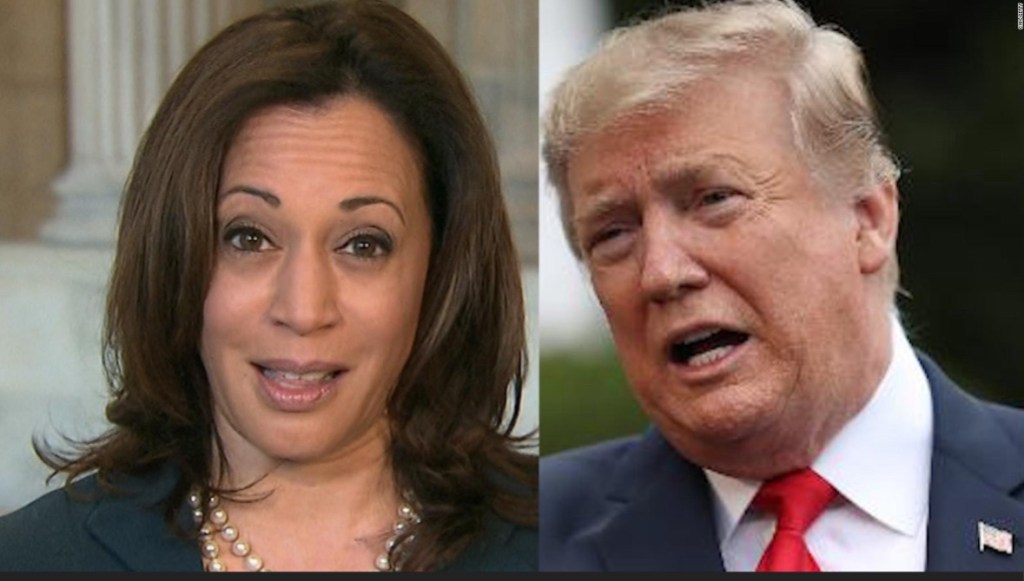
Wow! We’re less than a week from Election Day! I’d hoped to write a few more detailed posts about the platforms and policies of Kamala Harris and Donald Trump, but I was waylaid by Hurricane Milton. It sent us scrambling into prep mode, then we evacuated to the Florida Panhandle. The drive there and back took much longer than expected due to the mass exodus. On our return we found the house was fine, but there was significant damage to an exterior structure and a mess in the yard. We also had to “de-prep” the house, and we’ve been dealing with contractors ever since. It was an exhausting episode, but we feel like we were very lucky.

Now, with less than a week left till the election, I’ll limit myself to a summary of the positions of the candidates in a number of areas, mostly but not all directly related to policy. I assign “grades” in each area and calculate an equally-weighted “GPA” for each candidate. My summaries (and “grades”) are pretty off-the-cuff and not adequate treatments on their own. Some of these areas are more general than others, and I readily admit that a GPA taken from my grade assignments is subject to a bit of double counting. Oh well!

Role of Government: Kamala Harris is a statist through and through. No mystery there. Trump is more selective in his statist tendencies. He’ll often favor government action if it’s politically advantageous. However, in general I think he is amenable to a smaller role for the public than the private sector. Harris: F; Trump: C

Regulation: There is no question that Trump stands for badly needed federal regulatory reform. This spans a wide range of areas, and it extends to a light approach to crypto and AI regulation. Trump plans to appoint Elon Musk as his “Secretary of Cost Cutting”. Harris, on the other hand, seems to favor a continuation of the Biden Administration’s heavy regulatory oversight. This encourages a bloated federal bureaucracy, inflicts high compliance costs on the private sector, stifles innovation, and tends to concentrate industrial power. Harris: F; Trump: A

Border Policy: Trump wants to close the borders (complete the wall) and deport illegal immigrants. Both are easier said than done. Except for criminal elements, the latter will be especially controversial. I’d feel better about Trump’s position if it were accompanied by a commitment to expanded legal immigration. We need more legal immigrants, especially the highly skilled. For her part, Harris would offer mass amnesty to illegals. She’d continue an open border policy, though she claims to want certain limits on illegal border crossings going forward. She also claims to favor more funds for border control. However, it is not clear how well this would translate into thorough vetting of illegal entrants, drug interdiction at the border, or sex trafficking. Harris: D; Trump: B-

Antitrust: Accusations of price gouging by American businesses? Harris! Forty three corporations in the S&P 500 under investigation by the DOJ? The Biden-Harris Administration. This reflects an aggressively hostile and manipulative attitude toward the business community. Trump, meanwhile, might wheedle corporations to act on behalf of certain of his agendas, but he is unlikely to take such a broadly punitive approach. Harris: F; Trump: B-

Foreign Policy: Harris is likely to continue the Biden Administration’s conciliatory approach to dealing with America’s adversaries. The other side of that coin is an often tepid commitment to longtime allies like Israel. Trump believes that dealing from a position of strength is imperative, and he’s willing to challenge enemies with an array of economic and political sticks and carrots. He had success during his first term in office promoting peace in the Middle East. A renewed version of the Abraham Accords that strengthened economic ties across the region would do just that. Ideally, he would like to restore the strength of America’s military, about which Harris has less interest. Trump has also shown a willingness to challenge our NATO partners in order to get them to “pay their fair share” toward the alliance’s shared defense. My major qualification here has to do with the candidates’ positions with respect to supporting Ukraine in its war against Putin’s mad aggression. Harris seems more likely than Trump to continue America’s support for Ukraine. Harris: D+; Trump: B-

Trade: Nations who trade with one another tend to be more prosperous and at peace. Unfortunately, neither candidate has much recognition of these facts. Harris is willing to extend the tariffs enforced during the Biden Administration. Trump, however, is under the delusion that tariffs can solve almost anything that ails the country. Of course, tariffs are a destructive tax on American consumers and businesses. Part of this owes to the direct effects of the tax. Part owes to the pricing power tariffs grant to domestic producers. Tariffs harm incentives for efficiency and the competitiveness of American industry. Retaliatory action by foreign governments is a likely response, which magnifies the harm.

To be fair, Trump believes he can use tariffs as a negotiating tool in nearly all international matters, whether economic, political, or military. This might work to achieve some objectives, but at the cost of damaging relations more broadly and undermining the U.S. economy. Trump is an advocate for not just selective, punitive tariffs, but for broad application of tariffs. Someone needs to disabuse him of the notion that tariffs have great revenue-raising potential. They don’t. And Trump is seemingly unaware of another basic fact: the trade deficit is mirrored by foreign investment in the U.S. economy, which spurs domestic economic growth. Quashing imports via tariffs will also quash that source of growth. I’ll add one other qualification below in the section on taxes, but I’m not sure it has a meaningful chance.

Harris: C-; Trump: F

Inflation: This is a tough one to grade. The President has no direct control over inflation. Harris wants to challenge “price gougers”, which has little to do with actual inflation. I expect both candidates to tolerate large deficits in order to fulfill campaign promises and other objectives. That will put pressure on credit markets and is likely to be inflationary if bond investors are surprised by the higher trajectory of permanent government indebtedness, or if the Federal Reserve monetizes increasing amounts of federal debt. Deficits are likely to be larger under Trump than Harris due in large part to differences in their tax plans, but I’m skeptical that Harris will hold spending in check. Trump’s policies are more growth oriented, and these along with his energy policies and deregulatory actions could limit the inflationary consequences of his spending and tax policies. Higher tariffs will not be of much help in funding larger deficits, and in fact they will be inflationary. Harris: C; Trump: C

Federal Reserve Independence: Harris would undoubtedly like to have the Fed partner closely with the Treasury in funding federal spending. Her appointments to the Board would almost certainly lead to a more activist Fed with a willingness to tolerate rapid monetary expansion and inflation. Trump might be even worse. He has signaled disdain for the Fed’s independence, and he would be happy to lean on the Fed to ease his efforts to fulfill promises to special interests. Harris: D; Trump: F

Entitlement Reform: Social Security and Medicare are both insolvent and benefits will be cut in 2035 without reforms. Harris would certainly be willing to tax the benefits of higher-income retirees more heavily, and she would likely be willing to impose FICA and Medicare taxes on incomes above current earning limits. These are not my favorite reform proposals. Trump has been silent on the issue except to promise no cuts in benefits. Harris: C-; Trump: F

Health Care: Harris is an Obamacare supporter and an advocate of expanded Medicaid. She favors policies that would short-circuit consumer discipline for health care spending and hasten the depletion of the already insolvent Medicare and Medicaid trust funds. These include a $2,000 cap on health care spending for Americans on Medicare, having Medicare cover in-home care, and extending tax credits for health insurance premia. She supports funding to address presumed health care disparities faced by black men. She also promises efforts to discipline or supplant pharmacy benefit managers. Trump, for his part, has said little about his plans for health care policy. He is not a fan of Obamacare and he has promised to take on Big Pharma, whatever that might mean. I fear that both candidates would happily place additional controls of the pricing of pharmaceuticals, a sure prescription for curtailed research and development and higher mortality. Harris: F; Trump: D+

Abortion: The Supreme Court’s 2022 decision in Dobbs v. Jackson essentially relegated abortion law to individual states. That’s consistent with federalist principles, leaving the controversial balancing of abortion vs. the unborn child’s rights up to state voters. Geographic differences of opinion on this question are dramatic, and Dobbs respects those differences. Trump is content with it. Meanwhile, Harris advocates for the establishment of expanded abortion rights at the federal level, including authorization of third trimester abortions by “care providers”. And Harris does not believe there should be religious exemptions for providers who do not wish to offer abortion services. No doubt she also approves of federally funded abortions. Harris: F; Trump: A

Housing: The nation faces an acute housing shortage owing to excessive regulation that limits construction of new or revitalized housing. These excessive rules are primarily imposed at the state and local level. While the federal government has little direct control over many of these decisions, it has abetted this regulatory onslaught in a variety of ways, especially in the environmental arena. Harris is offering stimulus to the demand side through a $25,000 housing tax credit for first-time home buyers. This will succeed in raising the cost of housing. She has also called for heavier subsidies for developers of low-income housing. If past is prologue, this might do more to line the pockets of developers than add meaningfully to the stock of affordable housing. Harris also favors rent controls, a sure prescription for deterioration in the housing stock, and she would prohibit software allowing landlords to determine competitive neighborhood rents. Trump has called for deregulation generally and would not favor rent controls. Harris: F; Trump B

Taxes: Harris has broached several wildly destructive tax proposals. Perhaps the worst of these is to tax unrealized capital gains, and while she promises it would apply only to extremely wealthy taxpayers, it would constitute a wealth tax. Once that line is crossed, the threat of widening the base becomes a very slippery slope. It would also be a strong detriment to domestic capital investment and economic growth. Harris would increase the top marginal personal tax rate and the corporate tax rate, which would discourage investment and undermine real wage growth. She’d also increase estate tax rates. As discussed above, she unwisely calls for a $25,000 tax credit for first-time homebuyers. She also wants to expand the child care tax credit to $6,000 for families with newborns. A proposed $50,000 small business tax credit would allow the federal government to subsidize and encourage risky entrepreneurial activity at taxpayers’ expense. I’m all for small business, but this style of industrial planning is bonkers. She would sunset the Trump (TCJA) tax cuts in 2026.

Finally, Harris has mimicked Trump in calling for no taxes on tips. Treating certain forms of income more favorably than others is a recipe for distortions in economic activity. Employers of tip-earning workers will find ways to shift employees’ income to tips that are mandatory for patrons. It will also skew labor supply decisions toward occupations that would otherwise have less economic value. But Trump managed to find an idea so politically seductive that Harris couldn’t resist.

Trump’s tax plans are a mixed bag of good and bad ideas. They include extending his earlier tax cuts (TCJA) and restoring the SALT deduction. The latter is an alluring campaign tidbit for voters in high-tax states. He would reduce the corporate tax rate, which I strongly favor. Corporate income is double-taxed, which is a detriment to growth as well as a weight on real wages. He would eliminate taxes on overtime income, another example of favoring a particular form of income over others. Wage earners would gain at the expense of salaried employees, so one could expect a transition in the form employees are paid over time. Otherwise, the classification of hours as “overtime” would have to be standardized. One could expect existing employees to work longer hours, but at the expense of new jobs. Finally, Trump says Social Security benefits should not be taxed, another kind of special treatment by form of income. This might encourage early retirement and become an additional drain on the Social Security Trust Fund.

The higher tariffs promised by Trump would collect some revenue. I’d be more supportive of this plank if the tariffs were part of a larger transition from income taxes to consumption taxes. However, Trump would still like to see large differentials between tariffs and taxes imposed on the consumption of domestically-produced goods and services.

Harris: F; Trump C+

Climate Policy: This topic has undergone a steep decline in relative importance to voters. Harris favors more drastic climate interventions than Trump, including steep renewable subsidies, EV mandates, and a panoply of other initiatives, many of which would carry over from the Biden Administration. Harris: F; Trump: B

Energy: Low-cost energy encourages economic growth. Just ask the Germans! Consistent with the climate change narrative, Harris wishes to discourage the use of fossil fuels, their domestic production, and even their export. She has been very dodgy with respect to restrictions on fracking. Her apparent stance on energy policy would be an obvious detriment to growth and price stability (or I should say a continuing detriment). Trump wishes to encourage fossil fuel production. Harris: F; Trump: A

Constitutional Integrity: Harris has supported the idea of packing the Supreme Court, which would lead to an escalating competition to appoint more and more justices with every shift in political power. She’s also disparaged the Electoral College, without which many states would never have agreed to join the Union. Under the questionable pretense of “protecting voting rights”, she has opposed steps to improve election integrity, such voter ID laws. And operatives within her party have done everything possible to register non-citizens as voters. Harris: F; Trump: A

First Amendment Rights: Harris has called for regulation and oversight of social media content and moderation. A more descriptive word for this is censorship. Trump is generally a free speech advocate. Harris: F; Trump A-

Second Amendment Rights: Harris would like to ban so-called “assault weapons” and high-capacity magazines, and she backs universal background checks for gun purchases. Trump has not called for any new restrictions on gun rights. Harris: F; Trump: A

DEI: Harris is strongly supportive of diversity and equity initiatives, which have undermined social cohesion and the economy. That necessarily makes her an enemy of merit-based rewards. Trump has no such confusion. Harris: F; Trump: A

Hysteria: The Harris campaign has embraced a strategy of demonizing Donald Trump. Of course, that’s not a new approach among Democrats, who have fabricated bizarre stories about Trump escapades in Russia, Trump as a pawn of Vladimir Putin, and Russian manipulation of the 2016 Trump campaign. Congressional democrats spent nearly all of Trump’s first term in office trying to find grounds for impeachment. Concurrently, there were a number of other crazy and false stories about Trump. The current variation on “Orange Man Bad” is that Trump is a fascist and a Nazi, and that all of his supporters are Nazis. And that Trump will use the military against his domestic political opponents, the so-called “enemy within”. And that Trump will send half the country’s populace to labor camps. The nonsense never ends, but could anything more powerfully ignite the passions of violent extremists than this sort of hateful rhetoric? Would it not be surprising if at least a few leftists weren’t interested in assassinating “Hitler” himself. This is hysteria, and one has to wonder if that is not, in fact, the intent.

Can any of these people actually define the term fascist? Most fundamentally, a fascist desires the use of government coercion for private gain (of wealth or power) for oneself and/or one’s circle of allies. By that definition, we could probably categorize a great many American politicians as fascists, including Barack Obama, Joe Biden, Donald Trump, and a majority of both houses of Congress. That only demonstrates that corporatism is fundamental to fascist politics. Less-informed definitions of fascism conflate it with everything from racism (certainly can play a part) and homophobia (certainly can play a part) to mere capitalism. But take a look at the demographics of Trump’s supporters and you can see that most of these definitions are inapt.

Is the Trump campaign suffering from any form of hysteria? It’s shown great talent at poking fun at the left. Of course, Trump’s reactions to illegal immigration, crime, and third-trimester abortions are construed by leftists to be hysterical. I mean, why would anyone get upset about those kinds of things?

Harris: F; Trump: A

“Grade Point Average”

I’m sure I forgot an area or two I should have covered. Anyway, the following are four-point “GPAs” calculated over 20 categories. I’m deducting a quarter point for a “minus” grade and adding a quarter point for a “plus” grade. Here’s what I get:

Harris: 0.44; Trump: 2.68

Hmmm
To End War and Poverty in the Middle East

09 Friday Aug 2024

Posted by Nuetzel in Middle East, Terrorism

≈ Leave a comment

Tags

Abraham Accords, anti-Semitism, Ashkenazi, David Post, Egypt, Gaza Blockade, Gaza Strip, Genocide, Golan Heights, Hamas, Hezbollah, Houthis, Human Shields, Iran, Israel, Israeli Defence Forces, Jacob Sullum, Jerusalem, Jordan, League of Nations, Levant, Mizrahim, October 7th Massacre, Palestine, Palestinian Authority, Separation Wall, Six-Day War, Syria, Two-State Solution, UN Partition Plan, Volokh Conspiracy, West Bank

The timing of this post might be awkward given the escalation of threats by Iran and its client militia groups toward Israel. But I’m posting it anyway because this blog is a way for me to get things off my chest. Read on…

In the West there is fairly broad agreement that the Palestinian people should have a sovereign state of their own. There is much less agreement over the geographic boundaries of such a state and the sequence of events that must take place in order for it to be established. Among Palestinians there is some support for a two-state solution, but it is far from a majority.

The UN Partition Plan

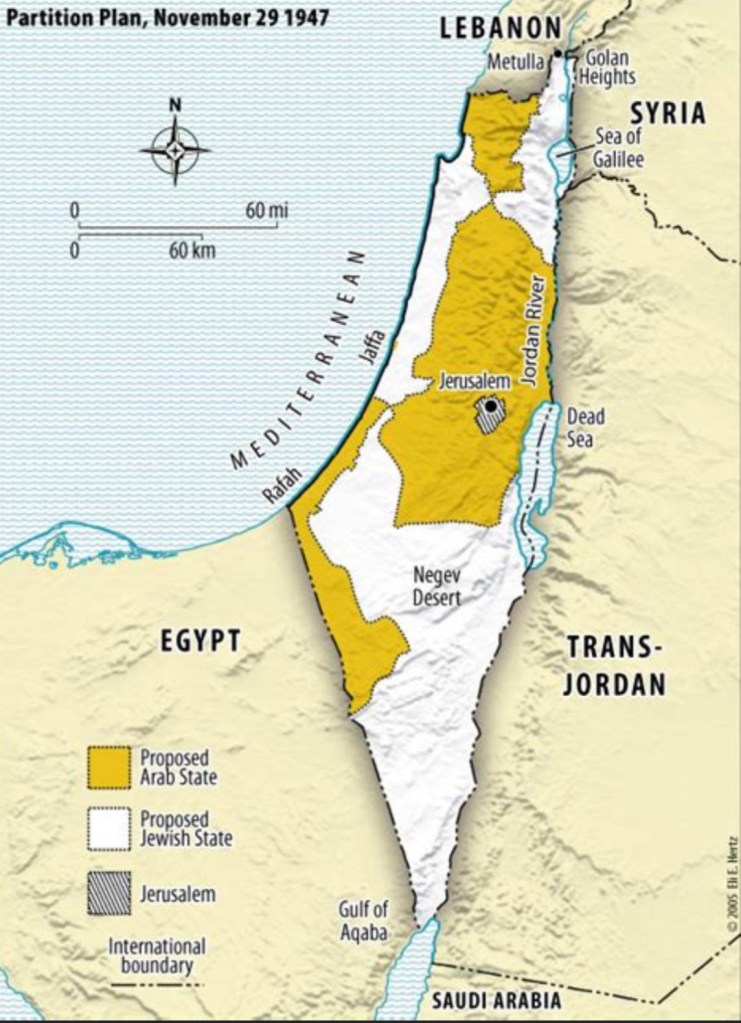
The following map might be helpful in what follows. It shows the proposed boundaries of an Israeli state and an Arab state under the Partition Plan adopted by UN Resolution in 1947. The Resolution called for replacing a League of Nations mandate for British administration of the region requiring the establishment of a Jewish homeland. Likewise, the Arab state was intended to accommodate Palestinian nationalists. Together the two states were expected to comprise an economic union.

What is striking is the discontinuity of the lands assigned to each state, and this surely contributed to almost immediate border challenges. More on that below.

The Gaza Strip is the region along the shore of the Mediterranean on the lower left, which was designated as Palestinian. The Golan Heights is the Israeli region on the upper right. The West Bank is the Palestinian region in the middle. Jerusalem and its vicinity was designated as an international zone to be administered by the UN.

Border Battles

Today, the geography of a prospective Palestinian state would certainly include the Gaza Strip. There doesn’t seem to be any great dispute there, but the West Bank is another story. In this context, it’s important to remember some key details about the history of this region since 1947. David Post writes at the Volokh Conspiracy that the Palestinian state was obliterated by other Arab states in 1948:

“The State of Palestine was strangled in its infancy, not by the Israelis, who accepted the U.N. partition plan, but by the neighboring Arab States—Egypt, Syria, and Jordan—who did not. The day after the British pulled their forces out, the Arab armies marched in, and the first Arab-Israeli War began.“

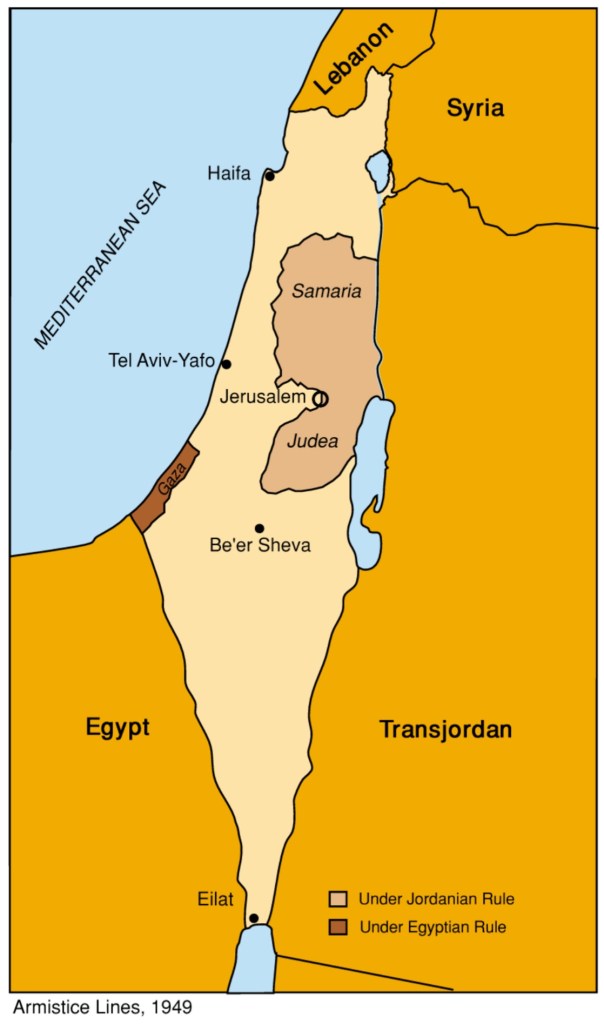
The hostilities were formally ended with the signing of three different Armistices in 1949:

“The boundaries fixed in those agreements gave to each of the four countries involved more-or-less the territory that their armies had managed to control as of the date that ceasefires had been declared. The West Bank became part of Jordan; Gaza became part of Egypt; the Golan Heights became part of Syria. Israel got—or kept—the rest. The Palestinians, who had no army of their own, got nothing.“

Here are the boundaries under the 1949 Armistices:

The three Arab states, which refused to recognize Israel’s right to exist, attacked again in 1967. In a matter of six days and on three fronts, the Israelis drove them back and took Gaza, the West Bank, and retook the Golan Heights. Post asks:

“Why is it that only starting then, now that Israel was in control of these areas, did the world rouse itself to Palestinian grievances, and demand that ‘Palestinian lands’ be given back to the Palestinians?“

It’s worth noting that these conflicts led to the displacement of a great many Palestinians, but Israel did not provoke the attacks.

Indigenous Populations

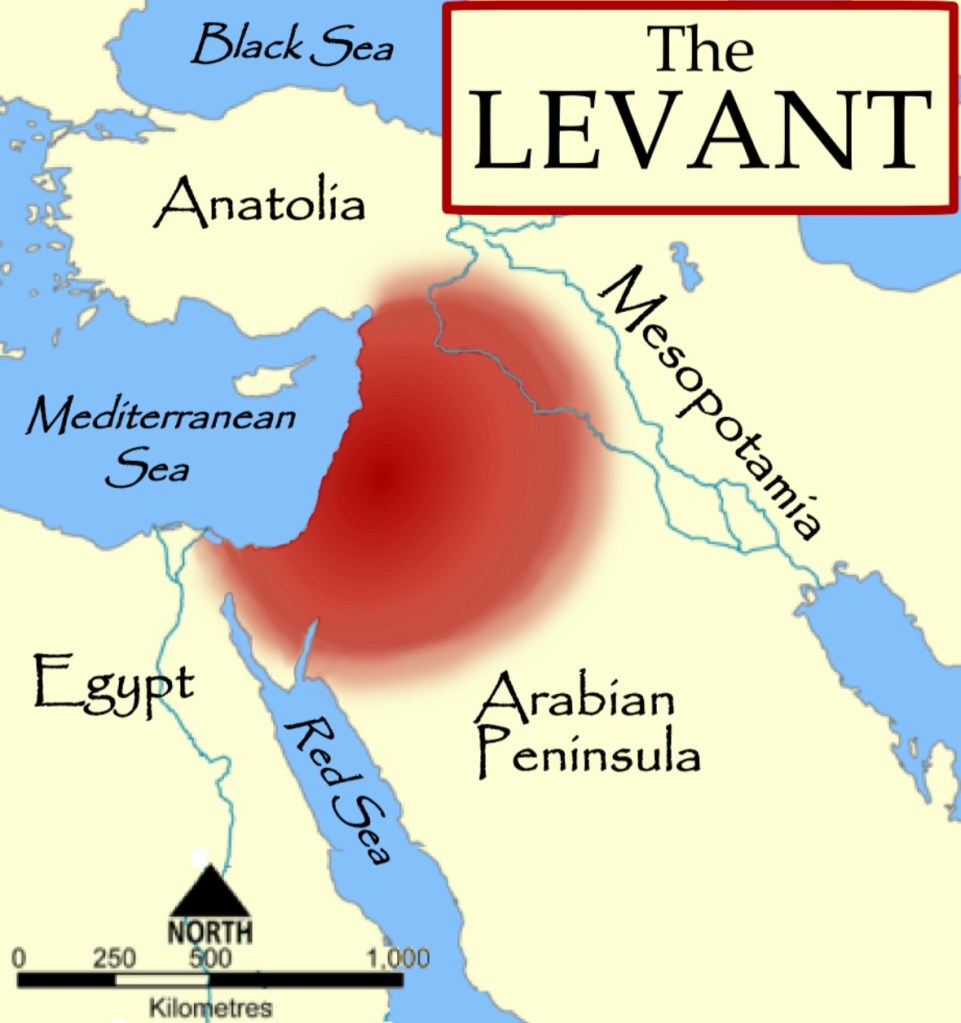
Enemies of Israel, including those in the West, go so far as to say the Israelis are not entitled to a homeland in the Levant. Even worse, they chant “from the river to the sea”, often ignorant that it is a thinly veiled call for genocide. But Jews have as great a claim to a homeland in the Levant as the Palestinians. Jacob Sullum wrote of this truth last October, in the wake of the Hamas butchery on October 7, 2023. Israeli Jews are characterized by enemies as “colonizers”. This, as Sullum says:

“… is a ‘simplistic morality tale’, that pits white European oppressors against ‘indigenous’ people, eliding Israel’s demographic roots and the ancient Jewish connection to the land. “

Sullum goes on to discuss research on the genetic origins of modern Jewish populations. For example, one paper found that the ancestors of Ashkenazi Jews, who account for almost a third of Jews in Israel, likely descended from a “diverse population in the Middle East.” And Sullum points out that Mizrahim Jews of Middle Eastern and North African origin represent almost 45% of Israeli Jews. Furthermore, another study found that Jews and Arabs in the Middle East both share high percentages of Y chromosomes with a single gene pool, which suggests a common origin. Therefore, both Palestinians and Israeli Jews have legitimate claims to a homeland in the Levant.

Israel and Gaza

Contrary to claims by Hamas supporters, there was no occupation of Gaza by Israel at the time of the October 7th massacre. Israel’s prior occupation of Gaza ended almost 20 years ago, in 2005. However, Israel has restricted the movement of goods in and out of the Gaza Strip since the 1990s. Israel and Egypt tightened the blockade on Gaza in 2007 after Hamas took control there, though it was eased in steps from 2010 – 2013. Given the uncompromising belligerence of Hamas and its proclivity for diverting resources to support aggression against Israel, it’s fair to say the blockade is, and has been, a legitimate instrument of defense, as long as Gaza is “governed” by Hamas.

Last year, less than a week after the October 7th massacre and hostage taking, the Israeli Defense Forces (IDF) began ground operations in Gaza in an effort to root out Hamas fighters, destroy their war-making infrastructure, and rescue hostages held by Hamas in Gaza. Of course, that fight goes on.

Hamas has fought against Israel’s retaliatory action in ways that have propaganda value, especially given the naïveté of much of the Western press. Its fighters are often embedded among civilians within residential areas and facilities like schools and hospitals. The use of human shields is a war crime for which Hamas bears full responsibility, and Hamas has made it clear that their aim is to kill Israelis, civilian and military alike. Hamas has made a practice of exaggerating Palestinian death counts, a distortion that has been more obvious to statisticians than journalists.

The Israeli blockade of the Gaza Strip will be tough to end without a complete surrender by Hamas and release of the hastages. Even then, the current IDF occupation is unlikely to end until efforts are well underway to flesh out the details of a new Palestinian government, if not statehood.

The West Bank

Perhaps even more thorny for an eventual two-state solution is that Israel occupies the West Bank and has established settlements that Palestinians strongly oppose. Jordan might also have designs on retaking West Bank territory, which would once again leave Palestinians as the odd people out. Israel took the land in its own defense during the Six-Day War in 1967 and kept it as a security buffer:

“… Israel insisted that it should not, and would not, simply return to the pre-war situation — the dangerous combination of precarious armistice lines and aggressive neighbors that had prevailed for 19 years. …

The idea that Israeli security depended on continued control over parts of the West Bank was held not only by Israeli officials, but also by the American Joint Chiefs of Staff. … Referring to the West Bank, they argued that Israel required a new boundary that would ‘widen the narrow portion of Israel’ and help protect Tel Aviv.“

Israel splits aspects of governance with the Palestinian Authority in parts of the West Bank, but most of the security apparatus is run by Israel.

The continued West Bank occupation is as fraught with controversy as ever. Today there is bitter resentment over new Israeli settlements and the construction of the “Separation Wall” just inside the western border of the West Bank. The situation is made all the more intractable by Hamas’ presence there amid ongoing attacks against Israeli interests.

Withdrawing from the West Bank would create a huge vulnerability for Israel, so one can hardly expect it to cede control of the entire territory. Yet it is hard to imagine an economically viable Palestinian state confined to the Gaza Strip. In fact, some feel that more than the West Bank should be in play for creating a contiguous corridor to Gaza, which would help promote a new Palestinian state’s economic viability.

Iran

Obviously Hamas is not the only threat to Israel’s security. To the north in Lebanon, Hezbollah is a well-armed adversary. And like Hamas, it receives considerable support from Iran. It’s difficult to imagine that Iran could maintain this support, not to mention its nuclear ambitions, without the flow of oil revenue made possible by U.S. acquiescence. Reaching a peaceful resolution to the conflicts between Israel and its neighbors will be very difficult without somehow neutralizing the Iranian threat. Regime change there would be key to this effort.

What Must Happen

The obstacles to establishing a peaceful, two-state solution for Palestinians and Israelis are so steep that the prospect seems almost unimaginable. A complete defeat of both Hamas and Hezbollah would be critical, and the Palestinian Authority or any other successor regime must be counted on to negotiate in good faith and with the legitimate support of the Palestinian people. Likewise, Israel must be willing to negotiate meaningful concessions, at least in terms of its occupied territories in the West Bank.

For a successful resolution, the role of other Arab states can’t be emphasized enough. These states should apply pressure to Israel’s neighbors like Syria and Jordan to rein-in their own territorial ambitions. In a positive sign, there is now growing pressure on Iran from other Arab states to end its belligerence.

A reconstituted Abraham Accords framework could strengthen diplomatic and economic ties across the region, promoting cross-investment, trade, and cultural exchange. The framework should include a mechanism to encourage aid from the Arab states and Israel to help Palestinians build a new, peaceful, and prosperous state.

Finally, a peaceful two-state solution hinges on continued U.S. support for Israel and a new Palestinian homeland. Unfortunately, in recent years we’ve witnessed a drift toward anti-Zionism (and even anti-Semitism) among Democrats. This sort of foolishness on the far Left knows no bounds. If the anti-Zionist position comes to be accepted by the mainstream of the party, it could severely compromise Israel’s leverage in negotiations.

Summary

A resolution that would ultimately bring peace to the Middle East seems remote in the midst of the current hostilities. It would require a dramatic softening of views among nearly all parties to solve the impasse over nation-state homelands for both Jews and Palestinians. In no particular order, the following are all necessary:

  • Israel’s neighboring states must not covet territory originally intended for the Palestinians, or for that matter the state of Israel.
  • Iran must butt out one way or another (in the language of high diplomacy), which would do much to neutralize militant factions like Hamas, Hezbollah, and the Houthis.
  • Other Arab states must come to the table along with the Israelis to negotiate economic and political accords, including aid to the Palestinian people.
  • The U.S. must resist internal calls from the Left to withdraw support for Israel.
  • More immediately, Israel must do its best to root out and defeat Hamas, Hezbollah, and the Houthis.
  • The Palestinian people must decide they want peace and a prosperous civilization.
  • Israel must show a willingness to negotiate concessions to Palestinians in the West Bank, and to aid in the rebuilding of Gaza.

Taken together that’s a very tall order! The U.S. can and should do its part to support Israel and the Palestinian people, penalize Iran, and help to bring all parties to the negotiating table. A refashioning of the Abraham Accords could contribute to peace in the region, including a stable, prosperous, and well-governed Palestinian homeland.

Four More Years to MAGAA

28 Wednesday Oct 2020

Posted by Nuetzel in Big Government, Liberty, Politics

≈ Leave a comment

Tags

Abraham Accords, Affordable Care Act, Amy Coney Barrett, Brett Kavanaugh, corporate taxes, Covid-19, Critical Race Theorist, David E. Bernstein, Deregulation, Donald Trump, Dreamers, Election Politics, Federalism, Free trade, Gun Rights, Immigration, Impeachment, Individual Mandate, Joe Biden, Joel Kotkin, Living Constitution, Medicare, Middle East Peace, Nancy Pelosi, National Defense, Nationalism, NATO, Neil Gorsuch, Originalism, Paris Climate Accord, Pass Through Business, Penalty Tax, Social Security, United Nations

As a “practical” libertarian, my primary test for any candidate for public office is whether he or she supports less government dominance over private decisions than the status quo. When it comes to Joe Biden and his pack of ventriloquists, the answer is a resounding NO! That should clinch it, right? Probably, but Donald Trump is more complicated….

I’ve always viewed Trump as a corporatist at heart, one who, as a private businessman, didn’t give a thought to free market integrity when he saw rent-seeking opportunities. Now, as a public servant, his laudable desire to “get things done” can also manifest to the advantage of cronyists, which he probably thinks is no big deal. Unfortunately, that is often the way of government, as the Biden family knows all too well. On balance, however, Trump generally stands against big government, as some of the points below will demonstrate.

Trump’s spoken “stream of consciousness” can be maddening. He tends to be inarticulate in discussing policy issues, but at times I enjoy hearing him wonder aloud about policy; at other times, it sounds like an exercise in self-rationalization. He seldom prevaricates when his mind is made up, however.

Not that Biden is such a great orator. He needs cheat sheets, and his cadence and pitch often sound like a weak, repeating loop. In fairness, however, he manages to break it up a bit with an occasional “C’mon, man!”, or “Here’s the deal.”

I have mixed feelings about Trump’s bumptiousness. For example, his verbal treatment of leftists is usually well-deserved and entertaining. Then there are his jokes and sarcasm, for which one apparently must have an ear. He can amuse me, but then he can grate on me. There are times when he’s far too defensive. He tweets just a bit too much. But he talks like a tough, New York working man, which is basically in his DNA. He keeps an insane schedule, and I believe this is true: nobody works harder.

With that mixed bag, I’ll now get on to policy:

Deregulation: Trump has sought to reduce federal regulation and has succeeded to an impressive extent, eliminating about five old regulations for every new federal rule-making. This ranges from rolling back the EPA’s authority to regulate certain “waters” under the Clean Water Act, to liberalized future mileage standards on car manufacturers, to ending destructive efforts to enforce so-called net neutrality. By minimizing opportunities for over-reach by federal regulators, resources can be conserved and managed more efficiently, paving the way for greater productivity and lower costs.

And now, look! Trump has signed a new executive order making federal workers employees-at-will! Yes, let’s “deconstruct the administrative state”. And another new executive order prohibits critical race theory training both in the federal bureaucracy and by federal contractors. End the ridiculous struggle sessions!

Judicial Appointments: Bravo! Neil Gorsuch, Brett Kavanaugh, Amy Coney Barrett, and over 200 federal judges have been placed on the bench by Trump in a single term. I like constitutional originalism and I believe a “living constitution” is a corrupt judicial philosophy. The founding document is as relevant today as it was at its original drafting and at the time of every amendment. I think Trump understands this.

Corporate Taxes: Trump’s reductions in corporate tax rates have promoted economic growth and higher labor income. In 2017, I noted that labor shares the burden of the corporate income tax, so a reversal of those cuts would be counterproductive for labor and capital.

At the same time, the 2017 tax package was a mixed blessing for many so-called “pass-through” businesses (proprietors, partnerships, and S corporations). It wasn’t exactly a simplification, nor was it uniformly a tax cut.

Individual Income Taxes: Rates were reduced for many taxpayers, but not for all, and taxes were certainly not simplified in a meaningful way. The link in the last paragraph provides a few more details.

I am not a big fan of Trump’s proposed payroll tax cut. Such a temporary move will not be of any direct help to those who are unemployed, and it’s unlikely to stimulate much spending from those who are employed. Moreover, without significant reform, payroll tax cuts will directly accelerate the coming insolvency of the Social Security and Medicare Trust Funds.

Nonetheless, I believe permanent tax cuts are stimulative to the economy in ways that increased government spending is not: they improve incentives for effort, capital investment, and innovation, thus increasing the nation’s productive capacity. Trump seems to agree.

Upward Mobility: Here’s Joel Kotkin on the gains enjoyed by minorities under the Trump Administration. The credit goes to strong private economic growth, pre-pandemic, as opposed to government aid programs.

Foreign Policy: Peace in the Middle East is shaping up as a real possibility under the Abraham Accords. While the issue of coexisting, sovereign Palestinian and Zionist homelands remains unsettled, it now seems achievable. Progress like this has eluded diplomatic efforts for well over five decades, and Trump deserves a peace prize for getting this far with it.

Iran is a thorn, and the regime is a terrorist actor. I support a tough approach with respect to the ayatollahs, which a Trump has delivered. He’s also pushed for troop withdrawals in various parts of the world. He has moved U.S. troops out of Germany and into Poland, where they represent a greater deterrent to Russian expansionism. Trump has pushed our NATO allies to take responsibility for more of their own defense needs, all to the better. Trump has successfully managed North Korean intransigence, though it is an ongoing problem. We are at odds with the leadership in mainland China, but the regime is adversarial, expansionist, and genocidal, so I believe it’s best to take a tough approach with them. At the UN, some of our international “partners” have successfully manipulated the organization in ways that make continued participation by the U.S. of questionable value. Like me, Trump is no fan of UN governance as it is currently practiced.

Gun Rights: Trump is far more likely to stand for Second Amendment rights than Joe Biden. Especially now, given the riots in many cities and calls to “defund police”, it is vitally important that people have a means of self-defense. See this excellent piece by David E. Bernstein on that point.

National Defense: a pure public good; I’m sympathetic to the argument that much of our “defense capital” has deteriorated. Therefore, Trump’s effort to rebuild was overdue. The improved deterrent value of these assets reduces the chance they will ever have to be used against adversaries. Of course, this investment makes budget balance a much more difficult proposition, but a strong national defense is a priority, as long as we avoid the role of the world’s policeman.

Energy Policy: The Trump Administration has made efforts to encourage U.S. energy independence with a series of deregulatory moves. This has succeeded to the extent the U.S. is now a net energy exporter. At the same time, Trump has sought to eliminate subsidies for wasteful renewable energy projects. Unfortunately, ethanol is still favored by energy policy, which might reflect Trump’s desire to assuage the farm lobby.

Climate Policy: Trump kept us out of the costly Paris Climate Accord, which would have cost the U.S. trillions of dollars in lost GDP and subsidies to other nations. Trump saw through the accord as a scam under which leading carbon-emitting nations (such as China) face few real obligations. Meanwhile, the U.S. has led the world in reductions in carbon emissions during Trump’s term, even pre-pandemic. That’s partly a consequence of increased reliance on natural gas relative to other fossil fuels. Trump has also supported efforts to develop more nuclear energy capacity, which is the ultimate green fuel.

COVID-19 Response: As I’ve written several times, in the midst of a distracting and fraudulent impeachment attempt, Trump took swift action to halt inbound flights from China. He marshaled resources to obtain PPE, equipment, and extra hospital space in hot spots, and he kick-started the rapid development of vaccines. He followed the advice of his sometimes fickle medical experts early in the pandemic, which was not always a good thing. In general, his policy stance honored federalist principles by allowing lower levels of government to address local pandemic conditions on appropriate terms. If the pandemic has you in economic straits, you probably have your governor or local officials to thank. As for the most recent efforts to pass federal COVID relief, Nancy Pelosi and House Democrats have insisted on loading up the legislation with non-COVID spending provisions. They have otherwise refused to negotiate pre-election, as if to blame the delay on Trump.

Immigration: My libertarian leanings often put me at odds with nationalists, but I do believe in national sovereignty and the obligation of the federal government to control our borders. Trump is obviously on board with that. My qualms with the border wall are its cost and the availability of cheaper alternatives leveraging technological surveillance. I might differ with Trump in my belief in liberalizing legal immigration. I more strongly differ with his opposition to granting permanent legal residency to so-called Dreamers, individuals who arrived in the U.S. as minors with parents who entered illegally. However, Trump did offer a legal path to citizenship for Dreamers in exchange for funding of the border wall, a deal refused by congressional Democrats.

Health Care: No more penalty (tax?) to enforce the individual mandate, and the mandate itself is likely to be struck down by the Supreme Court as beyond legislative intent. Trump also oversaw a liberalization of insurance offerings and competition by authorizing short-term coverage of up to a year and enabling small businesses to pool their employees with others in order to obtain better rates, among other reforms. Trump seems to have deferred work on a full-fledged plan to replace the Affordable Care Act because there’s been little chance of an acceptable deal with congressional Democrats. That’s unfortunate, but I count it as a concession to political reality.

Foreign Trade: I’m generally a free-trader, so I’m not wholeheartedly behind Trump’s approach to trade. However, our trade deals of the past have hardly constituted “free trade” in action, so tough negotiation has its place. It’s also true that foreign governments regularly apply tariffs and subsidize their home industries to place them at a competitive advantage vis-a-vis the U.S. As the COVID pandemic has shown, there are valid national security arguments to be made for protecting domestic industries. But make no mistake: ultimately consumers pay the price of tariffs and quotas on foreign goods. I cut Trump some slack here, but this is an area about which I have concerns.

Executive Action: Barack Obama boasted that he had a pen and a phone, his euphemism for exercising authority over the executive branch within the scope of existing law. Trump is taking full advantage of his authority when he deems it necessary. It’s unfortunate that legislation must be so general as to allow significant leeway for executive-branch interpretation and rule-making. But there are times when the proper boundaries for these executive actions are debatable.

Presidents have increasingly pressed their authority to extremes over the years, and sometimes Trump seems eager to push the limits. Part of this is born out of his frustration with the legislative process, but I’m uncomfortable with the notion of unchecked executive authority.

•••••••••••••••••••••••••••••••••••••••••••••••••

Of course I’ll vote for Trump! I had greater misgivings about voting for him in 2016, when I couldn’t be sure what we’d get once he took office. After all, his politics had been all over the map over preceding decades. But in many ways I’ve been pleasantly surprised. I’m much more confident now that he is our best presidential bet for peace, prosperity, and liberty.

Follow Sacred Cow Chips on WordPress.com

Recent Posts

  • Immigration and Merit As Fiscal Propositions
  • Tariff “Dividend” From An Indigent State
  • Almost Looks Like the Fed Has a 3% Inflation Target
  • Government Malpractice Breeds Health Care Havoc
  • A Tax On Imports Takes a Toll on Exports

Archives

  • December 2025
  • November 2025
  • October 2025
  • September 2025
  • August 2025
  • July 2025
  • June 2025
  • May 2025
  • April 2025
  • March 2025
  • February 2025
  • January 2025
  • December 2024
  • November 2024
  • October 2024
  • September 2024
  • August 2024
  • July 2024
  • June 2024
  • May 2024
  • April 2024
  • March 2024
  • February 2024
  • January 2024
  • December 2023
  • November 2023
  • August 2023
  • July 2023
  • June 2023
  • May 2023
  • April 2023
  • March 2023
  • February 2023
  • January 2023
  • December 2022
  • November 2022
  • October 2022
  • September 2022
  • August 2022
  • July 2022
  • June 2022
  • May 2022
  • April 2022
  • March 2022
  • February 2022
  • January 2022
  • December 2021
  • November 2021
  • October 2021
  • September 2021
  • August 2021
  • July 2021
  • June 2021
  • May 2021
  • April 2021
  • March 2021
  • February 2021
  • January 2021
  • December 2020
  • November 2020
  • October 2020
  • September 2020
  • August 2020
  • July 2020
  • June 2020
  • May 2020
  • April 2020
  • March 2020
  • February 2020
  • January 2020
  • December 2019
  • November 2019
  • October 2019
  • September 2019
  • August 2019
  • July 2019
  • June 2019
  • May 2019
  • April 2019
  • March 2019
  • February 2019
  • January 2019
  • December 2018
  • November 2018
  • October 2018
  • September 2018
  • August 2018
  • July 2018
  • June 2018
  • May 2018
  • April 2018
  • March 2018
  • February 2018
  • January 2018
  • December 2017
  • November 2017
  • October 2017
  • September 2017
  • August 2017
  • July 2017
  • June 2017
  • May 2017
  • April 2017
  • March 2017
  • February 2017
  • January 2017
  • December 2016
  • November 2016
  • October 2016
  • September 2016
  • August 2016
  • July 2016
  • June 2016
  • May 2016
  • April 2016
  • March 2016
  • February 2016
  • January 2016
  • December 2015
  • November 2015
  • October 2015
  • September 2015
  • August 2015
  • July 2015
  • June 2015
  • May 2015
  • April 2015
  • March 2015
  • February 2015
  • January 2015
  • December 2014
  • November 2014
  • October 2014
  • September 2014
  • August 2014
  • July 2014
  • June 2014
  • May 2014
  • April 2014
  • March 2014

Blogs I Follow

  • Passive Income Kickstart
  • OnlyFinance.net
  • TLC Cholesterol
  • Nintil
  • kendunning.net
  • DCWhispers.com
  • Hoong-Wai in the UK
  • Marginal REVOLUTION
  • Stlouis
  • Watts Up With That?
  • Aussie Nationalist Blog
  • American Elephants
  • The View from Alexandria
  • The Gymnasium
  • A Force for Good
  • Notes On Liberty
  • troymo
  • SUNDAY BLOG Stephanie Sievers
  • Miss Lou Acquiring Lore
  • Your Well Wisher Program
  • Objectivism In Depth
  • RobotEnomics
  • Orderstatistic
  • Paradigm Library
  • Scattered Showers and Quicksand

Blog at WordPress.com.

Passive Income Kickstart

OnlyFinance.net

TLC Cholesterol

Nintil

To estimate, compare, distinguish, discuss, and trace to its principal sources everything

kendunning.net

The Future is Ours to Create

DCWhispers.com

Hoong-Wai in the UK

A Commonwealth immigrant's perspective on the UK's public arena.

Marginal REVOLUTION

Small Steps Toward A Much Better World

Stlouis

Watts Up With That?

The world's most viewed site on global warming and climate change

Aussie Nationalist Blog

Commentary from a Paleoconservative and Nationalist perspective

American Elephants

Defending Life, Liberty and the Pursuit of Happiness

The View from Alexandria

In advanced civilizations the period loosely called Alexandrian is usually associated with flexible morals, perfunctory religion, populist standards and cosmopolitan tastes, feminism, exotic cults, and the rapid turnover of high and low fads---in short, a falling away (which is all that decadence means) from the strictness of traditional rules, embodied in character and inforced from within. -- Jacques Barzun

The Gymnasium

A place for reason, politics, economics, and faith steeped in the classical liberal tradition

A Force for Good

How economics, morality, and markets combine

Notes On Liberty

Spontaneous thoughts on a humble creed

troymo

SUNDAY BLOG Stephanie Sievers

Escaping the everyday life with photographs from my travels

Miss Lou Acquiring Lore

Gallery of Life...

Your Well Wisher Program

Attempt to solve commonly known problems…

Objectivism In Depth

Exploring Ayn Rand's revolutionary philosophy.

RobotEnomics

(A)n (I)ntelligent Future

Orderstatistic

Economics, chess and anything else on my mind.

Paradigm Library

OODA Looping

Scattered Showers and Quicksand

Musings on science, investing, finance, economics, politics, and probably fly fishing.

  • Subscribe Subscribed
    • Sacred Cow Chips
    • Join 128 other subscribers
    • Already have a WordPress.com account? Log in now.
    • Sacred Cow Chips
    • Subscribe Subscribed
    • Sign up
    • Log in
    • Report this content
    • View site in Reader
    • Manage subscriptions
    • Collapse this bar
 

Loading Comments...