• About

Sacred Cow Chips

Sacred Cow Chips

Tag Archives: Adam Smith

Tangled Up In Green Industrial Policy: Joe Biden’s Electrification

28 Thursday Mar 2024

Posted by Nuetzel in Government Failure, Industrial Policy, Liberty

≈ 1 Comment

Tags

Adam Smith, Administrative State, Arnold Kling, Battery Fires, Battery Replacement, Biden EPA Mandates, BYD, Carbon Credits, central planning, Charging Stations, Chevron Deference, Electric Stoves, Electric Vehicles, Electrification, Energiewende, EV Range, EV Rich-Man Subsidy, EV Tire Wear, Fossil fuels, Friedrich Hayek, Grid Capacity, Industrial Policy, Infrastructure Investment and Jobs Act, Joel Kotkin, John Mozena, Legislative Deference, Long Tailpipe, Ludwig von Mises, National Security, Net Zero, Offshore Wind, Rare Earth Minerals, Trade Intervention

Industrial policy allows government planners to select favored and disfavored industries or sectors. It thereby bypasses and distorts impersonal market signals that would otherwise direct scarce resources to the uses most valued by market participants. Instead, various forms of aid and penalties are imposed on different sectors in order to accomplish the planners’ objectives, This includes interventions in foreign trade and attempts to steer technological development. Industrial policy often comes under the guise of enhanced national security. Of course, it can also be used to reward cronies. And it has a poor record of accomplishing its objectives and avoiding unintended consequences.

The Sausage Factory

The executive and legislative branches of the U.S. government are loaded with economic interventionists, regardless of party affiliation. In an age of (Chevron) judicial deference to “experts” within the administrative state, it is not uncommon for legislative language to give abundant leeway to those who implement policy within the executive branch (though a couple of upcoming Supreme Court decisions might change that balance). Increasingly, bills are stuffed so full of provisions that lawmakers find it all but impossible to read them in full, let alone make an accurate assessment of their virtues, drawbacks, and internal contradictions.

Even worse is the fact that bills are, in great part, written by relatively youthful legislative staffers with little real world experience in industry, and who harbor the naive belief that whatever is wished, government can make it so. But their work also proceeds under guidance from lawmakers, administration officials, consultants, and lobbyists who have their own agendas and axes to grind. This is how industrial policy is promulgated in the U.S., and it is through this ugly prism that we must view environmental policy.

The Left dictates environmental and energy policy in several states, especially California, where energy costs have soared under renewable energy initiatives. California households now pay almost triple the rate per kilowatt-hour paid in Washington, and more than double what’s paid in Oregon. Something similar may happen in New York, which has highly ambitious goals for renewable energy even as the costs of the state’s offshore wind projects are out of control. These and other state-level “laboratories” are demonstrating that a renewable energy agenda can carry very high costs to the populace. The same is true of the painful experience in Germany with its much-heralded Energiewende.

Net Zero

The Left is also pulling the strings within the federal bureaucracy and the Biden Administration. The objective is an industrial policy to achieve “net zero” CO2 emissions, a practical impossibility for at least several decades (unless it’s faked, of course). Nevertheless, that policy calls for phasing out the use of fossil fuels. Under this agenda, mandates and subsidies are bestowed upon the use of renewable electric power sources, while restrictions and penalties are imposed on the production and use of fossil fuels. A subsequent post on the subject of power generation will address this prototypical failure of central planning.

Electrification

Here, I discuss another key objective of our industrial planners: electrify whatever is not electrified in order to advance the net zero agenda. Of course, for some time to come, more than half of electric power will be generated using fossil fuels (currently about 60%, with another 18% nuclear), so the policy is largely a sham on its face, but we’ll return to that point below. The EV tailpipe is very long, as they say.

Electrification means, among other things, the forced adoption of electronic vehicles (EVs). President Biden’s EPA has issued rules on auto emissions that are expected to require, by 2032, that 60% or more of cars and light trucks sold will be EVs. The USA Today article at the link offers this rich aside:

“…the original proposal — which was always technology-neutral in theory, meaning automakers could sell any cars and light-duty trucks they wanted as long as they hit the fleetwide reductions….”

Technology neutral? Hahaha! We aren’t forcing you to choose technologies as long as you meet our technological requirements!

EV Doldrums

Anyway, the EPA’s targets are completely impractical, partly because the value for drivers is lacking. Not coincidentally, the market for EVs seems to have chilled of late. Hertz has soured on heavy use of EVs in its fleet, and Ford has announced reductions in EV production. The new UAW agreements will make it difficult for some domestic producers to turn a profit on EVs. Fisker is just about broke. Apple has cancelled development of its EV, and several other automakers have reduced their production plans. Toyota was the first producer to raise the red flag on the breakneck transition to EVs in favor of a measured reliance on hybrids. Of course, there are other prominent voices cautioning against rapid attempts at electrification in general.

To be fair, some EVs are marvelous machines, but they and their supporting infrastructure are not yet well-suited to the mass market.

A Tangled Web

Here are some drawbacks of EVs that have yet to be adequately addressed:

  • They are expensive, even with the rich-man’s subsidy to buyers paid by the government and carbon credit subsidies granted to producers.
  • Costly battery replacement is an eventuality that looms over the wallets of EV owners.
  • EVs have limited range given the state of battery technology, especially when the weather is cold.
  • There presently exist far too few charging stations to make EVs workable for many people. In any case, charging away from home can be extremely time consuming and the charges vary widely.
  • The purchase and installation of EV chargers at home is a separate matter, and can cost $4,000 or more if an upgrade to the service panel is necessary. Installed costs commonly range from $1,175 to $3,300, depending on the type of charger and the region.
  • EVs are much heavier than vehicles powered by internal combustion engines. As a result, EV tire wear can be a surprising cost causer and pollutant.
  • Used EVs are not in demand, given all of the above, so resale value is questionable.
  • Battery fires in EVs are extremely difficult to extinguish, creating a new challenge for emergency responders.
  • Reliance on EVs for local emergency services would be dangerous without duplicative investment by local jurisdictions to offset the down-time required for charging.
  • For decades to come, the power grid will be unable to handle the load required for widespread adoption of EVs. A rapid conversion would be impossible without a great expansion in generating and transmission capacity, including transformer availability.
  • Domestically we lack the natural resources to produce the batteries required by EVs in a quantity that would satisfy the Administration’s goals. This forces dependence on China, our chief foreign adversary.
  • The mining of those resources is destructive to the environment. Much of it is done in China due to the country’s abundance of rare earth minerals, but wherever the mining occurs, it relies heavily on diesel power.
  • Joel Kotkin points out that China now hosts the world’s largest EV producer, BYD. Biden’s mandates might very well allow China to dominate the U.S. auto market, even as its own CO2 emissions are soaring,,
  • Producers of EVs earn carbon credits for each vehicle sold, which they can sell to other auto producers who fall short of their required mix of EVs in total production. Tesla, for example, earned revenue of $1.8 billion from carbon credit sales in 2022. But note again that these so-called zero-emission vehicles use electricity generated with an average of 60% fossil fuels. Thus, the scheme is largely a sham.

The push for EVs has been hampered by the botched rollout of (non-Tesla) charging stations under a huge Biden initiative in the Infrastructure Investment and Jobs Act. Progress has been bogged down by sheer complexity and expense, including the cost of bringing adequate power supplies to the chargers as well as the difficulty of meeting contracting requirements and operating standards. This is exemplary of the failures that usually await government efforts to engineer outcomes contrary to market forces.

Electric Everything?

Like EVs, electric stoves have drawbacks that limit their popularity, including price and the nature of the heat needed for quality food preparation. In addition to autos and stoves, wholesale electrification would require the replacement or costly reconfiguration of a huge stock of business and household capital that is now powered by fossil fuels, like gas furnaces, tractors, chain saws, and many other tools and appliances. This set of legacy investment choices was guided by market prices that reflect the scarcity and efficiency of the resources, yet government industrial planners propose to lay much of it to waste.

Central Planning: a False Conceit

John Mozena quotes Adam Smith on the social and economic hazards of rejecting the market mechanism and instead accepting governmental authority over the allocation of resources:

“All governments which thwart this natural course, which force things into another channel, or which endeavour to arrest the progress of society at a particular point, are unnatural, and to support themselves are obliged to be oppressive and tyrannical.”

And Arnold Kling gives emphasis to the disadvantages faced by even the most benevolent central planner:

“As Ludwig von Mises and Friedrich Hayek pointed out during the socialist calculation debate, central planners lack the information that is produced by markets. By over-riding market prices and substituting their own judgment, regulators incur the same loss of information.”

Advocates of EV industrial policy have failed to appreciate the large gaps between the technology they are determined to dictate and basic consumer requirements. These gaps are along such margins as range, charging time, tire and battery wear, and perhaps most importantly, affordability. The planners have failed to foresee the massive demands on the power grid of a forced replacement of the internal combustion auto stock with EVs. The planners elide the true nature of EV-driven emissions, which are never zero carbon but instead depend on the mix of power sources used to charge EV batteries. Finally, EV mandates show that the industrial planners are oblivious to other environmental burdens inherent in EVs, whatever their true carbon footprint might be.

Continue reading →
That Word “Liberal” … I Don’t Think That Means What You Think It Means

03 Wednesday Jan 2024

Posted by Nuetzel in Conservatism, Liberalism, Socialism

≈ Leave a comment

Tags

Adam Smith, Capitalism, Classical Liberal, Conservatism, Consumer Sovereignty, Corporatism, Free Markets, Freedom of Speech, Friedrich Hayek, Liberalism, Libertarianism, MAGA, monopoly, Monopsony, Nate Silver, Natural Rights, Non-Aggression Principle, Perfect Competition, Progressivism, Property Rights, Public goods, Religious Freedom, Right to Life, Scott Sumner, social engineering, Socialism, State Capacity, State Religion, statism, The Wealth of Nations

Leftism has taken on new dimensions amid its preoccupation with identity politics, victimhood, and “wokeness”. Traditional socialists are still among us, of course, but “wokeists” and “identitarians” have been on the progressive vanguard of late, rooting for the deranged human butchers of Hamas and the dismantling of liberal institutions. This didn’t happen overnight, of course, and traditional socialists are mostly fine with it.

An older story is the rebranding of leftism that took place in the U.S. during the first half of the 20th century, when the word “liberal” was co-opted by leftists. Before that, a liberal orientation was understood to be antithetical to the collectivist mindset long associated with the Left. Note also that liberalism retains its original meaning even today in much of Europe. Often we hear the term “classical liberal” to denote the “original” meaning of liberalism, but the modifier should be wholly unnecessary.

Liberalism Is Not “In-Betweenism”

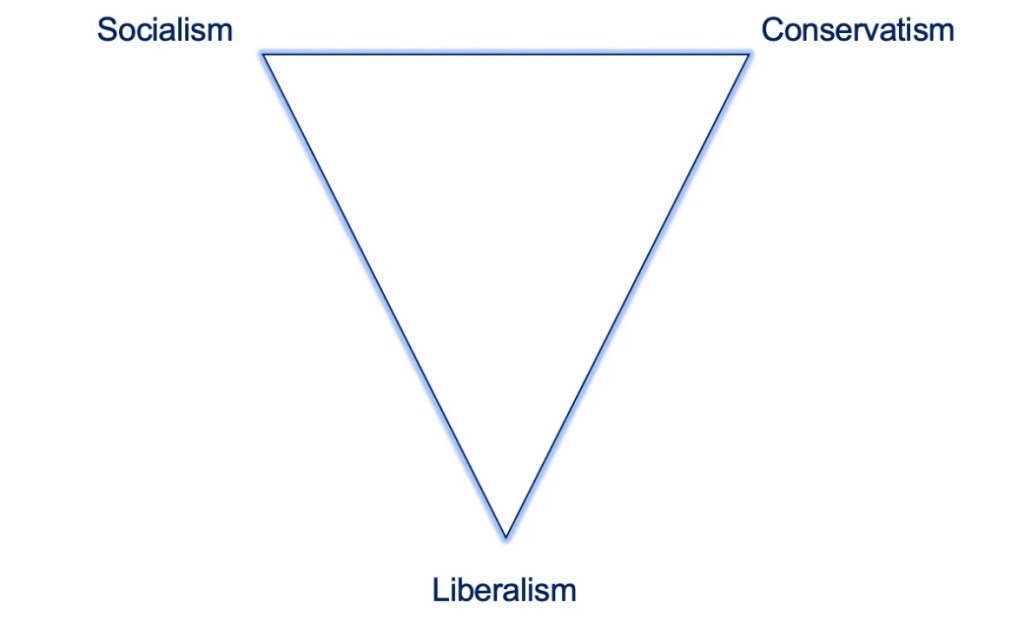
In this vein, Nate Silver presents a basic taxonomy of political orientation in a recent Substack post. It includes the diagram above, which distinguishes between socialism, conservatism, and liberalism. Silver draws on a classic essay written by Friedrich Hayek in 1945, “Why I am Not a Conservative”, in which Hayek discussed the meaning of the word “liberal” (and see here). Liberalism’s true emphasis is a tolerance for individual rights and freedoms, subject to varying articulations of the “nonaggression principle”. That is, “do as you like, but do no harm to others”.

We often see a linear representation distinguishing between so-called progressives on the left and conservatives on the right. Of course, a major hallmark of leftist thinking is extreme interventionism. Leftists or progressives are always keen to detect the slightest whiff of an externality or the slightest departure from the perfectly competitive market ideal. They seem eager to find a role for government in virtually every area of life. While it’s not a limiting case, we can substitute socialism or statism for progressivism on the far left, as Silver does, whereby the state takes primacy in economic and social affairs.

Conservatism, on the other hand, is a deep resistance to change, whether institutional, social, and sometimes economic. Conservatives too often demonstrate a willingness to use the coercive power of the state to prevent change. Hayek noted the willingness of both socialists and conservatives to invoke state power for their own ends.

Similarly, religious conservatives often demand state support beyond that afforded by the freedom to worship in the faith of one’s choice. They might strongly reject certain freedoms held to be fundamental by liberals. Meanwhile, socialists often view mere religious freedom as a threat to the power of the state, or at least they act like it (e.g. see here for an example).

Like conservatives, dedicated statists would doubtless resist change if it meant a loss of their own power. That is, they’d wish to preserve socialist institutions. On this point, witness the vitriol from the Left over what it perceives as threats to the public school monopoly. Witness also the fierce resistance among public employees to reducing the scale of the administrative state, and how advocates of entitlements fiercely resist decreases in the growth rate of those expenditures.

Silver, like Hayek, objects to the traditional, linear framework in which liberals are thought to occupy a range along a line between socialism and conservatism. He objects to that because real liberals value individual liberty as a natural human right, a viewpoint typically abhored by both socialists and conservatives. There is nothing “in between” about it! And of course, conservatives and progressives are equally guilty in their mistaken use of the word “liberal”.

Mapping Political Preferences

Liberty, statism, and conservatism are not exactly orthogonal political dimensions. Larger government almost always means less economic liberty. At a minimum, state dominance implies a social burden associated with public monopoly and monopsony power, as well as tax and welfare-state incentive problems. These features compromise or corrupt the exercise of basic rights. On the other hand, capitalism and its concomitant reliance on consumer sovereignty, individual initiative, free exchange and secure property rights is most in harmony with true liberalism.

For conservatives, resistance to change in support of a traditionally free market economy might offer something of a contradiction. In one sense, it corresponds to upholding market institutions. However, free markets allow new competitors and new technologies to undermine incumbents, who conservatives sometimes wish to defend through regulatory or protectionist measures. And conservatives are almost always too happy to join in the chorus of “price gouging” in response to the healthy operation of the free market in bringing forth supplies.

All that is to say that preferences involving liberty, statism, and traditionalism are not independent of one another. They cannot simply be mapped onto a three-dimensional space. At least the triangular representation gets liberalism out of the middle, but it’s difficult to visualize other ideological positions there. For example, “state religionism” could lie anywhere along the horizontal line at the top or even below it if certain basic liberties are preserved. Facism combines elements of socialism and a deformed version of capitalism that is properly called corporatism, but where would it fall within the triangle?

Big Government Liberalism?

Silver says he leans heavily toward a “big government” version of liberalism, but big government is hard to square with broad liberties. Granted, any well-functioning society must possess a certain level of “state capacity” to defend against private or public violations of individual rights, adjudicate disputes, and provide true public goods. It’s not clear whether Silver’s preferences lie within the bounds of those ambitions. Still, he deserves credit for his recognition that liberalism is wholly different from the progressive, socialist vision. It is the opposite.

The “New” Triangle

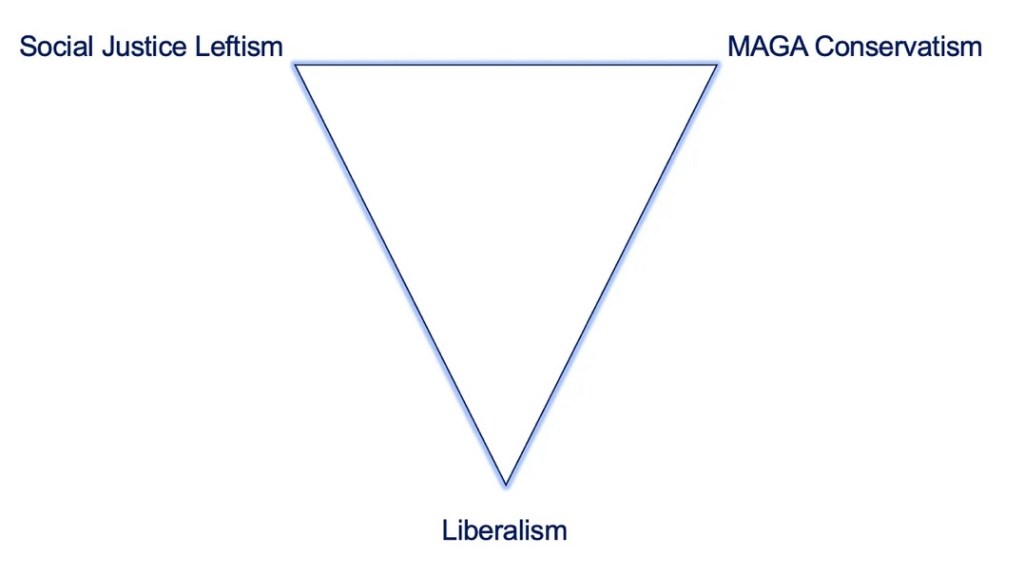
Silver attempts to gives the triangular framework a more contemporary spin by replacing conservatism with “MAGA Conservatism” and socialism with “Social Justice Leftism” (SJL), or “wokeism”. Here, I’m treating MAGA as a “brand”. Nothing below is intended to imply that America should not be a great nation.

The MAGA variant of conservatism emphasizes nationalism, though traditional conservatives have never been short on love of nation. For that matter, as a liberal American, it’s easier to forgive nationalist sentiments than it is the “Death to America” refrain we now hear from some SJLs.

The MAGA brand is also centered around a single individual, Donald Trump, whose rhetoric strikes many as nativistic. And Trump is a populist whose policy proposals are often nakedly political and counterproductive.

SJL shares with socialism an emphasis on various forms of redistribution and social engineering, but with a new focus on victimhood based on classes of identity. Of SJL, Silver says:

“Proponents of SJL usually dislike variations on the term ‘woke’, but the problem is that they dislike almost every other term as well. And we need some term for this ideology, because it encompasses quite a few distinctive features that differentiate it both from liberalism and from traditional, socialist-inflected leftism. In particular, SJL is much less concerned with the material condition of the working class, or with class in general. Instead, it is concerned with identity — especially identity categories involving race, gender and sexuality, but sometimes also many others as part of a sort of intersectional kaleidoscope.”

The gulf between liberals and SJLs couldn’t be wider on issues like free speech and “equity”, and equality of opportunity. MAGAns, on the other hand, have some views on individual rights and responsibility that are largely consistent with liberals, but reflexive populism often leads them to advocate policies protecting rents, corporate welfare, and protectionism.

Divided Liberalism

Liberalism emphasizes limited government, individual autonomy, and free exchange. However, there are issues upon which true liberals are of divided opinion. For example, one such area of controversy is the conflict between a woman’s right to choose and the fetal right to life. Many true liberals disagree over whether the rights of a fetus outweigh its mother’s right to choose, but most would concede that the balance shifts to the fetus at some point well short of birth (putting aside potential dangers to the mother’s life). Open borders is another area that can divide true liberals. On one side, the right to unrestricted mobility is thought to supersede any public interest in enforcing borders and limiting the flow of immigrants. On the other side, questions of national sovereignty, national security, as well as social and state capacity to absorb immigrants take primacy.

Don’t Call Lefties “Liberal”… They’re Not!

True liberalism (including most strains of libertarianism) recognizes various roles that a well-functioning state should play, but it also recognizes the primacy of the individual and individual rights as a social underpinning. As Hayek noted, true liberals are not resistant to change per se, unlike conservatives. But modern progressives demand changes of the worst kind: that the state should intervene to pursue their favored objectives, laying claim to an ever-greater share of private resources. This requires government coercion on a massive scale, the antithesis of liberalism. It’s time to recognize that “progressives” aren’t liberals in any sense of the word. For that matter, they don’t even stand for progress.

I’ll close with a quote from Adam Smith that I cribbed from Scott Sumner. Unfortunately, Sumner does not give the full reference, but I’ll take his word that Smith wrote this 20 years before the publication of The Wealth of Nations:

“Little else is requisite to carry a state to the highest degree of opulence from the lowest barbarism, but peace, easy taxes, and a tolerable administration of justice; all the rest being brought about by the natural course of things. All governments which thwart this natural course, which force things into another channel, or which endeavour to arrest the progress of society at a particular point, are unnatural, and to support themselves are obliged to be oppressive and tyrannical.”

Follow Sacred Cow Chips on WordPress.com

Recent Posts

  • The Case Against Interest On Reserves
  • Immigration and Merit As Fiscal Propositions
  • Tariff “Dividend” From An Indigent State
  • Almost Looks Like the Fed Has a 3% Inflation Target
  • Government Malpractice Breeds Health Care Havoc

Archives

  • January 2026
  • December 2025
  • November 2025
  • October 2025
  • September 2025
  • August 2025
  • July 2025
  • June 2025
  • May 2025
  • April 2025
  • March 2025
  • February 2025
  • January 2025
  • December 2024
  • November 2024
  • October 2024
  • September 2024
  • August 2024
  • July 2024
  • June 2024
  • May 2024
  • April 2024
  • March 2024
  • February 2024
  • January 2024
  • December 2023
  • November 2023
  • August 2023
  • July 2023
  • June 2023
  • May 2023
  • April 2023
  • March 2023
  • February 2023
  • January 2023
  • December 2022
  • November 2022
  • October 2022
  • September 2022
  • August 2022
  • July 2022
  • June 2022
  • May 2022
  • April 2022
  • March 2022
  • February 2022
  • January 2022
  • December 2021
  • November 2021
  • October 2021
  • September 2021
  • August 2021
  • July 2021
  • June 2021
  • May 2021
  • April 2021
  • March 2021
  • February 2021
  • January 2021
  • December 2020
  • November 2020
  • October 2020
  • September 2020
  • August 2020
  • July 2020
  • June 2020
  • May 2020
  • April 2020
  • March 2020
  • February 2020
  • January 2020
  • December 2019
  • November 2019
  • October 2019
  • September 2019
  • August 2019
  • July 2019
  • June 2019
  • May 2019
  • April 2019
  • March 2019
  • February 2019
  • January 2019
  • December 2018
  • November 2018
  • October 2018
  • September 2018
  • August 2018
  • July 2018
  • June 2018
  • May 2018
  • April 2018
  • March 2018
  • February 2018
  • January 2018
  • December 2017
  • November 2017
  • October 2017
  • September 2017
  • August 2017
  • July 2017
  • June 2017
  • May 2017
  • April 2017
  • March 2017
  • February 2017
  • January 2017
  • December 2016
  • November 2016
  • October 2016
  • September 2016
  • August 2016
  • July 2016
  • June 2016
  • May 2016
  • April 2016
  • March 2016
  • February 2016
  • January 2016
  • December 2015
  • November 2015
  • October 2015
  • September 2015
  • August 2015
  • July 2015
  • June 2015
  • May 2015
  • April 2015
  • March 2015
  • February 2015
  • January 2015
  • December 2014
  • November 2014
  • October 2014
  • September 2014
  • August 2014
  • July 2014
  • June 2014
  • May 2014
  • April 2014
  • March 2014

Blogs I Follow

  • Passive Income Kickstart
  • OnlyFinance.net
  • TLC Cholesterol
  • Nintil
  • kendunning.net
  • DCWhispers.com
  • Hoong-Wai in the UK
  • Marginal REVOLUTION
  • Stlouis
  • Watts Up With That?
  • Aussie Nationalist Blog
  • American Elephants
  • The View from Alexandria
  • The Gymnasium
  • A Force for Good
  • Notes On Liberty
  • troymo
  • SUNDAY BLOG Stephanie Sievers
  • Miss Lou Acquiring Lore
  • Your Well Wisher Program
  • Objectivism In Depth
  • RobotEnomics
  • Orderstatistic
  • Paradigm Library
  • Scattered Showers and Quicksand

Blog at WordPress.com.

Passive Income Kickstart

OnlyFinance.net

TLC Cholesterol

Nintil

To estimate, compare, distinguish, discuss, and trace to its principal sources everything

kendunning.net

The Future is Ours to Create

DCWhispers.com

Hoong-Wai in the UK

A Commonwealth immigrant's perspective on the UK's public arena.

Marginal REVOLUTION

Small Steps Toward A Much Better World

Stlouis

Watts Up With That?

The world's most viewed site on global warming and climate change

Aussie Nationalist Blog

Commentary from a Paleoconservative and Nationalist perspective

American Elephants

Defending Life, Liberty and the Pursuit of Happiness

The View from Alexandria

In advanced civilizations the period loosely called Alexandrian is usually associated with flexible morals, perfunctory religion, populist standards and cosmopolitan tastes, feminism, exotic cults, and the rapid turnover of high and low fads---in short, a falling away (which is all that decadence means) from the strictness of traditional rules, embodied in character and inforced from within. -- Jacques Barzun

The Gymnasium

A place for reason, politics, economics, and faith steeped in the classical liberal tradition

A Force for Good

How economics, morality, and markets combine

Notes On Liberty

Spontaneous thoughts on a humble creed

troymo

SUNDAY BLOG Stephanie Sievers

Escaping the everyday life with photographs from my travels

Miss Lou Acquiring Lore

Gallery of Life...

Your Well Wisher Program

Attempt to solve commonly known problems…

Objectivism In Depth

Exploring Ayn Rand's revolutionary philosophy.

RobotEnomics

(A)n (I)ntelligent Future

Orderstatistic

Economics, chess and anything else on my mind.

Paradigm Library

OODA Looping

Scattered Showers and Quicksand

Musings on science, investing, finance, economics, politics, and probably fly fishing.

  • Subscribe Subscribed
    • Sacred Cow Chips
    • Join 128 other subscribers
    • Already have a WordPress.com account? Log in now.
    • Sacred Cow Chips
    • Subscribe Subscribed
    • Sign up
    • Log in
    • Report this content
    • View site in Reader
    • Manage subscriptions
    • Collapse this bar
 

Loading Comments...