• About

Sacred Cow Chips

Sacred Cow Chips

Tag Archives: carbon Sensitivity

Hurricane—Warming Link Is All Model, No Data

18 Tuesday Oct 2022

Posted by Nuetzel in Climate science, Hurricanes, Uncategorized

≈ 2 Comments

Tags

Carbon Forcing Models, carbon Sensitivity, Climate Alarmism, Geophysical Fluid Dynamics Laboratory, Glenn Reynolds, Greenhouse Gases, Hurricane Ian, Hurricane Models, IPCC, Model Calibration, Named Storms, National Hurricane Center, National Oceanic and Atmospheric Administration, Neil L. Frank, NOAA, Paul Driessen, Roger Pielke Jr., Ron DeSantis, Ryan Maue, Satellite Data, Tropical Cyclones
There was deep disappointment among political opponents of Florida Governor Ron DeSantis at their inability to pin blame on him for Hurricane Ian’s destruction. It was a terrible hurricane, but they so wanted it to be “Hurricane Hitler”, as Glenn Reynolds noted with tongue in cheek. That just didn’t work out for them, given DeSantis’ competent performance in marshaling resources for aid and cleanup from the storm. Their last ditch refuge was to condemn DeSantis for dismissing the connection they presume to exist between climate change and hurricane frequency and intensity. That criticism didn’t seem to stick, however, and it shouldn’t.

There is no linkage to climate change in actual data on tropical cyclones. It is a myth. Yes, models of hurricane activity have been constructed that embed assumptions leading to predictions of more hurricanes, and more intense hurricanes, as temperatures rise. But these are models constructed as simplified representations of hurricane development. The following quote from the climate modelers at the Geophysical Fluid Dynamics Laboratory (GFDL) (a division of the National Oceanic and Atmospheric Administration (NOAA)) is straightforward on this point (emphases are mine):

“Through research, GFDL scientists have concluded that it is premature to attribute past changes in hurricane activity to greenhouse warming, although simulated hurricanes tend to be more intense in a warmer climate. Other climate changes related to greenhouse warming, such as increases in vertical wind shear over the Caribbean, lead to fewer yet more intense hurricanes in the GFDL model projections for the late 21st century.

Models typically are said to be “calibrated” to historical data, but no one should take much comfort in that. As a long-time econometric modeler myself, I can say without reservation that such assurances are flimsy, especially with respect to “toy models” containing parameters that aren’t directly observable in the available data. In such a context, a modeler can take advantage of tremendous latitude in choosing parameters to include, sensitivities to assume for unknowns or unmeasured relationships, and historical samples for use in “calibration”. Sad to say, modelers can make these models do just about anything they want. The cautious approach to claims about model implications is a credit to GFDL.

Before I get to the evidence on hurricanes, it’s worth remembering that the entire edifice of climate alarmism relies not just on the temperature record, but on models based on other assumptions about the sensitivity of temperatures to CO2 concentration. The models relied upon to generate catastrophic warming assume very high sensitivity, and those models have a very poor track record of prediction. Estimates of sensitivity are highly uncertain, and this article cites research indicating that the IPCC’s assumptions about sensitivity are about 50% too high. And this article reviews recent findings that carbon sensitivity is even lower, about one-third of what many climate models assume. In addition, this research finds that sensitivities are nearly impossible to estimate from historical data with any precision because the record is plagued by different sources and types of atmospheric forcings, accompanying aerosol effects on climate, and differing half-lives of various greenhouse gases. If sensitivities are as low as discussed at the links above, it means that predictions of warming have been grossly exaggerated.

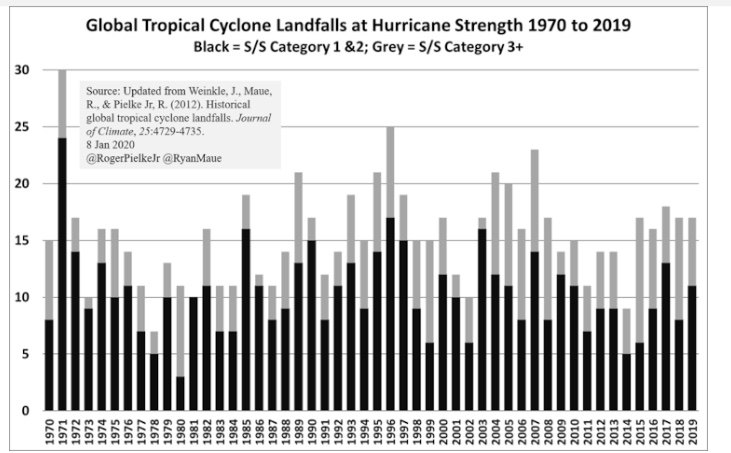
The evidence that hurricanes have become more frequent or severe, or that they now intensify more rapidly, is basically nonexistent. Ryan Maue and Roger Pielke Jr. of the University of Colorado have both researched hurricanes extensively for many years. They described their compilation of data on land-falling hurricanes in this Forbes piece in 2020. They point out that hurricane activity in older data is much more likely to be missing and undercounted, especially storms that never make landfall. That’s one of the reasons for the focus on landfalling hurricanes to begin with. With the advent of satellite data, storms are highly unlikely to be missed, but even landfalls have sometimes gone unreported historically. The farther back one goes, the less is known about the extent of hurricane activity, but Pielke and Maue feel that post-1970 data is fairly comprehensive.

The chart at the top of this post is a summery of the data that Pielke and Maue have compiled. There are no obvious trends in terms of the number of storms or their strength. The 1970s were quiet while the 90s were more turbulent. The absence of trends also characterizes NOAA’s data on U.S. landfalling hurricanes since 1851, as noted by Pail Driessen. Here is Driessen on Florida hurricane history:

“Using pressure, Ian was not the fourth-strongest hurricane in Florida history but the tenth. The strongest hurricane in U.S. history moved through the Florida Keys in 1935. Among other Florida hurricanes stronger than Ian was another Florida Keys storm in 1919. This was followed by the hurricanes in 1926 in Miami, the Palm Beach/Lake Okeechobee storm in 1928, the Keys in 1948, and Donna in 1960. We do not know how strong the hurricane in 1873 was, but it destroyed Punta Rassa with a 14-foot storm surge. Punta Rassa is located at the mouth of the river leading up to Ft. Myers, where Ian made landfall.”

Neil L. Frank, veteran meteorologist and former head of the National Hurricane Center, bemoans the changed conventions for assigning names to storms in the satellite era. A typical clash of warm and cold air will often produce thunderstorms and wind, but few of these types of systems were assigned names under older conventions. They are not typical of systems that usually produce tropical cyclones, although they can. Many of those kinds of storms are named today. Right or wrong, that gives the false impression of a trend in the number of named storms. Not only is it easier to identify storms today, given the advent of satellite data, but storms are assigned names more readily, even if they don’t strictly meet the definition of a tropical cyclone. It’s a wonder that certain policy advocates get away with saying the outcome of all this is a legitimate trend!

As Frank insists, there is no evidence of a trend toward more frequent and powerful hurricanes during the last several decades, and there is no evidence of rapid intensification. More importantly, there is no evidence that climate change is leading to more hurricane activity. It’s also worth noting that today we suffer far fewer casualties from hurricanes owing to much earlier warnings, better precautions, and better construction.

The SEC’s Absurd Climate Overreach

04 Monday Apr 2022

Posted by Nuetzel in Central Planning, Global Warming

≈ 2 Comments

Tags

capital costs, Carbon Emissions, Carbon Forcing Models, carbon Sensitivity, central planning, Corporatism, Disclosure Requirements, ESG Risk, ESG Scores, Green Energy, Greenhouse Gas, Hester Peirce, John Cochrane, Litigation Risk, Paris Agreement, Regulatory Risk, Renewable energy, Scope 1, Scope 2, Scope 3, SEC Climate Mandate, Securities and Exchange Commission

The Securities and Exchange Commission recently issued a proposed rule for reporting on climate change risk, and it is fairly outrageous. It asks that corporations report on their own direct greenhouse gas emissions (GHG – Scope 1), the emissions caused by their purchases of energy inputs (Scope 2), and the emissions caused by their “downstream” customers and “upstream” suppliers (Scope 3). This is another front in the Biden Administration’s efforts to bankrupt producers of fossil fuels and to force the private sector to radically alter its mix of energy inputs. The SEC’s proposed “disclosures” are sheer lunacy on several levels.

The SEC Mandate

If implemented, the rule would allow the SEC to stray well outside the bounds of its regulatory authority. The SEC’s role is not to regulate emissions or the environment. Rather, as its web site makes clear, the agency is charged with:

“… protecting investors, maintaining fair, orderly, and efficient markets, and facilitating capital formation.”

Given this mission, the SEC requires management to disclose material financial risks. Are a firm’s GHG emissions really material risks? The first problem here is quite practical: John Cochrane notes the outrageous costs that would be associated with compliance:

“‘Disclosure’ usually means revealing something you know. A perfectly honest answer to ‘disclose what you know about your carbon emissions’ is, ‘we have no idea what our carbon emissions are.’ Back that up with every document the company has ever produced, and you have perfectly ‘disclosed.’ There is no asymmetric information, fraud, etc.

The SEC has already required the production of new information, and as Hester Peirce makes perfectly clear, the climate rules again make a huge dinner out of that appetizer: essentially telling companies to hire a huge number of climate consultants to generate new information, and also how to run businesses.”

In a separate post, Cochrane quotes SEC Commissioner Hester Peirce’s response to the proposed rule. She emphasizes that companies are already required to disclose all material risks. Perhaps they have properly declined to disclose climate risks because those risks are not material.

“Current SEC disclosure mandates are intended to provide investors with an accurate picture of the company’s present and prospective performance through managers’ own eyes. How are they thinking about the company? What opportunities and risks do the board and managers see? What are the material determinants of the company’s financial value?”

Identifying the Risk Causers

Regardless of the actual risks to a firm caused by climate change, the SEC’s proposed GHG disclosures put a more subtle issue into play. Peirce describes what amounts to a fundamental shift in the SEC’s philosophy regarding the motivation and purpose of disclosure:

The proposal, by contrast, tells corporate managers how regulators, doing the bidding of an array of non-investor stakeholders, expect them to run their companies. It identifies a set of risks and opportunities—some perhaps real, others clearly theoretical—that managers should be considering and even suggests specific ways to mitigate those risks. It forces investors to view companies through the eyes of a vocal set of stakeholders, for whom a company’s climate reputation is of equal or greater importance than a company’s financial performance.”

In other words, a major risk faced by these firms has nothing to do with climate change itself, but with perceptions of “climate-related” risks by other parties. That transforms the question of climate risk into something that is, in fact, regulatory and political. Is this the true nature of the SEC’s concern, all dressed up in the scientism typically relied upon by climate change activists?

The reaction of government bureaucrats to the risks they perceive is a palpable threat to investor well-being. For example, GHG emissions might lead to future regulatory sanctions from various government agencies, including fines, taxes, various sanctions, and mitigation mandates. In addition, with the growth of investment management based on what are essentially shambolic and ad hoc ESG scores, GHG or carbon emissions might lead to constraints on a firm’s access to capital. Just ask the oil and gas industry! That penalty is imposed by activist investors and fund managers who wish to force an unwise and premature end to the use of fossil fuels. There is also a threat that GHG disclosures themselves, based (as they will be) on flimsy estimates, could create litigation risk for many companies.

Much Ado About Nothing

While there are major regulatory and political risks to investors, let’s ask, for the sake of argument: how would one degree celcius of warming by the end of this century affect corporate results? Generally not at all. (The bounds described in the Paris Agreement are 1.5 to 2 degrees, but these are based on unrealistic scenarios — see links below.) It would happen gradually in any case, with ample opportunity to adapt to the operating environment. To think otherwise requires great leaps of imagination. For example, climate alarmists probably fancy that violent weather or wildfires will wipe out facilities, yet there is no reliable evidence that the mild warming experienced to-date has been associated with more violent weather or an increased incidence of wildfires (and see here). There are a great many “sacred cows” worshiped by climate-change neurotics, and the SEC undoubtedly harbors many of those shibboleths.

What probabilities can be attached to each incremental degree of warming that might occur over several decades. The evidence we’ve seen comes from so-called carbon-forcing models parameterized for unrealistically high carbon sensitivities and subjected to unrealistic carbon-concentration scenarios. Estimates of these probabilities are not reliable.

Furthermore, climate change risks, even if they could be measured reliably in the aggregate, cannot reasonably be allocated to individual firms. The magnitude of the firm’s own contribution to that risk is equivalent to the marginal reduction in risk if the firm implemented a realistic zero-carbon operating rule. For virtually any firm, we’re talking about something infinitesimal. It involves tremendous guesswork given that various parties around the globe take a flexible approach to emissions, and will continue to do so. The very suggestion of such an exercise is an act of hubris.

Back To The SEC’s Mandated Role

Let’s return to the practical problems associated with these kinds of disclosure requirements. Cochrane also points out that the onerous nature of the SEC proposal, and the regulatory and political threats it embodies, will hasten the transition away from public ownership in many industries.

“The fixed costs alone are huge. The trend to going private and abandoning public markets, at least in the U.S. will continue. The trend to large oligopolized politically compliant static businesses in the U.S. will continue.

I would bet these rules wind up in court, and that these are important issues. They should be.”

Unfortunately, private companies will still have to to deal with certain investors who would shackle their use of energy inputs and demand forms of diligence (… not to say “due”) of their own.

The SEC’s proposed climate risk disclosures are stunningly authoritarian, and they are designed to coalesce with other demands by the regulatory state to kill carbon-based energy and promote renewables. These alternative energy sources are, as yet, unable to offer an economical and stable supply of power. The fraudulent nature of the alleged risks make this all the more appalling. The SEC has effectively undertaken an effort to engage in corporatist industrial policy benefitting a certain class of “green” energy investors, exposing the proposal as yet another step on the road to fascism. Let’s hope Cochrane is right: already, 16 state attorneys general are preparing a legal challenge. May the courts ultimately see through the SEC’s sham!

Hyperbolic Scenarios, Crude Climate Models, and Scientism

07 Sunday Nov 2021

Posted by Nuetzel in Climate science, Global Warming

≈ 6 Comments

Tags

Carbon Efficiency, Carbon forcing, carbon Sensitivity, Cloud Feedback, COP26, G20, Global Temprature, IEA, Intergovernmental Panel on Climate Change, International Energy Agency, IPCC, Joe Biden, Joe Brandon, Judith Curry, Justin Ritchie, Net Zero Emissions, Nic Lewis, Precautionary Principle, Prince Charles, RCP8.5, rent seeking, Representative Concentration Pathway, Roger Pielke Jr., Scientism, United Nations

What we hear regarding the dangers of climate change is based on predictions of future atmospheric carbon concentrations and corresponding predictions of global temperatures. Those predictions are not “data” in the normal, positive sense. They do not represent “the way things are” or “the way things have been”, though one might hope the initial model conditions align with reality. Nor can the predictions be relied upon as “the way things will be”. Climate scientists normally report a range of outcomes produced by models, yet we usually hear only one type of consequence for humanity: catastrophe!

Models Are Not Reality

The kinds of climate models quoted by activists and by the UN’s Intergovernmental Panel on Climate Change (IPCC) have been around for decades. Known as “carbon forcing” models, they are highly simplified representations of the process determining global temperatures. The primary forecast inputs are atmospheric carbon concentrations over time, which again are themselves predictions.

It’s usually asserted that climate model outputs should guide policy, but we must ask: how much confidence can we have in the predictions to allow government to take coercive actions having immediate, negative impacts on human well being? What evidence can be marshaled to show prospective outcomes under proposed policies? And how well do these models fit the actual, historical data? That is, how well do model predictions track our historical experience, given the historical paths of inputs like carbon concentrations?

Faulty Inputs

The IPCC has been defining and updating sets of carbon scenarios since 1990. The scenarios outline the future paths of greenhouse gas emissions (and carbon forcings). They were originally based on economic and demographic modeling before an apparent “decision by committee” to maintain consistency with scenarios issued in the past. Roger Pielke Jr. and Justin Ritchie describe the evolution of this decision process, and they call for change:

“Our research (and that of several colleagues) indicates that the scenarios of greenhouse gas (GHG) emissions through the end of the twenty-first century are grounded in outdated portrayals of the recent past. Because climate models depend on these scenarios to project the future behavior of the climate, the outdated scenarios provide a misleading basis both for developing a scientific evidence base and for informing climate policy discussions. The continuing misuse of scenarios in climate research has become pervasive and consequential—so much so that we view it as one of the most significant failures of scientific integrity in the twenty-first century thus far. We need a course correction.”

One would certainly expect the predicted growth of atmospheric carbon to evolve over time. However, as Pielke and Ritchie note, the IPCC’s baseline carbon scenario today, known as RCP8.5 (“Representative Concentration Pathway”), is remarkably similar to the “business as usual” (BAU) scenario it first issued in 1990:

“The emissions scenarios the climate community is now using as baselines for climate models depend on portrayals of the present that are no longer true. And once the scenarios lost touch with reality, so did the climate, impact, and economic models that depend on them for their projections of the future. Yet these projections are a central part of the scientific basis upon which climate policymakers are now developing, debating, and adopting policies.”

The authors go on to discuss a few characteristics of the BAU scenario that today seem implausible, including:

“… RCP8.5 foresees carbon dioxide emissions growing rapidly to at least the year 2300 when Earth reaches more than 2,000 ppm of atmospheric carbon dioxide concentrations. But again, according to the IEA and other groups, fossil energy emissions have likely plateaued, and it is plausible to achieve net-zero emissions before the end of the century, if not much sooner.”

Pielke and Ritchie demonstrate that the IPCC’s baseline range of carbon emissions by 2045 is centered well above (actually double) the mid-range of scenarios developed by the International Energy Agency (IEA), and there is very little overlap between the two. However, global carbon emissions have been flat over the past decade. Even if we extrapolate the growth in atmospheric CO2 parts per million over the past 20 years, it would rise to less than 600 ppm by 2100, not 1,200 ppm. It’s true that a few countries (China comes to mind) continue to exploit less “carbon efficient” energy resources like coal, but the growth trend in concentrations is likely to continue to taper over time.

It therefore appears that the IPCC’s climate scenarios, which are used broadly as model inputs by the climate research community, are suspect. As one might suspect: garbage in, garbage out. But what about the climate models themselves?

Faulty Models

The model temperature predictions have been grossly in error. They have been and continue to be “too hot”. The chart at the top of this post is typical of the comparisons of model projections and actual temperatures. Before the year 2000, most of the temperature paths projected by the particular model charted above ran higher than actual temperatures. However, the trends subsequently diverged and the gap has become more extreme over the past two decades.

The problem is not merely one of faulty inputs. The models themselves are deeply flawed, as they fail to account adequately for natural forces that strongly influence our climate. It’s been clear for many years that the sun’s radiative energy has a massive impact on temperatures, and it is affected not only by the intensity of the solar cycle but also by cloud cover on Earth. Unfortunately, carbon forcing models do not agree on the role that increased clouds might have in amplifying warming. However, a reduction in cloud cover over the past 20 years, and a corresponding increase in radiative heat, can account for every bit of the warming experienced over that time.

This finding not only offers an alternative explanation for two decades of modest warming, it also strikes at the very heart of the presumed feedback mechanism usually assumed to amplify carbon-induced warming. The overall effect is summarized by the so-called carbon sensitivity, measured as the response of global temperature to a doubling of carbon concentration. The IPCC puts that sensitivity in a range of 1.5C to 4.5C. However, findings published by Nic Lewis and Judith Curry are close to the low end of that range, as are those found by Frank Bosse reported here. The uncertainties surrounding the role of cloud cover and carbon sensitivities reveal that the outputs relied upon by climate alarmists are extreme model simulations, not the kind of reliable intelligence upon which drastic policy measures should be taken.

The constant anxiety issued from the Left on the issue of climate change, and not a little haranguing of the rest of us, is misplaced. The IPCC’s scenarios for the future paths of carbon concentration are outdated and seriously exaggerated, and they represent a breach of scientific protocol. Yet the scenarios are widely used as the basis of policy discussions at both the domestic and international levels. The climate models themselves embed questionable assumptions that create a bias toward calamitous outcomes.

Yet Drastic Action Is Urged

The UN’s 2021 climate conference, or COP26 (“Conference of the Parties …”) is taking place in Glasgow, Scotland this month. Like earlier international climate conferences, the hope is that dire forecasts will prompt broad agreement on goals and commitments, and that signatory countries will translate these into policy at the national level.

Things got off to a bad start when, before COP26 even began, the G20 nations failed to agree on a goal of “net-zero” carbon emissions by 2050. Another bad portent for the conference is that China and India, both big carbon emitters, will not attend, which must be tremendously disappointing to attendees. After all, COP26 has been billed by Prince Charles himself as “the last chance saloon, literally”, for saving the world from catastrophe. He said roughly the same thing before the Paris conference in 2014. And Joe Brandon … er, Biden, blurted some hyperbole of his own:

“Climate change is already ravaging the world. … It’s destroying people’s lives and livelihoods and doing it every single day. … It’s costing our nations trillions of dollars.”

All this is unadulterated hogwash. But it is the stuff upon which a crisis-hungry media feeds. This hucksterism is but one form of climate rent-seeking. Other forms are much more troubling: scary scenarios and model predictions serve the self-interest of regulators, grant-seeking researchers, interventionist politicians, and green investors who suckle at the public teat. It is a nightmare of scientism fed by the arrogance of self-interested social planners. The renewable energy technologies promoted by these investors, politicians, and planners are costly and land-intensive, providing only intermittent output (requiring backup fossil fuel capacity), and they have nasty environmental consequences of their own.

The precautionary principle is no excuse for the extreme policies advocated by alarmists. We already have economically viable “carbon efficient” and even zero-carbon energy alternatives, such as natural gas, modular nuclear power, and expanded opportunities for exploiting geothermal energy. This argues against premature deployment of wasteful renewables. The real crisis is the threat posed by the imposition of draconian green policies to our long-term prosperity, and especially to the world’s poor.

Renewables and Preempted Prosperity

10 Wednesday Jul 2019

Posted by Nuetzel in Central Planning, Renewable Energy

≈ Leave a comment

Tags

carbon Sensitivity, David Middleton, Economic Cost of Carbon, Fossil fuels, Intermittancy, John Barry, Los Angeles Eland Project, Martin Heidegger, Matt Ridley, Michael Schellenberger, Murray Bookchin, Renewable energy

Coerced conversion to renewable energy sources will degrade human living conditions. That’s certainly true relative to a voluntary conversion actuated by purely private incentives. It’s likely to be true even in an absolute sense, depending on the speed and severity of the forced transition. A coerced conversion will mean lower real incomes during the transition (one recent estimate: $42,000 total loss per U.S. household to transition by 2030), and the losses will continue after the transition, with little redeeming improvement in environmental conditions or risk.

The Reality

There are several underpinnings for the assertions above. One is that the sensitivity of global temperatures to carbon forcings is relatively low. We know all too well that the climate models relied upon by warming alarmists have drastically over-estimated the extent of warming to date. The models are excessively sensitive to carbon emissions and promote an unwarranted urgency to DO SOMETHING… with other people’s money. There is also the question of whether moderate warming is really a bad thing given that it is likely to mean fewer cold-weather fatalities, increased agricultural productivity, and significant reforestation.

Another underpinning is that the real economics of renewable energy are vastly inferior to fossil fuels and will remain so for some time to come. Proponents of renewables tend to quote efficiencies under optimal operating conditions, free of pesky details like the cost of installing a vast support infrastructure and environmental costs of producing components. Solar and wind energy are tremendously inefficient in terms of land use. One estimate is that meeting a 100% renewable energy target in the U.S. today would require acreage equivalent to the state of California. And of course rare earth minerals must be mined for wind turbines and solar panels, and fossil fuels are needed to produce materials like the steel used to build them.

But the chief renewable bugaboo is that the power generated by wind and solar is intermittent. Our ability to store power is still extremely limited, so almost all surplus energy production is lost. Therefore, intermittency necessitates redundant generating capacity, which imposes huge costs. When the winds are calm and the sun isn’t shining, traditional power sources are needed to meet demand. That redundant capacity must be maintained and kept on-line, as these facilities are even costlier to power up from a dead start.

LA Hucksterism

These issues are typified by the unrealistic expectations of Los Angeles’ plan to replace 7% of the city’s power consumption with renewables. The cost predicted by LA regulators is slightly less than 2 cents per kilowatt hour for solar and even less for battery power, which are unrealistically low. For one thing, those are probably operating costs that do not account for capital requirements. The plan promises to provide power 16 hours a day at best, but it’s not clear that the 7% estimate of the renewable share takes that into account or whether the real figure should be 4.2% of LA’s power needs. The project will require 2,600 acres for solar panels, and if it’s like other solar plant installations, the stated capacity is based on the few hours of the day when the sun’s rays are roughly perpendicular to the panels. So it’s likely that the real cost of the power will be many times the estimates, though taxpayers will subsidize 30% or more of the total. And then there is the negative impact on birds and other wildlife.

The Question of Intent

Michael Schellenberger goes so far as to say that a degraded standard of living is precisely what many fierce renewable advocates have long intended. Modern comforts are simply not compatible with 100% renewable energy any time soon, or perhaps ever given the investment involved, but a target of 100% was not really intended to be compatible with modern comforts. In fact, the renewable proposition was often intermingled with celebration of a more austere, agrarian lifestyle. Schellenberger discusses the case of Martin Heidegger, an early anti-technologist who said in 1954 that modern technology “puts to nature the unreasonable demand that it supply energy....” Of course, Heidegger was not talking about the use of solar panels. Others, like Murray Bookchin, were ultimately quite explicit about the “promise” of renewables to dial-back industrial society in favor of an agrarian ideal. And here’s a quote from a new book by John Barry, Professor of “Green Political Economy” (!) at Queen’s University Belfast:

“The first question which serves as the starting point of this chapter is to ask if the objective of economic growth is now ecologically unsustainable, socially divisive and has in many countries passed the point when it is adding to human wellbeing?”

If that’s the question, the answer is no! The quote is courtesy of David Middleton. Green Professor Barry has one thing right, however: growing anything will be tough after crowding erstwhile farm and forest land with solar panels and wind turbines. But at least someone “green” is willing to admit some economic realities, something many alarmists and politicians are loath to do.

Welfare Loss

Involuntary actions always involve a welfare loss, as “subjects” must sacrifice the additional value they’d otherwise derive from their own choices. So it is that coerced adoption of renewables implies a starker outcome than zero economic growth. Objective measurement of all welfare costs is difficult, but we know that the adoption of renewables implies measurable up-front and ongoing economic losses. Matt Ridley notes that the impact of those losses falls hardest on the poor, whose energy needs absorb a large fraction of income. This, along with fundamental impracticality and high costs, accounts for the populist backlash against radical efforts to promote renewables in some European states. The politics of forced adoption of renewables is increasingly grim, but attempts to sell a centrally-planned energy sector based on renewables continue.

Ridley is rightly skeptical of carbon doomsday scenarios, but the pressure to curb carbon emissions will remain potent. He advocates a different form of intervention: essentially a carbon tax on producers with proceeds dedicated to new, competing sequestration or carbon capture technologies. Still coercive, the tax itself requires an estimate of the “economic cost of carbon”, which is of tremendously uncertain magnitude. The tax, of course, has the potential to do real harm to the economy. On the other hand, Ridley is correct in asserting that the effort to fund competing carbon-capture projects would leverage powerful market forces and perhaps hasten breakthroughs.

Mandated Misery

The attempt to force a complete conversion to renewable energy sources is meeting increasing political challenges as its cost is revealed more clearly by experience. Alarmists have long recognized the danger of economic damage, however. Thus, they try to convince us that economic growth and our current standards of living aren’t as good as we think they are, and they continue to exaggerate claims about the promise of renewable technologies. One day, some of these technologies will be sufficiently advanced that they will be economically viable without taxpayer subsidies. The conversion to renewables should be postponed until that day, when users can justify the switch in terms of costs and benefits, and do so voluntarily without interference by government planners.

Follow Sacred Cow Chips on WordPress.com

Recent Posts

  • Immigration and Merit As Fiscal Propositions
  • Tariff “Dividend” From An Indigent State
  • Almost Looks Like the Fed Has a 3% Inflation Target
  • Government Malpractice Breeds Health Care Havoc
  • A Tax On Imports Takes a Toll on Exports

Archives

  • December 2025
  • November 2025
  • October 2025
  • September 2025
  • August 2025
  • July 2025
  • June 2025
  • May 2025
  • April 2025
  • March 2025
  • February 2025
  • January 2025
  • December 2024
  • November 2024
  • October 2024
  • September 2024
  • August 2024
  • July 2024
  • June 2024
  • May 2024
  • April 2024
  • March 2024
  • February 2024
  • January 2024
  • December 2023
  • November 2023
  • August 2023
  • July 2023
  • June 2023
  • May 2023
  • April 2023
  • March 2023
  • February 2023
  • January 2023
  • December 2022
  • November 2022
  • October 2022
  • September 2022
  • August 2022
  • July 2022
  • June 2022
  • May 2022
  • April 2022
  • March 2022
  • February 2022
  • January 2022
  • December 2021
  • November 2021
  • October 2021
  • September 2021
  • August 2021
  • July 2021
  • June 2021
  • May 2021
  • April 2021
  • March 2021
  • February 2021
  • January 2021
  • December 2020
  • November 2020
  • October 2020
  • September 2020
  • August 2020
  • July 2020
  • June 2020
  • May 2020
  • April 2020
  • March 2020
  • February 2020
  • January 2020
  • December 2019
  • November 2019
  • October 2019
  • September 2019
  • August 2019
  • July 2019
  • June 2019
  • May 2019
  • April 2019
  • March 2019
  • February 2019
  • January 2019
  • December 2018
  • November 2018
  • October 2018
  • September 2018
  • August 2018
  • July 2018
  • June 2018
  • May 2018
  • April 2018
  • March 2018
  • February 2018
  • January 2018
  • December 2017
  • November 2017
  • October 2017
  • September 2017
  • August 2017
  • July 2017
  • June 2017
  • May 2017
  • April 2017
  • March 2017
  • February 2017
  • January 2017
  • December 2016
  • November 2016
  • October 2016
  • September 2016
  • August 2016
  • July 2016
  • June 2016
  • May 2016
  • April 2016
  • March 2016
  • February 2016
  • January 2016
  • December 2015
  • November 2015
  • October 2015
  • September 2015
  • August 2015
  • July 2015
  • June 2015
  • May 2015
  • April 2015
  • March 2015
  • February 2015
  • January 2015
  • December 2014
  • November 2014
  • October 2014
  • September 2014
  • August 2014
  • July 2014
  • June 2014
  • May 2014
  • April 2014
  • March 2014

Blogs I Follow

  • Passive Income Kickstart
  • OnlyFinance.net
  • TLC Cholesterol
  • Nintil
  • kendunning.net
  • DCWhispers.com
  • Hoong-Wai in the UK
  • Marginal REVOLUTION
  • Stlouis
  • Watts Up With That?
  • Aussie Nationalist Blog
  • American Elephants
  • The View from Alexandria
  • The Gymnasium
  • A Force for Good
  • Notes On Liberty
  • troymo
  • SUNDAY BLOG Stephanie Sievers
  • Miss Lou Acquiring Lore
  • Your Well Wisher Program
  • Objectivism In Depth
  • RobotEnomics
  • Orderstatistic
  • Paradigm Library
  • Scattered Showers and Quicksand

Blog at WordPress.com.

Passive Income Kickstart

OnlyFinance.net

TLC Cholesterol

Nintil

To estimate, compare, distinguish, discuss, and trace to its principal sources everything

kendunning.net

The Future is Ours to Create

DCWhispers.com

Hoong-Wai in the UK

A Commonwealth immigrant's perspective on the UK's public arena.

Marginal REVOLUTION

Small Steps Toward A Much Better World

Stlouis

Watts Up With That?

The world's most viewed site on global warming and climate change

Aussie Nationalist Blog

Commentary from a Paleoconservative and Nationalist perspective

American Elephants

Defending Life, Liberty and the Pursuit of Happiness

The View from Alexandria

In advanced civilizations the period loosely called Alexandrian is usually associated with flexible morals, perfunctory religion, populist standards and cosmopolitan tastes, feminism, exotic cults, and the rapid turnover of high and low fads---in short, a falling away (which is all that decadence means) from the strictness of traditional rules, embodied in character and inforced from within. -- Jacques Barzun

The Gymnasium

A place for reason, politics, economics, and faith steeped in the classical liberal tradition

A Force for Good

How economics, morality, and markets combine

Notes On Liberty

Spontaneous thoughts on a humble creed

troymo

SUNDAY BLOG Stephanie Sievers

Escaping the everyday life with photographs from my travels

Miss Lou Acquiring Lore

Gallery of Life...

Your Well Wisher Program

Attempt to solve commonly known problems…

Objectivism In Depth

Exploring Ayn Rand's revolutionary philosophy.

RobotEnomics

(A)n (I)ntelligent Future

Orderstatistic

Economics, chess and anything else on my mind.

Paradigm Library

OODA Looping

Scattered Showers and Quicksand

Musings on science, investing, finance, economics, politics, and probably fly fishing.

  • Subscribe Subscribed
    • Sacred Cow Chips
    • Join 128 other subscribers
    • Already have a WordPress.com account? Log in now.
    • Sacred Cow Chips
    • Subscribe Subscribed
    • Sign up
    • Log in
    • Report this content
    • View site in Reader
    • Manage subscriptions
    • Collapse this bar
 

Loading Comments...