• About

Sacred Cow Chips

Sacred Cow Chips

Tag Archives: CHIPS Act

Trump’s New Corporatist Plunder Will Cost U.S.

05 Friday Sep 2025

Posted by Nuetzel in Central Planning, Protectionism, Socialism

≈ Leave a comment

Tags

AMD, central planning, CHIPS Act, Corporatism, Don Boudreaux, Donald Trump, Extortion, fascism, Golden Share, Howard Lutnick, Intel, MP Materials, National Security, Nippon Steel, NVIDIA, Protectionism, Public debt, Scott Bessent, Socialism, Tad DeHaven, TikTok, U.S. Steel, Unfunded Obligations, Veronique de Rugy

Since his inauguration, Donald Trump has been busy finding ways for the government to extort payments and ownership shares from private companies. This has taken a variety of forms. Tad DeHaven summarizes the major pieces of booty extracted thus far in the following bullet points (skipping the quote marks here):

  • June 13: Trump issues an executive order allowing the Nippon Steel-US Steel deal contingent on giving the government a “golden share” that enables the president to exert extensive control over US Steel’s operations.
  • July 10: The Department of Defense (DoD) unveils a multi-part package with convertible preferred stock, warrants, and loan guarantees, making it the top shareholder of rare earth metals producer MP Materials.
  • July 23: The White House claims an agreement with Japan to reduce the president’s so-called reciprocal tariff rate on Japanese imports comes with a $550 billion Japanese “investment fund” that Trump will control.
  • July 31: Trump claims an agreement with South Korea to reduce the so-called reciprocal tariff on South Korean imports comes with a $350 billion South Korean-financed investment in projects “owned and controlled by the United States” that he will select.
  • August 11: The White House confirms an “unprecedented” deal with Nvidia and AMD that allows them to sell particular chips to China in exchange for 15 percent of the sales.
  • August 12: In a Fox Business interview, Bessent points to the alleged investments from Japan, South Korea, and the EU “to some extent” and says, “Other countries, in essence, are providing us with a sovereign wealth fund.”
  • August 22: Fifteen days after calling for Intel CEO Lip-Bu Tan to resign, Trump announces that the US will take a 10 percent equity stake in Intel using the CHIPS Act and DoD funds, becoming Intel’s largest single shareholder.

Each of these “deals” has a slightly different back story, but national security is a common theme. And Trump says they’ll all make America great again. They are touted as a way for American taxpayers to benefit from the investment he claims his policies are attracting to the U.S. However, all of these are ill-advised for several reasons, some of which are common to all. That includes the extortionary nature of each and every one of them.

Short Background On “Deals”

The June 13 deal (Nippon/US Steel), the July 10 deal (MP Materials), and the August 22 deal (Intel) all involve U.S. government equity stakes in private companies. The August 11 deal (NVIDIA/AMD) diverts a stream of private revenue to the government. The July 23 and July 31 deals (Japan and South Korea) both involve “investment funds” that Trump will control to one extent or another.

The August 12 entry adds “expected” EU investments with some qualification, but that bullet quotes Treasury Secretary Bessent referring to these investments as part of a sovereign wealth fund (SWF). Secretary of Commerce Lutnick now denies that an SWF will exist. My objections might be tempered slightly (but only slightly) by an SWF because it would probably need to place constraints on an Administation’s control. That might give you a hint as to why Lutnick is now downplaying the creation of an SWF.

I object to the Nippon/US Steel “deal” in part (and only in part) because it was extortion on its face. There is no valid anti-trust argument against the deal (US Steel is the nation’s third largest steelmaker and is broke), and the national security concerns that were voiced (Japan! for one thing) were completely bogus. Even worse, the “Golden Share” would give the federal government authority, if it chose to exercise it, over a variety of the company’s decisions.

The Intel “deal” is another highly questionable transaction. Intel was to receive $11 billion under the CHIPS Act, a fine example of corporate welfare, as Veronique de Rugy once described the law. However, Intel was to receive its grants only if it stood up four fabrication facilities. But it did not. Now, instead of demanding reimbursement of amounts already paid, the government offered to pay the remainder in exchange for a 9.9% stake in the company. And there is no apparent requirement that Intel meet the original committment! This could turn out a bust!

The MP Materials transaction with the Department of Defense has also been rationalized on national security grounds. This excuse comes a little closer to passing the smell test, but the equity stake is objectionable for other reasons (to follow).

The Nvidia/AMD deal has been justified as compensation for allowing the companies to sell chips to China, which is competing with the U.S. to lead the world in AI development. This is another form of selective treatment, here applied to an export license. The chips in question do not have the same advanced specifications as those sold by the companies in the U.S., but let’s not let that get in the way of a revenue opportunity.

While nothing about TikTok appears on the list above, I fear that a resolution of its operational status in the U.S. presents another opportunity for extortion by the Trump Administration. I’m sure there will be many other cases.

Root Cause: Protectionism

The so-called investment funds described in the timeline above are nearly all the result of trade terms negotiated by a dominant and belligerent trading partner: the U.S. My objections to tariffs are one thing, but here we are extorting investment pledges for reductions in the taxes we’ll impose on our own citizens! Additionally, the belief that these investments will somehow prevent a general withdrawal of foreign investment in the U.S. is misguided. In fact, a smaller trade deficit dictates less foreign investment. The difference here is that the government will wrest ownership control over a greater share of less foreign investment.

Trump the Socialist?

Needless to say, I don’t favor government ownership of the means of production. That’s socialism, but do matters of national security offer a rationale for public ownership? For example, rare earth minerals are important to national defense. Therefore, it’s said that we must ensure a domestic supply of those minerals. I’m not convinced that’s true, but in any case, fat defense contracts should create fat profit opportunities in mining rare earths (enter MP Materials). None of that means public ownership is necessary or a good idea.

All of these federal investments are construed, to one extent or another, as matters of national security, but that argument for market intervention is much too malleable. Must we ensure a domestic supply of semiconductors for national security reasons? And public ownership? Is the same true of steel? Is the same true of our “manufacturing security”? It can go on and on. The next thing you know, someone will argue that grocery stores should be owned by the government in the name of “food security”! Oh, wait…

Trump the Central Planner

Government ownership takes the notion of industrial planning a huge step beyond the usual conception of that term. Ordinarily, when government takes the role of encouraging or discouraging activity in particular industries or technologies, it attempts to select winners and losers. The very idea presumes that the market is not allocating resources in an optimal way, as if the government is in any position to gainsay the decisions of private market participants who have skin in the game. This is a foolhardy position with predictably negative consequences. (For some examples, see the first, second, and fourth articles linked here by Don Boudreaux.) The fundamental flaw in central planning always comes down to the inability of planners to collect, process, and act on the information that the market handles with marvelous efficiency.

When government invests taxpayer funds in exchange for ownership positions in private concerns, the potential levers of control are multiplied. One danger is that political guidance will replace normal market incentives. And as de Rugy points out, the government’s potential role as a regulator creates a clear conflict of interest. In a strong sense, a government ownership stake is worse for private owners than a mere dilution of their interests. It looms as a possible taking, as private owners and managers surrender to creeping government extortion.

Financial Malfeasance

In addition to the objections above, I maintain that these investments represent poor stewardship of public funds. The U.S. public debt currently stands at $37 trillion with an entitlement disaster still to come. In fact, according to one estimate, the federal government’s total unfunded obligations amount to additional $121 trillion! Putting aside the extortion we’re witnessing, any spare dollar should be put toward retiring debt, rather than allowing its upward progression.

As I’ve noted before, paying off a dollar of debt entails a risk-free “return” in the form of interest cost avoidance, let’s say 3.5% for the sake of argument. If instead the dollar is “invested” in risk assets by the government, the interest cost is still incurred. To earn a net return as high as the that foregone from interest avoidance, the government must consistently earn at least 7% on its invested dollar. But of course that return is not risk-free!

A continuing failure to pay down the public debt will ultimately poison the debt market’s assessment of the government’s will to stay within its long-run budget constraint. That would ultimately manifest in an inflation, shrinking the real value of the public debt even as it undermines the living standards of many Americans.

One final thought: Though few MAGA enthusiasts would admit it even if they understood, we’re witnessing a bridging of two ends of the idealogical “horseshoe”. Right-wing populism and protectionism meet the left-wing ideal of central planning and public ownership. There is a name for this particular form of corporatist state, and it is fascism.
Big Spending, Explosive Debt, and the Inflation Tax

07 Tuesday May 2024

Posted by Nuetzel in Deficits, Fiscal policy, Inflation

≈ Leave a comment

Tags

American Rescue Plan, CBO, Child Tax Credit, CHIPS Act, Debt to GDP, Discretionary Spending, Donald Trump, Emergency Spending, entitlements, Eric Boehm, Inflation Premium, Inflation tax, Infrastructure Investment and Jobs Act, Joe Biden, John Cochrane, Medicare, OMB, Promise to Address Comprehensive Toxics Act, Social Security, Soft Default, Student Loan Forgiveness, Supreme Court, Treasury Debt

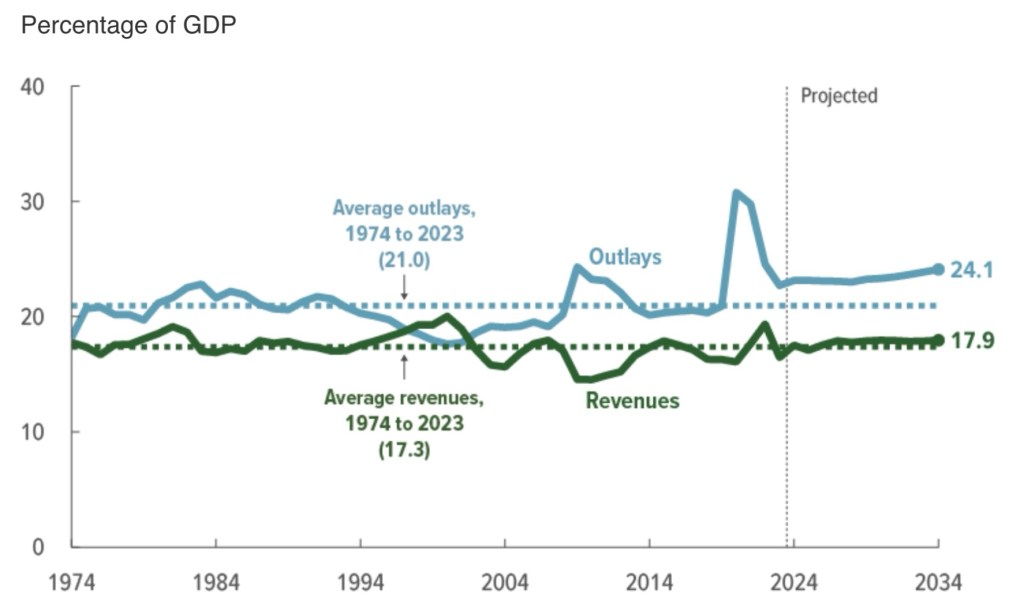
The chart above makes a convincing case that we have a spending problem at the federal level. Really, we’ve had a spending problem for a long time. But at least tax revenue today remains reasonably well-aligned with its 50-year historical average as a share of GDP. Not spending. Even larger deficits opened up during the pandemic and they haven’t returned to pre-pandemic levels.

We’ve seen Joe Biden break spending records. His initiatives, often with questionable merit, have included the $1.8 trillion American Rescue Plan and the nearly $0.8 trillion Infrastructure Investment and Jobs Act, along with several other significant spending initiatives such as the Promise to Address Comprehensive Toxics Act and the subsidy-laden CHIPS Act. Meanwhile, emergency spending has become a regular occurrence on Biden’s watch. More recently, he’s made repeated efforts to forgive massive amounts of student loans despite the Supreme Court’s clear ruling that such gifts are unconstitutional.

Indeed, while Biden keeps pretty busy spinning tales of his days driving an 18-wheeler, cannibals devouring his Uncle Bosie Finnegan, his upbringing in black churches, synagogues, or in the Puerto Rican community, he still finds time to dream up ways for the government to spend money it doesn’t have. Or his kindly puppeteers do.

Biden’s New Budget

Eric Boehm expressed wonderment at Biden’s fiscal 2025 budget not long after its release in March. He was also mystified by the gall it took to produce a “fact sheet” in which the White House congratulated itself on fiscal responsibility. That’s how this Administration characterizes deficits projected at $16 trillion over the next ten years. No joke!

Furthermore, the Administration says the record spending will be “paid for”. Well, yes, with tax increases and lots of borrowing! There are a great many fabulist claims made by the White House about the budget. This link from the Office of Management and Budget includes a handy list of propaganda sheets they’ve managed to produce on the virtues of their proposal.

The Congressional Budget Office (CBO) projects ten-year deficits under current law that are $3 trillion higher than Biden’s proposed budget. That’s the basis of the White House’s boast of fiscal restraint. But the difference is basically paid for with a couple of accounting tricks (see below). More charitably, one could say it’s paid for with higher taxes, aided by the assumption of slightly faster economic growth. The latter will be a good trick while undercutting incentives and wages with a big boost to the corporate tax rate.

The revenue projected by the While House from those taxes does not come anywhere close to eliminating the gap shown in the CBO’s chart above. Federal spending under Biden’s budget grows at about 4% annually, just a bit slower than nominal GDP. Thus, the federal share of GDP remains roughly constant and only slightly higher than the CBO’s current projection for 2034. Nevertheless, spending relative to GDP would continue at an historically high rate. Over the next decade, it would average more than 3% higher than its 50-year average. That would be about $1.3 trillion in 2034!

Meanwhile, the ratio of tax revenue to GDP under Biden’s proposal, as they project it, would average slightly higher than its 50-year average, reaching a full percentage point above by 2034 (and higher than the CBO baseline). That’s probably optimistic.

There is little real effort in this budget to reduce federal deficits, with Treasury borrowing rates now near 15-year highs. Interest expense has grown to an alarming share of spending. In fact, it’s expected to exceed spending on defense in 2024! Perhaps not coincidentally, the White House assumes a greater decline in interest rates than CBO over the next 10 years.

Treats or Tricks?

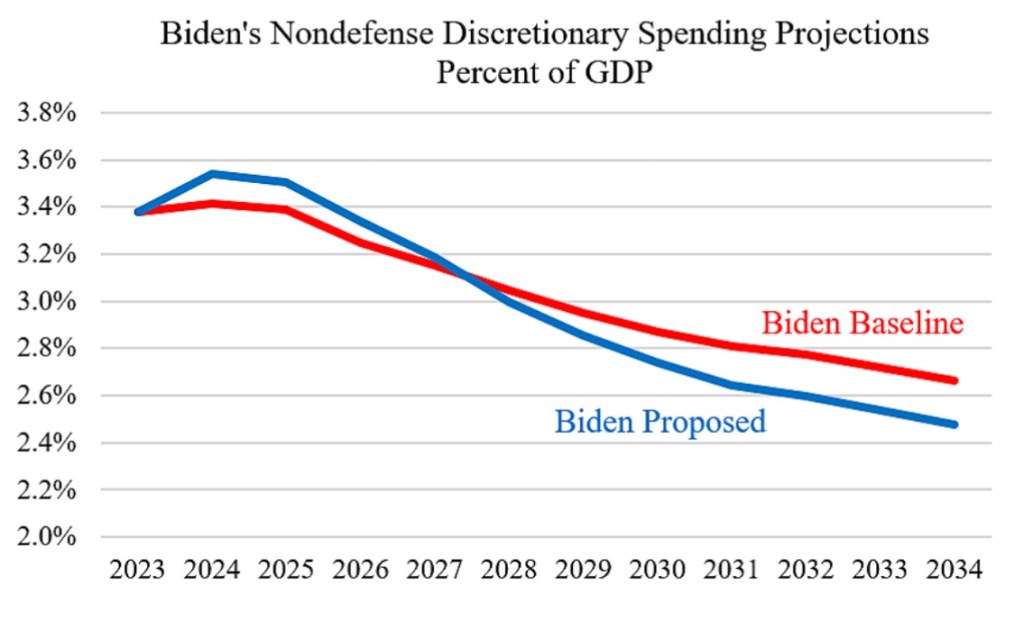
The situation is likely worse than the White House depicts, given that its budget incorporates assumptions that look generous to their claim of fiscal restraint. First, they frontload nondefense discretionary spending, allowing Biden to make extravagant promises for the near-term while pushing off steep declines in budget commitments to the out-years. The sharp reductions in this category of spending pares more than $2 trillion from the 10-year deficit. From the link above:

Biden also proposes to restore the expanded the child tax credit — for one year! How handy from a budget perspective: heroically call for an expanded credit (for a year) while avoiding, for the time being, the addition of a couple of trillion to the 10-year deficit.

Code Red

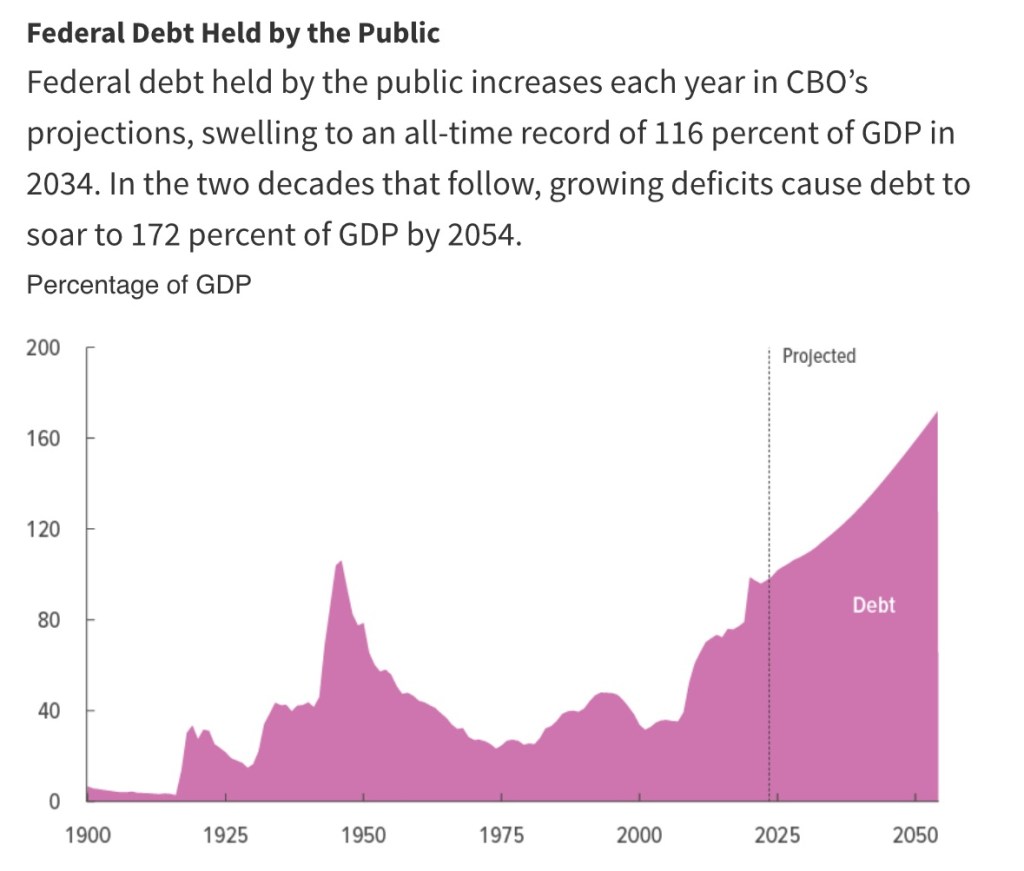
So where does this end? The ratio of federal debt to GDP will resume its ascent after a slight decline from the pandemic high. Here is the CBO’s projection:

The Biden budget shows a relatively stable debt to GDP ratio through 2034 due to the assumptions of slightly faster GDP growth, lower Treasury borrowing rates, and the aforementioned “fiscal restraint”. But don’t count on it!

The government’s growing dominance over real resources will have negative consequences for growth in the long-term. Purely as a fiscal matter, however, it must be paid for in one of three ways: revenue from explicit taxes, federal borrowing, or an implicit tax on the public more commonly known as the inflation tax. The last two are intimately related.

Bond investors always face at least a small measure of default risk even when lending to the U.S. Treasury. There is almost no chance the government would ever default outright by failing to pay interest or principal when due. However, investors hold an expectation that the value of their bonds will erode in real terms due to inflation. To compensate, they demand an “inflation premium” in the interest rate they earn on Treasury bonds. But an upside surprise to inflation would constitute a “soft default” on the real value of their bonds. This occurred during and after the pandemic, and it was triggered by a burgeoning federal deficit.

Brief Mechanics

John Cochrane has explained the mechanism by which acts of fiscal profligacy can be transmitted to the price of goods. The real value of outstanding federal debt cannot exceed the expected real value of future surpluses (a present value summed across positive and negative surpluses). If expected surpluses are reduced via some emergency or shock such that repayment in real terms is less likely, then the real value of government debt must fall. That means either interest rates or the price level must rise, or some combination of the two.

The Federal Reserve can prevent interest rates from rising (by purchasing bonds and increasing the money supply), but that leaves a higher price level as the only way the real value of debt can come into line. In other words, an unexpected increase in the path of federal deficits would be financed by money printing and an inflation tax. The incidence of this unexpected “implicit” tax falls not only to bondholders, but also on the public at large, who suffer an unexpected decline in the purchasing power of their nominal assets and incomes. This in turn tends to free-up real resources for government absorption.

Government Debt Is Risky

It appears that investors expect the future deficits now projected by the CBO (and the White House) to be paid down someday, to some extent, by future surpluses. That might seem preposterous, but markets apparently aren’t surprised by the projected deficits. After all, fiscal policy decisions can change tremendously over the course of a few years. But it still feels like excessive optimism. Whatever the case, Cochrane cautions that the next fiscal emergency, be it a new pandemic, a war, a recession, or some other crisis, is likely to create another huge expansion in debt and a substantial increase price level. Joe Biden doesn’t seem inclined to put us in a position to deal with that risk very effectively. Unfortunately, it’s not clear that Donald Trump will either. And neither seems inclined to seriously address the insolvencies of Social Security and Medicare. If unaddressed, those mandatory obligations will become real crises over the next decade.

Tariffs, Content Quotas, and What Passes for Patriotism

10 Friday Mar 2023

Posted by Nuetzel in Free Trade, Protectionism

≈ Leave a comment

Tags

budget deficits, Buy American, CCP, CHIPS Act, Comparative advantage, Consumer Sovereignty, Content Restrictions, Critical Supply Chains, Domestic Content, Donald Trump, Dumping, Export Markets, Federal Procurement, Foreign Trade, Free trade, George Will, Import Waivers, Joe Biden, Made-In-America Laws, Mercantilism, National Security, Nationalism, Patriotism, Price Competition, Price Preference, Protectionism, Tariffs, Trade Retaliation, Universal Baseline Tariffs, Uyghur Muslims

If there’s one simple lesson in economics that’s hard to get across it’s the destructive nature of protectionism. The economics aren’t hard to explain, but for many, the lessons of protectionist failure just don’t want to sink in. Putting aside matters of national security, the harms of protectionism to the domestic economy are greater than any gains that might inure to protected firms and workers. Shielding home industries and workers from foreign competition is generally not smart nor an act of patriotism, but that sentiment seems fairly common nonetheless.

The Pathology of Protectionism

Jingoistic slogans like “Buy American” are a pitch for voluntary loyalty to American brands. I’m all for voluntary action. Still, that propaganda relies on shaming those who find certain foreign products to have superior attributes or to be more economical. This feeds a psychology of economic insularity and encourages those who favors trade barriers, which is one of the earliest species of failed central planning.

The cognitive resistance to a liberal trade regime might have to do with the concentrated benefits of protectionist measures relative to the more diffuse (but high) costs it imposes on society. Some of the costs of protectionism manifest only with time, which makes the connection to policy less obvious to observers. Or again, obstructing trade and taxing “others” in the hope of helping ourselves may simply inflame nationalist passions.

Both Democrats and Republicans rally around policy measures that tilt the playing field in favor of domestic producers, often severely. And again, this near unanimity exists despite innumerable bouts with the laws of economics. I mean, how many times do you have to be beaten over the head to realize that this is a mistake? Unfortunately, politicians just don’t live in the long-term, they leap to defend powerful interests, and they seldom pay the long-term consequences of their mistakes.

Joe Biden’s “Buy American”

The Biden Administration has pushed a “Made In America” agenda since the President took office, It’s partly a sop to unions for their election support. Much of it had to do with tightening waivers granted under made-in-America laws (dating back to 1933) governing foreign content in goods procured by the federal government. The most recent change by Biden is an increase in the requirement for domestic content to 60% immediately and gradually to 75% from there. Also, “price preferences” will be granted to domestic producers of goods to strengthen supply chains identified as “critical”, including active pharmaceutical ingredients, certain minerals including rare earths and carbon fibers, semiconductors and their advanced packaging, and large capacity batteries such as those used in EVs.

There’s a strong case to be made for developing domestic supplies of certain goods based on national security considerations. That can play a legitimate role where defense goods or even some kinds of civilian infrastructure are involved, but Biden’s order applies much more broadly, including protections for industries that are already heavily subsidized by taxpayers. For example, the CHIPS Act of 2022 included $76 billion of subsidies and tax credits to the semiconductor industry.

George Will describes the cost of protectionism and Biden’s “Buy American”:

“‘Buy American,’ like protectionism generally, can protect some blue-collar jobs — but at a steep price: A Peterson Institute for International Economics study concludes that it costs taxpayers $250,000 annually for each job saved in a protected industry. And lots of white-collar jobs are created for lawyers seeking waivers from the rules. And for accountants tabulating U.S. content in this and that, when, say, an auto component might cross international borders (U.S., Canadian, Mexican) five times before it is ready for installation in a vehicle.”

Biden’s new rules will increase the cost of federal procurement. They will squeeze out contracts with foreign suppliers whose wares are sometimes the most price-competitive or best-suited to a project. This is not a prescription for spending restraint, and it comes at a time when the federal budget is under severe strain. Here’s George Will again:

“This will mean more borrowing, not fewer projects. Federal spending is not constrained by a mere shortage of revenue. So, Biden was promising to increase the deficit. And this policy, which elicited red-and-blue bonhomie in the State of the Union audience, also will give other nations an excuse to retaliate (often doing what they want to do anyway) by penalizing U.S. exporters of manufactured goods. ….. Washington lobbyists for both will prosper.”

Domestic manufacturers who find their contracting status “protected” from foreign competition will face less incentive to perform efficiently. They can relax, rather than improve or even maintain productivity levels, and they’ll feel less pressure to price competitively. Those domestic firms providing goods designated by the government as “critical” will be advantaged by the “price preferences” granted in the rules, leading to a less competitive landscape and higher prices. Thus, Biden’s “Buy American” order is likely to mean higher prices and more federal spending. This is destructive and counter to our national interests.

Donald Trump’s Tariffs

In a recent set of proposals trialed for his presidential election campaign, Donald Trump called for “Universal Baseline Tariffs” on imported goods. In a testament to how far Trump has stumbled down the path of economic ignorance, his campaign mentions “patriotic protectionism” and “mercantilism for the 21st century”. Good God! Trump might be worse than Biden!

This isn’t just about China, though there are some specific sanctions against China in the proposal. After all, these new tariffs would be “universal”. Nevertheless, the Trump campaign took great pains to cloak the tariffs in anti-China rhetoric. Now, I’m very unfavorably disposed to the CCP and to businesses who serve or rely on China and (by implication) the CCP. Certainly, in the case of China, national security may dictate the imposition of certain forms of protectionism, slippery slope though it might be. Nevertheless, that is not what universal tariffs are about.

One destructive consequence of imposing tariffs or import quotas is that foreign governments are usually quick to retaliate with tariffs and quotas of their own. Thus, export markets are shut off to American producers in an escalating trade conflict. That creates serious recession risks or might reinforce other recessionary forces. Lost production for foreign markets and job losses in the affected export industries are the most obvious examples of protectionist harm.

Then consider what happens in protected industries in the U.S. and the negative repercussions in other sectors. The prices charged for protected goods by domestic producers rise for two reasons: more output is demanded of them, and protected firms have less incentive to restrain pricing. Just what the protectionists wanted! In turn, with their new-found, government-granted market power, protected firms will compete more aggressively for workers and other inputs. That puts non-protected firms in a bind, as they’ll be forced to pay higher wages to compete with protected firms for labor. Other inputs may be more costly as well, particularly if they are imported. These distortions lead to reduced output and jobs in non-protected industries. It also means American consumers pay higher prices for both protected and unprotected goods.

Consumers not only lose on price. They also suffer a loss of consumer sovereignty to a government wishing to manipulate their choices. When choices are curtailed, consumers typically lose on other product attributes they value. It also curtails capital inflows to the U.S. from abroad, which can have further negative repercussions for U.S. productivity growth.

When imports constitute a large share of a particular market, it implies that foreign nations have a comparative advantage in producing the good in question. In other words, they sacrifice less to produce the good than we would sacrifice to produce it in the U.S. But if country X has a comparative advantage in producing good X, it means it must have a comparative disadvantage in producing certain other goods, let’s say good Y. (That is, positive tradeoffs in one direction necessarily imply negative tradeoffs in the other.) It makes more economic sense for other countries (country Y, or perhaps the U.S.) to produce good Y, rather than country X, since country Y sacrifices less to do so. And that is why countries engage in trade with each other, or allow their free citizens to do so. It is mutually beneficial. It makes economic sense!

To outlaw or penalize opportunities for mutually beneficial trade will only bring harm to both erstwhile trading partners, though it might well benefit specific interests, including some third parties. Those third parties include opportunistic politicians wishing to leverage nationalist sentiments, their cronies in protected industries, and the bureaucrats, attorneys, and bean counters who manage compliance.

When Is Trade Problematic?

Protectionists often accuse other nations of subsidizing their export industries, giving them unfair advantages or dumping their exports below cost on the U.S. market. There are cases in which this happens, but all such self-interested claims should be approached with a degree of skepticism. There are established channels for filing complaints (and see here) with government agencies and trade organizations, and specific instances often prompt penalties or formal retaliatory actions.

There are frequently claims that foreign producers and even prominent American businesses are beneficiaries of foreign slave labor. A prominent example is the enslavement of Uyghur Muslims in China, who reportedly have been used in the manufacture of goods sold by a number of big-name American companies. This should not be tolerated by these American firms, their customers, or by the U.S. government. Unfortunately, there is a notable lack of responsiveness among many of these parties.

Much less compelling are assertions of slave labor based on low foreign wage rates without actual evidence of compulsion. This is a case of severely misplaced righteousness. Foreign wage rates may be very low by American standards, but they typically provide for a standard of living in the workers’ home country that is better than average. There is no sin in providing jobs to foreign workers at a local wage premium or even a discount, depending on the job. In fact, a foreign wage that is low relative to American wages is often the basis for their comparative advantage in producing certain goods. Under these innocent circumstances, there is no rational argument for producing those goods at much higher cost in the U.S.

Very troublesome are the national security risks that are sometimes attendant to foreign trade. When dealing with a clear adversary nation, there is no easy “free trade” answer. It is not always clear or agreed, however, when international relations have become truly adversarial, and whether trade can be usefully leveraged in diplomacy.

Conclusion

As I noted earlier, protectionism has appeal from a nationalist perspective, but it is seldom a legitimate form of patriotism. It’s not patriotic to limit the choices and sovereignty of the individual, nor to favor certain firms or workers by shielding them from competition while penalizing firms requiring inputs from abroad. We want our domestic industries to be healthy and competitive. Shielding them from competition is the wrong approach.

So much of the “problem” we have with trade is the infatuation with goals tied to jobs and production. Those things are good, but protectionists focus primarily on first-order effects without considering the damaging second-order consequences. And of course, jobs and production are not the ultimate goals of economic activity. In the end, we engage in economic activity in order to consume. We are a rich nation, and we can afford to consume what we like from abroad. It satisfies wants, it brings market discipline, and it leads to foreign investment in the American economy.

Biden and Trump share the misplaced objectives of mercantilism. They are both salesmen in the end, though with strikingly different personas. Salesmen want to sell, and I’m almost tempted to say that their compulsion causes them see trade as a one-way street. Biden is selling his newest “Buy American” rules not only as patriotic, but as a national security imperative. The former is false and the latter is largely false. In fact, obstructions to trade make us weaker. They will also contribute to our fiscal imbalances, and that contributes to monetary and price instability.

Like “Buy American”, Trump’s tariffs are misguided. Apparently, Trump and other protectionists wish to tax the purchases of foreign goods by American consumers and businesses. In fact, they fail to recognize tariffs as the taxes on Americans that they are! And tariffs represent a pointed invitation to foreign trading partners to impose tariffs of their own on American goods. You really can’t maximize anything by foreclosing opportunities for gain, but that’s what protectionism does. It’s astonishing that such a distorted perspective sells so well.

Interventionists Love You and Demand You Change, or Else

19 Friday Aug 2022

Posted by Nuetzel in Central Planning, Industrial Policy, Uncategorized

≈ Leave a comment

Tags

CHIPS Act, David McGrogan, Dierdre McCloskey, Don Boudreaux, Industrial Planning, Inflation Reduction Act, Jason Brennan, Joseph Stiglitz, Lionel Trilling, Lockdowns, Pandemic, Paul Krugman, Scientism, Solyndra

Statistics and measurement might not be critical to the exercise of the authoritarian impulse, but they have served to enable the technocratic tyranny idealized by contemporary statists. Certain influential thinkers have claimed our ability to compile statistics helps give rise to the bureaucratized state. I ran across a great post that led with that topic: “The Brutalization of Compassion” by David McGrogan. The mere ability to compile relevant statistics on a population and its well being (income, jobs, wages, inequality, mortality, suicide, etc… ) can motivate action by authorities to “improve” matters. The purpose might be to get ahead of rival states, or the action might be rationalized as compassion. But watch out! McGrogan quotes a bit of cautionary wisdom from Lionel Trilling:

“‘When once we have made our fellow men the objects of our enlightened interest,’ he put it, something within us causes us to then ‘go on and make them the objects of our pity, then of our wisdom, ultimately of our coercion.’”

Ultimately, to pursue their vision, interventionists must impose controls on behaviors. In practice, that means any variance or attempted variance must be penalized. Here’s McGrogan’s description of the steps in this process:

“The conceptualisation of the population as a field of action, and the measurement of statistical phenomenon within it – the taking of an ‘enlightened interest’ in it – gives rise to both ‘pity,’ or compassion, and the application of ‘wisdom’ to resolve its problems. What is left, of course, is coercion, and we do not need to look far to identify it in the many means by which the modern state subjects the population to a kind of Tocquevillian ‘soft despotism,’ constantly manipulating, cajoling and maneuvering it this way and that for its own good, whether through compulsory state education or ‘sin taxes’ or anything in between.”

Follow the Scientism

I can’t neglect to mention another important condition: the hubris among apparatchiks who imagine the state can improve upon private institutions to achieve social betterment. They will always fail in attempts to replace the action of the private markets and the price mechanism to process information relating to scarcities and preferences. Absent that facility, human planners cannot guide flows of resources to their most valued uses. In fact, they nearly always botch it!

Government provision of public goods is one concession worth making, but the state capacity needed to fulfill this legitimate function is subject to severe mission creep: we frequently see efforts to characterize goods and service as “public” despite benefits that are almost wholly private (e.g. education). Likewise, we often hear exaggerated claims of “harms” requiring state intervention (e.g. carbon emissions). These situations often hinge purely on politics. Even when legitimate external benefits or costs can be identified, there is a pretension that they can be accurately measured and corrected via subsidies or taxes. This is far-fetched. At best, it’s possible to vouch for the directional appropriateness of some interventions, but the magnitude of corrective measures is variable and essentially unknowable. Too often we see government failure via over-subsidization of politically favored activities and over-penalization of politically disfavored activities.

One of the most egregious errors of intervention is the over-application of the precautionary principle: if risks are associated with an activity, then it must be curtailed. This often relies on measurements of highly uncertain causes and effects, and it involves aggregation subject to its own biases.

Just as questionable is the ability of “experts” to model natural or behavioral processes such that outcomes can be “predicted” over horizons extending many decades forward. That interventionists tend to ignore the uncertainties of these predictions is the most blatant and damaging conceit of all, not least because the public and the media usually have limited knowledge with which to assess the phenomenon in question.

Public Health Tyranny

The Covid pandemic presented a compelling excuse for precautionists in government and even private institutions to impose radical controls under a set of claims they called “the science”. These claims were often false and really antithetical to the principles of scientific inquiry, which calls for continually questioning hypotheses, even when they represent “consensus”. Yet a series of questionable scientific claims were used to justify abridgment of basic freedoms for the general population, most of whom faced little risk from the virus. This included lockdowns of schools and churches, business closures, cancellation of public events (except of course for protests and riots by Leftists), deferred medical care, vaccine mandates, and mask mandates. The damage these measures inflicted was fierce, and in the end we know that it was almost entirely unnecessary. Still, the public health establishment seems all too willing to ignore the facts in its readiness to repeat the whole range of mistakes at the slightest uptick in what’s now an endemic infection.

Standard Issue Cronyism

In the wake of the pandemic, we’ve witnessed a surge in calls for government to enhance the security of our nation’s supply chains. Too large a share of the critical goods required by domestic industries are produced overseas, which has made supply disruptions, and the threat of future disruptions, especially acute. Right on cue, advocates of industrial policy and planning have arranged for the federal government to provide $85 billion to domestic producers of semiconductors under the so-called CHIPS Act. But semiconductor producers are in no need of government incentives to “re-shore” production:

“… there has been even more chipmaking investment dedicated to the U.S. market, even as federal subsidies have languished. Construction is now underway at four major U.S. facilities and will continue with or without subsidies—something even Intel reluctantly acknowledged when it delayed the groundbreaking ceremony on its much‐ballyhooed Ohio facility to protest congressional inaction. This is because, as numerous experts have explained over the last year, there are real economic and geopolitical reasons to invest in additional U.S. semiconductor production—no federal subsidies needed.”

Moreover, the global shortage of computer chips appears to be ending. The subsidies will unnecessarily enrich industrialists and their shareholders, provide a source of graft to bureaucrats and various middle men, and likely over-allocate resources to domestic production of chips. Industrial planning of this kind has a long history of failure, and this time won’t be different.

Climate Fascists

We also see repeated over-application of the precautionary principle and rising dominance of industrial policy in climate and energy policy. Enormous sacrifices are imposed on consumers for the sake of minuscule changes in global carbon emissions and the “expected” long-term path of future “global” temperatures. The interventions taken in pursuit of these objectives are draconian, limiting choices and raising the cost of virtually everything produced and consumed. They distort the direction of physical investment, disfavoring reliable sources of base load capacity needed for growth, and also disfavoring the safest and most reliable zero-carbon alternative: nuclear power. The renewable energy sources foolishly pushed by the state and the ESG establishment are environmentally costly in their own right, and they don’t work when natural conditions are unfavorable. As one wag says about the climate provisions of the ironically named Inflation Reduction Act, “Gonna be a lot more Solyndras coming”.

And talk about sloppy! Our “trusted representatives” in Congress could hardly be bothered to pretend they’d done their homework. They neglected to provide any quantitative carbon and temperature impacts of the legislation. This must be a case of true honesty, because they really have no idea!

Delusions of Central Planning

One great weakness (among many) of arguments for state industrial planning is the assumption that government agents are somehow more competent, efficient, and “pure of heart” than agents in the private sector. Nothing could be more laughable. On this point, some of the most incisive commentary I’ve seen is provided by the masterful Don Boudreaux, first quoting Georgetown philosopher Jason Brennan before adding his own entertaining thoughts:

The typical way the left argues for the state is to describe what economists in the 1850s thought markets would be like under monopoly or monopsony, and then compare that to a state run by angels. Both halves of the argument are bad, and yet philosophy treats this as if it were rigorous and sophisticated.

“Far too many policy proposals are nothing more than prayers to the state-god. ‘We entreat you, Oh Powerful and Sacred One, to relieve our people of this or that misery, blemish, and market imperfection! We beseech you to bestow upon us – your faithful servants – cosmic justice, safety from new pathogens, unkind thoughts, and microaggressions, and protection from each and every burden of reality that we can imagine being cured by an omniscient, benevolent, and omnipotent deity! If we obey – and sacrifice to you without complaint our treasure and our freedoms – you will provide!’

I do not exaggerate. Pick at random any proposed government intervention offered by the likes of Progressives or national conservatives, and you’ll discover that the workability of this proposed intervention, when evaluated honestly, rests on nothing more solid than the above absurd faith that the state is – or, when in the right hands, will be – a secular god.”

On the idealization of government’s ability to “plan the economy” rationally, here is more from Boudreaux, first quoting the great Deirdre McCloskey:

Deep in left-wing thought about the economy, and in a good deal of right-wing thought, too, is the premise, as Isaiah Berlin once put it with a sneer, that government can accomplish whatever it rationally proposes to do. As has been often observed about leftists even as sweet as John Rawls, the left has no theory of the behavior of the government. It assumes that the government is a perfect expression of the will of The People.

“And nothing is more unscientific – indeed, more mystical – than is this still-commonplace practice of most Progressives, and also of very many conservatives, to analyze the economy and society, and to offer policy recommendations, using such a juvenile ‘understanding’ of the state. Yet such an ‘understanding’ of the state permeates the work even of some Nobel laureates in economics – laureates such as Paul Krugman and Joseph Stiglitz. This ‘understanding’ of the state is inseparable also from the work of pundits too many to count…

That these professors and pundits think of themselves as scientific – and are widely regarded as being especially intelligent, thoughtful, and scientific – testifies to the strength of the cult of democratically rubber-stamped coercion.”

Conclusion

Humans have proven to be incredible documentarians. The advent of measurement techniques and increasingly sophisticated methods of accounting for various phenomena has enabled better ways of understanding our world and our well being. Unfortunately, a by-product was the birth of scientism, the belief that men in authority are capable not only of measuring, but of fine-tuning, the present and future details of society and social interaction. Those pretensions are terribly mistaken. However, the actions of Congress and the Biden Administration prove that it’s adherents will never be persuaded, despite repeated demonstrations of the futility of central planning. Their words of compassion are no comfort — they must coerce the ones they “love”.

Follow Sacred Cow Chips on WordPress.com

Recent Posts

  • Immigration and Merit As Fiscal Propositions
  • Tariff “Dividend” From An Indigent State
  • Almost Looks Like the Fed Has a 3% Inflation Target
  • Government Malpractice Breeds Health Care Havoc
  • A Tax On Imports Takes a Toll on Exports

Archives

  • December 2025
  • November 2025
  • October 2025
  • September 2025
  • August 2025
  • July 2025
  • June 2025
  • May 2025
  • April 2025
  • March 2025
  • February 2025
  • January 2025
  • December 2024
  • November 2024
  • October 2024
  • September 2024
  • August 2024
  • July 2024
  • June 2024
  • May 2024
  • April 2024
  • March 2024
  • February 2024
  • January 2024
  • December 2023
  • November 2023
  • August 2023
  • July 2023
  • June 2023
  • May 2023
  • April 2023
  • March 2023
  • February 2023
  • January 2023
  • December 2022
  • November 2022
  • October 2022
  • September 2022
  • August 2022
  • July 2022
  • June 2022
  • May 2022
  • April 2022
  • March 2022
  • February 2022
  • January 2022
  • December 2021
  • November 2021
  • October 2021
  • September 2021
  • August 2021
  • July 2021
  • June 2021
  • May 2021
  • April 2021
  • March 2021
  • February 2021
  • January 2021
  • December 2020
  • November 2020
  • October 2020
  • September 2020
  • August 2020
  • July 2020
  • June 2020
  • May 2020
  • April 2020
  • March 2020
  • February 2020
  • January 2020
  • December 2019
  • November 2019
  • October 2019
  • September 2019
  • August 2019
  • July 2019
  • June 2019
  • May 2019
  • April 2019
  • March 2019
  • February 2019
  • January 2019
  • December 2018
  • November 2018
  • October 2018
  • September 2018
  • August 2018
  • July 2018
  • June 2018
  • May 2018
  • April 2018
  • March 2018
  • February 2018
  • January 2018
  • December 2017
  • November 2017
  • October 2017
  • September 2017
  • August 2017
  • July 2017
  • June 2017
  • May 2017
  • April 2017
  • March 2017
  • February 2017
  • January 2017
  • December 2016
  • November 2016
  • October 2016
  • September 2016
  • August 2016
  • July 2016
  • June 2016
  • May 2016
  • April 2016
  • March 2016
  • February 2016
  • January 2016
  • December 2015
  • November 2015
  • October 2015
  • September 2015
  • August 2015
  • July 2015
  • June 2015
  • May 2015
  • April 2015
  • March 2015
  • February 2015
  • January 2015
  • December 2014
  • November 2014
  • October 2014
  • September 2014
  • August 2014
  • July 2014
  • June 2014
  • May 2014
  • April 2014
  • March 2014

Blogs I Follow

  • Passive Income Kickstart
  • OnlyFinance.net
  • TLC Cholesterol
  • Nintil
  • kendunning.net
  • DCWhispers.com
  • Hoong-Wai in the UK
  • Marginal REVOLUTION
  • Stlouis
  • Watts Up With That?
  • Aussie Nationalist Blog
  • American Elephants
  • The View from Alexandria
  • The Gymnasium
  • A Force for Good
  • Notes On Liberty
  • troymo
  • SUNDAY BLOG Stephanie Sievers
  • Miss Lou Acquiring Lore
  • Your Well Wisher Program
  • Objectivism In Depth
  • RobotEnomics
  • Orderstatistic
  • Paradigm Library
  • Scattered Showers and Quicksand

Blog at WordPress.com.

Passive Income Kickstart

OnlyFinance.net

TLC Cholesterol

Nintil

To estimate, compare, distinguish, discuss, and trace to its principal sources everything

kendunning.net

The Future is Ours to Create

DCWhispers.com

Hoong-Wai in the UK

A Commonwealth immigrant's perspective on the UK's public arena.

Marginal REVOLUTION

Small Steps Toward A Much Better World

Stlouis

Watts Up With That?

The world's most viewed site on global warming and climate change

Aussie Nationalist Blog

Commentary from a Paleoconservative and Nationalist perspective

American Elephants

Defending Life, Liberty and the Pursuit of Happiness

The View from Alexandria

In advanced civilizations the period loosely called Alexandrian is usually associated with flexible morals, perfunctory religion, populist standards and cosmopolitan tastes, feminism, exotic cults, and the rapid turnover of high and low fads---in short, a falling away (which is all that decadence means) from the strictness of traditional rules, embodied in character and inforced from within. -- Jacques Barzun

The Gymnasium

A place for reason, politics, economics, and faith steeped in the classical liberal tradition

A Force for Good

How economics, morality, and markets combine

Notes On Liberty

Spontaneous thoughts on a humble creed

troymo

SUNDAY BLOG Stephanie Sievers

Escaping the everyday life with photographs from my travels

Miss Lou Acquiring Lore

Gallery of Life...

Your Well Wisher Program

Attempt to solve commonly known problems…

Objectivism In Depth

Exploring Ayn Rand's revolutionary philosophy.

RobotEnomics

(A)n (I)ntelligent Future

Orderstatistic

Economics, chess and anything else on my mind.

Paradigm Library

OODA Looping

Scattered Showers and Quicksand

Musings on science, investing, finance, economics, politics, and probably fly fishing.

  • Subscribe Subscribed
    • Sacred Cow Chips
    • Join 128 other subscribers
    • Already have a WordPress.com account? Log in now.
    • Sacred Cow Chips
    • Subscribe Subscribed
    • Sign up
    • Log in
    • Report this content
    • View site in Reader
    • Manage subscriptions
    • Collapse this bar
 

Loading Comments...