• About

Sacred Cow Chips

Sacred Cow Chips

Tag Archives: Goldman Sachs

Public Debt and AI: Ain’t But One Way Crowding Out

17 Sunday Aug 2025

Posted by Nuetzel in Artificial Intelligence, Deficits

≈ Leave a comment

Tags

AI Capital Expenditures, Artificially Intelligence, Bradford S. Cohen, Carlyle, central planning, Cronyism, crowding out, Daren Acemoglu, Digital Assets, Federal Deficits, Goldman Sachs, Jason Thomas, Megan Jones, Productivity Growth, Public debt, Scarcity, Seth Benzell, Sovereign Wealth Fund, Stanford Digital Economy Lab, Tyler Cowen
There’s a hopeful narrative making the rounds that artificial intelligence will prove to be such a boon to the economy that we need not worry about high levels of government debt. AI investment is already having a substantial economic impact. Jason Thomas of Carlyle says that AI capital expenditures on such things as data centers, hardware, and supporting infrastructure account for about a third of second quarter GDP growth (preliminarily a 3% annual rate). Furthermore, he says relevant orders are growing at an annual rate of about 40%. The capex boom may continue for a number of years before leveling off. In the meantime, we’ll begin to see whether AI is capable of boosting productivity more broadly.

Unfortunately, even with this kind of investment stimulus, there’s no assurance that AI will create adequate economic growth and tax revenue to end federal deficits, let alone pay down the $37 trillion public debt. That thinking puts too much faith in a technology that is unproven as a long-term economic engine. It would also be a naive attitude toward managing debt that now carries an annual interest cost of almost $1 trillion, accounting for about half of the federal budget deficit.

Boom Times?

Predictions of AI’s long-term macro impact are all over the map. Goldman Sachs estimates a boost in global GDP of 7% over 10 years, which is not exactly aggressive. Daren Acemoglu has been even more conservative, estimating a gain of 0.7% in total factor productivity over 10 years. Tyler Cowen has been skeptical about the impact of AI on economic growth. For an even more pessimistic take see these comments.

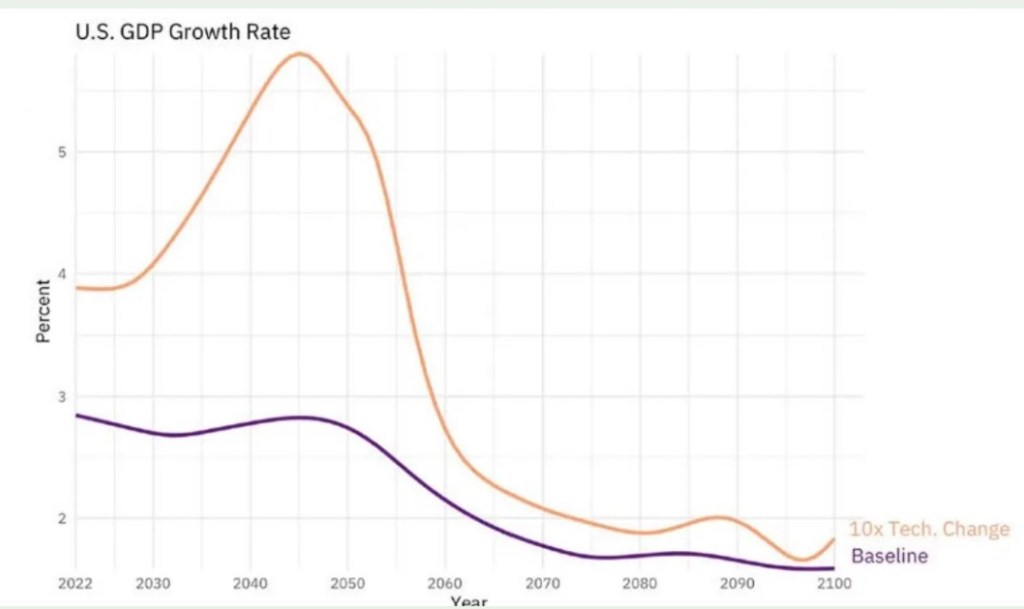
In July, however, Seth Benzell of the Stanford Digital Economy Lab discussed some simulations showing impressive AI-induced growth (see chart at top). The simulations project additional U.S. GDP growth of between 1% – 3% annually over the next 75 years! The largest boost in growth occurs now through the 2050s. This would produce a major advance in living standards. It would also eliminate the federal deficit and cure our massive entitlement insolvency, but the result comes with heavy qualifications. In fact, Benzell ultimately throws cold water on the notion that AI growth will be strong enough to reduce or even stabilize the public debt to GDP ratio.

The Scarcity Spoiler

The big hitch has to do with the scarcity of capital, which I’ve described as an impediment to widespread AI application. Competition for capital will drive interest rates up (3% – 4%, according to Benzell’s model). Ongoing needs for federal financing intensify that effect. But it might not be so bad, according to Benzell, if climbing rates are accompanied by heightened productivity powered by AI. Then, tax receipts just might keep-up with or exceed the explosion in the government’s interest obligations.

A further complication cited by Benzell lurks in insatiable demands for public spending, and politicians who simply can’t resist the temptation to buy votes via public largesse. Indeed, as we’ve already seen, government will try to get in on the AI action, channeling taxpayer funds into projects deemed to be in the public interest. And if there are segments of the work force whose jobs are eliminated by AI, there will be pressure for public support. So even if AI succeeds in generating large gains in productivity and tax revenue, there’s very little chance we’ll see a contagion of fiscal discipline in Washington DC. This will put more upward pressure on interest rates, giving rise to the typical crowding out phenomenon, curtailing private investment in AI.

Playing Catch-Up

The capex boom must precede much of the hoped-for growth in productivity from AI. Financing comes first, which means that rates are likely to rise sooner than productivity gains can be expected. And again, competition from government borrowing will crowd out some private AI investment, slowing potential AI-induced increases in tax revenue.

There’s no chance of the converse: that AI investment will crowd out government borrowing! That kind of responsiveness is not what we typically see from politicians. It’s more likely that ballooning interest costs and deficits generally will provoke even more undesirable policy moves, such as money printing or rate ceilings.

The upshot is that higher interest rates will cause deficits to balloon before tax receipts can catch up. And as for tax receipts, the intangibility of AI will create opportunities for tax flight to more favorable jurisdictions, a point well understood by Benzell. As attorneys Bradford S. Cohen and Megan Jones put it:

“Digital assets can be harder to find and more easily shifted offshore, limiting the tax reach of the U.S. government.”

AI Growth Realism

Benzell’s trepidation about our future fiscal imbalances is well founded. However, I also think Benzell’s modeled results, which represent a starting point in his analysis of AI and the public debt, are too optimistic an assessment of AI’s potential to boost growth. As he says himself,

“… many of the benefits from AI may come in the form of intangible improvements in digital consumption goods. … This might be real growth, that really raises welfare, but will be hard to tax or even measure.”

This is unlikely to register as an enhancement to productivity. Yet Benzell somehow buys into the argument that AI will lead to high levels of unemployment. That’s one of his reasons for expecting higher deficits.

My view is that AI will displace workers in some occupations, but it is unlikely to put large numbers of humans permanently out of work and into state support. That’s because the opportunity cost of many AI applications is and will remain quite high. It will have to compete for financing not only with government and more traditional capex projects, but with various forms of itself. This will limit both the growth we are likely to reap from AI and losses of human jobs.

Sovereign Wealth Fund

I have one other bone to pick with Benzell’s post. That’s in regard to his eagerness to see the government create a sovereign wealth fund. Here is his concluding paragraph:

“Instead of contemplating a larger debt, we should instead be talking about a national sovereign wealth fund, that could ‘own the robots on behalf of the people’. This would both boost output and welfare, and put the welfare system on an indefinitely sustainable path.”

Whether the government sells federal assets or collects booty from other kinds of “deals”, the very idea of accumulating risk assets in a sovereign wealth fund undermines the objective to reduce debt. It will be a struggle for a sovereign wealth fund to consistently earn cash returns to compensate for interest costs and pay down the debt. This is especially unwise given the risk of rising rates. Furthermore, government interests in otherwise private concerns will bring cronyism, displacement of market forces by central planning, and a politicization of economic affairs. Just pay off the debt with whatever receipts become available. This will free up savings for investment in AI capital and hasten the hoped-for boom in productivity.

Summary

AI’s contribution to economic growth probably will be inadequate and come too late to end government budget deficits and reduce our burgeoning public debt. To think otherwise seems far fetched in light of our historical inability to restrain the growth of federal spending. Interest on the federal debt already accounts for about half of the annual budget deficit. Refinancing the existing public debt will entail much higher costs if AI capex continues to grow aggressively, pushing interest rates higher. These dynamics make it pretty clear that AI won’t provide an easy fix for federal deficits and debt. In fact, ongoing federal borrowing needs will sop up savings needed for AI development and diffusion, even as the capital needed for AI drives up the cost of funds to the government. It’s a shame that AI won’t be able to crowd out government.

Social Credit Scores, ESGs, and Portfolio Rot

29 Thursday Apr 2021

Posted by Nuetzel in Capital Markets, Corporatism, Environment, Social Justice

≈ 4 Comments

Tags

American Conservative Union, Asian Hate, Bank of America, Credit Bureaus, Credit Score, CSRHub, Diversity, Environmentalism, Equifax, ESG Scores, ESGs, FICO Score, Giorgio Election Law, Goldman Sachs, Green Energy, Major League Baseball, Merrill Lynch, public subsidies, Refinitiv, Selling Indulgences, Social Credit Score, Social Justice, Stakeholders vs. Shareholders, Stop Corporate Tyranny, Sustainability, Transunion, Unilever, Woke Capitalism.

As a small investor I resent very much the use of so-called “ESG scores” to guide investment decisions on my behalf. ESG stands for “Environmental, Social, and Governance” criteria for rating companies. These scores or grades are developed and assigned by various firms (Refinitiv, CSRHub, and many others) to public companies. The scores are then marketed to financial institutions. While ESGs from various sources are not yet standardized, a public company can attempt to improve its ESG scoring through adoption of environmental goals such as “zero” carbon, diversity and inclusion initiatives, and (less objectionably) by enhancing its systems and processes to ensure protection of shareholder and other interests.

Who Uses ESGs?

An investment fund, for example, might target firms with high ESG scores as a way of appealing to progressive investors. Or an institutional investor like a pension fund might wish to invest in high ESG stocks in order to avoid riling “woke” activist investors, thus keeping the hounds at bay. This is nothing new: many corporations engage in various kinds of defensive actions, which amount to modern day “selling of indulgences”.

An aggregate ESG score can be calculated for a fund or portfolio of stocks by weighting individual holdings by market value. And of course, an ESG score can be calculated for YOUR portfolio. As a “service” to clients, Merrill Lynch plans to do just that.

My first reaction was to give my ML financial advisor an earful. Of course, ML’s presumed objective is to guide you to make “better” investment decisions. However, I do not wish to reward firms with capital based on their “social” positioning, nor do I wish to encourage exercises in “wokeness”. I simply want to supply capital based on a firm’s business fundamentals.

My advisor was more than sympathetic, and I believe he’s sincere. The problem is that corporate wokeness is so ubiquitous that it becomes difficult to invest in equities at all without accepting some of it and just holding your nose. That goes for virtually all ETFs and index funds.

ESGs Are Not Consumer Scores

I’m obviously unhappy about this as a Merrill account holder, and also as a financial economist and a libertarian. But first, a few words about what is not happening, at least not yet. A number of conservative commentators (see here, and here) have described this as an assignment of “social credit scores” to consumers based on their individual or household behavior, much as the Chinese government now grades people on the quality of their citizenship. These conservative voices have reacted to ESG scores as if they incorporate information on your energy usage, for example, to grade you along the environmental dimension. That is not the case, though ESGs can be used to grade the stocks you own. And yes, that is rather Orwellian!

One day, if present trends continue, banks might have access to our energy usage through affiliations with utilities, smart car companies, and various data aggregators. And who knows? They might also use information on your political contributions and subscriptions to grade you on your social “wokeness”, but only if they have access to payment records. Traditional credit information will be used as it is now, to grade you on financial discipline, but your “consumer ESG” might be folded into credit approval decisions, for example, or any number of other decisions that affect your way of life. But except for credit scoring, none of this is happening today. All the consumer information outside of traditional credit scoring data is too scattered and incomplete. So far, ESGs are confined to evaluating companies, funds, and perhaps your portfolio.

ESGs and Returns

ESGs get plenty of favorable coverage from the financial press and even from academics. This post from The Motley Fool from 2019 demonstrates the kind of praise often heaped upon ESGs. Sure, firms who cater to various cultural trends will be rewarded if they convince interested buyers they do it well, whatever it is. That includes delivering goods and services that appeal in some way to environmental consciousness or social justice concerns. So I don’t doubt for a moment that money can be made in the effort. Still, there are several difficulties in quantitatively assessing the value of ESG scores for investment purposes.

First, ESG inputs, calculations, and weights are often proprietary, so you don’t get to see exactly how the sausage is stuffed. On that point, it’s worth noting that much of the information used for ESG’s is rather ad hoc, not universally disclosed, or qualitative. Thus, the applicability (and reliability) of these scores to the universe of stocks is questionable.

Second, inputs to ESGs represent a mix of elements with positive and negative firm-level effects. I already mentioned that ESGs reward good governance on behalf of shareholders. The environmental component is almost surely correlated with lines of business that qualify for government subsidies. More generally, it might reflect conservation of certain materials having a favorable impact on costs. And attempts to measure diversity might extract legitimately positive signals from the employment of highly productive individuals, many of whom have come from distant shores. So ESG scores almost certainly have a few solidly useful components for investors.

The proprietary nature of ESG calculations also raises the question of whether they can be engineered to produce a more positive association with returns. There’s no doubt that they can, but I’m not sure it can be confirmed one way or the other for a particular ESG variant.

Like cultural or consumer trends, investment trends can feed off themselves for a time. If there are enough “woke” investors, ESGs might well feed an unvirtuous cycle of stock purchases in which returns become positively correlated with wokeness. My thinking is that such a divorce from business fundamentals will eventually take its toll on returns, especially when economic or other conditions present challenges, but that’s not the answer you’ll get from many stock pickers and investment pundits.

Remember also that while a particular ESG might be positively correlated with returns, that does not make it the best or even a good tool for evaluating stocks. In fact, it might not even rank well relative to traditional metrics.

Finally, there is the question of causality. There are both innocent and pernicious reasons why certain profitable firms are able to spend exorbitantly on initiatives that coincidentally enhance their ESGs. More on that below.

Social and Economic Rot

Most of the “green” initiatives undertaken by large corporations are good mainly for virtue signaling or to collect public subsidies. They are often wasteful in a pure economic sense, meaning they create more waste and other costs than their environmental benefits. The same is true of social justice and diversity initiatives, which can be perversely racist in their effects and undermine the rule of law. And acts on behalf of “stakeholders” often sacrifice shareholders’ interests unnecessarily.

There are many ways in which firms engaging in wasteful activities can survive profitably, at least for a time. Monopoly power is one way, of course. Large companies often develop a symbiosis with regulators which hampers smaller competitors. This is traditional corporatism in action, along with the “too big to fail” regime. And again, sheer growth in demand for new technologies or networking potential can hide a lot of warts. Hot opportunities sometimes leave growing companies awash in cash, some of which will be burned in wasteful endeavors.

Ultimately, we must recognize that the best contribution any producer can make to society is to create value for shareholders and customers by doing what it does well. But to see how far the corporate world has gone in the other direction, keep this in mind: any company supporting a sprawling HR department, pervasive diversity efforts, “sustainability” initiatives, and preoccupations with “stakeholder” outreach is distracted from its raison d’etre, its purpose as a business enterprise to produce something of value. It is probably captive to certain outside interests who have essentially commandeered management’s attention and shareholders’ resources. And this is evidence of rot.

My reference to “portfolio rot” reflects my conviction is that it is a mistake to dilute investment objectives by rewarding virtue signals. They are usually economically wasteful, though sometimes they might be rewarded via government industrial policy, regulators, and the good graces of activists. But ultimately, this waste will degrade the economy, undermine social cohesion, and devalue assets generally.

What Can We Do?

Despite the grim implications of widespread ESG scoring, there are a few things you can do. First, simply avoid any funds that extol progressive activism, whether based on ESGs or along any dimension. If you invest in individual stocks, you can avoid the worst corporate offenders. Here is one guide that lists some of the “woke-most” companies by industry, and it provides links to more detailed reviews. I gave my advisor a list of firms from which I wanted to permanently divest, including Bank of America, which owns Merrill! I also listed various firms that are owned and operated by Chinese interests because I am repulsed by the Chinese regime’s human rights violations.

If you have the time, you can do a little more research before voting your proxies. That goes for shareholder, board, or management proposals as well as electing board members. You are very unlikely to swing the vote, but it might send a useful signal. I recently voted against a Unilever green initiative. I also researched each of the candidates for board seats, voting against a few based on their political, social and environmental positions and activities. Good information can be hard to get, however, so I abstained from a few others. This kind of thing is time consuming and I’m not sure I’m eager to do very much of it.

You can also support organizations like the American Conservative Union, which is “taking a stand against the increasingly divisive and partisan activism by public corporations and organizations that are caving to ‘woke’ pressure.” And there is Stop Corporate Tyranny, which is “a one-stop shop for educational resources exposing the Left’s nearly completed takeover of corporate America, along with resources and tools for everyday Americans to fight back against the Left’s woke and censoring mob in the corporate lane.”

People can make it harder for social credit scoring to enter the consumer realm by protecting their privacy. There will be obstacles, however, as sellers offer certain benefits and apply “nudges” to obtain their customers’ data, and it is often shared with other sellers. Sadly, one day those who guard their privacy most closely might find themselves punished in the normal course of trade due to their “thin” social credit files. There are many dark aspects to a world with social credit scoring!

Conservative Social Scoring?

There are at least two ETFs available that utilize conservative “social scoring systems” in picking stocks: EGIS and LYFE. Both are sponsored by 2ndVote Funds. EGIS has as its stated theme to invest in stocks which receive a favorable rating in support of the Second Amendment right to bear arms and/or in the interest of border security. LYFE seeks to meet its long-term return objectives in stocks with a favorable rating on the pro-life agenda. Both have reasonable expense ratios, as those things go. Unfortunately, my advisor says Merrill won’t allow those funds to be purchased until they have close to a full year of experience.

Are these two ETFs really so special? Are they really just marketing gimmicks? After all, I noticed that EGIS has Goldman Sachs in its top 10 holdings. While Goldman might not be the worst of its peers in terms of wokeness, it has stooped to some politically-motivated “cancel capers”. Moreover, do I really want to mix my investment objectives with my social preferences? Leftist investors are doing it, so countering might be well-advised if you can afford the risk of diluting your returns. My heart says yes, but my investor brain isn’t sure.

Closing

When it comes to investing, I’d prefer absolute neutrality with to respect social goals, other than the social goals inherent in the creation of value for customers and shareholders. Any emphasis on ESG scores is objectionable, but it’s a regrettable fact that we have to live with to some extent. If “social scoring” is unavoidable, then perhaps the themes adopted by 2ndVote Funds are worth trying as part of an investment approach. After all, given my personal blacklist of woke corporations, I’ve already succumbed to the temptation to invest based on social goals. And I feel pretty good about it. Unfortunately, it might mean I’ll sacrifice return and witness the continued descent of western society into a woke hellscape.

A Trump Tax Reform Tally

03 Wednesday May 2017

Posted by Nuetzel in Big Government, Taxes, Trump Administration

≈ 1 Comment

Tags

Alternative Minimum Tax, Border Adjustment Tax, C-Corporation, Capex Expensing, Capital Tax, Carry Forward Rules, Child Care Tax Credit, Don Boudreaux, Double Taxation, Goldman Sachs, Immigration, Interest Deductibility, Kevin D. Williamson, Mortgage Interest Deduction, Pass-Through Income, Protectionism, Qualified Dividends, Revenue Neutrality, S-Corporation, Shikha Dalmia, Standard Deduction, Tax Burden, Tax Incentives, tax inversion, Tax Reform, Tax Subsidies, Territorial Taxes, Thomas Sowell, Trump Tax Plan

IMG_4199

The Trump tax plan has some very good elements and several that I dislike strongly. For reference, this link includes the contents of an “interpretation” of the proposal from Goldman Sachs, based on the one-page summary presented by the Administration last week as well as insights that the investment bank might have gleaned from its connections within the administration. At the link, click on the chart for an excellent summary of the plan relative to current law and other proposals.

At the outset, I should state that most members of the media do not understand economics, tax burdens, or the dynamic effects of taxes on economic activity. First, they seem to forget that in the first instance, taxpayers do not serve at the pleasure of the government. It is their money! Second, Don Boudreaux’s recent note on the media’s “taxing” ignorance is instructive:

“In recent days I have … heard and read several media reports on Trump’s tax plan…. Nearly all of these reports are juvenile: changes in tax rates are evaluated by the media according to changes in the legal tax liabilities of various groups of people. For example, Trump’s proposal to cut the top federal personal income-tax rate from 39.6% to 35% is assessed only by its effect on high-income earners. Specifically, of course, it’s portrayed as a ‘gift’ to high-income earners.

… taxation is not simply a slicing up of an economic pie the size of which is independent of the details of the system of taxation. The core economic case for tax cuts is that they reduce the obstacles to creative and productive activities.“

Boudreaux ridicules those who reject this “supply-side” rationale, despite its fundamental and well-established nature. Thomas Sowell makes the distinction between tax rates and tax revenues, and provides some history on tax rate reductions and particularly “tax cuts for the rich“:

“… higher-income taxpayers paid more — repeat, MORE tax revenues into the federal treasury under the lower tax rates than they had under the previous higher tax rates. … That happened not only during the Reagan administration, but also during the Coolidge administration and the Kennedy administration before Reagan, and under the G.W. Bush administration after Reagan. All these administrations cut tax rates and received higher tax revenues than before.

More than that, ‘the rich’ not only paid higher total tax revenues after the so-called ‘tax cuts for the rich,’ they also paid a higher percentage of all tax revenues afterwards. Data on this can be found in a number of places …“

In some cases, a proportion of the increased revenue may have been due to short-term incentives for asset sales in the wake of tax rate reductions. In general, however, Sowell’s point stands.

Kevin Williamson offers thoughts that could be construed as exactly the sort of thing about which Boudreaux is critical:

“It is nearly impossible to cut federal income taxes in a way that primarily benefits low-income Americans, because high-income Americans pay most of the federal income taxes. … The 2.4 percent of households with incomes in excess of $250,000 a year pay about half of all federal income taxes; the bottom half pays about 3 percent.”

The first sentence of that quote highlights the obvious storyline pounced upon by simple-minded journalists, and it also emphasizes the failing political appeal of tax cuts when a decreasing share of the population actually pays taxes. After all, there is some participatory value in spreading the tax burden in a democracy. I believe Williamson is well aware of the second-order, dynamic consequences of tax cuts that spread benefits more broadly, but he is also troubled by the fact that significant spending cuts are not on the immediate agenda: the real resource cost of government will continue unabated. We cannot count on that from Trump, and that should not be a big surprise. Greater accumulation of debt is a certainty without meaningful future reductions in the growth rate of spending.

Here are my thoughts on the specific elements contained in the proposal, as non-specific as they might be:

What I like about the proposal:

  • Lower tax rate on corporate income (less double-taxation): The U.S. has the highest corporate tax rates in the developed world, and the corporate income tax represents double-taxation of income: it is taxed at the corporate level and again at the individual level, perhaps not all at once, but when it is actually received by owners.
  • Adoption of a territorial tax system on corporate income: The U.S. has a punishing system of taxing corporate income wherever it is earned, unlike most of our trading parters. It’s high time we shifted to taxing only the corporate income that is earned in the U.S., which should discourage the practice of tax inversion, whereby firms transfer their legal domicile overseas.
  • No Border Adjustment Tax (BAT): What a relief! This was essentially the application of taxes on imports but tax-free exports. Whatever populist/nationalist appeal this might have had would have quickly evaporated with higher import prices and the crushing blow to import-dependent businesses. Let’s hope it doesn’t come back in congressional negotiations.
  • Lower individual tax rates: I like it.
  • Fewer tax brackets: Simplification, and somewhat lower compliance costs.
  • Fewer deductions from personal income, a broader tax base, and lower compliance costs. Scrapping deductions for state and local taxes in exchange for lower rates will end federal tax subsidies from low-tax to high-tax states.
  • Elimination of the Alternative Minimum Tax: This tax can be rather punitive and it is a nasty compliance cost-causer.

What I dislike about the proposal:

  • The corporate tax rate should be zero (with no double taxation).
  • Taxation of cash held abroad, an effort to encourage repatriation of the cash for reinvestment in the U.S. Taxes on capital of any kind are an act of repeated taxation, as the income used to accumulate capital is taxed to begin with. And such taxes are destructive of capital, which represents a fundamental engine for productivity and economic growth.
  • Retains the mortgage interest and charitable deductions: Both are based on special interest politics. The former leads to an overallocation of resources to owner-occupied housing. Certainly the latter has redeeming virtues, but it subsidizes activities conferring unique benefits to large donors.
  • Increase in the standard deduction: This means fewer “interested” taxpayers. See the  discussion of the Kevin Williamson article above.
  • We should have just one personal income tax bracket, not three: A flat tax would be simpler and would reduce distortions to productive incentives.
  • Tax relief for child-care costs: More special interest politics. Subsidizing market income relative to home activity, hired child care relative to parental care, and fertility is not an appropriate role for government. To the extent that public aid payments are made, they should not be contingent on how the money is spent.
  • Many details are missing: Almost anything could happen with this tax “plan” when the real negotiations begin, but that’s politics, I suppose.

Mixed Feelings:

  • Descriptions of the changes to treatment of pass-through” income seem confused. There is only one kind of tax applied to the income of pass-through entities like S-corporations, and it is the owner’s individual tax rate. Income from C-corporations, on the other hand, is taxed twice: once at a 15% corporate tax rate under the Trump plan, and a second time when it is paid to investors at an individual tax rate, which now range from 15% to almost 24% for “qualified dividends” (most dividend payments), but are likely to range up to 35% for “ordinary” dividends under the plan. So effectively, double-taxed C-corporate income would be taxed at total rates ranging from 30% to 50% after tallying both the C-corp tax and the individual tax. (This is a simplification: C-corp income paid as dividends would be taxed to the corporation and then immediately to the shareholder at their individual rate, while retained corporate income would be taxed later).

Presumably, the Trump tax plan is to reduce the rate on “pass-through” income to just 15% at the individual level, regardless of other income. (It is not clear how that would effect brackets or the rate of taxation on other components of individual income.) Is that good? Yes, to the extent that lower tax rates allow individuals to keep more of their hard-earned income, and to the extent that such a change would help small businesses. S-corps have always had an advantage in avoiding double taxation, however, and this would not end the differential taxation of S and C income, which is distortionary. It might incent business owners to shift income away from salary payments to profit, however, which would increase the negative impact on tax revenue.

  • Interest deductibility and expensing of capital expenditures are in question. Interest deductibility puts debt funding on an equal footing with equity funding only if the double tax on C-corp income is fully repealed. Immediate expensing of “capex” would certainly provide an investment incentive (as long as “excess” expenses can be carried forward), and for C-corporations, it would certainly bring us closer to elimination of the double-tax on income (the accounting matching principle be damned!).
  • There is no commitment to shrink government, but that’s partly (only partly) a function of having abandoned revenue neutrality. It’s also something that has been promised for the next budget year.
  • The tax reform proposal represents a departure from insistence on revenue neutrality: On the whole, I find this appealing, not because I like deficits better than taxes, but because there may be margins along which tax policy can be improved if unconstrained by neutrality, assuming that the incremental deficits are less damaging to the economy than the gains. The political landscape may dictate that desirable changes in tax policy can be made more easily in this way.

Shikha Dalmia wonders whether a real antidote for “Trumpism” might be embedded within the tax reform proposal. If the reforms are successful in stimulating non-inflationary economic growth, a “big if” on the first count, the popular preoccupations inspired by Trump with immigration policy, the “wall” and protectionism might just fade away. But don’t count on it. On the whole, I think the tax reform proposal has promise, though some of the good parts could vanish before a bill hits Trump’s desk, and some of the bad parts could get worse!

Follow Sacred Cow Chips on WordPress.com

Recent Posts

  • Immigration and Merit As Fiscal Propositions
  • Tariff “Dividend” From An Indigent State
  • Almost Looks Like the Fed Has a 3% Inflation Target
  • Government Malpractice Breeds Health Care Havoc
  • A Tax On Imports Takes a Toll on Exports

Archives

  • December 2025
  • November 2025
  • October 2025
  • September 2025
  • August 2025
  • July 2025
  • June 2025
  • May 2025
  • April 2025
  • March 2025
  • February 2025
  • January 2025
  • December 2024
  • November 2024
  • October 2024
  • September 2024
  • August 2024
  • July 2024
  • June 2024
  • May 2024
  • April 2024
  • March 2024
  • February 2024
  • January 2024
  • December 2023
  • November 2023
  • August 2023
  • July 2023
  • June 2023
  • May 2023
  • April 2023
  • March 2023
  • February 2023
  • January 2023
  • December 2022
  • November 2022
  • October 2022
  • September 2022
  • August 2022
  • July 2022
  • June 2022
  • May 2022
  • April 2022
  • March 2022
  • February 2022
  • January 2022
  • December 2021
  • November 2021
  • October 2021
  • September 2021
  • August 2021
  • July 2021
  • June 2021
  • May 2021
  • April 2021
  • March 2021
  • February 2021
  • January 2021
  • December 2020
  • November 2020
  • October 2020
  • September 2020
  • August 2020
  • July 2020
  • June 2020
  • May 2020
  • April 2020
  • March 2020
  • February 2020
  • January 2020
  • December 2019
  • November 2019
  • October 2019
  • September 2019
  • August 2019
  • July 2019
  • June 2019
  • May 2019
  • April 2019
  • March 2019
  • February 2019
  • January 2019
  • December 2018
  • November 2018
  • October 2018
  • September 2018
  • August 2018
  • July 2018
  • June 2018
  • May 2018
  • April 2018
  • March 2018
  • February 2018
  • January 2018
  • December 2017
  • November 2017
  • October 2017
  • September 2017
  • August 2017
  • July 2017
  • June 2017
  • May 2017
  • April 2017
  • March 2017
  • February 2017
  • January 2017
  • December 2016
  • November 2016
  • October 2016
  • September 2016
  • August 2016
  • July 2016
  • June 2016
  • May 2016
  • April 2016
  • March 2016
  • February 2016
  • January 2016
  • December 2015
  • November 2015
  • October 2015
  • September 2015
  • August 2015
  • July 2015
  • June 2015
  • May 2015
  • April 2015
  • March 2015
  • February 2015
  • January 2015
  • December 2014
  • November 2014
  • October 2014
  • September 2014
  • August 2014
  • July 2014
  • June 2014
  • May 2014
  • April 2014
  • March 2014

Blogs I Follow

  • Passive Income Kickstart
  • OnlyFinance.net
  • TLC Cholesterol
  • Nintil
  • kendunning.net
  • DCWhispers.com
  • Hoong-Wai in the UK
  • Marginal REVOLUTION
  • Stlouis
  • Watts Up With That?
  • Aussie Nationalist Blog
  • American Elephants
  • The View from Alexandria
  • The Gymnasium
  • A Force for Good
  • Notes On Liberty
  • troymo
  • SUNDAY BLOG Stephanie Sievers
  • Miss Lou Acquiring Lore
  • Your Well Wisher Program
  • Objectivism In Depth
  • RobotEnomics
  • Orderstatistic
  • Paradigm Library
  • Scattered Showers and Quicksand

Blog at WordPress.com.

Passive Income Kickstart

OnlyFinance.net

TLC Cholesterol

Nintil

To estimate, compare, distinguish, discuss, and trace to its principal sources everything

kendunning.net

The Future is Ours to Create

DCWhispers.com

Hoong-Wai in the UK

A Commonwealth immigrant's perspective on the UK's public arena.

Marginal REVOLUTION

Small Steps Toward A Much Better World

Stlouis

Watts Up With That?

The world's most viewed site on global warming and climate change

Aussie Nationalist Blog

Commentary from a Paleoconservative and Nationalist perspective

American Elephants

Defending Life, Liberty and the Pursuit of Happiness

The View from Alexandria

In advanced civilizations the period loosely called Alexandrian is usually associated with flexible morals, perfunctory religion, populist standards and cosmopolitan tastes, feminism, exotic cults, and the rapid turnover of high and low fads---in short, a falling away (which is all that decadence means) from the strictness of traditional rules, embodied in character and inforced from within. -- Jacques Barzun

The Gymnasium

A place for reason, politics, economics, and faith steeped in the classical liberal tradition

A Force for Good

How economics, morality, and markets combine

Notes On Liberty

Spontaneous thoughts on a humble creed

troymo

SUNDAY BLOG Stephanie Sievers

Escaping the everyday life with photographs from my travels

Miss Lou Acquiring Lore

Gallery of Life...

Your Well Wisher Program

Attempt to solve commonly known problems…

Objectivism In Depth

Exploring Ayn Rand's revolutionary philosophy.

RobotEnomics

(A)n (I)ntelligent Future

Orderstatistic

Economics, chess and anything else on my mind.

Paradigm Library

OODA Looping

Scattered Showers and Quicksand

Musings on science, investing, finance, economics, politics, and probably fly fishing.

  • Subscribe Subscribed
    • Sacred Cow Chips
    • Join 128 other subscribers
    • Already have a WordPress.com account? Log in now.
    • Sacred Cow Chips
    • Subscribe Subscribed
    • Sign up
    • Log in
    • Report this content
    • View site in Reader
    • Manage subscriptions
    • Collapse this bar
 

Loading Comments...