• About

Sacred Cow Chips

Sacred Cow Chips

Tag Archives: Gun Rights

Four More Years to MAGAA

28 Wednesday Oct 2020

Posted by Nuetzel in Big Government, Liberty, Politics

≈ Leave a comment

Tags

Abraham Accords, Affordable Care Act, Amy Coney Barrett, Brett Kavanaugh, corporate taxes, Covid-19, Critical Race Theorist, David E. Bernstein, Deregulation, Donald Trump, Dreamers, Election Politics, Federalism, Free trade, Gun Rights, Immigration, Impeachment, Individual Mandate, Joe Biden, Joel Kotkin, Living Constitution, Medicare, Middle East Peace, Nancy Pelosi, National Defense, Nationalism, NATO, Neil Gorsuch, Originalism, Paris Climate Accord, Pass Through Business, Penalty Tax, Social Security, United Nations

As a “practical” libertarian, my primary test for any candidate for public office is whether he or she supports less government dominance over private decisions than the status quo. When it comes to Joe Biden and his pack of ventriloquists, the answer is a resounding NO! That should clinch it, right? Probably, but Donald Trump is more complicated….

I’ve always viewed Trump as a corporatist at heart, one who, as a private businessman, didn’t give a thought to free market integrity when he saw rent-seeking opportunities. Now, as a public servant, his laudable desire to “get things done” can also manifest to the advantage of cronyists, which he probably thinks is no big deal. Unfortunately, that is often the way of government, as the Biden family knows all too well. On balance, however, Trump generally stands against big government, as some of the points below will demonstrate.

Trump’s spoken “stream of consciousness” can be maddening. He tends to be inarticulate in discussing policy issues, but at times I enjoy hearing him wonder aloud about policy; at other times, it sounds like an exercise in self-rationalization. He seldom prevaricates when his mind is made up, however.

Not that Biden is such a great orator. He needs cheat sheets, and his cadence and pitch often sound like a weak, repeating loop. In fairness, however, he manages to break it up a bit with an occasional “C’mon, man!”, or “Here’s the deal.”

I have mixed feelings about Trump’s bumptiousness. For example, his verbal treatment of leftists is usually well-deserved and entertaining. Then there are his jokes and sarcasm, for which one apparently must have an ear. He can amuse me, but then he can grate on me. There are times when he’s far too defensive. He tweets just a bit too much. But he talks like a tough, New York working man, which is basically in his DNA. He keeps an insane schedule, and I believe this is true: nobody works harder.

With that mixed bag, I’ll now get on to policy:

Deregulation: Trump has sought to reduce federal regulation and has succeeded to an impressive extent, eliminating about five old regulations for every new federal rule-making. This ranges from rolling back the EPA’s authority to regulate certain “waters” under the Clean Water Act, to liberalized future mileage standards on car manufacturers, to ending destructive efforts to enforce so-called net neutrality. By minimizing opportunities for over-reach by federal regulators, resources can be conserved and managed more efficiently, paving the way for greater productivity and lower costs.

And now, look! Trump has signed a new executive order making federal workers employees-at-will! Yes, let’s “deconstruct the administrative state”. And another new executive order prohibits critical race theory training both in the federal bureaucracy and by federal contractors. End the ridiculous struggle sessions!

Judicial Appointments: Bravo! Neil Gorsuch, Brett Kavanaugh, Amy Coney Barrett, and over 200 federal judges have been placed on the bench by Trump in a single term. I like constitutional originalism and I believe a “living constitution” is a corrupt judicial philosophy. The founding document is as relevant today as it was at its original drafting and at the time of every amendment. I think Trump understands this.

Corporate Taxes: Trump’s reductions in corporate tax rates have promoted economic growth and higher labor income. In 2017, I noted that labor shares the burden of the corporate income tax, so a reversal of those cuts would be counterproductive for labor and capital.

At the same time, the 2017 tax package was a mixed blessing for many so-called “pass-through” businesses (proprietors, partnerships, and S corporations). It wasn’t exactly a simplification, nor was it uniformly a tax cut.

Individual Income Taxes: Rates were reduced for many taxpayers, but not for all, and taxes were certainly not simplified in a meaningful way. The link in the last paragraph provides a few more details.

I am not a big fan of Trump’s proposed payroll tax cut. Such a temporary move will not be of any direct help to those who are unemployed, and it’s unlikely to stimulate much spending from those who are employed. Moreover, without significant reform, payroll tax cuts will directly accelerate the coming insolvency of the Social Security and Medicare Trust Funds.

Nonetheless, I believe permanent tax cuts are stimulative to the economy in ways that increased government spending is not: they improve incentives for effort, capital investment, and innovation, thus increasing the nation’s productive capacity. Trump seems to agree.

Upward Mobility: Here’s Joel Kotkin on the gains enjoyed by minorities under the Trump Administration. The credit goes to strong private economic growth, pre-pandemic, as opposed to government aid programs.

Foreign Policy: Peace in the Middle East is shaping up as a real possibility under the Abraham Accords. While the issue of coexisting, sovereign Palestinian and Zionist homelands remains unsettled, it now seems achievable. Progress like this has eluded diplomatic efforts for well over five decades, and Trump deserves a peace prize for getting this far with it.

Iran is a thorn, and the regime is a terrorist actor. I support a tough approach with respect to the ayatollahs, which a Trump has delivered. He’s also pushed for troop withdrawals in various parts of the world. He has moved U.S. troops out of Germany and into Poland, where they represent a greater deterrent to Russian expansionism. Trump has pushed our NATO allies to take responsibility for more of their own defense needs, all to the better. Trump has successfully managed North Korean intransigence, though it is an ongoing problem. We are at odds with the leadership in mainland China, but the regime is adversarial, expansionist, and genocidal, so I believe it’s best to take a tough approach with them. At the UN, some of our international “partners” have successfully manipulated the organization in ways that make continued participation by the U.S. of questionable value. Like me, Trump is no fan of UN governance as it is currently practiced.

Gun Rights: Trump is far more likely to stand for Second Amendment rights than Joe Biden. Especially now, given the riots in many cities and calls to “defund police”, it is vitally important that people have a means of self-defense. See this excellent piece by David E. Bernstein on that point.

National Defense: a pure public good; I’m sympathetic to the argument that much of our “defense capital” has deteriorated. Therefore, Trump’s effort to rebuild was overdue. The improved deterrent value of these assets reduces the chance they will ever have to be used against adversaries. Of course, this investment makes budget balance a much more difficult proposition, but a strong national defense is a priority, as long as we avoid the role of the world’s policeman.

Energy Policy: The Trump Administration has made efforts to encourage U.S. energy independence with a series of deregulatory moves. This has succeeded to the extent the U.S. is now a net energy exporter. At the same time, Trump has sought to eliminate subsidies for wasteful renewable energy projects. Unfortunately, ethanol is still favored by energy policy, which might reflect Trump’s desire to assuage the farm lobby.

Climate Policy: Trump kept us out of the costly Paris Climate Accord, which would have cost the U.S. trillions of dollars in lost GDP and subsidies to other nations. Trump saw through the accord as a scam under which leading carbon-emitting nations (such as China) face few real obligations. Meanwhile, the U.S. has led the world in reductions in carbon emissions during Trump’s term, even pre-pandemic. That’s partly a consequence of increased reliance on natural gas relative to other fossil fuels. Trump has also supported efforts to develop more nuclear energy capacity, which is the ultimate green fuel.

COVID-19 Response: As I’ve written several times, in the midst of a distracting and fraudulent impeachment attempt, Trump took swift action to halt inbound flights from China. He marshaled resources to obtain PPE, equipment, and extra hospital space in hot spots, and he kick-started the rapid development of vaccines. He followed the advice of his sometimes fickle medical experts early in the pandemic, which was not always a good thing. In general, his policy stance honored federalist principles by allowing lower levels of government to address local pandemic conditions on appropriate terms. If the pandemic has you in economic straits, you probably have your governor or local officials to thank. As for the most recent efforts to pass federal COVID relief, Nancy Pelosi and House Democrats have insisted on loading up the legislation with non-COVID spending provisions. They have otherwise refused to negotiate pre-election, as if to blame the delay on Trump.

Immigration: My libertarian leanings often put me at odds with nationalists, but I do believe in national sovereignty and the obligation of the federal government to control our borders. Trump is obviously on board with that. My qualms with the border wall are its cost and the availability of cheaper alternatives leveraging technological surveillance. I might differ with Trump in my belief in liberalizing legal immigration. I more strongly differ with his opposition to granting permanent legal residency to so-called Dreamers, individuals who arrived in the U.S. as minors with parents who entered illegally. However, Trump did offer a legal path to citizenship for Dreamers in exchange for funding of the border wall, a deal refused by congressional Democrats.

Health Care: No more penalty (tax?) to enforce the individual mandate, and the mandate itself is likely to be struck down by the Supreme Court as beyond legislative intent. Trump also oversaw a liberalization of insurance offerings and competition by authorizing short-term coverage of up to a year and enabling small businesses to pool their employees with others in order to obtain better rates, among other reforms. Trump seems to have deferred work on a full-fledged plan to replace the Affordable Care Act because there’s been little chance of an acceptable deal with congressional Democrats. That’s unfortunate, but I count it as a concession to political reality.

Foreign Trade: I’m generally a free-trader, so I’m not wholeheartedly behind Trump’s approach to trade. However, our trade deals of the past have hardly constituted “free trade” in action, so tough negotiation has its place. It’s also true that foreign governments regularly apply tariffs and subsidize their home industries to place them at a competitive advantage vis-a-vis the U.S. As the COVID pandemic has shown, there are valid national security arguments to be made for protecting domestic industries. But make no mistake: ultimately consumers pay the price of tariffs and quotas on foreign goods. I cut Trump some slack here, but this is an area about which I have concerns.

Executive Action: Barack Obama boasted that he had a pen and a phone, his euphemism for exercising authority over the executive branch within the scope of existing law. Trump is taking full advantage of his authority when he deems it necessary. It’s unfortunate that legislation must be so general as to allow significant leeway for executive-branch interpretation and rule-making. But there are times when the proper boundaries for these executive actions are debatable.

Presidents have increasingly pressed their authority to extremes over the years, and sometimes Trump seems eager to push the limits. Part of this is born out of his frustration with the legislative process, but I’m uncomfortable with the notion of unchecked executive authority.

•••••••••••••••••••••••••••••••••••••••••••••••••

Of course I’ll vote for Trump! I had greater misgivings about voting for him in 2016, when I couldn’t be sure what we’d get once he took office. After all, his politics had been all over the map over preceding decades. But in many ways I’ve been pleasantly surprised. I’m much more confident now that he is our best presidential bet for peace, prosperity, and liberty.
March of the Benighted Pawns

30 Friday Mar 2018

Posted by Nuetzel in Gun Control, Gun Rights

≈ 1 Comment

Tags

Assault Weapons, Australian Gun Policies, Confiscation, Defensive Gun Uses, DGUs, Gun Buy-Back Program, Gun Rights, James Alan Fox, John Paul Stephens, March For Our Lives, National Rifle Association, NRA, Parkland Shooting, Second Amendment, USA Today/Ipsos

I’ll say one thing for the high schoolers participating in the “March For Our Lives“ political front: they are no more ignorant about guns and the Constitution than their anti-gun, adult counterparts. These naive kids are learning the charms of virtue signaling, newly imbued with so much superstition, misconception, misplaced blame, and inflated self-regard that you’d be hard-pressed to engage most of them in reasoned discussion. But I reserve my highest disdain for adults who shake their fingers and say, “How dare you speak critically of these poor kids, who survived the tragedy that took place at their very own school.” Indeed, some of the Parkland students saw the mayhem with their own eyes. but that admonition is a sham show of indignance designed to squelch legitimate debate. The debate would be unnecessary if not for the anti-gun lobby’s opportunistic exploitation of children befallen by tragedy.

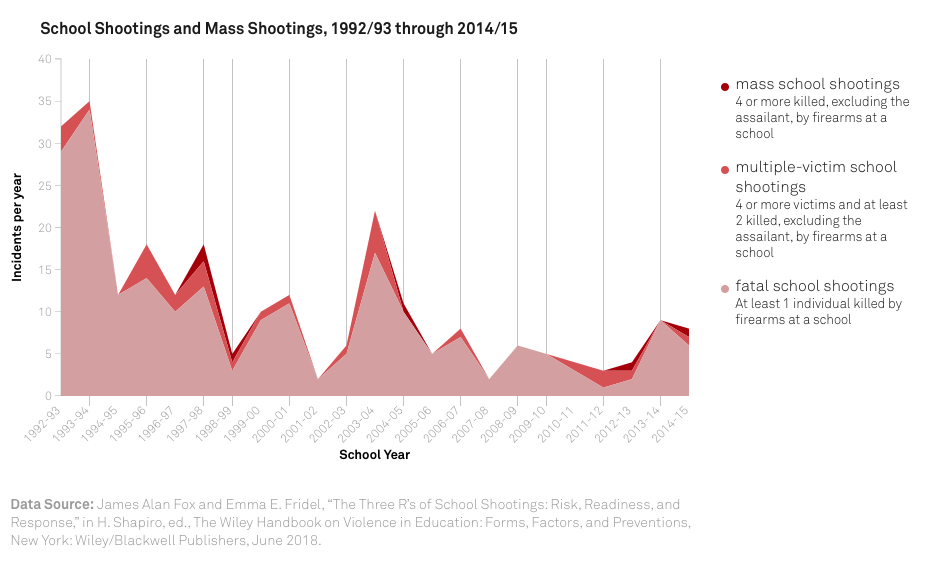
First, as I noted recently on SacredCowChips, the supposed escalation in mass shootings at schools is a myth. Northeastern University provides this summary of the research quoted in my post, including the chart on the long-term decline in school shootings shown above. In light of these statistics, the lead researcher, James Alan Fox, believes that most school security measures are counter-productive, including proposals to arm teachers. I do not fully agree, but be that as it may, it is astonishing that the media and large swaths of the public have accepted as fact the myth of a school shooting epidemic.

The ignorance of would-be gun controllers about guns themselves is legendary. Few of them can actually define an “assault weapon” yet are convinced that they must be banned. The cosmetic addition of certain features to a standard semi-automatic rifle apparently makes these guns too “scary”. And there is little understanding that standard rifles sold today, which fire one shot at a time, are semi-automatic weapons! Rifles, by the way, are involved in only a small fraction of gun homicides, so the focus on “assault weapons” is misplaced. Given this level of ignorance, it’s all too easy to dismiss the gun control crowd as unworthy of a real debate over gun regulation.

Of course, the crux of the debate revolves around constitutional rights. While many of those in favor of stricter gun regulation disavow any desire to repeal the Second Amendment or to actually confiscate guns, there is a significant contingent among them harboring that as an end-goal. Their ideal is politically laughable because it would never get a two-thirds vote of each house of Congress, let alone ratification by 3/4 of the states.

The Second Amendment is described by its foes as outdated and dangerous. I submit, however, that the right to defend oneself against predators, human or otherwise, is a natural right and not subject to obsolescence. The Second Amendment was also intended as protection against tyranny by government, and it serves as protection against a tyranny of any majority or rogue minority. Gun-rights critics argue that the founders of our country did not anticipate the powerful weapons available today, and that they would never have intended citizens to be armed with them. The claim is dubious because the founders certainly would have believed that citizens should have the freedom to arm themselves at least in proportion to the arms used by potential predators (please forgive the use of the term “assault weapons” at the link).

Frankly, I do not expect government tanks to roll down my street on a mission to confiscate guns. Instead, the first step would be a strongly-suggested voluntary sacrifice of weapons. Later, perhaps actual confiscations would be attempted via small detachments of authorities or perhaps by marauding, black-shirted proxies. But confiscations won’t happen as long as a serious threat of reprisal exists, with reasonably powerful weapons, and that is a credit to the Second Amendment.

There are serious misconceptions (not to mention plentiful media propaganda) about the likelihood that stricter gun laws can reduce gun homicides, or that they could have prevented the mass shooting tragedies that have occurred. Some of those shootings are better viewed as failures of law enforcement — examples are the lack of official follow-up on prior tips about the shooter in Parkland, FL, the failure of the school’s resource officer to engage the shooter, the failure of the FBI to detain a shooter prior to an attack at the Pulse nightclub in Orlando, and in still other cases, the failure of background checks to identify individuals as ineligible to purchase guns. There is little doubt that proper enforcement of existing law and protocol would have prevented a number of mass shootings. The focus should be on improving the existing system before expecting responsible citizens to happily consent to further erosion of their natural and constitutional rights.

Strict gun regulation would certainly infringe on liberty, leaving private citizens defenseless in exchange for tenuous assertions of social benefits. Defensive gun uses (DGUs) are thought to far outstrip gun homicides (seven posts touching on that subject are at this link). If guns could be effectively outlawed in the U.S., other instruments of homicide would replace guns because so much killing is driven by the drug war, gang activity, and other social dysfunctions. The same is true of suicides. If you recognize the futility of the war on drugs, you shouldn’t expect much success from a war on guns. Criminals will acquire guns whether they are illegal or not, so the ability to defend oneself with equal force is critical. There is a lively debate over the empirical research on the efficacy of stricter gun laws, but it’s always good to be skeptical when it comes to government prohibitions. Control advocates often cite Australia as an example of successful firearms control, but the country’s gun ban and buy-back program was ineffective in reducing gun homicides (also see here).

Finally, it’s appalling to see the depths to which certain radical enemies of gun ownership will sink in attempting to cast blame on their opponents for mass shootings. In fact, they have blamed not just the NRA, but all gun owners for the Parkland shooting and gun homicides generally. But the NRA represents responsible, law-abiding gun owners and promotes safe and responsible gun use. Roughly 47% of adults in the U.S. have guns in their homes, and they own guns for self-defense or sporting purposes. Attempts to shame them into supporting curtailments on their liberties is obnoxious and rather foolish because it is so unlikely to be fruitful approach. Successful codification always hinges on consensus, which just doesn’t exist with respect to gun law in the U.S.

The media have fawned over the students who have participated in the March For Our Lives campaign. The childrens’ ignorance of constitutional principles, and guns of course, is noteworthy, but their exploitation by powerful political and economic forces is pathetic. The significance of their numbers has been exaggerated as well: reports show the crowd size at the march in Washington, DC was about a quarter of what the organizers claimed. And the anti-gun students have failed to convince many of their peers, according to a poll conducted by USA Today/Ipsos. Perhaps as the spotlight fades, more of these student protestors will have occasion to study the U.S. Constitution and the natural rights it protects against government overreach. No matter how the kids feel now, I’m certain that many of them will be responsible gun owners someday.

Suicides Happen, Guns or Not

20 Monday Jun 2016

Posted by Nuetzel in Gun Rights

≈ Leave a comment

Tags

British Coal-Gas Story, Don B. Kates, Gary Mauser, Gun Rights, Guns and Suicide, Harvard, Impulsive Suicide, International Suicide Rates, Mises Institute, Mises Wire, OECD Suicide Comparison, Passion Suicide, Premeditated Suicide, Ryan McMaken, Teenage Suicide

heads

Gun-rights deniers often assert that access to guns increases the suicide rate, a question recently addressed by Ryan McMaken on the Mises Wire blog. He shows conclusively that suicide rates across countries are not related to gun laws. While gun ownership in the U.S. is extensive, and most gun deaths in the U.S. are suicides, the U.S. suicide rate is in the middle of the pack for OECD countries. Most of those countries have more restrictive gun laws. In fact, the U.S. suicide rate is lower than in Austria, Finland, France, Belgium, and Japan. Gun ownership rates are extremely low in Austria, France, and Japan. Therefore, suicide rates appear to be unrelated to legal gun ownership and the restrictiveness of gun laws. These facts, and simple logic, suggest that an individual in a state of extreme desperation has alternative means of taking their own life.

The most nuanced argument that guns encourage suicides is based on a dichotomy of premeditated suicides versus suicides of impulsivity or passion. Most impulsive suicides, according to this view, are carried out with faster, less painful and more reliable methods, which would include the use of guns. That’s based in part on interviews with suicide survivors and the mental health records of non-survivors. However, it would not be surprising to learn that survivors actually had less intent to begin with; a comparison is impossible because we can’t ask the non-survivors. And whether a mental health record, or the absence of one, is always  a reliable guide to the degree of impulsivity is open to question. So while there are differences in the mental health records of firearm suicide victims versus those who have used less reliable methods, the conclusions seem to rest on fairly unreliable measures of impulsivity or on survivor-only samples. Researchers don’t have much choice in the matter, but drawing conclusions based only on survivors is prone to severe bias.

McMaken shows that guns account for most suicides only among those of age 55 and above, a group that is likely to be the least impulsive. Teenagers might be expected to be the most impulsive, but they tend to have lowest rates of suicide by firearms. However, a teen might not have ready access to a gun even if one is in the home. The teenage suicide rate is even less related to gun ownership across countries. New Zealand, Ireland, Finland and Canada come in much higher than the U.S. on this sad measure, and Australia, Japan, Switzerland, Belgium and Sweden are above the U.S.

At the previous link, the “British coal-gas story” is told to argue that cutting off a common means of suicide will lead to a permanent reduction in suicides. In this case, a changeover from coal gas for heating and cooking to natural gas is alleged to have led to a permanent decrease in total suicides in Great Britain in the 1960s, as death by “sticking your head in the oven” was no longer very reliable. However, other research has found compensatory increases in other forms of suicide, so the coal-gas lesson is suspect.

A Harvard study (circa 2007) by criminologists Don B. Kates and Gary Mauser focused on the ties between guns, murder and suicide; they concluded that suicide does not bear a relationship to gun possession. The authors examined cross-country and within-country data:

“There is simply no relationship evident between the extent of suicide and the extent of gun ownership. People do not commit suicide because they have guns available. In the absence of fire‐ arms, people who are inclined to commit suicide kill themselves some other way.”

Suicide is a manifestation of despair so deep that the victim simply cannot get on with life. Guns have nothing to do with that anguish. It may be true that failed attempts often lead to a renewal of spirit, but survivors still have a high rate of suicidal recidivism. Moreover, the question of the depth of the original intent for survivors is open to question. Those choosing guns for suicide might think it’s the best alternative, but clearly other alternatives will be chosen when guns are unavailable. The claim that access to guns makes people more vulnerable to taking their own lives is not supported by the data.

Follow Sacred Cow Chips on WordPress.com

Recent Posts

  • Immigration and Merit As Fiscal Propositions
  • Tariff “Dividend” From An Indigent State
  • Almost Looks Like the Fed Has a 3% Inflation Target
  • Government Malpractice Breeds Health Care Havoc
  • A Tax On Imports Takes a Toll on Exports

Archives

  • December 2025
  • November 2025
  • October 2025
  • September 2025
  • August 2025
  • July 2025
  • June 2025
  • May 2025
  • April 2025
  • March 2025
  • February 2025
  • January 2025
  • December 2024
  • November 2024
  • October 2024
  • September 2024
  • August 2024
  • July 2024
  • June 2024
  • May 2024
  • April 2024
  • March 2024
  • February 2024
  • January 2024
  • December 2023
  • November 2023
  • August 2023
  • July 2023
  • June 2023
  • May 2023
  • April 2023
  • March 2023
  • February 2023
  • January 2023
  • December 2022
  • November 2022
  • October 2022
  • September 2022
  • August 2022
  • July 2022
  • June 2022
  • May 2022
  • April 2022
  • March 2022
  • February 2022
  • January 2022
  • December 2021
  • November 2021
  • October 2021
  • September 2021
  • August 2021
  • July 2021
  • June 2021
  • May 2021
  • April 2021
  • March 2021
  • February 2021
  • January 2021
  • December 2020
  • November 2020
  • October 2020
  • September 2020
  • August 2020
  • July 2020
  • June 2020
  • May 2020
  • April 2020
  • March 2020
  • February 2020
  • January 2020
  • December 2019
  • November 2019
  • October 2019
  • September 2019
  • August 2019
  • July 2019
  • June 2019
  • May 2019
  • April 2019
  • March 2019
  • February 2019
  • January 2019
  • December 2018
  • November 2018
  • October 2018
  • September 2018
  • August 2018
  • July 2018
  • June 2018
  • May 2018
  • April 2018
  • March 2018
  • February 2018
  • January 2018
  • December 2017
  • November 2017
  • October 2017
  • September 2017
  • August 2017
  • July 2017
  • June 2017
  • May 2017
  • April 2017
  • March 2017
  • February 2017
  • January 2017
  • December 2016
  • November 2016
  • October 2016
  • September 2016
  • August 2016
  • July 2016
  • June 2016
  • May 2016
  • April 2016
  • March 2016
  • February 2016
  • January 2016
  • December 2015
  • November 2015
  • October 2015
  • September 2015
  • August 2015
  • July 2015
  • June 2015
  • May 2015
  • April 2015
  • March 2015
  • February 2015
  • January 2015
  • December 2014
  • November 2014
  • October 2014
  • September 2014
  • August 2014
  • July 2014
  • June 2014
  • May 2014
  • April 2014
  • March 2014

Blogs I Follow

  • Passive Income Kickstart
  • OnlyFinance.net
  • TLC Cholesterol
  • Nintil
  • kendunning.net
  • DCWhispers.com
  • Hoong-Wai in the UK
  • Marginal REVOLUTION
  • Stlouis
  • Watts Up With That?
  • Aussie Nationalist Blog
  • American Elephants
  • The View from Alexandria
  • The Gymnasium
  • A Force for Good
  • Notes On Liberty
  • troymo
  • SUNDAY BLOG Stephanie Sievers
  • Miss Lou Acquiring Lore
  • Your Well Wisher Program
  • Objectivism In Depth
  • RobotEnomics
  • Orderstatistic
  • Paradigm Library
  • Scattered Showers and Quicksand

Blog at WordPress.com.

Passive Income Kickstart

OnlyFinance.net

TLC Cholesterol

Nintil

To estimate, compare, distinguish, discuss, and trace to its principal sources everything

kendunning.net

The Future is Ours to Create

DCWhispers.com

Hoong-Wai in the UK

A Commonwealth immigrant's perspective on the UK's public arena.

Marginal REVOLUTION

Small Steps Toward A Much Better World

Stlouis

Watts Up With That?

The world's most viewed site on global warming and climate change

Aussie Nationalist Blog

Commentary from a Paleoconservative and Nationalist perspective

American Elephants

Defending Life, Liberty and the Pursuit of Happiness

The View from Alexandria

In advanced civilizations the period loosely called Alexandrian is usually associated with flexible morals, perfunctory religion, populist standards and cosmopolitan tastes, feminism, exotic cults, and the rapid turnover of high and low fads---in short, a falling away (which is all that decadence means) from the strictness of traditional rules, embodied in character and inforced from within. -- Jacques Barzun

The Gymnasium

A place for reason, politics, economics, and faith steeped in the classical liberal tradition

A Force for Good

How economics, morality, and markets combine

Notes On Liberty

Spontaneous thoughts on a humble creed

troymo

SUNDAY BLOG Stephanie Sievers

Escaping the everyday life with photographs from my travels

Miss Lou Acquiring Lore

Gallery of Life...

Your Well Wisher Program

Attempt to solve commonly known problems…

Objectivism In Depth

Exploring Ayn Rand's revolutionary philosophy.

RobotEnomics

(A)n (I)ntelligent Future

Orderstatistic

Economics, chess and anything else on my mind.

Paradigm Library

OODA Looping

Scattered Showers and Quicksand

Musings on science, investing, finance, economics, politics, and probably fly fishing.

  • Subscribe Subscribed
    • Sacred Cow Chips
    • Join 128 other subscribers
    • Already have a WordPress.com account? Log in now.
    • Sacred Cow Chips
    • Subscribe Subscribed
    • Sign up
    • Log in
    • Report this content
    • View site in Reader
    • Manage subscriptions
    • Collapse this bar
 

Loading Comments...