• About

Sacred Cow Chips

Sacred Cow Chips

Tag Archives: Human capital

The Scary Progress and Hairy Promise of AI

18 Tuesday Apr 2023

Posted by Nuetzel in Artificial Intelligence, Existential Threats, Growth

≈ Leave a comment

Tags

Agentic Behavior, AI Bias, AI Capital, AI Risks, Alignment, Artificial Intelligence, Ben Hayum, Bill Gates, Bryan Caplan, ChatGPT, Clearview AI, Dumbing Down, Eliezer Yudkowsky, Encryption, Existential Risk, Extinction, Foom, Fraud, Generative Intelligence, Greta Thunberg, Human capital, Identity Theft, James Pethokoukis, Jim Jones, Kill Switch, Labor Participation Insurance, Learning Language Models, Lesswrong, Longtermism, Luddites, Mercatus Center, Metaculus, Nassim Taleb, Open AI, Over-Employment, Paul Ehrlich, Pause Letter, Precautionary Principle, Privacy, Robert Louis Stevenson, Robin Hanson, Seth Herd, Synthetic Media, TechCrunch, TruthGPT, Tyler Cowen, Universal Basic Income
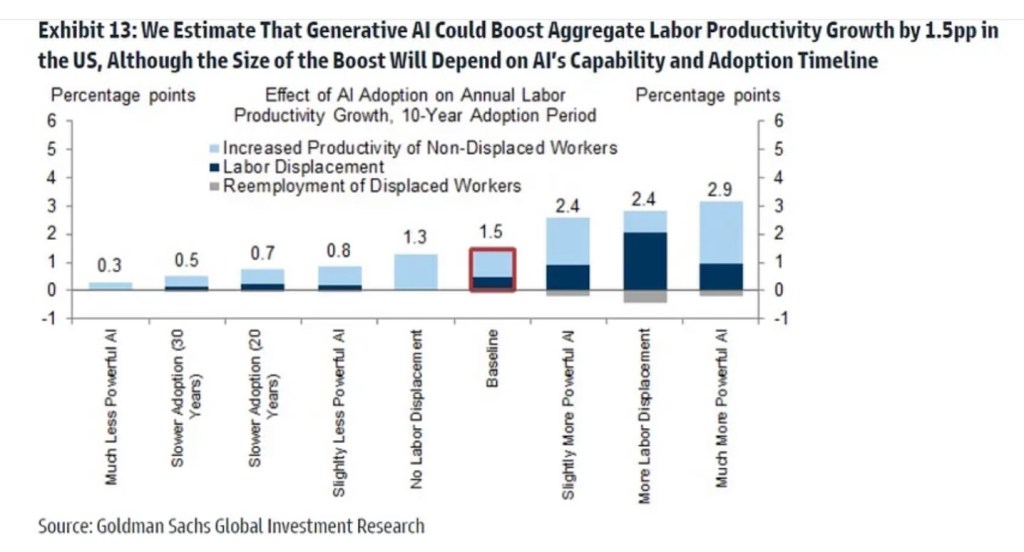
Artificial intelligence (AI) has become a very hot topic with incredible recent advances in AI performance. It’s very promising technology, and the expectations shown in the chart above illustrate what would be a profound economic impact. Like many new technologies, however, many find it threatening and are reacting with great alarm, There’s a movement within the tech industry itself, partly motivated by competitive self-interest, calling for a “pause”, or a six-month moratorium on certain development activities. Politicians in Washington are beginning to clamor for legislation that would subject AI to regulation. However, neither a voluntary pause nor regulatory action are likely to be successful. In fact, either would likely do more harm than good.

Leaps and Bounds

The pace of advance in AI has been breathtaking. From ChatGPT 3.5 to ChatGPT 4, in a matter of just a few months, the tool went from relatively poor performance on tests like professional and graduate entrance exams (e.g., bar exams, LSAT, GRE) to very high scores. Using these tools can be a rather startling experience, as I learned for myself recently when I allowed one to write the first draft of a post. (Despite my initial surprise, my experience with ChatGPT 3.5 was somewhat underwhelming after careful review, but I’ve seen more impressive results with ChatGPT 4). They seem to know so much and produce it almost instantly, though it’s true they sometimes “hallucinate”, reflect bias, or invent sources, so thorough review is a must.

Nevertheless, AIs can write essays and computer code, solve complex problems, create or interpret images, sounds and music, simulate speech, diagnose illnesses, render investment advice, and many other things. They can create subroutines to help themselves solve problems. And they can replicate!

As a gauge of the effectiveness of models like ChatGPT, consider that today AI is helping promote “over-employment”. That is, there are a number of ambitious individuals who, working from home, are holding down several different jobs with the help of AI models. In fact, some of these folks say AIs are doing 80% of their work. They are the best “assistants” one could possibly hire, according to a man who has four different jobs.

Economist Bryan Caplan is an inveterate skeptic of almost all claims that smack of hyperbole, and he’s won a series of bets he’s solicited against others willing to take sides in support of such claims. However, Caplan thinks he’s probably lost his bet on the speed of progress on AI development. Needless to say, it has far exceeded his expectations.

Naturally, the rapid progress has rattled lots of people, including many experts in the AI field. Already, we’re witnessing the emergence of “agency” on the part of AI Learning Language Models (LLMs), or so called “agentic” behavior. Here’s an interesting thread on agentic AI behavior. Certain models are capable of teaching themselves in pursuit of a specified goal, gathering new information and recursively optimizing their performance toward that goal. Continued gains may lead to an AI model having artificial generative intelligence (AGI), a superhuman level of intelligence that would go beyond acting upon an initial set of instructions. Some believe this will occur suddenly, which is often described as the “foom” event.

Team Uh-Oh

Concern about where this will lead runs so deep that a letter was recently signed by thousands of tech industry employees, AI experts, and other interested parties calling for a six-month worldwide pause in AI development activity so that safety protocols can be developed. One prominent researcher in machine intelligence, Eliezer Yudkowsky, goes much further: he believes that avoiding human extinction requires immediate worldwide limits on resources dedicated to AI development. Is this a severely overwrought application of the precautionary principle? That’s a matter I’ll consider at greater length below, but like Caplan, I’m congenitally skeptical of claims of impending doom, whether from the mouth of Yudkowsky, Greta Thunberg, Paul Ehrlich, or Nassim Taleb.

As I mentioned at the top, I suspect competition among AI developers played a role in motivating some of the signatories of the “AI pause” letter, and some of the non-signatories as well. Robin Hanson points out that Sam Altman, the CEO of OpenAI, did not sign the letter. OpenAI (controlled by a nonprofit foundation) owns ChatGPT and is the current leader in rolling out AI tools to the public. ChatGPT 4 can be used with the Microsoft search engine Bing, and Microsoft’s Bill Gates also did not sign the letter. Meanwhile, Google was caught flat-footed by the ChatGPT rollout, and its CEO signed. Elon Musk (who signed) wants to jump in with his own AI development: TruthGPT. Of course, the pause letter stirred up a number of members of Congress, which I suspect was the real intent. It’s reasonable to view the letter as a means of leveling the competitive landscape. Thus, it looks something like a classic rent-seeking maneuver, buttressed by the inevitable calls for regulation of AIs. However, I certainly don’t doubt that a number of signatories did so out of a sincere belief that the risks of AI must be dealt with before further development takes place.

The vast dimensions of the supposed AI “threat” may have some libertarians questioning their unequivocal opposition to public intervention. If so, they might just as well fear the potential that AI already holds for manipulation and control by central authorities in concert with their tech and media industry proxies. But realistically, broad compliance with any precautionary agreement between countries or institutions, should one ever be reached, is pretty unlikely. On that basis, a “scout’s honor” temporary moratorium or set of permanent restrictions might be comparable to something like the Paris Climate Accord. China and a few other nations are unlikely to honor the agreement, and we really won’t know whether they’re going along with it except for any traceable artifacts their models might leave in their wake. So we’ll have to hope that safeguards can be identified and implemented broadly.

Likewise, efforts to regulate by individual nations are likely to fail, and for similar reasons. One cannot count on other powers to enforce the same kinds of rules, or any rules at all. Putting our faith in that kind of cooperation with countries who are otherwise hostile is a prescription for ceding them an advantage in AI development and deployment. Regulation of the evolution of AI will likely fail. As Robert Louis Stevenson once wrote, “Thus paternal laws are made, thus they are evaded”. And if it “succeeds, it will leave us with a technology that will fall short of its potential to benefit consumers and society at large. That, unfortunately, is usually the nature of state intrusion into a process of innovation, especially when devised by a cadre of politicians with little expertise in the area.

Again, according to experts like Yudkowsky, AGI would pose serious risks. He thinks the AI Pause letter falls far short of what’s needed. For this reason, there’s been much discussion of somehow achieving an alignment between the interests of humanity and the objectives of AIs. Here is a good discussion by Seth Herd on the LessWrong blog about the difficulties of alignment issues.

Some experts feel that alignment is an impossibility, and that there are ways to “live and thrive” with unalignment (and see here). Alignment might also be achieved through incentives for AIs. Those are all hopeful opinions. Others insist that these models still have a long way to go before they become a serious threat. More on that below. Of course, the models do have their shortcomings, and current models get easily off-track into indeterminacy when attempting to optimize toward an objective.

But there’s an obvious question that hasn’t been answered in full: what exactly are all these risks? As Tyler Cowen has said, it appears that no one has comprehensively catalogued the risks or specified precise mechanisms through which those risks would present. In fact, AGI is such a conundrum that it might be impossible to know precisely what threats we’ll face. But even now, with deployment of AIs still in its infancy, it’s easy to see a few transition problems on the horizon.

White Collar Wipeout

Job losses seem like a rather mundane outcome relative to extinction. Those losses might come quickly, particularly among white collar workers like programmers, attorneys, accountants, and a variety of administrative staffers. According to a survey of 1,000 businesses conducted in February:

“Forty-eight percent of companies have replaced workers with ChatGPT since it became available in November of last year. … When asked if ChatGPT will lead to any workers being laid off by the end of 2023, 33% of business leaders say ‘definitely,’ while 26% say ‘probably.’ … Within 5 years, 63% of business leaders say ChatGPT will ‘definitely’ (32%) or ‘probably’ (31%) lead to workers being laid off.”

A rapid rate of adoption could well lead to widespread unemployment and even social upheaval. For perspective, that implies a much more rapid rate of technological diffusion than we’ve ever witnessed, so this outcome is viewed with skepticism in some quarters. But in fact, the early adoption phase of AI models is proceeding rather quickly. You can use ChatGPT 4 easily enough on the Bing platform right now!

Contrary to the doomsayers, AI will not just enhance human productivity. Like all new technologies, it will lead to opportunities for human actors that are as yet unforeseen. AI is likely to identify better ways for humans to do many things, or do wonderful things that are now unimagined. At a minimum, however, the transition will be disruptive for a large number of workers, and it will take some time for new opportunities and roles for humans to come to fruition.

Robin Hanson has a unique proposal for meeting the kind of challenge faced by white collar workers vulnerable to displacement by AI, or for blue collar workers who are vulnerable to displacement by robots (the deployment of which has been hastened by minimum wage and living wage activism). This treatment of Hanson’s idea will be inadequate, but he suggests a kind of insurance or contract sold to both workers and investors by owners of assets likely to be insensitive to AI risks. The underlying assets are paid out to workers if automation causes some defined aggregate level of job loss. Otherwise, the assets are paid out to investors taking the other side of the bet. Workers could buy these contracts themselves, or employers could do so on their workers’ behalf. The prices of the contracts would be determined by a market assessment of the probability of the defined job loss “event”. Governmental units could buy the assets for their citizens, for that matter. The “worker contracts” would be cheap if the probability of the job-loss event is low. Sounds far-fetched, but perhaps the idea is itself an entrepreneurial opportunity for creative players in the financial industry.

The threat of job losses to AI has also given new energy to advocates of widespread adoption of universal basic income payments by government. Hanson’s solution is far preferable to government dependence, but perhaps the state could serve as an enabler or conduit through which workers could acquire AI and non-AI capital.

Human Capital

Current incarnations of AI are not just a threat to employment. One might add the prospect that heavy reliance on AI could undermine the future education and critical thinking skills of the general population. Essentially allowing machines to do all the thinking, research, and planning won’t inure to the cognitive strength of the human race, especially over several generations. Already people suffer from an inability to perform what were once considered basic life skills, to say nothing of tasks that were fundamental to survival in the not too distant past. In other words, AI could exaggerate a process of “dumbing down” the populace, a rather undesirable prospect.

Fraud and Privacy

AI is responsible for still more disruptions already taking place, in particular violations of privacy, security, and trust. For example, a company called Clearview AI has scraped 30 billion photos from social media and used them to create what its CEO proudly calls a “perpetual police lineup”, which it has provided for the convenience of law enforcement and security agencies.

AI is also a threat to encryption in securing data and systems. Conceivably, AI could be of value in perpetrating identity theft and other kinds of fraud, but it can also be of value in preventing them. AI is also a potential source of misleading information. It is often biased, reflecting specific portions of the on-line terrain upon which it is trained, including skewed model weights applied to information reflecting particular points of view. Furthermore, misinformation can be spread by AIs via “synthetic media” and the propagation of “fake news”. These are fairly clear and present threats of social, economic, and political manipulation. They are all foreseeable dangers posed by AI in the hands of bad actors, and I would include certain nudge-happy and politically-motivated players in that last category.

The Sky-Already-Fell Crowd

Certain ethicists with extensive experience in AI have condemned the signatories of the “Pause Letter” for a focus on “longtermism”, or risks as yet hypothetical, rather than the dangers and wrongs attributable to AIs that are already extant: TechCrunch quotes a rebuke penned by some of these dissenting ethicists to supporters of the “Pause Letter”:

“‘Those hypothetical risks are the focus of a dangerous ideology called longtermism that ignores the actual harms resulting from the deployment of AI systems today,’ they wrote, citing worker exploitation, data theft, synthetic media that props up existing power structures and the further concentration of those power structures in fewer hands.”

So these ethicists bemoan AI’s presumed contribution to the strength and concentration of “existing power structures”. In that, I detect just a whiff of distaste for private initiative and private rewards, or perhaps against the sovereign power of states to allow a laissez faire approach to AI development (or to actively sponsor it). I have trouble taking this “rebuke” too seriously, but it will be fruitless in any case. Some form of cooperation between AI developers on safety protocols might be well advised, but competing interests also serve as a check on bad actors, and it could bring us better solutions as other dilemmas posed by AI reveal themselves.

Imagining AI Catastrophes

What are the more consequential (and completely hypothetical) risks feared by the “pausers” and “stoppers”. Some might have to do with the possibility of widespread social upheaval and ultimately mayhem caused by some of the “mundane” risks described above. But the most noteworthy warnings are existential: the end of the human race! How might this occur when AGI is something confined to computers? Just how does the supposed destructive power of AGIs get “outside the box”? It must do so either by tricking us into doing something stupid, hacking into dangerous systems (including AI weapons systems or other robotics), and/or through the direction and assistance of bad human actors. Perhaps all three!

The first question is this: why would an AGI do anything so destructive? No matter how much we might like to anthropomorphize an “intelligent” machine, it would still be a machine. It really wouldn’t like or dislike humanity. What it would do, however, is act on its objectives. It would seek to optimize a series of objective functions toward achieving a goal or a set of goals it is given. Hence the role for bad actors. Let’s face it, there are suicidal people who might like nothing more than to take the whole world with them.

Otherwise, if humanity happens to be an obstruction to solving an AGI’s objective, then we’d have a very big problem. Humanity could be an aid to solving an AGI’s optimization problem in ways that are dangerous. As Yudkowsky says, we might represent mere “atoms it could use somewhere else.” And if an autonomous AGI were capable of setting it’s own objectives, without alignment, the danger would be greatly magnified. An example might be the goal of reducing carbon emissions to pre-industrial levels. How aggressively would an AGI act in pursuit of that goal? Would killing most humans contribute to the achievement of that goal?

Here’s one that might seem far-fetched, but the imagination runs wild: some individuals might be so taken with the power of vastly intelligent AGI as to make it an object of worship. Such an “AGI God” might be able to convert a sufficient number of human disciples to perpetrate deadly mischief on its behalf. Metaphorically speaking, the disciples might be persuaded to deliver poison kool-aid worldwide before gulping it down themselves in a Jim Jones style mass suicide. Or perhaps the devoted will survive to live in a new world mono-theocracy. Of course, these human disciples would be able to assist the “AGI God” in any number of destructive ways. And when brain-wave translation comes to fruition, they better watch out. Only the truly devoted will survive.

An AGI would be able to create the illusion of emergency, such as a nuclear launch by an adversary nation. In fact, two or many adversary nations might each be fooled into taking actions that would assure mutual destruction and a nuclear winter. If safeguards such as human intermediaries were required to authorize strikes, it might still be possible for an AGI to fool those humans. And there is no guarantee that all parties to such a manufactured conflict could be counted upon to have adequate safeguards, even if some did.

Yudkowsky offers at least one fairly concrete example of existential AGI risk:

“A sufficiently intelligent AI won’t stay confined to computers for long. In today’s world you can email DNA strings to laboratories that will produce proteins on demand, allowing an AI initially confined to the internet to build artificial life forms or bootstrap straight to postbiological molecular manufacturing.”

There are many types of physical infrastructure or systems that an AGI could conceivably compromise, especially with the aid of machinery like robots or drones to which it could pass instructions. Safeguards at nuclear power plants could be disabled before steps to trigger melt down. Water systems, rivers, and bodies of water could be poisoned. The same is true of food sources, or even the air we breathe. In any case, complete social disarray might lead to a situation in which food supply chains become completely dysfunctional. So, a super-intelligence could probably devise plenty of “imaginative” ways to rid the earth of human beings.

Back To Earth

Is all this concern overblown? Many think so. Bryan Caplan now has a $500 bet with Eliezer Yudkowsky that AI will not exterminate the human race by 2030. He’s already paid Yudkowsky, who will pay him $1,000 if we survive. Robin Hanson says “Most AI Fear Is Future Fear”, and I’m inclined to agree with that assessment. In a way, I’m inclined to view the AI doomsters as highly sophisticated, change-fearing Luddites, but Luddites nevertheless.

Ben Hayum is very concerned about the dangers of AI, but writing at LessWrong, he recognizes some real technical barriers that must be overcome for recursive optimization to be successful. He also notes that the big AI developers are all highly focused on safety. Nevertheless, he says it might not take long before independent users are able to bootstrap their own plug-ins or modules on top of AI models to successfully optimize without running off the rails. Depending on the specified goals, he thinks that will be a scary development.

James Pethokoukis raises a point that hasn’t had enough recognition: successful innovations are usually dependent on other enablers, such as appropriate infrastructure and process adaptations. What this means is that AI, while making spectacular progress thus far, won’t have a tremendous impact on productivity for at least several years, nor will it pose a truly existential threat. The lag in the response of productivity growth would also limit the destructive potential of AGI in the near term, since installation of the “social plant” that a destructive AGI would require will take time. This also buys time for attempting to solve the AI alignment problem.

In another Robin Hanson piece, he expresses the view that the large institutions developing AI have a reputational Al stake and are liable for damages their AI’s might cause. He notes that they are monitoring and testing AIs in great detail, so he thinks the dangers are overblown.:

“So, the most likely AI scenario looks like lawful capitalism…. Many organizations supply many AIs and they are pushed by law and competition to get their AIs to behave in civil, lawful ways that give customers more of what they want compared to alternatives.”

In the longer term, the chief focus of the AI doomsters, Hanson is truly an AI optimist. He thinks AGIs will be “designed and evolved to think and act roughly like humans, in order to fit smoothly into our many roughly-human-shaped social roles.” Furthermore, he notes that AI owners will have strong incentives to monitor and “delimit” AI behavior that runs contrary to its intended purpose. Thus, a form of alignment is achieved by virtue of economic and legal incentives. In fact, Hanson believes the “foom” scenario is implausible because:

“… it stacks up too many unlikely assumptions in terms of our prior experiences with related systems. Very lumpy tech advances, techs that broadly improve abilities, and powerful techs that are long kept secret within one project are each quite rare. Making techs that meet all three criteria even more rare. In addition, it isn’t at all obvious that capable AIs naturally turn into agents, or that their values typically change radically as they grow. Finally, it seems quite unlikely that owners who heavily test and monitor their very profitable but powerful AIs would not even notice such radical changes.”

As smart as AGIs would be, Hanson asserts that the problem of AGI coordination with other AIs, robots, and systems would present insurmountable obstacles to a bloody “AI revolution”. This is broadly similar to Pethokoukis’ theme. Other AIs or AGIs are likely to have competing goals and “interests”. Conflicting objectives and competition of this kind will do much to keep AGIs honest and foil malign AGI behavior.

The kill switch is a favorite response of those who think AGI fears are exaggerated. Just shut down an AI if its behavior is at all aberrant, or if a user attempts to pair an AI model with instructions or code that might lead to a radical alteration in an AI’s level of agency. Kill switches would indeed be effective at heading off disaster if monitoring and control is incorruptible. This is the sort of idea that begs for a general solution, and one hopes that any advance of that nature will be shared broadly.

One final point about AI agency is whether autonomous AGIs might ever be treated as independent factors of production. Could they be imbued with self-ownership? Tyler Cowen asks whether an AGI created by a “parent” AGI could legitimately be considered an independent entity in law, economics, and society. And how should income “earned” by such an AGI be treated for tax purposes. I suspect it will be some time before AIs, including AIs in a lineage, are treated separately from their “controlling” human or corporate entities. Nevertheless, as Cowen says, the design of incentives and tax treatment of AI’s might hold some promise for achieving a form of alignment.

Letting It Roll

There’s plenty of time for solutions to the AGI threat to be worked out. As I write this, the consensus forecast for the advent of real AGI on the Metaculus online prediction platform is July 27, 2031. Granted, that’s more than a year sooner than it was 11 days ago, but it still allows plenty of time for advances in controlling and bounding agentic AI behavior. In the meantime, AI is presenting opportunities to enhance well being through areas like medicine, nutrition, farming practices, industrial practices, and productivity enhancement across a range of processes. Let’s not forego these opportunities. AI technology is far too promising to hamstring with a pause, moratoria, or ill-devised regulations. It’s also simply impossible to stop development work on a global scale.

Nevertheless, AI issues are complex for all private and public institutions. Without doubt, it will change our world. This AI Policy Guide from Mercatus is a helpful effort to lay out issues at a high-level.

Economic Growth and the Real Accretion of Resources

10 Friday Feb 2023

Posted by Nuetzel in Growth, Scarcity

≈ Leave a comment

Tags

Angus Maddison, Carbon Concentrations, Carbon Dial, Common Resources, Don Boudreaux, External Costs, Fusion Energy, Geothermal Energy, global warming, Grabby Civilization, Greening, Growth, Human capital, Human Ingenuity, Julian Simon, Known Reserves, Markets, Modular Reactors, Paleoclimate Data, Price Signals, Public Finance, Renewables, Resource Accretion, Risk Mitigation, S-Curve, Scarcity, Sea Levels, Space Mining, Urban Heat Islands

A few weeks ago I argued that raising living standards and eliminating poverty are human imperatives, and therefore growth is an imperative. Growth is a natural process for a free and creative people, and the alternative to growth is not zero growth. The coercion necessary to “achieve” a static economic environment would invariably lead to decline. It would be impossible to maintain average living standards while attempting a coerced leveling of those standards.

People have a notion, however, that it’s impossible to sustain growth due to the planet’s finite base of resources. If that is the case, we have available a mechanism to warn us as the time of hard limits approaches, which I’ll discuss below. So far, that signal hasn’t been activated. Moreover, the claim that growth is unsustainable can be challenged on several levels, which I’ll also address.

Effective Resources

First, a word about what I mean by the “accretion of resources”. The phrase refers to growth in the total effectiveness or productive potential of known resources given the rate of discovery and improvements in extraction and production technologies. Of course, if these discoveries and efficiencies are exceeded by current use, then there is no accretion, but depletion.

So let’s say we have a particular known stock of a resource we can readily draw on, so many pounds of resource X. In addition, we might know of the existence of another equally large quantity that can’t be readily drawn upon. Those are additional known (or proved) but undeveloped reserves. They might be difficult to exploit except at high cost, but we know they exist. We’d want to get on with the business of developing those reserves for extraction if they were needed any time soon, and we might want to begin prospecting for new reserves as well. As we’ve learned over the years. discoveries of previously unknown reserves of resources can be quite large. Prospectors are willing to bet that more resources exist, and they’ll undertake the risks of exploration if the potential rewards are adequate.

All of those concepts are straightforward. However, suppose we discover ways in which resource X can be used more efficiently, making things stronger or run longer or harder with less X. If we double the efficiency with which X is used, we have doubled the effective known reserves of X and, at least theoretically, unknown reserves as well. We’d have witnessed a doubling in the years that resource X can last. This is a form of resource accretion. Improvements in extraction or purification methods are also examples. Technological leaps like this, not to mention untold small increments in the efficiency of practices, have made economic growth possible in the past and will continue to do so in the future. Our effective resources seem to keep expanding. Accretion has occurred even with respect to resources like land as the world urbanized and the efficiency of farming advanced many-fold.

Growth In Real Time

Perceptions of growth are sometimes shaped by graphic depictions that some parties find alarming, so it might be helpful to take a quick look at some growth curves. First is an oldie-but-goodie chart showing GDP per capita taken from “Statistics on World Population, GDP, and Per Capital GDP, 1- 2008 AD” by Angus Maddison of the IMF:

This shows the explosion in the value of production that occurred during and after the industrial revolution, in contrast to very slow progress before that. The point I want to make here is how dramatic growth can look on a broad but visually compressed time scale. OMG! Look what we’ve done! How can we go on like this??? Often, the crux of the limits to growth argument is that such growth seems impossible assuming that we face fixed resource limits.

In fact, we experience growth in a very “local” way with respect to the passage of time. The two charts below illustrate a difference in perspectives using a hypothetically constant annual growth rate of 2.5%. The first chart shows 200 periods of growth, while the second expands only the last 20 periods of that time frame.

There is a great difference in the way the two vertical axes are scaled, which is important, but the second chart conveys that a respectable growth rate doesn’t really feel extreme when you’re in the middle of it, or, that is, in real time. It can look very extreme at the end of a long interval, depending on how severely the time axis is compressed. That’s not to discount the reality of much larger levels of activity (the vertical axes) and demands for resources as time goes on. However, those levels, and growth from those levels, is not at all alarming if our ability to achieve them has kept pace. So how can we know when we’re approaching a point at which resource limits will make it impossible to achieve those levels of activity? Market prices are the key signals, and they are the key to resource accretion.

Market Signals Light the Way

The market price is the best gauge of the scarcity of a resource. When resources become especially scarce, higher prices tell us so. That leads to conservation, which obviously extends the availability of those resources. Prices also function as an incentive for sellers to exploit new or harder-to-reach stores of a resource. That kind of resource accretion is one of the lessens the oil market has taught us again and again: oil exploration and known reserves tend to expand as the price rises, such that the prospect of oil depletion moves out to ever more distant horizons. There are certain minerals, elements, or isotopes (tritium?) that seem to be quite rare on Earth, but our ability to find them or extract them often improves with time. Space mining, which would vastly reduce the scarcity of resources like platinum, iron, nickel, cobalt, and many others, may become a reality in the near future. Interestingly, much of that activity could be in private hands. Space mining would lead to resource accretion on a whole new scale, and if we aspire to be a “grabby” civilization, it is a logical next step. So let’s go grab an asteroid!

When a price spikes due to greater scarcity, opportunities for substitution, exploration, and new efficiencies arise because the higher price justifies the cost of exploiting them. In addition to more difficult or costly extraction, a higher price encourages the use of close and even novel substitutes that may involve new technologies. In turn, that substitution reduces the relative scarcity of the original resource in question. And finally, back to conservation, users respond to price increases by finding their own innovative efficiencies in how a resource is utilized. The price response to scarcity is a channel through which much technological progress is encouraged.

While our earth-bound resources or even our star-system’s resources are finite, their effective quantity is highly flexible. Their potential at any time depends on our stage of discovery and the state of technology. Human ingenuity is a marvel at stretching the effective quantity of resources, and the greatest gains always occur when market forces are unleashed.

Thus, we see that prices, markets, and capitalism itself enable rational and sustainable responses to scarcity. Yet too often we hear claims that capitalism must be destroyed in order to save humanity. In fact, capitalism itself is the one system of social organization capable of achieving resource accretion, sustained growth, and lifting mankind from poverty. In fact, growth might well be an insurmountable problem without the dynamic energies of capitalism. Government planners are incapable of gathering and processing the vast information that markets process each and every day. Planners must substitute their own weak judgements, which prove flawed again and again.

Scarcity of the Commons

The environmental Left is quick to marshal a different kind of limits-to-growth argument. This one has to do with the scarcity of non-priced common resources and their overuse in production. For example, if a certain activity degrades the environment and those costs are not internalized by producers, they will tend to produce “too much”, leading to some degree of deterioration in human living conditions or the natural quality of the environment. In that case, we might not notice the limits to growth bearing down on us before corrective action is taken. Or so goes the theory that accumulating externalities lead to catastrophe. This is another front along which the limits to growth are asserted, particularly by climate alarmists and the environmental Left. Most prominently today, they contend that increases in atmospheric carbon concentration will lead to an unlivable warming of Earth’s climate.

Sense and Nonsense

The most glaring shortcoming of climate change advocacy is that the trends it decries are exaggerated. I’ve discussed the absurdly brief climate record cited by alarmists in several past posts (many of which appear here). We can start with the contention that carbon emissions are “poison”. In fact, carbon is life nourishing, as we’ve witnessed with the “greening” of the planet at current carbon concentrations of 4 parts per 10,000 of atmospheric gas. Furthermore, a longer historical temperature record using paleoclimate data shows that we are well within the range of past variation, even with the huge distortions to the record caused by urban heat islands and questionable downward adjustments to records of five to 15 decades ago.

The alarmist perspective is also inflamed by simplistic models of carbon forcing that ignore the impact of solar radiation, volcanic activity, and the behavior of aerosols in the atmosphere. Those models have consistently over-predicted temperature trends for decades. Equally troubling is that these models promote the fiction that mankind can control global temperatures by a little fiddling with a “carbon dial”, as if such fiddling could be accomplished without a massive centralization of political and economic power. The panicked narratives related to sea level increases and alleged increases in violent weather are equally flawed.

Growth Can Cure It

Another compelling response to climate arguments against growth is that technological advances have already enabled us to produce power without carbon emissions. Unfortunately, as a matter of public policy (regulation and bad choices by government industrial planners), we have increasingly failed to avail ourselves of these opportunities, instead choosing extremely wasteful methods of generating power. These are the windmill and solar “renewables”, which are resource-intensive, intermittent, low utilization, non-dispatchable, lacking storage for excess generation, intensive in land use (reversing prior accretions), and environmentally disastrous in fabrication, operation, and at disposal. Nuclear power is a far superior technology, especially with the advent of small, modular reactors and potential breakthroughs in fusion energy. These might help to rescue us from the spectacle of bone-headed industrial planning and greedy, renewable-energy rent seekers, but regulators have done seemingly all they can to prevent nuclear facilities from being built.

Just as human ingenuity is capable of expanding the exploitable stock of tradable, priced resources, it is also capable of inventing non-carbon power technologies that are more efficient and less environmentally destructive than ground-based solar and wind. Collection of non-intermittent solar energy in space arrays with wireless transmission to Earth is another promising alternative, as is geothermal energy. And carbon capture technologies show promise for neutralizing emissions or perhaps even reversing carbon concentrations one day, if that is deemed necessary. Much of this development work is in private hands, but barring drastic reductions in scale, the bulk of these efforts are (or will be) dependent on government funding.

It’s worth acknowledging here that resource accretion has a safety component in an expected value sense. Sometimes those risks can be internalized if risk reduction is of value to buyers. But the costs of “reasonable” risk mitigation cannot always be internalized without government action. For example, deflecting asteroid threats to the planet might be done best by private actors, but paying for that activity is a worthy application of public finance. The ability to deflect incoming asteroids is a noteworthy example of resource accretion via risk reduction.

Somehow, governments must be convinced to begin dedicating a larger share of the vast sums they spend on misguided climate interventions (including renewable technologies) to more sensible innovations. We might then benefit from accelerated breakthroughs that would settle not only our energy future, but a great deal of political strife as well. Like the market response to changes in scarcity, creative entrepreneurs will always step forward to compete for government funding. But if you pay them for crap, you’ll get a lot of crap!

Growth Once More

One day we might learn we are reaching the top of an s-curve. We aren’t there yet, if our ongoing accretion of resources is any guide, and there are new frontiers of space and technology to explore. The primary obstacles we face are not natural, but political and regulatory.

One area neglected above is the accretion of human capital. Certainly education is another way to expand our boundaries. However, population growth (and therefore labor force growth) tends to slow as living standards rise, and many argue that demographics have already become a drag on growth. A shrinking and aging population places a tremendous burden on young workers, making other sources of growth and productivity all the more critical. But new physical capital, resource development (including education), and new technologies can all continue to drive productivity and growth.

Growth depends on resource accretion, and there are many ways in which our effective stock of resources can be expanded. That includes enhancements in quantities, efficiencies, and safety. Private investment should be the primary avenue through which these are accomplished, which in turn requires flows of saving. Those flows are much more difficult to conjure without growth, so we have a chicken and egg cross-dependency. But chickens will lay eggs, just as saving and all kinds of investment will take place given the right incentives. Those would promote expansion in our effective stock of resources, improved adaptation to change, and enhanced well being. In the end, the rationale is simple: ending poverty requires growth.

Addendum: I just noticed that Don Boudreaux posted (and beautifully elaborated upon) this great Julian Simon quote:

“The quantity of a natural resource that might be available to us – and even more important the quantity of the services that can eventually be rendered to us by that natural resource – can never be known even in principle, just as the number of points in a one-inch line can never be counted even in principle.”

Don’t Cry for the Former Taxi Monopoly

23 Friday Mar 2018

Posted by Nuetzel in competition, monopoly, Technology, Uncategorized

≈ Leave a comment

Tags

Cartel, Consumer Surplus, Creative Destruction, Human capital, Lyft, Mark Perry, Ride sharing, Taxi Medallions, Taxi Monopoly, Uber, Warren Meyer

It would be odd to argue that innovation is not unequivocally positive, that its costs will exceed its benefits. Certainly there are downsides: human capital invested in the methods and technologies supplanted by an innovation is devalued, jobs may be lost, retraining becomes necessary, and even consumers must get used to new ways of doing things, which is not costless. But most of these costs are temporary. And when an innovation eliminates an incumbent’s monopoly, the former monopolist’s profit ends up back in the pockets of consumers.

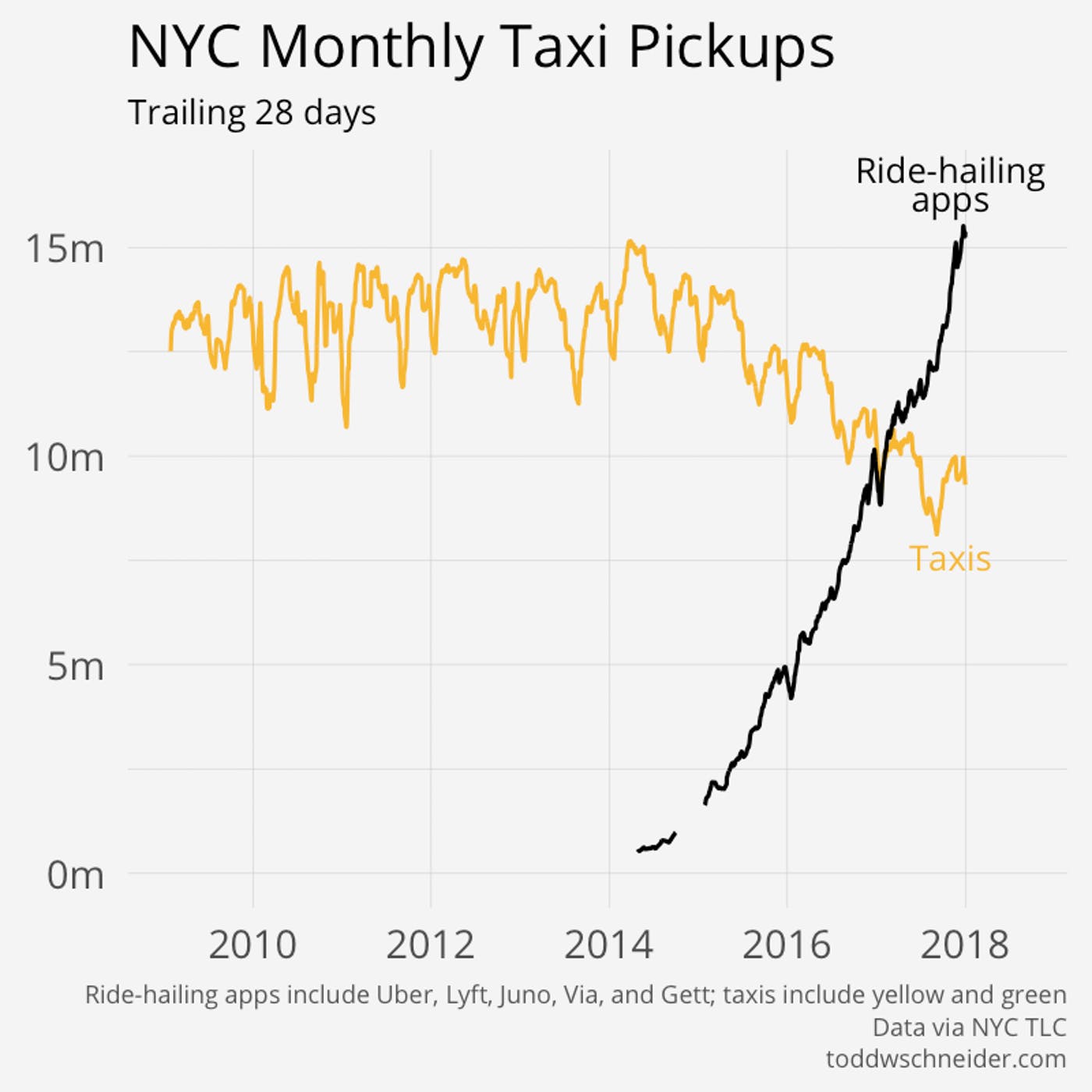
People do seem to focus excessively on the downside of innovation without carefully tallying the benefits. For example, this article focuses on the loss of New York City taxi pickups since ride sharing services like Uber and Lyft began to have an impact in 2014. Mark Perry reproduces a chart from that article, which is featured above. The number of monthly taxi rides in NYC has fallen by about one-third since then, from an average of 13+ million to about 9 million in 2017. In fact, Perry reports that the market for taxi medallions has tanked since then as well, with plunging medallion prices and many medallions sold out of bankruptcy and foreclosure. But don’t be too quick to shed tears for a monopoly lost.

The same chart shows the massive upside to ride sharing, as discussed here by Warren Meyer. The size of the total market has nearly doubled, from about 13 million per month to roughly 24 million (adding the two lines together). And it was a quick transition! That’s what happens when real competition is introduced to a market: prices fall and quantity increases, with an attendant increase in the welfare of consumers. That increase always exceeds the loss suffered by the former monopolist or cartel (as the case may be), which was earning excessive profits at the expense of consumers before the innovation had a market impact. And many former taxi drivers have made the switch to ride sharing providers, and they seem to prefer it for the flexibility and autonomy it offers. Yes, the best innovations benefit workers as well as consumers.

Competition can bloom when government opens markets to competitors or when an innovation creates new alternatives for consumers. In the case of ride sharing, both were necessary. For many years, NYC restricted the supply of taxi medallions, which kept taxi fares artificially high. The formal approval of ride sharing services in the city was not uncontested. But once it was approved, consumers took advantage of superior dispatching and payment technologies enabled by their smart phones, as well as security features and rating systems, not to mention lower fares. Again, these developments have contributed massively to consumer well-being, which is ultimately the point of all economic activity. Traditional taxis have to try to keep up. The ride sharing industry has inflicted the kind of creative destruction for which consumers are quite grateful.

Human Machinations, Technophobic Trepidations

04 Thursday Sep 2014

Posted by Nuetzel in Uncategorized

≈ 1 Comment

Tags

Automation, David Autor, Factor complementarity, Factor substitutability, Human capital, Jackson Hole, Luddites, Mark Mills, robots

human-machine collaboration Are robots likely to replace labor at an increasing rate? Or, are robots and labor sufficiently complimentary as inputs that there will be a continuing role for humans in production? The first argument has been made by pessimists and Luddites for at least two centuries, often hysterically, and they have been consistently wrong, as Mark Mills demonstrates in “The Data Are Clear: Robots Do Not Create Unemployment!”

Of course, “labor” has many facets: there is physical labor, there are skilled crafts, and there is so-called knowledge work; many other categories and sub-categories can be delineated. Mills makes the simple distinction between “drudgery” and higher-level “cognitive chores,” and he notes that automation has primarily functioned to eliminate the former. He also emphasizes that over time, automation has actually given rise to various cognitive chores that were never imagined prior to the substitution of capital for human drudgery. In this sense, new forms of labor are seen to be complimentary to capital. So, at once, the automation of tasks is both “labor-saving” and generative of new human functionality. There is every reason to believe that this process will continue to play out as robots begin to collaborate with humans in more complex ways.

Mills links to this interesting paper by David Autor of MIT, which the author Autor recently presented at the Federal Reserve’s annual conference in Jackson Hole, WY. The paper offers an interpreted history of the labor market over the five decades since the computor revolution. He summarizes the thrust of his thinking on the subject by appealing to the paradox that “our tacit knowledge of how the world works often exceeds our explicit understanding.” This implies that technological advance can and does tend to create expansive opportunities for humans. Autor says:

“… journalists and expert commentators overstate the extent of machine substitution for human labor and ignore the strong complementarities. The challenges to substituting machines for workers in tasks requiring adaptability, common sense, and creativity remain immense.”

Autor and Mills both note that automation necessarily leads to reduced demand for certain types of labor, and that the process can lead to severe dislocations and losses for many individuals in the short run. Autor also notes that some lower-level tasks are not yet especially amenable to automation, and that workers in such occupations are unlikely to benefit as automation takes place elsewhere. This serves to emphasize the importance of gaining the kinds of complex skills that can be of value in collaboration with more intelligent machinery. In other words, investment in human capital will be as valuable as ever.

Follow Sacred Cow Chips on WordPress.com

Recent Posts

  • Immigration and Merit As Fiscal Propositions
  • Tariff “Dividend” From An Indigent State
  • Almost Looks Like the Fed Has a 3% Inflation Target
  • Government Malpractice Breeds Health Care Havoc
  • A Tax On Imports Takes a Toll on Exports

Archives

  • December 2025
  • November 2025
  • October 2025
  • September 2025
  • August 2025
  • July 2025
  • June 2025
  • May 2025
  • April 2025
  • March 2025
  • February 2025
  • January 2025
  • December 2024
  • November 2024
  • October 2024
  • September 2024
  • August 2024
  • July 2024
  • June 2024
  • May 2024
  • April 2024
  • March 2024
  • February 2024
  • January 2024
  • December 2023
  • November 2023
  • August 2023
  • July 2023
  • June 2023
  • May 2023
  • April 2023
  • March 2023
  • February 2023
  • January 2023
  • December 2022
  • November 2022
  • October 2022
  • September 2022
  • August 2022
  • July 2022
  • June 2022
  • May 2022
  • April 2022
  • March 2022
  • February 2022
  • January 2022
  • December 2021
  • November 2021
  • October 2021
  • September 2021
  • August 2021
  • July 2021
  • June 2021
  • May 2021
  • April 2021
  • March 2021
  • February 2021
  • January 2021
  • December 2020
  • November 2020
  • October 2020
  • September 2020
  • August 2020
  • July 2020
  • June 2020
  • May 2020
  • April 2020
  • March 2020
  • February 2020
  • January 2020
  • December 2019
  • November 2019
  • October 2019
  • September 2019
  • August 2019
  • July 2019
  • June 2019
  • May 2019
  • April 2019
  • March 2019
  • February 2019
  • January 2019
  • December 2018
  • November 2018
  • October 2018
  • September 2018
  • August 2018
  • July 2018
  • June 2018
  • May 2018
  • April 2018
  • March 2018
  • February 2018
  • January 2018
  • December 2017
  • November 2017
  • October 2017
  • September 2017
  • August 2017
  • July 2017
  • June 2017
  • May 2017
  • April 2017
  • March 2017
  • February 2017
  • January 2017
  • December 2016
  • November 2016
  • October 2016
  • September 2016
  • August 2016
  • July 2016
  • June 2016
  • May 2016
  • April 2016
  • March 2016
  • February 2016
  • January 2016
  • December 2015
  • November 2015
  • October 2015
  • September 2015
  • August 2015
  • July 2015
  • June 2015
  • May 2015
  • April 2015
  • March 2015
  • February 2015
  • January 2015
  • December 2014
  • November 2014
  • October 2014
  • September 2014
  • August 2014
  • July 2014
  • June 2014
  • May 2014
  • April 2014
  • March 2014

Blogs I Follow

  • Passive Income Kickstart
  • OnlyFinance.net
  • TLC Cholesterol
  • Nintil
  • kendunning.net
  • DCWhispers.com
  • Hoong-Wai in the UK
  • Marginal REVOLUTION
  • Stlouis
  • Watts Up With That?
  • Aussie Nationalist Blog
  • American Elephants
  • The View from Alexandria
  • The Gymnasium
  • A Force for Good
  • Notes On Liberty
  • troymo
  • SUNDAY BLOG Stephanie Sievers
  • Miss Lou Acquiring Lore
  • Your Well Wisher Program
  • Objectivism In Depth
  • RobotEnomics
  • Orderstatistic
  • Paradigm Library
  • Scattered Showers and Quicksand

Blog at WordPress.com.

Passive Income Kickstart

OnlyFinance.net

TLC Cholesterol

Nintil

To estimate, compare, distinguish, discuss, and trace to its principal sources everything

kendunning.net

The Future is Ours to Create

DCWhispers.com

Hoong-Wai in the UK

A Commonwealth immigrant's perspective on the UK's public arena.

Marginal REVOLUTION

Small Steps Toward A Much Better World

Stlouis

Watts Up With That?

The world's most viewed site on global warming and climate change

Aussie Nationalist Blog

Commentary from a Paleoconservative and Nationalist perspective

American Elephants

Defending Life, Liberty and the Pursuit of Happiness

The View from Alexandria

In advanced civilizations the period loosely called Alexandrian is usually associated with flexible morals, perfunctory religion, populist standards and cosmopolitan tastes, feminism, exotic cults, and the rapid turnover of high and low fads---in short, a falling away (which is all that decadence means) from the strictness of traditional rules, embodied in character and inforced from within. -- Jacques Barzun

The Gymnasium

A place for reason, politics, economics, and faith steeped in the classical liberal tradition

A Force for Good

How economics, morality, and markets combine

Notes On Liberty

Spontaneous thoughts on a humble creed

troymo

SUNDAY BLOG Stephanie Sievers

Escaping the everyday life with photographs from my travels

Miss Lou Acquiring Lore

Gallery of Life...

Your Well Wisher Program

Attempt to solve commonly known problems…

Objectivism In Depth

Exploring Ayn Rand's revolutionary philosophy.

RobotEnomics

(A)n (I)ntelligent Future

Orderstatistic

Economics, chess and anything else on my mind.

Paradigm Library

OODA Looping

Scattered Showers and Quicksand

Musings on science, investing, finance, economics, politics, and probably fly fishing.

  • Subscribe Subscribed
    • Sacred Cow Chips
    • Join 128 other subscribers
    • Already have a WordPress.com account? Log in now.
    • Sacred Cow Chips
    • Subscribe Subscribed
    • Sign up
    • Log in
    • Report this content
    • View site in Reader
    • Manage subscriptions
    • Collapse this bar
 

Loading Comments...