• About

Sacred Cow Chips

Sacred Cow Chips

Tag Archives: Inflation Reduction Act

No Radar, No Rudder: Fiscal & Monetary Destabilization

31 Wednesday May 2023

Posted by Nuetzel in Fiscal policy, Monetary Policy

≈ 1 Comment

Tags

budget deficits, Credible Committments, crowding out, David Beckworth, David Henderson, Discretionary Spending, economic stimulus, Federal Reserve, Great Depression, Housing Bubble, Inflation Reduction Act, Long and Variable Lags, Lucas Critique, Mortgage Crisis, Pandemic Relief, Rational Expectations, Robert Lucas, Shovel-Ready Projects, Spending Multipliers, Stabilization policy, Tyler Cowen

Policy activists have long maintained that manipulating government policy can stabilize the economy. In other words, big spending initiatives, tax cuts, and money growth can lift the economy out of recessions, or budget cuts and monetary contraction can prevent overheating and inflation. However, this activist mirage burned away under the light of experience. It’s not that fiscal and monetary policy are powerless. It’s a matter of practical limitations that often cause these tools to be either impotent or destabilizing to the economy, rather than smoothing fluctuations in the business cycle.

The macroeconomics classes seem like yesterday: Keynesian professors lauded the promise of wise government stabilization efforts: policymakers could, at least in principle, counter economic shocks, particularly on the demand side. That optimistic narrative didn’t end after my grad school days. I endured many client meetings sponsored by macro forecasters touting the fine-tuning of fiscal and monetary policy actions. Some of those economists were working with (and collecting revenue from) government policymakers, who are always eager to validate their pretensions as planners (and saviors). However, seldom if ever do forecasters conduct ex post reviews of their model-spun policy scenarios. In fairness, that might be hard to do because all sorts of things change from initial conditions, but it definitely would not be in their interests to emphasize the record.

In this post I attempt to explain why you should be skeptical of government stabilization efforts. It’s sort of a lengthy post, so I’ve listed section headings below in case readers wish to scroll to points of most interest. Pick and choose, if necessary, though some context might get lost in the process.

  • Expectations Change the World
  • Fiscal Extravagance
  • Multipliers In the Real World
  • Delays
  • Crowding Out
  • Other Peoples’ Money
  • Tax Policy
  • Monetary Policy
  • Boom and Bust
  • Inflation Targeting
  • Via Rate Targeting
  • Policy Coordination
  • Who Calls the Tune?
  • Stable Policy, Stable Economy

Expectations Change the World

There were always some realists in the economics community. In May we saw the passing of one such individual: Robert Lucas was a giant intellect within the economics community, and one from whom I had the pleasure of taking a class as a graduate student. He was awarded the Nobel Prize in Economic Science in 1995 for his applications of rational expectations theory and completely transforming macro research. As Tyler Cowen notes, Keynesians were often hostile to Lucas’ ideas. I remember a smug classmate, in class, telling the esteemed Lucas that an important assumption was “fatuous”. Lucas fired back, “You bastard!”, but proceeded to explain the underlying logic. Cowen uses the word “charming” to describe the way Lucas disarmed his critics, but he could react strongly to rude ignorance.

Lucas gained professional fame in the 1970s for identifying a significant vulnerability of activist macro policy. David Henderson explains the famous “Lucas Critique” in the Wall Street Journal:

“… because these models were from periods when people had one set of expectations, the models would be useless for later periods when expectations had changed. While this might sound disheartening for policy makers, there was a silver lining. It meant, as Lucas’s colleague Thomas Sargent pointed out, that if a government could credibly commit to cutting inflation, it could do so without a large increase in unemployment. Why? Because people would quickly adjust their expectations to match the promised lower inflation rate. To be sure, the key is government credibility, often in short supply.”

Non-credibility is a major pitfall of activist macro stabilization policies that renders them unreliable and frequently counterproductive. And there are a number of elements that go toward establishing non-credibility. We’ll distinguish here between fiscal and monetary policy, focusing on the fiscal side in the next several sections.

Fiscal Extravagance

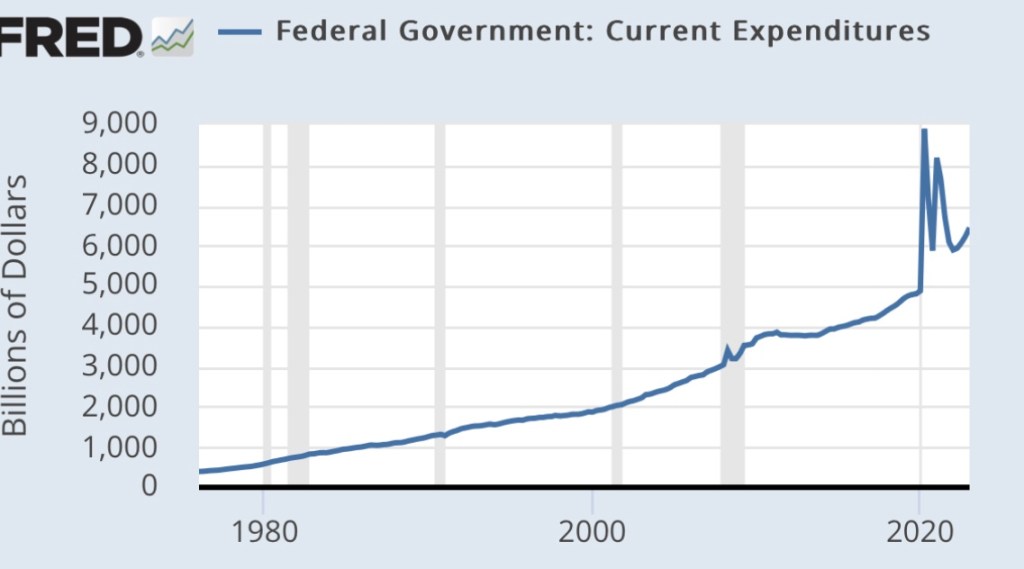
We’ve seen federal spending and budget deficits balloon in recent years. Chronic and growing budget deficits make it difficult to deliver meaningful stimulus, both practically and politically.
The next chart is from the most recent Congressional Budget Office (CBO) report. It shows the growing contribution of interest payments to deficit spending. Ever-larger deficits mean ever-larger amounts of debt on which interest is owed, putting an ever-greater squeeze on government finances going forward. This is particularly onerous when interest rates rise, as they have over the past few years. Both new debt is issued and existing debt is rolled over at higher cost.
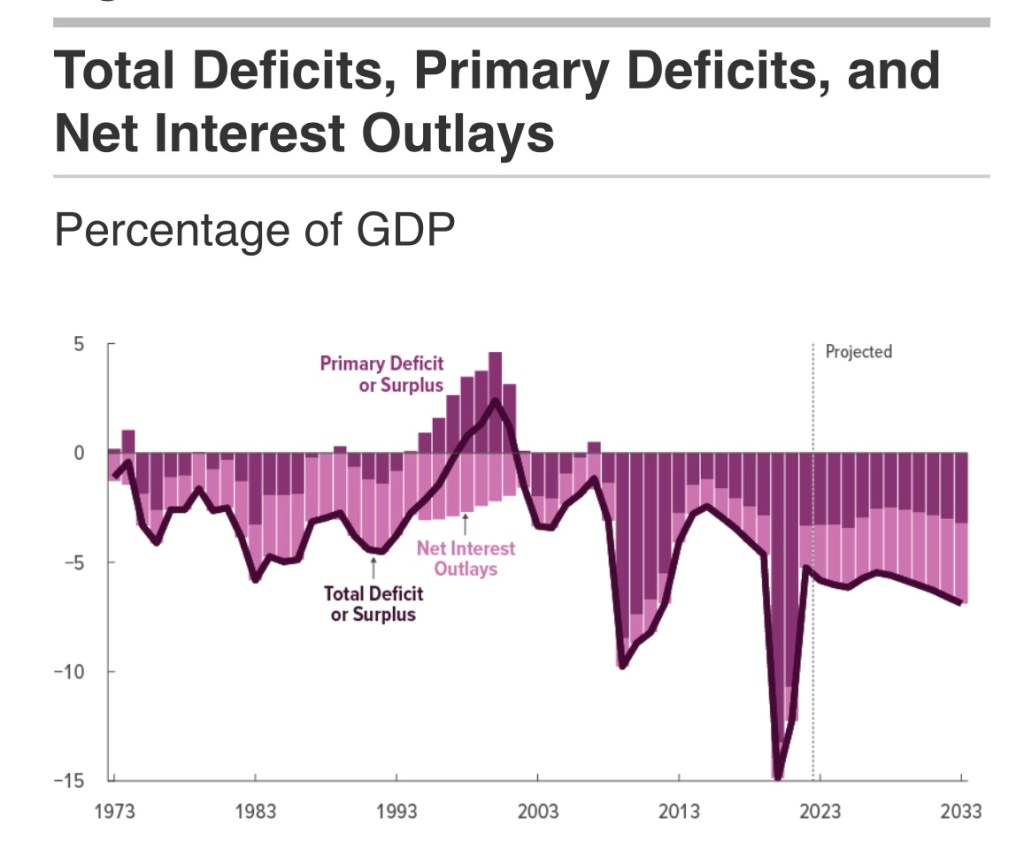
Relief payments made a large contribution to the deficits during the pandemic, but more recent legislation (like the deceitfully-named Inflation Reduction Act) piled-on billions of new subsidies for private investments of questionable value, not to mention outright handouts. These expenditures had nothing to do with economic stabilization and no prayer of reducing inflation. Pissing away money and resources only hastens the debt and interest-cost squeeze that is ultimately unsustainable without massive inflation.

Hardly anyone with future political ambitions wants to address the growing entitlements deficit … but it will catch up with them. Social Security and Medicare are projected to exhaust their respective trust funds in the early- to mid-2030s, which will lead to mandatory benefit cuts in the absence of reform.

If it still isn’t obvious, the real problem driving the budget imbalance is spending, not revenue, as the next CBO chart demonstrates. The “emergency” pandemic measures helped precipitate our current stabilization dilemma. David Beckworth tweets that the relief measures “spurred a rapid recovery”, though I’d hasten to add that a wave of private and public rejection of extreme precautions in some regions helped as well. And after all, the pandemic downturn was exaggerated by misdirected policies including closures and lockdowns that constrained both the demand and supply sides. Beckworth acknowledges the relief measures “propelled inflation”, but the pandemic also seemed to leave us on a permanently higher spending path. Again, see the first chart below.

The second chart below shows that non-discretionary spending (largely entitlements) and interest outlays are how we got on that path. The only avenue for countercyclical spending is discretionary expenditures, which constitute an ever-smaller share of the overall budget.
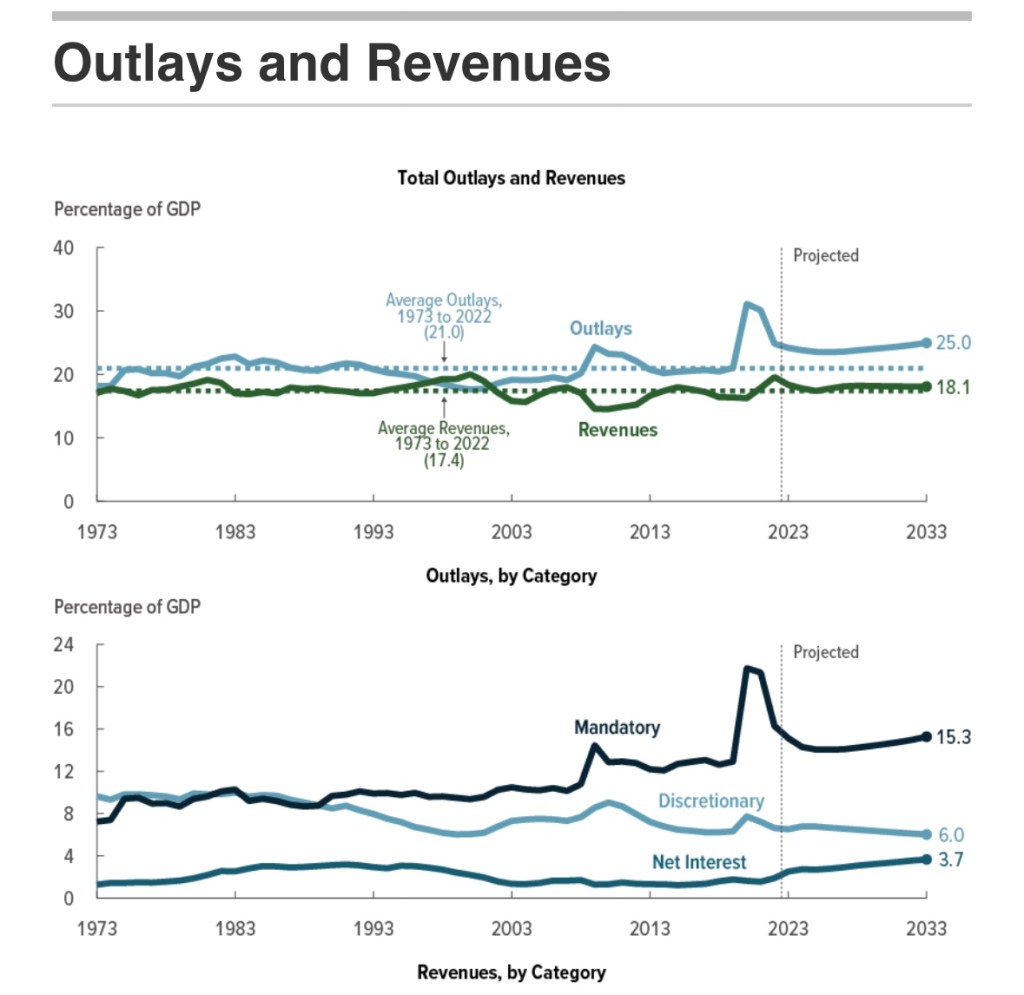
We’ve had chronic deficits for years, but we’ve shifted to a much larger and continuing imbalance. With more deficits come higher interest costs, especially when interest rates follow a typical upward cyclical pattern. This creates a potentially explosive situation that is best avoided via fiscal restraint.

Putting other doubts about fiscal efficacy aside, it’s all but impossible to stimulate real economic activity when you’ve already tapped yourself out and overshot in the midst of a post-pandemic economic expansion.

Multipliers In the Real World

So-called spending multipliers are deeply beloved by Keynesians and pork-barrel spenders. These multipliers tell us that every dollar of extra spending ultimately raises income by some multiple of that dollar. This assumes that a portion of every dollar spent by government is re-spent by the recipient, and a portion of that is re-spent again by another recipient. But spending multipliers are never what they’re cracked up to be for a variety of reasons. (I covered these in “Multipliers Are For Politicians”, and also see this post.) There are leakages out of the re-spending process (income taxes, saving, imports), which trim the ultimate impact of new spending on income. When supply constraints bind on economic activity, fiscal stimulus will be of limited power in real terms.

If stimulus is truly expected to be counter-cyclical and transitory, as is generally claimed, then much of each dollar of extra government spending will be saved rather than spent. This is the lesson of the permanent income hypothesis. It means greater leakages from the re-spending stream and a lower multiplier. We saw this with the bulge in personal savings in the aftermath of pandemic relief payments.

Another side of this coin, however, is that cutting checks might be the government’s single-most efficient activity in execution, but it can create massive incentive problems. Some recipients are happy to forego labor market participation as long as the government keeps sending them checks, but at least they spend some of the income.

Delays

Another unappreciated and destabilizing downside of fiscal stimulus is that it often comes too late, just when the economy doesn’t need stimulus. That’s because a variety of delays are inherent in many spending initiatives: legislative, regulatory, legal challenges, planning and design, distribution to various spending authorities, and final disbursement. As I noted here:

“Even government infrastructure projects, heralded as great enhancers of American productivity, are often subject to lengthy delays and cost overruns due to regulatory and environmental rules. Is there any such thing as a federal ‘shovel-ready’ infrastructure project?”

Crowding Out

The supply of savings is limited, but when government borrows to fund deficits, it directly competes with private industry for those savings. Thus, funds that might otherwise pay for new plant, equipment, and even R&D are diverted to uses that should qualify as government consumption rather than long-term investment. Government competition for funds “crowds-out” private activity and impedes growth in the economy’s productive capacity. Thus, the effort to stimulate economic activity is self-defeating in some respects.

Other Peoples’ Money

Government doesn’t respond to price signals the way self-interested private actors do. This indifference leads to mis-allocated resources and waste. It extends to the creation of opportunities for graft and corruption, typically involving diversion of resources into uses that are of questionable productivity (corn ethanol, solar and wind subsidies).

Consider one other type of policy action perceived as counter-cyclical: federal bailouts of failing financial institutions or other troubled businesses. These rescues prop up unproductive enterprises rather than allowing waste to be flushed from the system, which should be viewed as a beneficial aspect of recession. The upshot is that too many efforts at economic stabilization are misdirected, wasteful, ill-timed, and pro-cyclical in impact.

Tax Policy

Like stabilization efforts on the spending side, tax changes may be badly timed. Tax legislation is often complex and can take time for consumers and businesses to adjust. In terms of traditional multiplier analysis, the initial impact of a tax change on spending is smaller than for expenditures, so tax multipliers are smaller. And to the extent that a tax change is perceived as temporary, it is made less effective. Thus, while changes in tax policy can have powerful real effects, they suffer from some of the same practical shortcomings for stabilization as changes in spending.

However, stimulative tax cuts, if well crafted, can boost disposable incomes and improve investment and work incentives. As temporary measures, that might mean an acceleration of certain kinds of activity. Tax increases reduce disposable incomes and may blunt incentives, or prompt delays in planned activities. Thus, tax policy may bear on the demand side as well as the timing of shifts in the economy’s productive potential or supply side.

Monetary Policy

Monetary policy is subject to problems of its own. Again, I refer to practical issues that are seemingly impossible for policy activists to overcome. Monetary policy is conducted by the nation’s central bank, the Federal Reserve (aka, the Fed). It is theoretically independent of the federal government, but the Fed operates under a dual mandate established by Congress to maintain price stability and full employment. Therein lies a basic problem: trying to achieve two goals that are often in conflict with a single policy tool.

Make no mistake: variations in money supply growth can have powerful effects. Nevertheless, they are difficult to calibrate due to “long and variable lags” as well as changes in money “velocity” (or turnover) often prompted by interest rate movements. Excessively loose money can lead to economic excesses and an overshooting of capacity constraints, malinvestment, and inflation. Swinging to a tight policy stance in order to correct excesses often leads to “hard landings”, or recession.

Boom and Bust

The Fed fumbled its way into engineering the Great Depression via excessively tight monetary policy. “Stop and go” policies in the 1970s led to recurring economic instability. Loose policy contributed to the housing bubble in the 2000s, and subsequent maladjustments led to a mortgage crisis (also see here). Don’t look now, but the inflationary consequences of the Fed’s profligacy during the pandemic prompted it to raise short-term interest rates in the spring of 2022. It then acted with unprecedented speed in raising rates over the past year. While raising rates is not always synonymous with tightening monetary conditions, money growth has slowed sharply. These changes might well lead to recession. Thus, the Fed seems given to a pathology of policy shifts that lead to unintentional booms and busts.

Inflation Targeting

The Fed claims to follow a so-called flexible inflation targeting policy. In reality, it has reacted asymmetrically to departures from its inflation targets. It took way too long for the Fed to react to the post-pandemic surge in inflation, dithering for months over whether the surge was “transitory”. It wasn’t, but the Fed was reluctant to raise its target rates in response to supply disruptions. At the same time, the Fed’s own policy actions contributed massively to demand-side price pressures. Also neglected is the reality that higher inflation expectations propel inflation on the demand side, even when it originates on the supply side.

Via Rate Targeting

At a more nuts and bolts level, today the Fed’s operating approach is to control money growth by setting target levels for several key short-term interest rates (eschewing a more direct approach to the problem). This relies on price controls (short-term interest rates being the price of liquidity) rather than allowing market participants to determine the rates at which available liquidity is allocated. Thus, in the short run, the Fed puts itself into the position of supplying whatever liquidity is demanded at the rates it targets. The Fed makes periodic adjustments to these rate targets in an effort to loosen or tighten money, but it can be misdirected in a world of high debt ratios in which rates themselves drive the growth of government borrowing. For example, if higher rates are intended to reduce money growth and inflation, but also force greater debt issuance by the Treasury, the approach might backfire.

Policy Coordination

While nominally independent, the Fed knows that a particular monetary policy stance is more likely to achieve its objectives if fiscal policy is not working at cross purposes. For example, tight monetary policy is more likely to succeed in slowing inflation if the federal government avoids adding to budget deficits. Bond investors know that explosive increases in federal debt are unlikely to be repaid out of future surpluses, so some other mechanism must come into play to achieve real long-term balance in the valuation of debt with debt payments. Only inflation can bring the real value of outstanding Treasury debt into line. Continuing to pile on new debt simply makes the Fed’s mandate for price stability harder to achieve.

Who Calls the Tune?

The Fed has often succumbed to pressure to monetize federal deficits in order to keep interest rates from rising. This obviously undermines perceptions of Fed independence. A willingness to purchase large amounts of Treasury bills and bonds from the public while fiscal deficits run rampant gives every appearance that the Fed simply serves as the Treasury’s printing press, monetizing government deficits. A central bank that is a slave to the spending proclivities of politicians cannot make credible inflation commitments, and cannot effectively conduct counter-cyclical policy.

Stable Policy, Stable Economy

Activist policies for economic stabilization are often perversely destabilizing for a variety of reasons. Good timing requires good forecasts, but economic forecasting is notoriously difficult. The magnitude and timing of fiscal initiatives are usually wrong, and this is compounded by wasteful planning, allocative dysfunction, and a general absence of restraint among political leaders as well as the federal bureaucracy..

Predicting the effects of monetary policy is equally difficult and, more often than not, leads to episodes of over- and under-adjustment. In addition, the wrong targets, the wrong operating approach, and occasional displays of subservience to fiscal pressure undermine successful stabilization. All of these issues lead to doubts about the credibility of policy commitments. Stated intentions are looked upon with doubt, increasing uncertainty and setting in motion behaviors that lead to undesirable economic consequences.

The best policies are those that can be relied upon by private actors, both as a matter of fulfilling expectations and avoiding destabilization. Federal budget policy should promote stability, but that’s not achievable institutions unable to constrain growth in spending and deficits. Budget balance would promote stability and should be the norm over business cycles, or perhaps over periods as long as typical 10-year budget horizons. Stimulus and restraint on the fiscal side should be limited to the effects of so-called automatic stabilizers, such as tax rates and unemployment compensation. On the monetary side, the Fed would do more to stabilize the economy by adopting formal rules, whether a constant rate of money growth or symmetric targeting of nominal GDP.
Biden’s Rx Price Controls: Cheap Politics Over Cures

08 Tuesday Nov 2022

Posted by Nuetzel in Prescription Drugs, Price Controls, Uncategorized

≈ 1 Comment

Tags

Big Pharma, Charles Hooper, CMS, David Henderson, Drug Innovation, Drug R&D, FDA Approval Process, Inflation Reduction Act, Innovation, Insulin Costs, Joe Biden, Joe Grogan, Medicare, Medicare Part B, Medicare Part D, Opioids, Over-prescription, Patent Extensions, Prescription Drug Costs, Price Controls, Price Gouging, Pricing Transparency, Shortages, third-party payments

You can expect dysfunction when government intervenes in markets, and health care markets are no exception. The result is typically over-regulation, increased industry concentration, lower-quality care, longer waits, and higher costs to patients and taxpayers. The pharmaceutical industry is one of several tempting punching bags for ambitious politicians eager to “do something” in the health care arena. These firms, however, have produced many wonderful advances over the years, incurring huge research, development, and regulatory costs in the process. Reasonable attempts to recoup those costs often means conspicuously high prices, which puts a target on their backs for the likes of those willing to characterize return of capital and profit as ill-gotten.

Biden Flunks Econ … Again

Lately, under political pressure brought on by escalating inflation, Joe Biden has been talking up efforts to control the prices of prescription drugs for Medicare beneficiaries. Anyone with a modicum of knowledge about markets should understand that price controls are a fool’s errand. Price controls don’t make good policy unless the goal is to create shortages.

The preposterously-named Inflation Reduction Act is an example of this sad political dynamic. Reducing inflation is something the Act won’t do! Here is Wikipedia’s summary of the prescription drug provisions, which is probably adequate for now:

“Prescription drug price reform to lower prices, including Medicare negotiation of drug prices for certain drugs (starting at 10 by 2026, more than 20 by 2029) and rebates from drug makers who price gouge… .”

“The law contains provisions that cap insulin costs at $35/month and will cap out-of-pocket drug costs at $2,000 for people on Medicare, among other provisions.”

Unpacking the Blather

“Price gouging”, of course, is a well-worn term of art among anti-market propagandists. In this case it’s meaning appears to be any form of non-compliance, including those for which fees and rebates are anticipated.

The insulin provision is responsive to a long-standing and misleading allegation that insulin is unavailable at reasonable prices. In fact, insulin is already available at zero cost as durable medical equipment under Medicare Part B for diabetics who use insulin pumps. Some types and brands of insulin are available at zero cost for uninsured individuals. A simple internet search on insulin under Medicare yields several sources of cheap insulin. GoodRx also offers brands at certain pharmacies at reasonable costs.

As for the cap on out-of-pocket spending under Part D, limiting the patient’s payment responsibility is a bad way to bring price discipline to the market. Excessive third-party shares of medical payments have long been implicated in escalating health care costs. That reality has eluded advocates of government health care, or perhaps they simply prefer escalating costs in the form of health care tax burdens.

Negotiated Theft

The Act’s adoption of the term “negotiation” is a huge abuse of that word’s meaning. David R. Henderson and Charles Hooper offer the following clarification about what will really happen when the government sits down with the pharmaceutical companies to discuss prices:

“Where CMS is concerned, ‘negotiations’ is a ‘Godfather’-esque euphemism. If a drug company doesn’t accept the CMS price, it will be taxed up to 95% on its Medicare sales revenue for that drug. This penalty is so severe, Eli Lilly CEO David Ricks reports that his company treats the prospect of negotiations as a potential loss of patent protection for some products.”

The first list of drugs for which prices will be “negotiated” by CMS won’t take effect until 2026. However, in the meantime, drug companies will be prohibited from increasing the price of any drug sold to Medicare beneficiaries by more than the rate of inflation. Price control is the correct name for these policies.

Death and Cost Control

Henderson and Hooper chose a title for their article that is difficult for the White House and legislators to comprehend: “Expensive Prescription Drugs Are a Bargain“. The authors first note that 9 out of 10 prescription drugs sold in the U.S. are generics. But then it’s easy to condemn high price tags for a few newer drugs that are invaluable to those whose lives they extend, and those numbers aren’t trivial.

Despite the protestations of certain advocates of price controls and the CBO’s guesswork on the matter, the price controls will stifle the development of new drugs and ultimately cause unnecessary suffering and lost life-years for patients. This reality is made all too clear by Joe Grogan in the Wall Street Journal in “The Inflation Reduction Act Is Already Killing Potential Cures” (probably gated). Grogan cites the cancellation of drugs under development or testing by three different companies: one for an eye disease, another for certain blood cancers, and one for gastric cancer. These cancellations won’t be the last.

Big Pharma Critiques

The pharmaceutical industry certainly has other grounds for criticism. Some of it has to do with government extensions of patent protection, which prolong guaranteed monopolies beyond points that may exceed what’s necessary to compensate for the high risk inherent in original investments in R&D. It can also be argued, however, that the FDA approval process increases drug development costs unreasonably, and it sometimes prevents or delays good drugs from coming to market. See here for some findings on the FDA’s excessive conservatism, limiting choice in dire cases for which patients are more than willing to risk complications. Pricing transparency has been another area of criticism. The refusal to release detailed data on the testing of Covid vaccines represents a serious breach of transparency, given what many consider to have been inadequate testing. Big pharma has also been condemned for the opioid crisis, but restrictions on opioid prescriptions were never a logical response to opioid abuse. (Also see here, including some good news from the Supreme Court on a more narrow definition of “over-prescribing”.)

Bad policy is often borne of short-term political objectives and a neglect of foreseeable long-term consequences. It’s also frequently driven by a failure to understand the fundamental role of profit incentives in driving innovation and productivity. This is a manifestation of the short-term focus afflicting many politicians and members of the public, which is magnified by the desire to demonize a sector of the economy that has brought undeniable benefits to the public over many years. The price controls in Biden’s Inflation Reduction Act are a sure way to short-circuit those benefits. Those interventions effectively destroy other incentives for innovation created by legislation over several decades, as Joe Grogan describes in his piece. If you dislike pharma pricing, look to reform of patenting and the FDA approval process. Those are far better approaches.

Conclusion

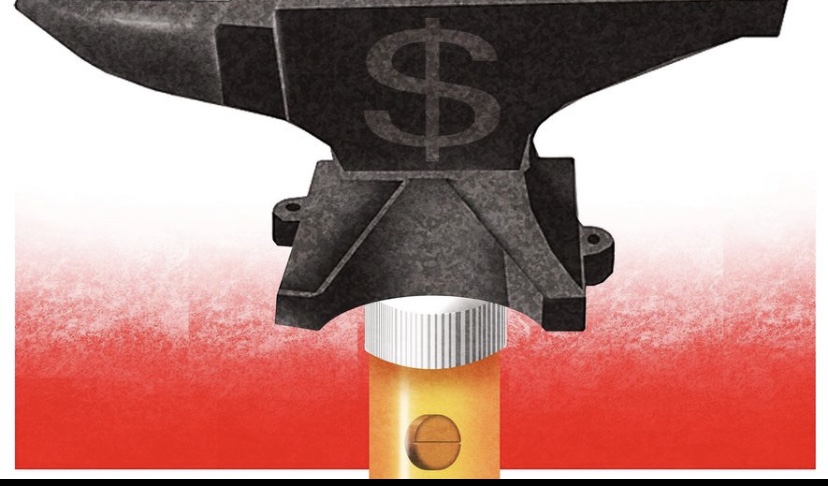
Note: The image above was created by “Alexa” for this Washington Times piece from 2019.

Harms Dismissed In “Standing Dead Zone” of Executive Action

26 Friday Aug 2022

Posted by Nuetzel in Checks and Balances, Executive Authority, Student Loans

≈ Leave a comment

Tags

Antonin Scalia, CDC, Department of Education, Executive Action, Federal Reserve, HEROES Act, Higher Education Act, Inflation Reduction Act, Jack V. Hoover, Joe Biden, Legal Standing, Lujan v. Defenders of Wildlife, Pandemic, Paycheck Protection Program, regressivity, Remain in Mexico, Standing Dead Zone, Student Loan Forgiveness, Supreme Court, Virginia Law Review

I hate to contribute to the deluge of ink spilled over Joe Biden’s latest executive action, which forgives massive amounts of federal student loan debt, but there’s an angle that hasn’t received adequate treatment. Of course, Biden’s action is an abridgment of taxpayer rights, a violation of the separation of powers, and an affront to borrowers who already paid off their student loans, but it will be nearly impossible for any challenger(s) to show that they have standing in court. Writing in the Virginia Law Review earlier this year, Jack V. Hoover says this kind of action lies within what he calls a “standing dead zone” created by the courts.

I’ll start with a few preliminaries. Note that student loan forgiveness was NOT legislated, unlike the Paycheck Protection Program, which the Administration keeps referencing in defense of the action. And I’d be remiss if I failed to mention that Biden’s action looks like a pathetic attempt to salvage votes ahead of what some democrats fear could be a disastrous midterm election. In addition, the action is regressive, with benefits weighted heavily toward high-income debtors with graduate degrees. The cost (write down, loss) to the federal government was originally said to be near $300 billion, depending on uptake, but independent estimates now put the full cost at $600 billion. This wipes out the hoped-for deficit reduction in the ridiculous but much ballyhooed “Inflation Reduction Act”, and yes, student loan forgiveness may well be inflationary. At a minimum, it makes the Fed’s job of restraining inflation by tamping down demand that much harder. Loan forgiveness will not solve the underlying problem of runaway cost escalation in higher education. In fact, it will exacerbate the problem by encouraging non-payment and additional borrowing, while tuition to colleges and universities will escalate all the more. So this is really bad policy all the way around!

Biden’s action is clearly a huge stretch on statutory grounds. In particular, the Administration invoked the HEROES Act, which authorizes the Secretary of Education to waive loan requirements during periods of national emergency. In this case, the Administration appeals to hardships caused by the pandemic for individuals with student debt. Of course, just two weeks ago, the CDC rolled back their emergency pandemic guidelines on social distancing and quarantines, so the “emergency” seems to be over, officially. Also, the Administration recently ended the “return to Mexico” policy at the border on the pretext that it had only been necessary because of the pandemic! Pardon my incredulity, but playing the “pandemic card” at this point is both dishonest and hypocritical.

“Standing” in the legal sense can’t be found in the text of the Constitution. It was itself created by the courts. Even so, why do taxpayers, Congress, or past borrowers lack standing to challenge the action on student loans through the judicial system? How can that be when the harms are so obvious? Well, courts tend to avoid interfering with the executive branch, and they’d rather leave such disputes up to the political system to hash out. That doesn’t seem like a terribly effective way to practice the game of “checks and balances”. Nevertheless, for many years the courts have relied on a strict test for establishing plaintiff standing promulgated in the Supreme Court decision in Lujan v. Defenders of Wildlife. In that majority opinion, Justice Antonin Scalia laid out a three-part test, which Hoover describes thusly:

“… (1) injury in fact that is actual, concrete, and particularized; (2) a causal connection between the injury and the conduct complained of; and (3) a likelihood that exercise of judicial power will redress the injury.28 The Court furthermore differentiated between cases in which government regulation targets the plaintiff and cases where the plaintiff complains about ‘unlawful regulation (or lack of regulation) of someone else,’ in which case “much more is needed” for standing to exist.29 The Court has regularly reaffirmed this formulation of its standing requirements.3”

Hoover discusses the executive’s authority to cancel debt under the Higher Education Act (HEA) of 1965. In terms of the impregnability of Biden’s action to legal challenge, Hoover implies that the president might just as well have fallen back on HEA as HEROES. However, the Department of Education (DOE) opined last year that it lacked the power to forgive debt. Here’s what the DOE said in 2021:

“… the Secretary does not have statutory authority to provide blanket or mass cancellation, compromise, discharge, or forgiveness of student loan principal balances, and/or materially modify the repayment amounts or terms thereof, whether due to the COVID-19 pandemic or for any other reason.”

Hoover seems to be saying that it is all but impossible to challenge Biden’s bald assertion of extra-legal power in forgiving student loans. Hoover goes on to discuss all classes of potential litigants who might challenge student loan forgiveness: taxpayers, former borrowers, Congress, state governments, and loan servicers. He is skeptical of all those, citing various reasons for their lack of standing, but I’ll focus on only the first three classes.

Taxpayers: The logic of denying taxpayers standing is at least two-fold. First, taxpayers cannot show direct harm from the action, though they are likely to pay a higher inflation tax over time as a consequence. Second, Congress appropriated funds for student loans, but it did so as an entitlement, and it did not restrict loan amounts nor the executive’s ability to waive “the government’s claim that borrowers must return the funds to the Treasury”. Hoover believes that the courts would defer to the political branches of government in settling such issues. The whole thing sounds rather thin to my ears, but precedent will probably hold sway unless the Supreme Court revisits its position on standing.

Congress: The standing of Congress is another matter. If, in the view of the legislature, an executive agency has exceeded its statutory authority, the matter might reflect as much on Congress as elsewhere, in failing to provide adequate limitations, guideposts, or oversight. However, in this case:,

“Congress duly appropriated funds for student loans,83 and the Executive is responsible for the funding’s disbursement. This means that any claim of standing due to institutional injury from compromising Congress’s control of the federal purse would fail.”

Here again, it will be left to settle by the political branches of government. To avoid such conflicts, it is up to the legislature to write laws that bind the discretion of the executive to varying degrees. Unrestrained entitlements are a damn good way to cede control of the “keys to the Treasury”.

Other borrowers who’ve managed their student loan debt responsibly will also lack standing, according to Hoover. Like taxpayers, they cannot show any direct harm or injury. In addition, standing is difficult to establish when an action or inaction by an executive agency pertains to someone else.

It’s my hope that a court challenge will be brought all the way to the Supreme Court, and at some level a court will define a new standard or test under which plaintiffs can attempt to establish standing against executive or agency actions. This is sorely needed as a check on the explosive growth of the administrative state. Furthermore, the “standing dead zone” allows all sorts of politically-motivated mischief by the executive branch, and the Biden Administration seems more than willing to push executive authority to extremes. However, I’m not too optimistic about the possibility of a new test for standing. Before all is said and done, Biden is likely to expand student loan forgiveness well beyond $20,000 per borrower. Federal finance is looking more precarious with Biden’s every step, and many of those steps cannot be walked back by Congress, no matter who holds the majority.

Interventionists Love You and Demand You Change, or Else

19 Friday Aug 2022

Posted by Nuetzel in Central Planning, Industrial Policy, Uncategorized

≈ Leave a comment

Tags

CHIPS Act, David McGrogan, Dierdre McCloskey, Don Boudreaux, Industrial Planning, Inflation Reduction Act, Jason Brennan, Joseph Stiglitz, Lionel Trilling, Lockdowns, Pandemic, Paul Krugman, Scientism, Solyndra

Statistics and measurement might not be critical to the exercise of the authoritarian impulse, but they have served to enable the technocratic tyranny idealized by contemporary statists. Certain influential thinkers have claimed our ability to compile statistics helps give rise to the bureaucratized state. I ran across a great post that led with that topic: “The Brutalization of Compassion” by David McGrogan. The mere ability to compile relevant statistics on a population and its well being (income, jobs, wages, inequality, mortality, suicide, etc… ) can motivate action by authorities to “improve” matters. The purpose might be to get ahead of rival states, or the action might be rationalized as compassion. But watch out! McGrogan quotes a bit of cautionary wisdom from Lionel Trilling:

“‘When once we have made our fellow men the objects of our enlightened interest,’ he put it, something within us causes us to then ‘go on and make them the objects of our pity, then of our wisdom, ultimately of our coercion.’”

Ultimately, to pursue their vision, interventionists must impose controls on behaviors. In practice, that means any variance or attempted variance must be penalized. Here’s McGrogan’s description of the steps in this process:

“The conceptualisation of the population as a field of action, and the measurement of statistical phenomenon within it – the taking of an ‘enlightened interest’ in it – gives rise to both ‘pity,’ or compassion, and the application of ‘wisdom’ to resolve its problems. What is left, of course, is coercion, and we do not need to look far to identify it in the many means by which the modern state subjects the population to a kind of Tocquevillian ‘soft despotism,’ constantly manipulating, cajoling and maneuvering it this way and that for its own good, whether through compulsory state education or ‘sin taxes’ or anything in between.”

Follow the Scientism

I can’t neglect to mention another important condition: the hubris among apparatchiks who imagine the state can improve upon private institutions to achieve social betterment. They will always fail in attempts to replace the action of the private markets and the price mechanism to process information relating to scarcities and preferences. Absent that facility, human planners cannot guide flows of resources to their most valued uses. In fact, they nearly always botch it!

Government provision of public goods is one concession worth making, but the state capacity needed to fulfill this legitimate function is subject to severe mission creep: we frequently see efforts to characterize goods and service as “public” despite benefits that are almost wholly private (e.g. education). Likewise, we often hear exaggerated claims of “harms” requiring state intervention (e.g. carbon emissions). These situations often hinge purely on politics. Even when legitimate external benefits or costs can be identified, there is a pretension that they can be accurately measured and corrected via subsidies or taxes. This is far-fetched. At best, it’s possible to vouch for the directional appropriateness of some interventions, but the magnitude of corrective measures is variable and essentially unknowable. Too often we see government failure via over-subsidization of politically favored activities and over-penalization of politically disfavored activities.

One of the most egregious errors of intervention is the over-application of the precautionary principle: if risks are associated with an activity, then it must be curtailed. This often relies on measurements of highly uncertain causes and effects, and it involves aggregation subject to its own biases.

Just as questionable is the ability of “experts” to model natural or behavioral processes such that outcomes can be “predicted” over horizons extending many decades forward. That interventionists tend to ignore the uncertainties of these predictions is the most blatant and damaging conceit of all, not least because the public and the media usually have limited knowledge with which to assess the phenomenon in question.

Public Health Tyranny

The Covid pandemic presented a compelling excuse for precautionists in government and even private institutions to impose radical controls under a set of claims they called “the science”. These claims were often false and really antithetical to the principles of scientific inquiry, which calls for continually questioning hypotheses, even when they represent “consensus”. Yet a series of questionable scientific claims were used to justify abridgment of basic freedoms for the general population, most of whom faced little risk from the virus. This included lockdowns of schools and churches, business closures, cancellation of public events (except of course for protests and riots by Leftists), deferred medical care, vaccine mandates, and mask mandates. The damage these measures inflicted was fierce, and in the end we know that it was almost entirely unnecessary. Still, the public health establishment seems all too willing to ignore the facts in its readiness to repeat the whole range of mistakes at the slightest uptick in what’s now an endemic infection.

Standard Issue Cronyism

In the wake of the pandemic, we’ve witnessed a surge in calls for government to enhance the security of our nation’s supply chains. Too large a share of the critical goods required by domestic industries are produced overseas, which has made supply disruptions, and the threat of future disruptions, especially acute. Right on cue, advocates of industrial policy and planning have arranged for the federal government to provide $85 billion to domestic producers of semiconductors under the so-called CHIPS Act. But semiconductor producers are in no need of government incentives to “re-shore” production:

“… there has been even more chipmaking investment dedicated to the U.S. market, even as federal subsidies have languished. Construction is now underway at four major U.S. facilities and will continue with or without subsidies—something even Intel reluctantly acknowledged when it delayed the groundbreaking ceremony on its much‐ballyhooed Ohio facility to protest congressional inaction. This is because, as numerous experts have explained over the last year, there are real economic and geopolitical reasons to invest in additional U.S. semiconductor production—no federal subsidies needed.”

Moreover, the global shortage of computer chips appears to be ending. The subsidies will unnecessarily enrich industrialists and their shareholders, provide a source of graft to bureaucrats and various middle men, and likely over-allocate resources to domestic production of chips. Industrial planning of this kind has a long history of failure, and this time won’t be different.

Climate Fascists

We also see repeated over-application of the precautionary principle and rising dominance of industrial policy in climate and energy policy. Enormous sacrifices are imposed on consumers for the sake of minuscule changes in global carbon emissions and the “expected” long-term path of future “global” temperatures. The interventions taken in pursuit of these objectives are draconian, limiting choices and raising the cost of virtually everything produced and consumed. They distort the direction of physical investment, disfavoring reliable sources of base load capacity needed for growth, and also disfavoring the safest and most reliable zero-carbon alternative: nuclear power. The renewable energy sources foolishly pushed by the state and the ESG establishment are environmentally costly in their own right, and they don’t work when natural conditions are unfavorable. As one wag says about the climate provisions of the ironically named Inflation Reduction Act, “Gonna be a lot more Solyndras coming”.

And talk about sloppy! Our “trusted representatives” in Congress could hardly be bothered to pretend they’d done their homework. They neglected to provide any quantitative carbon and temperature impacts of the legislation. This must be a case of true honesty, because they really have no idea!

Delusions of Central Planning

One great weakness (among many) of arguments for state industrial planning is the assumption that government agents are somehow more competent, efficient, and “pure of heart” than agents in the private sector. Nothing could be more laughable. On this point, some of the most incisive commentary I’ve seen is provided by the masterful Don Boudreaux, first quoting Georgetown philosopher Jason Brennan before adding his own entertaining thoughts:

The typical way the left argues for the state is to describe what economists in the 1850s thought markets would be like under monopoly or monopsony, and then compare that to a state run by angels. Both halves of the argument are bad, and yet philosophy treats this as if it were rigorous and sophisticated.

“Far too many policy proposals are nothing more than prayers to the state-god. ‘We entreat you, Oh Powerful and Sacred One, to relieve our people of this or that misery, blemish, and market imperfection! We beseech you to bestow upon us – your faithful servants – cosmic justice, safety from new pathogens, unkind thoughts, and microaggressions, and protection from each and every burden of reality that we can imagine being cured by an omniscient, benevolent, and omnipotent deity! If we obey – and sacrifice to you without complaint our treasure and our freedoms – you will provide!’

I do not exaggerate. Pick at random any proposed government intervention offered by the likes of Progressives or national conservatives, and you’ll discover that the workability of this proposed intervention, when evaluated honestly, rests on nothing more solid than the above absurd faith that the state is – or, when in the right hands, will be – a secular god.”

On the idealization of government’s ability to “plan the economy” rationally, here is more from Boudreaux, first quoting the great Deirdre McCloskey:

Deep in left-wing thought about the economy, and in a good deal of right-wing thought, too, is the premise, as Isaiah Berlin once put it with a sneer, that government can accomplish whatever it rationally proposes to do. As has been often observed about leftists even as sweet as John Rawls, the left has no theory of the behavior of the government. It assumes that the government is a perfect expression of the will of The People.

“And nothing is more unscientific – indeed, more mystical – than is this still-commonplace practice of most Progressives, and also of very many conservatives, to analyze the economy and society, and to offer policy recommendations, using such a juvenile ‘understanding’ of the state. Yet such an ‘understanding’ of the state permeates the work even of some Nobel laureates in economics – laureates such as Paul Krugman and Joseph Stiglitz. This ‘understanding’ of the state is inseparable also from the work of pundits too many to count…

That these professors and pundits think of themselves as scientific – and are widely regarded as being especially intelligent, thoughtful, and scientific – testifies to the strength of the cult of democratically rubber-stamped coercion.”

Conclusion

Humans have proven to be incredible documentarians. The advent of measurement techniques and increasingly sophisticated methods of accounting for various phenomena has enabled better ways of understanding our world and our well being. Unfortunately, a by-product was the birth of scientism, the belief that men in authority are capable not only of measuring, but of fine-tuning, the present and future details of society and social interaction. Those pretensions are terribly mistaken. However, the actions of Congress and the Biden Administration prove that it’s adherents will never be persuaded, despite repeated demonstrations of the futility of central planning. Their words of compassion are no comfort — they must coerce the ones they “love”.

Fiscal Foolishness a Costly Salve For Midterm Jitters

05 Friday Aug 2022

Posted by Nuetzel in Fiscal policy, Inflation

≈ 2 Comments

Tags

Alternative Minimum Corporate Tax, Brad Polumbo, Carried Interest, Chuck Schumer, CMS, Drug Price Controls, Eric Boehm, Fossil fuels, Green Energy, Inflation Reduction Act, IRS, Joe Biden, Joe Manchin, Kyrsten Sinema, Lois Lerner, Medicare Part D, Obamacare Subsidies, Private equity, Stock Buybacks, Sweat Equity, Tax Burden, Tax Enforcement, Tax Incidence, Wharton Economics, William C. Randolf

The “Inflation Reduction Act” (IRA) is about as fatuous a name for pork-barrel spending and taxes as its proponents could have dreamt up! But that’s the preposterous appellation given to the reconciliation bill congressional Democrats hope to approve. Are we to believe that Congress suddenly recognizes the inflationary effects of governments deficits? Well, the trouble is the projected revenue enhancements (taxes) and cost savings are heavily backloaded. It’s mostly spending up front, which is exactly how we got to this point. There are a number of provisions intended to increase domestic energy production in the hope of easing cost-push, supply-side price pressures. However, provisions relating to fossil fuel production are dependent on green energy projects in the same locales. So, even if we get more oil, we’ll still be pissing away resources on wind and solar technologies that will never be reliable sources of power. Even worse, the tax provisions in the bill will have burdens falling heavily on wage earners, despite the Administration’s pretensions of taxing only rich corporations and their shareholders.

The Numbers

The IRA (itself an irritating acronym) would add $433 billion of new federal outlays through 2031 (*investments*, because seemingly every federal outlay is an “investment” these days). At least that’s the deal that Chuck Schumer and Joe Manchin agreed to. As the table below shows, these outlays are mostly for climate initiatives, but the figure includes almost $70 billion of extended Obamacare subsidies. There is almost $740 billion of revenue enhancements, which are weighted toward the latter half of the ten-year budget window.

The deal reduces the federal budget deficit by about $300 billion over ten years, but that takes a while… somewhat larger deficits are projected through 2026. I should note that the Congressional Budget Office has issued a new score this week that puts the savings at a much lower $102 billion. However, that “new” score does not reflect the changes demanded by Kyrsten Sinema (R-AZ).

Spending

Budget projections are usually dependent on assumptions about the duration of various measures, among many other things like economic growth. For example, the increased Obamacare subsidies are an extension, and the scoring assumes they end in 2026. It’s hard to believe they won’t be extended again when the time comes. Over ten years, that would cut the deficit reduction roughly in half.

The bill is laden with green energy subsidies intended to reduce CO2 emissions. They will accomplish little in that respect, but what the subsidies will do is enrich well-healed cronies while reducing the stability of the electric grid. Tax credits for electric vehicles will be utilized primarily by wealthier individuals, though there are tax credits for energy-efficient appliances and the like, which might benefit a broader slice of the population. And while there are a few provisions that might address supplies of fossil fuels and investment in nuclear energy, these are but a sop to Joe Manchin and misdirection against critics of Joe Biden’s disastrous energy policies.

Revenue

Should we be impressed that the Democrats have proposed a bill that raises revenue more than spending? For their part, the Democrats insist that the bill will impose no new taxes on those with taxable incomes less than $400,000. That’s unlikely, as explained below. As a matter of macroeconomic stability, with the economy teetering on the edge of recession, it’s probably not a great time to raise taxes on anyone. However, Keynesians could say the same thing about my preferred approach to deficit reduction: cutting spending! So I won’t press that point too much. However, the tax provisions in the IRA are damaging not so much because they depress demand, but because they distort economic incentives. Let’s consider the three major tax components:

1. IRS enforcement: this would provide about $80 billion in extra IRS funding over 10 years. It is expected to result in a substantial number of additional IRS tax audits (placed as high as 1.2 million). Democrats assert that it will raise an additional $400 billion, but the CBO says it’s likely to be much lower($124 billion). This will certainly ensnare a large number of taxpayers earning less than $400,000 and impose substantial compliance costs on individuals and businesses. A simplified tax code would obviate much of this wasteful activity, but our elected representatives can’t seem to find their way to that obvious solution. In any case, pardon my suspicions that this increase in funding to enforce a Byzantine tax code might be used to weaponize the IRS against parties harboring disfavored political positions. Shades of Lois Lerner!

2. Carried Interest: Oops! Apparently the Democrat leadership just bought off Kyrsten Sinema by eliminating this provision and replacing it with another awful tax…. See #3 below. The next paragraph briefly discusses what the tax change for carried interest would have entailed:

The original bill sought to end the favorable tax treatment of “carried interest”, which is earned by private equity managers but is akin to the “sweat equity” earned by anyone making a contribution to the value of an investment without actually contributing a proportionate amount of capital. I’ve written about this before here. Carried interest income is taxed at the long-term capital gains tax rate, which is usually lower than tax rates on ordinary income. This treatment is really the same as for any partnership that allocates gains to partners, but populist rhetoric has it that it is used exclusively by nasty private equity managers. Changing this treatment for private equity firms would represent gross discrimination against firms that make a valuable contribution to the market for the ownership control of business enterprises, which helps to discipline the management of resources in the private sector.

3. Tax on Corporate Stock Buy-Backs: it’s not uncommon for firms to use cash they’ve generated from operations to repurchase shares of stock issued in past. Unaccountably, Democrats regard this as a “wasteful” activity designed to unfairly enrich shareholders. However, it is a perfectly legitimate way for firms to return capital to owners. The tax would create an incentive for managers to choose less efficient alternatives for the use of excess funds. In any case, the unrestricted freedom of owners to empower managers to repurchase shares is a fundamental property right.

A tax on corporate stock buybacks can result in the triple taxation of corporate profits. Profits are taxed at the firm level, and if the firm uses after-tax profits to repurchases shares, then the profits are taxed again, and further, any gain to shareholders would be subject to capital gains tax. This is one more violation of the old principle that income should be taxed once and only once.

The proposed excise tax on buy-backs now added to the IRA is *expected* to raise more revenue than the carried interest revision would have, but adjustments to behavior have a way of stymying expectations. Research has demonstrated that firms who buy back their shares often outperform their peers. But again, there are always politicians who wish to create more frictions in capital markets because firms and investors are easy political marks, and because these politocos do not understand the key role of capital markets in allocating resources efficiently between uses and across time.

4. Corporate taxes: Imposing a minimum tax rate of 15% on corporate book income above $1 billion is a highly controversial part of the IRA. While supporters contend that the burden would fall only on wealthy shareholders, in fact the burden would be heavily distributed across lower income ranges. First, a great many working people are corporate shareholders through their individual or employer-sponsored savings plans. Second, corporate employees shoulder a large percentage of the burden of corporate taxes via reduced wages and benefits. Here’s Brad Polumbo on the incidence of the corporate tax burden:

“William C. Randolph of the Congressional Budget Office found that for every dollar raised by the corporate tax, approximately 70 cents comes out of workers’ wages. Further confirming this finding, research from the Kansas City Federal Reserve concluded that a 10% increase in corporate taxes reduces wages by 7%.”

This again demonstrates the dishonesty of claims that no one with an income below $400,000 will be taxed under the IRA. In addition, almost 50% of the revenue from this minimum tax will come from the manufacturing sector:

As Eric Boehm states at the last link, “So much for improving American manufacturers’ competitiveness!” Incidentally, it’s estimated that the bill would cause differential increases in the effective corporate tax on investments in equipment, structures, and inventories. This is not exactly a prescription for deepening the stock of capital or for insulating the American economy from supply shocks!

5. Medicare Drug Prices: A final source of deficit reduction is the de facto imposition of price controls on certain prescription drugs under Medicare Part D. A small amount of savings to the government are claimed to begin in 2023. However, the rules under which this will be administered probably won’t be established for some time, so the savings may well be exaggerated. It’s unclear when the so-called “negotiations” with drug companies will begin, but they will take place under the threat of massive fines for failing to agree to CMS’s terms. And as with any price control, it’s likely to impinge on supply — the availability of drugs to seniors, and it is questionable whether seniors will reap any savings on drugs that will remain available.

Do Words Have No Meaning?

The IRA’s vaunted anti-inflationary effects are a pipe dream. A Wharton Study found that the reduction in inflation would be minuscule:

“We estimate that the Inflation Reduction Act will produce a very small increase in inflation for the first few years, up to 0.05 percent points in 2024. We estimate a 0.25 percentage point fall in the PCE price index by the late 2020s. These point estimates, however, are not statistically different than zero, thereby indicating a very low level of confidence that the legislation will have any impact on inflation.”

Over 230 economists have weighed in on the poor prospects that the IRA will achieve what its name suggests. And let’s face it: not even the general public has any confidence that the IRA will actually reduce inflation:

Conclusion

The Inflation Reduction Act is a destructive piece of legislation and rather galling in its many pretenses. I’m all for deficit reduction, but the key to doing so is to cut the growth in spending! Reducing the government’s coerced absorption of resources relative to the size of the economy prevents “crowding out” of private, voluntary, market-tested activity. It also prevents the need for greater tax distortions that undermine economic performance.

The federal government has played host to huge pandemic relief bills over the past two years. Then we have Joe Biden’s move to forgive student debt, a benefit flowing largely to higher income individuals having accumulated debt while in graduate programs. And then, Congress passed a bill to subsidize chip manufacturers who were already investing heavily in domestic production facilities. All the while, the Biden Administration was doing everything in its power to destroy the fossil fuel industry. So now, Democrats hope to follow-up on all that with a bill stuffed with rewards for cronies in the form of renewable energy subsidies, financed largely on the backs of the same individuals who they’ve sworn they won’t tax! The dishonesty is breathtaking! This crowd is so eager to do anything before the midterm elections that they’ll shoot for the nation’s feet!

Follow Sacred Cow Chips on WordPress.com

Recent Posts

  • The Case Against Interest On Reserves
  • Immigration and Merit As Fiscal Propositions
  • Tariff “Dividend” From An Indigent State
  • Almost Looks Like the Fed Has a 3% Inflation Target
  • Government Malpractice Breeds Health Care Havoc

Archives

  • January 2026
  • December 2025
  • November 2025
  • October 2025
  • September 2025
  • August 2025
  • July 2025
  • June 2025
  • May 2025
  • April 2025
  • March 2025
  • February 2025
  • January 2025
  • December 2024
  • November 2024
  • October 2024
  • September 2024
  • August 2024
  • July 2024
  • June 2024
  • May 2024
  • April 2024
  • March 2024
  • February 2024
  • January 2024
  • December 2023
  • November 2023
  • August 2023
  • July 2023
  • June 2023
  • May 2023
  • April 2023
  • March 2023
  • February 2023
  • January 2023
  • December 2022
  • November 2022
  • October 2022
  • September 2022
  • August 2022
  • July 2022
  • June 2022
  • May 2022
  • April 2022
  • March 2022
  • February 2022
  • January 2022
  • December 2021
  • November 2021
  • October 2021
  • September 2021
  • August 2021
  • July 2021
  • June 2021
  • May 2021
  • April 2021
  • March 2021
  • February 2021
  • January 2021
  • December 2020
  • November 2020
  • October 2020
  • September 2020
  • August 2020
  • July 2020
  • June 2020
  • May 2020
  • April 2020
  • March 2020
  • February 2020
  • January 2020
  • December 2019
  • November 2019
  • October 2019
  • September 2019
  • August 2019
  • July 2019
  • June 2019
  • May 2019
  • April 2019
  • March 2019
  • February 2019
  • January 2019
  • December 2018
  • November 2018
  • October 2018
  • September 2018
  • August 2018
  • July 2018
  • June 2018
  • May 2018
  • April 2018
  • March 2018
  • February 2018
  • January 2018
  • December 2017
  • November 2017
  • October 2017
  • September 2017
  • August 2017
  • July 2017
  • June 2017
  • May 2017
  • April 2017
  • March 2017
  • February 2017
  • January 2017
  • December 2016
  • November 2016
  • October 2016
  • September 2016
  • August 2016
  • July 2016
  • June 2016
  • May 2016
  • April 2016
  • March 2016
  • February 2016
  • January 2016
  • December 2015
  • November 2015
  • October 2015
  • September 2015
  • August 2015
  • July 2015
  • June 2015
  • May 2015
  • April 2015
  • March 2015
  • February 2015
  • January 2015
  • December 2014
  • November 2014
  • October 2014
  • September 2014
  • August 2014
  • July 2014
  • June 2014
  • May 2014
  • April 2014
  • March 2014

Blogs I Follow

  • Passive Income Kickstart
  • OnlyFinance.net
  • TLC Cholesterol
  • Nintil
  • kendunning.net
  • DCWhispers.com
  • Hoong-Wai in the UK
  • Marginal REVOLUTION
  • Stlouis
  • Watts Up With That?
  • Aussie Nationalist Blog
  • American Elephants
  • The View from Alexandria
  • The Gymnasium
  • A Force for Good
  • Notes On Liberty
  • troymo
  • SUNDAY BLOG Stephanie Sievers
  • Miss Lou Acquiring Lore
  • Your Well Wisher Program
  • Objectivism In Depth
  • RobotEnomics
  • Orderstatistic
  • Paradigm Library
  • Scattered Showers and Quicksand

Blog at WordPress.com.

Passive Income Kickstart

OnlyFinance.net

TLC Cholesterol

Nintil

To estimate, compare, distinguish, discuss, and trace to its principal sources everything

kendunning.net

The Future is Ours to Create

DCWhispers.com

Hoong-Wai in the UK

A Commonwealth immigrant's perspective on the UK's public arena.

Marginal REVOLUTION

Small Steps Toward A Much Better World

Stlouis

Watts Up With That?

The world's most viewed site on global warming and climate change

Aussie Nationalist Blog

Commentary from a Paleoconservative and Nationalist perspective

American Elephants

Defending Life, Liberty and the Pursuit of Happiness

The View from Alexandria

In advanced civilizations the period loosely called Alexandrian is usually associated with flexible morals, perfunctory religion, populist standards and cosmopolitan tastes, feminism, exotic cults, and the rapid turnover of high and low fads---in short, a falling away (which is all that decadence means) from the strictness of traditional rules, embodied in character and inforced from within. -- Jacques Barzun

The Gymnasium

A place for reason, politics, economics, and faith steeped in the classical liberal tradition

A Force for Good

How economics, morality, and markets combine

Notes On Liberty

Spontaneous thoughts on a humble creed

troymo

SUNDAY BLOG Stephanie Sievers

Escaping the everyday life with photographs from my travels

Miss Lou Acquiring Lore

Gallery of Life...

Your Well Wisher Program

Attempt to solve commonly known problems…

Objectivism In Depth

Exploring Ayn Rand's revolutionary philosophy.

RobotEnomics

(A)n (I)ntelligent Future

Orderstatistic

Economics, chess and anything else on my mind.

Paradigm Library

OODA Looping

Scattered Showers and Quicksand

Musings on science, investing, finance, economics, politics, and probably fly fishing.

  • Subscribe Subscribed
    • Sacred Cow Chips
    • Join 128 other subscribers
    • Already have a WordPress.com account? Log in now.
    • Sacred Cow Chips
    • Subscribe Subscribed
    • Sign up
    • Log in
    • Report this content
    • View site in Reader
    • Manage subscriptions
    • Collapse this bar
 

Loading Comments...