• About

Sacred Cow Chips

Sacred Cow Chips

Tag Archives: Joint Committee on Taxation

What’s To Like About Income Inequality?

22 Saturday May 2021

Posted by Nuetzel in Uncategorized

≈ 2 Comments

Tags

Capital Gains, David Splinter, Emmanuel Saez, Fiscal Income, Founders, Gerald Auten, Hoover Institution, Income Redistribution, Inequality, Inheritance, Joel Kotkin, John Cochrane, Joint Committee on Taxation, Omitted Income, Paul Graham, Progressive Taxes, Thomas Piketty, Transfer Oayments

What’s to like about inequality?

That depends on how it happened and on the conditions governing its future evolution. Inequality is a fact of life, and no social or economic system known to man can avoid or eliminate it. It’s “bad” in the sense that “not everybody gets a prize,” but inequality in a free market economic system arises out of the same positive dynamic that fosters achievement in any kind of competition. Even the logic underlying the view that inequality is “bad” is not consistent: we can be more equal if the rich all lose $1,000,000 and the poor all lose $1,000, but that won’t make anyone happy.

Unequal Rewards Are Natural

Many activities contribute to general prosperity and create unequal rewards as a by-product. A capitalist system rewards knowledge, effort, creativity, and risk-taking. Those who are very good at creating value earn commensurate rewards, and in turn, they often create rewarding opportunities for others who might participate in their enterprises. A system of just incentives and rewards also requires that property rights be secure, and that implies that wealth can be accumulated more readily by those earning the greatest rewards.

Equality can be decreed only by severely restricting the rewards to productive effort, and that requires a massive imbalance of power. The state, and those who direct its actions, always have a monopoly on legal coercion. In practice, the power to commandeer value created by others means that economic benefits will waft under the noses of apparatchiks. The raw power and economic benefits usurped under such an authoritarian regime cannot be competed away, and efficiency and value are seldom prioritized by state monopolists. The egalitarian pretense thus masks its own form of extreme inequality and decline. Inequality is unavoidable in a very real sense.

Measuring Trends in Inequality

Beyond those basic truths, the facts do not support the conventional wisdom that inequality has grown more extreme. A research paper by Gerald Auten and David Splinter corrects many of the shortcomings of commonly-cited sources on income inequality. Auten works for the U.S. Treasury, and Splinter is employed by the congressional Joint Committee on Taxation. They find that higher transfer payments and growing tax progressivity since the early 1960s kept the top after-tax income share stable.

John Cochrane shares the details of a recent presentation made by Auten and Splinter (AS) at the Hoover Institution. A few interesting charts follow:
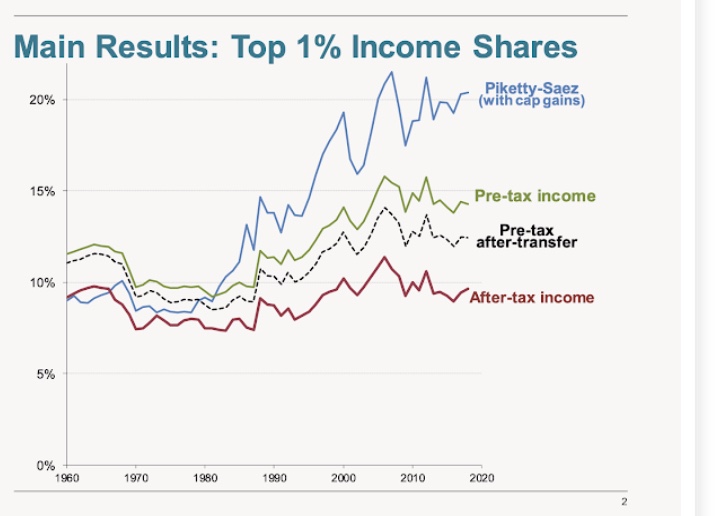
The blue “Piketty-Saez” (PS) line at the top uses an income measure from well-known research by Thomas Piketty and Emanuel Saez that contributed to the narrative of growing income inequality. The PS line is based on tax return information (fiscal income), but it embeds several distortions.

Realized capital gains are counted there, which misrepresents income shares because the realization of gains does not mark the point at which the true gains occur. Typically, the wealth exists before and after the gains are realized. Realized gains are often a function of changes in tax law and investor reaction to those changes. Moreover, neither realized nor unrealized gains represent income earned in production; instead, they capture changes in asset prices.

Income earned in production is about a third more than the income measure used by PS, even with the capital gains distortion. This omitted income and its allocation across earners is the subject of detailed analysis by AS. Their analysis is consistent in its focus on individual taxpayers, rather than households, which eliminates another upward bias in the PS line created by a secular decline in marriage rates. Then, AS consider the reallocation of income shares due to taxes and transfer payments. After all that, the income share of the top 1% shifts all the way down to the red line in the chart. The most recent observations put the share about where it was in the 1960s. 

The next chart shows income shares for broader segments: the top, middle, and lowest 20% of the income distribution. Taxes and transfers cause massive changes in the calculated shares and their trends over time. Again, these shares remain about where they were in the 1960s, contradicting the popular narrative that high earners are gobbling up ever larger pieces of the pie.
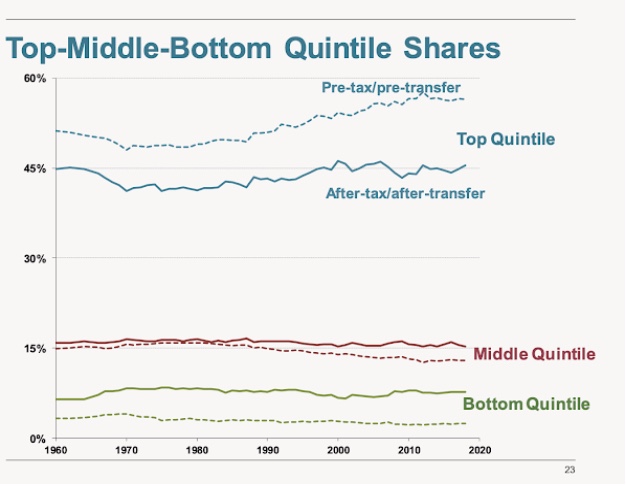
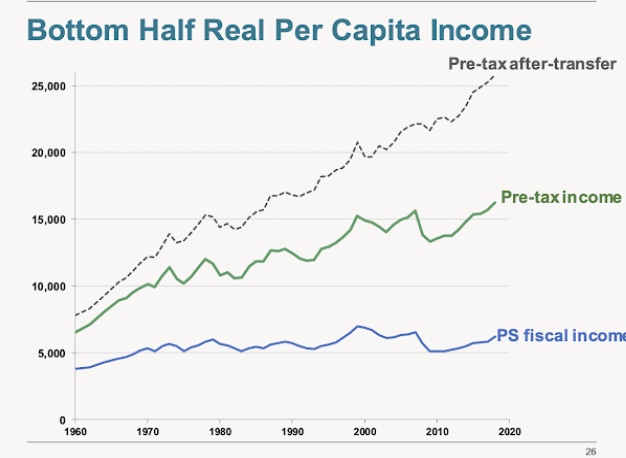
If income shares have remained about the same since the 1960s, that means high and low earners have made roughly equivalent income gains over that time. The next chart demonstrates that the bottom half of the income distribution has indeed seen significant growth in real incomes, despite the false impression created by PS and the common misperception of stagnant income growth among the working class. 
More Distributional Tidbits 

In a sense, all this is misleading because there is so much migration across the income distribution over time. Traditional calculations of income shares are “cross-sectional”, meaning they compare the same slices of the distribution at different points in time. But people near the low end in 1990 are not the same people near the bottom today. The same is true of those near the top and those in the middle. Income grows over time, and those lower in the distribution typically migrate upward as they age and acquire skills and work experience. Upward migration in income share is the general tendency, but there is some downward migration as well. Abandoning the cross-sectional view causes the typical story-line of rising income inequality to unravel.

There are many other interesting facts (and some great charts) in the AS paper and in Cochran’s post. One in particular shows that the average federal tax rate paid by the top 1% trended upward from the 1960s through the mid-1990s before flattening and trending slightly downward. This contradicts the assertion that high earners paid much higher taxes before the 1960s than today. In fact, the tax base broadened over that time, more than compensating for declines in marginal tax rates. 

Given the fact that more exacting measures of inequality haven’t changed much over the years, does that imply that redistributional policies have worked to keep the income distribution from worsening? That seems plausible on its face. If anything, taxes on high earners have increased, as have transfers to low earners and non-earners. Those changes appear to have offset other factors that would have led to greater inequality. However, the framing of the question is inappropriate. Maintaining a given income distribution is not a good thing if it inhibits economic growth. In fact, faster growth in production and greater well-being might well have led to a more unequal distribution of income. In other words, the whole question of offsetting inequality via redistribution is something of a chimera in the absence of a reliable counter-factual.

Wealth

Cochrane has a related post on the sources of wealth in America. Increasingly over the past few decades, wealth has been accumulated by self-made entrepreneurs, rather than through inheritance. That might come as a surprise to many on the left, to the extent that they care. Cochrane quotes Paul Graham on this point:

“In 1982 the most common source of wealth was inheritance. Of the 100 richest people, 60 inherited from an ancestor. There were 10 du Pont heirs alone. By 2020 the number of heirs had been cut in half, accounting for only 27 of the biggest 100 fortunes.

Why would the percentage of heirs decrease? Not because inheritance taxes increased. In fact, they decreased significantly during this period. The reason the percentage of heirs has decreased is not that fewer people are inheriting great fortunes, but that more people are making them.

How are people making these new fortunes? Roughly 3/4 by starting companies and 1/4 by investing. Of the 73 new fortunes in 2020, 56 derive from founders’ or early employees’ equity (52 founders, 2 early employees, and 2 wives of founders), and 17 from managing investment funds.”

The picture that emerges is one of great opportunity and dynamism. While the accumulation of massive fortunes might enrage the Left, these are the kinds of outcomes we should hope for, especially because the success of these new titans of industry is inextricably linked to tremendous value captured by their customers and lucrative opportunities for their employees. 

Here’s the best part of Cochrane’s post:

“We should not think about more or less inequality, we should think about the right amount of inequality, or productive vs. rent-seeking sources of inequality. Or, better, whether inequality is a symptom of health or sickness in the economy. Take Paul’s picture of the US economy at face value. What’s a better economy and society? One in which a few oligopolies … , deeply involved with government, run everything — think GM, Ford, IBM, AT&T, defense contractors — and it’s hard to start new innovative fast growing companies? Or the world in which the Bill Gates and Steve Jobs of the world can start new companies, deliver fabulous products and get insanely rich in the process? “

No doubt about it! However, today’s tremendously successful tech entrepreneurs also give us something to worry about. They have become oligarchs capable of suppressing competitive forces through sheer market power, influence, and even control over politicians and regulators. As I said at the top, whether inequality is benign depends upon the conditions governing its evolution. And today, we see the ominous development of a corporate-state tyranny, as decried by Joel Kotkin in this excellent post. Many of the daring tech entrepreneurs who benefitted from advantages endowed by our capitalist system have become autocrats who seek to plan our future with their own ideologies and self-interest in mind.

Conclusion

For too long we’ve heard the Left bemoan an increasingly “unfair” distribution of income. This includes propaganda intended to distort poverty levels in the U.S. The fine points of measuring shifts in the income distribution show that narrative to be false. Moreover, attempting to equalize the distribution of income, or even preventing changes that might occur as a natural consequence of innovation and growth, is not a valid policy objective if our goal is to maximize economic well-being.

The worst thing about inequality is that the poorest individuals are likely to be destitute and with no ability or means of supporting themselves. There is certainly such an underclass in the U.S., and our social safety net helps keep the poorest and least capable individuals above the poverty line after transfer payments. But too often our efforts to provide support interfere with incentives for those who are capable of productive work, which is both demeaning for them and a drain on everyone else. The best prescription for improving the well-being of all is economic growth, regardless of its impact on the distribution of income or wealth.

Tax Cuts Yes, Simplification a Mixed Bag

18 Monday Dec 2017

Posted by Nuetzel in Taxes, Trump Administration

≈ 2 Comments

Tags

Alternative Minimum Tax, AMT, AT&T, Chris Edwards, Comcast, Fifth-Third Bank, Joint Committee on Taxation, Pass-Through Income, Peter Suderman, Reason.com, Ricardian Equivalence, SALT, Tax Cuts and Jobs Act, Tax Deductions, Tax Reform, Tax Simplification, TCJA, Territorial Taxes, Wells Fargo

President Trump signed the Tax Cuts and Jobs Act (TCJA) this morning, the GOP tax bill with an acronym that simply won’t roll off my tongue. A useful summary of the Act produced by the House -Senate conference, and the full text of the Act, appear at this link. The TCJA hews more toward the earlier Senate bill than the House version. I’ve written about both (the House bill here and both here). Here is a good summary of the Act from Peter Suderman at Reason.com.

In my earlier assessments, I relied upon the principle of tax reform and real simplification as a justification for a tax cut without revenue neutrality. There are a few reforms and partial reforms, and the bill may simplify taxes for a number of individual taxpayers. However, on the whole I’m disappointed with the progress made by the GOP in those areas.

Notwithstanding my disappointment with the overall reform effort, the TCJA cuts taxes for most Americans and is likely to have salutary effects on economic growth and the job market. In fact, one of the most remarkable things about  the Act is the claim made by its adversaries on the Democrat side of the aisle. They apparently believe that the benefits of the TCJA flow primarily or even exclusively to the rich. This is a huge mistake for them. High-income taxpayers will receive greater benefits in absolute dollars, but not proportionally. This is shown by the table above, prepared by Chris Edwards from data produced by the Joint Committee on Taxation (JCT). In fact, the TCJA will extend tax reductions to a larger share of the middle class than either of its predecessor bills would have done. You cannot meaningfully reduce the taxes generated by a steeply progressive tax system without reducing the absolute dollars paid by high-income taxpayers. And you can’t lay the groundwork for sustainable economic growth without improving the investment incentives faced by high-income taxpayers and producers.

Here are some additional additional thoughts on the bill:

Yeah, I like me some tax cuts: The Act reduces taxes for many individuals and families by doubling the standard deduction and reducing tax rates. More importantly, perhaps, it will also reduce taxes for C-corporations, providing some relief from double taxation of corporate income, as will the switch to a territorial tax system on U.S. corporations doing business abroad. The latter is a real reform, while I consider the former a partial reform. Investment incentives are improved via the corporate rate cut and elimination of the corporate Alternative Minimum Tax (AMT) — a real reform, as well as the ability to write-off spending on new equipment immediately. As I argued last month, lower corporate taxes are likely to benefit both workers and consumers. The actions of few companies (AT&T, Comcast, Wells Fargo, and Fifth-Third) seem to demonstrate that this is the case: they have announced bonuses and increases in their base wage rates in the immediate wake of the TCJA’s massage.

Pass-through tax cuts are iffy: One of the most difficult parts of the TCJA to evaluate involves the implications for pass-through business entities like sole proprietorships, partnerships and S-corporations. Some might not receive significant cuts. The Act includes a maximum 25% rate on business income, but that is dependent on the proportion of the owner’s income deemed to be business income under the new rules. It also allows a flat deduction of 20% against business income. These provisions will be of benefit to very successful and very capital-intensive pass-throughs. Owners of smaller or less profitable firms will get the benefit of lower individual tax rates and the higher standard deduction, but might not have income high enough to benefit from the 25% rate cap.

Simpler for some, but it is not simplification: The doubled standard deduction will mean fewer taxpayers claiming itemized deductions. That sounds like simplification, but many will find it reassuring to calculate their taxes both ways, so a compliance burden remains. The Act retains or partially retains a number of deductions and credits slated for elimination in earlier versions, failing a simple principle held by reformers: eliminate deductions in exchange for lower rates. Along the same lines, the individual AMT is retained, but the exemption amount is increased, so fewer taxpayers will pay the AMT. Again, simpler for some, but not real simplification.

Elimination of the corporate AMT is simplification, as are immediate expensing of equipment purchases and territorial tax treatment. However, most of the complexities of corporate taxes remain, as do certain tax breaks targeted at specific industries. What a shame. And unfortunately, taxes for pass-through entities are anything but simplified under the Act. Complex new rules would govern the division of income into business income and the owners’ wage income.

Reducing deductions and bad incentives: The mortgage interest deduction encourages over-investment in housing and subsidizes the wealthiest homebuyers. The TCJA leaves it intact for existing mortgages, but allows the deduction to be claimed on new mortgage loans of up to $750,000. So the bad incentive largely remains, though the very worst of it will be eliminated. There have been complaints that this change could reduce home prices in states with the highest real estate prices. Good — they have been inflated by the subsidy at the expense of other taxpayers.

The tax write-off for state and local taxes (SALT) will be limited to $10,000 a year under the TCJA, though it adds some flexibility by allowing that sum to be met by any combination of state or local income, sales or property taxes. This change will reduce the subsidies from federal taxpayers residents of high-tax states, and should make leaders in those states more circumspect about the size of government.

The TCJA preserves and even expands a number of individual deductions and credits, subsidizing families with children, medical expenses, student loans, graduate students, educational saving, retirement saving, and the working poor. The interests benefiting from these breaks will be relieved, but this is not simplification.

Yet another case of “simpler for some” is the estate tax: it remains, but the exemption amounts are doubled. The estate tax does not produce much revenue, but it is fundamentally unjust: it ensnares the families of deceased property owners, farmers and small businesses; planning for it is costly; and it often forces survivors to sell assets quickly, sustaining losses, in order to meet a tax liability. The TCJA will significantly reduce this burden, but the tax framework will remain in place and will be an ongoing temptation to ravenous sponsors of future tax legislation.

Individual cuts are temporary: The corporate tax changes in the TCJA are permanent. They won’t have to be revisited (though they might be), and permanence is a desirable feature for sustaining the impact of positive incentives. The individual cuts and reforms, however, all expire within eight to ten years. The sun-setting of these provisions is, as some have said, a gimmick to reduce the revenue impact of the Act, but sunsetting means another politically fractious battle down the road. It is also a device to ensure compliance with the Byrd Act, which limits the deficit effects of legislation under Senate reconciliation rules. Eight years is a fairly long “temporary” tax cut, as those things go; for now, the impermanence of the cuts might not weaken the influence on spending. However, that influence is likely to wane as the cuts approach expiration.

Deficit Effects: The TCJA’s impact on the deficit and federal borrowing is likely to be somewhere north of $500 billion, possibly as much as $1.4 trillion. Deficits must be funded by government debt, which competes with private debt for the available pool of savings and must be serviced, repaid via future taxes or inflated away. In the latter sense, government borrowing is not really different from current taxes, a proposition known as Ricardian equivalence.

Nonetheless, the incentives, complexities and compliance costs of our current tax code are damaging, and the TCJA at least accomplishes some measure of reform. Moreover, the incremental debt is small relative to the impact of prior estimates of government borrowing over the next decade, with or without extension of the individual tax cuts. The most fundamental problem that remains is excessive government spending and its competing demands for, and absorption of, resources, with no market guidance as to the value of those uses.

Weighing Tax Reform vs. Spending and Deficits

05 Tuesday Dec 2017

Posted by Nuetzel in Taxes

≈ Leave a comment

Tags

Bernie Sanders, Brian Reidl, Dan Mitchell, Deficit Spending, GOP Tax Reform, Jeffrey Tucker, Joint Committee on Taxation, Quantria/Inforum, Ricardian Equivalence, Tax Trigger, Veronique de Rugy

The tax reform legislation likely to come out of the House and Senate reconciliation process will be far from ideal, but it will be much better than current tax law in several respects (see my last several posts listed in the left-hand margin). One complaint raised by Democrats and others, however, is that the GOP tax compromise will lead to higher budget deficits. Of course they are right, but Democrats fail as legitimate critics given their hypocrisy on the issue of deficit spending. And chronic deficits are ultimately a symptom of government excess. Deficits exist when the polity is unwilling to support the explicit taxes necessary to pay for the spending that politicians are willing and able to authorize.

Nevertheless, there is near-universal consensus that the tax plans passed by the House and Senate would add to the deficit if either were to become law, the biggest exception to that consensus being Republican leadership. The Joint Committee on Taxation (JCT) has estimated that the Senate plan would add $1.4 trillion to the deficit without the benefit of economic feedback. That shrinks to about $1 trillion with the dynamic feedback effect of resultant economic growth. Others believe the gap would be smaller, however. The Tax Foundation, for example, estimates the net cost in tax revenue at $500 billion. Veronique de Rugy quotes a dynamic score by Quantria/Inforum that would put the revenue loss at about $300 billion, based on the starting JCT static estimate. The Tax Foundation, as noted by de Rugy, believes the JCT errs in treating the U.S. economy as a closed economy in which business funding is limited to a fixed pool of domestic saving, and in assuming that the Federal Reserve would attempt to offset the economic growth spurred by the tax cuts. These JCT assumptions mute the economic and revenue responses to tax changes.

But whether you believe the JCT’s estimates or the others, the impact is relatively minor compared to the existing fiscal shortfalls brought on by government excess. Brian Riedl puts the proposed tax cuts in perspective. The 10-year deficit was already projected at $10 trillion, with little apparent concern from Democrats. Riedl notes that the opposition has repeatedly shown itself unwilling to address fiscal problems such as Obama’s deficit legislation, Bernie Sander’s $30 trillion health care plan, and a shortfall in Social Security and Medicare funding of $82 trillion over the next three decades:

“Critics who are unwilling to confront these mammoth spending deficits are in no position to lecture others on the deficit implications of a (comparatively modest) $2 trillion tax cut.“

Jeffrey Tucker, whose posts I usually enjoy, seems to assert that deficits are not worthy of great concern. He offers a negative and somewhat muddled assessment of Ricardian equivalence, the idea that deficit spending is neutral because the expectation of future taxes discourages private spending. Tucker’s position is rooted in impatience with the rhetoric of revenue neutrality, but I think his real point might not be too far from Reidl’s. To his credit, Tucker condemns “fiscal profligacy”. He says:

“To be sure, this is not a defense of fiscal irresponsibility. Debts and deficits are terrible. Fiscal conservatism is a good thing. The budget should always be balanced. But there is one proviso: none of this should happen at the expense of the wealth creators in society: you, me, and the business sector. Government should bear responsibility for its own profligacy.“

I will interpret that last remark generously to mean that Tucker would cut spending to shrink deficits, but he also advocates for the sale of federal assets, which I generally support.

Concern by some Republicans over the deficit effects of tax reform prompted a debate during the Senate negotiations over a so-called “trigger” that would have increased taxes automatically if revenue fell short of certain benchmarks. At the last link, Ryan Bourne explains what a bad idea that would have been. A future revenue shortfall could be attributed to any number of future developments, not all of which would be compatible with a tax hike as a fix. The trigger would also create uncertainty, dampening the positive revenue effects that would otherwise be operative. It’s a relief that the trigger idea was abandoned by the GOP.

Despite the corrosive effects of big government and excessive spending, there is a relatively painless solution to closing the fiscal gap, with or without GOP tax reform. (I use the word “painless” guardedly, because big government inflicts distortions and costs well beyond mere spending levels.) Dan Mitchell has updated his calculations showing that the annual deficit would be eliminated by a decline in the budgeted annual growth of spending from 5.49% to 2.67% over ten years, starting in 2019. That hardly seems draconian, but watch: progressives and even relatively reflective Democrats would call such growth reductions “heartless cuts”. Such is the intellectual integrity of the left.

Follow Sacred Cow Chips on WordPress.com

Recent Posts

  • The Case Against Interest On Reserves
  • Immigration and Merit As Fiscal Propositions
  • Tariff “Dividend” From An Indigent State
  • Almost Looks Like the Fed Has a 3% Inflation Target
  • Government Malpractice Breeds Health Care Havoc

Archives

  • January 2026
  • December 2025
  • November 2025
  • October 2025
  • September 2025
  • August 2025
  • July 2025
  • June 2025
  • May 2025
  • April 2025
  • March 2025
  • February 2025
  • January 2025
  • December 2024
  • November 2024
  • October 2024
  • September 2024
  • August 2024
  • July 2024
  • June 2024
  • May 2024
  • April 2024
  • March 2024
  • February 2024
  • January 2024
  • December 2023
  • November 2023
  • August 2023
  • July 2023
  • June 2023
  • May 2023
  • April 2023
  • March 2023
  • February 2023
  • January 2023
  • December 2022
  • November 2022
  • October 2022
  • September 2022
  • August 2022
  • July 2022
  • June 2022
  • May 2022
  • April 2022
  • March 2022
  • February 2022
  • January 2022
  • December 2021
  • November 2021
  • October 2021
  • September 2021
  • August 2021
  • July 2021
  • June 2021
  • May 2021
  • April 2021
  • March 2021
  • February 2021
  • January 2021
  • December 2020
  • November 2020
  • October 2020
  • September 2020
  • August 2020
  • July 2020
  • June 2020
  • May 2020
  • April 2020
  • March 2020
  • February 2020
  • January 2020
  • December 2019
  • November 2019
  • October 2019
  • September 2019
  • August 2019
  • July 2019
  • June 2019
  • May 2019
  • April 2019
  • March 2019
  • February 2019
  • January 2019
  • December 2018
  • November 2018
  • October 2018
  • September 2018
  • August 2018
  • July 2018
  • June 2018
  • May 2018
  • April 2018
  • March 2018
  • February 2018
  • January 2018
  • December 2017
  • November 2017
  • October 2017
  • September 2017
  • August 2017
  • July 2017
  • June 2017
  • May 2017
  • April 2017
  • March 2017
  • February 2017
  • January 2017
  • December 2016
  • November 2016
  • October 2016
  • September 2016
  • August 2016
  • July 2016
  • June 2016
  • May 2016
  • April 2016
  • March 2016
  • February 2016
  • January 2016
  • December 2015
  • November 2015
  • October 2015
  • September 2015
  • August 2015
  • July 2015
  • June 2015
  • May 2015
  • April 2015
  • March 2015
  • February 2015
  • January 2015
  • December 2014
  • November 2014
  • October 2014
  • September 2014
  • August 2014
  • July 2014
  • June 2014
  • May 2014
  • April 2014
  • March 2014

Blogs I Follow

  • Passive Income Kickstart
  • OnlyFinance.net
  • TLC Cholesterol
  • Nintil
  • kendunning.net
  • DCWhispers.com
  • Hoong-Wai in the UK
  • Marginal REVOLUTION
  • Stlouis
  • Watts Up With That?
  • Aussie Nationalist Blog
  • American Elephants
  • The View from Alexandria
  • The Gymnasium
  • A Force for Good
  • Notes On Liberty
  • troymo
  • SUNDAY BLOG Stephanie Sievers
  • Miss Lou Acquiring Lore
  • Your Well Wisher Program
  • Objectivism In Depth
  • RobotEnomics
  • Orderstatistic
  • Paradigm Library
  • Scattered Showers and Quicksand

Blog at WordPress.com.

Passive Income Kickstart

OnlyFinance.net

TLC Cholesterol

Nintil

To estimate, compare, distinguish, discuss, and trace to its principal sources everything

kendunning.net

The Future is Ours to Create

DCWhispers.com

Hoong-Wai in the UK

A Commonwealth immigrant's perspective on the UK's public arena.

Marginal REVOLUTION

Small Steps Toward A Much Better World

Stlouis

Watts Up With That?

The world's most viewed site on global warming and climate change

Aussie Nationalist Blog

Commentary from a Paleoconservative and Nationalist perspective

American Elephants

Defending Life, Liberty and the Pursuit of Happiness

The View from Alexandria

In advanced civilizations the period loosely called Alexandrian is usually associated with flexible morals, perfunctory religion, populist standards and cosmopolitan tastes, feminism, exotic cults, and the rapid turnover of high and low fads---in short, a falling away (which is all that decadence means) from the strictness of traditional rules, embodied in character and inforced from within. -- Jacques Barzun

The Gymnasium

A place for reason, politics, economics, and faith steeped in the classical liberal tradition

A Force for Good

How economics, morality, and markets combine

Notes On Liberty

Spontaneous thoughts on a humble creed

troymo

SUNDAY BLOG Stephanie Sievers

Escaping the everyday life with photographs from my travels

Miss Lou Acquiring Lore

Gallery of Life...

Your Well Wisher Program

Attempt to solve commonly known problems…

Objectivism In Depth

Exploring Ayn Rand's revolutionary philosophy.

RobotEnomics

(A)n (I)ntelligent Future

Orderstatistic

Economics, chess and anything else on my mind.

Paradigm Library

OODA Looping

Scattered Showers and Quicksand

Musings on science, investing, finance, economics, politics, and probably fly fishing.

  • Subscribe Subscribed
    • Sacred Cow Chips
    • Join 128 other subscribers
    • Already have a WordPress.com account? Log in now.
    • Sacred Cow Chips
    • Subscribe Subscribed
    • Sign up
    • Log in
    • Report this content
    • View site in Reader
    • Manage subscriptions
    • Collapse this bar
 

Loading Comments...