• About

Sacred Cow Chips

Sacred Cow Chips

Tag Archives: NBER

The Perils of Powell: Inflation, Illiquid Banks, Lonnng Lags

01 Saturday Apr 2023

Posted by Nuetzel in Inflation, Monetary Policy

≈ Leave a comment

Tags

Austrian Business Cycle Theory, Boom and bust, CPI, David Beckworth, Federal Funds Rate, Federal Open Market Committee, FOMC, Hard Landing, Hedging, Inflation, Interest Rate Risk, Jason Furman, Jerome Powell, Lender of Last Resort, Liquidity, Money Supply, NBER, Owner’s Equivalent Rent, PCE Deflator, Price Stability, Quantitative Tightening, Rate Targeting, Shelter Costs, Soft Landing

To the great chagrin of some market watchers, the Federal Reserve Open Market Committee (FOMC) increased its target for the federal funds rate in March by 0.25 points, to range of 4.75 – 5%. This was pretty much in line with plans the FOMC made plain in the fall. The “surprise” was that this increase took place against a backdrop of liquidity shortfalls in the banking system, which also had taken many by surprise. Perhaps a further surprise was that after a few days of reflection, the market didn’t seem to mind the rate hike all that much.

Switchman Sleeping

There’s plenty of blame to go around for bank liquidity problems. Certain banks and their regulators (including the Fed) somehow failed to anticipate that carrying large, unhedged positions in low-rate, long-term bonds might at some point alarm large depositors as interest rates rose. Those banks found themselves way short of funds needed to satisfy justifiably skittish account holders. A couple of banks were closed, but the FDIC agreed to insure all of their depositors. As the lender of last resort, the Fed provided banks with “credit facilities” to ease the liquidity crunch. In a matter of days, the fresh credit expanded the Fed’s balance sheet, offsetting months of “quantitative tightening” that had taken place since last June.

Of course, the Fed is no stranger to dozing at the switch. Historically, the central bank has failed to anticipate changes wrought by its own policy actions. Today’s inflation is a prime example. That kind of difficulty is to be expected given the “long and variable lags” in the effects of monetary policy on the economy. It makes activist policy all the more hazardous, leading to the kinds of “boom and bust” cycles described in Austrian business cycle theory.

Persistent Inflation

When the Fed went forward with the 25 basis point hike in the funds rate target in March, it was greeted with dismay by those still hopeful for a “soft landing”. In the Fed’s defense, one could say the continued effort to tighten policy is an attempt to make up for past sins, namely the Fed’s monetary profligacy during the pandemic.

The Fed’s rationale for this latest rate hike was that inflation remains persistent. Here are four CPI measures from the Cleveland Fed, which show some recent tapering of price pressures. Perhaps “flattening” would be a better description, at least for the median CPI:
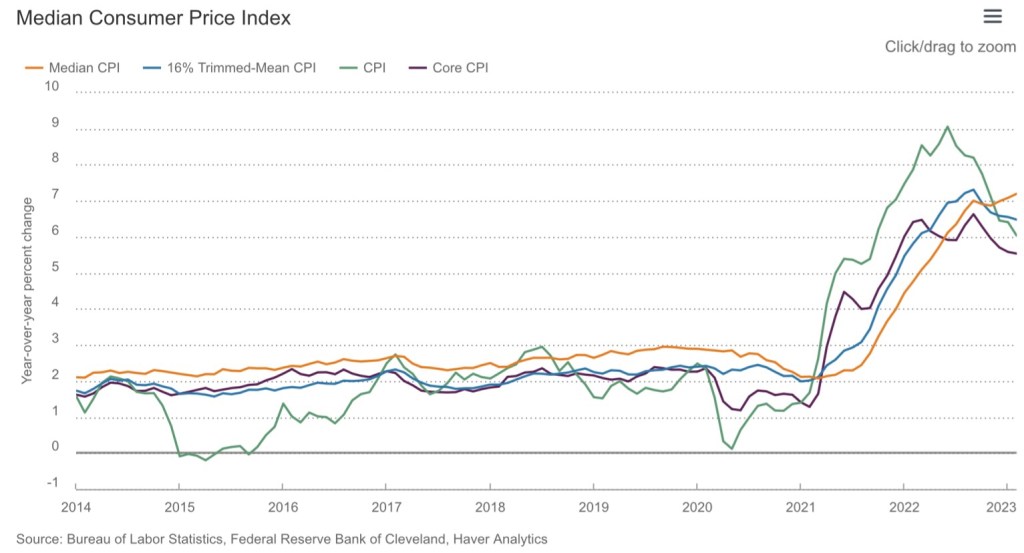
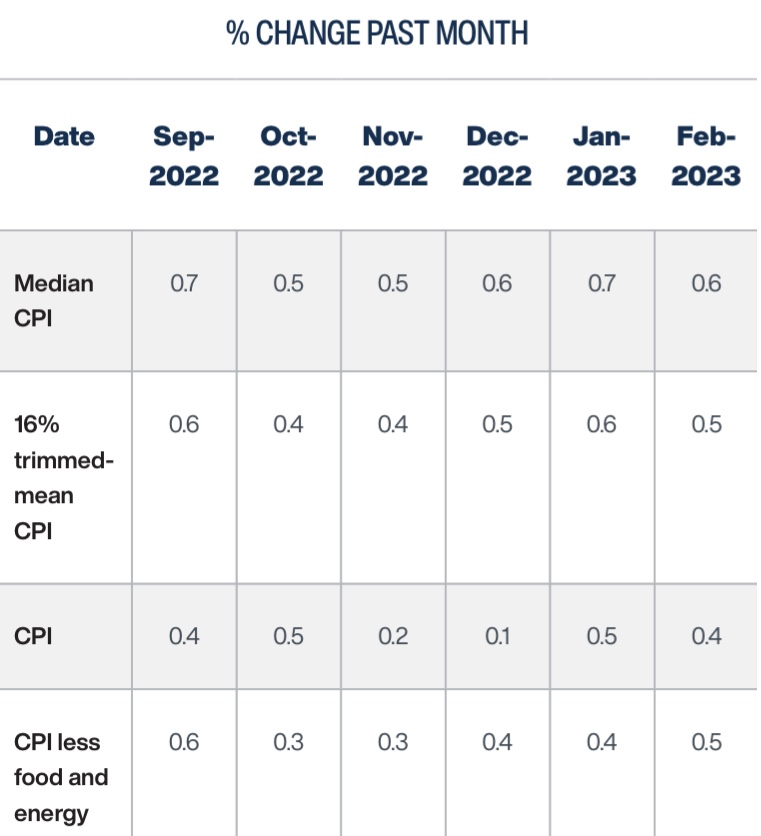
Those are 12-month changes, and just in case you’ve heard that month-to-month changes have tapered more sharply, that really wasn’t the case in January and February:
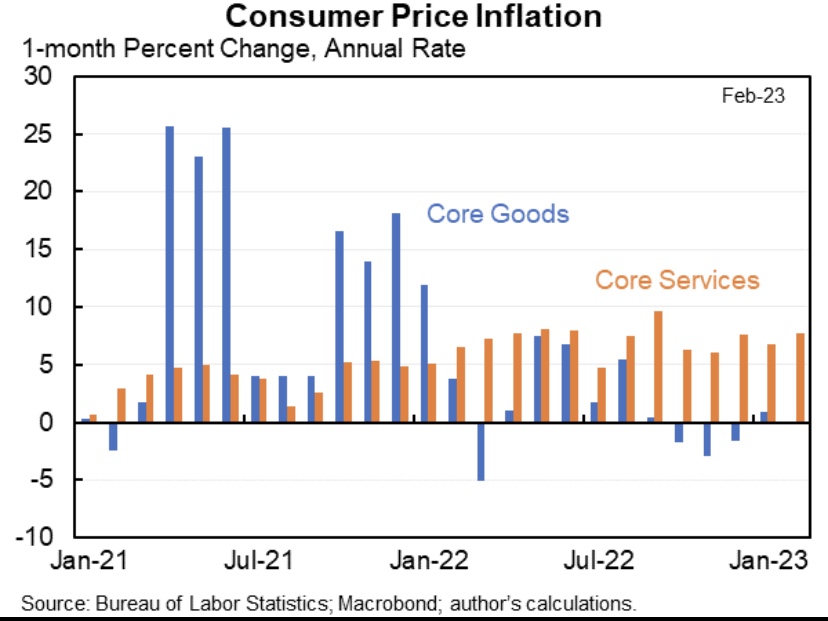
Jason Furman noted in a series of tweets that the prices of services are driving recent inflation, while goods prices have been flat:
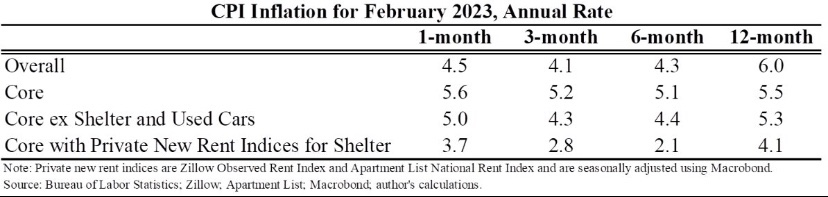
A compelling argument is that the shelter component of the CPI is overstating services inflation, and it’s weighted at more than one-third of the overall index. CPI shelter costs are known as “owner’s equivalent rent” (OER), which is based on a survey question of homeowners as to the rents they think they could command, and it is subject to a fairly long lag. Actual rent inflation has slowed sharply since last summer, so the shelter component is likely to relieve pressure on CPI inflation (and the Fed) in coming months. Nevertheless, Furman points out that CPI inflation over the past 3 -4 months was up even when housing is excluded. Substituting a private “new rent” measure of housing costs for OER would bring measured inflation in services closer the Fed’s comfort zone, however.
The Fed’s preferred measure of inflation, the deflator for personal consumption expenditures (PCE), uses a much lower weight on housing costs, though it might also overstate inflation within that component. Here’s another chart from the Cleveland Fed:
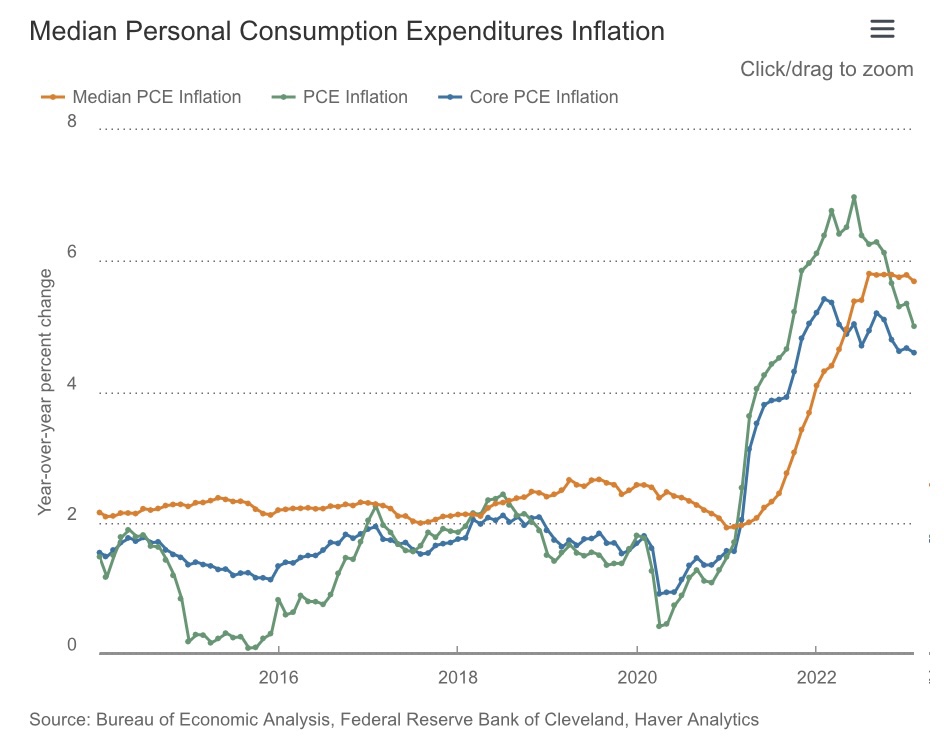
Inflation in the Core PCE deflator, which excludes food and energy prices, looks as if it’s “flattened” as well. This persistence is worrisome because inflation is difficult to stop once it becomes embedded in expectations. That’s exactly what the Fed says it’s trying to prevent.

Rate Targets and Money Growth

Targeting the federal funds rate (FFR) is the Fed’s primary operational method of conducting monetary policy. The FFR is the rate at which banks borrow from one another overnight to meet short-term needs for reserves. In order to achieve price stability, the Fed would do better to focus directly on controlling the money supply. Nevertheless, it has successfully engineered a decline in the money supply beginning last April, and recently the money supply posted year-over-year negative growth.
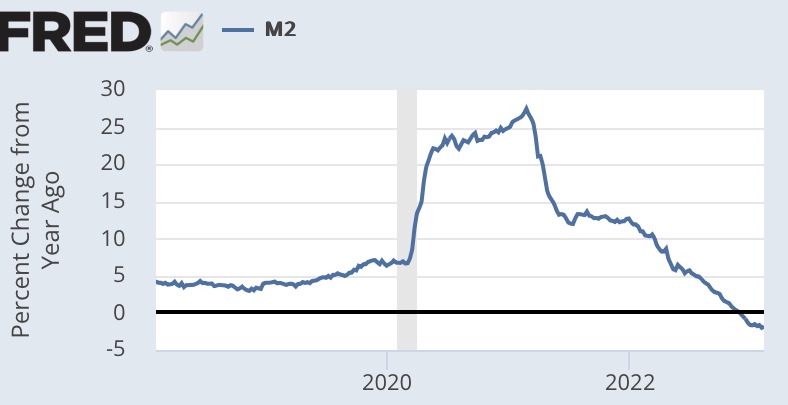
That doesn’t mean money growth has been “optimized” in any sense, but a slowdown in money growth was way overdue after the pandemic money creation binge. You might not like the way the Fed executed the reversal or its operating policy in general, and neither do I, but it did restrain money growth. In that sense, I applaud the Fed for exercising its independence, standing up to the Treasury rather than continuing to monetize yawning federal deficits. That’s encouraging, but at some point the Fed will reverse course and ease policy. We’ll probably hope in vain that the Fed can avoid sending us once again along the path of boom and bust cycles.

In effect, the FFR target is a price control with a dynamic element: the master fiddles with the target whenever economic conditions are deemed to suggest a change. This “controlled” rate has a strong influence on other short-term interest rates. The farther out one goes on the maturity spectrum, however, the weaker is the association between changes in the funds rate and other interest rates. The Fed doesn’t truly “control” those rates of most importance to consumers, corporate borrowers, government borrowers, and investors. It definitely influences those rates, but credit risk, business opportunities, and long-term expectations are often dominant.

The FOMC’s latest rate increase suggests its members don’t expect an immediate downturn in economic activity or a definitive near-term drop in inflation. The Committee may, however, be willing to pause for a period of several meeting cycles (every six weeks) to see whether the “long and variable lags” in the transmission of tighter monetary policy might begin to kick-in. As always, the FOMC’s next step will be “data dependent”, as Chairman Powell likes to say. In the meantime, the economic response to earlier tightening moves is likely to strengthen. Lenders are responding to the earlier rate hikes and reduced lending margins by curtailing credit and attempting to rebuild their own liquidity.

Is It Supply Or Demand?

There’s an ongoing debate about whether monetary policy is appropriate for fighting this episode of inflation. It’s true that monetary policy is ill-suited to addressing supply disruptions, though it can help to stem expectations that might cause supply-side price pressures to feed upon themselves (and prevent them from becoming demand-side pressures). However, profligate fiscal and monetary policy did much to create the current inflation, which is pressure on the demand-side. On that point, David Beckworth leaves little doubt as to where he stands:

“The real world is nominal. And nominal PCE was about $1.6 trillion above trend thru February. Unless one believes in immaculate above-trend spending, this huge surge could 𝙣𝙤𝙩 have happened without support from fiscal and monetary policy.”

In reality, this inflationary episode was borne of a mix of demand and supply-side pressures, and policy either caused or accommodated all of it. Nevertheless, it’s interesting to consider efforts to decompose these forces. This NBER paper attributed about 2/3 of inflation from December 2019 – June 2022 to the demand-side. Given the ongoing tenor of fiscal policy and the typical policy lags, it’s likely that the effects of fiscal and monetary stimulus have persisted well beyond that point. Here is a page from the San Francisco Fed’s site that gives an edge to supply-side factors, as reflected in this breakdown of the Fed’s favorite inflation gauge:
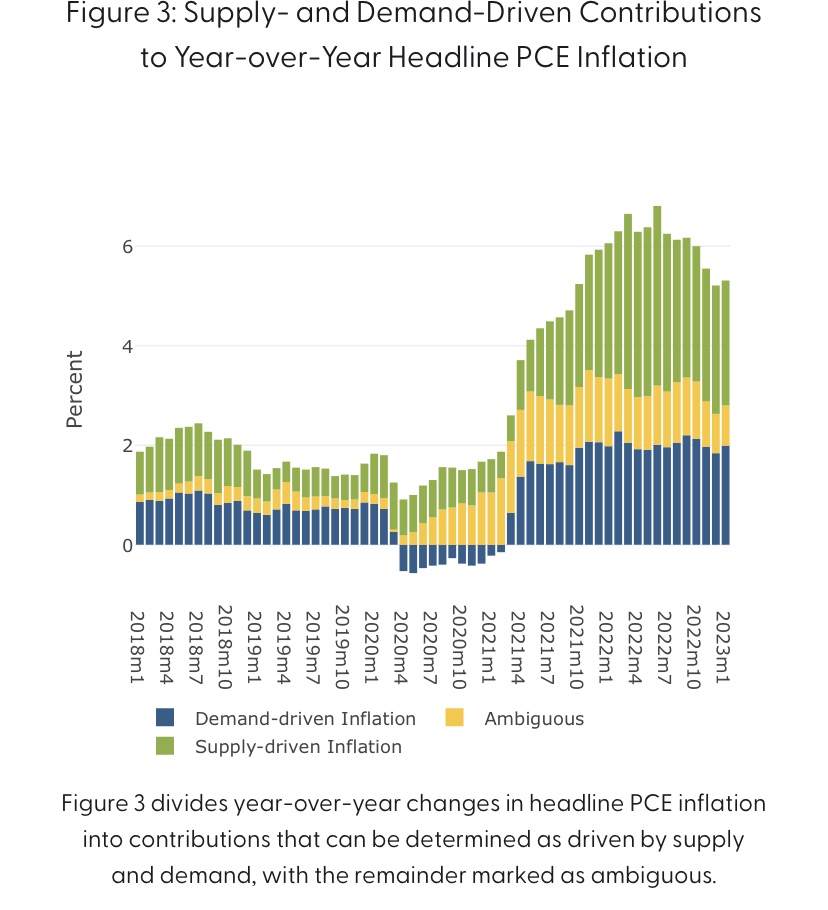
Of course, all of these decompositions are based on assumptions and are, at best, model-based. Nevertheless, to the extent that we still face supply constraints, they would impose limits to the Fed’s ability to manage inflation downward without a “hard landing”.

There’s also no doubt that supply side policies would reduce the kinds of price pressures we’re now experiencing. Regulation and restrictive energy policies under the Biden Administration have eroded productive capacity. These policies could be reversed if political leaders were serious about improving the nation’s economic health.

The Dark Runway Ahead

Will we have a recession? And when? There are no definite signs of an approaching downturn in the real economy just yet. Inventories of goods did account for more than half of the fourth quarter gain in GDP, which may now be discouraging production. There are layoffs in some critical industries such as tech, but we’ll have to see whether there is new evidence of overall weakness in next Friday’s employment report. Real wages have been a little down to flat over the past year, while consumer debt is climbing and real retail sales have trended slightly downward since last spring. Many firms will experience higher debt servicing costs going forward. So it’s not clear that the onset of recession is close at hand, but the odds are good that we’ll see a downturn as the year wears on, especially with credit increasingly scarce in the wake of the liquidity pinch at banks. But no one knows for sure, including the Fed.

The Socially Seductive Tax Deduction

20 Monday Nov 2017

Posted by Nuetzel in Taxes

≈ Leave a comment

Tags

Edward Glaeser, Externalities, Home ownership, Jesse Shapiro, Medical Expense Deduction, Mortgage Interest Deduction, NBER, SALT, State & Local Tax Deduction, Student Loan Interest Deduction, Tax Deductions, Tax Foundation, Tax Reform

deductions desert

The rat’s nest that is the federal income tax code is a testament to the counter-productive nature of central economic planning. Not only does the tax code force citizens to waste time and other resources on compliance activities. It also encourages us to direct resources into uses that would not be worthwhile in the absence of tax incentives, uses that are not worthwhile in a societal context.

A general rationale for many provisions of the tax code is that they serve some “worthwhile” public purpose. A special tax provision is created to subsidize activities contributing to that purpose. Since that reduces the flow of revenue, tax rates must increase as an offset. However, high tax rates are damaging to economic health in and of themselves. They blunt incentives and drive wedges between the values and rewards that guide all economic decisions.

The competing tax plans under debate in the House and Senate would eliminate or pare back deductions to varying degrees, enabling a reduction in tax rates. I applaud steps in that direction, though a consequence of doing so piecemeal is to invite later tinkering of the sort that got us into this mess in the first place. Both the House and Senate bills are piecemeal. Here is a run-down of some of the deductions that are under review in the GOP plans:

State and Local Tax (SALT) Deductions: this deduction prevents the imposition of federal “taxes on taxes”, which is a worthwhile consideration. However, SALT also gives lower levels of government a “discount” on tax burdens they impose on their citizens, thereby forcing that burden to be shared by members of other jurisdictions. According to the Tax Foundation:

“The deduction favors high-income, high-tax states like California and New York, which together receive nearly one-third of the deduction’s total value nationwide. Six states—California, New York, New Jersey, Illinois, Texas, and Pennsylvania—claim more than half of the value of the deduction.“

Defenders of this deduction note peremptorily that it is used by taxpayers in all fifty states, as if that should come as a surprise. Well of course it is! And those who are taxed most heavily benefit the most from this deduction, and those benefits are most concentrated in high-tax states. The House GOP bill would limit the SALT deduction to $10,000, while the Senate version would eliminate it entirely.

Mortgage Interest (MI) Deduction: Long ago, the idea took hold that ownership of a home was of greater inherent value than mere occupancy. It’s obviously true that owners have greater rights than renters over use of a property. Those benefits are internalized, and owner-occupants might well be more inclined than renters to take pride in, care for, and improve a property. That suggests a social or external benefit from home ownership, one that at least benefits others in the vicinity of a given property.

The MI deduction creates an incentive for debt-financed home ownership, but only for the minority of taxpayers who can benefit from itemizing deductions. It therefore tends to subsidize the housing choices of those at higher levels of income and those with larger homes. It has contributed little, if anything, to the homeownership rate. Here are Edward Glaeser and Jesse Shapiro describing the findings of their NBER Working Paper:

“Externalities from living around homeowners are far too small to justify the deduction. … the home mortgage interest deduction is a particularly poor instrument for encouraging homeownership since it is targeted at the wealthy, who are almost always homeowners. The irrelevance of the deduction is supported by the time series which shows that the ownership subsidy moves with inflation and has changed significantly between 1960 and today, but the homeownership rate has been essentially constant.“

This deduction has fostered a massive over-investment in housing relative to other assets and forms of consumption. The House tax bill would allow a deduction on interest payments for up to $500,000 of mortgage debt, but this limit would apply only to new mortgages. The Senate bill would not alter the deduction in any way. These steps are severely limited in their reform ambitions.

Medical Expense Deduction: To take this deduction, you must 1) be an itemizer; and 2) have eligible medical expenses exceeding 10% of adjusted gross income (AGI). Then, you can deduct only the excess above 10%. A relatively small percentage of taxpayers actually take this deduction, mostly wealthy, older individuals or couples. It can be argued that the deduction encourages overuse of medical resources in some cases, but there are certainly others in which it provides relief from the hardship of an illness requiring expensive care. On the other hand, the deduction might serve to discourage the purchase of supplemental Medicare coverage by individuals who can afford it but are willing to bet that they won’t need it. Part of that bet is covered by the deduction.

The House bill would repeal this deduction in its entirety. The Senate bill would leave it untouched.

Student Loan Interest Deduction: Currently, up to $2,500 of student loan interest can be deducted “above the line” by non-itemizers, but only if their AGI is within certain limits. Higher education is often claimed to have social (external) benefits. To some extent, the student loan interest deduction helps bring the cost of an eduction to within reach of a broader swath of the citizenry. These considerations provide the rationale for public subsidies for funding tuition and other costs with debt. The tax deduction is only one of many forms of education subsidies. Another is provided by the below-market rates at which students are able to borrow from the federal government.

The social benefits of higher education are strongly associated with the value it adds for the individual. It can be argued that as a society, we may have pushed college education well beyond that point. A large number of indebted students decide, too late, that continued enrollment has little value, so they drop out and often default on their federally-subsidized debt. Moreover, these loan subsidies stimulate the demand for college education, which leads to a certain amount of escalation in tuition and fees. These ill effects make elimination of this deduction a tempting way to broaden the income-tax base, enabling a reduction in tax rates.

The House bill eliminates the deduction for student loan interest, but the Senate bill leaves it intact.

Conclusion: There are plenty of shortcomings in both the House and Senate versions of tax reform. Three liberalizing goals of reform are tax simplification, elimination of provisions that benefit special interests, and of course lower rates. Most of the complexities in the tax code benefit special interests in one way or another. The deductions discussed above fall into that category and necessitate higher tax rates on personal income. That in turn makes the deductions more valuable to those who claim them. In terms of the liberalizing goals of reform, the House tax bill is wider ranging than the Senate version, though the Senate bill’s complete elimination of the SALT deduction is better.

Educational Free Fail

07 Monday Mar 2016

Posted by Nuetzel in Education, Subsidies

≈ 1 Comment

Tags

Accreditation Agencies, Ariel Deschapell, Bernie Sanders, College Admission Standards, Community Colleges, Diversity Goals, Dropout Rates, Federal Accreditation, Federal Reserve Bank of New York, Free Tuition, Graduation Rates, National Bureau of Economic Research, NBER, Socialized Costs, Student Debt, Subsidized Loans, Tuition Bubble

image

Free college tuition would undermine the quality of higher education and increase its real cost to society. In fact, it may well cost many subsidized students more than its worth in lost work experience, wages and self-esteem. Those foregone opportunities are very real costs despite their consignment as “unseen” counterfactuals. They are mostly incremental to costs that are more obvious to the minds of statists promoting free post-secondary education.

Basic supply and demand analysis is the only requirement for understanding the tuition bubble in U.S. higher education, and the absurdity of heavy subsidies as a solution. Ariel Deschapell calls subsidies “worse than nothing“, comparing the approach to “throwing gasoline on a fire“. He’s quite right.

There is no question that increased subsidies lead to higher tuition and ultimately greater student debt. A recent paper published by the National Bureau of Economic Research (NBER) found that loan subsidies “fully account” for the increase in college tuition costs from 1987 – 2010. Another 2015 study published by the Federal Reserve Bank of New York reached broadly similar conclusions:

“We find that institutions more exposed to changes in the subsidized federal loan program increased their tuition disproportionately around these policy changes, with a sizable pass-through effect on tuition of about 65 percent. We also find that Pell Grant aid and the unsubsidized federal loan program have pass-through effects on tuition, although these are economically and statistically not as strong. The subsidized loan effect on tuition is most pronounced for expensive, private institutions that are somewhat, but not among the most, selective.“

As Deschapell points out, most schools turn away a significant share of their applicants. How can that sort of demand exist, given the sky-high tuition charged by many colleges and universities? Subsidies. Subsidized tuition. Subsidized loans. When the cost to the end user of educational services is reduced at a given price, demand for those services increases. The papers linked above demonstrate the strength of the response.

Unfortunately, the supply of higher education is subject to relatively hard limits. Traditionally, the supply of educators, facilities and other learning resources has not been especially elastic. Technology has arguably made education more scalable, but only in terms of enrollment, and not at a zero incremental cost. Outcomes are more dependent than ever on a student’s intelligence, preparation and ability to remain engaged.

The supply of education is limited by still other factors. The long-term impact of inflation on costs is often more severe for service industries such as education, as they generally do not share in the productivity growth enjoyed by goods-producing sectors. Moreover, the increasing complexity of administrative functions, including education finance and regulatory compliance in an astonishing number of areas such as health, environmental and diversity goals (and certainly some self-inflicted administrative bloat), imposes cost escalation at many schools. Worst of all, the supply of education and acceptance of federally-subsidized student loans by certain institutions is restricted by federally-appointed accreditation agencies. This puts a lid on competitive pressures in higher education and inflates costs.

Higher demand and limited supply mean that some form of rationing is necessary. What mechanisms for rationing educational opportunities are available? Higher admission standards are sometimes a possibility, but public institutions may have little flexibility to raise standards, especially for resident students. Interestingly, diversity goals can lead to a de facto tightening of admission standards for some applicants even as standards for others are overridden or compromised. Declining quality of education is a “relief valve” to be avoided, but it is a very real possibility.

Higher tuition to the payer is an almost unavoidable consequence. That is why Deschapell likens free, givernment-paid tuition to an accelerant. Supporters of free tuition fail to recognize this relatively simple, causal chain.

When student debt is subsidized, it tends to mount faster than educational achievement and job prospects allow, leading to high rates of default. It also distorts the choices of would-be individual payers by inflating tuition costs. Passing the cost of education along to taxpayers, or “socializing the cost” as Deschapell says, completely severs the responsibility for marginal costs from the marginal benefit of education, an obvious prescription for a misallocation of resources. The decision to pursue more education, and the responsibility, should be in the hands of the same individuals: those in the best position to know whether it is viable: prospective students and their families. They know better than anyone the real opportunities foregone in terms of lost wages and the skills and experience that can be gained by staying out of school. Eliminating tuition from the decision would divert many more individuals into pursuits for which they are ill-suited.

College graduation or completion rates are disappointingly low, and correspondingly, dropout rates are very high, especially at community colleges. Moreover, profiles of the dropout population show that colleges have no business admitting a significant share of those individuals. This is damning evidence that we are already over-allocating resources to this activity. Additional subsidies won’t fix the problem.

There is no doubt that cross-sectionally, advanced education is associated with better employment prospects and higher incomes. And higher education can provide “social benefits” in excess of its direct value to students. Those facts do not imply, however, that generous inducements to questionable prospects will create positive outcomes. Quite the contrary. And in fact, the quality of education is vulnerable to dilution with increases in the number of poorly-qualified students.

A better way to improve the lifetime prospects of more people is to encourage production and employment opportunities with flexible wage policies, light taxes and less intrusive regulation. Competition at all levels of education should also be promoted; those steps would do more to improve outcomes than subsidies ever can. Throwing public money at education is generally unproductive, inflates tuition and drains the productive sector of resources. After all, the strength of that very sector must be relied upon to keep public education afloat. Individuals cannot be absolved of facing the real trade-offs inherent in their choices. Ultimately, by distorting decisions, free tuition cannot truly empower individuals and improve well being.


Social Security: Saving or Tax? Proceeds or Aid?

17 Monday Aug 2015

Posted by Nuetzel in Big Government

≈ 3 Comments

Tags

CATO Institute, Federal entitlements, FICA Tax, George W. Bush, Lump Sum vs. Annuity, Michael Tanner, Michigan Retirement Research Center, National Bureau of Economic Research, NBER, payroll taxes, Privatization, retirement, Social Safety Net, Social Security Privatization, Social Security Trust Fund, Treasury Special Purpose Bonds, Welfare Payments

SOCSEC Negative Return

In general parlance, an entitlement is a thing to which one is entitled. If you have paid into Social Security (FICA payroll “contributions”), you should feel entitled to receive benefits one day. Why do I so often hear indignant complaints about the use of the term “entitlement” when applied to Social Security and Medicare? I’ve heard it from both ends of the political spectrum, but more often from the Left. It is usually accompanied by a statement about having “paid for those benefits!”. Exactly, you should feel entitled to them. You are not asking society to pay you alms!

Yet there seems to be resentment of an imagined implication that such “entitlements” are equivalent to “welfare” of some kind. That might be because the definition of an entitlement is somewhat different in the federal budget: it is a payment or benefit for which Congress sets eligibility rules with mandatory funding, as contrasted with discretionary budget items with explicit approval of funding. Because payments are based solely on eligibility, Social Security, Medicare and many forms of welfare benefits are all classified as entitlements in the federal budget. Obviously, those complaining about the use of the term in connection with Social Security believe there is a difference between their entitlement and welfare. But as long as they are willing to leave their “contributions” and future eligibility in the hands of politicians, their claim on future benefits is tenuous. Yes, you will pay FICA TAXES, and then you might be paid benefits (alms?) if you are eligible at that time. Certainly, the government has behaved as if the funds are fair game for use in the general budget.

Having made that minor rant, I can get to another point of this post: the Social Security retirement system offers terrible returns for its “beneficiaries”. Furthermore, it is insolvent, meaning that its long-term promises are, and will remain, unfunded under the current program design. However, there is a fairly easy fix for both problems from an economic perspective, if not from a political perspective.

The chart at the top of this post shows that Social Security benefits paid to eligible retirees are less than the payroll taxes those same individuals paid into the system. The chart is a couple of years old, but the facts haven’t changed. It’s boggling to realize that you’ll receive a negative return on the funds after a lifetime of “contributions”. That kind of investment performance should be condemned as unacceptable. However, you should know that the program is not “invested” in your retirement at all! Social Security’s so-called “trust fund” is almost a complete fiction. Most FICA tax revenue is not held “in trust”. Instead, it is paid out as an intergenerational transfer to current retirees. In the past, any surplus FICA tax revenue was invested in U.S. Treasury special purpose bonds, which funded part of the federal deficit. Here is a fairly good description of the process. The article quotes the Clinton Office of Management and Budget in the year 2000:

“These balances are available to finance future benefit payments … only in a bookkeeping sense. They do not consist of real economic assets that can be drawn down in the future to fund benefits. Instead, they are claims on the Treasury that, when redeemed, will have to be financed by raising taxes, borrowing from the public, or reducing benefits, or other expenditures.“

Unfortunately, for the past few years, instead of annual surpluses for the trust fund, deficits have been the rule and they are growing. Retiring baby boomers, longer life expectancies, slow income growth and declining labor force participation are taking a toll and will continue to do so. Something will have to change, but reform of any kind has been elusive. An important qualification is that almost any reform would have to be phased in as a matter of political necessity and fairness to current retirees. Unfortunately, just about every reform proposal I’ve heard has been greeted by distorted claims that it would harm either current retirees or those nearing retirement. In fact, leaving the program unaltered is likely to be a greater threat to everyone down the road.

There are three general categories of reform: higher payroll taxes, lower benefits, and at least partial privatization. Tax increases have obvious economic drawbacks, while straight benefit reductions would be harmful to future recipients even if that entailed means testing: the return on contributions is already negative, especially at the upper end of the income spectrum. Michael Tanner discusses specific options within each of these categories, including raising the normal and early retirement ages. None of the options close the funding gap, but at least higher retirement ages reflect the reality of longer life expectancies.

Early in his presidency, the George W. Bush administration offered a reform plan involving no tax increases or benefit cuts. Instead, the plan would have offered voluntary personal accounts for younger individuals. Needless to say, it was not adopted, but it would have kept the system in better shape than it is today. The key to success of any privatization is that unlike the Social Security Trust Fund, workers with private accounts can earn market returns on their contributions, which are in turn reinvested, allowing the accounts to grow faster over time. Tanner notes that 20 other countries have moved to private accounts including Chile, Australia, Mexico, Sweden, Poland, Latvia, Peru, and Uruguay. This sort of change does not preclude a separate social safety net for those who have been unable to accumulate a minimum threshold of assets, as Chile has done. Tanner’s article lays out details of a tiered plan that would allow participants a wider range of investments as their accumulated assets grow.

Economic research suggests that participants do not place a high value on their future benefits. From a 2007 National Bureau of Economic Research (NBER) paper by John Geanakoplos and Stephen Zeldes entitled “The Market Value of Social Security“:

“We find that the difference between market valuation and ‘actuarial’ valuation is large, especially when valuing the benefits of younger cohorts. … The market value of accrued benefits is only 2/3 of that implied by the actuarial approach.“

An implication is that younger workers who have already made contributions could be offered the choice of a future lump sum that is less than the actuarial present value of their benefits when they become eligible. Such a program could cut the long-term funding gap significantly, if the results found by Geanakoplos and Zeldes can be taken at face value, though it could create additional short-term funding pressure at the time of payment.

Qualified support for such a program seems apparent from another 2007 NBER paper by Jeffrey R. Brown, Marcus D. Casey and Olivia S. Mitchell entitled “Who Values the Social Security Annuity? New Evidence on the Annuity Puzzle“. They find that:

“Our first finding is that nearly three out of five respondents favor the lump-sum payment if it were approximately actuarially fair, a finding that casts doubt on several leading explanations for why more people do not annuitize. Second, there is some modest price sensitivity and evidence consistent with adverse selection; in particular, people in better health and having more optimistic longevity expectations are more likely to choose the annuity. Third, after controlling on education, more financially literate individuals prefer the annuity. Fourth, people anticipating future Social Security benefit reductions are more likely to choose the lump-sum, suggesting that political risk matters.“

Moreover, lump sums may offer an additional advantage from a funding perspective: a 2012 paper from the Michigan Retirement Research Center at the University of Michigan by Jingjing Chai, Raimond Maurer, Olivia S. Mitchell and Ralph Rogalla called “Exchanging Delayed Social Security Benefits for Lump Sums: Could This Incentivize Longer Work Careers?” found that “... workers given the chance to receive their delayed retirement credit as a lump sum payment would boost their average retirement age by l.5-2 years.”

Certainly, it would be difficult for private accounts to fare as badly in terms of returns on contributions than the system has managed to date. The future appears even less promising without reform. There are several advantages to privatization of Social Security accounts beyond the likelihood of higher returns mentioned above: it would avoid some of the labor market distortions that payroll taxes entail, and it would increase the pool of national savings. Perhaps most importantly, over time, it would release the assets (and future benefits) accumulated by workers from the clutches of the state and self-interested politicians. They are not entitled to pursue their political ends with those assets; they are yours!

Government Supplies a Cliff; Would you Jump?

14 Friday Aug 2015

Posted by Nuetzel in Big Government, Welfare State

≈ Leave a comment

Tags

Benefits Cliff, Dan Mitchell, dependency, Earned Income Tax Credit, EITC, Federalism, Fight Club, Illinois Policy Institute, Labor Force Participation, LiberalForum, Marginal tax rate, National Bureau of Economic Research, NBER, Obamacare incentives, Pennsylvania welfare cliff, Tyler Durden, War on Drugs, Welfare Cliff, Welfare State, Work Disincentives, Work Effort, Zero Hedge

welfare cliff

People respond to incentives. That does not, in and of itself, make some people “energetic” and others “lazy”. To the contrary, it really means they are responsive and capable of calculating rewards. Critics of the welfare state are sometimes accused of labeling welfare recipients as “lazy”, which is absurd and a cop-out response to serious questions about the size, effectiveness, and even the fairness of means-tested benefits. The structure of welfare benefits in the U.S. often penalizes work effort and market earnings. That being the case, who can blame a recipient for minimizing work effort? From their perspective, that is what society wants them to do. Note that this has nothing to do with the provision of a social safety net for those who are unable to help themselves.

The welfare incentive phenomenon is explored by Zero Hedge under the Fight Club nom de guerre Tyler Durden in “When Work Is Punished: The Ongoing Tragedy Of America’s Welfare State“:

“At issue is the so-called “welfare cliff” beyond which families will literally become poorer the higher their wages, as the drop off in entitlements more than offsets the increase in earnings.“

The cliff looks different in different states and even differs by county. The chart at the top of this post is for Pennsylvania, from the state’s Secretary of Public Welfare, though I saw it on this post from LiberalForum. (Go to the link if the image is not clear). The Zero Hedge post linked above includes a dramatic illustration for Cook County in Illinois. Not many welfare recipients participate in all of the programs shown in the charts, but the point is that many of the programs create nasty incentives that tend to “trap” families at low income levels. Often, these workers and their families would be better off in the long-run if they were to suffer the consequences of the cliff in order to gain more work experience. Unfortunately, few have the resources to ride out a period of lower total income precipitated by the cliff. Another obvious implication is that increases in the minimum wage would actually harm some families by pushing them over the cliff.

Welfare cliffs differ by the recipients’ family structure (one- versus two-parent households, number of children) and do not apply to every welfare program. For example, the Earned Income Tax Credit (EITC) is very well-behaved in the sense that additional work and/or wage income flows through as a net gain the household. While most welfare programs involve a benefits cliff, incentives are undermined even before that point. A flattening in the level of total income as earned income rises indicates that the recipient faces an increasing marginal tax rate. The chart above shows that total income is relatively flat over a range of earned income below the income at which they’d encounter the cliff. This flat range starts at an earned income of $15,000 to $20,000 and extends up to the severe cliff at almost $30,000.

Zero Hedge quotes a report from the Illinois Policy Institute:

“We realize that this is a painful topic in a country in which the issue of welfare benefits and cutting (or not) the spending side of the fiscal cliff have become the two most sensitive social topics. Alas, none of that changes the matrix of incentives for Americans who find themselves facing a comparable dilemma: either remain on the left side of minimum US wage and rely on benefits, or move to the right side at far greater personal investment of work, and energy, and… have the same (or much lower) disposable income at the end of the day.“

Another interesting take on this issue is offered by Dan Mitchell, who cites a recent National Bureau of Economic Research (NBER) paper, which finds:

“…the decline in desire to work since the mid-90s lowered the unemployment rate by about 0.5 ppt and the participation rate by 1.75 ppt. This is a large effect…“

The findings suggest that the welfare reforms of the 1990s actually had positive effects on work effort, though even the EITC creates some incentive problems for second earners. Worst of all is the incentive impact of expanded disability benefits, which have undone some of the gains from reform. Newer programs like Mortgage Assistance and now, Obamacare, have added to the work disincentives. Mitchell cites other research that reinforce these conclusions.

The welfare cliff harms economic efficiency by distorting the offer price of labor, by increasing costs to taxpayers, and by reducing the availability of productive resources. It is grossly unfair because it consigns its intended beneficiaries to a life of dependency. What a waste! Here is Mitchell’s prescription:

“Regarding the broader issue of redistribution and dependency, I argue that federalism is the best approach, both because states will face competitive pressure to avoid excessively generous benefits and because states will learn from each other about the best ways to help the truly needy while minimizing the negative impact of handouts on incentives for productive behavior.“

A side effect of negative welfare incentives is that they increase the relative benefits of participating in illegal income-earning activity. The “War on Drugs” exacerbates this effect by driving up drug prices. Of course, this activity is untaxed, and because it is unreported, it does not push the recipient toward the benefits cliff. This is another example of different government policies working at cross purposes, which is all too common.

Follow Sacred Cow Chips on WordPress.com

Recent Posts

  • The Case Against Interest On Reserves
  • Immigration and Merit As Fiscal Propositions
  • Tariff “Dividend” From An Indigent State
  • Almost Looks Like the Fed Has a 3% Inflation Target
  • Government Malpractice Breeds Health Care Havoc

Archives

  • January 2026
  • December 2025
  • November 2025
  • October 2025
  • September 2025
  • August 2025
  • July 2025
  • June 2025
  • May 2025
  • April 2025
  • March 2025
  • February 2025
  • January 2025
  • December 2024
  • November 2024
  • October 2024
  • September 2024
  • August 2024
  • July 2024
  • June 2024
  • May 2024
  • April 2024
  • March 2024
  • February 2024
  • January 2024
  • December 2023
  • November 2023
  • August 2023
  • July 2023
  • June 2023
  • May 2023
  • April 2023
  • March 2023
  • February 2023
  • January 2023
  • December 2022
  • November 2022
  • October 2022
  • September 2022
  • August 2022
  • July 2022
  • June 2022
  • May 2022
  • April 2022
  • March 2022
  • February 2022
  • January 2022
  • December 2021
  • November 2021
  • October 2021
  • September 2021
  • August 2021
  • July 2021
  • June 2021
  • May 2021
  • April 2021
  • March 2021
  • February 2021
  • January 2021
  • December 2020
  • November 2020
  • October 2020
  • September 2020
  • August 2020
  • July 2020
  • June 2020
  • May 2020
  • April 2020
  • March 2020
  • February 2020
  • January 2020
  • December 2019
  • November 2019
  • October 2019
  • September 2019
  • August 2019
  • July 2019
  • June 2019
  • May 2019
  • April 2019
  • March 2019
  • February 2019
  • January 2019
  • December 2018
  • November 2018
  • October 2018
  • September 2018
  • August 2018
  • July 2018
  • June 2018
  • May 2018
  • April 2018
  • March 2018
  • February 2018
  • January 2018
  • December 2017
  • November 2017
  • October 2017
  • September 2017
  • August 2017
  • July 2017
  • June 2017
  • May 2017
  • April 2017
  • March 2017
  • February 2017
  • January 2017
  • December 2016
  • November 2016
  • October 2016
  • September 2016
  • August 2016
  • July 2016
  • June 2016
  • May 2016
  • April 2016
  • March 2016
  • February 2016
  • January 2016
  • December 2015
  • November 2015
  • October 2015
  • September 2015
  • August 2015
  • July 2015
  • June 2015
  • May 2015
  • April 2015
  • March 2015
  • February 2015
  • January 2015
  • December 2014
  • November 2014
  • October 2014
  • September 2014
  • August 2014
  • July 2014
  • June 2014
  • May 2014
  • April 2014
  • March 2014

Blogs I Follow

  • Passive Income Kickstart
  • OnlyFinance.net
  • TLC Cholesterol
  • Nintil
  • kendunning.net
  • DCWhispers.com
  • Hoong-Wai in the UK
  • Marginal REVOLUTION
  • Stlouis
  • Watts Up With That?
  • Aussie Nationalist Blog
  • American Elephants
  • The View from Alexandria
  • The Gymnasium
  • A Force for Good
  • Notes On Liberty
  • troymo
  • SUNDAY BLOG Stephanie Sievers
  • Miss Lou Acquiring Lore
  • Your Well Wisher Program
  • Objectivism In Depth
  • RobotEnomics
  • Orderstatistic
  • Paradigm Library
  • Scattered Showers and Quicksand

Blog at WordPress.com.

Passive Income Kickstart

OnlyFinance.net

TLC Cholesterol

Nintil

To estimate, compare, distinguish, discuss, and trace to its principal sources everything

kendunning.net

The Future is Ours to Create

DCWhispers.com

Hoong-Wai in the UK

A Commonwealth immigrant's perspective on the UK's public arena.

Marginal REVOLUTION

Small Steps Toward A Much Better World

Stlouis

Watts Up With That?

The world's most viewed site on global warming and climate change

Aussie Nationalist Blog

Commentary from a Paleoconservative and Nationalist perspective

American Elephants

Defending Life, Liberty and the Pursuit of Happiness

The View from Alexandria

In advanced civilizations the period loosely called Alexandrian is usually associated with flexible morals, perfunctory religion, populist standards and cosmopolitan tastes, feminism, exotic cults, and the rapid turnover of high and low fads---in short, a falling away (which is all that decadence means) from the strictness of traditional rules, embodied in character and inforced from within. -- Jacques Barzun

The Gymnasium

A place for reason, politics, economics, and faith steeped in the classical liberal tradition

A Force for Good

How economics, morality, and markets combine

Notes On Liberty

Spontaneous thoughts on a humble creed

troymo

SUNDAY BLOG Stephanie Sievers

Escaping the everyday life with photographs from my travels

Miss Lou Acquiring Lore

Gallery of Life...

Your Well Wisher Program

Attempt to solve commonly known problems…

Objectivism In Depth

Exploring Ayn Rand's revolutionary philosophy.

RobotEnomics

(A)n (I)ntelligent Future

Orderstatistic

Economics, chess and anything else on my mind.

Paradigm Library

OODA Looping

Scattered Showers and Quicksand

Musings on science, investing, finance, economics, politics, and probably fly fishing.

  • Subscribe Subscribed
    • Sacred Cow Chips
    • Join 128 other subscribers
    • Already have a WordPress.com account? Log in now.
    • Sacred Cow Chips
    • Subscribe Subscribed
    • Sign up
    • Log in
    • Report this content
    • View site in Reader
    • Manage subscriptions
    • Collapse this bar
 

Loading Comments...