• About

Sacred Cow Chips

Sacred Cow Chips

Tag Archives: Pre-Existing Conditions

Government Malpractice Breeds Health Care Havoc

02 Sunday Nov 2025

Posted by Nuetzel in Health Care, Subsidies

≈ Leave a comment

Tags

000 Mules, 340B Program, Affordable Care Act, Community Pricing, Continuing Resolution, Cross Subsidies, Federal Medical Assistance Percentages, Gender-Affirming Care, Government Shutdown, Guaranteed Renewability, Health Status Insurance, Jane Menton, John Cochrane, Medicaid, Medicare, Michael Cannon, Nationalized Health Care, Obamacare, Obamacare Expanded Subsidies, Obamacare Tax Credits, One Big Beautiful Bill Act, Peter G. Peterson Foundation, Portability, Pre-Existing Conditions, Right To Health Care, Tax Cuts and Jobs Act, Third-Party Payers
The impasse at the heart of the seemingly unending government shutdown revolves around health care subsidies.

First, there is disagreement about whether to extend the expanded Obamacare subsidies promulgated during the COVID pandemic. That expansion allowed individuals earning more than four times the federal poverty level (the original limit under the Affordable Care Act (ACA)) to receive tax credits for the purchase of health coverage on the exchange “marketplace”. Republicans find this highly objectionable. Many of them also object that the subsidies help pay for “essential health benefits” under the ACA that include so-called gender-affirming care.

Democrats and the insurance lobby would very much like to reinstate or retain the tax credits. The ten-year cost of extending them is more than $400 billion. Incredibly, it turns out that roughly 40% of individuals taking those tax credits did not file a medical claim in 2024. It was pure cash for insurers at the expense of taxpayers.

Second, the One Big Beautiful Bill Act (OBBB), among other things, restricts access to Medicaid by imposing work or job search requirements for overall eligibility. It also formally denies coverage to illegal aliens. This, of course, is opposed by Democrats, who insist that those requirements be rescinded.

Health Care Central Planning

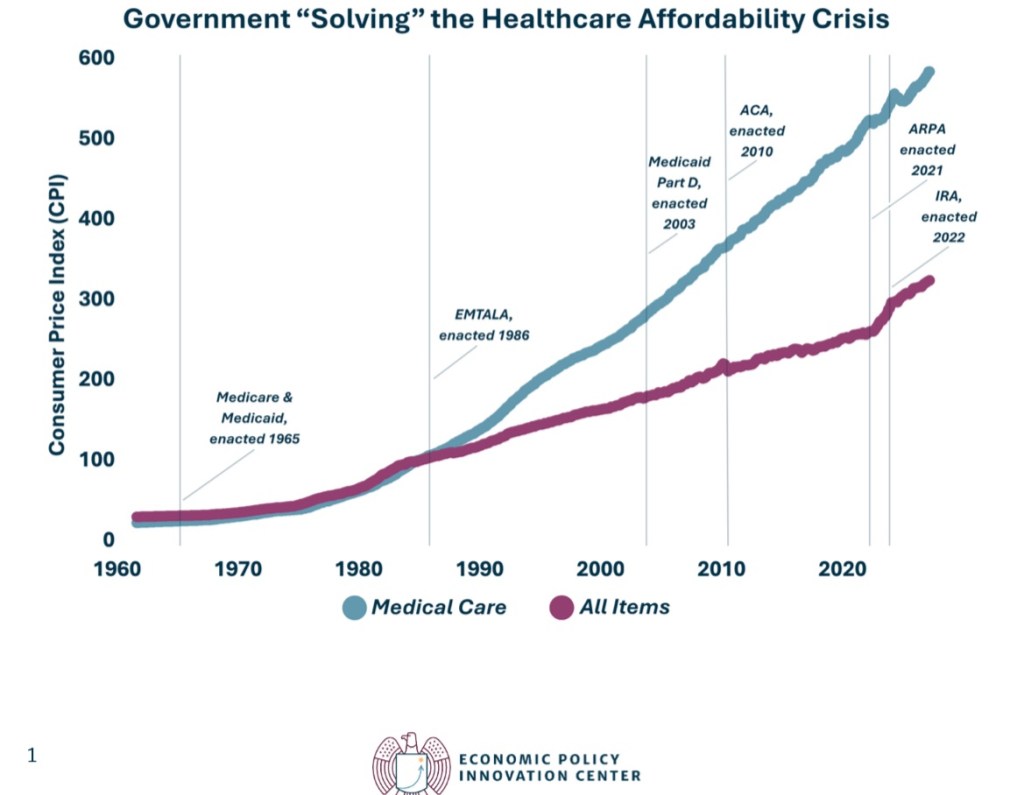
These issues are part of a much larger debate over government dominance of the health care system. Almost every institutional arrangement in health care coverage and delivery is dictated by rules and practices imposed by government, and it would seem they are intentionally designed to escalate costs and compromise the delivery of care. The chart at the top of this post illustrates, in a high-level way, the futility of these efforts.

Medicare and Medicaid dominate government health care spending, as this report from the Peter G. Peterson Foundation shows. However, that strict budgetary view greatly understates the control government now exerts on the health care sector.

Medical Free Market Myth

Michael Cannon recently emphasized the irony of the persistent myth of a U.S. free market in health care:

“… government controls a larger share of health spending in the United States than in 27 out of 38 OECD-member nations, including the United Kingdom (83%) and Canada (73%), each of which has an explicitly socialized health-care system. When it comes to government control of health spending, the United States is closer to communist Cuba (89%) than the average OECD nation (75%).

“Nor does the United States have market prices for health care. Direct government price-setting, price floors, and price ceilings determine prices for more than half of U.S. health spending, including virtually all health-insurance premiums.“

ObamaSnare

Government “control” takes a variety of forms, including regulatory intrusions under the aegis of Obamacare. The Affordable Care Act (ACA), as its name implies, was sold as a way to keep health care and health insurance costs affordable. And it was billed as a way to extend individual health care coverage to the previously uninsured population. It failed badly on the first count and met with only limited success on the second.

One leg upon which the ACA stood was kicked away in 2017: the penalty for violating the Act’s individual mandate for health coverage was eliminated by the Tax Cuts and Jobs Act (TCJA). The penalty was arguably unconstitutional as a tax on non-commerce, or the non-purchase of insurance on the exchange. However, the Supreme Court had ruled narrowly in favor of the penalty in 2012, claiming that it was within the scope of Congress’ taxing power. Following passage of the TCJA, however, the toothlessness of the mandate caused the risk pool to deteriorate. This was aggravated by the ACA’s insistence on comprehensive coverage, which applies not just to policies sold on the Obamacare exchange, but to almost all private health insurance sold in the U.S.

A well-functioning marketplace would instead have promoted the availability of more moderately-priced coverage options. Ultimately, subsidies were all that prevented a broad exit from the marketplace. But they did nothing to slow the escalation in coverage costs and deteriorating quality of coverage and care:

“The result has been a race to the bottom in terms of the quality of insurance coverage for the sick. …individual-market provider networks [have] narrow[ed] significantly… They have eroded coverage through ‘poor coverage for the medications demanded by [the sick]’ … higher deductibles and copayments; mandatory drug substitutions and coverage exclusions for certain drugs; more frequent and tighter preauthorization requirements; highly variable coinsurance requirements; inaccurate provider directories; and exclusions of top specialists, high-quality hospitals, and leading cancer centers from their networks. ….

“The healthy suffer, too. … ‘currently healthy consumers cannot be adequately insured against the negative shock of transitioning to one of the poorly covered chronic disease states.’ A coalition of dozens of patient groups has complained that this dynamic ‘completely undermines the goal of the [Affordable Care Act].’”

Price Distortions

Cannon emphasizes another persistent myth: that government sets prices at levels that would prevail in a free market. Here is one baffling aspect of the many prices set by government for individual services under the Medicare and Medicaid programs.

“One of the more striking indications of widespread mispricing is that Medicare routinely sets different prices for identical items depending solely on who owns the facility.“

For example, ambulatory surgical centers are compensated much less for the same services as hospitals. The same is true of compensation for skilled nursing facilities vs. long-term care hospitals, and there appears to be no economic rationale for the differences. Furthermore, it’s an open secret that Medicare sets higher prices for lower-cost providers (and treatment of lower-cost patients). As Cannon notes, this explains the rapid growth of specialty hospitals owned by physicians.

Cannon provides much more detail on Medicare and Medicaid mis-pricing, including the blunting of patients’ price-sensitivity and the shifting of costs to private payers.

Divorcing Risk and Insurance

The price of insurance and insurer reimbursements are also prescribed by government. Cannon’s discussion includes the ACA’s abolition of risk-based insurance pricing, which is an astonishing case of economic malpractice. Depending on one’s health status, “community pricing” acts as either a price ceiling or a price floor. This creates perverse incentives for both the healthy and the unhealthy. Premiums fall short of the cost of caring for the sick.

The federal government attempts to compensate by subsidizing insurers based on the health status of individuals in their risk pool, but that falls short in terms of the quality of coverage for unhealthy individuals. Thus, both the healthy and taxpayers must shoulder an ever-increasing cost burden of insuring the unhealthy.

Circular Scam

As for Medicaid, certain arrangements drive up the cost of the program to taxpayers. For example, last March I wrote about this apparent scam allowing state governments to inflate their Medicaid costs, qualifying for hundreds of billions of federal matching funds:

“Here’s the gist of it: increases in state Medicaid reimbursements qualify for a federal match at a rate known as the Federal Medical Assistance Percentage (FMAPs). First, increases in Medicaid reimbursements must be funded at the state level. To do this, states tax Medicaid providers, but then the revenue is kicked back to providers in higher reimbursements. The deluge of matching federal dollars follows, and states are free to use those dollars in their general budgets.“

Unfortunately, FMAP reform is not directly addressed in the “clean” Continuing Resolution before Congress, though reduced funding levels might lead to reductions in FMAP percentages.

And Another Circular Scam

John Cochrane is largely in agreement with Cannon’s piece, but he focuses first on cross subsidies flowing to “eligible” hospitals dispensing prescription drugs to low-income patients. These hospitals get the drugs from pharmaceutical companies at a steep discount mandated by the so-called 340B program, but the hospitals then bill insurers (or Medicare and Medicaid), a significant markup over their acquisition cost. The Medicaid expansion under the ACA led to an increase in the number of hospitals eligible for the drug discounts.

But that’s not the end of the story. This arrangement creates an obvious incentive for the drug companies to raise their pre-discounted prices. Another unintended outcome cited by Cochrane is that eligible hospitals do not use the proceeds of their mark-ups to offer better care (or care at a lower cost) to low-income consumers. Instead, the funds tend to be directed to investment accounts. The program also creates another incentive for hospital consolidation.

Someone Else’s Money

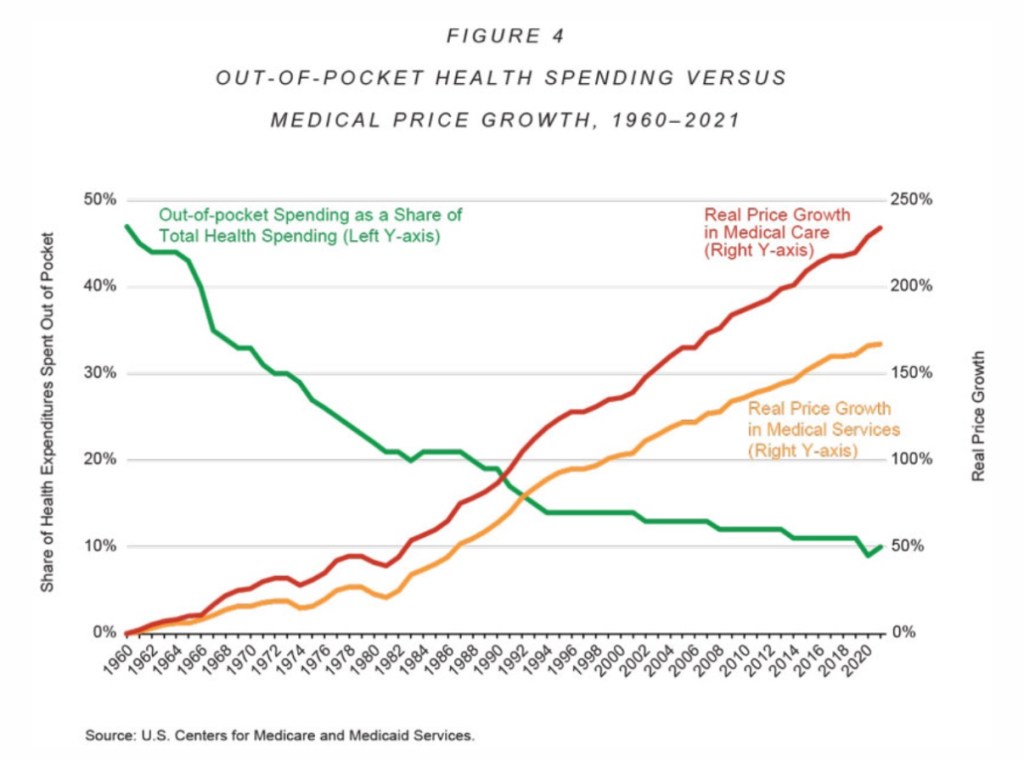
Unfortunately, the dysfunction in health care goes deeper than Obamacare, Medicare, and Medicaid. The third-party payment system itself has been at the root of cost escalation. It largely relieves consumers of their sovereignty over purchasing decisions, rendering them much less sensitive to variations in price. This can be seen clearly in one of Cannon’s charts, reproduced below:
In addition, the disparate income tax treatment of employer-provided health coverage exacerbates cost escalation. Obviously, employees receiving this deduction can afford higher-quality and more comprehensive coverage. This exemption has acted to drive up the cost of all health care and insurance coverage over the almost nine decades of its existence..

What To Do?

The claim that the U.S. health care system operates within a free market ecosystem is obviously absurd. Together, the Cochrane and Cannon pieces represent something of a gripe session, but it is well deserved. Both authors devote sections to reforms, however. They don’t break new ground in the debate, but the overarching theme of the suggested reforms is to give consumers authority over their health care spending. That means keeping government out of health care in all the myriad ways it now intrudes. It also means that insurers should not have authority to dictate how health care is priced. The key is to allow competition to flourish among health care providers and insurers.

Ending FMAPs and the tax exemption for employer-provided coverage is one thing, but it’s another to contemplate dismantling Medicare, Medicaid, and the many rules and pricing arrangements enforced under Obamacare.

Cochrane takes an accommodating approach to the health care needs of seniors and those in need of a safety net. He calls for Medicare and Medicaid to be replaced with the issuance of vouchers (rather than cash) toward the purchase of affordable private health care plans. Then, health coverage can be provided in a lightly regulated, competitive market without all the distortions and sneaky opportunities for graft embedded in our current entitlements.

Conflicting Rights and Reality

And what of the argument that health care is a human right? That notion is, of course, very popular on the left. The idea subtly shifts a meaningful portion of the responsibility for one’s health onto others, including providers and taxpayers. But smokers, heavy drinkers, reckless drivers, hard drug users, and the avoidably obese should not be led to expect a free ride for risky behaviors.

Of course, it’s not a basic human right to demand, by force of government, involuntary service of health care workers, or that taxpayers give alms, but Cochrane answers with this:

“Yes! It is a basic human right that I should be free to offer my money to a willing physician or hospital, in a brutally competitive and innovative market.”

“Willing” is a key word, and to that we should add “able”, but those are qualifying conditions that markets help facilitate.

Jane Menton has discussed the notion of a human right to health care, wisely explaining that conditions are not always compatible with fulfilling such a right. Her primary concern is the future supply of medical personnel, and an acute shortage of nurses.

“In our current political environment, young people seem to think that claiming something as an entitlement means someone will inevitably show up to do the work.“

To codify a right to health care would be an ill-fared call for a nationalized solution. It would be a prescription for still higher costs and lower quality care. As in any other sector, centralized decision-making leads to misallocated resources, higher costs, and inferior outcomes for patients. Our current mess gives a strong hint of the kind of over-regulated dysfunction that nationalization would bring.

Insurance On Insurability

Pre-existing conditions motivate much of the discussion surrounding a presumed right to health care. Individual portability of group health coverage goes partway in addressing coverage for pre-existing conditions. Portability is mandated by the Health Insurance Portability and Accountability Act of 1996, but like community rating, it shifts costs to others. That is, the cost of covering pre-existing conditions becomes the responsibility of employers in general, group insurers, and ultimately healthy (and younger) workers.

Given time, the debate over a right to health care can be rendered moot via market processes. Cochrane has long supported the concept of health status insurance. Such policies would allow healthy consumers to guarantee their insurability against the risk of future health contingencies. Guaranteed renewability is a limited form of this type of coverage. General availability of health status insurance contracts, offered regardless of current coverage, could allow for a range of future insurability options at affordable prices. Then, pre-existing conditions would cease to be such a huge driver of cross subsidies.

Beware of Government Health Care Yet To Come

02 Sunday Feb 2025

Posted by Nuetzel in Health Care

≈ Leave a comment

Tags

adverse selection, Affordable Care Act, Arnold Kling, Bryan Caplan, Claim Denials, David Chavous, Donald Trump, Employer-Provided Coverage, Essential Benefits, Hospital Readmissions, Joel Zinberg, Liam Sigaud, Make America Healthy Again, Matt Margolis, Michael F. Cannon, Moral Hazard, Noah Smith, Obamacare, Peter Earle, Pharmacy Benefit Managers, Portability, Pre-Authorization Rules, Pre-Existing Conditions, Premium Subsidies, Robert F. Kennedy Jr, Sebastian Caliri, Steven Hayward, Tax-Deductible Premiums, third-party payments, Universal Health Accounts

Ongoing increases in the resources dedicated to health care in the U.S., and their prices, are driven primarily by the abandonment of market forces. We have largely eliminated the incentives that markets create for all buyers and sellers of health care services as well as insurers. Consumers bear little responsibility for the cost of health care decisions when third parties like insurers and government are the payers. A range of government interventions have pushed health care spending upward, including regulation of insurers, consumer subsidies, perverse incentives for consolidation among health care providers, and a mechanism by which pharmaceutical companies negotiate side payments to insurers willing to cover their drugs.

It’s not yet clear whether the Trump Administration and its “Make America Healthy Again” agenda will serve to liberate market forces in any way. Skeptics can be forgiven for worrying that MAHA will be no more than a cover for even more centrally-planned health care, price controls, and regulation of the pharmaceutical and food industries, not to mention consumer choices. Robert F. Kennedy Jr., who is likely to be confirmed by the Senate as Donald Trump’s Secretary of Health and Human Services, has strong and sometimes defensible opinions about nutrition and public health policies. He is, however, an inveterate left-winger and is not an advocate for market solutions. Trump himself has offered only vague assurances on the order of “You won’t lose your coverage”.

Government Control

The updraft in health care inflation coincided with government dominance of the sector. Steven Hayward points out that the cost pressure began at about the same time as Medicare came into existence in 1965. This significantly pre-dates the trend toward aging of the population, which will surely exacerbate cost pressures as greater concentrations of baby boomers approach or exceed life expectancy over the next decade.

Government now controls or impinges on about 84% of health care spending in the U.S., as noted by Michael F. Cannon. The tax deductibility of employer-provided health insurance is a massive example of federal manipulation and one that is highly distortionary. It reinforces the prevalence of third-party payments, which takes decision-making out of consumers’ hands. Equalizing the tax treatment of employer-provided health coverage would obviously promote tax equity. Just as importantly, however, tax-subsidized premiums create demand for inflated coverage levels, which raise prices and quantities. And today, the federal government requires coverages for routine care, going beyond the basic function of insurance and driving the cost of care and insurance upward.

The traditional non-portability of employer-provided coverage causes workers with uninsurable pre-existing conditions to lose coverage when they leave a job. Thus, Cannon states that the tax exclusion for employer coverage penalizes workers who instead might have chosen portable individual coverage in a market setting without tax distortions. Cannon proposes a reform whereby employer coverage would be replaced with deposits into tax-free Universal Health Accounts owned by workers, who could then purchase their own insurance.

In 2024, federal subsidies for health insurance coverage were about $2 trillion, according to the Congressional Budget Office (CBO). Those subsidies are projected to grow to $3.5 trillion by 2034 (8.5% of GDP). Joel Zinberg and Liam Sigaud emphasize the wasteful nature of premium subsidies for exchange plans mandated by the Affordable Care Act (ACA), better known as Obamacare. Subsidies were temporarily expanded in 2021, but only until 2026. They should be allowed to expire. These subsidies increase the demand for health care, but they are costly to taxpayers and are offered to individuals far above the poverty line. Furthermore, as Zinberg and Sigaud discuss, subsidized coverage for the previously uninsured does very little to improve health outcomes. That’s because almost all of the health care needs of the formerly uninsured were met via uncompensated care at emergency rooms, clinics, medical schools, and physician offices.

Proportionate Consumption

Perhaps surprisingly, and contrary to popular narratives, health care spending in the U.S. is not really out-of-line with other developed countries relative to personal income and consumption expenditures (as opposed to GDP). We spend more on health care because we earn and consume more of everything. This shouldn’t allay concern over health care spending because our economic success has not been matched by health outcomes, which have lagged or deteriorated relative to peer nations. Better health might well have allowed us to spend proportionately less on health care, but this has not been the case. There are explanations based on obesity levels and diet, but important parts of the explanation can be found elsewhere.

It should also be noted that a significant share of our decades-long increases in health care spending can be attributed to quantities, not just prices, as explained at the last link above.

Health Consequences

The ACA did nothing to slow the rise in the cost of health care coverage. In fact, if anything, the ACA cemented government dominance in a variety of ways, reinforcing tendencies for cost escalation. Even worse, the ACA had negative consequences for patient care. David Chavous posted a good X thread in December on some of the health consequences of Obamacare:

1) The ACA imposed penalties on certain hospital readmissions, which literally abandoned people at death’s door.

2) It encouraged consolidation among providers in an attempt to streamline care and reduce prices. This reduced competitive pressures, however, which had the “unforeseen” consequence of raising prices and discouraging second opinions. The former goes against all economic logic while the latter goes against sound medical decision-making.

3) The ACA forced insurers to offer fewer options, increasing the cost of insurance by encouraging patients to wait until they had a pre-existing condition to buy coverage. Care was almost certainly deferred as well. Ultimately, that drove up premiums for healthy people and worsened outcomes for those falling ill.

4) It forced drug companies to negotiate with Pharmacy Benefit Managers (PBMs) to get their products into formularies. The PBMs have acted as classic middlemen, accomplishing little more than driving up drug prices and too often forcing patients to skimp on their prescribed dosage, or worse yet, increasing their vulnerability to lower-priced quackery.

The Insurers

So the ACA drastically increased the insured population (including the new burden of covering pre-existing conditions). It also forced insurers to meet draconian cost-control thresholds. Little wonder that claim rejection increased, a phenomenon often at the root of public animosity toward health insurers. Peter Earle cites several reasons for the increase in denial rates while noting that claim rejection has made little difference in insurer profit margins.

Matt Margolis points out that under the ACA, we’ve managed to worsen coverage in exchange for higher premiums and deductibles. All while profits have been capped. Claim denials or delays due to pre-authorization rules (which delay care) have become routine following the implementation of Obamacare.

Perhaps the biggest mistake was forcing insurers to cover pre-existing conditions without allowing them to price for risk. Rather than forcing healthy individuals to pay for risks they don’t face, it would be more economically sensible to directly subsidize coverage for those in high-risk pools.

Noah Smith also defends the health insurers. For example, while UnitedHealth Group has the largest market share in the industry, its net profit margin of 6.1% is only about half of the average for the S&P 500. Other major insurers earn even less by this metric. Profits just don’t explain why American health care spending is so high. Ultimately, the services delivered and charges assessed by providers explain high U.S. health care spending, not insurer profits or administrative costs.

Under the ACA, insurance premiums pay the bulk of the cost of health care delivery, including the cost of services more reasonably categorized as routine health maintenance. The latter is like buying insurance for oil changes. Furthermore, there are no options to decline any of the ten so-called “essential benefits” under the ACA, thus increasing the cost of coverage.

Medical Records

Arnold Kling argues that the ACA’s emphasis on uniform, digitized medical records is not a productive avenue for achieving efficiencies in health care delivery. Moreover, it’s been a key factor driving the increasing concentration in the health care industry. Here is Kling:

“My point is that you cannot do this until you tighten up the health care delivery process, making it more rigid and uniform. And I would not try to do that. Health care does not necessarily lend itself to being commoditized. You risk making health care in America less open to innovation and less responsive to the needs of people.

“So far, all that has been accomplished by the electronic medical records drive has been to put small physician practices out of business. They have not been able to absorb the overhead involved in implementing these systems, so that they have been forced to lose their independence, primarily to hospital-owned conglomerates.”

Separating Health and State

The problem of rising health care costs in the U.S. is capsulized by Bryan Caplan in his call for the separation of health and state. The many policy-driven failures discussed above offer more than adequate rationale for reform. The alternative suggested by Caplan is to “pull the plug” on government involvement in health care, relying instead on the free market.

Caplan debunks a few popular notions regarding the appropriate role for markets in health care and health insurance. In particular, it’s often alleged that moral hazard and adverse selection would encourage unhealthy behaviors and encourage the worst risks to over-insure, causing insurance markets to fail. But these problems arise only when risk is not priced efficiently, precisely what the government has accomplished by attempting to equalizing rates.

Pulling the plug on government interference in health care would also mean deregulating both insurance offerings and pricing, encouraging the adoption of portable coverage, expediting drug approvals based on peer-country approvals, reforming pharmacy benefit management, ending deadly Medicare drug price controls, and encouraging competition among health care providers.

Value Vs. Volume

There are a host of other reforms that could bring more sanity to our health care system. Many of these are covered here by Sebastian Caliri, with some emphasis on the potential role of AI in improving health care. Some of these are at odds with Kling’s skepticism regarding digitized health records.

Perhaps the most fundamental reforms entertained by Caliri have to do with health care payments. One is to make payments dependent on outcomes rather than diagnostic codes established and priced by the American Medical Association. To paraphrase Caliri, it would be far better for Americans to pay for value rather than volume.

Another payment reform discussed by Caliri is expanding direct payments to providers such as capitation fees, whereby patients pay to subscribe to a bundle of services for a fixed fee. Finally, Caliri discusses the importance of achieving “site-neutral payments”, eliminating rules that allow health systems to charge a higher premium relative to independent providers for identical services.

For what it’s worth, Arnold Kling disagrees that changing payment metrics would be of much help because participants will learn to game a new system. Instead, he emphasizes the importance of reducing consumer incentives for costly treatments having little benefit. No dispute there!

Avoid the Single-Payer Calamity

I’ll close this jeremiad with a quote from Caliri’s piece in which he contrasts the knee-jerk, leftist solution to our nation’s health care dilemma with a more rational, market-oriented approach:

“Single payer solutions and government control favored by the left are no solutions at all. Moving to a monopsonist system like Canada is a recipe for strangling innovation and rationing access. Just ask our neighbors to the north who have to wait a year for orthopedic surgery. The UK’s National Health Service (NHS) is teetering on the brink of collapse. We need to sort out some other way forward.

“Other parts of the economy provide inspiration for what may actually work. In the realm of information technology, for example, fifty years has taken us from expensive four operation calculators to ubiquitous, free, artificial intelligence capable of passing the Turing Test. We can argue about the precise details but most of this miracle came from profit-seeking enterprises competing in a free market to deliver the best value for the buyer’s dollar.“

Health Reform and Pre-Existing Confusion

24 Wednesday Apr 2019

Posted by Nuetzel in Health Care, Health Insurance

≈ Leave a comment

Tags

Capitation, Centers for Medicare and Medicaid Services, Concierge Medicine, Group Market, Individual Mandate, Individual Market, Insurance Subsidies, John C. Goodman, Medicaid, Medicare Advantage, Mediprex Advantage, Obamacare, Pre-Existing Conditions, Premium Tax, Public Option, Tax Deductibility, Wage controls

Several Democrats vying for the party’s presidential nomination are pushing Medicare For All (MFA) as a propitious avenue for health care reform. They make the dubious claim that universal government health insurance would broaden real access to health care. As we know from experience with Medicaid, Medicare, and Obamacare, broader coverage does not necessarily imply better access. Even more dubious is the claim that MFA would reduce the costs of insurance and health care.

Single-Payer Perils

MFA appeals to the Democrats’ extreme leftist flank, a segment likely to have an out-sized influence in the early stages of the nomination process. Their fixation on MFA is borne of leftist romanticism more than analytics. Democrats have long-championed less ambitious plans, such as a public option, but those are stalling in “blue” states precisely due to their costs.

MFA would demand a massive transfer of resources to the public sector and would completely decimate the private health insurance industry, upon which 90% of Americans rely. As John C. Goodman explains, MFA would lead to less choice, misallocated health resources, long waiting times to obtain care for serious illnesses, and even greater inequalities in access to care because those who can afford private alternatives will find them.

Goodman also discusses a new health plan proposed by House Democrats that is more of an effort to save Obamacare. It won’t, he says, because among other issues, it fails to address the narrowing in-network choices faced by people with chronic conditions, and it would aggravate cost pressures for those who do not qualify for subsidies.

Outlining A Plan

There are many obstacles to a health care deal. Democrats are bitter after the effective repeal of the individual mandate, but despite their assertions, subsidized coverage of pre-existing conditions is not a principle about which most Republicans disagree. Really, the question is how to get it done. MFA is pretty much dead-on-arrival, despite all the bluster. But those who wish to protect choice and the efficient allocation of risk prefer to leverage a combination private insurance and targeted subsidies to achieve broad coverage.

Capitation: Goodman suggests an approach to high-risk patients that has proven successful in private Medicare Advantage (MA) coverage. These plans are structured around “capitated” payments to the insurer from the Centers for Medicare and Medicaid Services (CMS): per patient fees that cover in-network costs above the patient’s out-of-pocket limit. The insurer bears the risk of a shortfall. Assuming that the capitated payment makes coverage of high-risk patients a fair risk, insurers will compete for those buyers. That competition is what makes MA so appealing. Patients with pre-existing conditions under an MA-like system, which I’ll call “Mediprex Advantage”, or just Mediprex for short, would be pooled in “special needs” plans with relatively large capitations.

Risk-Shifting: The other major issue addressed by Goodman is the need to eliminate incentives for risk-shifting from the employer-paid, group insurance market to the individual market. The population of employed individuals in the group market is less costly, on average, and the sickest individuals often have to stop working. Goodman recommends state-level premium taxes on group policies, dedicating the proceeds to subsidies for individuals who must migrate from the group to the individual market. Employers could avoid the tax by offering full portability.

Tax Treatment: The bifurcation of health insurance coverage between employer and individual markets might not have lasted were it not for the favorable tax treatment afforded to employer plans. Deductibility of premiums on employer plans has inflated both premiums and health care costs, much to the detriment of those in the individual market. I would be happy to see deductibility repealed. An obvious alternative to.repeal, extending deductibility to the individual market, would balance incentives, but it would also tend to inflate costs somewhat. Still, the status quo is probably inferior to either repeal or deductibility for all.

Future Insurability: The concept of insuring future insurability is highly attractive. That is precisely what employer guaranteed-portability does, and the actuarial cost could be funded at employer/employee initiative, by a premium tax, or simply mandated. Voluntary action is preferred, but there are reasons why it is not a natural progression in the group market. First, renewability is usually guaranteed for the duration of employment, though job tenures have declined substantially since the early years of employer-based coverage. Nevertheless, health coverage is a retention tool that full portability would nullify. Second, employer coverage is itself a creature of government intervention, a result of the wage controls put into place during World War II. Since then, the features of health coverage have partly been driven by the tax-deductibility of premiums, which makes the cost of coverage cheaper after-tax. That, in turn, has encouraged the extension of coverage into areas of health maintenance and preventative care, but that increases the burden of paying for portability.

Plan Migration: If you’re not already covered under a group plan, another mechanism is needed to insure your future insurability. For example, Obamacare requires guaranteed issue and renewability in the individual market with a few exceptions related to non-payment, fraud, and product availability. Lower-income premium payers are eligible for subsidies. The suggestion here is that a guaranteed issue, renewable contract must remain available in the individual market with subsidized premiums for some individuals. This might also apply when an individual’s employment terminates. An individual who has fallen ill might be placed into a different risk class via the sort of “Mediprex Advantage” program outlined above, perhaps with subsidies to fully cover the premium and capitation.

Catastrophic Plans: Affordable catastrophic policies with guaranteed renewability should be available in both the individual and group markets. But what becomes of an individual seeking a change to broader coverage? They’ll pay a higher premium to cover the actuarial cost as well as the greater level of future insurability they choose to insure. But if they are not eligible for broader coverage, then it’s on to Mediprex.

Belated Signups: Finally, under guaranteed-issue Mediprex, individuals who refuse coverage but then get sick might or might not be entitled to the same panoply of services available to other insureds. It is reasonable to expect that late-comers would pay a penalty premium and higher out-of-pocket costs, assuming they have the income or resources to do so, or they might face a curtailed set of benefits.

Conclusion

The ability to “insure future insurability” should be a key component of any health insurance reform plan. That means portability of group insurance, which requires funding. And it means premiums in the individual market reflecting the actuarial cost associated with future insurability. A healthy individual entering the individual market should have competitive insurance options from which to choose. A sick individual new to the individual market might have access to the portable coverage provided by their former employer, other risk-rated private plans, or they might need access to an individual plan that covers pre-existing conditions: what I have called Mediprex Advantage. A certain percentage of these individuals will have to be subsidized, but the cost will be supported, at least in part, by the premiums paid by healthy individuals to insure their future insurability. Finally, individuals should be free to opt-out of traditional insurance coverage, choosing concierge providers for various aspects of their health care.


Insuring Health Insurability

22 Saturday Dec 2018

Posted by Nuetzel in Health Insurance

≈ Leave a comment

Tags

Community Rating, Consumer Sovereignty, Death Spiral, Eugene Volokh, Health Insurance Options, Health Status Insurance, Individual Mandate, John C. Goodman, John Cochrane, Obamacare, Pre-Existing Conditions, Premium Subsidies, Tax Subsidies

The latest blow to Obamacare went down just before the holidays when a federal judge in Texas ruled that the individual mandate was unconstitutional. The decision will be appealed, so it will have no immediate impact on the health-care law or insurance markets. But as Eugene Volokh noted, the mandate itself became meaningless from an enforcement perspective after the repeal of the penalty tax for non-coverage in 2017, despite the fact that some individuals might still opt for coverage out of “respect for the law”. What will really matter, when and if the decision is upheld, is the nullification of the complex web of regulations created by Obamacare, officially known as the Affordable Care Act or ACA. Perhaps most important among these is the requirement that buyers in good health and those in poor health must be charged the same price for coverage. That is “community rating” and it is the chief reason for the escalation of insurance premiums under Obamacare.

One Size Misfits All

Community rating means that everyone pays the same premium regardless of health. Those in good health must pay higher than actuarially fair premiums to subsidize the sick or high-risk with premiums that are less than actuarially fair. Two provisions of the ACA were intended to make this work: first, the individual mandate required everyone to remain in the game (and paying the subsidies) rather than going uninsured and paying the “tax” penalty. But the penalty was so light that many preferred it to actually buying insurance. Now, of course, the penalty has been repealed. Second, individuals with incomes below 250% of poverty line receive premium subsidies from the federal government to offset the high cost of coverage. That means low-income buyers do not have to confront the high premiums, which was hoped to keep them in the game.

Community rating caused premiums in the individual insurance market to increase dramatically. This was compounded by the law’s minimum coverage requirements, which are more comprehensive than many consumers would have preferred. Lots of younger, healthier consumers opted out while the sick opted in, or even worse, opted in only when they became sick. This deterioration in the “risk pool” is the so-called insurance “death spiral”. The pool of insureds becomes increasingly risky, premiums escalate, more healthy consumers opt out, and the process repeats. At the root of it is the distortion in the way that risk is priced by community rating.

Tailored Coverage

The coverage and pricing of risk is better left to markets. That means consumers and insurers will reach agreement on policy provisions that are mutually beneficial ex ante. Insurers will offer to cover risks up to the point at which the expected marginal cost of underwriting is equal to value, or the buyer’s willingness to pay. An insurer who offers unattractive policies or charges too much will find its business undercut by competitors. But when risk is priced by government fiat and community rating, this natural form of market information discovery is impossible.

Tax vs. Premium Subsidies

Many in the high-risk population will be unable to afford coverage in the absence of community rating. There are only two general options: they pay what they can for care but otherwise go without insurance coverage, accepting charity care if they are willing; or, taxpayers pay, as under Medicaid. Most lack coverage because they simply cannot afford it, even when they earn too much to qualify for Medicaid.

That situation can be resolved in the long-term (as I’ll describe below), but an overhang of individuals with pre-existing conditions in need of subsidies will persist for a period of years. Under Obamacare, subsidies were paid by charging higher premia to healthy individuals through community rating. Again, that distorted signals about risk and value, creating unhealthy incentives among insurance buyers. The death spiral is the outcome. Subsidies funded by general taxation do not create these price distortions, however, and should be relied upon for assisting the high-risk population, at least those who are determined to qualify.

Health Status Insurance

The overhang of individuals with pre-existing conditions requiring subsidies can never be eliminated entirely—every day there are children born with critical, unanticipated health needs. However, the overhang can shrink drastically over time under certain conditions. A development that is already receiving meaningful attention in the market is the sale of health insurance options, as described by John Cochrane. I have written about this method of protecting future insurability here.

Cochrane raises the subject within the context of new HHS rules allowing insurance companies to offer “temporary” insurance coverage up to a year, but with guaranteed renewability through a total of 36 months of coverage. Unfortunately, if you get sick before the end of the 36th month, you’ll have to give up your policy and pay more elsewhere.  But Cochrane speculates:

“Unless, perhaps, they really are letting insurance companies offer the right to buy health insurance as a separate product, and that can have as long a horizon as you want? If they haven’t done that, I suggest they do so! I don’t think the ACA forbids the selling of options on health insurance of arbitrary duration.”

Cochrane links to this earlier article in which John C. Goodman discusses the ruling allowing the sale of temporary plans:

“The ruling pertains to ‘short-term, limited duration’ health plans. These plans are exempt from Obamacare regulations, including mandated benefits and a prohibition on pricing based on expected health expenses. Although they typically last up to 12 months, the Obama administration restricted them to 3 months and outlawed renewal guarantees that protect people who develop a costly health condition from facing a big premium hike on their next purchase.

The Trump administration has now reversed those decisions, allowing short-term plans to last up to 12 months and allowing guaranteed renewals up to three years. The ruling also allows the sale of a separate plan, call ‘health status insurance,’ that protects people from premium increases due to a change in health condition should they want to buy short-term insurance for another 3 years.”

That is far from permanent insurability, but the concept has nevertheless taken hold. An active market in health status insurance would reduce the pre-existing conditions problem to a bare minimum. The financial risks of deteriorating health would be underwritten in advance. Once stricken with illness, those unlucky individuals would then have coverage at standard rates by virtue of the earlier pooling of the risk of future changes in health status. At standard rates, relatively few high-risk individuals would require subsidies in order to afford coverage .

Will healthy, temporarily insured or uninsured individuals buy these options? Some, but not all, so subsidies will never disappear entirely. Still, the population of uninsured individuals with pre-existing conditions will shrink drastically. In the meantime, a healthy market for health insurance coverage should flourish, reestablishing the authority of the consumer over the kind of health care coverage they wish to purchase and the kinds of financial risks they are willing to bear.


The Destructive Pooling of Risks and Outcomes

29 Friday Jun 2018

Posted by Nuetzel in Health Insurance, Obamacare, Uncategorized

≈ 2 Comments

Tags

Benefit Mandates, Catastrophic Coverage, Death Spiral, Flood Planes, Free Riders, High-Risk Pool, Individual Mandate, Insurability Rider, Obamacare, Portability, Pre-Existing Conditions, Rate Regulation, Social Safety Net

Forcing health insurers to cover pre-existing conditions at standard rates is like asking home insurers to cover homes in flood plains at standard rates. If the government says home insurers must do so, standard rates will rise as well as the cost of homeownership. Lenders generally won’t accept homes as collateral unless they are adequately insured against flooding, and by raising the cost of insurance, the government requirement that all must share in the burden of high flood risk would discourage homeownership generally. But you’ll get a break if you’re in a flood plain! Coercive government regulations like rate regulation and coverage mandates have destructive (but predictable) consequences.

The difference between flood plains and health conditions is that sooner or later, a lot of us will be burdened with the latter. The trick is to get underwritten for health insurance before that happens. If the government says that health insurers must offer standard rates to those already afflicted with serious health conditions, à la Obamacare, standard rates will rise, which will induce some potential buyers to opt out. In fact, it will lead the youngest and healthiest potential buyers to opt out. This is the genesis of the so-called insurance death spiral.

Some then ask why the government shouldn’t prevent opt-outs by requiring all individuals to carry health insurance… an individual mandate. Perhaps doubling down on government coercion via compelled coverage might rectify the ill effects of rate regulation. However, requiring low-risk individuals to pay rates that exceed their willingness to pay cross-subsidizes individuals who belong in a different risk pool. Aside from it’s doubtful constitutionality and infringement on individual liberty, this policy forces low-risk individuals to insure and pay as if they are high-risk, and high-risk individuals to pay as if they are low risk, and it leaves the task of pricing to the arbitrary decisions of bureaucrats. It may also lead to massive distortions in the use of medical resources.

Direct Subsidies Are Better

There is a better way to provide coverage for individuals with pre-existing conditions, one that does not destroy the risk-mitigating function of health insurance markets. High-risk individuals can be covered through a combination of self-paid standard premiums and a direct public subsidy that does not distort the market’s social function in pricing risk. Such a subsidy would be funded by individuals in their roles as taxpayers, not as premium payers. Now, I’m the last person to advocate big-government solutions to social and economic problems, but this approach requires only that government serve as a pass-through entity. Government need not play any role in providing or regulating health care, and it should not interfere with the pricing of risk in private markets for health insurance.

Insurability Protection

The high-risk segment’s reliance on subsidies can be minimized over time with certain innovations. In particular, healthy individuals should be able to purchase riders protecting their future insurability at standard rates. Their premium would include a component reflecting the discounted expected costs of developing health conditions in the future. The additional premium could even be structured as level payments over time. People will develop health conditions, of course, a few much sooner than others, but without an incremental impact on their future premiums, as the additional risk  would be covered by the cost of the rider for future insurability.

To see how the situation would evolve, suppose that the standard risk pool includes everyone free of pre-existing conditions, young and old, with guaranteed future insurability. The high-risk segment is already afflicted with conditions and mostly reliant on the direct subsidies discussed above, but that segment will shrink over time as the population ages and mortality takes its toll. Therefore, the proportion of individuals reliant on subsidies will decline. Meanwhile, the standard risk pool transforms into a combination of healthy and sick, but it is actuarily sustainable without subsidies. Of course, some fraction of individuals will always be born with serious health conditions, though one day prospective parents could conceivably purchase future insurability protection for their children at conception… well, perhaps just a little after. The point is that the initial level of subsidies should be transitional. For a permanently small share of individuals, however, it will be a part of the social safety net.

To extend the foregoing, there is considerable latitude in the composition of “standard risks” and the willingness of individual buyers to pay premiums that might reflect interpersonal differences. For example, individuals should be free to self-insure, foregoing participation in the insurance market altogether. If they do so, the insured risk pool will e of lower quality. Some people might prefer to purchase insurance covering catastrophic health events only, paying for health maintenance out-of-pocket as well as care for conditions less immediately threatening. Health maintenance is not really a risk anyway, but more of a constant, so excluding it from insurance contracts is sensible. In fact, less “comprehensive” insurance coverage keeps the cost of coverage down, encouraging wider participation and enhancing the quality of the risk pool.

Mandates

These insurability riders might not accomplish much under a regime of mandated comprehensive benefits. That would increase the cost of coverage as well as the cost of the insurability rider, making it more likely that healthy individuals would opt-out. That brings us back to the “elephant in the room”: whether a so-called individual mandate is required to ensure that 1) the “standard” risk pool is of high quality; and 2) the uninsured don’t “free-ride” by capturing the public subsidy once their health deteriorates for any reason. But again, the availability of less comprehensive coverage will keep premiums low and help to accomplish both objectives. Moreover, free-riders whose health fails could always be denied the public subsidy if they had been uninsured over a period of any length prior to their diagnosis. That would leave them with several less attractive alternatives: pay high-risk-pool premiums out of their own pockets, or rely on assistance from family, friends, charitable organizations and providers.

Dumb Intervention

Requiring insurers to cover pre-existing health conditions at standard rates is destructive to insurance markets. It imposes liabilities for more certain, costly events in a market for which sustainable operation depends on the pooling of events of similar risk. It harms consumers directly by increasing the cost of mitigating those risks. It worsens the uninsured free-rider problem, causing additional deterioration in the risk pool and adding more cost pressure. It also may lead to increases in out-of-pocket deductibles and copayment rates as insurers attempt to manage high claim levels. And it invites further regulatory intervention, as policymakers engage in misguided attempts to “fix” problems created by the original intervention (while blaming the market, of course).

A further question is whether the alternative I have outlined would involve federal subsidies or state outlays funded in part by federal block grants. I prefer the latter, but either way, it is less costly and distortionary to pay for insuring against the costs of pre-existing conditions via direct subsidies to needy individuals as part of the social safety net than by destroying insurance markets.

Choice, Federal Exchange Failure, and a Path to Health Insurance Reform

25 Wednesday Oct 2017

Posted by Nuetzel in Health Insurance, Markets, Obamacare

≈ Leave a comment

Tags

Association Health Plans, Avik Roy, Barack Obama, Bill Cassidy, Cost-Sharing Subsidies, Donald Trump, Exchange Markets, Health Status Insurance, Insurer subsidies, Jeffrey Tucker, John C. Goodman, John Cochrane, John McCain, Medicaid, Medicare, Obamacare, Patient Freedom Act, Pete Sessions, Pre-Existing Conditions, Short-Term Policies, Tax-Credit Subsidies, Universal Health Allowance

“… a government program that is ruined by permitting more choice is not sustainable.“

That’s Jeffrey Tucker on Obamacare. Conversely, coercive force is incompatible with a free society. Tucker, no fan of President Donald Trump, writes that the two recent executive orders on health coverage are properly framed as liberalization. The orders in question: 1a) eliminate federal restrictions on the sale of so-called association health insurance plans, including their availability across state lines; 1b) remove the three-month limitation on coverage offered under temporary policies; and 2) end insurer cost-sharing subsidies for policies sold to low-income (non-Medicaid) segments of the individual market.

The most immediately impactful of the three points above might be 1b. These temporary policies became quite popular after Obamacare took effect, at least until the Obama Administration placed severe restrictions on their duration and renewal in 2016 (see Avik Roy’s post in Forbes on this point). Trump’s first order rescinds that late-term Obama order. The short-term policies are likely to become popular once again, as things stand. Small employers can avoid many of the Obamacare rules and save significantly on premiums using temporary policies.

Association plans are already sold to small businesses having a “commonality of interest”, but Trump’s order would expand the allowable common interests and permit association plans to be sold across state lines. Avik Roy doubts that this will have a large impact, but to the extent that association plans avoid both state and federal benefit mandates, they could prove to be another important source of more affordable coverage for employees than the Obamacare exchanges. In any case, as Tucker says:

“In the words of USA Today: the executive order permits a greater range of choice ‘by allowing more consumers to buy health insurance through association health plans across state lines.’  … The key word here is ‘allowing’– not forcing, not compelling, not coercing. Allowing.

Why would this be a problem? Because allowing choice defeats the core feature of Obamacare, which is about forcing risk pools to exist that the market would otherwise never have chosen. … The tenor of the critics’ comments on this move is that it is some sort of despotic act. But let’s be clear: no one is coerced by this executive order. It is exactly the reverse: it removes one source of coercion. It liberalizes, just slightly, the market for insurance carriers.“

The elimination of insurer cost-sharing subsidies might sound like the most draconian aspect of the orders. Those subsidies were designed to keep the cost of coverage low for consumers with low incomes, but the subsidies are illegal because the allocation of funds was never authorized by Congress. And contrary to what has been alleged, eliminating the insurer subsidies will have virtually no impact on low-income consumers. First, a large percentage of them are on Medicaid to begin with, not the exchanges. Second, tax-credit subsidies for low-income consumers are still in place for exchange plans, and they will scale based on the premium charged for the “silver” plan (also see Avik Roy’s link above). Taxpayers will be on the hook for those increased subsidies, as they were for the insurer cost-sharing payments.

The exchange market will be weakened by the executive orders, but it has been in a prolonged decline since its inception. Relatively healthy consumers will have opportunities to buy more competitive coverage through short-term policies or association plans, so they are now more likely to exit the risk pool. Higher-income, unsubsidized consumers are likely to pay more for coverage on the exchanges, particularly those with pre-existing conditions. As premiums rise, some of the healthy will simply forego coverage, paying the penalty instead (if it is enforced). Of course, the exchange risk pool was already risky, coverage options have thinned, and premiums have been rising, but the deterioration of conditions on the exchanges will likely be hastened under Trump’s executive orders.

Dismantling some of the restrictions on health insurance choice, which were imposed by executive order under President Obama, could prove to have been a stroke of genius on Trump’s part. As a negotiating ploy, Trump just might have maneuvered Republicans and Democrats into a position from which they can agree … on something. The new orders certainly give emphasis to the deterioration of the exchange markets. The insurers probably viewed the cost-sharing subsidies as a better deal for themselves than having to recoup costs via risky and controversial rate increases, so they are likely to pressure Congress for relief. And higher-income consumers with pre-existing conditions will face higher premiums but won’t have new choices. They will be a vocal constituency.

Democrats just don’t have any ideas with legs, however: single-payer and Medicare-for-all are increasingly viewed as politically unacceptable alternatives by most observers. As John C. Goodman notes at the last link, Medicare is already an actuarial and financial nightmare. Another program of the like to replace existing coverage that most voters would like to keep is not a position likely to win elections. Here is Goodman:

“So, the Democrats’ dilemma is: (1) they are not getting any electoral advantage from Obamacare, (2) they can’t afford to criticize it for fear of upsetting their base and (3) they don’t have an acceptable solution in any event.“

So perhaps we have conditions that might foster a compromise, at least one that could win enough votes to fix the insurance markets. Goodman contends that a plan originally attributable to John McCain, and now in the form of the Pete Sessions/Bill Cassidy-sponsored Patient Freedom Act, could be the answer. It would create something like a Universal Basic Health Allowance, in the form of a tax credit, funded by eliminating all current federal spending on health care (excluding Medicare and Medicaid). Those with pre-existing conditions would purchase coverage the same way as others, but the plan would give insurers a strong incentive to retain them. According to Goodman, a “health status risk adjustment” would assure actuarially-fair pricing by forcing an existing insurer to pay the adjustment to a new insurer when sick individuals change their insurance plans.

The Sessions/Cassidy plan (and Goodman) describes a particular implementation of a more general concept called health status insurance, a good explanation of which is offered by John Cochrane:

“Market-based lifetime health insurance has two components: medical insurance and health-status insurance. Medical insurance covers your medical expenses in the current year, minus deductibles and copayments. Health-status insurance covers the risk that your medical insurance premiums will rise. If you get a long-term condition that moves you into a more expensive medical insurance premium category, health-status insurance pays you a lump sum large enough to cover your higher medical insurance premiums, with no change in out-of-pocket expenses.“

It would be a miracle if Congress can successfully grapple with the complexities of health care reform in the current legislative session. However, Trump’s executive orders have improved the odds that some kind of agreement can be negotiated to address the dilemma of the failing exchanges and coverage for pre-existing conditions. Let’s hope whatever they negotiate will leverage consumer choice and free markets. Trump’s orders are a step, but only one step, in reestablishing the patient/insured as a key decision maker in the allocation of health care resources.

Insurance Subsidies: Taxes vs. High Premiums

16 Tuesday May 2017

Posted by Nuetzel in Health Care, Subsidies, Taxes

≈ Leave a comment

Tags

Charity, Guaranteed Issue, Individual Mandate, Kevin Williamson, Managed Health Care, Megan McArdle, monopoly, Pre-Existing Conditions, Right To Health Care, Single-Payer, Voluntary Exchange, Woodrow Wilson

Here’s a question a friend posed: Why do we care whether health care coverage for high-risk individuals is subsidized by taxpayers versus premium payers via common (community) rating in a combined risk pool? For convenience, let’s call those two scenarios T and C. Under C there is no segmentation whatsoever, while T involves a division of individuals into two groups: standard and high risk. Both scenarios involve guaranteed issue, though T assumes that high-risk individuals must purchase their coverage in the appropriate market. I’ll tackle T first because separate treatment of the distinct risk archetypes yields results that are useful as a baseline.

Taxpayers Subsidize Pre-Existing Conditions

Under scenario T, suppose that all standard risks face the same expected outcome in each period. Everyone in that group pays based on their expected health care costs. In the end, some will have greater health care needs than others, but only a few will be truly unlucky, incurring extremely high health care expenses. On balance, the pooling of risk makes the arrangement sustainable. People enter into these contracts voluntarily because they are risk averse. No one forces them; they are capturing value from protection against financial ruin. The paid-in cash can be invested by the plan in the interim between premium and claims payments. The combination of premium payments and investment income must be enough to cover claims and allow the managers of the plan to defray their administrative costs and make a tidy profit. The profit matters because it attracts voluntary resources to bear on the problem of health-expense risk. Therefore, these insurance transactions are mutually beneficial to the insured and the owners of the insurer.

Conceivably, the smaller high-risk group could be handled the same way, as long as their aggregate health care expenses are predictable. Those expenses will be high, however, so the cost of coverage for individuals in such a pool might be prohibitive. One solution is to force taxpayers to subsidize coverage for this group. The transactions in this market are also mutually beneficial to the insureds and the insurers, just as in the market for standard risks. In both cases, the value to purchasers of coverage is no less than the cost of providing it, including compensation for any capital employed in the process.

In the simplified world of scenario T, we have an optimal insurance outcome for both standard and high-risk individuals. The downside is the cost of the subsidies to taxpayers, which distort a variety of incentives, including labor supply, saving and investment. These lead to misallocations, but they are spread across the economy rather than concentrated on the outcomes in a single market. Is this better than simply pooling all risks, as in Scenario C (common rating)?

Common (Community) Rating

Common rating means that all risks are combined into one pool and everyone is charged the same premium. High-risk individuals get to participate just as if they are standard risks. However, because the combined risk pool has greater expected health care costs on average than the standard risk population, the premium must be greater than the one charged to standard risks in Scenario T. Otherwise, the plan could not cover all expenses nor earn a profit. Worse yet, the standard risks now have an incentive to exit the market while high-risk individuals have every reason to leap in. This is called adverse selection, and it leads to the sort of insurance death spiral we’ve witnessed under Obamacare. And not only does the risk pool deteriorate: the incentive to offer coverage is diminished as well. Thus, an entire industry is rendered dysfunctional. Those who wish to pool together voluntarily in order to efficiently hedge their risks are, by law, prohibited from doing so. The next step might well be for government to mandate participation in an attempt to keep the plan afloat.

Those who favor forced redistribution (not my set) might have other reasons to prefer Scenario T, as it creates greater latitude for progressive tax funding of the subsidies. However, the subsidies themselves could be sensitive to income such that the risky but well-heeled pay more.

From a libertarian perspective, Scenario C has obvious drawbacks, starting with the coercion of insurers to provide coverage to the high-risk population at rates that do not compensate for risk. Then, too, the mis-pricing of risk places a burden on individuals of standard risk. With the pooling of all risks, community rating and coverage mandates result in individual and aggregate over-insurance against most types of risk, tying up scarce resources in insurance assets that could be invested more productively in other uses. In addition, resources are absorbed by compliance costs as authorities find it necessary to enforce the many rules made in hopes of proping-up an otherwise unsustainable arrangement.

Then There’s Single-Payer

It’s often argued that going beyond this point in Scenario C to a single-payer system will yield better outcomes at lower costs. Megan McArdle shreds this idea in a recent column: well over 40% of health care spending in the U.S. is paid by government already; the average growth of that share is even higher than private health care spending; the quality of care is often lower in the government health sector, and in any case, single payer systems around the world do not enjoy slower growth in costs. Rather, they started from lower levels of health care costs. Our relatively high level of costs in the U.S. evolved many years ago, before single-payer systems were adopted abroad. We have many more private and semi-private hospital rooms in the U.S., we often have greater availability of advanced technology, and waiting times for care tend to be significantly shorter.

The high standard of living in the U.S., i.e., our level of consumption, explains a lot of the gap in health care spending. Overall, our health care outcomes are good relative to other developed countries. Unfortunately, we’ve also pushed-up costs from the demand side by offering tax subsidies on employer-provided care, and government in the U.S. has had a role in “managing” health care since the time of the Woodrow Wilson Administration, largely to the detriment of cost control. Government control stultifies competition, creating monopoly-like conditions in both insurance and the provision of care. That manifests in higher profits, safer profits, or slovenly performance by organizations and agents that lack accountability to customers and market forces. Costs rise.

Liberty or Coercion

Libertarians will object to the tax in Scenario T, which like all taxation is coerced, but the taxes necessary to pay for adequate coverage for pre-existing conditions is minor relative to the potential costs of distorting the entire health insurance industry, repleat with the costs of government regulation and compliance that entails, and the potential for still more encroachment of government in health care.

Finally, the question posed by my friend about tax subsidies versus common insurance rating was prompted by a presumed “right to health care”. One must ask whether that right is legitimate. Kevin Williamson argues that scarcity interferes with any such claim. More to the point, in a free society, one cannot simply demand health care from another free individual. Our choices for distributing scarce health care fall into one of only two categories: voluntary and coerced. We should always prefer the former, which may take the form of charity or a mechanism under which care is provided via free exchange. The latter works very well when incentives are clear and pricing is efficient. For those who cannot participate in exchange for any reason, including pre-existing conditions that make coverage prohibitive, private charity is an alternative to government subsidies. At a minimum, charity should serve as an important relief valve for the burden on taxpayers. The Left, however, is always quick to condemn private charity as if it is somehow an illegitimate mechanism for solving social problems, but it is often superior to government action.

Musings On Health Insurance Reform

10 Wednesday May 2017

Posted by Nuetzel in Health Care, Obamacare

≈ 1 Comment

Tags

AHCA, American Health Care Act, Block Grants, Catastrophic Coverage, Congressional Budget Office, Cross Subsidies, Essential Benefit Requirements, Health Care Freeloaders, High-Risk Pools, Mandated Benefits, McArthur Amendment, Medicaid Reform, Obamacare, Pre-Existing Conditions, Right To Health Care, Tyler Cowan, Uncompensated care

An acquaintance of mine is a cancer patient who just made the following claim on Facebook: the only people complaining about Obamacare are hypocrites because they don’t have to purchase their health insurance on the exchanges. That might be her experience. It certainly isn’t mine. I know several individuals who purchase their coverage on the exchanges and complain bitterly about Obamacare. But her assertion reveals its own bit of hypocrisy: it’s apparently okay to defend Obamacare if you are a net beneficiary, but you may not complain if you are a net payer. Of course, I would never begrudge this woman the care she needs, but it is possible to arrange for that care without destroying the health care industry and insurance markets in the process. Forgive me for thinking that Obamacare was designed with the cynical intent to do exactly that! Well, at least insurance markets. The damage to the health care industry was brought on by simple buffoonery and rent seeking.

Depending on developments in Congress over the next few months (3? 6? 9?), Obamacare could be a thing of the past. We’ve all probably heard hyperbolic claims that the new health care bill “will kill people”, which is another absurdity given the law’s dislocations. That was the subject of “Death By Obamacare“, posted in January on Sacred Cow Chips. AHCA detractors base their accusations of murderous intent on a fictitious notion of reduced access to care under the plan, as well as a Congressional Budget Office (CBO) report that viewed the future of Obamacare through rose-colored glasses. I discussed the CBO report at greater length in “The CBO’s Obamacare Fantasy Forecast“.

Before anyone gets too excited about what they like or dislike about the health care bill passed by the House of Representatives last week, remember that a final health care bill, should one actually get through Congress, is unlikely to bear a close resemblance to the House bill. The next step will be the drafting of a Senate bill, which might be assembled from parts of the House’s American Health Care Act (AHCA) and other ideas, or it might take a different form. It could take a while. Then, the House and Senate will attempt to shape a compromise in conference committee and bring it to a vote in both houses. President Trump, looking for a “win”, is likely to sign whatever gets through, even if he has to bargain with democrats to win votes.

So relax! If your legislators are democrats, tell them to participate in the shaping of new policies, rather than throwing petulant barbs from the sidelines. First, of course,  you’ll have to face up to the fact that Obamacare is a failed policy.

Another recent post on Sacred Cow Chips, “Cleaving the Health Care Knot… Or Not“, covered some of the most important provisions of the AHCA. By the time of the vote, a few new provisions had been added to the House bill. The McArthur Amendment allows states to waive the Obamacare essential benefits requirements. Fewer mandated benefits would allow insurance companies to offer simpler policies covering truly insurable health care events, as opposed to predictable health maintenance costs. Let’s face it: if you must have insurance coverage for your annual checkup, then it is not really insurance against risk; either the premium or the deductible must rise to cover the expenses, ceteris paribus.

The other change in the AHCA is an additional $8 billion dollars allocated to state high-risk pools for pre-existing conditions, for a total of $138 billion. These risks are too high to blend with standard risks in a well-functioning insurance market. (In a perfect insurance market, there would be no cross-subsidies between groups on an ex ante basis.) As a separate risk pool, these high-risk individuals would face very high premia, so the idea is to allow states the latitude to subsidize their health care costs in ways they see fit. This is a federalist approach to the problem of subsidizing coverage for pre-existing conditions, and it has the advantage of restoring the ability of insurers to underwrite standard risks at reasonable rates, correcting one of Obamacare’s downfalls. However, some GOP senators are advocating a combination of standard risks and those with pre-existing conditions, which obviously distorts the efficient pricing of risk and exaggerates the need for broader subsidies.

And what about the uninsured poor? A major focus of health care insurance reform, now and in the past, has been to find a way for the poor to afford coverage. Obamacare fell far short of its goals in this respect, as any enthusiasm for subsidized (though high) premia was dampened by shockingly high deductibles. This week, Tyler Cowan reported on some research suggesting that low-income individuals place a low value on insurance. Their responsiveness to subsidies is so low that few are persuaded to pay anything close to the premium required. Cowan quotes the authors as saying that even 90% subsidies for these individuals would leave about 25% of this population unwilling to pay for the balance. Cowen quotes the study’s authors:

“‘We conclude that the size of uncompensated care for low-income populations provides a plausible explanation for their low [willingness-to-pay].’ In other words, many of the poor do not value health insurance nearly as much as many planners feel they ought to, in large part because they are already getting some health care.“

This has several implications. First, these individuals are not without health care, regardless of their coverage status. One of the great misapprehensions among Obamacare supporters is that the poor had no access to care before the law’s passage. Never mind that emergency room utilization is still quite high. Uninsured individuals can go to a public hospital and get treatment in the emergency room and get admitted if that is deemed medically necessary. If the illness causes a loss of income, the individual might qualify for Medicaid if they hadn’t before, and Medicaid has no exclusion for pre-existing conditions. In fact, I’m told the hospital staff might even help you apply right there at the hospital! So who needs insurance before a health crisis?

Many of the poor have continued to do what they did before: go without coverage. Obamacare’s complex system of subsidies is almost beside the point, as is almost any other effort to sign up everyone prior to the onset of major health care needs. Eventual enrollment in Medicaid will pay some of the hospital bills, though it’s true that not all can qualify for the program. Either way, the hospital will swallow a share of the cost — that is, the taxpayer will. Providers would rather not rely on low Medicaid reimbursement rates or perform charity work. This coalition will grapple with the failure of many low-income individuals to arrive at their emergency room doors with coverage as long as we rely on direct subsidies as an inducement to purchase insurance. Unfortunately, a policy offering a separate guarantee of financial health for providers would create another set of awful incentives.

The unfortunate truth is that Medicaid is unsustainable at current funding levels. The AHCA would convert the federal share of the program to one of block grants to states, wnich have always managed the program under federal mandates. The AHCA would free the states to manage the program more flexibly, but caps on the grants would create pressure to manage costs. It is not yet clear whether the Senate will offer a different approach to Medicaid reform, but it was the primary driver of increased health care coverage under Obamacare.

Finally, there are certain individuals with higher incomes who can afford to pay for coverage but prefer to freeload. Those who experience catastrophic health problems will be a burden to others, not necessarily through distortions in insurance pricing, but via taxes and deficits. To an extent, the situation is a classic problem of the commons. In this case, the “commons” is an invention of government and the presumed “right to health care”: there is no solution to the freeloader problem faced by taxpayers short of denying the existence of that right to those who can afford catastrophic coverage but would refuse to pay. Only then would the burdens be internalized to the cost-causes. Charity can and should go partway to relieving individuals of the consequences of their bad decisions, but EMS will still arrive if called, providers will render care, and a chunk of the costs will be on the public dime.


Follow Sacred Cow Chips on WordPress.com

Recent Posts

  • Immigration and Merit As Fiscal Propositions
  • Tariff “Dividend” From An Indigent State
  • Almost Looks Like the Fed Has a 3% Inflation Target
  • Government Malpractice Breeds Health Care Havoc
  • A Tax On Imports Takes a Toll on Exports

Archives

  • December 2025
  • November 2025
  • October 2025
  • September 2025
  • August 2025
  • July 2025
  • June 2025
  • May 2025
  • April 2025
  • March 2025
  • February 2025
  • January 2025
  • December 2024
  • November 2024
  • October 2024
  • September 2024
  • August 2024
  • July 2024
  • June 2024
  • May 2024
  • April 2024
  • March 2024
  • February 2024
  • January 2024
  • December 2023
  • November 2023
  • August 2023
  • July 2023
  • June 2023
  • May 2023
  • April 2023
  • March 2023
  • February 2023
  • January 2023
  • December 2022
  • November 2022
  • October 2022
  • September 2022
  • August 2022
  • July 2022
  • June 2022
  • May 2022
  • April 2022
  • March 2022
  • February 2022
  • January 2022
  • December 2021
  • November 2021
  • October 2021
  • September 2021
  • August 2021
  • July 2021
  • June 2021
  • May 2021
  • April 2021
  • March 2021
  • February 2021
  • January 2021
  • December 2020
  • November 2020
  • October 2020
  • September 2020
  • August 2020
  • July 2020
  • June 2020
  • May 2020
  • April 2020
  • March 2020
  • February 2020
  • January 2020
  • December 2019
  • November 2019
  • October 2019
  • September 2019
  • August 2019
  • July 2019
  • June 2019
  • May 2019
  • April 2019
  • March 2019
  • February 2019
  • January 2019
  • December 2018
  • November 2018
  • October 2018
  • September 2018
  • August 2018
  • July 2018
  • June 2018
  • May 2018
  • April 2018
  • March 2018
  • February 2018
  • January 2018
  • December 2017
  • November 2017
  • October 2017
  • September 2017
  • August 2017
  • July 2017
  • June 2017
  • May 2017
  • April 2017
  • March 2017
  • February 2017
  • January 2017
  • December 2016
  • November 2016
  • October 2016
  • September 2016
  • August 2016
  • July 2016
  • June 2016
  • May 2016
  • April 2016
  • March 2016
  • February 2016
  • January 2016
  • December 2015
  • November 2015
  • October 2015
  • September 2015
  • August 2015
  • July 2015
  • June 2015
  • May 2015
  • April 2015
  • March 2015
  • February 2015
  • January 2015
  • December 2014
  • November 2014
  • October 2014
  • September 2014
  • August 2014
  • July 2014
  • June 2014
  • May 2014
  • April 2014
  • March 2014

Blogs I Follow

  • Passive Income Kickstart
  • OnlyFinance.net
  • TLC Cholesterol
  • Nintil
  • kendunning.net
  • DCWhispers.com
  • Hoong-Wai in the UK
  • Marginal REVOLUTION
  • Stlouis
  • Watts Up With That?
  • Aussie Nationalist Blog
  • American Elephants
  • The View from Alexandria
  • The Gymnasium
  • A Force for Good
  • Notes On Liberty
  • troymo
  • SUNDAY BLOG Stephanie Sievers
  • Miss Lou Acquiring Lore
  • Your Well Wisher Program
  • Objectivism In Depth
  • RobotEnomics
  • Orderstatistic
  • Paradigm Library
  • Scattered Showers and Quicksand

Blog at WordPress.com.

Passive Income Kickstart

OnlyFinance.net

TLC Cholesterol

Nintil

To estimate, compare, distinguish, discuss, and trace to its principal sources everything

kendunning.net

The Future is Ours to Create

DCWhispers.com

Hoong-Wai in the UK

A Commonwealth immigrant's perspective on the UK's public arena.

Marginal REVOLUTION

Small Steps Toward A Much Better World

Stlouis

Watts Up With That?

The world's most viewed site on global warming and climate change

Aussie Nationalist Blog

Commentary from a Paleoconservative and Nationalist perspective

American Elephants

Defending Life, Liberty and the Pursuit of Happiness

The View from Alexandria

In advanced civilizations the period loosely called Alexandrian is usually associated with flexible morals, perfunctory religion, populist standards and cosmopolitan tastes, feminism, exotic cults, and the rapid turnover of high and low fads---in short, a falling away (which is all that decadence means) from the strictness of traditional rules, embodied in character and inforced from within. -- Jacques Barzun

The Gymnasium

A place for reason, politics, economics, and faith steeped in the classical liberal tradition

A Force for Good

How economics, morality, and markets combine

Notes On Liberty

Spontaneous thoughts on a humble creed

troymo

SUNDAY BLOG Stephanie Sievers

Escaping the everyday life with photographs from my travels

Miss Lou Acquiring Lore

Gallery of Life...

Your Well Wisher Program

Attempt to solve commonly known problems…

Objectivism In Depth

Exploring Ayn Rand's revolutionary philosophy.

RobotEnomics

(A)n (I)ntelligent Future

Orderstatistic

Economics, chess and anything else on my mind.

Paradigm Library

OODA Looping

Scattered Showers and Quicksand

Musings on science, investing, finance, economics, politics, and probably fly fishing.

  • Subscribe Subscribed
    • Sacred Cow Chips
    • Join 128 other subscribers
    • Already have a WordPress.com account? Log in now.
    • Sacred Cow Chips
    • Subscribe Subscribed
    • Sign up
    • Log in
    • Report this content
    • View site in Reader
    • Manage subscriptions
    • Collapse this bar
 

Loading Comments...