• About

Sacred Cow Chips

Sacred Cow Chips

Tag Archives: Segregation

White Racialism, Identity Politics, and Crippling DEI

09 Thursday Nov 2023

Posted by Nuetzel in DEI, Identity Politics

≈ 1 Comment

Tags

Anti-discrimination law, Christopher Rufo, Colorblind Society, Comparative advantage, DEI, Diversity, Equity, George Floyd, Hobbesian, Identity Politics, Inclusion, Jim Crow Laws, Protected Classes, Racial Preferences, Racialism, racism, rent seeking, Segregation, Slavery, Social Constructs, Structural Racism, Tribalism, Tyler Cowen, Victimhood, Victor Davis Hanson, White Racialism, Zero-Sum Thinking

I’ve taken an extended hiatus from blogging while moving to a different part of the country. I haven’t posted here in over 10 weeks, but a new post appears below. I’m still tying-up loose ends from the move, but I’ll be trying to get back to posting more regularly … trying!

~~~~~~~~~~~~~~~~~~~~~~~~~~~~~~~~~~~~~~~
Absurd ideas about race and identity politics come from extreme elements on both the Left and the Right. Some leftists insist that race has no natural basis — that it’s simply a “social construct”. On the Right, a “racialist” contingent is promoting the “celebration of whiteness” and embracing racial preferences for whites. Treated as alternative pathways, I’d take “social construct”. It’s nonsense, of course, but the beautiful irony is that it provides a basis for stripping away from our institutions the entire diversity, equity, and inclusion (DEI) straightjacket. It’s almost as if those promoting race as a social construct wish to build a “colorblind” society. On the other hand, I suppose some think they can have their DEI cake along with a side of free choice to identify as anything they want: black, white, or furry.

Who Are the Racists?

People of good faith don’t harbor or act on racist tendencies. The mere recognition of racial/ethnic/cultural differences is not evidence of racism and does not preclude the treatment of all with fairness and due respect. It’s possible to respect, value, or fall in love with someone outside one’s own racial, ethnic, or cultural group of origin, even while holding a general affinity for one’s own group, as nearly everyone does.

But a few real racists are sprinkled across all races, ethnicities, cultures, and the full political spectrum. The “popular” racist stereotype as white male has been kept alive by the lingering echos of slavery in America, which ended nearly 16 decades ago, and the long hangover that included Jim Crow laws and segregation. Today, however, “white society” or “whiteness” is hardly the sole domain of prejudice.

Is Racialism Different?

Now, a few whites are promoting the celebration of “white identity” as a counterbalance to identity politics among non-whites. Ostensibly, this “white racialism” might be similar to celebrations of identity often practiced by minorities, which are also forms of racialism. Should white racialism be viewed as less savory than racialism practiced by racial minorities?

For most Caucasians, “being white” does not have much salience relative to other affiliations defining identity. That’s why white racialism seems odd to me. Sure, when forced to check a box, whites will check “Caucasian”, but “white identity” seems overly broad. There are too many distinct cultures and subcultures that dominate self-identity, such as national ancestry, religion, and cultural membership.

The same could be said for many other racial categories, but minority status and historical events (e.g., American slavery) help explain why broad categories often form cohesive identity groups. And, as Christopher Rufo notes in his great discussion of the racialist viewpoint, broad categories tend to be the most closely associated with racialism:

“Yes, left-wing racialism is indeed now deeply embedded in America’s institutions, and the demographic balance of the country has shifted in recent decades. And yes, the basic racial classification system in the United States broadly delineates continental origin—Europe, Africa, Latin America, Asia—in a way that is not arbitrary or meaningless. Terms such as ‘white,’ ‘black,’ ‘Latino,’ and ‘Asian,’ while often obscuring important variations within such groupings, have become the lingua franca and are useful shorthand descriptors for many purposes.”

There are individuals from all groups or “classes”, including whites, who react critically to aggressive expressions of identity by members of other classes. Perhaps that’s excusable, depending on the degree of zealotry on either part. The line between pride in race/ancestry/culture and fractious racialism might be hard to discern in some cases, but the chief distinction is rooted in explicit, demeaning and/or envious comparisons to “out-groups”. This might be damaging enough, but from there it can be a very short step into outright racism.

A preoccupation with the historic disadvantages of one’s race can be disempowering to an individual and destructive in a social sense. I believe the white racialist phenomenon belongs in that category. The presumed “disadvantages” of whiteness are very contemporary, however, rooted in policies dating back only to the widespread adoption of racial preferences for non-white “protected classes” and DEI.

Preferences For All

Imagine the racialist policies now practiced widely in government, industry, and academia — particularly racial preferences on behalf of protected classes — but now applied on behalf of heretofore unprotected classes as well. For example, what if some proportion of jobs, admissions, or other coveted placements were set aside for whites? If whites represent 50% of the population, then 50% of hires or admissions would be reserved for whites.

Some might assume that this treatment is already implied by existing racial preferences, but that’s not the case. In the wake of George Floyd’s death, just 6% of new hires among S&P companies were white, according to Bloomberg News.

Nevertheless, such a white racialist turnabout would be a colossal mistake. Adding strict limits to the application of existing preferences might be a good thing, but white racial preferences would buttress the entire system of racial preferences as an institution and add more rigidity to the operation of labor markets. From an economic viewpoint, it would be just as pernicious as racial preferences generally.

Racial preferences of any kind freeze labor markets and impair the allocation of human resources to their most-valued uses. In fact, placing one individual into a position on any basis other than their qualifications implies that two individuals must be placed into positions in which they lack comparative advantage relative to each other. Little by little, that means lost output and upward price pressure. It is a mechanism that short circuits gains from trade, shriveling the benefits that the most and least talented confer on society at large. Extending preferences to whites would only serve to further institutionalize this damaging practice.

Adherence to numerical preferences is to pretend that people can be treated less as individuals and more like interchangeable parts… except with respect to their value as “class members”. Racial preferences are presumed to be a remedy for so-called structural racism, as opposed to racism by individuals. But they involve classification and favor the so-called “oppressed” at the expense of designated “oppressors”. The latter, almost without exception, had no role oppressive regimes of the past. Favoritism of this kind necessarily means reverse discrimination and fails to match individuals to roles in an optimal fashion.

Whether publicly or privately imposed, racial preferences often undermine those they are purported to help by placing individuals into positions for which they may not be competitive. This can sabotage an individual’s long-term success. It goes without saying that preferences build resentment among the “unprotected”, which goes to the impetus for “white racialism”. Indeed, preferences are not always popular with protected classes either. That’s because they interfere with merit-based decision-making and are perceived to stigmatize those presumed to benefit.

The Fixed Pie Is a Lie

Racialism reflects zero-sum thinking, a hallmark of DEI initiatives. Tyler Cowen quoted the abstract of a recent NBER working paper that found:

“… a more zero-sum mindset is strongly associated with more support for government redistribution, race- and gender-based affirmative action, and more restrictive immigration policies.”

Zero-sum thinking is fundamental to rent-seeking behavior, which is motivated by either malevolent greed or perceptions of victimhood. Victimhood and rent seeking is at the heart of calls for DEI, to say nothing of more radical proposals like reparation payments. White racialism attempts to get in on the action by positing that whites are oppressed under the current institutional dominance of DEI. But the misguided presumption that every identity group should have their own preferences or quotas broadens the emphasis on redressing perceived harms and redistributing rewards — zero-sum activities.

These zero-sum efforts waste energy and resources, harming our ability to produce things that enhance well being. Ultimately, they are actually negative-sum activities, and they also breed hatred.

Race is obviously determined by genetics, but I’d be happy to pretend it’s a mere social construct if that would help get us to a “colorblind” society.

Conclusion

There’s a huge irony in the racialism exercised by both traditional and “white racialist” DEI advocates: it neglects the most fundamental and just application of diversity: equality of opportunity. This principle incorporates the concept of diversity without sacrificing economic efficiency. We’ve largely abandoned it in favor of equality of outcomes via racial preferences, even at a time when society has become enlightened with respect to racial differences. In doing so, we’ve unintentionally chosen another form of explicit racial victimization.

To close, here’s a good summary of the dangers of racialism and identity politics offered by Victor Davis Hanson:

“Anytime one ethnic, racial, or religious group refuses to surrender its prime identity in exchange for a shared sense of self, other tribes for their own survival will do the same.

All then rebrand their superficial appearance as essential not incidental to whom they are.

And like nuclear proliferation that sees other nations go nuclear once a neighboring power gains the bomb, so too the tribalism of one group inevitably leads only to more tribalism of others. The result is endless Hobbesian strife.”

And that’s how white racialism fits right in with the pernicious politics of identity. When you can, vote for the elimination, or at least reform, of DEI policies and practices, not for a reinforcement of identity politics.
Hiring Discrimination In the U.S., Canada, and Western Europe

10 Monday Oct 2022

Posted by Nuetzel in Discrimination

≈ Leave a comment

Tags

Alex Tabarrok, Anti-Discrimination Laws, Ban the Box, Disparate impact, European Union, Hiring Discrimination, Protected Groups, Racial Proxies, Segregation, Slavery

Some people have the impression that the U.S. is uniquely bad in terms of racial, ethnic, gender, and other forms of discrimination. This misapprehension is almost as grossly in error as the belief held in some circles that the history of slavery is uniquely American, when in fact the practice has been so common historically, and throughout the world, as to be the rule rather than the exception.

This week, Alex Tabarrok shared some research I’d never seen on one kind of discriminatory behavior. In his post, “The US has Relatively Low Rates of Hiring Discrimination”, he cites the findings of a 2019 meta-study of “… 97 Field Experiments of Racial Discrimination in Hiring”. The research focused on several Western European countries, Canada, and the U.S. The experiments involved the use of “faux applicants” for actual job openings. Some studies used applications only and were randomized across different racial or ethnic cues for otherwise similar applicants. Other studies paired similar individuals of different racial or ethnic background for separate in-person interviews.

The authors found that hiring discrimination is fairly ubiquitous against non-white groups across employers in these countries. The authors were careful to note that the study did not address levels of hiring discrimination in countries outside the area of the study. They also disclaimed any implication about other forms of discrimination within the covered countries, such as bias in lending or housing.

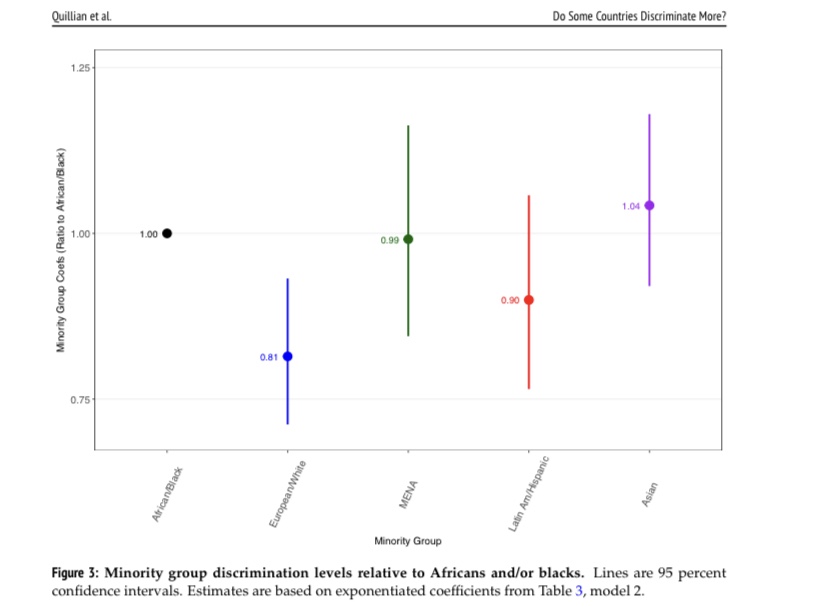
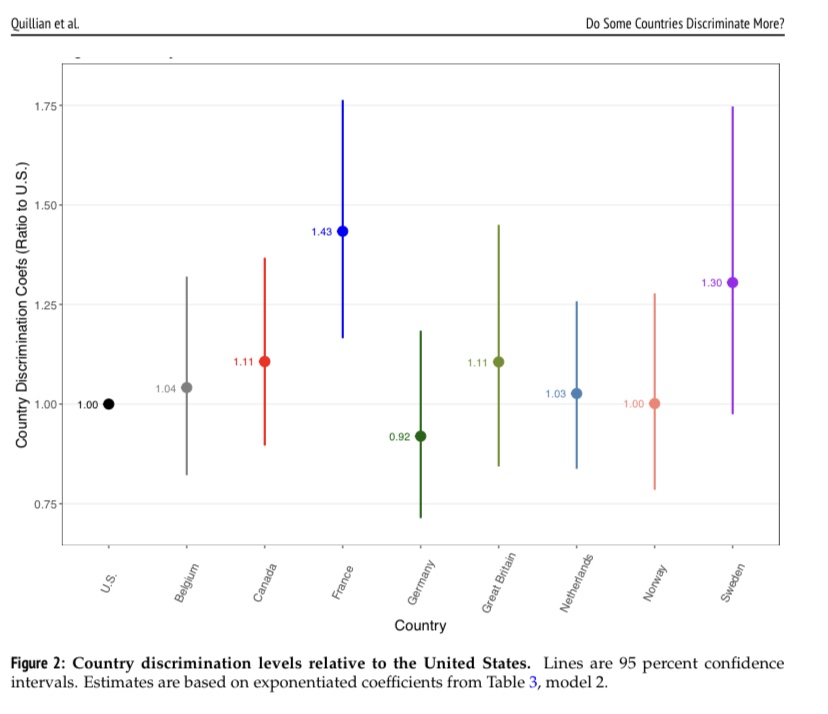
The study’s point estimates indicated “ubiquitous hiring discrimination”, though not all the estimates were statistically significant. My apologies if the chart below is difficult to read. If so, try zooming in, clicking on it, or following the link to the study above.

Some of the largest point estimates were highly imprecise due to less coverage by individual studies. The impacted groups and severity varied across countries. Blacks suffered significant discrimination in the U.S., Canada, France, and Great Britain. For Hispanics, the only coverage was in the U. S. and sparsely in Canada. The point estimates showed discrimination in both counties, but it was (barely) significant only in the U.S. For Middle Eastern and North African (MENA) applicants, discrimination was severe in France, the Netherlands, Belgium, and Sweden. Asian applicants faced discrimination in France, Norway, Canada, and Great Britain.

Across all countries, the group suffering the least hiring discrimination was white immigrants, followed by Latin Americans / Hispanics (but only two countries were covered). Asians seemed to suffer the most discrimination, though not significantly more than Blacks (and less in the U.S. than in France, Norway, Canada, and Great Britain). Blacks and MENA applicants suffered a bit less than Asians from hiring discrimination, but again, not significantly less.

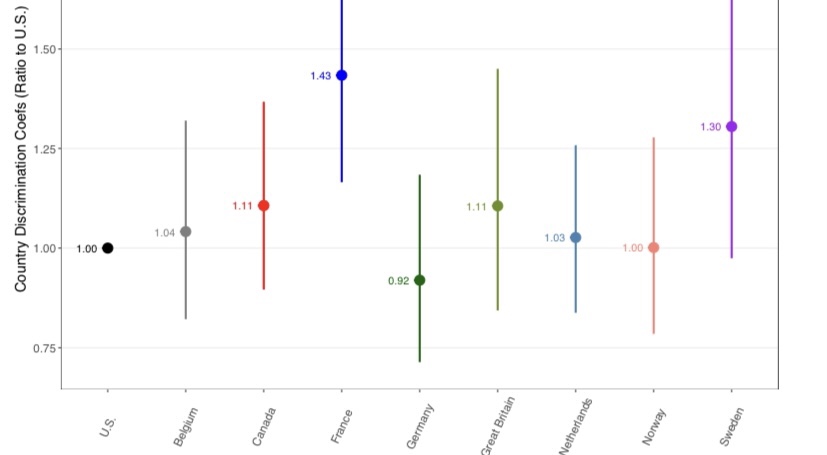
Comparing countries, the authors used U.S. hiring discrimination as a baseline, assigning a value of one. France had the most severe hiring discrimination and at a high level of significance. Sweden was next highest, but it was not significantly higher than in the U.S. Belgium, Canada, the Netherlands and Great Britain had higher point estimates of overall discrimination than the U. S., though none of those differences were significant. Employers in Norway were about as discriminatory as the U.S., and German employers were less discriminatory, though not significantly.

The upshot is that as a group, U.S. employers are generally at the low end of the spectrum in terms of discriminatory hiring. Again, the intent of this research was not to single out the selected countries. Rather, these countries were chosen because relevant studies were available. In fact, Tabarrok makes the following comment, which the authors probably wouldn’t endorse and is admittedly speculative, but I suspect it’s right:

“I would bet that discrimination rates would be much higher in Japan, China and Korea not to mention Indonesia, Iraq, Nigeria or the Congo. Understanding why discrimination is lower in Western capitalist democracies would reorient the literature in a very useful way.”

So the U.S. is not on the high-side of this set of Western countries in terms of discriminatory hiring practices. While discrimination against blacks and Hispanics in the U.S. appears to be a continuing phenomenon, overall hiring discrimination in the U.S. is, at worst, comparable to many European countries.

To anticipate one kind of response to this emphasis, the U.S. is not alone in its institutional efforts to reduce discrimination. In fact, the study’s authors say:

“A fairly similar set of antidiscrimination laws were adopted in North America and many Western European countries from the 1960s to the 1990s. In 2000, the European Union passed a series of race directives that mandated a range of antidiscrimination measures to be adopted by all member states, putting their legislative frameworks on racial discrimination on highly similar footing.”

Despite these similarities, there are a few institutional details that might have some bearing on the results. For example, France bans the recording and “formal discussion” of race and ethnicity during the hiring process. (However, photos are often included in job applications in European countries.) Does this indicate that reporting mandates and prohibiting certain questions reduce hiring discrimination? That might be suggestive, but the evidence is not as clear cut as the authors seem to believe. They cite one piece of conflicting literature on that point. Moreover, it does not explain why Great Britain had a greater (and highly significant) point estimate of discrimination against Asians, or why Canada and Norway were roughly equivalent to France on this basis. Nor does it explain why Sweden and Belgium did not differ from France significantly in terms of discrimination against MENA applicants. Or why Canada was not significantly different from France in terms of hiring discrimination against Blacks. Overall, discrimination in Sweden was not significantly less than in France. Still, at least based on the three applicant groups covered by studies of France, that country had the highest overall level of discrimination. France also had the most significant departure from the U.S., where recording the race and ethnicity of job applicants is institutionalized.

Germany had the lowest overall point estimates of hiring discrimination in the study. According to the authors, employers in German-speaking countries tend to collect a fairly thorough set of background information on job applications. This detail can actually work against discrimination in hiring. Tabarrok notes that so-called “ban the box” policies, or laws that prohibit employers from asking about an applicant’s criminal record, are known to result in greater racial disparities in hiring. The same is true of policies that threaten sanctions against the use of objective job qualifications which might have disparate impacts on “protected” groups. That’s because generalized proxies based on race are often adopted by hiring managers, consciously or subconsciously.

Discrimination in hiring based on race and ethnicity might actually be reasonable when a job entails sensitive interactions requiring high levels of trust with members of a minority community. This statement acknowledges that we do not live in a perfect world in which racial and ethnic differences are irrelevant. Still, aside from exceptions of that kind, overt hiring discrimination based on race or ethnicity is a negative social outcome. The conundrum we face is whether it is more or less negative than efforts to coerce nondiscrimination on those bases across a broad range of behaviors, most of which are nondiscriminatory to begin with, and when interventions often have perverse discriminatory effects. Policymakers and observers in the U.S. should maintain perspective. Discriminatory behavior persists in the U.S., especially against Blacks, but some of this discrimination is likely caused by prohibitions on objective tests of relevant job skills. And as the research discussed above shows, employers here appear to be a bit less discriminatory than those in most other Western democracies.

American Homicide Rates: Which America?

12 Thursday Oct 2017

Posted by Nuetzel in Discrimination, Gun Control, Immigration

≈ 1 Comment

Tags

Affirmative Action, Assimilation, Bretigne Shaffer, Diversity, Economic Mobility, Heterogeneity, Illegal Immigration, On the Banks, Rent Controls, Ryan McMaken, School Choice, Segregation, Sponsorship, Violent Victimization, War on Drugs

A heterogenious society and the successful assimilation of minorities are two very different things, as much as we might wish otherwise. Two populations within a region will come into contact, but conditions promoting real assimilation are complex. (I’m avoiding use of the term “diversity” because it has come to imply the successful assimilation of distinct groups.) While cultural differences can enrich the lives of both populations, sharp economic gaps between minority and majority populations (and even some cultural differences) will tend to slow the process of assimilation. This is often associated with social dysfunction, such as high crime and homicide rates, especially among the minority group. This is a fairly common phenomenon in countries with racial and ethnic minority or immigrant populations, as Ryan McMaken writes in a recent piece on international differences in heterogeneity and homicide rates.

Heterogeneity In the West

Countries in the Western Hemisphere tend to have relatively high immigrant and minority populations, as McMaken describes:

“… when considering the Americas, … nation-states are in most cases frontier states with populations heavily affected by immigration, a history of conflict with indigenous populations, and institutionalized chattel slavery that lasted until the 19th century. The factors are significant through the region, and the United States cannot be held apart in this regard from the Caribbean, Brazil, Colombia, and other states impacted by all these factors. 

Importantly, these factors also make the Americas significantly different from Western Europe and other areas — Japan and Korea, for example — where the present situation is marked by much higher levels of cultural uniformity and quite different recent histories and current demographic trends.“

Homicides

McMaken questions popular theories of cross-country differences in homicide rates based on the degree of gun control and gun ownership rates. Homicides and violent victimization have been declining in the U.S. for many years even as gun ownership has soared. Furthermore, international comparisons are traditionally plagued by arbitrary country classifications and exclusions, as well as inconsistent definitions of homocide and gun ownership. However, McMaken points to other explanations for violent crime found to be fairly robust in the academic literature: poverty and population heterogeneity:

“… these factors contribute to lower levels of social cohesion, and thus higher levels of criminality and other socially-undesirable behaviors.“

McMaken cites research involving ethnic minority populations of Slavs in Germany, Italians in Argentina and the U.S., and Arabs in Europe, all of whom had crime rates far exceeding those in their countries of origin. The connection between heterogeneity and crime might have nothing to do with particular ethnic groups, though it seems all too easy for observers within individual countries to blame specific “others” for crime. It is a symptom of alienation from the majority as well as economic desperation and vulnerability to opportunities and threats arising from the underground economy. Illegal activities might truly provide the best alternatives available to low-skilled, minority job seekers. Needless to say, underground economic activity, such as the drug trade, involves high risk and often violence among users and between competing factions. This is an important source of the high crime and victimization that typifies many minority communities.

Despite declines since the 1970s, the U.S. still has a higher homicide rate than many other industrialized countries. Beyond the weakness cited above, such comparisons fail to control for other confounding effects, including the degree of heterogeneity across countries.

Policies

Heterogeneity poses a problem in the context of involuntary and often voluntary segregation of sub-cultures. If you don’t believe the “voluntary” part, take a close look at the different clusters of individuals in the cafeteria at almost any “diverse” university or corporate office. Judge for yourself. Differences in language, fertility, demographics, religion and cultural traditions may be noteworthy, but where crime is associated with effectively segregated minorities, there is usually a gap in economic status and mobility relative to society at large.

What policies can mitigate these conditions and their impact on crime? It would be nice to approach this question strictly from the perspective that heterogeneity is a given, but the degree of heterogeneity is, to some extent, an endogenous outcome. Restrictive immigration policies might leap to mind as a way of restraining heterogeneity, and there is little doubt that illegal immigrants are less likely to assimilate (many contend that their crime rate is low). Policies allowing less restricted flows of legal immigrants tend to be salutary if they are based on domestic economic need, economic potential, or compassion for those seeking asylum or a haven from political oppression. A legal immigrant receiving a welcome on new shores is more likely to assimilate successfully than an illegal immigrant, all else equal. Citizenship and language education are avenues through which assimilation might be encouraged. And there could be ways to improve sponsorships and even temporary visa programs so as to encourage assimilation.

What can be done to encourage more effective assimilation of all minorities? And what can be done to reduce the crime associated with unassimilated populations? One major corrective is a strong economy. Policies that encourage economic growth will lead to greater participation in markets and society, with consequent interaction and mixing of sub-cultures. Growth policies include low and non-distortionary taxes and light regulation.

The war on drugs also accounts for a major share of homicides, and that war interacts with non-assimilation in perverse ways. It is crippling to disadvantaged communities precisely because it creates risky “opportunities” in the underground economy. It also produces high levels of incarceration and dangerous forms of “cut” contraband. As I’ll discuss in my next post, ending the war on drugs would reduce violent crime and lead to safer drugs in relatively short order.

A short list of other policies that would foster assimilation and economic mobility would include: improved education: school choice and apprenticeship programs; better labor market outcomes: reduce the minimum wage or create sub-minimum wage categories to enhance opportunities to gain experience and skills; better housing: eliminate rent controls.

Assimilation is always more effective when it occurs “organically”. Affirmative action and forced diversity initiatives often fail to achieve effective assimilation. Beyond the obvious infringement on liberty, these policies may sow resentment among those who suffer reverse discrimination, and among those who witness it, to the probable detriment of efforts to eliminate bias. Even worse, these policies often put their intended beneficiaries into vulnerable, un-winnable situations: jobs or programs for which their skills are not adequate. There are undoubtedly excellent candidates among those placed in positions under quotas, but there is a likelihood that many will be unsuccessful in their roles.

Conclusion

The anti-gun left is eager to attribute differences in homicide rates to the impact of gun control policies, but a close examination of the facts reveals better explanations. A prominent factor contributing to differences in homicide rates is the degree of heterogeneity across countries. Those with more homogeneous populations tend to have lower homicide rates and vice versa. But the problem is not merely heterogeneity, but the difficulty of economic and cultural assimilation of minority populations. These factors appear to lead to greater crime within many minority populations. The U.S. is not unique in its experience with high minority crime rates, but it is a relatively heterogenous nation. This is an important factor in explaining why the homicide rate tends to be higher in the U.S. than in other industrialized countries. To close, I’ll offer something cogent from Bretigne Shaffer’s On the Banks blog, in which she offers this quote from an individual named Michael Owen (the soccer player?):

“... we don’t really have a single America with a moderately high rate of gun deaths. Instead, we have two Americas, one of which has very high rates of gun ownership but very low murder rates, very comparable to the rest of the First World democracies such as those in western & northern Europe, Australia, New Zealand, Canada, Japan, South Korea. The other America has much lower rates of gun ownership but much, much higher murder rates, akin to violent third world countries.“

The Comparative Diversity of Ferguson, Missouri

19 Tuesday Aug 2014

Posted by Nuetzel in Uncategorized

≈ Leave a comment

Tags

Diversity, Ferguson Mo, Hoover Institution, Jonathan Rodden, MIchael Brown, Segregation, St. Louis County

ferguson-missouri 

I live in the St. Louis area, and like almost everyone in the region, I am disturbed by the unfortunate series of recent events in Ferguson, an “inner ring” suburb in St. Louis County. I found this post, “Is segregation the problem in Ferguson?” to be a good analysis of the degree of racial integration in Ferguson and in St. Louis County (which is separate from the city of St. Louis, the latter being essentially its own “county”). The author, Jonathan Rodden of The Hoover Institution, is a graduate of nearby McCluer North High School, part of the Ferguson-Florrissant School District. The post contains some nice maps and charts that shed light on the question of local diversity.

Rodden emphasizes the high degree of integration in Ferguson relative to St. Louis County, countering the notion that a lack of diversity has caused problems in Ferguson:

“While most of St. Louis County’s residents live in municipalities that are either homogeneous or internally segregated or both, Ferguson and its North County neighbors stand out for their relative heterogeneity and internal desegregation. Moreover, the income gap between blacks and whites is smaller in these municipalities than elsewhere.”

Rodden notes that much of the unrest has been focused on minimal African American representation on the city’s police force and in city government:

“The immediate problem in Ferguson is neither residential segregation nor its demise. Rather, as many have pointed out, it is that the racial integration of the community has not been reflected in the municipal government and police force, whose racial composition still reflects the status quo of the 1980s.”

He places some blame on certain interest groups who manipulate the election cycle: 

“Recent research by political scientists has shown that small but well-organized interest groups, such as unionized teachers and municipal workers, benefit handsomely from low-turnout off-cycle elections. Historically, off-cycle elections have been a favored strategy of established ethnic groups in American cities who wished to keep immigrants and minorities out of power.”

However, ultimately voter turnout is up to voters, so electing satisfactory representation should not be an insurmountable challenge within the existing system. Another quibble I have is that Rodden almost implies that the process of hiring a more diverse police force can be accomplished fairly easily and quickly. Such a change would probably have to occur through attrition of the existing force, which would take time. 

Follow Sacred Cow Chips on WordPress.com

Recent Posts

  • Immigration and Merit As Fiscal Propositions
  • Tariff “Dividend” From An Indigent State
  • Almost Looks Like the Fed Has a 3% Inflation Target
  • Government Malpractice Breeds Health Care Havoc
  • A Tax On Imports Takes a Toll on Exports

Archives

  • December 2025
  • November 2025
  • October 2025
  • September 2025
  • August 2025
  • July 2025
  • June 2025
  • May 2025
  • April 2025
  • March 2025
  • February 2025
  • January 2025
  • December 2024
  • November 2024
  • October 2024
  • September 2024
  • August 2024
  • July 2024
  • June 2024
  • May 2024
  • April 2024
  • March 2024
  • February 2024
  • January 2024
  • December 2023
  • November 2023
  • August 2023
  • July 2023
  • June 2023
  • May 2023
  • April 2023
  • March 2023
  • February 2023
  • January 2023
  • December 2022
  • November 2022
  • October 2022
  • September 2022
  • August 2022
  • July 2022
  • June 2022
  • May 2022
  • April 2022
  • March 2022
  • February 2022
  • January 2022
  • December 2021
  • November 2021
  • October 2021
  • September 2021
  • August 2021
  • July 2021
  • June 2021
  • May 2021
  • April 2021
  • March 2021
  • February 2021
  • January 2021
  • December 2020
  • November 2020
  • October 2020
  • September 2020
  • August 2020
  • July 2020
  • June 2020
  • May 2020
  • April 2020
  • March 2020
  • February 2020
  • January 2020
  • December 2019
  • November 2019
  • October 2019
  • September 2019
  • August 2019
  • July 2019
  • June 2019
  • May 2019
  • April 2019
  • March 2019
  • February 2019
  • January 2019
  • December 2018
  • November 2018
  • October 2018
  • September 2018
  • August 2018
  • July 2018
  • June 2018
  • May 2018
  • April 2018
  • March 2018
  • February 2018
  • January 2018
  • December 2017
  • November 2017
  • October 2017
  • September 2017
  • August 2017
  • July 2017
  • June 2017
  • May 2017
  • April 2017
  • March 2017
  • February 2017
  • January 2017
  • December 2016
  • November 2016
  • October 2016
  • September 2016
  • August 2016
  • July 2016
  • June 2016
  • May 2016
  • April 2016
  • March 2016
  • February 2016
  • January 2016
  • December 2015
  • November 2015
  • October 2015
  • September 2015
  • August 2015
  • July 2015
  • June 2015
  • May 2015
  • April 2015
  • March 2015
  • February 2015
  • January 2015
  • December 2014
  • November 2014
  • October 2014
  • September 2014
  • August 2014
  • July 2014
  • June 2014
  • May 2014
  • April 2014
  • March 2014

Blogs I Follow

  • Passive Income Kickstart
  • OnlyFinance.net
  • TLC Cholesterol
  • Nintil
  • kendunning.net
  • DCWhispers.com
  • Hoong-Wai in the UK
  • Marginal REVOLUTION
  • Stlouis
  • Watts Up With That?
  • Aussie Nationalist Blog
  • American Elephants
  • The View from Alexandria
  • The Gymnasium
  • A Force for Good
  • Notes On Liberty
  • troymo
  • SUNDAY BLOG Stephanie Sievers
  • Miss Lou Acquiring Lore
  • Your Well Wisher Program
  • Objectivism In Depth
  • RobotEnomics
  • Orderstatistic
  • Paradigm Library
  • Scattered Showers and Quicksand

Blog at WordPress.com.

Passive Income Kickstart

OnlyFinance.net

TLC Cholesterol

Nintil

To estimate, compare, distinguish, discuss, and trace to its principal sources everything

kendunning.net

The Future is Ours to Create

DCWhispers.com

Hoong-Wai in the UK

A Commonwealth immigrant's perspective on the UK's public arena.

Marginal REVOLUTION

Small Steps Toward A Much Better World

Stlouis

Watts Up With That?

The world's most viewed site on global warming and climate change

Aussie Nationalist Blog

Commentary from a Paleoconservative and Nationalist perspective

American Elephants

Defending Life, Liberty and the Pursuit of Happiness

The View from Alexandria

In advanced civilizations the period loosely called Alexandrian is usually associated with flexible morals, perfunctory religion, populist standards and cosmopolitan tastes, feminism, exotic cults, and the rapid turnover of high and low fads---in short, a falling away (which is all that decadence means) from the strictness of traditional rules, embodied in character and inforced from within. -- Jacques Barzun

The Gymnasium

A place for reason, politics, economics, and faith steeped in the classical liberal tradition

A Force for Good

How economics, morality, and markets combine

Notes On Liberty

Spontaneous thoughts on a humble creed

troymo

SUNDAY BLOG Stephanie Sievers

Escaping the everyday life with photographs from my travels

Miss Lou Acquiring Lore

Gallery of Life...

Your Well Wisher Program

Attempt to solve commonly known problems…

Objectivism In Depth

Exploring Ayn Rand's revolutionary philosophy.

RobotEnomics

(A)n (I)ntelligent Future

Orderstatistic

Economics, chess and anything else on my mind.

Paradigm Library

OODA Looping

Scattered Showers and Quicksand

Musings on science, investing, finance, economics, politics, and probably fly fishing.

  • Subscribe Subscribed
    • Sacred Cow Chips
    • Join 128 other subscribers
    • Already have a WordPress.com account? Log in now.
    • Sacred Cow Chips
    • Subscribe Subscribed
    • Sign up
    • Log in
    • Report this content
    • View site in Reader
    • Manage subscriptions
    • Collapse this bar
 

Loading Comments...