• About

Sacred Cow Chips

Sacred Cow Chips

Tag Archives: Warren Meyer

Don’t Cry for the Former Taxi Monopoly

23 Friday Mar 2018

Posted by Nuetzel in competition, monopoly, Technology, Uncategorized

≈ Leave a comment

Tags

Cartel, Consumer Surplus, Creative Destruction, Human capital, Lyft, Mark Perry, Ride sharing, Taxi Medallions, Taxi Monopoly, Uber, Warren Meyer

It would be odd to argue that innovation is not unequivocally positive, that its costs will exceed its benefits. Certainly there are downsides: human capital invested in the methods and technologies supplanted by an innovation is devalued, jobs may be lost, retraining becomes necessary, and even consumers must get used to new ways of doing things, which is not costless. But most of these costs are temporary. And when an innovation eliminates an incumbent’s monopoly, the former monopolist’s profit ends up back in the pockets of consumers.

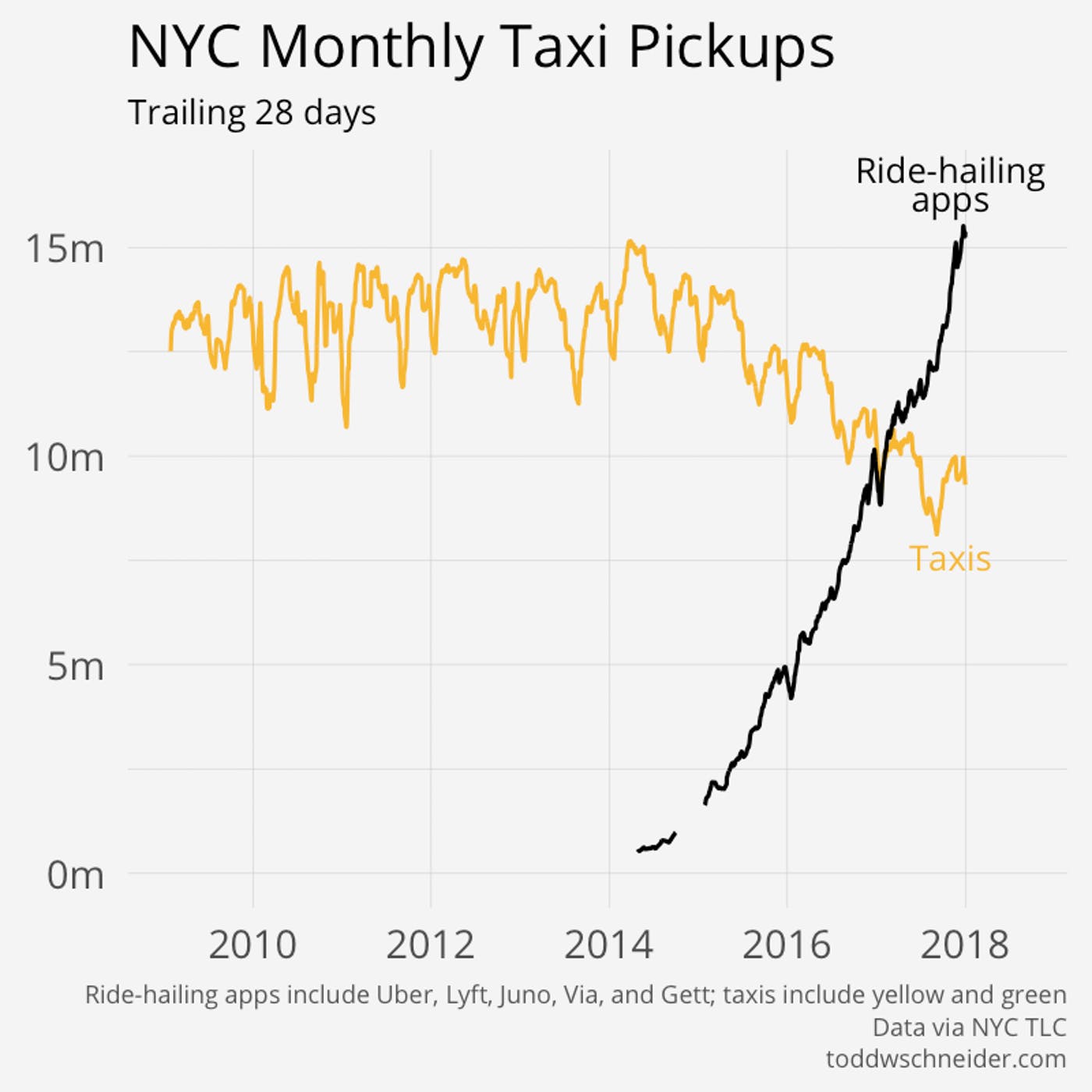
People do seem to focus excessively on the downside of innovation without carefully tallying the benefits. For example, this article focuses on the loss of New York City taxi pickups since ride sharing services like Uber and Lyft began to have an impact in 2014. Mark Perry reproduces a chart from that article, which is featured above. The number of monthly taxi rides in NYC has fallen by about one-third since then, from an average of 13+ million to about 9 million in 2017. In fact, Perry reports that the market for taxi medallions has tanked since then as well, with plunging medallion prices and many medallions sold out of bankruptcy and foreclosure. But don’t be too quick to shed tears for a monopoly lost.

The same chart shows the massive upside to ride sharing, as discussed here by Warren Meyer. The size of the total market has nearly doubled, from about 13 million per month to roughly 24 million (adding the two lines together). And it was a quick transition! That’s what happens when real competition is introduced to a market: prices fall and quantity increases, with an attendant increase in the welfare of consumers. That increase always exceeds the loss suffered by the former monopolist or cartel (as the case may be), which was earning excessive profits at the expense of consumers before the innovation had a market impact. And many former taxi drivers have made the switch to ride sharing providers, and they seem to prefer it for the flexibility and autonomy it offers. Yes, the best innovations benefit workers as well as consumers.

Competition can bloom when government opens markets to competitors or when an innovation creates new alternatives for consumers. In the case of ride sharing, both were necessary. For many years, NYC restricted the supply of taxi medallions, which kept taxi fares artificially high. The formal approval of ride sharing services in the city was not uncontested. But once it was approved, consumers took advantage of superior dispatching and payment technologies enabled by their smart phones, as well as security features and rating systems, not to mention lower fares. Again, these developments have contributed massively to consumer well-being, which is ultimately the point of all economic activity. Traditional taxis have to try to keep up. The ride sharing industry has inflicted the kind of creative destruction for which consumers are quite grateful.

The Master Negotiator: I’ll Beat Myself Till You Accept My Terms!

07 Wednesday Mar 2018

Posted by Nuetzel in Free Trade, Tariffs, Trump Administration

≈ Leave a comment

Tags

Balance of Trade, Chinese Trade Policy, Coyote Blog, Cronyism, Donald Trump, Dumping, NAFTA, National Security, Panda Blog, Peter Navarro, Pierre Lenieux, Protectionism, Stephen Mihm, Tariffs, Trade Retaliation, Trade War, Warren Meyer, Wilbur Ross

As if you needed more evidence that governments are incompetent, look no further than trade policy: public officials the world over are almost universally ignorant regarding the effects of international trade and trade imbalances. In this sense, the Trump Administration’s new tariffs on imported steel and aluminum are in keeping with the long history of public sector foibles on trade. This phenomenon stems from an unhealthy and obsessive focus on the well-being of producers without regard to the implications of policy for consumers. Warren Meyer of Coyote Blog offers an evaluation of Chinese trade policy, which he mischievously (I believe) claims was written by a Chinese blogger on a “sister blog” called “Panda Blog“. Despite Meyer’s playfulness, the post is instructive:

“Our Chinese government continues to pursue a policy of export promotion, patting itself on the back for its trade surplus in manufactured goods with the United States. The Chinese government does so through a number of avenues, … each and every one of these government interventions subsidizes US citizens and consumers at the expense of Chinese citizens and consumers. A low yuan makes Chinese products cheap for Americans but makes imports relatively dear for Chinese. So-called ‘dumping’ represents an even clearer direct subsidy of American consumers over their Chinese counterparts. And limiting foreign exchange re-investments to low-yield government bonds has acted as a direct subsidy of American taxpayers and the American government, saddling China with extraordinarily low yields on our nearly $1 trillion in foreign exchange. Every single step China takes to promote exports is in effect a subsidy of American consumers by Chinese citizens.“

The very idea of a trade deficit is often used to intimate a threat to a nation’s economic health. Conversely, a trade surplus is used to suggest that a nation is achieving great economic success. Both contentions are nonsense. Here is more from “Panda Blog“:

“We at Panda Blog believe it is insane for our Chinese government to continue to chase the chimera of ever-growing foreign exchange and trade surpluses. These achieved nothing lasting for Japan and they will achieve nothing for China. In fact, the only thing that amazes us more than China’s subsidize-Americans strategy is that the Americans seem to complain about it so much. They complain about their trade deficits, which are nothing more than a reflection of their incredible wealth. … They complain about China buying their government bonds, which does nothing more than reduce the costs of their Congress’s insane deficit spending. They even complain about dumping, which is nothing more than a direct subsidy by China of lower prices for American consumers.

And, incredibly, the Americans complain that it is they that run a security risk with their current trade deficit with China! This claim is so crazy, we at Panda Blog have come to the conclusion that it must be the result of a misdirection campaign by CIA-controlled American media. After all, the fact that China exports more to the US than the US does to China means that by definition, more of China’s economic production is dependent on the well-being of the American economy than vice-versa.“

By the way, those “quotes” from “Panda Blog” appeared on Coyote Blog 12 years ago!

All nations tend to play these trade games to one extent or another. But protectionist actions always harm a nation’s consumers more than they help producers, a proposition that is easy to demonstrate using a simple supply and demand diagram. While the class of consumers is broader than the class of producers, ultimately “producer” and “consumer” are different roles played by the same individuals. So protectionism is always harmful to a nation, on balance. Furthermore, retaliation against another nation for its dim-witted trade barriers also harms the retaliating nation’s consumers more than it helps its producers, and that’s true regardless of whether retaliation begets reciprocal actions.

Of course, producers are generally in a better position than consumers to grease the political skids in their favor. In a separate post, Meyer notes that protectionist trade policies are rooted in cronyism. The costs to society are very real, but they tend to be diffuse and therefore less obvious to most consumers.

“A lot of the media seems to believe the biggest reason they are bad is that they will incite retaliatory tariffs from other countries, which they almost certainly will.  But even if no one retaliated, even if the tariffs were purely unilateral, they would still be bad. In case after case, they are justified as increasing the welfare of a certain number of workers in targeted industries, but they hurt the welfare of perhaps 100x more people who consume or work for companies that consume the targeted products. Prices will rise for everyone and choices will be narrowed.“

A couple of points deserve emphasis in relation to my last post on Trump’s tariff action:

  • In terms of jobs, the tariffs announced by President Trump present a very poor risk-reward tradeoff (WSJ article is gated):

“The policy point is that Mr. Trump’s tariffs are trying to revive a world of steel production that no longer exists. He is taxing steel-consuming industries that employ 6.5 million and have the potential to grow more jobs to help a declining industry that employs only 140,000.“

  • Stephen Mihm discusses ways in which the U.S. steel industry squandered its superiority in the post-World War II era. Much of Mihm’s article is devoted to the industry’s failure to upgrade to new production technologies. Interestingly, however, it fails to mention the damaging role played by unions in the process. “Dumping” had very little to do with it.
  • Finally, Pierre Lemieux takes a closer look at the national security argument for trade barriers. He concludes that it is fallacious. Of course, it is an excuse for cronyism. Protectionism harms the competitiveness of the protected industries, which actually undermines national security. And protectionism is usually unnecessary on close examination. In the case of steel, for example, national defense and homeland security use only about 3% of American steel production. Beyond that simple fact, the argument is dangerously open-ended. Almost anything can be represented as critical to national security: steel, food, clothing, and many other categories. Even human resources.

Today, Trump announced that Canada and Mexico will be exempt from the new tariffs while a renegotiation of the North American Free Trade Agreement (NAFTA) is underway. That’s better, but this carve-out exempts only 25% of U.S. steel imports. Perhaps Australia will be granted an exemption as well, but additional carve-outs will prompt further increases in tariffs on non-exempt imports. Trump also said that U.S. flexibility in applying the new tariffs to allies will depend on their commitments for military spending!

Thus, rather than maintaining the pretense that trade relationships are about economics, the administration has conceded that the tariffs and the exemption process will be transparently political, never a prescription for efficient resource allocation. Moreover, U.S. trading partners are likely to be reluctant to test the politics of modifying their own trade manipulations at home. Indeed, the politics may dictate retaliation, rather than concessions. In any case, the governments of our trading partners are as clueless on trade as Trump, his Commerce Secretary Wilbur Ross, and his economic advisor Peter Navarro, or they would never intervene in private trade decisions to begin with.

Electric Cars: EPA Serves Up Green Kool-Aid To Pair With Subsidies

03 Tuesday Oct 2017

Posted by Nuetzel in Environment, Subsidies, Technology

≈ Leave a comment

Tags

Coyote Blog, Electric Cars, Energy Efficiency, Energy Losses, Environmental Protection Agency, EPA, Eric Schmidt, Fossil fuels, MPG Conversion Factor, MPGe, Storage Density, Tesla, Transmission Losses, Warren Meyer

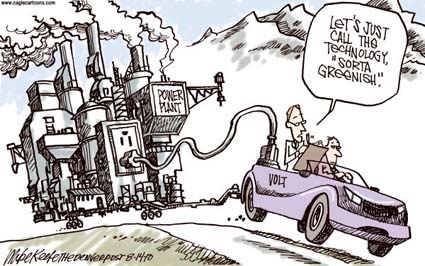
Electric cars don’t save much energy over gas-burners if at all, at least for now. Warren Meyer’s recent Coyote Blog post on this topic is aptly titled “Why Is It So Hard To Get Even Smart People To Think Clearly On Electric Vehicle Efficiency“. Meyer begins by quoting the following tweet from Google smarty Eric Schmidt, which typifies the general level of public awareness regarding the supposed energy savings from electric cars produced by Tesla and many others:

“Electric motors are the unsung hero of clean energy – the latest are 97% efficient, vs. 45% for internal combustion.“

Meyer emphasizes these major points:

  1. the efficiency with which source fuels are converted to physical work via electric and gas-burning cars is more comparable than Schmidt’s tweet suggests;
  2. differences in energy density weigh heavily in favor of fuel-burning vehicles.
  3. the so-called miles-per-gallon equivalent (MPGe) calculated by the U.S. Environmental Protection Agency (EPA) is a sham.

First, Schmidt’s tweet is accurate only if the discussion is confined to simple conversion of energy to physical work performed by the respective engines. The tweet ignores energy losses that occur prior to that conversion: electricity must be generated with far less than 100% efficiency, mainly by burning coal and natural gas. In an earlier Forbes article, Meyer compares this situation to a distorted comparison of two refrigerator installers:

“In both cases the customer lives in a fourth floor walkup. The first installer finds the refrigerator has been left on the street. He has to … haul the appliance up four flights of stairs. After that, relatively speaking, the installation is a breeze. The second installer finds his refrigerator has thoughtfully been delivered right to the customer’s door on the fourth floor. He quickly brings the unit inside and completes the installation. So who is a better installer?“

The fact is that both gas-burning and electric vehicles rely heavily on fossil fuels. And, in addition to losses in the generation process, there are other losses of energy attributable to electric cars: transmission of power involves a significant energy loss, as does charging batteries and storage itself. Meyer considers only the extra losses from production and transmission of electricity in the following comparison:

“We take 97% times 90% transmission efficiency times 50% electricity production efficiency equals 43.6%.  This is actually less than his 45% figure.  By his own numbers, the electric motor is worse….“

Meyer qualifies this comparison, as some of his assumptions are of the “best outcome” variety, but contrary to Schmidt’s assertion, gasoline and electric engines are reasonably comparable in terms of energy efficiency.

Some contend, however, that power losses in electricity transmission are much larger than the 10% Meyer assumes (see the comments on his post). Battery charging involves a loss of perhaps 20%. And a replacement for a Tesla battery, post 8-year warranty, is $8,000 – $12,000, an additional storage “cost” that is virtually non-existent for gas-powered vehicles. Beyond a certain point in its life, that cost will have an impact on a Tesla’s resale value. Moreover, some contend that the production of electric vehicles is more energy-intensive, putting them in an energy efficiency hole right from the get-go.

Meyer then takes up the notion of storage density as an explanation for why early experiments with electric cars were essentially abandoned:

“15 gallons of gasoline weighs 90 pounds and takes up 2 cubic feet. This will carry a 40 mpg car 600 miles. The Tesla Model S 85kwh battery pack weighs 1200 pounds and will carry the car 265 miles (from this article the cells themselves occupy about 4 cubic feet if packed perfectly but in this video the whole pack looks much larger). We can see that even with what Musk claims is twice the energy density of other batteries, the Tesla gets  0.22 miles per pound of fuel/battery while the regular car can get 6.7. More than an order of magnitude, that is simply an enormous difference…“

Meyer notes in the Forbes article that the EPA calculates its MPG conversion factor for electric vehicles by dividing BTU’s in a gallon of gas by the BTUs in a kilowatt hour: 33.7 KwH per gallon. Thus, the EPA multiplies an electric car’s miles per KwH by 33.7 to arrive at the so-called MPG equivalent: MPGe. But as we’ve seen above, the conversion factor ignores the generation and transmission of electricity required at the front end, and the associated energy losses that occur before a single KwH is released by a Tesla battery.

Despite what we hear from the EPA, Tesla, and other interests today, electric cars have not really overcome these disadvantages, at least not yet. The EPA’s MPGe estimates are vastly inflated. Perhaps if they were accurate, these vehicles would not have to rely so heavily on taxpayer subsidies to be competitive. By extension, the presumed environmental benefits of electric cars are nonexistent at this stage of development. I’m certain that Eric Schmidt and many other smart people are capable of understanding these nuances, but they might be too busy tripping over their politics to bother.

Net Neutrality: Degradation For All

20 Tuesday Jun 2017

Posted by Nuetzel in Net neutrality, Regulation

≈ 1 Comment

Tags

Ajit Pai, Bronwyn Howell, Common Carriers, Consumer Surplus, Content Providers, Coyote Blog, FCC, Internet Backbone, ISPs, Net Neutrality, Netflix, Network Capacity, Network Congestion, Oligopoly, Price Discrimination, Tiered Rates, Tim Wu, Usage-Based Pricing, Warren Meyer

The FCC recently voted to reverse its earlier actions on so-called net neutrality, which would have treated internet service providers (ISPs) as “common carriers” and subjected them to detailed federal regulation of their services, pricing, and profits. Many believe net neutrality would ensure a sort of fairness and nondiscrimination on the internet, but it is actually a destructive regulatory regime under which certain firms are allowed to extract economic rents from the efforts of others. Warren Meyer has a nice take on this at Coyote Blog:

“Net Neutrality is one of those Orwellian words that mean exactly the opposite of what they sound like…. What [it] actually means is that certain people … want to tip the balance in this negotiation towards the content creators ….  Netflix, for example, takes a huge amount of bandwidth that costs ISP’s a lot of money to provide. But Netflix doesn’t want the ISP’s to be be able to charge for this extra bandwidth Netflix uses – Netflix wants to get all the benefit of taking up the lion’s share of ISP bandwidth investments without having to pay for it. Net Neutrality is corporate welfare for content creators.“

I made the same point almost three years ago in “The Non-Neutrality of Network Hogs“. Meyer emphasizes that in the net-neutrality fight, the primary tension is between content creators and ISPs (and transport providers), but it is like any other battle to capture the gains from a vertical supply chain. Think of suppliers of goods versus shippers, for example, or traditional publishers versus delivery services, or oil extraction versus refining. Ultimately, all of the various parties must cover their costs in order to survive, and obviously each would like to capture a larger share of the value from its stage of the production process. In a series of arms-length transactions, one might assume that their shares would correspond roughly to the value they add to the final product, but things are more complicated than that. Much depends on the competitive state of the market and on the cost structures faced by different parties.

While the ISPs are often said to exercise monopoly power, there are few if any local markets in which that is actually the case, even in rural areas. Almost everywhere in the U.S., local internet markets could be better described as oligopolistic: there are at least a couple of rival firms (and alternatives for consumers), even if the technologies are sometimes radically different, so some competition exists. The same is true of the internet backbone.

Obviously, content providers compete with one another in a large sense, but many popular forms of content are unique and consumers demand access to them through their ISPs. Therefore, some content providers exercise a degree of monopoly power. And they might also require a lot of bandwidth.

The nature of the costs faced by ISPs and content providers is quite different. The latter have a much lower proportion of fixed costs than ISPs, who must invest in network capacity. Ultimately, the costs of providing that capacity must be priced. At first blush, it seems natural for users of capacity to be billed proportionately, but allocating those costs over customers and over time is a complex undertaking. Like all problems in economics, however, network usage involves a scarce resource. A large increment to demand can lead to network congestion and higher costs, not only directly to the ISPs but to users experiencing a degradation in the speed and quality of their service. ISPs have traditionally had the flexibility to negotiate with large content providers, reaching mutually agreeable terms. That’s what brought us to the state of today’s internet, and most observers would say that it’s pretty damn good!

It is the network that makes all of these wonderful services possible. The ISPs provide and maintain that network, and they must provide for expansion of that network as traffic grows. It is important that ISPs have adequate incentives to do so. However, the form of regulation to which so-called common carriers are subjected is known historically for its failure to provide good incentives. That history goes back as far as 130 years in transportation and about 80 years in telecommunications. This is why many analysts, and FCC Chairman Ajit Pai, contend that common carrier status for ISPs, and “net neutrality”, would lead to shortfalls in network capacity and a deterioration in the quality of service. It would also reward large content providers (think Netflix) in the short term at the expense of ISPs, essentially giving the former access to the existing network at less than cost. That’s the whole idea for industry advocates of net netrality, of course. But in the end, net neutrality is a shortsighted goal, even for the content providers.

The content providers have made every effort to propagandize the public, stoking fears that the ISPs are treating certain kinds of traffic unfairly. Without net neutrality, would ISPs unfairly discriminate against certain kinds of content? Or against certain types of users? Price discrimination is one of the primary criticisms of the presumed behavior of ISPs in the absence of net neutrality. Economist Bronwyn Howell points out that price discrimination is not unusual, however, and is not necessarily undesirable. Indeed, consumers of internet, telephone, mobile, and cable TV services seem to prefer certain forms of price discrimination! Consumers with heavy usage who purchase flat rate monthly internet access pay a lower charge per Gb than light users. Consumers who purchase “bundles” of internet and voice service may benefit from price discrimination relative to those who choose not to bundle their services. Strictly usage-based pricing would prevent price discrimination on this basis, but few would advocate the abolition of bundled offers, which provide benefits in terms of flexibility of use and predictability of cost, yielding net welfare gains for many consumers at no incremental cost to others. Like all voluntary trade, these are positive sum transactions: consumers capture more  “surplus” value while ISPs earn a greater contribution to the fixed costs of the network.

When ISPs charge a data rate based on usage, consumers face a positive marginal cost on incremental data. As usage increases, its marginal value to the consumer declines; the consumer will not use data beyond the point at which its value equals the data rate they pay. That places a cap on consumer surplus (the area above the price and below the consumer’s demand curve). When the consumer faces a zero marginal cost (an unlimited data plan), their usage rises to the point at which its marginal value is zero. The total amount of “surplus” in that scenario is larger, and it is possible for an ISP to split the gain with the consumer by offering a price for unlimited usage. Thus, as long as the network capacity is in place, both parties are made better off! If not, the practice can lead to congestion, but competition for users often dictates that such packages be offered.

Especially in the presence of positive network externalities, it makes no sense for the ISPs, as a group, to price users or traffic out of the market, unless they are punished for doing otherwise at below cost. As always, pricing is an exercise in balancing costs with the benefits to potential buyers. It should remain a private and unfettered exercise ending only in trades that are mutually beneficial.

And what of network capacity and the big content providers? At the “price discrimination” link above, Howell says:

“… available bandwidth allowed Netflix to happen, not the other way around. But now, as Netflix comes to dominate existing bandwidth, leading to higher costs, it is causing externalities (delays) and higher costs (ISP fees are now rising in real terms in some markets) to pay for new capacity.“

Should the ISPs charge all customers higher rates in order to manage growth in traffic and fund new capacity? How can they allocate costs to the cost-causers? Usage-based data rates are one simple alternative. Tiered rates would act to minimize the extent to which light users are penalized. ISPs have also negotiated with individual content providers directly, reaching agreements to compensate ISPs for access to their customers. Tim Wu, the Columbia Law professor credited with coining the term “net neutrality”, was quoted at the last link bemoaning these types of deals:

“‘I think it is going to be bad for consumers,’ he added, because such costs are often passed through to the customer.“

Well, yes! Netflix charges its customers, and it will attempt to recover these payments for network capacity. Streaming is an integral component of the service they offer, and they cannot do it without the ISPs. Would Wu propose that the pipes be provided at less than cost?

Some have said that it is more economically efficient for ISPs to charge users directly for incremental short-run network “externalities” caused by large data demands. (Conceptually, it is better to think of these costs as long-run marginal costs of network expansion.) It may be that a tiered rate structure can approximate the optimal solution, and packages are often tiered by download speed. Nevertheless, passing costs along to large content providers is a viable approach to allocating costs as well.

Another argument is that small content providers cannot afford these payments. However, if they don’t generate a significant amount of traffic, they probably won’t have to negotiate special deals. If they grow to require a large share of the “pipe”, it would indicate that they have passed a market test. Ultimately, their customers should pay the costs of providing the capacity in one way or another.

Net neutrality and regulation of ISPs is the wrong approach to encouraging the growth and value delivered by the internet. It would stifle incentives to provide the needed capacity and to develop new network technologies. We certainly didn’t get here by treating the ISPs like public utilities. Rather, the process was facilitated by the freedom to experiment technologically and contractually. ISPs are well aware that the value of their networks are enhanced by ubiquity. Affordable access to a broad share of the population is in their best interest. In the end, consumers are sovereign and should be the sole arbiters of the value offered by ISPs and content providers. Regulators will promise to protect us, but the inevitable result will be a market hampered by rules that degrade the network, leading to substandard service and a less vibrant internet.

Parks, Prisons and Profits

30 Friday Sep 2016

Posted by Nuetzel in Government, Profit Motive

≈ Leave a comment

Tags

Ann Althouse, Bernie Sanders, Coyote Blog, Cronyism, Hillary Clinton, incentives, Morality of Profit, Netflix, Occupancy Guarantees, Orange Is the New Black, Private Operators, Private Park Operations, Private Prisons, Profit Motive, Reason Foundation, Sasha Volokh, The Volokh Conspiracy, Warren Meyer

img_3117

One of my favorite pastimes is tallying the economic and social death wishes espoused by leftists, populists and other statists. A frequent theme of their entreaties is the presumed ugliness of profits sought by private businesses. Their expressed distaste is usually couched in terms suggesting that profits are a certainty, which of course they are not. Profits are always at risk unless protected by government. The critics are sometimes focused on lines of business that involve public assets or a supposed public purpose, such as education. Two other examples of that nature recently came up in my news feed: privately-operated prisons and private management of public parks.

The complaints heard about these kinds of business operations are based on ill-founded notions about the function of profit: that it is appropriate for resources to earn rewards only in some endeavors and not others, regardless of the property invested and the risks assumed by the enterprise. Another fallacy is that somehow, as if by magic, the motives and competence of public employees are beyond question. In fact, the ineffective and sometimes perverse incentives faced by public institutions and employees tend to undermine effective performance. That’s the underlying reason why privatization of services is often in the public interest. The detractors of profit usually rely on anecdotal evidence of poor performance by private managers without any objective basis of comparison.

Warren Meyer at Coyote Blog discusses the common misconception held by many regarding the relative morality of profits and wages. His comments are in the context of the company he owns and manages, which operates public parks under contract with the US Forest Service (USFS) and other public agencies, collecting revenue via entry and camping fees. Meyer (and I) find it astonishing that the aversion to private park operations is so common:

“The most typical statement I hear from USFS employees that summarizes this opposition — and it is quite common to hear it — is that ‘It is wrong to make a profit on public lands.’ …. This general distaste for profit, which is seen as “dirty” in contrast to wages which are relatively ‘clean’ (at least up to some number beyond which they are dirty again), is not limited to the USFS or even to government agencies in general, but permeates much of the public.“

Meyer goes on to describe a conversation he had with a USFS District Ranger. I provide a few excerpts below:

“Me: If you think it’s wrong to make money on public lands, I assume you must volunteer, else you too would be making money on public lands.
Ranger: No, of course I get paid.
Me: Well, I know what I make for profit in your District, and I have a good guess what your salary probably is, and I can assure you that you make at least twice as much as me on these public lands.
Ranger: But that is totally different.
Me: How? … My profit is similar to your wage in that it is the way I get paid for my effort on this land — efforts that are generally entirely in harmony with yours as we are both trying to serve visitors and protect the natural resources here. But unlike your wage, my profit is also a return on the investment I have made. Every truck, uniform, and tool we use comes out of my profit, whereas you get all the tools you need paid for by your employer above and beyond your salary. Further, your salary is virtually guaranteed to you, short of some staggering malfeasance. Even if you do a bad job you likely would just get shunted to a less interesting staff position at the same salary, rather than fired. On the other hand if I do a bad job, or if one of my employees slips up, or even if some absolutely random occurrence entirely outside my control occurs (like, say, a flood that closes our operations) my profit can completely evaporate, or even turn into a loss. So like you, I get paid for my efforts here on public lands, but I have to take risk and make investments that aren’t required of you. So what about that makes my profit less honorable than your wage?
Ranger: Working on public lands should be a public service, not for profit
Me: Well, I think you are starting to make the argument again that you should be volunteering and not taking a salary. But leaving that aside, why is profit inconsistent with service to the public?”

Privatization is not inconsistent with service to the public except under one circumstance highlighted by Meyer in a postscript. The ranger might have asked:

“How do we know your profits are not just the rents from a corrupt, cronyist government contracting process?“

Of course, if that were true, it would not necessarily be worse than a park operated exclusively by a public agency with no incentive to operate efficiently. The key here is to have effective review of the contracting process and good performance incentives in place. Meyer notes that his company serves millions of visitors each year at high service levels for a cost that is low relative to government-operated parks, and the company receives excellent reviews. More power to him! Profits are not synonymous with graft. Unfortunately, the purely emotional “feeling” that profits are immoral or dishonorable is amplified by the public nature of park assets, and that idea won’t ever be purged from the populist mind.

Ann Althouse brought similar thoughts to mind in describing Hillary Clinton’s weakly-reasoned condemnation of privately-operated prisons. Here’s Hillary at the first presidential debate early this week, after expressing approval of the Obama Administration’s decision to phase out most privately-operated federal prisons:

“You shouldn’t have a profit motivation to fill prison cells with young Americans.“

You can almost hear Althouse, a law professor at the University of Wisconsin, laughing at the idea that operators of private correctional facilities have any ability “to fill prison cells”. That’s not how our justice system works, Hillary! Some argue that “occupancy guarantees” in private prison contracts give prosecutors an incentive to seek harsh sentences, but that is a tenuous argument, especially with prisons generally over-crowded as they are. And it isn’t as if private prisons are free of oversight. Althouse contends that Hillary Clinton’s position is a concession to the left made necessary by earlier outrage that the Clinton campaign had accepted contributions from the private prison industry, itself prompted by a Bernie Sanders’ attack on that point.

Reason Magazine commented on Sanders’ condemnation of private prisons last year, which then housed only about 12 percent of the federal prison population. Reason noted that closing private federal prisons would contribute to over-crowding at publicly-operated facilities. Sanders also proposed forcing state and local governments to close private prisons under their jurisdictions within two years. Not only would that action ignore objective measures of performance and cost, it would violate established contracts and constitute an outrageous overreach of federal authority.

The Administration’s decision to phase out private prisons was subjected to an even-handed critique by Sasha Volokh (younger brother of Eugene) in August. Volokh covers the evidence on costs and quality of private versus publicly-operated prisons. He finds that the DOJ memo announcing the decision to phase out private operators exaggerates cost and quality differences that favor government operations, and discounts evidence that favors private prisons. Reminiscent of Warren Meyer’s notes on privately-operated parks, Volokh stresses the importance of creating appropriate incentives for operators. Current quality incentives are weak, and he believes there is vast room for improvement:

“It might seem surprising, but private prisons have almost never been evaluated on their performance and compensated on that basis. …. In light of that, maybe it’s even surprising that private prisons have done as well as they have in the comparative studies. Be that as it may, the advent of performance-based contracting could open up possibilities for substantial quality improvements. This could work in the public sector too (bonus payments for public prison wardens?), but the private sector is probably better situated to take advantage of monetary incentives.“

The Reason Foundation published a report earlier this year entitled “Private Prisons: Quality Corrections at a Lower Cost“. The study reveals the leftist critique of private prisons to be a sham. Here are the two major takeaways:

“Private prisons save money-10 to 15 percent average savings on operations costs, based on fourteen independent cost comparison studies.

Private prisons provide at least the same quality services that government prisons do-based on six independent quality comparison studies, rates of American Correctional Association accreditation, recidivism comparison studies, contract terminations, and prisoner and correctional officer lawsuits.“

People often get their “facts” from questionable sources. As to privately-operated correctional facilities, I’ve heard critics state that people should watch the fictional Netflix serial “Orange Is the New Black” to gain a proper understanding of the horrors of private prisons. And many seem eager to accept that narrative without any knowledge of the facts. That’s probably because they have been taught that profits are “dirty”, that public purposes like the operations of parks and prisons are so pure of public purpose that private operators can have no legitimate role, and that government operation can be counted upon for quality and efficiency. Now doesn’t that sound oxymoronic?


Hamilton, Jefferson & Miranda’s Propaganda

12 Sunday Jun 2016

Posted by Nuetzel in Constitution, Slavery

≈ 2 Comments

Tags

13th Amendment, Abraham Lincoln, Alexander Hamilton, Bank of the United States, Ben Affleck, Central Bank, Charles Kessler, Commerce Clause, Corwin Amendment, Declaration of Independence, Hamilton on Broadway, James Madison, James Monroe, King George, Lin-Manuel Miranda, Manumission, Maria Reynolds, Michelle DuRoss, Necessary and Proper Clause, Raymond Burr, Ron Chernow, Spencer Kornhaber, State's Rights, The Atlantic, The Federalist Papers, Thomas Jefferson, Three-Fifths Compromise, Warren Meyer, Yeoman Farmer

image

I know too well to take any history I get from the theatre with a grain of salt! Nevertheless, I’d really like to see Hamilton on Broadway. It’s a hugely successful musical by Lin-Manuel Miranda about the life of Alexander Hamilton, one of our nation’s founding fathers, inspired by the book Alexander Hamilton by Ron Chernow. I’ve heard much of the show’s music, infused with R&B and rap/hip-hop; it’s more appealing to me than I’d ever have expected of rap. The show has been nominated for a record 16 Tony Awards (the ceremony is tonight), and of course it’s a very hot ticket. The last time I checked, the cheapest seats available were about $650 each for the last row in the house, and that was about 45 days out! With a party of four, that’s a cool $2,600 for an evening of theatre. I think we’ll wait for the touring production to roll through the midwest next year.

In Hamilton, all of the founding fathers are cast as people of color, a controversial decision that led to a recent uproar over a casting notice encouraging non-white performers to audition for leads. The casting of the founding fathers is an interesting artistic decision. One writer, Spencer Kornhaber in The Atlantic,  says that the “colorblind” casting:

“… is part of the play’s message that Alexander Hamilton’s journey from destitute immigrant to influential statesman is universal and replicable….“

That’s admirable, as far as it goes. I believe Kornhaber comes closer to Miranda’s  true motivation for the casting decision a paragraph later:

“… movements like Black Lives Matter, and renewed calls for the consideration of reparations, are built on the idea that ‘all’ remains an unfulfilled promise—and that fulfillment can only come by focusing on helping the specific populations that suffer greatest from America’s many inequalities rooted in oppression. … While Hamilton does not explicitly take a side, the simple fact of its casting suggests which way it probably leans.“

In broad strokes, the following is true about the drafting of the U.S. Constitution and arguments over its adoption: Alexander Hamilton favored provisions that tipped power in favor of the central government at the expense of the states, while Thomas Jefferson favored more stringent limits on central powers and strong states’ rights, or federalism as it is commonly known. It’s also true that over the years, Hamilton’s constitutional legacy tended to receive little emphasis in historical narratives relative to Jefferson’s. In the musical, Hamilton is portrayed as a hero to those who would benefit from a powerful and benevolent central government, particularly slaves, while Jefferson is portrayed in less flattering terms. Miranda’s casting implies that the relative emphasis on federal power versus states rights would surely have been reversed had the founding fathers been people of color.

A friend of mine saw the show before it became quite so hot. His kids are “theatre kids”, as mine were up to a certain age. I have great respect for my friend’s intellect and I am sympathetic to his political orientation, which I’d describe as libertarian with strong Randian influences. Here is his brief review of Hamilton:

“I loved Hamilton — it was a great night of theater. I even like the music — which is rap/hip-hop style that I haven’t found enjoyable, at least until now. My biggest concern about the play is its portrayal of Jefferson and Madison, who don’t come off well. Jefferson is a party boy more interested in partying in Paris than in seriously running a new nation. Both are portrayed as instigators in digging up dirt on Hamilton to use against him politically. Yes, they would have benefited from Hamilton’s womanizing scandals, but did they actively seek out that kind of trash? The play says yes…

And of course the play takes the position, I’d argue, that nothing Jefferson writes or says can be taken seriously because he is a slaveholder….the Bank of the U.S. is regarded by the play as a wonderful creation, thanks to Hamilton.“

I’ve read a number of accounts confirming Miranda’s treatment of Jefferson in the show, and the influence it apparently has on viewers without much background in political thought, American history, and the U.S. Constitution. I’ve lost the link, but one writer quoted his teenage daughter as saying “That Jefferson, he’s the WORST!”

There are a number of historical inaccuracies in Miranda’s book of Hamilton. An important fact contradicting the show’s vilification of Jefferson is that he, Madison and Aaron Burr:

“…did not approach Hamilton about his affair [as represented in the show], it was actually James Monroe and Frederick Muhlenberg in 1792. Monroe was a close friend of Jefferson’s and shared the information of Hamilton’s affair with him. In 1796, journalist James Callendar broke the story of Hamilton’s infidelity. Hamilton blamed Monroe, and the altercation nearly ended in a duel. “

In no way did Chernow implicate Jefferson as a participant in blackmail against Hamilton over the affair with an “emotionally unstable” Maria Reynolds. That is entirely Miranda’s invention. His fictionalized Jefferson is a conniving devil, a disgraceful misrepresentation.

Let’s get one other thing out of the way: it is not reasonable to condemn individuals or their actions of 220 years ago outside the context of general attitudes and practices of that period. That’s not to condone those attitudes and practices, however. Last year, I quoted Warren Meyer on this point:

“Meyer mentions the recent incident involving Ben Affleck, who asked the host of a PBS documentary to omit any mention of a slave-owning Affleck ancestor:

‘So an ancestor held opinions about slavery we all would find horrifying today. But given the times, I can bet that pretty much every relative of Affleck’s of that era, slaveholder or no, held opinions (say about women) that we would likely find offensive today.’“

By all accounts, Chernow’s book about Hamilton is an excellent biography, but not without its faults. Charles Kessler states that Chernow relies on other biographies rather than original source material, and that Chernow misrepresents the attitudes of Jefferson and James Madison on commerce; like Hamilton, they viewed it as a “civilizing influence of the highest order“. I’m the first to vouch for the importance of well-functioning capital markets, but apparently Chernow is under the mistaken impression that capitalism itself is intricately tied to powerful banks, particularly central banks like the Federal Reserve! And Chernow exaggerates the difference in the views of Jefferson and Hamilton on the Constitution itself. Here is Kessler:

“A huge gulf remains between Hamilton’s loyalty to what he called a ‘limited Constitution’ and today’s ‘living Constitution,’ which seems capable of justifying virtually any activity that the federal government sees fit to undertake.“

Both Jefferson and Hamilton recognized that abolition would have represented a huge obstacle to forming a new nation. And there was the related problem, recognized by both men, of whether and how to compensate slave owners in the event of abolition. It should go without saying that a failure to reach an agreement between the colonies at the Constitutional Convention would not have led to abolition of slavery by other means. The contrary is implicit in any argument that the constitutional compromise was wholly unjust. It might have been hoped that forming a union would establish a framework within which dialogue on the issue could continue, though ultimately, a fractured union and a war was necessary to finally  emancipate the slaves.

Yes, Jefferson held slaves and had a strong economic interest in keeping them. In his circle of wealthy landowners, slavery was considered a normal part of life. However, Jefferson also publicly advocated various plans to free slaves, one as early as 1779. Here is a clause from Jefferson’s rough draft of the Declaration of Independence, before it was revised by other members of the Committee of Five and by Congress, in reference to “his present majesty”, King George:

“he has waged cruel war against human nature itself, violating it’s most sacred rights of life & liberty in the persons of a distant people who never offended him, captivating & carrying them into slavery in another hemisphere, or to incur miserable death in their transportation thither. this piratical warfare, the opprobrium of infidel powers, is the warfare of [the] Christian king of Great Britain, determined to keep open a market where MEN should be bought & sold, he has prostituted his negative for suppressing every legislative attempt to prohibit or to restrain this execrable commerce ….“

While the clause was explicitly critical of trade in slaves, as distinct from ownership, it reveals the thinking of a man who was very progressive for his time. As for outright abolition, it is easy today to be critical of Jefferson’s proposals, which called for gradualism and, later, even deportation of freed slaves to Santo Domingo. Those proposals were based in part on fear shared by many authorities of an economic crisis and civil disorder if slaves were freed en masse. Jefferson certainly did not view slaves as equals to white men, but that was not unusual in those times; he did call for training them in certain skills as a condition of granting them freedom.

Hamilton’s record on slavery is not quite as heroic as Miranda’s musical would have you believe. He was highly ambitious and something of a social climber, so he was reluctant to air his views publicly regarding abolition. He married into a prominent New York slaveholding family, and there are records of his role in returning slaves captured by the British to their previous owners. From historian Michelle DuRoss (linked above):

“… when the issue of slavery came into conflict with his personal ambitions, his belief in property rights, or his belief of what would promote America’s interests, Hamilton chose those goals over opposing slavery. In the instances where Hamilton supported granting freedom to blacks, his primary motive was based more on practical concerns rather than an ideological view of slavery as immoral.“

Hamilton’s is known to have advocated manumission: freeing slaves who agreed to serve in the fight against the British. That position was a practical matter, as it would help in the war effort, and it might have played on the patriotic instincts of slaveowners who would otherwise insist on compensation. His mentor, George Washington, himself a reluctant slave owner, undoubtedly saw the practical value of manumission.

Hamilton’s real constitutional legacy came in two parts: first was his strong support for the Constitution during the ratification process and his (anonymous) contributions to The Federalist Papers. Later came his relatively broad interpretation of provisions granting certain powers to the federal government: the power to issue currency, the commerce clause and the “necessary and proper clause”. He also proposed a few ideas that were never adopted, such as lifetime terms in office for the president and members of the Senate. He did not propose any constitutional provision for the abolition of slavery or for granting full constitutional rights to slaves.

Hamilton was a major proponent of establishing a so-called national bank, known as the Bank of the United States when it was chartered in 1793. This allowed the new country to issue currency and was used as a way to eliminate war debts that were, by then, greatly diminished in value. Hamilton’s central bank meant great rewards to any investor who held the debt, especially those who had purchased the debt at a steep discount. Unfortunately, this was tantamount to monetizing government debt, or paying off debt by imposing an inflation tax (which reached 72% in the bank’s first five years of operation). The establishment of the bank also removed a major restraint on the growth of the federal government. Moreover, Hamilton was a protectionist, advocating tariffs on foreign goods and subsidies to domestic producers. It is little wonder that some have called him the “father of crony capitalism”.

Jefferson was quite possibly a bon vibrant in the best sense of the term, as opposed to the “party boy” depicted by Miranda. He was a man of great intellect, capable and actively conversant in philosophy, science and the practical arts. He wrote the Declaration of Independence, itself a forceful testimonial to natural rights. His constitutional legacy was powerful if indirect: he was a mentor to James Madison, who wrote the first draft of the Constitution. Jefferson was an advocate of majoritarian rule but also sought to protect individual rights against a tyranny of the majority. To that end, he advocated government limited in function to the protection of rights. In short, he was a classical liberal.

There were certainly contradictions between Jefferson’s philosophy and actions. Slaveholding was one, as already noted, but that was not unusual among southern aristocrats of the time, and Jefferson at least recognized the ethical dilemma and publicly offered policy solutions. But as a slaveholder, he made an odd spokesperson for the interests of the “yeoman farmer”, an agrarian individualist in the popular mind and a myth that persists to this day. Jefferson also advocated protectionist policies, such as an embargo on U.S. exports starting in 1807.

Yes, there were abolitionists at the time of our nation’s founding. Both Hamilton and Jefferson were quite sympathetic to the principle of abolition, but both recognized the practical difficulty of pushing it forward without endangering the founding of the nation, and both had personal and probably selfish reasons to avoid fighting that battle. The musical Hamilton glosses over this reality in the case of Hamilton himself, and at the same time condemns Jefferson. Miranda might just as well condemn Abraham Lincoln for his initial support of the original 13th (Corwin) Amendment in the early 1860s, which was never ratified. Ultimately, in 1865, a different 13th Amendment was ratified, accomplishing what would have been evident from the original text of the Constitution but for the so-called “three-fifths compromise”. That provision essentially counted a slave as 3/5s of a “free person” for purposes of apportioning representation and taxes, an idea originally proposed by Madison and revived by Alexander Hamilton himself!

I will still see the musical Hamilton when I get an opportunity. Lin-Manuel Miranda is a man of great talent, but he has misrepresented crucial facts about the Founders of the nation. Those interested in the truth, including those who teach our children, should not take it seriously as an account of history.

Obama’s On-The-Clock Undertime Rule

23 Monday May 2016

Posted by Nuetzel in Labor Markets, Regulation, Uncategorized

≈ Leave a comment

Tags

AEIdeas, American Enterprise Institute, Andy Puzder, Business Formation, Compliance Costs, DOL Overtime Exemption, Flexible Work Arrangements, Hourly workers vs. Management, James Pethokoukis, John Cochrane, Nick Gillespie, Obama administration, Overtime Costs, Overtime rules, Private Compensation, Reason, Salaried Status, Warren Meyer

obama-unemployment-2

Hurting the ones you love: one of the Obama Administration’s calling cards is a penchant for misguided economic policy; the change in an overtime rule announced Wednesday by the Department of Labor (DOL) is a classic example. The DOL has amended the rule, which requires payments of time-and-a-half to workers who exceed 40 hours per week, by doubling the threshold at which salaried employees are exempt from overtime to $47,500 annually. This affects almost 5 million workers earning between the old threshold of $23,660 and the new threshold. While the media heralds Obama for “lifting the wages of millions of workers”, those with a grasp of economic reality know that it is a destructive policy.

The rule change is unambiguously bad for employers, many of which are small businesses. That should not be too difficult to understand. Most private employers operate in competitive markets and do not earn lavish profits at the expense of their employees. They need good employees, especially those in positions of responsibility, and they must pay them competitively. By imposing higher costs on these businesses, the rule puts them in a position of greater vulnerability in the marketplace. The higher costs also include extra record keeping to stay in compliance with the rule. The impact on new business formation is likely to be particularly damaging:

“We might be told that the answer for a startup is simply to ‘go and raise more money.’ But — aside from diluting the founders who are paying for the company with their sweat in exchange for the hope of a payoff that comes in years, if ever — raising capital is the single most difficult thing I do as a startup entrepreneur. I would invite anyone not in our field to give it a shot before he endorses a regulation that will impose greater capital costs on us.

Regulators often act as though they cannot imagine a world where a few hundred or a few thousand dollars can make the difference between success and failure. If you raise our costs even modestly, you will put some of us out of business.“

Shutting down, or not starting up, is a bad outcome, but that will be a consequence in some cases. However, there are other margins along which employers might respond. First, a lucky few well-placed managers might be rewarded with a small salary bump to lift them above the new exemption threshold. More likely, employers will reduce the base salaries of employees to accommodate the added overtime costs, leaving total compensation roughly unchanged.

Many other salaried employees with pay falling between the old and new thresholds are likely to lose their salaried status. Their new hourly wage might be discounted to allow them to work the hours to which they’re accustomed, as demotivating as that sounds. If their employers limit their hours, it is possible that a few extra workers could be hired to fill the gap. Perhaps that is what the administration hopes when it claims that an objective of the new rule is to create jobs. Unfortunately, those few lucky hires will owe their jobs to the forced sacrifice of hours by existing employees.

A change from a salary to hourly pay will have other repercussions for employees. Their relationships to their employers will be fundamentally transformed. Ambitious “hourly” managers might not have the opportunity to work extra hours in order to demonstrate their commitment to the business and a job well done. When the rule change was first proposed last June, I paraphrased a businessman who is one of my favorite bloggers, Warren Meyer (also see Meyer’s follow-ups here and here):

“As [Meyer] tells it, the change will convert ambitious young managers into clock-punchers. In case that sounds too much like a negative personality change, a more sympathetic view is that many workers do not mind putting in extra hours, even as it reduces their effective wage. They have their reasons, ranging from the non-pecuniary, such as simple work ethic, enjoyment and pride in their contribution to reward-driven competitiveness and ambition.“

As hourly employees, these workers might have to kiss goodbye to bonus payments, certain benefits, and flexible work arrangements, not to mention prestige. The following quotes are from a gated Wall Street Journal article but are quoted by James Pethokoukis in his piece at the AEIdeas blog of the American Enterprise Institute:

“Jason Parker, co-founder of K-9 Resorts, a franchiser of luxury dog hotels based in Fanwood, N.J., said the chain will reduce starting pay for newly hired assistant managers to about $35,000 from the $40,000 it pays now. That will absorb the overtime pay he expects he would have to give them, he said. …

Terry Shea, co-owner of two Wrapsody gift shops in Alabama, would prefer to keep her store managers exempt from the overtime-pay requirement as they are now. But raising their salaries above the new threshold to ensure that would be too big of a jump for those jobs in her region, she said. Instead, she’ll convert the managers to hourly employees and try to limit their weekly hours to as close to 40 as possible. She’ll also have to stop giving them a comp day when their weekly hours exceed 46, a benefit she said they like as working moms.

‘I will be demoted,’ said one of her store managers Bridget Veazey, who views the hourly classification as a step backward. ‘Being salaried means I have the flexibility to work the way I want,’ including staying an extra 30 minutes to perfect a window display or taking work home, she said. She is particularly concerned Ms. Shea might stop taking the managers on out-of-town trips to buy goods from retail markets, an experience she said would help her résumé but includes long days.“

Here is some other reading on the rule change: Nick Gillespie in Reason  agrees that it’s a bad idea. Andy Puzder in Forbes weighs in on the negative consequences for workers.  John Cochrane explores the simple economic implications of mandated wage increases, of which the overtime rule is an example. As he shows, only when the demand for labor hours is perfectly insensitive to wages can a mandated wage avoid reducing labor input.

This is another classic example of progressive good intentions gone awry. Government is singularly incapable of managing the private economy to good effect via rules and regulations. Private businesses hire employees to meet their needs in serving customers. The private compensation arrangements they make are mutually beneficial to businesses and their employees and are able to accommodate a variety of unique employee life-circumstances. Good employees are rewarded with additional compensation and more responsibility. By and large, salaried workers like being salaried! Hard work pays off, but the Obama Administration seems to view that simple, market truism as a defect. Please, don’t try to help too much!

The Broken-Climate Canard

19 Thursday May 2016

Posted by Nuetzel in Global Warming

≈ Leave a comment

Tags

AGW, Al Gore, Anthropomorphic Global Warming, Climate Alarmism, Climate Causality, Climate Change, CO2, Coyote Blog, Draught Severity, Hurricane Katrina, Little Ice Age, Measurement Technology Bias, Publication Bias, Tornadic Activity, Warren Meyer, Weather or Climate Change

MovieDisaster

In the imagination of the climate alarmist, almost everything portends an approaching catastrophe. A hurricane? Tornado? Draught? Warm spell? Cold spell? Blizzard? Bad harvest? To their way of thinking, these are all signs that CO2 is damaging the climate. Obviously, these are weather events that imply nothing in the absence of corroborating evidence, though you wouldn’t know it from listening to the precaution pols. Warren Meyer at Coyote Blog has posted another in his series of essays on this topic, this time called “Are We Already Seeing Climate Change?” He provides links to the earlier installments — all interesting. In this installment, he covers five topics under the heading “Manufacturing A Sense that the Climate Is Broken”, which I think would have made a better title for his post. I’ll try to summarize the five points briefly, but do read the whole thing:

Publication Bias:  This quote speaks for itself: “Every single tail-of-the-distribution weather event from around the world is breathlessly reported, leaving the impression among viewers that more such events are occurring, even when there is in fact no such trend. Further, since weather events can drive media ratings, there is an incentive to make them seem scarier.”

Claiming a Trend From One Data Point: This is the kind of error to which I alluded in the first paragraph. Think of Al Gore’s reaction to Hurricane Katrina. The charts offered by Meyer in this section are very nice. There is no upward trend in any of the following: hurricane energy; severe tornadic activity; the incidence of draughts or draught severity; heat waves; extremely hot days; and there is no abatement in the upward trend in crop yields. In fact, there is no trend in high temperature records in the U.S. The upward trend in average surface temperatures in the U.S. is entirely due to warmer nighttime temperatures.

Measurement Technology Bias: We now have the technology to measure various aspects of the climate from space. We can track polar ice extent with much more precision. Doppler radar technology and weather chasers have helped to identify more small tornados than we’d have known of 50 years ago. But when events seem noteworthy to alarmists, they draw extreme conclusions. To their great chagrin, these phenomena are often products of our enhanced ability to measure things.

What Is Normal?: This is related to measurement bias. Our detailed records on surface temperatures go back about 150 years, which is an extremely short slice of history. Temperature proxies from earlier eras, such as ice cores and fossilized tree rings, tell us that the recent past is not all that unusual. Moreover, we also know that glacier melting and sea level increases have been happening for much longer than the buildup of CO2. Those trends began near the end of the “Little Age Age”, around 1800. And there is evidence that these types of developments have happened before. Alarmists, however, assume that what we’ve witnessed in the recent past is unprecedented.

Collapsing Causality in a Complex System To a Single Variable:  “With all the vast complexity of the climate, are we really to believe that every unusual weather event is caused by a 0.013 percentage point change (270 ppm to 400 ppm) in the concentration of one atmospheric gas?” Not likely! Here Meyer helps put the recent temperature trends in perspective: they are tiny relative to their annual variation, which occurs both across seasons and within days.

The public seems to regard the co-called climate catastrophe with more skepticism today than perhaps ten years ago. Not only do the facts contradict the dire predictions of carbon-forcing climate models and alarmist scare stories, but people also recognize that the costs of attempting to avoid a global warming trend are massive and, well, probably not worth it. Moreover, they rightly suspect unworthy political motives in the alarmist community. If some carbon-induced warming is an eventuality, and that’s an “if”, it might well prove to be beneficial for people and the planet. Relax!


Climate Alarmists Warm To Speech Control

02 Monday May 2016

Posted by Nuetzel in Global Warming

≈ Leave a comment

Tags

ABC/Walt Disney, AGW, Al Gore, Climate Alarmism, Climate Doomsday, Coyote Blog, David French, ExxonMobile, False Consensus, Galileo, Heliocentrism, Inquisition, IPPC, Josh Gelernter, Judith Curry, Loretta Lynch, Natural Attribution, Rick Moran, Temperature Measurement, Warren Meyer

AGW-cartoon

The reactionaries in the global warming plunderbund are revealing their philosophical bankruptcy, dishonesty, and inner fascism. Science is a continuous process of learning through empirical observation, theory and testing. Refutation is as important to the process as original research and replication. Experimental results can be confirmed, but theory can never be established as absolute fact. The term “settled science” is very nearly an oxymoron, yet we constantly hear that climate science is “settled”. Nothing could be further from the truth.

We are asked by the warmists to accept sweeping conclusions on the basis of an extremely short historical record, one that is clouded by sharp disputes over measurement issues. The long-term record based on temperature proxies shows that recent trends are well within the range of natural variability. We are asked to accept conclusions based largely on models that have proven to be extremely inaccurate and that fail to account for important climate influences such as solar variation and oceanic cycles. And with essentially no historical justification, we are asked to accept assumptions about what global temperatures “should be”, and that we should make drastic sacrifices in a quixotic effort to make temperatures stay put. To do so, we are asked to divert resources on a massive scale to mitigate a risk that is speculative at best. An alternative view is that mankind should make sacrifices in order to adapt to change when it occurs, rather than taking the arrogant view that we can, with sufficient coercion and manipulation of private decisions, dominate natural forces to assure climate stability.

Warren Meyer at Coyote Blog has an excellent series of posts on climate change. The most recent of those posts is on natural attribution of climate change. It includes links to earlier parts of his series. Meyer compares today’s alarmists to a hypothetical observer predicting future temperatures in the year 1600, roughly the minimum of the “mini ice-age”. Of course, that observer would have said it would get colder based on his experience, but that would have been wrong. Today’s alarmists rest their case on a 20-year uptrend between 1978 and 1998, tying it to man-made carbon dioxide emissions. In fact, a longer-term view shows that surface temperatures had increased in similar spurts before carbon emissions were a factor of any kind.

Scoundrels tend to twist facts when the facts don’t support their view. Rick Moran reports on an academic paper concluding that it’s acceptable to lie about the threat posed by climate change. It’s not enough to present research and the full range of uncertainty surrounding forecasts, which is very wide. No, the reporting must be wrapped in a sort of Grimm’s fairy tale in order to teach the public a lesson, unschooled children that they are. Such is the manipulative nature of the warmist community.

And the dishonesty is extensive. Remember the claim that 97% of climate scientists accept the proposition of man-made global warming? It was debunked in short order, but the media seemingly can’t get enough of a disaster scenario, so the claim lives on. Famed climatologist Judith Curry has a number of posts on her blog explaining the misleading details of this bit of disinformation. Among the problems of methodology and reporting of this “survey” result is that it was not based on an actual survey of scientists. Instead, it rated abstracts of publications as to their consistency with particular views of the anthropomorphic global warming (AGW) proposition. Not only does this method double-count the views of individual scientists; the authors were highly selective about which scientists and how many of their publications were counted. Even more interestingly, the criteria were so loose that abstracts written by certain scientists known to be skeptical of AGW were counted within the 97%! In one of Curry’s posts, entitled “The Conceits of Consensus“, she discusses the weaknesses and refutations of the claim of a strong consensus, including the participation of non-scientist evaluators of research abstracts in the sample:

“Bottom line: inflating the numbers of ‘climate scientists’ in such surveys attempts to hide that there is a serious scientific debate about the detection and attribution of recent warming, and that scientists who are skeptical of the IPCC consensus conclusion are disproportionately expert in the area of climate change detection and attribution.“

Other studies have found that a majority of surveyed meteorologists (see here and here), geoscientists and engineers are skeptical of AGW. But again, this information is essentially ignored by the media and self-interested politicos because it does not support the crisis narrative that dictates coercive action by government.

Apparently, propaganda in support of the increasingly dubious warmist position must be reinforced by more drastic measures. Prominent leftists in government are asking whether disputing climate change is punishable under the law. You read that right! Two state attorneys general have threatened to prosecute ExxonMobil for allegedly misleading investors and the public about climate change. Senator Sheldon Whitehouse (D-RI) has proposed using RICO organized crime law to go after certain energy companies for climate change “denial”. Loretta Lynch, the U.S. Attorney General, has asked the FBI to look into it. To hell with freedom of speech. To hell with the spirit of free scientific inquiry. Your authoritarian masters insist that you must fall into line with their climate change agenda or else!

Josh Gelernter opens his recent discussion of this tyrannical gambit this way:

“Four hundred years ago this week, the Inquisition met in Rome to discuss Galileo’s support for the Copernican model of the cosmos, which placed the Sun at the center of the solar system. After five days of deliberation, a commission of inquisitors ruled that heliocentrism was ‘foolish and absurd in philosophy, and formally heretical since it explicitly contradicts in many places the sense of the Holy Scripture.’ Not a good moment for the Church. Two days later, Galileo was summoned to the Vatican and ordered ‘to abstain completely from teaching or defending this doctrine and opinion or from discussing it . . . to abandon it completely . . . and henceforth not to hold, teach, or defend it in any way whatever, either orally or in writing.’“

To underscore the hypocrisy of these threats of prosecution, David French observes that there are many other instances in which the public has been misled while the presumed climate mavens profited from the hysteria. Could these opportunistic ploys also be subject to prosecution?:

  • Al Gore insisted ten years ago that by now we’d suffer a “climate doomsday” if we failed to take the measures he advocated;
  • Perhaps ABC/Walt Disney has profited from its breathless warnings that “in 2015 milk would cost almost $13 a gallon, gas would be more than $9 a gallon, ‘flames [would] cover hundreds of square miles,’ one billion people would be malnourished, and Manhattan would be flooding — all because of climate change.“
  • The Chairman of the United Nations Intergovernmental Panel on Climate Change (IPCC) said, “If there’s no action before 2012, that’s too late….” And as French says: “The IPCC has received tens of millions of dollars while hyping the threat of global warming.“

French’s suggestions are not entirely tongue-in-cheek. These suggestions are no more outlandish than threats to prosecute anyone else over a legitimate dispute in scientific debate.

The AGW community suffers from a weak understanding of the philosophy of science, a dishonest presentation of the facts, and a tyrannical streak that should can only be tamed by stripping them of power. First, however, the voting public must wise up to the danger to our economic well being and our freedom posed by these fascist activists.

The Insane Substitution Of Regulation For Value

21 Monday Sep 2015

Posted by Nuetzel in Big Government, Regulation

≈ Leave a comment

Tags

Broadband Investment, Code of Federal Regulation, Compliance Costs, Coyote Blog, Dodd Frank Act, e-Verify, Great Stagnation, Jimmy Carter, L. Gordon Crovitz, Mercatus Center, Net Neutrality, Obamacare penalties, Regulatory Burdens, Regulatory State, Vestigial Regulations, Warren Meyer

Regulatory Burdens

My day-job at a financial institution has become increasingly dominated by governance and compliance issues, due largely to the Dodd-Frank Act. Much less of my time these days is dedicated to activities that are of direct value to the business or its customers. It’s not just me, but a large number of talented professionals with whom I work, many having advanced degrees. And a platoon of government regulators with advanced degrees often resides in a conference room on our floor. As I overheard one colleague say the other day, even a sneeze now requires permission from regulators. It feels very much like working for a regulated public utility, or worse yet, a government agency. This is obviously costly for shareholders, customers and taxpayers. If asked, I would be hard-pressed to explain how such massive compliance activity adds value for anyone, except perhaps the regulators themselves, or those who like the job guarantee provided by the situation. Does it offer some extra guarantee of stability for our institution, which remained stable and viable throughout the last financial crisis? Not likely, especially if actually managing the business has anything to do with it. Does it guarantee the stability of the larger financial system to impose massive compliance costs and ossify an otherwise dynamic enterprise?

The financial industry is not the only sector plagued by this phenomenon. At Coyote Blog, Warren Meyer provides a great perspective based on his own experience (and he deserves the inspirational hat-tip for this post). Meyer owns and operates a company that manages public parks. Here is his summary:

“Ten years ago, most of my company’s free capacity was used to pursue growth opportunities and refine operations. Over the last four years or so, all of our free capacity has been spent solely on compliance.“

Meyer offers details of compliance issues that have robbed his business of productive time and energy:

  • Managing hours of seasonal employees to avoid Obamacare penalties;
  • Seeking government approval of price increases to recover minimum wage hikes;
  • Implementing and running e-Verify on new hires;
  • Additional employee hiring documentation requirements;
  • Compliance with California regulation of chairs, hot-day practices, meal breaks, overtime assignments, employee sick days, and other processes;

He goes on to note some economy-wide implications of these entanglements:

“… for folks who are scratching their head over recent plateauing of productivity gains and reduced small business origination numbers, you might look in this direction.

By the way, it strikes me that regulatory compliance issues set a minimum size for business viability. You have to be large enough to cover those compliance issues and still make money. What I see happening is that as new compliance issues are layered on, that minimum size rises, like a rising tide slowly drowning companies not large enough to keep their head above water.“

There is no doubt that heavy regulation favors large firms over small firms, and it makes competing with entrenched businesses more difficult for new entrants. Here is the first of a trio of relevant posts from the Mercatus Center, a summary of research finding that regulation reduces new business start-ups and hiring activity.

A heavily regulated economy is likely to suffer from an accumulation of old, irrelevant, or often conflicting rules. A second Mercatus Center post, “‘Regulatory Appendicitis’ and the Dangers of Vestigial Regulations” focuses on an additional problem: the application of old rules to regulate new technologies:

“From a regulatory agency’s perspective, recycling old rules makes sense: Old rules have withstood legal challenges and offer a relatively safe legal route. However, the rules are unlikely to optimally fit the new context for which they are employed. The use of rules that aren’t optimized for the task at hand can significantly hamper innovation and the development of technology. Even worse, due to poor design, they may not actually accomplish the new objective.“

A case in point is the recent imposition of “net neutrality” rules, which prevent ISPs and internet backbone providers from charging incremental rates to network hogs. This involves the application of regulatory rules designed for railroads 130 years ago and applied to the phone system 80 years ago. L. Gordon Crovitz writes of the early, negative impact of this regulation on investment in broadband in a piece entitled “Obamanet Is Hurting Broadband” (if the link fails, Google “wsj Crovitz Obamanet Broadband” and choose the first link returned):

“Today bureaucrats lobbied by special interests determine what is ‘fair’ and ‘reasonable’ on the Internet, including rates, tariffs and business arrangements. The FCC got thousands of requests for new regulations within weeks of the new rules. … Before Obamanet went into effect, economist Hal Singer of the Progressive Policy Institute predicted in The Wall Street Journal that if price and other regulations were introduced, capital investments by ISPs could quickly fall … 5% and 12% a year …. Now Mr. Singer has analyzed the latest data, and his prediction has come true.“

Crovitz correctly states that consumers want more broadband, and broadband growth requires investment. Systematically punishing those who make such investments will not bring improvements in service. And this is not an isolated result. Apart from the absorption of staff time (which is often required to manage new investment), regulation discourages productive capital investment in new facilities, equipment and technology. The potential growth of the economy suffers as a result, including the potential growth of wages.

Several past posts on Sacred Cow Chips have dealt with the heavy costs imposed by regulation, including “Life’s Bleak When Your Goal Is Compliance“, “You Probably Broke The Law Today“, and “There Oughtta NOT Be a Law“.

Is there really a trend toward greater regulation? Yes, and it is not new. Has it accelerated? A third Mercatus Center post demonstrates that the Obama Administration, in terms of new regulatory restrictions, is on a pace to exceed all preceding presidents over the past 40 years. This is based on the Code of Federal Regulation (though Jimmy Carter edged Obama slightly over Obama’s first four years). Obama’s penchant for executive orders shows no sign of abating, and Congress is apparently incapable of over-riding any veto. Much of this can be reversed, in principle, but new regulations have a way of creating political constituencies, so reversals might be easier to say than do.

← Older posts
Newer posts →
Follow Sacred Cow Chips on WordPress.com

Recent Posts

  • The Case Against Interest On Reserves
  • Immigration and Merit As Fiscal Propositions
  • Tariff “Dividend” From An Indigent State
  • Almost Looks Like the Fed Has a 3% Inflation Target
  • Government Malpractice Breeds Health Care Havoc

Archives

  • January 2026
  • December 2025
  • November 2025
  • October 2025
  • September 2025
  • August 2025
  • July 2025
  • June 2025
  • May 2025
  • April 2025
  • March 2025
  • February 2025
  • January 2025
  • December 2024
  • November 2024
  • October 2024
  • September 2024
  • August 2024
  • July 2024
  • June 2024
  • May 2024
  • April 2024
  • March 2024
  • February 2024
  • January 2024
  • December 2023
  • November 2023
  • August 2023
  • July 2023
  • June 2023
  • May 2023
  • April 2023
  • March 2023
  • February 2023
  • January 2023
  • December 2022
  • November 2022
  • October 2022
  • September 2022
  • August 2022
  • July 2022
  • June 2022
  • May 2022
  • April 2022
  • March 2022
  • February 2022
  • January 2022
  • December 2021
  • November 2021
  • October 2021
  • September 2021
  • August 2021
  • July 2021
  • June 2021
  • May 2021
  • April 2021
  • March 2021
  • February 2021
  • January 2021
  • December 2020
  • November 2020
  • October 2020
  • September 2020
  • August 2020
  • July 2020
  • June 2020
  • May 2020
  • April 2020
  • March 2020
  • February 2020
  • January 2020
  • December 2019
  • November 2019
  • October 2019
  • September 2019
  • August 2019
  • July 2019
  • June 2019
  • May 2019
  • April 2019
  • March 2019
  • February 2019
  • January 2019
  • December 2018
  • November 2018
  • October 2018
  • September 2018
  • August 2018
  • July 2018
  • June 2018
  • May 2018
  • April 2018
  • March 2018
  • February 2018
  • January 2018
  • December 2017
  • November 2017
  • October 2017
  • September 2017
  • August 2017
  • July 2017
  • June 2017
  • May 2017
  • April 2017
  • March 2017
  • February 2017
  • January 2017
  • December 2016
  • November 2016
  • October 2016
  • September 2016
  • August 2016
  • July 2016
  • June 2016
  • May 2016
  • April 2016
  • March 2016
  • February 2016
  • January 2016
  • December 2015
  • November 2015
  • October 2015
  • September 2015
  • August 2015
  • July 2015
  • June 2015
  • May 2015
  • April 2015
  • March 2015
  • February 2015
  • January 2015
  • December 2014
  • November 2014
  • October 2014
  • September 2014
  • August 2014
  • July 2014
  • June 2014
  • May 2014
  • April 2014
  • March 2014

Blogs I Follow

  • Passive Income Kickstart
  • OnlyFinance.net
  • TLC Cholesterol
  • Nintil
  • kendunning.net
  • DCWhispers.com
  • Hoong-Wai in the UK
  • Marginal REVOLUTION
  • Stlouis
  • Watts Up With That?
  • Aussie Nationalist Blog
  • American Elephants
  • The View from Alexandria
  • The Gymnasium
  • A Force for Good
  • Notes On Liberty
  • troymo
  • SUNDAY BLOG Stephanie Sievers
  • Miss Lou Acquiring Lore
  • Your Well Wisher Program
  • Objectivism In Depth
  • RobotEnomics
  • Orderstatistic
  • Paradigm Library
  • Scattered Showers and Quicksand

Blog at WordPress.com.

Passive Income Kickstart

OnlyFinance.net

TLC Cholesterol

Nintil

To estimate, compare, distinguish, discuss, and trace to its principal sources everything

kendunning.net

The Future is Ours to Create

DCWhispers.com

Hoong-Wai in the UK

A Commonwealth immigrant's perspective on the UK's public arena.

Marginal REVOLUTION

Small Steps Toward A Much Better World

Stlouis

Watts Up With That?

The world's most viewed site on global warming and climate change

Aussie Nationalist Blog

Commentary from a Paleoconservative and Nationalist perspective

American Elephants

Defending Life, Liberty and the Pursuit of Happiness

The View from Alexandria

In advanced civilizations the period loosely called Alexandrian is usually associated with flexible morals, perfunctory religion, populist standards and cosmopolitan tastes, feminism, exotic cults, and the rapid turnover of high and low fads---in short, a falling away (which is all that decadence means) from the strictness of traditional rules, embodied in character and inforced from within. -- Jacques Barzun

The Gymnasium

A place for reason, politics, economics, and faith steeped in the classical liberal tradition

A Force for Good

How economics, morality, and markets combine

Notes On Liberty

Spontaneous thoughts on a humble creed

troymo

SUNDAY BLOG Stephanie Sievers

Escaping the everyday life with photographs from my travels

Miss Lou Acquiring Lore

Gallery of Life...

Your Well Wisher Program

Attempt to solve commonly known problems…

Objectivism In Depth

Exploring Ayn Rand's revolutionary philosophy.

RobotEnomics

(A)n (I)ntelligent Future

Orderstatistic

Economics, chess and anything else on my mind.

Paradigm Library

OODA Looping

Scattered Showers and Quicksand

Musings on science, investing, finance, economics, politics, and probably fly fishing.

  • Subscribe Subscribed
    • Sacred Cow Chips
    • Join 128 other subscribers
    • Already have a WordPress.com account? Log in now.
    • Sacred Cow Chips
    • Subscribe Subscribed
    • Sign up
    • Log in
    • Report this content
    • View site in Reader
    • Manage subscriptions
    • Collapse this bar
 

Loading Comments...