• About

Sacred Cow Chips

Sacred Cow Chips

Tag Archives: Zero Hedge

CDC Flubs COVID Impact on Life Expectancy

03 Wednesday Mar 2021

Posted by Nuetzel in Coronavirus, Public Health

≈ Leave a comment

Tags

Acquired Immunity, Cause of Desth, CDC, Covid-19, Death Certificates, Deferred Care, Excess Deaths, Influenza, Kyle Smith, Life Expectancy, Mortality Rates, Overdoses, Peter B.Bach, STAT News, Suicide, Vaccinations, Zero Hedge
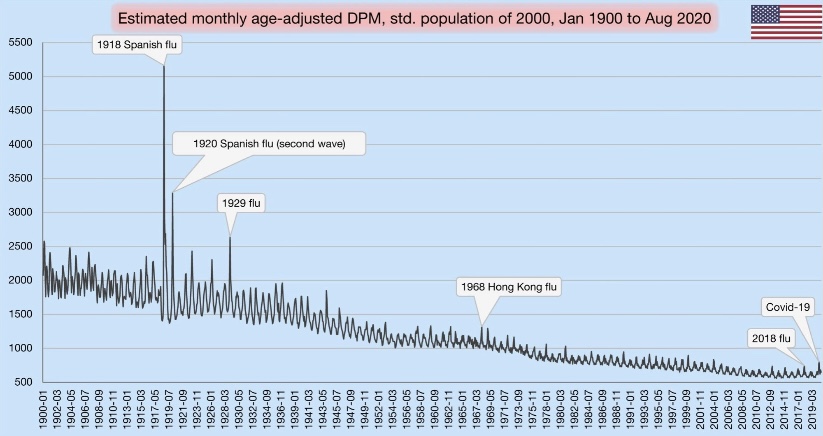
The CDC choked on a new analysis estimating COVID-19’s impact on U.S. life expectancy as of year-end 2020: they reported a decline of a full year, which is ridiculous on its face! As explained by Peter B. Bach in STAT News, the agency assumed that excess deaths attributed to COVID in 2020 would continue as a permanent addition to deaths going forward. Please forgive my skepticism, but isn’t this too basic to qualify as an analytical error by an agency that subjects its reports to thorough vetting? Or might this have been a deliberate manipulation intended to convince the public that COVID will be an ongoing public health crisis. Of course the media has picked it up; even Zero Hedge reported it uncritically!

Bach does a quick calculation based on 400,000 excess deaths attributed to COVID in 2020 and 12 life-years lost by the average victim. I believe the first assumption is on the high side, and I say “attributed to COVID” as a reminder that the CDC’s guidance for completing death certificates was altered in the spring of 2020 specifically for COVID and not other causes of death. Furthermore, if our objective is to assess the impact of the virus itself, under no circumstances should excess deaths induced by misguided lockdown policies enter the calculation (though Bach entertains the possibility). Bach arrives at a reduction in average life of 5.3 days! Of course, that’s not intended to be a projection, but it is a reasonable estimate of COVID’s impact on average lives in 2020.

The CDC’s projection essentially freezes death rates at each age at their 2020 values. We will certainly see more COVID deaths in 2021, and the virus is likely to become endemic. Even with higher levels of acquired immunity and widespread vaccinations, there will almost certainly be some ongoing deaths attributable to COVID, but they are likely to be at levels that will blend into a resumption of the long decline in mortality rates, especially if COVID continues to displace the flu in its “ecological niche”. I include the chart at the top to emphasize the long-term improvement in mortality (though the chart shows only a partial year for 2020, and there has been some flattening or slight backsliding over the past five years or so). As Bach says:

“Researchers have regularly demonstrated that life expectancy projections are overly sensitive to evanescent events like pandemics and wars, resulting in considerably overestimated declines. … And yet the CDC published a result that, if anything, would convey to the public an exaggerated toll that Covid-19 took on longevity in 2020. That’s a problem.”

There were excess deaths from other causes in 2020, which Bach acknowledges. Perhaps 100,000 or more could be attributed to lockdowns and their consequences like economically-induced stress, depression, suicide, overdoses, and medical care deferred or never sought. The Zero Hedge article mentioned above discusses findings that lockdowns and their consequences, such as unemployment spells and lost education, will have ongoing negative effects on health and mortality for many years. The net effect on life expectancy might be as large as 11 to 12 days. Again, however, I draw a distinction between deaths caused by the disease and deaths caused by policy mistakes.

The CDC’s estimate should not be taken seriously when, as Kyle Smith says, there is every indication that the battle against COVID is coming to a successful conclusion. Public health experts have not acquitted themselves well during the pandemic, and the CDC’s life expectancy number only reinforces that impression. Here is Smith:

“We have learned a lot about how the virus works, and how it doesn’t: Outdoor transmission, for the most part, hardly ever happens. Kids are at very low risk, especially younger children. Baseball games, barbecues, and summer camps should be fine. Some pre-COVID activities now carry a different risk profile — notably anything that packs crowds together indoors, so Broadway theater, rock concerts, and the like will be just about the last category of activity to return to normal.”

But return to normal we should, and yet the CDC seems determined to poop on the victory party!

Government Supplies a Cliff; Would you Jump?

14 Friday Aug 2015

Posted by Nuetzel in Big Government, Welfare State

≈ Leave a comment

Tags

Benefits Cliff, Dan Mitchell, dependency, Earned Income Tax Credit, EITC, Federalism, Fight Club, Illinois Policy Institute, Labor Force Participation, LiberalForum, Marginal tax rate, National Bureau of Economic Research, NBER, Obamacare incentives, Pennsylvania welfare cliff, Tyler Durden, War on Drugs, Welfare Cliff, Welfare State, Work Disincentives, Work Effort, Zero Hedge

welfare cliff

People respond to incentives. That does not, in and of itself, make some people “energetic” and others “lazy”. To the contrary, it really means they are responsive and capable of calculating rewards. Critics of the welfare state are sometimes accused of labeling welfare recipients as “lazy”, which is absurd and a cop-out response to serious questions about the size, effectiveness, and even the fairness of means-tested benefits. The structure of welfare benefits in the U.S. often penalizes work effort and market earnings. That being the case, who can blame a recipient for minimizing work effort? From their perspective, that is what society wants them to do. Note that this has nothing to do with the provision of a social safety net for those who are unable to help themselves.

The welfare incentive phenomenon is explored by Zero Hedge under the Fight Club nom de guerre Tyler Durden in “When Work Is Punished: The Ongoing Tragedy Of America’s Welfare State“:

“At issue is the so-called “welfare cliff” beyond which families will literally become poorer the higher their wages, as the drop off in entitlements more than offsets the increase in earnings.“

The cliff looks different in different states and even differs by county. The chart at the top of this post is for Pennsylvania, from the state’s Secretary of Public Welfare, though I saw it on this post from LiberalForum. (Go to the link if the image is not clear). The Zero Hedge post linked above includes a dramatic illustration for Cook County in Illinois. Not many welfare recipients participate in all of the programs shown in the charts, but the point is that many of the programs create nasty incentives that tend to “trap” families at low income levels. Often, these workers and their families would be better off in the long-run if they were to suffer the consequences of the cliff in order to gain more work experience. Unfortunately, few have the resources to ride out a period of lower total income precipitated by the cliff. Another obvious implication is that increases in the minimum wage would actually harm some families by pushing them over the cliff.

Welfare cliffs differ by the recipients’ family structure (one- versus two-parent households, number of children) and do not apply to every welfare program. For example, the Earned Income Tax Credit (EITC) is very well-behaved in the sense that additional work and/or wage income flows through as a net gain the household. While most welfare programs involve a benefits cliff, incentives are undermined even before that point. A flattening in the level of total income as earned income rises indicates that the recipient faces an increasing marginal tax rate. The chart above shows that total income is relatively flat over a range of earned income below the income at which they’d encounter the cliff. This flat range starts at an earned income of $15,000 to $20,000 and extends up to the severe cliff at almost $30,000.

Zero Hedge quotes a report from the Illinois Policy Institute:

“We realize that this is a painful topic in a country in which the issue of welfare benefits and cutting (or not) the spending side of the fiscal cliff have become the two most sensitive social topics. Alas, none of that changes the matrix of incentives for Americans who find themselves facing a comparable dilemma: either remain on the left side of minimum US wage and rely on benefits, or move to the right side at far greater personal investment of work, and energy, and… have the same (or much lower) disposable income at the end of the day.“

Another interesting take on this issue is offered by Dan Mitchell, who cites a recent National Bureau of Economic Research (NBER) paper, which finds:

“…the decline in desire to work since the mid-90s lowered the unemployment rate by about 0.5 ppt and the participation rate by 1.75 ppt. This is a large effect…“

The findings suggest that the welfare reforms of the 1990s actually had positive effects on work effort, though even the EITC creates some incentive problems for second earners. Worst of all is the incentive impact of expanded disability benefits, which have undone some of the gains from reform. Newer programs like Mortgage Assistance and now, Obamacare, have added to the work disincentives. Mitchell cites other research that reinforce these conclusions.

The welfare cliff harms economic efficiency by distorting the offer price of labor, by increasing costs to taxpayers, and by reducing the availability of productive resources. It is grossly unfair because it consigns its intended beneficiaries to a life of dependency. What a waste! Here is Mitchell’s prescription:

“Regarding the broader issue of redistribution and dependency, I argue that federalism is the best approach, both because states will face competitive pressure to avoid excessively generous benefits and because states will learn from each other about the best ways to help the truly needy while minimizing the negative impact of handouts on incentives for productive behavior.“

A side effect of negative welfare incentives is that they increase the relative benefits of participating in illegal income-earning activity. The “War on Drugs” exacerbates this effect by driving up drug prices. Of course, this activity is untaxed, and because it is unreported, it does not push the recipient toward the benefits cliff. This is another example of different government policies working at cross purposes, which is all too common.

Will SCOTUS Grant Executive License To Rewrite Laws?

07 Saturday Mar 2015

Posted by Nuetzel in Obamacare

≈ Leave a comment

Tags

ACA, Consequentialism, Executive license, Huffington Post, Jonathan Adler, Jonathan Cohn, King v. Burwell, Obamacare, Real Clear Politics, SCOTUS, Sean Trende, statism, The Joy of Cooking, U.S. Supreme Court, Zero Hedge

congress-obamacare-cartoon

Can a piece of legislation say any old thing, leaving the executive branch as the arbiter over what the law “should” say?  Can the executive decide a law means one thing ex ante and another ex post? That would be bizarre under the U.S. Constitution, but the Obama Administration has arrogated to itself the role of legislator-in-chief in its implementation the Affordable Care Act (ACA), aka Obamacare, effectively rewriting the law by repeatedly granting waivers and delaying key provisions. And the apparent legal doctrine of “executive license” to rewrite laws would be affirmed if the Supreme Court rules for the government in King v. Burwell.

The case, which was argued before the Court this week, revolves around whether the ACA allows subsidies to be paid on health insurance purchased by qualified consumers on federal exchanges. The plaintiffs say no because, in the “plain language of the statute”, subsidies can be paid only for health insurance purchased on exchanges “established by the state”. A ruling is expected in June.

The provision in question was intended to incent state governments to establish their own exchanges. Most states chose not to do so, however, instead opting to allow their citizens to purchase insurance on a federal exchange. Subsequently, the IRS overrode the provision in question by granting subsidies for purchases on any exchange. The case will be historic if the federal exchange subsidies are overturned, but if not, the ruling will still be historic in setting a precedent that the executive branch can enforce a view of Congressional intent so divergent from written law.

The most interesting aspect of the SCOTUS hearing was Justice Kennedy’s expressed concern that a ruling for the plaintiffs would create a situation in which the federal government coerced states into establishing exchanges, posing a conflict with principles of federalism. The Wall Street Journal was fairly quick to point out that the subsidies were intended as an incentive for states, not unlike many other incentives for state participation incorporated into a wide variety of federal programs:

“If Governors decline to establish an exchange, their citizens are not entitled to benefits, but that is not coercion. That is the very trade-off that is supposed to encourage states to participate. If the subsidies will flow no matter what, few if any states would become the partners the Administration wanted.

More to the point, federalism is supposed to protect political accountability. Two-thirds of the states made an informed decision to rebuff ObamaCare, but if voters prefer otherwise, they can elect new Governors who won’t. If federal subsidies flow no matter what, then states aren’t presented with a real choice. That isn’t how federalism works in the American system. As Justice Kennedy rightly noted, the exchange decision was partly ‘a mechanism for states to show they had concerns about the wisdom and workability of the act in the form that it was passed.’”

Jonathan Adler has some thoughts on the same issues here and here. At the second link, Adler gives a more detailed explanation of Kennedy’s concern, which involves additional regulatory implications for the states. Adler also  covers some court precedents for the kind of “coercion” at issue in King. On one case, New York v. United States, Adler says:

“In the very case that established the current anti-commandeering doctrine, the Court said there was no problem with Congress using its regulatory authority to encourage state cooperation.”

The Court would be reluctant to rule for the plaintiffs based on a principle contrary to so many of its own previous rulings. Such a justification would appear to undermine the existing extent of federal direction of state activity — a possible silver lining to a ruling for the government. But Adler also notes that what is so unique about the ACA relative to earlier precedents is that so many states decided to opt out, and there is plenty of evidence that they did so with their eyes wide open. The loss of the federal subsidies was not the only consideration in those decisions:

“… while states that choose to forego subsidies are exposing their citizens to an increase in one regulatory burden, they are relieving their citizens of others, and at least some states are perfectly happy to make that choice.”

An amusing analogy to the distinction between federal exchanges and state-established  exchanges is made by Jonathan Cohn in the Huffington Post. He contends that federal and state exchanges are comparable to the the choice between butter and oil in a pancake recipe from The Joy of Cooking. You get pancakes either way, says Cohn. Therefore, he asserts that the case against the government in King is based on a specious distinction. Sean Trende at Real Clear Politics point out that the two kinds of pancakes are not the same. If Congress wishes to reward the use of butter, then one should expect the government preserve that distinction in distributing rewards.

Trende points to another distinction missed by Cohn: suppose Congress also said that the batter must be whipped by a blender at 300 rpm. In the case of Obamacare, Congress stated that an exchange must be established by a state to qualify buyers for subsidies, and it did so with the full intent of gaining cooperation from states in shouldering the administrative burdens of the law. Of course, different pancakes might be close enough, but in the end, specific language was used by Congress to create incentives for the use of certain ingredients and a particular mixing technique. The meaning of the pancake law is clear enough and is independent of whether administration officials can dream up substitutes, even if they are right out of The Joy of Cooking.

The four statist justices (some claim they are liberal) emphasized the dire consequences that a ruling for the plaintiffs would have on the insurance market and on individual buyers in states using the federal exchange. While the impact could be mitigated by the Court in various ways, the impact itself has been exaggerated by Obamacare supporters. This piece at Zero Hedge examines the likely impact in detail, but it fails to discuss a few significant benefits related to the employer and individual mandates to residents of states without their own exchanges.

Justice Kennedy is unlikely to side with the government in this case, despite his concerns about coercive federal policy. Justice Roberts was silent for almost the entire hearing, and it is not clear whether he will side with the consequentialists, find another avenue for upholding the subsidies, or defer to the plain language of the law. The Court might engage in a form of avoidance, finding  a way to dismiss the case on unexpected grounds such as a lack of standing (though few consider the plaintiffs’ standing to be an issue). That would effectively grant the administration carte blanche in rewriting legislation.

Follow Sacred Cow Chips on WordPress.com

Recent Posts

  • The Case Against Interest On Reserves
  • Immigration and Merit As Fiscal Propositions
  • Tariff “Dividend” From An Indigent State
  • Almost Looks Like the Fed Has a 3% Inflation Target
  • Government Malpractice Breeds Health Care Havoc

Archives

  • January 2026
  • December 2025
  • November 2025
  • October 2025
  • September 2025
  • August 2025
  • July 2025
  • June 2025
  • May 2025
  • April 2025
  • March 2025
  • February 2025
  • January 2025
  • December 2024
  • November 2024
  • October 2024
  • September 2024
  • August 2024
  • July 2024
  • June 2024
  • May 2024
  • April 2024
  • March 2024
  • February 2024
  • January 2024
  • December 2023
  • November 2023
  • August 2023
  • July 2023
  • June 2023
  • May 2023
  • April 2023
  • March 2023
  • February 2023
  • January 2023
  • December 2022
  • November 2022
  • October 2022
  • September 2022
  • August 2022
  • July 2022
  • June 2022
  • May 2022
  • April 2022
  • March 2022
  • February 2022
  • January 2022
  • December 2021
  • November 2021
  • October 2021
  • September 2021
  • August 2021
  • July 2021
  • June 2021
  • May 2021
  • April 2021
  • March 2021
  • February 2021
  • January 2021
  • December 2020
  • November 2020
  • October 2020
  • September 2020
  • August 2020
  • July 2020
  • June 2020
  • May 2020
  • April 2020
  • March 2020
  • February 2020
  • January 2020
  • December 2019
  • November 2019
  • October 2019
  • September 2019
  • August 2019
  • July 2019
  • June 2019
  • May 2019
  • April 2019
  • March 2019
  • February 2019
  • January 2019
  • December 2018
  • November 2018
  • October 2018
  • September 2018
  • August 2018
  • July 2018
  • June 2018
  • May 2018
  • April 2018
  • March 2018
  • February 2018
  • January 2018
  • December 2017
  • November 2017
  • October 2017
  • September 2017
  • August 2017
  • July 2017
  • June 2017
  • May 2017
  • April 2017
  • March 2017
  • February 2017
  • January 2017
  • December 2016
  • November 2016
  • October 2016
  • September 2016
  • August 2016
  • July 2016
  • June 2016
  • May 2016
  • April 2016
  • March 2016
  • February 2016
  • January 2016
  • December 2015
  • November 2015
  • October 2015
  • September 2015
  • August 2015
  • July 2015
  • June 2015
  • May 2015
  • April 2015
  • March 2015
  • February 2015
  • January 2015
  • December 2014
  • November 2014
  • October 2014
  • September 2014
  • August 2014
  • July 2014
  • June 2014
  • May 2014
  • April 2014
  • March 2014

Blogs I Follow

  • Passive Income Kickstart
  • OnlyFinance.net
  • TLC Cholesterol
  • Nintil
  • kendunning.net
  • DCWhispers.com
  • Hoong-Wai in the UK
  • Marginal REVOLUTION
  • Stlouis
  • Watts Up With That?
  • Aussie Nationalist Blog
  • American Elephants
  • The View from Alexandria
  • The Gymnasium
  • A Force for Good
  • Notes On Liberty
  • troymo
  • SUNDAY BLOG Stephanie Sievers
  • Miss Lou Acquiring Lore
  • Your Well Wisher Program
  • Objectivism In Depth
  • RobotEnomics
  • Orderstatistic
  • Paradigm Library
  • Scattered Showers and Quicksand

Blog at WordPress.com.

Passive Income Kickstart

OnlyFinance.net

TLC Cholesterol

Nintil

To estimate, compare, distinguish, discuss, and trace to its principal sources everything

kendunning.net

The Future is Ours to Create

DCWhispers.com

Hoong-Wai in the UK

A Commonwealth immigrant's perspective on the UK's public arena.

Marginal REVOLUTION

Small Steps Toward A Much Better World

Stlouis

Watts Up With That?

The world's most viewed site on global warming and climate change

Aussie Nationalist Blog

Commentary from a Paleoconservative and Nationalist perspective

American Elephants

Defending Life, Liberty and the Pursuit of Happiness

The View from Alexandria

In advanced civilizations the period loosely called Alexandrian is usually associated with flexible morals, perfunctory religion, populist standards and cosmopolitan tastes, feminism, exotic cults, and the rapid turnover of high and low fads---in short, a falling away (which is all that decadence means) from the strictness of traditional rules, embodied in character and inforced from within. -- Jacques Barzun

The Gymnasium

A place for reason, politics, economics, and faith steeped in the classical liberal tradition

A Force for Good

How economics, morality, and markets combine

Notes On Liberty

Spontaneous thoughts on a humble creed

troymo

SUNDAY BLOG Stephanie Sievers

Escaping the everyday life with photographs from my travels

Miss Lou Acquiring Lore

Gallery of Life...

Your Well Wisher Program

Attempt to solve commonly known problems…

Objectivism In Depth

Exploring Ayn Rand's revolutionary philosophy.

RobotEnomics

(A)n (I)ntelligent Future

Orderstatistic

Economics, chess and anything else on my mind.

Paradigm Library

OODA Looping

Scattered Showers and Quicksand

Musings on science, investing, finance, economics, politics, and probably fly fishing.

  • Subscribe Subscribed
    • Sacred Cow Chips
    • Join 128 other subscribers
    • Already have a WordPress.com account? Log in now.
    • Sacred Cow Chips
    • Subscribe Subscribed
    • Sign up
    • Log in
    • Report this content
    • View site in Reader
    • Manage subscriptions
    • Collapse this bar
 

Loading Comments...