• About

Sacred Cow Chips

Sacred Cow Chips

Category Archives: Big Government

Ev’rybody’s Gone Serfin’, Serfdom USA

11 Tuesday Aug 2015

Posted by Nuetzel in Big Government, Regulation

≈ Leave a comment

Tags

Big government, Bureaucratic tyranny, Discovery, Due Process, Environmental regulation, Financial regulation, Friedrich Hayek, John Cochrane, Magna Carta, Regulatory fixers, Regulatory State, The Road To Serfdom, University of Chicago

image

Any new or existing enterprise can be strangled with ease when regulatory coercion is brought to bear. Whole industries can be strangled. And the strangulation of freedoms is not limited to business concerns. Individuals are impacted as well by the loss of employment choices and opportunities, choices in the marketplace, and even more basic freedoms such as speech and assembly. In an excellent paper, “The Rule of Law in the Regulatory State“, John Cochrane of The University of Chicago highlights the negative consequences of growth in the scope and complexity of regulation. It looks like a working paper with a few items in need of editorial attention. Nevertheless, it contains several interesting ideas, some noteworthy examples of regulatory overreach, and useful dimensions along which to think about regulatory power and its application.

Cochrane’s first two paragraphs give an overview of the pernicious social effects of regulation gone wild, yet they only scratch the surface:

“The United States’ regulatory bureaucracy has vast power. Regulators can ruin your life, and your business, very quickly, and you have very little recourse. That this power is damaging the economy is a commonplace complaint. Less recognized, but perhaps even more important, the burgeoning regulatory state poses a new threat to our political freedom.

What banker dares to speak out against the Fed, or trader against the SEC? What hospital or health insurer dares to speak out against HHS or Obamacare? What business needing environmental approval for a project dares to speak out against the EPA? What drug company dares to challenge the FDA? Our problems are not just national. What real estate developer needing zoning approval dares to speak out against the local zoning board?“

The centerpiece of Cochrane’s paper is his elaboration on a list of bullet points, or dimensions for assessing a regulatory process. The list is given below in italics (without quote marks), and each bullet is followed by my own brief clarification:

  • Rule vs. Discretion? – Rules are better. How much latitude shall a regulator have?
  • Simple/precise or vague/complex? – Simple is better. Vague/complex ≈ discretion.
  • Knowable rules vs. ex-post prosecutions? – Surprise! You’re busted. Vague ≈ unknowable. 
  • Permission or rule book? – Don’t make me ask. Review my plans non-arbitrarily. 
  • Plain text or fixers? – Must I hire a specialist with agency connections?
  • Enforced commonly or arbitrarily? – Objective vs. motivated enforcement.
  • Right to discovery and challenge decisions. – Transparency of evidence & standards.
  • Right to appeal. – to courts, not the agency.
  • Insulation from political process. – Limit discretion and scope of powers.
  • Speed vs. delay. – six months or approve by default.
  • Consultation, consent of the governed. – Formal representation in rule-making.

Sorry if lists make you snooze, but I think it’s a good list, even if the bullets aren’t mutually exclusive. The items highlight the always-present choice between restraining government’s exercise of coercive power versus restraining and coercing the governed.

Cochrane then takes the reader on a “tour” of regulatory areas, including several aspects of financial regulation, health care, foods & drugs, the environment, the internet, campaign finance, national security, immigration and education. These sections are brief, but in each of these areas, Cochrane highlights negative consequences of regulation that illustrate government failure based on the dimensions given in his list of bullets. Here’s an anecdote from his section on environmental regulation:

“Already, anyone opposed to a project for other reasons — like, it will block my view — can use environmental review to stop it. Delay is as good as denial in any commercial project.

The small story of Al Armendariz, head of EPA region 6 who proposed ‘crucifying’ some oil companies as an example to the others is instructive. He was caught on tape saying:

‘The Romans used to conquer little villages in the Mediterranean. They’d go into a little Turkish town somewhere, they’d find the first five guys they saw and they would crucify them. And then you know that town was really easy to manage for the next few years.

…we do have some pretty effective enforcement tools. Compliance can get very high, very, very quickly.’

According to the story, Armendariz shut down Range Resources, one of the first fracking companies. Range fought back and eventually a Federal Judge found in its favor. But an agency that operates by “crucifying” a few exemplars, explicitly to impose compliance costs, is ripe to choose just which exemplars will be crucified on political bases.“

Cochrane closes by describing his vision of a “Magna Carta for the regulatory state” in order to protect “citizens from arbitrary power“:

“It is time for a Magna Carta for the regulatory state. Regulations need to be made in a way that obeys my earlier bullet list. People need the rights to challenge regulators — to see the evidence against them, to challenge decisions, to appeal decisions. Yes, this means in court. Everyone hates lawyers, except when they need one.

People need a right to speedy decision. A “habeas corpus” for regulation would work — if any decision has not been rendered in 6 months, it is automatically in your favor.“

Accomplishing great things is difficult, both in the physical world and in creating value in any form for which other free individuals will trade. By comparison, failure is easy, and so are regulatory decisions that precipitate failure. So often, so easily, so arbitrarily, and with little accountability, those decisions destroy freedom, value and our ability to improve human welfare.

Trump Tower of Babble

09 Sunday Aug 2015

Posted by Nuetzel in Big Government, Marketplace of Ideas, Obamacare

≈ 2 Comments

Tags

Andrew Popkin, Bankruptcy, Brett Baier, crony capitalism, Donald Trump, eminent domain, GOP Debate, Hillary Clinton, Megyn Kelly, Obamacare, Peter Suderman, Rand Paul, single-payer plan, Vox

Presidential candidate, Donald Trump, has been critical of fellow Replubicans including Sen. John McCain. Some voters are curious about his "daffy" behavior.

Here’s a post-debate follow-up on Donald Trump the Shape Shifter: I’m surprised to hear anyone praising his performance after that debacle. He came off as a dick, and that’s really The Donald. I thought so before I heard that he suggested Megyn Kelly was menstruating that evening. Megan was tough, but please…. Trump is a loud-mouthed, offensive, and often incoherent bully.

Two Trump moments that I thought were amazing were his exchange with Brett Baier about political donations and his dust-up with Rand Paul over a single-payer health care system.

On donations, Trump seemed to take satisfaction in the fact that Hillary Clinton “had no choice” but to attend his wedding after he gave to her Senate campaign. He then made the following statement, which made me laugh:

“I will tell you that our system is broken. I gave to many people. Before this, before two months ago, I was a businessman. I give to everybody. When they call, I give. And you know what? When I need something from them, two years later, three years later, I call them. They are there for me. And that’s a broken system.“

Should I love him or hate him for that statement? He admits with no shame that he participates in crony capitalism, and he realizes that it’s corrupt. Andrew Popkin at Vox has a good analysis:

“Something Trump identifies that doesn’t always get mentioned is the way transactional politics transcend partisanship and ideology. Trump gave to Democrats and he gave to Republicans. He didn’t care what they believed. He cared what they could do for him. He wasn’t supporting them — he was buying them, and that’s completely different.“

It’s convenient for Trump to brag that he doesn’t need donations from others when campaigning. When he’s on the other side of the table, he’s happy to participate in the corruption. Did Trump buy the politicians who helped him arrange eminent domain actions against property owners who were in the way of his developments? He’s also quite proud of his use of bankruptcy laws allowing him to stiff lenders and investors in his enterprises. By the way, in comparing his four corporate bankruptcies to the many “deals” he’s executed over the years, he’d have you believe that the “deal” is always the relevant unit for a bankruptcy proceeding. That’s loose and misleading jargon.

I have said that Trump’s supporters really don’t know what their getting. Perhaps he won’t tell anyone because he’d lose “leverage”. A prime example of Trump’s shiftiness was his response to the following question on single-payer health care systems, including his attempt to embarrass Rand Paul:

Baier: “Now, 15 years ago, you called yourself a liberal on health care. You were for a single-payer system, a Canadian-style system. Why were you for that then and why aren’t you for it now?“

As Peter Suderman noted, Trump’s response to this question about health care began with his views on the war in Iraq. Donald’s rules…. But eventually, he addressed the health care question with a stream of words that thinking people might have been tempted to process logically in order to divine a coherent “Trump” position on the issue, but that would have been a mistake:

“As far as single payer, it works in Canada. It works incredibly well in Scotland. It could have worked in a different age, which is the age you’re talking about here.

What I’d like to see is a private system without the artificial lines around every state. I have a big company with thousands and thousands of employees. And if I’m negotiating in New York or in New Jersey or in California, I have like one bidder. Nobody can bid. You know why? Because the insurance companies are making a fortune because they have control of the politicians, of course, with the exception of the politicians on this stage. But they have total control of the politicians. They’re making a fortune.“

This is not a great moment of clarity for Trump. We still don’t know what he has in mind. He demonstrates that he doesn’t quite understand the inherent flaws in single-payer. If his complaint is with consolidation of the health insurance industry, single-payer would imply an even greater consolidation, indeed, a monopoly. A “private system” does not rule out single-payer. While the insurance companies have undoubtedly influenced politicians, just as Trump has, why is he complaining about a lack of choice, having just asserted that single-payer could work so well? And artificial lines have to do with non-price rationing, a typical feature of government intervention in markets. Thus far, the profits of under-pricing insurers have been protected by so-called “risk corridors” built into Obamacare. Would Trump allow health care providers and insurers to reprice in order to eliminate “artificial lines”? Trump’s words did not settle any questions about his position.

The end of Trump’s response is this:

“And then we have to take care of the people that can’t take care of themselves. And I will do that through a different system.“

So… was Trump still talking about single-payer or not? I forgive Rand Paul for imagining that he was. It was the only solid statement that one could cling to in Trump’s ramble.

Here is Suderman’s summary of Trump’s response with an account of the exchange with Rand Paul that followed:

“What matters is that [Trump] would be different. Different how? So very, very different—and definitely not a moron/loser/dummy/incompetent (pick one) like this other guy.

This is how Trump responds to almost everything: By not answering the question, by babbling out some at-best semi-relevant references, by promising to somehow be different and better without explaining how or why, and then by lobbing an insult.

An insult is how Trump finishes the Obamacare exchange as well. After Trump finishes answering the question, Sen. Rand Paul cuts in, saying, ‘News flash, the Republican Party’s been fighting against a single-payer system for a decade. So I think you’re on the wrong side of this if you’re still arguing for a single-payer system.’ [SCC’s bolding]

Trump’s comeback: ‘I’m not—I’m not are—I don’t think you heard me. You’re having a hard time tonight.’

The gist, as always, is that someone else—indeed, practically everyone else—is a dummy, a loser, a politician. Trump is the only one who really gets it, whatever it is.“

While I thought Rand Paul’s interjectory approach to debating was unwise, his comment to Trump was on-target, and he even qualified it. Trump responded with snark. Trump has yet to take a real position on health care in this campaign, but he has supported single-payer in the past. He doesn’t want to go to the trouble of deciding or revealing a specific plan just yet. Perhaps he’s “maintaining leverage”, keeping his options open, because he’s such a smart businessman. If you want to treat politics like a business deal, fine, but smart voters should be your partners, and they will expect you to reveal your terms.

Hillary’s Got Some Promises and a Rat’s Nest

03 Monday Aug 2015

Posted by Nuetzel in Big Government, Central Planning

≈ Leave a comment

Tags

Andrew Napolitano, Capital Gains Tax, central planning, Clinton renewable energy plan, Friedrich Hayek, Half a billion solar panels, Hillary Clinton, Hillarycare, Ira Stoll, Jeffrey Tucker, Larry Kudlow, Obamacare employer mandate

Hillary

Hillary Clinton is an advocate for governmentalizing the social order, and asks America to trust that central control, under her command, will accomplish great things such as upward mobility for the middle class, a rising standard of living, green energy for all, a “fix” for Obamacare, and much else. Jeffrey Tucker writes of Hillary’s delusions in “Hillary Clinton’s Ideological Vortex of Power and Planning” and her assurances that she’ll take measures with predictable impacts on the global climate, measures that will direct all details of energy production and use.

Tucker throws cold water on Hillary’s promises by viewing them in the context of F.A. Hayek warnings about the ruinous effects of central planning and control:

“That brilliant economist spent 50 years explaining, in book after book, that the greatest danger humanity faced, now and always, was a presumption on the part of intellectuals, politicians, and bureaucrats that they know better than the emergent and evolving wisdom of social forces.

This presumption might seem like science but it is really pretense. Civilization arises from, is protected by, and advances through the dispersed knowledge of billions of individual decision makers and the institutions that arise from them.

Hayek called the issue he was investigating the knowledge problem. Society needs to know how to use scarce resources, how to navigate a world of uncertainty, how to form rules that turn struggle into peace. It is a problem solved through freedom alone. No ruler, no scientist, no intellectual can substitute for the evolving process of decentralized decision making and trial and error.“

I discussed the fatuous presumptions of the left in an earlier SCC post entitled: “Conscious Design, the Collective Mind and Social Decline“. In that post, I used the wonderful Hayek quote:

“We flatter ourselves undeservedly if we represent human civilization as entirely the product of conscious reason or as the product of human design, or when we assume that it is necessarily in our power deliberately to re-create or to maintain what we have built without knowing what we were doing.“

More specifically, on energy policy, Clinton says she will set an agenda for the country to produce enough renewable energy within 10 years to power every American home, and to install half a billion solar panels across the country by the end of her first term. As Ira Stoll says at Reason.com, this is “central planning at its worst“.

“Clinton assumes that man-made climate change is a risk serious enough to try to mitigate, and that America should try to mitigate it by reducing its carbon emissions. These are big ‘ifs,’ but ones I will grant for argument’s sake. Even granting those assumptions, there is a humongous logical leap to the conclusion that the appropriate policy response is setting a national target for the number of solar panels installed.

For one thing, it’s a classic error of measuring inputs rather than outputs. If the goal is the reduction of dangerous emissions, why not set a goal for that, and support any energy method—solar, wind, algae, hydroelectric, nuclear, hydrofracturing—that gets America closer to that goal? Why privilege solar over all the other technologies, including some that may not even be invented yet?“

Certainly, proposals like this create tremendous opportunities for rewarding cronies. Stoll also notes that solar technology will improve over time, but rushing to install millions of panels, undoubtedly encouraged by heavy subsidies, would saddle users in the long-term with less efficient versions. With future improvements in efficiency and cost, the technology will gradually draw users in without the need for subsidies. That’s what rational economic decision-making looks like!

A specific economic proposal from the Clinton camp would increase the capital gains tax rate on asset sales held from 364 days up to six years. The rate would double if the asset was held up to two years. The increases become gradually smaller for two-to-six year holding periods. Hillary’s is somehow unaware that the government has already made it incredibly difficult for businesses to raise capital to invest in new buildings, equipment, and technology. Capital gains taxes are punitive: they represent double taxation of income to investors and they further distort rates of return by taxing assets on inflationary increases in value, which diminish their real value. Larry Kudlow wrote a good opinion piece on this proposal, called “Hillary’s Inconceivably Stupid Capital-Gains Tax Scheme“. He focuses on Hillary’s attack on the alleged “short-termism” in the economy, but this is a little odd, because her plan essentially discourages saving.

On health care, Clinton has pledged to “improve” Obamacare, but not repeal it. Too bad. It is similar to the plan she put forward as a Senator, including the individual mandate. The only piece of good news here is that she has discussed eliminating the employer mandate, which has been deferred by the Obama Administration twice already. However, some effects of the employer mandate have been felt, as it has tended to discourage employers from taking on full-time employees.

On foreign policy, Clinton is probably more hawkish than President Obama. Her stint as Obama’s Secretary of State was not marked by any noteworthy accomplishment.

Then there is the question of Clinton’s integrity. She’s been tainted by scandals before (e.g., Whitewater). She told a Brian Williams-like lie about being fired upon in Bosnia. The role of the Clinton Foundation, and whether it served as a mechanism for influence-buying, has also been in question, not to mention its seeming role as a personal slush fund for the Clintons. Her ties to Wall Street probably exceed Obama’s. And she maintained a private email server while Secretary of State, which was imprudent at best, and depending on the the classification of what went through that server, criminal at worst. Finally, her involvement in the Benghazi tragedy has been in question from the beginning. On some events related to Benghazi, including Hillary’s potential involvement in suspicious arms trading activity, Andrew Napolitano insists that “Hillary Keeps Lying“.

And here is Jeffrey Tucker waxing sarcastic about Hillary in another context: “Just trust her. Truly, just trust her …” 

Government Wants To Gut Your Gig

24 Friday Jul 2015

Posted by Nuetzel in Big Government, Regulation

≈ Leave a comment

Tags

Bill De Blasio, Economic conservatism, Erik Sherman, Gig economy, Hillary Clinton, Megan McArdle, Overtime rules, rent seeking, Sharing economy, St. Louis Metropolitan Taxi Commission, Taskrabbit, Taxi deserts, Uber

uber-cartoonjpg

Big government is an inherently conservative enterprise when it comes to protecting  the economic status quo. It frequently acts on behalf of entrenched interests by quashing innovation and competition. This is well illustrated by resistance to the “gig economy” (or “sharing economy”) and companies like Uber and Taskrabbit. The gig economy is growing rapidly because it is often more affordable than traditional channels and it offers tremendous convenience. Enabled by the internet, customized tasks or “gigs” can be performed anywhere for anyone demanding them. My son in New York City just found a talented carpenter through an on-line app, who stopped by his apartment in the evening and mounted a big-screen TV on the wall. The service he provided was not new, but the deal was facilitated and even enhanced by technology in a way that in some cases is reordering economic relationships. The competitive pressure this can create is drawing resistance with the aid of government power.

In St. Louis, there is an ongoing conflict between the Taxicab Commission and Uber, which has not yet gained entry to the market. Three of eight members of the commission own cab companies. They have succeeded in keeping Uber and Lyft out of the market for over a year. A resolution might be possible soon, but the commission is still haggling with Uber over insurance coverage levels, fingerprints and background checks.

On the national stage, the biggest issue surrounding the gig economy is the formal relationship between workers and any company they might represent. Should those workers be treated as independent contractors or employees? Companies like Uber insist that their drivers are independent, but the government would prefer that they be treated as employees. In some cases, that would oblige employers to offer certain benefits. Erik Sherman covers this issue in “How the U.S. Just Knee-Capped the ‘Gig Economy’“. According to Uber, most of its drivers are part-time and like it that way, so it’s not clear that the government can force Uber (under current rules) to pay for extra benefits, or how many of its drivers that would affect. Still, it is instructive that the government is applying pressure in this area, potentially undermining competitive forces and voluntary relationships formed between innovative businesses and their working partners.

Big government advocates are extremely uncomfortable with the gig economy, but there are a fair number of progressives who place a high value on their ability to transact with “gigsters”. Politicians such as Hillary Clinton, who “skewered” the gig economy last week, risk fracturing their own base by advocating steps that could threaten innovative enterprises like Uber. In another statist attack on Uber, New York Mayor Bill De Blasio recently proposed to “cap” the company’s growth while the city studied its impact on traffic. Fortunately, he has backed down.

Progressives should love the value that the gig economy brings to segments of society whose members otherwise can’t afford or can’t access traditional services. For example, residents of low-income neighborhoods often find themselves living in “taxi deserts” when forced to rely on the entrenched cab companies. Megan McArdle makes this point in “Uber Serves the Poor by Going Where Taxis Don’t“. Aside from the technology angle, this is basic capitalism in action. When government steps in to restrict the conditions under which services may be offered, and raises the cost, it lends a degree of monopoly power to the entrenched providers and blocks the diffusion of services to all segments of the market. This should be seen as antithetical to the progressive agenda, but politicians and cronies don’t always see it that way.

The advantages of the gig economy have been made possible by technology, but another key element is that it has unleashed a flood of voluntary activity to fill gaps that were heretofore inadequately addressed. There have been some principled objections to the business practices of Uber and other gig sponsors, which often involve details regarding the splitting of revenue. Despite these concerns, there are benefits to workers who choose to participate, including a great deal of flexibility in choosing working hours and conditions. Second guessing their motives and the opportunity costs they face is a purely speculative and presumptuous exercise. Furthermore, on other fronts, government has been engaged in a seemingly intentional effort to make only part-time work available, as with recent changes in overtime rules and Obamacare regulations; at least the gig economy fits into that framework.

Traditional service providers, some of whom enjoyed government-enforced monopolies, have reacted to new competition by calling for protection. This rent-seeking behavior is typical in the history of regulation, which has often taken root under strong pressure for protection by entrenched interests. Progressives should reject this perverse form of economic conservatism.

Corporatists of the World Unite!

01 Wednesday Jul 2015

Posted by Nuetzel in Big Government

≈ Leave a comment

Tags

Benito Mussolini, Capitalism, Classical Liberalism, Corporatism, Edmund S. Phelps, Free Markets, Jason Brennan, Liberalism, Max Borders, Neoliberalism, rent seeking, Thayer Watkins, The Freeman

Corporatism Santa

As a classical liberal, I’m fascinated by the ongoing confusion of the Progressive Left over the meaning of the word liberalism. To be “liberal” is to support individual autonomy, self-determination, and freedom from coercion by the state. True liberalism necessarily implies a minimal state apparatus because the state can only derive authority from its power to coerce. Confusion over the meaning of liberalism was covered in “Labels For the Authoritarian Left” on Sacred Cow Chips last year.

A similar confusion surrounds use of the word corporatism and its relationship to progressivism on the one hand, and liberalism on the other. I came across this excellent essay by Max Borders in The Freeman that begins with a discussion of the term neoliberalism. Lately this has been invoked as an derogatory reference to classical liberalism, except that the users don’t really understand the latter. In fact, as Borders points out, one prominent author describes free market advocacy as something more akin to cronyism, complete with state support and bailouts, which is contradictory on its face. But it is consistent with the doctrine of corporatism. Borders offers this quote from Thayer Watkins:

“In the last half of the 19th century people of the working class in Europe were beginning to show interest in the ideas of socialism and syndicalism. Some members of the intelligentsia, particularly the Catholic intelligentsia, decided to formulate an alternative to socialism which would emphasize social justice without the radical solution of the abolition of private property.

The result was called Corporatism. The name had nothing to do with the notion of a business corporation except that both words are derived from the Latin word for body, corpus.“

Sounds like innocent beginnings, but enforcing “social justice” within this framework demands a substantial role for the state and an intricate set of relationships between the state and private parties. That provides opportunities for accumulating economic power and wealth by manipulating any arm of government that legislates, adjudicates, purchases, licenses, regulates or levies taxes. That is, any arm of government! Such rent-seeking activity gives rise to a symbiosis between the state and powerful private economic actors, and that is the essence of modern corporatism as practiced by Mussolini, George W. Bush and Obama and their governments. Borders quotes economics Nobel laureate Edmund Phelps:

“The managerial state has assumed responsibility for looking after everything from the incomes of the middle class to the profitability of large corporations to industrial advancement. This system . . . is . . . an economic order that harks back to Bismarck in the late nineteenth century and Mussolini in the twentieth: corporatism.“

Borders closes with a discussion of Jason Brennan’s admonition: “Dear Left: Corporatism is Your Fault”, which dishes the bald truth.

“When you create complicated tax codes, complicated regulatory regimes, and complicated licensing rules, these regulations naturally select for larger and larger corporations. We told you that would happen. Of course, these increasingly large corporations then capture these rules, codes, and regulations to disadvantage their competitors and exploit the rest of us.“

Corporatism has nothing to do with the corporate form of business organization per se. Granted, limited liability is an artificial construct created by the state, and it is a hallmark of that form, so it’s fair to cite it as an example of corporatism. But corporatism in its systemic sense represents the larger web of non-market dependencies between the state and powerful economic actors, corporate in form or not. Both sides benefit from these relationships and, in many direct and indirect ways, compromise the integrity of the voluntary market mechanism and harm smaller actors who rely on it.

This is not a state of affairs that meets with the approval of classical liberals, free marketeers and fans of real capitalism, the so-called “neoliberals” of Leftist fiction. The Left purports to hate corporatism too, but they don’t understand its genesis and are fully oblivious to the real reasons for its progression. Instead, in their ignorance, they pass the blame onto “neoliberals”.

Federally-Mandated Regionalism

25 Thursday Jun 2015

Posted by Nuetzel in Big Government, Regulation

≈ 1 Comment

Tags

Affirmatively Furthering Fair Housing, Disparate impact, Housing and Urban Development, HUD, Katherine Kersten, Marc A. Thiessen, New Geography, Plan Bay Area, Regionalism, Stanley Kurtz, Sustainable Communities Grants, Thrive MSP 2040, Transit-oriented development, Wendell Cox

Adam Zyglis Cartoon

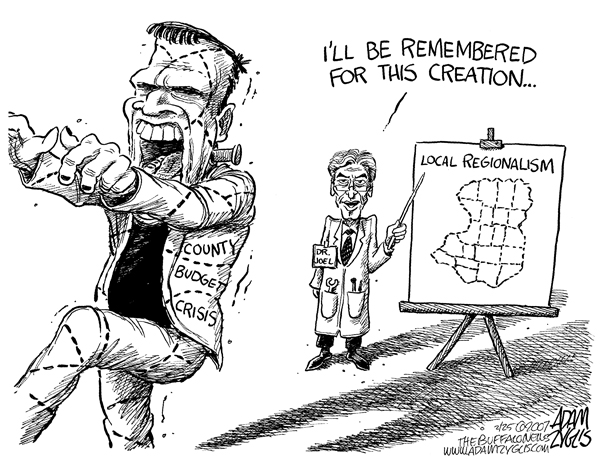
Quietly creeping into our lives is a regulatory framework from the Obama Administration dubbed “regionalism”. That might sound innocuous enough. On one level, we can think of regionalism as a pooling of resources in order to accomplish things that would be difficult at more fragmented levels, such as small municipalities. That could take various forms, such as annexation of an adjacent municipality or the formation of regional districts tasked with providing services such as special schools, transportation, utilities, or certain law enforcement functions. Obviously, any of these  steps involves a loss of local control — for someone.

Regionalism as redefined by the Obama regime is more radical and involves not just other regional jurisdictions, but the federal government. The key elements of one proposed rule are federal data collection, federal diversity objectives and federal purse strings. The new rule, to be issued by the Department of Housing and Urban Development (HUD), is described in a WaPo opinion piece by Marc A. Thiessen, “Obama wants to reengineer your neighborhood“:

“Under Obama’s proposed rule, the federal government will collect massive amounts of data on the racial, ethnic and socioeconomic makeup of thousands of local communities, looking for signs of ‘disparities by race, color, religion, sex, familial status, national origin, or disability in access to community assets.’ Then the government will target communities with results it doesn’t like and use billions of dollars in federal grant money to bribe or blackmail them into changing their zoning and housing policies.“

The clause “...in access to community assets” is subject to broad interpretation. As Thiessen notes later, housing and lending discrimination are already prohibited on all of the bases listed above. However, this rule has socioeconomic implications apart from the protected classes. The rule may well hold a community responsible for the aggregate disparate impact of what HUD calls “… the operation of housing markets, [and] investment choices by holders of capital.” The upshot is that a community could be penalized if HUD determines that private builders, developers and investors offer insufficient units of affordable housing within its borders.

By what standard will any such disparate impact be judged? A group’s non-representation within the borders of a subject community would frequently obviate the rule. Clearly, the reference area for any single community would have to encompass a larger regional geography, but that is likely to be decided by federal regulators. The scheme will become very arbitrary if regulators have much flexibility on a case-by-case basis.

I have been a critic of zoning laws and other local building restrictions that artificially restrict the supply of housing and inflate housing costs. It is possible that the HUD rule would weaken such restrictions, but it is more likely that local communities would leave those rules largely intact and instead carve out affordable housing “districts”. They might even find it convenient to do so via eminent domain. In any case, I do not support the kind of federal oversight and control of local communities envisioned by the Obama Administration.

Obama regionalism is much broader than the new HUD rule. Stanley Kurtz warned of this encroachment two years ago in “Regionalism: Obama’s Quiet Anti-Suburban Revolution“, and in an earlier book on the threat of Obama regionalism to American suburbs. The new HUD rule:

“… is part of a broader suite of initiatives designed to block suburban development, press Americans into hyper-dense cities, and force us out of our cars. Government-mandated ethnic and racial diversification plays a role in this scheme, yet the broader goal is forced ‘economic integration.’ The ultimate vision is to make all neighborhoods more or less alike, turning traditional cities into ultra-dense Manhattans, while making suburbs look more like cities do now. In this centrally-planned utopia, steadily increasing numbers will live cheek-by-jowl in ‘stack and pack’ high-rises close to public transportation, while automobiles fall into relative disuse.“

Much of Kurtz’s focus is on the San Francisco region’s “Plan Bay Area”. Under the guise of “sustainable development”, this initiative limits new development in the Bay Area, restricts new single-family home construction, and shoe-horns new housing and business expansion into districts near transportation hubs. Kurtz also discusses a 2012 award to Plan Bay Area of a “Sustainable Communities Grant” by the Obama Administration. The rules surrounding the use of such grants contribute to the further politicization of local development.

Wendell Cox elaborates on Kurtz’s book and the threat of regionalism to suburban life in a New Geography article entitled “Spreading the Fiscal Irresponsibility“. Obama’s regionalism entails greater local dependence on federal funds and an extreme loss of local control. Cox emphasizes the negative implications of that loss for fiscal restraint at local levels.

A more recent example of regionalism in action is in Minneapolis and St. Paul, MN, where a 30-year master plan called “Thrive MSP 2040” has been promulgated by a regional planning council. Katherine Kersten weighs in on the plan in the Wall Street Journal in “Turning the Twin Cities Into Sim City” (or you may need to use this Google search to get past the pay wall):

“While minority residents have been streaming into the Twin Cities’ suburbs for the past 15 years, the Met Council wants to make sure there is a proper race-and-income mix in each. Thus it recently mapped every census tract in the 2,800 square-mile, seven-county region by race, ethnicity and income. The purpose was to identify ‘racially concentrated areas of poverty’ and ‘high opportunity clusters.’ The next step is for the council to lay out what the region’s 186 municipalities must do to disperse poverty throughout the metro area.“

HUD and HUD grant money is assisting in this effort. To quote Kersten, HUD

“… says that mapping is intended, in part, to identify suburban land-use and zoning practices that allegedly deny opportunity and create ‘barriers’ for low-income and minority people.“

The Thrive plan also calls for “Transit-oriented development” and evaluation of “all future development policies through the ‘lens’ of climate change.” From Kersten’s closing paragraph:

“… Twin Cities residents will likely realize that Thrive MSP 2040’s centralized decision-making and Orwellian appeals to ‘equity’ and ‘sustainability’ are a serious threat to their democratic traditions of individual liberty and self-government. Let’s hope that realization comes sooner rather than later.“

The Government Inequality Machine

17 Wednesday Jun 2015

Posted by Nuetzel in Big Government

≈ Leave a comment

Tags

Beautiful Anarchy, Cronyism, Export-Import Bank, Housing Policy, Inequality, Intellectual Property Rights, Jeffrey Tucker, Kevin Erdmann, National Review, Redistribution, regulation, rent seeking, Robert P. Murphy, Scott Sumner, The Freeman, Thomas Piketty, Welfare for the Rich

Cronyism cartoon

Some perceive the government as an ideal agent of redistribution, but they fail to apprehend the many ways in which government policy undermines equality. Scott Sumner and Kevin Erdmann have written an excellent essay on this point entitled “Here’s What’s Driving Inequality” at National Review. They focus on three areas of government action with the unavoidable side-effect of upward redistribution: housing policy (at all levels of government), regulation, and excessive protections for intellectual property.

Sumner and Erdmann briefly cover Thomas Piketty’s controversial view that wealth becomes increasingly concentrated under conditions of secular stagnation. However, they note that over the past few decades:

“... almost the entire change in the share of domestic income going to capital in major developed economies was explained by rising rents on residential real estate. Non-rental capital income (including the corporate sector) still has a fairly stable share of domestic income.“

Housing policy has driven rents upward in myriad ways. For example, restrictive zoning laws, environmental regulation of new building and regulation of bank lending have all made homeownership less feasible and renting more expensive. If you’re already in your own home, you’re safe! If not, welcome to the have-nots! Here’s a story on government insurance programs that offer massive subsidies to wealthy homeowners. All these redistributional effects are compounded by a tax code that has inflated housing prices through the home mortgage interest deduction, and at the same time inflated rents via the incidence of higher taxes on rental income and real estate capital gains.

Regulation of private business activity is often viewed naively as a necessary, protective function of government, but regulation acts in perverse ways:

“Unfortunately, many government regulations tend to favor larger firms. In recent years we have seen the passage of some extremely complex regulations involving thousands of pages of rules, such as Sarbanes-Oxley, Dodd-Frank, and the Affordable Care Act. The Food and Drug Administration, the Department of Defense, and the public health-care complex tend to create opportunities for uber-firms within industries, which act as clearinghouses for public contracts and regulatory demands.”

Large firms tend to pay higher wages and salaries than small firms. By favoring large firms, regulation in turn favors their relatively high-income workers. In addition, regulation such as occupational licensing, labor regulations and local wage controls damage the health and growth potential of small firms and the mobility of individuals at the bottom of the economic ladder.

Finally, Sumner and Erdmann discuss the often bizarre extension of intellectual-property (IP) rights and the way it favors large firms:

“Copyright protections once lasted for 14 years, applied only to maps and books, and could be renewed once if the author was still alive. Now they’ve been extended to many other products, extend for 50 years after the death of the author, and last for at least 95 years for corporations. These extensions are widely seen as reflecting the lobbying power of companies such as Disney. In the high-tech sector, patents are often granted for seemingly minor and obvious innovations.“

Sacred Cow Chips featured a piece on IP several months ago called “Is The Patent a Perversion?” The Libertarian view of IP is skeptical, to say the least, and favors limited protection at most. In that post, I quoted Jeffrey Tucker of the Beautiful Anarchy blog:

“Through intellectual property laws, the state literally assigned ownership to ideas that are the source of innovation, thereby restricting them and entangling entrepreneurs in endless litigation and confusion. Products are kept off the market. Firms that would come into existence do not. Profits that would be earned never appear. Intellectual property has institutionalized slow growth and landed the economy in a thicket of absurdity.“

There is little doubt that economic mobility is not well served by excessive grants of IP rights that extend monopolies indefinitely.

Government fosters inequality in many other ways. The mere existence of a confiscatory mechanism for legal revenue collection, and a complex bureaucracy in charge of distributing the spoils and making rules, will always attract high-powered rent-seeking resources and encourage cronyism. It is a graft machine. The very complexity of the tax code creates fertile ground for transfers via obscure breaks and carve-outs, while higher tax rates on others are required to fund the exceptions. Here’s another: the Export-Import Bank, which subsidizes exports for large corporations. A nice run-down of some of the many areas of “Welfare for the Rich” was provided a few years ago by Robert P. Murphy in The Freeman.

Unfortunately, direct efforts by the government to help the poor are often mere palliatives. At the same time, many of these programs are notorious for destroying work incentives, which undermines equality and economic mobility.

Government is simply not as well-suited to promoting equality as well-functioning markets, free of government meddling and government grants of monopoly. Profits in such markets attract new resources that compete away excess returns and bid prices downward, actions that tend to promote equality. The opportunity to compete without restraint not only vitiates artificial or permanent claims to profits; along with strong property rights, it encourages invention, economic mobility and growth.

OTC Birth Control vs. State Control

09 Tuesday Jun 2015

Posted by Nuetzel in Big Government

≈ Leave a comment

Tags

Before It's News, Cory Gardner, Jillian Kay Melchior, Obamacare, OTC birth control, Over-the-counter birth control, Planned Parenthood, Prescription requirements, rent seeking, World Health Organization

cartoon_dancing

Why would the Progressive Left oppose over-the-counter birth control? Let us count the reasons…

Senator Cory Gardner (R-CO) has proposed a bill to eliminate the federal requirement that a doctor’s prescription is needed to obtain birth control. According to Gardner,

“Most other drugs with such a long history of safe and routine use are available for purchase over the counter, and contraception should join them.”

Six other Republicans have signed-on as co-sponsors. The change is sensible on many levels, from improving access to birth control to reducing health care costs, yet the Left and some so-called women’s advocates have reacted with horror. Most of what follows is discussed in two articles, “Why Liberals Oppose Over-the-Counter Birth Control“, by Jillian Kay Melchior, and “Republicans Push For Over-The-Counter Birth Control, Liberals Immediately Oppose The Plan“, from Before It’s News (BIN).

  1. “Free” birth control was offered under Obamacare. The Left claims that the OTC proposal is a conspiracy to eliminate federal funding of birth control and shift the cost burden back to women. Yet the bill does not change the coverage requirement in any way.
  2. The Left claims that the change to OTC will increase the cost of birth control. On one level, this is the same as #1. However, some have argued that the change will actually drive up the cost of contraception, and that’s a whole different level of delusional economics. Filling prescriptions involves much greater use resources than OTC, particularly the time of the physician and staff, the pharmacist, and the buyer. OTC would also remove a barrier to competition in the provision of birth control, which would reduce costs.
  3. Some physicians require an examination and even tests before they’ll write a birth control prescription, which can run into hundreds of dollars. Naturally, many of them would like to retain this flow of business, yet according to Melchior, “…the World Health Organization and the American Congress of Obstetricians and Gynecologists have confirmed that doctors can safely prescribe the pill without a full examination.” Freeing women of the need for a doctor’s blessing would  improve access unambiguously.
  4. Melchior also reports that “Planned Parenthood alone makes around $1.2 billion each year from contraceptive services.” Naturally, Planned Parenthood would like to protect that flow of revenue, but the availability of OTC birth control would expose it to competition.

What nonsense people spout in defense of their political agenda, not to mention their rents! The proposal for OTC birth control should be a slam-dunk liberalization, one that no self-respecting Liberal or Libertarian should oppose. But apparently, for the Progressives, helping women is secondary to preserving state control and the “statist quo”.

Bailouts and Destruction: Your Risk, Our Reward

31 Sunday May 2015

Posted by Nuetzel in Big Government, Regulation

≈ 1 Comment

Tags

Bailout Barometer, Dodd-Frank, Federal Reserve Bank of Richmond, Financial Risk Taking, Holman Jenkins, Housing Bubble, John Ligon, Too big to fail

bailout-gravy-train-cartoon

The federal government creates some artificial incentives for financial risk taking. These are mostly guarantees against losses, either explicit or implied by similar, past acts of loss indemnification, i.e, bailouts. Under this regime, successes accrue to private risk takers while failures are borne by taxpayers and others from whom resources are diverted by artificially low user costs. This is a huge source of waste, pure and simple.

The financial crisis that began in 2007 featured bailouts of a variety of privately-owned institutions such as banks and insurers, as well as government-sponsored enterprises (GSEs: Fannie Mae and Freddie Mac). So-called financial reforms enacted in the wake of the crisis, especially those embodied in the Dodd-Frank Act, did nothing to eliminate the expectation that losses, should they occur, would be met by a rescue package.

“This approach to financial regulation, while a natural response to a market failure narrative, only increases the vulnerability of financial system to regulatory failure. Regulatory failure played an important role in the last crisis by concentrating resources in the housing sector, encouraging reliance on credit-rating agencies, and driving financial institutions to concentrate their holdings in mortgage-backed securities. Dodd-Frank gives regulators more authority and broad discretion to shape the financial sector and the firms operating within it.“

The Federal Reserve Bank of Richmond’s so-called “bailout barometer” shows the share of implicit and explicit federal guarantees on a large class of financial liabilities. It reached a total of 60% at the end of 2013. When losses are covered, who cares about risk? Did any of this change, as a lesson learned, after the last financial crisis? No. Instead, we have this:

“The 2010 Dodd-Frank law has certified various large institutions as “systemically important,” as prelude to burying them in costly regulation ostensibly for safety purposes but partly to divert lending to politically favored sectors. This hasn’t helped the economy. It probably hasn’t done much to make the financial system safer.“

That quote is from Holman Jenkins in “Bank Bashing: the Modern Nero’s Fiddle“. Jenkins accepts “too big to fail” (TBTF) and government guarantees as a reality, blaming the financial crisis on other aspects of government regulatory policy. And there is plenty of evidence that the government contributed in a number of ways, contrary to the usual media narrative. I don’t disagree, but federal guarantees have, and still do, distort risk-reward tradeoffs faced in the financial sector. And the guarantees don’t stop there: federal bailouts of large or politically-connected firms in other industries are now more commonplace and they will continue. Today, the expectation of federal bailouts even extends to other levels of government saddled with insolvent pension funds and other debts that can’t be paid.

Even now, the federal government is creating conditions that may lead to another financial crisis: in addition to the high bailout barometer, bank reserves are plentiful thanks to Federal Reserve policy, and the government seems eager to have those reserves invested in new mortgage lending. Here is John Ligon on this point:

“Two recent examples: Fannie Mae recently started a program guaranteeing loans with as little as 3 percent down payments, and, earlier this year, the Federal Housing Administration reduced by 50 basis points the annual mortgage insurance premiums it charges borrowers. …

A great irony, though, is that these affordable housing initiatives have had the exact opposite of their intended impact: These programs encourage higher levels of debt, increased housing prices (and lower affordability) in many markets, and greater risk within the overall housing finance system.”

There is no doubt that taxpayers will be called upon to cover losses should another financial bubble pop, whether that is in housing or other assets. The one-sided risk this creates represents a transfer of wealth to the financial sector. What’s worse is the contribution of government policy to the sort of economic instability this creates.

Federal Strings and Executive Puppeteers

28 Thursday May 2015

Posted by Nuetzel in Big Government, Federalism, Regulation

≈ Leave a comment

Tags

Administrative State, Cooperative federalism, Executive federalism, Federalism, Michael S. Greve, Nullification, Tenth Amendment

federal bribes

We often think of government bureaucracy as a force of stasis, but it is unlikely to promote stability. At all levels, government administrative organs have a way of growing, absorbing increasing levels of resources and constricting private activity by imposing increasingly complex rules. A large administrative apparatus tends to calcify the economy, undermining growth or even a sustained level of economic activity. The negative consequences of the administrative state were treated twice on this blog last year.

Federalism, on the other hand, is usually viewed as a check on federal power relative to state governments. That was the perspective of “Nullifying the Federal Blob” last year on SCC. However, in “The Rise of Executive Federalism“, Michael S. Greve discusses forms of federalism that can serve as adjuncts or even alternatives to the exercise of federal legislative power. First, he discusses “cooperative federalism”, whereby lower levels of government receive federal funds and in turn administer federal programs:

“With very few exceptions…, virtually all federal domestic programs are administered by state and local governments, often under one of over 1,100 federal funding statutes (such as Medicaid or NCLB). Since its inception under the New Deal, this ‘cooperative’ federalism has proven stupendously successful in doing what it was supposed to do: expand government at all levels.“

Greve draws a connection between political and economic developments over recent decades, the coincident decline of cooperative federalism and the rise of a more aggressive “executive federalism”. These developments include constraints on funding at both the federal and state levels, a decline in the willingness of states to cooperate on certain programs, and a divided Congress. No funding, no federal-state cooperation and no federal legislative direction leaves a vacuum to be filled by federal executive initiative:

“Thus, to make federal programs ‘work’ under current conditions, agencies rewrite statutes, issue expansive waivers, and negotiate deals with individual states on a one-off basis. That is how the ACA is being ‘administered.’ That is how Secretary of Health and Human Services Sylvia Burwell is trying to expand Medicaid. That is how No Child Left Behind is run. And that is how Environmental Protection Agency is trying to impose its Clean Power Plan: ‘stakeholder meetings’ and assurances of regulatory forbearance for cooperating states; unveiled threats against holdout states. This brand of federalism knows neither statutory compliance nor even administrative regularity. It is executive federalism.“

It does not bode well that this perverse form of federalism “is robust to partisan politics.” Greve notes that certain aspects of executive federalism were initiated by the Reagan Administration.

Greve’s advice on combating this trend is to make federalism “less cooperative, one program at a time.” While he’s a little short on specifics, he advises that initiatives such as block grants to states are likely to be counterproductive in restoring traditional federalism. One point on which I part company with Greve is his disparaging reference to “state’s rights” as a battle of “yesterday”. I suspect his underlying objection (which I do not share) is drug legalization at the state level, or any other measure that he might find morally objectionable. Otherwise, I have no issue with what I take to be his favored approach, which seems to involve any assault on the exercise of federal administrative power and rule-making, whether that is through the courts or the exercise of nullification by the states. It is promising that so many states are resisting the imposition of additional administrative and funding burdens attendant to expansive federal sweeteners and control.

← Older posts
Newer posts →
Follow Sacred Cow Chips on WordPress.com

Recent Posts

  • The Case Against Interest On Reserves
  • Immigration and Merit As Fiscal Propositions
  • Tariff “Dividend” From An Indigent State
  • Almost Looks Like the Fed Has a 3% Inflation Target
  • Government Malpractice Breeds Health Care Havoc

Archives

  • January 2026
  • December 2025
  • November 2025
  • October 2025
  • September 2025
  • August 2025
  • July 2025
  • June 2025
  • May 2025
  • April 2025
  • March 2025
  • February 2025
  • January 2025
  • December 2024
  • November 2024
  • October 2024
  • September 2024
  • August 2024
  • July 2024
  • June 2024
  • May 2024
  • April 2024
  • March 2024
  • February 2024
  • January 2024
  • December 2023
  • November 2023
  • August 2023
  • July 2023
  • June 2023
  • May 2023
  • April 2023
  • March 2023
  • February 2023
  • January 2023
  • December 2022
  • November 2022
  • October 2022
  • September 2022
  • August 2022
  • July 2022
  • June 2022
  • May 2022
  • April 2022
  • March 2022
  • February 2022
  • January 2022
  • December 2021
  • November 2021
  • October 2021
  • September 2021
  • August 2021
  • July 2021
  • June 2021
  • May 2021
  • April 2021
  • March 2021
  • February 2021
  • January 2021
  • December 2020
  • November 2020
  • October 2020
  • September 2020
  • August 2020
  • July 2020
  • June 2020
  • May 2020
  • April 2020
  • March 2020
  • February 2020
  • January 2020
  • December 2019
  • November 2019
  • October 2019
  • September 2019
  • August 2019
  • July 2019
  • June 2019
  • May 2019
  • April 2019
  • March 2019
  • February 2019
  • January 2019
  • December 2018
  • November 2018
  • October 2018
  • September 2018
  • August 2018
  • July 2018
  • June 2018
  • May 2018
  • April 2018
  • March 2018
  • February 2018
  • January 2018
  • December 2017
  • November 2017
  • October 2017
  • September 2017
  • August 2017
  • July 2017
  • June 2017
  • May 2017
  • April 2017
  • March 2017
  • February 2017
  • January 2017
  • December 2016
  • November 2016
  • October 2016
  • September 2016
  • August 2016
  • July 2016
  • June 2016
  • May 2016
  • April 2016
  • March 2016
  • February 2016
  • January 2016
  • December 2015
  • November 2015
  • October 2015
  • September 2015
  • August 2015
  • July 2015
  • June 2015
  • May 2015
  • April 2015
  • March 2015
  • February 2015
  • January 2015
  • December 2014
  • November 2014
  • October 2014
  • September 2014
  • August 2014
  • July 2014
  • June 2014
  • May 2014
  • April 2014
  • March 2014

Blogs I Follow

  • Passive Income Kickstart
  • OnlyFinance.net
  • TLC Cholesterol
  • Nintil
  • kendunning.net
  • DCWhispers.com
  • Hoong-Wai in the UK
  • Marginal REVOLUTION
  • Stlouis
  • Watts Up With That?
  • Aussie Nationalist Blog
  • American Elephants
  • The View from Alexandria
  • The Gymnasium
  • A Force for Good
  • Notes On Liberty
  • troymo
  • SUNDAY BLOG Stephanie Sievers
  • Miss Lou Acquiring Lore
  • Your Well Wisher Program
  • Objectivism In Depth
  • RobotEnomics
  • Orderstatistic
  • Paradigm Library
  • Scattered Showers and Quicksand

Blog at WordPress.com.

Passive Income Kickstart

OnlyFinance.net

TLC Cholesterol

Nintil

To estimate, compare, distinguish, discuss, and trace to its principal sources everything

kendunning.net

The Future is Ours to Create

DCWhispers.com

Hoong-Wai in the UK

A Commonwealth immigrant's perspective on the UK's public arena.

Marginal REVOLUTION

Small Steps Toward A Much Better World

Stlouis

Watts Up With That?

The world's most viewed site on global warming and climate change

Aussie Nationalist Blog

Commentary from a Paleoconservative and Nationalist perspective

American Elephants

Defending Life, Liberty and the Pursuit of Happiness

The View from Alexandria

In advanced civilizations the period loosely called Alexandrian is usually associated with flexible morals, perfunctory religion, populist standards and cosmopolitan tastes, feminism, exotic cults, and the rapid turnover of high and low fads---in short, a falling away (which is all that decadence means) from the strictness of traditional rules, embodied in character and inforced from within. -- Jacques Barzun

The Gymnasium

A place for reason, politics, economics, and faith steeped in the classical liberal tradition

A Force for Good

How economics, morality, and markets combine

Notes On Liberty

Spontaneous thoughts on a humble creed

troymo

SUNDAY BLOG Stephanie Sievers

Escaping the everyday life with photographs from my travels

Miss Lou Acquiring Lore

Gallery of Life...

Your Well Wisher Program

Attempt to solve commonly known problems…

Objectivism In Depth

Exploring Ayn Rand's revolutionary philosophy.

RobotEnomics

(A)n (I)ntelligent Future

Orderstatistic

Economics, chess and anything else on my mind.

Paradigm Library

OODA Looping

Scattered Showers and Quicksand

Musings on science, investing, finance, economics, politics, and probably fly fishing.

  • Subscribe Subscribed
    • Sacred Cow Chips
    • Join 128 other subscribers
    • Already have a WordPress.com account? Log in now.
    • Sacred Cow Chips
    • Subscribe Subscribed
    • Sign up
    • Log in
    • Report this content
    • View site in Reader
    • Manage subscriptions
    • Collapse this bar
 

Loading Comments...