• About

Sacred Cow Chips

Sacred Cow Chips

Category Archives: Free Trade

A Tax On Imports Takes a Toll on Exports

10 Friday Oct 2025

Posted by Nuetzel in Free Trade, Tariffs

≈ Leave a comment

Tags

Balanced Trade, Capital Flows, Excise Tax, Export Tax, Import Substitution, Lerner Effect, Lerner Symmetry, Perfect Competition, Price Flexibility, Regressive Tax, Scott Sumner, Tariffs, Tax Burden, Trade Retaliation, Trump Administration, Tyler Cowen, Workably Competitive, WTO, Yale Budget Lab
Tariffs have far-reaching effects that strike some as counter-intuitive, but they are real forces nevertheless. Much like any selective excise tax, tariffs reduce the quantity demanded of the taxed good; buyers (importers) pay more, but sellers of the good (foreign exporters) extract less revenue. Suppose those sellers happen to be the primary buyers of what you produce. Because they have less to spend, you also will earn less revenue.

The Lerner Effect

The imposition of tariffs by the U.S. means that foreigners have fewer dollars to spend on exports from the U.S. (as well as fewer dollars to invest in the U.S. assets like Treasury bonds, stocks, and physical capital). That much is true without any change in the exchange rate. However, lower imports also imply a stronger dollar, further eroding the ability of foreigners to purchase U.S. exports.

The implications of the import tariff for U.S. exports may be even more starkly negative. Scott Sumner discusses an economic principle called Lerner Symmetry: a tax on imports can be the exact equivalent of a tax on exports! That’s because two-directional trade flows rely on two-directional flows of income.

Note that this has nothing to do with foreign retaliation against U.S. trade policy, although that will also hurt U.S. exporters. Nor is it a consequence of the very real cost increase that tariffs impose on U.S. export manufacturers who require foreign inputs. That’s a separate issue. Lerner Symmetry is simply part of the mechanics of trade flows in response to a one-sided tariff shock.

Assumptions For Lerner Symmetry

Scott Sumner enumerated certain conditions that must be in place for full Lerner Symmetry. While they might seem strict, the Lerner effect is nevertheless powerful under relaxed assumptions (though somewhat weaker than full Lerner Symmetry).

As Sumner puts it, while full Lerner Symmetry requires perfect competition, nearly all markets are “workably competitive”. In the longer-run, assumptions of price flexibility and full employment are anything but outlandish. Complete non-retaliation is an unrealistic assumption, given the breadth and scale of the Trump tariffs. Some countries will retaliate, but not all, and it is certainly not in their best interests to do so. The assumption of balanced trade is one and the same as the assumption of no capital flows; a departure from these “two” assumptions weakens the symmetry between tariffs and export taxes because a reduction in capital flows takes up some of the slack from lower revenue earned by foreign producers.

Trump Tariff Impacts

So here we are, after large hikes in tariffs and perhaps more on the way. Or perhaps more exceptions will be carved out for favored supplicants in return for concessions of one kind or another. All that is economically and ethically foul.

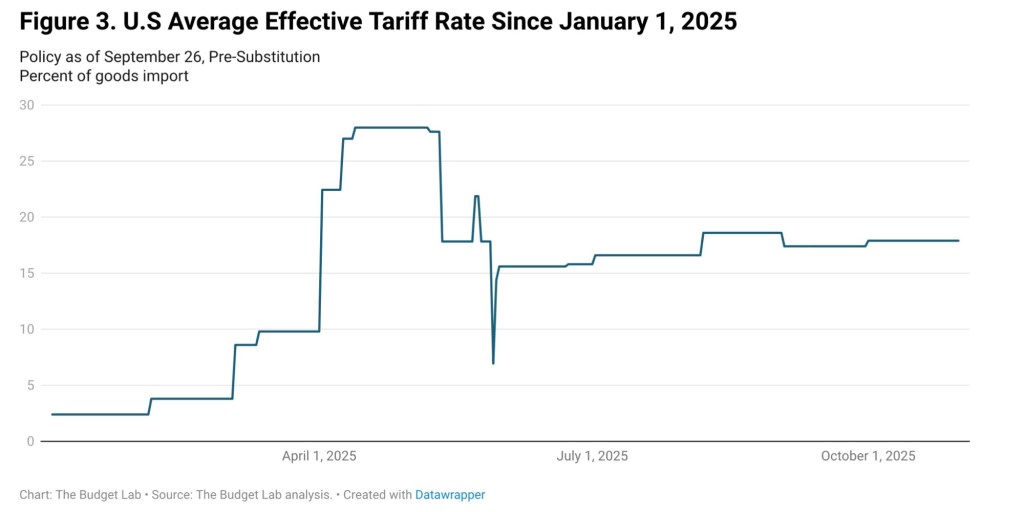
But how are imports and exports faring? Here I’ll quote the Yale Budget Lab’s (YBL) September 26th report on tariffs, which includes the chart shown at the top of this post:

“Consumers face an overall average effective tariff rate of 17.9%, the highest since 1934. After consumption shifts, the average tariff rate will be 16.7%, the highest since 1936. …

The post-substitution price increase settles at 1.4%, a $1,900 loss per household.“

The “post-substitution” modifier refers to the fact that price increases caused by tariffs would be somewhat larger but for consumers’ attempts to find lower-priced domestic substitutes. Suppose the PCE deflator ends 2025 with a 2.8% annual increase. The YBL’s price estimate implies that absent the Trump tariffs, the PCE would have increased 1.4%. If that seems small to you (and the tariff effect seems large to you), recall that monetary policy has been and remains moderately restrictive, so we might have expected some tapering in the PCE without tariffs.

We also know that the early effects of the tariffs have been dominated by thinner margins earned by businesses on imported goods. Those firms have been swallowing a large portion of the tariff burden, but they will increasingly attempt to pass the added costs into prices.

But back to the main topic … what about exports? Unfortunately, the data is subject to lags and revisions, so it’s too early to say much. However, we know exports won’t decline as much as imports, given the lack of complete Lerner symmetry. YBL predicts a drop in exports of 14%, but that includes retaliatory effects. In August the WTO predicted only about a 4% decline, which would be about half the decline in imports.

Seeking Compensatory Rents

More telling perhaps, and it may or may not be a better indicator of the Lerner effect, is the clamoring for relief by American farmers who face diminished export opportunities. As Tyler Cowen says, “Lerner Symmetry Bites”. Other industries will feel the pinch, but many are likely preoccupied with the more immediate problem of increases in the direct cost of imported materials and components.

The farm lobby is certainly on its toes. The Trump Administration is now asking U.S. taxpayers to subsidize soybean producers to the tune of $15 billion. Those exporting farmers are undoubtedly victimized by tariffs. But so much for deficit reduction! More from Cowen:

“Using tariff revenue to subsidize the losses of exporters is a textbook illustration of Lerner Symmetry because the export losses flow directly from the tax on imports! The irony is that President Trump parades the subsidies as a victory while in fact they are simply damage control for a policy he created.“

A List of Harms

Tariffs are as distortionary as any other selective excise tax. They restrict choice and penalize domestic consumers and businesses, whose judgement of cost and quality happen to favor goods from abroad. Tariffs create cost and price pressures in some industries that both erode profit margins and reduce real incomes. For consumers, a tariff is a regressive tax, harming the poor disproportionately.

Tariffs also diminish foreign flows of capital to the U.S., slowing the long-term growth of the economy as well as productivity growth and real wages. And the Lerner effect implies that tariffs harm U.S. exporters by reducing the dollars available to foreigners for purchasing goods from the U.S. In these several ways, Americans are made worse off by tariffs.

We now see attempts to cover for the damage done by tariffs by subsidizing the victims. A “tariff dividend” to consumers? Subsidies to exporters harmed by the Lerner effect? In both cases, we would forego the opportunity to pay down the bloated public debt. Thus, the American taxpayer will be penalized as well.
My Foolish Hopes For Free Trade Bargaining

24 Saturday May 2025

Posted by Nuetzel in Central Planning, Free Trade

≈ 2 Comments

Tags

Balance of Payments, Big Beautiful Bill, central planning, Coercion, Cronyism, Donald Trump, Eric Boehm, Fiscal Restraint, Foreign Investment, Free trade, Liberation Day, National Security, Non-Tariff Barriers, Price Pressures, Punitive Tariffs, Reciprocal Tariffs, Retaliatory Tariffs, Selective Tariffs, Tariff Exceptions, Tariff Incidence, Trade Deals, Trade Deficit

Just a few weeks back I engaged in wishful speculation that Trump’s drastic imposition of “reciprocal” and punitive tariffs could actually prove to be a free-trade play, but only if the U.S. used its universally dominant position in trade wisely at the bargaining table. I worried, however, that any notion Trump might have along those lines was eclipsed by his antipathy for otherwise harmless trade deficits. Another bad indicator was his conviction that manipulating tariffs could restore “fairness” in trade relations while raising revenue to pay for the selective tax cuts he promised for tips, overtime wages, and social security benefits.

Aside from that, I won’t repeat all of Trump’s fallacies about trade (and see here and here) except where they’ve impinged on recent developments.

One Raw Deal

My hopes for reduced trade barriers were dashed when the first “deal” (or really a “Memorandum of Understanding”) was announced with the United Kingdom. The U.S. runs a trade surplus with the UK, so one might think Trump would find it unnecessary to levy tariffs on U.S. imports from the UK. No dice! Clearly this was not motivated by the trade deficit bogeyman of Trump’s fever dreams. The White House stated that buyers of goods from the UK will pay the minimum 10% tariff (up from 3.3% before Trump took office).

Trump simply likes tariffs. Apparently he’s never given much thought to their incidence, which falls largely on domestic consumers and businesses. The MAGA faithful are in blissful denial that such a burden exists, despite ample evidence of its reality.

As Eric Boehm notes, the U.S. received a few concessions on British tariffs under the deal, but the reductions only amount to about a 2% equivalent. There are sharp reductions in special tariffs on U.S. agricultural products, especially meat. There are also exceptions to tariffs on certain British goods, like autos (up to 100,000 units). The selective nature of the concessions on both sides underscores the cronyist underpinnings of this style of economic governance, which amounts to ad hoc central planning.

Also troubling is the misleading spin the Administration attempted to put on news coverage of the deal. They claimed to have reduced tariffs of goods imported from the UK, which is true only in comparison to post-“Liberation Day” tariff levels established in early April. In fact, the baseline tariff now applied to most UK goods sold in the U.S. has more than tripled since last year! As Boehm states, American consumers and businesses are paying a lot more for this “deal” than their British counterparts.

Raw Deals To Be?

The “deal” with China is worse, partly because it’s only a 90-day pause in implementation (pending negotiation), and partly because the “reciprocal” tariff rate of 30% applied to Chinese goods is much higher than before Trump imposed the punitive rates. Still worse, the 10% tariff on U.S. exports to China applied during the pause is also much higher. What a deal! And it could get worse. These tariff hikes have little to do with “national security” and they are regressive, having disproportionately large burdens on lower-income consumers and small businesses.

The only other agreement announced thus far is with India. It is not a “trade deal” at all, but a so-called “Terms of Reference On Bilateral Trade Agreement”. It is a “roadmap” for future negotiations. Perhaps it will come together quickly, but it’s hard to expect much after the UK agreement.

Uniting Western Civilization

Just this week we had another hardball move by Trump: a 50% tariff on goods from the European Union starting in June, up from an average of about 3.8% on a trade-weighted basis. The new tariff rate is also higher than the 10% baseline tariff in place since the 90-day pause was announced in April. Trump claims the EU has been levying tariffs of 39% on U.S. goods, which might include what the Administration would call effective tariffs from non-tariff barriers to trade. Or it might refer to retaliatory tariffs announced by the EU in response to Trump’s Liberation Day announcement, but all of those have been paused. In any case, the World Trade Organization says EU tariffs on US goods average 4.8%. Quite a difference!

The move against the EU is much like Trump’s earlier ploy with China, but he says he’s “not looking for a deal”. He also says talks with the EU are “going nowhere”, though the Polish Trade Minister reassures that talks are “ongoing”. The outcome is likely to be a disappointment for anyone (like me) hoping for freer trade. The EU will probably make commitments to buy something from the U.S., maybe beef or liquified natural gas. But U.S. tariffs on EU goods will be higher than in the past.

So, thus far we have only one “deal” (such as it is), one roadmap for negotiations to follow, and a bunch of pauses pending negotiation (China included). The Trump team says about 100 countries hope to negotiate trade deals, but that is a practical impossibility. Even Trump says “… it’s not possible to meet the number of people that want to see us.” But it could be easy: just drop all U.S. trade barriers and allow protectionist countries to tax their own citizens, denying them access to free choice.

Bullying Enemies, Allies and Producers

Higher U.S. tariffs will put some upward pressure on the prices of imports and import-competing goods. We haven’t seen this play out just yet, but it’s early. In a defensive move, Trump is attempting to bully and shame domestic companies such as WalMart for attempting to protect their bottom lines in the face of tariffs. He also warned automakers about their pricing before carving out an exception for them. And now Apple has been singled-out by Trump for a special 25% tariff after it had announced plans to move assembly of iPhones to India, rather than in the U.S.

You better stay on Trump’s good side. This is a loathsome kind of interference. It encourages firms to seek favors in the form of tariff exemptions or to accept what amounts to state expropriation of profits. Cronyism and coercion reign.

Swamped By Spendthrifts?

The market seems to believe the negative impact of tariffs on economic growth will be more than offset by other stimulative forces. This includes the extension of Trump’s 2017 tax cuts. The so-called “big beautiful bill” passed by the House of Representatives also includes new tax breaks on tip and overtime pay, and an increase in the deduction for state and local taxes. While the bill reduces the growth of federal spending, there is disappointment that spending wasn’t reduced. The Senate might pass a version with more cuts, but the market sees nothing but deficits going forward. This is not the sort of “fiscal restraint” the market hoped for, particularly with escalating interest costs on the burgeoning federal debt.

Conflicting Goals

Trump has bargained successfully for some major investments in the U.S. by wealthy nations like Saudi Arabia and Dubai, as well as a few major manufacturing and technology firms. That’s wonderful. He doesn’t understand, however, that strong foreign investment in the U.S. will encourage larger trade deficits. That’s because foreign capital inflows raise incomes, which increase demand for imports. In addition, the capital inflows cause the value of the dollar to appreciate, making imports cheaper but exports more expensive for foreigners. It would be a shame if Trump reacted to these eventualities by doubling down on tariffs.

Conclusion

Alas, my hopes that Trump’s bellicose trade rhetoric was mere posturing were in vain. He could have used our dominant trading position to twist arms for lower trade barriers all around. While I worried that he massively misunderstood the meaning of trade deficits, and that he viewed higher tariffs as a magic cure, I should have worried much more!

Free Trade or Tariffs: Sow Wealth or Lay Waste

12 Tuesday Nov 2024

Posted by Nuetzel in Free Trade, Liberty, Tariffs

≈ 1 Comment

Tags

AI Industry, Consumer Sovereignty, Donald Trump, Favoritism, Foreign Direct Investment, Free trade, Noah Smith, Open Economy, Protectionism, Purchasing Power, rent seeking, Retaliatory Tariffs, Specialization, Tariffs

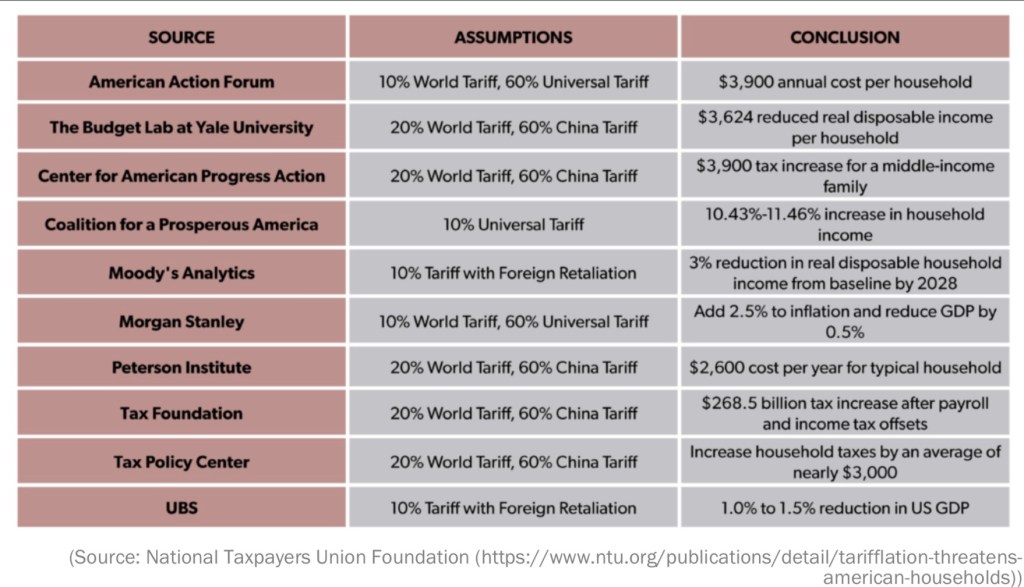
The table above is from Eric Boehm at Reason.com. It shows a variety of negative economic projections based on the likely imposition of tariffs by the incoming Trump Administration. Donald Trump’s protectionist agenda is motivated in large part by the notion that imports of foreign goods and services harm the U.S. economy. This misapprehension is common on both the populist left and the nationalist right, but it is also fueled by special interests averse to competition. Especially puzzling are those who extol the virtues of capitalism and free markets while claiming that free markets across borders are inimical to our nation’s economic interests.

Imports and Domestic Spending

Many assume that imports directly reduce GDP. In fact, on this point, some might be led astray by a superficial exposure to macroeconomics. As Noah Smith has noted, they might think back to the simple spending definition of GDP they learned as college freshmen:

GDP = C + I + G + (X – M),

where C is consumer spending on final goods and services, I is investment spending, G is government spending, X is foreign spending on U.S. exports, and M is U.S. spending on imports from abroad. So imports are subtracted! Doesn’t that mean imports directly reduce GDP?

The key here is to recognize that C, I, and G already include spending on imported goods. Therefore, imports must be subtracted from the spending totals to find the value spent on domestically-produced final goods and services. No, imports are not a direct, net subtraction from GDP.

Your Loathsome Foreign Car

Of course the domestic impact of imports goes deeper than this simple accounting framework. If someone decides to purchase an imported good instead of a close substitute produced domestically, what happens to GDP? If the decision has an immediate impact on production, then U.S. GDP declines. Otherwise, the domestic good is new inventory investment (part of I above), and there is no change. But if the import decision is repeated, the result is permanently lower U.S. GDP relative to the alternative, as producers won’t want to add to inventories indefinitely. The same is true if a domestic producer decides to purchase a component or raw material produced overseas rather than one produced at home.

The import decision causes a domestic producer to lose a sale along with the profit that sale would have earned. That puts pressure on the firm’s workers and wages as well. The firm still has the value of the unit in inventory, but if the import decision is repeated there will be more substantial follow-on effects on production, employment, spending, and saving.

Not So Fast

There is still more to the story, of course. By purchasing the foreign good,,which in the buyer’s estimation delivers greater value at that point in time, there is a gain in consumer surplus that is very real. To the buyer, that gain is perhaps equivalent to dollars in the bank. Their real wealth has increased relative to the surplus value of the foregone domestic purchase. This, too, will likely have follow-on effects in terms of spending and saving, but positive effects.

Therefore, to a first approximation, the immediate effects of an import purchase on total domestic welfare are ambiguous. Consumers of imports gain value; producers of import-competing goods lose value.

As to the loss of the domestic sale, competition is tough, but it greatly contributes to the efficiency of the free market system and to the well being of consumers. Let’s face it: ultimately, the whole point of economic activity is to enable consumption. Production has no other purpose. So producers must react to competition and strive to improve value for buyers along any margins they can. That, in turn, is unequivocally positive for potential buyers both here and abroad.

It’s also true that the purchase of foreign goods means that dollars must be sold in exchange for foreign currency. That weakens the dollar, but those “excess dollars” are generally used to purchase U.S. assets, including physical capital. That direct investment promotes economic growth.

Open Economy, Open Mind

No matter what you believe about the net benefits or costs of a single import transaction like the one described above, it is misleading to draw conclusions about the benefits of foreign trade based on a single transaction, or even a series of repeated transactions.

First, consumer sovereignty is based on freedom of choice, including the freedom to purchase from any seller, domestic or foreign. Consumers greatly benefit from that broad freedom. Add to that the benefit of producers who are free to purchase inputs from any source they believe to offer the greatest value (a benefit that ultimately flows through to consumers). These freedoms ultimately enhance productivity and well being.

Trade across borders leverages the same economic advantages as trade within borders. People tend to accept the latter as truth without giving it a thought, yet the former is often rejected reflexively. The question is inappropriately bound up in issues like patriotism and, over time, an excessive focus on high-visibility job losses in traditional industries.

Trade allows people and their countries to specialize in producing things at which they are comparatively efficient, i.e., in which they are lower-cost producers. This is at the very heart of mutually beneficial exchange: no party to a voluntary transaction expects to suffer a loss. And in trade, when an external, domestic party sustains a lost sale, for example, they have the opportunity to improve or reallocate their resources to endeavors to which they are better suited. So there are direct gains from trade and there are indirect gains via the discipline of competition, including the benefits of reallocating scarce resources from inefficient to efficient uses.

Tariff Gains

Now we shift gears to tariffs: interventions having benefits that are more concentrated than costs, and which tend to be more ephemeral:

— Domestic producers who compete with imports gain through the grant of additional market power, given the tax on foreign goods and services. These producers now have more pricing flexibility, and what is often more pertinent, survivability.

— Workers at domestic firms will benefit to the extent that their employers face reduced foreign competition. Some combination of employment, hours, and wages may rise.

— Some firms have mixed gains and losses, with more pricing power over final product but elevated costs due to the use of taxed foreign components.

Tariff Losses

Who pays when government succumbs to irrational protectionist pressure and attempts to restrict imports via tariffs?

— Domestic consumers suffer a loss of freedom and bear a large part of the burden of the tariff tax.

— Higher prices for imports lead to higher prices for competing domestic goods, causing consumers to experience a loss of purchasing power.

— Domestic businesses suffer a loss of control over input decisions. Those already utilizing foreign inputs (and their buyers downstream) bear some of the burden of the tariff tax. For example, tariffs could be quite damaging to the U.S. AI industry, a result that would run strongly contrary to Trump’s promise to promote American AI.

— The U.S. suffers a loss of foreign investment, which could engender higher interest rates, lower productivity growth, and lower real wages.

— As Tyler Cowen puts it in a review of this paper, “… lobbying, logrolling and political horse-trading were essential features of the shift toward higher US tariffs. A lot of the tariffs of the time [1870 -1909] depended on which party controlled Congress, rather than economic rationality.“

— Tariffs tend to reduce economic growth due to diminished productivity in tariff-protected industries, which also erodes real wages. Less productive firms capture a significant share of the benefits of tariffs, so that economic growth falls due to a compositional effect. Higher prices for imports and import-competing goods undermine the real gains of import-protected workers.

— Finally, tariffs invariably beget retaliatory tariffs by erstwhile friendly trading partners. Export industries and their employees take a direct hit. This retaliation damages the prospects of the most productive exporters, while weaker exporting firms might be forced to close shop unnecessarily.

One other note: the discussion of gains and losses above is essentially the same for policies that reward the use of American labor via tax breaks. This not only penalizes imports of final and intermediate foreign goods, it subsidizes high-cost domestic labor. Obviously, the upshot is a less competitive U.S. economy.

Tariff-Threat Policy

To be fair, Donald Trump has said he’d use the threat of tariffs strategically to achieve a variety of objectives, not all of which are directly related to trade. We can hope that many of those threats won’t be acted upon. On one hand, that’s more appealing than general tariffs, with potential foreign policy gains and less in the way of general damage to the economy. On the other hand, the discretionary application of tariffs could invite political favoritism and foster a corrupt rent-seeking environment.

Conclusion

Trade protectionism protects weak and strong producers alike. The weak should not be given artificial incentives to produce goods inefficiently. That’s simply a waste of resources. Protecting the strong is unnecessary and discourages the drive for efficiency as well as real value creation. It lends market power to already powerful firms, leading to higher prices and penalizing domestic consumers.

One last aside: tariffs cannot raise anywhere close to the revenue necessary to replace the income tax, an absurd claim made by Trump on the campaign trail.

Only free trade is consistent with the values of a free society. It enhances choice, makes markets more competitive, creates incentives for efficiency, and cultivates opportunities for economic growth, That would serve Trump and the nation much better than the fixation on tariffs.

Tariffs, Content Quotas, and What Passes for Patriotism

10 Friday Mar 2023

Posted by Nuetzel in Free Trade, Protectionism

≈ Leave a comment

Tags

budget deficits, Buy American, CCP, CHIPS Act, Comparative advantage, Consumer Sovereignty, Content Restrictions, Critical Supply Chains, Domestic Content, Donald Trump, Dumping, Export Markets, Federal Procurement, Foreign Trade, Free trade, George Will, Import Waivers, Joe Biden, Made-In-America Laws, Mercantilism, National Security, Nationalism, Patriotism, Price Competition, Price Preference, Protectionism, Tariffs, Trade Retaliation, Universal Baseline Tariffs, Uyghur Muslims

If there’s one simple lesson in economics that’s hard to get across it’s the destructive nature of protectionism. The economics aren’t hard to explain, but for many, the lessons of protectionist failure just don’t want to sink in. Putting aside matters of national security, the harms of protectionism to the domestic economy are greater than any gains that might inure to protected firms and workers. Shielding home industries and workers from foreign competition is generally not smart nor an act of patriotism, but that sentiment seems fairly common nonetheless.

The Pathology of Protectionism

Jingoistic slogans like “Buy American” are a pitch for voluntary loyalty to American brands. I’m all for voluntary action. Still, that propaganda relies on shaming those who find certain foreign products to have superior attributes or to be more economical. This feeds a psychology of economic insularity and encourages those who favors trade barriers, which is one of the earliest species of failed central planning.

The cognitive resistance to a liberal trade regime might have to do with the concentrated benefits of protectionist measures relative to the more diffuse (but high) costs it imposes on society. Some of the costs of protectionism manifest only with time, which makes the connection to policy less obvious to observers. Or again, obstructing trade and taxing “others” in the hope of helping ourselves may simply inflame nationalist passions.

Both Democrats and Republicans rally around policy measures that tilt the playing field in favor of domestic producers, often severely. And again, this near unanimity exists despite innumerable bouts with the laws of economics. I mean, how many times do you have to be beaten over the head to realize that this is a mistake? Unfortunately, politicians just don’t live in the long-term, they leap to defend powerful interests, and they seldom pay the long-term consequences of their mistakes.

Joe Biden’s “Buy American”

The Biden Administration has pushed a “Made In America” agenda since the President took office, It’s partly a sop to unions for their election support. Much of it had to do with tightening waivers granted under made-in-America laws (dating back to 1933) governing foreign content in goods procured by the federal government. The most recent change by Biden is an increase in the requirement for domestic content to 60% immediately and gradually to 75% from there. Also, “price preferences” will be granted to domestic producers of goods to strengthen supply chains identified as “critical”, including active pharmaceutical ingredients, certain minerals including rare earths and carbon fibers, semiconductors and their advanced packaging, and large capacity batteries such as those used in EVs.

There’s a strong case to be made for developing domestic supplies of certain goods based on national security considerations. That can play a legitimate role where defense goods or even some kinds of civilian infrastructure are involved, but Biden’s order applies much more broadly, including protections for industries that are already heavily subsidized by taxpayers. For example, the CHIPS Act of 2022 included $76 billion of subsidies and tax credits to the semiconductor industry.

George Will describes the cost of protectionism and Biden’s “Buy American”:

“‘Buy American,’ like protectionism generally, can protect some blue-collar jobs — but at a steep price: A Peterson Institute for International Economics study concludes that it costs taxpayers $250,000 annually for each job saved in a protected industry. And lots of white-collar jobs are created for lawyers seeking waivers from the rules. And for accountants tabulating U.S. content in this and that, when, say, an auto component might cross international borders (U.S., Canadian, Mexican) five times before it is ready for installation in a vehicle.”

Biden’s new rules will increase the cost of federal procurement. They will squeeze out contracts with foreign suppliers whose wares are sometimes the most price-competitive or best-suited to a project. This is not a prescription for spending restraint, and it comes at a time when the federal budget is under severe strain. Here’s George Will again:

“This will mean more borrowing, not fewer projects. Federal spending is not constrained by a mere shortage of revenue. So, Biden was promising to increase the deficit. And this policy, which elicited red-and-blue bonhomie in the State of the Union audience, also will give other nations an excuse to retaliate (often doing what they want to do anyway) by penalizing U.S. exporters of manufactured goods. ….. Washington lobbyists for both will prosper.”

Domestic manufacturers who find their contracting status “protected” from foreign competition will face less incentive to perform efficiently. They can relax, rather than improve or even maintain productivity levels, and they’ll feel less pressure to price competitively. Those domestic firms providing goods designated by the government as “critical” will be advantaged by the “price preferences” granted in the rules, leading to a less competitive landscape and higher prices. Thus, Biden’s “Buy American” order is likely to mean higher prices and more federal spending. This is destructive and counter to our national interests.

Donald Trump’s Tariffs

In a recent set of proposals trialed for his presidential election campaign, Donald Trump called for “Universal Baseline Tariffs” on imported goods. In a testament to how far Trump has stumbled down the path of economic ignorance, his campaign mentions “patriotic protectionism” and “mercantilism for the 21st century”. Good God! Trump might be worse than Biden!

This isn’t just about China, though there are some specific sanctions against China in the proposal. After all, these new tariffs would be “universal”. Nevertheless, the Trump campaign took great pains to cloak the tariffs in anti-China rhetoric. Now, I’m very unfavorably disposed to the CCP and to businesses who serve or rely on China and (by implication) the CCP. Certainly, in the case of China, national security may dictate the imposition of certain forms of protectionism, slippery slope though it might be. Nevertheless, that is not what universal tariffs are about.

One destructive consequence of imposing tariffs or import quotas is that foreign governments are usually quick to retaliate with tariffs and quotas of their own. Thus, export markets are shut off to American producers in an escalating trade conflict. That creates serious recession risks or might reinforce other recessionary forces. Lost production for foreign markets and job losses in the affected export industries are the most obvious examples of protectionist harm.

Then consider what happens in protected industries in the U.S. and the negative repercussions in other sectors. The prices charged for protected goods by domestic producers rise for two reasons: more output is demanded of them, and protected firms have less incentive to restrain pricing. Just what the protectionists wanted! In turn, with their new-found, government-granted market power, protected firms will compete more aggressively for workers and other inputs. That puts non-protected firms in a bind, as they’ll be forced to pay higher wages to compete with protected firms for labor. Other inputs may be more costly as well, particularly if they are imported. These distortions lead to reduced output and jobs in non-protected industries. It also means American consumers pay higher prices for both protected and unprotected goods.

Consumers not only lose on price. They also suffer a loss of consumer sovereignty to a government wishing to manipulate their choices. When choices are curtailed, consumers typically lose on other product attributes they value. It also curtails capital inflows to the U.S. from abroad, which can have further negative repercussions for U.S. productivity growth.

When imports constitute a large share of a particular market, it implies that foreign nations have a comparative advantage in producing the good in question. In other words, they sacrifice less to produce the good than we would sacrifice to produce it in the U.S. But if country X has a comparative advantage in producing good X, it means it must have a comparative disadvantage in producing certain other goods, let’s say good Y. (That is, positive tradeoffs in one direction necessarily imply negative tradeoffs in the other.) It makes more economic sense for other countries (country Y, or perhaps the U.S.) to produce good Y, rather than country X, since country Y sacrifices less to do so. And that is why countries engage in trade with each other, or allow their free citizens to do so. It is mutually beneficial. It makes economic sense!

To outlaw or penalize opportunities for mutually beneficial trade will only bring harm to both erstwhile trading partners, though it might well benefit specific interests, including some third parties. Those third parties include opportunistic politicians wishing to leverage nationalist sentiments, their cronies in protected industries, and the bureaucrats, attorneys, and bean counters who manage compliance.

When Is Trade Problematic?

Protectionists often accuse other nations of subsidizing their export industries, giving them unfair advantages or dumping their exports below cost on the U.S. market. There are cases in which this happens, but all such self-interested claims should be approached with a degree of skepticism. There are established channels for filing complaints (and see here) with government agencies and trade organizations, and specific instances often prompt penalties or formal retaliatory actions.

There are frequently claims that foreign producers and even prominent American businesses are beneficiaries of foreign slave labor. A prominent example is the enslavement of Uyghur Muslims in China, who reportedly have been used in the manufacture of goods sold by a number of big-name American companies. This should not be tolerated by these American firms, their customers, or by the U.S. government. Unfortunately, there is a notable lack of responsiveness among many of these parties.

Much less compelling are assertions of slave labor based on low foreign wage rates without actual evidence of compulsion. This is a case of severely misplaced righteousness. Foreign wage rates may be very low by American standards, but they typically provide for a standard of living in the workers’ home country that is better than average. There is no sin in providing jobs to foreign workers at a local wage premium or even a discount, depending on the job. In fact, a foreign wage that is low relative to American wages is often the basis for their comparative advantage in producing certain goods. Under these innocent circumstances, there is no rational argument for producing those goods at much higher cost in the U.S.

Very troublesome are the national security risks that are sometimes attendant to foreign trade. When dealing with a clear adversary nation, there is no easy “free trade” answer. It is not always clear or agreed, however, when international relations have become truly adversarial, and whether trade can be usefully leveraged in diplomacy.

Conclusion

As I noted earlier, protectionism has appeal from a nationalist perspective, but it is seldom a legitimate form of patriotism. It’s not patriotic to limit the choices and sovereignty of the individual, nor to favor certain firms or workers by shielding them from competition while penalizing firms requiring inputs from abroad. We want our domestic industries to be healthy and competitive. Shielding them from competition is the wrong approach.

So much of the “problem” we have with trade is the infatuation with goals tied to jobs and production. Those things are good, but protectionists focus primarily on first-order effects without considering the damaging second-order consequences. And of course, jobs and production are not the ultimate goals of economic activity. In the end, we engage in economic activity in order to consume. We are a rich nation, and we can afford to consume what we like from abroad. It satisfies wants, it brings market discipline, and it leads to foreign investment in the American economy.

Biden and Trump share the misplaced objectives of mercantilism. They are both salesmen in the end, though with strikingly different personas. Salesmen want to sell, and I’m almost tempted to say that their compulsion causes them see trade as a one-way street. Biden is selling his newest “Buy American” rules not only as patriotic, but as a national security imperative. The former is false and the latter is largely false. In fact, obstructions to trade make us weaker. They will also contribute to our fiscal imbalances, and that contributes to monetary and price instability.

Like “Buy American”, Trump’s tariffs are misguided. Apparently, Trump and other protectionists wish to tax the purchases of foreign goods by American consumers and businesses. In fact, they fail to recognize tariffs as the taxes on Americans that they are! And tariffs represent a pointed invitation to foreign trading partners to impose tariffs of their own on American goods. You really can’t maximize anything by foreclosing opportunities for gain, but that’s what protectionism does. It’s astonishing that such a distorted perspective sells so well.

April 22: Happy Human Achievement Day!

21 Sunday Apr 2019

Posted by Nuetzel in Free markets, Free Trade, Human Welfare, Uncategorized

≈ Leave a comment

Tags

Disease, Don Boudreaux, Earth Day, Fossil fuels, Free Markets, Human Ingenuity, Human Progress, Literacy, Marion Tupy, Paul Driessen, Poverty

By way of celebrating human ingenuity, I’ll be driving 600 miles on Monday in a beautiful sedan powered by high-octane fuel. I’ll be clothed in incredibly comfortable fibers and have access to a great variety of listening amusements via satellite. The celebration will continue when I arrive home. I’ll enjoy the comfort of climate-control, electric power, modern plumbing, a refrigerator and pantry full of agricultural bounty, delicious wine, and even more incredible access to entertainment and intellectual pursuits. But it’s not just the goods and technology I’ll celebrate. I’ll also raise a glass to the fabulous, free-market institutions that have made all this possible, effectively allowing us to trade with specialized producers all around the world at low cost, and at prices that signal the true scarcities of resources… ill-considered tariffs aside.

In honor of mankind’s great achievements, I bring you additional testimony from Don Boudreaux, who provides some juicy tidbits to mark our progress. Here is more from Marion Tupy at humanprogess.org. And one more link is from Paul Driessen, who last Thanksgiving wrote of the the many developments since 1800 that have drastically improved human well being, including the ability to exploit fossil fuels that are extremely clean-burning and efficient relative to primitive energy sources.

What riches we enjoy today! Contrary to the claims of doomsayers, busybodies, and self-appointed enforcers of an austere existence, our prospects for continued improvement in human standards of living are excellent. The long arc of technological progress has made the effective abundance of resources greater and more sustainable than ever. As the many charts in Tupy’s article demonstrate, long-term trends in real incomes, poverty, literacy, longevity and the incidence of disease are quite favorable. We owe all that to the spread of human ingenuity, freedom, and voluntary exchange. That’s truly progressive!

The Master Negotiator: I’ll Beat Myself Till You Accept My Terms!

07 Wednesday Mar 2018

Posted by Nuetzel in Free Trade, Tariffs, Trump Administration

≈ Leave a comment

Tags

Balance of Trade, Chinese Trade Policy, Coyote Blog, Cronyism, Donald Trump, Dumping, NAFTA, National Security, Panda Blog, Peter Navarro, Pierre Lenieux, Protectionism, Stephen Mihm, Tariffs, Trade Retaliation, Trade War, Warren Meyer, Wilbur Ross

As if you needed more evidence that governments are incompetent, look no further than trade policy: public officials the world over are almost universally ignorant regarding the effects of international trade and trade imbalances. In this sense, the Trump Administration’s new tariffs on imported steel and aluminum are in keeping with the long history of public sector foibles on trade. This phenomenon stems from an unhealthy and obsessive focus on the well-being of producers without regard to the implications of policy for consumers. Warren Meyer of Coyote Blog offers an evaluation of Chinese trade policy, which he mischievously (I believe) claims was written by a Chinese blogger on a “sister blog” called “Panda Blog“. Despite Meyer’s playfulness, the post is instructive:

“Our Chinese government continues to pursue a policy of export promotion, patting itself on the back for its trade surplus in manufactured goods with the United States. The Chinese government does so through a number of avenues, … each and every one of these government interventions subsidizes US citizens and consumers at the expense of Chinese citizens and consumers. A low yuan makes Chinese products cheap for Americans but makes imports relatively dear for Chinese. So-called ‘dumping’ represents an even clearer direct subsidy of American consumers over their Chinese counterparts. And limiting foreign exchange re-investments to low-yield government bonds has acted as a direct subsidy of American taxpayers and the American government, saddling China with extraordinarily low yields on our nearly $1 trillion in foreign exchange. Every single step China takes to promote exports is in effect a subsidy of American consumers by Chinese citizens.“

The very idea of a trade deficit is often used to intimate a threat to a nation’s economic health. Conversely, a trade surplus is used to suggest that a nation is achieving great economic success. Both contentions are nonsense. Here is more from “Panda Blog“:

“We at Panda Blog believe it is insane for our Chinese government to continue to chase the chimera of ever-growing foreign exchange and trade surpluses. These achieved nothing lasting for Japan and they will achieve nothing for China. In fact, the only thing that amazes us more than China’s subsidize-Americans strategy is that the Americans seem to complain about it so much. They complain about their trade deficits, which are nothing more than a reflection of their incredible wealth. … They complain about China buying their government bonds, which does nothing more than reduce the costs of their Congress’s insane deficit spending. They even complain about dumping, which is nothing more than a direct subsidy by China of lower prices for American consumers.

And, incredibly, the Americans complain that it is they that run a security risk with their current trade deficit with China! This claim is so crazy, we at Panda Blog have come to the conclusion that it must be the result of a misdirection campaign by CIA-controlled American media. After all, the fact that China exports more to the US than the US does to China means that by definition, more of China’s economic production is dependent on the well-being of the American economy than vice-versa.“

By the way, those “quotes” from “Panda Blog” appeared on Coyote Blog 12 years ago!

All nations tend to play these trade games to one extent or another. But protectionist actions always harm a nation’s consumers more than they help producers, a proposition that is easy to demonstrate using a simple supply and demand diagram. While the class of consumers is broader than the class of producers, ultimately “producer” and “consumer” are different roles played by the same individuals. So protectionism is always harmful to a nation, on balance. Furthermore, retaliation against another nation for its dim-witted trade barriers also harms the retaliating nation’s consumers more than it helps its producers, and that’s true regardless of whether retaliation begets reciprocal actions.

Of course, producers are generally in a better position than consumers to grease the political skids in their favor. In a separate post, Meyer notes that protectionist trade policies are rooted in cronyism. The costs to society are very real, but they tend to be diffuse and therefore less obvious to most consumers.

“A lot of the media seems to believe the biggest reason they are bad is that they will incite retaliatory tariffs from other countries, which they almost certainly will.  But even if no one retaliated, even if the tariffs were purely unilateral, they would still be bad. In case after case, they are justified as increasing the welfare of a certain number of workers in targeted industries, but they hurt the welfare of perhaps 100x more people who consume or work for companies that consume the targeted products. Prices will rise for everyone and choices will be narrowed.“

A couple of points deserve emphasis in relation to my last post on Trump’s tariff action:

  • In terms of jobs, the tariffs announced by President Trump present a very poor risk-reward tradeoff (WSJ article is gated):

“The policy point is that Mr. Trump’s tariffs are trying to revive a world of steel production that no longer exists. He is taxing steel-consuming industries that employ 6.5 million and have the potential to grow more jobs to help a declining industry that employs only 140,000.“

  • Stephen Mihm discusses ways in which the U.S. steel industry squandered its superiority in the post-World War II era. Much of Mihm’s article is devoted to the industry’s failure to upgrade to new production technologies. Interestingly, however, it fails to mention the damaging role played by unions in the process. “Dumping” had very little to do with it.
  • Finally, Pierre Lemieux takes a closer look at the national security argument for trade barriers. He concludes that it is fallacious. Of course, it is an excuse for cronyism. Protectionism harms the competitiveness of the protected industries, which actually undermines national security. And protectionism is usually unnecessary on close examination. In the case of steel, for example, national defense and homeland security use only about 3% of American steel production. Beyond that simple fact, the argument is dangerously open-ended. Almost anything can be represented as critical to national security: steel, food, clothing, and many other categories. Even human resources.

Today, Trump announced that Canada and Mexico will be exempt from the new tariffs while a renegotiation of the North American Free Trade Agreement (NAFTA) is underway. That’s better, but this carve-out exempts only 25% of U.S. steel imports. Perhaps Australia will be granted an exemption as well, but additional carve-outs will prompt further increases in tariffs on non-exempt imports. Trump also said that U.S. flexibility in applying the new tariffs to allies will depend on their commitments for military spending!

Thus, rather than maintaining the pretense that trade relationships are about economics, the administration has conceded that the tariffs and the exemption process will be transparently political, never a prescription for efficient resource allocation. Moreover, U.S. trading partners are likely to be reluctant to test the politics of modifying their own trade manipulations at home. Indeed, the politics may dictate retaliation, rather than concessions. In any case, the governments of our trading partners are as clueless on trade as Trump, his Commerce Secretary Wilbur Ross, and his economic advisor Peter Navarro, or they would never intervene in private trade decisions to begin with.

Trump Bumbles On Trade With Tariffs

02 Friday Mar 2018

Posted by Nuetzel in Free Trade, Protectionism, Tariffs

≈ 1 Comment

Tags

Carve-Outs, central planning, Fair Trade, Import Quotas, monopoly power, Protectionism, Tariffs, Trade Barriers, Trade War, Trading Partners, Trump Tariffs

You can get away with lousy policy by calling it a “negotiating tactic” for only so long. But that dubious ploy is one of the rationales offered last week by the Trump Administration for imposing a 25% tariff on imported steel and a 10% tariff on imported aluminum. Sure, the tariffs are like gifts rendered onto American steel and aluminum producers, their shareholders, and their unionized workers. The tariffs allow them to compete more effectively, without any effort, with foreign steel and aluminum in the domestic market, and the tariffs may also give them leeway to raise prices. The tariffs are also forgiving of degraded performance by domestic producers, since reduced competition relieves pressure for efficiency, a primary social cost of monopoly power.

So who pays for these gifts to the domestic steel and aluminum industries? A tariff, of course, is a tax, and a significant portion of it will be passed along into higher prices of both imported and domestically-produced steel and aluminum. Therefore, the burden of that tax will be borne to a large extent by domestics users, including every domestic industry that uses steel or aluminum as an input, and by consumers who purchase those products. That erodes the job security of many domestic workers outside of the steel and aluminum industries. In fact, the tariffs are unlikely to create more jobs even in the steel and aluminum industries given the negative impact of higher prices on the quantities of those metals demanded.

The desperate story line in support of tariffs also includes the assertion that the U.S. steel and aluminum industries are in such dire straits that they are in danger of vanishing. Statistics on U.S. production hardly suggest that is the case, however. Steel output in the U.S. has been reasonably steady since recovering from the last recession, though it has not achieved its pre-recession level. While aluminum output has been declining, it is hardly in a free fall. The stock prices of major steel and aluminum producers, which are forward-looking, have not demonstrated a particular need for government aid (as if that could ever justify a too-big or too-important-to-fail mentality).

Defenders of the tariffs claim that one effect will include additional direct investment in the U.S. by foreign producers of steel and aluminum, because they can avoid the tariffs by setting up production within our borders. Perhaps a few will, but capital is mobile in other sectors as well. Producers in other industries requiring intensive use of steel or aluminum inputs will now have an incentive to shift production overseas, where the tariffs won’t apply. Attempting to prevent such shifts via import tariffs on final products would quickly become a nightmare of central planning.

Apologists for the tariffs go even further, noting that our new regulatory and tax environment will bring foreign producers to the U.S., essentially making the tariffs irrelevant. If that’s the case, why bother imposing the tariffs at all? And why penalize consumers and industries requiring intensive use of steel or aluminum?

The argument that tariffs provide a stronger position from which to negotiate with foreign “trading partners” (or rather, their governments) is tenuous at best. More likely, the tariffs will prompt retaliation by foreign governments against a range of American products. The very notion that “trade wars are good”, tweeted by President Trump on Friday morning, is as nonsensical as a suggestion that voluntary exchange is destructive. Already, the EU has announced plans to retaliate by imposing tariffs  on bourbon and motorcycles produced in the U.S.

Negotiations are unlikely to be successful. Perhaps some foreign governments who subsidize their steel and aluminum producers could be persuaded to enter talks. Our own domestic producers are penalized by various tariffs and quotas in place abroad, and those might be used by foreign interests as a lever in negotiations. However, the most fundamental foreign trade advantages, when they exist, have to do with low wages, less regulation, more efficient production facilities, and sometimes a more favorable tax environment. Wage levels reflect labor productivity, but those wage levels are valued more highly in their home countries than in the U.S, and penalizing these countries with trade sanctions merely penalizes their workers. Not all dimensions of a cost advantage can be negotiated, and in any case, healthy competition in any industry is always in the interests of a nation’s consumers.

National security is another standard argument in favor of protectionist measures. We’re told, for example, that we cannot allow China to produce all of the steel, but China provides only a small fraction of U.S. steel imports. Canada, Brazil and Mexico provide far more. In fact, China was in 11th place on that list in 2017. So our sources of steel are fairly well diversified. A domestic shortage of steel or aluminum caused by a breakdown in relations with one or more steel-exporting countries would lead to higher prices, but it would bring forth greater supplies from other countries and even from high-cost domestic sources. That is not a national emergency.

It’s possible that the Trump Administration will create “carve-outs”, exempting goods from certain countries from the tariffs. Presumably, those would be based on an assessment of each country’s trade policies and whether they are consistent with “fair” trade, in the judgement of U.S. trade authorities. However, all nations play the protectionist game in one form or another, including the U.S. Any carve outs would be better than none at all, but the remaining tariffs imposed by the administration will be a net burden to the U.S. economy.

Up till now, I have been pleasantly surprised by the Trump Administration’s efforts to de-tax and deregulate the U.S. economy. However, the threat that Donald Trump would adopt protectionist trade policies was one of my major trepidations about his candidacy. And here it is, as he promised. The dilemma often expressed by protectionists is that foreign producers can put elements of the domestic economy out of business by selling below cost. That drain on a country’s resources cannot span all industries — the U.S. has a comparative advantage in many areas. Such an effort cannot last forever or else these nations would cannibalize their own industrial base. Foreign governments quite simply cannot afford it economically and politically. On our end, the best advice is to accept the gift of low-cost goods. With access to ultra-cheap goods, whether steel, sorghum, or some finished product, American consumers and producers who use those imports gain unambiguously, and the purchasing power released can be spent on other goods and services.

Protectionist Ugly: Trump Makes Bad on Tariffs

29 Monday Jan 2018

Posted by Nuetzel in Free Trade, Tariffs

≈ Leave a comment

I’ve reacted favorably to much of the Trump Administration’s economic agenda, but foreign trade has been a huge area of concern. Trump’s rhetoric on trade was bellicose on the campaign trail. Thus far in office he has succeeded in upending or threatening trade agreements: he pulled the U.S. out of the Trans-Pacific Partnership (TPP) negotiations, a multilateral trade agreement involving 11 of our Asian trading partners; he has also promised that NAFTA will be renegotiated. This week, he imposed tariffs on solar panels produced in China and washing machines built in South Korea. You will now be forced to pay a penalty tax on any purchase of those products.

Renegotiating existing trade agreements is one thing (though my ideal is unilateral elimination of trade barriers), as is a general preference for bilateral agreements, particularly if they remain focused on trade and not extraneous social issues. But I sincerely hope that the latest move is not the start of a long rollout of tariffs and other protectionist measures. Unfortunately, more such moves are expected.

What possible logic can explain these actions? To hear Donald Trump tell it, the U.S. must enforce trade laws and establish a “level playing field”. So, perhaps this is a form of negotiation. If so, are the cards we hold so strong that we can afford to risk retaliation in the form of tariffs levied on our own exports? Do our trading partners value our business so much that they will not retaliate? Would those countries offer to remove any subsidies they grant their own export industries? Would they tell those industries they must be price followers regardless of cost structure and taxes, charging no less than their American competitors? Can we dictate the terms of trade with these parties? Trump apparently thinks so, but we shall see. I believe the answer is almost certainly no.

Retaliation is likely; this is how trade wars begin, and they have a way of precipitating economic contraction. But that risk represents only one part of the cost of Trump’s tariff action. The real problem is the likely impact of the Trump tariffs on American consumers, American production, and on America’s long-run competitiveness.

  1. Prices: Tariffs are essentially a tax on imports. A significant share of the burden of that tax will be borne by consumers. The price they pay for the import will rise to reflect a portion of the tariff. If, instead, they opt to purchase the American product after the imposition of the tariff, that is a coerced and suboptimal decision based on their existing preferences. They are likely to pay more to the American producer than in the absence of the tariff on the import because American producers will face less competitive pressure. Thus, American consumers will be penalized by the tariff whether they continue to purchase the import or not.
  2. Output: Quantities purchased fall when prices rise. That is the law of demand. American consumers will buy less of the import and less overall, so consumers lose on both price and quantity. But it’s worse than that, because domestic producers gain a degree of market power under the tariff. They have greater leeway to price above marginal cost, which implies output restraint. It is therefore quite possible that domestic output will decrease as well.
  3. Competitiveness: Handicapping foreign competitors eases the pressure on domestic producers to perform by reducing costs, pleasing customers, creating value, and innovating. This is not likely to be a sudden change. Rather, it would manifest in a gradual deterioration of competitiveness. Perhaps no one abroad will want our exports, but domestic consumers will have little recourse except to pay the tariff for the foreign good they preferred to begin with. Meanwhile, if other domestic industries are reliant on tariffed imports as inputs to production, they too will suffer a loss of competitiveness.

I tend to be skeptical of any claim that a foreign government facilitates (or engages in) predatory pricing on American markets. Of course they might. And I know… the U.S. itself has thrown subsidies at solar panels in the past. (Well how unfair!) However, the facts are that in a variety of industries, foreign producers actually have cost advantages over U.S. producers. The very idea of trade is to take advantage of such differences for mutual gain. We buy things from others precisely because we can’t do it all ourselves, at least not without great sacrifice (high cost).

It is all too easy for domestic producers to cry “protect us”, and to claim that national security demands protection. These claims are often accepted with little if any analysis. The pleas for protection are characteristic of rent-seeking crony capitalism. And it isn’t as if Americans have nothing to gain in the exchange: cheap consumer goods and cheap inputs for domestic producers. The income released via low foreign pricing is available for other uses, including saving, larger quantities, or spending on other goods.

American consumers pay the price of trade restrictions and tariffs in several ways. The restrictions not only cost them directly in terms of higher prices, but they also represent a violation of consumer sovereignty and tend to restrain output. That a central authority would deign to prohibit or penalize certain consumer decisions is abominable. One can assert that the actions protect workers, but that is a fiction and holds only in the short-run at best. Remember that workers are consumers in the first instance. Ultimately, the trade restrictions degrade the ability of those workers to compete on world markets. In short, they are destructive. At the link above, George Will quotes Henry George to that effect:

“What protection teaches us, is to do to ourselves in time of peace what enemies seek to do to us in time of war.“

Trade Enragement Syndrome

31 Sunday Jul 2016

Posted by Nuetzel in Free Trade, Protectionism

≈ Leave a comment

Tags

Bernie Sanders, Capital Account Surplus, Don Boudreaux, Donald Trump, Free trade, Geocentrism, Heliocentrism, Import Competition, monopoly power, NAFTA, Protectionism, Trade Deficit, Trans-Pacific Partnership

tradebarriers

Trade makes us richer, not poorer. The anti-trade rhetoric spouted by neo-mercantilists like Donald Trump and Bernie Sanders is about as sensible as a boycott on goods produced in the next town, or for that matter, on anyone with whom one might otherwise choose to trade. Don Boudreaux perfectly captures my feelings about the rising trend of protectionist sentiment by comparing it to geocentrism:

“Lately I feel as I imagine an astronomer would today feel if, centuries after Copernicus and Galileo proved beyond a shadow of a doubt that the earth isn’t the center of the solar system, large numbers of people – including popular media pundits and politicians – began to insist that the sun and the planets and the stars do indeed all revolve around a stationary earth that is situated in the center of the universe.“

The very motivation for trade is to obtain something of value that one did not produce, to acquire that which one cannot easily acquire without trade, or to acquire it on more favorable terms than otherwise. It recognizes the reality that one’s productive efforts should be focused in an area that best suits their skills or natural talents. That’s better for the individual and better for society! Countries should produce what they are best at producing, which gives them a cost advantage in their areas of specialization. Trade allows individuals and nations to specialize in production but diversify in consumption, allowing them to enjoy access to the broadest possible range of goods and services produced worldwide.

The consummation of any trade heralds the attainment of mutual benefits to the parties: one produces and employs at a profit; the other consumes a thing of greater value than the price paid. The payments for foreign goods must come from either domestically-produced goods or from foreign investment in domestic real estate, buildings, factories or other real and financial assets. That is, if we purchase more goods from abroad than we export, then foreigners must either hold the dollars they receive or invest them in other ways. The latter represent trades in assets, and those trades, too, are mutually beneficial. The result is that U.S. investors gain and/or the economy benefits from new, productivity-enhancing plant and equipment, not terrible outcomes. Trade deficits are balanced by capital surpluses, and trade surpluses are balanced by capital deficits. Taken together, trade in goods and capital (assets) always balance and are mutually beneficial in every case, whether we run a trade deficit or a surplus.

That said, it’s worth emphasizing that so-called free trade agreements are something of a sham. Countries don’t trade. People do. Unfortunately, I have indulged the notion of national trade negotiation in the past, if only implicitly, by vouching for trade agreements like NAFTA and TPP as sort of second-best solutions to the horrid reality of trade restrictions promulgated by protectionist politicians. I reasoned that dismantling those barriers, one-country (or region) at-a-time was preferable to doing nothing. However, negotiations like these become mired in extraneous issues such as environmental policies, labor laws, immigration rules and other commercial policies. Nor do those negotiations always inhibit domestic subsidies to politically-favored activities. Indeed, they might actually encourage subsidies for value-eroding projects. Again, the entire process of trade negotiations is extraneous to the extent that trade takes place between individuals. Unfettered gains from trade require the absence of trade barriers. Dropping them unilaterally would benefit consumers, encourage efficiency by domestic producers, and provide a great example for other nations.

Opponents of trade, like Messrs. Trump and Sanders, lack a basic understanding of the reasons why individuals engage in cooperative exchange. Or at least they fail to acknowledge, for political reasons or sheer density, that what improves well-being at home is freedom to transact, across our borders as well as within our borders. To prevent this activity is to forcibly deny individual freedom. Boudreaux makes this point be asking trade opponents a series of questions, the first few of which are listed below:

“– Are you made richer if the supermarket … at which you once shopped hires armed goons to force you to start shopping there again?

– Do you believe that the owners and the employees of [that store] are so ethically entitled to your continuing patronage as a consumer that they are justified in employing armed goons to prevent you from shopping elsewhere?

– Do you believe that, now that [the store] has successfully forced you not to shop at competing supermarkets, that the owners and employees … will work as diligently and as creatively as possible to keep the prices they charge low and the quality of their service high?

– Do you believe that the higher profits and higher wages reaped by [the store’s] owners and workers as a result of their holding you hostage as a customer make you more prosperous?

– Do you believe that the higher profits and higher wages reaped by [the store’s] owners and workers as a result of their holding you hostage as a customer make your community more prosperous, even though [the store’s] higher profits and higher wages are necessarily funded by money that you and other … ‘customers’ are forced not to spend on other goods, services, or investment options?

– If you believe that [the store] has a right to force you not to shop for food at other supermarkets, do you believe also that [the store] has a right to force you not to grow more of your own food, or not to eat out more often at restaurants, or not to go on a diet?“

It is difficult to believe that educated people believe restrictions on the freedom of individuals to cooperate with others will improve their well being. Of course, those educated people are often politicians who stand to benefit from frightening voters, and who have no interest in reminding them that a flow of foreign goods broadens choices, reduces prices, and provides valuable discipline to domestic businesses. Without competitive discipline, we forgo important benefits and instead allow quality and price to come under the arrogant power of monopolists. There are, of course, many producers who are willing to provide meaningful support to politicians who will protect them from foreign competition. That’s not capitalism. Its cronyism!


Good Leaders Aren’t Trade Warriors

30 Wednesday Mar 2016

Posted by Nuetzel in Free Trade, Protectionism

≈ 1 Comment

Tags

Bernie Sanders, CATO Institute, Currency Manipulation, Daniel J. Ikenson, Direct Foreign Investment, Don Boudreaux, Donald Trump, Dumping, Federal Reserve, Free trade, Hillary Clinton, NAFTA, Open Trade, Paul Krugman, People's Bank of China, Predatory Pricing, Protectionism, Reserve Currency, Ted Cruz, TPP, Trade Deficit, Trade War, Unfair Competition

Protectionism

The protectionist foreign trade rhetoric issued by the major-party presidential candidates is intended to appeal to ignorant economic instincts. Donald Trump and Bernie Sanders come to mind most readily, but Ted Cruz and Hillary Clinton are jumping in with similar campaign positioning. The thrust of these populist, anti-trade appeals is that America is losing jobs to “unfair” foreign competition, an argument that distorts the very objective of trade: consumers take part in exchange in order to consume; they capture value from high quality, unique merchandise and competitive terms. Ultimately, producers engage in trade to gain the wherewithal to consume. Consumption is the real end-game.

It can be misleading to talk about “nations” engaging in trade with each other, despite the emphasis placed on trade agreements like NAFTA and TPP. In the first place, it is better to stress consumers and producers, rather than “nations”, because most foreign trade is private, cooperative activity, not national decision-making. But the candidates persist in characterizing trade as a “contest”. That misleading notion is what prompts governments to muck up the trade environment by imposing restrictions on the free flow of goods and services. Trade agreements have been heralded as great achievements, but they never approximate a regime of truly liberalized trade because the latter requires no formal agreement whatsoever, merely a hands-off approach by government. And trade agreements tend to entangle trade issues with other policy objectives, holding consumers hostage in the process.

We hear from opportunistic candidates that jobs are lost to trade with foreigners. But again, consumption, not “jobs” per se, is the real objective of economic activity. If domestic jobs are lost, it is generally because consumers judge the value produced inferior to what’s offered from abroad. American consumers should not be obliged to support inferior value, domestic market power unchecked by competition, monopoly prices and limited choices. Patriotic jingoism attempts to blind us from these economic imperatives.

The standard protectionist narrative is that foreign “nations” cheat on trade with the U.S. via currency manipulation, predatory pricing or “dumping”, “unfair” wages or other unfair labor practices. Do any of these objections to free trade hold water?

The “fairness” of foreign wages and labor practices is a matter of perspective. Wages cannot be considered unfair merely because they are low relative to U.S. wages. Wages paid to workers by foreign exporters tend to be consistent with the standard of living in those societies, and they are often some of the best income opportunities available there. This is economic dynamism that lifts masses from the grips of poverty. It’s absurd to caste it as “exploitation”.

Is it “unfair” to competitors in the U.S.? Not if they know how to compete and are allowed to do so. Unfortunately, government regulatory policies in the U.S. often present obstacles to the competitiveness of domestic producers. This is well-illustrated by Daniel J. Ikenson of The CATO Institute in “Crucifying Trade For The Sins Of Domestic Policy“. He emphasizes that trade promotes economic growth, but when it causes job losses for some workers, U.S. economic policies make it difficult for those workers to find new jobs.

“Incentivize businesses to hire people to train them in exchange for their commitment to work for the company for a period of time. Reform a corporate tax system that currently discourages repatriation of an estimated $2 trillion of profits parked in U.S. corporate coffers abroad, deterring domestic investment, which is needed for job creation. Curb excessive and superfluous regulations that raise the costs of establishing and operating businesses without any marginal improvements in social, safety, environmental, or health outcomes. Permanently eliminate imports duties on intermediate goods to reduce production costs and make U.S.-based businesses more globally competitive. Advocate the retirement of protectionist occupational licensing practices.“

So-called “dumping” by foreign producers, or selling below cost, is an unsustainable practice, by definition. Pricing below cost is difficult to prove, especially if local wages are low and raw inputs are plentiful. If dumping can be proven, retaliation might feel good but would punish American consumers. A foreign producer might be subsidized by its government as a matter of industrial policy and economic planning, an unhealthy policy to begin with, and possibly to facilitate a long-run market advantage in foreign trade. The U.S. itself is thick with subsidized industry, however, so arguing for retaliation on those grounds is more than a little hypocritical.

I rarely quote Paul Krugman, but when I do, it’s from work he’s done as an actual economist, not as an agenda-driven pundit. So we have the following Krugman quote courtesy of Don Boudreaux:

“I believe that if the rhetoric that portrays international trade as a struggle continues to dominate the discourse, then policy debate will in the end be dominated by men like [James] Goldsmith, who are willing to take that rhetoric to its logical conclusion. That is, trade will be treated as war, and the current system of relatively open world markets will disintegrate because nobody but a few professors believes in the ideology of free trade.

And that will be a shame, because for all their faults the professors are right. The conflict among nations that so many policy intellectuals imagines prevails is an illusion; but it is an illusion that can destroy the reality of mutual gains from trade.“

David Harsanyi asks how American consumers will like more restrictive trade policy when forced to pay more for smart phones, laptops, HDTVs, cars, food, and any number of other goods. The usual anti-trade narrative is that foreign producers have harmed the manufacturing sector disproportionately, but in another article, Ikenson lays bare the fallacy that U.S. manufacturing has been victimized by trade.

The consequences of trade restrictions are higher prices, reduced production and reduced consumption, an undesirable combination of outcomes. This means higher prices of imported goods as well as domestic goods, whose producers will face less competition by virtue of the trade barriers. With reduced availability of imported goods, economic theory predicts that domestic producers will not fully meet the frustrated demands. This is a classic response of producers with monopoly power: restraint of trade. The negative consequences are compounded when foreign governments impose retaliatory measures against the U.S., harming American exporters.

A further misgiving expressed by politicians regarding free trade is that America’s trade deficit implies greater indebtedness to the rest of the world. This argument has been made by a few leftist economists who misunderstand the nature of direct investment, and who tend to think erroneously of economic outcomes as zero-sum. It’s true that foreign producers who receive dollars in exchange for goods often invest those proceeds in U.S. assets. A fairly small share of that investment is in debt issued by U.S. governments and private companies. But a much larger share is invested in U.S. equities and real assets, which are not U.S. debts. As Don Boudreaux points out, the domestic sellers of those assets generally reinvest in other U.S. assets, so private U.S. ownership of global capital is not diminished by increased foreign investment in the U.S.

An interesting aspect of the trade debate is that the dollar’s role as a global reserve currency implies that the U.S. must run a chronic trade deficit. The rest of the world uses dollars to trade goods and assets, but to acquire dollars, foreigners must sell things to holders of dollars in the U.S. This keeps the foreign exchange value of the dollar elevated, which makes imports cheaper to Americans and U.S. exports more costly to foreigners. Those dollars are a form of U.S. debt, but it is debt for which we should feel flattered, as long as confidence in the dollar remains. A diminished role for the dollar in world trade would lead to a surplus of dollars, undermining its value and promoting inflation in the U.S. Let’s hope for a gradual transition to that world.

Finally, the presidential candidates allege that foreign currency manipulation is another reason for American job losses. One prominent example occurred last year when China allowed the renminbi to decline to more realistic levels on foreign exchange markets. Donald Trump called this an unfair trade tactic, but apparently the People’s Bank felt that it couldn’t support the renminbi without undermining economic growth. The earlier dollar peg also helped to keep Chinese inflation in check. Contrary to Trump’s assertions, if China stopped manipulating its currency altogether, the renminbi would go even lower!

Beyond the opportunistic political arguments, the point is that central banks (including the U.S. Federal Reserve) manage their currencies to achieve a variety of objectives, not merely to promote exports. That is not an endorsement of such policies. It is an objective fact. Anyone can argue that a foreign currency is “too low” if their objective is to demonize a country and it’s exports to the U.S., but the assertion may not be grounded in facts as markets assess them.

The arguments against open trade policies are generally specious, hypocritical or grounded in a mentality of victimhood. Vibrant producers who are free of government restrictions should welcome the expanded markets available to them abroad and should not seek redress against competition via government protection. Liberalized trade has engendered tremendous economic benefits over the years, while protectionist policies have only brought severe contractions. Let’s be free and trade freely!


← Older posts
Follow Sacred Cow Chips on WordPress.com

Recent Posts

  • Immigration and Merit As Fiscal Propositions
  • Tariff “Dividend” From An Indigent State
  • Almost Looks Like the Fed Has a 3% Inflation Target
  • Government Malpractice Breeds Health Care Havoc
  • A Tax On Imports Takes a Toll on Exports

Archives

  • December 2025
  • November 2025
  • October 2025
  • September 2025
  • August 2025
  • July 2025
  • June 2025
  • May 2025
  • April 2025
  • March 2025
  • February 2025
  • January 2025
  • December 2024
  • November 2024
  • October 2024
  • September 2024
  • August 2024
  • July 2024
  • June 2024
  • May 2024
  • April 2024
  • March 2024
  • February 2024
  • January 2024
  • December 2023
  • November 2023
  • August 2023
  • July 2023
  • June 2023
  • May 2023
  • April 2023
  • March 2023
  • February 2023
  • January 2023
  • December 2022
  • November 2022
  • October 2022
  • September 2022
  • August 2022
  • July 2022
  • June 2022
  • May 2022
  • April 2022
  • March 2022
  • February 2022
  • January 2022
  • December 2021
  • November 2021
  • October 2021
  • September 2021
  • August 2021
  • July 2021
  • June 2021
  • May 2021
  • April 2021
  • March 2021
  • February 2021
  • January 2021
  • December 2020
  • November 2020
  • October 2020
  • September 2020
  • August 2020
  • July 2020
  • June 2020
  • May 2020
  • April 2020
  • March 2020
  • February 2020
  • January 2020
  • December 2019
  • November 2019
  • October 2019
  • September 2019
  • August 2019
  • July 2019
  • June 2019
  • May 2019
  • April 2019
  • March 2019
  • February 2019
  • January 2019
  • December 2018
  • November 2018
  • October 2018
  • September 2018
  • August 2018
  • July 2018
  • June 2018
  • May 2018
  • April 2018
  • March 2018
  • February 2018
  • January 2018
  • December 2017
  • November 2017
  • October 2017
  • September 2017
  • August 2017
  • July 2017
  • June 2017
  • May 2017
  • April 2017
  • March 2017
  • February 2017
  • January 2017
  • December 2016
  • November 2016
  • October 2016
  • September 2016
  • August 2016
  • July 2016
  • June 2016
  • May 2016
  • April 2016
  • March 2016
  • February 2016
  • January 2016
  • December 2015
  • November 2015
  • October 2015
  • September 2015
  • August 2015
  • July 2015
  • June 2015
  • May 2015
  • April 2015
  • March 2015
  • February 2015
  • January 2015
  • December 2014
  • November 2014
  • October 2014
  • September 2014
  • August 2014
  • July 2014
  • June 2014
  • May 2014
  • April 2014
  • March 2014

Blogs I Follow

  • Passive Income Kickstart
  • OnlyFinance.net
  • TLC Cholesterol
  • Nintil
  • kendunning.net
  • DCWhispers.com
  • Hoong-Wai in the UK
  • Marginal REVOLUTION
  • Stlouis
  • Watts Up With That?
  • Aussie Nationalist Blog
  • American Elephants
  • The View from Alexandria
  • The Gymnasium
  • A Force for Good
  • Notes On Liberty
  • troymo
  • SUNDAY BLOG Stephanie Sievers
  • Miss Lou Acquiring Lore
  • Your Well Wisher Program
  • Objectivism In Depth
  • RobotEnomics
  • Orderstatistic
  • Paradigm Library
  • Scattered Showers and Quicksand

Blog at WordPress.com.

Passive Income Kickstart

OnlyFinance.net

TLC Cholesterol

Nintil

To estimate, compare, distinguish, discuss, and trace to its principal sources everything

kendunning.net

The Future is Ours to Create

DCWhispers.com

Hoong-Wai in the UK

A Commonwealth immigrant's perspective on the UK's public arena.

Marginal REVOLUTION

Small Steps Toward A Much Better World

Stlouis

Watts Up With That?

The world's most viewed site on global warming and climate change

Aussie Nationalist Blog

Commentary from a Paleoconservative and Nationalist perspective

American Elephants

Defending Life, Liberty and the Pursuit of Happiness

The View from Alexandria

In advanced civilizations the period loosely called Alexandrian is usually associated with flexible morals, perfunctory religion, populist standards and cosmopolitan tastes, feminism, exotic cults, and the rapid turnover of high and low fads---in short, a falling away (which is all that decadence means) from the strictness of traditional rules, embodied in character and inforced from within. -- Jacques Barzun

The Gymnasium

A place for reason, politics, economics, and faith steeped in the classical liberal tradition

A Force for Good

How economics, morality, and markets combine

Notes On Liberty

Spontaneous thoughts on a humble creed

troymo

SUNDAY BLOG Stephanie Sievers

Escaping the everyday life with photographs from my travels

Miss Lou Acquiring Lore

Gallery of Life...

Your Well Wisher Program

Attempt to solve commonly known problems…

Objectivism In Depth

Exploring Ayn Rand's revolutionary philosophy.

RobotEnomics

(A)n (I)ntelligent Future

Orderstatistic

Economics, chess and anything else on my mind.

Paradigm Library

OODA Looping

Scattered Showers and Quicksand

Musings on science, investing, finance, economics, politics, and probably fly fishing.

  • Subscribe Subscribed
    • Sacred Cow Chips
    • Join 128 other subscribers
    • Already have a WordPress.com account? Log in now.
    • Sacred Cow Chips
    • Subscribe Subscribed
    • Sign up
    • Log in
    • Report this content
    • View site in Reader
    • Manage subscriptions
    • Collapse this bar
 

Loading Comments...