• About

Sacred Cow Chips

Sacred Cow Chips

Category Archives: Taxes

Dynamism and Punishment

20 Wednesday Apr 2016

Posted by Nuetzel in Income Distribution, Taxes

≈ Leave a comment

Tags

Congressional Budget Office, Financial Crisis, Income Migration, Mark Perry, Middle Class, Peter G. Peterson Foundation, Regime Uncertainty, Scott Sumner, Tax Policy Center, Tax Progressivity, Weak Obama Recovery


econ

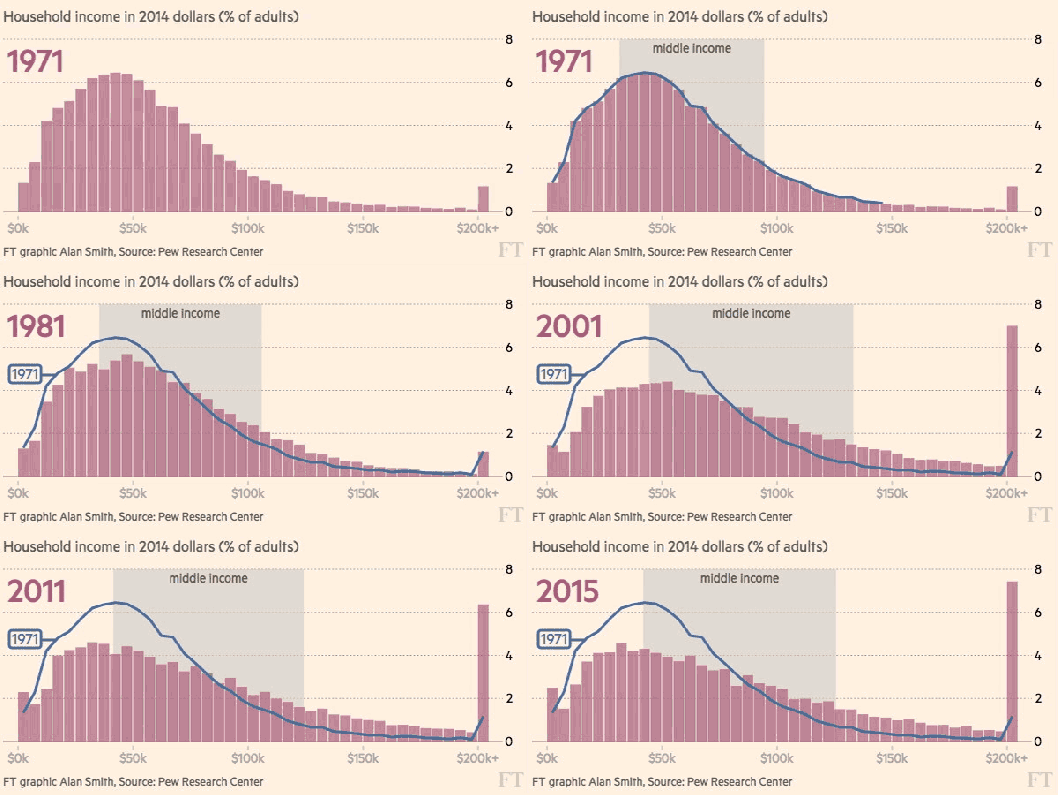
The “squeeze” on the U.S. middle class is a fiction. If you don’t believe it, take a look at the “gif” above. It first appeared in The Financial Times (FT) with a misleading description about how “…technological change and globalization drive a wedge between the winners and losers in a splintering US society.” It’s obvious that the middle class, as statically defined by the FT, is shrinking only because it is moving up to higher real income levels (i.e., adjusted for inflation). Mark Perry uses this and other supporting charts in noting that “…so many middle-income households have become better off“. Some of these gains are related to an aging population, but the gains are not remotely consistent with FT’s dramatization. One point of emphasis that the chart should make obvious, but doesn’t quite, is that groups appearing to remain within a particular income range over time are never comprised of the same individuals. There is always movement up and down across all of these groups from year-to-year.

There is a stagnation story here, but it’s more limited than suggested by FT’s narrative. It is twofold: first, the financial crisis in 2007-2009 put a temporary stop to the upward income migration, and its resumption during the Obama presidency has been less robust; second, the very lowest-income segment, $0 – $10,000 of annual income, has expanded in each time interval shown since 1991, from just above 1% of adults to roughly 2.5%. A primary reason for the tepid growth of the U.S. economy since the recession’s trough in 2009, and the weaker migration, has been weak physical investment in the productive economy from its recession lows. That form of spending usually takes a lead role in economic recoveries. A number of observers have attributed the poor performance this time around to “regime uncertainty“, or the risk that regulatory and tax regimes could take an even more destructive toll in the future, essentially devouring returns to capital. As for the increases in the lowest-income sliver of the chart, Scott Sumner says:

“It could be due to expansion of the welfare state, the break-up of the traditional family, or perhaps growth in the underground economy. Nonetheless, it is cause for concern. But it has nothing to do with the mythical decline in the ‘middle class.’“

A related fiction is that the U.S. tax system is unfair to the middle class, and that higher income groups do not pay their “fair share”. This is put to rest in an “Issue Brief” from the Peter G. Peterson Foundation (PPF), using data from the Tax Policy Center and the Congressional Budget Office. The analysis shows that while high-income taxpayers benefit from tax breaks, those breaks offset high marginal tax rates and do not diminish the fact that the tax system is highly progressive:

“The Tax Policy Center estimates that 69 percent of taxes collected in 2015 will come from those in the top quintile, or those earning an income above $138,265 annually. Within this group, the top one percent of income earners — those earning more than $709,166 in income per year — will contribute over a quarter of all federal revenues collected.“

Apparently, the PPF analysis does not account for the impact of transfer payments on progressivity, which make average effective tax rates negative at low income levels. However, PPF does acknowledge that the tax system is unnecessarily complex and creates a web of distortions and poor incentives that limit economic growth. It’s a wonder that the dynamic of upward migration in real income was possible at all.


Lucky Barack: Let Me “Invest” Your Winnings

22 Friday May 2015

Posted by Nuetzel in Big Government, Taxes, Welfare State

≈ Leave a comment

Tags

Barack Obama, Curtis Dubay, Investment, Redistribution, Society's lottery winners, Thomas Sowell

lucky obama

Ask a group of teenagers how to get rich and a significant share will say to win the lottery. The truth is that NOT buying lottery tickets and instead saving the ticket money is a far better approach. That, and hard work, are much more likely to get you there. Of course, that’s how many of the rich got that way, but President Obama now refers to them as “society’s lottery winners”. No doubt this description serves his redistributionist policy agenda by appealing to the ignorance of his base. I am tempted to say that his use of the phrase is a testament to his own ignorance, as his only real experience is in the political realm, as opposed to the world of actual production and wealth creation.

Thomas Sowell offers remarks on Obama’s smug characterization of the wealthy, highlighting the President’s disingenuous assertion that redistributionists merely “‘ask from society’s lottery winners’ that they make a ‘modest investment’ in government programs to help the poor.” Sowell notes that “asking” is not what the U.S. government will do:

“Despite pious rhetoric on the left about ‘asking’ the more fortunate for more money, the government does not ‘ask’ anything. It seizes what it wants by force. If you don’t pay up, it can take not only your paycheck, it can seize your bank account, put a lien on your home and/or put you in federal prison.“

Sowell also decries Obama’s continued abuse of the term “investment”. Everything is now an “investment”, whether it pays for consumption or new physical capital. You can feel Sowell’s frustration:

“... please don’t call the government’s pouring trillions of tax dollars down a bottomless pit ‘investment.’ Remember the soaring words from Barack Obama, in his early days in the White House, about “investing in the industries of the future”? After Solyndra and other companies in which he ‘invested’ the taxpayers’ money went bankrupt, we haven’t heard those soaring words so much.“

In The World According to Barack, wealth is created by luck, the government merely requests the cooperation of those paying the vast bulk of federal taxes, and redistribution itself and the consumption it pays for is “investment”.

High-Speed Third Rail For Taxpayers

15 Friday May 2015

Posted by Nuetzel in Big Government, infrastructure, Taxes

≈ 3 Comments

Tags

Amtrak, Bullet trains, California, capital costs, Carbon Emissions, fare revenue, Frederic Bastiat, High speed rail, infrastructure, Malinvestment, Megabus, operating costs, Privatization, profitability, Public benefits, Public boondoggles, Randall O'Toole, Sean Davis, The Federalist, Transit subsidies

bullet train

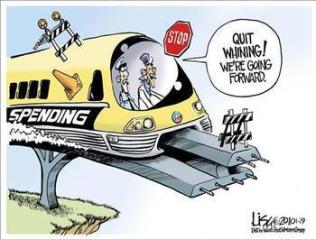
Public boondoggles come in many forms, including sports stadiums and entertainment venues, convention centers, local trolly lines, light rail, superhighways, “gold-plated” public offices, and even subsidies for politically-favored (as opposed to market-favored) industries. Anything involving “infrastructure” has an almost perverse  political appeal. The many varieties of boondoggles have much in common from a public finance perspective: ultimately, they are almost always funded by taxpayers; when they confer benefits to private parties (and they usually do), they are underpriced to those users. Taxpayers are often lucky if these projects cover their operating costs, let alone capital costs, via direct revenue generation. Taxpayers are usually on the hook for the bonds. Pure public benefits might offer some justication for this burden, but those cited by project proponents are often unconvincing on that basis. Let’s face it: projects are seldom evaluated against something approximating the true opportunity costs faced by the public or taxpayers.

A prominent example of such a project that seems to capture the political imagination is high-speed rail (HSR). My friend John Crawford emailed the following link: “Doing the math on California’s bullet train fares“. John provided this summary:

“Not surprisingly, today’s fare estimate has risen 72% over the estimate that was cited during planning. That’s telling but probably not surprising to anyone, even those that tried to change opinions by citing the $50 fare. What I think is most interesting follows.

CA-HSR price of 86 is about 20c/mile. Comparable prices are 22c for a Chinese train that everybody agrees to be subsidized, 54c for a French train that is profitable and 50c for the Amtrak corridor on the East coast, which is probably profitable; 46c in Germany. Somehow, they think they can do what nobody else in the world can do…profit at 20c/mile.“

The California authority is either spectacularly arrogant or stupid. Probably the former, because they are doing what self-interested bureaucrats and politicians always do. They want the project to get done, thus creating an empire, kicking a can-full of fare increases and taxpayer liabilities down the road, beyond the time when anyone will hold them accountable for the malinvestment. But the true extent of the malinvestment will never be obvious, because the counter-factual will remain in the unseen world of lost opportunity.

Something I find exasperating about articles like this are references to “profitability”, as in “… state officials say the system will quickly become profitable“, when the meaning is not actual profitability. My friend John did it too, but I forgive him because he knew the score, and because he’ll forgive me for being a pedant (I hope). But this is important! What the California officials mean by “profitability” (and it is a misuse of the term) is fare revenue in excess of operating costs. The latter do not include initial capital costs, so these officials are not making claims about actual profitability. Profitability means that revenue exceeds ALL costs, including capital costs. Many observers consider the California authority’s estimates of operating costs to be suspect, so it’s not even clear that revenue will cover the future costs of capital replacement, let alone the initial installation costs. Construction and planning costs are expected to be $68 billion for Phase 1 only, and you can safely bet on significant additional overruns by the projected completion of Phase 1 in 2029.

Fares calibrated to cover operating costs are not defensible in terms of long-run marginal cost pricing. While an incremental rider does not cause the capital cost of the system to increase in the short run, incremental riders absolutely do have an impact on long-run capital costs. In any case, there are many incremental riders at start-up. The long run is now. Yet, like many public projects, the burden of uncovered costs is justified in terms of other benefits of a supposedly public nature. Here is a vague description of such benefits from the CA HSR Authority:

“California high-speed rail will connect the mega-regions of the state, contribute to economic development and a cleaner environment, create jobs and preserve agricultural and protected lands.“

Let’s take these one at a time:

  • connecting “mega-regions”, if that is a real benefit of HSR relative to alternative modes of transportation, will largely accrue to riders, not the general public.
  • Economic development benefits are possible along the route or near stations, but that is hardly a pure public benefit, and it is likely to come at the expense of development elsewhere.
  • The trains will be powered, at least in part, by energy from fossil fuels. If HSR produces less carbon than equivalent airplanes, autos and other alternatives, that might represent a pure public benefit (according to the carbonphobic), but this is a costly way to achieve a minor reduction in carbon emissions. It is of value only to the extent that HSR brings real substitution away from other, higher carbon modes.
  • Construction jobs are part of the cost of the project, but this is a common ploy and very handy way to sell the project. Gains for the workers are certainly not a pure public benefit. To paraphrase Bastiat, calling construction jobs from malinvested capital a “public benefit” is like calling a broken window beneficial because it provides work for the glazier.
  • As for preserving agricultural and public lands, I do not believe that HSR will make much of a dent in future, land-gobbling highway construction (and if it did, it would offset those vaunted HSR job gains).

The public should always view large public projects like HSR with skepticism and insist that private benefits should be paid privately. There are always alternative uses of taxpayer funds, including the possibility that taxpayers should keep them. Too many public projects become funding disasters. In many cases, private parties would not be willing to buy the facilities for more than 10 cents on the dollar.of original cost.  Without access to tax revenue, only a low purchase price would allow them to operate at a profit.

At the national level, this week’s tragic Amtrak crash near Philadelphia was the context for misguided calls to provide additional funding to the rail service. Sean Davis in The Federalist has a more logical proposal, even if it is a bit radical: not only should Amtrak be privatized, its assets should be given away! And how could anyone reach such a conclusion?

“Amtrak lost nearly $1.3 billion in 2013. Since its creation, Amtrak has racked up over $31 billion in accumulated losses. And every penny of those losses has been covered by federal taxpayers.

… Hand over the entire enterprise to whichever rail company wants it. ‘But that’s crazy!’ you might say. ‘Giving it away for free makes no cents [sic]!’

Well, neither does keeping it on the taxpayers’ books. The status quo costs taxpayers at least a billion dollars each year.“

Davis makes a fair point, though a give-away might attract multiple takers. Ultimately, bidding just might be necessary! Or, perhaps it would be necessary to PAY a private rail operator to take Amtrak off the federal government’s hands. A fairly high payment would still be worthwhile to taxpayers.

Randall O’Toole provides this excellent discussion of privatizing transit in a video  of approximately 17 minutes. He discusses trends in ridership, the inefficiencies inherent in public transportation systems, and compares various market structures and types of private transportation systems, including private intercity buses (Megabus). He also addresses concerns that private transportation systems will not meet the needs of the poor by proposing the substitution of “transit stamps” for the huge subsidies currently paid into transportation bureaucracies.

Do Not Rot Productive Capital

21 Saturday Feb 2015

Posted by Nuetzel in Taxes

≈ Leave a comment

Tags

Capital Gains Tax, corporate income tax, Dividend tax Rate, Double Taxation, Inflation tax, Kim Henry, stepped-up basis, The Freeman, Triple Taxation

TrapDoorFail_8008

Dividend and capital gains income are taxed at lower rates than regular wage and salary income. That such income is taxed lightly strikes progressives as offensive, but the intent and effects of these lower rates is not to redistribute income to rentiers. Rather, relatively low dividend and capital gains tax rates are in place because they limit double-taxation, minimize taxation of inflationary “gains”, and reward successful risk-taking.

Dividends, and ultimately capital gains, derive from corporate earnings. Corporate income in the U.S. is taxed at the highest rate in the OECD, with a top federal rate of 38% (though the rate drops to 35% above a certain level of earnings). Dividends may or may not be paid to shareholders from corporate income, but if so, they are subsequently taxed again as personal income. If dividends were taxed as regular income to individuals, the combined federal taxes (corporate and individual) on that marginal income in upper brackets would be in excess of 75%. With state corporate and personal income taxes added on, the after-tax dividend received by an individual shareholder from each dollar of pre-tax corporate income could then be less than 10 cents in some states.

The top federal tax rate on dividends is 20%, versus 39.6% for regular income. One reason that dividend income is taxed at lower rates than wage and salary income is recognition of the confiscatory nature of double taxation, as illustrated above. Realized capital gains are taxed at the same rate as dividends for the same reason. A capital gain is the increase in the value of an asset over time. Such gains are taxed only when an asset is sold, when the gain is realized. The low tax rate on gains from the sale of corporate stock also limits double taxation (and even triple taxation).

Stock prices tend to rise along with the expected stream of future after-tax corporate earnings and dividends. A prospective buyer of shares knows they will incur taxes on future dividends, which limits the price they are willing to pay for the shares. So, higher future earnings will be taxed to the corporation when they occur, higher future dividends will be taxed to the buyer of shares when dividends are eventually paid, and the resulting gain in the share price received by the seller today is taxed as a capital gain to the seller. Triple (and anticipatory) taxation! A relatively low tax rate on capital gains at least helps to limit the damage from the awful incentives created by multiple taxation of the same income.

Another important reason for taxing capital gains more lightly than wages and salaries is that the tax, in the presence of inflation, diminishes the real value of an asset. As an example, compare the following situations in which the price level increases by 20% over five years: Worker Joe earns $10 an hour to start with and $12 an hour at the end of year 5; Saver Dev earns $1 dividends per share of the Prophet Corp (which he plans to hold indefinitely) to start with and $1.20 at the end of year 5; Retiree Cap buys one share of Gaines Corp worth $100 at the start and sells it for $120 at the end of year 5. On a pre-tax basis, these three individuals all keep pace with inflation. The real value of their pre-tax earnings, or the share value in Cap’s case, is unchanged after five years. Cap keeps pace by virtue of a $20 capital gain, so the real value of his share is unchanged.

If all three types of income are taxed at the same rate, Joe and Dev both keep pace with inflation on an after-tax basis as well. But what about Cap? After taxes, the proceeds of his stock sale are $115. Cap’s after-tax gain is only 15%, less than the inflation that occurred, so the real value of his investment was diminished by the combination of inflation and the capital gains tax. The same would be true for farmland, artwork, or any other kind of asset. It is one matter to tax flows of income that change with inflation. It is another to tax changes in property value that would otherwise keep pace with inflation. This is truly a form of wealth confiscation, and it provides a further rationale for taxing capital gains more lightly than wage and salary income, or not at all.

There are further complexities that influence the results. For one thing, all three individuals would suffer real losses if inflation pushed them into higher tax brackets. This is why bracket thresholds are indexed for inflation. Another wrinkle is the “stepped-up basis at death”, by which heirs incur taxable gains only on increases in value that occur after the death of their benefactor. This aspect of the tax code was recently discussed on Sacred Cow Chips here.

The third rationale for taxing capital gains more lightly than wage and salary income is an attempt to improve the risk-return tradeoff: larger rewards, ex ante and ex post, are typically available only with acceptance of higher risk of loss or complete failure. This is true for private actors and from a societal point of view. It is hoped that lighter taxes on contingent rewards will encourage savings and their deployment into promising ventures that may entail high risk.

This post was prompted by a article in The Freeman entitled “A Loophole For the Wealthy? Demystifying Capital Gains“, by Dr. Kim Henry. I was somewhat surprised to learn that Dr. Henry is a dentist. His theme is of interest from a public finance perspective, and he provides a good discussion of the advantages of maintaining a low tax rate on capital gains. My only complaint is with the first of these two points:

“[The capital gains tax rate] is lower for two important reasons:
1. Although the gain is realized in one year, it actually took place over more than one year. The wine did not increase in value just in the year it was sold. It took 30 years to achieve its higher price.
2. Capital gains are not indexed to inflation. …”

To be fair, Dr. Henry’s point relative to the time required to achieve a gain probably has more to do with the riskiness of an asset or venture’s returns, rather than the passage of time per se. If an asset’s value increases by 4% per year, the three points raised above (multiple taxation, taxing of inflationary gains, and rewarding successful risk-taking) would be just as valid after year 1 as they are after year 5.

Taxing income from capital is fraught with dangers to healthy investment incentives, which are primary drivers of employment and income growth. Double taxation of corporate income is not helpful. Capital gains taxes suffer from the same defect and others. But capital income is a ripe target for those who wish to score political points by inflaming envy. It’s a dark art.

Big Tax & Spend Party In Obama’s Head

04 Wednesday Feb 2015

Posted by Nuetzel in Big Government, Taxes

≈ Leave a comment

Tags

corporate income tax reform, corporate taxes, defense spending, estate taxes, government deficit, government spending, infrastructure, Investors Business Daily, Obama budget, Reason, Sequestration, stepped-up basis, tax inversion, Timothy Taylor

Obamas_budget

President Obama has thoughtfully dangled lots of freebies before the eyes of Americans in his proposed budget under the guise of “middle-class economics.” It’s not clear that the middle class will benefit over the long haul, but this certainly isn’t about forsaking present pleasure for future gain. It’s just about politics. Obama hopes his budget establishes a superior negotiating position with Republicans, and he hopes that the opposition to many of his giveaways will allow Democrats to tar the GOP as hard-hearted. In introducing his proposal, the president derided what he called the “mindless austerity” of the sequestration spending caps (which his budget would exceed by a mere $74 billion), but as Reason notes, the “sequestration process was the White House’s idea in the first place.”

Investor’s Business Daily has this to say in their editorial:

“The era of big government would be back with a vengeance. Obama wants a preposterous 7% spending hike this year for government agencies — with more nanny-state money for schools, early-childhood education, roads and bridges, child care, green energy and corporate welfare for manufacturers.”

All of these priorities are behaviorally non-neutral, heavily cross-subsidized and of questionable value, at best. Of course, everybody wants a high-speed rail line as long as the fare is heavily subsidized. Beyond that yearning, the poor state of American transportation infrastructure is something of a myth. Just as stupefying is the proposed increase in defense spending, which will end up as the most popular provision among hawks in Congress. From Reason:

“President Obama’s budget requests $561 billion for defense spending, which includes the biggest baseline Pentagon budget ever. Sequestration caps for military were already loosened from initial levels in a budget deal made in 2013. And the Pentagon has managed to keep spending freely on boondoggles like the Joint Strike Fighter—a $400 billion futuristic fighter that has serious trouble with basic functionality, like flying—and a program to build new nuclear bombers and subs expected to cost about $350 billion. This is not a picture of a fighting force that is desperately starving for cash.”

On the revenue side, the Obama budget would increase taxes by $1.6 trillion over 10 years. Some of the details are discussed here, including $200 billion in corporate tax reform. As explained by Timothy Taylor, the so-called reform is a hodge-podge of 67 different provisions. For the 2017 budget year, these would add revenue of about $19 billion, but when Taylor totals the top ten provision, those come to $49 billion. The $30 billion difference consists of various items such as “simplification and tax relief for small business,” which might represent sensible changes, and “incentives for manufacturing, research, and clean energy.” Those are tax breaks and subsidies. From Taylor: “Clearly, the temptation to redistribute the “special deductions, credits, and other tax preferences,” rather than ending them, remains strong.”

The current 35% U.S. corporate income tax rate is the highest in the industrialized world. The idea of corporate tax reform is to reduce the tax rate in exchange for eliminating various deductions, which is laudable in itself. Unfortunately, the Obama plan also proposes a tax on corporate profits earned and held abroad (not repatriated). Taylor explains the rub:

“Here, I’ll juse [sic] make the point that the U.S. is unique among the major economies in that it claims the right to tax the profits of U.S. corporations wherever in the world they are earned. Other countries only tax profits earned within their borders. Of course, this is one reason why U.S. companies sometimes seek to merge with a foreign firm and transfer their official ownership abroad. A foreign-controlled domestic company in the United States is taxed only on its U.S. profits; in contrast, if a company with the same structure is a U.S.-controlled firm, then the U.S. government claims the right to tax its foreign profits as well. This is a real issue for US corporate tax reform in a globalizing economy, and the approach in this budget document bascially just doubles down on going after revenue from abroad.”

Other tax increases proposed by Obama include an increase in the rate on dividends (already double-taxed) and capital gains (with its implicit inflation tax on wealth), capital gains taxation of assets at death (elimination of stepped-up basis), higher estate taxes, limits on itemized deductions, and several others. All of these complexities in the tax code could be eliminated entirely with real tax reform and simplification, but that would prevent the president’s beneficent “middle-class economics,” more appropriately called middle-class pandering. Higher taxes undermine economic growth: first, by reducing disposable income and spending, the traditional Keynesian explanation; second, and more fundamentally, by reducing incentives to work, invest and take risks that increase the economy’s productive potential over time. When it all plays out, a budget with a $1.6 trillion increase in taxes, no matter where the direct burden falls, will not help the middle class.

Finally, the Obama budget includes optimistic assumptions about economic growth. Even under that outlook, the budget deficit is expected to rise from  $474 billion in 2016 to $687 billion in 2025. The debt will keep expanding, absorbing private saving, leaving a smaller pool of capital available for private investment.

The president’s efforts to grow the state apparatus continue with this budget proposal. It might be “toast” as a package, but the political bidding war continues. Much depends on the ability of Americans to resist the goodies dangled before them by the White House candyman. That much is required to reverse the ongoing slide into dependency on the state.

The Dire Wolf’s Collectivist Dues

24 Saturday Jan 2015

Posted by Nuetzel in Taxes

≈ Leave a comment

Tags

529 Plans, Capital Gains Tax, Collectivism, Dire Wolf, Glenn Reynolds, Inequality, Market Inequality, Megan McArdle, Obama Tax Plan, Redistribution, Robert Higgs, Sheldon Richman, State of the Union, Statist Inequality

wolf mask

Inequality does not imply poverty for anyone, and inequality is a reasonable outcome of voluntary economic interactions between individuals who vary in their ability to create value. But inequality arising from artificial advantages conferred by the force of government and cronyism is indefensible. Sheldon Richman draws this useful distinction between the market’s distribution of rewards, which is a consequence of an unequal distribution of value-creating energy, ingenuity and talent, as opposed to the unequal rewards of a system of centralized control in which subsidies flow to cronies, monopolists are protected, barriers to activity are erected and political elites enjoy the fruits of value-destroying privilege. Here’s a sample from Richman’s post:

“Unlike market inequality, political-economic inequality is unjust and should be eliminated. … How? By abolishing all direct and indirect subsidies; artificial scarcities, such as those created by so-called intellectual property; regulations, which inevitably burden smaller and yet-to-be-launched firms more than lawyered-up big businesses; eminent domain; and permit requirements, zoning, and occupational licensing, which all exclude competition. …

Instead of symbolically tweaking the tax code to appear to be addressing inequality—the politicians’ charade—political-economic inequality should be ended by repealing all privileges right now.”

And yet we get fatuous rants from Obama about the ravages of market inequality and more tweaking of the tax code. Tweaking is too kind a word. The State of the Union address last week was a collectivist’s wet dream, replete with visions of central planning and a long list of non-neutral incentives and favors for the president’s base. He did his best to stoke the flames of class division and envy. One must ask: how long can the surviving market economy and a shrinking share of actual taxpayers support the growing dependent class and the nonproductive state apparatus?

In “Uncle Sam Is Coming After Your Savings?“, Megan McArdle warns of the dire wolf waiting at the door of every hopeful saver and middle class taxpayer. She cites Obama’s proposed tax on college savings plans (529s) as one piece of evidence, and asks “How would you feel if they did this to Roth IRAs”?

“… the very fact that we are discussing taxation of educational savings — redistributing educational subsidies downward — indicates that the administration has started scraping the bottom of the barrel when seeking out money to fund new programs. Why target a tax benefit that goes to a lot of your supporters (and donors), that tickles one of the sweetest spots in American politics (subsidizing higher education), and that will hit a lot of people who make less than the $250,000 a year that has become the administration’s de facto definition of ‘rich’?”

Then there’s the proposed elimination of the stepped-up tax basis at death, covered a few days ago at this blog, and the increase in the tax rate on capital gains and already double-taxed dividends from 24% to 28%. Of this, and the more general issue of investment incentives and efficient revenue generation, McArdle says:

“… we don’t try to tax the bejesus out of capital income, much as many would like to; old capital flees, and new capital doesn’t get formed, as savers decide it’s not worth it.”

No we don’t, for now, but that lack of capital formation is a dire implication of heavier taxes for the economy. It is an achilles heal of the redistributionist policy agenda, as a lack of new capital undermines productivity, income growth and opportunity across the board. Middle-class economics? Please, no. Glenn Reynolds has some additional thoughts on McArdle’s column:

“The truth is, in our redistributionist system politicians make their careers mostly by taking money from one group of citizens that won’t vote for them and giving it to another that will. If they run short of money from traditional sources, they’ll look for new revenue wherever they can find it. And if that’s the homes and savings of the middle class, then that’s what they’ll target.

For the moment, Americans are safe. With both houses of Congress controlled by the GOP, Obama’s proposals are DOA. But over the long term, the appetite for government spending is effectively endless, while the sources of revenue are limited. Keep that in mind as you think about where to invest your money … and your votes.”

Statistics on inequality are brandished by progressives as if to prove the existence of a great market malfunction, but as Richman points out at the link given above, an extreme form of inequality is an inevitable outcome of privilege conferred by the state. On the other hand, market inequality is no tragedy for humankind. It is an artifact of the most peaceful, productive system of social coordination ever devised. Market inequality is not related in any way to the absolute welfare of the median earning family or the least fortunate, as Robert Higgs explains in this interesting essay:

“Probably no subject in the social sciences has created so much unnecessary heat. Yet, at the same time, economists actually know a great deal about it and can dispel the public’s confusion about it if they try.” [Emphasis added]

Step-Up, Pay-Up & Shut-Up

23 Friday Jan 2015

Posted by Nuetzel in Taxes

≈ 4 Comments

Tags

Capital Gains Tax, dependency, economic growth, Estate Tax, Income Tax, IRS, President Obama, Stepped-Up Tax Basis, Tax Policy, Tax Simplification

obama-harry-potter-tax-increases-political-cartoon

Predicting support among relatively affluent leftists for President Obama’s proposed elimination of the step-up in tax basis at death is probably a simple matter of knowing whether they have a surviving parent or whether they have a bequest motive of their own. Perhaps I’m too cynical: it probably depends on age as well (as that may influence awareness of the tax provision). Still, I’ll bet my predictions would be highly accurate for “affluent leftists of a certain age”.

A technical digression: the cost basis of an asset is the price originally paid. The tax basis is the same until the owner’s death. When the asset is ultimately sold, the gain over and above the tax basis is taxed at the capital gains tax rate, now 20% (plus a 3.8% Medicare surtax for incomes greater than $200,000). However, under current law, when an asset is held until death, an heir’s tax basis is “stepped-up” from cost to the asset’s value at that time. No income tax is owed at the time of the inheritance even if the asset is sold immediately. The estate tax still applies to the asset’s value (depending on the size of the estate and whether there is a surviving spouse), but there is no capital gains tax liability until an heir sells the asset at a price greater than the stepped-up tax basis.

Our rhetorically-inclined president calls this feature of the income tax code a “loophole,” despite the fact that it is a legal feature of our ridiculously-complicated income tax and that inherited assets are still subject to the estate tax.

Obama’s proposal would eliminate the stepped-up basis at death. The increase in value would be subject to the capital gains tax at the time of inheritance (even if the asset is not sold) and subject to the estate tax (40%) if the size of the estate exceeds a threshold (about $5.4 million per individual). In addition, the President wants to increase the capital gains tax rate to 24.2% (plus 3.8% yields the oft-quoted 28%). These points are generally unaffected by whether the asset is held in trust for the full benefit of the heir. There are some exemptions in Obama’s proposal to eliminate stepped-up tax basis for small, family-owned businesses and for gains on primary residences. Also, gains would be taxed only after the first $100,000 per individual and only at the time of the second death for a couple.

The double taxation of capital gains in large estates might not evoke much sympathy, but it would ultimately have negative consequences for the economy. It would bleed capital out of productive, employment-generating private investments to feed a resource-hungry Leviathan, notwithstanding Obama’s high-minded pretensions. Perhaps worse is the impact on smaller estates held by conscientious middle-class savers who have understood the magic of compound growth. The aggrieved children of many such savers would find themselves in the grips of a significant income tax liability, which might require a fire-sale of assets in order to make payments to the IRS.

Complex features like the stepped-up basis are not hallmarks of a well-designed tax system. They tend to be promulgated as a way of offsetting other features of the tax code that would otherwise be punitive. If anything, this web of features is an impediment to efficient revenue generation. A simple tax code would minimize compliance costs and eliminate the many provisions that distort economic decisions. But complexity lends itself to political manipulation, which is the subtext for President Obama’s failure to propose any sort off meaningful tax simplification. Instead, he proposes even more complexity to be administered by that most trusted of institutions: the IRS. Fortunately, the president’s tax package stands no chance of becoming law, but it is illustrative of his statist agenda and his economic ignorance.

This post at Reason critiques this and other aspects of the President’s tax plan. This note in Forbes gives more detail about the proposal but is just a bit too optimistic about its potential to benefit the middle class. For a variety of reasons, the middle class is unlikely to benefit in the long-run. Slower economic growth will take its toll, and the sad truth is that Obama is seeking to increase middle-class dependence on the state.

Newer posts →
Follow Sacred Cow Chips on WordPress.com

Recent Posts

  • The Case Against Interest On Reserves
  • Immigration and Merit As Fiscal Propositions
  • Tariff “Dividend” From An Indigent State
  • Almost Looks Like the Fed Has a 3% Inflation Target
  • Government Malpractice Breeds Health Care Havoc

Archives

  • January 2026
  • December 2025
  • November 2025
  • October 2025
  • September 2025
  • August 2025
  • July 2025
  • June 2025
  • May 2025
  • April 2025
  • March 2025
  • February 2025
  • January 2025
  • December 2024
  • November 2024
  • October 2024
  • September 2024
  • August 2024
  • July 2024
  • June 2024
  • May 2024
  • April 2024
  • March 2024
  • February 2024
  • January 2024
  • December 2023
  • November 2023
  • August 2023
  • July 2023
  • June 2023
  • May 2023
  • April 2023
  • March 2023
  • February 2023
  • January 2023
  • December 2022
  • November 2022
  • October 2022
  • September 2022
  • August 2022
  • July 2022
  • June 2022
  • May 2022
  • April 2022
  • March 2022
  • February 2022
  • January 2022
  • December 2021
  • November 2021
  • October 2021
  • September 2021
  • August 2021
  • July 2021
  • June 2021
  • May 2021
  • April 2021
  • March 2021
  • February 2021
  • January 2021
  • December 2020
  • November 2020
  • October 2020
  • September 2020
  • August 2020
  • July 2020
  • June 2020
  • May 2020
  • April 2020
  • March 2020
  • February 2020
  • January 2020
  • December 2019
  • November 2019
  • October 2019
  • September 2019
  • August 2019
  • July 2019
  • June 2019
  • May 2019
  • April 2019
  • March 2019
  • February 2019
  • January 2019
  • December 2018
  • November 2018
  • October 2018
  • September 2018
  • August 2018
  • July 2018
  • June 2018
  • May 2018
  • April 2018
  • March 2018
  • February 2018
  • January 2018
  • December 2017
  • November 2017
  • October 2017
  • September 2017
  • August 2017
  • July 2017
  • June 2017
  • May 2017
  • April 2017
  • March 2017
  • February 2017
  • January 2017
  • December 2016
  • November 2016
  • October 2016
  • September 2016
  • August 2016
  • July 2016
  • June 2016
  • May 2016
  • April 2016
  • March 2016
  • February 2016
  • January 2016
  • December 2015
  • November 2015
  • October 2015
  • September 2015
  • August 2015
  • July 2015
  • June 2015
  • May 2015
  • April 2015
  • March 2015
  • February 2015
  • January 2015
  • December 2014
  • November 2014
  • October 2014
  • September 2014
  • August 2014
  • July 2014
  • June 2014
  • May 2014
  • April 2014
  • March 2014

Blogs I Follow

  • Passive Income Kickstart
  • OnlyFinance.net
  • TLC Cholesterol
  • Nintil
  • kendunning.net
  • DCWhispers.com
  • Hoong-Wai in the UK
  • Marginal REVOLUTION
  • Stlouis
  • Watts Up With That?
  • Aussie Nationalist Blog
  • American Elephants
  • The View from Alexandria
  • The Gymnasium
  • A Force for Good
  • Notes On Liberty
  • troymo
  • SUNDAY BLOG Stephanie Sievers
  • Miss Lou Acquiring Lore
  • Your Well Wisher Program
  • Objectivism In Depth
  • RobotEnomics
  • Orderstatistic
  • Paradigm Library
  • Scattered Showers and Quicksand

Blog at WordPress.com.

Passive Income Kickstart

OnlyFinance.net

TLC Cholesterol

Nintil

To estimate, compare, distinguish, discuss, and trace to its principal sources everything

kendunning.net

The Future is Ours to Create

DCWhispers.com

Hoong-Wai in the UK

A Commonwealth immigrant's perspective on the UK's public arena.

Marginal REVOLUTION

Small Steps Toward A Much Better World

Stlouis

Watts Up With That?

The world's most viewed site on global warming and climate change

Aussie Nationalist Blog

Commentary from a Paleoconservative and Nationalist perspective

American Elephants

Defending Life, Liberty and the Pursuit of Happiness

The View from Alexandria

In advanced civilizations the period loosely called Alexandrian is usually associated with flexible morals, perfunctory religion, populist standards and cosmopolitan tastes, feminism, exotic cults, and the rapid turnover of high and low fads---in short, a falling away (which is all that decadence means) from the strictness of traditional rules, embodied in character and inforced from within. -- Jacques Barzun

The Gymnasium

A place for reason, politics, economics, and faith steeped in the classical liberal tradition

A Force for Good

How economics, morality, and markets combine

Notes On Liberty

Spontaneous thoughts on a humble creed

troymo

SUNDAY BLOG Stephanie Sievers

Escaping the everyday life with photographs from my travels

Miss Lou Acquiring Lore

Gallery of Life...

Your Well Wisher Program

Attempt to solve commonly known problems…

Objectivism In Depth

Exploring Ayn Rand's revolutionary philosophy.

RobotEnomics

(A)n (I)ntelligent Future

Orderstatistic

Economics, chess and anything else on my mind.

Paradigm Library

OODA Looping

Scattered Showers and Quicksand

Musings on science, investing, finance, economics, politics, and probably fly fishing.

  • Subscribe Subscribed
    • Sacred Cow Chips
    • Join 128 other subscribers
    • Already have a WordPress.com account? Log in now.
    • Sacred Cow Chips
    • Subscribe Subscribed
    • Sign up
    • Log in
    • Report this content
    • View site in Reader
    • Manage subscriptions
    • Collapse this bar
 

Loading Comments...