Well-Intentioned Souls For Sale

Tags

, , , , , , , , , , , ,

Paint_the_town_red_1885

Most would agree that power corrupts. Some believe that greater wealth begets power, yet they cling to a naive hope that larger government can protect against “evil” private accretion. These well-intentioned souls forget that those holding power in government will not always have preferences that match their own. More importantly, they fail to account for the real-world implications of concentrating power in the public sector, conveniently forgetting that “control” itself is a problematic solution to the perceived “problem” of private power. They would grant ever more controlling authority to an entity possessing the police power, managed by politicians, employees and technocrats with their own incentives for accretion. Public administrative power is often exercised by rule-making, asserting more control over private affairs. It usually results in the granting of favors and favorable treatment, compensable in various ways, to certain private parties. Big government begets big rent seeking and the subjugation of market discipline in favor of privilege. It’s a devil’s playground.

The confusion of the statists, if I can be so charitable, now extends to the desire for control over the related issues of wealth inequality and political contributions. John Cochrane, an economist from the University of Chicago, has an interesting piece on these topics on wsj.com entitled What the Inequality Warriors Really Want(if this is gated, try googling the author and title). He points out some of the obvious hypocrisies of those calling for more government control, including limits on political spending:

… the inequality warriors want the government to confiscate wealth and control incomes so that wealthy individuals cannot influence politics in directions they don’t like. Koch brothers, no. Public-employee unions, yes. This goal, at least, makes perfect logical sense. And it is truly scary.

The presumption that redistribution of income and wealth can be achieved at low cost ignores the terrible incentives that such policies create for both the nominal losers and winners. In the real world, redistribution is not zero-sum; it is negative sum with compounding. Steve Simpson of the Ayn Rand Institute has some further thoughts on Cochrane’s piece as well as the work of Thomas Piketty, the new intellectual light of the redistributive statists.

Border Integrity or Lines In The Sand?

Tags

, , , , , , , , ,

obama-dictator

The constitutionality of President Obama’s recent amnesty order is debatable, to say the least, Obama himself having admitted that he simply “changed the law”. If that’s what he thinks he did, the law professor should know that his action was out-of-bounds from a constitutional perspective. The executive branch cannot make or change laws!

In “Legal but Still Poor: The Economic Consequences of Amnesty“, Joel Kotkin puts aside the constitutional question to focus on difficulties that are likely to be aggravated by amnesty. Kotkin emphasizes the economic distress that now hampers the working class. Illegals already compete for certain jobs, of course, a point Kotkin doesn’t mention. Nevertheless, the amnesty order will create new competition among workers for some positions, many of whom already face difficult conditions:

… the country suffers from rates of labor participation at a 36 year low. Many jobs that were once full-time are, in part due to the Affordable Care Act, now part-time, and thus unable to support families. Finally there are increasingly few well-paying positions—including in industry—that don’t require some sort of post-college accreditation.

Furthermore, the order might create incentives for new illegal immigration, leading to further labor market stress. Politically, the order is seen as an act of betrayal by legal immigrants who have gone to considerable effort and expense to obtain their status. It is also likely to be viewed as betrayal by some minority workers, who tend to be more heavily represented in parts of the labor market most vulnerable to the new competition:

African-American unemployment is now twice that of whites. The black middle class, understandably proud of Obama’s elevation, has been losing the economic gains made over the past thirty years. … Latino-Americans have made huge strides in previous decades, but now are also falling behind, with a gradual loss of income relative to whites. Poverty among Latino children in America has risen from 27.5 percent in 2007 to 33.7 percent in 2012, an increase of 1.7 million minors.

Kotkin mentions several other administration policies that are likely to diminish prospects for new and existing workers.

Ironically, the places where the cry for amnesty has been the loudest—New York, San Francisco, Los Angeles, and Chicago—also tend to be those places that have created the least opportunity for the urban poor. … Whatever their noble intentions, these cities generally suffer the largest degree of income inequality, notes a recent Brookings study.

The amnesty order will be expensive for taxpayers. Many newly legal immigrants will qualify for various forms of public assistance and benefits. The negative fiscal effects will be compounded if, as expected, those immigrants and the workers with whom they compete have greater difficulty finding jobs:

Herein lies the great dilemma then for the advocates of amnesty. In much of the country, and particularly the blue regions, they will find very few decent jobs but often a host of programs designed to ease their poverty. The temptation to increase the rolls of the dependent—and perhaps boost Democratic turnouts—may prove irresistible for the local political class.

Obama’s amnesty order attempts to deal head-on with the impossibility of deporting a large number of illegal immigrants. Unfortunately, many others will be made worse-off by the order: legal immigrants, relatively low-skilled workers and taxpayers are all likely to suffer negative consequences. And the order fails to deal adequately with the real economic need for more highly-skilled immigrants; it might well damage the prospects of achieving any near-term reform in this area. Instead of working with Congress to achieve more comprehensive reform, the President’s hasty action fuels suspicion that the real reason for his amnesty order is simply to build a larger constituency for a statist agenda.

The Bee Population Is Stable

Tags

, , , , , , ,

Larson-TheresABeeInTheCar

The extinction of the bees has been greatly exaggerated. I have questioned this from my own local perspective: despite a stream of ominous reports regarding colony collapse disorder (CCD), their numbers always seem robust in my neighborhood. While local is not global, fear not for the bees and the fulfillment of their important role in agriculture. The bee population in various parts of the world has been steady. There have been occasional bouts of decline (and later recovery) precipitated by various causes, and winter die-offs can magnify losses. And CCD is a real phenomenon, but it is not the end of the bees. Here is a link to Part I of a two-part series on the “bee death mystery.” Part II is here. Recently, the great bee bruhaha has been inflamed by: “…two controversial studies, both authored by the same researcher, that have become the linchpin for those who argue that bees and potentially the planet are facing a Beemageddon. It addresses:

  • Who is Chensheng Lu, the nutritionist who has become the face of the movement claiming that Big Ag is threatening bees, humans and our food supply?
  • What are neonicotinoids, the supposed time bomb at the center of the controversy?What role have journalists played in mis-reporting the bee death story.
  • Do prominent entomologists and beekeepers endorse Lu’s belief that the world faces a “bee crisis” as Lu’s research, held up by activists as seminal and groundbreaking, contends?
  • Will—or should—’neonics’ be banned as a precautionary measure?

The findings of the nutritionist-cum-bee expert Lu are hyperbolic in light of the bee population numbers, and they receive little support from entomologists. Part II demonstrates that the evidence against the supposed culprit for CCD, neonicotinoids, is rather weak:

“… Lu’s data suggests the opposite of his stated conclusion—bees appear to do fine when exposed to field realistic doses and even increasingly higher amounts of neonics, but ultimately succumb to astronomical levels.

The so-called “bee crisis” thus appears to be a fraud, and the campaign against a whole class of pesticides is without merit and a tremendous waste of resources. This is another misapplications of the precautionary principle by well-meaning advocates of naturalism (who happen to be enemies of agricultural productivity). Just wash your produce, especially if it’s composted organic!

Obamacare’s Verity Disparity

Tags

, , , , , , , , , ,

156570_600

Increase demand for health care and reduce the cost of care… that was the the major thrust of the Obamacare sales job. It didn’t take an MIT economist to realize that the promise would be unattainable without major steps to enhance the supply of medical care. Unfortunately, nearly everything in the ACA and its implementation ensured the opposite, from the medical device tax to compliance burdens on providers and low reimbursement rates. Given the supply constraints, it should be no surprise that access to care among the newly insured is limited. Scott Atlas notes that Obamacare placed an emphasis on general care rather than specialist care, despite the growing need for specialists to serve the needs of an increasingly elderly population:

Virtually all patients with serious diseases today are managed by specialists and with advanced technology. For seniors, visits to specialists have increased from 37% of visits two decades ago to 55% today. And that’s appropriate, because those are the doctors who have necessary training and expertise to use the complex diagnostic tests and devices, state-of-the-art procedures, and novel drugs of modern medicine. … Fittingly, Americans unambiguously prioritize the latest medical technology.

Atlas also points out that most of the newly insured obtained their coverage via Medicaid:

Medicaid is already refused by more than half of doctors across America, according to 2013 data from a 2014 Merritt Hawkins survey. Likewise, more than 20% of primary care doctors already accept no new Medicare patients, five times the percentage who refuse new privately insured patients.

In 2012 alone, CMS reported that almost 10,000 doctors opted out of Medicare, tripling from 2009. And, counter to the administration’s demonization of private insurers, it is Medicare that consistently ranks at the top of the charts for the highest rates of claim refusals….

In describing the campaign to make Obamacare law, the pejorative “sales job” never seemed more appropriate in light of the recent revelations provided by the Jonathan Gruber videos. He is the aforementioned MIT economist, and his statements indicate that the law’s team of elite architects knew full well that selling it would require deceit. Here are links to two perspectives on this crew’s dishonesty and contempt for voters: first, Clive Crook provides a Democrat voter’s perspective on certain tendencies in the party that he finds regrettable:

This syndrome of Democratic disdain, I think, has two main parts. First, liberals have an exaggerated respect for intellectual authority and technical expertise. Second, they have an unduly narrow conception of the values that are implicated in political choices. These things come together in the conviction that if you disagree with Democrats on universal health insurance or almost anything else, it can only be because you’re stupid.

Voters recognize this as insufferable arrogance and, oddly enough, they resent it. Democrats who might be asking where they went wrong in the mid-term elections — not that many of them are — ought to give this some thought. The conviction that voters are stupid, however, isn’t just bad tactics. It’s also substantively wrong.

Jonah Goldberg offers a view of the Obamacare deceit from the right:

Speaking of transparency, the Washington Examiner’s Timothy Carney notes that Obama frequently attacked the ‘special interests’ opposed to the bill even though the very same interests supported the bill thanks to the generous bribes — er, ‘subsidies’ — included therein. From the Rose Garden in 2009, Obama attacked drug companies for opposing the bill, even though he knew the drug lobby helped craft it. (Carney notes, ‘Behind closed doors, the White House apologized to drugmakers for that line, blaming a ‘young speechwriter.’’)

Here is an earlier SCC post on the Gruber videos, including the damage wrought by Gruber to the government’s argument in the upcoming King v. Burwell case to be heard by the Supreme Court next year.

Down On The Organic Farm

Tags

, , , , , , , , , , , ,

spaghetti tree

Organic agriculture is a low-yield alternative to conventional agriculture, despite some claims to the contrary and counter to assertions that organic farming can “feed the world.” The inferiorities of organic techniques were described last week by Henry I. Miller and Richard Cornett:

The low yields of organic agriculture–typically 20%-50% percent lower than conventional agriculture–impose various stresses on farmland and especially on water consumption. A British meta-analysis published in the Journal of Environmental Management (2012) addressed the question whether organic farming reduces environmental impacts. It identified some of the stresses that were higher in organic, as opposed to conventional, agriculture: ‘ammonia emissions, nitrogen leaching and nitrous oxide emissions per product unit were higher from organic systems,’ as were ‘land use, eutrophication potential and acidification potential per product unit.’

Organic production is also more soil disruptive, which leads to greater erosion and run-off, to say nothing of the pathogens introduced by heavy application of composted animal and sometimes human waste (the video on sewage treatment at this link is very interesting). Also, as the article notes, we have known for a couple of years that organics are not necessarily more nutritious than produce grown conventionally.

Organic food should always remain a viable choice for consumers should they insist on organic standards and are willing to pay the cost. However, the conceit that the world can be fed using organic agricultural techniques (like the trope that only organic farming is “sustainable”) is nothing less than cruel naivete. Given the low yields typical of organic farming, such an effort would imply a massive increase in land use, require major investment in the development of water supplies in many regions, and increase food costs to consumers. And it would fail to take advantage of biotechnology technology that can help crops withstand drought, reduce blight, reduce pesticide use, and bring important nutritional advantages. As the great Norman Borlaug would have insisted, to feed the world’s 9 billion mouths, organic farming cannot hope to compete with high-yield agriculture.

Cut CO2, But What About The Environment?

Tags

, , , , , , , , , ,

al_gore_climate_change

Reducing CO2 emissions can carry a high cost to the environment, as explained by The Climate Skeptic.  The tradeoff is all too real because the resources available for mitigating environmental damage are scarce. The simple economics of pollution abatement suggest that small reductions in CO2 are the best that can be achieved even as opportunities for large reductions in more dangerous pollutants are foregone. From The Skeptic:

Coal plants produce a lot of CO2, but without the aid of modern scrubbers and such, they also produce SOx, NOx, particulates matter and all the other crap you see in the Beijing air. The problem is that the CO2 production from a coal plant takes as much as 10-100x more money to eliminate than it takes to eliminate all the other bad stuff. … Thus the same money needed to make an only incremental change in CO2 output would make an enormous change in the breath-ability of air in Chinese cities.

In the developing world, the reductions  in CO2 emissions might also mean the sacrifice of gains in the standard of living and public health. To make matters worse, the actual benefits of reducing CO2 emissions are highly questionable: a warmer climate, should it come to pass, is unlikely to be any catastrophe, and in fact it could produce substantial net benefits for humanity.

Along the same lines, President Obama’s recent call for reduced CO2 emissions is described by Alan Caruba as a “Cruel and Costly Climate Hoax“. The climate panic has been inflamed by a community of climate researchers who have perpetrated fraud in the management of temperature data and corrupted their field’s peer review process,  and who continue to rely on climate models with terrible track records. After roughly 25 years of warming temperatures had dispelled fears of a new ice age, these researchers have recognized the latest 18-year pause in that trend with reluctance, marshaling a variety of excuses for the poor performance of their models: the ocean has acted as a heat sink (false), a series of small volcanic eruptions have caused solar energy to be reflected back into space (speculative at best, and without data prior to the year 2000 to back up the claim), or my favorite… that Chinese carbon emissions have limited solar radiation! How ironic is that?

Reductions in carbon emissions are resource intensive. Those resources have alternative uses that are too valuable to make a cavalier sacrifice. Opportunities for other kinds of environmental enhancements, improvements in public health, and better living standards should carry the day, not carbon reductions.

Negative Net Taxes For Most Is Not A Good Sign

Tags

, , , , , , , , ,

IRS Spider

Carpe Diem (Mark Perry) reports on a new CBO study showing that nearly all net federal taxes (taxes net of transfer payments received) are paid by households in the highest income quintile. The fourth quintile pays a small, positive amount of net taxes, but the lowest 60% of  households pay negative net taxes, with average tax rates on market income plus transfers ranging from -13.7% for the middle income quintile to -35% for the lowest quintile. From Perry:

The second-highest income quintile basically just barely covers its transfer payments, so it’s really the top 20% of “net payer” households that are financing transfer payments to the entire bottom 60% AND financing the non-financed operations of the entire federal government.

A heavy concentration of taxes at one end of the income distribution is not a healthy development for a democracy when it comes to fiscal responsibility.

In a second post, Perry uses the same study to show that adjusting market income for net taxes reduces income inequality by almost 50%. Advocates for greater income equality always focus on market income alone because it tends to show a more dramatic gap between rich and poor. This distortion understates the extent to which policies already in place reduce income inequality and amplifies the unabating contention that more must be done. In addition, standard measures of income inequality tend to distort trends, as SCC has noted in the past.

At the same time, OECD data reveal that the U.S. has the most progressive tax system in the industrialized world. The author of the OECD post cited the data in testifying before the Senate Budget Committee:

This prompted one Senator to point out that if the richest 10% of taxpayers earn the most of any OECD country, shouldn’t it make sense that they bear the largest tax burden of any country?

The Senator’s premise was false, as there are countries with higher or similar income shares earned by the top decile, but the tax burden on that decile in the U.S. is the highest. In addition, the U.S. has the highest corporate tax rate in the industrialized world, a point on which SCC has posted before.

The ongoing debate over inequality is counterproductive. Calls for higher taxes will certainly do nothing to encourage economic growth and job creation. Quite the opposite. And inequality, in principle, is not in any way synonymous with decreasing standards of living. However, I certainly agree that inequality can be harmful when it is induced by rent-seeking activity and cronyism, which become a way of life with growth in the public sector.

Achievement In Space Upstaged By Rage Over Shirt

Tags

, , , , , , , , , , , ,

BIGOT, RACIST, HATERS

That poor scientist working on the comet probe, castigated by feminists for wearing a shirt featuring comic book images of scantily-clad women brandishing weapons! Matt Taylor, of the European Space Agency’s Resetta project team, was reduced to a tearful apology on camera after a media uproar initiated by some condemnatory tweets from women on Twitter, especially Atlantic writer Rose Eveleth: “No no women are toooootally welcome in our community, just ask the dude in this shirt.Richochet has some comments with which I’m in complete agreement:

Several miserable harpies joined Ms. Eveleth on the public shaming, turning a staggering scientific achievement into a colloquy on restoring Victorian dress codes. For the record, the shirt was made by a woman named Elly Prizeman as a fun gift for her physicist friend. No doubt, she shall be placed in the village stockade for her grievous sin of consorting with a male and having her cartoon ladies show too much ankle. Her repentance will only be accepted when she covers them up in burkas.

Now, on a big day for the ESA and the project team, and on a day when the unconventional Taylor just might have expected to be interviewed by the media, he could be accused of making a poor judgement in his shirt selection. I sometimes wear Hawaiian shirts to my office, but the imagery is more “traditional” and understated. Some might even think Taylor has been guilty of poor judgement in saturating his body surface with tatoos, but to each his own. Tolerance and a well-developed sense of humor are assets in a free society, and they are better at keeping it free than humoring those afflicted by hyper-sensitivity.

And there is this reaction:

I’m furious. This is simply unacceptable. It is not ok to let the bullies win. I’ve spent years telling my daughters that it’s ok to be different, to not dress like every other girl in school. It’s ok for them to be geeks, to love science, to be in band, to not do what all the cool kids think they ought to do. And now, this comes along and suddenly all the work I have done is set back by the prissy mean girls who can’t stand that geeks are Odds.

Brava!

One can define “feminist” in a number of different ways. Does it refer to an individual who believes that women are entitled to compete for the same opportunities as men? That women are inherently capable of performing intellectual and physical tasks within the limits of their training, capacity and qualifications? Then I’m in! That implies nothing about gender quotas, reparations for perceived injustices, taxpayer subsidies to offset perceived gender-driven differences, or equality of gender outcome. If those things are required in order to be considered a feminist, then I’m out. And count me out if a humorless condemnation of a little sexually-inspired kitsch is a requirement. On the other hand, I truly believe that men and women should have equal opportunities to be objectified by the opposite sex. Again, no quotas!

Glen Reynolds has some thoughts about this unfortunate episode in his USA Today column. On a related note, here’s a piece from The New Republic defending the always grey t-shirted Mark Zuckerberg after certain feminists accused him of sexism for an otherwise innocuous “anti-fashion” comment.

CO2, Vegetation and Ocean Heat Sink Fiction

Tags

, , , , , , , , , , ,

China CO2 Deal

A new paper reported here debunks an important feature of IPCC climate models: that the oceans absorb infrared radiation from greenhouse gases, thus heating the oceans and accounting for the “missing heat” predicted by climate models. No, they do not. The research, which appeared in the Proceedings of the National Academy of Sciences, identified several physical reasons that ocean warming from CO2 is all but impossible. From the link above:

For all … of these physical reasons… ocean warming can only be related to solar activity and modulators of sunshine at the surface like clouds, and not increased far-IR radiation from increased greenhouse gases.

This is a death knell for conventional climate models, which falsely assume the opposite of the … physical reasons above, thus falsely claiming IR from greenhouse gases can heat the oceans (70% of Earth’s surface area) and where allegedly 90% of the ‘missing heat’ has gone.

One of those physical reasons is related to whether water and water vapor act as “blackbodies,” which is assumed by climate models embodying AGW. They do not:

The significance to the radiative ‘greenhouse effect’ is that the climate is less sensitive to both CO2 and water vapor since both are less ‘greenhouse-like’ emitters and absorbers of IR radiation as temperatures increase.

So the oceans are not the massive AGW heat sinks that we hear about so often. And much of that “nasty” CO2 finds eager vegetative consumers: This article reports research suggesting that 90% of CO2 emissions are stimulating forest growth around the world:

Even NASA’s own satellite data shows that the planet is steadily greening, by as much as 1.5 percent a year in northern latitudes. Yet in May last year, the world’s media mournfully reported that atmospheric CO2 had just passed the 400ppm mark for the first time in three to five million years, with NASA clamouring to paint the news in a calamitous light. …

Nova says ‘the northern Boreal forests are probably drawing down something like 2 – 5 gigatons of CO2 every year, and because the seasonal amplitude is getting larger each year, it suggests there is no sign of saturation. Those plants are not bored of extra CO2 yet. This fits with Craig Idso’s work on plant growth which demonstrates that the saturation point — where plants grow as fast as possible (and extra CO2 doesn’t help) is somewhere above 1000 and below 2000ppm. We have a long way to go.’

I believe a greener world is preferable to a less green one. In fact, I believe a somewhat warmer world is preferable. That would bring many obvious benefits to mankind, not least of which is a reduction in weather-related misery and death. (No, severe weather is not an implication of a warner climate.) I therefore find it bizarre that so many have been successfully propagandized to believe that we should sacrifice vast amounts of resources to prevent AGW. It is not a danger of much significance. There are explanations for the propaganda, of course, but they will have to be the subject of another post.

Obamacare Gets a Whole New Grube

Tags

, , , , , , , , ,

obamacare-cartoon

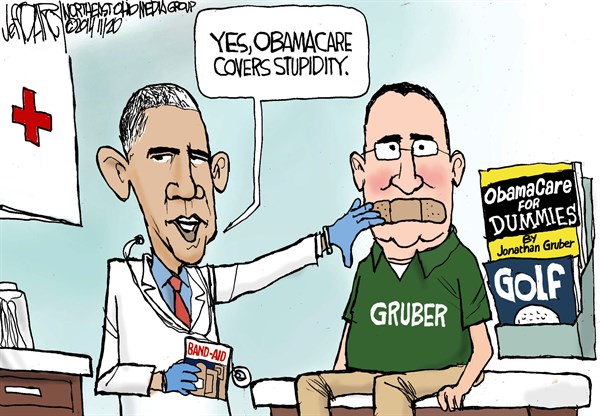
Is anyone unaware at this point that Obamacare (the ACA) was built on a foundation of lies? The “tax vs. penalty” controversy was squirrelly, as the administration shifted positions in defending the individual mandate before the Supreme Court in 2012. Surprisingly, that court decision went in favor of the ACA despite the obvious flip-flop. Of course, we heard Obama say, “if you like your plan, you can keep your plan,” and “if you like your doctor, you can keep your doctor,” both of which were patently false statements. Now, we have the curious case of Jonathan Gruber, the celebrated MIT economist and a chief architect of the ACA. A citizen journalist (“real” journalists were asleep at the switch) uncovered a series of video clips of Gruber in which he strongly asserts that there was willful deceit involved in the crafting and selling of the health care law. Some Gruber:

This bill was written in a tortured way to make sure CBO did not score the mandate as taxes. If CBO [Congressional Budget Office] scored the mandate as taxes, the bill dies. Okay, so it’s written to do that. In terms of risk rated subsidies, if you had a law which said that healthy people are going to pay in – you made explicit healthy people pay in and sick people get money, it would not have passed… Lack of transparency is a huge political advantage. And basically, call it the stupidity of the American voter or whatever, but basically that was really really critical for the thing to pass….

Ron Fournier, at the first link above, writes:

Liberals should be the angriest. Not only were they personally deceived, but the administration’s dishonest approach to health care reform has helped make Obamacare unpopular while undermining the public’s faith in an activist government. A double blow to progressives. …Gruber’s remarks are evidence that the administration intentionally deceived the American public on the costs of the programs. …And so even I have to admit, as a supporter, that Obamacare was built and sold on a foundation of lies.

Even worse for those clinging to hope that the ACA will survive intact, in July, a year-old video came to light in which Gruber confirmed that the Obamacare subsidies were intended as an inducement  to states to provide their own insurance exchanges, rather than relying on the federal exchange. This is now the subject of another case before the Supreme Court, King vs. Burwell. Sacred Cow Chips featured a post on Gruber’s statement in July, when he attempted to pass-off the remarks as mistaken, a “speak-o” as he put it, but he said the same thing on at least three separate occasions. In so doing, Gruber helped to make the case that subsidies were not intended for individuals purchasing insurance through the federal exchange.

There has been a spate of recent contentions that Obamacare is “working” after all. Lest any hypocrite take solace that the lies and deceit were worthwhile after all, the positive news is scant. Of course, the number of uninsured has declined to some extent, but almost entirely via Medicaid enrollment, for which access to providers is often problematic. Premia have increased for many previously insured under individual policies. Overall measures of premia are distorted by subsidies and the so-called “risk corridors,” basically bailout funds kicked back to health insurers to keep them profitable. There are a host of other problems. You can read about some of them here.