• About

Sacred Cow Chips

Sacred Cow Chips

Tag Archives: Classical Liberal

That Word “Liberal” … I Don’t Think That Means What You Think It Means

03 Wednesday Jan 2024

Posted by Nuetzel in Conservatism, Liberalism, Socialism

≈ Leave a comment

Tags

Adam Smith, Capitalism, Classical Liberal, Conservatism, Consumer Sovereignty, Corporatism, Free Markets, Freedom of Speech, Friedrich Hayek, Liberalism, Libertarianism, MAGA, monopoly, Monopsony, Nate Silver, Natural Rights, Non-Aggression Principle, Perfect Competition, Progressivism, Property Rights, Public goods, Religious Freedom, Right to Life, Scott Sumner, social engineering, Socialism, State Capacity, State Religion, statism, The Wealth of Nations
Leftism has taken on new dimensions amid its preoccupation with identity politics, victimhood, and “wokeness”. Traditional socialists are still among us, of course, but “wokeists” and “identitarians” have been on the progressive vanguard of late, rooting for the deranged human butchers of Hamas and the dismantling of liberal institutions. This didn’t happen overnight, of course, and traditional socialists are mostly fine with it.

An older story is the rebranding of leftism that took place in the U.S. during the first half of the 20th century, when the word “liberal” was co-opted by leftists. Before that, a liberal orientation was understood to be antithetical to the collectivist mindset long associated with the Left. Note also that liberalism retains its original meaning even today in much of Europe. Often we hear the term “classical liberal” to denote the “original” meaning of liberalism, but the modifier should be wholly unnecessary.

Liberalism Is Not “In-Betweenism”

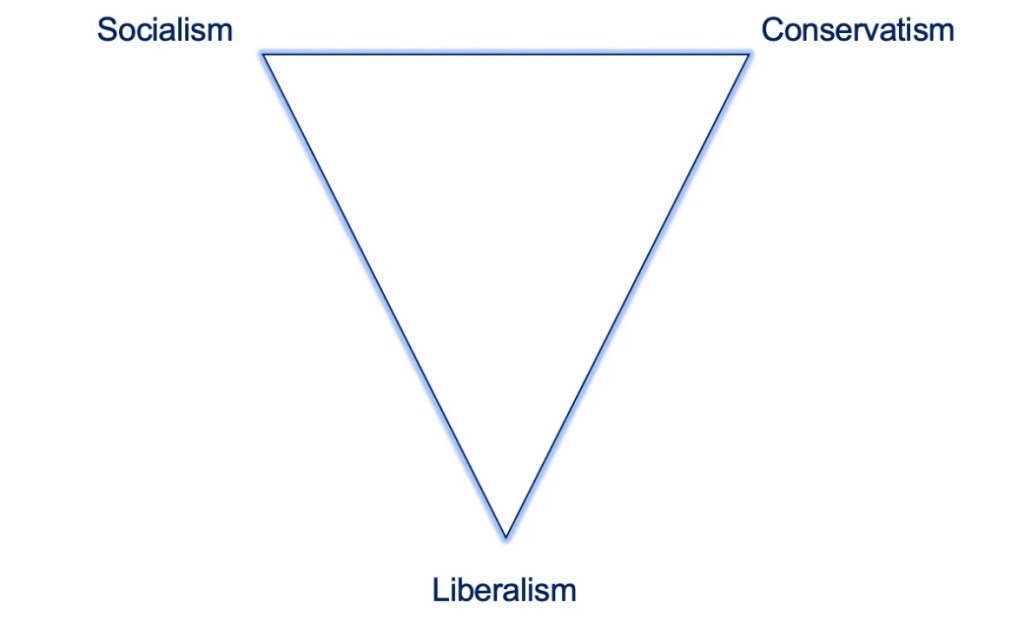
In this vein, Nate Silver presents a basic taxonomy of political orientation in a recent Substack post. It includes the diagram above, which distinguishes between socialism, conservatism, and liberalism. Silver draws on a classic essay written by Friedrich Hayek in 1945, “Why I am Not a Conservative”, in which Hayek discussed the meaning of the word “liberal” (and see here). Liberalism’s true emphasis is a tolerance for individual rights and freedoms, subject to varying articulations of the “nonaggression principle”. That is, “do as you like, but do no harm to others”.

We often see a linear representation distinguishing between so-called progressives on the left and conservatives on the right. Of course, a major hallmark of leftist thinking is extreme interventionism. Leftists or progressives are always keen to detect the slightest whiff of an externality or the slightest departure from the perfectly competitive market ideal. They seem eager to find a role for government in virtually every area of life. While it’s not a limiting case, we can substitute socialism or statism for progressivism on the far left, as Silver does, whereby the state takes primacy in economic and social affairs.

Conservatism, on the other hand, is a deep resistance to change, whether institutional, social, and sometimes economic. Conservatives too often demonstrate a willingness to use the coercive power of the state to prevent change. Hayek noted the willingness of both socialists and conservatives to invoke state power for their own ends.

Similarly, religious conservatives often demand state support beyond that afforded by the freedom to worship in the faith of one’s choice. They might strongly reject certain freedoms held to be fundamental by liberals. Meanwhile, socialists often view mere religious freedom as a threat to the power of the state, or at least they act like it (e.g. see here for an example).

Like conservatives, dedicated statists would doubtless resist change if it meant a loss of their own power. That is, they’d wish to preserve socialist institutions. On this point, witness the vitriol from the Left over what it perceives as threats to the public school monopoly. Witness also the fierce resistance among public employees to reducing the scale of the administrative state, and how advocates of entitlements fiercely resist decreases in the growth rate of those expenditures.

Silver, like Hayek, objects to the traditional, linear framework in which liberals are thought to occupy a range along a line between socialism and conservatism. He objects to that because real liberals value individual liberty as a natural human right, a viewpoint typically abhored by both socialists and conservatives. There is nothing “in between” about it! And of course, conservatives and progressives are equally guilty in their mistaken use of the word “liberal”.

Mapping Political Preferences

Liberty, statism, and conservatism are not exactly orthogonal political dimensions. Larger government almost always means less economic liberty. At a minimum, state dominance implies a social burden associated with public monopoly and monopsony power, as well as tax and welfare-state incentive problems. These features compromise or corrupt the exercise of basic rights. On the other hand, capitalism and its concomitant reliance on consumer sovereignty, individual initiative, free exchange and secure property rights is most in harmony with true liberalism.

For conservatives, resistance to change in support of a traditionally free market economy might offer something of a contradiction. In one sense, it corresponds to upholding market institutions. However, free markets allow new competitors and new technologies to undermine incumbents, who conservatives sometimes wish to defend through regulatory or protectionist measures. And conservatives are almost always too happy to join in the chorus of “price gouging” in response to the healthy operation of the free market in bringing forth supplies.

All that is to say that preferences involving liberty, statism, and traditionalism are not independent of one another. They cannot simply be mapped onto a three-dimensional space. At least the triangular representation gets liberalism out of the middle, but it’s difficult to visualize other ideological positions there. For example, “state religionism” could lie anywhere along the horizontal line at the top or even below it if certain basic liberties are preserved. Facism combines elements of socialism and a deformed version of capitalism that is properly called corporatism, but where would it fall within the triangle?

Big Government Liberalism?

Silver says he leans heavily toward a “big government” version of liberalism, but big government is hard to square with broad liberties. Granted, any well-functioning society must possess a certain level of “state capacity” to defend against private or public violations of individual rights, adjudicate disputes, and provide true public goods. It’s not clear whether Silver’s preferences lie within the bounds of those ambitions. Still, he deserves credit for his recognition that liberalism is wholly different from the progressive, socialist vision. It is the opposite.

The “New” Triangle

Silver attempts to gives the triangular framework a more contemporary spin by replacing conservatism with “MAGA Conservatism” and socialism with “Social Justice Leftism” (SJL), or “wokeism”. Here, I’m treating MAGA as a “brand”. Nothing below is intended to imply that America should not be a great nation.

The MAGA variant of conservatism emphasizes nationalism, though traditional conservatives have never been short on love of nation. For that matter, as a liberal American, it’s easier to forgive nationalist sentiments than it is the “Death to America” refrain we now hear from some SJLs.

The MAGA brand is also centered around a single individual, Donald Trump, whose rhetoric strikes many as nativistic. And Trump is a populist whose policy proposals are often nakedly political and counterproductive.

SJL shares with socialism an emphasis on various forms of redistribution and social engineering, but with a new focus on victimhood based on classes of identity. Of SJL, Silver says:

“Proponents of SJL usually dislike variations on the term ‘woke’, but the problem is that they dislike almost every other term as well. And we need some term for this ideology, because it encompasses quite a few distinctive features that differentiate it both from liberalism and from traditional, socialist-inflected leftism. In particular, SJL is much less concerned with the material condition of the working class, or with class in general. Instead, it is concerned with identity — especially identity categories involving race, gender and sexuality, but sometimes also many others as part of a sort of intersectional kaleidoscope.”
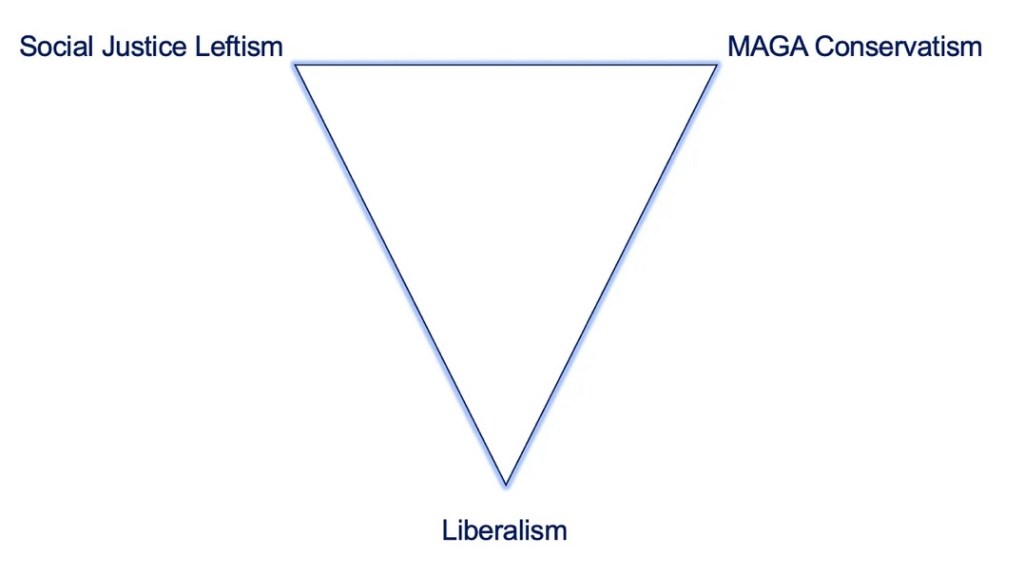
The gulf between liberals and SJLs couldn’t be wider on issues like free speech and “equity”, and equality of opportunity. MAGAns, on the other hand, have some views on individual rights and responsibility that are largely consistent with liberals, but reflexive populism often leads them to advocate policies protecting rents, corporate welfare, and protectionism.

Divided Liberalism

Liberalism emphasizes limited government, individual autonomy, and free exchange. However, there are issues upon which true liberals are of divided opinion. For example, one such area of controversy is the conflict between a woman’s right to choose and the fetal right to life. Many true liberals disagree over whether the rights of a fetus outweigh its mother’s right to choose, but most would concede that the balance shifts to the fetus at some point well short of birth (putting aside potential dangers to the mother’s life). Open borders is another area that can divide true liberals. On one side, the right to unrestricted mobility is thought to supersede any public interest in enforcing borders and limiting the flow of immigrants. On the other side, questions of national sovereignty, national security, as well as social and state capacity to absorb immigrants take primacy.

Don’t Call Lefties “Liberal”… They’re Not!

True liberalism (including most strains of libertarianism) recognizes various roles that a well-functioning state should play, but it also recognizes the primacy of the individual and individual rights as a social underpinning. As Hayek noted, true liberals are not resistant to change per se, unlike conservatives. But modern progressives demand changes of the worst kind: that the state should intervene to pursue their favored objectives, laying claim to an ever-greater share of private resources. This requires government coercion on a massive scale, the antithesis of liberalism. It’s time to recognize that “progressives” aren’t liberals in any sense of the word. For that matter, they don’t even stand for progress.

I’ll close with a quote from Adam Smith that I cribbed from Scott Sumner. Unfortunately, Sumner does not give the full reference, but I’ll take his word that Smith wrote this 20 years before the publication of The Wealth of Nations:

“Little else is requisite to carry a state to the highest degree of opulence from the lowest barbarism, but peace, easy taxes, and a tolerable administration of justice; all the rest being brought about by the natural course of things. All governments which thwart this natural course, which force things into another channel, or which endeavour to arrest the progress of society at a particular point, are unnatural, and to support themselves are obliged to be oppressive and tyrannical.”


Great Moments In Projection: Il Doofe Says His Opponents Are Anti-Democratic, Fascist

06 Tuesday Sep 2022

Posted by Nuetzel in Democracy, fascism, Uncategorized

≈ Leave a comment

Tags

Administrative State, Angelo M. Codaville, Babylon Bee, Benito Mussolini, Classical Liberal, Constitutional Republic, Corporatism, crony capitalism, Dan Klein, Democracy, fascism, FDR, Federalism, Friedrich Hayek, G.W.F. Hegel, Hitler, Il Duce, Joe Biden, Joseph Stalin, Majoritarianism, Nationalism, New Deal, Semi-Fascism, Sheldon Richman, Socialism

When partisans want to make sure they get their way, perhaps we shouldn’t be surprised to hear them claim their opponents are “anti-democratic”. Well, one-party rule is not democratic, just in case that’s unclear to leftists prattling about “hunting down” the opposition. We now have those forces hurling cries of “fascism” and “semi-fascism” at political adversaries for opposing their use of the state’s coercive power to get their way and to punish political enemies.

Restrained Democracy

The U.S. is not a democracy; it is a constitutional republic. The reason it’s not a democracy is that the nation’s founders were wary of the dangers of majoritarianism. There are many checks on unbridled majoritarianism built into our system of government, including the many protections and guarantees of individual rights in the Constitution, as well as federalism and three branches of government intended as coequals.

In a short essay on democracy, Dan Klein refers to a mythology that has developed around the presumed democratic ideal, quoting Friedrich Hayek on the “fantasy of consensus” that tends to afflict democratic absolutists. Broad consensus is possible on many issues, but it might have been an imperative within small bands of primitive humans, when survival of the band was of paramount concern. That’s not the case in modern societies, however. Classical liberals are often derided as “anti-democratic”, but like the founders, their distaste for pure democracy stems from a recognition of the potential for tyrannies of the majority. Klein notes that the liberal emphasis on individual rights is naturally at tension with democracy. Obviously, a majority might selfishly prefer actions that would be very much to the detriment of individuals in the minority, so certain safeguards are necessary.

However, the trepidation of classical liberals for democracy also has to do with the propensity for majorities to “governmentalize” affairs so as to codify their preferences. As Klein says, this often means regulation of many details of life and social interactions. These are encroachments to which classical liberals have a strong aversion. One might fairly say “small government” types like me are “anti-pure democracy”, and as the founders believed, democratic processes are desirable if governing power is distributed and restrained by constitutional principles and guarantees of individual rights.

Democracy has vulnerabilities beyond the danger posed by majoritarian dominance, however. Elections mean nothing if they can be manipulated, and they are easily corrupted at local levels by compromises to the administration of the election process. Indeed, today powerful national interests are seeking to influence voting for local election officials across the country, contributing substantial sums to progressive candidates. It’s therefore ironic to hear charges of racism and anti-democracy leveled at those who advocate measures to protect election integrity or institutions such as federalism.

And here we have the White House Press Secretary insisting that those in the “minority” on certain issues (dependent, of course, on how pollsters phrase the question) are “extremists”! To charge that someone or some policy is “anti-democratic” usually means you didn’t get your way or you’re otherwise motivated by political animus.

Fascism

Biden and others are throwing around the term fascism as well, though few of these partisans can define the term with any precision. Most who pretend to know its meaning imagine that fascism evokes some sort of conservative authoritarianism. Promoting that impression has been the purpose of many years of leftist efforts to redefine fascism to suit their political ends. Stalin actually promoted the view that anything to the right of the Communist Party was inherently fascist. But today, fascism is an accurate description of much of Western governance, dominated as it is by the administrative state.

I quote here from my post “The Fascist Roader” from 2016:

“A large government bureaucracy can coexist with heavily regulated, privately-owned businesses, who are rewarded by their administrative overlords for expending resources on compliance and participating in favored activities. The rewards can take the form of rich subsidies, status-enhancing revolving doors between industry and powerful government appointments, and steady profits afforded by monopoly power, as less monied and politically-adept competitors drop out of the competition for customers. We often call this “corporatism”, or “crony capitalism”, but it is classic fascism, as pioneered by Benito Mussolini’s government in Italy in the 1920s. Here is Sheldon Richman on the term’s derivation:

‘As an economic system, fascism is socialism with a capitalist veneer. The word derives from fasces, the Roman symbol of collectivism and power: a tied bundle of rods with a protruding ax.’”

Meanwhile, Hitler’s style of governing shared some of the characteristics of Mussolini’s fascism, but there were important differences: Hitler persecuted Jews, blaming them for all manner of social problems, and he ultimately had them slaughtered across much of Europe. Mussolini was often brutal with his political enemies. At the same time, he sought to unite an Italian people who were otherwise a fairly diverse lot, but once Mussolini was under Hitler’s thumb, Italian Jews were persecuted as well.

Angelo M. Codevilla provides an excellent account of Mussolini’s political career and the turns in his social philosophy over the years. He always considered himself a dedicated socialist, but the views he professed evolved as dictated by political expediency. So did his definition of fascism. As he took power in Italy with the aid of “street fighters”, fascism came to mean nationalism combined with rule by the administrative state and a corresponding preemption of legislative authority. And there were concerted efforts by Mussolini to control the media and censor critics. Sound familiar? Here’s a quote from Il Duce himself on this matter:

“Because the nature of peoples is variable, and it is easy to persuade them of things, but difficult to keep them thus persuaded. Hence one must make sure that, when they no longer believe, one may be able then to force them to believe.”

Here is Codevilla quoting Mussolini from 1919 on his philosophy of fascism:

“The fascist movement, he said, is ‘a group of people who join together for a time to accomplish certain ends.’ ‘It is about helping any proletarian groups who want to harmonize defense of their class with the national interest.’ ‘We are not, a priori, for class struggle or for class-cooperation. Either may be necessary for the nation according to circumstances.’”

This framing underlies another basic definition of fascism: a system whereby government coercion is used to extract private benefits, whether by class or individual. Codevilla states that Mussolini was focused on formal “representation of labor” in policy-making circles. Today, western labor unions seem to have an important, though indirect, influence on policy, and labor is of course the presumed beneficiary of many modern workplace regulations.

Modern corporatism is directly descended from Mussolini’s fascist state. The symbiosis that exists between large corporations and government has several dimensions, including regulatory capture, subsidies and taxes to direct flows of resources, high rates of government consumption, rich government contracts, and of course cronyism. This carries high social costs, as government dominance of economic affairs gives rise to a culture of rent seeking and diminished real productivity. Here is Codevilla’s brief description of the transition:

“Hegel, as well as the positivist and Progressive movements, had argued for the sovereignty of expert administrators. Fascist Italy was the first country in which the elected legislature gave up its essential powers to the executive, thus abandoning the principle, first enshrined in the Declaration of Independence and the U.S. Constitution, by which people are rightly governed only through laws made by elected representatives. By the outbreak of World War II, most Western countries’ legislatures—the U.S. Congress included—had granted the executive something like ‘full powers,’ each by its own path, thus establishing the modern administrative state.”

Mussolini saw Italian fascism as the forerunner to FDR’s New Deal and took great pride in that. On this point, he said:

“… the state is responsible for the people’s economic well-being, it no longer allows economic forces to run according to their own nature.”

The Babylon Bee’s take on Biden and fascism would have been more accurate had it alluded to Mussolini, but not nearly as funny! The following link (and photoshopped image) is obviously satire, but it has a whiff of eerie truth.

Biden Condemns Fascism in Speech While Also Debuting Attractive New Mustache

Conclusion

Biden’s slur that Republicans are “anti-democratic” is an obvious distortion, and it’s rather ironic at that. The nation’s support for democratic institutions has always been qualified for good reasons: strict majoritarianism tends to disenfranchise voters in the minority, and in fact it can pose real dangers to their lives and liberties. Our constitutional republic offers “relief valves”, such as “voting with your feet”, constitutional protections, and seeking recourse in court. Biden’s party, however, has a suspicious advantage via control of election supervision in many key urban areas of the country. This can be exploited in national elections to win more races as long as the rules on election administration are sufficiently lax. This is a true corruption of democracy, unlike the earnest efforts to improve election integrity now condemned by democrats.

Joe Biden hasn’t the faintest understanding of what fascism means. He uses the term mostly to suggest that Trump, and perhaps most Republicans, have authoritarian and racist sympathies. Meanwhile, he works to entrench the machinery and the breadth of our own fascist state, usurping legislative authority. He is buttressed by a treacherous security apparatus, “street fighters” under the guise of Antifa and BLM, and the private media acting as a propaganda arm of the administration. Joe Biden, you’re our fascist now.

Follow Sacred Cow Chips on WordPress.com

Recent Posts

  • The Case Against Interest On Reserves
  • Immigration and Merit As Fiscal Propositions
  • Tariff “Dividend” From An Indigent State
  • Almost Looks Like the Fed Has a 3% Inflation Target
  • Government Malpractice Breeds Health Care Havoc

Archives

  • January 2026
  • December 2025
  • November 2025
  • October 2025
  • September 2025
  • August 2025
  • July 2025
  • June 2025
  • May 2025
  • April 2025
  • March 2025
  • February 2025
  • January 2025
  • December 2024
  • November 2024
  • October 2024
  • September 2024
  • August 2024
  • July 2024
  • June 2024
  • May 2024
  • April 2024
  • March 2024
  • February 2024
  • January 2024
  • December 2023
  • November 2023
  • August 2023
  • July 2023
  • June 2023
  • May 2023
  • April 2023
  • March 2023
  • February 2023
  • January 2023
  • December 2022
  • November 2022
  • October 2022
  • September 2022
  • August 2022
  • July 2022
  • June 2022
  • May 2022
  • April 2022
  • March 2022
  • February 2022
  • January 2022
  • December 2021
  • November 2021
  • October 2021
  • September 2021
  • August 2021
  • July 2021
  • June 2021
  • May 2021
  • April 2021
  • March 2021
  • February 2021
  • January 2021
  • December 2020
  • November 2020
  • October 2020
  • September 2020
  • August 2020
  • July 2020
  • June 2020
  • May 2020
  • April 2020
  • March 2020
  • February 2020
  • January 2020
  • December 2019
  • November 2019
  • October 2019
  • September 2019
  • August 2019
  • July 2019
  • June 2019
  • May 2019
  • April 2019
  • March 2019
  • February 2019
  • January 2019
  • December 2018
  • November 2018
  • October 2018
  • September 2018
  • August 2018
  • July 2018
  • June 2018
  • May 2018
  • April 2018
  • March 2018
  • February 2018
  • January 2018
  • December 2017
  • November 2017
  • October 2017
  • September 2017
  • August 2017
  • July 2017
  • June 2017
  • May 2017
  • April 2017
  • March 2017
  • February 2017
  • January 2017
  • December 2016
  • November 2016
  • October 2016
  • September 2016
  • August 2016
  • July 2016
  • June 2016
  • May 2016
  • April 2016
  • March 2016
  • February 2016
  • January 2016
  • December 2015
  • November 2015
  • October 2015
  • September 2015
  • August 2015
  • July 2015
  • June 2015
  • May 2015
  • April 2015
  • March 2015
  • February 2015
  • January 2015
  • December 2014
  • November 2014
  • October 2014
  • September 2014
  • August 2014
  • July 2014
  • June 2014
  • May 2014
  • April 2014
  • March 2014

Blogs I Follow

  • Passive Income Kickstart
  • OnlyFinance.net
  • TLC Cholesterol
  • Nintil
  • kendunning.net
  • DCWhispers.com
  • Hoong-Wai in the UK
  • Marginal REVOLUTION
  • Stlouis
  • Watts Up With That?
  • Aussie Nationalist Blog
  • American Elephants
  • The View from Alexandria
  • The Gymnasium
  • A Force for Good
  • Notes On Liberty
  • troymo
  • SUNDAY BLOG Stephanie Sievers
  • Miss Lou Acquiring Lore
  • Your Well Wisher Program
  • Objectivism In Depth
  • RobotEnomics
  • Orderstatistic
  • Paradigm Library
  • Scattered Showers and Quicksand

Blog at WordPress.com.

Passive Income Kickstart

OnlyFinance.net

TLC Cholesterol

Nintil

To estimate, compare, distinguish, discuss, and trace to its principal sources everything

kendunning.net

The Future is Ours to Create

DCWhispers.com

Hoong-Wai in the UK

A Commonwealth immigrant's perspective on the UK's public arena.

Marginal REVOLUTION

Small Steps Toward A Much Better World

Stlouis

Watts Up With That?

The world's most viewed site on global warming and climate change

Aussie Nationalist Blog

Commentary from a Paleoconservative and Nationalist perspective

American Elephants

Defending Life, Liberty and the Pursuit of Happiness

The View from Alexandria

In advanced civilizations the period loosely called Alexandrian is usually associated with flexible morals, perfunctory religion, populist standards and cosmopolitan tastes, feminism, exotic cults, and the rapid turnover of high and low fads---in short, a falling away (which is all that decadence means) from the strictness of traditional rules, embodied in character and inforced from within. -- Jacques Barzun

The Gymnasium

A place for reason, politics, economics, and faith steeped in the classical liberal tradition

A Force for Good

How economics, morality, and markets combine

Notes On Liberty

Spontaneous thoughts on a humble creed

troymo

SUNDAY BLOG Stephanie Sievers

Escaping the everyday life with photographs from my travels

Miss Lou Acquiring Lore

Gallery of Life...

Your Well Wisher Program

Attempt to solve commonly known problems…

Objectivism In Depth

Exploring Ayn Rand's revolutionary philosophy.

RobotEnomics

(A)n (I)ntelligent Future

Orderstatistic

Economics, chess and anything else on my mind.

Paradigm Library

OODA Looping

Scattered Showers and Quicksand

Musings on science, investing, finance, economics, politics, and probably fly fishing.

  • Subscribe Subscribed
    • Sacred Cow Chips
    • Join 128 other subscribers
    • Already have a WordPress.com account? Log in now.
    • Sacred Cow Chips
    • Subscribe Subscribed
    • Sign up
    • Log in
    • Report this content
    • View site in Reader
    • Manage subscriptions
    • Collapse this bar
 

Loading Comments...