• About

Sacred Cow Chips

Sacred Cow Chips

Tag Archives: Congressional Budget Office

Cleaving the Health Care Knot… Or Not

18 Saturday Mar 2017

Posted by Nuetzel in Health Care, Obamacare

≈ 2 Comments

Tags

AHCA, American Health Care Act, Avik Roy, Budget Reconciliation, CBO, Community Rating, Congressional Budget Office, John C. Goodman, Medicaid Reform, Michael Cannon, Michael Tanner, Obamacare, Patient Freedom Act, Rand Paul, Refundable Tax Credits, Rep. Pete Sessions, Se. Bill Cassidy, Universal Basic Income, Yuval Levin

IMG_3957

Republican leadership has succeeded in making their health care reform plans in 2017 even more confusing than the ill-fated reforms enacted by Congress and signed by President Obama in 2010. A three-phase process has been outlined by Republican leaders in both houses after the initial rollout of the American Health Care Act (AHCA), now billed as “Phase 1”. The AHCA was greeted with little enthusiasm by the GOP faithful, however.

As a strictly political matter, there is a certain logic to the intent of “three-phase plan”: limiting the provisions of the AHCA to issues having an impact on the federal budget. That would allow the bill to be addressed under “budget reconciliation” rules requiring only 51 votes for passage in the Senate. Phase 2 would involve regulatory rule-making, or rule-rescinding, as the case may be. The putative Phase 3 would require additional legislation to address such unfinished business as allowing health insurance competition across state lines, eliminating anti-trust protection for insurers, and medical tort reform. How the sponsors will get 60 Senate votes for Phase 3 reforms is an unanswered question.

Legislative Priorities

Yuval Levin wrote a great analysis of the AHCA last week In which he described the structure of the House bill as a paranoid reaction to the demands of an “imaginary parliamentarian”. By that he means that the reforms in the bill conform to a rigid and potentially flawed interpretation of Senate budget reconciliation rules. Levin’s view is that the House should not twist itself up over what might be negotiated prior to a Senate vote. In other words, the House should concern itself at this stage with passing a bill that at least makes sense as reform, without bowing to any of the awful legacy provisions in Obamacare.

Medicaid reform is one piece of the proposed legislation and is reasonably straightforward. It imposes caps on federal funding to states after 2020, but it grants more flexibility to the states in managing the program. It also involves a tradeoff by allowing Medicaid funding to increase over the first few years, in line with the expansion under Obamacare, in exchange for capped growth later. The expectation is that long-term costs of the program will be reduced through a combination of the caps and better management at the state level.

The more complex aspects of the AHCA attempt to effect changes in the individual market. Levin offers a good perspective on these measures. First, he describes the general character of earlier Republican reform proposals from which the AHCA descends:

“Those various proposals all involved bringing premium costs down by enabling insurers to sell catastrophic coverage plans (along with more comprehensive plans) and enabling everyone in the individual market to afford at least those catastrophic coverage plans. This would enable far greater competition and let anyone not otherwise covered by insurance enter the individual market as a consumer.  …

The House proposal bears a clear resemblance to this approach. It involves some deregulation from Obamacare, it includes a refundable tax credit for coverage, it gestures toward incentives for continuous coverage. But it is also fundamentally different from this approach, because it functions within the core insurance rules established by Obamacare, which means it can’t really achieve most of the key aims of the conservative reforms it is modeled on.”

The rules established by Obamacare to which Levin refers include the form of community rating, which is merely loosened somewhat by the AHCA. However, the AHCA would impose a 30% penalty for those who fail to enroll while still healthy. This is a poorly designed incentive meant to substitute for Obamacare’s individual mandate, and it is likely to backfire. Levin is clear that this feature could have been avoided by scrapping the old rules and introducing a new form of community rating available only to the continuously insured.

The AHCA also fails to cap the tax benefits of employer-provided coverage, which retains a potential imbalance between the incentives for employer versus individual coverage. Levin believes, however, that some of these shortcomings can be fixed through a negotiation process in either the House or the Senate, if and when the bill goes there.

The CBO’s Report

As it is, the bill was “scored” by the Congressional Budget Office (CBO) with results that are widely viewed as unsatisfactory. The CBO’s report states that the AHCA would reduce the federal budget deficit, but the ugly headline is that relative to Obamacare, it woud cause 24 million people to lose their coverage by 2024. That number is drastically inflated, as Avik Roy demonstrated in his Forbes column this week. Here are the issues laid out by Roy:

  1. The CBO has repeatedly erred by a large margin in its forecasts of Obamacare exchange enrollment, overestimating 2016 enrollment by over 100% as recently as 2014.
  2. The AHCA changes relative to Obamacare are taken from CBO’s 2016 forecast, which still appears to over-predict Obamacare enrollment substantially. Roy estimates that this difference alone would shave at least 7 million off the 24 million loss of coverage quoted by the CBO.
  3. The CBO also assumes that all states will opt to participate in expanded Medicaid going forward. That is highly unlikely, and it inflates CBO’s estimate of the AHCA’s negative impact on coverage by another 3 million individuals, according to Roy.
  4. Going forward, the CBO expects the Obamacare individual mandate to encourage millions more to opt for insurance than would under the AHCA. Roy estimates that this assumptions adds as much as 9 million to the CBO’s estimate of lost coverage across the individual and employer markets, as well as Medicaid.

Thus, Roy believes the CBO’s estimate of lost coverage for 24 million individuals is too high by about 19 million! And remember, these hypothetical losses are voluntary to the extent that individuals refuse to avail themselves of AHCA tax credits to purchase catastrophic coverage, or to enroll in Medicaid. The latter will be no less generous under the AHCA than it is today. The tax credits are refundable, which means that you qualify regardless of your pre-credit tax liability.

Fixes

Despite Roy’s initial skepticism about the AHCA, he thinks it can be fixed, in part by means-testing the tax credits, rather than the flat credit in the bill. He also believes the transition away from the individual mandate should be more gradual, allowing more time for markets to being premiums down, but I find this position rather puzzling given Roy’s skepticism that the mandate has a strong impact on enrollment. Perhaps gradualism would convince the CBO to score the bill more favorably, but that’s a bad reason to make such a change.

It’s impossible to say how the bill will evolve, but certainly improvements can be made. It is also impossible to know whether Phases 2 and 3 will ultimately bring a more complete set of cost-reducing regulatory and competitive reforms. Phase 3, of course, is a political wild card.

Michael Tanner notes a few other advantages to the AHCA. Even the CBO says the cost of health insurance would fall, and the AHCA will bring greater choice to the individual market. It also promises over $1 trillion in tax cuts and lower federal deficits.

Alternatives

The GOP faced alternatives that should have received more consideration, but those alternatives might not be politically viable at this point. Some of them contain features that might be negotiated into the final legislation. Rand Paul’s plan has not attracted many advocates. Paul took the courageous position that there should be no entitlements in a reform plan (i.e., subsidies); instead, he insisted, with liberalized market forces, premium costs would decline sufficiently to allow affordable coverage to be purchased by a broad cross-section of Americans. Paul is obviously unhappy about the widespread support in the GOP for refundable tax credits as a replacement for existing Obamacare subsidies.

John C. Goodman has advocated a much simpler solution: take every federal penny now dedicated to health care and insurance subsidies, including every penny of taxes now avoided via tax deductions on employer-provided coverage, and pay it out to households as a tax credit contingent on the purchase of health insurance or health care expenses. This is essentially the plan put forward by Rep. Pete Sessions and Sen. Bill Cassidy in the Patient Freedom Act, described here. While I admire the simplicity of one program to replace the existing complexities in the federal funding of health care coverage, my objection is that a health care “dividend” of this nature resembles the flat tax credit in the AHCA. Neither is means-tested, amounting to a “Universal Basic Health Insurance Benefit”. Regular readers will recall my recent criticism of the Universal Basic Income, which is the sort of program that smacks of “universal state dependency”. But let’s face it: we’re already in a state of federal health care dependency. In this case, there is no incremental cost to taxpayers because the credit would replace existing outlays and tax expenditures. In that sense, it would eliminate many of the distortions currently embedded in federal health care policy.

A more drastic approach, at this point, is to simply repeal Obamacare, perhaps with a lengthy phase-out, and attempt to replace it later in the hope that support will coalesce around a reasonable set of measures leveraging market forces, and with accommodations for high-risk individuals and the economically disadvantaged. Michael Cannon writes that CBO estimated a simple repeal would increase the number of uninsured by 23 million over ten years, slightly less than the 24 million estimate for the AHCA! Of course, neither of these estimates is likely to be remotely accurate, as both are distorted by the CBO’s rosy assumptions about the future of Obamacare.

Where To Go?

Tanner reminds us that the real alternative to Republican legislation, whatever form it might take, is not a health care utopia. It is Obamacare, and it is collapsing. That plan cannot be effectively reformed with additional subsidies for insurers and consumers, or we’d find ourselves in a continuing premium spiral. The needed reforms to Obamacare would resemble changes contemplated in some of the GOP proposals. While I cannot endorse that AHCA legislation in its current form, or as a standalone reform, I believe it can be improved, and the later phases of reform we are told to anticipate might ultimately vindicate the approach taken by GOP leadership. I am most skeptical about the promise of subsequent legislation in Phase 3. I’ll have to keep my fingers crossed that by then, the path to additional reforms will be more attractive to democrats.
Dynamism and Punishment

20 Wednesday Apr 2016

Posted by Nuetzel in Income Distribution, Taxes

≈ Leave a comment

Tags

Congressional Budget Office, Financial Crisis, Income Migration, Mark Perry, Middle Class, Peter G. Peterson Foundation, Regime Uncertainty, Scott Sumner, Tax Policy Center, Tax Progressivity, Weak Obama Recovery


econ

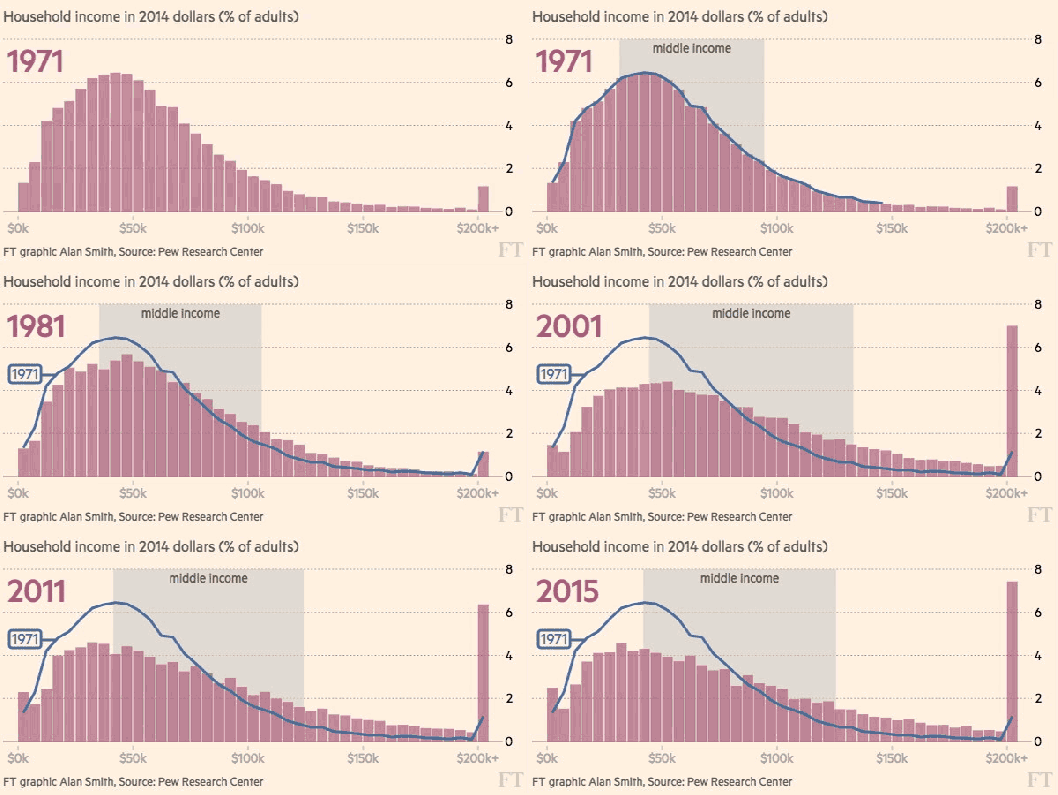
The “squeeze” on the U.S. middle class is a fiction. If you don’t believe it, take a look at the “gif” above. It first appeared in The Financial Times (FT) with a misleading description about how “…technological change and globalization drive a wedge between the winners and losers in a splintering US society.” It’s obvious that the middle class, as statically defined by the FT, is shrinking only because it is moving up to higher real income levels (i.e., adjusted for inflation). Mark Perry uses this and other supporting charts in noting that “…so many middle-income households have become better off“. Some of these gains are related to an aging population, but the gains are not remotely consistent with FT’s dramatization. One point of emphasis that the chart should make obvious, but doesn’t quite, is that groups appearing to remain within a particular income range over time are never comprised of the same individuals. There is always movement up and down across all of these groups from year-to-year.

There is a stagnation story here, but it’s more limited than suggested by FT’s narrative. It is twofold: first, the financial crisis in 2007-2009 put a temporary stop to the upward income migration, and its resumption during the Obama presidency has been less robust; second, the very lowest-income segment, $0 – $10,000 of annual income, has expanded in each time interval shown since 1991, from just above 1% of adults to roughly 2.5%. A primary reason for the tepid growth of the U.S. economy since the recession’s trough in 2009, and the weaker migration, has been weak physical investment in the productive economy from its recession lows. That form of spending usually takes a lead role in economic recoveries. A number of observers have attributed the poor performance this time around to “regime uncertainty“, or the risk that regulatory and tax regimes could take an even more destructive toll in the future, essentially devouring returns to capital. As for the increases in the lowest-income sliver of the chart, Scott Sumner says:

“It could be due to expansion of the welfare state, the break-up of the traditional family, or perhaps growth in the underground economy. Nonetheless, it is cause for concern. But it has nothing to do with the mythical decline in the ‘middle class.’“

A related fiction is that the U.S. tax system is unfair to the middle class, and that higher income groups do not pay their “fair share”. This is put to rest in an “Issue Brief” from the Peter G. Peterson Foundation (PPF), using data from the Tax Policy Center and the Congressional Budget Office. The analysis shows that while high-income taxpayers benefit from tax breaks, those breaks offset high marginal tax rates and do not diminish the fact that the tax system is highly progressive:

“The Tax Policy Center estimates that 69 percent of taxes collected in 2015 will come from those in the top quintile, or those earning an income above $138,265 annually. Within this group, the top one percent of income earners — those earning more than $709,166 in income per year — will contribute over a quarter of all federal revenues collected.“

Apparently, the PPF analysis does not account for the impact of transfer payments on progressivity, which make average effective tax rates negative at low income levels. However, PPF does acknowledge that the tax system is unnecessarily complex and creates a web of distortions and poor incentives that limit economic growth. It’s a wonder that the dynamic of upward migration in real income was possible at all.


The Inhumane Minimum Wage Fantasy

22 Monday Feb 2016

Posted by Nuetzel in Minimum Wage, Poverty

≈ Leave a comment

Tags

American Enterprise Institute, Angela Rachidi, Congressional Budget Office, David Neumark, Don Boudreaux, Economic Policy Institute, Living Wage, Low-skilled labor, Minimum Wage, OLena Nizalova, Public Assistance, Wefare Cliff

min-wage ball n chain

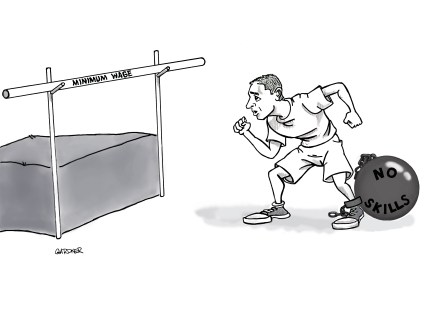
An analysis by the Economic Policy Institute (EPI) is the basis for breathless claims by the Left that a substantial increase in the minimum wage would have “sweeping benefits for low-income families.” The EPI study purports to show that spending on public assistance will decline significantly with the increase in the minimum wage. Author David Cooper’s analysis is purely static, dressed up with a few linear regression equations relating participation in federal welfare programs to the wage distribution. However, his conclusion is preordained by the very design of the analysis, which relies on pooled data from public assistance programs across 2012 – 2014. This was a period over which wages were generally rising, but the federal minimum wage was constant (and only a few state minimum wages were increased).

It’s no surprise that higher wages are associated with a reduced likelihood of receiving needs-based public assistance in a cross section. That’s not quite the same as measuring the dynamic impact of an increase in the minimum wage. The adjustment to a higher wage floor involves more complex shifts in the structure of the economy, including higher prices, a higher incidence of small business failure and the substitution of automated systems for labor. And celebration would not be in order if the policy change prompted a deterioration in the employment prospects of the least-skilled workers, and it would.

There are a few gaping holes in the EPI analysis. One involves a data limitation whereby the distribution of public assistance by wage decile is related to individual workers or their families. It is one thing to say that most recipients of public assistance work for a living. It is quite another to say “Most recipients of public assistance work or have a family member who works.” Obviously, the latter does not imply the former, yet the analysis asks you to accept that the wage rates of family members who perform work during a year are the determining factor in welfare program participation, rather than the employment status and hours of all members of the household.

The analysis includes cross-sectional regressions relating the receipt of public assistance (yes or no) to wages imputed at the individual level, controlling for a complex function of age (polynomial terms), other demographic factors and part-time work status during the previous year. As stated above, the data are plagued by measurement issues. Furthermore (and this is a technical critique), linear regression is not an appropriate statistical methodology with a binary dependent variable. The author should have known better, but we’ll leave that aside.

Controlling for part-time status is intended to create a more reliable estimate of the effect of wages on program participation, as part-timers are more likely to earn low wage rates. But if hours matter in that way, then the regression is all the more suspect because hours of work are otherwise ignored (except in the imputation of wage rates).

The truth is that poverty is not a wage problem as much as a jobs and hours problem. A recent post by Angela Rachidi  of the American Enterprise Institute notes that “Only 11.7% of poor working-age adults worked full-time for the entire year in 2014.” Impoverished individuals who work full or part-time are concentrated in low-skilled occupations. Those are likely to be the same kinds of jobs for which impoverished non-workers might otherwise compete. Many of those jobs are at or near the minimum wage, but increasing the wage floor will only exacerbate the problem of unemployment or underemployment.

An increase in the minimum wage might help those workers who are able to keep their jobs. Unfortunately, if they remain employed, they are likely to suffer non-wage repercussions at their jobs. Therefore, the size of the net economic gain for those lucky enough to keep their jobs is open to question, though their measured income will rise. Still, keeping your job may be a big challenge.

The EPI analysis pays no heed to the negative employment effects of changes in the minimum wage. These stem from  employers’ efforts to control costs, hiring only when the skills and expected productivity of a worker exceed the cost. Growth and job opportunities are thus quashed by the intervention, including the gain in skills that comes with experience. If a business hikes price to defray higher labor costs, the negative impact on customers will induce them to buy less, reducing the need for labor. Another possible impact may be caused by the so-called “welfare cliff“, or the tendency of many program benefits to decline as income rises, which imposes a marginal tax rate on beneficiaries’ labor income. A higher wage floor might induce a worker to reduce hours to avoid the cliff, if their employer allows it, or it might induce another employed member of the same household to reduce hours.

Here is the extent of EPI’s treatment of the negative employment effects of a higher minimum wage, quoting the Congressional Budget Office (CBO):

“CBO predicts that federal expenses would initially go down, but could later increase if the higher minimum wage has a significant negative effect on employment. On net, they conclude that ‘it is unclear whether the effect for the coming decade as a whole would be a small increase or a small decrease in budget deficits.’ It is important to note that the CBO’s ambiguity on this point is driven by their atypically high estimates of the probability of significant employment loss stemming from such an increase. If employment loss is insignificant (as most research on a minimum-wage increase of this magnitude indicates), the budget savings would surely dominate.” [Emphasis added]

The parenthetical, bolded statement is offered by Cooper without any support whatsoever, and it is incorrect. First, the evidence that the wage floor has negative employment effects “has been piling up” of late. “Living wage” advocates should not be encouraged by the recent experience of six large cities that have increased their minimum wages. Here is further information on the District of Columbia and WalMart’s reaction to a recent wage hike. The long-run effects of minimum wages are the most destructive, according to a recent paper authored by David Neumark and Olena Nizalova:

“The evidence indicates that even as individuals reach their late 20’s, they earn less and perhaps work less the longer they were exposed to a higher minimum wage at younger ages. The adverse longer-run effects of facing high minimum wages at young ages are stronger for blacks. From a policy perspective, these longer-run effects of minimum wages are likely more significant than the contemporaneous effects of minimum wages on youths that are the focus of most research and policy debate.“

Other recent work shows that minimum wage increases during the Great Recession increased unemployment among workers age 16 – 30 with less than a high-school education. Another paper finds that minimum wage hikes are bad anti-poverty measures, poorly targeted and regressive in their effects on the poor due to higher prices. A couple of previous posts on Sacred Cow Chips include many links to other work on minimum wages: “Major Mistake: The Minimum Opportunity Wage“, and “Unintended Consequences: Living (Without a) Wage“. Today, many jobs are at risk of automation, so the responsiveness of employers might be greater than ever.

In a strong sense, EPI’s findings and conclusion are beside the point for the many low-skilled workers whose jobs would be at risk, as well as those who might never be given legitimate employment opportunities under a higher wage floor. Those erstwhile workers and job seekers are generally the least skilled and most in need of experience. But EPI, and unthinking living wage advocates, are all too eager to signal the humanity and virtue of their favored policies, foolishly ignoring the negative and inhumane employment consequences.

Without Reform, Social Security Is a Game of Chance

25 Sunday Oct 2015

Posted by Nuetzel in Social Security

≈ 1 Comment

Tags

Congressional Budget Office, Cost of Living Adjustments, Intergenerational Transfers, Internal Rates of Return, Michael Tanner, Pay-As-You-Go, Social Security, Social Security Privatization, Social Security Trust Fund, Tax Policy Center, The Urban Institute

social-security slot

Social Security does not provide future retirees with a safe “return” on taxes paid into the system on their behalf, given the program’s funding problems. It’s not even clear that it provides a decent return to many current retirees, and it will get worse as younger age cohorts become eligible. Demographic changes worked in the system’s favor in its early years, but no more: the number of eligible retirees is growing faster than the working-age population. This has led to cash flow deficits since 2010 that will widen in the years ahead. The unfunded liabilities of the system are currently estimated to be $26 trillion. The so-called “Trust Fund” for retirement holds about about $2.8 trillion of government securities, but those can’t be “cashed out” without a raid on general tax revenue or new borrowing by the Treasury.

Michael Tanner reveals the absurdity of some of the myths surrounding SS, such as claims that there is “no crisis” (and even more absurdly, that benefits should be expanded), that the Trust Fund will “save” the system, and that SS payroll taxes are “saved” for retirees. They are not saved; it is a “pay-as-you-go” system with current payroll tax collections paid out to today’s retirees. Here is Tanner on the woeful state of the system’s finances:

“According to projections by the Congressional Budget Office, for workers born in the 1980s, there are only enough funds to pay 76 percent of their schedule benefits; for today’s children born in the 2000s, this falls to 69 percent. And, taxes are already so high relative to benefits that young people will receive far less than they could receive if they invested their taxes privately.“

Measuring the return on Social Security (SS) payroll taxes (otherwise known as FICA) is not without controversy. The Social Security Administration (SSA) performs its own analyses of the returns on payroll taxes periodically. They analyze individuals at different income levels for each of four circumstances: single men, single women, one-earner couples and two-earner couples. They do so under different scenarios about future payroll taxes and benefits. The benefits include cost-of-living adjustments. These calculations show that today’s younger workers, singles and high-income workers can expect to receive the lowest returns. According to the most recent report, from December 2014, annual rates of return for those not yet drawing benefits under present law varies from less than 1% to 6.5%. Of course, the promised benefits are not sustainable under present law.

Reforms are not optional, as the program cannot run a deficit under its current authority once the Trust Fund is exhausted. SSA attempts to analyze steps that might close the gap and the impact of those changes on returns to retirees. One scenario involves higher payroll taxes and another lower benefits. These changes reduce the calculated returns in all cases, though even the lowest returns remain positive, if barely. These alternative scenarios involve no changes until 2033, however.

At the time of the SSA report, the most recent Congressional Budget Office (CBO) predicted that the SS Trust Fund would be exhausted in 2033. More recently, the CBO predicted that the fund will run dry in 2029. (The Disability Trust Fund is projected to run dry in 2017.) Therefore, the returns calculated by SSA under the alternative scenarios are over-estimates, since more drastic and earlier measures are required to restore balance. It’s likely that some of those returns would turn negative using SSA’s methodology. And it’s not unreasonable to suggest that reforms, whatever shape they might take, should be implemented sooner than 2029. After all, the need for reforms is well known, and we’re talking about it now! As for the SSA’s alternative scenarios, changes much sooner than 2033 would cause even lower returns.

While the SSA’s effort to provide the estimates is laudable, there are several aspects of the methodology that are questionable. SSA claims that the returns are real (inflation-adjusted) internal rates of return (IRRs), but they do not offer a detailed explanation of the inflation adjustment that must take place after calculating the nominal IRR. Using projected cost-of-living increases to inflate future benefits does not make the calculated IRRs “real”, if that’s what they have in mind. Second, the cost-of-living adjuster is the Consumer Price Index for Urban Wage Earners, which underestimates inflation experienced by the elderly. Third, they do not attempt to account for the probability of death before retirement, which would obviously reduce the return on contributions for single earners.

The “present-law” returns are essentially irrelevant, given the unfunded projected benefits. But the calculations under the alternative scenarios fail on other grounds: they are not “dynamic” in terms of adjusting for the economic impacts of the policy changes. In particular, higher payroll taxes are likely to reduce employment and slow the economy. A slowdown might even lead to additional claims on the system from earlier-than expected retirements. Thus, the higher payroll tax rates used by SSA will not be sufficient to close the gap. Likewise, reduced benefits would have a negative impact on the economy, reducing payroll tax collections. In both cases, dynamic economic effects would cause a wider funding gap; closing it will reduce returns more than suggested by SSA’s calculations.

An analysis by the Urban Institute in 2012 made somewhat arbitrary assumptions about rates of return. They used a 2% real rate of return to compound past contributions and discount future benefits (presumably with no cost-of-living adjustment). Under their assumptions, the value of payroll tax contributions at retirement often exceeds the discounted value of SS benefits for age cohorts turning 65 in 2010 and 2030. That implies that the real IRR must be lower than 2%.

As a hypothetical exercise, if individuals could invest their own payroll contributions over their working lives, significantly better returns could be earned than the IRRs discussed above, even if workers were forced into low-risk investments as they approach retirement. Therefore, the implied value of payroll contributions at retirement inherent in the IRR calculations is far too low. And while the discounting of retirement benefits at a relatively low rate reflects an appropriate conservatism, the level of SS benefits would not be competitive with the dollar returns on safe investments funded by a larger pot at retirement. The IRR calculations show only that the SS program is about as good as stuffing money into a mattress.

Unfortunately, the mattress might burn. The risks inherent in future SS benefits are substantial, and none of the reform alternatives are very popular. Some of the opposition is rooted in unreasonable criticism: No one has suggested programatic changes that would affect the benefits of anyone over the age of 55. Still, cuts in benefits for future retirees, delayed eligibility and higher payroll taxes are not easy sells. Another solution is to phase out the pay-as-you-go system, allowing younger workers the option of a a self-directed account (subject to certain restrictions), including a discounted “cash value” credit as a buyout for previous contributions. This was discussed in a recent post on Sacred Cow Chips.

Social Security is unsustainable and is an inter-generational rip-off in its current, pay-as-you-go form, as younger, less affluent workers subsidize current retirees, who are relatively wealthy as a class. Rather than shutting-down debate over reforms with exaggerated political claims, those interested in assuring a viable public retirement program should consider proposals that would give workers more choice and control, taking advantage of the higher returns available on private investments. Only this type of program can take advantage of the economy’s ability to convert savings into productive investment and real growth. Simple transfers from young to old do not leverage this process, and can never hope to compete with it.

Newer posts →
Follow Sacred Cow Chips on WordPress.com

Recent Posts

  • The Case Against Interest On Reserves
  • Immigration and Merit As Fiscal Propositions
  • Tariff “Dividend” From An Indigent State
  • Almost Looks Like the Fed Has a 3% Inflation Target
  • Government Malpractice Breeds Health Care Havoc

Archives

  • January 2026
  • December 2025
  • November 2025
  • October 2025
  • September 2025
  • August 2025
  • July 2025
  • June 2025
  • May 2025
  • April 2025
  • March 2025
  • February 2025
  • January 2025
  • December 2024
  • November 2024
  • October 2024
  • September 2024
  • August 2024
  • July 2024
  • June 2024
  • May 2024
  • April 2024
  • March 2024
  • February 2024
  • January 2024
  • December 2023
  • November 2023
  • August 2023
  • July 2023
  • June 2023
  • May 2023
  • April 2023
  • March 2023
  • February 2023
  • January 2023
  • December 2022
  • November 2022
  • October 2022
  • September 2022
  • August 2022
  • July 2022
  • June 2022
  • May 2022
  • April 2022
  • March 2022
  • February 2022
  • January 2022
  • December 2021
  • November 2021
  • October 2021
  • September 2021
  • August 2021
  • July 2021
  • June 2021
  • May 2021
  • April 2021
  • March 2021
  • February 2021
  • January 2021
  • December 2020
  • November 2020
  • October 2020
  • September 2020
  • August 2020
  • July 2020
  • June 2020
  • May 2020
  • April 2020
  • March 2020
  • February 2020
  • January 2020
  • December 2019
  • November 2019
  • October 2019
  • September 2019
  • August 2019
  • July 2019
  • June 2019
  • May 2019
  • April 2019
  • March 2019
  • February 2019
  • January 2019
  • December 2018
  • November 2018
  • October 2018
  • September 2018
  • August 2018
  • July 2018
  • June 2018
  • May 2018
  • April 2018
  • March 2018
  • February 2018
  • January 2018
  • December 2017
  • November 2017
  • October 2017
  • September 2017
  • August 2017
  • July 2017
  • June 2017
  • May 2017
  • April 2017
  • March 2017
  • February 2017
  • January 2017
  • December 2016
  • November 2016
  • October 2016
  • September 2016
  • August 2016
  • July 2016
  • June 2016
  • May 2016
  • April 2016
  • March 2016
  • February 2016
  • January 2016
  • December 2015
  • November 2015
  • October 2015
  • September 2015
  • August 2015
  • July 2015
  • June 2015
  • May 2015
  • April 2015
  • March 2015
  • February 2015
  • January 2015
  • December 2014
  • November 2014
  • October 2014
  • September 2014
  • August 2014
  • July 2014
  • June 2014
  • May 2014
  • April 2014
  • March 2014

Blogs I Follow

  • Passive Income Kickstart
  • OnlyFinance.net
  • TLC Cholesterol
  • Nintil
  • kendunning.net
  • DCWhispers.com
  • Hoong-Wai in the UK
  • Marginal REVOLUTION
  • Stlouis
  • Watts Up With That?
  • Aussie Nationalist Blog
  • American Elephants
  • The View from Alexandria
  • The Gymnasium
  • A Force for Good
  • Notes On Liberty
  • troymo
  • SUNDAY BLOG Stephanie Sievers
  • Miss Lou Acquiring Lore
  • Your Well Wisher Program
  • Objectivism In Depth
  • RobotEnomics
  • Orderstatistic
  • Paradigm Library
  • Scattered Showers and Quicksand

Blog at WordPress.com.

Passive Income Kickstart

OnlyFinance.net

TLC Cholesterol

Nintil

To estimate, compare, distinguish, discuss, and trace to its principal sources everything

kendunning.net

The Future is Ours to Create

DCWhispers.com

Hoong-Wai in the UK

A Commonwealth immigrant's perspective on the UK's public arena.

Marginal REVOLUTION

Small Steps Toward A Much Better World

Stlouis

Watts Up With That?

The world's most viewed site on global warming and climate change

Aussie Nationalist Blog

Commentary from a Paleoconservative and Nationalist perspective

American Elephants

Defending Life, Liberty and the Pursuit of Happiness

The View from Alexandria

In advanced civilizations the period loosely called Alexandrian is usually associated with flexible morals, perfunctory religion, populist standards and cosmopolitan tastes, feminism, exotic cults, and the rapid turnover of high and low fads---in short, a falling away (which is all that decadence means) from the strictness of traditional rules, embodied in character and inforced from within. -- Jacques Barzun

The Gymnasium

A place for reason, politics, economics, and faith steeped in the classical liberal tradition

A Force for Good

How economics, morality, and markets combine

Notes On Liberty

Spontaneous thoughts on a humble creed

troymo

SUNDAY BLOG Stephanie Sievers

Escaping the everyday life with photographs from my travels

Miss Lou Acquiring Lore

Gallery of Life...

Your Well Wisher Program

Attempt to solve commonly known problems…

Objectivism In Depth

Exploring Ayn Rand's revolutionary philosophy.

RobotEnomics

(A)n (I)ntelligent Future

Orderstatistic

Economics, chess and anything else on my mind.

Paradigm Library

OODA Looping

Scattered Showers and Quicksand

Musings on science, investing, finance, economics, politics, and probably fly fishing.

  • Subscribe Subscribed
    • Sacred Cow Chips
    • Join 128 other subscribers
    • Already have a WordPress.com account? Log in now.
    • Sacred Cow Chips
    • Subscribe Subscribed
    • Sign up
    • Log in
    • Report this content
    • View site in Reader
    • Manage subscriptions
    • Collapse this bar
 

Loading Comments...