• About

Sacred Cow Chips

Sacred Cow Chips

Tag Archives: Dodd-Frank

The Case Against Interest On Reserves

05 Monday Jan 2026

Posted by Nuetzel in Interest Rates, Monetary Policy

≈ Leave a comment

Tags

Ample Reserves, Basel III, Brian Wesbury, Capital Requirementd, Debt Monetization, Dodd-Frank, Fed Independence, Federal Reserve, Interbank Borrowing, Interest on Reserves, John Cochrane, Modern Monetary Theory, Nationalization, Nominal GDP Targeting, Operation Twist, Quantitative Easing, Reserve Requirements, Scarce Reserves, Scott Sumner, Socialized Risk
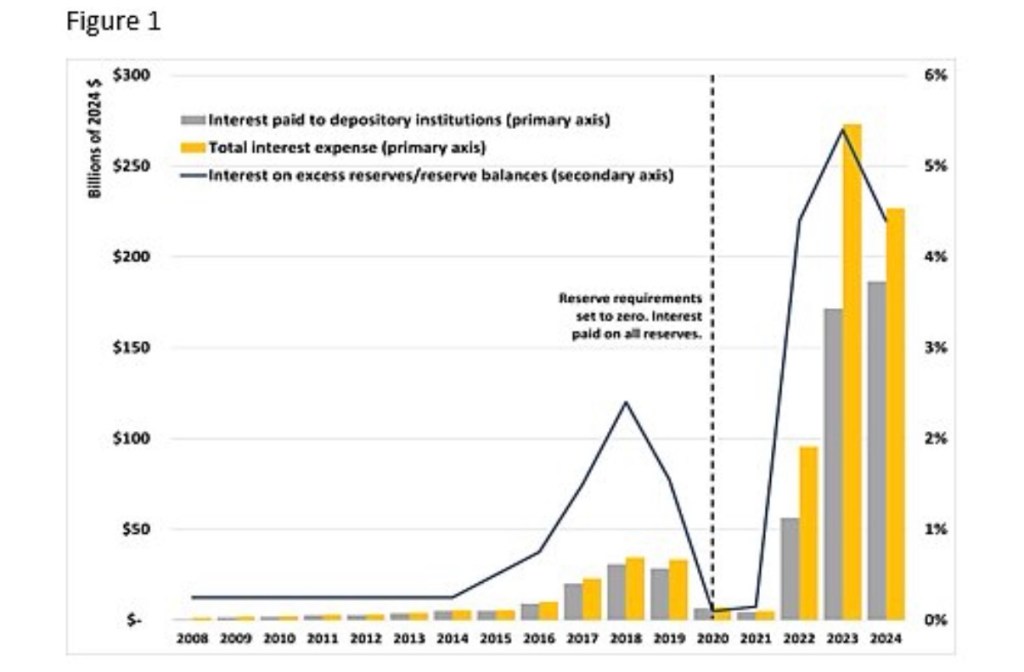
This topic flared up in 2025, with legislation proposing to end the Federal Reserve’s payment of interest on bank reserves (IOR). The bills have not yet advanced in Congress, however. As a preliminary on IOR and its broader implications, consider two hypotheticals:

First, imagine banks that take deposits, make loans, and invest in assets like government securities (i.e., Treasury debt). Banks are required to hold some percentage of reserves against their deposits at the central bank (the Fed), but the reserves earn nothing.

Now consider a world in which the Fed pays banks a risk-free interest rate on reserves. Banks will opt to hold plentiful reserves and relatively less in Treasuries. But in this scenario, the Fed itself holds large amounts of Treasuries and other securities, earns interest, and in turn pays interest to banks on their reserves.

The first scenario held sway in the U.S. until 2008, when Congress authorized the Fed to pay IOR. Since that time, we’ve had the second scenario: the IOR monetary order.

Socialized Risk

The central bank can basically print money, so there is no danger that banks won’t be paid IOR, despite some risk inherent in assets held by the Fed in its portfolio. While the rate paid on reserves can change, and banks are paid IOR every 14 days, they do not face the rate risk (and a modicum of default risk) inherent in holding Treasuries and mortgage securities, which have varying maturities. Instead, the Fed and ultimately taxpayers shoulder that risk, despite the Fed’s assurances that any portfolio losses and negative net interest income are economically irrelevant. These risks have been socialized, so we now share them.

This means that an essential function of the banking system, assessing and rationally pricing risks associated with certain assets, has been nationalized. It is a suspension of the market mechanism and an invitation to misallocated capital. Why bother to critically assess the risks inherent in assets if the Fed is happy to take them off your hands, possibly at a small premium, and then pay you a risk-free return on your cash to boot.

Bank Subsidies

IOR is a subsidy to banks. They get a return with zero risk, while taxpayers provide a funding bridge for any losses on the Fed’s holdings of securities on its balance sheet or any shortfall in the Fed’s net interest income. Banks, however, can’t lose money on their ample reserves.

The subsidy may come at a greater cost to some banks than others. This regime has been accompanied by significantly more regulation of bank balance sheets, such as capital and liquidity requirements (Basel III and Dodd-Frank). Not only is IOR a significant step toward nationalizing banks, but the attendant regulatory regime tends to favor large banks.

On the other hand, zero IOR with a positive reserve requirement amounts to a tax on banks, which is ultimately paid by bank customers. Allowing banks to hold zero reserves is out of the question, so we could view the implicit reserve-requirement tax as a cost of achieving some monetary stability and promoting safer depository institutions.

Quantitative Easing

Again, the advent of IOR created an incentive for banks to hold more reserves and relatively less in Treasuries and other assets (even some loans). Rather than “scarce reserves”, banks were encouraged by IOR to hold “ample reserves”. Of course, this is thought to promote stability and a safer banking system, but as Scott Sumner notes, it represents a contractionary policy owing to the increase in the demand for base money (reserves) by banks.

The Fed took up the slack in the debt markets, buying mortgage-backed securities and Treasuries for its own portfolio in large amounts. That kind of expansion in the Fed’s balance sheet is called quantitative easing (QE). which adds to the money supply as the Fed pays for the assets.

QE helped to neutralize the contractionary effect of IOR. And QE itself can be neutralized by other measures, including regulations governing bank capital and liquidity levels.

Fed Balance Sheet Policies

QE can’t go on forever… or can it? Perhaps no more than expanding federal deficits can go on forever! The Fed’s balance sheet topped out in 2022 at about $9 trillion. It stood at just over $6.5 trillion in November 2025.

Quantitative tightening (QT) occurs when the Fed sells assets or allows run-off in its portfolio as securities mature. Nevertheless, the Fed’s mere act of holding large amounts of debt securities (whether accompanied by QE, QT, or stasis) is essentially part of the ample reserves/IOR monetary regime: without it, the demand for debt securities would be undercut (because banks get a sweeter deal from the Fed, and so disintermediation occurs).

In terms of monetary stimulus, QE was more or less offset during the financial crisis leading into the Great Recession via higher demand for bank reserves (IOR) and stricter banking regulation. Higher capital requirements were justified as necessary to stabilize the financial system, but critics like Brian Wesbury stress that the real destabilizing culprit was mark-to-market valuation requirements.

During the Covid pandemic, however, aggressive QE was intended to stabilize the economy and was not neutralized, so the Fed’s balance sheet and the money supply expanded dramatically. A surge in inflation followed.

Rates and Monetary Policy

The IOR regime severs the connection between overnight rates and monetary policy, while artificially fixing the price of reserves. There is little interbank borrowing of reserves under this “ample reserves” policy. But if there is little or no volume, what’s the true level of the Fed funds rate? Some critics (like Wesbury) claim it’s basically made up by the Fed! In any case, there is no longer any real connection between the fed funds rate and the tenor of monetary policy.

Instead, the rate paid to banks on reserves essentially sets a floor on short-term interest rates. And whenever the Fed seeks to tighten policy via IOR rate actions, it faces a potential loss on its interest spread. That represents a conflict of interest for Fed policymaking.

Sumner dislikes the IOR arrangement because, he say, it reinforces the false notion that interest rates are key to understanding monetary policy. For example, higher short-term rates are not always consistent with lower inflation. Sumner prefers controlling the monetary base as a means of targeting the level of nominal GDP, allowing interest rates to signal reserve scarcity. All of that is out of the question as long as the Fed is manipulating the IOR rate.

The Fed As Treasury Lapdog

With IOR and ample reserves, the Fed’s management of a huge portfolio of securities puts it right in the middle of the debt market across a range of maturities. As implied above, that distorts pricing and creates tension between fiscal policy and “independent” monetary policy. Such tension is especially troubling given ongoing, massive federal deficits and increasing Administration pressure on the Fed to reduce rates.

Of course, when the Fed engages in QE, or actively turns over and replaces its holdings of maturing Treasuries with new ones, it is monetizing deficits and creating inflationary pressure. It’s one kind of money printing, the mechanism by which an inflation tax is traditionally understood to reduce the real value of federal debt.

The IOR monetary regime is not the first time the Fed has intervened in the debt markets at longer maturities. In 1961, the Fed ran “Operation Twist”, selling short-term Treasuries and buying long-term Treasuries in an effort to reduce long-term rates and stimulate economic activity. However, the operation did not result in an increase in the Fed’s balance sheet holdings and cannot be interpreted as debt monetization.

Fed Adventurism

The Fed earned positive net interest income from 2008-2023, enabling it to turn over profits to the Treasury. This had a negative effect on federal deficits. However, some contend that the Fed’s net interest income over those years fostered mission creep. Wesbury notes that the Fed dabbled in “… research on climate change, lead water pipes and all kinds of other issues like ‘inequality’ and ‘racism.’” These topics are far afield of the essential functions of a central bank, monetary authority, or bank regulator. One can hope that keeping the Fed on a tight budgetary leash by ending the IOR monetary regime would limit this kind of adventurism.

A Contrary View

John Cochrane insists that IOR is a “lovely innovation”. In fact, he wonders whether the opposition to IOR is grounded in nostalgic, Trumpian hankering for zero interest rates. Cochrane also asserts that IOR is “usually” costless because longer-term rates on the Fed’s portfolio tend to exceed the short-term rate earned on reserves. That’s not true at the moment, of course, and the value of securities in the Fed’s portfolio tanked when interest rates rose. The Fed treats the shortfall in net interest as an increment to a “deferred asset”, but the negative profit, in the interim, must be met by taxpayers (who would normally benefit from the Fed’s profit) or printing money. The Fed shoulders ongoing interest-rate risk, freeing banks of the same to the extent that they hold reserves. Again, this subsidy has a real cost.

I’m surprised that Cochrane doesn’t see the strong potential for monetary lapdoggery under the IOR regime. Sure, the Fed can always print money and load up on new issues of Treasury debt. But IOR and an ongoing “quantitative” portfolio create an institutional bias toward supporting fiscal incontinence.

I’m also surprised that Cochrane would characterize an attempt to end IOR as easier monetary policy. Such a change would be accompanied by an unwinding of the Fed’s mammoth portfolio (QT). That might or might not mean tighter policy, on balance. Such an unwinding would be neutralized by lower demand for bank reserves and a lighter regulatory touch, and it should probably be phased in over several years.

Conclusion

Norbert Michel summarizes the problems created by IOR (the chart at the top of this post is from Michel). Here is a series of bullet points from his December testimony before the Senate Homeland Security and Governmental Affairs Committee (no quote marks below, as I paraphrase his elaborations):

  • The economic cost of the Fed’s losses is high. Periodic or even systemic failures to turn profits over to the Treasury means more debt, taxes, or inflation.
  • The IOR framework creates a conflict of interest with the Fed’s mandate to stabilize prices. The IOR rate set by the Fed has an impact on its profitability, which can be inconsistent with sound monetary policy actions.
  • The IOR system facilitates government support for the private financial sector. Banks get a risk-free return and the Fed acquiesces to bearing rate risk.
  • More accessible money spigot. The Fed can buy and hold Treasury debt, helping to fund burgeoning deficits, while paying banks to hold the extra cash that creates.

The money spigot enables wasteful expansion of government. Unfortunately, far too many partisans are under the delusion that more government is the solution to every problem, rather than the root cause of so much dysfunction. And of course advocates of so-called Modern Monetary Theory are all for printing the money needed to bring about the “warmth of collectivism”.

Cap Rates and You’ll Kill Low-Income Credit Cards

19 Wednesday Feb 2025

Posted by Nuetzel in Lending, Price Controls

≈ Leave a comment

Tags

BBVA Research, Bernie Sanders, Credit Card Lending, Credit Limits, Credit Report, Dodd-Frank, Donald Trump, Federal Reserve, Interest Rate Caps, J.D. Tuccille, Josh Hawley, Late Fees, Loan Sharks, Minimum Payments, Or, PATRIOT Act, Pawn Shops, Payday Loans, Purchase Limits, Relationship Requirements, Revolving Balances, Thin Files, Title Loans, Usury Laws

If you want to induce a shortage, a price ceiling is a reliable way to do it. Usury laws are no exception to this rule. Private credit can be supplied plentifully to borrowers only when lenders are able to charge rates commensurate with other uses of their funds. Importantly, the rate charged must include a premium for the perceived risk of nonpayment. That’s critical when extending credit to financially-challenged applicants, who are often deserving but may be less stable or unproven.

No doubt certain lenders will seek to exploit vulnerable borrowers, but those borrowers are made less vulnerable when formal, mainstream sources of credit are available. A legal ceiling on the price of credit short-circuits this mechanism by restricting the supply to low-income borrowers, many of whom rely on credit cards as a source of emergency funds.

A couple of odd bedfellows, Senators Josh Hawley (R-MO) and Bernie Sanders (D-CT), are cosponsoring a bill to impose a cap of 10% on credit card interest rates. Sanders is an economic illiterate, so his involvement is no surprise. Hawley is otherwise a small government conservative, but in this effort he reveals a deep ignorance. Unfortunately, President Trump would be happy to sign their bill into law if it gets through Congress, having made a similar promise last fall during the campaign. Unfortunately, this is a typically populist stance for Trump; as a businessman he should know better.

Many consumers in the low-income segment of the market for credit have thin credit reports, a few delinquencies, or even defaults. Most of these potential borrowers struggle with expenses but generally meet their obligations. But even a few with the best intentions and work ethic will be unable to pay their debts. The segment is risky for lenders.

Card issuers might be able to compensate along a variety of margins. These include high minimum payments, stiff fees for late payments, tight credit limits (on lines, individual purchases, or revolving balances), deep relationship requirements, and limits on rewards. However, the most straightforward option for covering the risk of default is to charge a higher interest rate on revolving balances.

The total return on assets of credit-card issuing banks in 2023 was 3.33%, more than twice the 1.35% earned at non-issuing banks, as reported by the Federal Reserve. But that difference in profitability is well aligned with the incremental risk of unsecured credit card lending. According to BBVA Research:

“… studies confirm that higher interest rates on credit cards are not related to limited market competition but to greater levels of risk relative to other banking activities backed or secured by collateral. … In fact, an investigation into the risk-adjusted returns of credit cards banks versus all commercial banks suggests that over the long term, credit cards banks do not enjoy a significant advantage. … the market is characterized by participants that operate a high-risk business that requires elevated risk premiums.”

So card issuers are not monopolists. They face competition from other banks, often on the basis of non-rate product features, as well as “down-market” lenders who “specialize” in serving high-risk borrowers. These include payday lenders, pawn shop operators, vehicle title lenders, refund anticipation lenders, and informal loan sharks, all of whom tend to demand stringent terms. People turn to these alternatives and other informal sources when they lack better options. Hawley, Sanders, and Trump would unwittingly throw more credit-challenged consumers into this tough corner of the credit market if the proposed legislation becomes law.

Much of this was discussed recently by J.D. Tuccille, who writes that many consumers:

“… find banks, credit card companies, and other mainstream institutions rigid, uninterested in their business, and too closely aligned with snoopy government officials. Often, the costs and requirements imposed by government regulations make doing business with higher-risk, lower-income customers unattractive to mainstream finance.

‘The regulators are causing the opposite of the desired effect by making it so dangerous now to serve a lower-income segment,’ JoAnn Barefoot, a former federal official, including a stint as deputy controller of the currency, told the book’s author. She emphasized red tape that makes serving many potential customers a legal minefield“

Tuccille offers a revealing quote attributed to a bank official from a 2015 article in the Albuquerque Journal:

“‘Banking regulations stemming from the Dodd-Frank Wall Street Reform and Consumer Protection Act of 2010 and the Patriot Act of 2001 have created an almost adversarial credit environment for people whose finances are in cash.‘“

In other words, for some time the government has been doing its damnedest to choke off bank-supplied credit to low-income and risky borrowers, many of whom are deserving. It’s tempting to say this was well-intentioned, but the truth might be more sinister. Onerous regulation of lending practices at mainstream financial institutions, including caps on credit card interest rates, is political gold for politicians hoping to exploit populist sentiment. “Good” politics often hold sway over predictable but unintended consequences, which later can be blamed on the very same financial institutions.

The Fascist Roader

04 Thursday Aug 2016

Posted by Nuetzel in Central Planning, fascism

≈ 1 Comment

Tags

Barack Obama, Benito Mussolini, central planning, competition, Dodd-Frank, fascism, Industrial Concentration, Industrial Policy, Innovation, Jonah Goldberg, Obamacare, rent seeking, Sheldon Richman, Socialism, Thomas Sowell

Obamas - fascist world government


President Obama is a believer in centralized social and economic management, despite the repeated disasters that have befallen societies whose leaders have applied that philosophy in the real world. Those efforts have often taken the form of socialism, with varying degrees of government ownership of resources and productive capital. However, it is not necessary for government to own the means of production in order to attempt central planning. You can keep your capital as long as you take direction from the central authority and pay your “fair share” of the public sector burden.

A large government bureaucracy can coexist with heavily regulated, privately-owned businesses, who are rewarded by their administrative overlords for expending resources on compliance and participating in favored activities. The rewards can take the form of rich subsidies, status-enhancing revolving doors between industry and powerful government appointments, and steady profits afforded by monopoly power, as less monied and politically-adept competitors drop out of the competition for customers. We often call this “corporatism”, or “crony capitalism”, but it is classic fascism, as pioneered by Benito Mussolini’s government in Italy in the 1920s. Here is Sheldon Richman on the term’s derivation:

“As an economic system, fascism is socialism with a capitalist veneer. The word derives from fasces, the Roman symbol of collectivism and power: a tied bundle of rods with a protruding ax.“

With that in mind, here’s an extra image:

Mussolini Quote

The meaning of fascism was perverted in the 1930s, as noted by Thomas Sowell:

“Back in the 1920s, however, when fascism was a new political development, it was widely — and correctly — regarded as being on the political left. Jonah Goldberg’s great book ‘Liberal Fascism’ cites overwhelming evidence of the fascists’ consistent pursuit of the goals of the left, and of the left’s embrace of the fascists as one of their own during the 1920s. … 

It was in the 1930s, when ugly internal and international actions by Hitler and Mussolini repelled the world, that the left distanced themselves from fascism and its Nazi offshoot — and verbally transferred these totalitarian dictatorships to the right, saddling their opponents with these pariahs.“

The Obama Administration has essentially followed the fascist playbook by implementing policies that both regulate and reward large corporations, who are only too happy to submit. Those powerful players participate in crafting those policies, which usually end up strengthening their market position at the expense of smaller competitors. So we have transformational legislation under Obama such as Obamacare and Dodd-Frank that undermine competition and encourage concentration in the insurance, health care, pharmaceutical  and banking industries. We see novel regulatory interpretations of environmental laws that destroy out-of-favor industries, while subsidies are lavished on favored players pushing economically questionable initiatives. Again, the business assets are owned by private cronies, but market forces are subjugated to a sketchy and politically-driven central plan designed jointly by cronies inside and outside of government. That is fascism, and that’s the Obama approach. He might be a socialist, and that might even be the end-game he hopes for, but he’s a fascist in practice.

As Sowell points out, Obama gains some crucial advantages from this approach. For starters, he gets a free pass on any claim that he’s a socialist. And however one might judge his success as a policymaker, the approach has allowed him to pursue many of his objectives with the benefit of handy fall-guys for failures along the way:

“… politicians get to call the shots but, when their bright ideas lead to disaster, they can always blame those who own businesses in the private sector.  Politically, it is heads-I-win when things go right, and tails-you-lose when things go wrong. This is far preferable, from Obama’s point of view, since it gives him a variety of scapegoats for all his failed policies, without having to use President Bush as a scapegoat all the time.

Thus the Obama administration can arbitrarily force insurance companies to cover the children of their customers until the children are 26 years old. Obviously, this creates favorable publicity for President Obama. But if this and other government edicts cause insurance premiums to rise, then that is something that can be blamed on the “greed” of the insurance companies.The same principle, or lack of principle, applies to many other privately owned businesses. It is a very successful political ploy that can be adapted to all sorts of situations.“

Obama’s most ardent sycophants are always cooing that he’s the best president EVAH, or the coolest, or something. But the economy has limped along for much of his presidency; labor force participation is now at its lowest point since the late 1970s; and median income has fallen on his watch. He has Federal Reserve policy to thank for stock market gains that are precarious, at least for those companies not on the fascist gravy train. Obama’s budgetary accomplishments are due to a combination of Republican sequestration (though he has taken credit) and backloading program shortfalls for his successors to deal with later. Obamacare is a disaster on a number fronts, as is Dodd-Frank, as is the damage inflicted by questionable environmental and industrial policy, often invoked via executive order.  (His failures in race relations and foreign policy are another subject altogether.)

Fascism is not a prescription for rapid economic growth. It is a policy of regression, and it is fundamentally anti-innovation to the extent that government policymakers create compliance burdens and are poor judges of technological evolution. Fascism is a policy of privilege and is regressive, with rewards concentrated within the political class. That’s what Obama has wrought.


Bailouts and Destruction: Your Risk, Our Reward

31 Sunday May 2015

Posted by Nuetzel in Big Government, Regulation

≈ 1 Comment

Tags

Bailout Barometer, Dodd-Frank, Federal Reserve Bank of Richmond, Financial Risk Taking, Holman Jenkins, Housing Bubble, John Ligon, Too big to fail

bailout-gravy-train-cartoon

The federal government creates some artificial incentives for financial risk taking. These are mostly guarantees against losses, either explicit or implied by similar, past acts of loss indemnification, i.e, bailouts. Under this regime, successes accrue to private risk takers while failures are borne by taxpayers and others from whom resources are diverted by artificially low user costs. This is a huge source of waste, pure and simple.

The financial crisis that began in 2007 featured bailouts of a variety of privately-owned institutions such as banks and insurers, as well as government-sponsored enterprises (GSEs: Fannie Mae and Freddie Mac). So-called financial reforms enacted in the wake of the crisis, especially those embodied in the Dodd-Frank Act, did nothing to eliminate the expectation that losses, should they occur, would be met by a rescue package.

“This approach to financial regulation, while a natural response to a market failure narrative, only increases the vulnerability of financial system to regulatory failure. Regulatory failure played an important role in the last crisis by concentrating resources in the housing sector, encouraging reliance on credit-rating agencies, and driving financial institutions to concentrate their holdings in mortgage-backed securities. Dodd-Frank gives regulators more authority and broad discretion to shape the financial sector and the firms operating within it.“

The Federal Reserve Bank of Richmond’s so-called “bailout barometer” shows the share of implicit and explicit federal guarantees on a large class of financial liabilities. It reached a total of 60% at the end of 2013. When losses are covered, who cares about risk? Did any of this change, as a lesson learned, after the last financial crisis? No. Instead, we have this:

“The 2010 Dodd-Frank law has certified various large institutions as “systemically important,” as prelude to burying them in costly regulation ostensibly for safety purposes but partly to divert lending to politically favored sectors. This hasn’t helped the economy. It probably hasn’t done much to make the financial system safer.“

That quote is from Holman Jenkins in “Bank Bashing: the Modern Nero’s Fiddle“. Jenkins accepts “too big to fail” (TBTF) and government guarantees as a reality, blaming the financial crisis on other aspects of government regulatory policy. And there is plenty of evidence that the government contributed in a number of ways, contrary to the usual media narrative. I don’t disagree, but federal guarantees have, and still do, distort risk-reward tradeoffs faced in the financial sector. And the guarantees don’t stop there: federal bailouts of large or politically-connected firms in other industries are now more commonplace and they will continue. Today, the expectation of federal bailouts even extends to other levels of government saddled with insolvent pension funds and other debts that can’t be paid.

Even now, the federal government is creating conditions that may lead to another financial crisis: in addition to the high bailout barometer, bank reserves are plentiful thanks to Federal Reserve policy, and the government seems eager to have those reserves invested in new mortgage lending. Here is John Ligon on this point:

“Two recent examples: Fannie Mae recently started a program guaranteeing loans with as little as 3 percent down payments, and, earlier this year, the Federal Housing Administration reduced by 50 basis points the annual mortgage insurance premiums it charges borrowers. …

A great irony, though, is that these affordable housing initiatives have had the exact opposite of their intended impact: These programs encourage higher levels of debt, increased housing prices (and lower affordability) in many markets, and greater risk within the overall housing finance system.”

There is no doubt that taxpayers will be called upon to cover losses should another financial bubble pop, whether that is in housing or other assets. The one-sided risk this creates represents a transfer of wealth to the financial sector. What’s worse is the contribution of government policy to the sort of economic instability this creates.

Government’s Siren Song of Mortgage Risk

19 Friday Dec 2014

Posted by Nuetzel in Uncategorized

≈ 1 Comment

Tags

Arnold Kling, Dodd-Frank, Fannie Mae, Foreclosure, Freddie Mac, Housing Crisis, Interest-only loans, Nontraditional mortgages, Option ARMs, Peter Wallison, Subprime lending, Too big to fail

subprime

What’s not to like about cheap, easy housing credit? It would be hard to criticize if it developed in response to real risks and rewards in a free market, devoid of interference by public authorities. Lenders with their own capital at risk tend to keep their pencils sharp when assessing collateral and borrower repayment capacity; borrowers respond to rate incentives by adjusting the timing of their consumption and their borrowing demands. This helps keep the extension of credit at manageable levels relative to earning power, and discourages destructive boom and bust cycles in housing prices. Conceivably, such arrangements could give rise to a more stable and prosperous economy with relatively, realistically easy credit as a by-product. If so, I’m all for it.

Unfortunately, that is not the sort of housing finance market we have in the U.S. In particular, bank lending often carries little real risk to anyone but taxpayers. Depositors who fund bank lending are almost always 100% federally-insured. As for bank capital, large institutions may be rational to regard themselves as too-big-to-fail, meaning that federal authorities will come forward with bailout money should they fall on hard times. Borrowers are encouraged by mortgage agency buyers (Fannie Mae and Freddie Mac) whose implicit federal guarantees reduce the nominal cost of borrowing, and whose standards of credit quality tend to move procyclically. Borrowers are subsidized by the tax deductibility of interest costs. Bankruptcy laws and foreclosure rules make collecting on bad debts more difficult. Finally, there is always pressure on lenders to engage proactively in high-risk community lending.

When risks are meaningless to market participants and rewards are inflated, the normal self-regulatory function of the market is suspended. Who cares about mistakes when you don’t have to pay the consequences? But society ultimately pays in misallocated resources, higher taxes and unstable markets. And while the costs to lenders and borrowers are blunted, most don’t get off scot-free: other consequences may include falling housing prices, widespread personal bankruptcies and damaged credit, foreclosures, stricter regulatory oversight, and a prolonged follow-on episode of hard credit.

The expansion of credit leading up to the housing crisis was marked by the rise of non-traditional mortgage products, which typically involve risky collateral and borrowers with tenuous credit. Interest-only mortgages reduce the borrower’s monthly payments, but the borrower fails to build their equity cushion over time. Payment option adjustable rate mortgages (ARMs) can be criticized on the same grounds, except they are arguably worse. Subprime mortgages are characterized by high loan-to-value ratios and tend to be marketed to borrowers with less than stellar credit histories.

Arnold Kling reviews a new book by Peter Wallison on the role of “non-traditional” mortgages in the financial crisis. Wallison highlights the culpability of government in encouraging the subprime lending boom, especially Fannie and Freddie. He also points to the failure of government to institute real reforms to prevent the recurrence of such a crisis:

“Congress mandated regulation of practices that played no role in the crisis, either because legislators wanted to mislead the public or were themselves misled. Meanwhile, they did not confront the issue of what do about Freddie Mac and Fannie Mae, and they left the door open for the return of nontraditional mortgages. Indeed, Melvin L. Watt, the recently appointed regulator of Freddie Mac and Fannie Mae, is once again calling for the loosening of underwriting standards.”

The drift back to risky lending is underway. Dodd-Frank will not stop it or end “too-big-to-fail” risk-taking and cronyism. The best advice to potential borrowers is to emphasize adverse personal and economic scenarios when evaluating a loan offer, and try to resist the temptation to over-invest in housing. AS voters, we  should demand an end to destructive government intervention in housing markets and home lending.

“Credit” On Nanny’s Terms

19 Sunday Oct 2014

Posted by Nuetzel in Uncategorized

≈ Leave a comment

Tags

CFPB, Credit, Dodd-Frank, Elizabeth Warren, FEE, Layaway, regulation, The Freeman

dentures_on_lay_away

Senator Elizabeth Warren would have you believe that buying on layaway is a wonderful deal. In “Layaway: Live After Death” in The Freeman, the authors discuss the horrible economics of layaway, Warren’s predilection for the practice, and the reason why it has risen from the dead.

First, the economics: these programs allow consumers to defer possession but “keep the dream alive” for a limited time, for a small down payment, which might be forfeited if the balance isn’t paid by the deadline. What a deal!

“In a sense, customers do not actually need Walmart to offer a layaway program; they can simply start saving the money themselves. Layaway essentially offers Walmart an interest-free loan. Put another way, while credit cards allow consumers to enjoy their goods today and pay later, layaway reverses this transaction by allowing Walmart to enjoy the customer’s money today and pay back the customer in the form of goods later. Layaway thus represents a shift in credit away from consumers and toward corporations. So much for consumer protection!”

But will supplies last? Usually they do. What if the availability of a “hot new item” is limited? That’s when the availability of credit can be extremely valuable. It’s up to the consumer as to whether the cost of buying the product on credit is worthwhile, but immediate possession is certainly of value. Ah, but statists like Warren want to intrude, er… help, so Congress passed the Dodd-Frank Act. It established the Consumer Financial Protection Bureau’s (CFPB) to regulate the financial industry, and in so doing, the agency has succeeded in limiting the availability of many forms of credit, especially to potential borrowers who pose high risks. The increasing availability of layaway programs is an attempt to fill the breach, though their similarity to real credit is slight. Or perhaps “slight of hand” is a better description.

Follow Sacred Cow Chips on WordPress.com

Recent Posts

  • The Case Against Interest On Reserves
  • Immigration and Merit As Fiscal Propositions
  • Tariff “Dividend” From An Indigent State
  • Almost Looks Like the Fed Has a 3% Inflation Target
  • Government Malpractice Breeds Health Care Havoc

Archives

  • January 2026
  • December 2025
  • November 2025
  • October 2025
  • September 2025
  • August 2025
  • July 2025
  • June 2025
  • May 2025
  • April 2025
  • March 2025
  • February 2025
  • January 2025
  • December 2024
  • November 2024
  • October 2024
  • September 2024
  • August 2024
  • July 2024
  • June 2024
  • May 2024
  • April 2024
  • March 2024
  • February 2024
  • January 2024
  • December 2023
  • November 2023
  • August 2023
  • July 2023
  • June 2023
  • May 2023
  • April 2023
  • March 2023
  • February 2023
  • January 2023
  • December 2022
  • November 2022
  • October 2022
  • September 2022
  • August 2022
  • July 2022
  • June 2022
  • May 2022
  • April 2022
  • March 2022
  • February 2022
  • January 2022
  • December 2021
  • November 2021
  • October 2021
  • September 2021
  • August 2021
  • July 2021
  • June 2021
  • May 2021
  • April 2021
  • March 2021
  • February 2021
  • January 2021
  • December 2020
  • November 2020
  • October 2020
  • September 2020
  • August 2020
  • July 2020
  • June 2020
  • May 2020
  • April 2020
  • March 2020
  • February 2020
  • January 2020
  • December 2019
  • November 2019
  • October 2019
  • September 2019
  • August 2019
  • July 2019
  • June 2019
  • May 2019
  • April 2019
  • March 2019
  • February 2019
  • January 2019
  • December 2018
  • November 2018
  • October 2018
  • September 2018
  • August 2018
  • July 2018
  • June 2018
  • May 2018
  • April 2018
  • March 2018
  • February 2018
  • January 2018
  • December 2017
  • November 2017
  • October 2017
  • September 2017
  • August 2017
  • July 2017
  • June 2017
  • May 2017
  • April 2017
  • March 2017
  • February 2017
  • January 2017
  • December 2016
  • November 2016
  • October 2016
  • September 2016
  • August 2016
  • July 2016
  • June 2016
  • May 2016
  • April 2016
  • March 2016
  • February 2016
  • January 2016
  • December 2015
  • November 2015
  • October 2015
  • September 2015
  • August 2015
  • July 2015
  • June 2015
  • May 2015
  • April 2015
  • March 2015
  • February 2015
  • January 2015
  • December 2014
  • November 2014
  • October 2014
  • September 2014
  • August 2014
  • July 2014
  • June 2014
  • May 2014
  • April 2014
  • March 2014

Blogs I Follow

  • Passive Income Kickstart
  • OnlyFinance.net
  • TLC Cholesterol
  • Nintil
  • kendunning.net
  • DCWhispers.com
  • Hoong-Wai in the UK
  • Marginal REVOLUTION
  • Stlouis
  • Watts Up With That?
  • Aussie Nationalist Blog
  • American Elephants
  • The View from Alexandria
  • The Gymnasium
  • A Force for Good
  • Notes On Liberty
  • troymo
  • SUNDAY BLOG Stephanie Sievers
  • Miss Lou Acquiring Lore
  • Your Well Wisher Program
  • Objectivism In Depth
  • RobotEnomics
  • Orderstatistic
  • Paradigm Library
  • Scattered Showers and Quicksand

Blog at WordPress.com.

Passive Income Kickstart

OnlyFinance.net

TLC Cholesterol

Nintil

To estimate, compare, distinguish, discuss, and trace to its principal sources everything

kendunning.net

The Future is Ours to Create

DCWhispers.com

Hoong-Wai in the UK

A Commonwealth immigrant's perspective on the UK's public arena.

Marginal REVOLUTION

Small Steps Toward A Much Better World

Stlouis

Watts Up With That?

The world's most viewed site on global warming and climate change

Aussie Nationalist Blog

Commentary from a Paleoconservative and Nationalist perspective

American Elephants

Defending Life, Liberty and the Pursuit of Happiness

The View from Alexandria

In advanced civilizations the period loosely called Alexandrian is usually associated with flexible morals, perfunctory religion, populist standards and cosmopolitan tastes, feminism, exotic cults, and the rapid turnover of high and low fads---in short, a falling away (which is all that decadence means) from the strictness of traditional rules, embodied in character and inforced from within. -- Jacques Barzun

The Gymnasium

A place for reason, politics, economics, and faith steeped in the classical liberal tradition

A Force for Good

How economics, morality, and markets combine

Notes On Liberty

Spontaneous thoughts on a humble creed

troymo

SUNDAY BLOG Stephanie Sievers

Escaping the everyday life with photographs from my travels

Miss Lou Acquiring Lore

Gallery of Life...

Your Well Wisher Program

Attempt to solve commonly known problems…

Objectivism In Depth

Exploring Ayn Rand's revolutionary philosophy.

RobotEnomics

(A)n (I)ntelligent Future

Orderstatistic

Economics, chess and anything else on my mind.

Paradigm Library

OODA Looping

Scattered Showers and Quicksand

Musings on science, investing, finance, economics, politics, and probably fly fishing.

  • Subscribe Subscribed
    • Sacred Cow Chips
    • Join 128 other subscribers
    • Already have a WordPress.com account? Log in now.
    • Sacred Cow Chips
    • Subscribe Subscribed
    • Sign up
    • Log in
    • Report this content
    • View site in Reader
    • Manage subscriptions
    • Collapse this bar
 

Loading Comments...