• About

Sacred Cow Chips

Sacred Cow Chips

Tag Archives: Don Boudreaux

Horizons Lost To Coercive Intervention

27 Wednesday Jan 2016

Posted by Nuetzel in Human Welfare, Price Controls, Regulation

≈ Leave a comment

Tags

Allocation of Resources, Don Boudreaux, Foregone Alternatives, Frederic Bastiat, Luddites, Minimum Wage, Opportunity Costs, Price Ceilings, Price Controls, Price floors, Rent Control, Scientism, Unintended Consequences, What is Not Seen

ceiling prices

Every action has a cost. When you’re on the hook, major decisions are obviously worth pondering. But major societal decisions are often made by agents who are not on the hook, with little if any accountability for long-term consequences. They have every incentive to discount potential downside effects, especially in the distant future. Following Frederic Bastiat, Don Boudreaux writes of three levels of “What Is Not Seen” as a consequence of human decisions, which I summarize here:

  1. Immediate foregone alternatives: Possession, use and enjoyment of X is not seen if you buy Y.
  2. Resources not directed to foregone alternatives: The reduction in X inventory is not seen, compensating production of X is not seen, and extra worker hours, capital use and flow of raw materials needed for X production are not seen.
  3. The future implied by foregone alternatives: Future impacts can take many forms. X might have been a safer or healthier alternative, but those benefits are unseen. X might have been lower quality, so the potential frustration and repairs are unseen. X might have been less expensive, but the future benefits of the money saved are unseen. All of these “unseens” have implications for the future world experienced by the decision-maker and others.

These effects take on much more significance in multiples, but (2) and (3) constitute extended unseen implications for society at large. In multiples, the lost (unseen) X production and X labor-hours, capital and raw materials are more obvious to the losers in the X industry than the winners in the Y industry, but they matter. In the future, no vibrant X industry will not be seen; the resources diverted to meet Y demand won’t be seen at new or even old X factories. X might well vanish, leaving only nontransformable detritus as a token of its existence.

Changes in private preferences or in production technologies create waves in the course of the “seen” reality and the “unseen” world foregone. Those differences are caused by voluntary, private choice, so gains are expected to outweigh losses relative to the “road not traveled”. That’s not a given, however, when decisions are imposed by external authorities with incentives unaligned with those in their thrall. For that reason, awareness of the unseen is of great importance in policy analysis, which is really Boudreaux’s point. Here is an extreme example he offers in addressing the far-reaching implications of government intrusions:

“Suppose that Uncle Sam in the early 20th century had, with a hypothetical Ludd Act, effectively prohibited the electrification of American farms, businesses, and homes. That such a policy would have had a large not-seen element is evident even to fans of Bernie Sanders. But the details of this not-seen element would have been impossible today even to guess at with any reliability. Attempting to quantify it econometrically would be an exercise in utter futility. No one in a 2015 America that had never been electrified could guess with any sense what the Ludd Act had cost Americans (and non-Americans as well). The not-seen would, in such a case, loom so large and be so disconnected to any known reality that it would be completely mysterious.“

Price regulation provides more familiar examples. Rent controls intended to “protect” the public from landlords have enormous “unintended” consequences. Like any price regulation, rent controls stifle exchange, reducing the supply and quality of housing. Renters are given an incentive to remain in their units, and property owners have little incentive to maintain or upgrade their properties. Deterioration is inevitable, and ultimately displacement of renters. The unseen, lost world would have included more housing, better housing, more stable neighborhoods and probably less crime.

A price floor covered by Boudreaux is the minimum wage. The fully predictable but unintended consequences include immediate losses in some combination of jobs, hours, benefits, and working conditions by the least-skilled class of workers. Higher paid workers feel the impact too, as they are asked to perform more (and less complex) tasks or are victimized by more widespread substitution of capital for labor. Consumers also feel some of the pain in higher prices. The net effect is a reduction in mutually beneficial trade that continues and may compound with time:

“As the time span over which obstructions to certain economic exchanges lengthens, the exchanges that would have, but didn’t, take place accumulate. The businesses that would have been created absent a minimum wage – but which, because of the minimum wage, are never created – grow in number and variety. The instances of on-the-job worker training that would have occurred – but, because of the minimum wage, didn’t occur – stack up increasingly over time.“

Regulation and taxation of all forms have such destructive consequences, but policy makers seldom place a heavy weight on the unobserved counterfactual. Boudreaux emphasizes the futility of quantifying the “unseen” effects these policies:

“… those who insist that only that which can be measured and quantified with numerical data is real must deny, as a matter of their crabbed and blinding scientism, that such long-term effects … are not only not-seen but also, because they are not-seen, not real.“

The trade and welfare losses of coercive interventions of all types are not hypothetical. They are as real as the losses caused by destruction of property by vandals. Never again can the owners enjoy the property as they once had. Future pleasures are lost and cannot be observed or measured objectively. Even worse, when government disrupts economic activity, the cumulative losses condemn the public to a backward world that they will find difficult to recognize as such.


 

Automate No Job Before Its Time

28 Monday Dec 2015

Posted by Nuetzel in Price Controls, Technology

≈ 6 Comments

Tags

Automation, Capital-Labor Sucstiturion, David Neumark, Don Boudreaux, Innovation, Living Wage, McKinsey Global Institute, Minimum Wage, Risk of Automation, Technological Diffusion

This interactive chart from the McKinsey Global Institute (not the one above, as good as it is…) shows occupations at risk of automation, and it should give warning to those asserting that a substantial increase in the minimum wage is in the interests of low-wage workers. It shows the extent to which various jobs can be automated under existing technology. The salient facts here are that a large number of workers earn less than $15 per hour, that most of those workers perform jobs that can be automated, and that further advances in technology will increase the potential for automation beyond what’s shown in the chart.

A simple truth that must be understood is that wage rates are strongly associated with the skills and productivity required for particular jobs. Denial of that fundamental rule cannot help anyone, and will almost certainly harm many. Low skill requirements are less highly-compensated because they add little value and are easily satisfied.

As Don Boudreaux points out, innovation is often spurred by economic forces. A mandated wage minimum, which is a price floor creating artificial surplus conditions, magnifies incentives for greater innovation. In addition to the substitution away from low-skilled labor (or domestic labor) that can be expected, there are many other margins along which employers can economize in the face of such government edicts: higher expectations for productivity, fewer benefits, fewer breaks, fewer niceties in the workplace, and less flexibility over hours and days off. These things matter greatly to employees and employers. A wage law can make for an unpleasant work environment.

Those who suffer most from minimum wage decrees are the least skilled, whose jobs are the most vulnerable. Economist David Neumark notes that “The Evidence Is Piling Up That Higher Minimum Wages Kill Jobs“, despite claims to the contrary (gated… Google “wsj NeumarK”, select the December 15, 2015 link).

Lest anyone decry the technologies that could replace these workers, recall that the substitution of capital for labor over time has led to the great gains in productivity that have elevated wages and income over time. Many jobs that are commonplace today (and were not even imagined in earlier times) would not exist if not for advances in technology. Likewise, there will be jobs that are commonplace in the future that do not exist today, and we won’t have the power (nor will the government) to anticipate those jobs until the enabling technologies come to fruition and early adoption. These kinds of changes are never without difficulty, as workers bear significant costs of adjustment in the short run, including the acquisition of new skills. However, wage floors force an even earlier and contrived adoption of technologies, which harms low-wage workers most severely. Far better to allow an unfettered and natural process of free choice, technological diffusion, price adjustment, and growth to take place.

Climate Negotiators To Discuss Economic Cannibalism

18 Wednesday Nov 2015

Posted by Nuetzel in Global Warming

≈ 1 Comment

Tags

AGW, Anthropomorphic Global Warming, Bjorn Lomborg, Carbon Emissions, Climate Change, COP 21, Don Boudreaux, economic growth, Foundation For a Positive Planet, Global Carbon Budget, Industrial Pollution, IPCC, Kuznets Curve, Manhattan Institute, Natural Pollution, Oren Cass

globalwarming_vodka_500

There is virtually zero chance that the coming round of international talks on climate change will produce a substantive agreement. The United Nations’ 21st Conference of the Parties (COP 21) on Climate Change is scheduled will be held in Paris, France from November 30 to December 11. The failure of earlier conferences to produce a meaningful pact informs us of the low odds of success: this conference, like the others, will be unproductive in any real sense. As in the past, there are severely conflicting objectives among the parties. Oren Cass explains the reasons in a recent report from the Manhattan Institute, “Leading Nowhere: The Futility and Farce of Global Climate Negotiations“:

“… there is no plausible path to an agreement premised on collective action or compensation: developing nations that must bear the brunt of emissions reductions in any successful scenario cannot achieve those reductions while pursuing rapid economic growth; developed nations cannot sufficiently compensate developing ones for forgoing such growth. Evidence from recent negotiations, as well as preparations for the next round of talks, reinforces this conclusion. … [A] third path to an agreement—coercion—has received little attention. No group of nations appears prepared to employ the approach and risk subsequent conflict.“

Even the President of the Foundation For a Positive Planet asks, “What Purpose Does COP 21 Still Serve?”

It’s worth emphasizing that the the developing world will account for 79% of the world’s cumulative carbon emissions by 2100 under a moderate growth scenario developed by the Intergovernmental Panel on Climate Change (IPCC). Cass points out that even if the world’s developed countries ceased all carbon emissions immediately, developing countries would face an impossible task in cutting emissions sufficiently to stay within the IPCC’s estimated “safe carbon budget” for the globe. The best that can be said is that the IPCC might be trying to set the bar high for negotiators, although that would make claims of success at COP 21 difficult. Perhaps that’s fine for activists, because they’ll have an ongoing “crisis” to meet their insatiable need for doomsaying.

Relatively impoverished developing countries will not wish to sacrifice their own economic growth at the altar of climate worship without compensation. In fact, redistribution might be a better description than compensation, which just might be the real point of the conference for many developing countries. Promises of carbon reductions are not guarantees in any case. Future compensation to the developing world, if any, should be contingent on actual results. But no matter the outcome of the negotiations, the importance of cheap words will be exaggerated.

The magnitude of any negotiated reductions in carbon emissions will be inadequate to put much of a dent in actual, climate outcomes, but they will be costly. Writing in the Wall Street Journal, Bjorn Lomborg describes estimates of lost global output due to proposed carbon cutbacks of $1 – $2 trillion each year by 2030 and beyond. That’s roughly 1% – 2% of projected real GDP. of course, there is considerable uncertainty around those estimates and even more around the magnitude of the possible climate effects. Lomborg estimates a best-case outcome amounting to a reduction in global temperatures of a fraction of a degree Fahrenheit. That difference could easily be swamped by natural climate effects. Worth it?

Indeed, imposed limits on economic growth will compound the difficulty of improving carbon efficiency and would consign third-world populations to an impoverished existence in both economic and environmental terms.

President Obama has promised significant carbon reduction in the U.S. However, the COP 21 negotiations do not fall under the “fast-track” authority that Obama was granted by Congress last May over trade agreements. Instead, the hoped-for climate agreement has been characterized as an update to a 1992 treaty to avoid a Congressional ratification process. In addition, Obama has already issued executive orders to push forward the climate measures he has promised to other parties to COP 21. So much for the separation of powers. However, a number of states are not taking it lying down. In fact, 24 states and others have filed suit against the new regulations, asking the D.C. Circuit Court to stay the regulatory plan while the case moves through the courts.

Anthropomorphic global warming (AGW) has been a preoccupation of the alarmist left since the late 20th century, when surface temperatures trended upward for a few decades. Climate change (10 posts at this link), on the other hand, is and always has been a fact of life, but the satellite temperature record has been trendless since the mid 1990s, while the alarmist climate models have predicted significant warming. Beyond the predictions themselves, there is little to suggest that some warming would constitute a disaster for mankind, and perhaps it would be a boon.

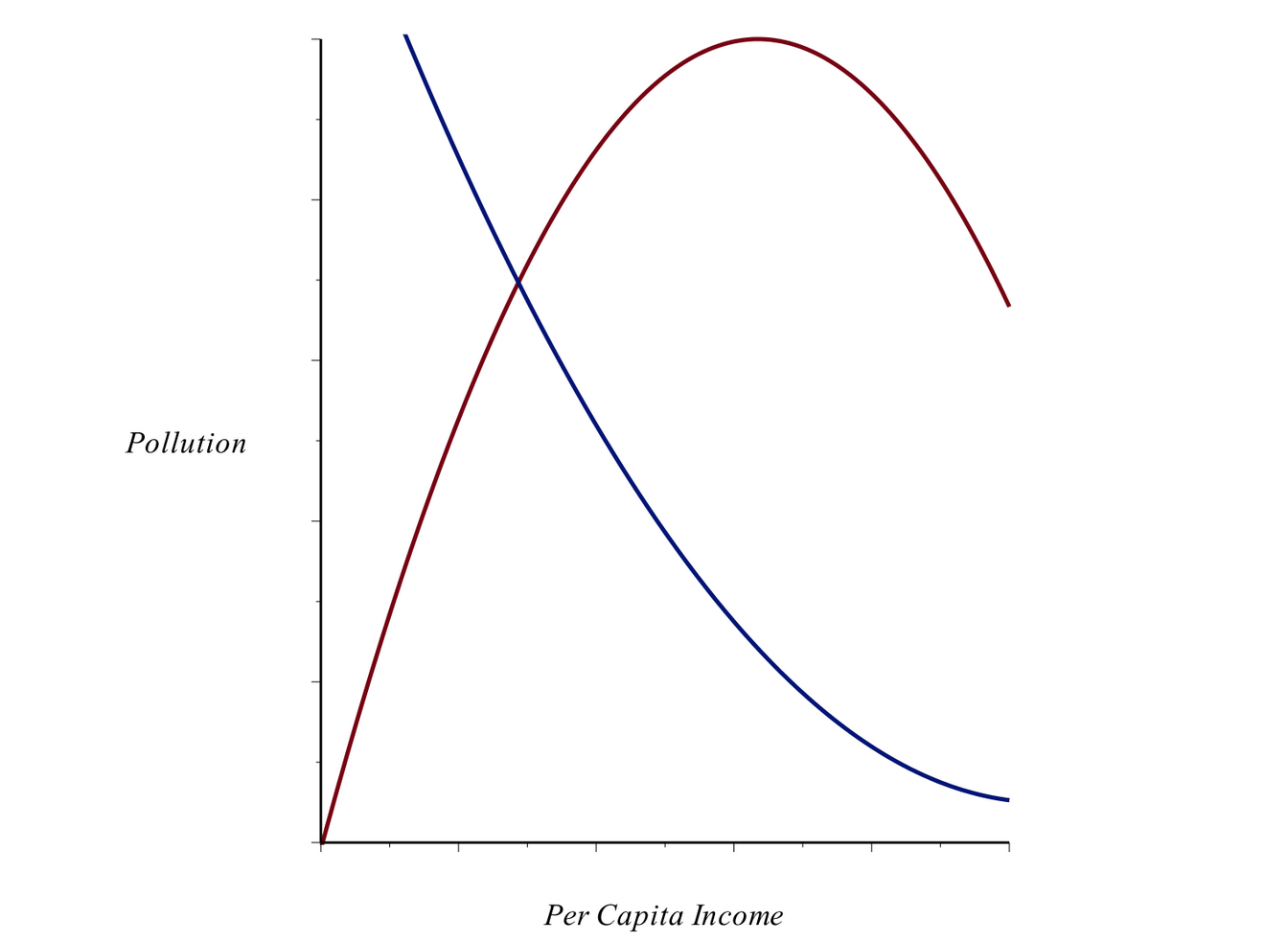
Nevertheless, even if we stipulate that carbon emissions must be reduced, there is an innocuous alternative to government regulatory intrusions and taxes for achieving that end: the enhanced carbon efficiency and technological innovation that economic growth makes possible. One of my favorite bloggers, economist Don Boudreaux, explains the logic of this alternative in this excellent post: “Economic Growth and Pollution Abatement“. He takes a “broad view” of pollution, not simply carbon or other industrial pollutants, because there are many forms of “natural” pollution that inflict greater misery than carbon ever will. With that in mind, Boudreaux appeals to the following relationships between pollution and income (or production):

Pollution Chart

Here is his description of the chart:

“The red curve in the nearby graph is the standard environmental Kuznets curve. This red curve shows the relationship between per-capita income and industrial pollutants. The blue curve shows the relationship between per-capita income and what we might, as a short-hand, call “naturally occurring pollutants” (that is, filth such as bacteria, mud on indoor floors, and rodent and bird droppings from the ceiling of one’s home).“

The red curve implies that a cleaner environment is a “luxury good”. I would also point out that the ascent of the red line at relatively low income levels will be muted by the substitution of cleaner fuels for primitive forms such as dung- and wood-burning, often burned indoors. This is consistent with Boudreaux’s point, though in a way that is not directly addressed by his explanation of the chart:

“… my hypothesis – which I believe is borne out by the historical record – is that people almost immediately start to consume greater cleanliness as they become wealthier.“

The combination of the two lines in the chart shows that economic growth is not unambiguously “bad” for the environment. It has certainly proven to be a good thing in terms of human health and welfare. As a consequence, developing countries should not be so foolish as to sacrifice economic growth for immediate carbon reductions. On the other hand, they may well make “promises” in exchange for massive compensation.

Neither should the world be singularly focused on immediate carbon reductions, because economic growth will be accompanied by improvements in carbon efficiency and the development of technologies far superior to today’s wasteful renewables. The activists attending COP 21 hope to improve the world, but they would saddle humanity with unnecessary burdens. I pity the denizens of countries whose leaders force costly authoritarian energy policies upon them in an effort to set, or comply with, a radical agenda. Oh, wait, that might be us! But I am optimistic that any agreement reached in Paris, if there is any, won’t hold or won’t matter.

Proof of Concept: School Choice vs. Failing Publics

09 Monday Nov 2015

Posted by Nuetzel in Education, School Choice

≈ 1 Comment

Tags

Administrative Costs, CATO Institute, Don Boudreaux, Monopoly Schools, Monopsonist Unions, Rural Education, School Choice, Show-Me Institute, Specialization, Teachers Unions, The Netherlands

School Vouchers2

The evidence that school choice is associated with better educational outcomes has been mounting. Given the poor performance of so many public schools, it is time to reject the “sanctity” of their monopoly privilege. The link above emphasizes the promise of choice as a reform for public schools in the U.S. (as do several other links below from the Show-Me Institute and elsewhere).

It is implausible to suggest that the opportunities afforded by choice could make things worse than public-school outcomes. Poorly-served students and families have too much to gain from broadening their educational options and they know it. A recent survey of African-American parents of school children found that more than 75% of the respondents were interested “in obtaining a voucher to cover the cost of private or parochial school tuition for [their] children“. A majority agreed that:

“… I should be able to enroll my child in the school I think will give my child the best educational opportunity. If my choice is a private or parochial school then I should be allowed to use the same tax dollars allotted to every child in public school to cover the cost of their tuition.“

Choice should not be viewed as a threat to the public school system, although that is a familiar narrative issued by school-choice opponents. In fact, it will create new opportunities for public schools to excel, taking advantage of the benefits of specialization that are well-known in most walks of life. Choice and competition will either reform or weed-out the worst-performing schools and will encourage a rationalization of the administrative bloat so characteristic of public institutions. That’s all to the good, but by weakening schools’ market power, choice will change the relationships between public schools and families. Apparently that is threatening to vested interests, which underscores the importance of reform.

The Netherlands has had a system of school vouchers in place for almost 100 years, and research indicates that it has been highly successful:

“Specifically, access to private schooling has helped Dutch students. A 2013 study reveal[ed] strong positive effects for students using the voucher program to attend private schools. The effects were anywhere between 0.2 and 0.3 standard deviations, which would move a student at the mean of the standard bell curve of student performance up 10 or so percentile points (from a 50 to a 60).

Given these large effects, it shouldn’t be surprising that in a system where two thirds of the schools are private, we see strong academic performance. What’s more, according to the National Center on Education Statistics, Dutch schools spend on average $1,500 less per student per year than American schools do.“

A recent study from the CATO Institute demonstrated the long-run impacts of school choice on several types of outcomes. Little wonder that choice is described as a “Moral and Financial Imperative” (video). School choice is also an option for providing better educations to students in rural areas, despite the worn-out argument that distances make it impossible. Under today’s archaic structure, course offerings at many rural schools are necessarily limited, but new technology and choice programs can allow those schools to specialize and give their local students broader access to educational resources.

Teacher’s unions have been consistent opponents of school choice. They view choice as a threat to their members’ job security and their own ability to negotiate favorable contract terms. Perhaps, but the goal of improving educational outcomes cannot be subjugated to the goals of union monopsonists. When it comes to education, the schools should focus on serving children and their parents, and parents in failing schools want the kind of solution choice can offer.

Several months ago, a post here on Sacred Cow Chips discussed an entertaining question posed by Don Boudreaux: What if supermarkets were like public schools? To quote Boudreaux directly:

“In the face of calls for supermarket choice, supermarket-workers unions would use their significant resources for lobbying—in favor of public-supermarkets’ monopoly power and against any suggestion that market forces are appropriate for delivering something as essential as groceries.“

Parental control is a critical change needed in our schools. Schools should never be placed in a position exceeding the authority of parents over their children, even if public funds are involved. Teachers and administrators of public schools must learn to treat parents like customers. The only way to assure that kind of responsiveness is to give parents a choice.

Francis Pontiff-icates In His Fallible Zone

24 Thursday Sep 2015

Posted by Nuetzel in Capitalism, Global Warming, Poverty, Socialism

≈ Leave a comment

Tags

Anti-Capitalism, Bono and Capitalism, Cafe Hayek, Don Boudreaux, economic growth, Karl Marx, Matters of Faith, Opiate of the Masses, Papal infallibility, Pope Francis, Raul Castro, Reason.com, Stephanie Slade, World Poverty

Francis Politics

Pope Francis dispenses guidance in matters of faith from his heart. In matters of economics and science, his guidance doesn’t come from a well-informed mind. I’ve devoted two posts to Francis’ political follies this year: “Green Hubris: The Flub of Rome“, and “Francis’ Statist Vision Not Shared By Venezuelan Clergy“. While foreswearing ideology in the pulpit, he nevertheless promotes leftist economic ideology and denigrates capitalism, the single-best form of social organization for lifting mankind from privation. He ignores mountains of evidence demonstrating that his hopes for humanity are best served by free markets and liberty. Francis further confuses the issue of church teachings versus personal ideology by claiming that his views are longstanding views of the Church.

A dark theory of the Pope’s anti-capitalist rhetoric occurred to me. It has to do with an ecclesiastical variant on statism: just as statist elites like President Obama seem to prefer widespread dependence on the state, so too does the Pope wish for widespread dependence on the Church for spiritual nourishment. Karl Marx is often quoted as having said “Religion is the opiate of the masses.” However, the full quote is the following:

“Religion is the sigh of the oppressed creature, the heart of a heartless world, and the soul of soulless conditions. It is the opium of the people.“

Perhaps the Pope understands this all too well. An impoverished world may well be a more pious world, and his condemnation of capitalism might help to lead us there. Is such an ulterior motive too Machiavellian to describe the kind-hearted pontiff? Probably. Perhaps the Devil made me think of it!

Like most on the Left, the Pope does the world’s poor no favor by way of blindly accepting the global warmist agenda, which is based on a hypothesis “proven” only in the sense that a certain class of climate models predict a directional outcome. Those models have accumulated a long track record of bad forecasts. Not only that: the surface temperature records reported by U.S. Government agencies and the media as “evidence” of global warming are not supported by satellite records, and trends have been heavily manipulated via downward adjustments to past temperatures. But even if we stipulate that the carbon-forcing models and the surface temperature records are correct, there are major questions regarding the severity of the outcome and whether it poses a two-sided risk to human welfare. Mediation of this hypothetical risk is extremely costly, requiring diversion of vast quantities of resources, and that takes a real human toll. This is why the policy prescriptions of the warmist community lack internal consistency. For example, they wish to restrict power production from fossil fuels in the developing world, forcing populations to deforest and rely on unhealthy wood burning — indoors! — to meet basic needs like heating and cooking.

Here is the full text of a letter from Don Boudreaux to the Washington Post:

“On the opening page of your website today you ask readers to register their agreement or disagreement with this statement of Pope Francis: ‘This is our sin: Exploiting the Earth and not allowing her to give us what she has within her.’

This claim is laughable. History testifies unmistakably that the earth is extremely stingy in volunteering to humans ‘what she has within her.’ Indeed, what the earth has within her are mere raw materials, by themselves useless unless and until human creativity discovers not only how to transform them into actual resources and outputs that improve human well-being (Ever try fueling your jet with crude oil?) but also how to ‘exploit’ the earth so that she releases her materials to us at a reasonable cost.

The Pope is vocal about helping the world’s poor. I believe that he’s sincere. So I sincerely hope that he comes to realize that the greatest sin of all against humanity would be the suppression of those capitalist institutions that have proven to be the only practical means of transforming what the earth has within her into a bounty of goods and services that allows the masses, for the first time in history, to live lives of material abundance and dignity upon her.“

A few of the comments that follow Boudreaux’s post on Cafe Hayek are good, too.

Stephanie Slade has an excellent piece in Reason entitled “If Pope Francis Wants to Help the Poor, He Should Embrace Capitalism“. Here are some samples addressing the power of markets and capitalism to improve human welfare and eradicate poverty:

“Pope Francis thinks free marketeers have been deluded by a ‘myth of unlimited material progress.’ If we have, it’s because we’ve seen for ourselves the wonders that economic development and technological advancement can bring—from modern medicine stopping diseases that were the scourge of civilizations for centuries, to buildings more able to withstand natural disasters than at any time before, to ever-widening access to the air conditioning he wishes us to use less of.“

“‘Entrepreneurial capitalism takes more people out of poverty than aid.’ With those 10 words, spoken to an audience at Georgetown University in 2013, philanthropist rock star Bono demonstrated a keener understanding of economic reality than the leader of global Catholicism.

The U2 frontman clearly has it right—and Pope Francis is wrong to suggest that poverty is growing, or that capitalism, free markets, and globalization are fueling the (non-existent) problem. In just two decades, extreme poverty has been reduced by more than 50 percent. ‘In 1990, almost half of the population in developing regions lived on less than $1.25 a day,’ reads a 2014 report from the United Nations. ‘This rate dropped to 22 per cent by 2010, reducing the number of people living in extreme poverty by 700 million.’

How was this secular miracle achieved? The bulk of the answer is through economic development, as nascent markets began to take hold in large swaths of the world that were until recently desperately poor. A 2013 editorial from The Economist noted that… ‘Most of the credit… must go to capitalism and free trade, for they enable economies to grow—and it was growth, principally, that has eased destitution.’“

As Slade explains, far from a scourge on the environment, capitalism is and has been a great blessing:

“Both the economics and the history are clear: The more prosperous the developing world becomes, the more it too will be able to demand and achieve livable conditions. If your goal is to move the world to concern for the preservation of biodiversity, the answer is economic growth. If you want to increase access to clean water, the solution is to increase global wealth, and the consumer power that comes with it. Studies have shown that deforestation reverses when a country’s annual GDP reaches about $3,000 per capita. While some environmental indicators do get worse during the early stages of industrialization, the widely accepted Environmental Kuznets Curve hypothesis convincingly argues that they quickly reverse themselves when national income grows beyond a certain threshold. If the pope wants a cleaner world, the best way to get there is by creating a richer world—something Pope Francis’ own policy recommendations will make more difficult.“

A theme in Slade’s essay is that Francis is simply confused. On one level, he seems to know that technological advance is of great benefit to mankind, yet he is extremely wary of economic growth and believes that less production and consumption is better. That would make the job of alleviating conditions for the world’s poor much more challenging, if not impossible! He acknowledges that the environment has improved drastically in some parts of the world, but he seems unaware that the same areas are the most economically developed, and have the most well-developed markets. Like most on the Left, he also seems confused about the real meaning of capitalism. And the Pope “often blurs the line between public and private action.”

Slade concludes with some messages for Catholics. First, the Pope’s opinions on matters of faith are said to be infallible, according to Catholic doctrine. But opinions on topics like capitalism and the environment are outside his sphere of infallibility. Second, Slade is rightly offended by the Pope’s attitude that libertarianism and a belief in the efficacy of free markets is not compatible with Christianity.

Thus far during the Pope’s visit to Cuba and the U.S., he has thrilled the murderous Castro brothers and spoken out in favor of Obama’s climate agenda. Raul Castro is so happy about the Pope’s opinions on capitalism “that he might ‘start praying again’ and rejoin the church“. I truly hope that members of the Catholic flock, or any others,  don’t take the Pope’s political exhortations too seriously.

Public Monopolists Say “Don’t Be Choosy”

12 Sunday Jul 2015

Posted by Nuetzel in Markets, School Choice

≈ 3 Comments

Tags

Cafe Hayek, Don Boudreaux, K-12 education, monopoly, Politicized interests, Private education, Public education, Redistribution, Restraint of Trade, School Choice

choice better schools

Imagine a food distribution system that mirrored the organization of K-12 education in the U.S. How do you think it would work out? That thought exercise was conducted four years ago by Don Boudreaux in his Wall Street Journal op-ed: “If Supermarkets Were Like Public Schools”(gated). Boudreaux has helpfully reblogged this op-ed at Cafe Hayek as part of his post “Separate School From State“. Read the whole thing! Because this is a topic in economics and I am so very pedantic, I prefer not to use the term “market” at all in this context. After all, a public “supermarket”, as discussed by Boudreaux, is no more a market than a public school is a market. I will use the term “public grocery store” instead, except when quoting Boudreaux.

The comparison of grocery stores to schools involves outputs that are both considered essential. In fact, there should be no argument that food is the more essential of the two. Yet the essential nature of educating children in a modern society is thought to be an important rationale for the existence of a public school system. Would supporters of public education care to apply the argument that “market forces can’t supply quality education” to another essential product, like food?

Boudreaux invokes several features of K-12 education in “designing” his hypothetical food distribution system:

  • “Residents of each county would pay taxes on their properties.“
  • “Each family would be assigned to a particular supermarket according to its home address. And each family would get its weekly allotment of groceries—’for free’—from its neighborhood public supermarket.“
  • “No family would be permitted to get groceries from a public supermarket outside of its district.“
  • “... families would be free to shop at private supermarkets that charge directly for the groceries they offer. Private-supermarket families, however, would receive no reductions in their property taxes.“

Economic theory predicts that the monopoly status held by public grocery stores over the provision of “free food” within their districts would cause the quality and variety offered at those stores to suffer. This is just a form of restraining trade, which is what monopolists do. The classic monopolist charges a higher price and produces less output. Exactly the same is predicted in Boudreaux’s experiment.

One difference in comparing food stores to schools is that families, presumably, could purchase some of their groceries from private stores and meet the rest of their food needs from their district grocery store at no marginal cost, whereas the school selection is all public or all private. However, this does not invalidate Boudreaux’s assertion that the quality offered by the monopoly provider will suffer.

Like public schools, there would be massive variations in quality across public grocery stores due to variation in the tax base from one district to another. This would tend to reinforce differences in the value of property across districts, because it is so desirable to live in a district with a good public grocery.

Here’s an extended excerpt from Boudreaux:

“Being largely protected from consumer choice, almost all public supermarkets would be worse than private ones. In poor counties the quality of public supermarkets would be downright abysmal. ….

Responding to these failures, thoughtful souls would call for ‘supermarket choice’ fueled by vouchers or tax credits. Those calls would be vigorously opposed by public-supermarket administrators and workers.

Opponents of supermarket choice would accuse its proponents of demonizing supermarket workers (who, after all, have no control over their customers’ poor eating habits at home). Advocates of choice would also be accused of trying to deny ordinary families the food needed for survival. Such choice, it would be alleged, would drain precious resources from public supermarkets whose poor performance testifies to their overwhelming need for more public funds.

As for the handful of radicals who call for total separation of supermarket and state—well, they would be criticized by almost everyone as antisocial devils indifferent to the starvation that would haunt the land if the provision of groceries were governed exclusively by private market forces.

In the face of calls for supermarket choice, supermarket-workers unions would use their significant resources for lobbying—in favor of public-supermarkets’ monopoly power and against any suggestion that market forces are appropriate for delivering something as essential as groceries.“

That sounds all too familiar. Even with massive state redistribution of public grocery store funding from wealthy to poor districts, the result would be much the same, as it is with public schools. Increased grocery store funding cannot correct the larger problems plaguing the community, many of which are created by the welfare state itself. And increased funding does not correct fundamental dislocations created by a monopoly, especially a public monopoly. The entrenched, politicized interests that infest public institutions always resist changes that might improve quality. They are typified by bloated administrative machinery and a general lack of responsiveness to the community. Only competition and choice can eliminate these tendencies and drive improvement.

An objection that might be raised to Boudreaux’s comparison is that public schools must accommodate a student population with wide variations in learning ability. It may be claimed that this variation strains the resources of public relative to private schools. However, that burden is due in large part to the structure of the education system. A benefit of competition and choice is the extent to which it can accommodate diverse needs, and there is no reason why education should prove to be an exception. In fact, diverse needs are already met very well by private education, but they serve only “private school families.” Empowering all families to choose the schools that best accommodate their needs would bring higher quality to our K-12 education system.

Should Foreign Goods Be Pricey?

18 Thursday Jun 2015

Posted by Nuetzel in Free Trade

≈ Leave a comment

Tags

Caroline Baum, Don Boudreaux, Fast Track Authority, Free trade, Intellectual Property Rights, Mercantilism, Protectionism, Trade Promotion Authority, Trans-Pacific Partnership

barriers-to-trade-us

Even ardent supporters of the Pacific trade deal get one thing wrong consistently: promoting free trade is not so much about domestic producers, jobs and export promotion as it is about consumers, prices and improved access to imports. The latter are the real rewards of trade, while the former are more appropriately viewed as payments. This was the subject of “Free Trade Lets You Make a Deal” on Sacred Cow Chips in April., in which I quoted Greg Mankiw:

“A nation benefits from imports, [Adam Smith] argued, because they expand its opportunities for consumption. Exports are necessary only because other nations have the temerity to want to be paid for the goods they provide.“

Free trade is a process of exploiting exchanges that are mutually beneficial, but based on the commentary in the press and social media, one would think it was something harmful. You could hardly blame anyone from drawing that impression based on the way governments negotiate trade deals. Last month, Don Boudreaux had a humorous take on this in “If Buying A Car Were Like Negotiating A Trade Deal“. The parties just can’t tolerate a better deal!

To draw another analogy, when IKEA opens a store in a new town, consumers are excited about the goods available there, and about the new shopping experience. When the circus comes to town, people are thrilled by the “imported” entertainment. They are not especially antagonized about the extra spending this might entail, or the extra hours they might have to work in order to afford it. Of course, the cheaper, the better. Yet when it comes to foreign trade, the general commentary turns this logic on its head: you’d think our concerns centered around a desire for more expense and that our access to new goods is a nuisance!

Opposition to trade deals among progressives is based on classic protectionist sentiment. This usually ends in protecting rents earned by interests that would rather not face competition. Nothing could be more corporatist in its effect. But it is obviously counter-productive to argue in support of industries that cannot compete internationally, so opponents retreat to accusations that trading partners cheat by selling below cost or manipulating their currencies. If so, those policies represent gifts to the U.S. It would be wonderful for the country if the flow of gifts from abroad continued indefinitely, but that is not sustainable. As matters are rationalized over time, and they will be, opportunities will present themselves to U.S. producers, who may well be in better stead by virtue of the earlier gifts from abroad. Don’t look a gift horse in the mouth by favoring domestic rent seekers.

Like Boudreaux, I support trade deals like the Trans-Pacific Partnership (TPP) “with my nose held tightly“. Deals like this generally do reduce trade barriers, though they invariably involve politically-motivated nonsense like the imposition of cross-country rules and regulations that negate some of the economic gains.

Caroline Baum has a good summary of legislation related to the TPP, which involves the president’s “fast-track” negotiating authority as well as assistance to “workers who are adversely affected by a trade agreement“. The trade deal, fast track and trade assistance have created strange political bedfellows and estrangements. Baum notes the confusion surrounding the real benefits of trade from fast track’s biggest proponent:

“Obama’s entire trade pitch – ‘the more we sell abroad, the more jobs we create at home’ – is a thinly disguised mercantilist argument: the idea that a country can export its way to prosperity. It’s a mistake to think that the advantages of free trade are limited to the export side.“

Some otherwise strong supporters of free trade are opposed to granting Obama fast-track authority, despite the fact that the last six presidents have had that authority. I am as skeptical about Obama’s leadership and negotiating skills as anyone, and I have little faith that he would keep sight of the main objective, were he actually sitting at the negotiating table. That would be lower trade barriers, not the environment or any other intrusion into the domestic policies of other parties to the deal. If our domestic regulatory standards are tougher or involve greater expense than those abroad, that should be afforded by greater U.S. productivity, not by making our producers uncompetitive on international markets. And if that is the case, our standards should be reassessed, we should recognize the prohibitive impact that our standards could have on the costs of our trading partners, and we should hope for those partners to eliminate any additional barriers to our goods.

I am also opposed to making the trade deal hinge on the extension of tougher intellectual property (IP) rights to poor Asian nations, though that is certain to be part of the negotiations.  There is disagreement among economists about whether such an extension of IP rights would be good or bad.

I would like to see Congress grant Obama fast-track authority, but only because Congress will still have the authority to approve or reject a final deal. The promise of reductions in trade barriers is unequivocally positive. We’ll have to evaluate the downside when the deal goes before Congress.

Major Mistake: The Minimum Opportunity Wage

06 Saturday Jun 2015

Posted by Nuetzel in Price Controls

≈ 1 Comment

Tags

Alan Krueger, Brian Doherty, competition, Coyote Blog, David Card, Don Boudreaux, Economic justice, Fast food robots, Mark Perry, Minimum Wage, Monopsony, Reason Magazine, Rise of the Machines, Robert Reich, Robot replacements, Show-Me Institute, Steve Chapman, Substitutability, Tim Worstall, Unintended Consequences, Wage compression, Warren Meyer

government-problem

City leaders in St. Louis and Kansas City are the latest to fantasize that market manipulation can serve as a pathway to “economic justice”. They want to raise the local minimum wage to $15 by 2020, following similar actions in Los Angeles, Oakland  and Seattle. They will harm the lowest-skilled workers in these cities, not to mention local businesses, their own local economies and their own city budgets. Like many populists on the national level with a challenged understanding of market forces (such as Robert Reich), these politicians won’t recognize the evidence when it comes in. If they do, they won’t find it politically expedient to own up to it. A more cynical view is that the hike’s gradual phase-in may be a deliberate attempt to conceal its negative consequences.

There are many reasons to oppose a higher minimum wage, or any minimum wage for that matter. Prices (including wages) are rich with information about demand conditions and scarcity. They provide signals for owners and users of resources that guide them toward the best decisions. Price controls, such as a wage floor like the minimum wage, short-circuit those signals and are notorious for their disastrous unintended (but very predictable) consequences. Steve Chapman at Reason Magazine discusses the mechanics of such distortions here.

Supporters of a higher minimum wage usually fail to recognize the relationship between wages and worker productivity. That connection is why the imposition of a wage floor leads to a surplus of low-skilled labor. Those with the least skills and experience are the most likely to lose their jobs, work fewer hours or not be hired. In another Reason article, Brian Doherty explains that this is a thorny problem for charities providing transitional employment to workers with low-skills or employability. He also notes the following:

“All sorts of jobs have elements of learning or training, especially at the entry level. Merely having a job at all can have value down the line worth enormously more than the wage you are currently earning in terms of a proven track record of reliable employability or moving up within a particular organization.“

The negative employment effects of a higher wage floor are greater if the employer cannot easily pass higher costs along to customers. That’s why firms in highly competitive markets (and their workers) are more vulnerable. This detriment is all the worse when a higher wage floor is imposed within a single jurisdiction, such as the city of St. Louis. Bordering municipalities stand to benefit from the distorted wage levels in the city, but the net effect will be worse than a wash for the region, as adjustments to the new, artificial conditions are not costless. Again, it is likely that the least capable workers and least resourceful firms will be harmed the most.

The negative effects of a higher wage floor are also greater when substitutes for low-skilled labor are available. Here is a video on the robot solution for fast food order-taking. In fact, today there are robots capable of preparing meals, mopping floors, and performing a variety of other menial tasks. Alternatively, more experienced workers may be asked to perform more menial tasks or work longer hours. Either way, the employer takes a hit. Ultimately, the best alternative for some firms will be to close.

The impact of the higher minimum on the wage rates of more skilled workers is likely to be muted. A correspondent of mine mentioned the consequences of wage compression. From the link:

“In some cases, compression (or inequity) increases the risk of a fight or flee phenomonon [sic]–disgruntlement culminating in union organizing campaigns or, in the case of flee, higher turnover as the result of employees quitting. … all too often, companies are forced to address the problem by adjusting their entire compensation systems–usually upward and across-the-board. .. While wage adjustments may sound good for those who do not have to worry about profits and losses, the real impact for a company typically means it must either increase productivity or lay people off.“

For those who doubt the impact of the minimum wage hike on employment decisions, consider this calculation by Mark Perry:

“The pending 67% minimum wage hike in LA (from $9 to $15 per hour by 2020), which is the same as a $6 per hour tax (or $12,480 annual tax per full-time employee and more like $13,500 per year with increased employer payroll taxes…)….“

Don Boudreaux offers another interesting perspective, asking whether a change in the way the minimum wage is enforced might influence opinion:

“... if these policies were enforced by police officers monitoring workers and fining those workers who agreed to work at hourly wages below the legislated minimum – would you still support minimum wages?“

Proponents of a higher minimum wage often cite a study from 1994 by David Card and Alan Krueger purporting to show that a higher minimum wage in New Jersey actually increased employment in the fast food industry. Tim Worstall at Forbes discussed a severe shortcoming of the Card/Krueger study (HT: Don Boudreaux): Card and Krueger failed to include more labor-intensive independent operators in their analysis, instead focusing exclusively on employment at fast-food chain franchises. The latter were likely to benefit from the failure of independent competitors.

Another common argument put forward by supporters of higher minimum wages is that economic theory predicts positive employment effects if employers have monopsony power in hiring labor, or power to influence the market wage. This is a stretch: it describes labor market conditions in very few localities. Of course, any employer in an unregulated market is free to offer noncompetitive wages, but they will suffer the consequences of taking less skilled and less experienced hires, higher labor turnover and ultimately a competitive disadvantage. Such forces lead rational employers to offer competitive wages for the skills levels they require.

Minimum wages are also defended as an anti-poverty program, but this is a weak argument. A recent post at Coyote Blog explains “Why Minimum Wage Increases are a Terrible Anti-Poverty Program“. Among other points:

“Most minimum wage earners are not poor. The vast majority of minimum wage jobs are held as second jobs or held by second earners in a household or by the kids of affluent households. …

Most people in poverty don’t make the minimum wage. In fact, the typically [sic] hourly income of the poor appears to be around $14 an hour. The problem is not the hourly rate, the problem is the availability of work. The poor are poor because they don’t get enough job hours. …

Many young workers or poor workers with a spotty work record need to build a reliable work history to get better work in the future…. Further, many folks without much experience in the job market are missing critical skills — by these I am not talking about sophisticated things like CNC machine tool programming. I am referring to prosaic skills you likely take for granted (check your privilege!) such as showing up reliably each day for work, overcoming the typical frictions of working with diverse teammates, and working to achieve management-set goals via a defined process.”

Some of the same issues are highlighted by the Show-Me Institute, a Missouri think tank, in “Minimum Wage Increases Not Effective at Fighting Poverty“.

A higher minimum wage is one of those proposals that “sound good” to the progressive mind, but are counter-productive in the extreme. The cities of St. Louis and Kansas City would do well to avoid market manipulation that is likely to backfire.

Immigration and Reverse Discrimination

09 Thursday Apr 2015

Posted by Nuetzel in Immigration

≈ Leave a comment

Tags

Affirmative Action, Alex Tabarrok, Civil Rights Act of 1964, discrimination, Don Boudreaux, Immigration and employment, Immigration and Equality, New York Times Magazine, Nicholas Rosenkranz, Obama immigration order, Protected status

Affirmative Action

Conflicts between anti-discrimination law and presumptive constitutional rights were discussed Monday’s SCC post. Another avenue for such conflicts is when anti-discrimination efforts interact with other policies to foster a perverse spiral of encroachments upon presumed rights. In a post entitled “Immigration and Equality“, Nicholas Rosenkranz asserts that affirmative action programs not only discriminate unfairly against “unprotected classes”, but that their interplay with an open-borders immigration policy makes these reverse discriminatory effects far more pernicious.

I favor a liberalized immigration policy, provided that it is accompanied by security at entry to ensure health and public safety, and without subsidizing either potential employers or the immigrants themselves (except perhaps for short-term settlement assistance). Most critics of liberalized immigration focus on negative employment and wage impacts for established residents, but this piece in The New York Times Magazine debunks that notion. Alex Tabarroc adds some great points on the subject here. In essence, the evidence suggests that the short-run economic impact of immigration is not negative, and the long-run impact is unambiguously positive. The always passionate Don Boudreaux makes a case for liberalized immigration, and he is skeptical of the assertion that immigrants, once endowed with voting rights, will always support statist policies.

Yet as Rosencranz argues, affirmative action policies may attract flows of immigrants to the U.S. that are not supported by the labor market and general economic conditions. In this view, the contention that immigration is an always beneficial flow of productive resources is erroneous. Instead, the policy may attract an excess supply of immigrant labor that truly would undermine wages and employment for established workers. It could also give rise to other negative consequences such as skewed college admission decisions.

Federal anti-discrimination law has roots of varying depth in a few different parts of the Constitution, but the “protected status” conferred to specific classes or minorities is statutory, based on several federal laws, beginning with the Civil Rights Act of 1964. Government and private affirmative action programs favor hiring or advancement of members of protected classes to eliminate discrimination against them, or as a form of reparation for past discrimination. Rosenkranz has this to say about these programs:

“American law and policy will discriminate in favor of most immigrants — those of favored races such as blacks and Hispanics — and their children, and their children’s children. Correspondingly, American law and policy will discriminate against Americans of disfavored races — Asian Americans, Indian Americans, Caucasian Americans — and their children, and their children’s children.”

Rosenkranz believes this creates a “natural bargain”, a political compromise involving immigration reform in exchange for an end to government affirmative action programs, which have institutionalized “discrimination on the basis of race“:

“Democrats believe that immigration is a winning political issue for them; they believe that it makes them look compassionate while it makes Republicans look churlish. Affirmative action, on the other hand, is a political winner for Republicans; polls overwhelmingly oppose it, and it allows Republicans to argue for the ringing principle of equality under law, while Democrats are left to defend the status quo of institutional discrimination and racial spoils.”

I seriously doubt that such a compromise can be reached, but it’s a nice idea.

On a related note, the federal judge who placed a hold on President Obama’s immigration order has denied the administration’s request to lift the hold, and in rather dramatic fashion.

Peak-Resource Myopia Serves the State

08 Sunday Feb 2015

Posted by Nuetzel in Peak Oil

≈ Leave a comment

Tags

David Henderson, Don Boudreaux, Government Failure, Michael Lynch, Peak Oil, Scarcity, Thomas Malthus, William Jevons

smith-marx-schumpeter-keynes We often hear we’re at the “peak” availability of some resource, but what’s really meant is that we’re at a cliff’s edge, about to run dry. These claims are usually uninformed and have been wrong historically. Of course, scarcity is real; it’s why I do economics and love markets, which solve the problem of scarcity through voluntary, arms length cooperation in balancing needs and wants with the availability of resources. But scarcity at any point in time rarely implies anything about the availability of resources going forward. Current knowledge and conditions, and existing technology for extracting and utilizing resources, provide signals about opportunities; they should not dominate our outlook for the future in a dynamic economy.

The view that the availability of resources is subject to hard limits, or that they will “run out”, is discussed by David Henderson in his post “The Jevons Fallacy,” regarding the “peak” views often credited to economist William Jevons. Henderson quotes his own bio of Jevons:

“Jevons failed to appreciate the fact that as the price of an energy source rises, entrepreneurs have a strong incentive to invent, develop, and produce alternate sources. In particular, he did not anticipate oil or natural gas. Also, he did not take account of the incentive, as the price of coal rose, to use it more efficiently or to develop technology that brought down the cost of discovering and mining (see natural resources).”

Don Boudreaux has a few thoughts on Henderson’s post and the topic of scarcity, emphasizing the contribution of human ingenuity to the supply of resources:

“Atoms are created and made into matter by the impersonal forces of nature (or, if you are a theist, by God). In contrast, matter is made into resources only by human creativity, especially when this creativity is unleashed and directed by markets. So more humans – and more markets – quite realistically (and, so far, historically) mean an increasing, not a decreasing, supply of resources.”

A 2005 post at the humansunderrated blog made the same point: “Only one resource truly matters and that is the human mind.” And the human mind, guided by market signals, is what ultimately solves the problem of scarcity. It does not get solved when human initiative is shackled by regulation, insecure property rights, or protected monopoly interests, which are all varieties of government failure.

In “Peak Nonsense,” Michael Lynch concurs:

“And so here we go again on the trial of exhaustion theory, one step removed from the scientism of central planning where decline rates are projected and a social cost of depletion is calculated for an extraction tax. But it is all bad science. ”

There is no end to scarcity. It will always be with us, but we have not reached peak oil, peak fossil fuels, peak food, or peak anything. The dreary viewpoint credited to Jevons and Thomas Malthus is misguided as long as people remain free to engage in voluntary production and trade. The “peak” perspective serves the interest of statists who’d prefer to impose arbitrary limits on our productive potential.

← Older posts
Newer posts →
Follow Sacred Cow Chips on WordPress.com

Recent Posts

  • The Coexistence of Labor and AI-Augmented Capital
  • The Case Against Interest On Reserves
  • Immigration and Merit As Fiscal Propositions
  • Tariff “Dividend” From An Indigent State
  • Almost Looks Like the Fed Has a 3% Inflation Target

Archives

  • January 2026
  • December 2025
  • November 2025
  • October 2025
  • September 2025
  • August 2025
  • July 2025
  • June 2025
  • May 2025
  • April 2025
  • March 2025
  • February 2025
  • January 2025
  • December 2024
  • November 2024
  • October 2024
  • September 2024
  • August 2024
  • July 2024
  • June 2024
  • May 2024
  • April 2024
  • March 2024
  • February 2024
  • January 2024
  • December 2023
  • November 2023
  • August 2023
  • July 2023
  • June 2023
  • May 2023
  • April 2023
  • March 2023
  • February 2023
  • January 2023
  • December 2022
  • November 2022
  • October 2022
  • September 2022
  • August 2022
  • July 2022
  • June 2022
  • May 2022
  • April 2022
  • March 2022
  • February 2022
  • January 2022
  • December 2021
  • November 2021
  • October 2021
  • September 2021
  • August 2021
  • July 2021
  • June 2021
  • May 2021
  • April 2021
  • March 2021
  • February 2021
  • January 2021
  • December 2020
  • November 2020
  • October 2020
  • September 2020
  • August 2020
  • July 2020
  • June 2020
  • May 2020
  • April 2020
  • March 2020
  • February 2020
  • January 2020
  • December 2019
  • November 2019
  • October 2019
  • September 2019
  • August 2019
  • July 2019
  • June 2019
  • May 2019
  • April 2019
  • March 2019
  • February 2019
  • January 2019
  • December 2018
  • November 2018
  • October 2018
  • September 2018
  • August 2018
  • July 2018
  • June 2018
  • May 2018
  • April 2018
  • March 2018
  • February 2018
  • January 2018
  • December 2017
  • November 2017
  • October 2017
  • September 2017
  • August 2017
  • July 2017
  • June 2017
  • May 2017
  • April 2017
  • March 2017
  • February 2017
  • January 2017
  • December 2016
  • November 2016
  • October 2016
  • September 2016
  • August 2016
  • July 2016
  • June 2016
  • May 2016
  • April 2016
  • March 2016
  • February 2016
  • January 2016
  • December 2015
  • November 2015
  • October 2015
  • September 2015
  • August 2015
  • July 2015
  • June 2015
  • May 2015
  • April 2015
  • March 2015
  • February 2015
  • January 2015
  • December 2014
  • November 2014
  • October 2014
  • September 2014
  • August 2014
  • July 2014
  • June 2014
  • May 2014
  • April 2014
  • March 2014

Blogs I Follow

  • Passive Income Kickstart
  • OnlyFinance.net
  • TLC Cholesterol
  • Nintil
  • kendunning.net
  • DCWhispers.com
  • Hoong-Wai in the UK
  • Marginal REVOLUTION
  • Stlouis
  • Watts Up With That?
  • Aussie Nationalist Blog
  • American Elephants
  • The View from Alexandria
  • The Gymnasium
  • A Force for Good
  • Notes On Liberty
  • troymo
  • SUNDAY BLOG Stephanie Sievers
  • Miss Lou Acquiring Lore
  • Your Well Wisher Program
  • Objectivism In Depth
  • RobotEnomics
  • Orderstatistic
  • Paradigm Library
  • Scattered Showers and Quicksand

Blog at WordPress.com.

Passive Income Kickstart

OnlyFinance.net

TLC Cholesterol

Nintil

To estimate, compare, distinguish, discuss, and trace to its principal sources everything

kendunning.net

The Future is Ours to Create

DCWhispers.com

Hoong-Wai in the UK

A Commonwealth immigrant's perspective on the UK's public arena.

Marginal REVOLUTION

Small Steps Toward A Much Better World

Stlouis

Watts Up With That?

The world's most viewed site on global warming and climate change

Aussie Nationalist Blog

Commentary from a Paleoconservative and Nationalist perspective

American Elephants

Defending Life, Liberty and the Pursuit of Happiness

The View from Alexandria

In advanced civilizations the period loosely called Alexandrian is usually associated with flexible morals, perfunctory religion, populist standards and cosmopolitan tastes, feminism, exotic cults, and the rapid turnover of high and low fads---in short, a falling away (which is all that decadence means) from the strictness of traditional rules, embodied in character and inforced from within. -- Jacques Barzun

The Gymnasium

A place for reason, politics, economics, and faith steeped in the classical liberal tradition

A Force for Good

How economics, morality, and markets combine

Notes On Liberty

Spontaneous thoughts on a humble creed

troymo

SUNDAY BLOG Stephanie Sievers

Escaping the everyday life with photographs from my travels

Miss Lou Acquiring Lore

Gallery of Life...

Your Well Wisher Program

Attempt to solve commonly known problems…

Objectivism In Depth

Exploring Ayn Rand's revolutionary philosophy.

RobotEnomics

(A)n (I)ntelligent Future

Orderstatistic

Economics, chess and anything else on my mind.

Paradigm Library

OODA Looping

Scattered Showers and Quicksand

Musings on science, investing, finance, economics, politics, and probably fly fishing.

  • Subscribe Subscribed
    • Sacred Cow Chips
    • Join 128 other subscribers
    • Already have a WordPress.com account? Log in now.
    • Sacred Cow Chips
    • Subscribe Subscribed
    • Sign up
    • Log in
    • Report this content
    • View site in Reader
    • Manage subscriptions
    • Collapse this bar
 

Loading Comments...