• About

Sacred Cow Chips

Sacred Cow Chips

Tag Archives: FDA

Opioids and The War On Pain Treatment

08 Friday Mar 2019

Posted by Nuetzel in Prohibition, War On Drugs

≈ 1 Comment

Tags

Annals of Internal Medicine, CATO Institute, Chronic Pain, Dr. Ted Noel, FDA, Fentanyl, Geraldo Rivera, Heroin, Imported Opioids, Jacob Sullum, Jeffrey Miron, Opioid Addiction, Opioid Deaths, Opioid Prescription, Opioid Production Quotas, OxyContin, PDMPs, Portugal Decriminalization, Prescription Drug Monitoring Programs, Prohibition, Purdue Pharma, Scientific American

I repeatedly hear the bogus claim that prescription pain killers are a primary cause of opioid addiction. Twice this week I heard Geraldo Rivera prattling about it, blaming the drug companies for the opioid epidemic, expressing his view of the righteousness of the many lawsuits faced by Purdue Pharma and other firms. But these cases are hardly sure wins for the plaintiffs, and for good reason. The idea that pharmaceutical companies misleadingly promoted the effectiveness of drugs like Oxycontin for pain relief, and minimized their addictive potential, might appear credible, but there are a number of factors that argue strongly against these claims. Of course, opioids are legal prescription drugs, approved for pain relief by the FDA, and are generally marketed by drug companies under guidelines established by the FDA at the time of approval. And sadly, the narrative promoted by Rivera and many others is at tension with the needs of patients suffering from chronic pain.

In fact, opioids are effective for temporary and chronic pain relief, and they have been used for those purposes for many decades. In “The Other Opioid Problem“, anesthesiologist Dr. Ted Noel asserts that few chronic pain patients have overdosed or been killed by ODs. According to Scientific American:

“A Cochrane review of opioid prescribing for chronic pain found that less than one percent of those who were well-screened for drug problems developed new addictions during pain care; a less rigorous, but more recent review put the rate of addiction among people taking opioids for chronic pain at 8-12 percent [but less than 1% abuse].”

Those prescribed opioids for temporary relief after an injury or surgical procedure are even less likely to develop an addiction. The large majority of addicts are self-selected out of a population of individuals who want to get high. And most of them feed their addictions on opioids obtained illegally, often from imported heroin and fentanyl. Yes, opioids are stolen from legitimate patients, pharmacies, or elsewhere, and sometimes they are prescribed illegally by unscrupulous physicians. That might be the way many addicts get started, but most of the illegal opioid supply in the U.S. is imported heroin and fentanyl.

A causal linkage between opioid prescriptions, addiction and opioid deaths would imply a strong, positive correlation between prescription and death rates. However, Jacob Sullum reports that there is no correlation across states between prescription rates and death rates from opioids. As Sullum notes, this result offers “more reason to doubt that pain pill restrictions will save lives”.

In fact, in a separate article, Sullum writes of other evidence strongly suggesting that those restrictions may have counterproductive effects on opioid deaths, in addition to denying some patients access to the pain pills they legitimately need for treatment. According to Sullum, all 50 states have Prescription Drug Monitoring Programs (PDMPs) that monitor controlled substances and keep tabs on prescribers and pharmacies. These have succeeded in discouraging opioid prescriptions, but research appearing in the Annals of Internal Medicine suggests that the programs might be doing more harm than good:

“Fink et al found six studies that included heroin overdoses, half of which reported a statistically significant association between adoption of PDMPs and increases in such incidents. … To the extent that PDMPs succeed in making pain pills harder to obtain, they encourage nonmedical users to seek black-market substitutes. ‘Changes to either the supply or cost of prescription opioids after a PDMP is instituted,’ Fink et al. observe, ‘might reasonably drive opioid-dependent persons to substitute their preferred prescription opioid with heroin or nonpharmaceutical fentanyl.’

The FDA has enforced quotas on the production of legal opioids. According to the CATO Institute:

“The tight quotas on opioid production contributed to the acute shortage of injectable opioids being felt in hospitals across the nation. It is not only making patients suffer needlessly but places them at increased risk for adverse drug reactions or overdose.”

The FDA’s restrictions were eased somewhat after complaints from the medical community, but the harm continues. At the time of CATO’s report, opioid prescriptions had declined by 41% since 2010, while the overdose rate continued to escalate.

This pattern is all too familiar to those who have been arguing against drug prohibition for years. The flood of fentanyl into the country, and into what is sold as street heroin, is a direct consequence of prohibitions on supplies of legal heroin and other narcotics. But breaking through the puritanical and bumptious mentality of drug warriors is almost impossible. The worse the situation gets, the tighter they turn the screws, doubling down on the policies that have repeatedly failed in the past. Here I repeat the concluding paragraph of a Sacred Cow Chips post from January 2018 on the opioid epidemic:

“There are solutions to the deadly nature of the opioid epidemic, but prohibition is not one of them and never will be. If anything, prohibition in varying degrees has aggravated the dangers of opioids. To truly solve the problem, we should eliminate restrictions on the production and distribution of legal opioids for pain management, legalize heroin, and stop interfering in markets. That would be merciful for patients in real pain, make recreational use of opioids dramatically safer, and put an end to the gangland violence associated with underground competition. Second, redirect those resources into … harm reduction programs. [Jeffrey] Miron notes that legalization has worked in other countries, like Portugal and France, to reduce overdoses and opioid deaths. As a political matter, however, these steps might not be feasible unless we get over the cultural bias stigmatizing recreational opioid use as ‘evil’, and the idea that laws and enforcement can actually prevent people from trying to get high.

Slam the Damn Brakes on the Regulatory Potentate

28 Saturday Oct 2017

Posted by Nuetzel in Regulation

≈ Leave a comment

Tags

Administrative State, Barry Brownstein, Corn Ethanol, crony capitalism, DARPA, Deregulation, Donald Trump, Drug Review, EPA, FCC, FDA, Greg Ip, Industrial Policy, Mercatus Center, NASA, Net Neutrality, Paris Climate Accord, Patrick McLaughlin, Puerto Rico, Renewable Fuel Standards, Steve Bannon, The Brookings Institution, Two-For-One Regulatory Order

The stock market’s recent gains have at least three plausible explanations: corporate earnings growth, the prospect of tax reform, and deregulation. Tax reform and deregulation are stated priorities of the Trump Administration and have the potential to lift the economy and generate additional earnings. Investors obviously like that prospect, though regulation itself is a tool used subversively by crony capitalists to stifle competition in their markets. Conceivably, some of the large firms that dominate major stock indices could suffer from deregulation. And I have to wonder whether the economic threat of Trumpian trade protectionism is not taken seriously by the equity markets. Let’s hope they’re right.

It’s no mystery that high taxes and tax complexity can inhibit economic growth. Let’s face it: when it comes to productive effort, we can all think of better things to do than tax planning, crony capitalist or not. The same is true of regulation: the massive diversion of resources into non-productive compliance activities stifles innovation, growth, and even the stability of the status quo. Regulation creates obstacles to activities like new construction and the diffusion of telecommunications services. And it discourages the creation of new products and services like potentially life-saving drugs and slows their introduction to market. The sheer number of federal regulations is so spectacular that one wonders how anything productive ever gets done! Patrick McLaughlin of The Mercatus Center and several coauthors tell of “The Impossibility of Comprehending, or Even Reading, All Federal Regulations“.

Regulation is more than a mere economic burden. It is the product of an administrative apparatus that is not subject to the checks and balances that are at the very heart of our system of constitutional government. That is a threat to basic liberties. Barry Brownstein offers an instructive case study of “The Tyranny of Administrative Power” involving violations of property rights in New Hampshire. The case involves the administrative machinations surrounding an installation of high-power lines.

Governmental efforts to spur innovation ordinarily take the form of spending on research, subsidies for certain technologies or favored industries (e.g., alternative energy), and large government programs dedicated to the achievement of various technological goals (e.g., NASA, DARPA). Together with regulatory rules that influence the allocation of resources, these governmental efforts are called industrial policy. An unfortunate recent example is Trump’s decision to retain the renewable fuel standard (RFS), but on the whole, industrial policy does not seem central to Trump’s effort to stimulate innovation.

It’s clear that a deregulatory effort is well underway: the so-called “deconstruction of the administrative state” hailed by Steve Bannon not long after Trump took office. First came Trump’s 2-for 1 executive order (also see here) requiring the elimination (or modification) of two rules for every new rule. In the Wall Street Journal, Greg Ip writes about changes at the FDA and the FCC that could dramatically alter the pace of innovation in the pharmaceutical and telecom industries. (If the link is gated, you access the article on the WSJ’s Facebook page.) Speedier and less burdensome reviews of new drugs will greatly benefit consumers. An end to net neutrality rules will support greater investment in broadband infrastructure and access to innovative services. There is a new emphasis at the FCC on enabling innovative solutions to communications problems, such as Google’s effort to provide cell phone service in Puerto Rico by flying balloons over the island. The Trump Administration is also reining-in an aggressive EPA, the source of many questionable rules that weaken property rights and inhibit growth. (Again, the RFS is a disappointing exception.) Health care reform could offer much needed relief from overzealous insurance regulation and high compliance costs for physicians and other providers.

But deconstructing the administrative state is hard. Regulations just seem to metastasize, so deregulatory gains are offset by continued rule-making. This is partly from new legislation, but it is also a consequence of the incentives facing self-interested regulators. With that in mind, it’s impressive that regulation has not grown, on balance, thus far into Trump’s first year in office. According to Patrick McLaughlin, zero regulatory growth has been unusual going back at least to the Carter Administration. In quoting McLaughlin, The Weekly Standard says that Trump might well earn the mantle of “King of Deregulation“, but he has a long way to go. Brookings has this interactive tool to keep track of his deregulatory progress. One item on the Brookings list is the President’s intention to withdraw from the Paris Climate Accord. That represents a big save in terms of avoiding future regulatory burdens.

I can’t help but be wary of other avenues through which the Trump Administration might regulate activity and undermine economic growth. Chief among these is Trump’s negative attitude toward foreign trade. Government interference with our freedom to freely engage in transactions with the rest of the world is costly in terms of both foreign and domestic prices. With something of a history as a crony capitalist himself, Trump is not immune to pressure from private economic interests, as illustrated by his recent cow-tow to the ethanol lobby. Nevertheless, I’m mostly encouraged by the administration’s deregulatory efforts, and I hope they continue. The equity market apparently expects that to be the case.

Now, What About Trump?

25 Wednesday Jan 2017

Posted by Nuetzel in Trump Administration

≈ Leave a comment

Tags

Ajit Pai, Barack Obama, Bill Weld, Donald Trump, Drug War, eminent domain, Entitlement Reform, Executive Authority, FCC, FDA, Fourth Amendment, Gary Johnson, Hillary Clinton, Industrial Policy, Jim O'Neil, Keystone Pipeline, Legal Immigration, Limited government, Paris Climate Accord, Protectionism, Scott Alexander, Slate Star Codex, Standing Rock Sioux, State's Rights, Trade Partnerships, Trans-Pacific Partnership, Trump's Great Wall, USA Freedom Act, Wilbur Ross

donald-trump-hair-force-1

This guy I voted for… Hoo boy! I’m tellin’ ya’, this guy’s a real beaut! But now, it’s time for me to make an accounting of the good and the bad I see in a Donald Trump presidency. I’ll cover a number of policy areas and how well I think, at this point, the Trump Administration will match my preferences, which are generally libertarian. In posting this list, I’m reminded of a wonderful quote of the late guitarist Jerry Garcia on his ideas for a new project: “I’m shopping around for something to do that no one will like.” I certainly don’t expect many to agree with the entirety of my “scorecard”, but here it is. But before getting to it, a few preliminaries:

First, I’ve had mixed feelings about Trump since he first announced that he’d seek the republican nomination. A basic concern was the difficulty of knowing his real philosophy about the role of government and fundamental constitutional rights. Trump has a history of contradictory positions on big issues like taxes, health care, and gun rights. It was a gamble to count on him to follow any particular idealogical course, and some of it remains unclear even now. My misgivings about Trump’s inclinations as a whirligig were discussed on Sacred Cow Chips in “Trump Flaunts Shape-Shifting Powers” in 2015. Uncertainty still colors my views, though his cabinet picks and other alliances have served to clarify the direction of policy. My discussion below reflects this uncertainty. Also, Trump shows every intention of moving fast on a number of fronts, so I hope the relevance of this post isn’t too perishable.

Second, it’s worth noting that Trump’s policy statements and predilection to “keep-’em-guessing” are probably a by-product of his instincts as a negotiator. His bellicosity may be something of a ploy to negotiate more favorable compromises in international affairs, trade and domestic issues. Still, I can’t know that. Should I evaluate all those statements at face value as policy positions? I have to make some allowance for the reasonability of a bargaining position, but I’ll try to be consistent in my approach.

Third, revelations during the campaign of Trump’s past remarks about women, and some in-campaign remarks like his attack on Megyn Kelly, were highly offensive. I’ve heard plenty of “locker-room talk” over my years, but some of Trump’s statements were made well outside the locker room and well beyond the age at which “youthful indiscretion” could be taken as a mitigating factor. Trump has plenty of female defenders, however, and he has a record of placing women in key roles within the Trump organization and for paying them well. While I do not condone the remarks, and I doubt that complete reform is possible, he cannot change his history and he is now the president. Evaluating his policy positions is now an entirely separate matter. I only hope the exposure has taught him to be more respectful.

Finally, I do not buy the narrative that Trump is a racist. This “Crying Wolf” essay on Scott Alexander’s Slate Star Codex blog demonstrates that Trump’s rhetoric and behavior during his campaign was not racist when viewed in the broader context of his record of denigrating anyone who opposes him. He seems to be an equal opportunity offender! In fact, Trump made strong attempts to appeal to minority voters and succeeded to some extent. His positions on border security and immigration were boisterous, but they were not truly about race or ethnicity. Instead, they were rooted in concerns about illegal immigration and public safety. Efforts by the left to characterize those points as de facto evidence of racism are simply not credible. Nor are claims that he practiced racial discrimination at his apartment buildings early in his career. Today, I would call those cases garden-variety disparate impact actions, as when a business is challenged on the use of screening criteria that might be correlated with race, such as credit rating. A legitimate business purpose is generally a valid defense, though Trump did agree to settle out of court.

So what about Trump from a policy perspective? Here is what I expect of his administration thus far:

I’m Pretty Sure of the Following, Which I Rate As Bad

Trump is a protectionist. He is extremely ignorant of trade principles and favors import duties to punish those who wish to purchase goods from abroad. This would raise both domestic and import prices and directly harm employment in import-dependent industries. It would also discourage innovation by domestic producers, who would face less competition. I cover these protectionist tendencies here as an unqualified negative, but I have a more mixed view on his opposition to certain government-negotiated trade agreements (e.g., the Trans-Pacific Partnership ), which are covered below.

Trump is likely to be a drug warrior. He could do much to restore order in inner cities by ending the drug war, but he will not. He will thereby encourage activity in the black market for drugs, which produces both violence and more dangerous varieties of drugs. He might well interfere with the rights of states to determine their own policies toward relatively benign substances like marijuana, including medical marijuana, by choosing to enforce destructive federal drug laws. The possible appointment of marijuana legalization advocate Jim O’Neil to head the FDA looks decreasingly likely. That might be a game changer, but I doubt it will happen.

Big public infrastructure outlays. This is distinct from private infrastructure, to be discussed below. The latter is motivated by private willingness-to-pay. Rushing into a large public construction program with questionable economic justification will bring waste, and it will probably be sold as an economic stimulus package, which is unnecessary and dangerous at a time when the economy is finally operating near capacity. The decrepitude of American infrastructure is greatly exaggerated by those with a private interest in such projects, and the media eats it up. The breathless promotion of massive but noneconomic projects like high-speed rail is also greeted with enthusiasm by the media. And politicians love to boast to constituents of their efforts to secure federal funds for big local projects. We also know that Trump wants to build a massive border wall, but I’m convinced that border security could be achieved at lower cost by leveraging surveillance technology and other, less costly barriers.

Deficits: Increased defense outlays, a big infrastructure package, a “great” wall, tax credits and lower tax rates will almost certainly add up to ballooning federal deficits in the years ahead. That fiscal combination will be unsustainable if accompanied by higher interest rates and could very well have inflationary consequences.

Trump favors public and private eminent domain and believes it should be treated as a hallowed institution. He truly thinks that a “higher-valued use” is a superior claim to existing ownership of property. This is perverse. I have trouble accepting eminent domain action even for a public purpose, let alone a private purpose; it should only be motivated by the most compelling public interest, as a last resort, and with handsome compensation to the existing property owner. We can only hope that Trump’s public and private infrastructure programs do not lead to many takings of this kind.

Industrial policy. This is the essence of government central planning, picking winners and losers by granting tax and loan subsidies, lenient reviews, and other advantages. The most obvious example of Trump’s amenability to industrial policy is his penchant for trade protectionism, but I fear it will go much deeper. For some reason, Trump believes that manufacturing activity creates private and public benefits far beyond its market value. Moreover, manufacturers require far fewer workers now than they did in his youth, so the sector is not the job engine it once was. His appointee for Commerce Secretary is Wilbur Ross, an investor with a history of trading on prospects for government assistance. This article provides disturbing background on Ross, along with this quote: “We ought, as a country, to decide which industries are we going to really promote — the so-called industries of the future.” Trump’s plan to meet regularly with leaders of giant corporations is a sure sign that corporatism will be alive and well for at least the next four years… as long as they tow The Donald’s line.

Restricting Legal Immigration. I’m all for securing the border, but legal immigration is a major driver of economic growth. Many industries rely on a flow of skilled and unskilled workers from abroad, a need that will be more intense given Trump’s plan to tax outsourcing. Moreover, the country will face a low ratio of workers to retirees over the next few decades; short of massive entitlement reform, immigration is perhaps the only real chance of meeting public obligations to retirees.

Endangered Privacy Rights: As a “law and order” guy, Donald Trump might not be a reliable defender of the privacy protections enshrined in the Fourth Amendment. He has expressed a willingness to repeal the USA Freedom Act, which restricts the bulk collection of metadata and provides other privacy protections. Trump also has expressed an interest in forcing technology companies to enable “back doors” into the devices and programs they sell to the public. I’m concerned that we’ll see the creation of security databases with an excessively broad scope. As a likely drug warrior, Trump will support the sort of privacy violations in law enforcement that have become all too common.

I’m Pretty Sure of the Following, Which I Rate As Good

He’s not Hillary Clinton, and he is not a statist in the mold of Clinton and Barack Obama, though he does embody some statist tendencies as described above.  I thought I would vote for Gary Johnson, but he made crucial mistakes, such as choosing Bill Weld as his running mate and fumbling at attempts to explain libertarian philosophy. At some point, my distaste for Clinton’s criminality and her advocacy of big government in so many aspects of life convinced me she had to be defeated, and that Trump was the only real possibility. But whether he can actually reduce the resources that the federal government absorbs is hard to say, as he has his own spending priorities.

Trump favors deregulation generally, as it places an enormous burden on society’s ability to improve well being. This covers aspects of the Affordable Care Act and reducing the role of the federal government in education. He opposes the costly Paris Climate Accord and other intrusive federal environmental measures, such as wetlands regulation.

Obamacare repeal and replacement with market-oriented delivery of health care, insurance with broad choices, and equalized tax treatment across the employer and individual market segments via refundable tax credits. There is a chance that Trump’s preferred alternative will assign excessive responsibility to the federal government rather than markets, but I’m optimistic on this point.

Entitlement reform is a possibility. Social Security and Medicare are insolvent. Ideas about how future retirees might take advantage of market opportunities should be explored. This includes private retirement accounts with choices of investment direction and greater emphasis on alternatives like Medicare Advantage.

Tax reform of some kind is on Trump’s agenda. This is likely to involve lower corporate and individual tax rates and some tax simplification. It is likely to stimulate economic growth from both the demand and the supply sides. In the short-run, traditional demand-side macroeconomic analysis would suggest that upward price pressures could arise. However, by encouraging saving and investment, the economy’s production capacity would increase, mitigating price pressure in the longer run.

Trump favors border security. No mystery here. My enthusiasm for this is not based on a physical wall at the border. That might come and it might be very costly. I favor a liberalized but controlled flow of immigration and vetting of all immigrants. The recent order of a temporary hold on refugees from a short list of countries will be of concern if it is not short-lived, and it remains to be seen what “extreme vetting” will entail. Nevertheless, I support enhanced integrity of our borders and our right as a nation to be cautious about who enters.

Education reform and school choice. Increased spending on public education, especially at the federal level, has made no contribution to educational productivity, and the country is burdened with too many failing schools.

Encouraging private infrastructure. This relies on private incentives to build and finance  infrastructure based on users’ willingness to pay, thereby avoiding stress on public funding capacity.

Deregulating energy: This includes encouraging zero-carbon nuclear power, deregulation of fossil fuels, and lower energy costs.

Deregulating financial institutions. Repeal of the burdensome Dodd-Frank Act, which has imposed costs on both banks and consumers with little promise of a benefit in terms of financial stability.

Unabashed support for Israel. I strongly favor repairing our damaged ties with Israel and the proposed move of our embassy to West Jerusalem, which has been a part of Israel proper since its founding. Israel is the only real democracy in the middle east and a strong ally in an extremely dangerous part of the globe.

Trump supports Second Amendment rights. This is fundamental. Private gun ownership is the single-best line of self-defense, especially for those with the misfortune to live in areas rife with black market drug activity.

States’ rights and federalism. On a range of issues, Trump seems amenable to transferring more responsibility to states, rather than asserting federal supremacy on issues that are unsettled from region-to-region.

Ending federal funding for abortion. Tax dollars should not be used for a purpose that is morally abhorrent to a large segment of the population. This is not the same as the “right” to abort a child, as settled by Roe vs. Wade.

Putting the screws to the UN. This organization is not aligned with U.S. interests, yet the U.S. foots a large part of the bill for its activities. Sharp reductions in funding would be a powerful message.

Reduced federal funding for the arts. I’ve never been comfortable with allowing the federal government to disburse funds in support of the arts. Lower levels of government are less objectionable, where there is greater accountability to local voters. Dependence on federal purse strings creates a powerful line of influence that usurps authority and may conflict with the desires of local taxpayers. Individuals pay for art voluntarily if they find it of value, and people give privately to support the arts for the same reason. Federal taxpayers certainly have other valued uses for the funds. Art is not a “public good” in a strict sense, and its external benefits, to the extent they exist, do not justify a federal role.

Reversing the FCC’s net neutrality rules. Trump has appointed Ajit Pai as the new chairman of the FCC. Pai is no fan of net neutrality, a policy that rewards heavy users of network capacity and is likely to discourage the growth of network infrastructure.

I’m Not Sure How To Rate the Following

Foreign policy reset. I welcome several likely foreign policy initiatives from the Trump Administration, such as deemphasizing our role in the UN, restoring our relationship with Israel, and taking a harder line on nuclear development by Iran. I also favor greater scrutiny of outlays for foreign aid, much of which is subject to graft by recipient governments. However, I would not welcome a continuation of foreign policy designed around U.S. strategic interests that are, in fact, private investments.

Defense build-up. Our armed forces have suffered a decline in their ability to defend the country during the Obama years. I favor some restoration of the defense budget, but I am concerned that Trump will go on a defense binge. I’m also concerned about how aggressively he’ll wish to project American power overseas. Let’s not go to war!

Upending Trade Partnerships. I am a free-trader, and I abhor Trump’s belligerent talk about erecting trade barriers. So how could I be “unsure” about anything that promotes trade? Formal trade partnerships between nations are an aggravation to me because governments don’t trade… people do! And they do because they reap unambiguous benefits from trade. I’d much rather the U.S. simply eliminated all trade barriers unilaterally than get entangled in complicated trade agreements. These agreements are rats nests. They stipulate all sorts of conditions that are not trade related, such as environmental rules and labor policy. I therefore view them as a compromise to sovereignty and a potential impediment to economic growth. To the extent that trade agreements can be renegotiated in our favor, I should not complain. And to the extent that we’ll never see a government allow completely free and open trade, I should probably hope for agreements that at least reduce trade barriers.

The Keystone pipeline. I am happy with Trump’s decision to approve completion of the pipeline on its merits for energy delivery, and also because it is environmentally less risky than rail, barge and container ships. And yes, it is private infrastructure. But I am unhappy about the heavy application of eminent domain against landowners in the path of the pipeline. The Standing Rock Sioux tribe’s opposition is suspect because the path does not cross its tribal land, and the tribe originally gave its consent to the project. The tribe’s recent position could be an effort to extract rents from the process.

Executive authority. I am somewhat wary of Trump’s aggressiveness thus far. He seems eager to take actions that are questionable under existing law, such as seizing wire-transfer remittances by undocumented immigrants. Granted, he is busy “undoing” some of Obama’s actions, but let’s hope he doesn’t get carried away.

Summary

What we have here is a very mixed bag of policies. On the whole, I’m still pleased that Trump was elected. I believe he favors a smaller role for government in most affairs. But while the balance of considerations listed above seems to be in Trump’s favor, the negatives have the potential to be disastrous. He certainly wants to spend. My biggest fears, however, are that Trump will not respect the Constitution, that he will govern as a cronyist, and that he will succumb to the notion that he can actively manage the economy like a casino build.

End The FDA’s War On Drug Development

16 Wednesday Dec 2015

Posted by Nuetzel in Health Care, Regulation

≈ Leave a comment

Tags

21st Century Cures Act, Alex Tabarrok, Biologics, Drug Approval, European Medicines Agency, FDA, Federal Drug Administration, Fred Upton, Free To Choose Medicine, Genetic Targeting, Goldwater Institute, Mike Lee, Reciprocity, Right To Try, Ted Cruz

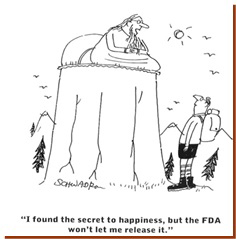
FDA Secret Happiness

For the seriously ill, the phrase “regulated to death” might hit close to home when it comes to the U.S. Food and Drug Administration. The agency is a notorious bottleneck on the availability of new, potentially life-saving drugs. Its policies seem to rely on an over-reading of the precautionary principle: that the risk of harm must be weighted heavily regardless of the opportunity cost in terms of curative, life-extending or palliative potential. The facts are as economist Alex Tabarrok describes:

“It costs well over a billion dollars to get the average new drug approved and much of that cost comes from FDA required clinical trials. Longer and larger clinical trials mean that the drugs that are eventually approved are safer. But longer trials also mean that good drugs are delayed. And the more expensive it is to produce new drugs the fewer new drugs will be produced. In short, longer and larger trials mean drug delay and drug loss.“

One billion-plus dollars of incremental cost for the average new drug! Not only are the lengthy delays unacceptable, but the added cost seriously inflates new drug prices. Furthermore, it is difficult for small, innovative competitors to engage in development in the face of costs like these. And while large pharmaceutical companies might be forced to limit investment in new drug research and might rightfully bemoan their cost structures, they are in a much better position to handle the regulatory burden than start-ups.

Tabarrok has long advocated “reciprocity”, or U.S. approval of “drugs, devices and biologics” that have been approved by authorities (such as the European Medicines Agency, or EMA) in certain other developed countries. He has also advocated “Free To Choose Medicine” principles, which would create a dual track allowing certain patients to opt into the use of drugs at a relatively early stage in the FDA’s approval process. Research studies cited by Tabarrok suggest that expedited drug approval can provide substantial benefits in terms of patient survival years without compromising safety.

A bill introduced by Senators Ted Cruz (R-TX) and Mike Lee (R-UT) would authorize reciprocity in the U.S. In October, Cruz discussed the legislation in this article:

“The FDA model is risk-averse, by its very nature obstructing promising innovations. It largely assumes that the biology of patients is the same, rather than recognizing that individuals’ genetic makeup varies widely. As a result, the only drugs the agency tends to approve are those that help a broad spectrum of patients and harm close to no one. That method may work to fight diseases that affect us all in a similar way, such as smallpox or cholera, but it does not work for diseases such as Alzheimer’s and cancer, which are highly tailored to each individual’s genetic makeup. In medicine, a one-size-fits-all approach ignores the diversity of the human person and limits the discovery of innovative cures to a small segment of those afflicted with disease.“

Tabarrok anticipates a certain objection to reciprocity:

“The argument for reciprocity, however, isn’t that the FDA is uniquely bad or always worse than the EMA or vice-versa. The argument is that it’s wasteful to duplicate the lengthy approval process and that both agencies sometimes make mistakes. As a result, it’s simple common sense to let Americans avail themselves of drugs and devices approved in other developed countries.“

There are other reform proposals in play. The Goldwater Institute has advocated “Right to Try” laws at the state level that would allow terminally-ill patients to access unapproved medicines. Representative Fred Upton (R-MI) has introduced the 21st Century Cures Act, which includes:

“... steps to streamline clinical trials; advance personalized medicine by encouraging greater use of drug development tools, such as biomarkers; and creat[es] incentives for developing drugs for uncommon but deadly diseases.”

Regulation is often an obstacle to vibrant competition and innovation, and the FDA’s antiquated drug approval process is certainly a hindrance. The process adds time and expense to drug development that carries unacceptable human costs. It is beyond comprehension that drugs can be rejected for procedural reasons when their proposed use involves circumstances that could hardly be worse, when those drugs carry little incremental downside risk. The rights of patients and the judgements of their physicians should take precedence over the sometimes picayune concerns of a regulatory bureaucracy. The reforms discussed above would be positive steps toward establishing that primacy.


Life’s Bleak When Your Goal Is Compliance

08 Wednesday Oct 2014

Posted by Nuetzel in Uncategorized

≈ 2 Comments

Tags

Administrative State, Asset Forfeiture, Banana Republic, Compliance Costs, DOE, FDA, Fines and Taxes, Michael Greve, Regulatory State, Richard Rahn

compliant_with_the_universe

Don’t underestimate the danger and cost of giving it up to the regulatory state. It’s ability to impel behavior in the absence of any legislative mandate, and apparently without accountability to the judicial branch or any other authority, is explored by Michael Greve in “Prescription for a Banana Republic.” He does this mostly in the context of the Department of Education, but he also mentions the FDA’s practice of issuing “draft” guidance, frequently with perverse consequences. I know from my own experience in the financial industry that the problem is more general. Here’s one snippet from Greve’s article:

“Why do we permit agencies to proceed in this underhanded, unreviewable fashion? The general idea is that in choosing to proceed by “guidance” rather than formal, reviewable regulation, the agency is giving something up: the legally binding effect of its rulings. It’s not really coercing anybody, and so why bother the courts? That answer, however, wildly underestimates government’s ingenuity in giving real-world effect to supposedly informal documents.”

Richard Rahn had a piece yesterday on the closely related topic of fines and asset forfeitures imposed by regulators without any court proceeding, let alone a conviction. He quotes two former directors of the DOJ’s Asset Forfeiture and Money Laundering Office:

“Civil asset forfeiture and money-laundering laws are gross perversions of the status of government amid a free citizenry. The individual is the font of sovereignty in our constitutional republic, and it is unacceptable that a citizen should have to ‘prove’ anything to the government. If the government has probable cause of a violation of law, then let a warrant be issued. And if the government has proof beyond a reasonable doubt of guilt, let that guilt be proclaimed by 12 peers.”

Greve mentions the strong influence exerted by regulators issuing so-called “Dear Colleague” letters containing “suggested” steps that might be taken “voluntarily” to avoid falling out of compliance with often ill-defined requirements:

“Whereupon compliance officers across the country can be heard clearing their throats: I can help…. Replicate the m.o. across the full range of government services and regulation: it takes a ton of money to escape. Once you start adopting Juan Peron’s legal model, social patterns will follow. We’re well on our way.”

Nudge me when it’s over. Oh, wait!

Newer posts →
Follow Sacred Cow Chips on WordPress.com

Recent Posts

  • The Case Against Interest On Reserves
  • Immigration and Merit As Fiscal Propositions
  • Tariff “Dividend” From An Indigent State
  • Almost Looks Like the Fed Has a 3% Inflation Target
  • Government Malpractice Breeds Health Care Havoc

Archives

  • January 2026
  • December 2025
  • November 2025
  • October 2025
  • September 2025
  • August 2025
  • July 2025
  • June 2025
  • May 2025
  • April 2025
  • March 2025
  • February 2025
  • January 2025
  • December 2024
  • November 2024
  • October 2024
  • September 2024
  • August 2024
  • July 2024
  • June 2024
  • May 2024
  • April 2024
  • March 2024
  • February 2024
  • January 2024
  • December 2023
  • November 2023
  • August 2023
  • July 2023
  • June 2023
  • May 2023
  • April 2023
  • March 2023
  • February 2023
  • January 2023
  • December 2022
  • November 2022
  • October 2022
  • September 2022
  • August 2022
  • July 2022
  • June 2022
  • May 2022
  • April 2022
  • March 2022
  • February 2022
  • January 2022
  • December 2021
  • November 2021
  • October 2021
  • September 2021
  • August 2021
  • July 2021
  • June 2021
  • May 2021
  • April 2021
  • March 2021
  • February 2021
  • January 2021
  • December 2020
  • November 2020
  • October 2020
  • September 2020
  • August 2020
  • July 2020
  • June 2020
  • May 2020
  • April 2020
  • March 2020
  • February 2020
  • January 2020
  • December 2019
  • November 2019
  • October 2019
  • September 2019
  • August 2019
  • July 2019
  • June 2019
  • May 2019
  • April 2019
  • March 2019
  • February 2019
  • January 2019
  • December 2018
  • November 2018
  • October 2018
  • September 2018
  • August 2018
  • July 2018
  • June 2018
  • May 2018
  • April 2018
  • March 2018
  • February 2018
  • January 2018
  • December 2017
  • November 2017
  • October 2017
  • September 2017
  • August 2017
  • July 2017
  • June 2017
  • May 2017
  • April 2017
  • March 2017
  • February 2017
  • January 2017
  • December 2016
  • November 2016
  • October 2016
  • September 2016
  • August 2016
  • July 2016
  • June 2016
  • May 2016
  • April 2016
  • March 2016
  • February 2016
  • January 2016
  • December 2015
  • November 2015
  • October 2015
  • September 2015
  • August 2015
  • July 2015
  • June 2015
  • May 2015
  • April 2015
  • March 2015
  • February 2015
  • January 2015
  • December 2014
  • November 2014
  • October 2014
  • September 2014
  • August 2014
  • July 2014
  • June 2014
  • May 2014
  • April 2014
  • March 2014

Blogs I Follow

  • Passive Income Kickstart
  • OnlyFinance.net
  • TLC Cholesterol
  • Nintil
  • kendunning.net
  • DCWhispers.com
  • Hoong-Wai in the UK
  • Marginal REVOLUTION
  • Stlouis
  • Watts Up With That?
  • Aussie Nationalist Blog
  • American Elephants
  • The View from Alexandria
  • The Gymnasium
  • A Force for Good
  • Notes On Liberty
  • troymo
  • SUNDAY BLOG Stephanie Sievers
  • Miss Lou Acquiring Lore
  • Your Well Wisher Program
  • Objectivism In Depth
  • RobotEnomics
  • Orderstatistic
  • Paradigm Library
  • Scattered Showers and Quicksand

Blog at WordPress.com.

Passive Income Kickstart

OnlyFinance.net

TLC Cholesterol

Nintil

To estimate, compare, distinguish, discuss, and trace to its principal sources everything

kendunning.net

The Future is Ours to Create

DCWhispers.com

Hoong-Wai in the UK

A Commonwealth immigrant's perspective on the UK's public arena.

Marginal REVOLUTION

Small Steps Toward A Much Better World

Stlouis

Watts Up With That?

The world's most viewed site on global warming and climate change

Aussie Nationalist Blog

Commentary from a Paleoconservative and Nationalist perspective

American Elephants

Defending Life, Liberty and the Pursuit of Happiness

The View from Alexandria

In advanced civilizations the period loosely called Alexandrian is usually associated with flexible morals, perfunctory religion, populist standards and cosmopolitan tastes, feminism, exotic cults, and the rapid turnover of high and low fads---in short, a falling away (which is all that decadence means) from the strictness of traditional rules, embodied in character and inforced from within. -- Jacques Barzun

The Gymnasium

A place for reason, politics, economics, and faith steeped in the classical liberal tradition

A Force for Good

How economics, morality, and markets combine

Notes On Liberty

Spontaneous thoughts on a humble creed

troymo

SUNDAY BLOG Stephanie Sievers

Escaping the everyday life with photographs from my travels

Miss Lou Acquiring Lore

Gallery of Life...

Your Well Wisher Program

Attempt to solve commonly known problems…

Objectivism In Depth

Exploring Ayn Rand's revolutionary philosophy.

RobotEnomics

(A)n (I)ntelligent Future

Orderstatistic

Economics, chess and anything else on my mind.

Paradigm Library

OODA Looping

Scattered Showers and Quicksand

Musings on science, investing, finance, economics, politics, and probably fly fishing.

  • Subscribe Subscribed
    • Sacred Cow Chips
    • Join 128 other subscribers
    • Already have a WordPress.com account? Log in now.
    • Sacred Cow Chips
    • Subscribe Subscribed
    • Sign up
    • Log in
    • Report this content
    • View site in Reader
    • Manage subscriptions
    • Collapse this bar
 

Loading Comments...