• About

Sacred Cow Chips

Sacred Cow Chips

Tag Archives: Hillary Clinton

Beastly Hillary Benghazi Baggage

10 Sunday Jul 2016

Posted by Nuetzel in Diplomacy, Terrorism

≈ 2 Comments

Tags

13 Hours, Amateur Video, Bengazi, Chris Stevens, Clinton Foundation, Diplomacy, Hillary Clinton, Leave No Man Behind, Muammar Ghadafi, Obama administration, Running Arms, Stand Down, Syrian Rebels, Whitewater Land Deal

HillaryDifference

The Clinton Can-o’-Worms is just as slimy and writhing as ever. We’ve heard about Hillary’s misadventures for decades: defending the rapist of a 12-year-old girl and later gloating (on tape) about the light sentence she’d helped arrange; dismissal from the staff of the House Judiciary Committee for lying during the Watergate case, and the shady Whitewater land deal. The most recent trio of scandals include 1) questionable decisions and misleading public statements in the Benghazi affair; 2) exposing national security to compromise via her private servers; and perhaps the biggest of the biggies: 3) suspicious relationships between the Clinton Foundation and foreign governments with whom she dealt as Secretary of State for four years. I’ll discuss Benghazi in this post, but I’ll return to Clinton’s grossly negligent email handling and the Clinton Foundation pay-to-play activity in the next few days.

The Benghazi attack in 2011 was at least in part a reaction to arms shipments that Libyan Ambassador Chris Stevens was attempting to arrange. This is believed to have involved weapons belonging to Libyan rebels, some of them jihadists, and to the deposed Libyan regime of Muammar Gaddafi. Apparently, Stevens mission was to work to get those arms into the hands of Syrian rebels, many of whom turned out to be jihadists as well, of course. Apparently there were Libyans who wanted to see those arms stay at home. Stevens and three other Americans lost their lives in the attack. It turns out that Stevens had asked repeatedly for additional security in Benghazi, but the requests ware denied by Clinton’s State Department. When the attack went down, requests for aid in the form of air support and even a tactical team were denied, despite the fact that “assets” were within reach. “Stand down” was the order of the day, in keeping with the Obama Administrations “no boots on the ground” policy.

It is now clear that the attack was planned, but Mrs. Clinton, who knew the facts, told the American public that the attack was precipitated by an amateur video critical of radical Islamists. Why the misleading statements? The Benghazi mission was politically sensitive, of course. In addition, an objective during the presidential election season was to play down terrorism, to propagate the myth that the terrorists were “on the run” under Obama. There is no doubt that Clinton lied to the American people in this case, but apparently her supporters think that’s unimportant in a leader.

A recent defense of Clinton and the administration has it that aid should never have been expected for the Americans in Benghazi during the 13 hours of the siege. After all, according to this reasoning, Ambassador Stevens and the other personnel knew it was a risky mission. Well, so much for “leave no man behind“, which has a long and honorable tradition in the military. Soldiers on patrol often accept great risk, yet no one would suggest their acceptance of risk as an excuse to refuse them aid when in dire need.

While it is true that the host country is presumed to be responsible for providing the first line of security for foreign diplomats, that was not realistic in Libya at the time. The guards and contractors attached to the mission in Benghazi were obviously inadequate to defend the staff under the circumstances. Military assets are in place to respond under just such a contingency. Given the nature of Stevens’ mission, which was apparently to transfer arms to parties intended to serve as sub rosa U.S. military proxies in Syria, the military should have been allowed to honor the “leave no man behind” imperative. Unfortunately, the administration’s political objectives, and the terrorists, won the day in Benghazi. Hillary Clinton was complicit in this.

Good Leaders Aren’t Trade Warriors

30 Wednesday Mar 2016

Posted by Nuetzel in Free Trade, Protectionism

≈ 1 Comment

Tags

Bernie Sanders, CATO Institute, Currency Manipulation, Daniel J. Ikenson, Direct Foreign Investment, Don Boudreaux, Donald Trump, Dumping, Federal Reserve, Free trade, Hillary Clinton, NAFTA, Open Trade, Paul Krugman, People's Bank of China, Predatory Pricing, Protectionism, Reserve Currency, Ted Cruz, TPP, Trade Deficit, Trade War, Unfair Competition

Protectionism

The protectionist foreign trade rhetoric issued by the major-party presidential candidates is intended to appeal to ignorant economic instincts. Donald Trump and Bernie Sanders come to mind most readily, but Ted Cruz and Hillary Clinton are jumping in with similar campaign positioning. The thrust of these populist, anti-trade appeals is that America is losing jobs to “unfair” foreign competition, an argument that distorts the very objective of trade: consumers take part in exchange in order to consume; they capture value from high quality, unique merchandise and competitive terms. Ultimately, producers engage in trade to gain the wherewithal to consume. Consumption is the real end-game.

It can be misleading to talk about “nations” engaging in trade with each other, despite the emphasis placed on trade agreements like NAFTA and TPP. In the first place, it is better to stress consumers and producers, rather than “nations”, because most foreign trade is private, cooperative activity, not national decision-making. But the candidates persist in characterizing trade as a “contest”. That misleading notion is what prompts governments to muck up the trade environment by imposing restrictions on the free flow of goods and services. Trade agreements have been heralded as great achievements, but they never approximate a regime of truly liberalized trade because the latter requires no formal agreement whatsoever, merely a hands-off approach by government. And trade agreements tend to entangle trade issues with other policy objectives, holding consumers hostage in the process.

We hear from opportunistic candidates that jobs are lost to trade with foreigners. But again, consumption, not “jobs” per se, is the real objective of economic activity. If domestic jobs are lost, it is generally because consumers judge the value produced inferior to what’s offered from abroad. American consumers should not be obliged to support inferior value, domestic market power unchecked by competition, monopoly prices and limited choices. Patriotic jingoism attempts to blind us from these economic imperatives.

The standard protectionist narrative is that foreign “nations” cheat on trade with the U.S. via currency manipulation, predatory pricing or “dumping”, “unfair” wages or other unfair labor practices. Do any of these objections to free trade hold water?

The “fairness” of foreign wages and labor practices is a matter of perspective. Wages cannot be considered unfair merely because they are low relative to U.S. wages. Wages paid to workers by foreign exporters tend to be consistent with the standard of living in those societies, and they are often some of the best income opportunities available there. This is economic dynamism that lifts masses from the grips of poverty. It’s absurd to caste it as “exploitation”.

Is it “unfair” to competitors in the U.S.? Not if they know how to compete and are allowed to do so. Unfortunately, government regulatory policies in the U.S. often present obstacles to the competitiveness of domestic producers. This is well-illustrated by Daniel J. Ikenson of The CATO Institute in “Crucifying Trade For The Sins Of Domestic Policy“. He emphasizes that trade promotes economic growth, but when it causes job losses for some workers, U.S. economic policies make it difficult for those workers to find new jobs.

“Incentivize businesses to hire people to train them in exchange for their commitment to work for the company for a period of time. Reform a corporate tax system that currently discourages repatriation of an estimated $2 trillion of profits parked in U.S. corporate coffers abroad, deterring domestic investment, which is needed for job creation. Curb excessive and superfluous regulations that raise the costs of establishing and operating businesses without any marginal improvements in social, safety, environmental, or health outcomes. Permanently eliminate imports duties on intermediate goods to reduce production costs and make U.S.-based businesses more globally competitive. Advocate the retirement of protectionist occupational licensing practices.“

So-called “dumping” by foreign producers, or selling below cost, is an unsustainable practice, by definition. Pricing below cost is difficult to prove, especially if local wages are low and raw inputs are plentiful. If dumping can be proven, retaliation might feel good but would punish American consumers. A foreign producer might be subsidized by its government as a matter of industrial policy and economic planning, an unhealthy policy to begin with, and possibly to facilitate a long-run market advantage in foreign trade. The U.S. itself is thick with subsidized industry, however, so arguing for retaliation on those grounds is more than a little hypocritical.

I rarely quote Paul Krugman, but when I do, it’s from work he’s done as an actual economist, not as an agenda-driven pundit. So we have the following Krugman quote courtesy of Don Boudreaux:

“I believe that if the rhetoric that portrays international trade as a struggle continues to dominate the discourse, then policy debate will in the end be dominated by men like [James] Goldsmith, who are willing to take that rhetoric to its logical conclusion. That is, trade will be treated as war, and the current system of relatively open world markets will disintegrate because nobody but a few professors believes in the ideology of free trade.

And that will be a shame, because for all their faults the professors are right. The conflict among nations that so many policy intellectuals imagines prevails is an illusion; but it is an illusion that can destroy the reality of mutual gains from trade.“

David Harsanyi asks how American consumers will like more restrictive trade policy when forced to pay more for smart phones, laptops, HDTVs, cars, food, and any number of other goods. The usual anti-trade narrative is that foreign producers have harmed the manufacturing sector disproportionately, but in another article, Ikenson lays bare the fallacy that U.S. manufacturing has been victimized by trade.

The consequences of trade restrictions are higher prices, reduced production and reduced consumption, an undesirable combination of outcomes. This means higher prices of imported goods as well as domestic goods, whose producers will face less competition by virtue of the trade barriers. With reduced availability of imported goods, economic theory predicts that domestic producers will not fully meet the frustrated demands. This is a classic response of producers with monopoly power: restraint of trade. The negative consequences are compounded when foreign governments impose retaliatory measures against the U.S., harming American exporters.

A further misgiving expressed by politicians regarding free trade is that America’s trade deficit implies greater indebtedness to the rest of the world. This argument has been made by a few leftist economists who misunderstand the nature of direct investment, and who tend to think erroneously of economic outcomes as zero-sum. It’s true that foreign producers who receive dollars in exchange for goods often invest those proceeds in U.S. assets. A fairly small share of that investment is in debt issued by U.S. governments and private companies. But a much larger share is invested in U.S. equities and real assets, which are not U.S. debts. As Don Boudreaux points out, the domestic sellers of those assets generally reinvest in other U.S. assets, so private U.S. ownership of global capital is not diminished by increased foreign investment in the U.S.

An interesting aspect of the trade debate is that the dollar’s role as a global reserve currency implies that the U.S. must run a chronic trade deficit. The rest of the world uses dollars to trade goods and assets, but to acquire dollars, foreigners must sell things to holders of dollars in the U.S. This keeps the foreign exchange value of the dollar elevated, which makes imports cheaper to Americans and U.S. exports more costly to foreigners. Those dollars are a form of U.S. debt, but it is debt for which we should feel flattered, as long as confidence in the dollar remains. A diminished role for the dollar in world trade would lead to a surplus of dollars, undermining its value and promoting inflation in the U.S. Let’s hope for a gradual transition to that world.

Finally, the presidential candidates allege that foreign currency manipulation is another reason for American job losses. One prominent example occurred last year when China allowed the renminbi to decline to more realistic levels on foreign exchange markets. Donald Trump called this an unfair trade tactic, but apparently the People’s Bank felt that it couldn’t support the renminbi without undermining economic growth. The earlier dollar peg also helped to keep Chinese inflation in check. Contrary to Trump’s assertions, if China stopped manipulating its currency altogether, the renminbi would go even lower!

Beyond the opportunistic political arguments, the point is that central banks (including the U.S. Federal Reserve) manage their currencies to achieve a variety of objectives, not merely to promote exports. That is not an endorsement of such policies. It is an objective fact. Anyone can argue that a foreign currency is “too low” if their objective is to demonize a country and it’s exports to the U.S., but the assertion may not be grounded in facts as markets assess them.

The arguments against open trade policies are generally specious, hypocritical or grounded in a mentality of victimhood. Vibrant producers who are free of government restrictions should welcome the expanded markets available to them abroad and should not seek redress against competition via government protection. Liberalized trade has engendered tremendous economic benefits over the years, while protectionist policies have only brought severe contractions. Let’s be free and trade freely!


Gagging On Campaign Finance Reform

10 Wednesday Feb 2016

Posted by Nuetzel in Big Government, Campaign Finance

≈ Leave a comment

Tags

Bernie Sanders, Bipartisan Campaign Reform Act, Buckley v. Valeo, Bundler Disclosure, Campaign Contributions, Campaign Finance, Citizens United, Eigene Volokh, Elena Kagan, Federal Election Commission, First Amendment Protections, Hillary Clinton, Ilya Shapiro, Influence Spending, Jacob Sullum, Jeb Bush, Jeffrey Milyo, Jonathan Adler, Legislative Dysfunction, McCain-Feingold, McCutcheon v. FEC, Michael McConnell, Press Clause, rent-seeking behavior, Speechnow.org v. FEC, Spending Limits

campaign-finance-reform

Campaign finance is an area of internal conflict for some libertarians. On one hand, they do not believe in restrictions of any kind on freedom of expression. That implies no limits on what an individual can spend in support of a political cause, by themselves or in association with others, and whether it merely promotes a point of view or supports a political candidate. At the same time, libertarians are strongly opposed to rent-seeking activity, or efforts to use government power to promote private interests. Political spending is seen by many as an avenue for rent seeking, which suggests to them a need for limits on campaign contributions.

In fact, full-throated support of free speech and opposition to campaign limits do not stand in conflict. The reasons are: 1) such limits are an assault on free speech; 2) campaign contributions represent “small change” in the larger scheme of rent-seeking pursuits; 3) contributions seldom represent direct efforts to influence policy; and 4) imposed limits have a detrimental effect on the ability of elected officials to do their jobs.

Speech

Free speech, long interpreted by the courts more broadly as free expression, is protected by the First Amendment to the U.S. Constitution. This includes political expression, but traditionally it included campaign contributions as well, the latter being an obvious mechanism by which one can express views. However, the Supreme Court has upheld statutory limits on individual contributions to specific campaigns, as well as disclosure rules, on the grounds that they prevent corruption (Buckley v. Valeo and more recently McCutcheon v. Federal Election Commission(FEC)). I view the contribution limits as a contravention of the First Amendment, denying an enumerated right on the grounds that it “might” lead to corruption. If preventing corruption is the sole rationale for these limits, then government itself should be sharply limited, as it most certainly leads to graft and corruption at the expense of relatively powerless taxpayers.

Citizens United

A well-known Supreme Court case decided in 2010 involved independent political speech, as opposed to expression of political preference revealed by campaign spending. This was Citizens United v FEC, in which the Court ruled that political speech cannot be restricted on any basis other than corruption. As described by Ilya Shapiro, the case is widely misunderstood. One point of interest here is that the case related to speech by an organization rather than an individual. The Court ruled that a corporation (a nonprofit in the case) could not be prevented from airing a film critical of Hillary Clinton, striking down provisions of the Bipartisan Campaign Reform Act of 1990 (McCain-Feingold) under the First Amendment.

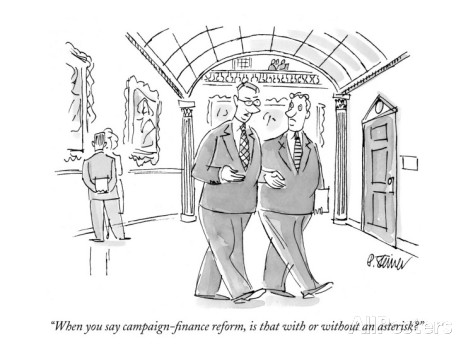
The Citizens United decision was NOT about campaign contributions. As an interesting aside, in a search of cartoons related to campaign finance, a great many imply that the Supreme Court abolished such limits in Citizens United. It did not. Even given some level of disaffection, it is hard to account for the near-complete lack of understanding about the case.

More informed critics of the decision bemoan that fact that it allows speech by corporations (and unions and other associations) to go unlimited, though they don’t seem to mind the absence of limits on political speech by media corporations. (See Eugene Volokh’s view in the Brown Daily Herald and Michael McConnell’s reinterpretation of Citizen’s United as a Press Clause case in the Yale Law Journal.) The critics also fail to recognize that corporations are associations of individuals, who are otherwise subject to no restrictions on independent speech or on what they can spend to speak independent of any political candidate (as established in Speechnow.org v. FEC in 2010). The technical treatment of a corporation as a “person”, which many find objectionable, is beside the point. Only by distorting the meaning of the First Amendment can any limitation be placed on the freedom of individuals to speak in association with others.

Jacob Sullum covers the confused legal thinking of leading Democrats Hillary Clinton and Bernie Sanders on campaign finance reform, and on Citizens United in particular. Jeb Bush is no better. Most of the opposition to the decision centers around the notion of “balancing” speech, but Sullum offers a piece of wisdom from a 1996 quote of future Supreme Court Justice Elena Kagan: “the government may not restrict the speech of some to enhance the speech of others.”

Corporate Campaign Spending

Another point raised by Ilya Shapiro is that corporate spending growth has neither accelerated nor decelerated in the wake of Citizens United. Moreover, restrictions on direct campaign contributions are still in place. However, campaign contributions are a relatively small percentage of corporate “influence spending”, averaging roughly 10% of the total between 2007 and 2012 for 200 large “politically active” corporations. Thus, direct campaign contributions are unlikely to be the primary avenue for rent-seeking activity. They might help buy “access” to politicians, but they may not be especially effective in influencing policy. These points are supported by University of Missouri economist Jeffrey Milyo in “Politics Ain’t Broke, So Reforms Won’t Fix It“. Milyo marshals empirical evidence that should make us skeptical of campaign finance reform efforts.

Incapacitated Legislators

Jonathan Adler of Case Western emphasizes the legislative dysfunction created by campaign finance reforms. McCain-Feingold places limits on funds candidates can receive from their political parties and other sources, forcing them to spend a large proportion of their time on fundraising (and placing incumbents at a distinct advantage). If there is a shred of sincerity in the populist insistence that members of Congress be subject to tighter term limits, or that Congress is woefully unproductive, then full repeal of these limitations should be a priority.

Visibility Versus Effectiveness

The chief advantage of combatting corruption through regulating campaign finance is that it is a visible target. However, it is a target too rich with free speech implications. Disclosure requirements are one thing (through arguments can be made against infringements on the privacy of contributors as well). Limiting forms of expression outright is draconian, and reformers are unlikely to be satisfied until campaigns are funded entirely by taxpayers. Attacking “corruption” via limits on campaign contributions presumes a need to protect both contributor and recipient from their own guilt. Even if contributions help gain better access to an elected representative, it does not imply that the representative will act on motives counter to the perceived public merits of an issue. Moreover, the argument that limits on direct contributions to candidates “keep money out of politics” is flawed. Limits simply change the distribution of political spending, increasing the reliance on bundlers and organizations like Super PACs, and shifting the tables in favor of incumbents.

There are far better ways to combat corruption among legislators and others in government, some with more severe drawbacks than others. Term limits are one possibility, but would deny voters of legitimate choices. Another option is to allow candidates to have unrestricted access to campaign funds through central organizations, rather than forcing them to rely on independent Super PACs, which cannot always be relied upon to craft a candidate’s preferred messages. Immediate disclosure of contributors and amounts would help to bring more transparency to the campaign finance process. Stiffer disclosure requirements for “bundlers” would also help. Perhaps elected executives could be prohibited from appointing bundlers to positions of authority, though a precise definition of “bundler” might become contentious. There are other reform possibilities related to limiting permissible lobbying activity.

The libertarian’s dilemma with respect to campaign finance is easily resolved once the focus is placed squarely on protecting individual rights. In the end, the best defense of individual rights and against corruption in government is to limit government. It’s wise to place strong reigns on an institution that operates by virtue of coercive authority. The danger was well-acknowledged by the limits on government power enshrined in the Constitution.

Universal Pre-K Dumb-Down

30 Friday Oct 2015

Posted by Nuetzel in Education, Welfare State

≈ 1 Comment

Tags

Bernie Sanders, Child Development, Cradle to Grave Socialism, Ezra Klein, Federal funding, Fertility Decisions, Head Start, Hillary Clinton, Negative Incentives, Pre-Kindergarten Education, Pre-School For All, Socialization, Subsidies, Tennessee Pre-K Study, Universal Pre-K, Vox, Welfare State

big_government-school

Can the middle class be sold on federal pre-kindergarten dependency? Is pre-K always beneficial to children? All children? One of many issues agitating the “government-must-do-something” crowd is universal pre-kindergarten. It’s a favorite topic of the Socialist-Democrat Bernie Sanders and, more recently, it became a campaign promise from the Democrat-Socialist Hillary Clinton. It’s typical of the freebies these two presidential candidates are compelled to promise their base. While federal funding of universal pre-K is often billed as way to assist low-income working families, the subsidies proposed are not well-targeted: Clinton’s proposal calls for pre-K subsidies for middle-class families as well. A “Pre-School For All” proposal by President Obama in 2013 required $75 billion in funding. These kinds of broad-based transfer payments aren’t cheap.

In addition to the expense, it’s not clear that pre-K schooling is beneficial to all children. In Vox, Ezra Klein describes a recent study on the efficacy of a pre-K program in Tennessee (hat tip: John Crawford). The selection of children for the pre-K and control groups was randomized by virtue of a “lottery” for admission in regions experiencing excess demand. Here is Klein’s description of the results:

“At the end of pre-K, the results look pretty much as you would expect: Teachers rates [sic] the children who went through pre-K as ‘being better prepared for kindergarten work, as having better behaviors related to learning in the classroom and as having more positive peer relations.’

The problem is those results dissipate by the end of kindergarten — by then, the group that attended pre-K is no better off than the group that didn’t — and then begin to reverse by the end of first grade. By the end of second grade, the children who attended the pre-K program are scoring lower on both behavioral and academic measures than the children who didn’t.“

Klein cites two other “high-quality” studies (one by Head Start) that are consistent with the findings in Tennessee. He also notes some weaknesses of earlier studies suggesting that pre-K provides developmental benefits.

Some prominent advocates of pre-K insist that there are long-term benefits that the recent studies fail to capture. If so, it is hard to square that belief with such negative results after three years. I suspect that there are significant developmental rewards for children who spend their days with family members or even family friends, and I am skeptical that improved socialization can be gained from full-time attendance at a public facility. Perhaps some children benefit, but clearly not all.

None of this is to suggest that low-income parents would not benefit economically from additional subsidies for early education. To the extent that the parents are able to earn more income, the entire household will benefit and perhaps even society will benefit. But this is a social safety net issue at its base, not a broad-based social need. Ideally, one’s prospects for income should have a strong bearing on fertility decisions. Individual families should not expect others to bear the costs. And as for the safety net, let’s face it, great parts of it would be unnecessary in the absence of the negative work and family incentives inherent in many transfer programs. Neutralizing the costs of raising children compounds the bad incentives.

Like so many other statist misadventures, the populist appeal of universal pre-K is a desire for a freebie at the expense of others. The politicians Sanders, Clinton and Obama understand that, and they recognize it as another pillar of support for the great federal highway of cradle-to-grave serfdom.

Bernie Sanders Wants To Deal… Your Property

18 Sunday Oct 2015

Posted by Nuetzel in Socialism, The Road To Serfdom

≈ Leave a comment

Tags

Angus Deaton, Bernie Sanders, Chelsea German, Dierdre McCloskey, Fixed Pie Fallacy, Free Stuff, Gary Burtless, Hillary Clinton, HumanProgress.org, Scandinavia, Socialism, Student Loans, The Brookings Institution, The Great Escape

Fall In Hole giphy

Bernie Sanders is very sincere in his beliefs, and yet he is profoundly ignorant regarding economic growth in the U.S. and the futility of socialism as form of economic organization. Chelsea German, at the HumanProgress blog, presents some simple facts that contradict a few of the Senator’s favorite assertions. In “Senator Sanders and the Fixed Pie Fallacy“, German quotes a line that Sanders has been using for at least 41 years: “The rich are getting richer and the poor are getting poorer.” Granted, his first utterance of that expression might have been in a recession, but aside from those relatively brief episodes, he’s been wrong for the duration. Apparently, Sanders cannot fathom the widespread gains made possible by capitalism and economic growth. Only a “fixed pie” (or worse) would necessarily imply that gains must come at the expense of others, as he seems to believe. (H.T. to Ken DeVaughn on the brilliant gif above.)

One chart in German’s post shows that after-tax income grew in every quintile of the U.S. income distribution from 1979 (pre-recession) to 2010 (post-recession). The chart is taken from CBO data used by Gary Burtless in a piece published by Brookings. Sanders should have a look. However, it’s also important to note that people generally don’t remain in the same strata of the distribution over time. A second chart, from Angus Deaton’s “The Great Escape“, shows that U.S. poverty rates have generally declined over time. Finally, German shows that with a few interruption, GDP has grown over time. All of these facts might be something of a surprise to Sanders. German quotes the great Deirdre McCloskey:

“The rich got richer, true. But millions more have gas heating, cars, smallpox vaccinations, indoor plumbing, cheap travel, rights for women, lower child mortality, adequate nutrition, taller bodies, doubled life expectancy, schooling for their kids, newspapers, a vote, a shot at university, and respect.“

Sanders showcases his lack of familiarity with economic principles almost every time he opens his mouth, or his Twitter account. He recently opined that rates of interest on student loans should be lower than rates on loans for autos and mortgages. Of course, both auto loans and mortgages are secured by valuable collateral and have much lower default rates. It’s a good thing for Sanders that he didn’t pursue a career in lending.

Recently, Hillary Clinton has been unable to restrain herself from chasing Sanders off the rhetorical cliff. Clinton is offering the public lots of “free stuff“, like Sanders, in a transparent attempt to buy votes with promises of future largess. Neither candidate has offered a credible plan for funding their promises. Higher taxes on “Wall Street” and other top earners are the supposed answer, but those measures would be woefully inadequate. Look out, middle class!

By the way, another recent Brookings study shows that increasing the top marginal income tax rate, a policy of which Sanders would approve, would do little to reduce the degree of income inequality.

Of course, Sanders seems just as unfamiliar with the great failures of socialism over the past century as he is with the successes of capitalism in eliminating poverty. He thinks the U.S. should adopt the socialist policies in Scandanavia, but the truth is that socialism has served to inhibit the continued success of capitalism in those countries (also see here). Perhaps that’s why Denmark is scaling back its redistributionist policies.

The Left, including Bernie Sanders, are burdened by a naive utopianism so powerful that they can rationalize the confiscation of private property to support their personal preferences and those of the political class. The aristocratic Left, like Hillary, differ only in the power they hold to influence policy. Perhaps a few suffer from a strong sense of guilt regarding their own circumstances. No, not Hillary. But both Bernie and Hillary are guilty of gross social and economic misdiagnosis. Politicians, heal thyselves!

Trump Tower of Babble

09 Sunday Aug 2015

Posted by Nuetzel in Big Government, Marketplace of Ideas, Obamacare

≈ 2 Comments

Tags

Andrew Popkin, Bankruptcy, Brett Baier, crony capitalism, Donald Trump, eminent domain, GOP Debate, Hillary Clinton, Megyn Kelly, Obamacare, Peter Suderman, Rand Paul, single-payer plan, Vox

Presidential candidate, Donald Trump, has been critical of fellow Replubicans including Sen. John McCain. Some voters are curious about his "daffy" behavior.

Here’s a post-debate follow-up on Donald Trump the Shape Shifter: I’m surprised to hear anyone praising his performance after that debacle. He came off as a dick, and that’s really The Donald. I thought so before I heard that he suggested Megyn Kelly was menstruating that evening. Megan was tough, but please…. Trump is a loud-mouthed, offensive, and often incoherent bully.

Two Trump moments that I thought were amazing were his exchange with Brett Baier about political donations and his dust-up with Rand Paul over a single-payer health care system.

On donations, Trump seemed to take satisfaction in the fact that Hillary Clinton “had no choice” but to attend his wedding after he gave to her Senate campaign. He then made the following statement, which made me laugh:

“I will tell you that our system is broken. I gave to many people. Before this, before two months ago, I was a businessman. I give to everybody. When they call, I give. And you know what? When I need something from them, two years later, three years later, I call them. They are there for me. And that’s a broken system.“

Should I love him or hate him for that statement? He admits with no shame that he participates in crony capitalism, and he realizes that it’s corrupt. Andrew Popkin at Vox has a good analysis:

“Something Trump identifies that doesn’t always get mentioned is the way transactional politics transcend partisanship and ideology. Trump gave to Democrats and he gave to Republicans. He didn’t care what they believed. He cared what they could do for him. He wasn’t supporting them — he was buying them, and that’s completely different.“

It’s convenient for Trump to brag that he doesn’t need donations from others when campaigning. When he’s on the other side of the table, he’s happy to participate in the corruption. Did Trump buy the politicians who helped him arrange eminent domain actions against property owners who were in the way of his developments? He’s also quite proud of his use of bankruptcy laws allowing him to stiff lenders and investors in his enterprises. By the way, in comparing his four corporate bankruptcies to the many “deals” he’s executed over the years, he’d have you believe that the “deal” is always the relevant unit for a bankruptcy proceeding. That’s loose and misleading jargon.

I have said that Trump’s supporters really don’t know what their getting. Perhaps he won’t tell anyone because he’d lose “leverage”. A prime example of Trump’s shiftiness was his response to the following question on single-payer health care systems, including his attempt to embarrass Rand Paul:

Baier: “Now, 15 years ago, you called yourself a liberal on health care. You were for a single-payer system, a Canadian-style system. Why were you for that then and why aren’t you for it now?“

As Peter Suderman noted, Trump’s response to this question about health care began with his views on the war in Iraq. Donald’s rules…. But eventually, he addressed the health care question with a stream of words that thinking people might have been tempted to process logically in order to divine a coherent “Trump” position on the issue, but that would have been a mistake:

“As far as single payer, it works in Canada. It works incredibly well in Scotland. It could have worked in a different age, which is the age you’re talking about here.

What I’d like to see is a private system without the artificial lines around every state. I have a big company with thousands and thousands of employees. And if I’m negotiating in New York or in New Jersey or in California, I have like one bidder. Nobody can bid. You know why? Because the insurance companies are making a fortune because they have control of the politicians, of course, with the exception of the politicians on this stage. But they have total control of the politicians. They’re making a fortune.“

This is not a great moment of clarity for Trump. We still don’t know what he has in mind. He demonstrates that he doesn’t quite understand the inherent flaws in single-payer. If his complaint is with consolidation of the health insurance industry, single-payer would imply an even greater consolidation, indeed, a monopoly. A “private system” does not rule out single-payer. While the insurance companies have undoubtedly influenced politicians, just as Trump has, why is he complaining about a lack of choice, having just asserted that single-payer could work so well? And artificial lines have to do with non-price rationing, a typical feature of government intervention in markets. Thus far, the profits of under-pricing insurers have been protected by so-called “risk corridors” built into Obamacare. Would Trump allow health care providers and insurers to reprice in order to eliminate “artificial lines”? Trump’s words did not settle any questions about his position.

The end of Trump’s response is this:

“And then we have to take care of the people that can’t take care of themselves. And I will do that through a different system.“

So… was Trump still talking about single-payer or not? I forgive Rand Paul for imagining that he was. It was the only solid statement that one could cling to in Trump’s ramble.

Here is Suderman’s summary of Trump’s response with an account of the exchange with Rand Paul that followed:

“What matters is that [Trump] would be different. Different how? So very, very different—and definitely not a moron/loser/dummy/incompetent (pick one) like this other guy.

This is how Trump responds to almost everything: By not answering the question, by babbling out some at-best semi-relevant references, by promising to somehow be different and better without explaining how or why, and then by lobbing an insult.

An insult is how Trump finishes the Obamacare exchange as well. After Trump finishes answering the question, Sen. Rand Paul cuts in, saying, ‘News flash, the Republican Party’s been fighting against a single-payer system for a decade. So I think you’re on the wrong side of this if you’re still arguing for a single-payer system.’ [SCC’s bolding]

Trump’s comeback: ‘I’m not—I’m not are—I don’t think you heard me. You’re having a hard time tonight.’

The gist, as always, is that someone else—indeed, practically everyone else—is a dummy, a loser, a politician. Trump is the only one who really gets it, whatever it is.“

While I thought Rand Paul’s interjectory approach to debating was unwise, his comment to Trump was on-target, and he even qualified it. Trump responded with snark. Trump has yet to take a real position on health care in this campaign, but he has supported single-payer in the past. He doesn’t want to go to the trouble of deciding or revealing a specific plan just yet. Perhaps he’s “maintaining leverage”, keeping his options open, because he’s such a smart businessman. If you want to treat politics like a business deal, fine, but smart voters should be your partners, and they will expect you to reveal your terms.

Hillary’s Got Some Promises and a Rat’s Nest

03 Monday Aug 2015

Posted by Nuetzel in Big Government, Central Planning

≈ Leave a comment

Tags

Andrew Napolitano, Capital Gains Tax, central planning, Clinton renewable energy plan, Friedrich Hayek, Half a billion solar panels, Hillary Clinton, Hillarycare, Ira Stoll, Jeffrey Tucker, Larry Kudlow, Obamacare employer mandate

Hillary

Hillary Clinton is an advocate for governmentalizing the social order, and asks America to trust that central control, under her command, will accomplish great things such as upward mobility for the middle class, a rising standard of living, green energy for all, a “fix” for Obamacare, and much else. Jeffrey Tucker writes of Hillary’s delusions in “Hillary Clinton’s Ideological Vortex of Power and Planning” and her assurances that she’ll take measures with predictable impacts on the global climate, measures that will direct all details of energy production and use.

Tucker throws cold water on Hillary’s promises by viewing them in the context of F.A. Hayek warnings about the ruinous effects of central planning and control:

“That brilliant economist spent 50 years explaining, in book after book, that the greatest danger humanity faced, now and always, was a presumption on the part of intellectuals, politicians, and bureaucrats that they know better than the emergent and evolving wisdom of social forces.

This presumption might seem like science but it is really pretense. Civilization arises from, is protected by, and advances through the dispersed knowledge of billions of individual decision makers and the institutions that arise from them.

Hayek called the issue he was investigating the knowledge problem. Society needs to know how to use scarce resources, how to navigate a world of uncertainty, how to form rules that turn struggle into peace. It is a problem solved through freedom alone. No ruler, no scientist, no intellectual can substitute for the evolving process of decentralized decision making and trial and error.“

I discussed the fatuous presumptions of the left in an earlier SCC post entitled: “Conscious Design, the Collective Mind and Social Decline“. In that post, I used the wonderful Hayek quote:

“We flatter ourselves undeservedly if we represent human civilization as entirely the product of conscious reason or as the product of human design, or when we assume that it is necessarily in our power deliberately to re-create or to maintain what we have built without knowing what we were doing.“

More specifically, on energy policy, Clinton says she will set an agenda for the country to produce enough renewable energy within 10 years to power every American home, and to install half a billion solar panels across the country by the end of her first term. As Ira Stoll says at Reason.com, this is “central planning at its worst“.

“Clinton assumes that man-made climate change is a risk serious enough to try to mitigate, and that America should try to mitigate it by reducing its carbon emissions. These are big ‘ifs,’ but ones I will grant for argument’s sake. Even granting those assumptions, there is a humongous logical leap to the conclusion that the appropriate policy response is setting a national target for the number of solar panels installed.

For one thing, it’s a classic error of measuring inputs rather than outputs. If the goal is the reduction of dangerous emissions, why not set a goal for that, and support any energy method—solar, wind, algae, hydroelectric, nuclear, hydrofracturing—that gets America closer to that goal? Why privilege solar over all the other technologies, including some that may not even be invented yet?“

Certainly, proposals like this create tremendous opportunities for rewarding cronies. Stoll also notes that solar technology will improve over time, but rushing to install millions of panels, undoubtedly encouraged by heavy subsidies, would saddle users in the long-term with less efficient versions. With future improvements in efficiency and cost, the technology will gradually draw users in without the need for subsidies. That’s what rational economic decision-making looks like!

A specific economic proposal from the Clinton camp would increase the capital gains tax rate on asset sales held from 364 days up to six years. The rate would double if the asset was held up to two years. The increases become gradually smaller for two-to-six year holding periods. Hillary’s is somehow unaware that the government has already made it incredibly difficult for businesses to raise capital to invest in new buildings, equipment, and technology. Capital gains taxes are punitive: they represent double taxation of income to investors and they further distort rates of return by taxing assets on inflationary increases in value, which diminish their real value. Larry Kudlow wrote a good opinion piece on this proposal, called “Hillary’s Inconceivably Stupid Capital-Gains Tax Scheme“. He focuses on Hillary’s attack on the alleged “short-termism” in the economy, but this is a little odd, because her plan essentially discourages saving.

On health care, Clinton has pledged to “improve” Obamacare, but not repeal it. Too bad. It is similar to the plan she put forward as a Senator, including the individual mandate. The only piece of good news here is that she has discussed eliminating the employer mandate, which has been deferred by the Obama Administration twice already. However, some effects of the employer mandate have been felt, as it has tended to discourage employers from taking on full-time employees.

On foreign policy, Clinton is probably more hawkish than President Obama. Her stint as Obama’s Secretary of State was not marked by any noteworthy accomplishment.

Then there is the question of Clinton’s integrity. She’s been tainted by scandals before (e.g., Whitewater). She told a Brian Williams-like lie about being fired upon in Bosnia. The role of the Clinton Foundation, and whether it served as a mechanism for influence-buying, has also been in question, not to mention its seeming role as a personal slush fund for the Clintons. Her ties to Wall Street probably exceed Obama’s. And she maintained a private email server while Secretary of State, which was imprudent at best, and depending on the the classification of what went through that server, criminal at worst. Finally, her involvement in the Benghazi tragedy has been in question from the beginning. On some events related to Benghazi, including Hillary’s potential involvement in suspicious arms trading activity, Andrew Napolitano insists that “Hillary Keeps Lying“.

And here is Jeffrey Tucker waxing sarcastic about Hillary in another context: “Just trust her. Truly, just trust her …” 

Government Wants To Gut Your Gig

24 Friday Jul 2015

Posted by Nuetzel in Big Government, Regulation

≈ Leave a comment

Tags

Bill De Blasio, Economic conservatism, Erik Sherman, Gig economy, Hillary Clinton, Megan McArdle, Overtime rules, rent seeking, Sharing economy, St. Louis Metropolitan Taxi Commission, Taskrabbit, Taxi deserts, Uber

uber-cartoonjpg

Big government is an inherently conservative enterprise when it comes to protecting  the economic status quo. It frequently acts on behalf of entrenched interests by quashing innovation and competition. This is well illustrated by resistance to the “gig economy” (or “sharing economy”) and companies like Uber and Taskrabbit. The gig economy is growing rapidly because it is often more affordable than traditional channels and it offers tremendous convenience. Enabled by the internet, customized tasks or “gigs” can be performed anywhere for anyone demanding them. My son in New York City just found a talented carpenter through an on-line app, who stopped by his apartment in the evening and mounted a big-screen TV on the wall. The service he provided was not new, but the deal was facilitated and even enhanced by technology in a way that in some cases is reordering economic relationships. The competitive pressure this can create is drawing resistance with the aid of government power.

In St. Louis, there is an ongoing conflict between the Taxicab Commission and Uber, which has not yet gained entry to the market. Three of eight members of the commission own cab companies. They have succeeded in keeping Uber and Lyft out of the market for over a year. A resolution might be possible soon, but the commission is still haggling with Uber over insurance coverage levels, fingerprints and background checks.

On the national stage, the biggest issue surrounding the gig economy is the formal relationship between workers and any company they might represent. Should those workers be treated as independent contractors or employees? Companies like Uber insist that their drivers are independent, but the government would prefer that they be treated as employees. In some cases, that would oblige employers to offer certain benefits. Erik Sherman covers this issue in “How the U.S. Just Knee-Capped the ‘Gig Economy’“. According to Uber, most of its drivers are part-time and like it that way, so it’s not clear that the government can force Uber (under current rules) to pay for extra benefits, or how many of its drivers that would affect. Still, it is instructive that the government is applying pressure in this area, potentially undermining competitive forces and voluntary relationships formed between innovative businesses and their working partners.

Big government advocates are extremely uncomfortable with the gig economy, but there are a fair number of progressives who place a high value on their ability to transact with “gigsters”. Politicians such as Hillary Clinton, who “skewered” the gig economy last week, risk fracturing their own base by advocating steps that could threaten innovative enterprises like Uber. In another statist attack on Uber, New York Mayor Bill De Blasio recently proposed to “cap” the company’s growth while the city studied its impact on traffic. Fortunately, he has backed down.

Progressives should love the value that the gig economy brings to segments of society whose members otherwise can’t afford or can’t access traditional services. For example, residents of low-income neighborhoods often find themselves living in “taxi deserts” when forced to rely on the entrenched cab companies. Megan McArdle makes this point in “Uber Serves the Poor by Going Where Taxis Don’t“. Aside from the technology angle, this is basic capitalism in action. When government steps in to restrict the conditions under which services may be offered, and raises the cost, it lends a degree of monopoly power to the entrenched providers and blocks the diffusion of services to all segments of the market. This should be seen as antithetical to the progressive agenda, but politicians and cronies don’t always see it that way.

The advantages of the gig economy have been made possible by technology, but another key element is that it has unleashed a flood of voluntary activity to fill gaps that were heretofore inadequately addressed. There have been some principled objections to the business practices of Uber and other gig sponsors, which often involve details regarding the splitting of revenue. Despite these concerns, there are benefits to workers who choose to participate, including a great deal of flexibility in choosing working hours and conditions. Second guessing their motives and the opportunity costs they face is a purely speculative and presumptuous exercise. Furthermore, on other fronts, government has been engaged in a seemingly intentional effort to make only part-time work available, as with recent changes in overtime rules and Obamacare regulations; at least the gig economy fits into that framework.

Traditional service providers, some of whom enjoyed government-enforced monopolies, have reacted to new competition by calling for protection. This rent-seeking behavior is typical in the history of regulation, which has often taken root under strong pressure for protection by entrenched interests. Progressives should reject this perverse form of economic conservatism.

Pricing Wizards Baffle Public Officials

22 Wednesday Jul 2015

Posted by Nuetzel in infrastructure

≈ Leave a comment

Tags

Congestion pricing, e21, Highway spending, Hillary Clinton, infrastructure, Infrastructure bank, Market pricing, Mass Transit, Mis-allocation of resources, Reihan Salam, robert Krol

traffic-cartoon

When government invests in physical infrastructure, voters are led to believe that the resources invested will enhance their well being and safety as well as the productivity of the nation’s economy. In any particular instance, however, there is a strong chance that confidence in such assurances is misplaced. Allocation of public monies is always subject to a high likelihood of mismanagement, not least because decision-making in this arena is highly politicized. Government efficiency is always compromised because its actions are not guided by a profit motive. And it is well known that politicians and bureaucrats often act on their own private motives, rather than as purely disinterested public servants.

Another primary shortcoming of government infrastructure investment is that it is mis-priced. Highways are a perfect example. They are often congested because they are free. A weak objection to the last statement is that “pricing” is accomplished through gas taxes, which should provide incentives for curtailing the use of automobiles, but that is true only in the most general sense. The marginal cost to a driver of using a specific route is zero all day long. This leads to greater congestion, higher maintenance costs and, invariably, calls for expanding highway infrastructure.

Robert Krol has an excellent essay on the e21 website in which he lays out the strong case for congestion pricing:

“Although current federal law prohibits charging tolls on existing interstates, states may apply for permission to charge tolls on new lanes. This has occurred on a limited basis in Southern California. Variable tolls have been used outside the United States to successfully reduce congested highways. Before we spend more on highways, we need to change how we price highways. …

… the revenues could be used for highway maintenance and construction. Most importantly, by pricing roads correctly, we may actually find that we don’t need to spend more on highways. …

Economists Gilles Duranton and Matthew Turner have shown that building more highway capacity in U.S. cities results in residents driving more, greater commercial traffic, and population in-migration. Congestion remains, resulting in wasted time. A recent estimate from the Texas A&M Transportation Institute shows that these delays cost drivers $121 billion per year. Congestion also increases air pollution in neighborhoods near the congested highways.“

Public transit proposals are almost always boondoggles, including light rail. These systems usually generate fare revenue that falls short of operating costs (with zero contribution to capital costs). But at least fares are non-zero! The ability of mass transit systems to charge fares that pay for themselves is seriously undermined by the ongoing expansion of “free” urban highways.

Reihan Salam reinforces these points in a post about Hillary Clinton’s infrastructure proposals. Clinton pushes the general idea that more infrastructure spending is a must, going so far as to promote a public / private “infrastructure bank” for a wide range of projects that quite possibly are unnecessary, given more rational pricing. She doesn’t promote the latter and she probably doesn’t even think about it, or whether scarcity should be priced.

“If new infrastructure is to be financed with private capital, investors are going to expect spending discipline and, eventually, a meaningful return. Will this return be extracted from taxpayers or from users of the infrastructure service in question? The Obama administration, to its credit, supports allowing state government to collect tolls on their Interstate highway segments if they choose. Would Clinton favor giving states the freedom to make greater use of user fees? ….

I don’t think our main problem is that we’re not spending enough on highways, as Clinton seems to believe. If anything, I think our highway system is overbuilt. ​… The chief problem with our airports is not … that they’re not as sleek and modern as the vast white elephants you’ll find in East Asia. Rather, it is that they are congested, and the reason they are congested is that the federal government doesn’t provide for market-rate pricing for take-off and landing slots. This straightforward reform would greatly increase the productivity, not to mention the pleasantness, of our aviation system. Yet it doesn’t involve spending billions of dollars and cutting ribbons, so politicians are by and large not interested.“

Voters should not grant free points to politicians who merely utter the I-word: infrastructure. A more creative approach involves efficient, market pricing of highways and other public assets. The technology to price highways efficiently is now available. That may involve some loss of privacy, as it requires detecting the presence of individual vehicles on the roads, but privacy could be protected to some extent by using private firms to manage billing.

Casting A Bad Light On The Seventh Floor

16 Tuesday Sep 2014

Posted by Nuetzel in Uncategorized

≈ Leave a comment

Tags

Benghazi, Cover-Up, Hillary Clinton, Sheryl Attkisson, State Department

hillbilly_08

The seventh floor, in this case, meant the offices of Secretary of State Hillary Clinton and her top staff. Sheryl Attkisson’s report on the latest allegations of a Benghazi cover-up at the State Department is a real eye-opener. If it holds up, it will implicate some of Hillary Clinton’s top advisors at State. It sounds as if the allegations could be corroborated by several individuals. This is sure to be a topic of discussion at hearings of the House Select Committee on Benghazi beginning on Wednesday.

← Older posts
Newer posts →
Follow Sacred Cow Chips on WordPress.com

Recent Posts

  • The Case Against Interest On Reserves
  • Immigration and Merit As Fiscal Propositions
  • Tariff “Dividend” From An Indigent State
  • Almost Looks Like the Fed Has a 3% Inflation Target
  • Government Malpractice Breeds Health Care Havoc

Archives

  • January 2026
  • December 2025
  • November 2025
  • October 2025
  • September 2025
  • August 2025
  • July 2025
  • June 2025
  • May 2025
  • April 2025
  • March 2025
  • February 2025
  • January 2025
  • December 2024
  • November 2024
  • October 2024
  • September 2024
  • August 2024
  • July 2024
  • June 2024
  • May 2024
  • April 2024
  • March 2024
  • February 2024
  • January 2024
  • December 2023
  • November 2023
  • August 2023
  • July 2023
  • June 2023
  • May 2023
  • April 2023
  • March 2023
  • February 2023
  • January 2023
  • December 2022
  • November 2022
  • October 2022
  • September 2022
  • August 2022
  • July 2022
  • June 2022
  • May 2022
  • April 2022
  • March 2022
  • February 2022
  • January 2022
  • December 2021
  • November 2021
  • October 2021
  • September 2021
  • August 2021
  • July 2021
  • June 2021
  • May 2021
  • April 2021
  • March 2021
  • February 2021
  • January 2021
  • December 2020
  • November 2020
  • October 2020
  • September 2020
  • August 2020
  • July 2020
  • June 2020
  • May 2020
  • April 2020
  • March 2020
  • February 2020
  • January 2020
  • December 2019
  • November 2019
  • October 2019
  • September 2019
  • August 2019
  • July 2019
  • June 2019
  • May 2019
  • April 2019
  • March 2019
  • February 2019
  • January 2019
  • December 2018
  • November 2018
  • October 2018
  • September 2018
  • August 2018
  • July 2018
  • June 2018
  • May 2018
  • April 2018
  • March 2018
  • February 2018
  • January 2018
  • December 2017
  • November 2017
  • October 2017
  • September 2017
  • August 2017
  • July 2017
  • June 2017
  • May 2017
  • April 2017
  • March 2017
  • February 2017
  • January 2017
  • December 2016
  • November 2016
  • October 2016
  • September 2016
  • August 2016
  • July 2016
  • June 2016
  • May 2016
  • April 2016
  • March 2016
  • February 2016
  • January 2016
  • December 2015
  • November 2015
  • October 2015
  • September 2015
  • August 2015
  • July 2015
  • June 2015
  • May 2015
  • April 2015
  • March 2015
  • February 2015
  • January 2015
  • December 2014
  • November 2014
  • October 2014
  • September 2014
  • August 2014
  • July 2014
  • June 2014
  • May 2014
  • April 2014
  • March 2014

Blogs I Follow

  • Passive Income Kickstart
  • OnlyFinance.net
  • TLC Cholesterol
  • Nintil
  • kendunning.net
  • DCWhispers.com
  • Hoong-Wai in the UK
  • Marginal REVOLUTION
  • Stlouis
  • Watts Up With That?
  • Aussie Nationalist Blog
  • American Elephants
  • The View from Alexandria
  • The Gymnasium
  • A Force for Good
  • Notes On Liberty
  • troymo
  • SUNDAY BLOG Stephanie Sievers
  • Miss Lou Acquiring Lore
  • Your Well Wisher Program
  • Objectivism In Depth
  • RobotEnomics
  • Orderstatistic
  • Paradigm Library
  • Scattered Showers and Quicksand

Blog at WordPress.com.

Passive Income Kickstart

OnlyFinance.net

TLC Cholesterol

Nintil

To estimate, compare, distinguish, discuss, and trace to its principal sources everything

kendunning.net

The Future is Ours to Create

DCWhispers.com

Hoong-Wai in the UK

A Commonwealth immigrant's perspective on the UK's public arena.

Marginal REVOLUTION

Small Steps Toward A Much Better World

Stlouis

Watts Up With That?

The world's most viewed site on global warming and climate change

Aussie Nationalist Blog

Commentary from a Paleoconservative and Nationalist perspective

American Elephants

Defending Life, Liberty and the Pursuit of Happiness

The View from Alexandria

In advanced civilizations the period loosely called Alexandrian is usually associated with flexible morals, perfunctory religion, populist standards and cosmopolitan tastes, feminism, exotic cults, and the rapid turnover of high and low fads---in short, a falling away (which is all that decadence means) from the strictness of traditional rules, embodied in character and inforced from within. -- Jacques Barzun

The Gymnasium

A place for reason, politics, economics, and faith steeped in the classical liberal tradition

A Force for Good

How economics, morality, and markets combine

Notes On Liberty

Spontaneous thoughts on a humble creed

troymo

SUNDAY BLOG Stephanie Sievers

Escaping the everyday life with photographs from my travels

Miss Lou Acquiring Lore

Gallery of Life...

Your Well Wisher Program

Attempt to solve commonly known problems…

Objectivism In Depth

Exploring Ayn Rand's revolutionary philosophy.

RobotEnomics

(A)n (I)ntelligent Future

Orderstatistic

Economics, chess and anything else on my mind.

Paradigm Library

OODA Looping

Scattered Showers and Quicksand

Musings on science, investing, finance, economics, politics, and probably fly fishing.

  • Subscribe Subscribed
    • Sacred Cow Chips
    • Join 128 other subscribers
    • Already have a WordPress.com account? Log in now.
    • Sacred Cow Chips
    • Subscribe Subscribed
    • Sign up
    • Log in
    • Report this content
    • View site in Reader
    • Manage subscriptions
    • Collapse this bar
 

Loading Comments...