• About

Sacred Cow Chips

Sacred Cow Chips

Tag Archives: Inflation

“Hard Landing” Is Often Cost of Fixing Inflationary Policy Mistakes

05 Wednesday Oct 2022

Posted by Nuetzel in Inflation, Monetary Policy

≈ Leave a comment

Tags

Ample Reserves, Budget Deficit, Core CPI, Demand-Side Inflation, Energy Policy, Expected Inflation, Hard Landing, Inflation, Inflation Targeting, Inverted Yield Curve, Jeremy Siegel, John Cochrane, M2, Median CPI, Median PCE, Monetary Base, Monetary policy, PCE Deflator, Price Signals, Recession, Scott Sumner, Soft Landing, Supply-Side Inflation, Trimmed CPI

The debate over the Federal Reserve’s policy stance has undergone an interesting but understandable shift, though I disagree with the “new” sentiment. For the better part of this year, the consensus was that the Fed waited too long and was too dovish about tightening monetary policy, and I agree. Inflation ran at rates far in excess of the Fed’s target, but the necessary correction was delayed and weak at the start. This violated the necessary symmetry of a legitimate inflation-targeting regime under which the Fed claims to operate, and it fostered demand-side pressure on prices while risking embedded expectations of higher prices. The Fed was said to be “behind the curve”.

Punch Bowl Resentment

The past few weeks have seen equity markets tank amid rising interest rates and growing fears of recession. This brought forth a chorus of panicked analysts. Bloomberg has a pretty good take on the shift. Hopes from some economists for a “soft landing” notwithstanding, no one should have imagined that tighter monetary policy would be without risk of an economic downturn. At least the Fed has committed to a more aggressive policy with respect to price stability, which is one of its key mandates. To be clear, however, it would be better if we could always avoid “hard landings”, but the best way to do that is to minimize over-stimulation by following stable policy rules.

Price Trends

Some of the new criticism of the Fed’s tightening is related to a perceived change in inflation signals, and there is obvious logic to that point of view. But have prices really peaked or started to reverse? Economist Jeremy Siegel thinks signs point to lower inflation and believes the Fed is being too aggressive. He cites a series of recent inflation indicators that have been lower in the past month. Certainly a number of commodity prices are generally lower than in the spring, but commodity indices remain well above their year-ago levels and there are new worries about the direction of oil prices, given OPEC’s decision this week to cut production.

Central trends in consumer prices show that there is a threat of inflation that may be fairly resistant to economic weakness and Fed actions, as the following chart demonstrates:
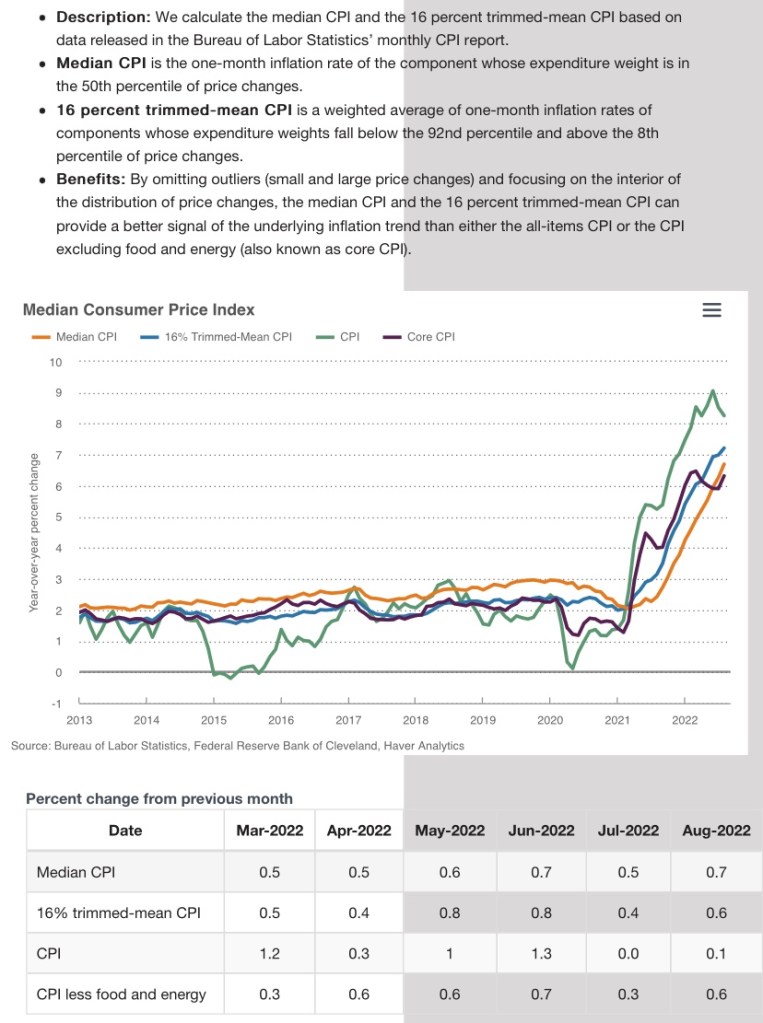
Overall CPI growth stopped accelerating after June, and it wasn’t just moderation in oil prices that held it back (and that moderation might soon reverse). Growth of the Core CPI, which excludes food and energy prices, stopped accelerating a bit earlier, but growth in the CPI and the Core CPI are still running above 8% and 6%, respectively. More worrisome is the continued upward trend in more central measures of CPI growth. Growth in the median component of the CPI continues to accelerate, as has the so-called “Trimmed CPI”, which excludes the most extreme sets of high and low growth components. The response of those central measures lagged behind the overall CPI, but it means there is still inflationary momentum in the economy. There is a substantial risk that expectations of a more permanent inflation are becoming embedded in expectations, and therefore in price and wage setting, including long-term contracts.

The Fed pays more attention to a measure of prices called the Personal Consumption Expenditures (PCE) deflator. Unlike the CPI, the PCE deflator accounts for changes in the composition of a typical “basket” of goods and services. In particular, the Fed focuses most closely on the Core PCE deflator, which excludes food and energy prices. Inflation in the PCE deflator is lower than the CPI, in large part because consumers actively substitute away from products with larger price increases. However, the recent story is similar for these two indices:
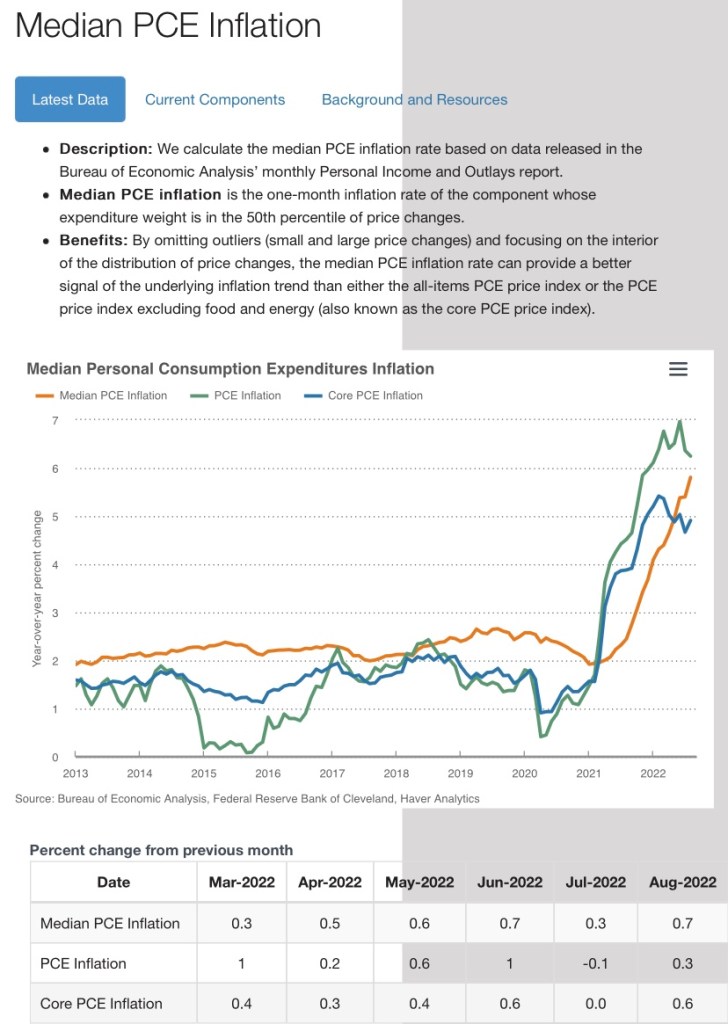
Both overall PCE inflation and Core PCE inflation stopped accelerating a few months ago, but growth in the median PCE component has continued to increase. This central measure of inflation still has upward momentum. Again, this raises the prospect that inflationary forces remain strong, and that higher and more widespread expected inflation might make the trend more difficult for the Fed to rein in.

That leaves the Fed little choice if it hopes to bring inflation back down to its target level. It’s really a only a choice of whether to do it faster or slower. One big qualification is that the Fed can’t do much about supply shortfalls, which have been a source of price pressure since the start of the rebound from the pandemic. However, demand pressures have been present since the acceleration in price growth began in earnest in early 2021. At this point, it appears that they are driving the larger part of inflation.

The following chart shows share decompositions for growth in both the “headline” PCE deflator and the Core PCE deflator. Actual inflation rates are NOT shown in these charts. Focus only on the bolder colored bars. (The lighter bars represent estimates having less precision.) Red represents “supply-side” factors contributing to changes in the PCE deflator, while blue summarizes “demand-side” factors. This division is based on a number of assumptions (methodological source at the link), but there is no question that demand has contributed strongly to price pressures. At least that gives a sense about how much of the inflation can be addressed by actions the Fed might take.
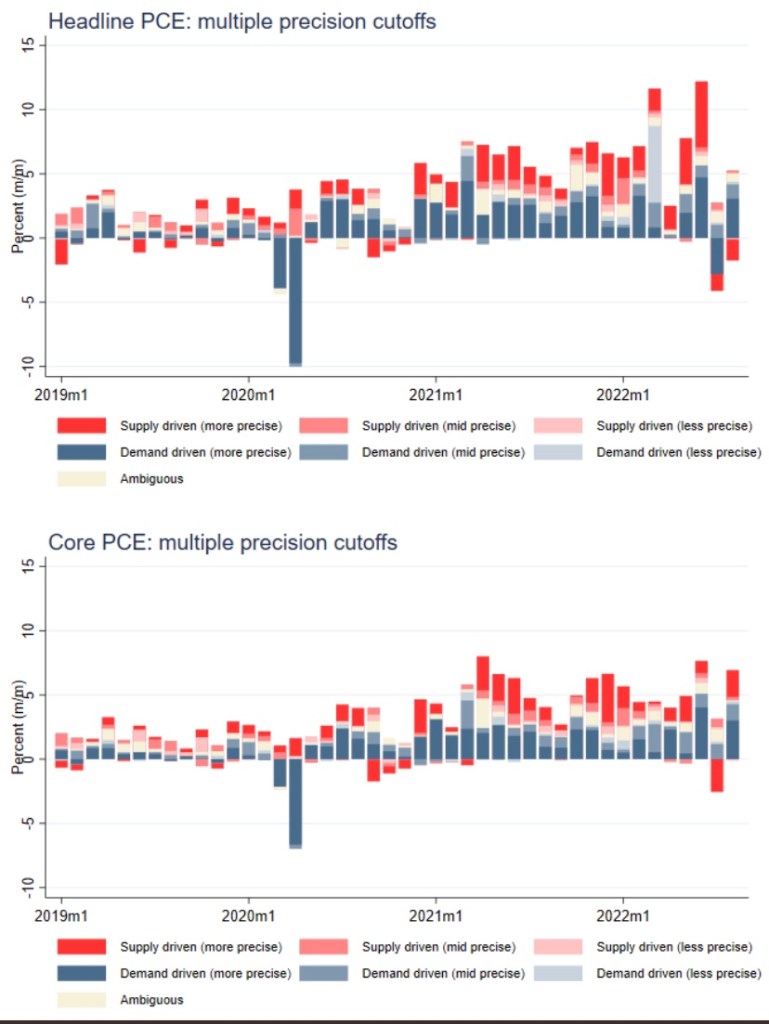
I mentioned the role of expectations in laying the groundwork for more permanent inflation. Expected inflation not only becomes embedded in pricing decisions: it also leads to accelerated buying. So expectations of inflation become a self-fulfilling prophesy that manifests on both the supply side and the demand-side. Firms are planning to raise prices in 2023 because input prices are expected to continue rising. In terms of the charts above, however, I suspect this phenomenon is likely to appear in the “ambiguous” category, as it’s not clear that the counting method can discern the impacts of expectations.

What’s a Central Bank To Do?

Has the Fed become too hawkish as inflation accelerated this year while proving to be more persistent than expected? One way to look at that question is to ask whether real interest rates are still conducive to excessive rate-sensitive demand. With PCE inflation running at 6 – 7% and Treasury yields below 4%, real returns are still negative. That’s hardly seems like a prescription for taming inflation, or “hawkish”. Rate increases, however, are not the most reliable guide to the tenor of monetary policy. As both John Cochrane and Scott Sumner point out, interest rate increases are NOT always accompanied by slower money growth or slowing inflation!

However, Cochrane has demonstrated elsewhere that it’s possible the Fed was on the right track with its earlier dovish response, and that price pressures might abate without aggressive action. I’m skeptical to say the least, and continuing fiscal profligacy won’t help in that regard.

The Policy Instrument That Matters

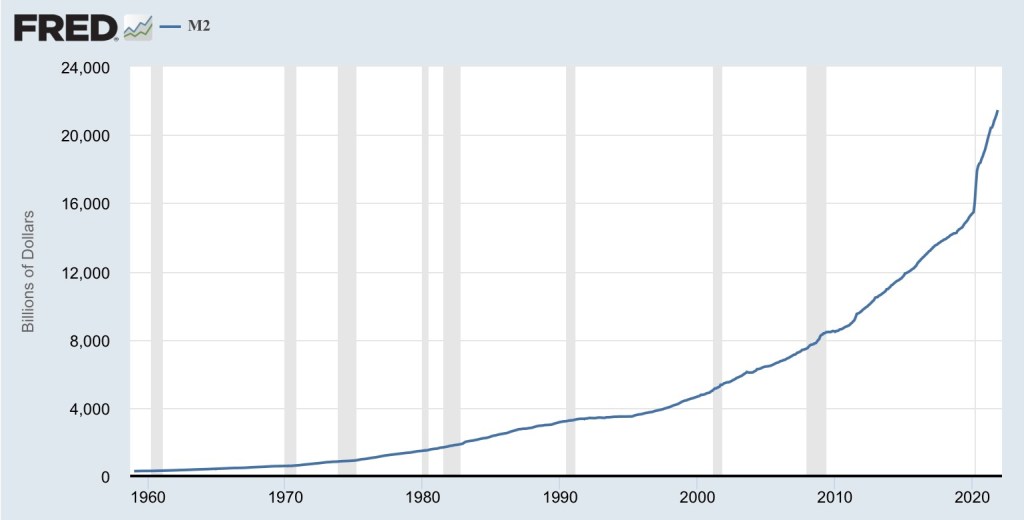
Ultimately, the best indicator that policy has tightened is the dramatic slowdown (and declines) in the growth of the monetary aggregates. The three charts below show five years of year-over-year growth in two monetary measures: the monetary base (bank reserves plus currency in circulation), and M2 (checking, saving, money market accounts plus currency).
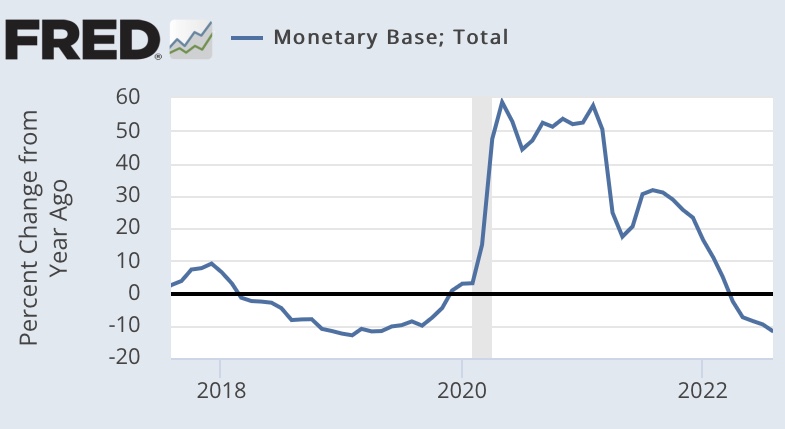
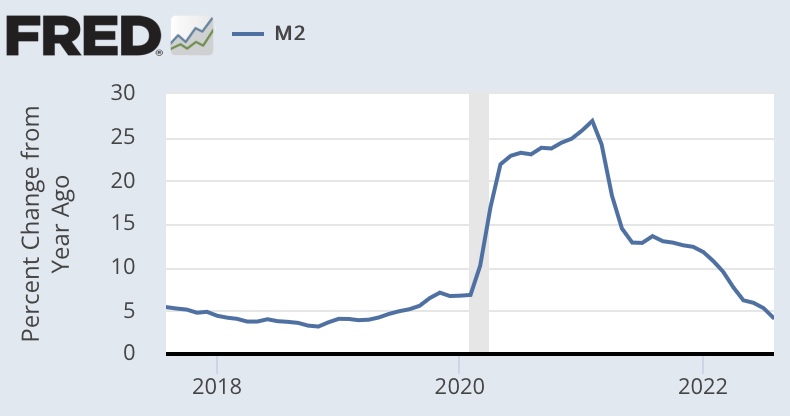
Growth of these aggregates slowed sharply in 2021 after the Fed’s aggressive moves to ease liquidity during the first year of the pandemic. The monetary base and M2 growth have slowed much more in 2022 as the realization took hold that inflation was not transitory, as had been hoped. Changes in the growth of the money stock takes time to influence economic activity and inflation, but perhaps the effects have already begun, or probably will in earnest during the first half of 2023.

The Protuberant Balance Sheet

Since June, the Fed has also taken steps to reduce the size of its bloated balance sheet. In other words, it is allowing its large holdings of U.S. Treasuries and Agency Mortgage-Backed Securities to shrink. These securities were acquired during rounds of so-called quantitative easing (QE), which were a major contributor to the money growth in 2020 that left us where we are today. The securities holdings were about $8.5 trillion in May and now stand at roughly $8.2 trillion. Allowing the portfolio to run-off reduces bank reserves and liquidity. The process was accelerated in September, but there is increasing tension among analysts that this quantitative tightening will cause disruptions in financial markets and ultimately the real economy, There is no question that reducing the size of the balance sheet is contractionary, but that is another necessary step toward reducing the rate of inflation.

The Federal Spigot

The federal government is not making the Fed’s job any easier. The energy shortages now afflicting markets are largely the fault of misguided federal policy restricting supplies, with an assist from Russian aggression. Importantly, however, heavy borrowing by the U.S. Treasury continues with no end in sight. This puts even more pressure on financial markets, especially when such ongoing profligacy leaves little question that the debt won’t ever be repaid out of future budget surpluses. The only way the government’s long-term budget constraint can be preserved is if the real value of that debt is bid downward. That’s where the so-called inflation tax comes in, and however implicit, it is indeed a tax on the public.

Don’t Dismiss the Real Costs of Inflation

Inflation is a costly process, especially when it erodes real wages. It takes its greatest toll on the poor. It penalizes holders of nominal assets, like cash, savings accounts, and non-indexed debt. It creates a high degree of uncertainty in interpreting price signals, which ordinarily carry information to which resource flows respond. That means it confounds the efficient allocation of resources, costing all of us in our roles as consumers and producers. The longer it continues, the more it erodes our economy’s ability to enhance well being, not to mention the instability it creates in the political environment.

Imminent Recession?

So far there are only limited signs of a recession. Granted, real GDP declined in both the first and second quarters of this year, but many reject that standard as overly broad for calling a recession. Moreover, consumer spending held up fairly well. Employment statistics have remained solid, though we’ll get an update on those this Friday. Nevertheless, payroll gains have held up and the unemployment rate edged up to a still-low 3.7% in August.

Those are backward-looking signs, however. The financial markets have been signaling recession via the inverted yield curve, which is a pretty reliable guide. The weak stock market has taken a bite out of wealth, which is likely to mean weaker demand for goods. In addition to energy-supply shocks, the strong dollar makes many internationally-traded commodities very costly overseas, which places the global economy at risk. Moreover, consumers have run-down their savings to some extent, corporate earnings estimates have been trimmed, and the housing market has weakened considerably with higher mortgage rates. Another recent sign of weakness was a soft report on manufacturing growth in September.

Deliver the Medicine

The Fed must remain on course. At least it has pretensions of regaining credibility for its inflation targeting regime, and ultimately it must act in a symmetric way when inflation overshoots its target, and it has. It’s not clear how far the Fed will have to go to squeeze demand-side inflation down to a modest level. It should also be noted that as long as supply-side pressures remain, it might be impossible for the Fed to engineer a reduction of inflation to as low as its 2% target. Therefore, it must always bear supply factors in mind to avoid over-contraction.

As to raising the short-term interest rates the Fed controls, we can hope we’re well beyond the halfway point. Reductions in the Fed’s balance sheet will continue in an effort to tighten liquidity and to provide more long-term flexibility in conducting operations, and until bank reserves threaten to fall below the Fed’s so-called “ample reserves” criterion, which is intended to give banks the wherewithal to absorb small shocks. Signs that inflationary pressures are abating is a minimum requirement for laying off the brakes. Clear signs of recession would also lead to more gradual moves or possibly a reversal. But again, demand-side inflation is not likely to ease very much without at least a mild recession.

Price Controls: Political Gut Reaction, Gut Punch To Public

06 Thursday Jan 2022

Posted by Nuetzel in Price Controls, Shortage

≈ 1 Comment

Tags

Artificial Tradeoffs, Big Meat, Big Oil, Black Markets, central planning, Excess Demand, Federal Reserve, Inflation, Isabella Weber, Joe Biden, Money Supply, Paul Krugman, Price Controls, Relative Prices, Scientism, Shortage, Unintended Consequences

In a gross failure of education or perhaps memory, politicians, policymakers, and certain academics seem blithely ignorant of things we’ve learned repeatedly. And of all the dumb ideas floated regarding our current bout with inflation, the notion of invoking price controls is near the top. But watch out, because the Biden Administration has already shifted from “inflation is transitory” to “it only hurts the rich” to “it’s fine because people just want to buy things”, and now “greedy businessmen are the culprits”. The latter falsehood is indeed the rationale for price controls put forward by a very confused economist at the University of Massachusetts-Amherst named Isabella Weber. (See this for an excerpt and a few immediate reactions.) She makes me grieve for my profession… even the frequently ditzy Paul Krugman called her out, though he softened his words after realizing he might have offended some of his partisan allies. Of course, the idea of price controls is just bad enough to gain favor with the lefty goofballs pulling Biden’s strings.

To understand the inflation process, it’s helpful to distinguish between two different dynamics:

1. When prices change we usually look for explanations in supply and demand conditions. We have supply constraints across a range of markets at the moment. There’s also a great deal to say about the ways in which government policy is hampering supplies of labor and energy, which are key inputs for just about everything. It’s fair to note here that, rather than price controls, we just might do better to ask government to get out of the way! In addition, however, consumer demand rebounded as the pandemic waned and waxed, and the federal government has been spending hand over fist, with generous distributions of cash with no strings attached. Thus, supply shortfalls and strong demand have combined to create price pressures across many markets.

2. Economy-wide, all dollar prices cannot rise continuously without an excess supply of a monetary asset. The Federal Reserve has discussed tapering its bond purchases in 2022 and its intention to raise overnight interest rates starting in the spring. It’s about time! The U.S. money supply ballooned during 2020 and its growth remains at a gallop. This has enabled the inflation we are experiencing today, and only recently have the markets begun to react as if the Fed means business.

Weber, our would-be price controller, exhibits a marked ignorance with respect to both aspects of price pressure: how markets work in the first instance, and how monetary profligacy lies at the root of broader inflation. Instead, she insists that prices are rising today because industrialists have simply decided to extract more profit! Poof! It’s as simple as that! Well what was holding those greedy bastards back all this time?

Everyone competes for scarce resources, so prices are bid upward when supplies are short, inputs more costly, or demand is outpacing supply for other reasons. Sure, sellers may earn a greater margin on sales under these circumstances. But the higher price accomplishes two important social objectives: efficient rationing of available quantities, and greater incentives to bring additional supplies to market.

So consider the outcome when government takes the advice of a Weber: producers are prohibited from adjusting price in response to excess demand. Shortages develop. Consumers might want more, but that’s either impossible or it simply costs more. Yet producers are prohibited from pricing commensurate with that cost. Other adjustments soon follow, such as changes in discounts, seller credit arrangements, and product quality. Furthermore, absent price adjustment, transaction costs become much more significant. Other resources are consumed in the mere process of allocating available quantities: time spent in queues, administering quotas, lotteries or other schemes, costly barter, and ultimately unsatisfied needs and wants, not to mention lots of anger and frustration. Lest anyone think this process is “fair”, keep in mind that it’s natural for these allocations to take a character that is worse than arbitrary. “Important people” will always have an advantage under these circumstances.

Regulatory and financial burdens are imposed on those who play by the rules, but not everyone does. Black market mechanisms come into play, including opportunities for illegal side payments, rewards for underworld activity, along with a general degradation in the rule of law.

Price controls also impose rigidity in relative prices that can be very costly for society. “Freezing” the value of one good in terms of others distorts the signals upon which efficient resource allocation depends. Tastes, circumstances, and production technology change, and flexible relative prices enable a smoother transitions between these states. And even while demand and/or input scarcity might increase in all markets, these dynamics are never uniform. Over time, imbalances always become much larger in some markets than others. Frozen relative prices allow these imbalances to persist.

For example, the true value of good A at the imposition of price controls might be two units of good B. Over time, the true value of A might grow to four units of good B, but the government insists that A must be traded for no more than the original two units of B. Good B thus becomes overvalued on account of government intervention. The market for good A, which should attract disproportionate investment and jobs, will instead languish under a freeze of relative prices. Good B will continue to absorb resources under the artificial tradeoff imposed by price controls. Society must then sacrifice the gains otherwise afforded by market dynamism.

The history of price controls is dismal (also see here). They artificially suppress measured inflation and impose great efficiency costs on the public. Meanwhile, price controls fail to address the underlying monetary excess.

Price controls are destructive when applied economy-wide, but also when governments attempt to apply them to markets selectively. Posturing about “strategic” use of price controls reveals the naïveté of those who believe government planners can resolve market dislocations better than market participants themselves. Indeed, the planners would do better to discover, and undo, the damage caused by so many ongoing regulatory interventions.

So beware Joe Biden’s bluster about “greedy producers” in certain markets, whether they be in “Big Meat”, or “Big Oil”. Price interventions in these markets are sure to bring you less meat, less oil, and quite possibly less of everything else. The unintended consequences of such government interventions aren’t difficult to foresee unless one is blinded with the scientism of central planning.

Inflation: The Leftist “Tax the Poor” Policy

23 Thursday Sep 2021

Posted by Nuetzel in Deficits, Inflation, Redistribution

≈ 2 Comments

Tags

Asymmetric Information, Bank of International Settlements, Biden Administration, budget deficits, Budget Reconcilation Bill, Claudio Bario, Confiscation, dependency, Federal Reserve, Fixed-Rate Debt, Inflation, infrastructure, Joe Biden, John Maynard Keynes, MMT, Moderm Monetary Theory, Money Illusion, Money Printing, Noah Smith, Patrick Horan, Redistribution, Regressive Tax, Scott Sumner, Social Infrastructure, Unexpected Inflation

Recent years have seen explosive growth in federal deficits along with growth rates in the money supply that would have made John Maynard Keynes blush. It’s no coincidence that a new school of thought has developed among certain “monetary economists”. But as someone trained in monetary economics, I wish I could make those quote marks larger. This new school of thought is known as Modern Monetary Theory (MMT), and it asserts that the money spigot is a perfectly legitimate means of financing government spending and, furthermore, that it is not necessarily inflationary. Here is how Scott Sumner and Patrick Horan describe MMT:

“A central idea of MMT is that a government that issues its own fiat currency can pay its bills in that same currency. These governments need not worry about budget deficits when contemplating additional spending. Thus because the US government has a monopoly on money creation, our federal government does not need to raise all its revenue through tax or bond finance. A government with its own currency cannot go bankrupt because it can always issue more currency to cover any budget deficit. … MMT advocates argue that this why the US government can afford expensive programs such as a jobs guarantee and universal healthcare.”

Spend and Print

Joe Biden’s $3.5 trillion “social infrastructure” package would be just a start, but that’s likely to be more like $5.5T once the budget gimmicks are stripped out. We can be somewhat hopeful, because that initiative looks increasingly likely to fail in Congress, at least this time around. But the tax side of that bill was already $2.6T short of the latter spending figure, and the tax provisions keep shrinking. Now, it’s looking more like a shortfall of $3.5T would require financing. Moderate Democrats may not support this crazy bill in the end, but Dems from deep blue states want to reinstate state and local tax deductibility, which would cut the tax component still more. Well who cares? Print the money, say the brave MMT advocates.

Sumner gets to the heart of the problem in this piece. Progressives, with false assurance from MMT, want loose monetary policy to make their expansive programs “affordable”. As he explains, if this happens while the economy is near its production potential, inflation is a sure thing. These lessons were learned long ago, but have been conveniently forgotten by the political class (or they simply prefer to ignore them), instead jumping onto the MMT bandwagon.

Inflation Is Taxation

No conscientious observer of government finance should ever forget that inflation is a form of taxation. Assets whose values are either fixed or subject to some inertia are devalued by inflation in terms of purchasing power, or in real terms, as economists put it. Strictly speaking, this is true when inflation is unexpected… if it is expected, then lenders and borrowers can negotiate terms that will compensate for these changes in real value. But when inflation is unexpected, the losses to lenders are offset by gains to borrowers. Of course the federal government is a gigantic borrower, so inflation can represent a confiscation of wealth from the public.

It’s not small potatoes. Currently, about $22T of U.S. Treasury debt is held by the public, and its average maturity is more than 5 years. If the Federal Reserve engineers an unexpected 1% jump in the rate of inflation, it shaves over $1T off the real value of that debt before it’s repaid, and it reduces the real interest cost of that debt as well. Of course, the holders of that debt will suffer an immediate loss if they are forced to sell prior to maturity for any reason, since new buyers will be demanding higher yields to compensate for higher inflation if it is expected to persist.

The Poor Losers

Inflation causes redistributions to take place, especially when it is unexpected inflation. We’ve already discussed lenders and borrowers, but similar considerations apply to anyone entering into fixed price contracts for goods or labor. Here’s what Claudio Bario of the Bank of International Settlements (BIS) has to say about these shifts:

“Inflation shifts income and wealth away from those who are least aware of it, or least able to protect against it. These segments of the population often coincide with lower-income groups, which explains why inflation has often been portrayed as a most regressive form of tax. The ‘inflation tax’ takes its toll through the erosion of the value of financial assets and contracts fixed in nominal terms.”

Inflation is a regressive tax! In this respect, economist Noah Smith echos Bario in a recent op-ed in which he discusses “money illusion”, or the confusion of real and nominal income:

“Workers … who are slow to perceive the rise in prices they pay for goods like cars and groceries, won’t realize this, and will be happy with their unusually large raises. But companies, whose accountants and managers certainly know the true inflation rate, will also be happy, because they know they’re not actually paying more for labor.

That information asymmetry between workers and employers may be exactly what keeps wages from rising faster than inflation. If workers take a year to realize how much prices have gone up, they may be satisfied with the raises they got during the time of high inflation — even if that inflation ultimately turns out to be transitory. By then, it might be too late to negotiate for a real, inflation-adjusted raise.”

Inflation taxes and redistributions become more acute at higher rates of inflation, but any unexpected escalation in the rate of inflation will take a toll on the poor. Bario elaborates on the mechanisms by which inflation inflicts budgetary pain on the those at the lower end of the socioeconomic spectrum.

“As regards wealth distribution, the financial assets that are most vulnerable to inflation are cash and bank accounts – the typical savings vehicles held by the poorest segments of the population. This is mostly because the poorest have access only to limited investment options to protect their savings. …

… wages and pensions – the main sources of income for a large majority of households and even more so for the poorest half of the population – are typically fixed in nominal terms and hence vulnerable to inflation. Indexation mechanisms, such as those adopted in many [advanced economies] in the 1970s, are no panacea: they may fail to keep pace as inflation accelerates; …”

In addition to the inflationary gains reaped by government, it’s clear that inflation gives rise to redistributions between private parties: generally from those with lower incomes and wealth to their employers, producers, financial institutions, and pension payers (businesses, state and local governments). An exception is some low income debtors might benefit if they owe long term obligations at fixed interest rates, but low income individuals are often constrained from obtaining this form of credit.

Causing, Then Exploiting, Inequality

Another especially galling aspect of the Left’s focus on money finance is how its consequences fly in the face of their concerns about income and wealth inequality. Inflation is typically manifested in rising equity prices: nominal stock values tend to escalate in an inflationary environment, protecting their owners from losses to the real value of their investments. Stocks are generally a good inflation hedge. Yet we know that stocks are disproportionately owned by those in the highest strata of the income and wealth distributions. Later, of course, the Left will seek to level the burgeoning inequality wrought by their own policies by “taxing the rich”! Apparently, for the Left, consistency is never considered a virtue. This is not unlike another trick, which is to blame “greedy corporations” for the inflation wrought by Leftist policies.

It’s a great irony that the Left, which purports to support the poor and working people, would propose a form of government finance that is so regressive in its effects. To be generous, perhaps it’s just another case of “progressives” unknowingly hurting the ones they love. The expansive programs they advocate will confer government benefits to many individuals in higher income brackets, not just the poor, but those government alms will help to compensate for higher inflation. But this too takes advantage of money illusion, because those benefits might well buy progressives the loyalty of beneficiaries unable to recognize the ongoing erosion in their standard of living, and who are unwilling to come to grips with their increasing dependency.

But Tut, Tut, They Say

Advocates of MMT, in combination with expansive government, also have a tendency to deny that inflation has ever been a consequence of such policies. As Sumner points out, they have forgotten historical episodes that run contrary to the theory, and most “popular” advocates of MMT fail to recognize the important role played by limits on the economy’s production potential. When money growth outruns the economy’s ability to produce real goods and services, the prices of goods will rise.

Inflation Doomsayers and Downplayers

25 Friday Jun 2021

Posted by Nuetzel in Inflation, Monetary Policy

≈ 2 Comments

Tags

Consumer Price Index, Core CPI, Cryptocurrencies, Deficits, Energy Policy, Federal Reserve, Financial Velocity, Fisher Effect, Helicopter Money, Housing Costs, Import Prices, Inflation, Inflation Premium, Irving Fisher, M1, Median CPI, Monetary policy, Monetization, Shrinkflation, Trading Volume, Trimmed CPI, Velocity of Money

There’s a big disconnect between recent news about escalating inflation and market expectations of inflation. In fact, there’s a big disconnect between market expectations and what we’re hearing from some conservative economists. The latter are predicting more inflation based on the recent spurt in prices and the expansionary policy of the Federal Reserve. Can these disparate views be reconciled?

Market Predictions

Market interest rates are considered pretty good predictors of inflation, at least relative to surveys and macroeconomic models. That’s because a fixed interest return is eroded by inflation, and fixed income investors will bid up interest rates to incorporate a premium to compensate for perceptions of increased inflation risk. This is known as the Fisher Effect, after the economist Irving Fisher. In fact, investors should bid rates up more than one-for-one with expected inflation, because the inflation premium will be taxed. A higher return must compensate for both higher expected inflation and taxes on the increased inflation premium.

After rising by about 1.2% from last summer through mid-March, interest rates on Treasury notes have declined slightly. The earlier run-up anticipated a strengthening economy, but if the increase was due to higher expected inflation, we could say it represented an added premium of about 1%, and that’s roughly in-line with changes in some other market-based gauges of expected inflation (ignoring pandemic lows).

Recent Inflation News

Meanwhile, measured inflation certainly has increased in 2021. I say “measured” because 1) “true” price changes are measured imperfectly, and 2) there is a difference between real inflation, which is a continuing process, and month-to-month changes in prices. Here, we’re really talking about the latter and hoping it doesn’t turn into a bad case of the former!

The green line in the chart below is the percent change in the consumer price index (CPI) from a year earlier. After declining during the pandemic, it rebounded sharply this year to almost 5% in May. The purple line is the increase in the CPI excluding food and energy prices, otherwise known as the “core” CPI. The jumps shown in the chart are well in excess of the market’s assessment of inflation trends.  

Both versions of the CPI have jumped in the past few months, but it turns out that durable goods like washing machines, TVs, and (probably) Pelotons have jumped the most sharply. Most of the weakness in prices during the pandemic was in non-durable goods, which stands to reason because so many activities away from home were curtailed. Also noteworthy about these price movements: when measured over a span of two years, prices excluding food and energy have risen at an annualized rate of only 2.6%. 

There are two other lines in the chart above that demonstrate much less alarming changes in prices: the orange line is so-called “median” inflation, which is the price change in the median component of the CPI. That is, half of all price components included in the CPI rose faster and half rose slower than the median. It has barely accelerated this year and stood at only about 2.1% higher in May than a year earlier. The blue line is the so-called “trimmed” CPI, or the average price change of the middle 84% of all CPI components. While it has accelerated in 2021, the year-over-year increase was only 2.6% in May. 

Thus, the breadth of the jump in prices was limited. The Federal Reserve and a lot of market participants insist that the uptick is narrow and temporary — a transitional phenomenon related to the sluggish recovery of supplies in the post-pandemic environment.

But again, the accuracy of price measures is always in question. For example, the housing cost component of the CPI was up only 2.2% in May from a year ago, but it is calibrated to actual survey data only twice a year, the survey is a weak data source, and we know home prices and rents have risen aggressively. Quality and quantity adjustments are always in question as well. An old approach for businesses dealing with rising costs is to reduce package size, which has been called “shrinkflation”. It seems to be back in vogue.

Inflation Drivers

It’s not yet clear how much wage pressure is occurring now. The economy-wide average hourly earnings data has been distorted over the past 15 months by the changing mix of employment, first shifting toward greater concentration in high-wage (work-at-home) occupations and now shifting back toward lower-wage jobs as the economy reopens. But we know many employers are facing a labor shortage, due in large part to extended unemployment benefits and other pandemic-related aid, so this puts upward pressure on wages. In 2021, minimum wage rates are undergoing substantial increases in 17 states, and a number of large employers such as Amazon have increased their minimum pay rates. That creates competitive pressure for smaller employers to boost pay as well.

The fundamental cause of an “honest-to-goodness” inflation is “too much money chasing too few goods”. The Federal Reserve has certainly given us enough to worry about in that regard. The basic money stock (M1) increased by four-fold in the late winter and early spring of 2020, just as the pandemic was spreading. Today, it is almost five times greater than in early 2020, so growth in the money stock remains quite fast even as the recovery proceeds. No wonder: the U.S. Treasury is issuing about $1 trillion of new debt every four-to-six weeks, and the Fed is essentially monetizing these deficits by purchasing a huge chunk of that debt.

That’s a lot of “helicopter” money… new money! But are there too few goods for it to chase? Or is it really chasing anything? Is it just sitting idle? First, GDP is likely to exceed its pre-pandemic level in the second quarter, despite the fact that private payrolls are still down by about 7 million employees. Of course, that doesn’t eliminate the ostensible imbalance between money and goods, and one might expect a veritable explosion in price inflation under these circumstances.

So far that seems unlikely. The so-called velocity of money (its rate of turnover) has plunged since the start of the pandemic, with no discernible rebound through the first quarter of 2021. That means a lot of the cash is not being used in transactions for real goods, but financial transaction volume has been quite strong in 2020-21. Daily stock trading volume was up by more than 50% in 2020 from 2019, and in the first quarter of 2021 it stood another 34% higher than the 2020 average (though volume tapered in April). This is to say nothing of the increased frenzy in cryptocurrency trading. So, while some money is turning over, the expansion of the money stock remains daunting and pressure might well spill-over into goods prices.

Caution Is a Virtue

So long as the Fed keeps printing money, and assuring investors that it will keep printing money, the equity markets are likely to remain strong. There are mixed signals coming from Fed officials, but the over-riding message is that the recent uptick in prices is largely temporary and limited in scope. That is, they assert that certain prices are being squeezed temporarily by rebounding demand for goods while suppliers play catch-up. 

Market expectations of inflation seem to agree with that view, but I have strong trepidations. There are cash reserves held in the private sector to support more aggressive spending. Large companies, consumers, and banks are still holding significant amounts of cash. The Biden Administration is doing its best to spend hand-over-fist. This administration’s energy policy is causing fuel bills to escalate. Home prices and rents are strong. The dollar is down somewhat from pre-pandemic levels, which increases import prices. Finally, the Fed is reluctant to reverse the huge increase in the money supply it engineered during the pandemic. If the recent surge in prices continues, and if higher inflation embeds itself into expectations, it will be all the more difficult for the Fed to correct. 

The market and the Fed might be correct in predicting that the spike in measured inflation is temporary. The recent data show that these worrisome price trends have not been broad. Just the same, I don’t want to hold fixed income investments right now: if higher expectations of inflation cause market interest rates to rise, the value of those assets will fall. Stock values should generally keep pace with inflation barring stronger signals of tightening by the Fed. Unfortunately, however, many would suffer in an inflationary environment as wages, fixed assets, and benefits are devalued by rising prices.

Fiat Money, Government and Culture

24 Wednesday Aug 2016

Posted by Nuetzel in Monetary Policy

≈ Leave a comment

Tags

Asset Price Inflation, Commercial Culture, Crony Culturalism, Debt Monetization, Distribution of Wealth, Federal Reserve Act, Fiat Money, Full Faith and Credit, Gresham's Law, Inflation, Jörg Guido Hülsmann, Mises Wire, Redeemability, Tyler Cowan

Partytime

The money we use every day has roughly zero intrinsic value. That includes paper, coins made from base metals, and electronic bookkeeping entries that can be drawn on via plastic cards and communication devices. We take it for granted that all of these forms of payment will be accepted in transactions. The dollars we use in the U.S. are backed only by the “full faith and credit” of the U.S. government, which is quite a bit of nothing when it comes right down to it. This form of money is called “fiat money” because it derives value essentially by decree, including the government’s willingness to accept your dollars in payment of taxes. It’s a fine thing that such a level of trust exists in society, and most important is trust that the next seller will accept your dollars in trade.

An old maxim in economics known as Gresham’s Law holds that “bad money drives out good”, particularly when the “good money” and the “bad money” are assigned the same legal value in exchange. The good money, having greater intrinsic value than the bad money, will quickly disappear from use as a medium of exchange. Like any asset, the good money will be held as a store of value, but not used in routine transactions.

In the past, our “good money” consisted mainly of claims on precious metals. However, the U.S. government stopped redeeming dollars in gold in the 1930s, silver in the 1960s, and silver coins stopped circulating at about the same time.

What’s so “bad” about fiat money, given that we trust its usefulness in the next transaction? The lack of intrinsic value places its issuing authority, the Federal Reserve in our case, in a position of tremendous power and responsibility as the keeper of the “full faith” of the U.S. government. However, the Fed is privately owned (by banks), and no one at the Fed is elected. The members of its Board of Governors are appointed by the President to 14-year terms. The lengthy terms are hoped to keep the Fed independent and immune to political manipulation. Ostensibly, the Fed conducts policy in the objective pursuit of price stability and full employment. (Never mind that the two goals may be incompatible.)

The Fed, as the authority responsible for the nation’s fiat money, has traditionally allowed the money supply to grow by issuing “new money” in exchange for federal debt obligations, like Treasury bonds. The Fed buys the bonds, and the payment becomes a seed for new money growth. For the Treasury, which raises funds to finance government activities by collecting taxes and borrowing, this mechanism is quite convenient. The Fed can act to “accommodate” the government’s needs, essentially printing money to fund deficits.

Does it happen? Absolutely, although in the past few years, the Fed has demonstrated a more subtle variation on this theme, and one that is cheaper for the government. That will be the subject of a future post. The key point here is that with the cooperation of the monetary authority, the government avails itself of the so-called printing press. Thus, it is not answerable to taxpayers for any expansion in its spending. The government can commandeer resources as it sees fit, with no restraint from the governed.

That’s the key point made by Jörg Guido Hülsmann in a post on the Mises Wire blog, “How Fiat Money Destroys Culture“. On that note, I’d say first that enabling the displacement of private commerce for government-directed activity is a sure-fire prescription for degrading the culture. Government is not and never will be a font of creativity. Capitalism and markets, on the other hand, deliver an astonishing degree of cultural wealth to every segment of society. The freedom to create and share art, cuisine, customs and technology, without interference by government, is the very essence of culture. Some might object that government often serves as a conduit for bringing cultural works to the public, and that government can and does direct resources to the arts. There is an extent to which that’s true, of course, but it may be a deal with the devil: public sector support for new art is often subject to strings, politicization, and favoritism. That’s crony culturalism, to coin a phrase.

Hülsmann discusses other cultural repercussions of fiat money. By enabling the government to compete for resources with the private sector, and by swelling the quantity of money relative to goods and assets, fiat money puts upward pressure on prices. This might manifest in the prices of goods, the prices of assets, or both, and it might be very uneven. This changes the distribution of rewards in society in fundamental ways.

Price inflation penalizes those who hold currency. Hülsmann says:

“In a free economy with a natural monetary system, there is a strong incentive to save money in the form of cash held under one’s immediate control. Investments in savings accounts or other relatively safe investments also play a certain role, but cash hoarding is paramount, especially among low-income families. … By contrast, when there is constant price inflation, as in a fiat-money system, cash hoarding becomes suicidal.“

Price inflation also rewards those in debt. Strictly speaking, this is true only when inflation accelerates unexpectedly, since lenders tend to demand sufficient interest to offset expected inflation. Hülsmann blames the widespread growth of debt financing in modern society on fiat currency. There is an element of truth to this assertion, but it strikes me as an exaggeration, given the advances in financial markets and technologies over the past century or so. We are much better at allocating resources inter-temporally than in 1900, for example, so the growth of consumer and business debt over the years should be viewed in the context of future earning power and enabling technology. Still, there are those for whom these markets and technologies are out of reach, and the destructive effect of inflation on their ability to save should not be minimized. This contributes to greater dependency at the lowest levels of the socioeconomic spectrum, a very regrettable kind of cultural change.

Growth of the money stock tends to reward many at the top of the socioeconomic spectrum, partly because it is associated with stock market appreciation. Again, when the Fed buys government bonds, or mortgage bonds, or any other asset, it always finds willing sellers, usually brokers/dealers and banks. Successful bidding by the Fed for assets is the first step in lifting asset prices (and reducing yields). But market participants tend to know all this in advance. Therefore, private traders will bid up asset prices in advance, assuming that the Fed has indicated its intentions. Other assets, being substitute vehicles for wealth accumulation, will also be bid upward, as a given amount of income produced by an asset is valued more highly when competing yields are low. After the Fed completes a round of asset purchases, the process can repeat itself.

Goods inflation and higher asset prices generated by continuing debt monetization and distorted interest rates tend to skew the distribution of wealth toward the top and away from the bottom. Moreover, if cost and pricing pressure build up in goods markets, those with the greatest market power always fare best. Thus, debt monetization has the potential to be a very inegalitarian process, and one not based on fundamental economic criteria such a productivity. This too represents a damaging form of cultural change.

A more accurate form of Gresham’s law might be the following: government ambition drives out “good money”. The existence of fiat money creates an avenue through which the expansion of government can be funded without approval by current or future taxpayers. This ultimately leads to a stagnant economic environment and a stagnant culture: government displaces private activity, the economy’s growth potential and vibrancy deteriorates, and society’s ability to support all forms of culture declines. To add insult to injury, the process of monetizing government debt punishes small savers and rewards the privileged. The distribution of cultural rewards will follow suit.

Busted Big Government

01 Monday Jun 2015

Posted by Nuetzel in National Debt

≈ Leave a comment

Tags

Alan Greenspan, bailouts, Contingent liabilities, Default, Disability Insurance Fund, entitlements, Inflation, Lawrence Lindsey, Medicare, Nicholas Ballasy, Social Security Trust Fund, Taxes

accounting or accountability

Alan Greenspan says we are “way underestimating” the U.S. national debt. His statements on this point make a great follow-up to last night’s post on bailouts. Here are a couple of recent Greeenspan quotes from an article by Nicholas Ballasy:

“Largely because we are not including what I would call contingent liabilities, that is the issue of, which is answered by a question: what is the probability that in today’s environment JP Morgan would be allowed to default? The answer is zero or less.”

Now, that means that whole balance sheet is a contingent liability. Now to be sure, while it’s contingent, there’s no interest payments but ultimately that overhangs the structure because we have committed in so many different ways to guarantee this, that and the other thing. It’s not only Fannie and Freddie but it’s a whole series of financial institutions and, regrettably, it is also non-financial institutions.”

The bailout barometer I mentioned last night is an eye-opener, but it reflects a very incomplete view of the contingent liabilities faced by the government. Ballasy discusses some massive unfunded liabilities associated with programs like Social Security, which has a trust fund that Greenspan calls “meaningless”:

“The Social Security and Medicare Trustees 2014 annual report said while legislation is needed to address all of Social Security’s financial imbalances, ‘the need has become most urgent with respect to the program’s disability insurance component. Lawmakers need to act soon to avoid automatic reductions in payments to DI beneficiaries in late 2016.’”

Lawrence Lindsey, an economic official in the Bush Administration, says the real national debt is closer to 300 percent of GDP when unfunded obligations for Social Security and Medicare are added. The fast-dissipating disability insurance fund was the subject of another post here two days ago. It is a case study in irresponsible governance. Here is Ballasy with another Greenspan quote:

“According to Greenspan, entitlement spending in the U.S. was 4.7 percent of GDP in 1967 compared to more than 14 percent today. ‘Had we kept it at that level, our productivity would be far higher today. The average wage would be very significantly higher, the standard of living would be higher and what we have to do is think about how we are going to shrink that pie back and, to me, that is the single most important problem that confronts this country,’ he said.“

Shrinking the ongoing flow of entitlements is a tall political order. Avoiding the contingencies that would add to existing obligations calls for economic policies that promote stability, rather than boom and bust cycles that follow misguided efforts to stimulate the economy. Still another matter is to deal with the obligations that already exist. Higher taxes, inflation and default do not represent attractive policy options, but our activist government has placed us squarely in that corner.

Newer posts →
Follow Sacred Cow Chips on WordPress.com

Recent Posts

  • The Case Against Interest On Reserves
  • Immigration and Merit As Fiscal Propositions
  • Tariff “Dividend” From An Indigent State
  • Almost Looks Like the Fed Has a 3% Inflation Target
  • Government Malpractice Breeds Health Care Havoc

Archives

  • January 2026
  • December 2025
  • November 2025
  • October 2025
  • September 2025
  • August 2025
  • July 2025
  • June 2025
  • May 2025
  • April 2025
  • March 2025
  • February 2025
  • January 2025
  • December 2024
  • November 2024
  • October 2024
  • September 2024
  • August 2024
  • July 2024
  • June 2024
  • May 2024
  • April 2024
  • March 2024
  • February 2024
  • January 2024
  • December 2023
  • November 2023
  • August 2023
  • July 2023
  • June 2023
  • May 2023
  • April 2023
  • March 2023
  • February 2023
  • January 2023
  • December 2022
  • November 2022
  • October 2022
  • September 2022
  • August 2022
  • July 2022
  • June 2022
  • May 2022
  • April 2022
  • March 2022
  • February 2022
  • January 2022
  • December 2021
  • November 2021
  • October 2021
  • September 2021
  • August 2021
  • July 2021
  • June 2021
  • May 2021
  • April 2021
  • March 2021
  • February 2021
  • January 2021
  • December 2020
  • November 2020
  • October 2020
  • September 2020
  • August 2020
  • July 2020
  • June 2020
  • May 2020
  • April 2020
  • March 2020
  • February 2020
  • January 2020
  • December 2019
  • November 2019
  • October 2019
  • September 2019
  • August 2019
  • July 2019
  • June 2019
  • May 2019
  • April 2019
  • March 2019
  • February 2019
  • January 2019
  • December 2018
  • November 2018
  • October 2018
  • September 2018
  • August 2018
  • July 2018
  • June 2018
  • May 2018
  • April 2018
  • March 2018
  • February 2018
  • January 2018
  • December 2017
  • November 2017
  • October 2017
  • September 2017
  • August 2017
  • July 2017
  • June 2017
  • May 2017
  • April 2017
  • March 2017
  • February 2017
  • January 2017
  • December 2016
  • November 2016
  • October 2016
  • September 2016
  • August 2016
  • July 2016
  • June 2016
  • May 2016
  • April 2016
  • March 2016
  • February 2016
  • January 2016
  • December 2015
  • November 2015
  • October 2015
  • September 2015
  • August 2015
  • July 2015
  • June 2015
  • May 2015
  • April 2015
  • March 2015
  • February 2015
  • January 2015
  • December 2014
  • November 2014
  • October 2014
  • September 2014
  • August 2014
  • July 2014
  • June 2014
  • May 2014
  • April 2014
  • March 2014

Blogs I Follow

  • Passive Income Kickstart
  • OnlyFinance.net
  • TLC Cholesterol
  • Nintil
  • kendunning.net
  • DCWhispers.com
  • Hoong-Wai in the UK
  • Marginal REVOLUTION
  • Stlouis
  • Watts Up With That?
  • Aussie Nationalist Blog
  • American Elephants
  • The View from Alexandria
  • The Gymnasium
  • A Force for Good
  • Notes On Liberty
  • troymo
  • SUNDAY BLOG Stephanie Sievers
  • Miss Lou Acquiring Lore
  • Your Well Wisher Program
  • Objectivism In Depth
  • RobotEnomics
  • Orderstatistic
  • Paradigm Library
  • Scattered Showers and Quicksand

Blog at WordPress.com.

Passive Income Kickstart

OnlyFinance.net

TLC Cholesterol

Nintil

To estimate, compare, distinguish, discuss, and trace to its principal sources everything

kendunning.net

The Future is Ours to Create

DCWhispers.com

Hoong-Wai in the UK

A Commonwealth immigrant's perspective on the UK's public arena.

Marginal REVOLUTION

Small Steps Toward A Much Better World

Stlouis

Watts Up With That?

The world's most viewed site on global warming and climate change

Aussie Nationalist Blog

Commentary from a Paleoconservative and Nationalist perspective

American Elephants

Defending Life, Liberty and the Pursuit of Happiness

The View from Alexandria

In advanced civilizations the period loosely called Alexandrian is usually associated with flexible morals, perfunctory religion, populist standards and cosmopolitan tastes, feminism, exotic cults, and the rapid turnover of high and low fads---in short, a falling away (which is all that decadence means) from the strictness of traditional rules, embodied in character and inforced from within. -- Jacques Barzun

The Gymnasium

A place for reason, politics, economics, and faith steeped in the classical liberal tradition

A Force for Good

How economics, morality, and markets combine

Notes On Liberty

Spontaneous thoughts on a humble creed

troymo

SUNDAY BLOG Stephanie Sievers

Escaping the everyday life with photographs from my travels

Miss Lou Acquiring Lore

Gallery of Life...

Your Well Wisher Program

Attempt to solve commonly known problems…

Objectivism In Depth

Exploring Ayn Rand's revolutionary philosophy.

RobotEnomics

(A)n (I)ntelligent Future

Orderstatistic

Economics, chess and anything else on my mind.

Paradigm Library

OODA Looping

Scattered Showers and Quicksand

Musings on science, investing, finance, economics, politics, and probably fly fishing.

  • Subscribe Subscribed
    • Sacred Cow Chips
    • Join 128 other subscribers
    • Already have a WordPress.com account? Log in now.
    • Sacred Cow Chips
    • Subscribe Subscribed
    • Sign up
    • Log in
    • Report this content
    • View site in Reader
    • Manage subscriptions
    • Collapse this bar
 

Loading Comments...